



Abstract
Objectives:
There is growing interest in engaging patients in healthcare research, which raises important questions about the factors that may promote such engagement. The purpose of this study was to examine the association between patient characteristics and three aspects of patient engagement in the medical research process: awareness, interest, and actual participation.
Methods:
Cross-sectional, bivariate analyses were employed using the 2014 Health Information National Trends Survey.
Results:
Analyses suggest modest levels of interest among respondents engaging as patient partners in the research process (37.7% of respondents), low level of awareness of what patient engagement in research was (15.3% of respondents), and a very low level of actual participation (2.7% of respondents). Respondents of higher socioeconomic status and with more positive patient attitudes regarding their health and healthcare were more likely to be interested in research. In comparison, relatively few patient characteristics were significantly associated with patient awareness and actual participation in research.
Conclusion:
Although it is promising that people are interested in being engaged in research, the results suggest that there is work to be done to raise awareness of these engagement opportunities. Likewise, the gap between awareness and participation highlights opportunities to identify why patients may be reluctant to participate even when they are aware of research opportunities.
Keywords
Introduction
Research has shown that there are a number of benefits to including the perspectives of patients in research studies, including lower participant attrition, more relevant research questions, and improved translation of research findings into practice. 1 Consequently, there is growing interest in more fully engaging patients in the research process.2,3 For example, the Patient-Centered Outcomes Research Institute requires all funded research projects to substantially include stakeholders in the research planning and implementation processes. 4 An emphasis on including patients in the research process raises important questions about the factors that may facilitate or impede such partnerships.
New contributions
The purpose of this study was to extend previous studies of patient engagement in research in several ways. First, the study adopts a more comprehensive definition of patient engagement in research by examining interest and involvement in the research process, as opposed to serving as a research subject. Second, the study considers patient health status and attitudes about their health and healthcare as factors associated with patient engagement in the research process, which builds on studies that have highlighted the importance of sociodemographic characteristics (e.g. race/ethnicity, income, education5,6). Findings from the study will provide insights into the types of patients who may be most likely to be partners in the research process and whether these factors function the same way across different aspects of engagement. Such insights are important for identifying ways to promote greater patient engagement in the research process and insuring that research reflects the interests and needs of the patients that it strives to serve.
Methods
Data source
The data were drawn from the 2014 Health Information National Trends Survey (HINTS), a nationally representative survey administered every few years by the National Cancer Institute since 2003. The HINTS target population is adults 18 years or older in the United States. The survey focuses on how people access and use health information. The survey was conducted via mail between August and November 2014, with a US$2 prepaid monetary incentive to encourage participation. The mailing protocol followed a modified Dillman et al. 7 approach with a total of four mailings: an initial mailing, a reminder postcard, and two follow-up mailings. The final sample consisted of 3677 respondents, for an overall household response rate of 34.4%.
Dependent variables
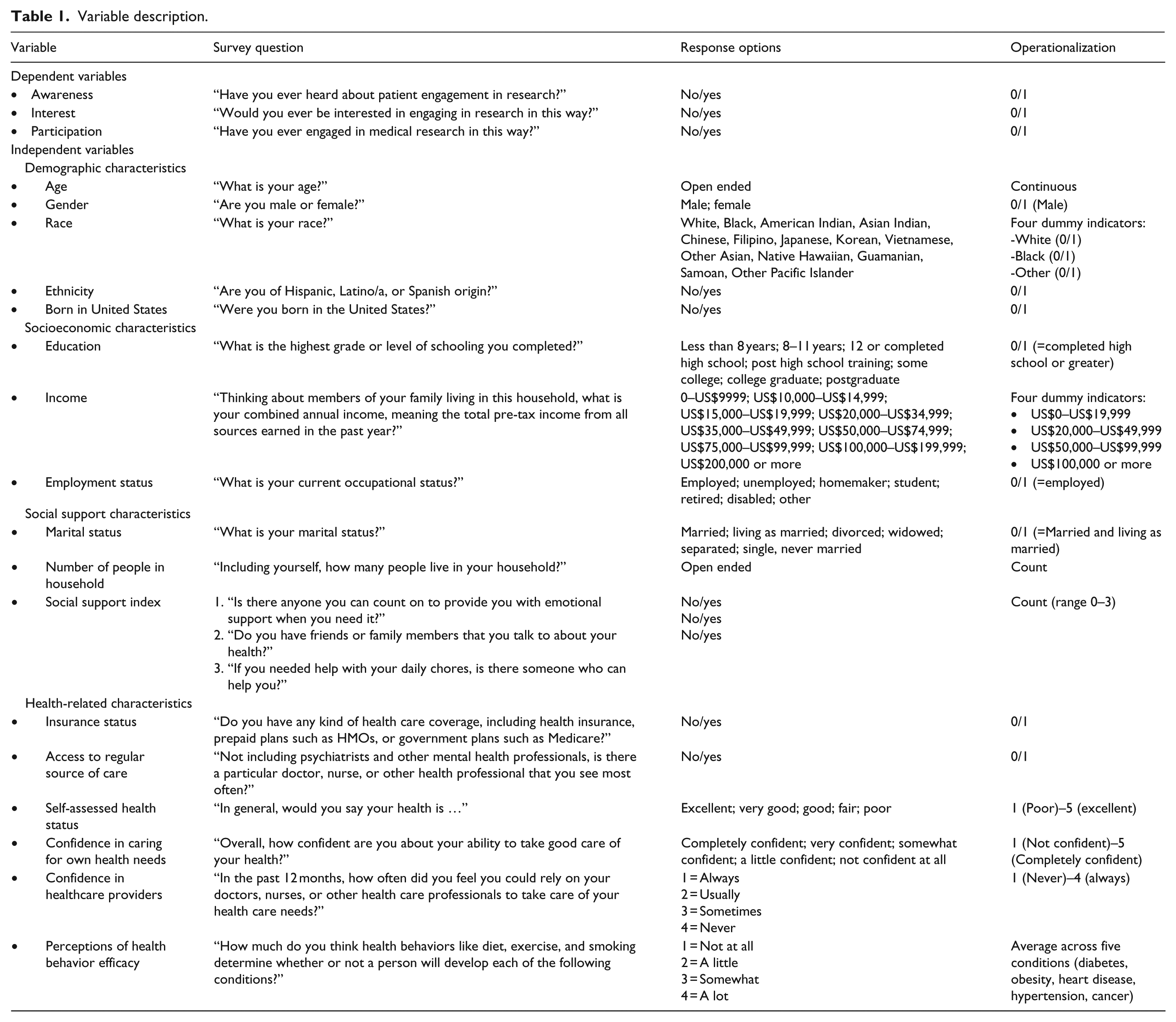
Three variables were used to reflect patient engagement in the research process. Potential respondents were asked “More and more, people are getting involved in research in new ways beyond being a research subject.” They are partnering with medical researchers to help decide what research is done and how it is done. For example, people can suggest important topics to study or how to report results to the public. This is sometimes called “patient engagement in research.” 8 The first item asked “Have you ever heard about ‘patient engagement’ in medical research?” (“awareness”). A second item asked “Would you ever be interested in engaging in research in this way?” (“interest”). The third item asked “Have you ever engaged in medical research in this way?” (“participation”). We constructed three dichotomous variables by coding each item as 1 = Yes and 0 = No. Not sure responses were coded as missing and excluded from subsequent analysis.
Independent variables
The study included four groups of independent variables, related to demographic, socioeconomic, social support, and health-related characteristics, as correlates of their awareness, interest, and participation in research. Demographic characteristics included age, gender, race/ethnicity, and whether they were born in the United States. Socioeconomic characteristics included education, income, and employment status. Social support characteristics included whether the respondent was married, number of people in household, and an index of social support. Health-related characteristics were assessed with six variables: (1) insurance status, (2) access to a regular source of care, (3) self-assessed health status, (4) confidence in their ability to take good care of their own health needs, (5) confidence in healthcare providers, and (6) perceptions of health behavior efficacy. A more complete description of how these variables were operationalized is included in Table 1.
Variable description.
Analytic strategy
The unit of analysis was the individual survey respondent. Univariate statistics were used to describe the study sample. Chi-square tests and t-tests were used to assess differences between patient characteristics and awareness of medical research and interest in research variables. Since it can be assumed that respondents who have participated in medical research were both aware of what patient engagement in research was and were interested in engaging in this type of activity, we compared those who have and have not participated among those both aware and interested in participating using chi-square tests and t-tests. All analyses incorporated recommended replicate weights and used jackknife replication to calculate accurate standard errors. 9
Results
Sample characteristics
On average, 37.7% of the survey respondents expressed an interest in participating in research (Table 2). In contrast, less than one in six (15.7%) respondent was aware of what patient engagement in research was and less than 3% (2.7%) of all respondents had actually participated in research. However, among those respondents who were aware of opportunities to participate in research and expressed an interest in participating in research, almost one-third have participated in research (31.1%). Survey respondents were predominantly White (71.9%), female (61.3%), and had at least a high school education (91.6%). Most respondents had health insurance (86.6%) and a regular healthcare provider (68.5%).
Univariate results.

SD: standard deviation.
Awareness of research
Awareness of research varied as a function of several demographic characteristics (Table 3). First, slightly more than one-quarter (25.2%) of all survey respondents who were not born in the United States were aware of patient engagement opportunities in research, compared to 13.5% of all respondents born in the United States (χ2 = 41.00, p < 0.001). Minorities were also more aware of research opportunities for patients. Specifically, 18.7% of all Black respondents and 15.7% of other survey respondents were aware of research opportunities, compared to 13.8% of all White survey respondents (χ2 = 8.49, p < 0.05). Likewise, Hispanic respondents were more likely to report being aware of research (23.4%) compared to non-Hispanic respondents (14.0%; χ2 = 26.72, p < 0.001). Respondents who reported greater confidence in their ability to care for their own needs, on average, were associated with greater awareness of research engagement opportunities (t = 3.50, p < 0.001).
Bivariate association between awareness of research and patient characteristics.

Bold values indicate statistically significant relationships at the p < .05 value or lower
Interest in research
Two socioeconomic characteristics were significantly associated with interest in research (Table 4). Respondents with a high school education or greater were more likely to report being interested in participating in research than respondents with less than a high school education (38.8% vs 25.5%, respectively; χ2 = 13.22, p < 0.001). Likewise, employed respondents were more likely to report being interested in participating in research than respondents who were unemployed (41.6%% vs 33.9%, respectively; χ2 = 15.19, p < 0.001). Respondents who were interested in participating in the research process reported having fewer sources of support (M = 2.46) than respondents who were not interested in participating (M = 2.55; t = 2.59, p < 0.01). Two health-related characteristics were associated with respondents’ interest in participating in research. Respondents who reported having a regular care provider were more likely to report being interested in participating in research compared to respondents without a regular care provider (40.4% vs 31.9%, respectively, χ2 = 16.4, p < 0.001). Respondents who were interested in participating in research reported better self-assessed health status (M = 3.41) than respondents who were not interested in participating in research (M = 3.29; t = 3.11, p < 0.01). Finally, two patient attitude variables were significantly associated with an interest in participating in research. Respondents who were interested in participating in research reported lower confidence in their healthcare providers (M = 3.31) than respondents who were not interested in participating in research (M = 3.44; t = 3.69, p < 0.001). In contrast, respondents who were interested in participating in research had more positive perceptions of the efficacy of their health behaviors on health conditions (M = 3.62) than respondents who were not interested in participating in research (M = 3.43; t = 7.55, p < 0.001).
Bivariate association between interest in research and patient characteristics.

Bold values indicate statistically significant relationships at the p < .05 value or lower
Participation in research
Respondents who have participated in research had fewer people in their households (M = 1.31) than respondents who have not participated in research (M = 2.41; t = 2.07, p < 0.05; Table 5). Likewise, respondents who have participated in research had lower confidence in their ability to care for their own needs (M = 3.07) than respondents who have not participated in research (M = 3.38; t = 2.14, p < 0.05).
Bivariate association between participation in research and patient characteristics among respondents both interested in research and aware of research.

Bold values indicate statistically significant relationships at the p < .05 value or lower
Discussion
Overall, our analysis suggests that respondents have modest levels of interest, low levels of awareness, and even lower levels of actual participation. However, when we looked at just respondents who had heard about patient engagement in research and were interested in participating, we then see a moderate level of actual participation. Such a pattern is not entirely unexpected since patients are not likely to participate in the research process if they are not interested and cannot participate in the research process if they are not aware of such opportunities. Even so, given growing interest in getting patients involved in research, the pattern does point to some ways to facilitate greater participation in the research process. For example, it is promising that people are interested in being involved in research, but the results suggest that there is work to be done to raise awareness of these research opportunities. Likewise, even among those who are aware of what patient engagement in research is and are interested in such opportunities, participation rates are modest and raise questions as to why patients are reluctant to participate and what can be done to promote actual participation.
Our bivariate analysis begins to sheds some light on such questions. For example, our findings suggest that, on average, individuals of higher socioeconomic status (SES) and with more healthcare-related capabilities (e.g. access to care, self-efficacy) may be more interested in engaging in the research process. One explanation for these differences is that the resources afforded by higher SES and better access to care may enable patients to more consider these opportunities, while it is more difficult for patients of lower SES or who lack reliable access to healthcare to seriously consider engaging in the research process when more basic needs are not being met. Notably, though, respondents with lower levels of social support were more interested in participating in research. One possible explanation for this finding is that these individuals see research as a means of filling in missing gaps in their social support systems. It is also notable that these differences in interest do not necessarily translate into differences in actual participation in the research process. In fact, the only two respondent characteristics associated with actual participation in the research process were household size and confidence in ability to care for own needs, with respondents from smaller households more likely to participate and more confident respondents less likely to participate, despite being more aware of such opportunities. One potential explanation for this seemingly contradictory finding is rooted in the health behavior literature that argues behaviors are a function of both confidence/self-efficacy and outcome expectancies.10,11 It is possible that respondents are confident and possess the requisite self-efficacy, but have low expectations about the outcomes of their participation in research, and thus fail to convert their awareness into actual participation. Likewise, awareness and interest reflect cognitive states of individuals, whereas participation entails actual agency and behavior. As such, the factors that may facilitate or impede these outcomes may differ for individuals.12,13
That said, the absence of significant differences in actual participation between respondents with different demographic, socioeconomic, and environmental characteristics could potentially be viewed positively as it suggests that specific types of patients are not likely to be engaged in research projects to the exclusion and potential detriment of other types of patients. Nevertheless, given low levels of awareness and actual participation, as well as differences in interest as a function of these characteristics, promoting patient engagement in research activities would appear to be a significant challenge for researchers and funders. Indeed, it may be difficult to raise awareness and participation across the entire population. Instead, efforts at engaging patients as research collaborators can begin with a targeted focus on specific socioeconomic groups or health condition–related groups. The Patient-Centered Outcomes Research Institute (PCORI), for example, maintains Patient-Powered Research Networks that comprise patients, their advocacy organizations, and clinical researchers who are dedicated to the development of research agendas around a specific health condition. 14 These kinds of organizations are useful for the identification of patients who might want to serve as research collaborators. For patient–investigator research partnerships to be successful, PCORI maintains that the collaborative must be built on trust, co-learning, transparency, reciprocal relationships, partnerships, and respect. 4
In addition to identifying ways to raise awareness of these opportunities and encouraging patients to follow through on such opportunities, researchers and funders will need to be attentive to potential selection biases that may arise due to varying levels of interest for different types of patients. Moreover, given known challenges to recruiting patients for research, such as mistrust and gatekeeper functions of healthcare providers,15,16 efforts to overcome these hurdles will likely require multiple modes of outreach, some of which may need to be customized to recruit reach and recruit specific patient populations (e.g. minorities, vulnerable populations;17,18).
The findings of our analysis should be interpreted in light of several limitations. First, it was a cross-sectional analysis and we cannot make any strong inferences regarding causality. Nevertheless, to validate the findings described above, the analysis was replicated using the 2013 HINTS data and similar relationships were found (results available from authors upon request), providing some confidence in the pattern of the results reported here. Another potential limitation pertains to respondents’ definition of research. If individuals outside of a research setting are not familiar with what research is, definitions of “interest,” “awareness,” and “participation” may vary across respondents, especially given the novelty of involving patients in a significant way in the research process.
Conclusion
It is promising that people are interested in being involved in research, but the results suggest that there is work to be done to raise awareness of these research opportunities. Likewise, the gap between awareness and participation highlights opportunities to identify why patients may be reluctant to participate even when they are aware of research opportunities.
Footnotes
Declaration of conflicting interests
The author(s) declared no potential conflicts of interest with respect to the research, authorship, and/or publication of this article.
Funding
The author(s) received no financial support for the research, authorship, and/or publication of this article.