



Abstract
Objective:
The continual increase in production and disposal of nanomaterials raises concerns regarding the safety of nanoparticles on the environmental and human health. Recent studies suggest that cerium oxide (CeO2) nanoparticles may possess both harmful and beneficial effects on biological processes. The primary objective of this study is to evaluate how exposure to different concentrations (0.17–17.21 µg/mL) of aggregated CeO2 nanoparticles affects indices of whole animal stress and survivability in Caenorhabditis elegans.
Methods:
Caenorhabditis elegans were exposed to different concentrations of CeO2 nanoparticles and evaluated.
Results:
Our findings demonstrate that chronic exposure of CeO2 nanoparticle aggregates is associated with increased levels of reactive oxygen species and heat shock stress response (HSP-4) in Caenorhabditis elegans, but not mortality. Conversely, CeO2 aggregates promoted strain-dependent decreases in animal fertility, a decline in stress resistance as measured by thermotolerance, and shortened worm length.
Conclusion:
The data obtained from this study reveal the sublethal toxic effects of CeO2 nanoparticle aggregates in Caenorhabditis elegans and contribute to our understanding of how exposure to CeO2 may affect the environment.
Introduction
The use of nanotechnology in industry is rapidly increasing, with a worldwide market size estimated to be in excess of $1 trillion US by the year 2015. 1 Despite the swift progress and early acceptance of nanotechnology, the potential for adverse health effects in humans and the environment due to prolonged exposure at various concentration levels has not yet been established. Assessing the potential toxicity and the effects of nanoparticles on biological systems has become a relevant and quickly growing area of environmental toxicology research. 2
Due to their smaller size and increased surface to volume ratio, nanomaterials oftentimes exhibit differences in their biological reactivity compared to that observed in “bulk” materials. 3 Previous work has suggested that material toxicity can vary in a size-dependent fashion with smaller features being associated with increased cellular dysfunction.3,4 How exposure to nanoparticles may affect the environment and human health is still not fully understood. 2
Cerium is a rare-earth element that in its oxide (CeO2) form is used as an industrial catalyst, in the automotive industry, 5 as an ultraviolet blocking material, 6 and an industrial polishing reagent. 7 Research on how CeO2 may affect biological function when present as a nanoparticle is equivocal with some studies showing that these particles may be toxic while others have shown little or no toxicity and even beneficial effects. In support of this latter possibility, CeO2 nanoparticles have also been shown to exhibit antioxidant properties by acting as superoxide dismutase (SOD) and catalase mimetics. 8 CeO2 nanoparticles demonstrate an autoregenerative capability to cycle between +3 and +4 valence states, which can allow for the scavenging of hydroxyl and superoxide radicals during each cycle.9,10 However, other studies have demonstrated that exposure to CeO2 nanoparticles can lead to increases in oxidative stress,11,12 cellular inflammation, and DNA damage13–16 and that CeO2 nanoparticles are toxic to aquatic organisms.17,18
Caenorhabditis elegans is widely used in the laboratory for different types of investigations given its short lifespan, transparency, ease of cultivation, and high level of conservation with the vertebrate genome. 19 In the last decade or so, C. elegans has begun to be used as a model organism for the investigation of chemical toxicity given its sensitivity to oxidative stress. 20 How exposure to CeO2 nanoparticle aggregates may affect biological function in C. elegans is not well understood. Recent data suggest that CeO2 nanoparticle exposure in C. elegans is associated with decrease in longevity 21 and growth inhibition. 22 Although informative, it should be noted that only one size of CeO2 nanoparticles was investigated in these publications. Given that nanoparticle size directly influences chemical and biological reactivity and that toxicological effects are concentration dependent, additional study is warranted. Similarly, while the measurement of growth inhibition and decreased longevity is important to understanding the toxicity of dispersed CeO2, how exposure to CeO2 nanoparticle aggregates might affect C. elegans longevity, larval development, indices of stress, and fecundity is not known. This latter fact is particularly important given the potential roles that nematodes play in regulating ecosystem productivity. Therefore, the purpose of this study was to observe multiple endpoints for the toxicity of CeO2 nanoparticles at both different sizes and concentrations in an aggregated state. We hypothesized that changes in CeO2 aggregate, concentration, and size have the potential to alter C. elegans development, indices of stress response, external stress resistance, reproduction, and even viability. Our data suggest that exposure to higher levels of CeO2 nanoparticle aggregates is associated with increased levels of organismal stress markers, decreases in fertility, and diminished worm growth. Taken together, these findings suggest that exposure to CeO2 nanoparticle aggregates may be toxic to C. elegans.
Materials and methods
CeO2 nanoparticle preparation and characterization
Previously characterized NanoActive CeO2 (99.9% purity as determined by inductively coupled plasma mass spectrometry (ICP-MS); Lot #06-0118) was purchased from NanoScale Corporation (Manhattan, KS, USA). Stock suspensions (3.5 mg/mL) were prepared in double-distilled water (ddH2O) by sonication for 2 min using a Vibra-Cell Sonicator (Sonics & Materials, Inc. Newton, CT) at room temperature and characterized.
Transmission electron microscopy and energy dispersive X-ray spectroscopy
Particles were imaged in their native state using a JEOL JEM 3010 transmission electron microscope at 300 keV. For determining the atomic composition of the particles, energy dispersive X-ray spectroscopy (EDX) was performed using a detector fitted to a JEOL JSM-6320F Field Emission Scanning Electron Microscope that was equipped with Noran Voyager EDX software.
Dynamic light scattering
The hydrodynamic size and size distribution of the CeO2 nanoparticle aggregates were evaluated in ddH2O water using a Particle Size Analyzer (Model-LB-550; HORIBA, New Jersey, NJ) equipped with an He–Ne laser (633 nm) using back-scattered light. Experiments were performed in triplicate runs that were performed on three different days with freshly prepared samples.
C. elegans strains and culturing conditions, chemicals, and materials
C. elegans strains were obtained from the Caenorhabditis Genetics Center (CGC) at the University of Minnesota. The CL2166 strain carries a gst-4::GFP reporter allowing fluorescent observation of glutathione S-transferase. The SJ4005 strain exhibits an HSP-4::GFP transgene that exhibits oxidative stress-inducible fluorescence of heat shock protein production (HSP-4) (the human equivalent to hsp70). 23 Age-synchronized populations of C. elegans were prepared using standard procedures. 24 Nematode strains were maintained at 20°C using Escherichia coli OP50-1 suspensions spread on nematode growth medium (NGM) plates 24 h prior to nematode transfer to ensure sufficient bacterial lawn growth.
Determination of lifespan and fertility of C. elegans in presence or absence of CeO2 nanoparticles
Age-synchronous eggs (d = 0) were grown to L4 larval stage and then transferred to OP50-1-coated plates with or without CeO2 nanoparticles (0.172 µg/mL (3.822 × 10⁻⁶ µg/cm2), 1.72 µg/mL (3.822 × 10⁻⁵ µg/cm2), and 17.21 µg/mL (3.822 × 10⁻⁴ µg/cm2)). C. elegans were transferred to new plates during each day of the reproductive cycle. Just prior to the end of the reproductive phase, nematodes were transferred to new plates every 3 days. Worms were observed daily and the number of live and dead counted. Nematodes were scored as dead when it no longer responded to being touched with a worm pick made from platinum wire. Nematodes that escaped the bacterial lawn or burrowed into agar were excluded from analysis. Lifespan experiments were performed with n = 60–100.
Age-synchronous L4s were transferred to individual NGM plates with different doses of nanoparticles at the beginning of their reproductive cycle (~2.5 days) and then transferred to new plates every 24 h. Eggs were counted following each 24-h plate transfer. Reproduction experiments were performed in triplicate with n = 30.
Transgene GFP expression, growth, and development
After paralysis using 5 µL of 5% hypochlorite solution, GFP reporter gene expression was observed using an Olympus BX51 fluorescence microscope (Olympus America, Melville, NY, USA). Images were captured under standardized conditions, and ImageJ software was used to quantify mean GFP intensity per unit area and animal length. Imaging experiments were performed in triplicate with n = 30.
Thermotolerance assay
Thermotolerance assays were performed as described by Lithgow et al. 25 Briefly, 3-day-old nematodes were exposed to 35°C. Surviving worms were counted after 8 h. Thermotolerance experiments were performed in triplicate with n = 60.
Statistical analysis
Results are presented as mean ± standard error of mean (SEM). The log-rank test was performed using Prism 5.0 software (GraphPad Software, La Jolla, CA, USA) to determine differences in nematode survivability between groups. Comparisons between groups were performed using the Student’s t-tests or one-way analysis of variance (ANOVA) with Newman–Keuls post hoc testing as appropriate. The level of significance accepted a priori was p < 0.05.
Results
Characterization of CeO2 nanoparticle aggregates
The mean hydrodynamic diameter of the CeO2 nanoparticle aggregates as measured by dynamic light scattering (DLS) was 184 ± 75 nm (Figure 1(a)). Transmission electron microscopy (TEM) analysis showed that the individual CeO2 nanoparticles were spherical/round in shape with a diameter of 10–30 nm in size (Figure 1(b) and (c)). EDX analysis showed the presence of cerium and oxygen with weight percentages of approximately 97% and 2%, respectively (Figure 1(d)).

Physical characterization of CeO2 nanoparticle aggregates by (a) dynamic light scattering (DLS), (b, c) transmission electron microscopy (TEM), and (d) energy dispersive X-ray spectroscopy (EDX).
Exposure to CeO2 nanoparticle aggregates is associated with increased stress but not death
Compared to untreated worms, we observed CeO2 particle exposure did not affect nematode longevity irrespective of strain in CL2166 or SJ4005 strains at our chosen dosing concentrations (undocumented). We chose the N2 wild type to verify the survivability results of both GFP transgene strains and still observed no change in longevity with CeO2 exposure (Figure 2). In an effort to better understand any potential toxicity of the CeO2 particles, we next investigated whether particle exposure was associated with increased organismal stress using the fluorescent transgenic strains SJ4005 and CL2166. The SJ4005 contains a GFP reporter coupled to HSP-4 production, while the CL2166 strain contains a GFP reporter coupled to GST-4 response genes. Compared to that observed in the unexposed worms, CeO2 particle exposure appeared to significantly increase HSP-driven fluorescence in a dose- and time-dependent fashion at days 2, 4, and 6 (Figure 3(a) and (c); p < 0.05). Like that seen with the HSP-driven GFP reporter strain, CeO2 particle exposure appeared to exhibit a similar effect in the CL2166 animals (Figure 3(b) and (d); p < 0.05). Taken together, these data suggest that CeO2 particle exposure is associated with a significant increase in HSP-4 expression and cellular reactive oxygen species (ROS) levels as seen by increased GST-4.

Exposure to CeO2 nanoparticle aggregates does not affect Caenorhabditis elegans longevity. Strain N2 wild type showed no significant changes in longevity with CeO2 particle exposure (0–17.21 µg/mL). Experiments were performed in triplicate (n = 60–100).

Exposure to CeO2 nanoparticle aggregates induces organismal stress. GFP-coupled heat shock production (HSP-4) genes from (a) SJ4005 and GFP-coupled reactive oxygen species (ROS) response (GST-4) from (b) CL2166 were observed (original images at 4× magnification). Scale bar = 1 mm. CeO2 caused an increase in GFP-related heat shock protein production in strain (c) SJ4005 and GFP-related ROS expression in strain (d) CL2166. Average mean pixel intensity per unit area is measured in ImageJ software. Data are expressed as mean ± standard error of mean (SEM) relative to controls (n = 10–20).
Exposure to CeO2 nanoparticle aggregates is associated with diminished egg laying and reduced body length
Age-synchronized worms were isolated in individual NGM plates, and egg production was counted over the entire reproduction period. Compared to that observed in the unexposed worms, exposure to CeO2 particles significantly decreased the average daily egg production in the CL2166 but not the SJ4005 strain at days 3 and 5 (Figure 4(a) and (c), p < 0.05) and the total number of eggs produced during the entire reproduction period (Figure 4(b) and (d), p < 0.05).

Exposure to CeO2 nanoparticle aggregates decreases fecundity. Egg production by individual worms was determined daily and then totaled. SJ4005 strain egg production by (a) day and (b) totaled. CL2166 strain egg production by (c) day and (d) totaled (n = 90 worms).
Similar to that seen in egg production, the effects of CeO2 particle exposure on worm length also appeared to be strain dependent. Specifically, CeO2 particle exposure appeared to diminish CL2166 body length early in development (Figure 5(b), p < 0.05), while in the SJ4005 strain, significantly diminished body length was not observed until day 6 (Figure 5(a), p < 0.05).

Exposure to CeO2 nanoparticle aggregates affects worm growth and development. Cerium oxide particle exposure decreased length of strain (a) SJ4005 and (b) CL2166.
Exposure to CeO2 nanoparticle aggregates is associated with diminished thermotolerance
To determine whether CeO2 nanoparticles increase or diminishes stress load during exposure to elevated temperatures, thermotolerance was chosen to further measure the organism’s stress response. Our results show that exposure to CeO2 particles lowered the ability of the SJ4005 strain but not the CL2166 animals to tolerate elevated temperatures (Figure 6, p < 0.05).
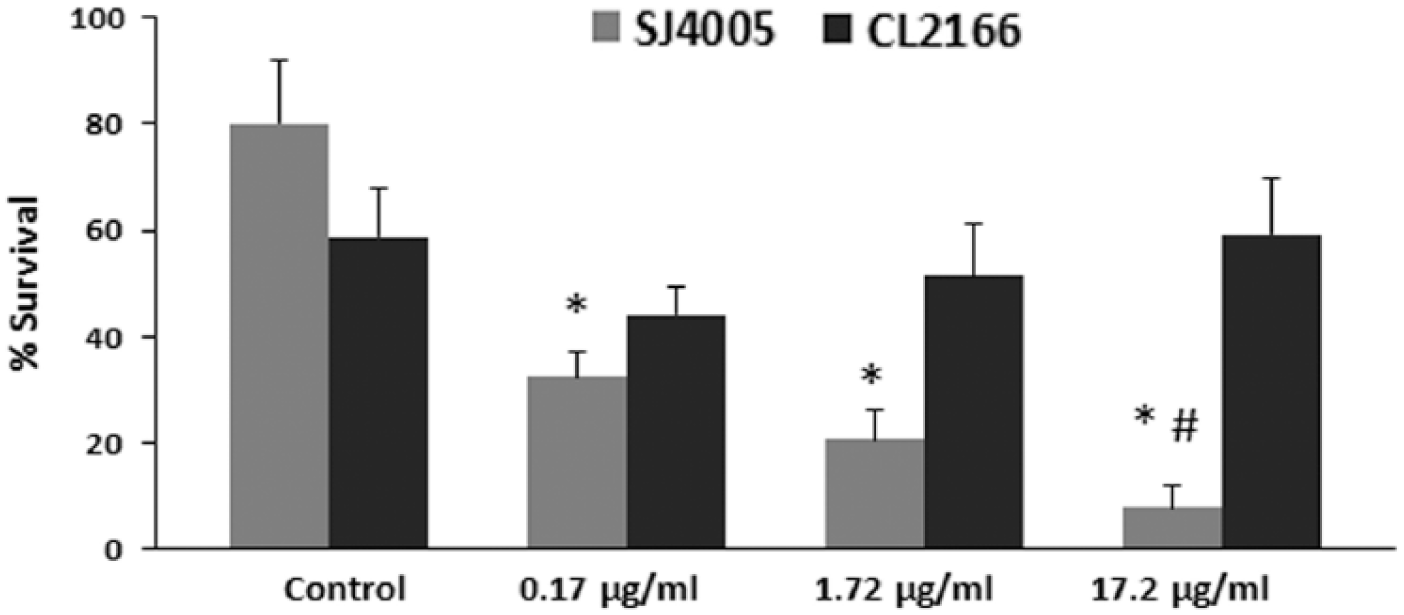
Exposure to CeO2 nanoparticle aggregates decreases worm thermotolerance. Age-synchronized SJ4005 or CL2166 worms were exposed to CeO2 particles (0–17.21 µg/mL) at 35°C for 8 h on day 3, and animal survivability was recorded (n = 60).
Discussion
It is thought that engineered nanoparticles may pose a threat to human beings and the environment given their widespread and growing use in everyday products. 26 CeO2 is currently 1 of 14 manufactured nanomaterials on the priority list of nanomaterials under investigation by the Organization for Economic Cooperation and Development (OECD). 27 In contrast to previous reports,21,28 we examined the effects of exposure to CeO2 aggregates given the fact that nanoparticles frequently undergo aggregation in the high ionic strength environments oftentimes observed in environmental and biological fluids. 29 Our data suggest that exposure of C. elegans to aggregated CeO2 nanoparticles is associated with increased markers of organismal stress, decreased fertility, stunted growth, delays in organismal development, and diminished thermotolerance.
Exposure to CeO2 nanoparticle aggregates is sublethal and increases expression of organismal stress markers
Exposure to CeO2 particles had no significant effect on C. elegans lifespan even when used at concentrations as high as 17.21 µg/mL. These results, at first glance, were surprising given the previous paper of Zhang et al. 21 which demonstrated that exposure to 0.00017 µg/mL was associated with significant increases in the incidence of C. elegans mortality. It is possible that differences between this study and previous work may be related to differences in the size of the nanoparticle used. For example, Zhang and co-workers used particles with a mean particle size of 8.5 ± 1.5 nm, whereas in this study, the mean particle size was measured to be 184 ± 75 nm by DLS and 10–30 nm by TEM. It is thought that as particle size increases, the particle becomes generally less permeable and less catalytic due to larger molecular structure hindering exposure to the CeO2 active site. 4 Multiple factors, such as pH and the ionic strength of the environment, can cause particle aggregation which can result in the loss of nanoscale properties. 30 This has been shown by Arnold et al. 22 who observed that CeO2 nanoparticles were more toxic than equimolar amounts of “bulk” cerium oxide. Whether the change in particle size is solely responsible for the differences in toxicity observed in this study and previous work is unclear and will require further investigation.
Similar to the work of Zhang and colleagues, we found that exposure to CeO2 nanoparticle aggregates in C. elegans was associated with a toxicological response as demonstrated by increased exposure-induced expression of GFP (Figure 3, Panels A–D). Specifically, we found that particle exposure in the SJ4005 strain was associated with an increase in HSP-driven GFP expression (Figure 3, Panels A and C) and that particle treatment in the CL2166 strain induced the ROS-dependent expression of GFP in a concentration-dependent manner (Figure 3, Panels B and D). Although beyond the scope of this study, the reason for the observed increase in stress response markers by CeO2 may be related not only to its ability to relieve oxidative stress but also to cause it. The ability of CeO2 to cause oxidative stress has been well documented in cell culture31,32 and in rats. 13 CeO2 redox cycling between Ce3+ and Ce4+ may play a vital role in the generation of damaging oxygen radicals. Using paramagnetic resonance, previous work has demonstrated that CeO2 nanoparticles in the presence of hydrogen peroxide can cause the formation of hydroxyl radicals and superoxide anions. 33 Just as the beneficial ROS scavenging properties of CeO2 rely on the number of oxygen vacancies and the Ce3+/Ce4+ ratio, 34 the oscillatory cycling of giving and taking oxygen appears to work in both directions depending upon the chemical conditions. 33 Whether the creation of hydroxyl and superoxide by CeO2 explains the increases in organismal stress indices seen in our GFP analysis as well as diminished C. elegans fertility, growth, and development observed in this study is currently unclear.
Exposure to CeO2 particles attenuates growth and development
It is well known that free radicals can cause deleterious effects on C. elegans fertility (fecundity) 35 as well as growth and development. 36 Whether exposure to oxygen radicals, by themselves, is the direct cause of these changes or if such alterations are secondary to these elevations in radical levels is currently unclear. For example, Arnold and colleagues observed similar decrease in C. elegans growth following CeO2 exposure which they suggested was due to diminished food intake that was caused by the interactions of CeO2 and E. coli. 22 Bearing this in mind, it is possible that changes in development and growth may be related to C. elegans food intake, as CeO2 has a strong affinity to bind to E. coli 37 which could, in principle, diminish food intake. Restricted dietary intake has been shown to increase lifespan in C. elegans at the expense of prolonging time in dauer stages of the development cycle. 38 Although there may be other factors at play, it is conceivable that the worms exposed to the CeO2 particles consumed less and that this decrease in food intake may be a contributing factor in the observed decrease in growth and development. Additional experiments, perhaps designed to directly test this assertion, will be useful in proving cause and effect.
It has been previously reported that increased stress plays a role in decreasing growth and development in C. elegans.38,39 In addition to elevations in organismal stress, another potential reason for the decrease in C. elegans growth and development seen in this study may be related to the ability of CeO2 to target and down-regulate nitric oxide synthase (NOS). 40 Nitric oxide (NO) is known to be highly conserved between both invertebrate and vertebrate species, and it is thought that this molecule plays an important role in neurotransmission, water and salt balance, organismal development, and immune function. 41 Although not measured, it is possible that CeO2 exposure could diminish NOS and NO levels, which one could predict to cause impairments in nervous system function and C. elegans development. 42 Further experiments to directly examine this possibility are needed to establish causation.
Exposure to CeO2 particles decreases fecundity and ability to endure external stressors and causes strain-specific variations in data
It is thought that the measurement of fecundity is one of the most significant toxicological endpoint assays for assessing toxicity in C. elegans. 43 Given the nature of our study design, it is currently difficult to pinpoint the direct mechanism(s) by which exposure to CeO2 might decrease fertility although we hypothesize that the increased oxidative stress response marked by GST-4 and HSP-4 we observed following CeO2 exposure is the primary mechanism (Figure 3). Indeed, recent work has demonstrated that nematode stress levels are inversely associated with reproductive capability, along with worm growth and development. 44 Potentially, increased stress response may also contribute to the diminished thermotolerance we observed following CeO2 exposure (Figure 6). Why the response to CeO2 nanoparticle exposure may differ between strains is not clear but may be related to the ability of C. elegans to undergo hermaphroditic reproduction which could give rise to spontaneous mutations.42,45 Additional studies may be warranted to explore this possibility further.
In summary, our data demonstrate that exposure to CeO2 particle aggregates in C. elegans is associated with increased indices of organismal stress, diminished growth, impaired development, and decreased fecundity in both dose- and strain-specific manner. The tendency of nanoparticles to favor aggregation such as that observed during “real world” aquatic exposure suggests that CeO2 may not be as potentially toxic as previously considered when studied in its non-aggregate form. Additional studies on the effect of aggregated versus non-aggregated CeO2 nanoparticles at varying concentrations and particle sizes, with both soil and aquatic organisms, will be needed to increase our understanding of the effects of CeO2 on the environment and those that inhabit it.
Footnotes
Declaration of conflicting interests
The authors declare that there is no conflict of interest.
Funding
This study was supported by Department of Energy Grant DE-PS02-09ER09-01 to E.R.B.