



Abstract
Contemporary climate activism has often been called a “religion” or a “cult.” We investigate what is done with climate religion discourse (CRD), by whom, and to what ends. Our case study concerns Finland, one country out of many where forms of climate activism are regularly dismissed by equating them with “irrational” religion. We find that political parties and newspaper columnists use terms and phrases such as “millenarianism,” “prophet,” “Messiah,” “cult,” “apocalypse,” “Virgin Mary of climate religion,” and “children’s crusade.” We argue that these are examples of strategic othering in the Finnish context. We observe that this religionizing stems from the activism’s incompatibility with prevalent economic rationality, and that gender is a significant theme in CRD use. An unintended consequence of CRD is that it constructs those forms of religion, which do not disturb modernity and the capitalist order as more legitimate than others.
Introduction
On September 23rd 2019, young Swedish climate activist Greta Thunberg (b. 2003) gave a speech at the United Nations Climate Action Summit in New York. She accused world leaders of inactivity against climate change and for stealing her dreams and childhood (United Nations 2019). Thunberg’s performance fired up conservative commentators around the world, who found the young climate activist an example of a new unsavory style of politics. So, for example, Madeline Grant (2019) wrote in the conservative British newspaper The Telegraph: Religious thinking pervades our supposedly secular age, from the purity-obsessed “clean eating” fetish to the unforgiving online lynch mob, with its public shamings and demands for penance. …. Thunberg, with her apocalyptic warnings and Pippi Longstocking plaits, has become a global icon in a matter of months. More striking than the ubiquitous crowds accompanying her, however, is their quasi-religious reverence. She is portrayed as a child-prophet, a modern-day Joan of Arc in her ability to inspire a movement.
Other commentators joined the choir with descriptors like “religious,” “prophetic,” or “messianic,” while also debating whether such comparisons are appropriate (Boucher 2019; O’Neill 2019; Sky News Australia 2022; Vargic 2019). Parallels between climate activism and religion travelled widely and quickly. Public discourse in Finland, for example, promptly followed international examples. National Coalition Party Member of Parliament Atte Kaleva attended a television discussion about Thunberg’s activism and criticized the “Greta-phenomenon,” saying it resembled a “religious cult” (Kaleva 2019).
We refer to such language as climate religion discourse (CRD). It is primarily (though not exclusively) used to discredit and de-legitimate climate activism. CRD is an illustrative example of advancing particular interests with selective language use, which calls for a critical, discourse-analytical approach. The purpose of this article is to answer what is done when CRD is used, who uses it, and to what ends. Furthermore, we ask what potential consequences such language use entails, not only for politics but also for religion. We answer these questions in the context of Finland by analyzing material produced by political parties, newspaper columns, and a far-right discussion board. We identify two main de-legitimating sub-discourses (climate activism as “cult,” and climate activism as “non-modern”) and discuss these in the framework of capitalist rationality and good and bad religion. Although our systematic analysis is limited to Finland, we believe the study is relevant more broadly, since much of Finnish CRD is borrowed from abroad, consciously or not. We argue that in addition to using “religion” as a negative marker to de-legitimate climate activism, an unintended consequence of CRD is that it constructs those forms of religion which do not disturb modernity and the capitalist order as more legitimate than others. 1
Climate Activism and ‘Old’ Politics
Climate change became a recurring theme in national and international politics in the 1980s, following key discoveries regarding greenhouse gases produced by industrialized human societies. The Intergovernmental Panel on Climate Change (IPCC) was founded in 1988, and the United Nations Framework Convention on Climate Change established in 1992. This resulted in further climate treaties, such as the Kyoto Protocol of 1997, superseded by the Paris Agreement in 2015.
Many climate activists have considered the above-mentioned international actions too slow and inadequate. The latest climate activist generation was set in motion in November 2015, when about 50,000 students from various countries skipped school on the first day of the UN Climate Change Conference in Paris, demanding more radical action from governments. Such student protests became a still-ongoing international wave after August 2018, when Greta Thunberg organized her first demonstration in front of the Swedish parliament, holding a sign with the words “skolstrejk för klimatet” (English: school strike for climate) and skipping her Friday classes. Thunberg publicized her demonstration initially on social media, but soon she began receiving news media attention more broadly. By the time of the 2019 United Nations Climate Change Conference, she was an internationally known figure who had held high-profile speeches and motivated youth climate movements in many countries. Besides the School Strike for Climate, other names adopted by the movement include Fridays for Future and Youth for Climate. Their first demonstration in Finland occurred in January 2019 in front of the Finnish parliament.
Concurrent with the youth movement inspired by Thunberg, another climate activist group, Extinction Rebellion (ER), started making headlines internationally. Experienced activists, such as Roger Hallam (b. 1966), founded ER in the United Kingdom in May 2018. Their favored form of demonstration has been a nonviolent “sit-in,” where a group remains seated in a place of public importance until forcibly removed or until their demands are met. While not part of the founders, Thunberg has supported Extinction Rebellion from the beginning. The movement’s first protest in Finland was in May 2019, and it has remained active since.
The positive inspiration provided by these climate activist groups (and others) has been balanced in public discussion by an equal amount of notoriety. As many of the activists have been minors, like Thunberg initially was, some have criticized the movement for taking advantage of the naiveté of the young and making them anxious via climate alarmism. A Thunberg-specific criticism has been to focus on her Asperger’s syndrome, made public by her mother, and to claim that such a child should be protected from heated politics. Finally, one line of criticism has talked about the dynamic youth movement itself and described it as either resembling religion or constituting one—the focus of the article at hand.
Since these public discourses filter down to national politics and the other way around, it is useful to briefly discuss the political context of CRD in contemporary Finland. As in most European nations, the division between liberals and conservatives has become more visible in Finnish politics in the 2010s. This division—also described reasonably accurately in the Finnish context as being between post-materialistic values (i.e., individualism, environmentalism, self-expression, and minority rights) and values emphasizing material needs and uniformity of culture (Westinen et al. 2015, 274–276)—has been relevant to topics such as security (e.g., in the context of Muslim immigration), national identity, and the environment. Political scientist Rauli Mickelson (2015, 313–314) describes the period beginning from 2008 as a time of “global angst” during which, as in many other countries, traditional Finnish consensus politics (Kettunen and Kiviniemi 2006) was broken by the emergence of a populist and increasingly far right Finns Party. Since 2011, it has been one of the three largest parties in the Finnish parliament.
As climate change became more visible in the wake of Thunberg and ER’s climate activism, the Finns Party ramped up their criticism of climate change politics. Their rhetoric portrays “green left” politics (meaning the Green Party and the Left Alliance particularly—but ultimately anyone who opposes the Finns Party line) as threatening the lifestyle of “ordinary” Finns, which, they claim, includes “motoring, traveling abroad, and dietary habits” (Niemi 2013, 84). Such identity politics revolve around traditional forms of masculinity, nationalism, value conservativism, and anti-feminism (Kovala and Pöysä 2018; Saresma 2018). Climate activism—international and led by young women—is, unsurprisingly, a social problem rather than a positive social movement in the Finns Party world view. The Finns Party is not the only party critical of climate activism, however. Other political parties—especially the traditionally industrialist National Coalition Party and the traditionally agrarian Centre Party, both on the right of the political spectrum—have a political stake against any kind “green transition” in economic and social life. Yet, as our analysis shows, the Finns Party has led the way, both in terms of the amount of attention paid to climate questions and in terms of the rhetoric of anti-activism. 2
Legitimation and the Analysis of Climate Religion Discourse
Ever since Max Weber’s foundational writings in political sociology, the concepts of legitimacy and legitimation have been part of social scientific vocabulary. “Legitimacy” is commonly used to assess whether the state or other institutions command respect and obedience in the public. “Legitimation,” in turn, as used by Peter Berger (e.g., 2011, 39), “serves to explain and justify the social order.” In other words, “legitimation explains why an institution is as it is, and also why it should be as it is” (Hjelm 2014a, 25; emphases in the original). One way to legitimate things is to refer to an “ultimate reality,” which legitimates the social order on a cosmic scale. Berger called these, the broadest level of legitimation, “symbolic universes,” of which religion is the prime case (Berger 2011, 43; Hjelm 2018, 3). Craig Martin, however, argues that there is no essential difference between religious and non-religious legitimation. The question of legitimation should be understood in terms of cultural toolboxes, which are socially inherited repertoires of discourses and practices that may be used to reinforce or undermine social order (Martin 2012, 96–98.) We consider CRD one form of such a cultural toolbox.
Our approach to legitimation and de-legitimation examines how terminology associated with religion in Finnish public discourse is used to erode the legitimacy of climate activism. Legitimacy, as far as we are concerned here, refers to general social legitimacy: the state of being socially acceptable, compatible, and proper. We understand legitimation as a two-way phenomenon: a thing can be legitimated or de-legitimated with religion. When this is done, a particular form of religion is simultaneously given a legitimate or illegitimate status. For example, when the supporters of Donald Trump are called “a MAGA cult,” the supporters are de-legitimated, but so is the type of religion (“cult”) the group is likened to. Thus, we will look for such implications of the language use at hand: what forms of religion are legitimated and de-legitimated as collateral effects when certain actors criticize the climate movement?
Following Stuart Hall (1997, 6), we understand discourse as “ways of referring to or constructing knowledge about a particular topic of practice.” We do discourse analysis mainly on the level of textual analysis (naming, predication, and narration). Still, we also analyze the discursive practices (what kind of other discourses and genres are utilized) and the social practices (how the analyzed texts relate to the political and religious landscape). (Fairclough 1995, 133; Hjelm 2014b; see also Taira 2022, 28.) While our focus is on contemporary discourse in the Finnish linguistic context, we also pay attention to the presence of other discourses with long historical roots that transcend national and linguistic borders.
Data and Method
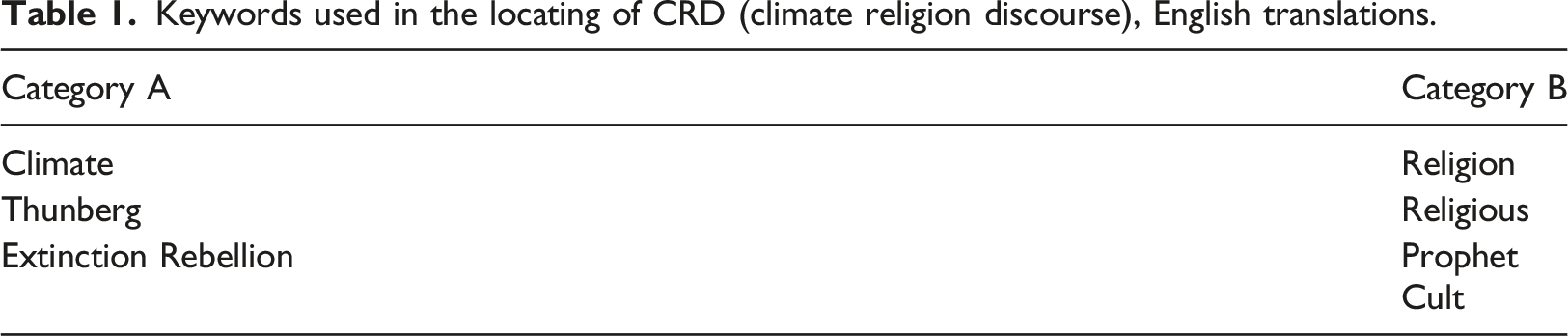
Our data comes in three forms: party-produced materials, regular newspapers, and an online discussion forum. Our primary data consists of party think tank publications, party newspapers, and regular newspaper opinion columns. These are collected systematically via keyword searches to capture CRD. As supporting secondary material, we will utilize unsystematically collected news stories from regular Finnish newspapers—that mainly reported on the sayings of politicians, which were also discussed in party newspapers—and a Finnish far right online discussion forum topic that exhibits the CRD. Our timeframe is from the beginning of 2019 up until the time of writing, autumn 2022.
Keywords used in the locating of CRD (climate religion discourse), English translations.
Primary data
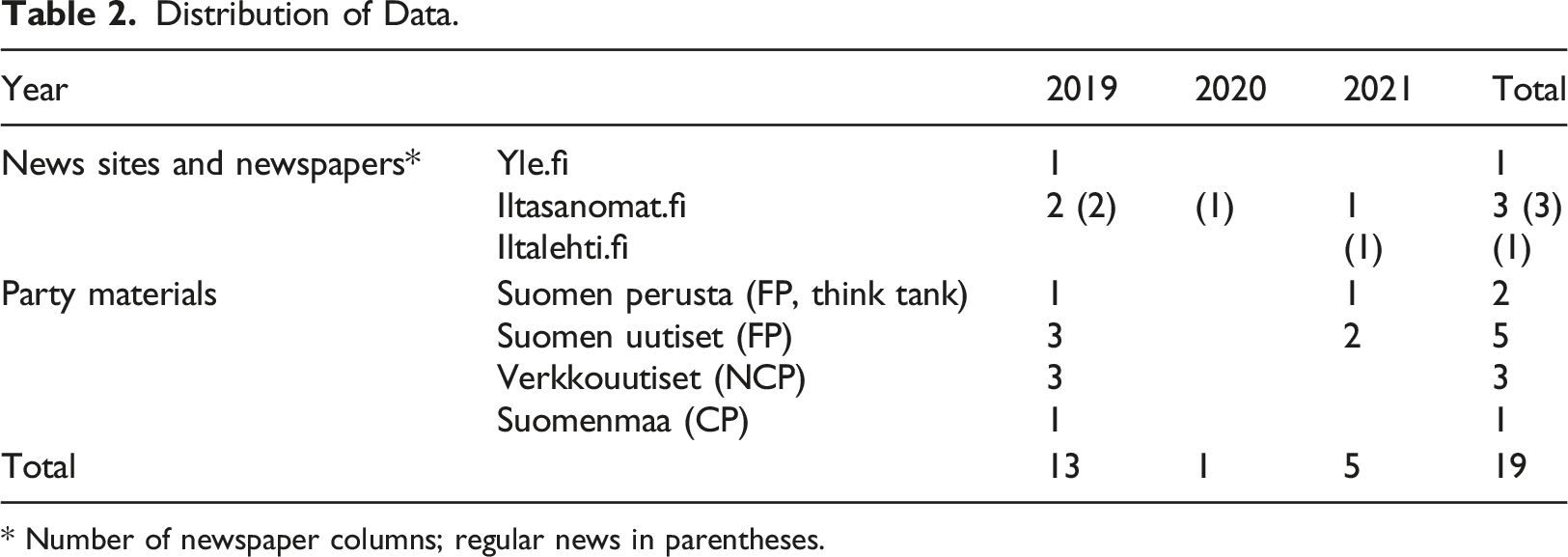
We screened the most popular Finnish news sites for columns that use CRD. Our screening included the Finnish public broadcasting company Yle.fi, two tabloids Ilta-sanomat.fi and Iltalehti.fi and Mtv.fi, a news site of a sizeable commercial television channel. Additionally, we screened the online database of the biggest national newspaper, Helsingin Sanomat. This resulted in three newspaper columns in total.
Concerning the materials produced by political parties, we focused on think tank publications and party news websites of all established parliamentary parties in Finland. In our screening, only the Finns Party, National Coalition, and the Centre Party used CRD. Thus, our focus will be on these parties.
We identified CRD in two think tank publications. Both are from the Finns Party think tank Suomen Perusta (English: the Foundation of Finland). These are the Tulvia ja tulikiveä: maailmanlopun tematiikka ilmastokeskustelussa (English: Floods and Brimstone: End-of-the-World Themes in Climate Discussion), published in 2021, and the Ympäristörealistin käsikirja (English: Manual for the Climate Realist), published in 2019. The first is a pamphlet authored by nationalist conservative writer Marko Meretvuo, and the second is a collection of short essays edited by the think tank leader Simo Grönroos and their regular conservative writer, former science journalist Marko Hamilo. CRD is in a much more prominent role in the former publication, but is also present in the latter.
Finally, our primary data incorporates news stories and other types of texts published by official party media. We found CRD in three party (online) newspapers: Suomen Uutiset, of the Finns Party, Verkkouutiset of the National Coalition Party, and Suomenmaa of the Centre Party. Our screening captured eight texts in total with CRD published by these newspapers.
Secondary materials
Distribution of Data.
* Number of newspaper columns; regular news in parentheses.
General observations
The political emphasis of the material is quite clear. In our data, we found CRD among the political right (National Coalition, Centre Party), far right (Finns Party), and conservative columnists without a clear party connection. We also screened the political platforms (including party and election platforms and manifestoes) and the plenary speeches from the research period and beyond, but found no instances of CRD. This suggests that CRD is either still making its way to the official political discourse, or that CRD is simply considered unsuitable in more formal contexts.
The use of CRD in Finland can be divided into three periods: in February 2019, a thread on the discussion forum Hommaforum commenting on Thunberg was started, and Suomen Uutiset published the first news article referring to these concepts. The second period started after Thunberg’s UN speech in September 2019 and lasted until December 2019. This period contains tweets, media columns, and Finns Party politicians’ comments circulated in the news media. The third peak in the discussions was in the summer of 2021, when Riikka Purra was campaigning to be Jussi Halla-Aho’s follower as the chair of the Finns Party (see also Table 2). Although we found some mentions of “climate religion” or “climate cult” from before the 2010s, it seems that the discourse in its current form made its way to the Finnish public sphere in February 2019 and has been in circulation since with varying degrees of importance. Although the number of sources we found for the close analysis suggests that CRD is a minor theme in the overall discussion on climate change, our analysis shows that on the right end of the political spectrum CRD has become a recognized and, indeed, legitimate way to talk about climate activism.
Climate Activism as a “Cult”
Sometime in the mid-1960s it became common to refer to “small, insignificant, inward-looking, unorthodox, weird, and possibly threatening” new religious movements as “cults”. The term carries strong negative connotations with references to brainwashing, abuse, and widely publicized cult suicides. It is therefore perhaps unsurprising that in CRD, it is common to refer to the climate movement as a “religious cult” or “apocalyptic cult.” This cult discourse can be broken down by analyzing Floods and Brimstone (Meretvuo 2021), produced by the Finns Party think tank Suomen Perusta. The pamphlet has four main themes: the end of the world as a religious topic, direct comparisons between cults and the climate movement, prophetic leader figures, and the anti-capitalism of climate activism and climate politics.
Meretvuo (2021) identifies three main components of religious anticipation of the end of the world in Floods and Brimstone: cataclysmic themes (strong imagery about the time before and the time after the core event), the end of evil (the end of the world marks the defeat of the forces of evil), and revelations (the end of the world reveals new things about the world) (See also Hamilo and Grönroos 2019, 67). Literate in religious studies, Meretvuo names The People’s Temple, Heaven’s Gate, Branch Davidians, and Aum Shinrikyo, thus evoking images of self-destruction and apocalyptic violence. Then, he moves to find similarities between descriptions of religion and the climate movement: Talk about the end of the world, us running out of time, questions of destiny, last warning signs, and humanity reaching its endpoint has recently become more and more common in climate-related news, newspaper columns, and even in scientific publications …. Cataclysmic themes abound in verbal descriptions, documentaries, and media images regarding climate change. The end of evil is conveyed by accusing greedy corporations, the Western consumerist way of life, or “climate denialists.” …. The theme of revelation is present via the recent linkage between climate action and sustainable development with aims such as social justice and measures against poverty. (Meretvuo 2021, 3)
Relatedly, the pamphlet also identifies a “climate eschatology”: Religious eschatology is equally about destruction and salvation. Although the world is about to be wiped out, those who have welcomed the religious message and lived their lives accordingly can be saved in this life or the next. In the climate change discourse, the apocalyptic themes, besides being prophecies about destruction, are also eschatological sermons: they give humanity instructions regarding how the end of the world can be prevented or its effect mitigated. (Meretvuo 2021, 4)
For Meretvuo (2021, 6), apocalypticism and eschatology are examples, of climate activism’s cult-like nature. The comparison is made even more explicitly later when the author lists the supposed features of “cults”: - Layfolk as figures of authority and leadership, one example being Greta Thunberg, who has even been called a “prophetic child” …. - The indoctrination of children into the cult’s beliefs and values.
This line of argument is followed by columnist Lasse Lehtinen, who labels Greta Thunberg as “the climate war’s cute warrior”: We condemn the use of child soldiers in wars and crises. Children frightened by the climate scare and other vulnerable groups of people are now used against society and as human shields. If someone got hurt or lost their life, the movement would get a martyr and more sought-after visibility. The little girl Greta cannot be that well informed about the many contradictions of climate science, but she definitely believes in an approaching end. Throughout history, sect leaders have used adolescents to their ends. (Lehtinen 2019b)
References to “sects”—often used interchangeably with “cults” in international anti-cult literature—is one way of painting a picture of people taking advantage of those who lack understanding. Interestingly, themes of brainwashing and mind-control are typical of anti-cult discourse.
To return to the The Suomen Perusta pamphlet, it continues by introducing “millenarianism,” which, according to Meretvuo (2021, 6), is the belief that an ideal society can be achieved in the present reality instead of the afterlife, that the transformation into such society is historical and thus political, and that the change in question must be total. Climate activists, the pamphlet claims, often think along these lines. The critical difference is the lack of supernatural authority in the climate movement. The pamphlet concludes the comparison by reminding the reader that millenarian movements, such as the Peruvian communist guerrilla group The Shining Path, have been historically violent.
The prophetic leadership theme is already familiar from the provided quotations. Direct comparisons include passages such as this: Just like in religious eschatology, the world is alternately said to be “in flames” or “flooding,” referring to, for example, the wildfires in the USA and Australia, and to studies regarding climate change causing sea level rise. Here, the discussion has characteristics of religious divination and prophesying based on omens. (Meretvuo 2021, 4)
While the point that the activists employ imagery that relates to the possible end of the world, which could be called apocalyptic, is justified, it is noteworthy that the activists themselves do not refer to divine authorities or holy texts. Instead, they base their warnings on climate science, not divination or omens. Thus, it is clear that the religionization comes from the side of the critics.
Finally, the pamphlet underlines the anti-capitalist facets of climate activism. Meretvuo (2021, 3) notes that climate activism connects the problem of climate change with the dominance of global capitalism and that this is problematic: The “end of evil”-theme is recognizable when the discussion identifies greedy industrial companies, the commercial and consumption-based Western way of life, or the “climate denialists” who criticize climate change…. as the culprits…. The revelationist themes have become more visible during recent years, as the climate policies and sustainable development have become entangled with the aims of social justice and reduction of poverty. Such discussion appears to draw from the Marxist critique of capitalism…. [T]he companies from Europe and North America that presumably destroy the climate are also identified as exploiters of the poorest populations in the world. Thus, climate policy is accompanied by an aim to transfer wealth to such populations. As such, the climate discussion connects with the broader discussions regarding human rights and equality, which are, in turn, motivated by political aims regarding the re-organization of wealth and income structures.
Fair enough, many climate policy aspects are intimately connected with economics and global justice. However, the pamphlet (Meretvuo 2021, 7) argues that this is tactical. It mentions the UN’s “Agenda 2030” and the WEFs “The Great Reset” 3 as examples of new re-organization of global wealth in the guise of climate policy. Additionally, the pamphlet mentions that climate alarmism has allowed new types of businesses, such as “clean tech,” to be born out of artificial market regulation. In sum, the critique of anti-capitalism in the pamphlet attempts to tease out the “leftist heart” of climate politics.
This is a discourse not limited to the far right, however. Communications consultant Eero Iloniemi writes on the National Coalition Party online newspaper Verkkouutiset that [A]ctivists and journalists, whose knowledge regarding climate change is thin at best, are evoking images of the end of the world caused by original sin: consumption and capitalism. For them, this is primarily a moral issue. (Iloniemi 2019)
Similarly, Simon Elo, a politician of the National Coalition Party, has written in the party’s newspaper about the “religious self-flagellation” and anti-capitalism of the climate movement (Elo 2019). He is critical of how the movement equates capitalism with destruction and sees this as compromising the movement’s credibility. Presenting climate activists as a “cult” is therefore not just a matter of how climate activists present their case (“apocalypticism,” etc.), but also a matter of why (anti-capitalism). The latter turns out to be an underlying theme in all of CRD.
Climate Activism as Non-Modern Religion vs. Modern Rationality
Where comparisons with cults refer to recent history of “irrational” religion, another type of CRD reaches back to history, and (imagined) medieval religion, specifically. Lasse Lehtinen, a columnist for the tabloid Ilta-Sanomat, writes in his piece addressing the climate movement as follows: Throughout history, most learned people, not to mention the politicians and clergy members, have been repeating a liturgy that conforms to the majority view. Medieval Europe thought the earth was flat, and the Catholic Church banned research on alternative theories. (Lehtinen 2019a)
Typically, the imagery of medieval religion is accompanied by references to the Catholic Church, such as the one by Lehtinen above and here: Nicolas Copernicus dared to say in the 1500s that the earth revolves around the sun, not vice versa. The claim was shameless, and the wise ones scolded as a choir. One hundred years later, Galileo Galilei went to Rome to explain the same thing and was prosecuted for blasphemy in a court. (Lehtinen 2019a)
Eero Iloniemi also writes in Verkkouutiset that we are now experiencing something similar to the treatment of Galilei. Where the church and rulers of the time could not accept Galileo’s astronomy, current climate activists try to coerce public opinion regarding climate change on moral grounds. Iloniemi writes: In medieval times, leaders listened to teenage herder girls as they made geopolitical decisions. The Maid of Orleans was inspired by God, Thunberg more fashionably by Mother Earth. In medieval times, just like in Helsinki recently, people marched on the streets with marching drums, warning us that the end is upon us unless we change our ways for the better. (Iloniemi 2019)
Such medievalism was also present in the news of Finns Party news website Suomen Uutiset. The richest example is a story published in June 2021 that cites the British historian David Starkey, who had recently criticized Thunberg in an interview with Sky News. Suomen Uutiset writes as follows: He [Starkey] contends that Thunberg is positioning herself against the modern world. According to Starkey, the thinking of the climate activist is more like religiosity for the new era with its focus on the end of the world rather than protecting the environment. The historian compares Thunberg’s cult of personality with the medieval child saints and considers the whole affair comical. …. Starkey also sees similarities between Thunberg’s use of language and religious language regarding the original sin, self-flagellation, and questions of forgiveness…. Starkey calls Thunberg’s thinking millenarianism…. “We have had these throughout history. This time, we got rid of God, but not religion. In Thunberg’s case, the object of worship is the Earth itself. She worships Mother Earth.”
According to Starkey, Thunberg’s climate activism also has the characteristics of Christianity with self-flagellation. He sees parallels to strict Catholic ethics. (Suomen Uutiset 2021b)
Not only is this an excellent example of discourse traveling internationally, but the quoted passages also exhibit the variety of CRD. A historian from a predominantly Protestant country, quoted by a nationalist and far right Finnish party website, writes how Thunberg reminds him of medieval Catholicism with “child saints” and “strict Catholic ethics” with self-flagellation. The othering continues by talking about “millenarianism,” alluding to fringe religious and political movements.
According to media scholar Andrew B. R. Elliott (2017, 17-18), contemporary references to medieval or related imagery have no specific historical referent. Instead, they are used in various ways to support multiple political or other uses, from positive self-identification (e.g., the past as the era of mythical national authenticity) to branding the opponent as non-modern (e.g., medievalist talk in the criticism of Islam). Such banal medievalism consists of various symbolic notions connected with the medieval (e.g., the Joan of Arc, Templars, crusaders, and the term medieval itself). Elliott argues that such references further the myth of progress in the present. He points out how medievalism has been applied in the US rhetoric on the war on terror, by European anti-immigrant movements, mass media, and the blogosphere, as well as by the Islamic State and by its Western commentators.
Comparing climate activism to non-modern religion is also done by referring to the indigenous peoples and their worldview and by comparing it with the contemporary West: Nature worship fits the indigenous peoples, but a high culture refined by a scientific worldview ascends above sensory enchantment. After Darwin and evolutionary research, it is indisputable that nature simply adapts to changing circumstances…. (Ehrnrooth 2019)
In this example, non-modern religion and its collectivistic crowd mentality act as a barrier against scientific thought, coupled with using nature for human needs. In a colonialist way, conservative columnist Ehrnrooth opposes this “unmodern religion” with “rationality,” which should not be distracted by enchanting nature: The indisputable wondrousness of nature distracts the mind into imposing an intrinsic value on natural objects that really do not exist in what is given. Value exists only in things humans have created, modified, or appropriated. Nature, as such, is merely an enchanting process of metabolism. I can eat an adorable deer without remorse. Still, I leave [Finnish painter known for his animal paintings] Osmo Rauhala’s paintings alone, as he has painted the intrinsic value of beauty and truth to them. (Ehrnrooth 2019)
Ehrnrooth recognizes that humans may have aesthetic experiences but still denies that nature can have any value other than what humans give it. He equates such value-assigning to nature worship, which he contrasts with the “rational” appropriation of nature that is only interested in its instrumental value.
The irrational versus rational theme appears also in the Finns Party materials. Suomen Uutiset wrote about the party’s views in a story titled “The Finns Party: As the significance of religions decreases, the climate religion comes to their place—‘young people are agitated to feel fear and guilt’”: The Finns Party is no different from other parties in that it sees cutting down emissions as a common good for the citizens. However, in climate policy, the Finns Party aims to offer rationality and realism instead of self-flagellation…. The first vice-chair of the Finns Party, MP Riikka Purra, sees that while religions are fading today, they are being replaced by a kind of climate religion. The definition refers, for example, to young people being agitated to feel fear and guilt…. The young are told that their future hinges on the personal sacrifices they make or how afraid they are, told Purra in discussion event Suomi Areena today…. She [Purra] continues that the Finns Party does not wish to chastise personal car owners or accuse anybody based on their food choices. “In our mind, this is not a reasonable approach.” (Suomen Uutiset 2021a)
In the quoted passages and others (see Suomen Uutiset 2019a; 2019b; 2019c), the climate movement is pictured as irrational and religion-like, and for which the Finns Party offers a rational alternative. Whereas the climate activists make the youth feel guilt and fear over their “sins,” the Finns Party offers a vision with no significant changes to material lifestyle choices such as petroleum car use or eating meat. Although the frame of reference is different, the comparison of climate activism with both “cults” and “medieval” religion is, at its heart, a defense of capitalist rationality.
Conclusion
Perhaps religion is an obvious point of comparison when existential threats—a phrase used by Greta Thunberg in her UN speech—are on the agenda. Our analysis shows, however, that what we call Climate Religion Discourse is used almost exclusively to de-legitimate climate activism by presenting it as irrational (i.e., affective, something having to do with women, and blindly following dogma), collectivist (i.e., not focusing on the individual agency), and archaic (i.e., “medieval” or “nature worship”). Usually the term “climate religion” appeared as a shorthand, often in headlines, which was then elaborated with terminology that is more particular. This religionization of climate activism enables the critics to bypass the consensus of climate science itself by focusing on the style of politics that climate activism represents. Climate activism may be dismissed, according to the critics, because of how the movement conducts its politics. That the critics are all older right-wing men passing judgement on younger women fits the profile of petro-masculinity, as per Daggett (2018), which we will discuss below.
Going back to capitalism, it is also the clue towards an answer to why climate activism is thus religionized. Here it is useful to discuss Bruce Lincoln’s distinction between religious maximalism and minimalism. The former refers to the cultural situation before the Enlightenment, when religion was the central domain of culture and constitutive of society. The latter, in turn, relates to modernity, where the economy has become the primary point of reference and religion’s place has been restricted “to private sphere and metaphysical concerns” (Lincoln 2006, 59). From the minimalist point of view, the maximalist system may be experienced in two ways: as “quaint, seductive diversion” or “resentful atavism, capable of reactionary counterattacks” (Lincoln 2006, 59). Whether Lincoln’s historical characterization is accurate is irrelevant, the point is that the distinction enables us to understand why CRD is a useful tool in anti-climate activism.
Craig Martin supplements Lincoln’s maximalism-minimalism distinction by stating that “Christian maximalism” has been replaced by “capitalist maximalism” today, and that: Minimalist Christianity is implicitly capitalist Christianity [...] The idea of “minimalist religion” is subtly seductive, like the discourse of individualism: it organizes the social sphere as a whole while pretending to organize only a part of it. (Martin 2012, 37)
Following Martin’s idea, portraying climate activism as religious in a maximalist way is symptomatic of the fact that today capitalism is maximalist: economic rationality is all-encompassing. Climate activism challenges maximalist capitalism and is thus illegitimate. Hence it is effective to portray it as a maximalist “religion,” which is bad religion per se. It is perhaps unsurprising that CRD belongs to the rhetorical toolbox of right-wing populists and conservative columnists in particular, and as such exhibits the kind of strategic othering familiar from public and political discourse on immigration and gender diversity, for example. In other words, it is useful as a political tool, because it can be used to remove legitimacy from political opponents.
So far, our focus has been on what is said in the criticisms of climate activism. Who says these things might be bypassed (as some approaches to discourse analysis do) if it was not for the glaring fact that where many of the climate activists are young women or girls, the bulk of the voices in our data are middle-aged or older men. As we explored above, CRD posits climate activism as religion-like and, therefore, irrational. It makes use of gendered expressions such as “little girl” (Lehtinen 2019b), “Maid of Orleans” (Iloniemi 2019), and “mother earth” (Iloniemi 2019; Suomen Uutiset 2021b). Such features are contrasted with the rationality and reasonability of the male critics themselves.
Offering a feminist reading of climate denialism and related authoritarian tendencies in the current moment, Cara Daggett (2018) argues that since fossil fuels have more or less formed the material foundation of the Global North, they have also become a part of its identity and have produced what Daggett calls petro-masculinity: a combination of fossil fuel-related identity and white patriarchy. In petro-masculinity, gender anxiety meets climate anxiety, as previous privileges associated with masculine identity and lifestyle are thought to be under attack. One of President Donald Trump’s key talking points involved a type of petro-nostalgia: making America great again, as it were, would involve a limitless supply of inexpensive gasoline and the maintenance of jobs related to the extraction of coal and petroleum—both conceived as necessary to the white working men, attached to the masculine ideal of a breadwinner job. Far right movements such as the Proud Boys blatantly combine such notions of masculinity and political authoritarianism.
The notion of petro-masculinity resonates well with our observations regarding gender in CRD. In the Finnish context, fossil-based energy consumption as an identity issue is present in the political rhetoric of the three parties that circulated CRD. All of them have consistently supported private car ownership. Gender-related identity politics has been essential for the Finns party, as it has the most significant proportion of male voters out of all parties (Suuronen, Grönlund and Sirén 2019). It also has often criticized feminism of the political left as something that excludes white men. CRD as a cultural toolbox is easily adaptable to wider anti-feminist and petro-masculine identity politics. In our reading, the climate activists are “good enemies” primarily, because they question the prevailing petrol-based economic rationality but also because of the gender and age of their most prominent figure, Greta Thunberg.
The strategic othering by means of CRD has interesting unintended consequences. Although the explicit target of CRD is, of course, climate activism, the discourse constructs images of legitimate and, by definition, illegitimate religion as well. What is notable in the Finnish context is that CRD uses the religious examples that are mostly foreign to the Finnish religious landscape, and the descriptions of religion are far removed from the image of the majority Lutheran church. “Cults” and “medieval” religious practices are alien to mainstream Lutheranism that is considered the unnamed baseline in Finnish public discourse on religion (Moberg et al. 2015, 59–62; Hjelm 2014c). “Cults” and “medieval” religious practices are “bad religion” (McCutcheon 2020; Robertson 2020; Elliott 2017; Hughes 2020). In contrast, the Lutheran church respects its modern role as merely one segment of social life and faith is considered a personal matter. Crucially, the Lutheran church never interferes with “hardcore” political topics, such as economics. It fits, in other words, in the minimalist role reserved for it in maximalist capitalism. Other forms, such as consumer-focused spirituality (something that the CRD never refers to), fit the acceptable category of individualistic, capitalism-complying, and politically non-threatening religion as well (Martin 2014). The question of climate activism is, then, not only a question of good and bad politics, but also a question of good and bad religion. In the case of climate activism, the distinctions between good and bad religion, rationality and irrationality and gender coalesce, and are used by their opponents to remove legitimacy from activity that questions the prevailing economic order.
Footnotes
Funding
The author(s) disclosed receipt of the following financial support for the research, authorship, and/or publication of this article: This work was supported by the Academy of Finland, Research Council for Culture and Society; 334157.
