



Abstract
The COVID-19 pandemic has highlighted the benefits which digital technology offers to all aspects of dental practice and education. This paper provides an overview of how digital technology has enhanced clinical and administrative procedures within dental practice, including computer-aided design/computer-aided manufacture (CAD/CAM), digital radiography, 3D printing, patient records, electronic patient referrals and electronic communications from dental practices. It then considers the development of teledentistry (mHealth) and its benefits in enabling distant consultations with patients, who for one reason or another are unable to visit dental practices easily. It then goes on to consider how and why digital dental distance learning materials were provided to general dental practitioners in England by the Department of Health (DoH) (England) and how they evolved. Finally, this paper considers the use of digital technology in dental education by dental schools.
Learning Objectives
To gain an understanding of the development of digital dentistry in the UK over the last 30 years
To understand that it has influenced all aspects of clinical practice and education
To appreciate how the COVID-19 pandemic has raised awareness of the need for distant consultations and education
Introduction
The topic of digital dentistry is very broad. An editorial written in 2017 suggested that: “So far as digital dentistry is concerned, it can be interpreted to mean whatever each of us dental professionals wish it to be”. 1 For the purposes of this paper, digital dentistry is taken to include the use of digital and visual technologies in all aspects of the provision of oral healthcare. These include:
clinical and administrative applications within dental practices, hospitals, dental schools, and dental laboratories
teledentistry
dental education
The development in each of these areas since 1990, will be considered in turn. Prior to this date, the commercial internet did not exist, few people owned computers and the impact of digital technology on all aspects of the provision of oral healthcare and dental education was minimal. As will be described, uptake of digital dentistry has been slow in some areas. 2 However, the COVID-19 pandemic has provided a very strong incentive for the use of distant consultations, teledentistry and online teaching.
Digital clinical and administrative applications
These include computer-aided design/computer-aided manufacture (CAD/CAM); digital radiography, 3D printing, electronic patient records and communication within the NHS, electronic patient referrals, and other communications from dental practices.
Computer-aided design/computer-aided manufacture (CAD/CAM)
CAD/CAM was first introduced into dental practice in the 1980s. It had previously been used in the precision engineering of aircraft parts. Due to limiting factors, including requiring an inordinate amount of time to produce a viable product and high purchase cost, its take-up in dental practices in the UK has been slow. Other papers3 -5 in this edition of the Primary Dental Journal detail aspects of the use of CAD/CAM in dental practice.
Digital radiography
Digital dental radiography provides instant images at the chairside and eliminates the need for the use of chemicals to process films and a suitable light-free environment. In 2010, a study indicated that nearly 50% of general dental practitioners (GDPs) working in West Kent used digital radiography. 6 The author of this paper has been unable to find a report of the percentage of GDPs working in the UK who used digital radiography in 2022, however, anecdotally it may well be over 90%.
3D printing
3D printing, or additive manufacturing, is the construction of a three-dimensional object from a CAD or digital 3D model. It is used in a growing number of industries, including aerospace, fashion and by the military. In dentistry it has been used to produce working models (casts) and several different types of prostheses and guides, including complete dentures, removable partial denture frameworks, occlusal splints and surgical implant guides.7,8 Studies have suggested that crowns produced by 3D printing have a good fit and complete dentures produced using this technique are accurate.8,9
Electronic patient records and communication within the NHS
Most GDPs in the UK use electronic patient record software systems. For those dental practices with an NHS contract there is a requirement to transmit patient related information to the NHS Business Services Authority electronically. Unfortunately, there is no one electronic patient record system and, as a result, transmission of electronic patient records can be a problem. In the past, GDPs with NHS contracts were unable to obtain N3 connections (a secure system to allow the transmission of patient records within the NHS) to access the secure NHS email system. Recently, the NHS Health and Social Care Network (HSCN) has been established. Its aims include:
enabling organisations to rationalise their connectivity by obtaining public (internet) and private network services over a single connection
allowing simple access to NHS Digital’s national applications, making it easier to work collaboratively across both health and social care
making it easier to share information, confirm NHS numbers, share patient Care Plans and access Summary Care Records 10
It is uncertain whether GDPs with NHS contracts will be able to use the HSCN.
Electronic patient referrals
Referrals of dental patients to NHS hospitals and the community dental services in England are made electronically. However, different referral systems exist in different parts of the country. In London and the South and South East of England, the Rego (NEC Software Solutions, Hemel Hempstead, UK) electronic patient referral software system has been used since 2018. 11
Other electronic communications from dental practices
These include dental practice websites, online appointment booking and reminders to patients of their appointments transmitted via text messages to mobile phones or emails.
Teledentistry (mHealth)
The definition of teledentistry has changed over time. In 1997, when the author of this paper was appointed as Teledentistry Lead at the Eastman Dental Institute, UK, the term included the use of digital technology to provide education and training as well as providing advice and provisional diagnoses to patients remotely from clinics and practices. The broad definition suggested by Chen et al. (2003), 12 which was “Teledentistry is a technology pertaining to e-health or telehealth which combines the use of telecommunications and dentistry,” encapsulated this concept. However, more recently, for some, the term teledentistry has become synonymous with mobile health (mHealth), as defined by the World Health Organization, 13 implying that teledentistry may not include distance learning for dentists and other dental professionals. For this reason, the use of digital technology to provide dental education will be considered in a separate section to mHealth, in this paper.
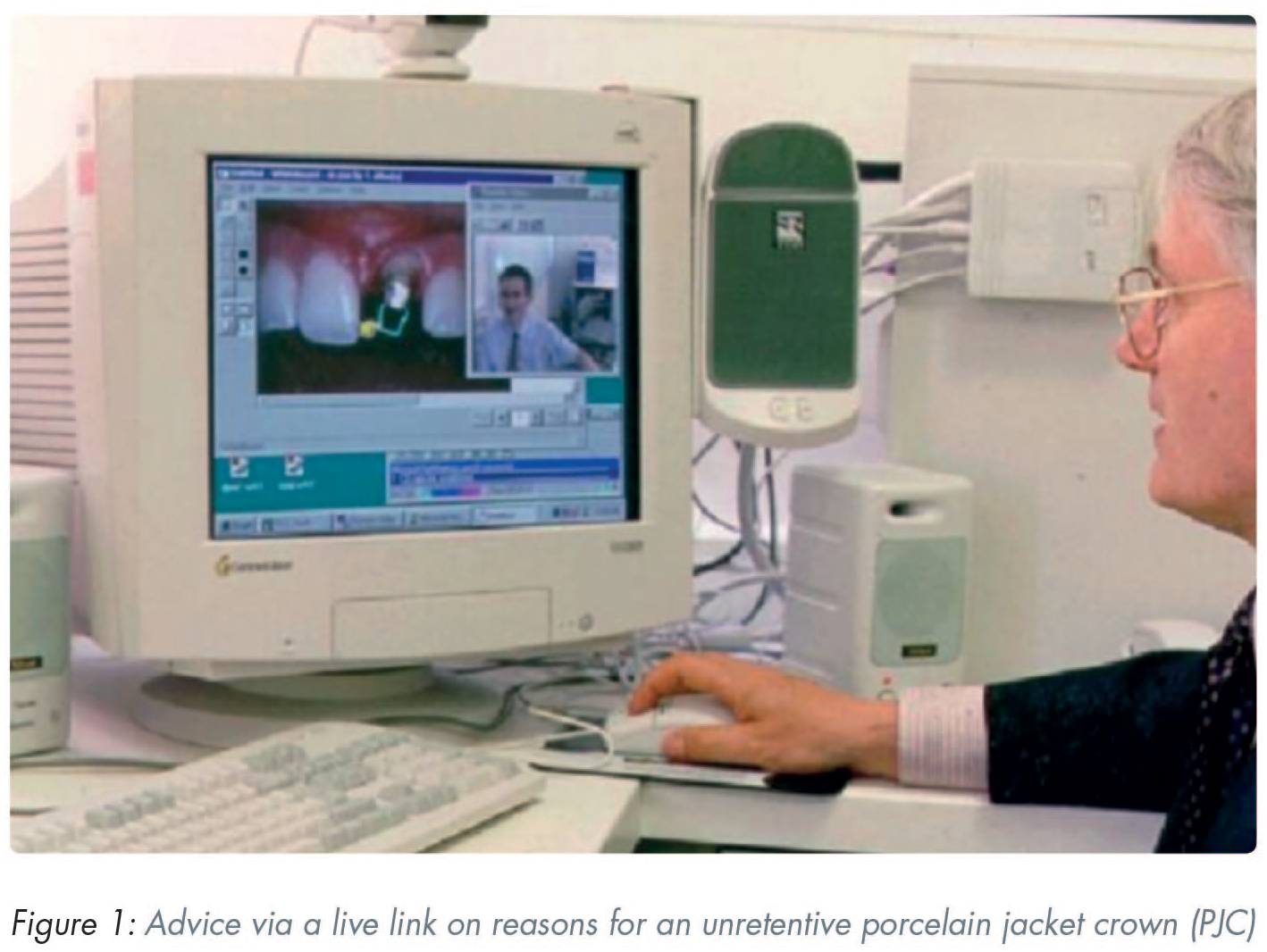
In the late 1990s, the orthodontic department at the Bristol Dental School provided advice to dentists and patients in West Cornwall via video conference using Integrated Services Digital Network (ISDN) links to transmit live images of the patients, their radiographs and study casts. 14 This may have been the first use of digital technology in the UK to provide distant dental consultations and treatment plans. Between 1998 and 2002, informal one-off consultations in real time using videophones and ISDN 6 links, also took place, to distant dental practices from the Eastman Dental Institute. Figure 1 shows such a link, during which advice on the probable reason for an unretentive porcelain jacket crown (PJC) was given to a GDP in a practice 40 miles distant.
In other countries, since 2014 and prior to the COVID-19 pandemic, examples of the use of teledentistry to provide distant diagnosis and advice include: to the residents of care homes for the elderly in Australia15,16 and in Brazil to diagnose dental caries in juvenile offenders in prison. 17
During lockdowns caused by the COVID-19 pandemic, GDPs in the UK used mobile phones and/or computers to provide online advice to their patients, usually in real time. It is also possible for patients to store and forward images to their clinicians.
As a result of the COVID-19 pandemic, there has been a marked increase in papers written on teledentistry. Readers of this paper are referred to two such papers, one a systematic review 18 and the other a narrative review. 19 The narrative review 19 is particularly useful as it succinctly deals with the scope of teledentistry, the equipment required, the use of teledentistry in general dental practice and specialist practice, its role in oral medicine, oral and maxillofacial surgery, endodontics, orthodontics, prosthodontics, periodontics, children’s dentistry and preventive dentistry, the pitfalls of teledentistry, informed consent and patient confidentiality.
Digital dental education
This section describes in detail how and why the Department of Health (DoH) (England) funded the development of a range of digital distance learning for GDPs and how digital learning has developed in dental schools over the last 30 years.
Department of Health (England) distance learning for GDPs in England
Section 63 of the NHS Act 1968 permits the secretary of state for health to make NHS funds available for the provision of the continuing education of dentists who have NHS General Dental Services (GDS) contracts. 20 Prior to 1997 in England, the Dental Division of the DoH (England) administered Section 63 funds and supervised their distribution. In 1997, the Department outsourced this responsibility to the National Centre for the Continuing Professional Education of Dentists (NCCPED).
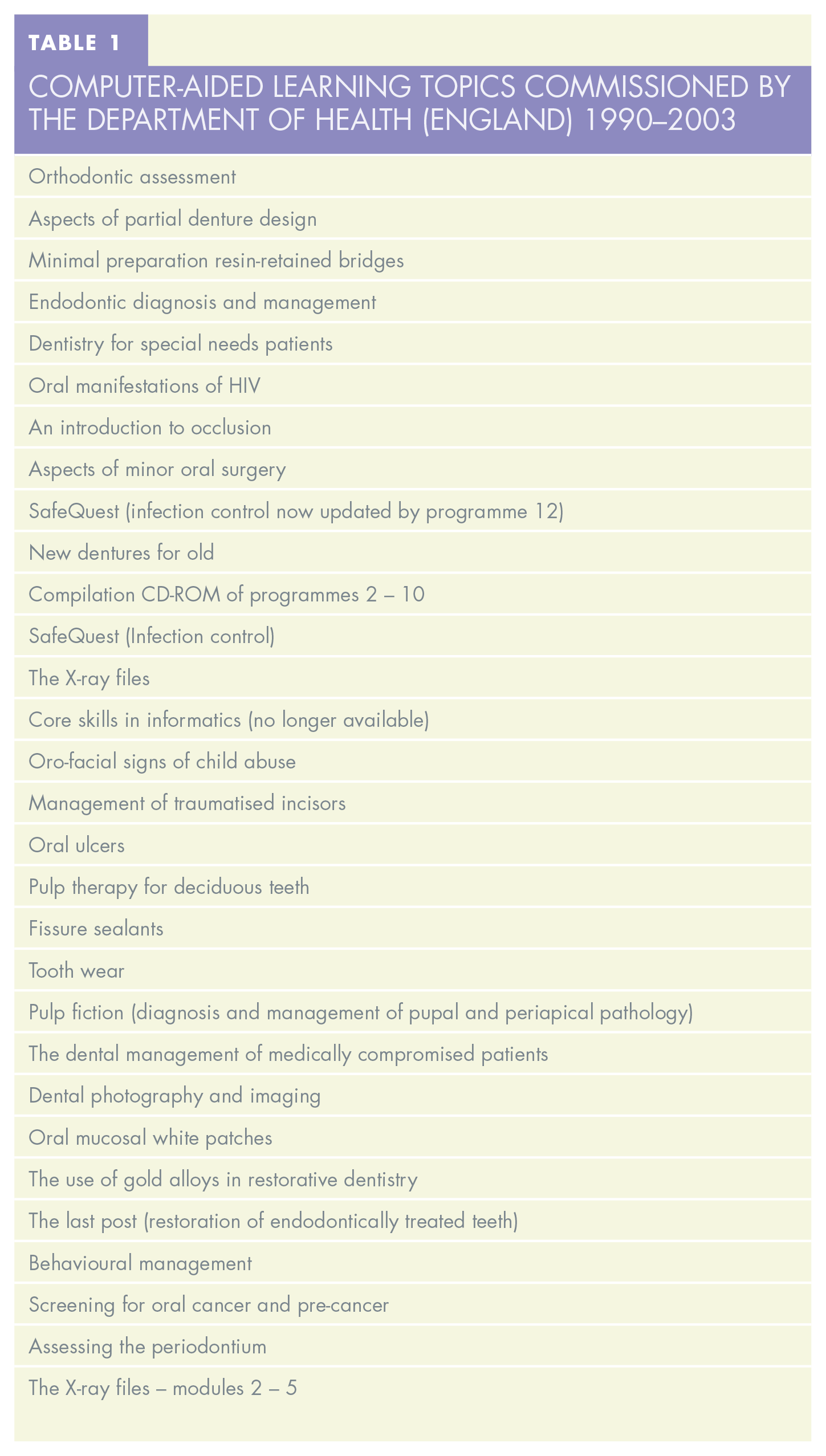
The reason why the DoH (England) commissioned the provision of distance learning material for GDPs with NHS contracts, related to the Schanschieff Report of an enquiry into alleged overprescription of treatment by GDPs with NHS contracts. It found that there was little evidence of deliberate over-treatment but there was evidence that several GDPs had not updated their knowledge since they graduated. 21 A subsequent national survey 22 found that the main reasons for this were lack of time and difficulty in accessing continuing professional development (CPD) courses. The DoH (England) therefore decided to commission a series of videos on 18 different topics to update GDPs. The videos were made available free of charge to all dental practices in England with a contract to provide NHS general dental services. However, these videos did not include any active learning so the next stage was to commission interactive computer-aided learning (CAL) programmes, initially on floppy discs, then on CD-ROMs, and finally on DVDs. Most topics in clinical dentistry were covered, as listed in Table 1.
COMPUTER-AIDED LEARNING TOPICS COMMISSIONED BY THE DEPARTMENT OF HEALTH (ENGLAND) 1990–2003
Prior to their general release, each CAL programme was assessed by 50 GDPs and any problems relating to the accuracy of their contents or ease of use were addressed. Subsequently, quality standards for distance learning materials for dentists were published, 23 addressing three broad questions:
does the material encourage and enable effective learning?
are its contents scientifically correct?
is the technology user-friendly, reliable, and durable?
In 2000, NCCPED funded a successful series of 40 video conferences which linked presenters from the then four London dental schools (Eastman, Guy’s, King’s, and the Royal London) to groups of GDPs meeting in postgraduate centres in the home counties. The project was named PROVIDENT (Postgraduate Regional Online Video conferencing in Dentistry).24,25 In the following year, five webinars were produced and broadcast to 200 dentists in their homes.
The digital distance learning programmes were funded by retaining a small percentage of the annual Section 63 budget centrally. The rest of the Section 63 funds were distributed to the postgraduate deaneries for local CPD courses and hands-on skills centres.
Unfortunately, in 2003 the DoH (England) decided to close the 20 agencies (colloquially known as “off-shore islands”) which it had established to administer various activities, including CPD for GDPs and Dental Vocational Training. As a result, the two dental agencies (NCCPED and the Committee for Vocational Training), were closed. The DoH (England) then transferred all funds for CPD direct to postgraduate deaneries and none were retained for central initiatives, such as the production and evaluation of digital distance learning. The then Faculty of General Dental Practice (UK) was also a loser as, between its foundation and 2003, it had received Section 63 funds for activities such as national one day CPD conferences held in London.
Digital dental education in dental schools
From the mid-1990s two pioneers lead the development of CAL and digital dentistry in UK dental schools. They were Professor Chris Stephens of Bristol and Professor Pat Reynolds of King’s College London (KCL). A CAL facility was established in the University of Bristol in 1994 and the Centre for Computer Assisted Teaching in Medicine was based in Bristol. 26 In addition to the provision of distant orthodontic consultations from Bristol to West Cornwall described earlier in this paper, 14 Professor Stephens produced a range of digital educational material, including an expert rule-based system for fixed appliance treatment planning. 27
At KCL, Professor Reynolds promoted the use of technology enhanced learning (TEL) and virtual learning environments (VLEs). At KCL, TEL and VLE initiatives have included the development of an International Virtual Dental School (IVIDENT), 28 a computer game for public health planning (Games Research Applied to Public Health with Innovative Collaboration [GRAPHIC]), 29 and haptic dental training (Haptel) simulators to help dental students acquire tactile skills when drilling teeth. 30 Several other haptic stimulators have been developed for dental teaching, including Dentsim (Image Navigation, New York, USA), Simodont (Nissin Dental Products Inc., Kyoto, Japan), and Periosim (College of Dentistry, University of Illinois, Chicago, USA). None are perfect, however, they are improving all the time.
Moodle™ (Moodle, Perth, Australia) and Blackboard® (Blackboard Inc., Reston, Virginia, USA) have been developed as online repositories for teaching material and the transmission of student assignments, and Turnitin (Advance Publications, Oakland, California, USA) has been developed to assess whether student assignments, dissertations and other written work have been plagiarised. 31
Online forums for dentists and dental care professionals
GDPUK, 32 one of the earliest online forums for GDPs, was established in 1997. There are now several others and most dental organisations, such as the College of General Dentistry and the General Dental Council, produce monthly updates which are distributed via email and social media.
Conclusions
This paper has reviewed some of the initiatives involving digital media which have transformed all aspects of dental practice and dental education in the last 30 years. Progress has not been made at a consistent speed. However, the recent COVID-19 pandemic has highlighted the benefits of using digital technology in all aspects of dental practice and education.