




Abstract
This article examines the merging of mobile media and gaming cultures through mobile esports (electronic sports). Exploring the accessibility and challenges associated with mobile esports labor practices offers a critical look at Indonesia's informal economy today. This economy operates at the intersection of mobile networked creativity and “playbour"—the blend of play and work—in a fragile employment environment. The article introduces the concept of mobile playbour to analyze specific practices in Indonesia, emphasizing the creative, social, and emotional labor of players that drives the monetization of esports. It ultimately highlights digital and community-building opportunities, the structural instability of mobile game labor, and its broader implications for creativity and monetization in mobile media and game studies.
The convergence of mobile media and gaming cultures in the Asia Pacific Region has created a significant field of mobile media production and consumption that was once unique, large, and overlooked (Hjorth, 2008; Jiwandono, 2025; Moore, 2025). In this context, Indonesia offers a compelling case study. Indonesia has rapidly increasing mobile media adoption rates (Kemp, 2025a) as part of the mobile media trend in Asia (Kemp, 2025b; 2025c) and emerging micro-industries related to mobile game convergence in the form of mobile electronic sports (henceforth mobile esports). Indonesian mobile esports offers a fascinating case study of conditions of precarity and play-as-work—or what Julian Kücklich calls playbour (2005). Defined initially by Kücklich (2005) to describe game players’ modding practices, in which companies exploit players’ free labor for profit, the current definition of playbour includes the monetization of gaming activities like streaming (Goggin, 2011; Richardson et al., 2021; Taylor et al., 2015). The definition varies even more in Indonesia. Playbour intersects with mobile esports in Indonesia through digital entrepreneurship, competitive gaming, local esports, and traditional entrepreneurial activities (Jiwandono & Purwandi, 2020; Jiwandono, 2025).
Mobile media have played a key role in the rise of these types of work. The use of mobile media has introduced new features to esports work in Indonesia, including an orientation toward mobile games, community engagement, and working flexibility. Game streaming and competitions take place on mobile devices and apps, primarily focused on mobile games. They also frequently intersect with local esports, which is focused mainly on mobile media usage. In addition to this, traditional entrepreneurship supports esports by offering mobile gaming spaces and community events. The flexibility of mobile gaming in terms of space and social aspects also often leads to these activities blending and overlapping. For example, game streaming, game competitions, and local esports tournaments are common at spontaneous game spots, such as food stalls. This creates mutual benefits for the esports workers and businesses owners.
These emerging forms of work have revealed a direct linkage between the fusion of play and labor, and the broader community, with mobile media serving as the primary conduit. In turn, this fusion underscores the convergence of playbour and mobile networked creativity—an essential lens through which to examine Indonesia's mobile esports. Mobile networked creativity involves commodifying mobile media hardware and software to navigate challenging living conditions (de Souza e Silva & Xiong-Gum, 2021; de Souza e Silva, 2022a; 2022b). Previous studies have observed this phenomenon predominantly in regions of the Global South, such as Brazil, Venezuela, and the Philippines (de Souza e Silva & Xiong-Gum, 2021; de Souza e Silva, 2022a; 2022b). Mobile networked creativity also defines mobile gaming as being characterized by its commodification through mobile network innovations for social interaction (Andrade & Filho, 2022) and for earning income (Mirani, 2023).
The investigation of mobile playbour draws on the centrality of mobile networked creativity in play-as-work in Indonesia. In the following discussion, I examine two key dimensions of this centrality. First, mobile esports in Indonesia illustrate a form of playbour that is heavily shaped by the prominence of mobile media culture. Second, the esports work examined in this article highlights the strengths and weaknesses of mobile networked creativity and playbour as flexible and accessible yet unsustainable sources of income for Indonesian mobile esports practitioners. As a result, mobile playbour in Indonesia remains inherently precarious.
To explore and understand the phenomenon of mobile playbour in Indonesia, I employed digital ethnography (Hjorth et al., 2017; Pink et al., 2016). By conducting semi-structured interviews (Bryman, 2012) with 18 participants—including e-athletes, esports organization administrators, content creators, and amateur competitors—I analyzed the practice of mobile esports work in Indonesia. Fieldwork also involved attending events to understand the complex practices. Digital ethnography is a well-established method for investigating emerging phenomena related to mobile media use and digital gaming (Hjorth, 2008; Thornham, 2011). The research was conducted in the islands of Java and Borneo. The fieldwork in Java revealed playbour-related esports activities such as game streaming, competitive online gaming, and local esports. In contrast, fieldwork in Borneo focused on the mobile esports community within the context of traditional entrepreneurship.
Two key contributions to mobile media studies and game studies are made by this research. The first contribution emphasizes the importance of mobile gaming in the Indonesian mobile media ecosystem. It examines how gaming has evolved as a mobile media practice, its vital role in the rise of mobile esports, and the region-specific media environment they have created. The second contribution considers Indonesian gaming culture as inseparable from the country's mobile media practices—as essential parts of the Indonesian mobile media ecosystem. Gaming only became a mainstream part of Indonesian culture after mobile esports gained popularity. It then developed into various digital and traditional entrepreneurship activities and local competitions in Indonesia, serving as creative practices rooted in human–mobile media relationships that are expressed through play (de Souza e Silva & Xiong-Gum, 2021). In the following section, I explore the factors shaping mobile playbour in the country by examining Indonesian mobile media practices, mobile gaming in Asia, its adaptation into esports, and the emerging phenomena of mobile networked creativity and playbour in a subsequent section on the context of Indonesian mobile playbour.
The context of Indonesian mobile playbour
Indonesian mobile media uses
Mobile media are crucial to Indonesians’ daily lives, needs, and leisure activities (Onitsuka et al., 2018; Purbo, 2017; Tapsell, 2015). Four main mobile media characteristics define how Indonesians use mobile media: high usage rates (Kemp, 2024; 2025a), daily engagement with mobile media (Tapsell, 2015), digital leapfrogging (i.e., bypassing earlier technological stages to close the digital divide via mobile media) (Puspitasari & Ishii, 2016), and the rising popularity of mobile gaming (Jiwandono & Purwandi, 2020; Jiwandono, 2025). Observed through the lens of mobile playbour, the widespread popularity of mobile games has created new economic opportunities in Indonesia. This has allowed Indonesians to earn money through mobile esports by engaging in digital entrepreneurship, participating in local esports competitions, and pursuing various traditional entrepreneurial activities.
The primary foundation for the rise of mobile playbour in Indonesia is the country's strong mobile internet. Indonesia is a country that has experienced rapid growth in mobile internet usage (Kemp, 2024; 2025c). Its information and communications technology (ICT) literacy and networked connectivity are afforded by mobile media (Onitsuka et al., 2018; Purbo, 2017; Puspitasari & Ishii, 2016). The mobile internet penetration rate steadily increased from around 11% in 2018 to over 74% in 2025 and is predicted to reach 85% by 2029 (Kemp, 2025c; Nurhayati-Wolff, 2024). In China, mobile internet penetration was reported to be approaching 78% by 2025 (Kemp, 2025a) and 77% in India in the same year (Kemp, 2025b). This positions Indonesia among the top Asian countries for mobile internet access.
This strong position is reflected in Indonesian's daily use of mobile media for leisure, socialization, and information gathering, all of which are integral to Indonesians’ everyday lives (Tapsell, 2015). Furthermore, Puspitasari and Ishii (2016) argue that mobile media use is a crucial element in leapfrogging the digital divide in Indonesia. In contrast, there was previously a persistent inequality in wired internet connectivity (Ariyanti, 2013). Its strong position also enables Indonesians to gain experience with up-to-date ICT skills (Ariansyah et al., 2019) and to be involved in contemporary media activities, including mobile esports (Jiwandono & Purwandi, 2020).
Mobile esports phenomena mirror the rise of mobile gaming in Northeast Asia and Southeast Asia. Consequently, Chinese mobile games were imported into Southeast Asia and quickly gained immense popularity there. I will discuss mobile gaming in Northeast and Southeast Asia, the shift from mobile gaming to mobile esports, and the rise of mobile playbour in Indonesia in the next section.
Mobile games in Northeast Asia and Southeast Asia
Indonesia's connections to Asian mobile media and the digital gaming culture are crucial in driving the rapid growth of its unique form of playbour. Indonesia is the largest mobile game market in Southeast Asia, earning over 3 billion U.S. dollars in revenue in 2023 and more than 1 billion U.S. dollars annually from 2023 to 2025 (xsolla, 2025). In terms of revenue, Indonesia surpassed India, which generated only 400 million U.S. dollars in 2025 (Mitter, 2025). Indonesia's reputation as a hub for mobile gaming is also evident in mobile esports (Jiwandono & Purwandi, 2020; Jiwandono, 2025). The popularity of mobile esports in Indonesia has been growing rapidly since 2016 as part of its increasing adoption across Southeast Asia (Jiwandono & Purwandi, 2020; Marta et al., 2020).
The rise of esports is due to the prominence of mobile media, rather than video game consoles or computers, as the primary devices for digital gaming and esports competition (Jiwandono & Purwandi, 2020). However, it is essential to understand that the Indonesian mobile esports phenomenon was not formed in a vacuum. It was informed by the global uptake of touchscreen mobile gaming (Consalvo, 2012; Juul, 2010; Richardson, 2011), the Chinese mobile games industry (Fung, 2017), and the distribution of Chinese mobile games to Southeast Asia (Borrowy, 2017; Jiwandono & Purwandi, 2020; McCauley et al., 2020; Moore, 2023; 2025).
Globally, there has been an increasing entanglement of digital games and mobile media over the past two decades. Gaming on mobile media has gradually become the primary mode of gaming (Consalvo, 2012; Juul, 2010; Richardson, 2011). Consalvo (2012) points out that digital games are crucial to the rapid adoption of touchscreen smartphones, as evidenced by the iPhone's popularity during the late 2000s, when mobile games such as Angry Birds and Street Fighter IV were popular. The popularity of touchscreen mobile games was the beginning of mobile gaming's third significant feature: the shift toward playing games on touchscreen smartphones and, consequently, the phasing out of dedicated portable gaming devices (Richardson et al., 2021).
The use of touchscreen smartphones for mobile gaming has promoted a global rise in mobile game use. In Western countries such as Australia, there have been rises in casual gaming (Balmford & Davies, 2020; Leaver, 2016; Richardson, 2011), locative mobile gaming (Hjorth & Richardson, 2014; Wilken, 2015), and even background gaming (Hjorth & Richardson, 2009; Keogh & Richardson, 2018) among Australians’ daily mobile media uses. However, Northeast Asia is unique because it is a region where mobile gaming has evolved from casual to competitive gaming (Borrowy, 2017; Yu, 2018).
For Juul (2010), casual gaming is characterized by accessible and interruptible mobile gaming. Northeast Asian mobile gaming practices initially followed casual gaming characteristics during daily activities such as commuting or waiting (Hjorth, 2008; Jin et al., 2025); however, the trend changed to mobile esports following the release of Chinese online multiplayer games on mobile media with a strong focus on the competitive scene (Borrowy, 2017; Yu, 2018; Zhao & Lin, 2021). This business model has proven highly popular domestically (Borrowy, 2017; Fung, 2017) and internationally, as China expands its mobile game distribution into Southeast Asian markets (Ball, 2024; Moore, 2023; Moore, 2025; Zhao et al., 2023).
Indonesia represents a key part of China's market expansion. Chinese online mobile games such as Mobile Legends: Bang Bang (MLBB) and PUBG Mobile (PUBGM), as well as the Singaporean game Garena Free Fire (FF)—which has significant Chinese involvement—are very popular in Indonesia (Jiwandono, 2025). Chinese mobile games’ compatibility with low-cost smartphones (Berida, 2017), free-to-play characteristics (Ball, 2024), similarities to established online games (Jiwandono & Purwandi, 2020), and the Indonesian high percentage of smartphone usage (Kemp, 2024; 2025c) are essential factors in Chinese mobile games’ popularity in Indonesia. Over time, Chinese mobile games have been commodified to make a profit through esports competitions and the by-product of which is precarious work. This includes digital entrepreneurship, local competitions, and traditional entrepreneurship (Jiwandono, 2025). Understanding this rise of mobile esports as a source of employment and entrepreneurship in Indonesia requires situating it within mobile networked creativity and playbour—as I will discuss next.
Indonesian mobile esports, playbour, and mobile networked creativity
Mobile playbour in Indonesia has emerged from the intersection of mobile esports’ popularity, its acceptance among both the esports community and the public, and the economic opportunities it creates. It is essential first to define each practice and concept to identify the intersection. Mobile esports is, in general, a mobile gaming competition that superficially resembles esports on a desktop or PC (Jin & Besombes, 2025). In Indonesia, mobile esports allows several media-centric mobile activities to flourish beyond the professional competitive scene. They include mobile game streaming, paid online gaming, local esports, and traditional entrepreneurships. These activities, in turn, are closely associated with the concept of playbour.
Playbour fundamentally refers to any user-initiated productivity around digital games on digital platforms that is free for corporations to monetize (Goggin, 2011; Kücklich, 2005; Richardson et al., 2021). However, playbour in Indonesia has diverged to touch more on esports communities at the grassroots (Jiwandono & Purwandi, 2020; Jiwandono, 2025). Diversification means that while the basic principles of game design on digital platforms remain the same, several of these practices occur through direct collaboration within communities. That collaboration is where playbour intersects with mobile networked creativity.
Mobile networked creativity itself can be understood as the communal use of mobile media that eventually crystallizes into practices (Andrade & Filho, 2022; de Souza e Silva & Xiong-Gum, 2021). This reflects the conditions in many parts of the Global South, where people use their mobile phones to earn informal income, including through playing mobile games (de Souza e Silva & Xiong-Gum, 2021; Mirani, 2023). Therefore, mobile playbour centers on mobile media and is socially practiced. It differs from the playbour observed in the West, where playbour is mainly practiced on desktop computers or through parasocial relationships (Goggin, 2011; Kücklich, 2005; Richardson et al., 2021).
The intersection of playbour and mobile networked creativity has led to the commercialization of esports through mobile devices in Indonesia. This commercialization is evident in three areas: the rise of mobile esports into the mainstream, mobile esports as a gaming logic, and the informal Indonesian economy sector, which has long been its foundation (Nugroho, 2021). The mainstreaming of esports via mobile media as its primary platform is clear. Mobile esports has been transforming gaming into a mainstream trend in Indonesia since 2018 after being niched for decades (Jiwandono & Purwandi, 2020). As a result, there is a perception that digital gaming is synonymous with mobile esports. This perception has been reinforced by the emergence of the esports business within informal micro and small enterprises in Indonesia.
The inclusion of mobile esports in the Indonesian informal economy is driven by the popularity of esports as entertainment (Andreas & Arymami, 2021; Jiwandono & Purwandi, 2020), and the ease of earning income through mobile media (Jiwandono, 2025). The commercialization of mobile esports in Indonesia is clear in two well-established sectors: gaming spectatorship (Abidin, 2018; Richardson et al., 2021; Taylor, 2018) and contract work (Liboriussen, 2016; Taylor et al., 2015). Both involve income generation through commercial activities on mobile gaming platforms, community outreach, networking, and personal branding.
There are four forms of esports work in Indonesia: game streaming, game competitions, local esports, and traditional entrepreneurship activities. Game streaming on YouTube primarily involves playing popular mobile games, actively engaging with audiences, and inviting them to join the stream. Esports competitors earn income from mobile game esports by becoming contract players on mobile game apps or by playing, such as competing for local or regional esports teams. There is also a growing trend of traditional entrepreneurship activities, such as coffee shops and food stalls, becoming game centers for mobile esports players.
These activities constitute the intersection of digital gameplay and paid work through mobile media in Indonesian gaming communities. The key concept of playbour guides the intersection (Kücklich, 2005; Goggin, 2011) and the creation of “culturally appropriate technologies” (de Souza e Silva & Xiong-Gum, 2021, p. 823) through the community-based activities that are at the core of mobile networked creativity. Through interviews with Indonesian esports practitioners, in my exploration of the creative intersection of mobile networked creativity and playbour I have expanded the term to encompass mobile esports. In the following section, I will discuss digital ethnography as my research methodology by explaining my rationale for using it, my data collection process, and my data analysis.
Methodology
As stated, this study deployed digital ethnography research methods. This method allows for everyday life experiences and practices to be captured and for the complex entanglement between digital, material, and social worlds to be situated (Pink et al., 2016). This research paradigm is well-suited to exploring mobile esports, as it helps us to understand how mobile game usage informs innovative mobile media practices. Digital ethnography is typically conducted through participant-led interviews (Pink et al., 2016) because it emphasizes two key features: reflexivity and empowerment. It places the primacy of knowledge production with participants and takes an anti-determinist approach, positing that research “findings” cannot be predicted but are instead revealed through the ethnographic process (Bryman, 2012). As demonstrated by Hjorth (2008), Thornham (2011), and Hjorth and Richardson (2020), knowledge is constructed through participants’ actions and refined through researchers’ interpretations.
Participants were recruited using a combination of purposive and snowball sampling methods. They were approached based on their experience with, and proximity to, mobile esports, as well as the feasibility of their participation. The snowball sampling component was particularly effective, as one participant could lead me to others. This research included 18 participants, consisting of e-athletes, esports administrators, amateur competitors, and game streamers from various cities and towns on the islands of Java and Borneo. This sample size was suitable for an iterative ethnographic project and included the necessary range of participant criteria. As Bryman (2012) notes, ethnographic studies consume significant time and resources, suggesting that one participant equates to 20 or more quantitative research participants in terms of data richness.
Java and Borneo were selected for economic significance and logistical reasons. Economic significance was based on the difference in esports activity between the two islands. Java is the unofficial “main” island of Indonesia, with over 155 million residents (Boakye, 2025), and it serves as the country's economic hub (Boakye, 2025). As a result, esports is prevalent there, with numerous game streaming and local competitions generating revenue. My participants agreed with this view, as they came from streaming and competitive backgrounds in major Indonesian cities such as Jakarta, Surabaya, Yogyakarta, Surakarta, and even smaller towns like Temanggung. In Borneo, esports activities mainly revolve around local food stalls that act as community centers. The logistical reason for selecting Java and Borneo for this research was the agreement to participate from residents of these islands.
The data for this research were collected using semi-structured interviews and participant observation. The interview process involved contacting participants and visiting their chosen locations to conduct the interviews. Interviews ranged from 45 to 60 min and were audio-recorded. When the interview took place at the participant's workplace or gathering spot, permission was granted to observe and record the participant's activities and relevant practices and to clarify the observed practices. The entire data collection process was divided into three phases, with six participants in each phase.
There were two data outputs from the semi-structured interviews: the interview recordings and the fieldwork summary. The interview recordings represented raw data that were processed and organized through the writing of the fieldwork summary. The summaries included information on individual meaning-making, sociocultural relationships, and tacit knowledge. The data analysis approach for this research was grounded theory: a formulation of knowledge based on people's actions, interactions, and experiences (Bryman, 2012). I chose grounded theory as a data analysis method because the inductive process of digital ethnography aligns well with its constructivist approach (Charmaz, 2006). Additionally, I selected it because mobile esports constitutes a specific, novel phenomenon where actions, interactions, and experiences materialize through access to and engagement with mobile digital game technology.
After the data were captured, they needed to be coded and analyzed. The purpose of coding is to ensure that the collected data are relevant to the research direction. The constructivist data analysis coding procedure consists of two phases: the initial phase and the focused phase (Charmaz, 2006). My fieldwork summaries served as both initial and focused coding. There were 18 initial codes corresponding to research participants’ identities, as well as the time and place of the interview or observation. The focused coding encompassed the research topics such as collaboration within esports communities, mobile game affordances, and participatory media aspects of mobile esports, which I and the research participants discussed. Patterns of analytical categories were analyzed and condensed into theoretical clusters. This research identified four theoretical clusters related to Indonesian mobile esports work: game streaming, competitive online gaming, local esports, and traditional entrepreneurship. I will provide an overview of these clusters and evaluate their opportunities and challenges in the next section.
The precarious condition of mobile playbour in Indonesia
Overview
Mobile playbour has the benefits of flexibility and quick income generation; however, it is also open to challenges in sustainability. Mobile media play a major role in these benefits, arising from the low barriers to entry and the almost nonexistent bureaucratic process. Mobile media are also key to social opportunities arising from community engagement between local businesses and esports practitioners. However, the challenges are clear. Incomes are irregular despite the quick payouts, and job insecurity is high, especially among local esports team members. In summary, short-term ventures with limited career prospects significantly offset their accessibility, flexibility, and simplicity. These circumstances make mobile playbour precarious. In the following discussion, I will elaborate on forms of mobile playbour in Indonesia, based on my interviews, starting with game streaming. I will refer to interviewees by first-name pseudonyms to protect their anonymity.
Game streaming
In Indonesian mobile esports, game streaming is a business that uses social media and gaming platforms to earn money. It has become a popular self-employment option. It generally follows standard practices in esports game streaming while also addressing emerging trends in mobile media use. Game streaming is practiced on video-sharing and streaming platforms such as YouTube and, previously, Niimo.TV.
It is monetized through community-based enterprises that enable game streamers to generate income by fostering strong engagement with their audiences (Abidin, 2018). The community-based enterprises demonstrate a significant connection between game streaming and esports. Cunningham et al. (2019), Scholz (2020), and Johnson and Woodcock (2021) emphasize the crucial role of streaming services like Twitch and social media platforms in the esports ecosystem across both Western and Asian contexts, as these platforms allow esports teams to build their brands and nurture relationships with their fan bases. In Indonesia, game streamers frequently intersect with mobile esports competitions, and the accompanying camaraderie, and cultivate their brands by focusing on mobile game fandom (Jiwandono & Purwandi, 2020; Sari & Djamaris, 2022). In doing so, they begin to incorporate mobile esports into their routines and identities.
This is explicitly practiced by Joko, who combines online gaming and game streaming by enticing his audience to play ranked matches together on his YouTube channel. He coins this activity as “pushrank bersama viewer” or a “ranked match with viewers” in English. Joko describes the mechanism of a ranked match with viewers as follows: I would create a game room and share the code with my subscribers. Whoever joins the fastest can play a game together with me. We usually play Free Fire. However, if a subscriber joins the game too often, I will ask them if they would like to give others an opportunity to join.
Joko argues that the main selling point of a ranked match with viewers is the unpredictability of his team's chemistry. The ad hoc team's dynamic with little introduction among its members is markedly different from an established team that has had sufficient time and opportunity to team build. Joko describes the dynamic as follows: The audiences are generally entertained by a fierce game, where we fight tooth and nail to achieve a victory. That scenario often happens because me and viewers/team members don’t have enough time to develop a gaming chemistry. Another thing that is well-liked by the audiences is when a viewer plays better than I do which adds more to the element of surprise.
Joko modifies gaming parasociality, which usually refers to one-way idolization from audiences toward gaming personalities (Taylor, 2018; Richardson et al., 2021). That is, through the membership system for his YouTube channel, which costs only 50 US cents (USD) per month. The benefit of being a member is gaining more insight into popular mobile games and being regularly invited to the ranked match with the viewers program. The membership program offers an incentive, as Joko is an FF coach with a proven track record in the mobile esports scene in Surabaya, East Java.
The membership program is a practice where mobile media use is essential. Joko invites paid members to join a WhatsApp group in which he often shares FF tips and tricks. This reflects the creative practices of mobile media networks that focus on improving quality amid limitations through mobile media use (de Souza e Silva, 2022a, 2022b). Using WhatsApp for a mobile esports group helps mitigate the lack of online gaming forums in Indonesia, since Reddit is inaccessible without a VPN (i.e., virtual private network). When analyzed through a playbour lens, Joko's management of the WhatsApp group fosters a mobile community-based playbour. He allows group members to join him in moderating the YouTube channel to manage trolls and unsavory behaviors. In doing so, Joko has transformed the parasocial aspect of playbour into direct social interaction by sharing his gaming work with his subscribers.
Joko also works effectively with mobile esports teams in Surabaya, East Java, Indonesia. He is often hired as an esports coach and game streamer for various teams. Joko's dual roles as coach and streamer highlight the unstable nature of mobile playbour in Indonesia, where people often take on multiple insecure jobs to earn money. This is especially clear in gaming, as there are several ways for mobile esports players to make money through the commodification of play. As I will discuss in the next section, competitive online gaming turns play into a product for profit. It leverages mobile gaming's popularity and accessibility, but remains uncertain due to its informal employment practices and dependence on short-term contracts.
Competitive online gaming
Competitive online gaming in Indonesia's mobile playbour environment is a form of work where a player offers their services to help another player achieve victory or a higher rank. There are two main practices: becoming a ranked-match jockey or a player-for-hire. Both are common among the MLBB community. During the process, a jockey is given access to their clients’ game accounts to play specific sets of games on their behalf, aiming to increase their clients’ rankings through repeated wins.
A player-for-hire lends their services as a teammate to their client, rather than acting as a proxy player. The mechanism for becoming a player-for-hire is implemented through a mobile game app called Lita. Lita was developed in Singapore by Battuta Technology and has been popular in Indonesia since 2021. The app enables users to apply to become freelance players. Lita's system primarily compensates talent in Lita coins, which can be cashed in for real-world currency, such as the Indonesian rupiah. Lita user Diandra described how Lita is popular among esports community members at her university. Another Lita user, Iman, emphasized the economic potential of becoming a player-for-hire, noting that his friend earned US$1,200 within 3 months of becoming a player-for-hire for an entire MLBB season. That amount of money enabled him to become a breadwinner for his family within the Indonesian standard of living (see Figure 1).
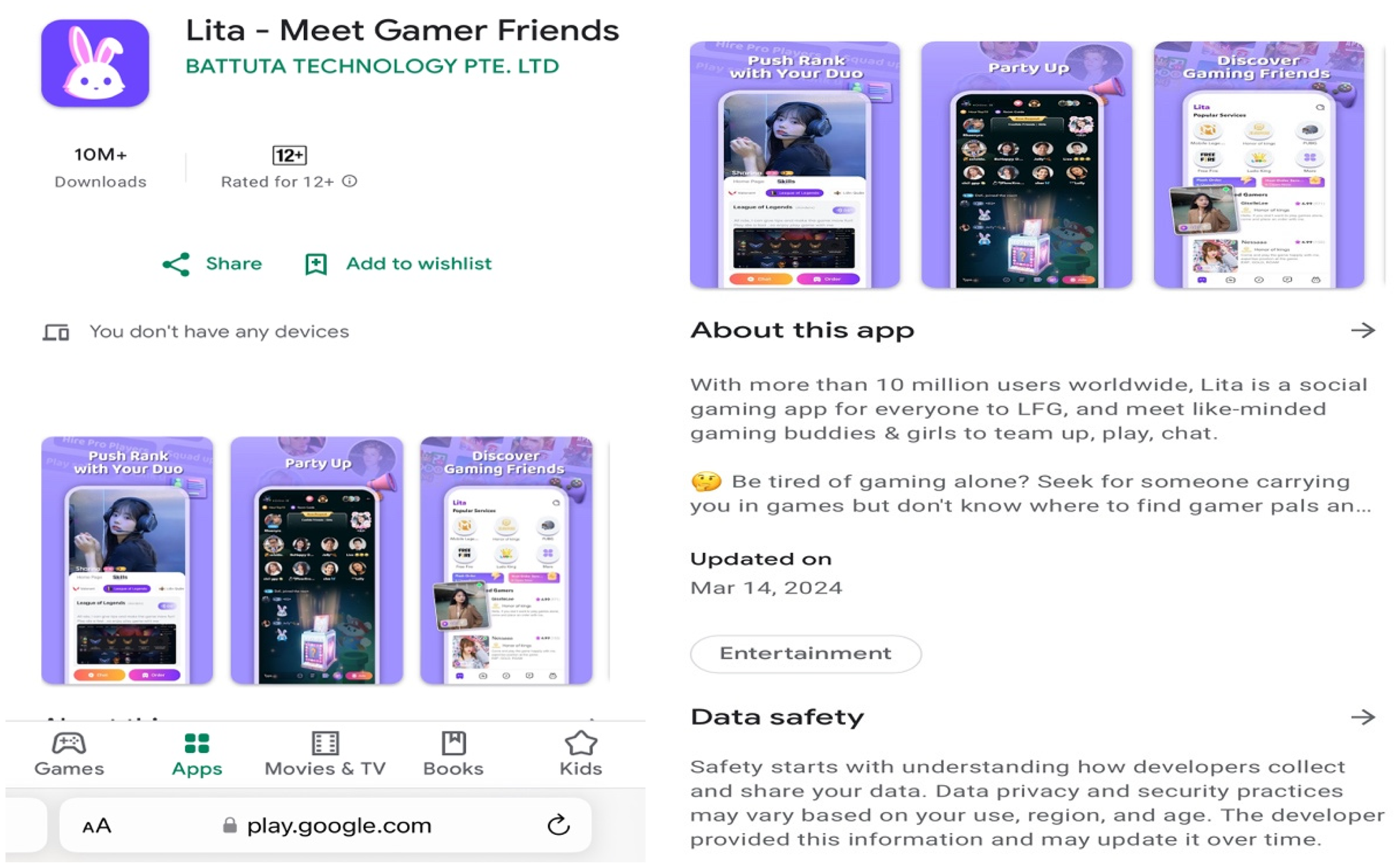
Lita app screenshot from Google Play Store. It describes the app's overview and user interface.
Both practices are clear examples of playbour within Indonesia's mobile esports scene. They both commodify playing digital games, stem from the Indonesian mobile media focus, and carry the vulnerability of short-term, accessible income. Diandra and Iman contend that neither activity offers a career path and both are only suitable as a side job during school or university. Iman told me that a common way for a ranked-match jockey to promote their service is through social media content on TikTok and Instagram. The platform-based mobile networked playbour is embodied by the Lita app, which supports competitive online mobile gaming along with social media features. Lita and its popularity have helped establish an Indonesian mobile gaming economy.
However, Indonesian mobile playbour is not limited to digital platforms. I will examine offline work through local esports involvement in the upcoming section, which will define what local esports participation means in the Indonesian context, include research participants’ insights on the phenomenon, highlight the role of mobile media in gaming, and explain why it is the riskiest form of mobile playbour.
Participation in local esports
Indonesian local esports represents an evolution in grassroots mobile gaming that predates major league esports. (Jiwandono & Purwandi, 2020; Jiwandono, 2025). It demonstrates how esports remains connected to its grassroots roots while also framing semi-professional competition within the local context. In practice, local esports teams do not compete in major leagues of well-established games in Indonesia, such as MLBB or PUBGM. They usually have more limited funds and generate less income. Local esports teams are also more likely to actively participate as stakeholders in the regional esports ecosystem than major esports teams, which often operate more like profit-oriented companies on national or international stages. Adam, a manager of an Indonesian local esports team that I interviewed has a close working relationship with their region's esports organization and local football club. They not only function as a competitive esports team but also as ambassadors who help to introduce mobile esports to the local community.
The smaller scale of a local esports team is reflected in its e-athletes, who are often given additional responsibilities, including involvement in the team's administrative and managerial duties. These volunteer roles are needed as local esports teams usually have fewer positions in their management structure. This situation was experienced by Andi, Fajar, and Hadi, who worked together in a local esports team based in Jogjakarta from 2022 until 2023. During their stint together, Andi served as the team's manager. At the same time, Fajar and Hadi played for the team and were tasked with talent scouting in addition to their competitive obligations.
Despite being given extra tasks, they made a relatively small income. Fajar disclosed his monthly salary of US$75, a meager amount even by Indonesian living standards, while Hadi made more money from streaming than from competition. On the managerial side, Adam lamented that his continuous requests for human resources to the executive board were not adequately addressed. Furthermore, a local e-athlete's contract is usually short-term. Both Fajar and Hadi had changed clubs three times in 3 years, and their latest contract was for only 1 year.
Participation in local esports teams is rarely a sustainable economic opportunity. Many mobile esports players will remain at the grassroots level, making it difficult to progress to Indonesian national and international mobile esports. This instability is worsened by intense grassroots competition, fueled by the popularity of esports and the accessibility of mobile games. Clearly, poor performance by Fajar and Hadi had led to their exit. Hadi described his experience: Mobile esports is risky because many are unwilling to see the grim pictures and the difficulty in establishing a foothold in the profession. Especially if you’re from a small town. To be successful in this business, you need connections. It means you need a lot of money. Only a select few have that.
Local esports participation in Indonesia offers both opportunities and risks related to mobile media access and game work. Local mobile esports turns mobile gaming into a form of accessible productivity (Mirani, 2023), thereby immediately incentivizing the commodification of digital gaming (Kücklich, 2005; Goggin, 2011) and enabling Indonesian local e-athletes to earn income (Jiwandono & Purwandi, 2020; Jiwandono, 2025). However, this accessible productivity remains unstable because local esports faces significant job insecurity (McCutcheon & Hitchens, 2020; Johnson & Woodcock, 2021).
Therefore, local esports offers precarious economic opportunities that serve as a temporary work-around rather than a long-term solution. This is especially relevant to deeply rooted Indonesian issues such as unemployment and job insecurity (Yanindah, 2021; Sitompul & Athoillah, 2023). On the positive side, mobile playbour can also expand into traditional entrepreneurship activities. The expansion generally presents more optimistic situations than local esports, as they strategically align with Indonesian mobile gaming habits. This is important because it shows that mobile playbour has successfully connected esports communities with the broader public, as demonstrated by ongoing collaborations. I will explore their emergence and the significance for both in the upcoming section.
Traditional entrepreneurship activities
The following cases illustrate how traditional entrepreneurship opportunities intersect with the demands of mobile esports. This was evident in the Special Region of Yogyakarta, Indonesia, as described by Chandra, a university lecturer in the province who has been observing the local esports scene since 2019. He noted that venues are gaining value as competitions increase, along with the development of gaming infrastructure like gaming chairs, tables, cooling fans, Wi-Fi routers, and signal boosters, and the rise of small businesses making jerseys for local esports teams.
Traditional entrepreneurial activities in mobile esports are mainly seen in food and beverage businesses. Budi and Chandra told me that coffee shops, cafés, and Indomie noodle stalls (warung makan Indomie [Warmindo]) throughout Surakarta and other major cities in Central Java are popular spots for mobile gamers who train or compete online through a practice known as play gathering (main bareng [mabar]). Play gathering is a mobile development of South Korea's game center culture called PC bang (Jin, 2010; Chee, 2016). Mobile gaming enables gamers to turn food and beverage establishments into game centers (Jiwandono, 2025). This creates a mutual relationship as owners of food and drink establishments also adapt their businesses to support mobile gaming, for example, by installing stronger Wi-Fi networks or offering all-inclusive packages for play gatherings.
This makes local businesses centers for mobile esports. Qadir is a casual gamer from Tenggarong, east Borneo, who described a unique entrepreneurial practice related to esports in his hometown. Qadir informed me that Tenggarong has a distinctive social gaming activity at angkringans: Javanese street food stalls (pronounced: unc-kree-ngan) across the town (see Figure 2).
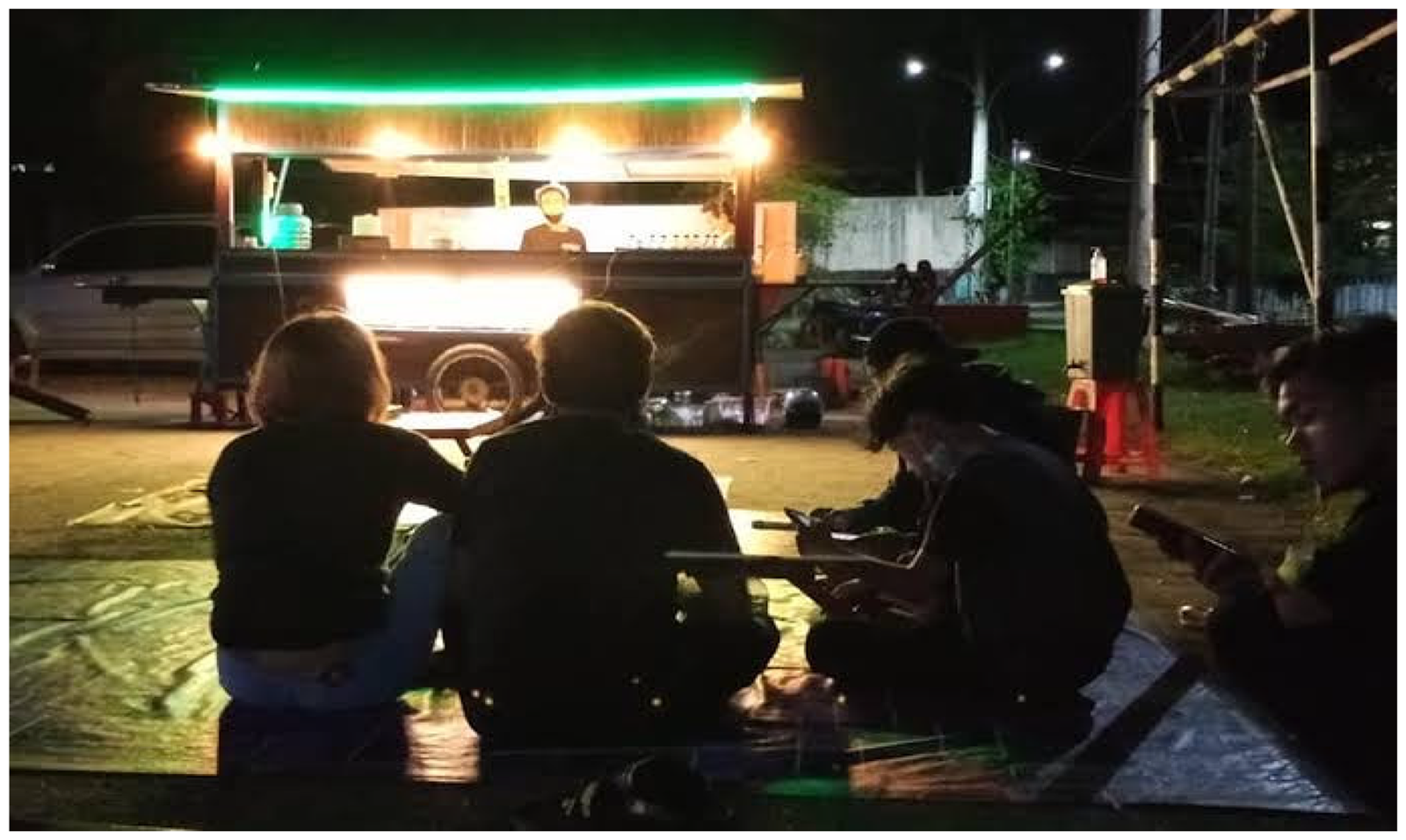
A mobile game esports activity at an angkringan in Tenggarong, east Borneo, Indonesia.
There are three factors that explain why angkringans are becoming popular as gathering spots for fun. First, angkringans sell much cheaper food and drink such as fried tofu, fried tempeh, and iced instant coffee compared to coffee shops, which tend to sell higher-priced items. Most food and drink at angkringans cost less than US$1. Second, angkringans usually open from dusk until dawn, aligning with after-work and after-school times. This allows employees and students to gather more casually than they would at a coffee shop, which normally close at 10 p.m. More importantly, angkringans in Tenggarong play an active role in the local gaming scene by regularly hosting weekly micro-tournaments. This relationship benefits both sides: players get a space to play, and business owners get free promotion as their venues become lively during mobile esports events.
These traditional entrepreneurial activities align with the core feature of mobile network creativity: innovative community engagement through mobile media. This characteristic has been observed elsewhere. For instance, de Souza e Silva (2022a; 2022b) notes how Brazilian bus services and bicycle rentals are directly improved through WhatsApp groups, which facilitate communication and transactions among customers and business owners. In the realm of playbour, focusing on traditional mobile esports entrepreneurial activities broadens its research scope, which mainly centers on digital activities such as modding, game streaming, and gold farming which refers to the practice of accumulating in-game currency or items in order to sell them for real-world money (Goggin, 2011; Liboriussen, 2016; Chew, 2023). By situating digital game works within the relationship between entrepreneurs and the esports community, it also advances research on physical esports and gaming entrepreneurship in Asia, such as the South Korean PC bang (Jin, 2010; Chee, 2016).
I now turn to my conclusions on how mobile esports in Indonesia, by reflecting a localized version of playbour and mobile networked creativity, mirrors Indonesia's mobile media ecology.
Conclusion: Mobile esports in the Indonesian mobile media ecology
The Indonesian mobile media ecology is generally understood as gaining access to new ICT skills through mobile media (Tapsell, 2015; Puspitasari & Ishii, 2016). Mobile esports is one of these new skills that has gained momentum following the emergence of Chinese mobile games and their use as competitive sports (Jiwandono & Purwandi, 2020). Over time, the popularity of mobile esports has led to the spread of mobile playbour, as discussed earlier. It combines the commodification of play with the use of mobile media, community networking, and the appropriation of technologies within Indonesia's informal economy. Ultimately, it creates a picture of productivity that is counterbalanced by job insecurity.
This picture renews the importance of mobile networked creativity as a digital gaming practice. Previous studies on mobile networked creativity in mobile games have focused on their community-gathering aspects (Andrade & Filho, 2022) and explored online game entrepreneurship (Mirani, 2023). My work sits at the intersection of both fields, investigating mobile game entrepreneurship activities and contract work within the esports community, both online and offline, as is often the case with mobile networked creative practices (de Souza e Silva & Xiong-Gum, 2021; de Souza e Silva, 2022a; 2022b).
These playful ventures of mobile playbour are located at the crossroads of mobile networked creativity and playbour. This intersection underscores the importance of play in Indonesia's mobile media ecosystem, which is focused on unstable esports work. Consequently, it expands the idea of playbour by integrating it with mobile creativity through esports. As a result, playbour in Indonesia has evolved from the original focus on game-based (Kücklich, 2005; Goggin, 2011) and platform-based businesses (Liboriussen, 2016; Chew, 2023) to include offline esports competitions and esports entrepreneurship. Playbour plays an essential role in linking mobile game esports with other facets of Indonesia's mobile networked creativity, such as social media and mobile game apps, with esports work serving as a unifying element.
That linking informs my contribution. Firstly, framing mobile esports in Indonesia through the lenses of mobile networked creativity and playbour helps to identify the significance of mobile gaming within the Indonesian media ecology. The confluence is evident in the multitude of grassroots entrepreneurial activities and casual work on digital and offline platforms. It signifies mobile gaming as a practice that transcends gaming communities, infiltrating Indonesian society's media uses and behaviors. Secondly, this article argues that Indonesia's mobile media culture is inseparable from its digital game culture. This is evident in that digital gaming practices diversified only after the rise in popularity of mobile game esports (Jiwandono & Purwandi, 2020; Jiwandono, 2025). Mobile media have become the center of both productivity and the ecosystem of mobile games.
Footnotes

Ethical approval
This article received approval from the RMIT Ethics Committee as part of my PhD research project.
Funding
The author received no financial support for the research, authorship, and/or publication of this article.