




Abstract
This study presents an exploratory approach to the analysis of social differences in smartphone use. Previous research has predominantly focused on problematic smartphone use and addiction. By contrast, this study turns to the research program of Pierre Bourdieu to forward a sociological study on social differences in how people use their smartphones. Using multiple correspondence analysis of Swedish survey data (n = 2,401), the study explores the structure of the “space of smartphone use.” This space is characterized by two main oppositions: high vs. low volumes of smartphone use on the one hand, and degree of investment in legitimized uses on the other. While age and gender remain key factors in explaining how people position themselves in this space, we show that cultural capital, economic capital, and habitus shape these differences. Privileged social positions tend to “push” social agents toward more frequent and legitimized smartphone uses. Social inequalities shape smartphone uses, particularly among older generations.
Introduction
This study employs the research program of French sociologist Pierre Bourdieu to study social differences in smartphone use. We approach smartphone use in an exploratory manner and conceptualize the affordances of the smartphone as a space of potential practices that is likely structured by what Bourdieu (1984) refers to as the social space (that is, social positions). We thus ask how access to social resources (capital and habitus) shapes how people position themselves in the space of smartphone use. The study contributes to existing research on digital divides and internet use (e.g., Pearce & Rice, 2017; Ragnedda et al., 2024; Van Deursen & Van Dijk, 2014), and studies on the relationship between social inequality and smartphone use in particular (e.g., Jansson et al., 2025; Tsetsi & Rains, 2017; Wenz & Keusch, 2023). We also set out to contribute to the scholarly understanding of social reproduction in everyday practices: in our case, how smartphone use reflects broader social structures, such as unequal distribution of social resources. The study takes off from the premise that age and gender remain key factors in predicting different forms and volumes of smartphone use (see e.g., Tsetsi & Rains, 2017). We add the Bourdieusian focus on how social positions shape mundane practices and lifestyles to shed new light on how social differences are reflected in smartphone use. We set out to answer the following research questions:
To answer our research questions, we rely on multiple correspondence analyses (MCA) of a web-based survey (n = 2,401) deployed in Sweden in 2021. Sweden during the Covid-19 pandemic makes for a peculiar case in the study of smartphone practices and social inequality. In numerous rankings and statistics, Sweden emerges as one of the most digitalized countries in the world (e.g., European Commission, 2021). In 2021, 9 out of 10 Swedes reported using a smartphone on a daily basis (Svenskarna och internet, 2021). This year was also when the world witnessed the height of the Covid-19 pandemic—which, among many things, constituted a natural experiment in the acceleration of mediatization and media reliance (Jansson, 2022). The present study is thus asking about the extent to which social positions shape existing and well-documented divides between gender identities and age groups in smartphone use, in a context characterized by far-reaching digitalization and near universal smartphone access. Viewed in this light, the study contributes broadly to the understanding of digital divides beyond access to technology, that is, inequalities in how media are used (e.g., Van Deursen & Helsper, 2015; Van Deursen & Van Dijk, 2014).
We begin by positioning our study in relation to previous research. We then theorize smartphone use as socially structured space of potential practices via Bourdieu. The following section spells out how the Bourdieusian approach was translated into the study design. The subsequent sections show our findings and discuss their implications.
Previous research
In comparison to the vast body of research on divides in internet access and digital media use, previous research on smartphone use has, according to Wenz and Keusch (2023, p. 463), been sparse. Furthermore, the field tends to focus on problematic use (Elhai et al., 2020; Hao et al., 2023; Horwood & Anglim, 2021; Liu et al., 2023), for instance, the risk of smartphone addiction (Aker et al., 2017; Belic et al., 2024; Choi et al., 2015; Van Deursen et al., 2015). In this body of research, personality traits such as neuroticism (Horwood & Anglim, 2021; Liu et al., 2023) and fear of missing out (Elhai et al., 2020) are posited to increase the risk of problematic smartphone use. For instance, women (Choi et al., 2015; Van Deursen et al., 2015) and younger users (Belic et al., 2024), as well as people experiencing anxiety or depression (Aker et al., 2017), have been shown to be more likely to develop smartphone addiction.
In other corners of the field, focus has been put on typologizing smartphone uses (e.g., Wenz and Keusch, 2023) as, for example, “advanced users,” “social media and information users,” etc. A variety of factors can, furthermore, influence to what degree, and how, smartphones are used. One such factor is gender (Auter, 2007; Shade, 2007), as research has found that women are more likely to utilize smartphones for social purposes (Beneito-Montagut et al., 2022; Jeong, 2025; Kongaut & Bohlin, 2016; Van Deursen et al., 2015). Other studies suggest that men are more prone to use their smartphone for entertainment (Jeong, 2025) or tool-related purposes (Zhao et al., 2020). Such gendered patterns also emerge in the stereotypes that people rely on when classifying types of smartphone use. In both women's self-presentation and in men's discourses on smartphone use, women's use of the smartphone is depicted as mainly oriented toward the private sphere (e.g., using the phone to coordinate family activities) (Comunello et al., 2017, p. 808; see also Ytre-Arne, 2023). Women have also been shown to display higher degrees of moral dissonance in relation to how much they use their smartphones and in what ways (Jansson et al., 2025). Age has been shown to be a predictive factor as well, as younger generations use smartphones more than older people (Bolin, 2014; Kongaut & Bohlin, 2016; Van Deursen & van Dijk, 2019). Age also influences the activities performed, as younger users are more likely to use smartphones both for social purposes (Kongaut & Bohlin, 2016; Tsetsi & Rains, 2017) and for news and informational content (Tsetsi & Rains, 2017). Younger users are also more likely to use smartphones in “advanced” ways (Wenz & Keusch, 2023).
Socioeconomic factors such as level of education and income also affect smartphone use (Schofield Clark et al., 2024). Higher income is associated with a higher degree of use of smartphones (Van Deursen & van Dijk, 2019). In terms of activities, educational attainment has been shown to be related to social networking (Kongaut & Bohlin, 2016), use of email services, and news consumption (Ucar et al., 2021), as well as more advanced adoption of smartphones (Wenz & Keusch, 2023). Higher education (Bhuyan et al., 2016) and socioeconomic status (Wang et al., 2022) have also been connected to the likelihood of health-related use of smartphones.
We contribute to this body of research by adopting the Bourdieusian approach. This allows an exploratory analysis of the smartphone, which is conceptualized as a complex cultural form that opens a space of potential practices in which social agents position themselves based on dispositions formed at various social positions. Thus, rather than focusing on individual psychological states, we turn our attention to sociological variables. More specifically, we focus on how capital and habitus shape existing gender and age divides in smartphone use. Besides our contribution to research on smartphone use, we also contribute to the understanding of the structure of lifestyle spaces uncovered by research in the Bourdieusian tradition. While others have studied the space of lifestyles in the general sense (e.g., Atkinson, 2022; Bourdieu, 1984; Hjellbrekke et al., 2015), the space of media use (Purhonen et al., 2021; Sivertsen, 2025), or the distribution of various forms of media use in social space (Hovden & Rosenlund, 2021; Lindell & Hovden, 2018), no other study has, to the best of our knowledge, applied the Bourdieusian research program to study smartphone uses. Given its ubiquitous nature in large parts of the world, we argue that it is high time to shed cultural sociological light on the smartphone.
Theory
We draw on Bourdieusian social theory (Bourdieu, 1984) and Bourdieusian media studies (Lindell, 2024) to accomplish two things. First, relying on the overarching principle of “constructivist structuralism” or “structuralist constructivism” (Bourdieu, 1989, p. 14), we approach the social world and social groups as “existing twice” (Bourdieu & Wacquant, 2013, p. 296). In this view, the social world exists “objectively” (e.g., in the unequal access to resources or capital) but also “subjectively,” that is, in social agents’ classifications and meaning-making (e.g., in practices and preferences). This approach includes the argument that it is equally important to study distributions of social resources (the social space) and the symbolic space, that is, the universe of available lifestyles. Transposed to the study of smartphone use, this allows us to fathom, and indeed empirically analyze, a universe of potential practices, much like previous studies on the space of lifestyles (Atkinson, 2022; Hjellbrekke et al., 2015), space of media use (Purhonen et al., 2021; Sivertsen, 2025), and the space of the dominant taste (Bourdieu, 1984, p. 266). What the main logics and distinctions in this universe are remain an empirical question.
Second, and relatedly, we argue that the ways in which social agents maneuver in a given symbolic space are not random. Bourdieu essentially set out to explain practice and link it to social reproduction. Practice is shaped by capital and habitus, following the formula: “[(habitus) (capital)] + field = practice” (Bourdieu, 1984, p. 101). Movements through different fields (e.g., the educational field) and upbringing under different social circumstances define social positions. These positions are characterized by access to different capitals, mainly cultural capital (such as cultural knowledge, mannerisms, and educational credentials) and economic capital (such as incomes, goods and property, and savings). Social positions (particularly the position of one's family during childhood [Bourdieu, 1984]) generate ways of orienting in the social world, what Bourdieu refers to as the habitus. The habitus is a structured, durable, and transposable system of classification—“a present past that tends to perpetuate itself in the future” (Bourdieu, 1990, p. 54). Bourdieu (1984) and scholars following in his footsteps (e.g., Atkinson, 2022; Flemmen et al., 2018; Rosenlund, 2019) have shown that everyday practices function as markers of distinction. Certain practices become legitimized due to their links to particular social groups and positions in the social space. Previous research shows that this applies to digital media as well—that “offline backgrounds” impact digital media use (Hargittai & Hinnant, 2008; Ragnedda et al., 2024; see also Lindell, 2018; Van Deursen & Van Dijk, 2014). Taken together, we approach the smartphone as an extraordinarily multifaceted cultural form (cf. Williams, 1974; Ytre-Arne, 2023)—a “polymedia environment” (Madianou, 2014, p. 668) that introduces a universe of potential practices (ranging from gaming, news use, photography, navigation, etc.). Due to this diversity, we expect capital and habitus to promote systematic social differences in the “always on lifestyle” (boyd, 2012) afforded by the smartphone.
However, critique highlights that gender (de Saint Martin, 2015; Swartz, 1997), age, and generational differences (Glevarec & Cibois, 2021) constitute blind spots in Bourdieusian sociology (which tends to treat these factors as “secondary properties” [Bourdieu, 1984, p. 155]). Indeed, age and gender have been shown to be strong predictors for lifestyles more broadly (Glevarec & Cibois, 2021; Lizardo, 2006) and also for the ways in which people use their mobile phones (Auter, 2007; Jansson et al., 2025; Shade, 2007; Van Deursen & van Dijk, 2019; Wenz & Keusch, 2023; Zhao et al., 2020). Given what we know about gender and age-based divides, it would be reductionist to expect that social position (capital and habitus) would constitute the main factors that explain differences in smartphone use. Regarding the importance of age in shaping media use, work on “media generations” (Bolin, 2014) or “cultural generations” (Glevarec & Cibois, 2021) has argued that generational belonging operates as habitus—a durable disposition guiding practices and preferences. This means that “fresh contact” with media and a particular “cultural history” (Glevarec & Cibois, 2021) in formative years shape cultural practices throughout the lifetime, which explains clear-cut age differences in mobile media use (Bolin, 2014). Likewise, in line with scholars arguing that gender identity also functions as a habitus (McNay, 1999), media researchers have highlighted the dramatic divergence in media habits between men and women, starting in early and middle childhood (Hust & Brown, 2008).
Taking this into account, we ask about how capital and habitus interplay with differences between gender identities and age groups in terms of smartphone use. This allows a focus on intersections between key variables such as age and gender, as well as capital and habitus. Our approach rhymes with recent work on the “plural habitus” and the idea that social agents are multidetermined and that social position should be analyzed alongside other social differences (Hadas, 2022). In our view, then, the Bourdieusian approach can productively be supplemented by a more explicit focus on factors besides cultural and economic capital that create lasting and durable dispositions—that impact the ways in which people form lifestyles and use media (e.g., Bolin, 2014; Hadas, 2022). Analytically, we rely on the exploratory method tied to empirical Bourdieu-inspired research—MCA. This allows us to study the smartphone as providing a space of potential practices in a first step, and then, in a second step, analyze how position-takings in this space relate to a combination of measures of age, gender identity, capital, and habitus.
Data and method
The study uses a web-based survey deployed in Sweden in February 2021. The survey was carried out within the context of the research institute Kantar-Sifo's web panel, to which participants are recruited from representative national samples. Data included 2,401 respondents (29% answering rate). Respondents were between 18 and 94 years old (M = 49) and the sample consists of 51% women and 49% men, which reflects the general population well.
MCA is a form of geometric data analysis that retrieves dimensions from the analysis of differences in a number of categorical variables and represents these as axes in a multidimensional space (Hjellbrekke, 2018). We used this method to explore the space of smartphone use in Sweden (RQ1). Bourdieu and those following in his footsteps have relied on MCA to study various lifestyle spaces (see e.g., Atkinson, 2022; Bourdieu, 1984; Hovden & Rosenlund, 2021; Purhonen et al., 2021; Sivertsen, 2025). This method—“a relational technique whose philosophy entirely corresponds to what social reality is in my view /…/ ‘thinks’ in terms of relationships, as I try to do with the idea of the field” (Bourdieu, 1991, p. 254)—identifies dimensions in a number of “active” variables, much like other exploratory statistical techniques (e.g., factor analysis). The method is thus well-suited to study the field, or space, of smartphone uses. Once the dimensions of this space have been identified and interpreted, so-called supplementary variables can be projected onto the space, allowing the study of how well they are explained by the dimensions retrieved from the active variables (RQ2) (Hjellbrekke, 2018). In MCA, the model and the analysis follow the data (axes are retrieved and interpreted in an open-ended way). Thus, our method is different to the more widely used regression analysis (wherein data is fitted to a hypothesized model and where focus is put on the effects of a number of independent variables on a dependent variable).
Quantitative Bourdieusian research harbors two main analytical models. While the “social space model” uses information on demographics and access to various forms of capital as active variables, the “reciprocal approach” starts instead in the symbolic realm and focuses on the space of lifestyles, such as media use (Lindell, 2024; Rosenlund, 2015). The latter model, which is used for this study, superimposes demographics (in our case, variables measuring gender identity, age group, habitus, and capital) as supplementary variables. This implies that we study the main dimensions in the universe of smartphone uses and in a second step we focus on how social positions fit into different positions in that universe. Attention is directed at distances in the space, which are indicative of social differences (Bourdieu, 1989, p. 16).
The present analyses rely on 20 survey questions that measure smartphone use as active variables. These include social media use, getting information and news, navigating, taking photographs and selfies, working, sending emails, etc. The overarching question was posed as “How often do you use a smartphone to…” and the original scales ranged from “never” (7) to “daily” (1). In the present analysis, the active variables have been recoded to ensure that no category holds less than 5% of the observations (thus avoiding skewing the model) (Table 1).
Active Variable Categories for Constructing the Space of Smartphone Use.
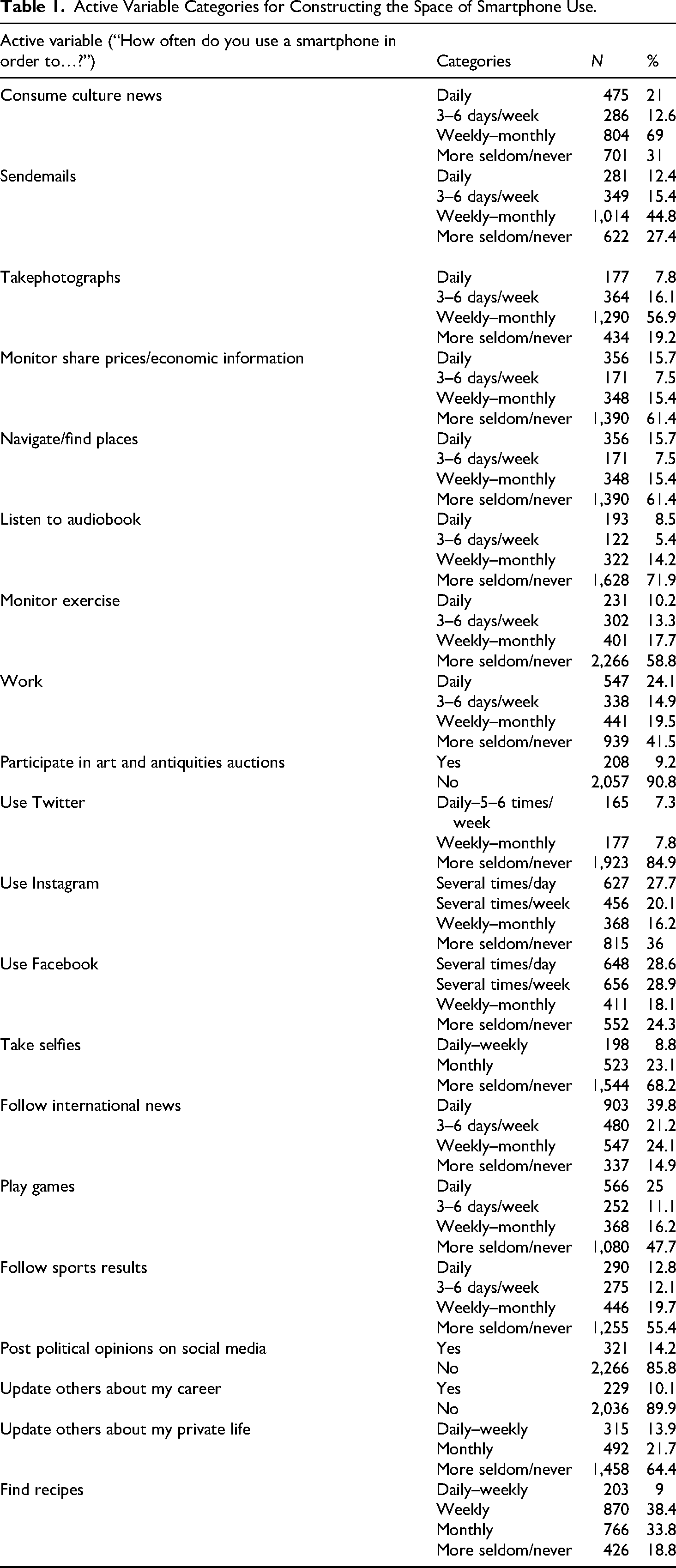
In order to study the extent to which access to economic and cultural capital and habitus interplay with existing gender and age differences in smartphone use, we focused on five variables. The variable age groups separates 18–29-year-olds—who were kids or young teenagers when smartphones were introduced broadly in Sweden—from older groups including 30–49-year-olds, 50–64-year-olds, and people older than 65. Gender is a binary variable separating people identifying as men from people identifying as women (0.7 percent identified as “other” or refused to respond, and due to the few observations in these categories we have not been able take them into account in the present analyses). Respondents’ economic capital was measured by asking about monthly income (recoded to be above or below 50,000 SEK/month in two instances, and above or below 35,000 SEK/month in two instances [see note to Table 2 for a discussion]). Cultural/educational capital was measured by asking about respondents’ levels of education (recoded into having vs. not having a university degree). While there are other ways of measuring both cultural and economic capital (such as cultural knowledge, material assets and savings, value of homes and cars, etc.), we settled for the two key variables that reoccur across studies (see e.g., Flemmen et al., 2018; Hovden & Rosenlund, 2021; Lindell, 2024). Measuring habitus is less straightforward (Reay, 2004). Indeed, in most MCA-oriented Bourdieusian studies, habitus is not measured as such. Rather, it serves as an “intermediate concept” to explain systematic overlaps between the social space and the space of lifestyles (Bourdieu, in Rosenlund, 2019, p. 3). In this study, asking about respondents’ father's occupation (white-collars and entrepreneurs with employees vs. the working class, farmers, etc.) serves as a proxy for respondents’ habitus. While far from perfect, this variable captures the fact that habitus is a durable and structured system of classification produced at particular social positions (especially tied to early socialization) (Bourdieu, 1984, 1990). Our paternal focus (“father's occupation”) is due to 20th-century gender inequality and the fact that women entered the workforce on a broad scale later than men. Thus, a focus on respondents’ mothers' occupation would impact the analysis of older generations in this study.
Supplementary Variables.
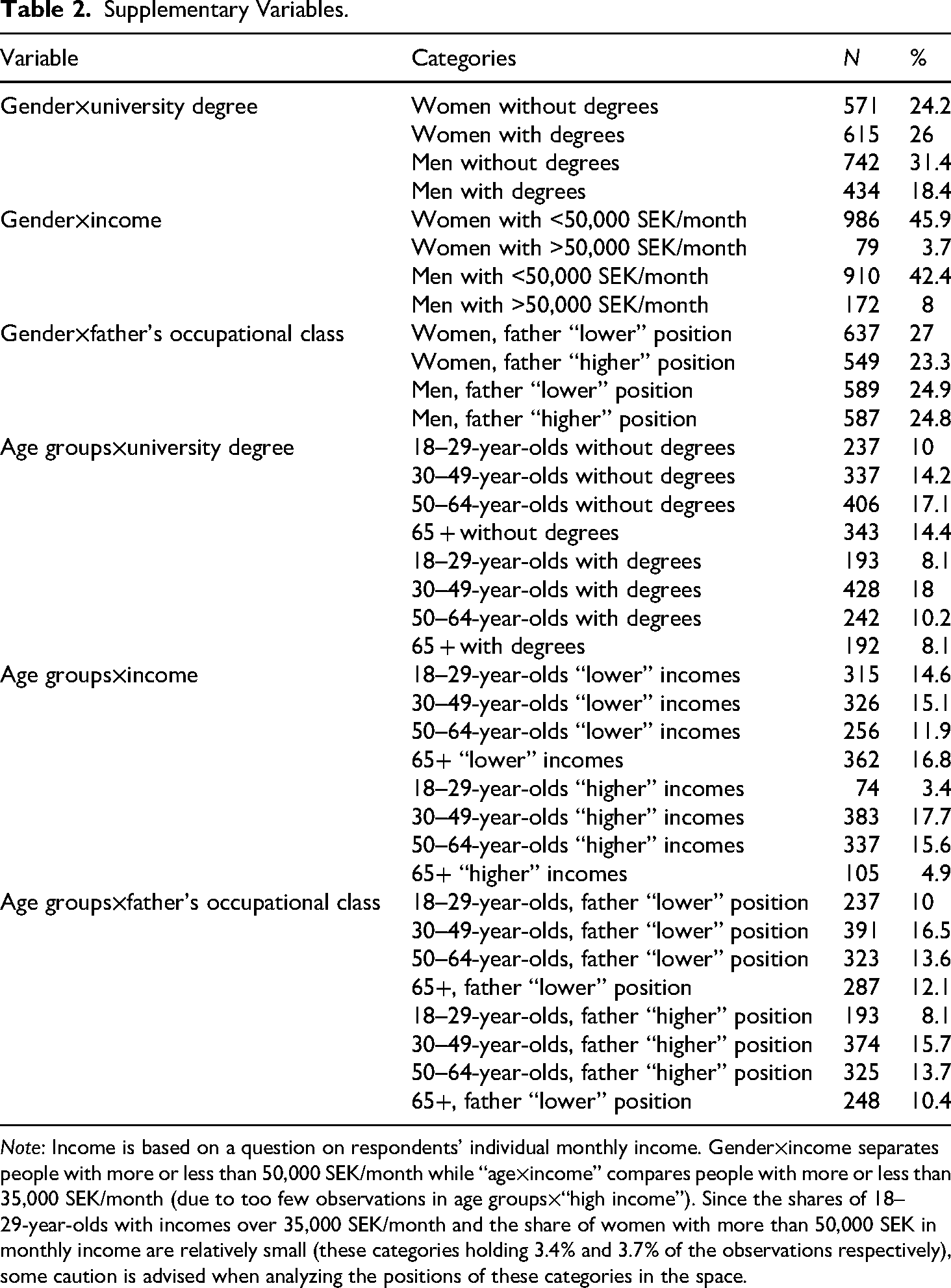
Note: Income is based on a question on respondents' individual monthly income. Gender×income separates people with more or less than 50,000 SEK/month while “age×income” compares people with more or less than 35,000 SEK/month (due to too few observations in age groupsדhigh income”). Since the shares of 18–29-year-olds with incomes over 35,000 SEK/month and the share of women with more than 50,000 SEK in monthly income are relatively small (these categories holding 3.4% and 3.7% of the observations respectively), some caution is advised when analyzing the positions of these categories in the space.
Inspired by Börjesson's (2016) analysis of the intersections of social positions and gender in the Swedish space of lifestyles, Glevarec and Cibois’ (2021) and Hovden and Rosenlund's (2021) emphasis on the interrelations between cultural capital (education) and generation, the three variables—holding a university degree or not, monthly income, and father's occupation—were combined with age group and gender identity. This resulted in a total of six supplementary variables (see Table 2).
The analyses were conducted using the FactoMiner and Soc.ca packages in R-statistics. Missing values have been omitted.
Findings
In this section, we first interpret the MCA of the active variables, that is, we focus initially on the structure of the space of smartphone use (RQ1). We then turn to our supplementary variables (age groups and gender identity in relation to access to cultural capital, economic capital, and habitus) and how these are positioned in the space (RQ2).
Exploring the space of smartphone use
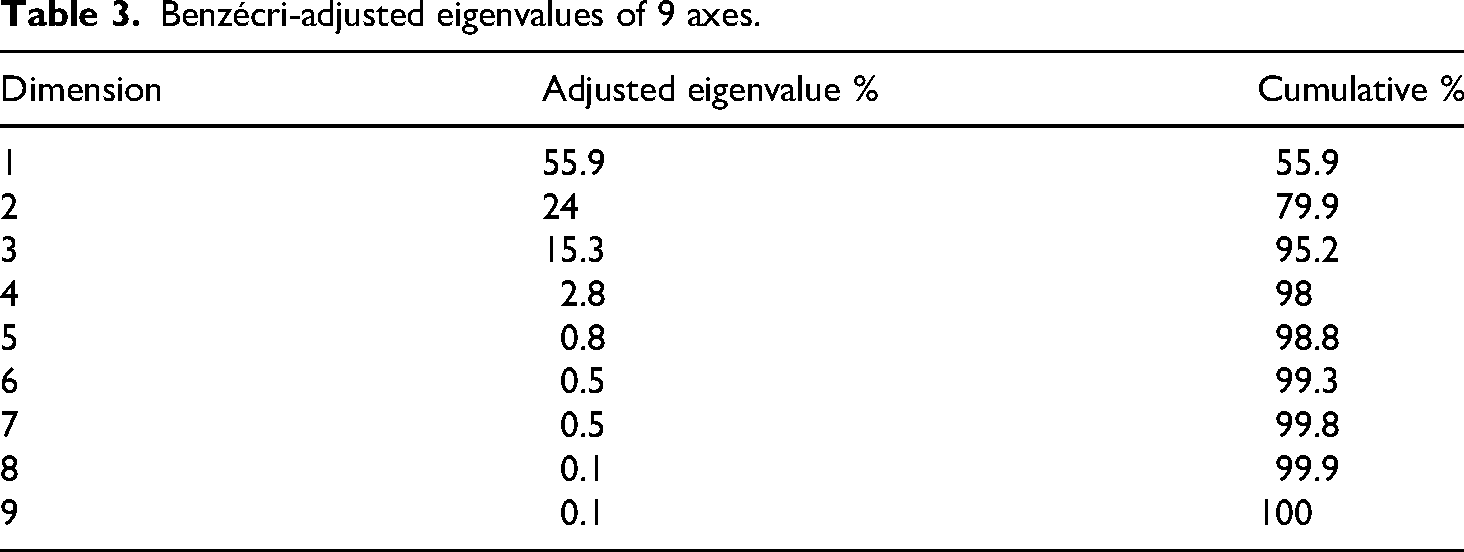
Figure 1 shows a statistical representation of the space of smartphone use, derived from the 20 active variables, allowing us to answer RQ1. The first, horizontal, axis accounts for 56% of the (Benzécri-adjusted) variance in the active variables, while the second, vertical, axis accounts for 24% (see Table 3). The following analysis focuses on the first two axes since a common criterion deciding the number of dimensions to interpret in MCA is 80% of the variance (Hjellbrekke, 2018).
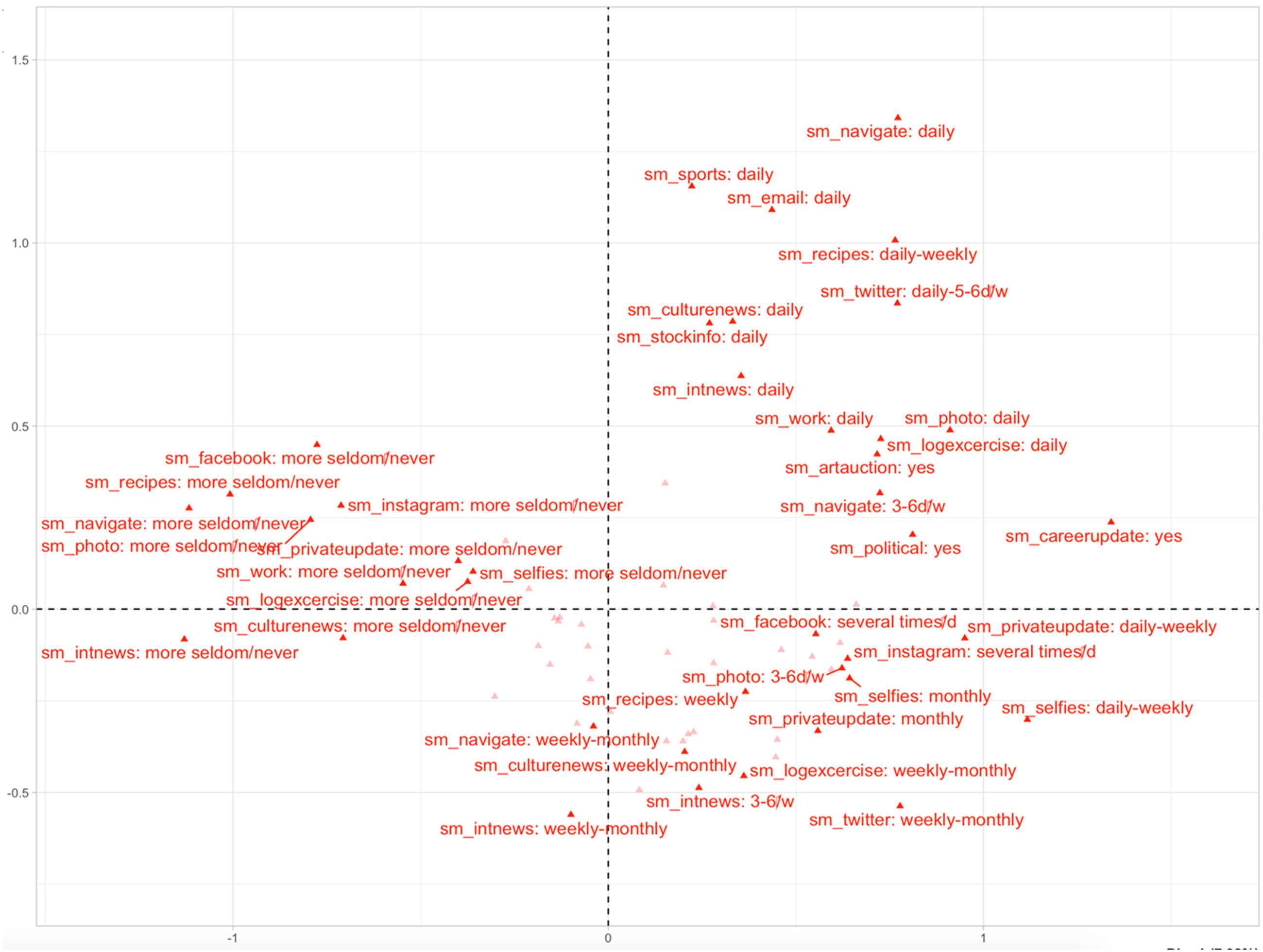
The Space of Smartphone Use, Axes 1 and 2. Top 40 Contributing Categories.
Benzécri-adjusted eigenvalues of 9 axes.
Like in previous studies on lifestyle spaces, the two main axes describe different frequencies on the one hand and preferences/types of practices on the other (Börjesson, 2016; Sivertsen, 2025). The first axis is a volume axis, along which frequent use of the smartphone, across virtually all investigated areas, is found on the right-hand side while less use is found on the left-hand side.
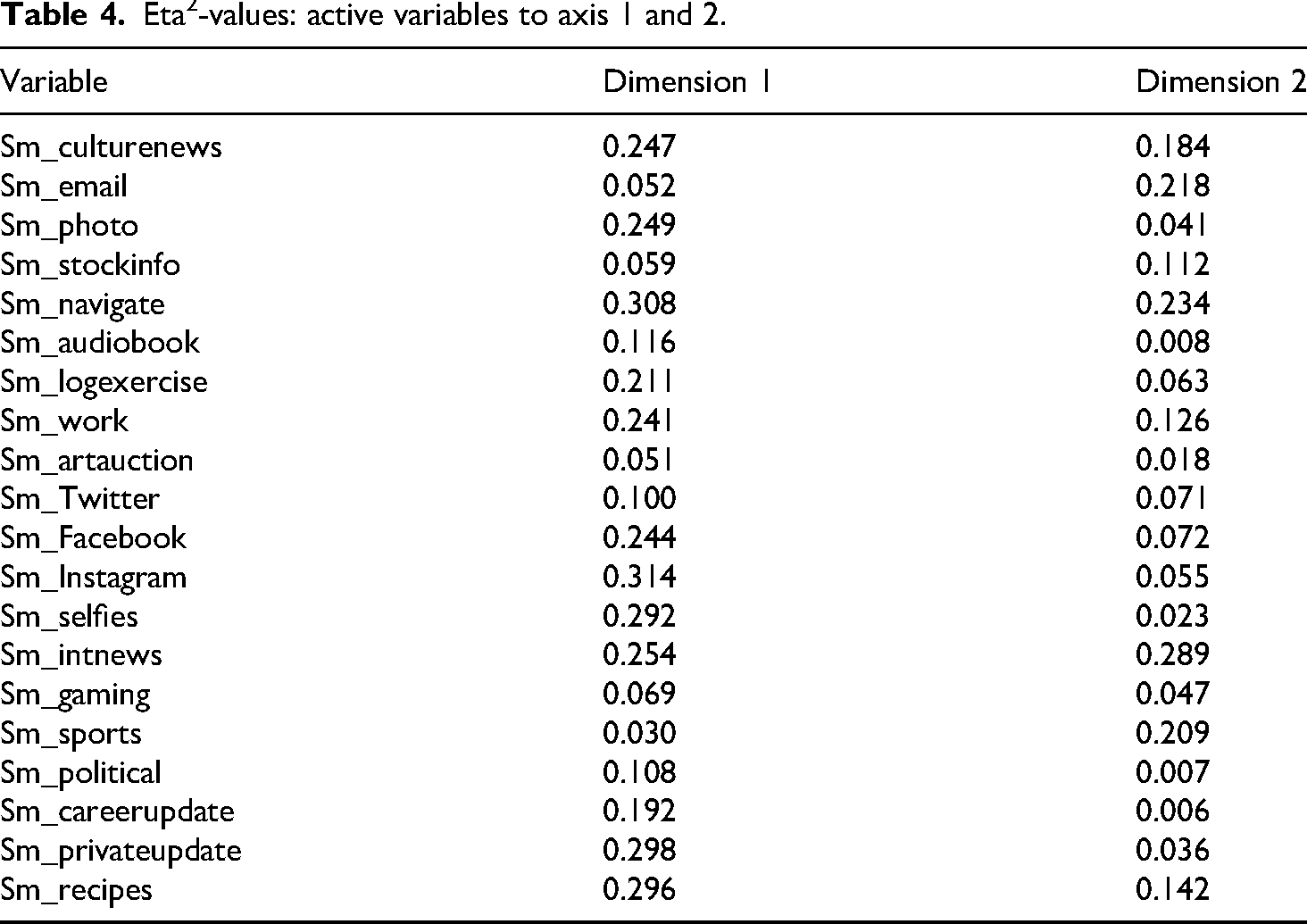
The second axis is less straightforward, as it captures several oppositions (publicly oriented vs. privately oriented uses, male-coded vs. female-coded uses, and high vs. moderate news use). While the top of the space harbors categories such as logging one's exercise, taking photographs, and finding recipes, it is a region that is characterized by heavy news consumption, sports updates, stock trading, public debate (e.g., Twitter use [since 2023, X]), and work-oriented uses (e.g., emailing). In the bottom of the space, by contrast, we find moderate investments in similar practices (e.g., weekly or monthly news consumption and Twitter use) and more privately oriented and feminized practices, including posting updates about the private life, Instagram, taking selfies, and moderate news use (cf. Comunello et al., 2017; Toff & Palmer, 2019; Ytre-Arne, 2023; Zhao et al., 2020) (see Table 4 for contribution of variables to the axes). Set against previous research on the connections between lifestyles and social positions (Atkinson, 2022; Bourdieu, 1984; Flemmen et al., 2018; Lindell & Hovden, 2018; Rosenlund, 2019), we argue that the second axis describes a degree of investment in “legitimized” practices. So-called “capital-enhancing” (Hargittai & Hinnant, 2008) practices oriented to the public world (trading, culture news, debate forums, work), that is, practices connected to “information capital” (Prieur et al., 2008, p. 66), gather at the top. Conversely, orientations toward the private sphere (although practices pertaining to this sphere might be broadcast to online audiences and in that sense be “public”) are mainly located at the bottom of the space Figure 1.
Eta2-values: active variables to axis 1 and 2.
V-tests for supplementary variable categories.
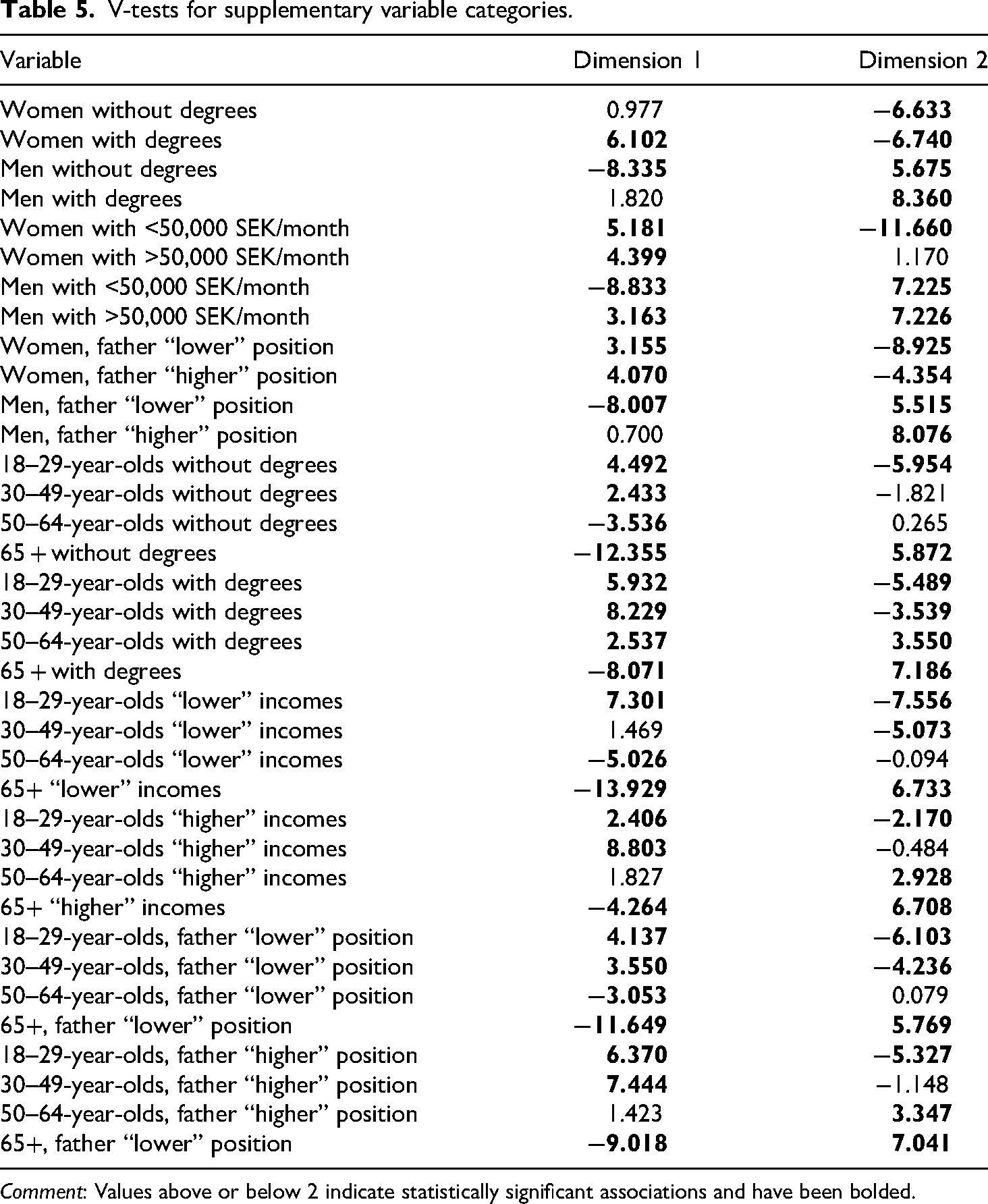
Comment: Values above or below 2 indicate statistically significant associations and have been bolded.
At the overarching level, this two-fold structure resembles the results from Börjesson's (2016) Swedish space of lifestyles, Purhonen et al.'s (2021) study on the Finnish space of media use, and Sivertsen's (2023) Danish study on public connection. The tendency, especially in the latter two studies, is to identify more vs. less digital media use along the first axis and “elite” vs. “popular” uses of media along the second axis (see also Hovden & Rosenlund, 2021). The structure of the space of smartphone use—where the main axis separates high and low frequencies of use and the second separates publicly oriented, male-coded, and legitimatized practices from moderate news use and orientations toward the private sphere—leads us to expect that age and gender would constitute key factors shaping how social agents move about in it (as also shown in previous research [Jeong, 2025; Kongaut & Bohlin, 2016; Tsetsi & Rains, 2017; Van Deursen et al., 2015; Wenz & Keusch, 2023; Ytre-Arne, 2023]). Indeed, this pattern is confirmed empirically when we project age groups and gender identity as supplementary variables in the space (not shown in figure). Age mainly corresponds to frequency of use (axis 1): the oldest groups are positioned to the left-hand side whereas the younger are to the right (but also more toward the bottom of the space). Women seem more frequent in their use, while men are overrepresented at the top of the space. Thus, in the space of smartphone use, the relationship between gender and legitimized practices is inverted since women tend to be more clearly positioned in the “legitimate culture” in other areas, including, for example, book reading and museum visits (see e.g., Lizardo, 2006).
Socially shaped positions in the space of smartphone use
To assess how capital and habitus shape existing differences between age groups and gender identities (RQ2), we projected our supplementary variables in the space of smartphone use (see Table 5 for V-tests). We turn first to how gender interplays with capital and habitus, then to age groups. In the following analyses we thus study how these supplementary variables are positioned in relation to the axes uncovered above.
Gender×degree (Figure 2): In our initial statistical analyses, we established that women overall seem to use their smartphones more than men (see e.g., Auter, 2007; Shade, 2007). However, our results suggest that men with university degrees use their smartphones about as much as women without degrees. Among respondents who identify as men, there is a stark contrast between people with and without university degrees. This difference is not as clear-cut among women. The strongest association between the axes and a supplementary category is found in the category of university-educated men (located around .4 deviations from the center of the space), who are more prone than the other groups to use their smartphones for public connection and work.
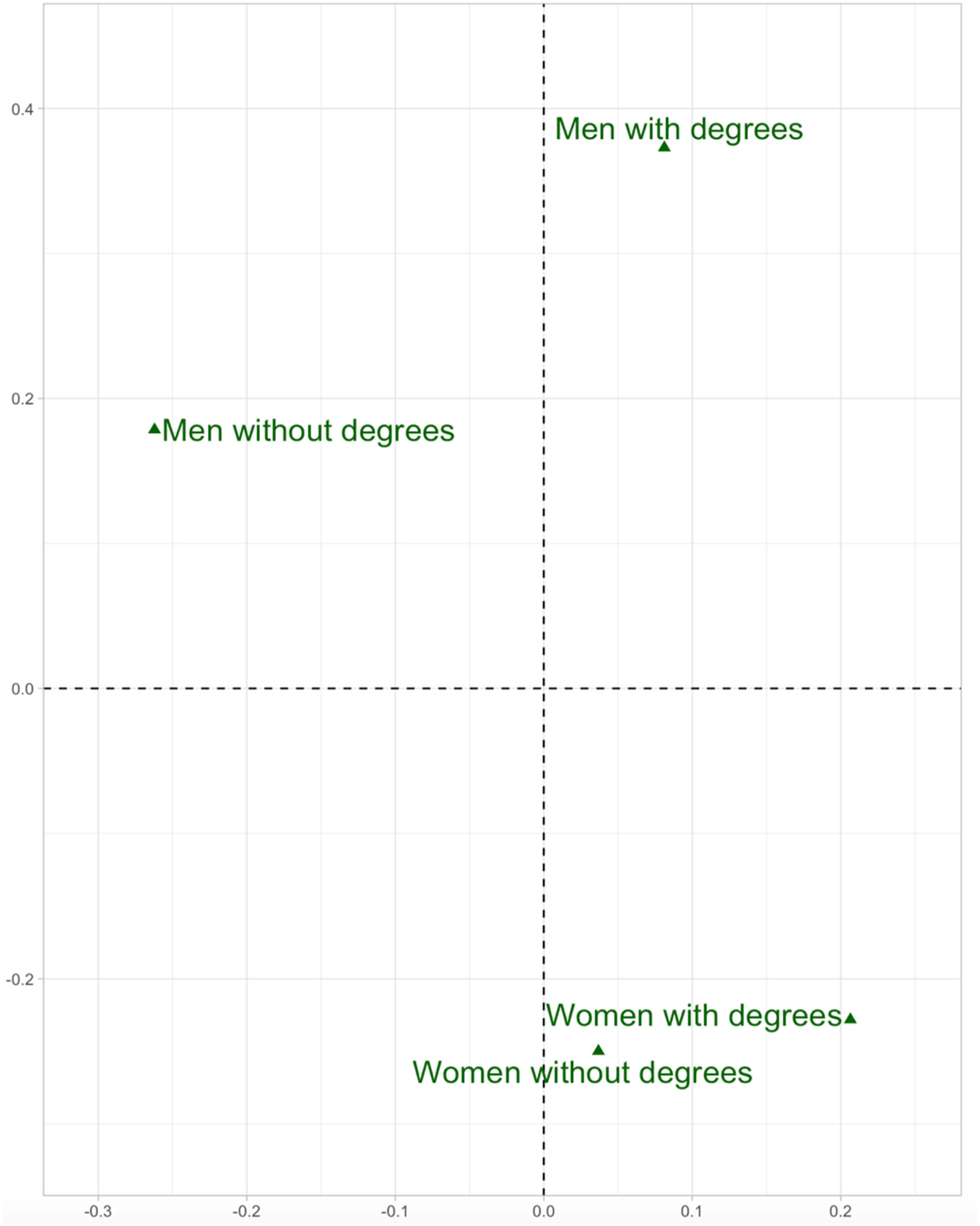
Gender×Degree as Supplementary Variable in the Space of Smartphone Use, Axes 1 and 2.
Gender×income (Figure 3): Economic capital implies more frequent use of the smartphone. While high-earning women emerge as the heaviest users in this analysis, they are followed by well-paid men (rather than women with lower salaries). Both categories of high earners are located at notable positions in the space, indicating relatively high volumes of smartphone use and information-oriented preferences. In this analysis, men with low incomes use smartphones the least while women with low incomes are more likely to be less invested in the “legitimized” uses of the smartphone.
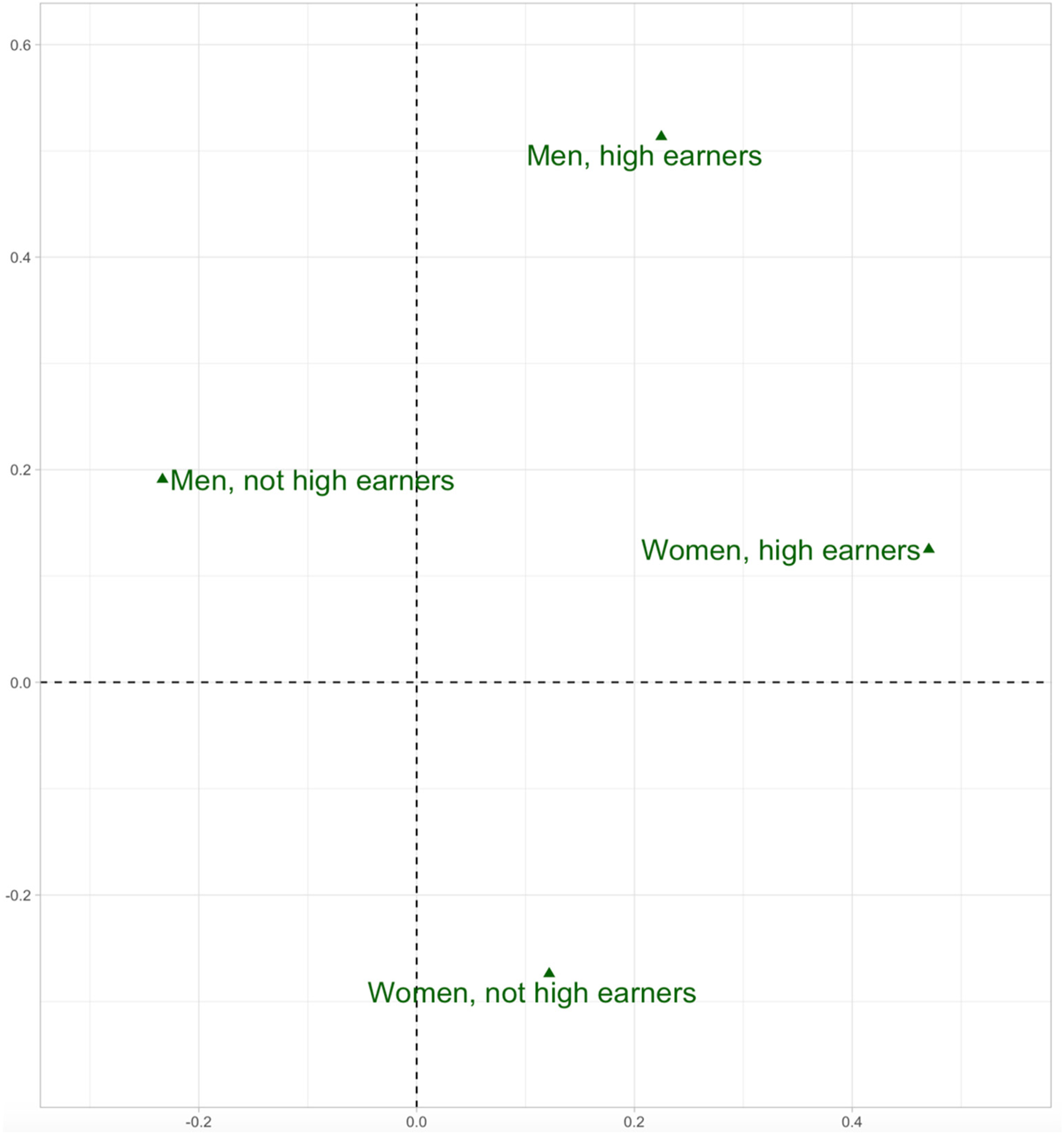
Gender×Income as Supplementary Variable in the Space of Smartphone Use, Axes 1 and 2.
Gender×father's occupation (Figure 4): Being endowed with a “privileged” habitus does not alter existing differences between men and women. It does, however, highlight differences within the gender identity groups since a privileged habitus “pushes” both men and women slightly upwards in the space, toward the legitimized uses of the smartphone.
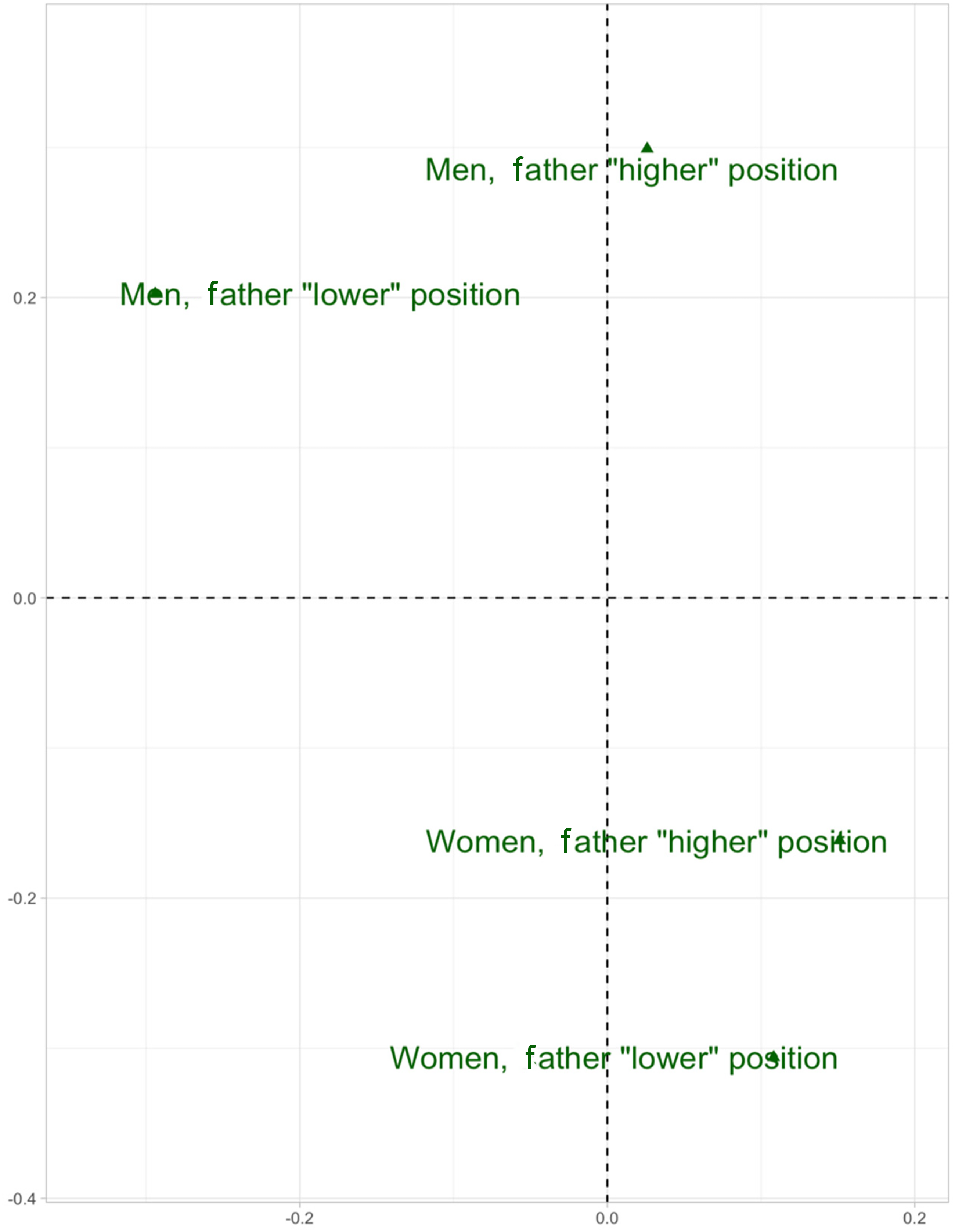
Gender×Father's Occupational Class in the Space of Smartphone Use, Axes 1 and 2.
Age groups×degree (Figure 5): Turning to how capital and habitus interact with age, we focus first on age groups×degree. As already established in previous research, results highlight that young people use smartphones more than older people. An interesting exception takes place in that 30–49-year-olds with university degrees are found slightly to the right of 18–29-year-olds without degrees. In this sense, cultural capital is altering existing differences between ages (although to a limited extent). However, the main finding here is that cultural capital engenders differences within age groups along the second axis, meaning that among people older than 50, access to cultural capital “pushes” social agents upwards in the space, toward more public and “legitimate” uses of the smartphone. For the younger groups (less than 49 years old), the university degree primarily implies more use.
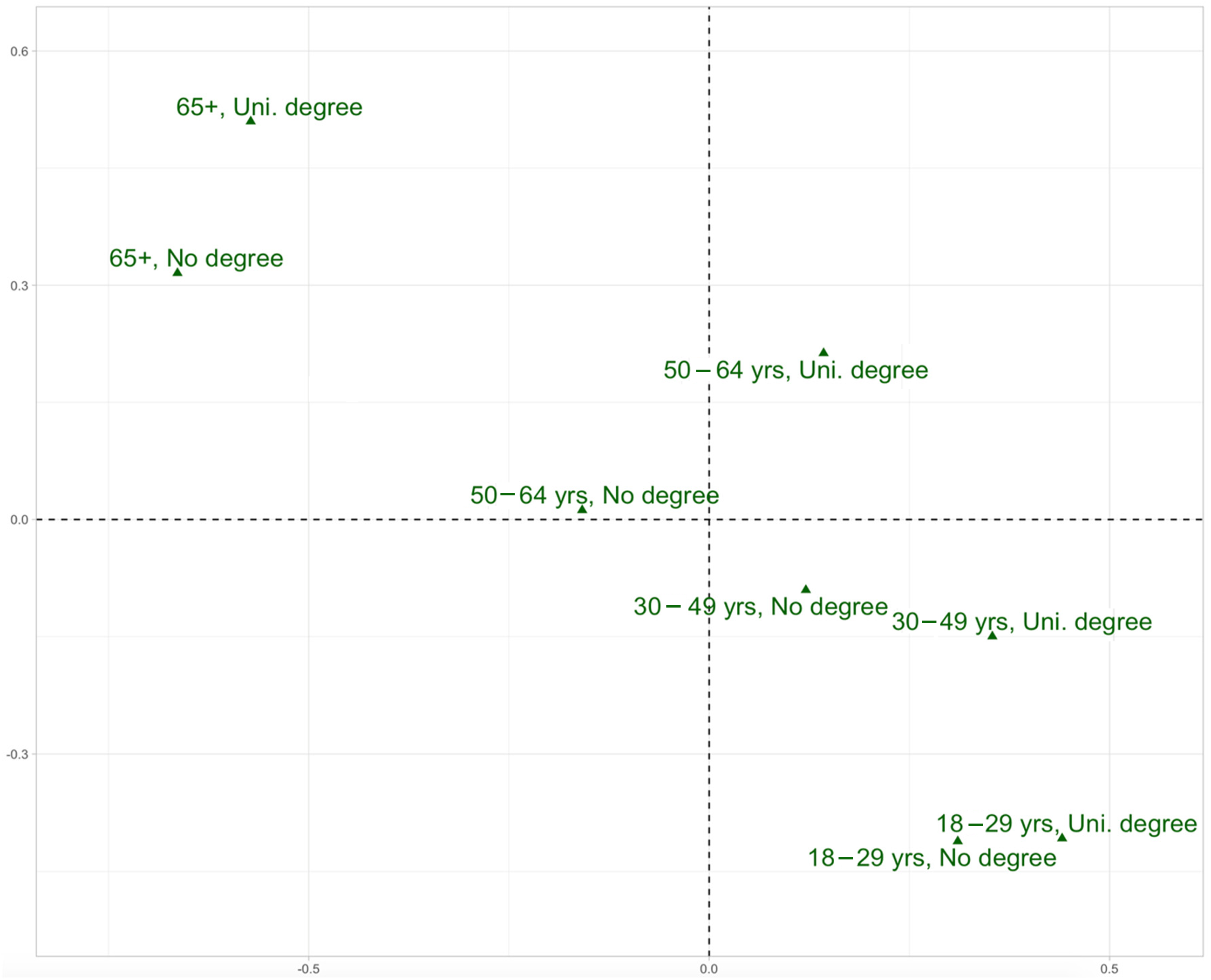
Age Group×Degree as Supplementary Variable in the Space of Smartphone Use, Axes 1 and 2.
Age groups×income (Figure 6): Access to economic capital implies pushing social agents toward the top-right in the space, indicating more smartphone use overall and “legitimate” uses of the device. This is evident in all groups except the youngest. We also note that highly salaried 30–49-year-olds use their smartphones more than the youngest respondents, since young people without high salaries are the most frequent smartphone users among the groups studied in Figure 6.
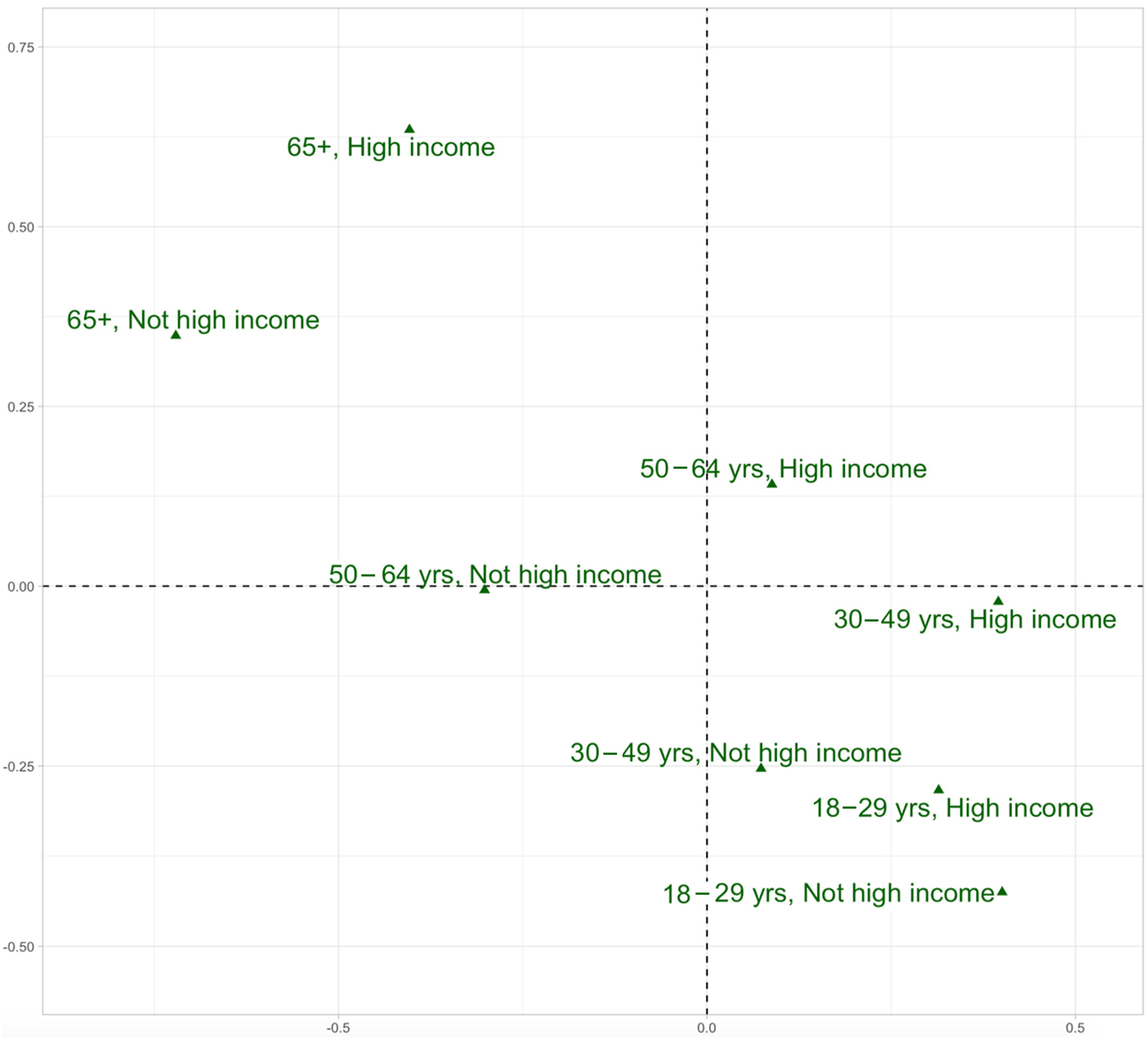
Age Group×Income as Supplementary Variable in the Space of Smartphone Use, Axes 1 and 2.
Age groups×father's occupation (Figure 7): Figure 7 repeats a familiar pattern: privileged positions push social agents upwards and to the right in the space, toward more smartphone use overall and toward the pole of “legitimate” smartphone use. And again, while these tendencies are rather clear-cut for people above 30 years, they are seemingly neglectable in the youngest group.
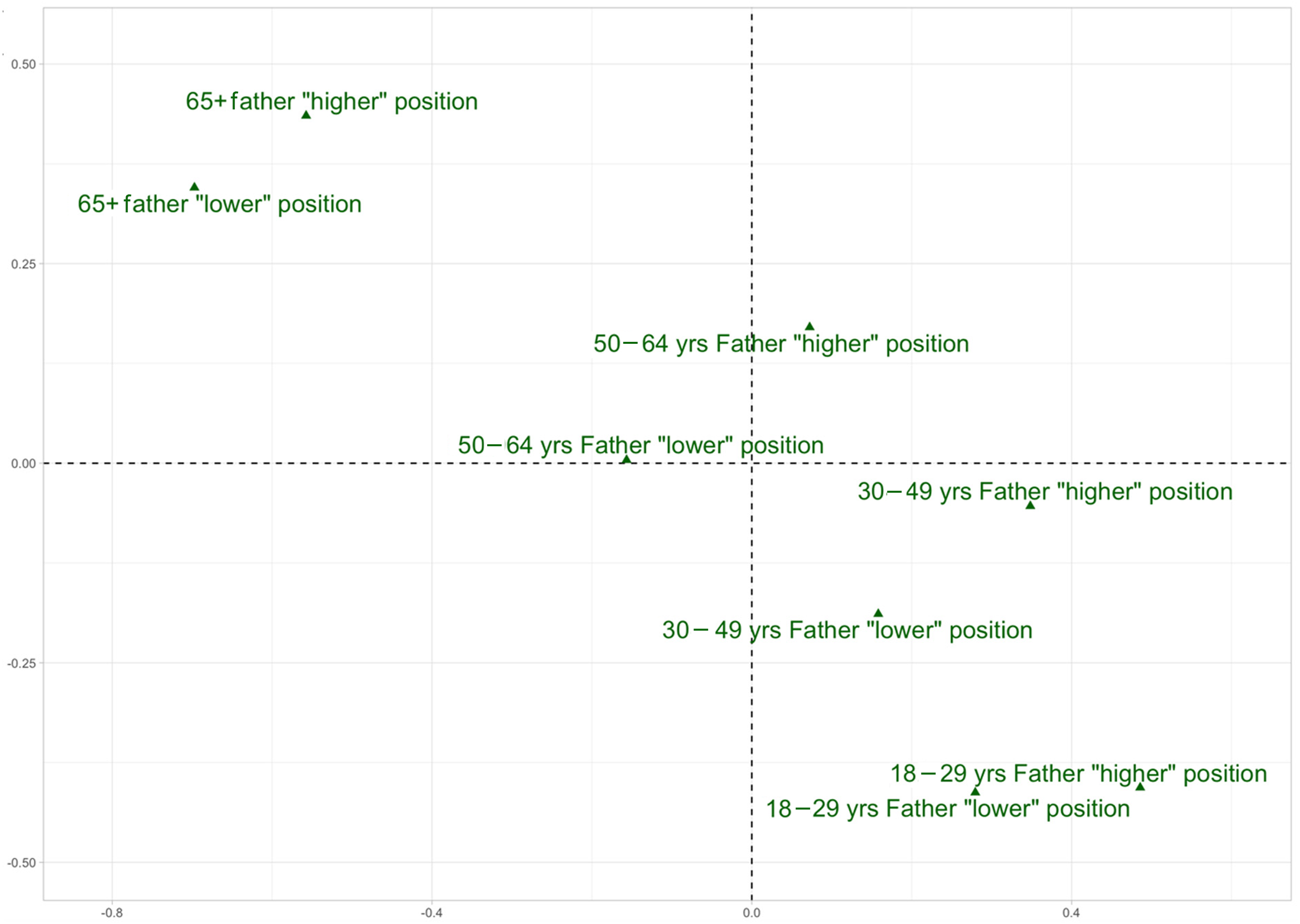
Age Groups×Father's Occupational Class in the Space of Smartphone Use, Axes 1 and 2.
In responding to our first research question, we find that the Swedish space of smartphone use is characterized by two main principles of division: overall volume of smartphone use and degree of investment in legitimized smartphone uses. At the general level, this echoes the structures identified in studies of related lifestyle domains, including the space of media use (Purhonen et al., 2021) and the space of public connection (Sivertsen, 2025). In response to our second research question, we find that relatively privileged positions (that is, access to both economic and cultural capital and a privileged habitus) engender differences within age groups and among men and women. The main finding is that privileged positions push social agents (e.g., certain men, or certain 30–49-year-olds, etc.) toward more smartphone use overall and toward legitimized uses. Both economic and cultural capital and the “privileged” habitus display similar tendencies, suggesting that global volume of capital is more important than capital composition (that is, differences between people with different capital endowments) (cf. Bourdieu, 1984). A key finding is that the tendency of capital and habitus to draw social agents toward the top-right in the space is tied to social agents above the age of 30. A possible explanation is that young people's lives are entangled in this technology to the degree that it equalizes potential intra-generational differences that capital and habitus engender in older groups. In other words, existing social inequalities do reflect in smartphone uses, but primarily in age groups that have not grown up with this technology.
Another finding regards the fact that the inclusion of capital and habitus in the analysis highlights certain breaks with the notion that women and younger people by default use their smartphones more than men and older people. Although we focus on 20 areas of use and have not measured exact frequencies of smartphone use, we can follow the positions of the social groups on axis 1 (overall use of the smartphone for a range of different purposes) to get important indications. Doing so suggests that well-educated and highly paid men are on par with low-educated and low-salaried women in terms of frequency of use, 50–64-year-olds with university degrees use the smartphone as much as 30–49-year-olds without degrees, and the same goes for 30–49-year-olds holding degrees compared to 18–29-year-olds without degrees. Furthermore, well-paid 50–64-year-olds use their smartphones more than 30–49-year-olds without high salaries; and finally, 30–49-year-olds with a privileged habitus seem to use their smartphones more than 18–29-year-olds without this kind of habitus.
Discussion
By employing the Bourdieusian research program, this study has introduced a novel way to go about the study of smartphone use and social divides. Approaching the “polymedia environment” (Madianou, 2014, p. 668) of the smartphone as a space of potential practices allows tracing interrelations between types of uses and the main divides in how this technology is adopted by social agents with different resources at their disposal. Through the exploratory analysis of 20 different practices, we identified a two-fold structure of the Swedish space of smartphone uses. The main axis deals with overall volumes of use in the investigated practices, while the second describes oppositions between intense news consumption, work, and public connection on the one hand, and moderate investments in similar practices, as well as uses oriented toward the private sphere, on the other. We furthermore find that capital and habitus engender differences within age groups and among men and women. The overall pattern is that privileged positions “push” agents toward the region in the space characterized by work-related uses and public connection. Given that studies on smartphone use to a large degree deal with “problematic use” and psychological variables, showing how persisting social inequalities reflect in the “always on lifestyle” (boyd, 2012) promoted by the smartphone makes for a contribution in itself. This study thus adds to previous work in the field that in different ways have unearthed the links between social inequality and mobile media use (e.g., Schofield Clark et al., 2024; Tsetsi & Rains, 2017; Wenz & Keusch, 2023).
In relation to previous research on various symbolic spaces (Atkinson, 2022; Bourdieu, 1984; Purhonen et al., 2021; Sivertsen, 2025), we contribute with the analysis of a space hitherto not studied in this research tradition. At the overarching level, our findings nonetheless support previous depictions of the structure of symbolic spaces where volumes (“high volumes” vs. “low volumes”) and types of uses (“elite” vs. “popular”) are the key dimensions. We have shown that seemingly universal practices such as smartphone use connect to positions of relative privilege and precarity. Income and educational gaps echo in the ways in which people use mundane technologies such as the smartphone. What is important to point out here is that we have studied how social differences generated by capital and habitus operate in tandem with age and gender gaps. Indeed, a common critique of Bourdieusian sociology is that social inequalities between age groups or generations are downplayed despite being crucial factors that shape cultural practices (Glevarec & Cibois, 2021). Similar critiques regard gender inequalities (de Saint Martin, 2015). This study accounted for both these factors and showed how capital and habitus interplay with age and gender identity to shape the ways in which people use their smartphones. Our results align with previous work on media generations (Bolin, 2014) and cultural generations (Glevarec & Cibois, 2021). Age emerges as a key dispositional factor in shaping cultural practices. Yet, cultural generation operates in tandem with capital, making it so that the more privileged people in an age group become drawn to legitimized practices, except within the generation that grew up with the smartphone (18–29-year-olds), which is less internally differentiated by capital and habitus. This cements the argument about the relative strength of cultural generation vis-à-vis capital in regard to the formation of cultural practices (Glevarec & Cibois, 2021). At the same time, it accentuates the importance of social privilege in shaping older generations’ cultural practices tied to relatively new technologies.
Gender inequalities are reproduced in terms of how men and women orient in the space of smartphone use. Men tend to be drawn to the top of the space where more legitimate and publicly oriented uses of the smartphone prevail—practices that reproduce one's “informational capital” (Prieur et al., 2008)—whereas women are overrepresented in a region of the space characterized by less news use and practices oriented toward the private sphere (cf., Comunello et al., 2017; Ytre-Arne, 2023). In other lifestyle domains, it is women rather than men who tend to be oriented toward “legitimate” cultural practices (such as visiting museums or reading books) (Lizardo, 2006). The somewhat reversed pattern identified in the space of smartphone use (wherein public and news-oriented uses cluster together) nonetheless aligns with previous research on news use/public connection and gender (Toff & Palmer, 2019) and the moral dissonance that women experience in relation to their smartphone use (Jansson et al., 2025). It also connects to observations on the domestication of the smartphone as a tool in women's managerial and emotional labor in the household (Ytre-Arne, 2023). Besides this overarching pattern, we have also stressed how capital and habitus produce differences among men and among women. Among both men and women, the relatively privileged groups are more invested in legitimized practices compared to those in less privileged positions. Thus, adding a focus on capital and habitus unearths the complexities in gendered uses of the smartphone.
There are, however, some important limitations to the present study. First, the study was conducted in the highly digitalized context of Sweden during the Covid-19 pandemic (implying increased media reliance). Second, our variables are not exhaustive and there are other practices outside of the 20 smartphone uses studied here. Third, we rely on a self-reported web-survey with a limited response rate (although 29% is relatively high for contemporary surveys). While these limitations may warrant caution, we have good reasons to believe that we have captured key principles of division in the space of smartphone use in modern and differentiated societies (indeed, the structure of the space resembles those in other studies (Purhonen et al., 2021; Sivertsen, 2025). There is nonetheless a need to supplement this study with research on uses of smartphones through the analysis of ethnographic or digital trace data.
Footnotes

Ethical Approval
The project has received ethical approval from Karlstad University.
Funding
This research has been funded by the Ann-Marie and Gustav Ander’s foundation for media research (project “Measuring mediatization: phase 2”).
Declaration of Conflicting Interests
The authors declared no potential conflicts of interest with respect to the research, authorship, and/or publication of this article.
Data Availability Statement
Not available. Respondents have not agreed to having data made open access.