




Abstract
Revisiting polymedia within the ageing context, this research unfolds dynamics experienced by marginalized older groups in the Global South when navigating an increasingly complicated media landscape on smartphones. While polymedia shifts the focus from individual media platforms to an integrated media environment that can potentially expand communicative opportunities, existing discussions on this socio-technological transformation tend to neglect the role of user agency, particularly in socially constrained contexts such as marginalized ageing. Giving a voice to socioeconomically restricted older female adults in the Global South, this research illuminates their engagement with polymedia is contingent upon the intersection of individual ageing experiences as well as uneven social structures and the lack of policy support for digital inclusion in a broader context. The findings highlight their contextualized strategies to make sense of polymedia, revealing their evolving understanding of nuances in media affordances and how they develop their unique media preferences. Simultaneously, the diverse constraints limiting their exploration of polymedia can sometimes transform theoretical communicative opportunities into obstacles, leading to a loss of control within the polymedia environment.
Introduction
The concept of “smartphone as polymedia” (Madianou, 2014) has shifted the paradigm towards investigating the integrated media environment embedded in smartphone devices, and socio-technological dynamics emerging from users’ interactions with this complicated media environment. Building on this paradigm, recent studies have explored how users navigate polymedia to exploit various communicative opportunities, thereby managing their diverse social relationships and emotional needs (e.g., Aziz, 2022; Madianou, 2016). However, research seldom illuminates the possibly constrained user agency in marginalized contexts who might not be able to fully embrace polymedia and take advantage of the expanded communicative possibilities. There is a lack of discussion regarding how the restricted agency can impact users’ engagement with polymedia and their sense of control within the polymedia environment.
An in-depth and contextualized understanding of agency is particularly necessary in the context of this research, which focuses on smartphone usage by marginalized older groups in the Global South. The past few years have witnessed an increasing number of older smartphone users in the Global South, including those of disadvantaged socioeconomic status (Bansal & Choudhary, 2023; Chan et al., 2024; Pei et al., 2024). In developing countries such as Colombia, South Africa, Lebanon, and Jordan, over 30% of people aged 50 and above have adopted smartphones (Pew Research Center, 2019). A national survey in China revealed that half of older adults aged between 65 and 69 are smartphone users (China Daily, 2023).
Despite the growing adoption of smartphones by marginalized older adults in the Global South, their experiences with smartphones as polymedia remain underexplored. Notably, little is known about their struggles when navigating polymedia given the intricate social structural inequalities encountered by them and simultaneously varying challenges associated with their ageing processes. Meanwhile, scarce discussion revolves around their enactment of contextualized strategies when engaging with polymedia, making sense of polymedia in their own ways and negotiating the boundary of their smartphone usage.
To address these gaps, this research draws attention to socioeconomically restricted older female adults in China. Through qualitative interviewing and digital ethnography, it unfolds the dynamics of their polymedia experiences: how they negotiate agency, often within contextual constraints, to develop an evolving understanding of nuanced media affordances and shape their unique media preferences within the accessible communicative options. Simultaneously, it also reveals how multifaceted constraints restrict their exploration of polymedia, occasionally transforming theoretical communicative opportunities into obstacles and leading to a loss of control within the polymedia environment.
Revisiting polymedia in the context of marginalized ageing, this research contributes to reconceptualizing polymedia as a socio-technological process encapsulating the interactions between technology, agency of older adults, and the broader structural context. In this research, the broader structural context encompasses discrimination and bias associated with ageing, gender inequalities, socioeconomic marginalization, and the lack of government support for digital inclusion of older adults. Their agency of polymedia engagement is profoundly shaped by the interplay of these contextual factors, resulting in a more contextually restricted and nuanced polymedia experience. By highlighting these dynamics, this research advances the theory of polymedia by situating individual user behaviors within their sociocultural and political-economic context.
Literature review
Smartphones, older adults, and the Global South
In the past few decades, alongside the global diffusion of smartphone technologies amid the older populations, a growing body of researchers has started to illuminate the smartphone usage of older adults (e.g., Beneito-Montagut et al., 2022; Busch et al., 2021; Miller et al., 2021; Zhu & Cheng, 2024). Great attention has been drawn to the age-related digital divide, often termed “grey divide,” experienced by older adults in terms of their access to and ways of engaging with smartphones (Choudrie et al., 2020; Mubarak & Suomi, 2022; Laksmi et al., 2024). Studies are interested in comparing the adoption and usage patterns of smartphones between older adults and younger cohorts, with a particular focus on examining how older adults’ usage tends to be more restricted (Busch et al., 2021), often confining them to fewer affordances (Zhou et al., 2014). In particular, many tend to associate the constrained smartphone usage of older adults with their ageing processes, often emphasizing cognitive and physical decline, as well as distinct emotional and social needs stemming from loneliness and sense of social isolation (Aranha et al., 2021; Choudrie et al., 2020; Wilson et al., 2023).
In recent years, a cluster of researchers (e.g., Beneito-Montagut et al., 2022; Hülür & Macdonald, 2020; Turnbull & Yau, 2024; Zhu & Cheng, 2024) have started to criticize the digital ageism embodied in the early research stream, which tends to portray older adults as less capable technology users and to view ageing as a homogenous process. For instance, building upon a comparative study across four different countries, Beneito-Montagut et al. (2022) suggested the importance of considering “the broader sociocultural” of digital technology use by older adults—how their engagement with technologies can be influenced by sociodemographic variables (e.g., income, gender, education), alongside their individual digital skills and knowledge. This perspective resonates with Rosales & Fernández-Ardèvol (2016), who indicated that “ageing and age are socially constructed phenomena and are ongoing processes,” and therefore digital usage of older adults often shapes and is shaped by wider relations of power.
This is particularly evident in the context of the Global South where the sociocultural context and political-economic system significantly shape digital adoption and usage among older adults (Bansal & Choudhary, 2023; Mubarak & Nycyk, 2017; Yu et al., 2023). To specify, the socioeconomic development gap between developing and developed countries often translates into limited financial resources for older adults to access digital technologies. Van Biljon and colleagues (2010) noted that many older adults in developing countries cannot afford mobile phones. Instead, they often use obsolete phones passed down from family members, which rarely align with their specific needs and expectations. Situated in Myanmar, Pyae (2017) pointed out that the lack of strong support from the government is another factor hindering the potential of using digital technologies to promote active ageing. Additionally, Mubarak and Nycyk (2017) highlighted the influence of deeply rooted cultural beliefs, which often foster conservative attitudes toward older adults’ adoption of digital technologies within society.
While highlighting the contextual constraints, studies seldom gave voice to older adults at the lower rungs of society in the Global South to illuminate their negotiation of agentic response. Little is known about their agency - how older adults make use of the available, though often limited, social and digital resources to develop their media preferences and usage strategies. Furthermore, in the context of smartphone adoption and usage, the examination of agency should consider the dynamics that may emerge from the interactions between marginalized older adults and the increasingly complicated digital landscape entailed in the smartphone, where multifaceted and often interconnected functions are encapsulated within a single device (Madianou & Miller, 2013a; Madianou 2014). This digital environment may either offer greater opportunities for the manifestation of agency or impose boundaries that further limit socially marginalized older end users from fully controlling their media usage decisions. Addressing these dynamics requires a more nuanced understanding of the digital environment embedded in the smartphone, which has been coined as “polymedia” (Madianou, 2014).
Polymedia and agency
Madianou and Miller (2013a, 2013b) introduced the concept of “polymedia” in response to the emergence of an integrated digital media environment characterized by the proliferation and convergence of multiple media forms. Within this environment, “each individual medium or platform is defined in relational terms in the context of all other media” (Madianou & Miller, 2013a, p. 170), rather than being understood as “a list of discrete objects and technologies” (Madianou, 2014, p. 672). Notably, Madianou (2014) emphasized the role of the smartphone as a hybrid device, combining elements of traditional telephony and personal computing, in fostering the conditions for polymedia. As Humphreys et al. (2018, p. 2795) further observed, smartphones “can host practically unlimited combinations of apps and include a wide range of sensors and interfaces,” thereby amplifying the polymedia environment.
The emergence of polymedia has been accompanied by a shifting conceptualization of digital media affordances. In particular, the integration of multiple media forms entails the convergence of their respective affordances, encapsulating a broad spectrum of communicative possibilities within the polymedia environment (Madianou, 2014). Studies (e.g., Androutsopoulos, 2021; Aziz, 2022) have increasingly explored how interactions with polymedia affordances can give rise to diverse emotional, social, and moral consequences across different communication contexts.
In particular, integrated affordances are often viewed as opportunities for individuals to expand their possibilities for social connectivity in varied forms. For example, studies have shown how socially marginalized migrants (de Bruin, 2019; Mintarsih, 2019) seamlessly switch between functions such as viewing social media posts, instant messaging, and location sharing within the polymedia environment. This flexibility allows them to foster a sense of “ambient co-presence” with their social networks in their hometowns, enabling them to maintain “a peripheral yet constant awareness” of the actions and daily rhythms of their distant peers (Madianou, 2016, p. 183).
However, emerging research has also drawn attention to the potential negative consequences associated with polymedia affordances. These include interpersonal conflicts arising from disagreements over the selection of media affordances for communication, which may fail to meet the expectations of both parties (Wang & Lim, 2021), as well as the reinforcement of surveillance and control within asymmetrical power relationships, facilitated through the use of multiple media options (Winarnita, 2019).
Regardless of the communication consequences, most research tends to view users as agents capable of exploiting the wide spectrum of affordances offered by polymedia. Notably, the original work of Madianou and Miller (2013a) noted that the expansion of communication opportunities may not benefit everyone. They indicated that users’ engagement with polymedia could be limited, depending on the access to ICT infrastructure and devices, affordability, and digital literacy. Echoing this point, Ben Elul (2021) once documented how people in urban Ghana had to develop their own ways to choose between media because of unstable infrastructures.
While acknowledging that interactions with polymedia can be limited, research still largely overlooks users’ agency as a contextualized social construct, which cannot be solely defined by device accessibility, affordability, and digital literacy. It is important to note that in the context of socially marginalized older adults in the Global South, social structures (e.g., gender, ethnicity/race, socioeconomic status) (Laksmi et al., 2024; Malhotra & Ling, 2020), the ageing process (Pei et al., 2024), as well as government digital support policy (Guo et al., 2022; Pyae, 2017) can all play a part in affecting individual's agency in understanding and exploring technologies. This research therefore suggests an approach to comprehend the social consequences of polymedia within a broader context where structural inequalities, individual struggles, and the complex digital environment interact to collectively create contextually situated and dynamically negotiated processes of polymedia engagement. Guided by this approach, we draw attention to older female adults with marginalized socioeconomic status in China and their experiences with smartphones as polymedia.
Socioeconomically marginalized older female adults in China
In recent years, the number of older smartphone users in China has increased drastically to 274 million by 2020 (Xinhuanet, 2021). This growth includes socioeconomically disadvantaged older groups, whose access to mobile phones and services has been facilitated by rapid advancements in China's domestic mobile industry (Lu, 2021). These advancements have resulted in more affordable mobile options, driven by the emergence of prominent domestic brands such as Vivo and Xiaomi.
However, socioeconomic status continues to perpetuate disparities in the digital experiences of older adults in China, which are evident in the limited accessibility to advanced mobile resources and the inadequate availability of support for acquiring essential digital skills and knowledge. Ma and colleagues (2016) pointed out that younger older adults, with higher education, non-widowed, better economic condition were more likely to be more capable of adopting smartphone technologies in China.
This digital divide can be further exacerbated for older women at the lower rungs of Chinese society, whose socioeconomic marginalization, intertwined with persistent gender inequalities (Yang et al., 2018), tends to deprive them of the economic and social capital necessary for digital inclusion (Yang & Du, 2021). This is reflected in their significantly more limited digital literacy, both in understanding technological mechanisms and acquiring the skills necessary to use smart devices effectively, when compared to their male counterparts and those from more socioeconomically advantaged backgrounds (Pei et al., 2024).
It is also worth considering the absent government policy support for ageing populations in China. Although there are emerging activities organized for older adults to enhance their digital literacy, such support scarcely reaches socially marginalized older groups, particularly those residing outside major cities (Zhang et al., 2021). Additionally, alongside China's rapid and ongoing digitalization efforts aimed at constructing “digital China” (Office of the Central Cyberspace Affairs Commission, 2021), there is a significant lack of age-friendly design in digital systems specifically tailored for older adults (Chen & Hartt, 2021). Chen and Hartt (2021) observed that this deficiency significantly exacerbates the challenges older adults encounter in adapting to new technologies and, more broadly, in engaging with China's overall digitalization efforts.
These structural factors all play a part, in conjunction with the ageing processes, collectively shaping the agency of socially marginalized older female adults in navigating new digital systems. With an emphasis on their smartphone usage, this research aims to map out how different factors impact their engagement with polymedia embedded in smartphones. To specify, this research is interested to examine how socioeconomically marginalized older female adults in China dynamically negotiate their own understanding of polymedia and their contextualized ways to navigate polymedia to manage their informational, social, and emotional needs. This research also aims to identify the constraints restricting their agency of interacting with polymedia. Therefore, it raises the following research question:
Methodology
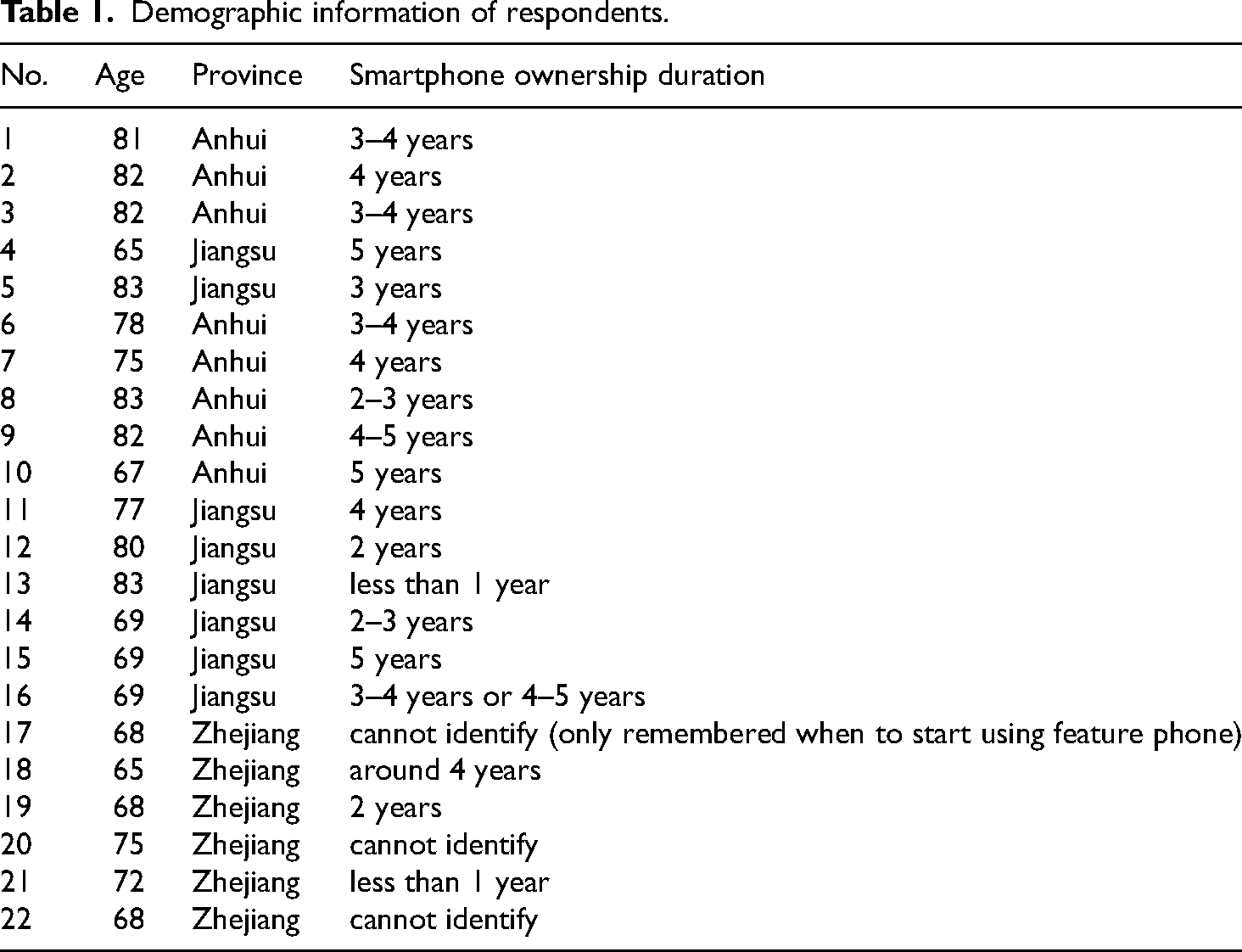
This study includes a sample of twenty-two older women, aged between 65 and 83, residing in Jiangsu, Anhui, and Zhejiang provinces which are undergoing a gradual shift towards an ageing society (Wan, 2021). Participants were recruited through snowball sampling, utilizing referrals between respondents to reach potential participants. Sharing a common working-class background, the respondents were employed prior to retirement as either factory workers or primary school teachers in remote suburbs within third-tier Chinese cities.
The respondents’ average annual pension income ranged from RBM 30,000–40,000. They generally shared a limited literacy level and educational background. Twenty-one had secondary or high school diplomas, while one respondent withdrew from primary school education. All participants were smartphone users, with their usage experience varying from less than one year to five years. Table 1 gives more demographic details. To provide additional perspectives on respondents’ smartphone adoption and usage, interviews were also conducted with two of their children and two husbands. (Table 1).
Demographic information of respondents.
This study employed qualitative semi-structured interviews and digital ethnography to enable data triangulation across 2020 and 2021, with institutional review board approval ensuring anonymity and respondents’ rights to withdraw or skip sensitive questions. In-depth interviews provided insight into respondents’ daily experiences (Josselson, 2013). Due to COVID-19 pandemic restrictions, twenty interviews were conducted through video calls on WeChat, and four in person. Two interviews included respondents together with their family members (one with a husband, the other with a child). Each interview last between half to one hour, with questions tailored to each respondent's context. The shared gender of the author facilitated discussions on gendered smartphone experiences, while the age difference encouraged respondents to narrate life stories from the perspective of the elderly generation.
On-site observation of respondents’ digital engagement (Kozinets, 2020) was conducted within a WeChat group—Sunset Glow Friends’ Group (wanxia qunyou), an exclusive space for low-income older women, including six respondents. Introduced by the first respondent, the author joined the group with consent from other members and conducted digital ethnography from 7th January to 23rd August, 2021. To maintain natural interaction patterns, the author remained a passive observer, recording communicative threads and capturing relevant screenshots. This group provided valuable insight into the interactions, information exchange, and social support among marginalized older women, illustrating how they learned to create a shared space for information and mutual support.
The dataset comprised twenty-four transcribed interview recordings, accompanied by observational notes. Data analysis employed the constant comparative method (Boeije, 2002), with the author immersing herself in repeated readings, recording memos for key insights and reflections, and engaging in iterative discussions to identify and refine emerging themes until reaching saturation. The data analysis was guided by polymedia theory focusing on capturing the narratives related to user behaviors and the underlying reasons. Specific guiding analytical dimensions included (a) how respondents understand, navigate and make choices across diverse media and communication channels on smartphones; (b) what are the constraints; and (c) their negotiation of agency. This analysis led to three emerging themes including “exploration of nuances of different communication modes, yet often within a single platform,” “the preference of video”, and “choices as constraints.” Findings will focus on a detailed analysis of these themes.
Findings
The empirical evidence results in an analytical framework encompassing three dimensions that facilitate a comprehensive understanding of the impacts of intersectional factors on agency of marginalized older groups in navigating polymedia. The first dimension is about their unique exploration mode. While often being limited to a single platform such as WeChat, marginalized older female adults actively explore the nuances of different communication modes within this platform to maintain social connectivity. Second is about the media preferences in a polymedia environment. Their engagement tends to be media-centric, with a discernible inclination towards video-mediated communication. Although this serves their entertainment needs, information sharing and emotional expression, it likely increases the exposure to eye-catching yet low-quality content. The third dimension focuses on the sense of control. Polymedia complicates the control over smartphone usage, manifesting in the struggles against disruptive elements such as pop-ups, targeted advertising, and unsolicited app installations.
Exploration of nuances of different communication modes, yet often within a single platform
When asked about their smartphone usage, the typical answer was “I do not know how to use the phone, only checking WeChat.” For most respondents, WeChat was the only frequently visited platform. In their words, WeChat “allows us a platform to know the world outside and helps us with getting connected” (No.12). Especially, WeChat reduced the cost of staying connected by operating in a Wi-Fi environment, which met the needs of socioeconomically restricted respondents who were concerned about the expenditure on mobile communication. As one respondent said (No.11), “previously, remote calls required payment, so you would not chat for so long.”
Although more than one respondent initially mentioned that they only used WeChat for calling family and friends, the interviews revealed their much more complex usage of WeChat. Respondents were observed to engage in making use of their accessible resources from polymedia embedded in this single platform to gradually develop their understanding of the nuanced differences between multiple communication modes. As reflected in their words (No.1), “at beginning, I did not even dare to click on any button, but now gradually progressing (my skills of using WeChat).”
One such example is their accumulated knowledge of the boundary between private and public communicative spaces. They enjoyed the intimacy provided by video chat that enabled them to connect with old friends in a manner akin to in-person interaction—or as they said, “video calls just bring friends to your front.” However, they did not prefer sharing any posts on Moment, a feature within WeChat that functions as a social media feed. As one respondent (No.18) stated: (Sharing on Moment) equals to you are telling this to the public. Once this information is on your phone, later, this might be heard by others, as people can forward it to anyone.
In addition, respondents also discussed the differences between synchronous and asynchronous communication. For instance, one respondent (No.17) mentioned what they thought about voice message: Voice messages are very fast. You say something, and the message is delivered instantly. However, they are not restricted by time. The recipients can listen to the message anytime and anywhere, simply by clicking on it. They can choose not to listen right away.
Unlike dyadic communication, messaging groups enabled collective engagement in discussions within a single space. Therefore, this space became their important venue to foster peer support. Since the on-site observation of Sunset Glow Friends’ Group took place during the pandemic, the group was used to share various types of information concerning updates on virus infection, protection methods, and vaccines. Also, it served as a space where members supported each other to learn how to check their pension status. With the lockdown confining everyone to their homes and the pension confirmation process moving online, a relatively tech-savvy member would typically forward the pension list from the previous work organization to the group and guide group members on how to open the Excel file on WeChat to check their individual pension details. One respondent (No.13) shared her experience: “I had not known to check the pension in WeChat group. My colleague told me, then I clicked on it.”
Respondents also employed certain functions innovatively to meet their own communicative needs, deviating from the technology's original design purpose. One interesting observation was their usage of WeChat Sports, a feature that tracks and displays users’ daily step count and shares the history with users’ contacts on WeChat. For the group of older female adults, WeChat Sports became an alternative way to understand the mobility of their friends based on the step count. One respondent (No.3) mentioned that whenever her WeChat step count decreased, her older friend would call to check in and ask if everything was alright. My friends asked me, ‘Why haven’t you been walking lately?’ I told my two old schoolmates that I hadn’t been feeling well. My stomach was upset, and I felt nauseous. I couldn’t drink water or eat. It took me a week to recover, which is why there was no activity shown on WeChat for two weeks.
However, the exploration within WeChat did not always go smoothly. One such example is the QR code—a type of barcode capable of storing various information and easily scanned using smartphones or dedicated QR code readers. During the pandemic, QR codes embedded on WeChat were utilized to track health status and travel history, allowing this information to be accessed by scanning with WeChat.
Although scanning WeChat QR codes was a compulsory requirement for entering public spaces such as hospitals, banks, and public transportation, respondents widely expressed confusion and even fears regarding QR codes. One respondent (No.17) stated: Scanning a QR code might allow others to access our phone, leading to scams that steal our money, so we will not scan them randomly. My families also warned me not to scan, do not scan.
Therefore, it was common for respondents experiencing the rejection of entering public spaces because they did not know how to generate QR codes on WeChat nor how this scanning system worked.
The preference of video
In the Sunset Glow Friends’ Group, short video was the major media for information sharing. These videos were usually forwarded from public accounts followed by group members on WeChat and sometimes from other WeChat message groups of group members. The main purpose of sharing this type of information was for entertainment. As one respondent (No.17) said, when she forwarded the information, she wanted to “let group members enjoy the news together.”
Short video was also the major reason for some respondents to start using other applications such as Douyin. One respondent (No.6) shared her experience: Douyin is easy to use—just open the app, and you can keep watching videos. I enjoy watching videos about situations where a daughter-in-law treats her mother-in-law poorly or where a son mistreats his mother. I also like listening to traditional operas. Douyin is fun, and I check it out whenever I have some free time.
Compared to text information, short videos were “easier to be seen” (No.9) for respondents with declined eyesight. It could be challenging for them to “recognize small words on a small screen.” Therefore, the visualized information allowed them an alternative way to receive information. As one respondent stated, “I can receive news from all over the country on Douyin” (No.11).
Additionally, their limited literacy level often resulted in a restricted ability to read and comprehend written text. One respondent (No.6), who is completely illiterate, said: I do not know words and I am not at all educated. Now using Douyin, it is already an achievement as I can watch people talking, arguing, and singing by using a smartphone.
On another note, although short video news primarily served an entertainment purpose, the content circulated within older adults’ groups or pushed to them through news feeds often included low-quality or even fake information. These widely shared videos frequently featured sensational titles designed to capture users’ attention. During the pandemic, it was very common to spot videos including exaggerated or entirely fabricated reports about the pandemic status overseas in the WeChat group. Typical eye-catching headlines included “India has found solution to Delta” or “Immigrants to United States now are feeling regretful because of pandemic.” After a while or even on the same day, these contents would be shown as “already been deleted/removed” when clicked on again. This was attributed to the regulatory system on WeChat that classified such information as fake news.
However, notably, short video media also enabled an effective channel for older adults to express their emotions. In the Sunset Glow Friends’ Group, one popular video was about Koktokay, a small town in Xinjiang where many group members used to work when they were young. Video media, which combined music and moving images of Koktokay's beautiful natural scenery, evoked a deep sense of nostalgia, bringing back memories of their youth and their connection to this place. For older female adults, sharing videos was a meaningful way to reminisce about their past and the places where they once worked. This rekindling of memories was particularly important for older adults, providing them with a channel to express emotions that cannot be easily shared in daily lives. One respondent (No.9) was so moved by the video that she shared it with her friends who did not work in Koktokay before: I sent this video to my old classmates so they could also see the beautiful view.
Choices as constraints
For marginalized older groups, the complex polymedia system could impose additional constraints on media usage. Different from previous studies where constraints typically arise from unwanted social connectivity (Pei, 2021) or the inappropriate selection of communication media (Wang & Lim, 2021), for respondents, challenges include limited knowledge of polymedia and the sense of lacking control over polymedia.
Regarding this, respondents were often fearful of unfamiliar functions. They were afraid of making mistakes in operation that might lead to irreversible consequences. For instance, due to the limited storage capacity of their outdated smartphones, many respondents wanted to delete some messages to free up space. However, they expressed uncertainties, stating, “I do not know how to do this and do not dare to delete anything.” One respondent (No.20) echoed this fear: I am afraid deleting anything as this might influence my mobile phone usage in the future. So which one can be deleted and which cannot, I do not really understand.
Especially, the integration of e-commerce in mobile applications tended to exacerbate the fears and sense of uncontrollability. One typical example is WeChat Pay, which has become a widely used mobile payment and digital wallet service in China. As noted, WeChat was the respondents’ most frequently used platform. However, very few used WeChat Pay. One respondent (No.16) recalled her distressing experiences with WeChat Pay during one transaction that only accepted digital currency: I am ageing, and not familiar with the procedure, I put the password of my bank account as the amount of money and click on the transaction. I was supposed to only pay 5 RMB, but I put six digits which is my password, fortunately I did not have so much money in my account.
In addition, respondents were also confused about pop-ups, targeted advertising, and unsolicited app installations. They were unaware of the underlying algorithms embedded in the smartphone operating system and mobile applications. One respondent (No.21) stated: Sometimes, accounts you didn’t know how you subscribed to on WeChat keep sending you messages. One day, you might receive seven or eight messages promoting a single product.
Another respondent (No.22) described unsolicited information as a form of “harassment.” For them, smartphones can become “a mess,” with too many uncontrollable notifications and unclear sources.
The constraints were likely to be a consequence arising from the intersection of the complexity of the polymedia environment, structural inequalities, as well as the ageing process. Firstly, this research identified the absence of government support systems aimed at helping socioeconomically marginalized older female adults understand essential smartphone functions. Respondents commonly stated that they had never heard of any government-organized programs designed to enhance their digital literacy. Even among the five respondents who participated in continuing education courses specialized for older adults, none reported having access to classes specifically tailored to their digital needs.
Especially, it is important to note that some respondents expressed the desire to learn more about smartphone usage. For instance, during the interview, once one respondent (No.17) knew that she could access Baidu on her smartphone, she immediately requested a demonstration and asked whether she could use it to search for information on certain diseases. The desire for support was also reflected in the words of another respondent (No.16): Sixty-five to seventy years old older adults can learn the smartphone. We just need some volunteers to teach us … We do not need complicated functions, just very common ones. We just need very simple learning and very simple usage, then we can use smartphones ourselves.
Apart from lacking government support, respondents also reported receiving very limited help from their adult children. Discrimination and bias against ageing parents were often reflected in their children's responses to requests for help, such as “how come you do not even know how to use this function?” Due to the deeply rooted patriarchal family hierarchy, gender intersected with ageing, further diminishing the attention and resources allocated to older female adults to support their digital engagement. Their digital needs were more likely to be regarded as “not necessary” by family members. Respondents frequently described their children as “too busy” or “too impatient to help.” Only three participants mentioned that their children were actively providing timely instructions and guidance on smartphone usage.
Socioeconomic restriction can be another major constraint. Most respondents received an obsolete phone from their children, which were outdated models with poor battery life and small storage. Especially as older female members, their digital needs are often the most overlooked by family members. One respondent (No.22) reported that she had to request her own phone from family members, arguing, “other people all have phones, but I did not. I said I also wanted one.” The outdated smartphone devices add another layer of challenge for their exploration of polymedia. Respondents reported that “the phone can die all of a sudden, and then you do not know what to do” (No.17) or “my phone storage is small, very troublesome” (No.20).
Some respondents expressed that they would not bother to catch up with the skills and knowledge required for smartphone usage. They said they just “did not want to check phone frequently” because of declined eyesight. They asked, “why should I learn how to use a smartphone at this age?” Although this may reflect the challenges of keeping up with new technologies associated with ageing, choosing not to engage with polymedia remains a personal decision. As one respondent (No.21) stated: I do not want to learn, anyways, I am old. My life is fulfilled, and I am happy with my life. Whatever I have is good enough.
Discussion
Grounded in polymedia theory, this research maps out the dynamics of smartphone usage by socioeconomically marginalized older female adults in China. The findings highlight user agency as a critical factor influencing individuals’ capacity to acquire knowledge about and make informed choices among various affordances to meet their social and emotional needs within the polymedia environment. Notably, the findings challenge several foundational theoretical dimensions of polymedia by revealing how engagement with polymedia is contextually constrained for marginalized older populations.
First, it advances the conceptualization of digital literacy as central to one's capacity to navigate the polymedia environment (Madianou, 2014). Departing from much of the existing literature that emphasizes polymedia affordances as communicative opportunities, our findings highlight how limited digital knowledge and skills among socioeconomically disadvantaged older women often confine their use to a single platform and a few functions, restricting their access to broader communicative channels. Furthermore, an incomplete understanding of mobile functionalities can render features such as QR codes or pop-up interfaces more burdensome than empowering. These findings call for a reframing of digital literacy not as a fixed or fully attained state, but as a fluid spectrum that variably shapes patterns of polymedia engagement and the social and emotional consequences across different contexts.
In addition, the findings advance the scholarly discussion on polymedia by situating individual user behaviors within a broader sociocultural and political-economic context. This research acknowledges that prior studies on polymedia often center around specific contexts—for example, a significant body of research focuses on polymedia and migrant families. However, the extant literature still lacks discussion on the external forces imposed by social, cultural, economic, and political contextual constraints upon individual experiences of polymedia.
Notably, for the marginalized older female group, the constraints often extend beyond merely lacking digital skills and resources to include more fundamental contextual factors rooted in their society. As shown in the findings, while ageing significantly contributes to biases and discrimination against older people's digital abilities, gender stereotypes and inequalities exacerbate this marginalization by further reducing the bargaining power of older women and leading to the neglect of their digital needs by family members. Socioeconomic status serves as an additional barrier, limiting digital access alongside factors such as educational background and literacy levels. Moreover, the lack of adequate government support further restricts the resources available to these individuals, resulting in their exclusion from digitalization processes at the societal level. Therefore, this research proposes a theorization of polymedia that considers the varying levels of constraints that shape users’ choices in navigating polymedia affordances.
The findings also illuminate how marginalized older adults actively negotiate their agency in navigating the polymedia environment, shaping a nuanced and context-specific engagement experience. Within a single platform, either through self-learning or peer support, they gradually explore the different communication experiences offered by different communication modes within this platform. In this way, they expand their channels to remain connected and stay informed about updates from family, friends, and the outside world. Meanwhile, within the constraints of their agency, they have developed a distinct preference for short video media, which provides a relatively low-effort avenue to share information, seek entertainment, and express emotions.
Conclusions
This research contributes to extending polymedia theory to the context of mobile communication of marginalized older social groups in the Global South. It foregrounds agency as a critical yet underexamined factor in shaping the boundaries of older adults’ engagement with polymedia. This approach allows for a novel perspective on the socio-technological dynamics of polymedia, encouraging an understanding of polymedia encapsulating the interactions between technology, user agency, and the structural contexts. Additionally, this research suggests viewing polymedia as an evolving process shaped by users’ ongoing negotiation of agency, through which they gradually construct meanings associated with experiences of different communication modes.
Another contribution lies in enriching the scholarship at the intersection of mobile communication and ageing contexts. This research gives voice to low-income older female adults in the Global South whose digitalization processes are often left out of the spotlight. Therefore, it enhances the understanding of marginalized older adults’ struggles with smart technologies and their agentic responses to the rapid digitalization of daily life. For these ageing individuals, engagement with polymedia serves not only as a means of communication but also as a strategy for adapting to digitalized societies in developing countries, where offline services and interactions have largely shifted to online platforms, particularly during the COVID-19 pandemic and in the post-pandemic era.
This research also provides valuable insights for policymakers and mobile technology companies, facilitating an in-depth understanding of the most pressing challenges encountered by socially marginalized older smartphone users. It advocates for the development of more inclusive policies that actively engage older adults in the digitalization process at a societal level. For instance, this research highlights the potential for government collaboration with technology companies to design alternative systems specifically tailored for older adults. Examples include replacing QR code-based systems with more user-friendly alternatives or simplifying verification processes, such as simplifying facial recognition for pension collection. This research highlights the importance of organizing workshops specifically designed for socially marginalized older adults, focusing on basic mobile operations such as managing phone storage, handling pop-ups, using e-payment systems, and navigating search engines embedded in mobile devices. Notably, the findings emphasize not only the need of older adults for skills training but also the importance of addressing and reducing their fears associated with mobile functions.
This research demonstrates its limitations which can be new directions for future studies. First, future research can examine the nuances even within the group of marginalized older adults—for instance, the differences between rural and urban older adults, and between the relatively young older adults and more senior older adults. In addition, future research should consider that China presents a distinct digitalization context compared to other developing countries given its thriving domestic mobile industry. The analytical framework proposed by this research, which focuses on examining the contextualized agency of marginalized older adults, remains relevant and can inform similar examinations in other local contexts. In addition, it is important to note that the overarching dominance of WeChat plays an important role in shaping polymedia experiences in China (Xiong & Liu, 2023). This represents an important direction for future research, particularly in exploring how China's distinctive digital governance culture shapes older adults’ media practices and their engagement with polymedia.
Footnotes
Declaration of Conflicting Interests
The author declared no potential conflicts of interest with respect to the research, authorship, and/or publication of this article.
Funding
The author received no financial support for the research, authorship, and/or publication of this article.
