




Abstract
Studies show that the use of smartphones in the presence of a partner may result in lower relationship quality, intimacy, and increased conflict. Such co-present phone use, often referred to as “phubbing” or “technoference,” has been problematized in the literature. However, few studies have hitherto explored the possibility that using phones in each other's presence may not cause any relational harm and might even support relationship maintenance. Only recently did the critiques and theoretical frameworks begin to expand our understanding of the broader role of smartphones in dyadic interactions. In this study, we tested whether co-present phone use is always perceived as negative, or if it could also be neutral or positive. We employed quantitative methods and content coding of free responses to understand the participants’ experiences and reasoning in different evaluations. We analyzed the responses of British participants (N = 383) living with their partner, who were enrolled via Prolific to take part in the study. The analyses revealed that only 15% of participants perceived their partner's phone use as negative, the majority evaluating it as neutral or positive. Most participants reported that their partner's phone use had no impact on their time together or was integrated with other activities. Those who reported a negative impact attributed it to the partner's lack of attention. The present study challenges the existing literature and highlights the need for a conceptual expansion of smartphone-related behaviors in dyads.
Keywords
Introduction
Since the introduction of high-performance smartphones, co-present mobile phone use in interactions among romantic partners has significantly increased (Sbarra et al., 2019). Research on mobile phone use has primarily concentrated on its detrimental effects on relationship welfare when the partner is ignored in favor of the mobile phone (largely conceptualized as phubbing; Chotpitayasunondh & Douglas, 2016). Studies indicate that such behavior may reduce intimacy, relationship quality, and escalate conflicts (e.g., Beukeboom & Pollmann, 2021; Vanden Abeele et al., 2019). However, as the research field has emphasized the negative implications of mobile phone use, it may have pathologized routine activities associated with smartphone use (Billieux et al., 2015). We also argue that the existing instruments do not accurately measure the phenomenon, which raises doubts about their credibility (Frackowiak et al., 2024b). We propose a study focusing on participants’ subjective experiences and interpretations of their partner's behavior within specific contexts. This approach values participants’ personal evaluations—a perspective often overlooked in past research.
Mobile phone use in dyadic interactions
Dyadic interactions drive relationship development, with functional behaviors enhancing satisfaction and dysfunctional ones leading to break-ups (Kelley et al., 1983). Interpersonal communication, characterized by verbal and non-verbal elements such as tone and body language (Hilpert et al., 2020), plays a crucial role in these dynamics. For instance, mutual listening, which partners expect to be prompt, influences dyadic outcomes (Carmichael et al., 2007). Interactions between partners vary in context and intensity, ranging from casual exchanges during shared activities to dialogues requiring undivided attention. Smartphone use may affect how partners interact (Sbarra et al., 2019). The outcome of smartphone's ubiquity is “co-present mobile phone use,” where smartphones are frequently used in each other's presence throughout the day. Since partners cohabit or spend substantial amounts of time together, smartphone use during daily exchanges is inevitable (Avgustis & Oloff, 2023). Early studies suggest that phone use can reduce quality time with partners and act as a “third person” in relationships (Morgan et al., 2017). This intrusion may hinder positive interactions, crucial for fulfilling relationships as per clinical studies (Hilpert et al., 2013).
Phubbing and technoference
Early research has led to a focus on how mobile phone use disrupts the interactions and harms relationships. Two terms have emerged from this line of inquiry: phubbing and technoference. Phubbing is defined as ignoring the interaction partner due to phone use (Chotpitayasunondh & Douglas, 2016; Pathak, 2013), while technoference pertains to technological device interruptions in interactions (McDaniel & Coyne, 2016). Research has linked those terms to various relational outcomes (Al-Saggaf & O’Donnell, 2019; Nuñez & Radtke, 2023), such as reduced perceived partner responsiveness (Frackowiak et al., 2022), relationship quality (Beukeboom & Pollmann, 2021), intimacy (Halpern & Katz, 2017), and elevated negative emotions (Frackowiak et al., 2024a; Thomas et al., 2022).
However, there are several issues related to the terms phubbing and technoference. The phenomenon has been studied using closely related but seemingly distinct constructs (Hagger, 2014). This “jangle” fallacy (Block, 1995), which hinders scientific progress by failing to identify existing but differently labeled constructs, is evident in the cases of phubbing and technoference. 1 This has been argued to impose constraints on building comprehensive theoretical frameworks and drawing conclusions about real-life phenomena (Hagger, 2014). This is because the variables cannot be distinguished empirically.
Secondly, there exists a discrepancy between the definitions of phubbing/technoference and corresponding scales: they do not capture feeling ignored or technological interference. This is evident in the Partner Phubbing Scale (Roberts & David, 2016) and the Technoference in Life Examples Scale (McDaniel & Coyne, 2016). The items depict presence of technological devices, or situations where a partner uses a device in the participant's co-presence, but without implying ignoring or interference, which are central to the definitions of phubbing and technoference. 2 This may create uncertainty about the erroneous conclusions and misguided recommendations drawn from such measurements (see commentary by Frackowiak et al., 2024b). Furthermore, the current measures do not consider ambiguous or inconclusive scenarios, that is, how participants perceive and evaluate partner's phone use, or whether the phone use is part of a shared activity with the partner. Therefore, the scales have been argued to be suboptimal (Davidson et al., 2022; Frackowiak et al., 2024b), and not accurate in capturing the instances of co-present phone use in relationships. This shows that measuring complex behaviors like phubbing and technoference is challenging, due to the interplay between partner A's behavior and partner B's perception and experience.
Thus, recognizing the complexity of co-present phone use is crucial. Ignoring a partner due to technology can lead to feelings of rejection and undermine the sense of belonging and immediacy (Ochs & Sauer, 2023; Vanden Abeele et al., 2024; Wesselmann et al., 2023). However, viewing all co-present smartphone use as problematic by default can bias research and pathologize everyday behaviors (Billieux et al., 2015), especially as smartphones are now a common part of social interactions (Turkle, 2011), and have, paradoxically, become ubiquitous and taken for granted (Ling, 2012). It is therefore necessary to explore both the function and context of smartphone use in partner interactions, instead of assuming its innate negative connotations (Cummings & Reimer, 2021). There are studies that explore this issue in the context of intimate relationships, as the predominant research narrative revolves around the potential of phone use to cause relational harm. For instance, Miller-Ott and Kelly (2015) reported that partner's phone use was seen as negative only when their attention was expected (e.g., during a formal date), but more acceptable when the phone use was short, or during informal situations. Similar findings were reported by Kelly et al. (2017): checking something together on the devices counted as a positive experience, which may enhance bonding (Schellewald, 2024). It has also been reported that spending time together with the partner, when each of them was using their own phone is an acceptable practice (Kelly et al., 2017), and that psychological inclusion of one's partner in own phone-related activities may promote relationship maintenance (Kelly & Miller-Ott, 2022).
Theoretical frameworks of mobile phone use
The limited number of studies exploring the complex nature of smartphone use in interactions indicates the need for an empirical exploration that overcomes the existing limitations and provides a theoretical expansion. The recently developed frameworks describe the mechanisms that define the potential consequences of co-present mobile phone use. The attention-arousal-attribution framework (Vanden Abeele, 2020) proposes that phubbing's negative effects stem from a combination of attention shifts toward the phone, emotional arousal, and interpretations of the situation (self- or other-attribution). The framework identifies factors that can intensify or mitigate phubbing's impact on relationships. These include behavioral aspects like phubbing intensity, relationship type and duration, and contextual circumstances of phone use like intensity and length, which can mitigate or magnify the relational harm (Vanden Abeele, 2020). 3
Second, the cellphone relevance hypothesis (Cummings & Reimer, 2021) argues that a phone's presence in social interactions is not inherently negative. Rather, the effects of using a cellphone on the satisfaction of a conversational partner depend on the perceived function of the cellphone use. These effects hinge on whether cellphone use is seen as integral or incidental to the conversation. Phone use unrelated to the conversation is viewed as incidental if it is irrelevant to the current conversation, and integral if it directly relates to the conversation. The theory extends Vanden Abeele's (2020) idea of screen-sharing for self-disclosure. It further incorporates mobile devices in interactions but does not explore the potential relational consequences. It also does not account for ambiguous interpretations of partner's phone-related behavior beyond its function within the interaction.
The study rationale
Drawing from previous research and the theories, we suggest conceptual and methodological refining. As argued, current models presume negative impacts of co-present phone use, but the measurements inaccurately capture participants’ experiences, narrowing the research scope and prompting erroneous conclusions. What is more, the reliance on questionnaires overlooks the experiential and phenomenological aspects of partners’ feelings about smartphone use (Hertlein & Blumer, 2014). Borrowing from the theories, we argue that smartphone use in interactions can be facilitative (e.g., Cummings & Reimer, 2021), not just disruptive. Expanding the narrative to account for the natural heterogeneity of phone-related experiences is essential for theory development (Bringmann et al., 2022). Building upon previous studies, we suggest that smartphones can enhance interactions, for instance, when partners share the found content with each other or engage in a discussion regarding each other's phone use (e.g., Foster Campbell, 2022; Kelly & Miller-Ott, 2022). The context also plays a role; a partner's brief phone use during a TV viewing may not negatively impact the couple, but it may if they use it for an extended period (Vanden Abeele, 2020).
We propose a study that emphasizes participants’ subjective experiences, perceptions, and interpretations of their partner's behavior, considering the context and situation, instead of establishing direct statistical associations between a partner's phone use and relational outcomes. The significance of such an inquiry lies in allowing participants to make their own sense of and evaluate their partner's behavior, a perspective largely overlooked in previous studies. Given the ubiquity of smartphones in daily tasks and interactions, it is relevant to consider that their use could not only not jeopardize the quality of time partners spend together, but could also enhance and elevate, or simply have no impact on it.
The current study
To test these theoretical assumptions, we integrated quantitative aspects and content coding of participants’ free responses. First, based on the previous findings, we posited two hypotheses. To counteract the prevailing narrative regarding co-present phone use as innately negative (Cummings & Reimer, 2021), we postulated that positive and neutral evaluations of the partner's mobile phone use in an interaction occurred as frequently as negative evaluations (H1). However, we also assumed that the duration of co-present phone use played a role, as previously suggested (Vanden Abeele, 2020). We proposed that the longer the partner's phone use lasts, the more likely the experience is to be negative (H2).
Next, we proposed two exploratory research questions. It has been brought up that partners’ communication practices are inevitably affected by technology, regardless of the interaction context (Foster Campbell, 2022). Exploratively, we wanted to know whether the type of activity (for instance, cooking or a face-to-face interaction) that is interrupted by mobile phone use plays a role in whether the use of the mobile phone is then rated as positive, neutral, or negative (RQ1). In the final part of the study, we aimed to explore why participants evaluated partner's mobile phone use as positive, negative, or neutral (RQ2), to recognize their sense-making and experiential ambiguities, which are not accommodated by the existing measurements.
Method
Participants
Participants were recruited from the United Kingdom using opportunity sampling. Recruitment was conducted via a crowd-sourcing platform, Prolific. Prolific prescreening criteria ensured that only eligible participants could access the study. The criteria included being based in the United Kingdom, balanced gender sample, age range of 18–45, any sexuality and ethnicity, native or fluent English level, full-time employment with regular office hours, childless, in a relationship for more than 3 months, cohabiting with the partner, and a minimum 95% approval rate on Prolific (Kothe & Ling, 2019). Full-time employment with regular office hours was proposed as a criterion to ensure that the participants would spend time with their partner in the evening, after not seeing them all day. Furthermore, partners who have children may spend less time with each other and may be impacted differently by concurrent phone use (Roman et al., 2017).
A total of 750 participants were recruited for the baseline questionnaire (see Figure 1 for a study flowchart). To validate the prescreeners and filter out ineligible participants, we included a question in the baseline questionnaire asking whether the participant cohabited with their current partner. Participants whose responses did not match their prescreening answer were redirected back to Prolific and excluded (n = 89). Participants who were eligible and completed the baseline questionnaire were automatically enrolled in the study and invited to the subsequent study measures (see Procedure). They were compensated for their time according to the Prolific participation payment standard (£2.50).
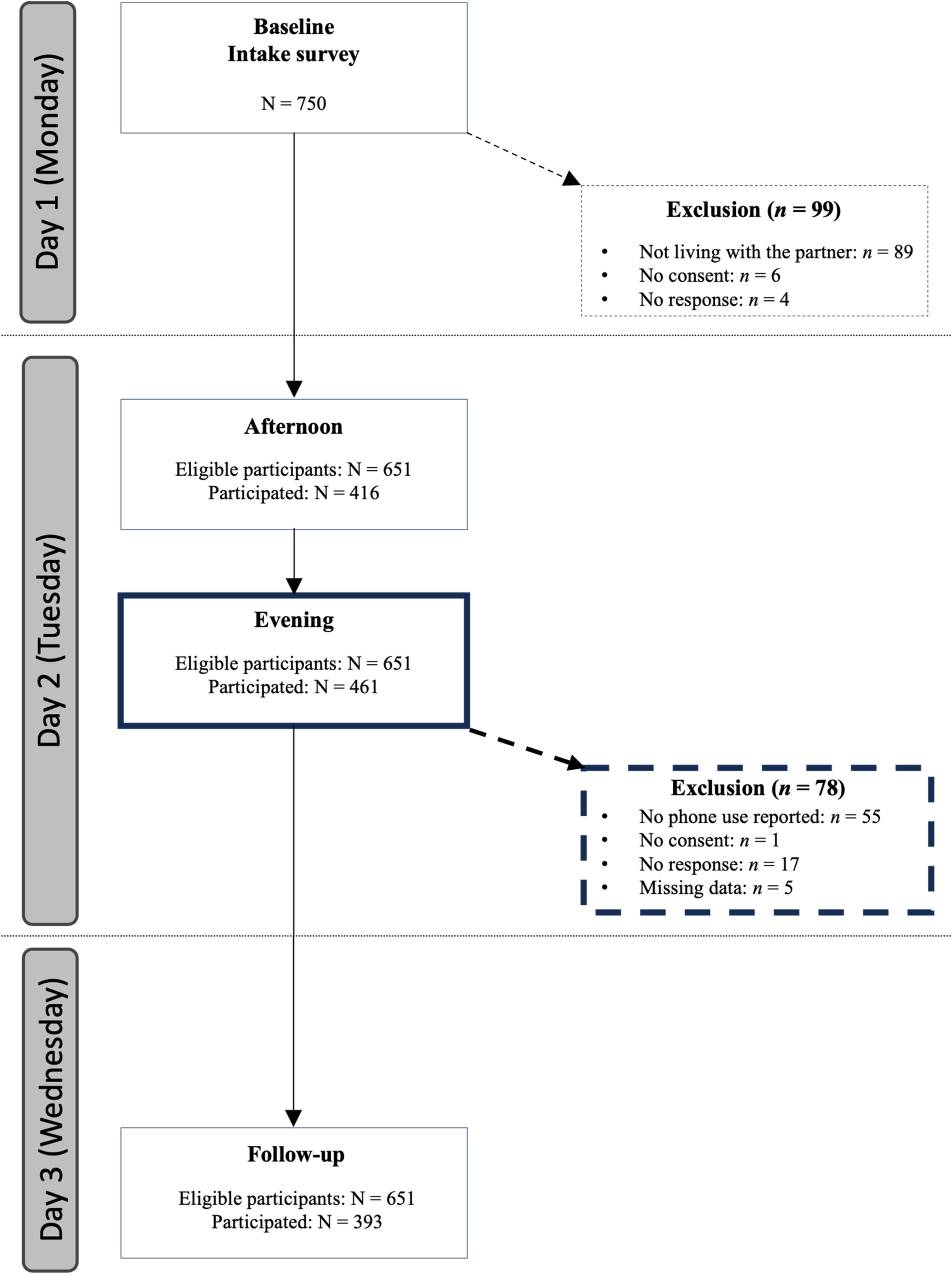
Study flowchart.
The study experienced an attrition rate over its 3-day duration, with 461 participants responding to the evening questionnaire (see Procedure). Of these, 78 were excluded due to missing data that precluded the required analyses. The final sample consisted of 383 participants, of which 206 (53.8%) were female. The sample age ranged from young to middle-aged (22–64 years old; M = 33.0, SD = 7.41,). Most participants identified as heterosexual (n = 326, 85.3%), with 6.8% (n = 26) identifying as homosexual, and 7.6% (n = 29) as bisexual. The average relationship length was M = 7.65 years, SD = 5.43 (0.50–40 years). See Table 1 for the sociodemographic information.
Sociodemographic characteristics of participants at baseline.
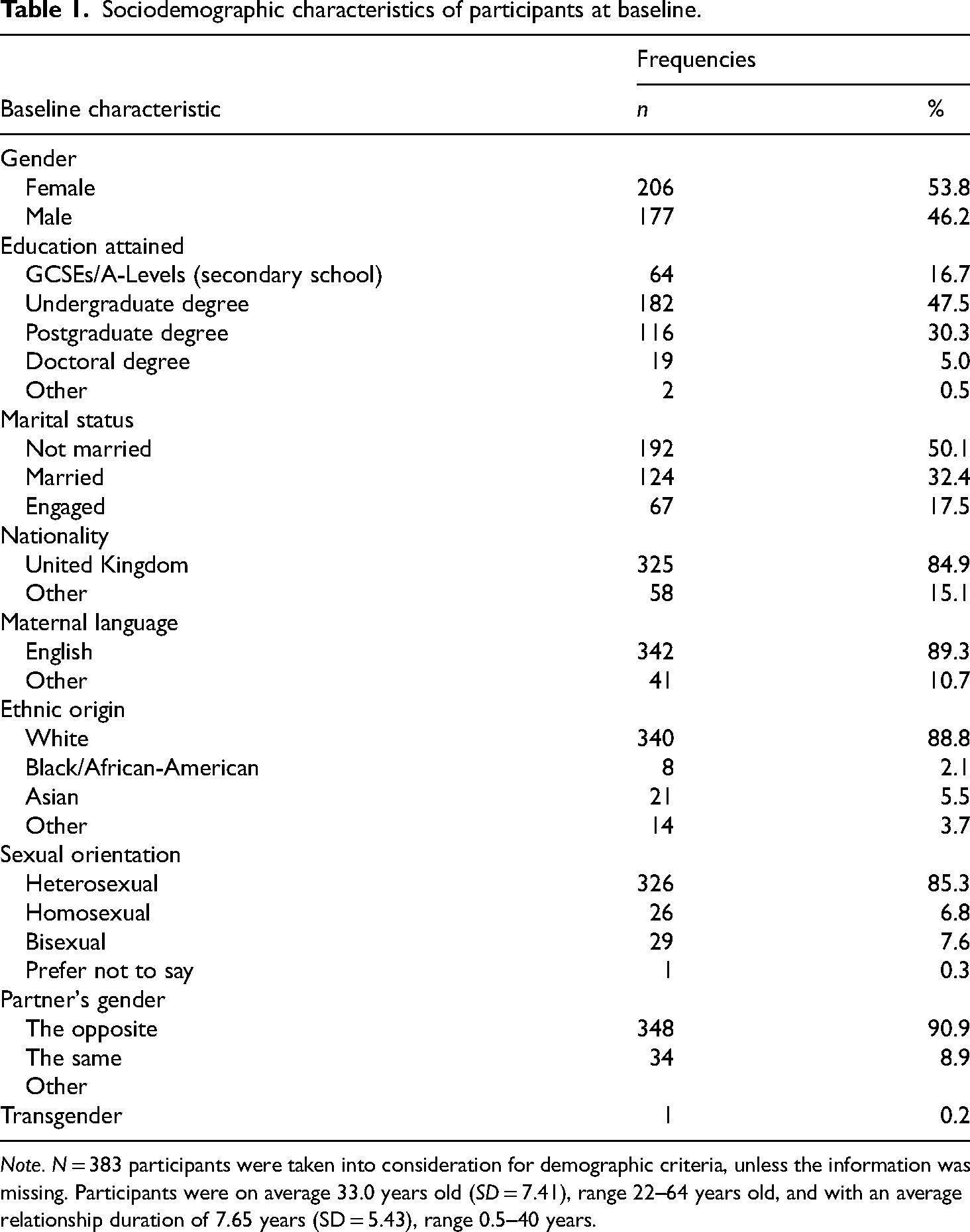
Note. N = 383 participants were taken into consideration for demographic criteria, unless the information was missing. Participants were on average 33.0 years old (SD = 7.41), range 22–64 years old, and with an average relationship duration of 7.65 years (SD = 5.43), range 0.5–40 years.
Procedure
The study was conducted over three weekdays in November/December 2022. On Day 1, eligible participants received a baseline questionnaire (see below for the data availability statement and full study overview). On Day 2, participants received two questionnaires: one in the afternoon and another in the evening. The evening questionnaire, distributed at 6.00 p.m. and closed at midnight asked about the time spent with the partner that evening. Participants were asked to complete it just before bedtime. The questionnaire began by asking about the perceived mobile phone use by the partner that evening. If participants reported no mobile phone use, they were redirected to the final question and ended the questionnaire. We therefore excluded 55 participants (see Figure 1 for the details on participant exclusion).
Participants who reported their partner using a mobile phone were asked to describe the situations during which the partner used the mobile device and to report the perceived outcome of those events as positive, neutral, or negative. If multiple events with different outcomes occurred, participants were encouraged to select more than one option. Selecting any outcome generated a separate block of identical questions, differing only in the event outcome (positive/neutral/negative). Within each block, participants provided more detailed information about the event context (e.g., face-to-face conversation, watching a film, doing sport together, cooking together) and conversation topic. Within the same block, participants were prompted to elaborate on why the event of the partner's phone use had an overall positive/neutral/negative outcome. Once the block was completed, participants were redirected to the final question, or—if they selected more than one of the three outcomes—to another block of questions about the outcome. For instance, if a participant selected positive and negative outcomes of their partner's phone use, they were presented with two blocks of identical questions, one enquiring about the positive, the other about the negative outcome.
Measures
Multiple measures were used over the complete study run, we only report the measures that are relevant to this publication. 4 For this manuscript, we used the questions from the evening survey: time spent with the partner (1 = not much to 5 = a lot), and perceived time spent by partner using mobile phone (“How much do you think your partner engaged in the use of their mobile phone while spending time with you?”; 1 = not at all to 5 = a great deal). Participants who selected “not at all” in this question were excluded.
Individuals who reported that their partner had used the mobile phone in their presence that evening were asked about the outcome of the event: “Think about the situations with your partner during which they used their mobile phone. Think about the outcome of those situations. Was it overall positive, negative, or neutral? If there were multiple situations that happened tonight, you can choose more than one.” An additional block of questions inquiring further about the event was prepared, and the participants were asked to fill out as many blocks for as many event outcomes they had selected. In that block, the participants were asked about the context of the event (e.g., face-to-face interaction). Finally, they were asked to elaborate on the experience, and why it was perceived as such (e.g., as negative).
Data analysis strategy
The first hypothesis, which postulates that positive, neutral, and negative assessments of the partner's mobile phone use in an interaction occur with equal frequency, was analyzed with an exact multinomial one-sample test (EMT). This tested whether the actual frequency of occurrence differed from a theoretical frequency of 33.3%. If a difference was found, a binomial test was subsequently performed to see which assessment now differed significantly from which other assessment in frequency. Some participants experienced and evaluated more than one event. However, the basis for our analysis comprised the situations in which the co-present phone use took place, rather than the nesting within participants. Thus, we collapsed the data set in order for one event to correspond to one observation in the data set. Consequently, the number of considered observations was higher than the number of participants. The exact multinomial test was performed with the EMT package (Menzel, 2024). To respond to the second hypothesis regarding the total length of partner's phone use during the evening, we applied a one-way analysis of variance (ANOVA). The factor variable was “event outcome” with three levels: positive, negative, and neutral and the dependent variable was the duration.
The first exploratory research question enquired about the contextual features of the partner's co-present mobile phone use. Frequencies and percentages are reported in answer to this question. The data that were used to test the hypotheses were further collapsed from a wide to a long format to accommodate multiple options selected by the participants when asked about the contextual circumstances of their partner's phone use. The observations where participants selected more than one contextual feature, for instance, “Cooking together” and “Doing sports together,” were collapsed, so that each feature would be counted as a separate observation in the data set. Consequently, the number of contextual features taken into consideration in reporting descriptive statistics was larger than the number of participants, and larger than the number of observations considered for the first two hypotheses. All the accumulated contextual features added up to 589 observations (see Results section).
In the final exploratory research question, we analyzed participants’ explanations for rating their partner's mobile phone use as positive, negative, or neutral (RQ2). All the responses were collapsed in the data set, so that each outcome (positive, negative, or neutral) would be in a separate row. This was done to accommodate those participants who had selected more than one situation outcome, and it resulted in 432 rows of data. Responses were coded for each situation, that is, the contextual features of the partner's mobile phone use. Two authors coded the responses, with those not conveying the event characteristics excluded from further analysis (45 from 432 events 5 ). The first author coded the entire data set, while a co-author coded 20% to maintain consistency with previous content analysis studies. A 78% intercoder reliability was achieved, with discrepancies resolved through discussion. Some 387 responses underwent content analysis. The responses were analyzed separately in relation to the three outcomes (positive, negative, or neutral). Responses were clustered for similarities. Initial labels were assigned to response clusters and refined for accuracy. The final list of themes was established with the help of one of the co-authors.
Ethical approval
The study received a favorable ethical assessment from the ethical research commission (Commission d’éthique de la recherche) at University of Lausanne, Switzerland. Participants were asked for consent (Reference number: E_SSP_112022_00001).
Results
Participants reported spending a moderate amount of time with their partner on the evening the study was run (M = 2.95, SD = 1.18), and reported a moderate amount of partner's phone use during the time spent together (M = 2.69, SD = 0.78).
6
The results of the EMT showed that there were differences in the frequency of occurrence, χ2(2) = 148, p < .001. The subsequent three exact binomial tests showed that the positive assessment of the partner's mobile phone use (32%) did not differ from the theoretical expectation of 33.3%. However, the partner's mobile phone use was much more often rated as neutral (55%) and much less often as negative (15%).
The assumption of homogeneity of variance was met: F(2, 434) = 1.55, p = .21. The one-way ANOVA showed significant differences: F(2, 434) = 3.52, p = .031, ηp2 = 0.016. The subsequent Tukey's post hoc test revealed a significant difference between negative and positive outcomes: t(434) = 2.56, p = .029, 95% CI [0.07, 0.78]. Participants reporting a negative interaction outcome viewed their partner's mobile phone use duration as significantly longer (M = 2.95, SD = .77; see Figure 2) than those reporting a positive outcome (M = 2.59, SD = .76). The neutral outcome did not differ from the other two outcomes.
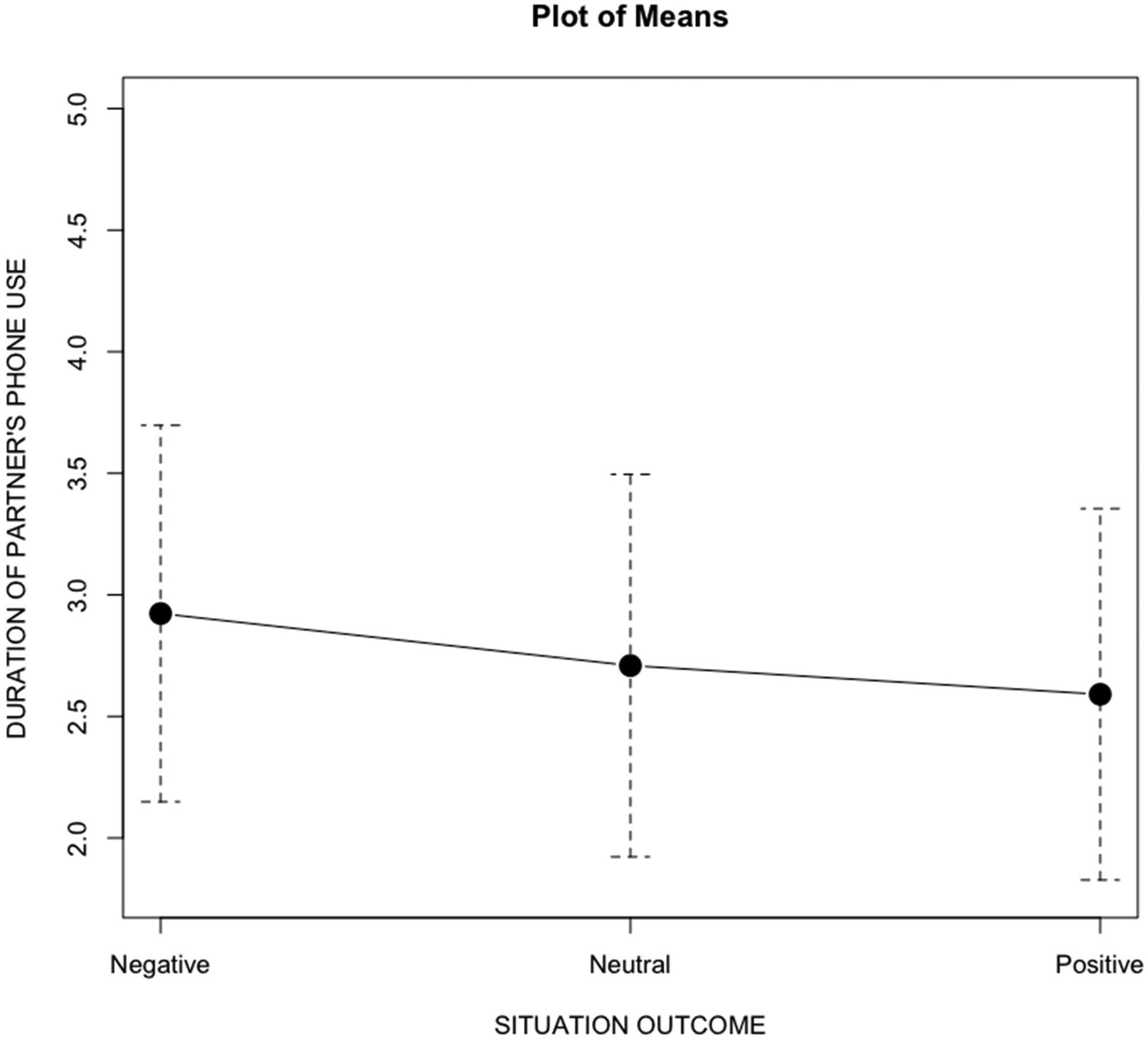
The amount of perceived mobile phone use by a partner differs significantly between partners who reported a positive event outcome and those reporting a negative effect outcome.
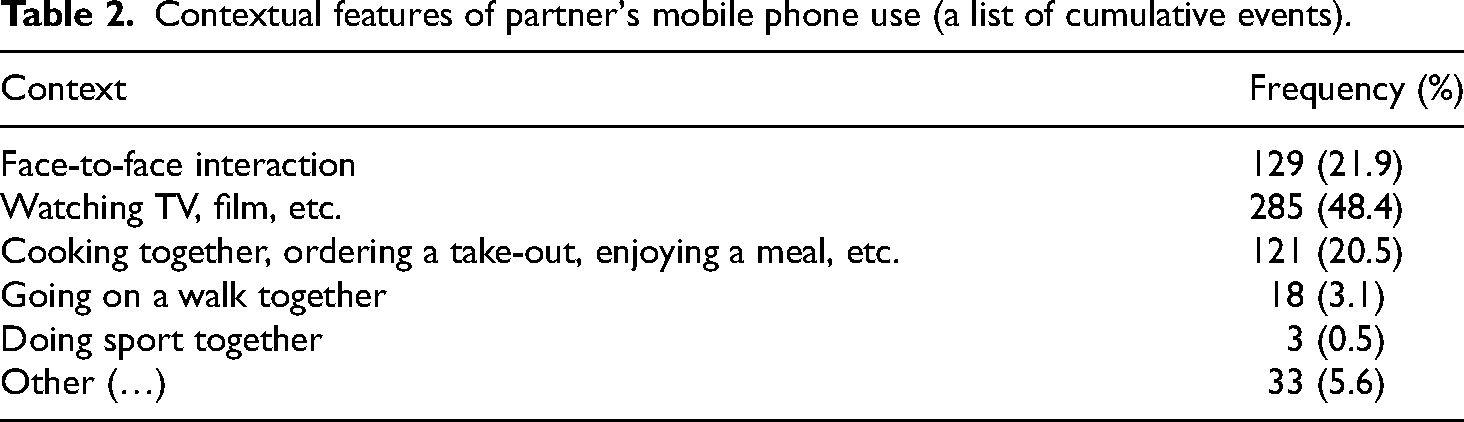
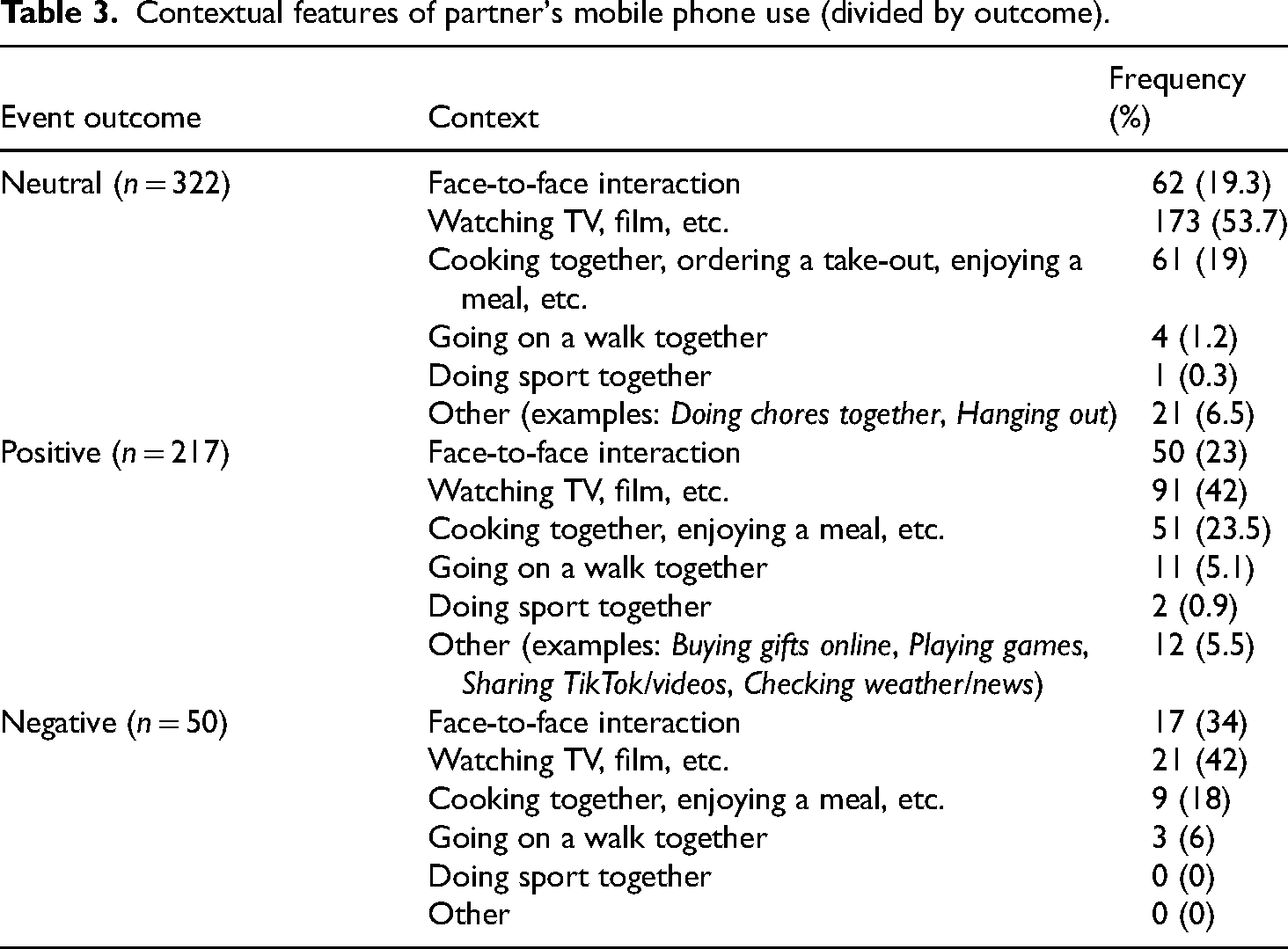
The participants accounted for a cumulative 589 contextual instances of mobile phone use by their partner, with several individuals documenting multiple instances within a single evening (n = 41). The most frequent occurrence of a partner's mobile phone use was during television viewing (48.4%), succeeded by face-to-face interactions (21.9%), meal preparation or consumption (20.4%), doing sports (3.1%), and other activities (5.6%; refer to Table 2 for details). Upon segregating these data based on the perceived impact of mobile phone usage (neutral, positive, or negative), the initial analysis suggested minimal deviation from the sequence of television viewing, face-to-face interaction, and meal-related activities. The sole exception was a higher frequency of face-to-face interactions in negative ratings (34.0%). However, it is imperative to note that instances of negative ratings were relatively infrequent (50 instances, 8% of the total) in comparison to positive (217 instances, 37%) and neutral ratings (322 instances, 55%; see Table 3 for a detailed breakdown)
Contextual features of partner's mobile phone use (a list of cumulative events).
Contextual features of partner's mobile phone use (divided by outcome).
The reasons individuals gave for experiencing their partner's mobile phone use as negative, positive, or neutral, were summarized into thematic groups. The key findings are summarized here (for a detailed compilation of all thematic areas, refer to the online supplemental material) in descending order (the most prominent themes explained first). See Table 4 for a list of themes.
A list of themes by outcome, ordered according to the frequency of appearance.
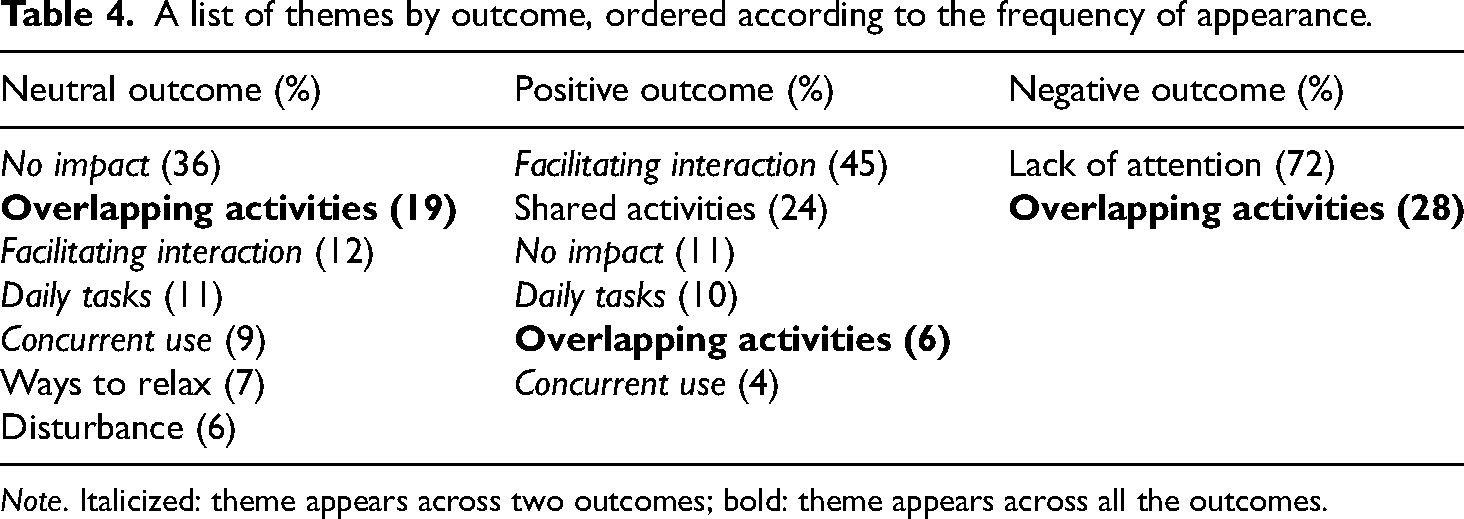
Note. Italicized: theme appears across two outcomes; bold: theme appears across all the outcomes.
Neutral outcome (n = 204)
In essence, most participants considered their partner's mobile phone use as neutral, blending into daily routines without significantly affecting interactions. The first theme, “No impact,” outlines situations where a partner's phone use was characterized by convenient timing, not altering the situation, or the partner remaining engaged in conversation (“didn’t make the situation any different,” “the conversation was not important,” “we had spent quality time before that”). The next theme, “Overlapping activities,” referred to the partners doing something together like cooking, eating, or watching TV, and partner's phone use served as a background activity: “it is frequent that we use our phones while eating,” “we were just passing time together but alone, which is acceptable.” The theme “Facilitating interactions” referred to reasons when the mobile phone was used to select a movie or plan the couple's time together, while other participants associated partner's phone use with habitual daily tasks, including work, personal calls, and messaging (“Daily tasks”). Work-related tasks sometimes spilled over into personal time, leading to mixed feelings because of instances of poor timing. Some participants did notice that their partner was inattentive during phone use, even when aware of the importance of their task (“it felt necessary despite being badly timed”).
Some participants viewed their partner's phone use as “down time” after work (“Ways to relax”) and highlighted spending time together while engaged with their own phones (“Concurrent use”). Some participants shared content they found online, which helped bridge the psychological distance from their partner. Despite this, some expressed frustration over the occurrence, acknowledging their own participation in it (“it's annoying but I do the same so I can’t really complain”), whereas others reported that phones were used during intervals between activities without interference. Finally, the occasional frustration (“Disturbance”) was reported due to the partner's lack of attention and willingness to engage during shared activities (“we didn’t get much time to talk and catch up”).
Positive outcome (n = 151)
Less than half of the participants reported that partner phone use had positive effects, enhancing interaction and shared experiences. Almost half of them believed that a partner's phone use was relevant to the interaction or problem resolution (“Facilitating interaction”). The mobile phone's presence was justified when used to answer questions and aid conversations (“it was used in the context of what we were doing”). Looking up information also allowed partners to cooperate effectively. A quarter of participants found that their partner's smartphone use facilitated mutual bonding (“Shared activities”), via sharing online content, which was a fun way to engage together. Some participants mentioned using phones to reminisce about old experiences through photos. Comparative to the neutral outcome, some participants felt their partner's phone use had “no impact” on positive time spent together (“nobody felt ignored,” “it was mild usage”) or associated partner's phone use with necessary “daily tasks” (“was only doing it because of work”). Some participants were happy that their partner was relaxing. None believed these tasks interfered with quality time. Finally, only a handful of participants reported partner's phone use occurring alongside other activities, for example, watching TV (“Overlapping activities”) or considered mobile phone use a mutual activity (“Concurrent use”). Using phones together served as a way to spend time and relax. None viewed this as problematic.
Negative outcome (n = 32)
Finally, less than a tenth of participants reported a negative outcome of partner's mobile phone use. Only two themes were identified. Most of the participants attributed their negative evaluation of the situation to the partner's lack of attention. They reported instances of having to repeat themselves and their partners taking too long to respond. Participants also mentioned that low responsiveness contributed to feelings of neglect: “it made me feel uncared for and like I wasn’t as important as her phone.” Lack of communication between partners was also linked to phone use. The habitual nature of co-present phone use caused frustration and tension in relationships. Other participants elaborated on a partner's disengagement from overlapping activities, like watching movies or walking. Some participants interpreted their partner's co-present phone use as a sign of disinterest, such as “[my partner] didn’t want to watch the movie I was watching” or “they ignored me and started scrolling on their phone while eating.” Globally, participants’ negative experiences highlighted how mobile phone use during shared activities can impact communication, attentiveness, and connection in relationships.
Discussion
Prior research has predominantly examined co-present mobile phone use through the lenses of phubbing and technoference, based on the notion that the presence of a phone during couples’ interactions causes relational harm (Chotpitayasunondh & Douglas, 2016). However, inadequate operationalizations can lead to erroneous conclusions and, as a result, overpathologize daily behaviors. In addition, only a limited number of studies have investigated other functions or perceptions of smartphones in couples’ interactions (Foster Campbell, 2022; Kelly et al., 2017; Miller-Ott & Kelly, 2015). To address this, we inquired about participants’ perceptions of their partner's mobile phone use during their time together. The results indicated that partner's phone use was mostly perceived as neutral or positive, seldom as negative. This suggests that many couples have adapted to the technology.
Evaluation of partner's co-present phone use
H1
The results showed that respondents rated only 15% of their partner's mobile phone use events as negative, while a third viewed it as positive, and more than half as neutral. These results suggest that smartphone use in partner interactions does not inherently lead to negative outcomes. Previous studies (e.g., Allred & Crowley, 2017; Przybylski & Weinstein, 2013; Misra et al., 2016) associated smartphone use with negative conversation outcomes in experimental and naturalistic settings. However, recent studies (Crowley et al., 2018; Linares & Sellier, 2021) have failed to replicate the findings of Przybylski and Weinstein (2013), suggesting that smartphone use does not necessarily negatively impact conversations and relationships, particularly considering the evolving technological landscape and the integration of smartphones into social interactions. Given that over 80% of our participants perceived their partner's phone use as neutral or positive, we suggest broadening the discussion beyond the negative effects. Future research should consider the possibility that there may be no effect or even benefits from partner's phone use (Cummings & Reimer, 2021; Vanden Abeele, 2020), aligning with theoretical perspectives arguing that smartphones are integral to daily routines, so much so that their presence is unremarkable in many cases (e.g., Ling, 2012; Turkle, 2011).
H2
The results showed that when a partner's mobile phone use was perceived as longer that evening, the events were, on average, rated negative more often. Even though the effect size was relatively small, and the results should be interpreted with caution, this suggests that brief durations of phone usage are deemed more acceptable. However, people feel more ignored if the partner's engagement with the phone is prolonged, which is consistent with theoretical assumptions (Vanden Abeele, 2020). Future studies should measure the duration of individual mobile phone use events and investigate whether duration also plays a role in negative interpretations (Denecker et al., 2024; Frackowiak, 2020).
RQ1
We explored the situations in which couples find themselves when one partner uses a mobile phone. It is conceivable that phone use is perceived as significantly more negative in certain situations than in others. The phone use occurred primarily while watching television, during personal interactions, and while cooking and eating. One might assume that phubbing while watching TV is less problematic than, for example, during an intense conversation. Cummings and Reimer (2021) have previously reported that the function of the mobile device within a conversation defines whether its use is integrated or incidental, that is, not related to the conversation. However, there were hardly any differences in the situations when we subsequently divided them according to whether the partner's mobile phone usage was rated as negative, positive, or neutral. The only exception was when the partner's mobile phone usage was rated negatively, this occurred mostly during a face-to-face interaction. This suggests that mobile phone usage is more frequently rated as negative when it occurs during a personal interaction, rather than when it is incidental, such as while watching television or cooking (Cummings & Reimer, 2021). This mirrors the previous qualitative findings on co-present phone use in relationships: Miller-Ott and Kelly (2015) and Kelly et al. (2017) found that partner's phone use was less negatively evaluated during informal situations, but viewed more negatively when the partner's attention was expected.
RQ2
Justifications for negative evaluations
Analyzing the justifications behind the negative evaluations revealed that participants felt neglected and distanced by their partner, attributing this emotional rift to the smartphone presence. Others complained that their partner's behavior interfered with shared activities, and they were upset about their partner's perceived inability to maintain a conversation due to mobile phone use.
We propose two reasons why feeling ignored during an activity is perceived negatively. First, when deciding on a shared activity, a partner may expect that their counterpart's focus is on the shared activity. The use of the mobile phone is then perceived as a breach of this implicit assumption, which in turn is experienced as negative. For example, it has been shown that if the presence of a mobile phone reduces “quality time” (Morgan et al., 2017; Vanden Abeele et al., 2016), it can have a negative impact on the relationship. Moreover, building upon the cellphone relevance hypothesis (Cummings & Reimer, 2021), we argue that when the phone use is incidental to the conversation, it may generate negative interaction outcomes and evaluations. However, our speculations go beyond the current state of research and suggest that such a lack of attention could represent a violation of an expectation or an implicit contract partners may have established. Previous studies have brought up partner's potential phone use to be seen as an expectancy violation: when individuals expect a partner's undivided attention, the latter's co-present phone use is seen more as a violation than when expecting divided attention (Miller-Ott & Kelly, 2015). Vanden Abeele (2020) attributed this to “mobile etiquette,” and proposed the expectancy violation to be a mechanism that explains why a partner's co-present phone use may provoke relational harm.
Justifications for neutral evaluations
Neutral evaluations were more frequent than negative evaluations, and participants provided a wider range of justifications for their neutral evaluations. Most of them reported that their partner's smartphone use had “no impact” on their shared time. This was primarily attributed to habitual smartphone use, which has become normalized, although participants also mentioned the opportune timing of phone use by the partner, which did not interfere with joint activities that required the partner's active engagement. These results showed that, contrary to previous reports, participants did not have to compete for attention with their partners’ mobile devices (Turkle, 2008). Recent narratives have also begun to argue that the use of mobile phones in social situations is “no longer remarkable” (Kelly & Miller-Ott, 2022, p. 192).
Other reasons for why participants reported partner's mobile phone use as neutral also seem to indicate that their engagement with the device was integral to the couple's daily routine in a form of plan making facilitation, or mutual phone use. Participants’ statements emphasized the way that they could spend time with their partner, even when each of them tended to different tasks, whether them being daily errands or simply a way to relax. This evidence supports the new theory that relationships can exist in many forms because technology is now a normal part of our interactions and does not interrupt or invade them (Cummings & Reimer, 2021; Foster Campbell, 2022). However, numerous participants who rated mobile phone use still noted the decreased attention and responsiveness of the partner, despite evaluating it as neutral. This is surprising, as lack of attention has hitherto been associated with a negative reaction, which was not the case here. Since the lack of attention was still evaluated as neutral, one can assume that this probably has something to do with expectations. For example, if expectations regarding watching TV are not high, mobile phone use is not likely to be a problem—only in special cases when the expectations of shared time are precise (see above for Miller-Ott & Kelly, 2015; Vanden Abeele, 2020, on expectancy violation). Conceptually, this would suggest that couples do not have a general implicit contract regarding mobile phone use, but that this contract is not only situation-dependent (e.g., less damaging when watching TV than during a joint conversation), but also mood- or expectation-dependent (e.g., a bit of TV watching versus watching a movie together).
We also believe it relevant to expand on the discrepancy between a global event evaluation (“neutral”), and a potentially negative experience (“feeling ignored”). This potentially points to the complex interplay between technology presence and subjective experience. It is debatable whether participants who reported minding their partner's phone use yet saw it as neutral were, to some degree, accustomed to brief instances of neglect due to technology. In line with the “taken-for-granted” argument (Ling, 2012), we could speculate that with the unremarkable omnipresence of smartphones in daily interactions, people may have partially accepted that feeling ignored could be part of this expected smartphone presence, which constitutes a possible avenue for future research.
Justifications for positive evaluations
There was a variety of different reasons given for a positive assessment of the partner's mobile phone use. Partner's phone use was predominantly rated as positive when it enriched interactions, that is, when the phone played a role in conversations, facilitated shared tasks, or allowed partners to enjoy physical closeness even while engaged in separate activities. Participants particularly emphasized shared activities, which contributed to enjoyment and further bonding between partners. The notion of social bonding thanks to sharing found content with each other is not novel in the literature, due to its integral nature (Cummings & Reimer, 2021; Kelly & Miller-Ott, 2022). A recent study has demonstrated that partners appreciate sharing content with their partner to “generate social connection” and togetherness, even if no specific message is transmitted (Kelly & Miller-Ott, 2022; Schellewald, 2024). The prevalence of positive assessments of mobile phone use suggests that couples may have established implicit rules regarding technology use, reflecting successful adaptation to the presence of technological devices (Foster Campbell, 2022). While phone use can still lead to relational harm, couples often find ways to enhance their shared experience with technology, challenging the prevailing paradigm regarding mobile phone use (Morgan et al., 2017; Przybylski & Weinstein, 2013).
Implications and future research
Our findings allow us to expand upon prevailing theoretical explanations. Research should investigate what other factors, besides, for instance, lack of attention or positive involvement, could play a role in perceiving a partner's mobile phone use. Notably, the concept of implicit contracts—where expectations toward a partner shift based on the situational context and mood—could influence the impact of mobile phone usage. Initially, societal norms and rules shape these implicit contracts within a relationship, but over time, couples may adapt these rules (Foster Campbell, 2022). Investigating this area further promises to be a worthwhile endeavor, especially given the omnipresence of technology within relational spaces (Cummings & Reimer, 2021; Ling, 2012).
Participants’ justifications for evaluating their partner's phone use as neutral lay the groundwork for theoretical expansion. The existing theories have explored the functions of phone use in interactions (Cummings & Reimer, 2021; Kelly & Miller-Ott, 2022), but it is rarely considered that co-present phone use may be ambivalent. Future studies should acknowledge that the presence of smartphones may not always yield an outcome but may simply be an “invisible” and taken-for-granted part of daily routine and background activities (see Ling, 2012). However, this perspective may pose some challenges for the development of theoretical frameworks that consider the role of technological devices. As the concept of phubbing may become less expected to be “potentially harmful” (Vanden Abeele, 2020), the theoretical models must be adapted accordingly.
We suggest that further research should inquire about the temporal dynamics and behavioral fluctuations over time during partner's phone use, using daily diaries and experience sampling. This would help reveal patterns, such as when phone use is most common and how it affects interactions. Smartphone logging (recording smartphone use activity) would additionally provide precise and objective data on phone use duration and frequency, which would aid a real-time exploration (Denecker et al., 2024).
Enhancing our comprehension of what constitutes positive or negative interactions could potentially aid in the development of interventions. These interventions would not necessarily aim to reduce mobile phone usage, but rather, they would seek to shift its usage toward more beneficial periods, based on partners’ experiential perspectives.
Limitations
The study is subject to certain limitations. Firstly, participants were only surveyed on weekdays, and it is conceivable that couples may have different rules regarding mobile phone usage during weekends. Secondly, the sample consisted of individuals based in the United Kingdom, with most of the sample being British and White. The study did not take into consideration different cultural norms surrounding mobile phone use in the social co-presence of a partner, or in relation to couples with children. Finally, although we found that partners’ mobile phone behavior was commonly perceived as neutral, it is possible that this accumulation of behavior could eventually be perceived as negative in the long term, which could impact relationship functioning. Finally, we would like to reflect on the limitation regarding our data analytic strategy. In our analyses, we took into consideration the global evaluation (positive, negative, neutral) as the main separating variable. However, taking into consideration different specific co-present phone use situations (as reported in the contextual details: RQ1) would have provided a more precise insight into specific interaction mechanisms, for instance, why there is variability between positive, negative, and neutral evaluations of partner's phone use in “Face-to-face interactions” or “Cooking together.”
Concluding remarks
The findings of this study demonstrate that more detailed scrutiny is required to comprehend the function of co-present smartphone use between partners. The authors propose a conceptual expansion and a profound investigation of how partners establish rules surrounding technology use.
Supplemental Material
sj-docx-1-mmc-10.1177_20501579241298271 - Supplemental material for Disentangling the good, the bad, and the neutral of co-present mobile phone use: A new perspective on “partner phubbing”
Supplemental material, sj-docx-1-mmc-10.1177_20501579241298271 for Disentangling the good, the bad, and the neutral of co-present mobile phone use: A new perspective on “partner phubbing” by Michal Frackowiak, Pascale Sophie Russell, Matthew J. Vowels and Peter Hilpert in Mobile Media & Communication
Footnotes
Data availability statement

Declaration of conflicting interests
The authors declared no potential conflicts of interest with respect to the research, authorship, and/or publication of this article.
Funding
The authors disclosed receipt of the following financial support for the research, authorship, and/or publication of this article: All the costs related to the participants’ recruitment were covered by the Institute of Psychology, University of Lausanne, Switzerland.
Supplemental material
Supplemental material for this article is available online.
Notes
Author biographies
Michal Frackowiak, MSc, is a doctoral candidate and a teaching assistant at the Institute of Psychology, University of Lausanne, and a former visiting researcher at imec-mict-UGent at Ghent University in Belgium. His thesis concentrates on the conceptual and methodological development of research on co-present mobile phone use in interactions. His research interests combine broader implications of the intersection between technology and society.
Pascale Sophie Russell, PhD, is a lecturer in social psychology at the University of Surrey, UK. She investigates how specific emotions (e.g., disgust, anger, shame, and guilt) impact our thoughts and behaviors in social and moral contexts. In particular, she is interested in how moral emotions can be utilized to foster positive social relationships.
Matthew J. Vowels, PhD, is a post-doctoral researcher at the Institute of Psychology, University of Lausanne, as well as a senior researcher position at The Sense, Centre Hospitalier Universitaire Vaudois, and a visiting research fellow at the Centre for Vision, Speech and Signal Processing, University of Surrey. His work falls at the intersection between machine learning, statistics, and causality, and the application of techniques from these domains to the human sciences.
Peter Hilpert, PhD, is an associate professor at the Institute of Psychology, University of Lausanne. His research centers on dyadic interactions, aiming to understand how mutual behavioral exchange processes unfold in real time and how these interactions impact outcomes over the long term. He primarily studies interactions between intimate partners as well as between patients and therapists.
References
Supplementary Material
Please find the following supplemental material available below.
For Open Access articles published under a Creative Commons License, all supplemental material carries the same license as the article it is associated with.
For non-Open Access articles published, all supplemental material carries a non-exclusive license, and permission requests for re-use of supplemental material or any part of supplemental material shall be sent directly to the copyright owner as specified in the copyright notice associated with the article.
