




Abstract
Connecting with others through mobile dating apps has become one of the most popular ways for people to meet. These apps might help people find a suitable partner and, thus, achieve a satisfactory love life. To examine whether mobile dating apps deliver on their potential for positive relationship outcomes, this study investigates if and how the use of these apps is related to satisfaction with one's relationship status. In a survey study, we compared previous and current users of mobile dating apps with people who have never used such apps (n= 1,054, from the United States or United Kingdom, younger than 35). Results showed that dating app users score lower on satisfaction with their relationship status than non-users. This negative association between dating app use and satisfaction was stronger for women than it was for men. The most crucial factor in relationship status satisfaction, however, is whether people are in a relationship or not. Future research should aim to disentangle the causal order of the association between mobile dating app use and relationship status satisfaction, and investigate if these apps have the potential to improve users’ satisfaction with their relationship status in the long term through facilitating romantic relationships.
Keywords
Mobile dating applications (apps) play an important role in shaping romantic lives. In the United States, one in four adults has used an online dating app to find a potential romantic partner (Statista, 2021b). Among younger adults (18 to 29 years old), this share rises to about 1 in 2 young adults (Vogels, 2020). The most popular mobile dating app worldwide, Tinder, has 10 million daily users who generate 30 million matches every day (Smith, 2021; Statista, 2021a). Perhaps unsurprisingly then, connecting with others through mobile dating apps has become one of the most popular ways for couples in modern society to meet (Rosenfeld et al., 2019). In times of social distancing and self-isolation due to the spread of COVID-19, mobile dating apps have gained even more momentum by allowing people to continue to form romantic connections with potential romantic partners (Alexopoulos et al., 2021; Wiederhold, 2021).
The success of mobile dating apps is mainly due to the vast pool of potential romantic partners available outside people's pre-existing social networks (Alexopoulos et al., 2020; Paul, 2014; Thomas et al., 2022). The broader virtual proximity afforded by mobile dating apps connects users to others without the narrow spatial constraints of real-life interaction (Alexopoulos et al., 2020; Sumter et al., 2017). Essentially, mobile dating apps offer people the possibility to connect with a very large pool of potential partners, thereby increasing their odds of finding a romantic partner compared to offline dating. Moreover, mobile dating apps may better facilitate successful interactions with potential romantic partners given that people often find it easier to express and shape their identity and to share intimate information with others online—for example, because they feel more shy offline (Jiang et al., 2013; Lenton-Brym et al., 2021; Sumter et al., 2017). An explanation for this is that people typically engage in more self-disclosure in computer-mediated compared to face-to-face communication, which then leads to more intimate interactions (Jiang et al., 2013).
Mobile dating apps advertise their potential to help people achieve a satisfactory love life (Thomas et al., 2022) and, thus, to increase people's well-being. Yet there is no compelling evidence that online dating apps deliver on this potential. In contrast, numerous studies report on the potential adverse outcomes of mobile dating app use on well-being (e.g., D’Angelo & Toma, 2017; Her & Timmermans, 2021; Thomas et al., 2022). Adverse effects of increased dating app use may include partner choice overload, decreased self-esteem, and increased fear of being single (D’Angelo & Toma, 2017; Thomas et al., 2022). Furthermore, compulsive Tinder use is associated with sadness and anxiety (Her & Timmermans, 2021). Thus, the use of mobile dating apps may be related to less love-life satisfaction rather than more. This is noteworthy, given that mobile dating apps’ primary function is to help people who are not satisfied with their current relationship status, whether they are single or in a relationship, to connect with other potential romantic partners.
To better understand how dating app use relates to love life satisfaction, the main research question of the current exploratory study was whether and how mobile dating app use is related to satisfaction with one's relationship status. Relationship status satisfaction refers to how satisfied people are with their current love life status, irrespective of whether they have a partner or are single (Lehmann et al., 2015). It is essential to examine satisfaction beyond looking at differences between those who are partnered and those who are single (Oh et al., 2021), because how satisfied people feel with their relationship status is much more indicative of general well-being than their relationship status (e.g., people may be happily single by choice, Lehmann et al., 2015; Oh et al., 2021). Therefore, the current study examines people's relationship status satisfaction simultaneously in both partnered and single people.
Specifically, to examine whether mobile dating apps deliver on their potential to influence people's well-being positively, we compared both previous and current users of mobile dating apps with people who have never used such apps. Moreover, given that people tend to compare their current situation with potential romantic alternatives (Alexopoulos et al., 2020; Drouin et al., 2015), we explored the role that people's perceived quality of alternatives plays in this relationship. Are people who believe that there are many potential partners for them more satisfied with their relationship status than others? And does this interact with mobile dating app use?
Method
The research question, planned sample size, main analysis, and exclusion criteria were preregistered on the Open Science Framework (OSF; https://osf.io/ca4s6). The study materials, data, and analysis script (R) are also available on the OSF (https://osf.io/g4dcx/). The study was reviewed and approved by the Ethics Committee Social Science of Radboud University (reference number ECSW-2020-146).
Participants
As no previous research was available to estimate an expected effect size, we used a more general approach to determine the sample size. Reported effects in communication are often small- to medium-sized, and even this might be an overestimation (Dienlin et al., 2021). To usefully determine whether the relation between mobile dating app use and relationship status satisfaction could be a valuable future research interest, we powered this study on what is conventionally known as a small effect size (Cohen's d = 0.20; Cohen, 1988), which can be considered the smallest effect size of interest. If the relation between mobile dating app use and relationship status satisfaction is smaller than this smallest effect size of interest, thus smaller than many reported effects in communication, one might argue that future research efforts might be better spent on another topic than mobile dating apps and relationship status satisfaction. We calculated the required sample size using GPower (Faul et al., 2009). With a small effect size (d = 0.20) and alpha = .05, we needed a total sample size of 1,053 to achieve .90 power to detect a relation between mobile dating app use and relationship status satisfaction if there indeed is such an association.
We used Prolific's online crowdsourcing platform (www.prolific.co) to recruit participants in April 2021. Only participants with a U.S. or U.K. nationality, fluent in English, and between 18 and 34 years old were eligible for participation in the study. Participants were paid £0.45, equal to about $16 per hour. To recruit equal numbers of dating app users and nonusers, we created two different studies on Prolific. One study was only available to individuals who indicated they had used smartphone-enabled dating apps, while the “control study” was only available to individuals who did not. We defined dating app users as individuals who had ever used or were using smartphone-enabled dating apps, and nonusers as individuals who had never used such apps. We screened these participants by asking them: Have you used, or are you using, any smartphone-enabled dating apps? Both studies reached the target sample, constituting an initial sample size of n = 1,058.
One participant managed to complete the experiment twice. Therefore, the second observation from this participant was removed. As preregistered, participants who failed a seriousness check (see below; n = 0) would have been excluded from the analyses; we excluded and replaced two participants who completed the study in less than 1 min; and we excluded but did not replace 13 participants with outlying values at 3 SD completion time. This resulted in a final sample size of n = 1,043 (Mage = 28.52, SDage = 3.84, 63.76% women), of which 520 participants were using or had used mobile dating apps and 523 never used mobile dating apps.
Procedure
The procedure was similar for both groups of participants, except for the minor deviations mentioned below. At the start of the survey, participants were asked about their nationality, age, and dating app use to confirm that they were eligible for participation. Surveys of participants who were not eligible were immediately terminated, allowing these participants to be replaced in Prolific by individuals who were eligible for participation. Then, we introduced the questions related to relationship status satisfaction by explaining that “current relationship status” could refer either to being single or being in a relationship, depending on the participant's current relationship status. Subsequently, participants completed five questions from the adjusted satisfaction with relationship status scale (see Measures, below). After this measure of our main dependent variable, participants answered questions about their perception of the quality of alternatives and their relationship status. Participants in the dating app survey then answered questions related to whether they were currently using smartphone-enabled dating apps (and if not, their relationship status at the time of use), frequency of use, and which dating app(s) they used. Participants in the non-dating app survey answered similar questions, but related to smartphone-enabled social media apps (and were not asked about their relationship status at the time of use). Finally, participants in both surveys completed questions related to the remaining demographics (i.e., gender, sexual orientation, and education level) and a seriousness check.
Measures
Relationship status satisfaction
The satisfaction with relationship status scale enabled simultaneous investigation of the relationship status satisfaction in both singles and in people who were in a relationship at the time of the study. This measure was adapted from previous research that developed and validated this scale (Lehmann et al., 2015). In our survey, we mentioned “current relationship status” instead of the original “current status” to stress that items concerned participants’ satisfaction with their current relationship status. The included items were:
In general, how satisfied are you with your current relationship status?
How often do you wish you hadn’t gotten into this situation? (reverse-scored)
How happy are you with your current relationship status?
To what extent does your current relationship status meet your expectations?
Do you enjoy your current relationship status?
Participants rated their level of agreement with these items on a 4-point scale with response options not at all (0), a little (1), to quite some extent (2), and to a great extent (3). The scale showed excellent reliability (Cronbach's α = .95). On average, participants scored “to quite some extent” to “to a great extent” on relationship status satisfaction (M = 2.21, SD = 0.87).
Perceived quality of alternative others
We first explained that “Romantic relationships can satisfy various needs, such as the need for intimacy, companionship, security, emotional involvement, and sexual needs.” Then, we asked participants to what extent they believed that people, other than the current partner they may have, could satisfactorily fulfill these needs for them (M = 0.71, SD = 1.81). Response options were definitely not (−3), probably not (−2), possibly not (−1), unsure (0), possibly yes (1), probably yes (2), and definitely yes (3).
Relationship status and dating app use
Current relationship status was measured by asking participants whether they were single or in a relationship. Most participants were in a relationship while taking the survey (67.88%). Current mobile dating app use was measured by asking participants whether they were currently using any smartphone-enabled dating app(s) or not. Most of the participants in the group that use or had ever used mobile dating apps (68.46%) currently did not use a mobile dating app. Relationship status at the time of mobile dating app use was measured similarly to current relationship status, but referring to when the participant was using (a) smartphone-enabled dating app(s). Most participants were single at the time of mobile dating app use (93.54%), followed by participants who used mobile dating apps both while single and in a relationship (4.78%), and participants who were in a relationship during dating app use (1.67%). Frequency of mobile dating app use (M = 4.13, SD = 1.90) was measured by asking When you use(d) any smartphone-enabled dating app(s), how often do/did you use one?, with response options almost never (0), once a month (1), multiple times a month (2), once a week (3), multiple times a week (4), every day (5), or multiple times a day (6). Which specific dating apps were used was measured by asking participants which dating apps they primarily use(d) when they use(d) smartphone-enabled dating apps, with seven response options naming the most popular smartphone-enabled dating apps and an “other” option with free text entry. Tinder was mentioned most often (59.80%), followed by Bumble (10%) and OkCupid (8.85%).
Seriousness check
The seriousness check at the end of the surveys read: “It would be very helpful if you could tell us at this point whether you have taken part seriously, so that we can use your answers for our scientific analysis, or whether you were just clicking through without paying attention.” We also explained that their response would not affect whether their submission in Prolific would be accepted (i.e., if they got paid). Participants could respond by indicating that they had taken part seriously or that they had just clicked through.
Demographics
We asked participants to report their gender using options female, male, and a third option with a free-entry text field. Participants could report their sexual orientation using response options heterosexual, homosexual, and again a free-entry text field. Most participants reported to be heterosexual (81.11%), 5.85% of the participants reported to be homosexual, and 13.04% reported the “other” category (including asexual and bisexual). Finally, education level was measured by asking the participants what their highest completed education level (M = 3.53, SD = 1.23) was, with response options No formal qualification (0), Secondary school (e.g., GED, GCSE) (1), High school diploma/A levels (2), Technical/community college (3), Undergraduate degree (BA/BSc/other) (4), Graduate degree (MA/MSc/MPhil/other) (5), Doctorate degree (PhD/other) (6), and Don’t know/not applicable (NA).
Data analysis
For the planned analysis related to the main research question, we conducted an analysis of covariance (ANCOVA) with relationship status satisfaction as the dependent variable. The main independent variable was mobile dating app use (with values representing our groups), while we controlled for gender, age, and education level (one participant who reported Don’t know/not applicable was removed).
Results
Samples
Due to our screening procedure, all participants were between 18 and 34 years old. Nonetheless, participants in the mobile dating app group were slightly younger (n = 520; M = 28.27, SD = 3.76) than participants in the non-mobile dating app group (n = 523; M = 28.77, SD = 3.91), t(1039.88) = 2.11, p = .035. Overall, most participants were female (63.76%), while there were relatively more women in the non-mobile dating app group (69.02%) than in the dating app group (58.46%). Focusing on men and women (there were only 17 participants in other categories), this difference was statistically significant between the two groups, χ2 (1, n = 1026) = 12.19, p < .001. In terms of education, participants in the dating app group were slightly higher educated than in the non-mobile dating app group (median for both groups = undergraduate degree), t(1028.81) = −4.69, p < .001.
Relationship status satisfaction
The main research question was if and how mobile dating app use is related to relationship status satisfaction. The ANCOVA indicated a significant difference between the two groups, F(1, 1036) = 23.25, p < .001, ηp2 = .022, with participants in the dating app group scoring lower (M = 2.07, SD = 0.9) on relationship status satisfaction than participants in the non-mobile dating app group (M = 2.34, SD = 0.82).
Non-preregistered analyses
We conducted two sensitivity analyses to investigate the robustness of this result. As planned, we controlled for gender, age, and education in the main analysis. However, there were also some differences between the two groups in terms of nationality (there were relatively more U.S. participants in the dating app group than in the non-mobile dating app group; 34.81% vs. 26.64%, respectively) and sexual orientation (there were relatively more non-heterosexual participants in the dating app group than in the non-mobile dating app group; 22.69% vs. 15.11%, respectively). Thus, for the first sensitivity analysis, we reran the main analysis while also controlling for nationality and sexual orientation (dichotomized). This did not substantially change the results, however, F(1, 1034) = 22.65, p < .001, ηp2 = .021.
Second, the distribution of relationship status satisfaction was severely left-skewed with a relatively high median score (median = 2.40). This could indicate a ceiling effect on the relationship status satisfaction measure, which may have affected the main result. Therefore, we investigated whether the difference between groups was robust to such ceiling effects by rerunning the main analysis while excluding participants with the highest possible score on the scale. By removing these participants (excluded participants in group dating app users = 152, excluded participants in group non-users = 223) in this sensitivity analysis, we only included participants who did not experience a “ceiling” in the relationship status satisfaction measure. The results of this analysis provide some insight into the robustness of the main results to a potential ceiling effect. Although the difference between app users (n = 368, M = 1.69, SD = 0.80) and non-users (n = 300, M = 1.85, SD = 0.78) in this subsample was slightly smaller, it was still statistically significant, F(1, 661) = 7.13, p = .008, ηp2 = .011, making it less likely that the main results are an artifact of a potential ceiling effect in the satisfaction measure.
Although our research question concerns two groups (mobile dating app users and non-users), it is likely that other individual factors play a role in people's relationship status satisfaction (Park et al., 2022). Therefore, we conducted exploratory analyses to investigate whether the association between mobile dating app use and relationship status satisfaction was moderated by the demographic variables gender, age, or education. Only the interaction between dating app use and gender (dichotomized) was statistically significant, F(1, 1019) = 7.96, p = .005, ηp2 = .008. As visualized in Figure 1, there was a bigger difference between the two groups for women than there was for men. This interpretation is supported by the results of separate ANCOVAs for women and men: there was a significant difference between dating app users and non-users for women, F(1, 660) = 33.34, p < .001, ηp2 = .048, but not for men, F(1, 357) = 0.30, p = .58, ηp2 < .001.
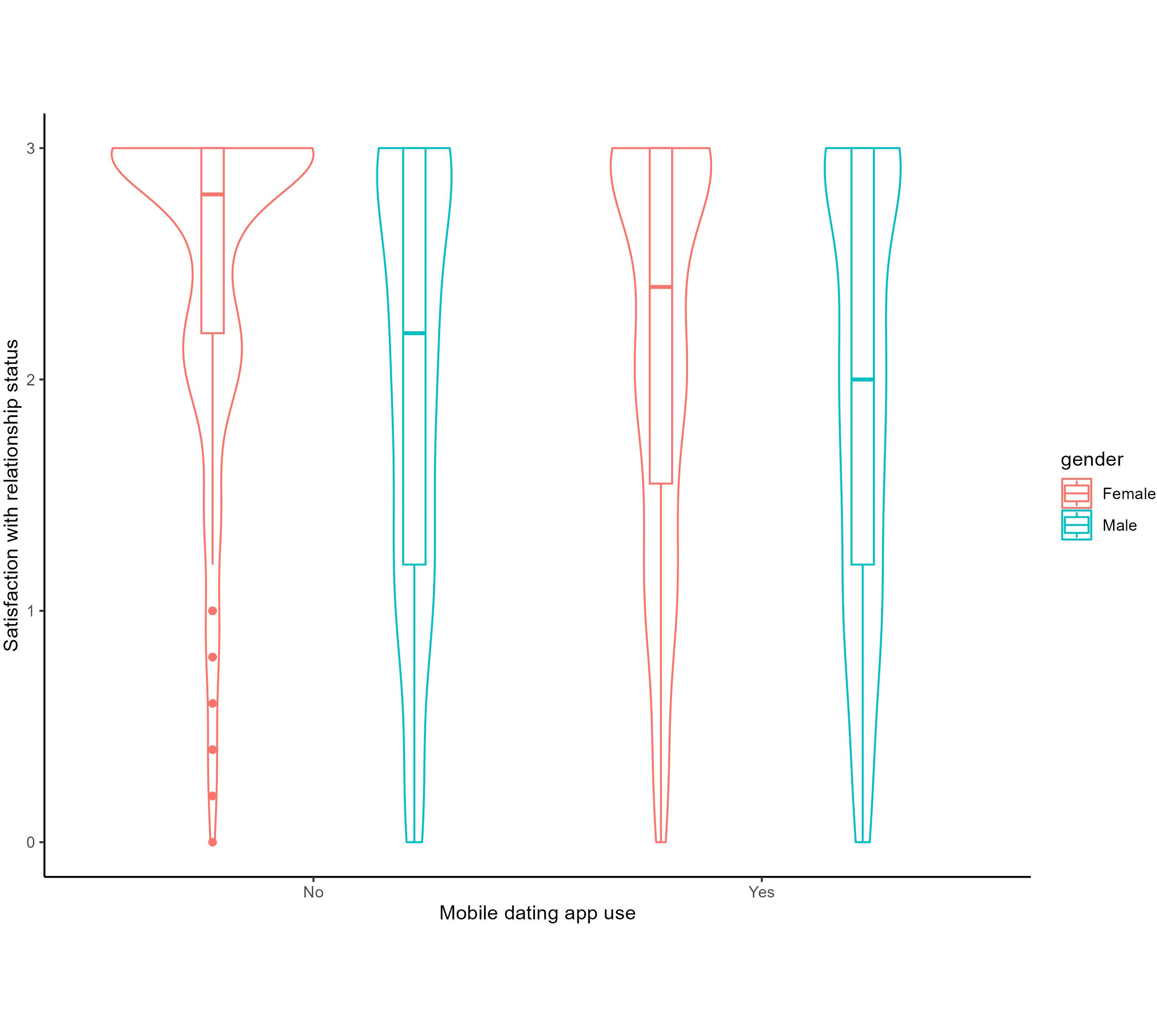
Violin plot of relationship status satisfaction by gender and mobile dating app use.
Besides looking at differences in relationship status satisfaction due to individual characteristics, we also explored whether participants’ current relationship status moderated the association between dating app use and relationship status satisfaction. Previous mobile dating app use may have led to a relationship. People's current relationship status could, thus, moderate the relationship between mobile dating app use and relationship status satisfaction. However, there was no significant moderating effect, F(1, 1034) = 0.20, p = .656, ηp2 < .001. Participants who were in a relationship and those who were not both had a higher satisfaction score than their respective counterparts who did not use mobile dating apps. Interestingly, focusing on participants who were using or had used mobile dating apps but were in a relationship at the time of the study, most participants (93.54%) reported that they were single at the time of use of the dating app(s). It thus seems that the apps were not frequently used to look for alternative options during a relationship.
Next, we explored the role of perceived quality of alternatives in relationship status satisfaction. As one might expect, overall, there was a statistically significant, negative correlation between the perceived quality of alternatives and relationship status satisfaction, r = −.18, 95% confidence interval (CI) [−0.24, −0.12], p < .001. Going one step further, regression analysis indicated that this relationship was characterized by a three-way interaction among perceived quality of alternatives, dating app use, and current relationship status, b = 0.12, SE = 0.05, t(1030) = 2.28, p = .023. Visualizing this interaction (see Figure 2) indicated a negative association between perceived quality of alternatives and relationship status satisfaction in most situations, except for participants who use(d) smartphone-enabled dating apps and were single. For this group, there was instead a statistically significant, positive relationship between perceived quality of alternatives and relationship status satisfaction, b = 0.08, SE = 0.04, t(187) = 2.06, p = .041. This finding indicates that a higher perceived quality of alternatives is related to lower relationship status satisfaction in most groups, except for the group that used mobile dating apps and was single. In this group, a higher perceived quality of alternatives is related to more satisfaction with being single.
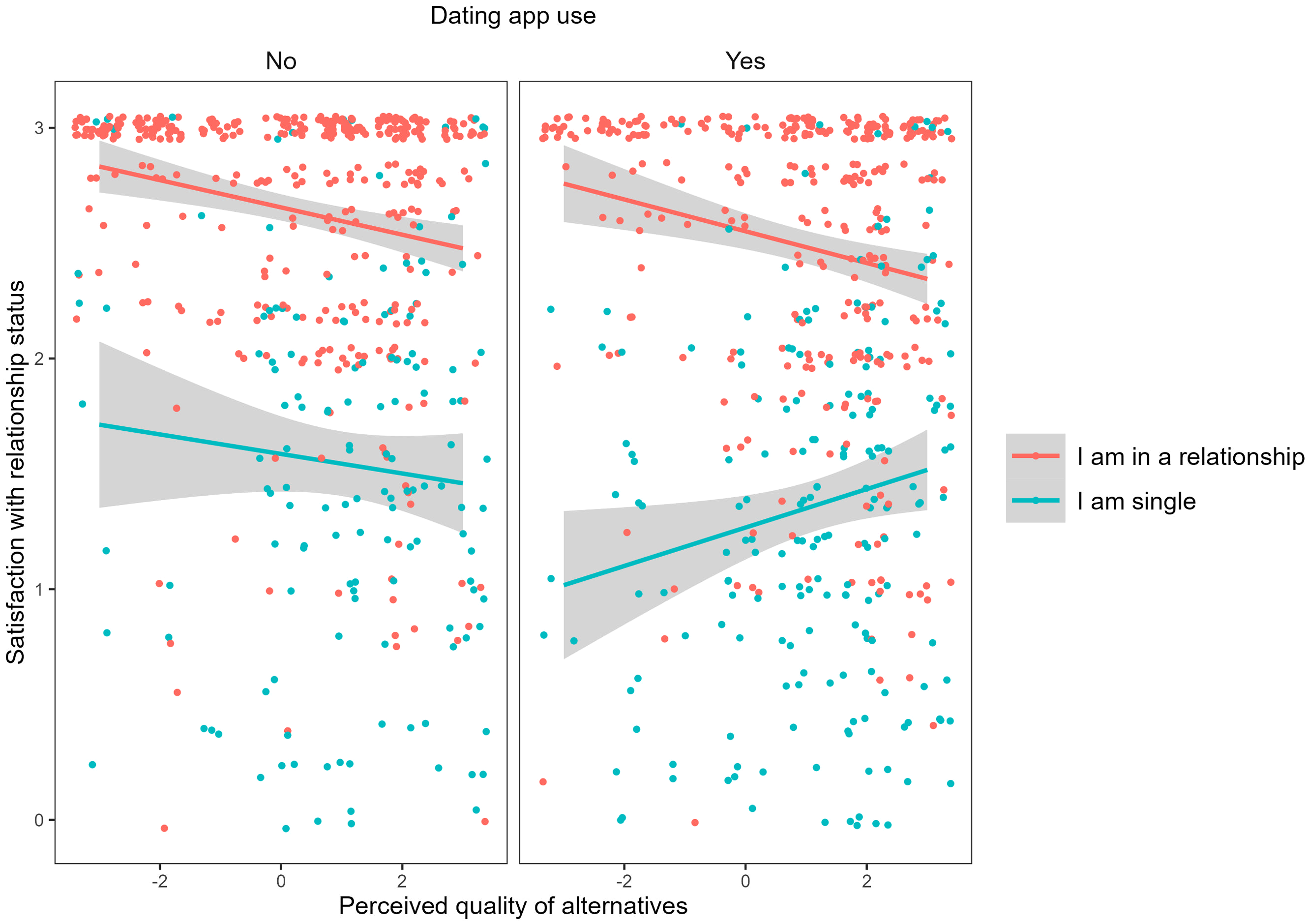
Relationship status satisfaction by perceived quality of alternatives, dating app use, and current relationship status.
Finally, we explored the relationship between the frequency of mobile dating app use and relationship status satisfaction in the group of participants who use(d) mobile dating apps. This could explain our main result that mobile dating app use is related to lower relationship status satisfaction. Perhaps only individuals who frequently use(d) the apps show lower satisfaction, indicating that overuse of the apps drives the negative association. On the other hand, if only individuals who barely use(d) the apps have low relationship status satisfaction, maybe they stopped using the app too early to reap its rewards. We conducted a regression analysis with only the participants who use(d) mobile dating apps, with relationship status satisfaction as the outcome, predicted by frequency of mobile dating app use, here too controlling for gender, age, and education. The results indicated that frequency of use was not significantly related to relationship status satisfaction (b = 0.03, SE = 0.03, t(514) = 2.28, p = .225).
Discussion
The current research investigated the association between mobile dating app use and relationship status satisfaction. We found robust evidence that mobile dating app use is related to relationship status satisfaction. Relationship status satisfaction was higher for people who have never used mobile dating apps than for people who use(d) them. Mobile dating apps propagate their potential to help achieve a satisfactory love life (Thomas et al., 2022), but do they deliver on this promise? People who use mobile dating apps are less satisfied with their relationship status than people who do not use mobile dating apps. This finding adds to a line of studies that outline potential negative correlates with mobile dating app use, such as decreased self-esteem and increased fear of being single (D’Angelo & Toma, 2017; Thomas et al., 2022).
The causal direction of these findings is unclear, however. One potential explanation is that mobile dating apps might induce less relationship status satisfaction. The fact that mobile dating apps are always available and presumably make it easier to find romantic partners could increase the pressure that people experience to need to “find” someone (Sumter et al., 2017). This could subsequently lead to less relationship status satisfaction. On the other hand, people who are less satisfied with their relationship status might use mobile dating apps more often than more satisfied people.
Nevertheless, our results suggest that the most crucial factor in relationship status satisfaction, more than using mobile dating apps, is whether people are in a relationship or not. In line with other research on singlehood and relationship and life satisfaction (Adamczyk, 2017; Oh et al., 2021), we found that people who were single at the time of this study scored lower (more than one point on the 0 to 3-point scale) on relationship status satisfaction than people who were in a relationship. This may partly be due to societal expectations of being in a committed romantic relationship (cf. Oh et al., 2021), which is strongly associated with well-being (Bojanowska & Zalewska, 2016).
The importance of relationship status to relationship status satisfaction makes it difficult to tease apart the effects of mobile dating app use on the one hand, and those of relationship status on the other. Most participants in the mobile dating app group reported being single at the time of mobile dating app use. At the same time, singles were also significantly less satisfied with their relationship status than people who were in a relationship. This means that there could be a small negative association between mobile dating app use and relationship status satisfaction because:
More people in the mobile dating app group were single. Singles who use mobile dating apps may feel a stronger desire to be in a relationship than singles who do not use mobile dating apps.
At the time of the study, a majority of the people who reported having used mobile dating apps were in a relationship. Therefore, one might ask whether singles who use mobile dating apps have a higher chance of getting into a relationship than those who do not and whether singles who use mobile dating apps seek a relationship more often than singles who do not use mobile dating apps. In those situations, mobile dating apps could, ultimately, be beneficial for people's relationship status satisfaction, via the role they play in helping people find a romantic partner. Research does indicate that using mobile dating apps, such as Tinder, might increase the likelihood of finding a romantic partner (Erevik et al., 2020). However, in the current study, we did not ask participants who use(d) mobile dating apps and were in a relationship at the time of the study whether they had met their partner using a mobile dating app. This makes it difficult to say anything about the potential of mobile dating apps to help people looking for a romantic partner to actually find one. Asking people whether they have actually met their current partner via a dating app and examining how this interplays with dating app use and relationship status satisfaction may provide more insight into this potential.
Apart from the difficulty in teasing apart the effects of mobile dating app use and relationship status, the association between mobile dating app use and relationship status satisfaction does not seem to be that clear-cut. Our non-preregistered analysis showed that this association is moderated by gender, showing a stronger relationship status satisfaction difference in women than in men. While relationship status satisfaction was highly similar for men who use(d) or do not use mobile dating apps, women who use(d) mobile dating apps scored significantly lower on relationship satisfaction than women who did not use mobile dating apps.
One potential explanation for the difference between men and women might be gender differences in mobile dating app use motivations. Women are generally socialized toward investment in committed relationships, while men are socialized toward valuing and having multiple sexual relationships (Tolman et al., 2003). This difference in socialization might affect mobile dating app use motivations. When using a mobile dating app, men, compared to women, generally have higher motivations to use mobile dating apps for “entertainment purposes,” such as to seek casual sex, because of the ease of communication, and for the thrill of excitement (Sumter et al., 2017). Most participants reported that they were single at the time of use of the dating app(s). If women are more socialized toward investment in committed relationships and if they are often single at the time of dating app use, this might explain the larger difference in relationship status satisfaction. Given that we measured current relationship status satisfaction and not relationship status satisfaction at the time of dating app use, this explanation is speculative and needs further exploration.
Furthermore, this research investigated the role of perceived quality of alternatives in explaining relationship status satisfaction. In line with earlier research (e.g., Drouin et al., 2015), there was a negative association between the perceived quality of alternatives and relationship status satisfaction in most groups. However, in the group that used mobile dating apps and was single, the association between perceived quality of alternatives and relationship status satisfaction was positive. Having the idea that there are alternatives out there thus might negatively affect relationship status satisfaction, but for someone who is single and on a mobile dating app having this idea can go hand in hand with more satisfaction with being single. Conversely, the role of frequency of mobile dating app use in relationship satisfaction remains unclear. Our results did not indicate an association between the two, perhaps indicating that use of the app in itself already is enough to have an effect on satisfaction, if there even is a causal order.
potential methodological limitation of this study pertains to the measurement of satisfaction with relationship status, by Lehmann et al. (2015). This measure has been developed to incorporate both people in a relationship and people who are single. Still, it might measure relationship status satisfaction less optimally for people who are single than for those in a relationship. Previous research (e.g., Chopik, 2017; Fisher et al., 2021) has shown that single people likely have other fulfilling relationships, which could be more influential for their well-being than their relationship status satisfaction. Future research should incorporate measures beyond relationship status satisfaction in studies such as this one, to explore the relative importance of relationship status satisfaction in explaining well-being, compared to measures of other potentially fulfilling relationships than romantic ones.
An additional methodological limitation to this study is that we did not include a measure for participants’ duration of dating app use. We asked dating app users how frequently they use(d) dating applications (e.g., once a week or multiple times a day) which is indicative of the intensity of use. However, it is possible that the length of time during which people use(d) dating apps (e.g., over a period of a few days or over a period of a year) influences people's dating experiences and, through that, their relationship status satisfaction. For example, users who have been using dating applications for a longer period of time may have more disappointing dating experiences, or more positive dating experiences, than users who only use(d) dating apps for a few days. This could influence their relationship status satisfaction differently. Future research should include measures for the duration of dating app use in addition to frequency of use, to explore how dating app use intensity may influence relationship status satisfaction.
The findings of this study provide some additional directions for future research. Future research should aim to disentangle the causal order of the association between mobile dating app use and relationship status satisfaction. However, because conducting experimental research on this topic is limited by considerable practical and ethical constraints related to manipulating mobile dating app use, researchers should consider conducting longitudinal research on mobile dating app use. Longitudinal research could, for example, further clarify if people who use mobile dating apps indeed are more likely to get into a relationship, and, as a result, they become more satisfied with their relationship status than those who do not use mobile dating apps.
Furthermore, research on the association between mobile dating app use and relationship status satisfaction could greatly benefit from more insights into the role of people's motivations to use mobile dating apps or not and into people's experience using these apps. People's motivations for using mobile dating apps differ, ranging from passing the time to seeking social approval or a relationship (Timmermans & De Caluwé, 2017). These different gratifications sought through mobile dating apps—and the extent to which people's dating app experiences fulfill these—might influence people's relationship status satisfaction. Unfulfilling experiences with mobile dating apps can, for example, lead to a perceived diminished connection quality (Newett et al., 2018) and can hinder the formation of durable relationships (Yeo & Fung, 2018). Future research could further dive into the role of these motivations and experiences in the relationship between dating app use and relationship status satisfaction, for example, by conducting qualitative interviews.
Conclusion
Mobile dating apps remain extremely popular and are used by a growing number of people worldwide (Statista, 2021b). These apps appear to remove barriers in communication, allow people to connect to an almost unlimited number of potential partners, and advertise their potential to achieve a satisfactory love life (Alexopoulos et al., 2020; Paul, 2014; Thomas et al., 2022). Our study shows that mobile dating app use is negatively associated with relationship status satisfaction, but that, in the end, people's current relationship status seems to be more influential in determining relationship status satisfaction than dating app use. For mobile dating app users, these results do not immediately warrant the need to stop using mobile dating apps. However, people should be cautious in applauding mobile dating apps for their potential success.
Footnotes
Data availability statement

Declaration of conflicting interests
The authors declared no potential conflicts of interest with respect to the research, authorship, and/or publication of this article.
Funding
The authors received no financial support for the research, authorship, and/or publication of this article.
Author Biographies
Daniëlle N. M. Bleize, PhD, is assistant professor at the Behavioural Science Institute, Radboud University. Her research interests are broadly situated around the social dimensions of computer-mediated communication, environmental psychology and sustainable behavior.
Aart van Stekelenburg, PhD, is an assistant professor at the Behavioural Science Institute, Radboud University. He investigates science communication, examining how people can be informed about important but sometimes societally contested topics.
Sanne L. Tamboer, PhD, is a postdoctoral researcher at the Behavioural Science Institute, Radboud University. She is broadly interested in youths' relationship with the news, from finding ways to increase our understanding of the relationship between youth and news, to co-creating fitting and empowering interventions with youth.