




Abstract
Individuals use their smartphones for an assortment of communication and functional activities and in a variety of contexts. Researchers analyzing smartphone use during interpersonal interactions have posed hypotheses and developed theories regarding the positive and negative influences that smartphones have on individuals and relationships. However, there is little research that examines the role smartphone use plays in a public speaking context. The current study uses a video vignette methodology to explore audience perceptions of a speaker who uses a smartphone as a presentation aid at a small university in Singapore. Overall, results suggest that the speaker’s smartphone use did not have a negative impact on perceptions of credibility (likeability/trustworthiness, competence, speaker ability), speaker immediacy, or persuasion. However, there was a small interaction effect when accounting for participants’ degree of smartphone acceptance. University students who reported lower smartphone acceptance perceived the speaker who used a smartphone as less credible (likable/trustworthy) than a speaker who delivered a speech from memory. Additionally, despite reporting significantly less smartphone use than students, staff and instructors did not perceive a speaker who uses a smartphone compared to a memorized presentation differently. This exploratory study carries implications for better understanding normative and appropriate smartphone use in public speaking contexts and provides recommendations for public speaking educators.
Since technology companies began producing smartphones in the early 2000s (Campbell-Kelly & Garcia-Swartz, 2015) they have diffused incrementally throughout human societies (Fortunati, 2023). In 2022, 68% of the world population and 92% of the Singaporean population had a smartphone and these numbers are forecast to rise steadily (Statista, 2023a, 2023b). Smartphones are a ubiquitous part of everyday life, overshadow other technologies, and have transformed human behaviors (Fortunati, 2023). One popular realm in which students, professionals, and performers have begun using their smartphone is for public presentations, for example, emcees, stand-up comedians, slam poets, television reporters, and speakers in a university classroom. This study specifically examines the implications of using a smartphone as a public speaking aid in a university classroom setting.
Public speaking courses and their accompanying textbooks provide students with the knowledge and practice to improve their presentation competence and establish credibility with audiences (Beebe & Beebe, 2015; Beebe et al., 2016; Lucas, 2020; Tucker et al., 2019). Students learn to speak extemporaneously using a well-prepared speaking outline and are encouraged to present using immediately legible notecards to jog the memory (Lucas, 2020). Some public speaking textbooks also indicate that speakers may opt for electronic notes such as those saved on a tablet, an application for speaking notes (Beebe & Beebe, 2015), or a smartphone (Beebe et al., 2016). In terms of presentation preparation and delivery, the two public speaking textbooks by Beebe and colleagues do not advocate using notecards or electronic devices. Tucker et al. (2019) suggest that cell phones are potentially disadvantageous as speakers have difficulty viewing the screen and must squint or hold the phone near their faces.
An exhaustive literature review revealed no published research specifically examining the role that smartphone use plays on audience perceptions of a speaker. However, researchers have examined smartphone (and cell phone) use as a barrier or distraction during interpersonal interactions (Allred & Crowley, 2017; Cummings & Reimer, 2021; Hales et al., 2018) and as an expectancy violation during work meetings (Piercy & Underhill, 2021). This study incorporates literature and theory from these related contexts and poses research questions pertaining to perceptions of speaker credibility, immediacy, and persuasion while also exploring the role that individual attitudes and behaviors play in relation to smartphones.
Smartphones and interpersonal interactions
Researchers have examined the role that mobile phones play during interpersonal interactions and proposed several relevant theories that vary in terms of specific phone use behavior. First, the Mere Presence Theory (Przybylski & Weinstein, 2012) suggests that mobile phones, even if only placed casually on a table, can have a negative impact on interpersonal closeness and trust while reducing empathy and understanding between conversation partners. Subsequent authors have failed to report a negative impact of a mobile phone's mere presence on conversation satisfaction (Allred & Crowley, 2017; Crowley et al., 2018). However, these authors do suggest that mobile phones can be disruptive when their presence is perceptually salient to conversation partners (Allred & Crowley, 2017).
Second, several scholars have examined more explicit cell phone use during interpersonal interactions. Roberts and David (2016) introduced the phubbing (phone snubbing) concept to describe distracting and disengaging cell phone use that undermines romantic partner satisfaction. During interpersonal interactions, listeners who gaze at their phones produce lower feelings of affiliation with their interaction partner and are perceived as disinterested (Abeele & Postma-Nilsenova, 2018). Further, cell phone use during interaction implies that a conversation is boring or unimportant (Miller-Ott & Kelly, 2017), communicates inattention (Kadylak et al., 2018), and can induce ostracism (Hales et al., 2018). Scholars have applied Judy Burgoon's (1978) expectancy violations theory to examine cell phone use during romantic partner interactions (Miller-Ott & Kelly, 2015) and business meetings (Piercy & Underhill, 2021). For romantic partners, perceived expectancy violations in relation to cell phone use depended on the context (e.g., intimate time versus unstructured time together) (Miller-Ott & Kelly, 2015). Participants in a video vignette study perceived cell phone use during a business meeting as an expectancy violation, evaluated meeting attendees using cell phones less favorably and as less competent, and perceived meetings with participants using smartphones to be less effective (Piercy & Underhill, 2021).
Third, Cummings and Reimer (2021) developed the Cell Phone Relevance Hypothesis, which proposes that the perceived function of the cell phone use will affect a conversation partner's satisfaction. If an individual uses their cell phone to search for something related to the conversation, their partner would consider the usage as integral to the conversation and interpret the behavior positively. Conversely, a conversation partner would judge incidental cell phone use that is irrelevant or unrelated to the exchange negatively.
The general conclusion stemming from this literature is that the impact smartphones have on interpersonal interactions tends to vary depending on the context and nature of the use. These studies center around interpersonal communication goals, which are distinct from the goals that a speaker has in a public speaking context, such as being perceived as credible and persuasive.
Speaker credibility, immediacy, and persuasion
Credibility is considered one of the most crucial attributes in determining speaker persuasion, with high credibility sources tending to be more persuasive than low credibility sources (Hass, 1981). However, examining speaker credibility is a complex issue involving multiple dimensions (McCroskey & Young, 1981) and there are numerous factors that affect audience perceptions of a speaker. A speaker's physical appearance can have a significant impact on audience attributions of competence, moral character, personality, and friendliness (Anderson, 2008). In a public speaking context, audience members form first impressions based on physical appearance in a brief moment, arguably even before a speaker delivers a speech (Rodero et al., 2022). Much research examining physical appearance focuses on facial expressions and features (e.g., Brownlow, 1992; Cogsdill et al., 2014; Rodero et al., 2022); however, physical appearance, including clothing, hair color and style, tattoos, and personal artifacts such as glasses and jewelry can send signals to other people, influence impressions, and affect the perception of credibility (Duck & McMahan, 2008; Knapp et al., 2014). Speakers can connect relationally with audiences and convey credibility via appearance (Duck & McMahan, 2008), and in certain conditions appearance and dress are the primary factors determining audience responses (Knapp et al., 2014). Speakers add a persuasive element by wearing attire that audiences perceive as similar to theirs and appropriate to the situation (Knapp et al., 2014), and speakers who conform to audience expectations regarding appearance are more likely to be perceived as more knowledgeable and trustworthy (Duck & McMahan, 2008). Using a smartphone to present is potentially inconsistent with audience expectations, and much like in a business meeting setting (Piercy & Underhill, 2021), deemed to be an expectancy violation.
Considering the potential that smartphones have in impacting impression formation and audience perceptions, and the role they play during interpersonal interactions, this study poses the following research question:
Another related nonverbal communication concept relevant to public speaking is speaker immediacy, that is, the degree to which nonverbal behavior stimulates sensory involvement and signals the psychological approach to a receiver (Burgoon et al., 1990). In an educational context, teacher immediacy is the degree of perceived physical or psychological closeness between teachers and students (Mottet et al., 2006). One nonverbal immediacy behavior that is relevant to public speaking is the reduction of physical barriers, such as a podium or desk, between teachers and students (Mottet et al. 2006). A speaker using a smartphone to present potentially places a physical barrier between themselves and the audience, thus creating more psychological distance.
Numerous studies have reported positive relationships between speaker immediacy, credibility, and persuasion (Burgoon et al., 1990); therefore, to verify and replicate previous findings we pose the following hypothesis:
It is quite possible that individuals will differ considerably regarding their perceptions of a speaker who uses a smartphone as a presentation aid. The subsequent section discusses research findings and theories in relation to smartphone use, smartphone attitudes, and technology adoption, which potentially influence an individual’s perception of a speaker.
Smartphone use, attitudes, and acceptance
Scholars have used the technology acceptance model (TAM) to assess attitudes toward technology and behavioral intention to adopt and use technology (Davis et al., 1989; Venkatesh & Davis, 2000). Davis et al. (1989) originally addressed the organizational context and examined graduate student computer use, specifically a word processing program. Subsequent researchers have applied the TAM to better understand the relationship between perceptions and technology adoption with regard to smartphones in a U.S. consumer context (Bruner & Kumar, 2005), smartphones in a U.S. medical context (Park & Chen, 2007), iPhones in South Korea (Joo & Sang, 2013), and smartphone use by older adults in China (Ma et al., 2016). The TAM focuses primarily on the causal relationships between system design features, such as perceived usefulness (PU) and perceived ease of use (PEU), and attitudes toward technology (ATT) and behavioral intention (BI) (Davis et al., 1989). Researchers have also applied the TAM to examine the relationship between perceptions of smartphone technology and adoption of smartphones for specific technological uses, for example smartphones for mobile banking in India (Kumar et al., 2017) and smartphones for academic activities in a Malaysian and Nigerian university (Ahmed et al., 2017).
Research suggests that a variety of sociodemographic (Van Volkom et al., 2013) and individual psychological (Ahmed et al., 2017) factors influence technology adoption, and smartphone acceptance specifically (Ma et al., 2016). For example, Piercy and Underhill (2021) found that employees who themselves tended to engage in multiple conversations at once, rated a multicommunicator higher. Smartphones evoke perceptions of a person (Piercy & Underhill, 2021) and differing smartphone usage and acceptance levels potentially influence the perceptions that audience members form of a speaker who uses a smartphone as a speaking aid. This study assesses participants’ smartphone usage and attitudes toward smartphone use and poses the following research question:
Age
Researchers have documented significant differences between an individual's age and their perception and use of technology (Chung et al., 2010; Deng et al., 2019; Van Volkom et al., 2013). Younger adults are more likely to view technology as a useful tool for entertainment and be more comfortable with current technology than older adults (Van Volkom et al., 2013). A study in China reported that younger adults were more likely to accept smartphones (Ma et al., 2016), and an Iranian study examining adults older than 60 suggested that negative attitudes toward smartphone use were due to anxiety (Navabi et al., 2016). Older adults in the United States reported that mobile phone use by younger family members during interactions disrupted communication quality and perceived connections (Kadylak et al., 2018). Thus, given the overwhelming amount of research illustrating that age impacts attitudes regarding technology acceptance and smartphone use, this study poses the following hypotheses and research question:
Method
Video vignettes
The current study incorporates a between-persons video vignette design in which each participant views only one vignette and comparisons are made between participants (Atzmuller & Steiner, 2010). Experimental vignette methodology is particularly useful when examining scenarios that are relatively easy to reproduce and allows researchers to ensure internal validity while establishing and providing knowledge about causal relationships (Aguinis & Bradley, 2014). To produce the video vignettes, the research team contracted a professional videographer and recruited an AIESEC member to volunteer as the speaker. AIESEC is a global youth leadership movement that partners with many universities (AIESEC, 2022). The speaker wrote her own script and the research team made several minor changes to make the speech shorter and more generalized. The speaker delivered her 1-minute speech using notecards, using a smartphone, or from memory, and wore formal business attire while speaking in front of a black and white background with the AIESEC logo (see Figure 1). During the filming, each research team member focused on distinct aspects of her delivery to ensure each scenario was the same length, she used the same words, the same nonverbal gestures and facial expressions, and that she maintained the same vocal tone. In the smartphone condition she referred to her smartphone 30 times for 22.66s and in the notecard condition 22 times for 16.60s. The videographer shared 14 take options and the research team selected the three takes that appeared the most identical.
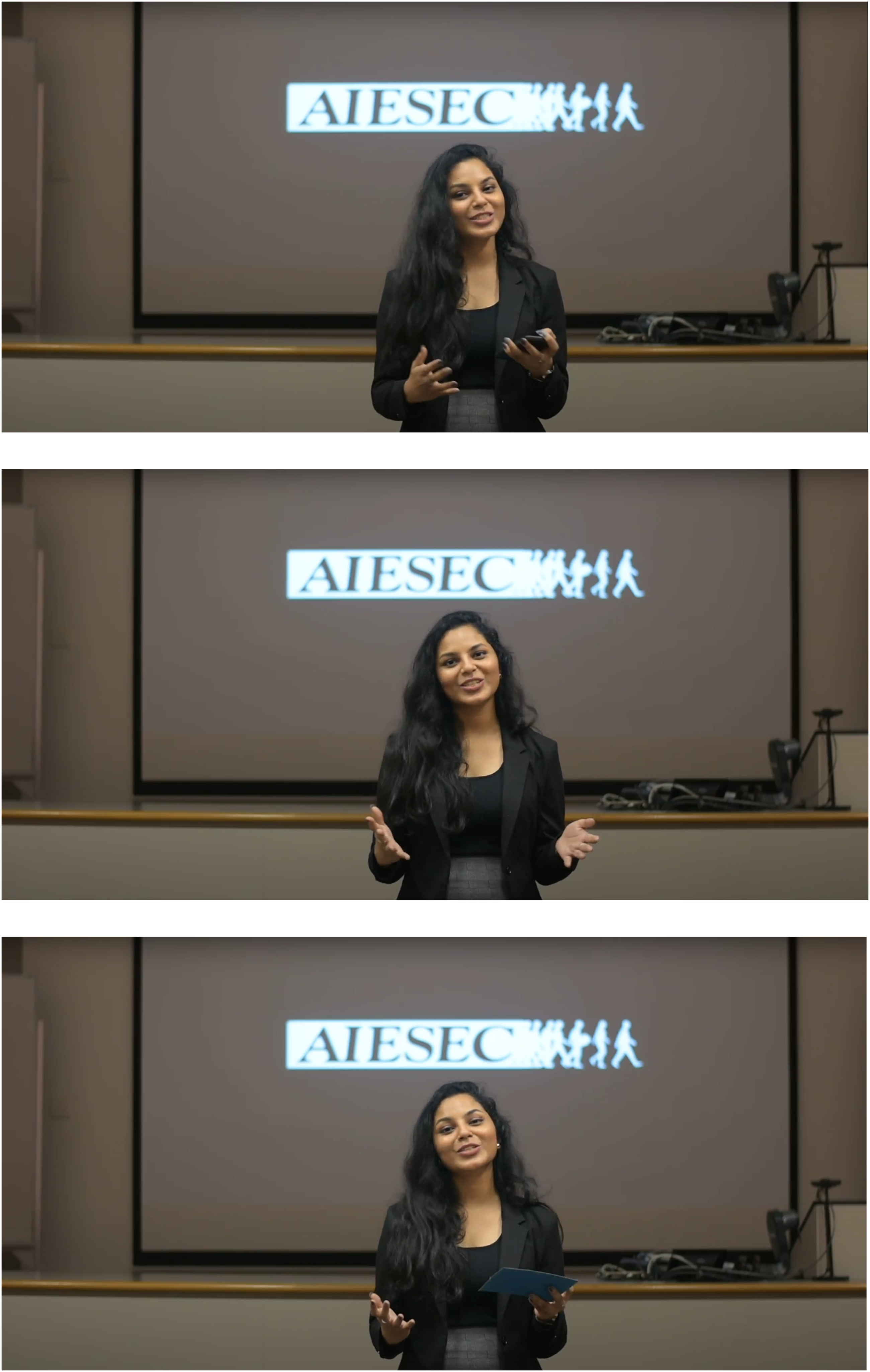
Example Video Vignette Screenshots
In order to generate more realism and better simulate a public speaking context, participants viewed one of the vignettes while sitting in a university classroom (Aguinis & Bradley, 2014). Participants indicated the degree to which they agreed or disagreed with the following two statements on a 5-point Likert scale: “The video presented a realistic scenario (individual visits class to discuss a co-curricular club)”; and “The scenario (individual visits class to discuss a co-curricular club) could possibly happen in real life.” The two-item realism scale reliability was α = .74 and the average realism score was M = 3.81, SD = .75, indicating that participants tended to agree that the context was realistic.
Data collection and participants
The research team contacted communication, sociology, psychology, and management professors from a small university in Singapore with an approximate enrollment of 1,400 students. In total, six professors across 15 classes agreed to participate. The research team randomly assigned one of the three scenarios to each class based on the approximate class size. Research team members visited each classroom and gave a short recruitment speech accompanied by a PowerPoint slide, which included both a QR code and survey link. Participants first answered six questions regarding their attitude toward AIESEC and when everyone was ready viewed the 1-minute video and completed the survey.
In total, 375 students completed the survey; however, 65 participants missed the manipulation check (the final survey question asked participants to indicate which speaking aid the speaker used) and six students reported they knew the speaker, leaving a total sample of N = 304. Participants’ average age was M = 22, SD = 1.75; 238 (78%) were female and 66 (22%) were male. The majority (90%) identified as Singaporean. Eighty-four participants viewed the notecard scenario, 119 viewed the smartphone scenario, and 101 viewed the memorized speech scenario. A Levene's test indicated that the variances were equal across the three groups for all dependent variables and covariates.
In order to address Hypothesis 2, Hypothesis 3, and Research Question 4, the research team recruited administrative staff and instructors from the same university in Singapore. Approximately 190 individuals (147 administrative staff, 43 instructors) received an email invitation to register and attend a live viewing and participation session in a classroom. Over five sessions n = 33 individuals (26 administrative staff, seven instructors) participated. The participants’ (14 male and 18 female) mean age was M = 41, SD = 11.66 and the majority (64%) identified as Singaporean. All participants answered the manipulation check correctly and nobody reported to know the speaker. Due to the small sample size the research team was only able to test the smartphone scenario (17 participants) and the memorized speech scenario (16 participants).
Instrumentation
Speaker persuasion
Before viewing the 1-minute video, participants reported their present attitude toward AIESEC, defined generally as their degree of favorability or summary evaluation of AIESEC (Ajzen, 2001). The survey directions informed participants that AIESEC is a global youth leadership movement and asked them to indicate the degree to which they agreed or disagreed with the following six statements on a 5-point Likert scale: “AIESEC is a positive co-curricular group”; “I would enjoy being a member of AIESEC”; “Being an AIESEC member would be an unpleasant experience”; “AIESEC members contribute positively to society”; “I would recommend AIESEC to others”; and “Being an AIESEC member would be a beneficial experience.” After viewing the video, the participants responded to the same six statements. The pre-video AIESEC attitude scale reliability was α = .86 and the post-video AIESEC attitude scale reliability was α = .82. 1 The analysis created an attitude change variable subtracting the post-video response scores from the pre-video response scores.
Speaker credibility
The speaker credibility instruments are based on similar measures incorporated by Kneip (2011) for assessing audience perceptions of a speaker.Kneip (2011) measured credibility using a 16-question, 7-point semantic differential scale on which numbers 1 and 7 indicate strong feelings, 2 and 6 indicate moderate feelings, 3 and 5 indicate weak feelings, and 4 indicates undecided/neutral. This credibility scale contains several semantic differential items similar to the competence and trustworthiness dimensions of McCroskey and Teven's (1999) source credibility scale. The competence factor included competent–incompetent, intelligent–unintelligent, expert–inexpert, trained–untrained, and logical–illogical, the likeability factor included honorable–dishonorable, kind–cruel, friendly–unfriendly, genuine–phony, and just–unjust, and the confidence factor included certain–uncertain, assertive–unassertive, and reliable–unreliable. The final three factors were honest–dishonest, accurate–inaccurate, and knowledgeable–uninformed (Kneip, 2011). To account for the public speaking context, participants also determined whether the adjectives eloquence, clarity, logic, and efficiency were “not descriptive at all” or “extremely descriptive” of the speaker on a 5-point scale.
In order to better understand the scales, the current study conducted a principal factor analysis on the 20 items with oblique rotation (direct oblimin) for the student sample. Initial screening led to dropping three items (logical, friendly, trained) (Field, 2013). The Kaiser–Meyer–Olkin (KMO) measure verified the sampling adequacy for the analysis, KMO = .913, and all KMO values for individual items were greater than .88. An initial analysis was run to obtain eigenvalues for each factor in the data. Three factors had eigenvalues over Kaiser's criterion of 1 and in combination explained 57.60% of the variance. Table 1 shows the factor loadings after rotation. The items that cluster on the same factor suggest that Factor 1 represents competence, Factor 2 represents likeability, and Factor 3 represents speaker ability. Factor 1 includes four items (competent, expert, intelligent, informed) that McCroskey and Teven (1999) include as competence, whereas Factor 2, likeability, includes three items that they include as trustworthiness (honorable, honest, genuine), suggesting that likeability and trustworthiness are related constructs. The current analysis averages each item for likeability/trustworthiness, competence, and speaker ability to compute a separate score for each dimension.
Exploratory Factor Analysis Results Summary for the Credibility Items.
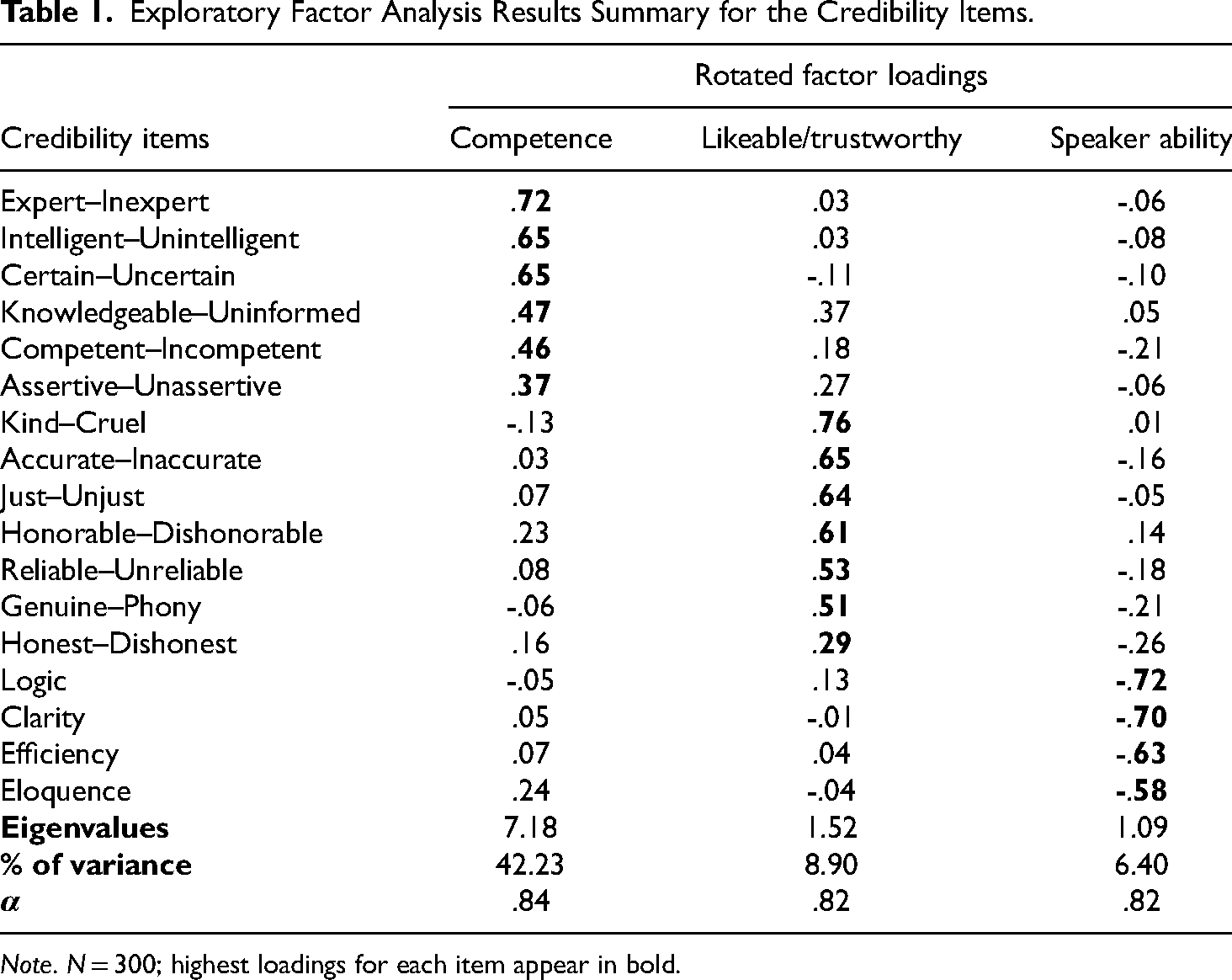
Note. N = 300; highest loadings for each item appear in bold.
Speaker immediacy
The speaker immediacy measure was inspired by semantic differential items used to assess the perceived interaction involvement of a conversational partner (Cummings & Reimer, 2021; Guerrero, 1997). Participants indicated the degree to which they agreed or disagreed with the following five statements on a 5-point Likert scale: “The speaker appeared distracted”; “The speaker appeared distant”; “The speaker appeared unapproachable”; “The speaker appeared alert”; and “The speaker appeared close.” Reliability for the immediacy measure was α = .78.
Smartphone acceptance and use
First, this study incorporates constructs from the original Technology Acceptance Model (TAM) (Davis 1989; Davis et al., 1989) and research applying the TAM to smartphones (Ahmed et al., 2017; Joo & Sang, 2013; Ma et al., 2016) to create a smartphone acceptance measure. Much research incorporating the TAM is interested in predicting behavioral intention (BI) and technology adoption, whereas the current study seeks to control for smartphone acceptance by treating the variable as a covariate. Thus, the smartphone acceptance measure combines the related constructs of Perceived Usefulness (PU), Perceived Ease of USE (PEU), and Attitude Towards Technology (ATT). Participants indicated the degree to which they agreed or disagreed with the following six statements on a 5-point Likert scale. PU: “Using my smartphone makes my life easier,” “Using my smartphone enhances my effectiveness professionally”; PEU: “Learning to use a smartphone is easy for me,” “I am skillful at using my smartphone”; ATT: “Using my smartphone is a good idea,” “I like the idea of using my smartphone.” The scale reliability was α = 0.82. Second, using a drop-down menu, participants indicated their daily smartphone use between 0 and 1,440 minutes.
Results
Speaker credibility, persuasiveness, and immediacy
A paired-samples t-test indicated that participants had a more positive attitude toward AIESEC after viewing the recording (M = 3.83, SE = 0.03) than before viewing the recording (M = 3.49, SE = 0.03). This attitude difference, 0.34, BCa 95% CI [0.30, 0.38], was significant t(300) = 14.67, p = < .001, and represented a medium-sized effect, d = 0.69. The significant attitude change suggests that the speaker in the recording was persuasive. Results mostly supported Hypothesis 1, which predicted that persuasion, credibility, and immediacy would be significantly related. Persuasion was not significantly correlated with credibility and immediacy for the staff and instructor sample. See Table 2 for means, standard deviations, and correlations for all dependent variables and covariates.
Descriptive Statistics and Correlations for Dependent Variables and Covariates.
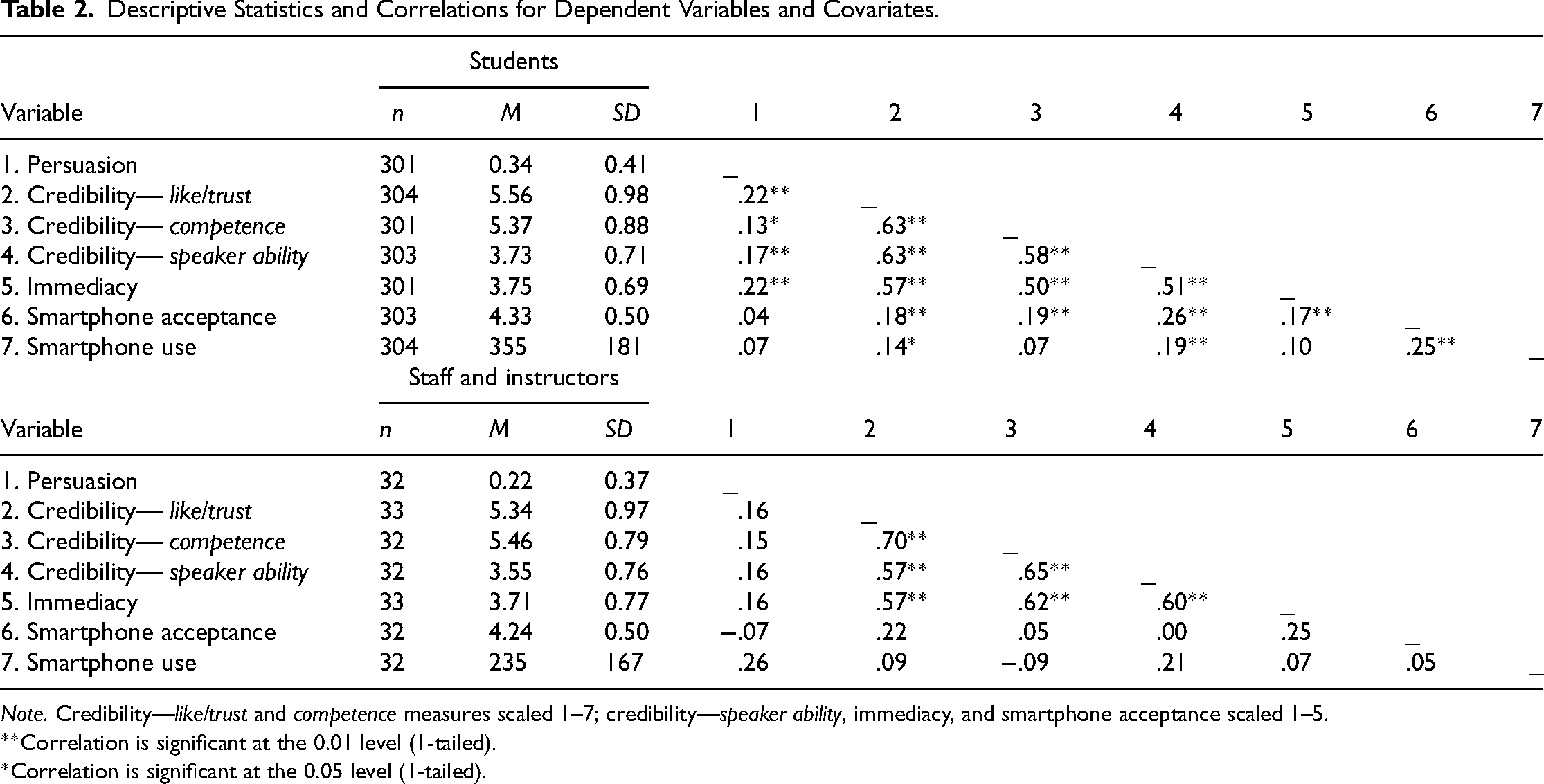
Note. Credibility—like/trust and competence measures scaled 1–7; credibility—speaker ability, immediacy, and smartphone acceptance scaled 1–5.
**Correlation is significant at the 0.01 level (1-tailed).
*Correlation is significant at the 0.05 level (1-tailed).
Research Questions 1 and 2 explored the differences in audience perceptions of speaker credibility, speaker persuasiveness, and speaker immediacy. First, a multivariate analysis of variance (MANOVA) including credibility—like/trust, credibility—competence, credibility—speaker ability, immediacy, and persuasion was run. Box's test of equality of covariance was not significant (p = .11); thus, the assumption of equality of covariance was met. Using Roy's largest root there was a significant difference between the three speaking modalities (presenting with notecards, a smartphone, or with no speaking aid), Θ = 0.04, F(5, 288) = 2.48, p = .032. However, follow-up univariate analyses of variance (ANOVAs) were nonsignificant, although the ANOVA for perceptions of speaker credibility—like/trust was nearing significance, F (2, 301) = 2.99, p = .052, ω = 0.11 and prompted a Gabriels's post-hoc procedure, which indicated that the slightly higher mean credibility—like/trust difference (M = .31 SE = .13, p = .053) when presenting with no speaking aid as opposed to presenting with a smartphone was not significant. Table 3 provides means and standard deviations for each dependent variable and ANOVA results for the three speaking scenarios.
Means, Standard Deviations, and One-Way ANOVA Statistics for Dependent Variables.
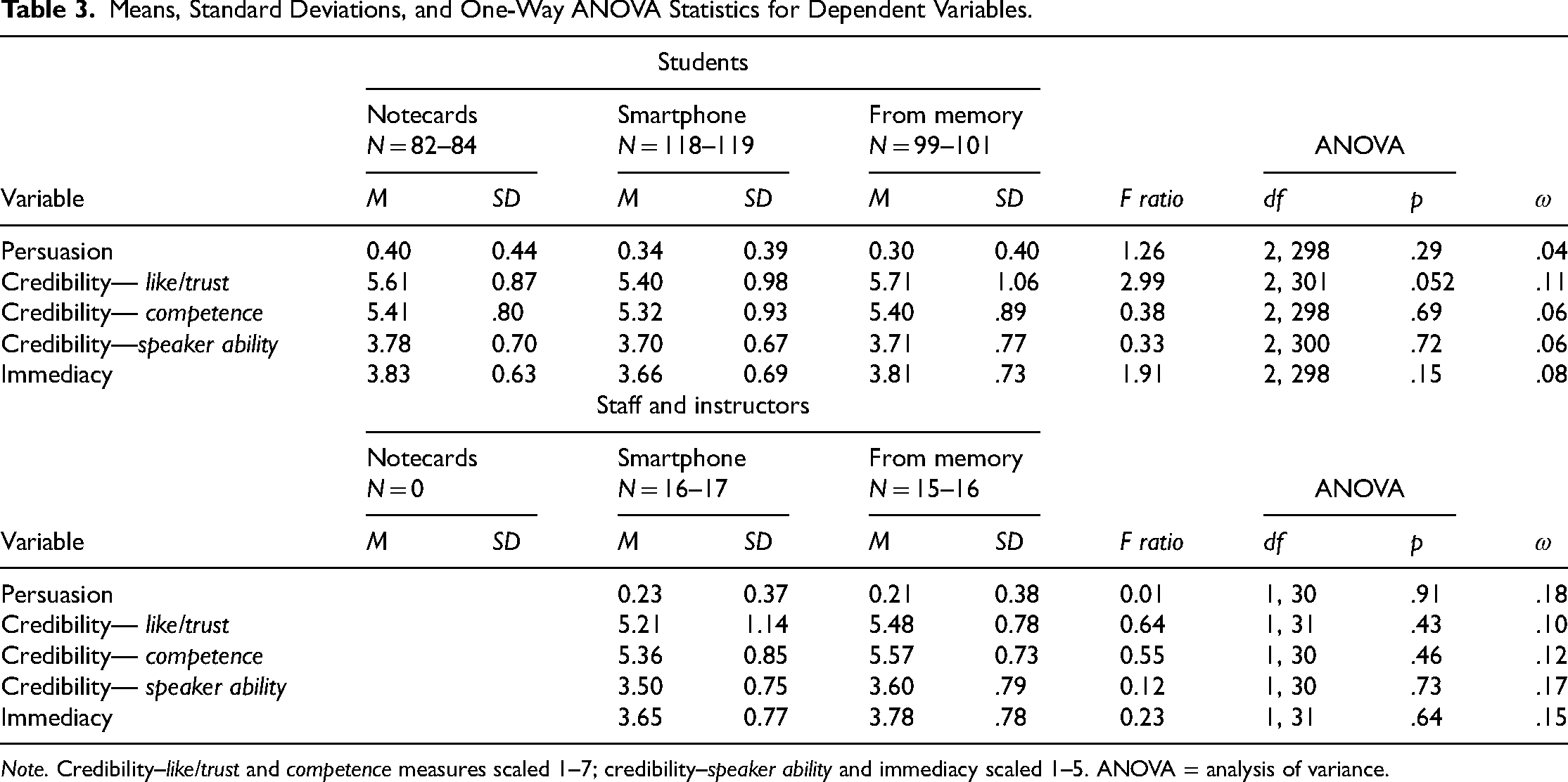
Note. Credibility–like/trust and competence measures scaled 1–7; credibility–speaker ability and immediacy scaled 1–5. ANOVA = analysis of variance.
Smartphone acceptance and smartphone use
Research Question 3 explored the potential influence of technology-related covariates.
The smartphone acceptance variable was M = 4.33, SD = 0.49 and students reported spending M = 5 hours, 55 minutes (SD = 3 h, 1 min) on their smartphone per day. Smartphone acceptance and daily smartphone use were significantly correlated r = .205, p < 0.01.
A multivariate analysis of covariance (MANCOVA) including smartphone acceptance as a covariate and credibility—like/trust, credibility—competence, credibility—speaker ability, immediacy, and persuasion as dependent variables was run. Box's test of equality of covariance was not significant (p = .11); thus, the assumption of equality of covariance was met. Using Roy's largest root there was a significant difference between the three speaking modalities (presenting with notecards, a smartphone, or with no speaking aid), Θ = 0.04, F(5, 286) = 2.47, p = .033. Follow-up analyses of covariance (ANCOVAs) revealed that smartphone acceptance was significantly related to perceptions of credibility—like/trust F(1, 299) = 11.50, p = <.001, partial η2 = 0.04. Further, controlling for smartphone acceptance resulted in a significant effect of speaking modality on perceptions of credibility—like/trust F(2, 299) = 3.63, p = .028, partial η2 = 0.02. A Šidák correction post-hoc procedure indicated that the mean credibility—like/trust difference (M = -.34, SE = .13, p = .030) when presenting with a smartphone as opposed to no speaking aid was significant.
A MANCOVA analysis including daily smartphone use as a covariate and credibility—like/trust, credibility—competence, credibility—speaker ability, immediacy, and persuasion as dependent variables was run. Box's test of equality of covariance was not significant (p = .11); thus, the assumption of equality of covariance was met. Using Roy's largest root there was a significant difference between the three speaking modalities (presenting with notecards, a smartphone, or with no speaking aid), Θ = 0.04, F(5, 287) = 2.46, p = .033. However, follow-up ANCOVAs revealed no significant effects, although credibility—like/trust and smartphone use were significantly related, F(1, 300) = 5.78, p = .017, partial η2 = 0.02, and there was a near significant effect of speaking modality on perceptions of credibility—like/trust when controlling for smartphone use F(2, 300) = 2.90, p = .057, partial η2 = 0.02. A Šidák correction post-hoc procedure indicated that the mean credibility—like/trust difference (M = -.30, SE = .13, p = .062) when presenting with a smartphone as opposed to no speaking aid was not significant.
Age comparison
Hypotheses 2 and 3 examined attitudes and behaviors regarding smartphone use and Research Question 4 explored age differences in speaker perceptions. Overall, findings in relation to speaker perceptions followed similar patterns as those for the student sample, albeit with one exception. First, a paired-samples t-test indicated that older participants also reported a more positive attitude toward AIESEC after viewing the recording (M = 4.06, SE = 0.09) than beforehand (M = 3.84, SE = 0.10). This attitude difference, 0.22, BCa 95% CI [0.09, 0.35] was significant t(31) = 3.37, p = < .001 and represented a small to medium-sized effect, d = 0.40.
Second, a MANOVA analysis including credibility—like/trust, credibility—competence, credibility—speaker ability, immediacy, and persuasion was run. Box's test of equality of covariance was not significant (p = .92); thus, the assumption of equality of covariance was met. Using Roy's largest root there was no significant difference between the two speaking modalities (presenting with a smartphone or with no speaking aid), Θ = 0.08, F(5, 24) = 0.40, p = .841. Table 3 shows means and standard deviations for each dependent variable and univariate ANOVA results across the two speaking scenarios.
Third, the smartphone acceptance mean for staff and instructors was M = 4.24, SD = 0.50 and the daily smartphone use mean was M = 3 hour, 55 minutes (SD = 2 h, 47 min). Smartphone acceptance was not significantly correlated with smartphone use per day r = .05, p = 0.79. Hypothesis 2 predicted that older participants would report a lower degree of smartphone acceptance than younger participants. An independent samples t-test showed that the difference, 0.08, BCa 95% CI [-0.098, 0.264] between the smartphone acceptance mean for staff and instructors (M = 4.24, SD = 0.50) and students (M = 4.33, SD = 0.49) was not significantly different t(333) = .90, p = .37. Hypothesis 3 predicting that older participants would report less smartphone use was supported. An independent samples t-test showed that students (M = 5 h, 55 min, SD = 3 h, 1 min) spent more time per day on their smartphones than staff and instructors (M = 3 h, 55 min, SD = 2 h, 47 min). This difference, 2 h, 1 min, BCa 95% CI [55.257, 186.73], was significant t(334) = 3.62, p < .001, and represented a medium-sized effect, d = 0.67.
Fourth, a MANCOVA analysis including smartphone acceptance as a covariate and credibility—like/trust, credibility—competence, credibility—speaker ability, immediacy, and persuasion as dependent variables was run. Box's test of equality of covariance was not significant (p = .92); thus, the assumption of equality of covariance was met. Using Roy's largest root, unlike the student sample, there was no significant difference between the two speaking modalities (presenting with a smartphone or with no speaking aid), Θ = 0.12, F(5, 23) = 0.57, p = .724. A MANCOVA analysis including daily smartphone use as a covariate was also nonsignificant using Roy's largest root, Θ = 0.10, F(5, 23) = 0.44, p = .818.
Discussion
There are four principal findings stemming from this investigation. First, results suggest that a dynamic speaker can change an audience's attitude regarding an organization and it only takes one minute. Second, speaker credibility, immediacy, and persuasion were positively correlated, which is consistent with previous research (Burgoon et al., 1990). Participants reported no significant differences in perceptions of speaker credibility (trust/like, competence, speaker ability), immediacy, or persuasion between a speaker presenting with notecards, presenting with a smartphone, or presenting without a presentation aid. However, there was a near significant difference for credibility—like/trust between the smartphone and memorized condition, and this difference became significant when accounting for participant smartphone acceptance levels. Third, participants reported heavy smartphone use and high smartphone acceptance levels and these variables were significantly correlated for the student audiences. Fourth, older participants (staff and instructors) followed similar patterns as students regarding attitude change and presenting with a smartphone as opposed to delivering a memorized speech. They also reported high smartphone acceptance levels, but significantly less daily smartphone use compared with students. Findings regarding age must be interpreted with extreme caution because the staff and instructor sample size was small. Overall, the results have implications for public speaking educators and those concerned with smartphone use in other presentation contexts.
Audience perceptions
Speaker credibility and persuasion
Results show that delivering a speech from memory does not result in heightened perceptions of speaker credibility or persuasion. Thus, referring to speaking aids such as notecards or a smartphone did not negatively impact a dynamic and prepared speaker. Public speaking textbooks emphasize the role that an effective speaking outline plays in presenter performance (Beebe & Beebe, 2015; Lucas, 2020; Tucker et al., 2019) and findings from the current study suggest this to be empirically sound advice. Audiences did not judge speakers who access their speaking outline on their smartphone as less credible or persuasive. One potential explanation comes from interpersonal communication research and the influence that cell phones have on conversation satisfaction. The Cell Phone Relevance Hypothesis (Cummings & Reimer, 2021) suggests that cell phone use can have a positive effect on communication when it is integral to the interaction, for example, searching for conversation-enriching information. In the current study, the speaker used a smartphone to deliver a speech, and this integral use served a key communicative function and potentially aided her delivery. It is possible that participants would judge incidental smartphone use differently, for example, if the speaker became distracted by an alert message.
Treating smartphone acceptance as a covariate did have a significant interaction effect on perceptions of speaker credibility—like/trust between the memorized speech and smartphone condition. Participants who reported slightly lower smartphone acceptance perceived the speaker to possess less credibility—likeability/trustworthiness, but not significantly less credibility—competence, credibility—speaker ability, persuasion, or immediacy. This finding has implications for understanding the role that individual smartphone acceptance plays in impacting perceptions of others’ smartphone use and highlights the importance of distinguishing source credibility dimensions (McCroskey & Teven, 1999). Someone who adopts a new technology may not be perceived by others as less competent and able, but they may be perceived as less likable and trustworthy. In a related study, Cameron and Webster (2011) found that an individual's beliefs and attitudes toward polychronic communication indirectly influenced their perceptions of uncivil behavior, such as ignoring or excluding others, and that higher perceptions of incivility were related to a reduction in interpersonal trust. Thus, it is possible that individuals with lower smartphone acceptance levels potentially perceive a speaker's smartphone use as uncivil or disrespectful, resulting in slightly lower perceptions of credibility—like/trust. Further, Knapp et al. (2014) suggest that speakers who wear attire that others perceive as similar to their own and/or appropriate to the situation will be more persuasive. Like clothing, smartphones are arguably extensions of the self (Ross & Bayer, 2021), albeit a technology-related extension, that potentially induces feelings of perceived similarity or dissimilarity. Future research examining the role that individual smartphone acceptance, and technology acceptance in general, plays in forming perceptions of others is needed to both verify these results and obtain a better understanding of technology acceptance as a perception-shaping variable.
Speaker immediacy
Results indicated no significant differences in perceptions of speaker immediacy between the three speaking conditions (presenting with notecards, with a smartphone, or with no speaking aid). Much speaker immediacy research highlights nonverbal communication behavior related to eye movement, facial expressions, and gestures (Anderson, 2008; Burgoon et al., 1990; Mottet et al., 2006; Rodero et al., 2022), and in the current study these powerful immediacy cues were held constant. The only immediacy-related difference between the three conditions was the presence of notecards or a smartphone. It is understandable that there was no relationship, considering that strong reactions to artifacts (e.g., holding a smartphone) are potentially short-lived, and that overall impressions are likely based on additional appearance-related features, other nonverbal behavior, and verbal communication (Knapp et al., 2014).
Smartphone use, smartphone acceptance, and age
Participant smartphone use and acceptance is another way of explaining why audience perceptions were mostly similar across the three speaking conditions. It is quite possible that participants in the current study perceived smartphone use by a speaker as a relatively normal and acceptable practice. Participants reported relatively high smartphone acceptance (students m = 4.33/5, staff and instructors m = 4.24/5) and daily smartphone use (students m = 6 hours per day, staff and instructors m = nearly 4 hours per day). Individuals have expectations regarding smartphone use norms (Büttner et al., 2022) and etiquette (Kadylak et al., 2018), and what is considered appropriate smartphone use is constantly changing (Crowley et al., 2018).
Previous literature suggested that participant age would potentially influence an individual’s perception of a speaker who uses a smartphone to give a presentation. Results from the current study do not support this possibility. Although the staff and instructors in the current study reported significantly less smartphone use, their smartphone acceptance levels were not significantly different from the students’. When investigating Chinese adults over 55, Ma et al. (2016) found that the younger participants were more likely to accept smartphones. The average age for staff and instructors in the current study was m = 40 years, arguably qualifying the current sample as relatively young. Findings in relation to age need to be considered with caution given the small staff and instructor sample size.
Additionally, Singapore is a country with relatively high smartphone penetration (Statista, 2023a, 2023b) and smartphone use is commonplace in a variety of social and professional settings. Future research examining perceptions of a speaker’s smartphone use for public speaking in other countries and contexts is needed. For example, an individual using a smartphone to give a presentation in a business meeting may potentially have older audience members with lower smartphone acceptance and be perceived negatively. On the contrary, using a smartphone in a context in which a manager's policy favors technology could potentially work in the employee's favor in terms of communicator evaluation and competence ratings (Piercy & Underhill, 2021). Thus, if the context includes leaders who are pro-technology, smartphone use as a speaking aid would potentially be more accepted, if not preferred. More research is needed before generalizing findings outside the university context or making more concrete conclusions regarding age.
Recommendations for practice
The speaker in the current study presented extemporaneously and referred to her notecard or smartphone without reading information. Public speaking educators should consider teaching students proper smartphone use while presenting, as opposed to abstaining from using smartphones, especially when presenting to younger audiences and peers. However, before encouraging students to use their smartphones to give a public presentation, educators could offer strategies for using them as a presentation aid, for example, turning off ringers and notifications that could potentially distract the speaker, ensuring the smartphone has sufficient battery, and considering the physical size of the smartphone. Further, speakers may need to modify their speaking outline preparation for use with a smartphone and presentation applications.
Footnotes
Acknowledgments
The authors thank three other research team members (Ananyaa Kashyap, Joshua Jun Kit Lee, and Janice Prasetio) for their contributions during the earlier stages of this project.
Declaration of conflicting interests
The authors have no conflicts of interest to declare.
Funding
The authors received no financial support for the research, authorship, and/or publication of this article.
