




Abstract
How does the use of parent–daycare mobile communication applications reconfigure the emplacement and timing of parenting? In what ways, if any, do parents’ practices challenge the distinction between warm care and cold technology? Based on 35 interviews with 18 parents, we identified 4 ways in which Aula, Denmark's parent–daycare app, reconfigures the time-space dimensions of parenting. While parents and children are apart, mobile communication via Aula allows parents to “plan ahead,” and “synchronize” expectations and schedules with those of their children and the daycare center and “look back” on their children's time away. In addition, communication via Aula enhances co-presence. Overall, this paper's findings offer an alternative to views that oppose technology and care, showing how mobile communication may reshape responsibility for childcare in the welfare state.
Introduction
If we haven’t seen each other for six hours, then it's really nice to know what he actually does when I’m not there. (Laura)
The comment above came from Laura, Karl's mother, while talking to us about Denmark's parent–daycare communication application, Aula. At the time of our interview, Karl was four and, like most children in Denmark, spent most weekdays at daycare. When the daycare center employed a previous communication system, Laura received daily updates on her toddler's day. With the shift to Aula, however, Laura felt that the staff were “not very much into it” and therefore did not use the app as often. Laura found that her ability to bond with her son was limited as a result since she missed a lot of what he did daily. “It is my kid! I want to learn and get to know him!”, she explained.
Laura's experience was rare in that most parents in our sample reported that daycare centers use Aula frequently. However, the themes and practices that emerge in this short vignette—the separation of parents and children for long stretches of time, the importance of communication, and the ways parents may mobilize the information in Aula—are illustrative of the experiences reported by the participants in this study. The present paper explores the time-space practices of parents of children aged 0–6 living in Denmark, focusing on the use of the parent–daycare communication app Aula. In doing so, it contributes to research on how mobile communication technologies participate in and affect the emplacement and timing of care exchanges, as well as our experiences of care. It asks: how does the use of parent–daycare mobile communication applications reconfigure the time and space dimensions of parenting? In what ways, if any, do these practices challenge the distinction between warm care and cold technology? Because Aula is an app created and introduced by the Danish welfare state as the main communication tool between families and public early childhood education institutions, the answers to these questions also have implications for the relationship between parents, children, and welfare state institutions. In particular, this paper will argue that the way it is used intensifies the responsibility of parents to engage in the institutional life of their children.
To address these research questions, this paper draws on feminist care perspectives as well as on digital parenting and mobile communication research. Methodologically, we conducted 35 interviews with 18 parents of children who attend public daycare. Based on the analysis of the interview data, four broad patterns emerge. First, communication in Aula makes it possible for parents to “plan ahead,” anticipating their children's needs and responding to the daycare center's requirements. Second, mobile communication applications allow parents to “synchronize” their expectations and schedules with their children and with the daycare center. Third, parents can use Aula to “look back” on what their child did while they were in daycare. Last but not least, Aula extends co-presence by enhancing parents’ time with their children. Taken together, these results reveal how looking at parents’ everyday practices through the lens of communication and time-space relations challenges the notion that the introduction of technology in caring contexts necessarily leads to reduced care and human interaction. This paper draws on these findings to reflect on how mobile communication through Aula changes the allocation of responsibility and creates expectations for parents to align with the values, temporalities, and dynamics of the welfare state.
Care and technology
In the eyes of both scholars and lay people, technology is still often perceived as being in opposition to warm human contact (Pols & Moser, 2009; Sparrow & Sparrow, 2006). The distinction between warm care and cold technology is especially common in discussions of caring for the young, where “pro-active human interaction” is favored over technological means of watching over children (Macnish, 2017, p. 199). According to this perspective, technology is cold, rational, and functional, whereas human care is affective, comforting, and warm. Those who frame technology as cold, therefore, worry about the prospect of it replacing human contact and face-to-face interaction (Macnish, 2017; Pols & Moser, 2009).
Feminist approaches to care, however, question this clear-cut antagonism (Mol, 2008; Mol et al., 2010; Pols, 2012; Pols & Moser, 2009). This scholarship emphasizes both that human care is not always warm and that care is not opposed to technology, but rather includes it (Mol, 2008; Pols, 2012). Care refers here to a genre of activity involving four interconnected phases: caring about, taking care of, caregiving, and care-receiving (Tronto, 2020). That is, to care draws together the emotional engagement of being concerned (caring about), the act of taking responsibility (taking care of), and the “practical engagement of contributing to restoring, sustaining, or improving something” (caring for) (Mol & Hardon, 2020, p. 185). Notably, this feminist notion of care does not equate it to a positive set of practices or feelings; care practices can be easily connected to both nurturing and oppression, and the affects that mediate care situations can include contradictory feelings of intimacy, security, anxiety, and obligation (Puig della Bellacasa, 2017).
Importantly, care's dispositions and activities require a wide range of people, tools, and infrastructures, including technologies (Mol et al., 2010). Because caring is understood as a group effort, scholars use the notion of “care collectives” (Ahlin, 2018) to describe the relationship between care receivers, caregivers, and technology, seeing them as mutually interdependent rather than as separate entities.
Introducing a communications approach
This conceptualization of care as a process and its connection to technology requires us to consider how care is enacted through everyday practices. To do this, this paper looks at the actual communication practices that take place through Aula using James Carey's (1989) framework, which sees communication as ritual; that is, the everyday interactions that establish social relationships. This approach considers communication as closely connected to and as a means for producing and maintaining commonality and community. Its key accomplishment is the maintenance of society in time (Carey, 1989).
Mobile communication, for its part, is studied here as a specific type of “social action across physical distance” (Jensen, 2013, p. 27). This understanding of mobile communication allows us to explore how, historically, shifting technologies have extended our communicative capacities over time and space. In doing so, they have expanded our ability to care as well, becoming key participants in contemporary “care collectives” (Ahlin, 2018).
Looking at our case study from this vantage point, the communication afforded by Aula is shaped in particular by two historical institutions of the Danish welfare state: the family and the daycare center. At the same time, the mobile application and its implementation also have an effect on those institutions and their interactions, since the accumulation of communicative exchanges that take place through and around the platform help (re)constitute specific care collectives. Thus, communication technologies can be viewed as both part of and organizers of care collectives, making us reconsider the opposition between cold technology and warm interpersonal care as well as transforming childcarers’ responsibilities.
Our approach also allows us to study how changes in communication affect our experience of time and space, a topic that has long been of interest to mobile communication scholars (Haddon & Ling, 2003; Jensen, 2013; Katz, 2006; Ling & Campbell, 2010). In particular, mobile communications studies show how contemporary mobile communications modulate social relationships, shifting interpersonal contexts of interaction across these two dimensions. As Jensen (2013) puts it: “What's mobile about mobile communication is not so much the particular device, the individual user, or the general technology, but the social contexts in which these components come together in communication” (p. 27).
That is, contemporary communication technologies are not only mobile because they are portable, but because they make mobile the “contexts of agency”—that is, contexts of meaningful social interaction—in which people and technologies come together (Jensen, 2013). In what follows, we discuss how a mobile communications approach has been employed to study parents’ time-space practices.
Parenting in the mobile communication era
In the case of parenting, research in the United States and East Asia finds that mobile media’s “always-on, always-available” character has been transferred to parenting, extending parents’ context of agency beyond co-presence (Beckman & Mazmanian, 2020; Lim, 2019). This literature contends that the ubiquity of mobile communication technologies facilitates a form of parenting referred to as “transcendent parenting” (Lim, 2019), whereby parents use technology to go beyond traditional, physical, practices of parenting. Transcendent parenting is born out of the convergence of a technologically infused environment and a parenting climate of intensive parenting, where parents are expected to invest large amounts of time, money, and energy in their children’s upbringing (Lee et al., 2014; Faircloth, 2014).
Lim's book contends that transcendent parenting is characterized by its defiance of temporal and spatial limits. This provides us with an important starting point for explaining how mobile communication impacts parenting. However, how time and space are restructured is not fully developed in Lim's work. Other mobile communications literature helps expand Lim's findings in this direction, exposing how the family sphere, along with its associated responsibilities, has become increasingly mobile. This literature reveals that new communication technologies have transformed the dynamics of family life, allowing for constant availability and nuanced micro-coordination among family members (Beckman & Mazmanian, 2020; Clark, 2013; Haddon & Ling, 2003; Licoppe, 2004). These processes allow for a sense of “connected presence” (Licoppe, 2004) or “mediated co-presence” (Madianou, 2016) despite physical separation, continuously reproducing family relations. Literature on transnational families (Ahlin, 2018; Madianou, 2016; Madianou & Miller, 2011; Wilding et al., 2020), in particular, illustrates how a lack of physical co-presence does not mean that care ceases to exist, but rather that it is reconfigured as family members find new ways of being “there” for each other (Baldassar, 2016).
These frameworks have shed light on the complex interplay between mobile communication technologies and the reshaping of family practices, relationships, and perceptions of time and space. Combining them with a care-geographies approach helps illuminate the power of infrastructures in the (re)configuration of time-space coordinates (Lawson, 2007). From this perspective, time and space are inextricably linked; both are dynamic, socially constituted, and shaped by power relations (Bowlby, 2012). A geographical approach to parenting reveals how the spatial distribution of housing, schools, and other facilities, and the transportation and communication resources that connect them, enable or constrain certain care practices and experiences of time. Conceptualizations of care as a process, for their part, show how “care time” involves reorienting one's own time to the temporal flows and processes of others, including those of (welfare state) institutions (Puig della Bellacasa, 2017; Mol, 2008; Sharma, 2014).
Transcendent parenting in Denmark
Denmark is an interesting setting to study digital parenting because it is a media-rich environment where most children are enrolled in early childhood education, but where childcare institutions, parental norms, and pressures differ considerably from those described by previous literature (Sparrman et al., 2017). In Denmark, most children attend state-subsidized daycare centers from the ages of 1–6. Nowadays, nearly universal out-of-family care is deemed essential for parents to maintain their participation in the labor market while simultaneously facilitating the child’s development and socialization. Indeed, daycare institutions have become the appropriate setting for children to spend their weekdays, even for infants and toddlers, increasing state involvement in the raising of children (Gilliam & Gulløv, 2017). Crucial here is the daycare centers’ role in “civilizing the youngest” (Gilliam & Gulløv, 2017, p.54) by encouraging children to express their views and show consideration towards others since these skills are construed as essential for a harmonious and functional community.
At first glance, the welfare state principles of universal childcare and state involvement in child-rearing may appear contradictory to the idea of intensive parenting, often associated with the privatization and individualization of child-rearing responsibilities within the nuclear family (Faircloth, 2021). However, multiple studies confirm that intensive parenting is actually a prevalent cultural norm among Danish parents (Dannesboe et al., 2018; Gilliam, 2022; Gilliam & Gulløv, 2017). Therefore, it is likely that the dissemination of this norm in Denmark does not imply a withdrawal of the state, but rather a stronger expectation for parents and public institutions to collaborate to ensure children's effective socialization (Akselvoll, 2022; Gilliam, 2022). Hence, contemporary parenthood in Denmark implies being part of what Juhl (2016) calls a “shared care arrangement” (p. 41), and good parents are defined as those who collaborate with daycare staff (Bach, 2016, p. 58).
The need for cooperation, and its equation with good parenting, means that parents are urged to use mobile applications, as collaboration can increasingly only be achieved through these means (Akselvoll, 2022). Existing literature on digital parenting has started to discuss the digitalization and datafication of family life, focusing on its potential risks and the normativities they create (Leaver, 2017). So far, most studies focus on relatively voluntary practices, like “sharenting”, or the use of parenting apps (Leaver, 2017; Lupton, 2020; Mascheroni & Holloway, 2019; Siibak & Traks, 2019). Still, as the public institutions that sustain everyday life become more digital, it is worth taking a closer look at how the communication practices that this transformation entails impact on the family and its boundaries, and whether parents are “coerced” into digital parenting (Barassi, 2019).
This paper cannot comprehensively analyze the implications of integrating welfare state technologies into family life. Yet it contributes to the discussion by examining Aula as a case study of how and what upbringing ideals and spatio-temporal practices unfold in the everyday lives of Danish families and daycare centers. In particular, this research reveals spatio-temporal regulation as a key element of “civilizing” projects where the public, both young and old, are expected to adapt their behavior to other people and institutions.
Methods
Aula as a case study
According to Lim, “transcendent parenting is platform- and device-agnostic” (2019, p. 139); it is the very nature of mobile communication that enables transcendent parenting. Yet if we are interested in specific time-space configurations, attending to one technology and institutional setting enables us to zoom in on the relationship between the application's affordances and the practices, rhythms, and realities it helps shape. Thus, this paper focuses on the mobile application Aula because families in Denmark that have at least one child in public daycare or primary school must use the app.
According to official communications, the goal of Aula is to strengthen and reinforce cooperation among parents, staff, and children (Aula, n.d.). Participants in this study themselves brought up the fact that “kommunes” (municipalities) put a lot of effort into promoting the app, whose central features include an overview where messages, updates, and schedules are posted by daycare staff. Opting out is not an option, as parents are expected by daycare staff to update information. These practices may therefore be considered part of what Barassi (2019) describes as “coerced digital participation” (p. 415), where individuals are forced to communicate at least minimally by providing their data in exchange for public childcare and education.
Research design and empirical material
This paper focuses on how Danish parents use mobile communication technologies to transcend time and space in parenting. It draws on 35 in-depth interviews with 18 parents of at least one child aged 0–6 living in Denmark. It is part of a larger project, where parents were interviewed three times throughout a year, with the first interviewees being recruited in October 2021. During that time, participants who consented were also asked to carry out small tasks such as keeping photo diaries or engaging in interactive activities to give researchers a glimpse of the everyday life environments of which media is part (Pink & Leder Mackley, 2013).
The authors of the paper conducted all the interviews, which examined the links between digital childcare practices, mobile communication technologies, and the values and relationships they enable. They also included a walkthrough component, whereby participants gave us a tour of Aula and evaluated the different features and functionalities along the way (Light et al., 2018). This provided us with insight into how the app is used and valued in relation to care. Additionally, our longitudinal approach allowed us to establish a deeper relationship with our participants and see how using Aula became habitual for them and their children's daycare institutions over the course of a year.
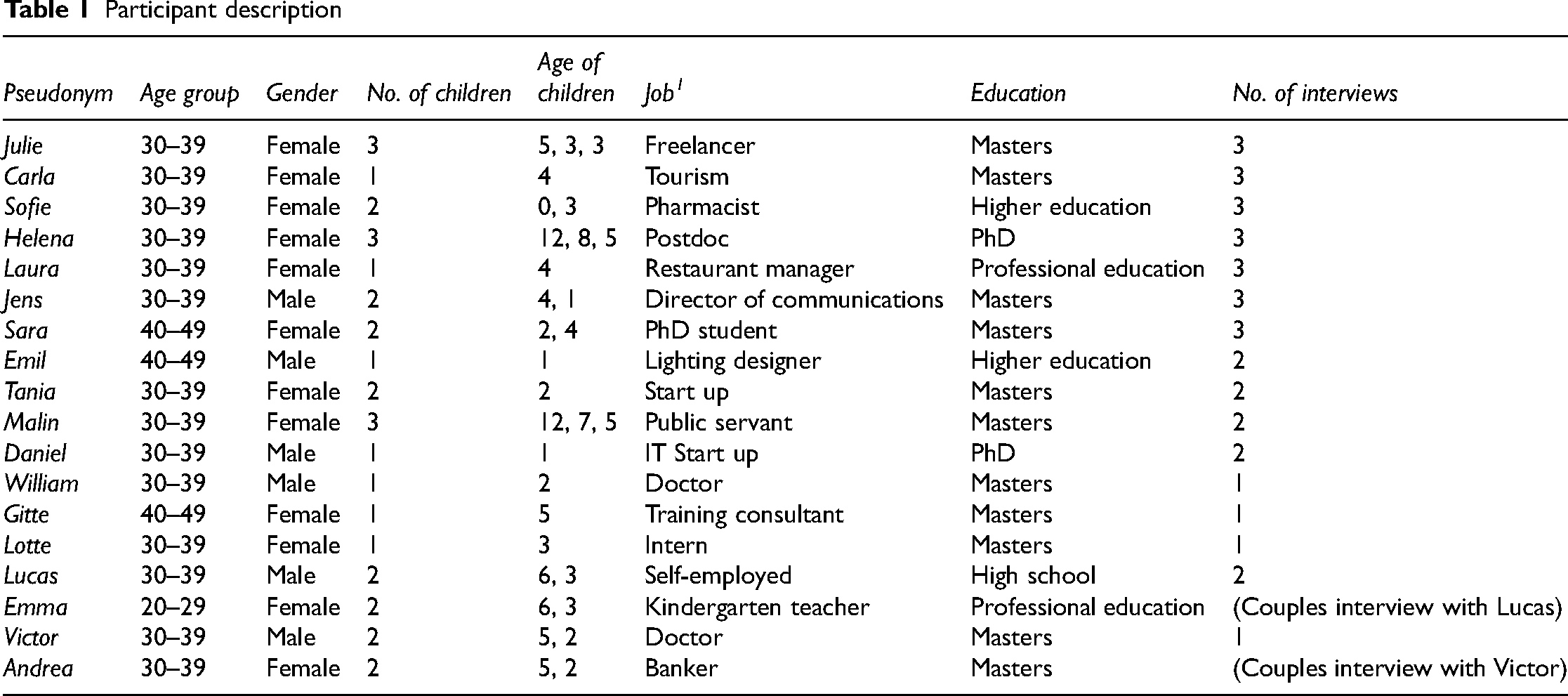
Following institutional ethics approval, we recruited participants through snowballing from personal networks and Facebook parenting groups. A total of 18 parents were recruited and interviewed. Interviewees could participate in the interviews alone or as a couple. The majority of participants (14/18) did individual interviews. Only Lucas and Emma and Victor and Andrea participated as couples. At the time of starting this paper, five participants had been interviewed once, six participants twice, and seven participants had been interviewed three times. These are the interviews included in the analysis. The average duration of these interviews was 58 min, with the longest interview being 86 min long and the shortest one being 29 min.
Out of all the participants, 6 of them were male and 12 of them were female (Table 1). We sought to represent a variety of parenting experiences, including those of single parents, queer parents, and migrants. While our sample is diverse in these regards, all but three of the participants reside in the Capital Region of Denmark and most of them have a higher education. This lack of diversity in participants’ place of residence and educational background might have led to somewhat homogenous participant experiences. Consequently, additional research is needed to gain a comprehensive understanding of how parents’ socioeconomic contexts may influence their digital parenting practices.
Participant description
All interviews were recorded, transcribed, and anonymized. Quotes from interviews conducted in Danish have been translated by the second author. The transcripts were stored in NVivo and read to generate codes for analysis. As an initial analytic tactic, we used a combination of “in vivo codes” and process coding (Saldaña,
Results
Most participants reported using Aula very frequently, and at least weekly. When first asked to describe Aula, parents label it as a “logistical app” (Helena). It allows them to let the daycare center know when they are dropping off or picking up their children, acquire parent contact information, notify the institution about holiday plans, and, more generally, send and receive messages to daycare staff. Daycare professionals, for their part, upload photos and updates.
The app, therefore, frames caring for children as a collaborative endeavor between parents and daycare professionals, casting all adult stakeholders into specific roles with designated communicative tasks in relation to caregiving. In the following sections, we consider how parents’ participation in these communicative tasks affects the emplacement and timing of communicative exchanges between daycare staff and parents through the practices of planning, synchronizing, recalling, and extending co-presence.
Planning: looking forward
Participants used Aula to “look ahead” and plan for the future according to what the daycare staff write in it. As Helena described it, staff “write messages like ‘remember to bring winter boots to the kindergarten tomorrow’ ” which parents use to prepare their children. Likewise, parents may use what is communicated through Aula to decide what to make for dinner. Julie explained: “We have a food plan here and I keep an eye on that. So, at least if they ate pasta for lunch, I’m not going to cook pasta for dinner.” Similarly, Gitte said that “[i]t actually annoys me when I do not know what they are eating” because that allows her to avoid them eating “pasta twice in a day.” This mundane example of micro-coordination shows how the mobile app participates in identifying a need (caring-about, in Tronto's terms) and responding to it.
Julie also mentioned in our second meeting that, with time, staff have become more accustomed to using the app. Now they publish “in advance what happened last week and what we’re going to do this week” and provide “a lot more details.” In this case, by providing parents with more information, the staff's habituation to the app increases parents’ ability to anticipate their children's needs. Having more information, Julie believes, “is good for us to prepare the kids” for the day ahead. In her view, preparing her children for the day was not just about obtaining the materials they may need while they are away. It was also about preparing them mentally by talking about what was coming up at daycare: I don’t tell them the whole week—but every day, maybe in the morning or the evening before, I will talk about “OK, tomorrow you’re going to that group” and “Oh she's going on a tour” or something like that. So, I will tell them and then we can talk about it.
This comment illustrates how Julie processes the information she receives in Aula and then makes the content manageable for her children.
Moreover, features like the calendar and “come and go”—where parents inform the daycare center about the times they will drop off or pick up their children—allow parents’ and the staff's schedules to be coordinated so that the child is never left without care. Parents are assumed to be responsible for managing and coordinating this synchronization, especially when they enlist support from family members as they must register in the app when someone other than the parent (e.g., a grandparent) picks up their child.
Synchronizing: augmenting the present
Through Aula, parents must also remain cognizant of any real-time changes in their child's daycare schedule. Carla, for instance, described how she would check the app when her child had a field trip to see when they were coming back: “If they are late with the bus, they send you a message.” In those situations, parents must adjust to the temporal needs of the daycare and reorganize their time accordingly to pick up their children at the right time. This real-time aspect was taken to the extreme during the COVID-19 outbreak, when parents received constant notifications and even requests to pick up their children at the slightest sign of infection. In this situation, features that were once appreciated by parents generated negative effects. As Sofie put it, “I’m getting so many notifications because there was Corona. It's not Aula's fault.”
Parents also checked how long their children had slept in daycare and used the information to reorganize their time. Emil conveyed this when he stated that using Aula allowed him to know the length of his child's nap, “which is quite nice to know because then you understand at what time she gets cranky.” Sometimes, synchronizing simply entailed mentally preparing for children being irritable. Parents like Sofie, however, also used the napping information to choose afternoon activities that fitted the child's needs: “Is she tired? Has she been sleeping at all? Then maybe after the nap, she would be hungry and so, yeah, some life planning.” This indicates the ways parents’ use of Aula restructures their experience of time as they recalibrate and adjust the evening routine to their children’s needs.
Thus, for some parents, checking nap times makes the future manageable. But parents may also check the sleeping feature in real time to decide whether to collect the child: “Sometimes she sleeps until four o’clock almost, and then it doesn’t make sense to go there if she's not awake yet” (Jens). In other words, instead of waking up the child, parents try to adjust their pick-up time to the child’s embodied temporalities and physical needs.
The first thing to note here is that parents checking nap time and nap length usually takes place while the children are at daycare. Parents are probably working during this time, illustrating how mobile communication technologies bring parenting into other spheres of life. This is in line with research that finds that mobile communication technologies blur the experience of absence and presence, disrupting and re-articulating the public and private spheres or, here, work and parenting (Jensen, 2013). This also showcases how “cold” technology can enable parents to practice “warm” care even when they are not in the same place as their children. The term warm is used here to refer to the sense of closeness and responsiveness that mobile communication allows, despite physical distance. A feminist perspective that avoids a “feel good” understanding of care is vital here, as this (ability to) care is not necessarily beneficial for the parents. It may indeed interrupt their day—like in the case of COVID-19 notifications—or force them back into their caregiving role.
Second, the monitoring of naps involves other-person tracking or what Lupton calls “caring dataveillance” (Lupton, 2020). Here, parents and caregivers may gather data about a child to find patterns in an attempt to solve a problem they have identified. Tania's case exemplifies this, as she employed Aula to monitor the napping patterns of her son, who was experiencing sleeping difficulties, and used them to get expert advice from the doctor. Here, Aula becomes part of Tania's negotiations with other welfare state stakeholders to create a personalized care plan that fits the needs of her child.
The collective narratives of parents reveal their attempts to adjust to the daily rhythms of daycare and the physical ones of their children, which are made available to them via mobile applications. Most of the time, parents’ reported practices are consistent with what Sharma (2014) calls recalibration or the “ways in which individuals and social groups synchronize their body clocks, their sense of the future or the present, to an exterior relation” (p. 18). In other words, parents change their schedules and expectations to suit the institutions’ and their children’s needs by transcending time and space through mobile communication.
Recalling: looking back
So far, we can see how parents use Aula for more logistical purposes, or “micro-coordination” (Ling & Yttri, 2002), like planning and adjusting their schedules based on the information provided by the mobile application. While the logistical aspect of Aula was experienced positively by many participants, it was the photos and written updates that parents brought up the most when asked about what they liked best about the app. Jens, for example, had originally described Aula as being for “practical things only.” However, as he walked us through the app, he referred without prompting to the gallery as “the most important thing.” When encouraged to elaborate, he said: “Yeah, because it has photos of what they’ve been doing during the day. The other things are … it's only administration, but this is also … It satisfies my need to know what they’ve been doing during the week.”
For Jens and other participants like Sara, who found that Aula “allows me to see what's [sic] she's up to on a daily basis,” the photos in the gallery let them peek into their children's lives somewhat unobtrusively. The pictures allowed parents to imagine what their children’s day looked like.
Yet the photos give parents more than just information about the activities their children are engaging in at daycare. Pictures offer a glimpse of the child's independent activities, sociability, and personality. In addition, the photographs allow parents to witness some of their children's emotional states: “how they feel during the day” (Jens). Here, the indexical character of photography is key: a photograph always records the existence of a specific thing in a specific time and place (Barthes, 1981). The combination of the documentary nature of mobile photography and its rapid availability made parents feel more in touch with their children's lives and emotions, which they felt resulted in a stronger bond (Villi, 2015).
Thus, parents mobilize Aula's affordances to bridge home and daycare, overcoming the physical distance from their children. However, the motivations for this are different from those explored by Lim's research. Rather than “help them along or protect them from harm” or “shield children from adversity and risk” (Lim, 2019, p. 3), parents in our sample claimed that they just wanted to “be a part” (Jens) of their children’s day and “learn” about them (Laura), illustrating the Danish ideal of children as independent and social beings (Gilliam & Gulløv, 2017). This also shows how these situated uses of mobile communication technologies help foster and maintain social relations—in this instance, parents’ relationship with their children—as will be further explored in the next section.
Extending co-presence: making conversation
Up until now, we have concentrated most of our attention on how parents use Aula while their children are in daycare. However, the information Aula provides also serves to enrich co-presence. In our study, parents used the updates to talk to their children about their day at the daycare center. Lotte, for instance, shared that her daughter was a bit behind in developing her linguistic skills. Lotte and her partner, therefore, use the content on Aula as a way for their daughter to practice her speaking: “It's a really good conversation starter to sit and practice with her what she has done throughout the day, and try to combine it with some photos.” This demonstrates attentiveness to their child's developmental needs and the use of Aula to aid caregiving.
Beyond language development, parents see Aula as enriching their social interactions with their children. Being apart for so many hours a day, some parents feel they risk becoming estranged from their children if they do not know what the children did during the day and how they felt about it. As Andrea put it: “They are there for a lot of hours [ … ] And due to the way our society is structured, you miss out on a lot.” Andrea is referring here to the conditions of full-time dual-earning families who need to send children to daycare. Communication with children is key here: “We have to talk to each other and also talk to each other about what we have done that day so that we can be together or just know what is happening in our lives” (Sofie). Thus, parents’ use of Aula to initiate conversations and find out about their children's lives is in part to compensate for the time apart and avoid missing out on their children's experiences.
Like many participants, Victor and his partner used Aula as a memory aid to improve this communication; they would “with the help of the photos support their stories and get them to talk about it.” Similarly, Sara explained: “If I see the pictures, I can also use it as a point of conversation like: ‘Okay, I saw you went to the fjord or something. So, how was that? did you enjoy it?’.” Thus, parents used the information in Aula to elicit communicative situations with their children that helped them maintain, nurture, and reaffirm their relationship with one another.
Family relationships between parents and children are usually understood as created through physical—and usually digitally disconnected—activities. Participants’ practices, however, show how parents may use mobile communication technologies to bridge the physical distance produced by institutionalization. While this contact is not directly mediated by Aula, it is enabled by it. This indicates how, even when children are too young to communicate with their parents via technology, communication among caregivers can help family members feel closer to one another. Furthermore, these uses of Aula are in line with the “civilizing ideal” that anthropologists recognize in daycare practices more generally, as we will discuss further in the next section.
Discussion
Inspired by Lim's concept of “transcendent parenting” (2019), the analysis above explores the time-space implications of using Aula, a mobile application that connects parents and public daycare institutions in Denmark. “Transcendent parenting” here does not entail erasing the boundaries of time and space but rather describes a set of practices that re-organize the spatio-temporal coordinates of parenting. Time-space considerations, it is argued, are still relevant for parenting in the digital age. If anything, with real-time information available, our conversations with participants demonstrated how parents are expected to be even more in tune with their children's needs and the daycare's schedule, including any changes.
Participants’ narratives demonstrate that using Aula made possible four key time-space practices: it allowed parents to plan ahead, synchronize their expectations and schedules to daycare centers’ and children's needs, look back on their child's time away from home, and enhance the time spent together. This type of communication, in line with Carey (1989), shaped parents’ relationship with their kids, making them feel closer to one another. Furthermore, the synchronization practices described in the analysis were not available to parents before mobile communication technologies took part in parent–daycare communication. Here, the real-time character of updates in Aula allows for a “mediated co-presence” (Madianou, 2016), requiring parents’ responsiveness; for example, by picking up their children later. Mobile communication, then, changes the emplacement and timing of care by allowing parents to accommodate themselves to the needs and daily rhythms of the daycare institution and of their children.
The transcendent parenting practices described above also challenge the distinction between warm care and cold technology. They reveal that Aula is not always a “cold” technology, used instrumentally or logistically. In addition, logistics and micro-coordination (Ling & Yttri, 2002) are not necessarily opposed to warm care but may enable it. This is where a ritual view of mobile communication can be of assistance, since it shifts the focus from technology being a threat to care and connection to communication and the relationships it helps build. This reframing shows how applications like Aula play a crucial role in creating and maintaining intersubjective relations which in turn are at the core of care understood as a collaborative endeavor.
The communication practices enabled by Aula are not simply about transmitting information but about creating a sense of connection and of being “in tune” with the child regardless of the time spent apart. This process of attuning to another person requires monitoring their rhythm, affect, and experiences, all enabled by communication through Aula. The mediated presence of children—through nap-tracking and photo sharing, for example—and the extension of co-presence described by parents are two ways in which using Aula fosters a (sense of) connectedness. When these things are not available, as in the example at the beginning of the paper, some parents might feel they lose touch with their children.
Some level of attunement is also necessary for care: to be able to recognize a need in another person, take responsibility, and act upon it. From this perspective, parents’ practices in the analysis can be seen as participating in the different phases of the care process outlined by Tronto (2020): caring about, taking care of, caregiving, and care-receiving. Significantly, parents’ narratives also show how Aula helps parents participate in the care process at various stages. It does so by allowing the tracking and documentation of physical and emotional states and by enabling parents to inform other childcare stakeholders of their children's needs. In the absence of co-presence, then, mobile communication enabled by apps such as Aula becomes central to care. Aula might not “take care” of children in Tronto's sense of assuming responsibility but allows the recognition of needs (caring-about) and helps the coordination of caregiving.
Importantly, care here is not understood as exclusively positive but rather as always circulating within “non-innocent histories” and power relations (Murphy 2015). Researchers have started to uncover the risks and the emerging normativities that digital parenting practices can promote concerning what it means to be a “good parent” (Leaver, 2017). However, the majority of studies conducted thus far have primarily focused on voluntary practices (Leaver, 2017; Lupton, 2020; Mascheroni & Holloway, 2019; Siibak & Traks, 2019). This paper expands on that body of literature by examining how the utilization of a widely used communication app developed and implemented by the welfare state affects the temporal and spatial aspects of the family and its boundaries, giving rise to expectations of what parents should do for their child's proper development and socialization.
In line with previous mobile communication scholarship (Beckman & Mazmanian, 2020; Haddon & Ling, 2003), this paper shows how the possibility of flexible coordination creates new expectations of parents: that they are, in fact, in tune with their children's mediated rhythms and the daycare center's changing requirements. Daycare continues to be the correct setting for children to spend their weekdays. Yet this study reveals that parents feel they must now compensate for their time apart and avoid “missing out” on their children's lives by using Aula.
Crucially, these increased expectations come from the introduction of a technology used and produced by the welfare state. Initially, intensive parenting (Lee et al., 2014; Faircloth, 2014) may seem at odds with the welfare state principles of state involvement in child-rearing. However, this paper uncovers how the use of Aula facilitates a form of intensive parenting that promotes greater parental engagement in children's daily lives while maintaining the active role of the state in shaping citizens from an early age via technological means. Instead of doing away with state involvement, then, intensive parenting through Aula aligns with the values, temporalities, and dynamics of the welfare state. In this way, the state has redefined its active involvement in the lives of citizens, resulting in an additional burden being placed upon parents. Furthermore, because this cultivates a particular parenting approach that aligns and collaborates with the daycare institution, the way in which daycare shapes behavior extends not only to the children themselves but also to parents.
The welfare state and its civilizing ideals thus permeate the family sphere through mobile media communication apps in new ways. A good example is how the extension of co-presence described above aligns parents’ practices with the state ideal of raising children who are civil, social, and can express themselves through language from a young age (Gilliam & Gulløv, 2017). Previous studies have shown that digital technologies such as monitoring devices provide reassurance to parents about their children's safety (Lim, 2019; Lupton, 2020). However, in Aula's case, parents’ narratives focus more on fostering closeness and promoting a social environment where children can express themselves and listen to others. These practices align with what Danish educational anthropologists find in their research on daycare institutions more generally, where children's verbal self-expression is seen as a prerequisite for a harmonious and functional society (Gilliam & Gulløv, 2017).
Participants’ experiences also show how mobile technologies like Aula make certain needs visible or even bring them into existence. For instance, parents are now aware of what their children eat at school and therefore can be expected—by others, by themselves, and by their children—to act upon that knowledge. Similarly, they now have real-time information about when their children are napping and can therefore adjust their pick-up time to better fit their child's physical needs. In Tronto's terms, this changes the assignment of responsibility as well as caregiving itself.
This brings us to the last point in this discussion of the implications of parent–daycare mobile communication: the communication enabled by Aula reshapes the (day)care collective. Danish parenthood has long involved working closely with welfare state professionals (Juhl, 2016). Yet a communications approach illuminates how the introduction of mobile technologies and the communication they allow reshapes these care collectives, making parents its primary managers across time and space.
Assuming control and responsibility for the care collective entails additional obligations for parents. For instance, the need to ensure timely pick-ups or engage in negotiations with educators regarding appropriate nap schedules can be perceived as a substantial increase in parents’ cognitive burden. Due to space constraints and the specific focus of this paper, it is not feasible to provide here a detailed analysis of how technologies like Aula have transformed the distribution of reproductive labor. Yet our analysis points to the fact that the continuous connectivity facilitated by mobile applications like Aula makes it hard for parents to disengage from their parental role. This experience is likely to vary among different types of parents, a topic we hope to explore in forthcoming research.
Furthermore, to gain a comprehensive understanding of the effects of mobile communication technologies on parents from various socioeconomic and educational backgrounds, further research is necessary. This is because, despite its contribution, this study's sample has limitations that should be acknowledged. Scholars studying parenting in Denmark have argued that examining the practices of economically privileged families offers insights into prevailing parenting norms in society, aligned with Norbert Elias’ theory on upper-class influence (Bach, 2016). However, focusing solely on this group neglects the experiences of less-privileged parents and how they may navigate, conform to, or reject dominant norms. Moreover, current studies indicate that digital technologies can exacerbate power imbalances, disadvantaging migrants and those with low socioeconomic backgrounds (Eubanks, 2018; O’Neil, 2017). Further research with diverse data collection is therefore needed to comprehend the impact of parents’ socioeconomic backgrounds on digital parenting. In particular, future studies could consider the barriers that underprivileged parents may face in using apps such as Aula. The obstacles considered by this research should go beyond digital access through smartphones, which may not show a significant divide in the Danish context (European Commission, 2022). Instead, obstacles may include a lack of resources, such as time, or language barriers that hinder underprivileged immigrant parents’ ability to engage in the intensive parenting practices described in this paper. Understanding the influence of these factors on digital parenting is crucial to developing inclusive policies and interventions that cater to the needs of all parents, as such an approach would better align with the Danish welfare state principles of equality and social justice (Esping-Andersen, 1990).
Taken together, our findings show that the mobility of parents’ context of action not only normalizes but also makes it desirable for parents to monitor children while they are in daycare. In this way, being a good parent may become equated to—among other things—being attentive to communications on Aula. Here, the mobile application itself is important, as it sets the stage for what roles parents and daycare staff can have. However, as Laura's example shows, the cooperation of human stakeholders is necessary for the production and proper functioning of the care collective—indicative of communications’ constitutive role (Lomborg et al., 2021). Rather than replace human contact, then, mobile communication applications become key players in the Danish (day)care collective by enabling human interaction in ways that reshape the location and timing of care.
Conclusion
This paper explored the time-space practices of parents of children aged 0–6 living in Denmark, focusing on the use of the parent–daycare communication app Aula. That mobile communication makes individuals available to the demands of others is well known (Beckman & Mazmanian, 2020), but how this affects our relationships not only with individuals but also with institutions in specific contexts and locations still warrants study.
In line with previous research on digital parenting, the paper concludes that parents are now expected to transcend time and physical distance between them and their children (Lim, 2019). Expanding on that literature, our study shows that, rather than replacing human contact, mobile communication is reshaping the Danish (day)care collective, enabling communication between stakeholders even when the children are not present, and enhancing face-to-face communication with children themselves.
Employing a mobile communications lens to look at Aula revealed how the shift in parents’ contexts of agency alters who can be (and is) assigned responsibility for monitoring children's needs around the clock. Future research should further examine how mobile applications affect the division of care labor among institutions, like families and daycare centers, as well as within the family itself. This is especially pertinent as literature on digital parenting already suggests that transcendent parenting may disproportionately affect women, providing them with a new, digital, shift (Lai, 2021; Lim, 2019). These questions, too, will benefit from an approach that does not position care and technology as opposites and that focuses instead on the actual practices and care collectives (re)produced via mobile communication.
Footnotes
Acknowledgements
The authors would like to thank Stine Lomborg and Darsana Vijay for their valuable feedback on this manuscript.
Declaration of conflicting interests
The authors(s) declared no potential conflicts of interest with respect to the research, authorship, and/or publication of this article.
Funding
The author(s) disclosed receipt of the following financial support for the research, authorship, and/or publication of this article: This work was supported by the H2020 European Research Council, (grant number 947735).
