




Abstract
During the last decades the Nordic media model has been challenged by neoliberal policy and welfare retrenchment. This study asks about the extent to which the values, functions and institutions of the “media welfare state” are supported by the adult Swedish citizenry, despite political mobilization against it. Drawing on a national survey (n = 2003) this study shows that the media welfare state is generally well-supported by the population. Using exploratory statistical analysis, we identify a media welfare state of mind. While widespread in the population, this attitudinal constellation is more common in older segments of the population, in the working-class, and by those who frequently use and trust public service media. The main conclusion is that support for the media welfare state primarily can be explained by political attitudes, where left-leaning and GAL-oriented individuals are more positive than people holding right-wing and TAN-attitudes.
Introduction
Like in many other policy areas (Esping-Andersen, 1990; West Pedersen and Kuhnle, 2017) the Nordic media policy system has stood out internationally. In a seminal contribution to comparative media studies Syvertsen et al. (2014) detailed the traits that set the media system of Denmark, Finland, Iceland, Norway and Sweden apart from the rest of the world. Although sharing certain qualities with other media systems (see e.g. Hallin and Mancini, 2004) the system in these countries, which is referred to as the media welfare state, stands out in a number of ways. While there are country-specific exceptions (Ala-Fossi, 2020) the media have been approached as public goods which has manifested in a strong public service media and ambitions on universal access to communication infrastructures. The Nordic countries show relatively egalitarian patterns in news consumption and high levels of trust in news media and they have long and stable traditions of institutionalized editorial freedom. Additionally, media and communications have been regulated within a broader cultural policy framework, and press subsidies have been comparably generous. Finally, the media market has been characterized by consensual relations between stakeholders (Syvertsen et al., 2014). This media system facilitated the egalitarian democracies in which they were shaped (Enli et al., 2018).
However, the neoliberal counter revolution starting in the late 1970s has had a significant impact, not only on the welfare state (Kvist et al., 2011), but also on media policy (Ala-Fossi, 2020; Jakobsson et al., 2021). At the core of this development is the deployment of market-based solutions to policy problems concerning distribution of resources. Previous policy measures and institutions designed to limit the impact of market forces, or to compensate for market-failures, have been either abolished or gradually transformed (Jakobsson et al., 2021). Instead, political energy in policy making is directed towards the creation and upholding of markets as such (Berry, 2019). This has been discussed as a general turn from “cultural policies” of the media to “competition policies” (Flew, 2012) in what can be described as a new “media policy paradigm” (Van Cuilenburg and McQuail, 2003). Naturally, this international trend of a “neo-liberalization” of the media has played out somewhat differently in different countries, due to varying historical, social and cultural trajectories.
In Sweden, the media system has gradually been transformed since the 1980s: commercialization, de-regulation and de-monopolization of the telecommunications market were important first steps in the 1980s and 1990s. In the 1990s and 2000s the public service institutions were gradually transformed with the implementation of several “competition policies”, such as public value tests, demands for outsourcing production to commercial companies, governmental preview of public service media and the implementation of new models for governance (i.e. new public management) (Jakobsson et al., 2021). Following rapid technological development in the 2000s, changes in press- and media subsidies were implemented as well as a new funding model for the public service companies. All in all, this has led to a vastly more economically liberal or commercialized media market, in which concentration of ownership is increasing (ibid).
Taken together, contemporary challenges such as radical right-wing attacks on public service media (Holtz-Bacha, 2021), increasingly antagonistic relations between stakeholders in the media market, a more polarized media audience (Jakobsson et al., 2021) and the dominant role played by transnational platform companies in the media market, suggest that the media welfare state is turning into an “image in the rearview mirror” (Ala-Fossi, 2020, 146).
In taking a different route compared to the political and institutional focus that tends to prevail in media policy research this study asks if the Nordic media model retains citizen support, despite transformations taken place during the last decades. A key debate in regards to the media welfare state concerns its (in)ability to persist in the midst of change (Enli and Syvertsen, 2020; Syvertsen et al., 2014). Ultimately, the resilience, or perhaps even the survival of the (media) welfare state rests, in part at least, on popular support (Enroth and Henriksson, 2020).
Welfare policy and state intervention is generally supported by the Scandinavian citizenries (Edlund and Johansson Sevä, 2013; Svallfors, 1989; 2003; 2011). Here we ask if this holds for media policy as well. We set out to study the extent to which the media welfare state (Syvertsen et al., 2014) finds support in the adult Swedish citizenry, and if it is – like other welfare policy areas – a system held in high regard by citizens. Sweden is of particular interest because of its comparably fast welfare retrenchment (Kvist et al., 2011) and neoliberal transformations of the media welfare state in past decades (Jakobsson et al., 2021). We draw on a national survey (n = 2003) to answer the following research questions:
RQ1: To what extent are values, functions and institutions of the media welfare state supported in the adult Swedish citizenry?
RQ2: Which attitudinal constellations in the support and non-support for the media welfare state can be identified?
RQ3: What factors explain support for the media welfare state?
The media welfare state: moving “from above” to “from below”
The notion of the media welfare state was conceived to nuance comparative views on media systems (Hallin and Mancini, 2004) by detailing the unique features of a Nordic media system. The main focus in The Media Welfare State (Syvertsen et al., 2014) and follow-up studies is put on structural traits connected to media policy and the media market. In a literature review on the uses of the concept Enli and Syvertsen (2020) conclude thus that most research deals with if and how the media welfare state manifests itself–be it in the Nordic gaming industry (Jørgensen et al., 2017), cultural journalism (Nørgaard Kristensen and Riegert, 2017) or the broader public sphere (Engelstad et al., 2017). Additionally, a critical strand of research has surfaced questioning the validity of the notion of the media welfare state against “actually existing” media policy (Ala-Fossi, 2020; Jakobsson et al., 2021).
While there are measurements on public support for isolated elements of a broader “media welfare state” – such as trust in public service media (Andersson, 2020) or citizens’ views on media pluralism (Eurobarometer, 2016) – we currently have no understanding of the extent to which the normative foundations of the media welfare state as a whole find support in the citizenry. Ahva et al. (2017) close in on such an endeavor by studying the professional identities of Nordic journalists, showing that these identities–a “welfare state of mind”–correspond to the values of the media system in which they are embedded. In addition, Schrøder et al. (2020) find that Nordic news audiences live up to the expectations embedded in the notion of the media welfare state (e.g. in displaying comparably high levels of trust in the news and willingness to pay for journalism). There are, nonetheless, no studies on the opinions of the citizenry, and whether or not the values, functions and institutions characterizing the media welfare state retains support “from below”.
There is, however, plenty of sociological research on general welfare opinions. In Sweden Svallfors (1989; 2003, 2011) and Edlund and Johansson Sevä (2013) have observed strong support for redistribution and welfare policy since the 1980s. In fact, Swedes’ support for various welfare policies is increasing over time (Svallfors, 2011). In light of this strong and lasting support for the welfare state (despite welfare retrenchment and decreasing support for the Social Democratic Party, which traditionally has been the strongest advocate for welfare policies) and in light of the high levels of trust in key institutions connected to the media welfare state (public service media) (Andersson, 2020) we formulate the following hypothesis in relation to the first research question:
H1: Support for the values, functions and institutions of the media welfare state is overall strong in Sweden.
While we expect overall supportive popular sentiments toward the media welfare state, previous research on welfare opinions suggests that we have reasons to expect that certain demographic segments of the population are more prone to support welfare policy. Women (Goossen, 2020; Inglehart and Norris, 2003) and older people (Svallfors et al., 2012) tend to support the welfare state to a higher extent than men and younger people. We thus formulate the following hypotheses in relation to research question three:
H2a: Support for the media welfare state is stronger among women. H2b: Support for the media welfare state increases with age.
Additionally, previous research has documented persisting albeit declining class-based differences in support for the welfare state (Svallfors, 2011). Compared to other classes, the Swedish working-class has generally been more positively attuned to welfare state policies, since these were designed by workers’ parties to protect, support and safeguard less resourceful segments of society (Svallfors, 2004, see also Jaeger, 2006). As such we add the following hypothesis in relation to research question three:
H2c: Support for the media welfare state is stronger among the working-class.
Positive experiences with welfare provision have been shown to correlate with a support and trust in the institutions providing such provision, and the systems upholding these institutions (Kumlin, 2002; Rothstein and Teorell, 2008). Similarly, we might expect that trust in, use of and familiarity with key media welfare state institutions, that is, public service media, increases support for the media welfare state (Andersson, 2020). Subsequently we pose the following hypothesis:
H2d: Support for the media welfare state is stronger among those who trust and frequently use public service media.
Edlund and Johansson Sevä (2013) note that public support for welfare policy is subject to ideological polarization. Jaeger (2006) and van Oorschot (2010) have observed that support for the welfare state is stronger amongst people supporting left-wing political parties. Relatedly, Garritzmann et al. (2018) found that social investment policy retains higher support by left-leaning and GAL-oriented individuals. Welfare opinion is thus connected both to material (left-wing vs. right-wing) and post-material political dividing lines (e.g. the Green/Alternative/Libertarian vs. Traditional/Authoritarian/Nationalist dimension [see e.g. Hooghe et al., 2002]). Since the media welfare state rests upon generous public funding and egalitarian ambitions (e.g. universal access to communicative infrastructure, and state support in the media market) (Syvertsen et al., 2014) we expect left-leaning and GAL-oriented individuals (because of their respective concern with redistribution and equality of outcome) to display stronger support compared to right-leaning and TAN-oriented people:
H2e: Support for the media welfare state is stronger among left-leaning and GAL-oriented individuals.
Data and method
This study draws on a national web-based survey of the adult Swedish population. The survey was distributed by the research institute Kantar-Sifo to 10,395 Swedes between 18 and 99 years old. In November of 2020, 2003 responses had been retained, leaving the answering rate at 19,3 percent. The sample was skewed towards older people and as such it was weighed to compensate for the relative lack of answers from younger people.
In order to answer the first research question regarding the extent to which the media welfare state is supported in the adult Swedish citizenry, we probed peoples’ attitudes on the values, functions and institutions connected to the media welfare state (Syvertsen et al., 2014). The measures were constructed as attitudinal statements drawn from previous definitions of the media welfare state as a specific Nordic media system (ibid.; Ala-Fossi, 2020; Nord, 2008). These definitions include that the communication services are organized in a way that ensures their character as “public assets”, that extensive subsidies exist and requirements are set for universal access (e.g. broadband expansion, public service). They include, furthermore, that regulation exists to ensure freedom of the press, editorial freedom, and professional autonomy in the media industry and in the journalist corps. Media policy is regarded as part of cultural policy, which implies that regulatory demands are placed on companies and organizations, and that support (film support, press support, etc.) is distributed to ensure diversity and quality. This model differs from other corporativist systems and welfare states (Germany and France, e.g.), in that egalitarianism and universalism have been its general ideological underpinnings, and that the welfare system in this respect had a transformative agenda (Esping-Andersen, 1990).
Following these defining features of the media welfare state, 16 individual statements were used. Respondents could agree or disagree to these statements on the scale: 1 = ”I fully disagree”, 2 = ”I disagree”, 3 = ”I agree”, 4 = “I fully agree”, and 5 = ”I do not have an opinion”. These items included, for instance, the statement that “Internet access is a citizen right and as such internet access should be publicly funded via taxes” or that “Public funds should be used to ensure diversity on the media market, for example by supporting smaller actors and news outlets”. Basic descriptive statistics were used to answer RQ1.
The second research question asked about the dimensionality, that is, the make-up of the attitudinal constellations, in the support for the media welfare state. To this end factor analysis (Principal Component Analysis with Varimax-rotation) was used. The PCA allowed us to find and analyze the latent dimensions in the 16 items, and to collapse variables loading into the most prevalent dimension into one dependent index-variable – a general media welfare state of mind. This variable was used as a dependent variable to answer the third research question.
The third, and last, research question concerned the factors that might predict support for the media welfare state. Ordinary Least Squared Regression (OLS) was used to study the influence of a range of independent variables on the media welfare state of mind-index. The independent variables comprise predictors hypothesized in the previous section as well as control variables, and they can be categorized into four main clusters: demographics, socio-economic status, media access, use and trust, and political attitudes.
Demographics: (1) age (a continuous variable ranging from 18 to 99); (2) gender (a dummy-variable where “woman” was the reference category), (3) residential area (a four-split dummy variable were the country-side was used as the reference category), (4) born in Sweden (a binary dummy-variable where “not born in Sweden” comprised the reference category) and (5) employed in the public sector (ref: not employed in the public sector).
Socio-economic status: (1) monthly income (a three-split dummy variable where low salaries constituted the reference category); (2) university degree (a binary dummy variable where “no university degree” was the reference category); (3) occupational class (a binary dummy variable where the working-class was studied in relation to all other occupational categories [reference category]).
Media access, use and trust: (1) daily use of the public broadcaster Swedish Television (including their streaming service SVT Play) (a binary dummy-variable where “non-daily use” was the reference category), (2) daily social media use (a binary dummy-variable where “non-daily use” was the reference category), (3) trust in SVT (a binary dummy-variable where “trust” was the reference category), (4) access to fiber broadband (a binary dummy-variable where all other types of internet connections and “do not know” comprised the reference category).
Political attitudes: This cluster of variables included both traditional left- versus right-wing attitudes and post-material political, that is, GAL/TAN, attitudes (Hooghe et al., 2002). This was measured with a variable on current favorite political block (a binary dummy variable contrasting the socialist-green parties [Social Democrats, Green Party, Left Party] and the conservative-liberal parties [Moderates, Christian Democrats, Sweden Democrats, Center Party, Liberals] wherein the latter was the reference category). Additionally, we used the statement “there should be no private profit in the welfare sector” (scale 1-4, where 1 is “fully agree” and 4 is “fully disagree) to probe respondents left- or right-wing orientation. The GAL/TAN variables included three attitudinal variables measuring the degree to which respondents agreed (scale 1-4, where 1 is “fully agree” and 4 is “fully disagree) to the following statements: “it is important that Sweden remains in the European Union”, “more should be done to increase equality between the genders”, and “taxes on environmentally dangerous fossil fuels should be raised”. Agreeing to these statements implies a GAL-orientation, vice-versa, disagreeing suggests elements of a TAN-orientation.
In the analyses connected to the third research question, we were only concerned with respondents who displayed an opinion regarding the values, functions, and institutions connected to the media welfare state. As such all “I don't have an opinion”-answers were coded as missing.
Results and analysis
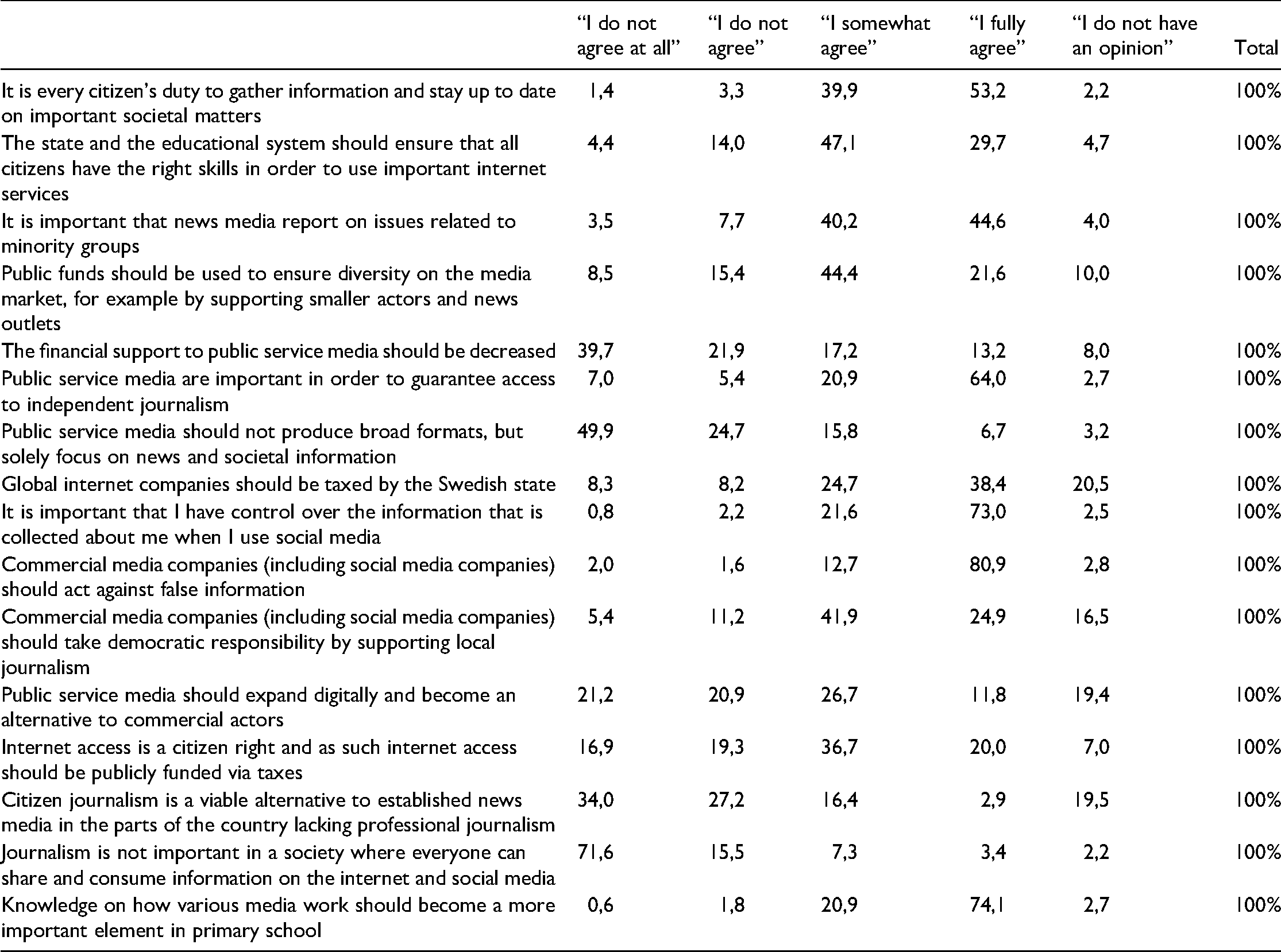
Turning to the first research question (to what extent are values, functions and institutions of the media welfare state supported in the adult Swedish citizenry?) Table 1 shows that respondents’ answers to the various questions tapping into the support for the media welfare state tend to affirm the values and institutions of the media welfare state. In many items a vast majority is in favor of the media welfare state. For instance, almost three quarters of the sample support the idea that public service media should produce broad formats such as entertainment and sports, and not only news and informational programming. Over 80 percent of respondents agree that it is important that journalism covers issues related to minority groups. 77 percent thinks that the state has responsibility to ensure digital literacy, and 57 percent contends that internet access is a citizen right, and that public funds should go into providing such access. The first hypothesis is thus supported.
Citizen support for the media welfare state (percentages).
Turning to the second research question (which attitudinal constellations in the support and non-support for the media welfare state can be identified?) a factor analysis was conducted with the 16 attitudinal questions that tap into various manifestation of supporting the media welfare state. Four factors with an eigenvalue above 1 (which together explain 51 percent of the variation in the items) were retained and thus interpreted (Table 2).
Factor analysis of the 16 items measuring support for the media welfare state.
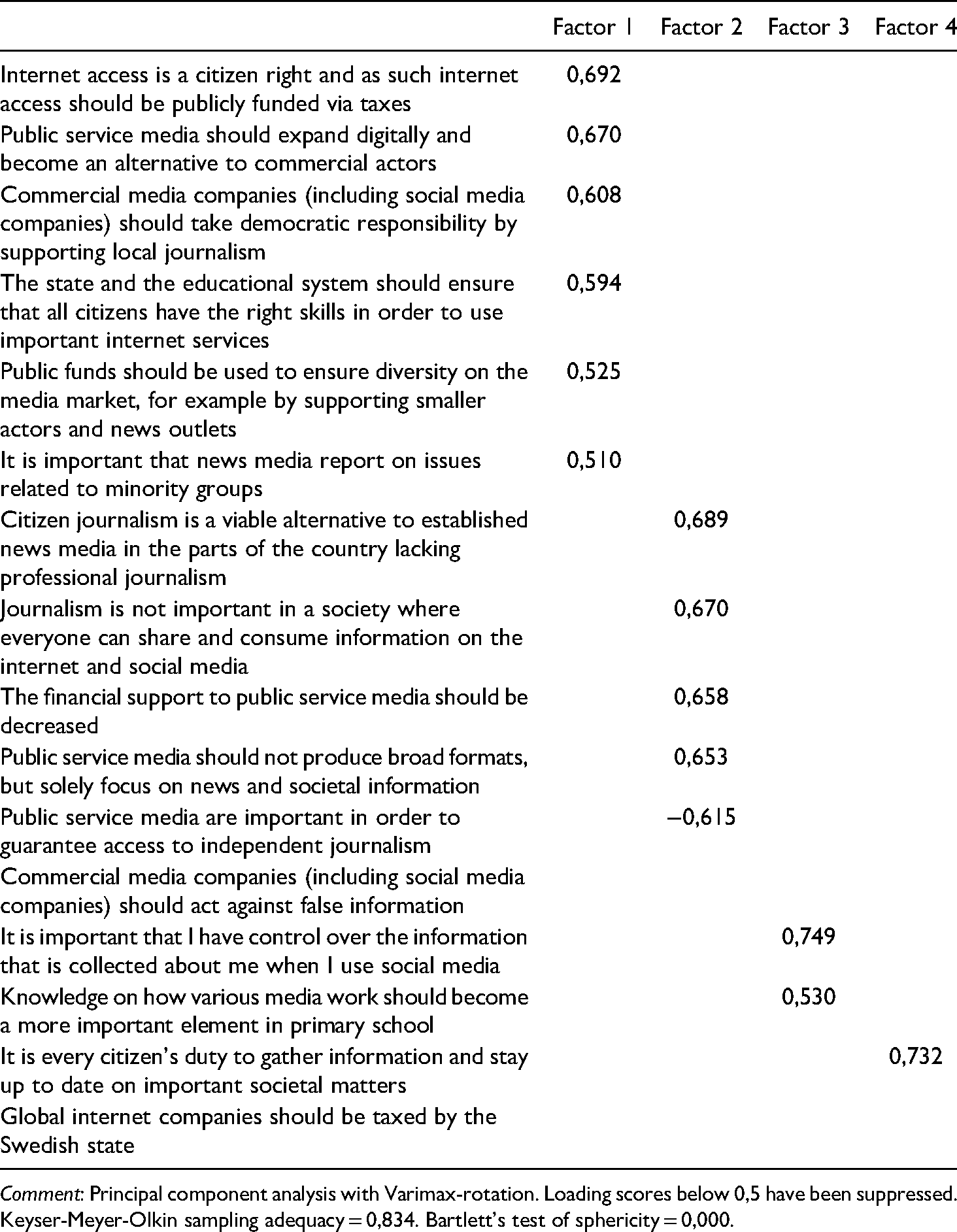
Comment: Principal component analysis with Varimax-rotation. Loading scores below 0,5 have been suppressed. Keyser-Meyer-Olkin sampling adequacy = 0,834. Bartlett's test of sphericity = 0,000.
Factor 1 explains 26 percent of the variance among the 16 items measuring attitudes towards the media welfare state. Six items contribute to this factor with a loading score above 0,5. These include the following statements: “internet access is a citizen right and should be publicly funded”, “public service media should expand in the digital realm”, “commercial media companies should take democratic responsibility (for instance by supporting local journalism)”, “the state and the educational system should ensure that all citizens have the skills required to use important internet services”, “there should be publicly funded initiatives to ensure media diversity”, and “it is important that journalism cover issues relating to minority groups”. Given the rather broad character of this factor we label it the media welfare state of mind dimension. A reliability analysis showed internal consistency among these six variables (Cronbach's Alpha = .739) and as such we collapsed the six items into one index. The mean value on this index (which can range from 1 to 4) was 2,96 which mirrors the rather strong support for the media welfare state uncovered in Table 1.
Factor 2 explains 11 percent of the variance among the variables, and it presents itself as a critical stance towards the media welfare state. Respondents scoring high on the items loading strongly into factor 2 are skeptical towards the value of both public service media and professional journalism. The anti-public service media sentiment manifests in the view that public service media are no guarantee of an independent journalism, the contention that public service media should be defunded, and not produce broad formats such as entertainment and sports. The public service skepticism is supplemented with the argument that professional journalism is no longer a key democratic institution, since citizen journalism and social media constitute viable alternatives in today's digital media landscape. The mean value of an index created from these variables is lower (M = 1,71 on a scale from 1 to 4) compared to the media welfare state of mind-index, which goes to say that the critical disposition towards the media welfare state is less common in the population.
Factor 3 describes a dimension centered around control and knowledge in the digital media landscape. This factor explains seven percent of the variation. Lastly, factor 4 explains an additional seven percent of the variation and constitutes a civic duty dimension, capturing the argument that every citizen should stay up to date with current affairs and important societal matters. While these factors are interesting in their own right, we are primarily concerned with the support for the media welfare state (RQ3). As such we proceed this section by analyzing the first factor.
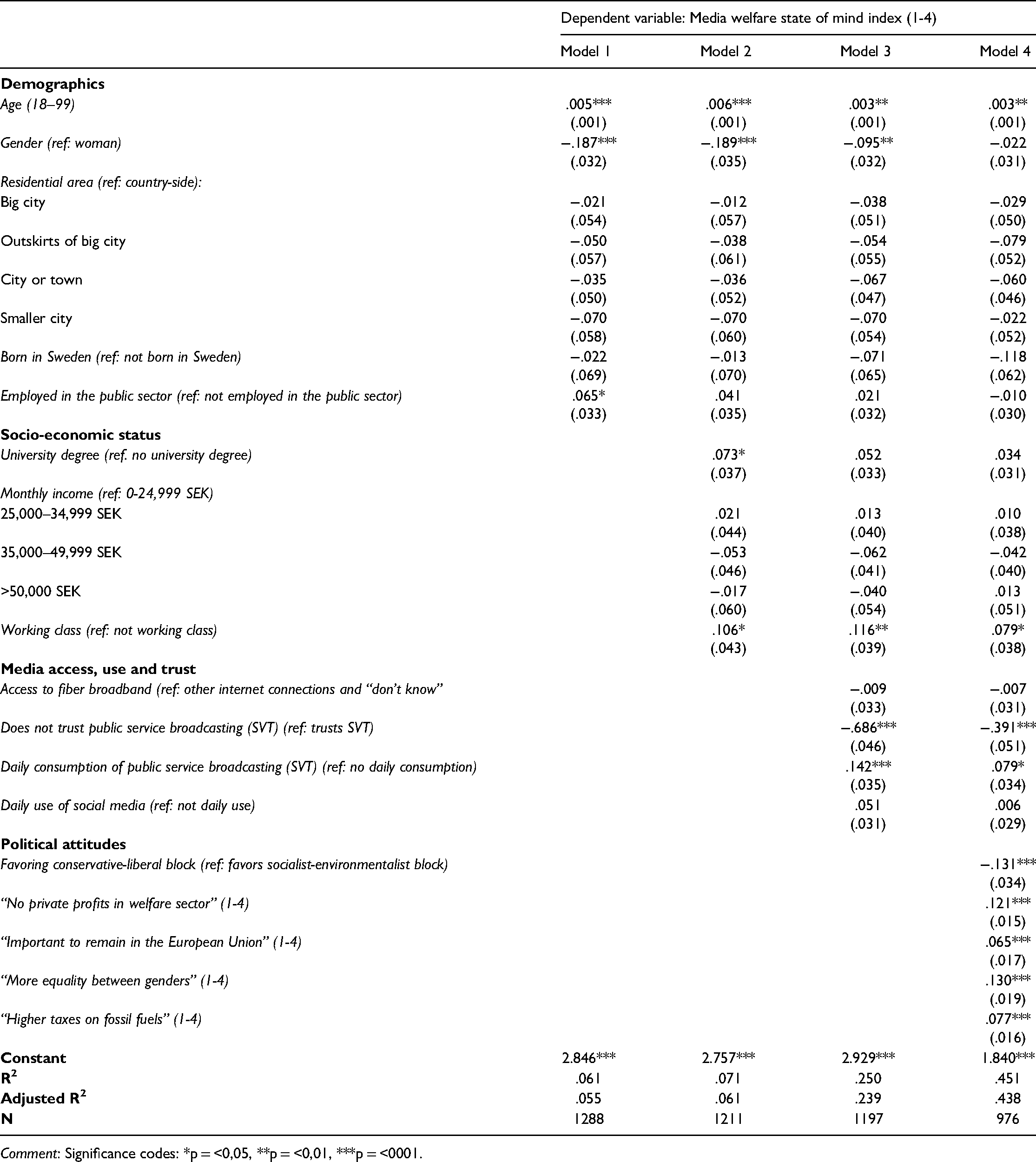
To answer research question three (what factors explain support for the media welfare state?) we used step-wise multiple regression analysis. This allowed us to study the influence of a range of independent variables in the four clusters (demographics, socio-economic status, media access, use and trust, and political attitudes) on the media welfare state of mind-dimension (as retained from Factor 1, Table 2). An ANOVA reveals that the regression model is statistically significant. The final model (Model 4) explains around 45 percent of the variation in the dependent variable. In what follows we put focus on the final regression model (Model 4 in Table 3).
Factors influencing “media welfare state of mind”. Regression analysis (OLS). B-coefficients (standard error in parenthesis).
Comment: Significance codes: *p = <0,05, **p = <0,01, ***p = <0001.
In terms of demographics, only age displays a statistically significant relation (b = 0.003, SE = 0.001, p = 0.05) to a general support for the media welfare state. As hypothesized, older people are (slightly) more supportive of the media welfare state. As for the variables measuring socio-economic status, only occupational class retains a statistically significant effect: the working-class is slightly more in favor (b = 0.079, SE = 0.038, p = 0.036) of the media welfare state (Jaeger, 2006; Svallfors, 1989; 2011). In the other two clusters of independent variables–media access, use and trust, as well as political attitudes–we find stronger explanatory value. While access to media infrastructure (fiber broadband) and social media usage do not display significant relationships with the media welfare state of mind, daily use of public service media (b = 0.079, SE = 0.034, p = 0.000), and trusting public service media (b = −0.391, SE = 0.051, p = 0.000) do. Daily users and “high trusters” of public service media support the media welfare state to larger extent than those who do not use public service media on a daily basis, and who do not trust this societal institution.
All items measuring political attitudes explain support for the media welfare state. Adding this cluster of independent variables boosts the explained variation in the model with around 20 percentage points (adjusted R2 = 0438), indicating that political divisions are key to understanding variations in peoples’ attitudes towards the media welfare state (Edlund and Johansson Sevä, 2013; van Oorschot, 2010). People who favor conservative (including the far right-wing party Sweden Democrats) and/or liberal parties are significantly less positive to the values, functions and institutions of the media welfare state (b = −0.131, SE = 0.034, p = 0.000). This left-wing vs. right-wing discrepancy is further supported by the fact that those who are critical towards private profits in the welfare sector (e.g. schooling and health care) are more likely to support the media welfare state (b = 0.121, SE = 0.015, p = 0.000). The media welfare state of mind is also related to other differences in political attitudes, including social and cultural values, that are often understood as a conflict between GAL and TAN-values (Hooghe et al., 2002). The items measuring GAL-orientations (favoring higher taxes on fossil fuels [b = 0.077, SE = 0.016, p = 0.000], EU-membership [b = 0.064, SE = 0.017, p = 0.000], and more equality between the genders [b = −0.130, SE = 0.019, p = 0.000]) are all statistically significant. The GAL-orientation thus correlates with support for the media welfare state (see Garritzmann et al., 2018).
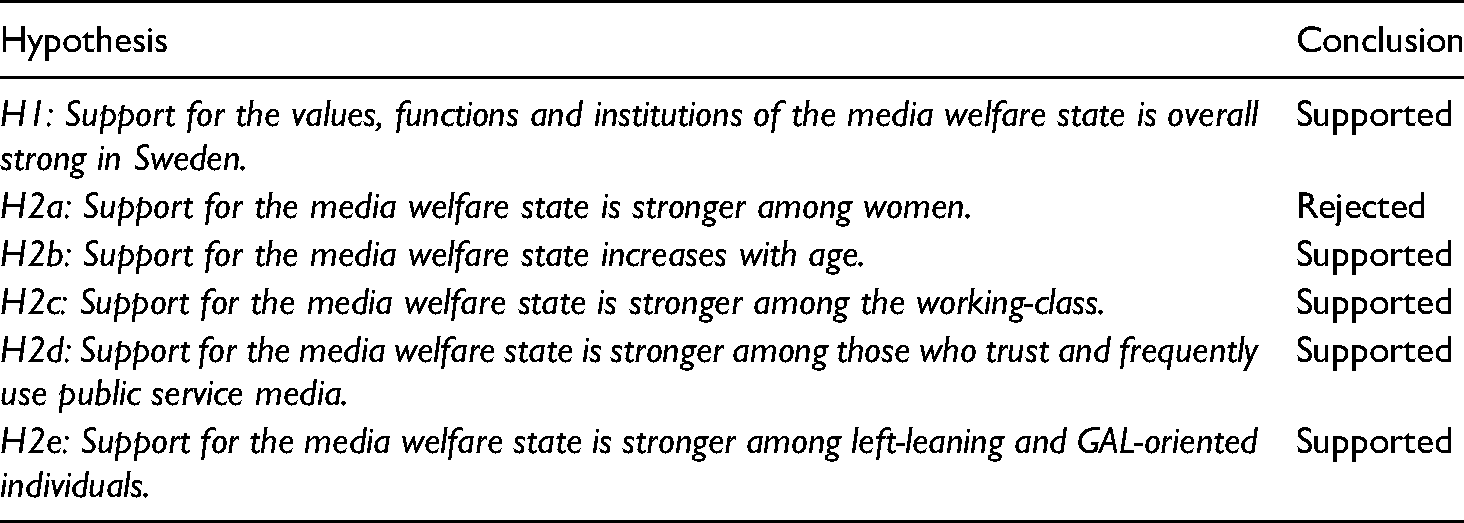
Taken together, the support for the media welfare state is, ceteris paribus, slightly higher among older citizens and in the working-class. This media system is, furthermore, held in higher regard by those who trust and frequently consume the contents produced by the institutions central to the media welfare state: public service media. However, the main factors that engender a supportive stance are political attitudes: people preferring the Left Party, the Social Democratic Party or the Green Party, and those oriented toward the GAL-pole in contemporary political disputes, tend to be more in favor of the media welfare state than the political right and people drawn toward the TAN-pole. Table 4 summarizes the conclusions in relation to the hypotheses.
Hypotheses and conclusions.
Conclusions and discussion
This study has approached the media welfare state “from below”, by asking about the extent to which the values, functions and institutions of the media welfare state (Syvertsen et al., 2014) are supported by the adult Swedish citizenry. We furthermore asked about the dimensionality of this support, and finally about the factors that predict the media welfare state of mind.
Results show that the media welfare state finds support among the Swedish citizenry (RQ1). This is interesting in light of the transformations and retrenchment of the media welfare state in Sweden and the Nordic region (Ala-Fossi, 2020; Jakobsson et al., 2021). While studies on the Nordic media market and media policy show the media welfare state transitions in liberal (Nord, 2008; Ohlsson, 2015) or neoliberal (Jakobsson et al., 2021) directions, the citizenry generally remains positive towards welfare-oriented media politics. This support manifests also in a factor analysis of the attitudinal constellations connected to the values, functions and institutions of the media welfare state (RQ2). The strongest dimension turned out to describe a general media welfare state of mind. In addition, we identified, in the second factor, a critical stance toward the media welfare state. This disposition presents itself as combination of a critique of public service media and what one might call a libertarian approach to the digital media landscape wherein the journalistic institution is viewed as obsolete in the face of the internet and social media.
The critical attitudinal constellation is less common in the Swedish population. Still, this attitude has become more and more pronounced among the Swedish political class during the last years, and especially among the center and right-wing parties. Representatives from the Moderate Party (the largest conservative party in Sweden), the Christian Democratic Party, and the Sweden Democrats (a far right-wing party) have only during the last five years demanded defunding of the public service media organizations, a narrower public service mission, personal penalties for individual journalists (Reporters without borders, 2020) and abolishing the press subsidy system altogether (Swedish Parliament, 2015). Shifts in media policy has mainly happened without such bold political rhetoric and without much political debate. As shown by Moe (2012) it is not unusual that important media policy changes are performed in “silence”, carried out by civil servants and bureaucrats in cooperation with trade and industry. Such changes to the rules are generally described as apolitical or merely pragmatic shifts to meet a changing reality. As Moe points out, however, these regulatory shifts have major consequences for the overall focus of policy objectives. Importantly, these changes tend to follow a pattern of neoliberalization, or what Moe calls “the implicit” within media policy (ibid).
During the last three to four decades, several of the institutions of the media welfare state have been challenged by political developments (Holtz-Bacha, 2021; Jakobsson et al., 2021). Thus, the media welfare state, which is celebrated internationally by media scholars (Benson et al., 2017) and supported locally by voters, is increasingly an “image in the rearview mirror” (Ala-Fossi, 2020: 146). Since the media welfare state is widely supported by the electorate it seems that it has been a wise political strategy to attack the media welfare state in “stealth mode”. In the 1980s the media policy debate was rather lively, as Swedish Enterprise and right-wing parties pushed for a de-regulation of radio and television (Jakobsson et al., 2021), but since then a public discussion on media policy has been rather absent. Instead, as argued by Des Freedman (2008), media policy has been handled as “technical issues” or purely bureaucratic issues that lack ideological differences and conflict. Media policy shift has silently and slowly moved with the tide of times towards a more market-oriented media policy regime, in which the media welfare state, its mechanisms and institutions have gradually been transformed. That both cultural policy and media policy are low-status issues within politics may play a role here; other areas of politics are more prestigious (with vastly larger budgets and larger ministries) and get more public attention. There are signs however that the “stealth mode” of media policy is coming to an end. The growth of the radical right and their fierce attacks on public service media (Holtz-Bacha, 2021), which have changed the stance on public service among the traditional right-wing parties (being increasingly critical), have moved issues of media policy into the eye of the public. Our data suggests, however, that while they are generally less positive, even citizens who favor the conservative parties are, on average, supportive of the media welfare state. This implies the existence of a gap between politicians and the public in terms of the future direction of Swedish media policy, and that conservative representatives and populists are far more radical in their critique of the media welfare state than their voters. This suggests that questions of media policy might become politically charged issues that might sway voters in other directions, once media policy leaves the shadows. The support of the media welfare state within the electorate can possibly create a backlash for parties that want to radically restructure media policy in a direction away from the media welfare state.
Finally, we studied the factors that predict the media welfare state of mind (RQ3). In line with previous research on welfare attitudes (Svallfors, 1989; 2011; Svallfors et al., 2012) we find both age and working-class affiliation to be positively correlated with the media welfare state of mind. If it is true that the notion of media welfare state first and foremost describes a media system of the past (Ala-Fossi, 2020) one could make sense of the fact that older generations are more supportive of it through the lens of “media generations” (Bolin, 2016). Older generations have grown up during the social democratic hegemony (the Swedish governments between 1936 and 1976 were Social Democratic) under which the media welfare state was formed. Thus, it might be reductionist to state that support for welfare-oriented media politics “increases with age” (supported H2b). Rather, the media welfare state might be found close at hand – a taken-for-granted way in which media politics should operate – for the generation (which is relatively old today) that grew up under this media policy regime. This suggests that the far-reaching public support for the media welfare state identified in the present cannot be taken for granted as the media welfare state is likely to be increasingly far off in the rearview mirror for future generations.
Welfare policy tends to find more support in the working-class, and a broadly conceived welfare state optimism in the working-class seems, to some extent at least, to accommodate progressive media policy. However, the relationship between class and the media welfare state of mind is rather weak, which aligns with findings suggesting that class-discrepancies in welfare opinion are waning (Svallfors, 2011). On the one hand, this might reflect the fact that class is becoming a weaker predictor for welfare-opinions more generally, and that the working class is more fragmented in their welfare-opinions than what used to be the case. This also corresponds to findings that the class-consciousness and self-understanding of the working class of itself as a political agent for social change has been weakened since the 1980s (Oskarson et al., 2010) and that the political organization of the working class (in specific political parties and unions) is lower than in previous periods. On the other hand, the weak relationship between class and media welfare state opinions might also have to do with the fact that the “cultural welfare” provided by the media welfare state also aligns with and enrichens the cultural interests of (at least part of) the middle- and upper-class. As we have shown in previous studies, public service media tends to have a “middle-class gaze” on the world (Jakobsson and Stiernstedt, 2018; Stiernstedt and Jakobsson, 2017), and people working in (public service) television production tends to share a similar class-background in the cultural middle-class (Lindell et al., 2020), which might increase its support among these groups.
In regards to the hypothesized gender difference, we fail to find support for the notion that women would support the media welfare state to a higher extent than men. However, results align with previous literature on media trust (Andersson, 2020) and studies that link positive experiences of welfare provision to support for the welfare state (Kumlin, 2002). We find positive correlations between daily usage and high trust of public service media and the media welfare state of mind. This is not very surprising and an oft-repeated finding in the trust literature. Whether it is use that begets trust or vice versa is an open question, but arguably the causal link goes in both directions. It is, however, political attitudes that are the most important predictors. In line with previous research on welfare opinion (Garritzmann et al., 2018; Jaeger, 2006; van Oorschot, 2010) we established that left-leaning and GAL-oriented individuals are significantly more in favor of the media welfare state compared to right-leaning and TAN-oriented individuals. The cluster of political attitude-variables almost doubled the explained variance in the regression model (Table 3), suggesting that the media welfare state of mind is embedded in contemporary ideological conflicts (as discussed by e.g. Edlund and Johansson Sevä, 2013; Holtz-Bacha, 2021; Hooghe et al., 2002).
Ways forward
The future of a distinct Nordic media policy hinges, in part, upon popular support for a strong public service media, democratic responsibility of private actors in the media market, press subsidies, public funding of communication infrastructures and media literacy initiatives. In the Swedish citizenry, this media political ideology is widely supported. Future comparative research is needed to establish if popular support for the media welfare state cuts across the Nordic region and applies to the media systemic level (i.e. the Nordic media system). At the more general level, we call for more research on the correspondence (or lack thereof) between the media policy being implemented and citizens’ opinions, aspirations and needs–across countries and media systems. Studying media policy support “from below”, as done here, seems increasingly pressing when the egalitarian and universal ethos of media politics is challenged globally (Fenton et al., 2020; Pickard, 2020). Another question for future research concerns what will happen to the citizen support for media welfare measures once media policy questions have been pushed into the open. Will right-wing parties that openly seek to dismantle media welfare provisions meet increasing opposition, or are media policy issues of relatively little importance in the eye of the public? Media researchers concerned with the media welfare state might also need to think about how the public support for media welfare can be won in the long-run and if there is political potential in calling for a defense of the media welfare state.
Footnotes
Declaration of Conflicting Interests
The author(s) declared no potential conflicts of interest with respect to the research, authorship, and/or publication of this article.
Funding
The author(s) disclosed receipt of the following financial support for the research, authorship, and/or publication of this article: This work was supported by the The Ander Foundation for Media Research
