




Abstract
The smartphone has become an integral part of adolescents’ daily life. Despite the countless affordances of smartphones, concerns have been raised about their enormous potential to cause failures in self-regulation, such as distraction and task delay. The current study investigated whether two smartphone usage patterns, fragmented and sticky smartphone use, are associated with distraction and task delay. For three weeks, we logged the smartphone usage of 160 adolescents (733,359 observations) and assessed their distraction and task delay six times a day with experience sampling (12,723 observations). Using Dynamic Structural Equation Modeling, we found that, overall, adolescents felt more distracted when their smartphone use was more fragmented or sticky. Exploratory analyses indicated that 77% of adolescents experienced increased distraction (i.e., β > .05) when their smartphone use was more fragmented, and 55% when it was sticky. Overall, adolescents did not report more task delay as their smartphone use was more fragmented or sticky. Nonetheless, 22% experienced increased task delay when their smartphone use was more fragmented, and 42% when it was sticky. Together, our findings underline the dynamic nature of smartphone use and its differential impact on self-regulation outcomes.
Keywords
Introduction
The smartphone has become an integral part of adolescents’ daily life (Rideout et al., 2022). Practically all adolescents now possess a smartphone and half of them are on their smartphones almost constantly (Vogels et al., 2022). While the smartphone affords adolescents to socially connect, be entertained, and seek information at their disposal (Wang et al., 2016; Whiting & Williams, 2013), concerns have been raised about its enormous distraction potential. For example, studies have shown that smartphones may cause shifts in attention away from important activities such as academic tasks (Levine et al., 2007; McCoy, 2016), social conversations (Chotpitayasunondh & Douglas, 2016), and sleep (Murnane et al., 2016). In addition, smartphones can be seen as tools for procrastination that facilitate immediate gratification to optimize mood by delaying boring yet important tasks (Aalbers et al., 2022; Reinecke et al., 2018).
Since most adolescents spend hours and hours on their smartphone and check their smartphone frequently (Beierle et al., 2020; Meier et al., 2023), it is important to understand how exactly smartphone use is associated with both distraction and task delay, which are considered two prototypical types of self-regulation failure (Baumeister & Heatherton, 2009; Diehl et al., 2006; Steel, 2007). Overall, the literature shows that distraction and task delay increase when smartphone use increases (e.g., Aalbers et al., 2022; Schnauber-Stockmann et al., 2018; Stothart et al., 2015). For example, Dwyer et al. (2018) showed that increased smartphone use made participants feel more distracted during social interactions, and Meier et al. (2023) found that adolescents experienced more task delay when they checked their smartphones more frequently.
Despite these promising insights, the literature is characterized by an important gap. Specifically, self-regulation failures such as distraction and task delay are often investigated in light of either the duration or frequency of smartphone usage (e.g., David et al., 2015; Soror et al., 2015). However, the duration and frequency of smartphone use in themselves may not cause distraction and task delay, but specific smartphone usage patterns may be crucial instead. For instance, it may well be that distraction is predominantly experienced when smartphone use is highly fragmented, that is, when smartphone interactions occur frequently and scattered across time. Conversely, task delay may predominantly be experienced when smartphone use is sticky, that is, when users dwell on their smartphone for a longer time without interruptions (Brinberg et al., 2023). However, an investigation and comparison of the effects of different smartphone usage patterns on distraction and task delay are still lacking in the current literature. Therefore, our study aims to fill this gap by investigating the within-person associations of two different smartphone usage patterns, fragmented and sticky smartphone use, with two types of self-regulation failure, distraction and task delay.
Most studies to date have relied on self-report measures to assess smartphone use, which may be too crude to capture specific smartphone usage patterns such as fragmentation and stickiness. Besides, self-report measures of smartphone use are subject to recall and social desirability bias (de Reuver & Bouwman, 2015; Griffioen et al., 2020; Parry et al., 2021). Newer sampling methods such as smartphone logging have been developed that can measure actual smartphone usage patterns (Aalbers et al., 2022; Andrews et al., 2015). Hence, we assessed adolescents’ smartphone usage patterns by logging their smartphone usage for three weeks and investigated whether and to what extent these usage patterns resulted in distraction and task delay, which we measured through experience sampling (ESM).
Fragmented smartphone use
Fragmented smartphone use is a smartphone usage pattern that has often been mentioned in previous research (e.g., Deng et al., 2019; Mark et al., 2005; Oulasvirta et al., 2005; Yeykelis et al., 2018), but that has rarely been investigated empirically. Consequently, this phenomenon lacks a uniform interpretation. For instance, one line of research has used frequency of use as a proxy of fragmentation, assuming that increases in the frequency of smartphone use represent increases in fragmentation (Zhu et al., 2018). Other studies considered the (average) time of smartphone use as a measure of fragmentation (Brinberg et al., 2023; Tossell et al., 2015). For example, Tossell et al. (2015) perceived a shorter duration of smartphone use as more fragmented. And yet other studies looked at the time in-between closing and opening the smartphone as an indicator of fragmentation, to measure how quickly users switch back and forth between using and not using the smartphone (Aalbers et al., 2022; Peng & Zhu, 2020).
While these studies have captured important aspects of fragmented smartphone use, they all focus on one dimension of smartphone use—either the frequency, duration, or time in between switches. However, fragmentation is a multi-dimensional construct that depends on the frequency of a behavior and how scattered it is across time (Hubers et al., 2008). Specifically, smartphone use is more fragmented when it occurs more frequently and more scattered across time. For instance, when people use the smartphone 10 times in one hour, their smartphone use is more fragmented as compared to when they use it five times in one hour. Likewise, when people use the smartphone five times every 12 min for one hour, their use is more fragmented than when they use the smartphone five times within only the first 10 min of that hour. Therefore, we will operationalize fragmented smartphone use as the frequency of smartphone use and its dispersion across time.
Sticky smartphone use
Sticky smartphone use reflects the endless dwelling on the smartphone without interruptions. Sticky media use has largely been studied in the realm of online consumer behavior. In the consumer context, stickiness refers to the ability to attract and sustain the attention of customers to a commercial website (Zott et al., 2000), which is crucial for selling products and stimulating advertisement views (Hsu & Tang, 2020). Other research has investigated stickiness in the use of various online media, such as games (Montag et al., 2019), blogs (Lu & Lee, 2010), and social media (Chiang & Hsiao, 2015; Lin, 2022). For instance, Chiang and Hsiao (2015) investigated determinants of sticky YouTube use and found that users who shared more videos stuck around longer on YouTube.
Studies have shown that sticky media are entertaining (Brinberg et al., 2023), interactive (Furner et al., 2014; Nandi et al., 2021), and engaging (Zhang et al., 2017), and may elicit a state of flow in their users (Hoffman & Novak, 1996; Montag et al., 2019). This state of flow is characterized by absolute concentration and full absorption in the medium and causes a distorted perception of time (Hoffman & Novak, 1996; Roberts & David, 2023). In fact, when users have entered a flow state, they may concentrate on the medium in a way that is “so intense that there is little attention left to consider anything else” (Hoffman & Novak, 1996, p. 58). Recently, Brinberg et al. (2023) designated this phenomenon screenertia, a derivative of attentional inertia (Richards & Anderson, 2004). Screenertia describes the fact that the longer individuals pay attention to the screen, the less likely they become to withdraw their attention from that screen, which is reflected by log-normally distributed look durations. Likewise, sticky smartphone use can be described as the endless dwelling on the smartphone (Brinberg et al., 2023). Therefore, we will operationalize sticky smartphone use as the amount of time users dwell on their smartphones without interruptions.
Smartphone usage patterns and distraction
Distraction is the deployment of attention towards stimuli that are irrelevant for goal-directed behavior, and therefore represents a perceptual self-regulatory failure (Diamond, 2013). A large body of research underlines that the smartphone holds great distracting potential, for instance in classrooms (e.g., David et al., 2015; Levine et al., 2007), in traffic (e.g., Stavrinos et al., 2018), and during social conversations (e.g., Chotpitayasunondh & Douglas, 2016). Different smartphone usage patterns, such as fragmented and sticky use, may appeal to different attentional mechanisms (Liebherr et al., 2020), and consequently, cause distraction for different reasons.
Fragmented smartphone use may cause distraction because it leads to attentional switching. When smartphone use is fragmented, users continuously switch attention between the smartphone and offline activities (see Liebherr et al., 2020). Each switch in attention is accompanied by a cognitive cost, as it takes time and effort to reconfigure attention to the task at hand (Mark et al., 2005; Verschooren et al., 2019). Attentional switches due to fragmented smartphone use are likely caused by incoming notifications or as a result of checking habits (Kushlev & Leitao, 2020; Oulasvirta et al., 2012). Numerous studies have shown that interfering notifications from smartphones cause serious impairments in one's ability to focus attention (e.g., Graben et al., 2022; Kushlev et al., 2016; Stothart et al., 2015). Besides, research has shown that checking habits are the main drivers of smartphone distractions (Heitmayer & Lahlou, 2021; Oulasvirta et al., 2012), and that they make it difficult for people to control their phone use (Du et al., 2020). Therefore, we hypothesize:
Sticky smartphone use may cause distraction as a result of selective attention to the smartphone (Liebherr et al., 2020). Selective attention is a form of inhibitory control that allows people to focus their attention on stimuli that are important or salient and ignore irrelevant stimuli (Diamond, 2013). Specifically, sticky smartphone use is characterized by full absorption into the smartphone while completely disregarding other tasks. Users are then completely drawn into their smartphones, causing a state of flow (Hoffman & Novak, 1996; Montag et al., 2019) or absent-mindedness (Marty-Dugas et al., 2018). Research has shown that users become predominantly distracted when using the smartphone in a more absent-minded fashion, for instance, for longer than initially planned or without a clear goal (Marty-Dugas et al., 2018). At these moments, users may lose their focus on the tasks at hand. Therefore, we hypothesize:
Even though both fragmented and sticky use may cause distraction, we expect the effect of fragmented use on distraction to be stronger. In today's permanently connected world (Ling & Lai, 2016), the fragmented nature of incoming notifications and checking behaviors draws the attention of users almost constantly. This leads to costly attentional switches between the tasks at hand (e.g., homework), the smartphone, and back (Jeong et al., 2020; Mark et al., 2005; Yeykelis et al., 2018). The scatteredness of smartphone sessions and the additional cognitive costs that come with frequent attentional switching may make fragmented smartphone use almost continuously distractive throughout the day. Conversely, sticky smartphone use may be perceived as less distractive than fragmented use as it is more contiguous, thereby causing fewer interruptions in adolescents’ attention. Existing research has indeed shown that people felt less distracted when smartphone interruptions lasted longer (Yuan et al., 2017). Thus, we hypothesize:
Smartphone usage patterns and task delay
Task delay can be interpreted as the act of postponing an intended course of action, which is closely linked to and a strong predictor of procrastination (Steel, 2007). This failure to comply with planned behavior could be seen as a behavioral self-regulation failure (Meier et al., 2016). Smartphones allow users to escape from aversive tasks and gain joyful experiences from entertaining content (Sirois & Pychyl, 2013). However, the delay of intended tasks can manifest for different reasons, depending on how the user engages with the smartphone.
Fragmented smartphone use may cause task delay due to interruptive attentional switches between the smartphone and the task at hand. Such interruptions are often initially triggered by notifications or checking habits (Heitmayer & Lahlou, 2021; Oulasvirta et al., 2012), and may subsequently develop into longer withdrawals from the task as smartphone content may call for further action (e.g., changing the schedule, searching for information, or starting a conversation). Experimental research showed that frequent interruptions due to notifications impair people's focus on their intended tasks, particularly among adolescents (Whiting & Murdock, 2021). Subsequently, this fragmentation of task-related activity may delay task completion. Recently, support was found for this assumption, showing that fragmented smartphone use causes intended tasks to be delayed (Aalbers et al., 2022). Therefore, we hypothesize:
Sticky smartphone use may also cause delays of intended tasks due to task displacement. The displacement theory (Neuman, 1988) argues that media consumption replaces other activities (Kushlev & Leitao, 2020). Although smartphone multitasking is common, one cannot pay attention to other tasks, such as completing homework, when being fully absorbed into the smartphone. Consequently, when adolescents stick to their smartphones, they cannot complete the task at hand. Moreover, central bottleneck theories and cognitive resource theories (e.g., Lang, 2000; Pashler, 1994) argue that people can only handle one task at a time. Hence, when two activities draw one's attention simultaneously, such as homework and the smartphone, activities will have to be processed serially and one of the two activities will be impaired or delayed. Besides, empirical research has shown that it is often tempting to delay (aversive) tasks when media are at hand (Reinecke & Hofmann, 2016). Specifically, the joy that people obtain from sticky smartphone use may make them even more immersed in the content (Brinberg et al., 2023; Yang & Lin, 2014), resulting in further delay of intended tasks. Therefore, we hypothesize:
Although theories and existing research suggest that both fragmented and sticky smartphone use may cause task delay, we expect the association to be stronger for sticky use. Specifically, with fragmented smartphone use, attention is switched back and forth between the smartphone and the task at hand, allowing users to focus on tasks at least partly. Indeed, prior studies found that fragmented smartphone use predicted procrastination only weakly (i.e., β = .017; Aalbers et al., 2022). On the contrary, the uninterrupted nature of sticky smartphone use may replace or delay the intended task entirely, since attention can only be focused on one task at a time (Neuman, 1988). Therefore, we hypothesize:
Method
The current preregistered study (https://osf.io/sgmj7) is part of a larger preregistered project (https://osf.io/327cx) that investigates the effects of adolescents’ social media use on their psychosocial functioning. It uses data from a three-week data collection wave in which ESM data were collected in combination with smartphone logging data, in June 2020. The procedure of this study was approved by the Ethics Review Board of the authors’ university.
Participants
Participants were recruited at a large secondary school in the south of the Netherlands. A total of 312 participants participated in the three-week study. About half of them (i.e., 152 participants) did not possess an Android smartphone, which was required for logging their app usage data. Hence, the final sample consisted of 160 adolescents. The average age of the participants in our sample was 14.60 (SD = 0.68; range = 13–16) and 47% were girls. For more details about the sample, see Open Science Framework (OSF; https://osf.io/2yjqp).
Procedure
The ESM data were collected through the Ethica app, which participants installed on their smartphones. To log their app usage, participants were asked to install the Ethica App Usage Stream app on their smartphones.
ESM data
Six ESM surveys were distributed every day for 21 days (i.e., 126 in total) at random time points within fixed time intervals (see https://osf.io/b8vsa for the ESM survey trigger scheme). It took about two minutes to complete the surveys. A reminder was sent after 10 min if a survey was not yet completed. The number of items in the ESM surveys ranged between 19 and 32, depending on the time the surveys were sent. The ESM surveys contained items about distraction, task delay, social media use, and a series of psychosocial variables.
Out of 20,160 ESM surveys that were sent (6 per day × 21 days × 160 participants), 12,723 ESM surveys were (partially) completed. The compliance was 63% and every participant completed on average 79.52 surveys (SD = 34.73). Participants received 30 euro cents per completed ESM survey. Every day, participants who completed all six ESM surveys were automatically nominated to participate in a lottery on the next day, in which four participants could win 25 euros. Participants could monitor their compliance and earnings via an interactive real-time website built in R Shiny (Chang et al., 2020).
App usage data
The Ethica App Usage Stream app logged participants’ smartphone app usage continuously. App use was assessed as the foreground time of an app, that is, the time during which an app was active on a participant's screen while the screen was turned on. Hence, if an app was running in the background or while the screen was turned off, this was not recorded. Although multiple apps can run in the foreground simultaneously via split screen mode, adolescents never used this possibility. A total of 733,359 app activities were logged, of which 21,565 (2.9%) represented Ethica app activities. To link participants’ app activities to the measures of distraction and task delay, we merged the app usage data with the ESM data. Specifically, each ESM survey was linked to the timestamped app activities that were logged within one hour before the ESM survey was opened (i.e., the time frame of the ESM questions). Out of all app usage activities, 198,884 app activities (27%) occurred within an hour before an ESM survey was sent and were used in our analyses.
Measures
Smartphone usage patterns
Participants’ smartphone usage patterns were derived from the logged app usage data. To assess fragmented and sticky smartphone use, we took smartphone sessions as a unit of analysis. A smartphone session starts when the user's smartphone screen is turned on and ends when it is turned off (Van Berkel et al., 2016). During one session, users can use one app (i.e., solo-app session) or multiple apps (i.e., multi-app session; Peng & Zhu, 2020). When the screen is turned off and on in quick succession, this is interpreted as one smartphone session. The maximal timeout period that marks the end of a smartphone session is called a session “threshold” (Van Berkel et al., 2016, p. 4711). We set the session threshold to 30 s, as this has been most often used in previous research (Beierle et al., 2020; Böhmer et al., 2011; Carrascal & Church, 2015). This procedure resulted in 51,556 smartphone sessions.
Fragmented smartphone use
Fragmented smartphone use was calculated based on the number of smartphone sessions and their temporal dispersion, as suggested by Hubers et al. (2008). Temporal dispersion was calculated as the ratio between the total session duration and the measurement duration. The total session duration is the time in between the start of the first session and the end of the final session, in minutes. The measurement duration was set at 60 min, as this is the duration over which distraction and task delay were measured in the ESM surveys. If the number of sessions during the past hour was less than two, the fragmentation score was set to 0, as fragmentation only occurs if multiple sessions take place. Theoretically, the highest possible fragmented smartphone use score was 120, given the 60-minute measurement duration and the 30-second session threshold. Fragmented smartphone use was calculated as follows:

Sticky smartphone use
Sticky smartphone use was calculated as the natural logarithm of the duration of the longest session of the measurement period (i.e., the past hour). The longest session was chosen because stickiness is described as the act of dwelling on the smartphone without interruptions, and, by definition, the longest smartphone session implies the most dwelling without interruptions. The natural logarithm was used because media stickiness follows a log-normal distribution, implying that the probability to stick to media increases over time (Brinberg et al., 2023). Phrased differently, increases in longer sessions (e.g., 50-minute → 55-minute session) are relatively less substantial than equal increases in short sessions (e.g., 1-minute → 6-minute session). To illustrate, sticky smartphone use scores of, for example, 0, 1, 2, 3, and 4 represent session durations of 1, 2.7, 7.4, 20.1, and 54.6 min, respectively. The scores were calculated via the log transformation and ranged from −4.09 (i.e., 1 s) to 4.09 (i.e., 60 min):

Distraction and task delay
Distraction was measured in the ESM surveys with the item “To what extent were you distracted by something over the past hour?.” This item has been used in previous research to measure distraction as a momentary failure of attentional control (Chin et al., 2021). Task delay was measured with the reversed item “To what extent have you done what you intended to do in the past hour?” Following prior ESM research (e.g., Aalbers et al., 2022), this measure was based on the widely used and well-validated General Procrastination Scale (Sirois et al., 2019). It captures the gap between behavioral intention and action, which is a core aspect of procrastination (Klingsieck, 2013; Steel, 2007). Participants responded to the distraction and task delay questions on a 7-point Likert scale ranging from 0 (not at all) to 6 (completely), with 3 (a little) as the midpoint. Higher scores for the distraction measure indicated more distraction. Task delay scores were reverse coded so that higher values indicated more task delay.
Statistical analysis
We followed our preregistration (https://osf.io/sgmj7/) to investigate our hypotheses. We examined the associations of fragmented and sticky smartphone use on distraction and task delay by means of Dynamic Structural Equation Modeling (DSEM) in Mplus version 8.8 (Muthén & Muthén, 2017). Before estimating the DSEM models, we checked the assumption of stationarity, by investigating whether the means of distraction and task delay did not systematically change over the course of the study (McNeish & Hamaker, 2020). We compared a two-level fixed effect model including the day of study as a predictor of distraction and task delay with an intercept-only model (i.e., one model with distraction and one model with task delay, but without predictors). The assumption was confirmed since the day of the study accounted for only 0.1% of the variance in both distraction and task delay. Similarly, the time of the day did not systematically influence distraction and task delay as it accounted for less than 2.5% of the variance in our study variables (see Appendix A). Hence, there was no need to detrend the data (McNeish & Hamaker, 2020; Wang & Maxwell, 2015).
We estimated four two-level autoregressive lag-1 models (AR[1] models) to analyze our hypothesized within-person associations (H1a–H1b; H2a–H2b). The outcomes of the models were distraction (in Models 1a, 1b) and task delay (in Models 2a, 2b), and the predictors were fragmented smartphone use (in Models 1a, 2a) and sticky smartphone use (in Models 1b, 2b). In all four models, repeated momentary assessments (ESM occasions; level 1) were nested within adolescents (level 2). Each model was split into two levels: within-person level and between-person level. At the within-person level, we specified the predictors as the time-varying covariates, together with the autoregressive effects of the outcomes (i.e., distraction predicted by lag-1 distraction, and task delay predicted by lag-1 task delay). The within-person associations relied on latent person-mean centered scores. At the between-person level, we included the latent mean levels of the outcomes and the predictors, and the correlations between these mean levels.
We conducted additional exploratory analyses to investigate the heterogeneity in the hypothesized within-person associations. The person-specific associations represent the within-person standardized estimates for each single participant (Schuurman et al., 2016). These analyses allowed us to investigate to how many adolescents each of the four hypothesized effects (H1a, H1b, H2a, and H2b) applied. In addition, using paired t-tests, we tested H1c by comparing the person-specific associations of fragmented smartphone use and distraction (Model 1a) with the person-specific associations of sticky smartphone use and distraction (Model 1b). Similarly, we tested H2c by comparing the person-specific associations of fragmented smartphone use and task delay (Model 2a) with the person-specific associations of sticky smartphone use and task delay (Model 2b).
For our analyses pertaining to fixed (average) within-person associations of smartphone use, we will use two preregistered inference criteria. First, we will report the Bayesian p-values and the 95% credible intervals (CIs) of the standardized effects. In addition, we consider an effect size of β = .05 as the smallest effect size of interest (SESOI; Lakens et al., 2018). Therefore, we will interpret within-person associations ranging from β = −.05 to β = +.05 as “non-existent to very small,” and all associations beyond this range as negative or positive. We will report the Bayesian CIs for the parameters of interest. For our exploratory person-specific analyses, we only rely on our preregistered SESOI, because person-specific associations are less powerful than fixed within-person effects (Lerner & Lerner, 2019; Valkenburg et al., in press).
Data availability
All materials of the current study, including the preregistration (https://osf.io/sgmj7/), the codebook (https://osf.io/tbk6u), and the syntaxes (https://osf.io/qezw3/), and all materials of the larger project (https://osf.io/327cx) can be found on the OSF. The anonymized dataset used in our analyses is publicly available on Figshare (Siebers et al., 2023).
Results
Descriptive statistics and correlations
The continuous app usage data showed that, in total, participants engaged in 733,359 app activities over a period of three weeks. A smartphone session lasted on average 6.9 min (SD = 31.8; median = 1.5) and included on average 4.2 app activities (SD = 8.4; median = 3). The duration of smartphone sessions followed a power-law distribution, meaning that most smartphone sessions lasted very short, while a few smartphone sessions lasted very long (see Figure 1—left histogram). Likewise, the number of apps used in one smartphone session also followed a power-law distribution (see Figure 1—right histogram), so that most sessions consisted of only one app (i.e., solo-app sessions) or a few apps, while a few sessions consisted of many apps (i.e., multi-app sessions). Table 1 shows the descriptive statistics and correlations of all study variables.
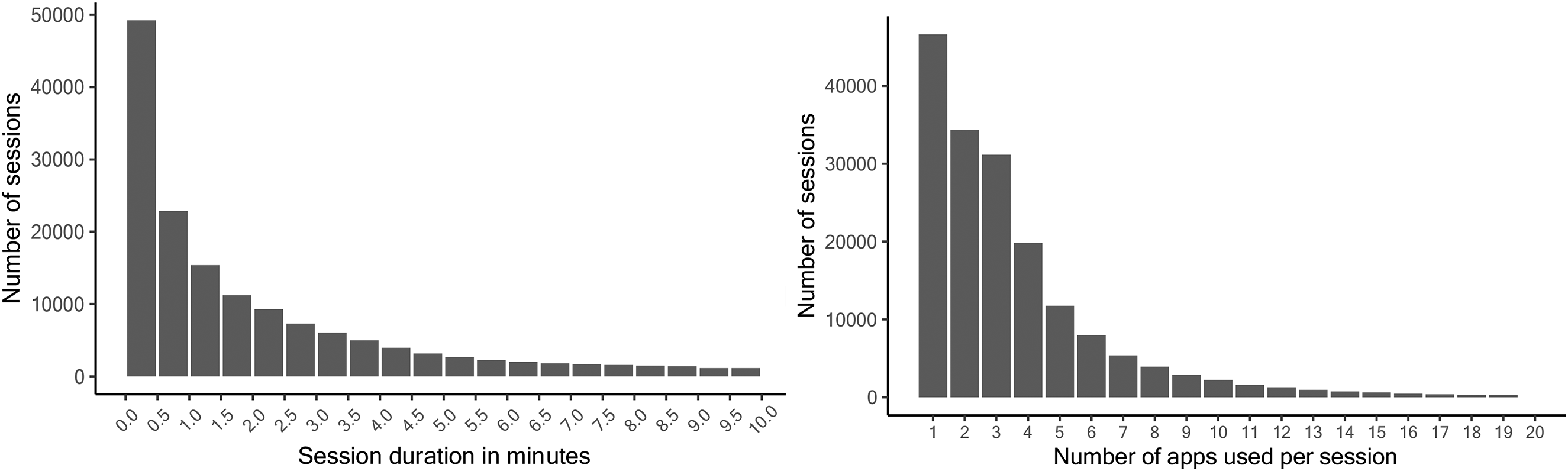
Power-law distributions of the session durations and number of apps used per smartphone session.
Descriptives and Correlations for All Study Variables.
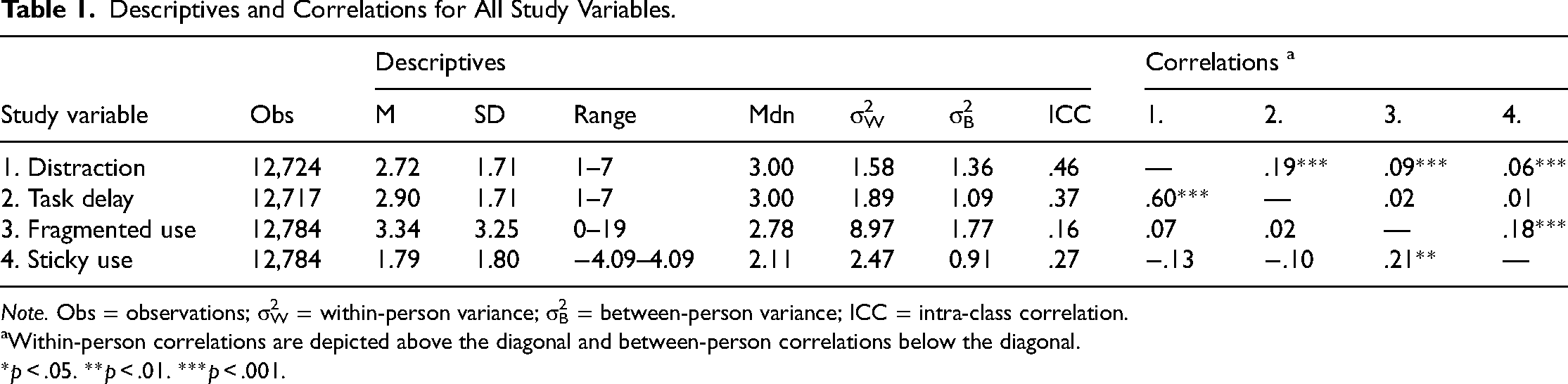
Note. Obs = observations; σ2W = within-person variance; σ2B = between-person variance; ICC = intra-class correlation.
Within-person correlations are depicted above the diagonal and between-person correlations below the diagonal.
*p < .05. **p < .01. ***p < .001.
DSEM analyses
The four DSEM models were estimated using Bayesian Markov Chain Monte Carlo estimation. The models converged well after 5,000 iterations, as the Potential Scale Reduction (PSR) values approached 1 (Model 1a = 1.001; Model 1b = 1.005; Model 2a = 1.005; Model 2b = 1.006). The PSR values were still close to 1 after doubling the number of iterations. Thus, the possibility of a premature stoppage problem (i.e., PSR values are close to 1 by chance) was excluded (Schultzberg & Muthén, 2018). The results corresponded to those of the 5,000-iteration models.
Smartphone usage patterns and distraction
Our first distraction hypothesis (H1a) predicted a positive within-person association of fragmented smartphone use with distraction. As shown in Table 2, this hypothesis was supported by the DSEM analyses (β = .10). On average, adolescents experienced more distraction during hours when their smartphone use was more fragmented. Our person-specific estimates showed that the hypothesized association applied to 77% of adolescents (based on SESOI of β = .05). For 1% of adolescents, fragmented smartphone use led to an opposite association, while for 23% the association was smaller than β = .05 and thus non-existent (see Figure 2). See Appendix B for an overview of the distribution of the person-specific associations.
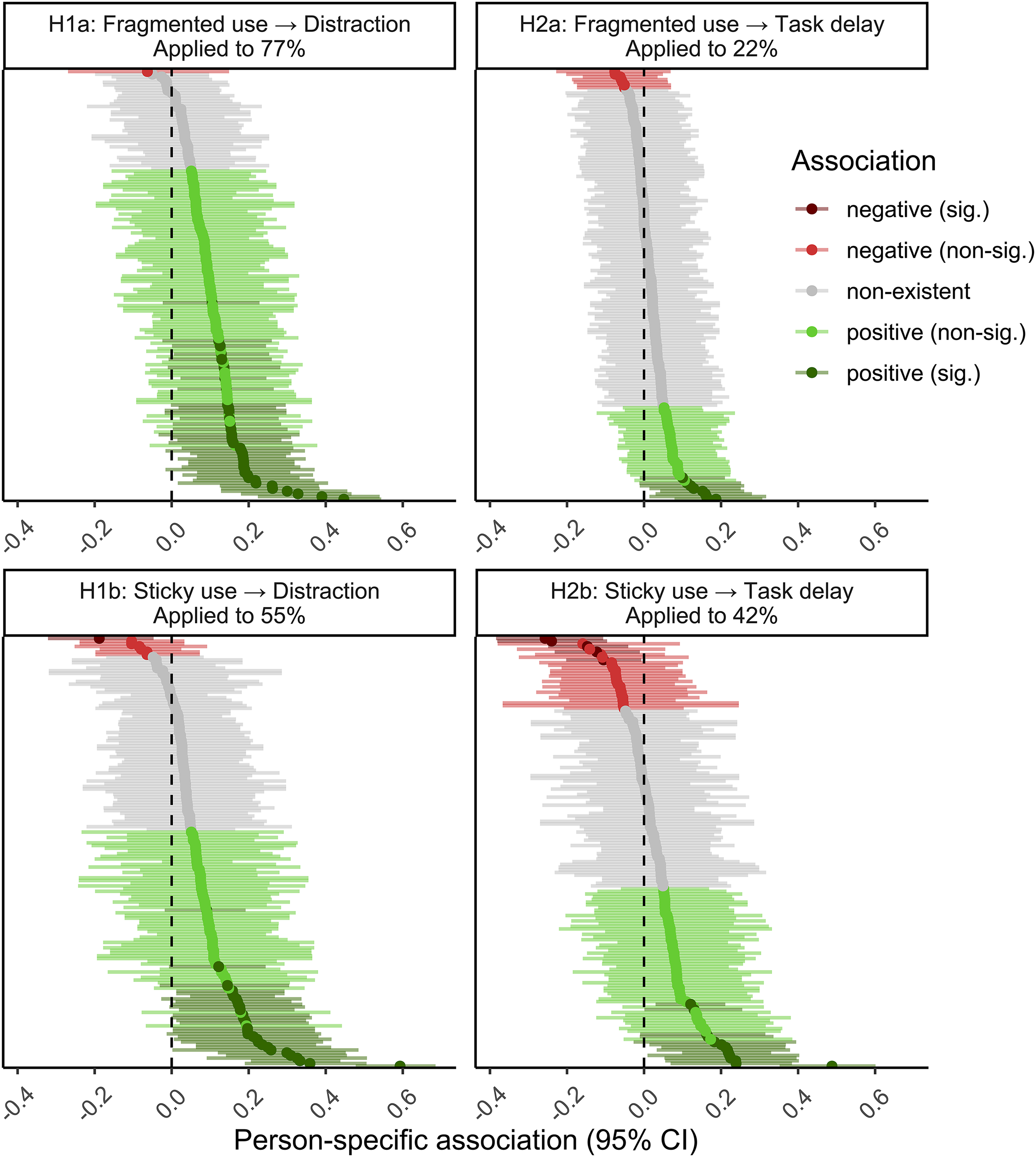
Distributions of the person-specific associations of fragmented and sticky smartphone use on distraction and task delay.
Model Parameters of the Four Dynamic Structural Equation Modeling Models.
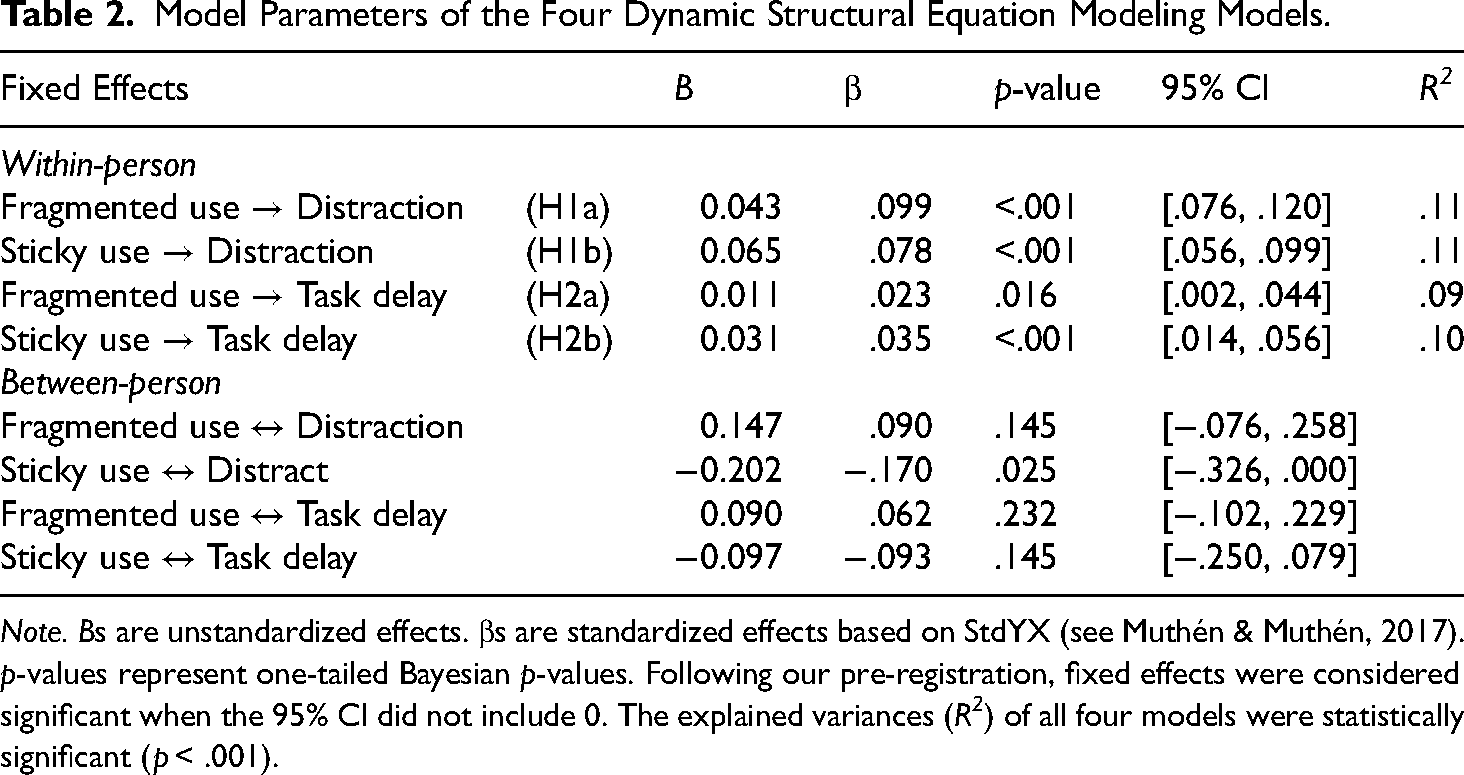
Note. Bs are unstandardized effects. βs are standardized effects based on StdYX (see Muthén & Muthén, 2017). p-values represent one-tailed Bayesian p-values. Following our pre-registration, fixed effects were considered significant when the 95% CI did not include 0. The explained variances (R2) of all four models were statistically significant (p < .001).
Our second distraction hypothesis (H1b) predicted a positive within-person association of sticky smartphone use with distraction. Supporting this hypothesis, the analyses showed that, on average, adolescents experienced more distraction during hours when their smartphone use was sticky (β = .08; see Table 2). Our person-specific estimates revealed that the hypothesized association applied to 55% of adolescents. For 4% of adolescents, sticky smartphone use led to an opposite association, while for 41% the association was non-existent (see Figure 2).
Our third distraction hypothesis (H1c) predicted that the association of fragmented smartphone use with distraction would be stronger than the association of sticky smartphone use with distraction. Using a paired t-test, we found support for this hypothesis, t(159) = 3.70, p < .001. For 64% of adolescents, the association of fragmented smartphone use with distraction was stronger than the association of sticky smartphone use with distraction. Finally, aside from the hypothesized within-person associations, we found no evidence for between-person associations of fragmented and sticky smartphone use with distraction (see Table 2).
Smartphone usage patterns and task delay
Our first task delay hypothesis (H2a) predicted a positive within-person association of fragmented smartphone use with task delay. This hypothesis was not supported by the DSEM analyses because the effect size was lower than our SESOI (β = .02; see Table 2), despite achieving statistical significance. This means that, on average, we found no proof that adolescents experienced more task delay during hours when their smartphone use was more fragmented. Our person-specific estimates revealed that the hypothesized association applied to 22% of adolescents. For 4% of adolescents, fragmented smartphone use led to an opposite association, while for 74% the association was non-existent (see Figure 2).
Our second task delay hypothesis (H2b) predicted a positive within-person association of sticky smartphone use with task delay. Again, we found no support for our hypothesis as the effect size was lower than our SESOI (β = .04; see Table 2), despite achieving statistical significance. This implies that, on average, there was no evidence that adolescents experienced more task delay during hours when their smartphone use was sticky. However, our person-specific estimates revealed that the hypothesized association applied to 42% of adolescents. For 17% of adolescents, sticky smartphone use led to an opposite association, while for 41% the association was non-existent (see Figure 2).
Our third task delay hypothesis (H2c) predicted that the association of sticky smartphone use with task delay would be stronger than the association of fragmented smartphone use with task delay. Using a paired t-test, we found support for this hypothesis, t(159) = 2.00, p < .05. For 58% of adolescents, the association of sticky smartphone use with task delay was stronger than the association of fragmented smartphone use with task delay. Finally, aside from the hypothesized within-person associations, we found no evidence for between-person associations of fragmented and sticky smartphone use with task delay.
Sensitivity analyses
In addition to our preregistered analyses, we conducted sensitivity analyses to examine the robustness of the results when session thresholds were decreased (i.e., 0 and 10 s) and increased (i.e., 60 and 90 s). All results remained virtually unchanged, except for the between-person association of sticky smartphone use with distraction. Adolescents who used their smartphone in a sticky way across the three-week study experienced less distraction than adolescents who used their smartphone in a less sticky way when the session threshold was reduced to 0 s (β = −.18) and 10 s (β = −.18). An overview of the sensitivity analyses and results can be found in Appendix C.
Discussion
The current study investigated the associations of two typical smartphone usage patterns, fragmented and sticky smartphone use, with two types of self-regulation failures, distraction, and task delay. As for distraction, we found that, on average, adolescents felt more distracted at moments when their smartphone use was more fragmented (β = .10; H1a) and sticky (β = .08; H1b), which is in line with theory and existing empirical work. Exploratory person-specific analyses showed that, based on an effect size of β > .05, 77% of adolescents experienced increased distraction when their smartphone use was more fragmented and 55% when it was sticky. In addition, we found that fragmented use was more strongly associated with distraction than sticky use, in support of H1c. Although the effect sizes seem relatively small, the effects of repetitive fragmented and sticky smartphone use on distraction may accumulate over time into a distractive attention style, as assumed by the drip hypothesis of media effects (Thomas, 2022).
As for task delay, we found that, on average, adolescents did not experience increases in task delay at moments when their smartphone use was more fragmented or sticky. Thus, both H2a and H2b were not supported. Nonetheless, our exploratory person-specific analyses showed that, again based on an effect size of β > .05, 22% of adolescents experienced more task delay at moments when their smartphone use was more fragmented and 42% of adolescents experienced more task delay at moments when their smartphone use was sticky. When comparing both associations, we found that task delay was more strongly tied to sticky than to fragmented smartphone use, thereby supporting H2c.
The associations of fragmented and sticky smartphone use with distraction may be explained by two different attentional mechanisms (Liebherr et al., 2020). On the one hand, fragmented use may cause distractions because of attentional switches between the smartphone and the task at hand. Research has shown that this can be triggered externally via notifications or internally via checking habits (Heitmayer & Lahlou, 2021; Oulasvirta et al., 2012). On the other hand, sticky smartphone use may cause distraction due to selective and immersed attention to the smartphone, thereby suppressing attention towards other tasks. Such endless dwelling on the smartphone occurs when users enter a state of flow (Roberts & David, 2023), which causes attentional inertia—an increase in attentional engagement as the gaze progresses (Brinberg et al., 2023; Richards & Anderson, 2004). App features, such as endless timelines, personalized newsfeeds, and “auto plays,” may contribute to a sticky smartphone usage pattern (Montag et al., 2019), which could, in turn, distract the users’ attention.
The reason why fragmented and sticky smartphone use did not lead to task delay for most adolescents could be that adolescents used their smartphones intentionally to complete tasks. For instance, adolescents may have used their smartphone to recover from a long day of school (Reinecke & Hofmann, 2016), to develop new skills (Kacetl & Klímová, 2019), or to find a romantic partner (Sumter & Vandenbosch, 2019). In these instances, smartphone use becomes a means to accomplish an intended task and does not lead to task delay, but likely task completion. Moreover, it is also likely that the effects on task delay are positive at some moments, and negative at other moments. That is, adolescents may experience less task delay at moments when they perform tasks on their smartphone because the smartphone is being used to complete the task. On the contrary, they may experience more task delay at moments when they perform tasks without the smartphone because their smartphone use interferes with their task completion. These opposing effects may cancel each other out, resulting in an overall person-specific null effect.
We found no evidence for associations of sticky and fragmented use with distraction and task delay at the between-person level. In other words, adolescents who usually use their smartphones in a sticky or fragmented way did not experience more distraction or task delay than their peers. Still, the intra-class correlations (ICCs) show that about half of the variance in distraction and a third of the variance in task delay can be attributed to between-person differences. This indicates that some adolescents have better self-regulation skills than others, which is in line with existing self-regulation research (Diehl et al., 2006; King et al., 2013; Raffaelli et al., 2005). Since these between-person differences in distraction and task delay cannot be explained by differences in fragmented or sticky smartphone use, it is still an open question whether and how exactly adolescents’ ability for self-regulation is associated with their smartphone usage patterns.
Smartphone usage patterns
The data of our study show that many smartphone sessions lasted very short whereas only a few sessions lasted exceptionally long. This phenomenon has been found in previous studies and is described by a power-law distribution (Zhu et al., 2018). The fact that most smartphone sessions were ephemeral and consisted of only one app further emphasizes the fragmented nature of smartphone behavior. On the contrary, the small number of smartphone sessions that lasted exceptionally long and consisted of many different apps suggests that smartphone use may also be sticky, and may lead to screenertia (Brinberg et al., 2023). Overall, fragmented and sticky smartphone use appeared to be typical usage patterns as reflected in the data.
Previous research has suggested that smartphone use is highly diverse across individuals and moments of use (Brinberg et al., 2021; Soikkeli et al., 2011). We also found that adolescents’ smartphone usage patterns fluctuated strongly from moment to moment. The low ICCs for fragmented (.16) and sticky smartphone use (.27) indicate that most of the variance in our data comes from within-person fluctuation, while relatively little variance can be attributed to between-person differences. Therefore, the fluctuations in fragmented and sticky smartphone use may be highly dependent on context factors that affect the activation of smartphone sessions, such as offline obligations. As suggested by previous research (Schnauber-Stockmann et al., 2023), smartphone usage patterns may also vary due to content factors that determine how long users will interact with their smartphone, such as app features and the actual content of the text or video that is consumed.
Avenues for future research
The current study extends prior research on smartphone use and self-regulation failures by using smartphone log data to obtain insights into the association of adolescents’ smartphone usage patterns with distraction and task delay. To investigate fragmented and sticky smartphone use, we relied on smartphone sessions, that is, the user's interaction with the smartphone from the moment the screen is turned on until it is turned off (Van Berkel et al., 2016). However, our measures of fragmented and sticky smartphone use may have overlooked adolescents’ switching between different apps. Most multi-app sessions start with brief interactions with communication apps (e.g., messaging apps) and continue with more prolonged scrolling through social networking sites (Böhmer et al., 2011; Peng & Zhu, 2020). Hence, starting a smartphone session (e.g., checking WhatsApp) may develop into continued use by switching to other apps that were initially not planned. This has previously been described as “gateway behavior” (Oulasvirta et al., 2012, p. 107). Future research is needed to investigate what causes users to either quit or continue usage by switching to other apps, and to what extent app switching and gateway behavior cause distraction and task delay.
Another avenue for future research is to investigate how smartphone usage patterns affect self-regulatory outcomes when used concurrently with other activities. Because of their mobility and portability, research has shown that smartphones are often used while performing other activities (Carrier et al., 2015; David et al., 2015). Prior research found that, on the one hand, multitaskers are better at dividing their attention over multiple tasks than those who perform tasks sequentially (Yap & Lim, 2013). On the other hand, research showed that media multitasking was positively associated with attentional failures in daily life, such as lapses of attention and mind wandering (Ralph et al., 2014). It may well be that smartphone use is beneficial only when it complements the other task, for instance by listening to relaxing music while doing homework. Therefore, future research is needed that investigates when smartphone use may complement other tasks, and when it is only distracting.
Conclusion
Smartphone usage is a dynamic and complex behavior that is deeply integrated into adolescents’ daily life. This study has moved beyond mere duration and frequency measures of smartphone use to investigate how two smartphone usage patterns, fragmented and sticky use, affect two self-regulatory outcomes, distraction and task delay. We found that three out of four adolescents experienced more distraction when their smartphone use was more fragmented, and more than half of them experienced more distraction when their smartphone use was sticky. In addition, fragmented use was associated with task delay among one in five adolescents, while sticky use was associated with task delay among two in five adolescents. Overall, our findings emphasize that both fragmented and, to a somewhat lesser extent, sticky smartphone use impact adolescents’ ability to concentrate and focus their attention.
Footnotes
Acknowledgements
We thank Tim Verbeij, Irene I. van Driel and J. Loes Pouwels for their contribution to the data collection of this study, and Tim Verbeij for sharing his insights on our data processing procedure.
Funding
The authors disclosed receipt of the following financial support for the research, authorship, and/or publication of this article: This work was supported by the Nederlandse Organisatie voor Wetenschappelijk Onderzoek (grant number 024.001.003).

Author biographies
Teun Siebers is a PhD candidate in the Amsterdam School of Communication Research (ASCoR) at the University of Amsterdam. His research focuses on the effects of adolescents' (social) media use on their self-regulation, attention, and daily functioning.
Ine Beyens is an assistant professor in the Amsterdam School of Communication Research (ASCoR) at the University of Amsterdam. Her research focuses on the effects of media on the emotional, psychological, and social development of children and adolescents.
Patti M. Valkenburg is a university distinguished professor at the University of Amsterdam. Her research focuses on the cognitive, emotional, and social effects of (social) media on youth and adults. She is particularly interested in theorizing, studying, and demonstrating how children, adolescents, and adults differ in their susceptibility to the effects of (social) media.
Appendix A
As an extension to our preregistration, we investigated whether our study variables fluctuated depending on the time of the day that they were measured. We estimated two-level fixed effect models including the time of the day as predictor of distraction, task delay, fragmented use, and sticky use, respectively. The results showed that the time of the day explained less than 2.5% of the variance in distraction (R² = .010, p < .001), task delay (R² = .002, p = .088), fragmented use (R² = .024, p < .001), and sticky use (R² = .005, p = .004) and did thus not systematically influence these measures.
Appendix B
See Table B1.
Appendix C
In our main DSEM analyses, we used a session threshold of 30 s (the maximum timeout period that marks the end of a smartphone session), which was used most often in previous research (Beierle et al., 2020; Böhmer et al., 2011; Carrascal & Church, 2015). However, other thresholds have been used, such as 0 s (Beierle et al., 2020; Soikkeli et al., 2011) and 10 s (Brinberg et al., 2021). To further understand how decreasing and increasing the threshold may affect our findings, we reran our DSEM analyses using session thresholds of 0, 10, 60, and 90 s.
As shown in Table C1, the within-person associations of fragmented and sticky smartphone use with distraction and task delay remained virtually unchanged when the session thresholds were lower (i.e., 0 s and 10 s) or higher (i.e., 60 s and 90 s) than 30 s. However, when using thresholds of 0 s or 10 s, a significant between-person association was found between sticky smartphone use and distraction: Adolescents who used their smartphone in a sticky way experienced less distraction (0 s: β = −.18, 95% CI [−.335, −.010]; 10 s: β = −.18, 95% CI [−.334, −.010]) than adolescents who used their smartphone in a less fragmented way. The association was not significant with session thresholds of 60 s (β = −.16, 95% CI [−.320, .007]) and 90 s (β = −.16, 95% CI [−.318, .009]).