




Abstract
How do people use media technologies in everyday life and how do they make sense of them? This is one of the core questions in media and communication studies, gaining even more in relevance in light of the rapidly changing, convergent media environment. Yet, rich and context-sensitive data about media and technology use are difficult to generate when media consumption is increasingly pervasive, ubiquitous, and often goes on in passing. At the same time, the full potential of smartphones in qualitative research has not yet been realized. The mobile instant messaging interview (MIMI) introduced and assessed in this paper is intended to fill this gap by exploiting some of the unique communication and multimedia features offered by mobile instant messaging apps. Drawing on diary techniques and on the tried and tested mobile experience sampling method (MESM), the MIMI uses WhatsApp for an in situ exploration of distinct settings and situations of social action (e.g., media usage). To substantiate the approach, the results of a pilot study conducted with young smartphone users are presented, discussing the advantages and drawbacks of mobile instant messaging interviews in detail, from the researcher’s as well as the participant’s point of view.
Keywords
Introduction
Media communication has become, with the emergence and widespread use of personal portable Internet technologies (e.g., smartphones, tablets, and smart watches) as well as the increasing connectivity of more and more devices and items, so profoundly embedded in people’s everyday life that it permeates a plethora of daily routines, practices, and social interactions (Couldry & Hepp, 2017; Deuze, 2012). The fleeting and often indistinguishable character of media usage brings new challenges for media and communication research, especially audience studies, as conventional measuring instruments for capturing media use reach their limits. At the same time, newer media technologies such as smartphones, with their omnipresence and distinct “affordances” such as portability, availability, locatability, and multimediality (Schrock, 2015), offer a wide methodological potential for the social sciences. As programmable, software-based technologies (Boase, 2013), smartphones are promising tools generating new opportunities both for the researcher (van Doorn, 2013) and for the data collection process (Paulus, Jackson, & Davidson, 2017; Plowman & Stevenson, 2012). Yet, despite their versatile potential, smartphones have gained attention mainly as tools for quantitative data collection where their sensory and automatic logging features are applied (e.g., Boase & Ling, 2013; Bouwman, de Reuver, Heerschap, & Verkasalo, 2013). The smartphone’s dialogical, instantaneous, and multimedia capacities have not been sufficiently exploited to date (Dowling, Lloyd, & Suchet-Pearson, 2016; Kaye, Monk, & Hamlin, 2018): “This absence is notable, as smartphones by their very nature and interactive design are extremely capable of collecting and even generating qualitative data” (García, Welford, & Smith, 2015, p. 3). Here, we see a methodological opportunity, especially for qualitative research, as will be shown in this article. To capture media consumption when and where it occurs and to learn about its contextual significance, we implemented mobile instant messaging into our research design. This means of communication enables immediate communication between researcher and participant, provides an easy-to-use tool for data collection, and includes various options for self-expression, such as written text, photographs, and video-recording.
Instant messaging has become a worldwide phenomenon and since moving to mobile platforms, it is increasingly replacing the traditional Short Message Service (SMS) system. With mobile instant messaging, users can communicate with other users on their smartphones in real time as well as asynchronously, thus without being required to immediately take part in the communication to receive a message. Studies have shown, however, that smartphone users pay attention to incoming messages in a continuous way (Pielot, Church, & de Oliveira, 2014) and regularly slot “brief bursts of usage” into their everyday activities (Ferreira, Goncalves, Kostakos, Barkhuus, & Dey, 2014, p. 91). The most prevalent mobile messaging app is WhatsApp, a free-of-charge, advertising-free, yet commercial mobile messaging service with more than one billion users in 180 countries (WhatsApp, 2019). It was founded in 2009 and is now part of the Facebook Corporation. WhatsApp allows for one-to-one and group communication and offers a wide range of multimedia functions (Church & de Oliveira, 2013; Gajjala & Verma, 2018; O’Hara, Massimi, Harper, Rubens, & Morris, 2014). Functions include making voice and video calls; exchanging pictures, emojis, audio and video messages, and even locations in a text chat; and posting status updates. WhatsApp is available for all major mobile platforms and has a desktop version, which mirrors the chat from a linked mobile phone. Unlike SMS, WhatsApp provides information about the connectivity status of the communication partner (date when last online) and the communication content (points of time when a message was transmitted, received, seen) unless the default settings are adjusted so that this information is not given. In the last couple of years, WhatsApp and, more generally, mobile instant messaging, have been of some methodological interest in the social sciences (e.g., Maeng, Ahn, Yoon, & Lee, 2016)—but, so far, their capabilities have not been fully exploited.
Starting from these premises, the article details a pilot study in which WhatsApp was used as a research tool in a qualitative design to explore in depth different settings and situations of media use, in collaboration with the participants. Part of the pilot study was also the assessment of the new method by participants in follow-up interviews. Our approach was inspired by the objective of gaining rich context data of media use, as observed and experienced by the media users. The objective was to meet the methodological challenge of permanence and pervasiveness in today’s convergent media environments through obtaining detailed descriptions of discrete moments of media consumption rather than retrospective accounts of all media contacts over the course of one day. We developed the mobile instant messaging interview (MIMI) to capture the fleeting moments of social behaviour within everyday life contexts and to explore situations and experiences of media use in dialogue with the participants (see also Kaye et al., 2018).
The article starts out from situating the MIMI in the methodological environment of diaries and mobile experience sampling. After critically discussing their achievements and weaknesses, we show how the MIMI combines some of their capacities by relying on the enormous potential of smartphones as mobile, connected technologies for interpersonal communication. In the following section, we present our case study in detail and reflect on the advantages and disadvantages of the MIMI, from the perspectives of both the researchers and the participants. The article closes with recommendations on needful refinements and possible further uses of the method and with an outlook on ethical considerations.
Developing the mobile instant messaging interview from diaries and mobile experience sampling
In this section, we provide an overview of the state of research in the two methodological approaches we aim to blend in the MIMI: diaries and mobile experience sampling.
The diary method
The diary method is suited for extensive data collection as it allows for the prompt recording of social behaviour and documentation of situational factors. Diaries are a classic tried-and-tested method used in the social sciences and applied in a wide range of research designs, albeit playing a rather tangential role in qualitative research and not being overly popular in media and communication research (Bartlett & Milligan, 2015; Berg & Düvel, 2012). Coming in a variety of forms and styles (Kunz & Pfadenhauer, 2014), the diary method does not refer to a certain procedure. Instead, it includes different techniques for people to record their own thoughts and feelings and to provide information on the experiences and events of their daily lives (Alaszewski, 2006; Bartlett & Milligan, 2015; Berg & Düvel, 2012). Differentiating factors relate to, among others, the purpose of production (e.g., solicited or unsolicited diary writing), the degree of structuring (from open structure to highly structured forms), the temporal extension of the documentation process, the distinction between in situ and reconstructive self-reporting, and the supporting media and documenting tools (e.g., paper-and-pencil diaries or electronic input devices, sometimes aided by additional technologies such as cameras or voice recorders; Bytheway, 2012; Kunz & Pfadenhauer, 2014). The main benefits of the diary method include the consideration of the participant’s individual perceptions and interpretations, the immediacy of data gathering, and the capturing of social actions in natural, spontaneous settings (e.g., Bolger, Davis, & Rafaeli, 2003). One of its key potentials is the provision of “insight into taken-for-granted activities” (Alaszewski, 2006, p. 37) and hence of access to “tacit knowledge” (Alaszewski, 2006, p. 37).
With the digitization of media and the proliferation of personal handheld devices since the 2000s, the application of technologies in diary studies has significantly increased (Bartlett & Milligan, 2015, p. 51). New and emerging capturing tools, notably smartphones, as well as web-based applications and platforms (e.g., email, weblogs, moblogs, social media) are often cost-effective and user-friendly and have altered the nature of diary-writing. They come with additional advantages regarding the style and handling of reporting, the quality of data, and the communication between researcher and participant (Bartlett & Milligan, 2015, p. 63). Yet, despite the diversification of forms and the enhanced possibilities for data collection, certain limitations of the diary method persist. One problem discussed in the literature is the high level of commitment that is demanded from both the researcher and the participant (Bartlett & Milligan, 2015; Bolger et al., 2003): keeping a diary might not only require technical competence and effortful training sessions for a smooth operation, it can also be time-consuming and tiring and may thus easily result in incomplete logs or participants dropping out. While it might be useful and economical to involve the participants in the data collection process, the researcher is dependent on their ability and motivation to produce content. Another issue concerns the interpretation of data which can become difficult due to the vast amounts of material or the lack of contextual information (Bartlett & Milligan, 2015). For questions related to media and communications there are further challenges that can bring classic self-report methods to their limits: due to the ambient and pervasive character of media communication, discrete acts of media consumption are often beyond perception and thus difficult to identify. Fragmented, overlapping, and ongoing forms of media usage therefore call for an enhancement of the diary method, taking into account the volatility of certain research objects.
The mobile experience sampling method (MESM)
The other methodological approach adopted by the MIMI is the mobile experience sampling method (MESM), which developed primarily from the emergence of mobile communication technologies that have opened up new ways to conduct research (Boase, 2013; Raento, Oulasvirta, & Eagle, 2009). The classic experience sampling method (ESM) was designed as a means “to allow respondents to document their thoughts, feelings, and actions outside the walls of a laboratory and within the context of everyday life” (Christensen, Feldman Barrett, Bliss-Moreau, Lebo, & Kaschub, 2003, p. 53; on the history and development of ESM, see Kubey, Larson, & Csikszentmihaly, 1996). To collect the data, a schedule is programmed to determine the intervals at which participants are to be signalled (time-based alerts) so they can report their activities. Alternatively, alerts can be event-based and either triggered by the system or by the participants, for example, when they engage in a certain activity or find themselves at a certain type of location (Consolvo, Bentley, Hekler, & Phatek, 2017, p. 88). In any case, participants needed to carry equipment for the signalling (unless alerts are participant-triggered) and the reporting with them at all times.
With the shift to personal mobile media devices it has become much easier to apply momentary assessments and to collect in situ data. As smartphones are typically always switched on as well as permanently connected to the Internet and carried by users wherever they go (Ling & Lai, 2016), additional equipment is redundant. Both alerting and replying can take place in a single app or a mobile browser, which also allows the researcher a much higher degree of control over the data collection process than with SMS-based alerts (Karnowski, 2013, p. 239). In the MESM, recipients are invited several times a day automatically via their smartphone to fill out a short structured online questionnaire regarding their current activity and experience. Various options to implement the questionnaire and to capture the answers make MESM a flexible design (Consolvo et al., 2017, pp. 89–90), which has been successfully applied to a broad range of topics (Kubey et al., 1996). In media and communication research, MESM is still an emerging method which has been mainly employed in studies investigating the causes and motivations of media usage (Karnowski, 2013, p. 243).
A reported advantage of (M)ESM—especially compared to other self-report methods—is that it can minimize both the recall and the observer bias since data are supposed to be collected at the moment and context of experience (Consolvo et al., 2017, p. 83). The downside is that (M)ESM “interrupts people in their natural environments as they live their lives” (Consolvo et al., 2017, p. 91). Furthermore, in asking participants to reflect on the experience at the moment itself, there is a significant risk of affecting the very target of measurement, which might lead to unintended effects (Consolvo et al., 2017, pp. 91–92).
Bringing it together: The mobile instant messaging interview
Although offering a range of opportunities for qualitative research—in situ exploration; contextual orientation; insights into people’s experiences, perceptions, and feelings, to name but a few—both diary and mobile experience sampling methods have some limitations with regard to the depth of exploration and range of communication possibilities between researcher and respondent in the situations surveyed. In MESM, the documentation by the participants happens in response to certain prompts and includes links to surveys for momentary assessment. While the advantage of this approach is that it is much less based on the not always reliable memory of participants, unlike diaries, to date, the questioning must follow a stimulus–response routine due to technical restrictions (e.g., when using SMS). The means to “dive” into the instant is restricted in both approaches. Documented experiences can be elicited in more depth only in subsequent interviews. Here, mobile instant messaging offers a promising potential: users can easily be alerted in a mobile messaging app to report their current activities. Once in touch with the participants, researchers can then explore remotely and exhaustively the reported situation together with the participants and ask for pictures, screenshots, videos, etc., in search of insights on taken-for-granted activities and non-reconstructable aspects.
This new approach, the mobile instant messaging interview (MIMI), thus benefits from the potential of the related methods while at the same time overcoming some of their shortcomings, for example, memory effects and the limited scope of questions. The MIMI can fill the gaps by providing a means to prompt the self-documentation process, to enhance it with photographic and audiovisual material, and to start a dialogue with the respondents in real time, using not only a mobile instant messenger to signal the participants, but also to interact in a mobile, instant setting.
In the context of using software for data collection, researchers often prefer specifically programmed solutions due to greater control and data security (see Gergle & Hargittai, 2018). Yet, for financial and other resource-related reasons, individually tailored software solutions are not always possible or feasible. Fortunately, there are various viable, feature-rich commercial messengers by which millions of people communicate daily in their networks. To go—in a methodological sense—where users already are, seemed to us an auspicious approach for researching media use in everyday life (see also Kaufmann, 2019). Participants would be unlikely to switch off the app or its notifications as this would isolate them from their everyday communication partners, too. Also, as researchers, we would be able to capitalize on the attention users pay to their network’s communication activities. To apply MIMIs in a case study, we therefore chose one of the most popular mobile messaging services worldwide—WhatsApp, a free-of-charge service deemed very reliable and supporting a variety of input modes and attachment options.
Case study: Researching media use with WhatsApp
With WhatsApp as our data collection and participant interaction tool, we started a qualitative pilot study on the use of media, their role within an individual’s media repertoire, and their meaning in everyday life. The aim of the study was to understand media-related practices in a rapidly changing media environment characterized by digitization, (de)convergence (Peil & Sparviero, 2017) and deep mediatization (Couldry & Hepp, 2017). We wanted to generate data that go beyond time, duration, location, and purpose of media usage, giving us concrete ideas about the often casual acts of media consumption and their contextual complexity.
Our target group were men and women born after 1990, whom we expected to be confident and engaged media users and open-minded for this rather unusual form of data collection. Recruiting was based on the following criteria: owning a smartphone, connecting to the Internet not only via Wi-Fi but also via mobile data, regularly using WhatsApp. Only people who already used WhatsApp were eligible as we wanted to capitalize on the embeddedness of the messaging app in participants’ everyday life. Recruiting took place with our personal WhatsApp accounts through personal contacts who had siblings or friends that fulfilled the criteria. Some of the participants were personally known to us, others not at all.
Via WhatsApp, we conducted eight daylong studies in October 2016 with young adults (four female, four male) aged between 19 and 25 years. All the collected data were in German. We contacted potential participants directly on WhatsApp and obtained their informed consent to make use of their data for academic purposes and, on the part of the research, assuring their anonymity and the data’s careful handling. Simultaneously, we made it clear that we were neither aware of, nor had any influence on, the purposes and objectives that the platform operator was pursuing with customer data.
After agreeing to a certain weekday for the survey and clarifying the time during which they would participate, the participants were requested to have their smartphone within reach and be generally available throughout that day, while otherwise continuing with regular tasks and activities. We strongly advised them not to reply to our text messages in situations where the use of smartphones was dangerous or prohibited (e.g., while driving).
The studies were complemented by follow-up interviews usually on the following day for an assessment from the participants’ perspective of the MIMI. These interviews, too, took mostly place in a WhatsApp chat.
The data collection process
On the survey day, we contacted each participant—from their indicated waking up to going to bed—approximately every hour, between eight and 11 times in total, and asked via text chat if they were using any media at that time. In our first text message of the survey day, we provided a short explanation of what type of media they should consider: Hi, I would like to ask you if you are using any media at this particular moment (or if any media content is being screened or received in the background). These include smartphones, tablets, desktop computers, TV sets, radios, and also newspapers, books, and game consoles. Please reply within 15 minutes. (Interviewer’s text message)
The times of contact were randomly chosen and, therefore, unknown to the participants, so that they could not prepare, nor deliberately choose specific activities for the in situ elicitation. The participants were asked to report their media usage at the time of reading our prompts, and not to reconstruct any activities as of the time when the prompts were sent.
For their answers, participants were encouraged to exercise the whole range of multimedia options featured by WhatsApp—to send pictures, videos, screenshots, and make use of emojis, filters, and hashtags. If the participants did not respond within 15 minutes of the researcher’s contact attempt, they were instructed to wait for the next time they would be approached. This was to avoid large deviations among participants with regard to reaction times and to ensure data comparability. Furthermore, this helped us to organize the communication flow and to ensure some degree of predictability. On average, a response was received 3 minutes after having sent the initial text message. This is in line with studies showing a high degree of attention towards mobile messages (Pielot et al., 2014). Only in 15% of all contact initiations was no answer given within the 15-minute response limit. In the case of a negative response (i.e., no media usage at the time of questioning), the investigator only briefly confirmed receipt. When there was a positive response, a text-based WhatsApp dialogue was started to grasp the meanings and contexts of media use and the people involved. The participants were invited to provide detailed descriptions of the media content and communication partners; the device(s) and application(s) used; and their reasons for having chosen a particular content, service, or platform.
Depending on the availability of the respondents in a particular situation and on the completeness of their answers, the lengths of enquiries varied. Since the participants did not always respond immediately to subsequent questions, the dialogues in total lasted between 2 and 38 minutes, but usually stretched over a time span of 10 to 20 minutes. The conversations were ended on the part of the researcher when the information density seemed satisfactory. From three quarters of all media situations we received pictures or screenshots accompanying the written documentation; however, no participant chose to send hashtags or video recordings.
Advantages and drawbacks of the mobile instant messaging interview
For the discussion of advantages and drawbacks, we first refer to the researchers’ and then to the participants’ perspectives.
The mobile instant messaging interview from the researchers’ perspective
Technical features and specifics of WhatsApp
In the study, the included features of WhatsApp like the sent/delivered/read check marks proved useful. We could track whether a message was received, and if a new message was being typed. These features of WhatsApp helped us to decide when to proceed with a conversation and how to align our questions (see also Gergle & Hargittai, 2018). This direct feedback about the status of a message exceeds the functional range of the conventional short message service (SMS). From our researchers’ perspective, the availability of a desktop version of WhatsApp was also convenient, as it helped to facilitate the survey phase on several levels. First, ease of communication exchange increased because the desktop allowed entering text via keyboard rather than via a cramped smartphone touchscreen. Second, the desktop allowed for practical copying and inserting of prepared text modules. Both features proved especially useful when chat conversations with different participants overlapped resulting in the researcher having to manage parallel chat windows. A third benefit was the easy transfer of WhatsApp chat data (including written text, screenshots and pictures as well as automatically added time stamps; see figure 1) into a word-processing programme, superseding the cumbersome process of transcribing data for analysis. The reliance on a broad variety of technical features, however, meant that the data collection process was vulnerable to technical failures, for example, the breakdown of a participant’s smartphone battery, poor network coverage, or restricted data plans that impede the transmission of attachments. In our pilot study, we did not encounter any of these kinds of failures. Yet, researchers need to be aware that such incidents pose a risk beyond their control.
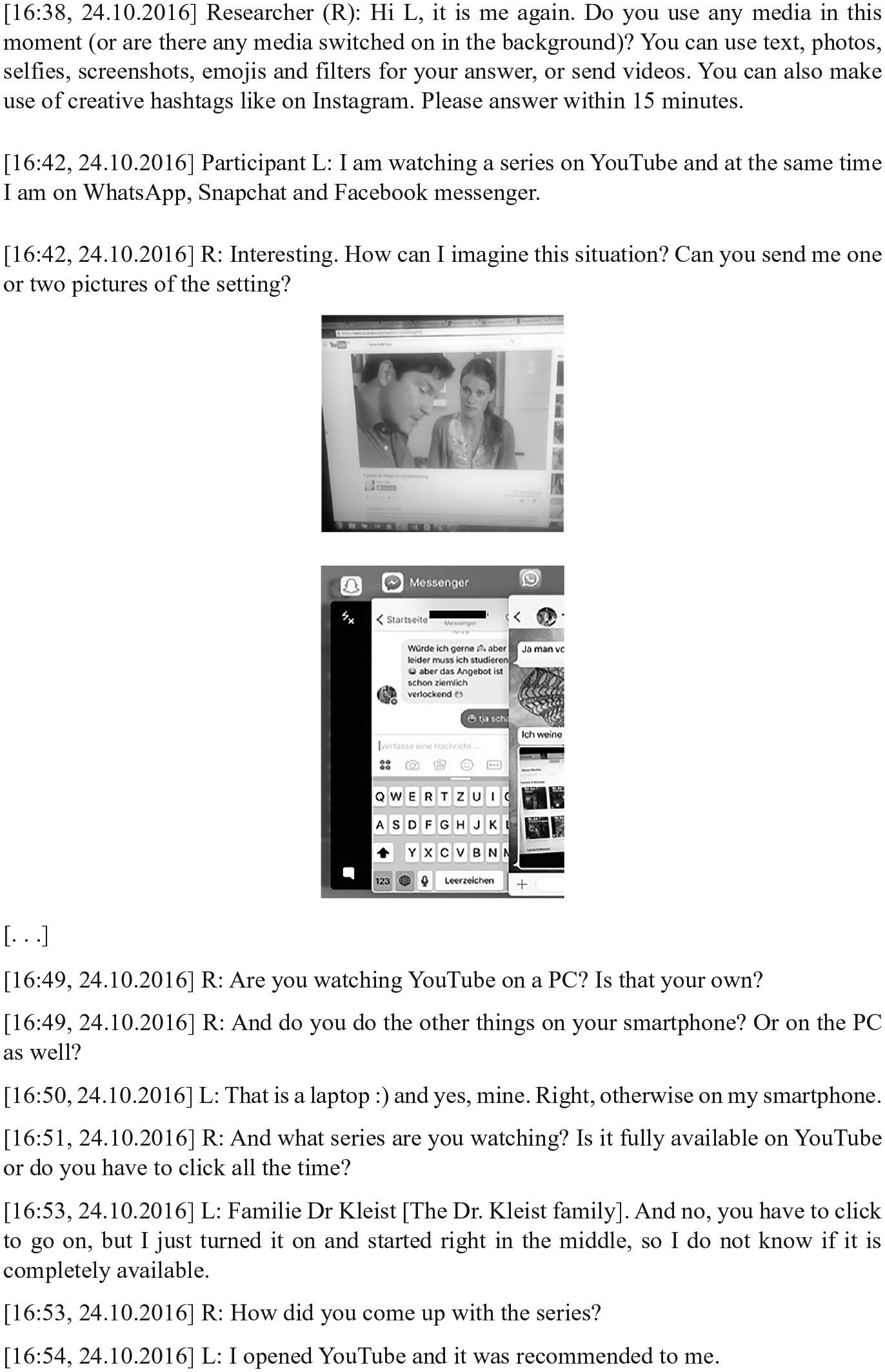
Example of MIMI chat on the mobile messaging app WhatsApp, translated from German.
Implications of perceptions relating to WhatsApp
Generally thought of as a channel for private communication (Staudacher & Kaiser-Grolimund, 2016, p. 36), mobile instant messaging fosters an informal style of communication. This allowed us to approach the participants in a casual way, establishing a comfortable conversational atmosphere and encouraging open communication. Using a communication space perceived as private might be advantageous for a rather unobtrusive topic like everyday media use. More serious or intimate topics might necessitate either other measures to gain trust (see also participants perspective in what follows) or, contrastingly, call for establishing a professional distance.
Flexibility and scalability of data collection
A specific benefit of MIMIs is their flexibility, both regarding place and times of use. Participants and investigators do not have to share a geographic location and the research can be carried out wherever there is an Internet connection. Accordingly, we could recruit participants independently of their place of residence. However, the interactive character of the approach and the necessary availability of the researcher require an approximate overlap of time zones and a certain degree of adaptability to the respondent’s daytime rhythms. Overall, commitment for a whole day is necessary to conduct the research. Still, we were able to adjust the questioning to our own working rhythms, as we had not booked contacting times. In one case, we ran two surveys concurrently on the same day, which was easily feasible. Drawing from our experience, we assume that up to five MIMIs can be handled in parallel when full attention is given. On the downside, researchers do not have any control over the participant’s response behaviour, and waiting for replies can sometimes drag on. The pilot study also showed potential for scalability of exploration (times of contact, length of dialogues, scope of questions, and depth of enquiries). This possibility contrasts to highly structured diaries and MESM, which are both rather restricted concerning the comprehensiveness of input (Karnowski, 2013; Kunz & Pfadenhauer, 2014). However, when the input time is too extensive there is the risk of overstraining the participants (also see section WhatsApp as an Unusual Space for Research Activities). Thus, there is a need to sensibly weigh in-depth explorations against participants’ capacities.
Context and comprehension orientation
The opportunity to pursue a momentary exploration of the settings and backgrounds of social behaviour and to receive rich context data through exhaustive enquiries and interventions proved undoubtedly to be one of the strongest assets of the approach. Even though the platform design and the communication culture of mobile instant messaging promote brevity (e.g., emojis, abbreviations, response routines), the interactive chat character allowed us to address certain issues repeatedly until we had gained an impression of a complete picture. By agreeing to give answers on the spot about their media behaviour and about their chosen technologies, our participants provided insights into the circumstances and contexts of media usage. They explained how media were integrated into their daily routines and used to manage interactions and relationships. The approach not only considers the whole media ensemble, but also captures and retraces overlapping and uncommon media uses. It thus focuses on real usage scenarios that are difficult to grasp through other forms of data collection such as interviews or surveys, or even diaries and MESM.
Quality of data
The diversity and richness of data stimulated by our MIMIs were encouraging. Through photos and screenshots, we often gained insights into unexpected settings and original media consumption practices. We received text-based answers as well as screenshots and photos. Since WhatsApp is a renowned and much used platform where various media such as pictures, web links, or audio files are routinely integrated into the written text chats, participants followed a known pattern of behaviour when they made use of these features as part of the research. On the downside, we were unable to guarantee data security on the part of the platform provider as our participants were also subject to WhatsApp’s terms of usage and had passed over their data rights when initially setting up their WhatsApp account. This is a disadvantage in comparison to apps that are exclusively programmed for research (see Gergle & Hargittai, 2018). As for data accuracy, there seemed to be less distortion and memory effects because social activities and experiences were observed and documented in (close to) real time.
The mobile instant messaging interview from the respondents’ perspective
After the daylong data collection phase, we got in touch with each participant for a follow-up interview reflecting on their experiences during the process, as well as asking for suggestions for improvements in the implementation of the MIMI.
Convenience and comprehensiveness of data input
Overall, the feedback in these debriefings was favourable. Participants had experienced the data collection as nonintrusive since WhatsApp and the smartphone were well embedded into their everyday lives anyway (see also Pielot et al., 2014). Thus, answering questions and sending visuals from time to time was described as “no big deal”: “Generally, I think it’s easy and convenient to do such surveys on WhatsApp” (female, age 24). This was also due to the refined usability of the commercial messaging app WhatsApp and stands in stark contrast to methods that afford special gear and detailed instructions further complicating the data collection process (e.g., Carter & Mankoff, 2005). Participants also stressed the advantage that they did not have to keep anything specific in mind but just react to questions whenever they popped up: “Answering the questions was quite pleasant and simple” (male, age 22). This supports studies that report memory bias to be an additional burden to participants and a problem for the validity of data (Bolger et al., 2003). Another advantage for participants was the permanent option to message back for clarification if questions or tasks were no longer clear, instead of being left alone after an initial briefing. This seems to be especially useful for a method where participants are likely to be busy with everyday duties while reporting. On the other hand, the interactive character of our approach probably produced a higher complexity than approaches where participants are asked to simply gather data for later elicitation purposes (e.g., Plowman & Stevenson, 2012).
WhatsApp as an unusual space for research activities
From the point of view of all respondents, WhatsApp had a positive connotation which made the approach seem more attractive compared to classic survey instruments (see also García et al., 2015, p. 3): “For this kind of study on media use during the whole day, a questionnaire wouldn’t be useful or convenient” (female, age 24).
Yet, it also became clear that using WhatsApp for research purposes (so far) is out of the ordinary. WhatsApp is perceived as a space reserved primarily for private communication: “If I didn’t know you in person, I would find it unusual [to report in WhatsApp]” (female, age 19). Despite this type of response, most of the participants reported that they used WhatsApp continuously during their day anyway, which made it effortless to them to be reachable for small research chats (see also Maeng et al., 2016): “WhatsApp is in my view especially suited because of its immediacy and speed . . . Everyone has their mobile device with them and is instantly available” (male, age 25). This put pressure on some participants: they reported having tried to be especially reachable during this day or having at least permanently expected to be contacted, which resulted in a higher than usual attention paid to the smartphone: “It was difficult and strenuous to be on standby, to be bound by WhatsApp” (male, age 22). These respondents felt being part of the study as an obligation. In view of this assessment, making contact approximately once an hour appears suitable to neither overstress the participants nor interrupt their regular everyday activities in a distorting way.
Perceived privacy and degree of comfort
As the interviewer was not present beside them but only remotely connected with the participant through the WhatsApp chat, participants mostly felt very comfortable and experienced a high degree of control of what data to share, as one participant stressed: “At all times I felt that I was able to keep answers to myself or to not send pictures if I didn’t want to” (male, age 25). This quality also makes the approach eligible for sensitive topics where face-to-face interaction may be detrimental (see also Opdenakker, 2006). Still, one of the younger participants felt that she was being pushed to reveal private information: “Sending screenshots made me feel rather uncomfortable. Usually, I would never let someone have such a deep look into my mobile phone” (female, age 19).
While answering questions was mostly seen as an effortless process, the inevitable task of using the smartphone during the chats—particularly in inappropriate situations—was viewed critically. One participant who was working in a social work institution where he was involved in talks throughout the day said, “Personally, I think it is rude to concentrate on your mobile phone while other people are present. It disturbs personal communication” (male, age 25). Similar effects might occur with other occupations that demand a high degree of attention, to people or machines, or those that forbid the use of mobile devices (see also Consolvo et al., 2017, p. 91). Thus, the circumstances of participants during the survey time need to be taken into consideration.
Learning curve: Acceleration and improvement of the data collection over time:
Participants reported a process of becoming familiar with the unusual form and approach to data collection on WhatsApp. After a couple of chat rounds they could reply more autonomously: “Eventually, I had the feeling that I knew what kind of information you were after” (female, age 19). This learning effect simplified the data collection considerably and made it increasingly efficient for both the researcher and the participant, thus notably speeding up individual chat sessions (see also Fitt, 2017).
Reactivity to self-monitoring
Finally, in the follow-up interviews, participants reported that the daylong chatting about the whereabouts of their everyday media use had also made them reflect on their habits and choices to an unusually high degree: “It was demanding to think about my reasons for using just this medium. Sometimes, I felt that even I didn’t know why I was using this medium at this moment” (male, age 25). This risk of reactivity in the data collection process affects all momentary assessment methods and needs special consideration when developing the research design (Consolvo et al., 2017, pp. 91–92; Kaye et al., 2018, pp. 19–20).
Discussion
The objective of this article was to introduce and assess MIMI as a new qualitative approach that combines elements from diaries as well as the MESM and thus gives researchers the means to enter into a dialogue with the participants in the moment of experience. For this purpose, the study used WhatsApp as a data collection and communication tool in a pilot study that comprised data collection and a subsequent assessment of the applied approach with the participants.
Besides making use of its “standby character” and the nonintrusive, remote form of questioning during data collection, WhatsApp fulfilled two main functions: first, it was used for the random selection of usage situations. By this means, participants were discharged from the obligation of having to bear in mind to log each time they used media. Instead, they only had to record acts of media consumption when prompted by the investigator. Second, it allowed participants to engage in a textual conversation about the contexts and reasons of media use while that media use was taking place. WhatsApp is used in everyday life and in multiple ways for micro-coordinating social activities (Ling & Lai, 2016), and thus, participants were approached in a way that they did not necessarily experience as an artificial research setting. Rather, the approach draws on a form of dialogue familiar to the respondents and thus enables a casual, open communication atmosphere likely to be beneficial to the examination phase. The follow-up interviews made it possible to catch and reflect on the participants’ point of view, which is a vital aspect of developing qualitatively oriented approaches that rely on participant engagement.
Considering our research interest—to understand from the users’ perspective everyday media practices within a fast changing, dynamic media environment—MIMIs proved effective as they allowed digging deep into the contexts and situations of media usage while they were being experienced. The actual settings often turned out more complex than can be represented in studies based on other, in particular reconstructing, methodological approaches (e.g., interviews). For example, in some chats we learned about the multiplicity of screens used at the same time and the parallel handling of several applications as well as their different functions, such as “background noise” (e.g., Instagram), entertainment and distraction (e.g., YouTube), or means for establishing community (e.g., WhatsApp). In other chats, the randomness of media content selection was explained by the participants and further examined through the dialogic exploration of the situation. In yet other chats, novel devices and settings of electronic media usage were detected and surveyed, such as the common use of an electronic game table in a shisha bar. Asking the participants about their motivation to employ a media device or application as well as their experiences and assessments in a given moment was extremely helpful to get a comprehensive idea about how they made sense of the media that become meaningful in their daily lives.
The approach enables the examination of social action deeply rooted in everyday life and focuses on the understanding and meaning of what people think and do in a particular context. This entails a form of “methodological situationalism” and “radical contextualism” (Ang, 1996, p. 70). In this way, the MIMI meets some of the core aspirations of ethnography (e.g., Brennen, 2017, p. 166; Hammersley & Atkinson, 2007). Additionally, with its possibilities of expression and representation, the approach can be considered as a way to get back to “thick descriptions” (Geertz, 1973). Its capacity to provide insights into both explicit and somewhat tacit routines and practices, which are difficult to grasp in conventional interviewing or self-documentation methods, makes it also valuable for complementing other methods in order to triangulate data.
For MIMIs to be integrated into an ethnographic research design, such a combination with additional methods seems worthwhile. In so doing, certain topics that are only marginally touched in the instant messages can be more deeply examined, and investigators can more fully engage with the life of a participant. When the MIMI is preceded by a qualitative interview, the survey phase could be thoroughly prepared, for example by explaining the scope of research to the participants or by preestablishing a trusting relationship with them; whereas, when applied in the run-up to a guided interview, the MIMI could generate valuable stimuli for a later elicitation and reflection process. In conjunction with observations, MIMIs seem apt to deliver relevant context information and to establish frames of reference. Also in line with ethnographic approaches, a key aspect is the small number of participants implied by the MIMI. As WhatsApp chats are not automated, but attention-demanding, real-time interactions, MIMIs are not appropriate for larger samples. For the analysis of the multifaceted data gained through MIMIs, different procedures seem possible, depending on the textual material provided by the participants. While some aspects, such as location, situational circumstances, or types of activity are suitable for content analysis, hermeneutic-descriptive approaches appear reasonable for the interpretation of motives, experiences, and sense-making processes. Still, to assess and substantiate the MIMI approach further, a more systematic evaluation is needed beyond our initial small pilot study. The potential of the approach could be assessed more broadly by systematically varying, for example, the traits, backgrounds, and size of samples; the number of inquiries per time unit and the total period of data collection; as well as the types of data available to participants to document their experiences. Empirical studies that identify and evaluate the benefits and the limitations of this approach in direct comparison with other methods, including the parent approaches, would further add to a comprehensive understanding of using mobile instant messaging, and particularly the MIMI approach, as a data collection tool in in situ research.
Recommendations and outlook
The implementation of MIMIs, also into other fields of research, needs first and foremost the target group to be taken into account carefully. While using apps is always exclusionary (García et al., 2015), WhatsApp has, at the time of writing, more than one billion users in over 180 countries (WhatsApp, 2019), and smartphone ownership as well as mobile Internet access are currently becoming truly global phenomena (Donner, 2015). WhatsApp is successful among young people, and it is increasingly relevant for older adults who want to stay in touch with peers and family (Fernández-Ardèvol & Rosales, 2018). Still, some people cannot afford smartphones or might not want to own them, rendering these individuals out of reach for the MIMI approach. The same applies to nonusers of mobile instant messaging; e.g., less engaged mobile users who make only limited use of their devices. In addition, there are those technically skilled persons who are highly aware of privacy issues and refuse to use commercial apps like WhatsApp. Finally, and above all, the applicability of the MIMI depends on the embeddedness of a particular mobile instant messaging app in a participant’s everyday life. If users—regardless of their age and background—rely on the app in their daily life, they are very likely suitable participants in a MIMI study.
In addition, chances are high that with this approach, researchers will be able to study societal groups that are possibly not reachable by traditional social science methods (anymore). A case in point is the vulnerable group of refugees, among which WhatsApp is used as the main communication tool in everyday life (Kaufmann, 2018).
Opportunities for future research also derive from the possibility to expand the array of applied functions in MIMIs: for example, group communication tools for interaction among participants, location-sensing capabilities to include the geographies of daily life, or (audio)visual means of communication to complement the set of usually text-focused self-reporting data. Such an expansion would open the MIMI up, not only to new participant groups but also to other fields of research (sociology, health studies, mobilities and urban studies, human geography, migration studies, etc.), thereby contributing to the development of more inclusive methods for the social sciences.
Lastly, from an ethical point of view, to what extent should academic research use commercial software based on private interests? After all, mobile messaging apps are usually part of privately owned corporations. The Facebook Corporation bought WhatsApp in 2014 and the data security remains at risk despite an end-to-end encryption promise. Still, users exchange billions of individual messages via WhatsApp. Should researchers strive to use open-source software or even develop their own applications (Do & Yamagata-Lynch, 2017), despite the high costs, so that the data participants produce in good will for academic research can be handled appropriately? Should researchers exclude topics that are likely to produce sensitive data when using a commercial service? Or is it quite the contrary, that appropriating the informal and casual atmosphere of a private communication space, like WhatsApp, allows researchers to gain data that users would not disclose in a more formal research setting? Ethical issues always need to be considered and weighed carefully in designing and conducting an individual study as well as in advancing social sciences research methods that make use of the potential that today’s technologies and commercial services offer.
Footnotes
Acknowledgements
The authors would like to thank the Open Access Publication Fund of the University of Salzburg for their financial support and the anonymous reviewers for their most helpful comments.
Author’s note
Katja Kaufmann is now affiliated to University of Innsbruck, Austria.
Funding
The author(s) received no financial support for the research, authorship, and/or publication of this article.
