




Abstract
With the rising popularity of digital reading media, leisure reading is undergoing a transformation process. However, the reasons for readers to adopt e-book reading or to stick to traditional printed books are mainly unknown. Therefore, we explored demographic and motivational differences between print readers, digital readers, and readers using both reading media. We further studied their book-reading practices, like the amount of reading, the preferred genres, the different reading situations, and if there are dedicated reading media for specific genres or situations. Additionally, we explored if digital reading media have changed the reading process or just appeal to a certain type of reader. Therefore, we conducted a survey (n = 779) of adult book readers about their leisure reading behavior. The results show that print readers, digital readers, and readers using both media differ in age, gender, amount of reading, genre preference, and the situations in which they read. Furthermore, digital reading media especially foster reading on the move.
Keywords
Introduction
With the advancing digitization of our everyday lives and the widespread distribution of digital texts came the assumption that the printed book as a cultural asset and the reading of printed books would lose importance (e.g., Wolf, 2018). Through the metaphor of the death of the book, a powerful narrative was formulated that fundamentally addresses the impact of digital media on cultural, social, and economic practices (Ballatore & Natale, 2016). Nevertheless, as history shows, media rarely “die” (Lesage & Natale, 2019). Multiple technical and social innovations over time have not made the printed book disappear, and “the end of the book” is probably a misguided phrase (Eco & Carrière, 2011). Yet, new media and technologies always brought about new reading behaviors and practices (e.g., Chartier, 1995). In particular, e-books are accessed on multifunctional devices, which enhance the possible interactions with texts due to different affordances than the printed book (D’Ambra et al., 2019).
This makes it necessary to examine reading practices relating to the traditional printed book and to the new medium of e-books. Today, book readers are more than ever confronted with the conscious decision of whether to read in print or on a digital screen (Baron, 2021). The Pew Research Center reported that of the 75% of US adults who are saying they have read a book in the past 12 months, 32% say they read only printed books, 9% read only in digital formats (which in this study includes e-books and audiobooks), and 33% read both digital books and books in print (Faverio & Perrin, 2022). 1 These figures show that the e-book is far from displacing the printed book but that it has established itself as an important medium for the consumption of books. Above all, the Pew study is about leisure-time book reading, which must be distinguished from reading informative texts such as newspapers or reading for study in an educational context, where the choice of media and reading practices is quite different. As a growing number of people use printed books as well as e-books, it raises the question of what affects the selection of the printed book or the e-book and what differences in handling and reading practices go along with it.
The ongoing proliferation of digital and mobile reading devices and the increasing number of e-book users have inspired research on digital reading in recent years (e.g., Baron, 2021; Coiro, 2021; Kuzmičová et al., 2020). However, only a very small part of this research is concerned with who the people are who read books either only in print, only digitally, or through both media, and what their different and media-related reading practices are. Andersen et al. (2021) pointed out that the digital revolution's impact on the production and distribution of literature has already been discussed in detail, but how current media developments have affected readers has hardly been considered.
It is exactly this gap that is addressed through our study of book reading practices in the digital age. In particular, we focus on adult leisure-reading behavior, which is still a strong desideratum, because reading research is often strongly focused on children, literacy, and reading competence. The present study explores how the increasing digitization of books shapes readers’ leisure-time reading practices. It furthermore shows which aspects, such as genre selection, reading locations, reading situations, and the number of books read, relate to medium choices. The focus is on how the media shift has affected behavioral patterns and how the use of printed books has perhaps changed in view of its digital successor. In the following, we examine the usage of printed books and e-books. However, we do not conceptualize them as known and interpreted objects in the conventional sense, but rather, following Reckwitz’s (2002) demand for praxeology, as objects to be handled and constitutive elements of forms of behavior. Drawing on a media-oriented practice approach, we explore, quite simply, what people are doing in relation to media across different situations and contexts (Couldry, 2010). Thus, the focus is less on different affordances and object properties of the reading device and more on the behavioral patterns that are triggered due to the choice of a certain reading medium.
To investigate the impacts of new media on established reading practices and how they differ from reading printed books, it is primarily necessary to understand who the individuals adopting digital reading devices in their book reading behavior are.
We investigate these issues of reading practices based on a large-scale survey conducted among habitual book readers, which was conceptualized in extension of prior focus group-based research (Kosch et al., 2021). This research suggests that e-books complement rather than replace printed books, and that book readers tend to diversify their reading in terms of purchase, genre selection, quantity, locations, and circumstances.
In the whole debate about the “end” of the printed book and the impact of reading on screens, it is time to survey actual reading behavior and focus on established reading practices. Our contribution is important in this regard because it reveals behavioral patterns that show how printed and digital books are handled in today's society and what specific practices have emerged.
Demographic and motivational differences in the adoption of digital reading devices
Not everybody adopts digital book reading in their routine, but it is somewhat unknown which individual factors and situations foster digital reading. The simplest explanations for differences in digital reading adoption lie in demographic differences, like age, gender, and education, as they are often related to technology acceptance. However, the direction of the effect is unclear.
In a meta-analysis, Hauk et al. (2018) showed that perceived ease of use of the technological devices used for growth and knowledge acquisition decreases with age. One would assume that especially e-readers with the possibility of enlarging the font size and their limited functions could appeal to older readers; but the results regarding digital reading, in particular, are ambiguous. Among older adults, there is an increase with age in using printed books but not in using e-books (Taipale et al., 2021). Nevertheless, older people use a greater variety of digital reading devices compared to younger people. While younger people mainly use devices they already own, like smartphones and laptops, older people can afford extra devices, like tablets (Balling et al., 2019). Thus, age could play a role in digital reading, but the direction of the effect is uncertain.
Furthermore, gender might also play a role in adopting digital book reading, but, again, the direction of this possible relationship is unclear. As reading history shows, at least since the end of the 18th century, women have read significantly more fiction than men (e.g., Schön, 1999), which still seems to be the case across different age groups (Baron, 2021). Since women have a higher interest in fiction reading in general, this could also lead to an increased interest in digital book reading and digital reading devices. Further, a meta-analysis has shown that girls perform better than boys in theoretical and applied digital literacy tests (Siddiq & Scherer, 2019). Thus, girls have a higher digital competence than boys. However, the results might not be transferable to adults because, in contrast, men rate their digital self-efficacy higher than women (Cai et al., 2017). Furthermore, there are still small gender differences in attitudes toward technology, with women favoring technology less than men. This effect has not systematically changed over the last 25 years (Cai et al., 2017), suggesting that, in general, newer technologies have not been able to close the gap.
Additionally, Cai et al. (2017) showed that with higher education, gender differences in attitudes toward technology do not vanish but at least decrease. Nevertheless, as most people own a mobile communication device (e.g., a smartphone), it is not surprising that the general adoption of mobile technologies is not correlated to education level. Also, education is not a significant predictor for using a mobile communication device for entertainment purposes if other demographic variables are controlled for (Thorson et al., 2015). Therefore, the influence of education on the adoption of digital book reading is unclear.
Another explanation for differences in digital reading practices could be another individual aspect. Print, digital, and multi-format users (who use both media) could vary in their motivation to read. Reading is a multidimensional and goal-directed activity, and so education psychology, in particular, has referred to the importance of motivation for the successful construction of meaning (e.g., Afflerbach et al., 2013; Conradi et al., 2014). By reading motivation, we mean the drive that results from “a comprehensive set of an individual's beliefs about, attitudes toward, and goals for reading” (Conradi et al., 2014, p. 154). The motivation and reasons to read a book can vary: they range from reading for pleasure, to pass the time, to get information, to learn something, or because you are asked to read (Baron, 2021). As we look at the leisure reading of books, it is the intrinsic motivation that we are interested in. As Thumala Olave (2020) has shown, e-books are mostly seen as practical and one-time use texts, while printed books have the status of individual and durable objects of value. Thus, it can be assumed that when reading e-books, the goal and motivation of entertainment could be predominant.
In sum, demographic and motivational differences could play an important role in adopting digital book reading. To examine how print, digital, and multi-format users differ from each other in their individual characteristics, we formulated the following questions:
What are the socio-demographic differences between the readers of printed books, e-books, and those reading both formats? What are the differences in reading motivations between readers of printed books, e-books, and those reading both formats?
Digital book reading practices
If different demographic conditions and different reading motivations can influence the adaptation of printed or digital books, the question then arises as to whether this also results in specific reading practices. As the primary reasons for starting to read e-books are mainly lack of space at home, the portability of digital reading devices, and the easy and immediate access to, at least in their own perception, a huge number of books, we can assume that digital readers have the need to read a large number of books and that the new medium extends their possibilities for reading in space and time (Kosch et al., 2021). Moreover, a consistent pattern has been the selection of a certain reading medium according to the genre and a subsequent appreciation of books after they have been read. Crime novels, thrillers, fantasy, and other light fiction are preferably consumed as e-books. In contrast, literary classics, in addition to personal favorite books, are purchased in printed form (Kosch et al., 2021). Thus, it can be assumed that different genres are read on different media.
Furthermore, before the reading process starts, people unconsciously or consciously decide where and when to read a particular book, at home or on vacation, during the day or at night, and sometimes this is also related to the subject matter of the text (Burke, 2010). Kuzmičová et al. (2020) further developed the embodiment constraint introduced by Mangen (2008) and referred to the situation constraint—that is, the fact that the reader's experiencing body is always embedded in an environmental and broader situational context. Therefore, next to the reading motivation and the genre, the reading situation and the reading place affect the reading experience and, moreover, the use of books and certain reading practices. The digitization of texts, which allows the retrieval of many texts on a single reading device, has naturally opened up new possibilities for reading in different locations and circumstances (Balling et al., 2019; Hupfeld et al., 2013). A large number of digital texts are thus bundled on one reading medium and can be accessed quickly and instantly, even at locations and in short reading times where and when the printed book would not have been taken (Kosch et al., 2021).
Thus, to explore how reading practices differ in terms of quantity, genre, and reading situations, the analysis of our data is guided by the following questions:
What are the differences between print, e-book, and multi-format readers in terms of the number of read books, genre selection, and reading situations and locations? What is the preferred reading medium for specific genres, situations, or locations? Do digital reading devices diversify book reading in terms of how much, where, when, and what people read, and, if so, how?
Lastly, we study if possible differences between readers were initiated by switching from print to digital reading, or if these differences were the reason to change from solely printed reading to (also) digital reading, using our last research question:
Methods
Sample
Our sample consists of adults living in Austria who frequently read books in their spare time. The online survey, administered in German, was quota-based (quotas set on age, gender, and education), distributed to 12,000 adults, and the response rate was 9.21%. In total, 1,041 participants agreed to take part in the survey. A filter question was used to differentiate between readers and non-readers, excluding 219 non-readers from completing the remainder of the questionnaire. Despite the low return rate, the sample quality seems good, given that the percentage of participants who answered that they would read books is similar to that in other studies (e.g., Faverio & Perrin, 2022). We excluded two participants who said they read a book zero minutes per week and zero books per year. Furthermore, we excluded 37 participants due to obvious mismatching answers (e.g., reading an average of 600 min per week, but only two books per year) or clear overestimation. Due to the low case number, we also excluded two non-binary participants and two participants who did not disclose their gender. The final sample contained 418 women and 361 men (a total of 779 participants) between 18 and 82 years of age (mean = 48.69 years, SD = 15.22). About 72.8% of the participants had finished secondary education and 27.2% tertiary education.
In total, 47.5% of the participants read books only in print, 43.3% read books in print and e-books (multi-format users), and 9.2% only read e-books. Of those participants reading e-books, 34.9% use an e-reader, 16.0% a tablet, 15.8% a smartphone, and 10.1% a computer or laptop. In the results section, we refer to participants using only printed books as print readers, to participants using only e-books as digital readers, and to participants using both reading media as multi-format users.
Questionnaire
The participants provided information about their age, gender (i.e., female, male, non-binary, I don’t want to disclose my gender), and educational level (nine Austria-specific categories, which we afterward coded as secondary and tertiary).
Furthermore, the questionnaire consisted of questions probing how many books participants read on average per year and how many minutes they read on average per week. Based on a focus group study (Kosch et al., 2021), we used a self-developed scale with nine items with a 4-point Likert scale exploring reading motivation. To create the subfactors of the reading motivation scale, we conducted an exploratory maximum likelihood factor analysis with varimax rotation, creating three distinct subfactors: escapism (Cronbach's α = .66), education (Cronbach's α = .72), and culture (Cronbach's α = .65).
Moreover, we asked which reading media the participants use to read books (printed book, e-reader, tablet, smartphone, computer) and if they use a specific reading medium (printed, digitally, or no preference) when reading a specific genre (e.g., classic literature, contemporary literature, non-fiction), in a specific place (e.g., in public places outdoors, on public transportation, in libraries), and at a specific time (e.g., during the daytime, before bed/at night, on vacation). Participants also had the option to answer that they do not read a specific genre, at a specific time, or in a specific place. Additionally, the participants answered five items about the changes they had noticed since they started reading digitally (e.g., “Since I’ve been reading e-books, I read books on other topics or from other genres”). These items were only filled out by participants who read both printed books and e-books. An English translation of the entire questionnaire is provided in Appendix 1.
Data analysis
To investigate demographic differences between digital and print readers and print readers and multi-format users, we conducted a multinomial logistic regression with age, gender, and education as predictors and use of reading media as the dependent variable.
To analyze if there is a difference in the number of minutes read per week, the number of books read per year, and reading motivation between participants who read only printed books, only digital books, and printed and digital books, we used multiple linear regression models with age, gender, educational level, and reading media (dummy coded: printed only, digitally only, both; with the participants reading print as the reference category) as predictors, and number of minutes, number of books, and the motivation subfactors as dependent variables. Moreover, to analyze if the reading medium relates to the choice of genre, reading place, and reading time, we dichotomized the items exploring the preferred reading medium for each genre, place, and time (reads this genre/in this place/at this time vs. does not read this genre/in this place/at this time). We used these dichotomized items as dependent variables in binary logistic regression models with age, gender, educational level, and reading media as predictors. In this part of the analysis, due to very low variance in the dependent variables, we had to exclude the items about reading at home, during the daytime, before bed/at night, on vacation, and if there is a lot of time to read.
Lastly, to explore if there is a dedicated genre, place, or time to read digitally versus in print, we only included answers provided by the participants who read both printed and e-books (multi-format users). We used the same items as before, this time in their original form but without the “I do not read this genre/in this place/at this time” option and employing Χ²-tests to test if there are significant differences in frequency distribution. If the Χ²-test showed a significant difference, we also performed pairwise comparisons with a Bonferroni correction. Furthermore, we used the same subsample to analyze if the participants noticed a change in their reading habits, again with Χ²-tests using only the “I agree” and the “I disagree” answers. The level of significance for all analyses was p = .05, except for the Bonferroni corrected pairwise comparisons (p = .017).
Results
Demographic differences
While age (Χ²(2, n = 779) = 17.12, p < .001) and gender (Χ²(2, n = 779) = 18.39, p < .001) were both significant predictors of using digital reading media, education was not (Χ²(2, n = 779) = 4.05, p = .13). Print readers were more often women than digital readers (Exp(B) = 2.78, p < .001) and multi-format users (Exp(B) = 1.57, p < .01). Furthermore, print readers were older than digital readers (Exp(B) = .97, p < .001). For descriptive information, see Table 1.
Demographic of print readers, multi-format users, and digital readers.

Differences in reading amount and reading motivation
The multiple linear regressions showed that digital readers and multi-format users read more than print readers. They read more books per year, and multi-format users also read for more minutes per week than print readers. Print readers, digital readers, and multi-format users also differ in their motivation for reading. Escapism and education were more relevant reading motivations for multi-format users compared to print readers. In contrast, escapism and education were less relevant for digital readers than for print readers. However, there was no difference between multi-format users, digital readers, and print readers in reporting cultural aspects as reading motivation (see Table 2).
Differences in reading amount and motivation.
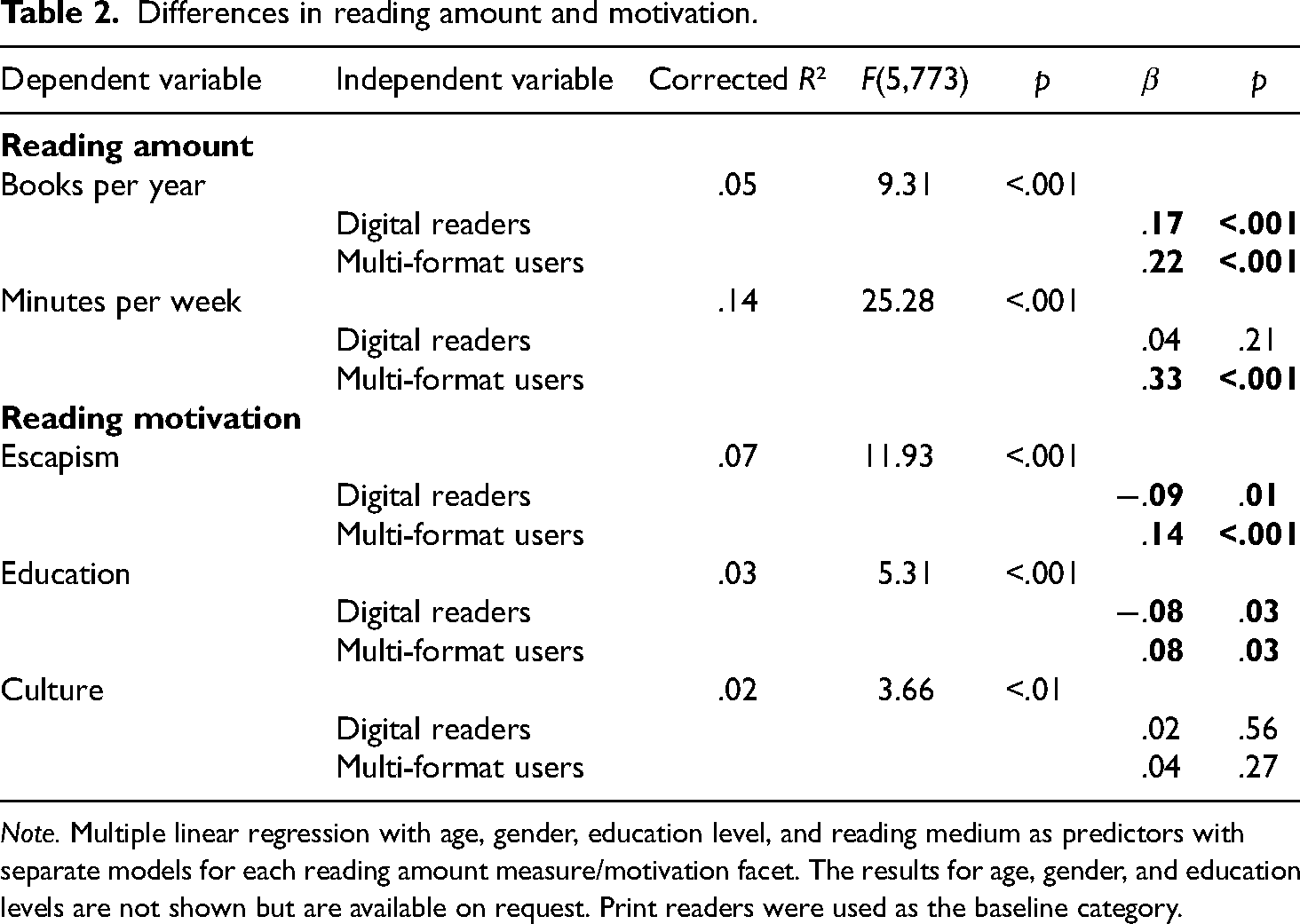
Note. Multiple linear regression with age, gender, education level, and reading medium as predictors with separate models for each reading amount measure/motivation facet. The results for age, gender, and education levels are not shown but are available on request. Print readers were used as the baseline category.
Differences in preferred genres and reading situations
Print readers, digital readers, and multi-format users differ in the genres they read. Especially, multi-format users seem to read more diversely than the other two groups. Multi-format users (but not digital readers) read more classic literature, romance/entertainment novels, crime/thriller/horror, and historical novels than print readers. Furthermore, multi-format users and digital readers read significantly more erotic novels and fantasy/science fiction than participants who only read printed books. However, print readers read significantly more non-fiction books than digital readers (but not multi-format users). There was no significant difference between the reading medium groups in reading poetry, contemporary literature, children's/young adults’ literature, biographies, guidebooks, and religious scriptures. The results for differences between the reading medium groups in reading situations are similar to the differences in genre. Multi-format users and digital readers seem to read in more diverse situations than print readers. Compared to print readers, multi-format users and digital readers read significantly more when they have only a little time to read and in public spaces, like on public transport, in public places outdoors and indoors, and at the workplace. Additionally, multi-format users read significantly more in libraries than print readers (see Table 3).
Differences in genre preferences and reading situations.
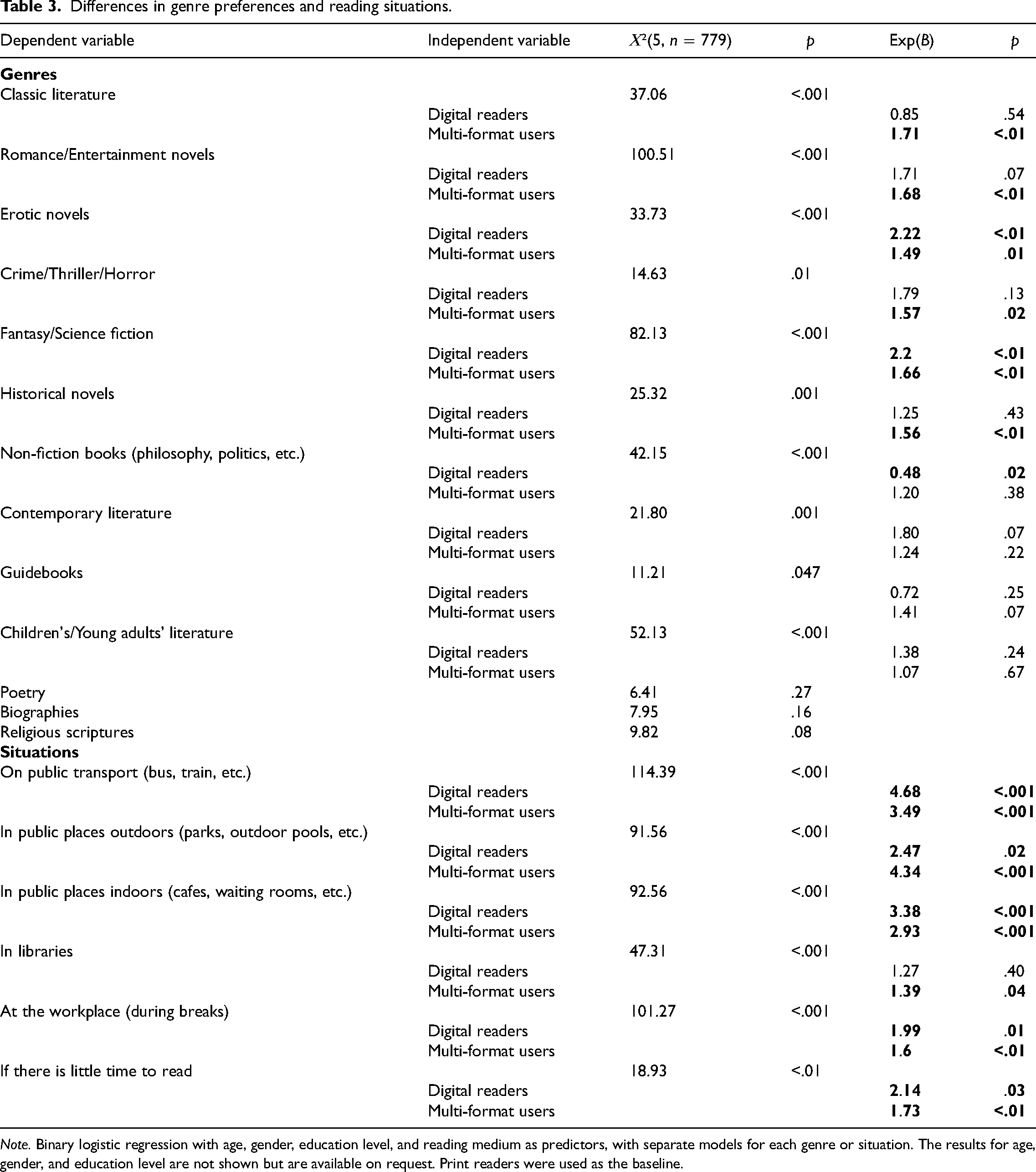
Note. Binary logistic regression with age, gender, education level, and reading medium as predictors, with separate models for each genre or situation. The results for age, gender, and education level are not shown but are available on request. Print readers were used as the baseline.
However, even though digital readers and multi-format users seem to be more diverse in their reading practice than print readers, the additional digital reading medium does not seem to be the reason for this diversification, but rather a tool utilized by a specific group of readers with pre-existing differences from print readers. Most participants disagreed with the statement that they read more books in general (Χ²(1, n = 200) = 4.5, p = 0.03) or books from different genres (Χ²(1, n = 243) = 6.92, p = .01) since they also started reading digitally. Furthermore, there was no significant difference in agreement or disagreement with the statement that participants noticed a change in reading at different times during the day and in situations where they only have a little time, since they also read digitally. However, most participants agreed that their places of reading have diversified since they started reading e-books (Χ²(1, n = 277) = 49.42, p <. 001).
Preferences in reading medium for specific genres and situations
While it seems that, overall, multi-format users read more diverse genres, in more diverse places, and in more diverse situations than other participants, the digital reading medium is not the preferred reading medium for most genres (see Table 4). Using only the data of the multi-format users, the Χ²-tests showed a significant preference for printed books when reading classic literature, poetry, children's/young adults’ literature, non-fiction books, guidebooks, and religious scriptures. Furthermore, the Χ²-tests regarding the preferred reading medium for contemporary literature, historical novels, and biographies did show significant differences in the answer distribution, but the category with the highest frequency was “no preference”. The pairwise comparisons showed that there was a significant difference between the answer categories “reading in print” and “reading digitally”, and no significant difference between “reading in print” and “no preference” when reading these genres. This means that print is at least more favored than digital reading devices when reading contemporary literature, historical novels, and biographies. In contrast, the Χ²-test regarding the preferred reading medium for erotic novels showed a significant difference in answer distribution, the highest frequency being in the “no preference” category. Furthermore, the pairwise comparisons showed that there was a preference for digital reading of erotic novels compared to print, and no significant difference between the “digital reading preference” and “no preference”, suggesting that digital reading devices are favored over print. Additionally, the Χ²-test for the preferred reading medium for fantasy/science fiction showed a significant difference in answer distribution, with the most answers in the “no preference” category. In contrast, there was no significant difference in the direct comparison of print and digital. Therefore, the interpretation is that there was no difference in the reading medium preference for fantasy/science fiction. Furthermore, there was no significant difference in reading medium preference in romance/entertainment novels and crime/thriller/horror.
Genre and situation dependent preferences for a specific reading medium.
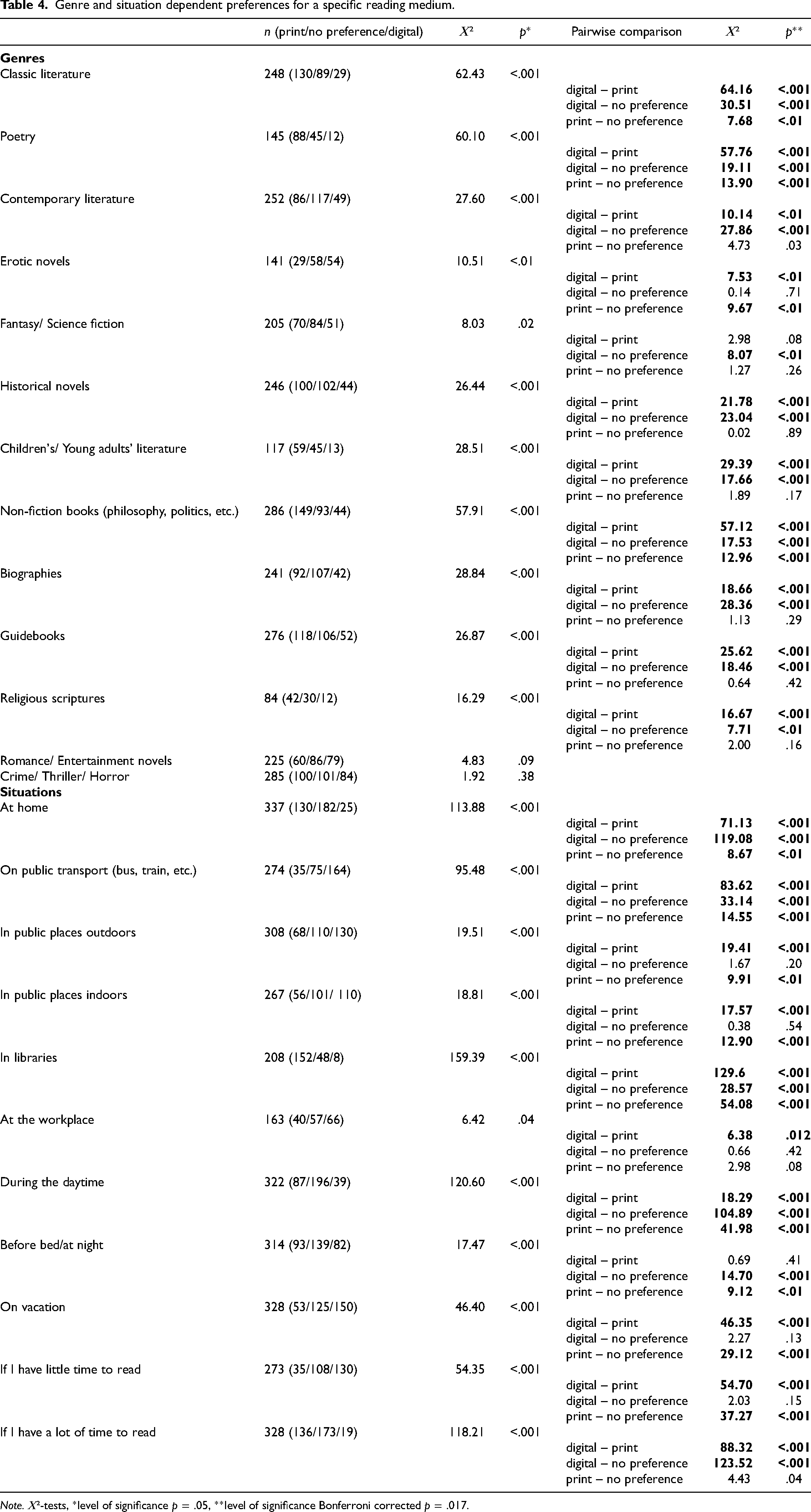
Note. Χ²-tests, *level of significance p = .05, **level of significance Bonferroni corrected p = .017.
In contrast, the results showed a very different pattern for the preferred reading medium in specific situations and in specific places (see Table 4). All of the Χ²-tests were significant. However, reading digitally was the preferred medium for reading on public transport, in a public place outdoors, in a public place indoors, in the workplace, on vacation, and if there is only a little time to read. Only in libraries was print the preferred reading medium. Nevertheless, in four cases, the category with the highest frequency was the “no preference” category. Pairwise comparisons, however, showed that reading in print was favored over reading digitally when reading at home, during the daytime, and if there is a lot of time for reading. The pairwise comparisons of reading printed or digital books before bed/at night were not significant, suggesting that there was no preference for a reading medium.
Discussion
To explore if digital reading devices and e-books herald “the end of the book”, we surveyed actual reading practices and individual differences of readers to determine which factors play a role in adopting digital book reading. Our results show that for leisure reading, the printed book is still the preferred reading medium and is more used than any digital reading device. About 90.8% of the participants still read printed books, either solely or in addition to digital reading media, while only 9.2% of the participants read only digital books. However, there are different aspects of who adopts digital reading and why. Our specific research questions asked how multi-format users, digital readers, and traditional print readers differ and if digital reading devices diversify reading practices. Furthermore, we explored the preferences in genres or situations when it comes to reading in print or digital format. The results clearly showed that:
1. There is a difference between traditional print readers, readers using only digital reading devices, and multi-format users.
2. Digital reading devices diversify the reading practice to a certain degree.
3. There are dedicated reading media for a couple of specific genres and situations.
First of all, multi-format users, digital readers, and print readers differ in their demographic. Digital readers and multi-format users are more often men, while print readers are more often women. These results are in line with a Japanese and a US-American study (Kurata et al., 2017; Zhang & Kudva, 2014), suggesting that this gender gap might not be a specifically national phenomenon. Moreover, print readers are on average older than digital readers. Even though digital reading devices offer some features which could especially meet the needs of elderly people—for example, the light weight of the device or the possibility of enlarging the font size—technophobia could hinder the acceptance of a digital reading device in older people (Hou et al., 2017). Education does not seem to be a crucial factor in the choice of reading medium in Austria. These results contradict the results of Zhang and Kudva (2014) and Faverio and Perrin (2022), who found that in the USA, §higher-educated people (at least college level) are more likely to read digitally than people with a lower education level (high-school level or less). However, due to the Austrian education system, our sample comprised only people with at least a secondary education level, which could explain the lack of variance and that we did not find an effect of education level on adoption of digital book reading.
Furthermore, the reading motivation differs between people reading via different reading media. Compared to print readers, the motivation to read for multi-format users is more often escapism and education, while escapism and education are less often the motivation to read for people reading only digitally. The assumption that print readers, in particular, would value aspects such as participation in cultural life or social recognition more than other readers is not confirmed and does not underlie the reading media decision. In contrast, the results show that multi-format users seem to have a stronger conscious reading motivation than the other two groups, while print and digital readers might not be aware of why they are reading a book. The reason could be that multi-format users have to reflect on which reading medium they use for a specific book and what the use of a specific reading medium implies for the reading experience.
In the USA, the number of books read is the strongest predictor of adoption of digital reading (Zhang & Kudva, 2014). Our results support this claim. Readers exclusively or additionally reading digitally seem to read more than people only reading print. In total, they read more books per year, and participants stating that they read on both reading media also read more minutes per week. However, the participants reported that the amount they read did not change when adopting digital book reading. The results suggest that rather than increasing the number of books read, digital reading devices are more appealing to people who already read a lot. This finding is not surprising, since e-books do not have a physical presence like printed books and therefore do not need to be stored on bookshelves at home and do not take up space in a suitcase. Furthermore, digital reading devices give immediate access to a large number of books, which might not even cost additional money (e.g., digital library access, Amazon Prime reading).
The results regarding readers’ genre preferences are similar. While there are differences in genre preferences between multi-format users, digital readers, and print readers, the digital reading devices did not seem to be the trigger for these differences, but again rather attract different people. It turns out that it is mainly multi-format users who read many different genres and thus show the most diverse spectrum of book reading. They stated that their genre selection did not change since they also read digitally, suggesting that they already read diverse genres when reading only in print. Nevertheless, for multi-format users, print is still the preferred reading medium for most genres. However, we were not able to replicate our focus group findings which stated that crime novels, thrillers, and other light fiction were preferably read digitally (Kosch et al., 2021). The survey showed that there is no preference for a reading medium when reading romance and entertainment novels or crime, thriller, and horror. Only erotic novels are rather preferred to be read digitally, most probably because of the greater anonymity when buying (i.e., ordering or downloading) and reading them.
Furthermore, the results are clear and revealing regarding reading places and situations. “Reading on the go is not new”, said Balling et al. (2019, p. 198). However, our findings suggest that it is more prevalent than before. The specific affordances of digital reading devices do not only enable reading in more kinds of different locations (Hupfeld et al., 2013), but they actually lead to additional reading on the go. Multi-format users and digital readers read more than print readers when they are not at home or when they only have a little time to read, and multi-format users also choose the digital reading medium in these situations. If the printed book is preferred at home, during the daytime, and when there is enough time, the preferred reading medium for reading on public transport, in a public place, on vacation, and if there is only a little time to read is the digital one. Furthermore, in our sample, digital readers reported reading in more diverse places since they started reading digitally, suggesting that digital reading changed their reading practice.
In summary, the results of the survey show that there are differences between traditional print readers and readers who read digitally exclusively or additionally. Book reading in the digital age has changed primarily in that reading now increasingly takes place on the go and in new situations and places.
However, our study is not without limitations. We conducted the survey online and therefore excluded people who do not use web-enabled devices in the process. Also, under some circumstances, readers’ personal preference for a reading medium may be irrelevant, due to the fact, that some books are only published as e-book or only published as printed book. Furthermore, even though most of our results are in line with international studies, some results might be a national phenomenon. The results about the influence of education level on the adoption of digital reading practices especially might be different to other countries due to the Austrian education system.
Of course, we recognize that reading or book cultures differ between countries (e.g., Kurschus, 2014). In particular, fixed book prices are a particularity that may affect medium choices. In general, however, we think our results are largely generalizable because most of them relate to the medium specific affordances, like the transportability or accessibility of books. Yet cross-national research is needed to further understand the contextual boundaries of our findings. Future research should focus on more interindividual differences, such as education level and digital literacy, but also on general access to technology and, in consequence, how possible differences could be reduced, such as the age or gender gap. Furthermore, listening to audiobooks is a totally different form of book consumption which has not changed much in its mode during the last 50 years but has become more accessible to a wider population due to digitization. Though it seems to be less studied than digital reading, it is an important aspect of consuming literature. Another desideratum is a comprehensive and transdisciplinary theoretical framework which includes specific forms of practice when dealing with printed or digital books. Particular attention would have to be paid to medium-specific practices such as page-turning versus scrolling, distraction, and reading interruptions with multifunctional reading devices, or differences in finishing and rereading books. Such a framework could help to differentiate further and specify more precisely broad surveys regarding digital and print reading.
In conclusion, we can say that today's digital reading of books in leisure time is mainly adopted by those people who read a lot, who read different genres, and who read in various places and situations. This means that experienced book readers especially extend their reading practice with the e-book because it is meeting their demands. The assumption that the e-book will replace the printed book therefore cannot be confirmed, because rather than an either/or, the e-book is a new technological complement to the printed book that is accepted above all by the group of frequent print readers.
Footnotes
Acknowledgements
We thank Jakob-Moritz Eberl for reviewing our survey.
Declaration of conflicting interest
The authors declared no potential conflicts of interest with respect to the research, authorship, and/ or publication of this article.
Funding
The authors disclosed receipt of the following financial support for the research, authorship, and/or publication of this article: The results presented here are part of the “Books on Screen” project P 31723-G30, funded by the Austrian Science Fund (FWF).

Notes
Author biographies
Annika Schwabe studied Psychology at the University of Vienna with a focus on Research Methods and Statistics and studied additionally International Development Studies. She also completed the postgraduate training in Emergency Psychology and Psychological Crisis Management at the Sigmund Freud Private University and is a lecturer for Statistics at the Faculty of Psychology of the University of Vienna. Since June 2019, she has been working on her dissertation in Communication Sciences, dealing with the cognitive, social, and emotional aspects of the digitization of fiction reading.
Lukas Kosch studied German Literature and History at the University of Vienna and is doing research on post-war literature and philosophy. He taught German and created teaching materials for the Austrian Mediathek (project “Interviews als Quelle”). In his doctoral thesis he is searching for the localization und function of the reader in literary theory.
Hajo G. Boomgaarden is Professor of Empirical Social Science Methods with a Focus on Text Analysis at the Department of Communication, and currently Dean of the Faculty of Social Sciences at the University of Vienna. Previously, he has worked as an Associate Professor for Political Communication at the Amsterdam School of Communication Research and the Department of Communication at the University of Amsterdam. Currently, he is principle investigator of the Media Side project of the Austrian National Election Study and in the H2020 projects REMINDER and MIRROR. He serves as deputy scientific director of the Austrian Social Science Data Archive, deputy director of the Vienna Center for Electoral Research and Scientific Board member of the European Social Survey. He is an Associate Editor of the Journal of Communication. His research interests focus on content analyses of media portrayals of politics, on media effects on political attitudes and behaviors, on the effects of media on cognitive processes and on methodological advances of content analysis techniques. He has (co-)authored more than 80 international journal articles and numerous book chapters on issues such as media and European integration, media election campaign and issue coverage, media effects on economic perceptions, immigration attitudes and extreme-right voting and on framing effects.
Günther Stocker is a university professor for German Literature at the University of Vienna; studied German Literature and Communication Studies at the Universities of Salzburg and Zurich, 1996 PhD. from the University of Salzburg; Habilitation at the University of Vienna (2007); lecturer at the Universities of Rome III, Cassino, and Salzburg; APART-Scholarship from the Austrian Academy of Sciences; main research areas: postwar- and Cold War literature, Austrian literature, reading research.