



Abstract
Using mobile media can be both detrimental and beneficial for well-being. Thus, explaining how and when they elicit such effects is of crucial importance. To explicate boundary conditions and processes for digital well-being, this article introduces the Integrative Model of Mobile Media Use and Need Experiences (IM³UNE). Instead of assuming mobile media to be pathogenic, the IM³UNE offers a salutogenic perspective—it focuses on how we can stay healthy when using mobile media ubiquitously in daily life. More specifically, the model assumes that both the satisfaction and the frustration of basic psychological needs are key underlying mechanisms linking demanding mobile media use to well-being. However, the impact of these mechanisms is contingent on how users perceive, appraise, act on, and make sense of mobile media demands according to their global orientation to life (i.e., their sense of coherence, SOC). Integrating prior work, we theoretically link mindfulness, self-control, and meaningfulness to SOC's central facets, arguing that they represent crucial personal resources required to cope with mobile media demands. Thus, the offers an integrative framework, guiding further research towards a more nuanced study of mobile media’s effect on well-being.
Introduction
Mobile media afford anytime, anyplace connectivity (Vanden Abeele et al., 2018), allowing us to be permanently online and permanently connected with others (POPC; e.g., Vorderer et al., 2016). However, using mobile and social media appears to affect individuals’ well-being both positively and negatively (e.g., Meier & Reinecke, 2020; Reinecke, 2018; Vanden Abeele, 2020). This ambivalence has recently been coined the “mobile connectivity paradox” (Vanden Abeele, 2020). Central to this dualism is the notion that mobile devices offer numerous features serving multiple purposes, which, in turn, can be perceived and experienced in both positive and negative ways. For instance, mobile connectivity in terms of technical cues (Bayer, Campbell, et al., 2016) such as audiovisual message notifications may increase the feeling of connectedness and companionship (Oulasvirta et al., 2007), thereby satisfying the need for relatedness. In contrast, absent notifications may ostracize users, thereby frustrating this need (Schneider et al., 2017). At the same time, receiving such signals may elicit feelings of communication overload, stress, and the obligation to respond immediately (Mai et al., 2015; Reinecke et al., 2017). We conceive such stimuli as mobile media use demands that challenge digital well-being; that is, the “optimal balance between the benefits and the drawbacks obtained from mobile connectivity” (Vanden Abeele, 2020, p. 7). If mobile connectivity causes positive and negative effects simultaneously, this could be explained by differing subjective appraisals, experiences, and the coping resources of individuals. Thus, the following research problem arises: what are the underlying mechanisms and boundary conditions that result in differential effects on well-being? To address this question, the present article introduces the Integrative Model of Mobile Media Use and Need Experiences (IM3UNE; see Figure 1), which explains how and when mobile media use leads to well-being.
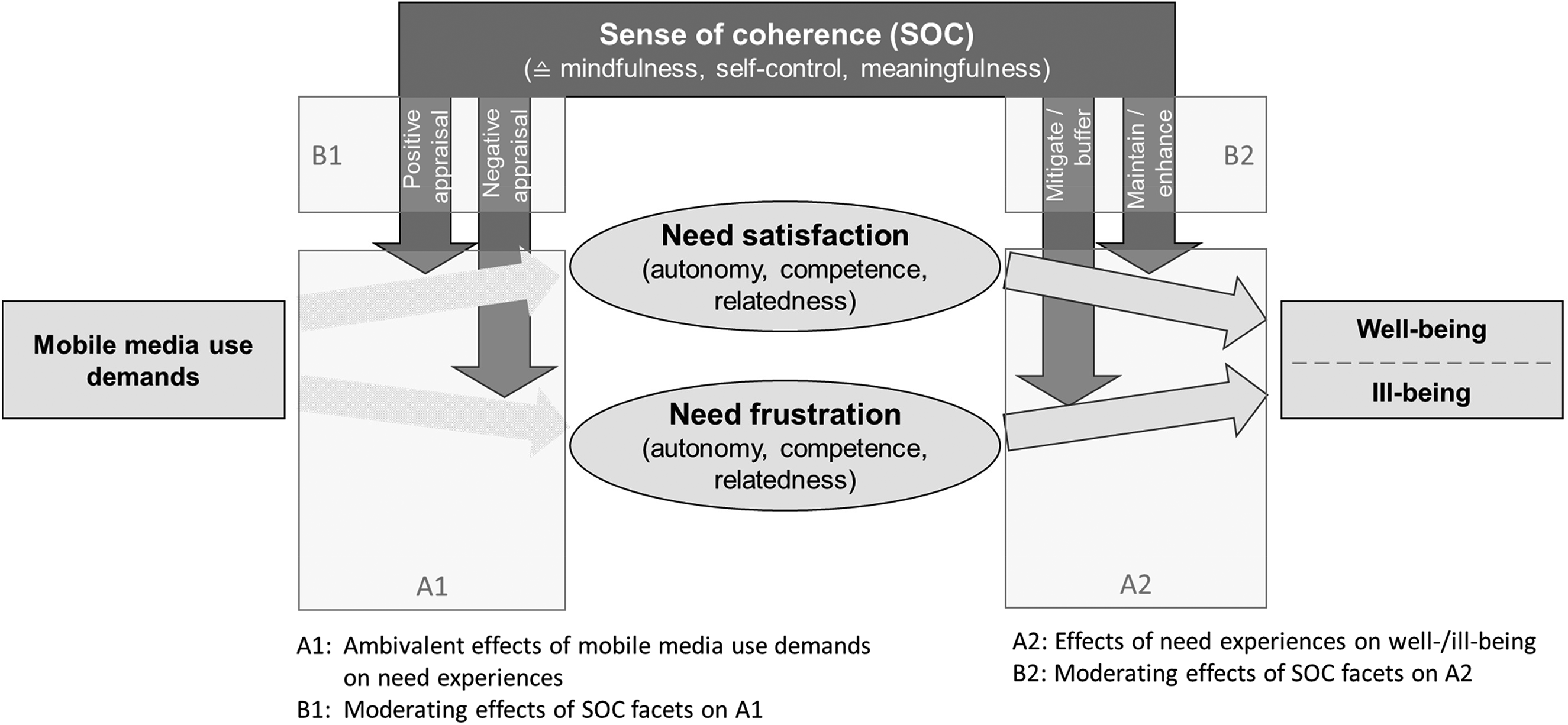
Integrative Model of Mobile Media Use and Need Experiences (IM3UNE)
Drawing on self-determination theory (SDT; Ryan & Deci, 2017), we conceptualize the satisfaction and frustration of basic needs—autonomy, competence, and relatedness—as the mechanisms (i.e., the hows) between mobile media use and well-being (see Figure 1-A1 and A2). However, current SDT research demonstrates that moderators (i.e., the whens) crucially modify the relations between both everyday contexts and need experiences as well as between need experiences and health outcomes (Vansteenkiste et al., 2020). Our model thus delineates under which conditions mobile media users experience need satisfaction versus frustration, and under which conditions these experiences result in well- or ill-being (see Figure 1-B1 and B2, respectively).
To identify these conditions, we apply a salutogenic approach that proposes boundary conditions for human thriving, rather than suffering (Antonovsky, 1987). Following recent developments introducing positive psychology into communication research (e.g., de Leeuw & Buijzen, 2016; Raney et al., 2021), this offers an alternative to previous approaches, which often conceptualized (mobile) media use as a stressor that, by definition, should negatively impact well-being (e.g., Hefner & Vorderer, 2017). Whereas a pathogenic perspective understands the human system as well-functioning unless it is confronted with inherently negative stressors, a salutogenic perspective assumes that environmental demands are omnipresent and inevitable in the human condition; in fact, they are necessary for personal growth. The perceived valence of these demands and their beneficial versus detrimental effects strongly depend on appraisal processes and personal coping resources. In this way, mobile media use is neither good nor bad per se and even seemingly negative aspects of mobile media use may promote well-being in the long run. In the following, we further explicate this notion under the integrative concept of mobile media demands. We then propose that whether mobile media demands either satisfy or frustrate needs, resulting in well- or ill-being respectively, is mainly conditioned on individuals’ sense of coherence (SOC; e.g., Antonovsky, 1987, 1996). SOC is the essential construct in the salutogenic approach and reflects a trait-like, global orientation to embrace life as comprehensible, manageable, and meaningful. Although SOC may be new to many media scholars, its facets can be theoretically connected to three constructs that have received increasing attention in media research—mindfulness, self-control, and perceived meaningfulness (Schneider et al., 2019). We build on these ideas and extend them by scrutinizing the moderating roles of these constructs. Consequently, we explain how the interplay of mobile media demands, need experiences, and well-being is conditioned by these three SOC-related constructs. In conclusion, the present theoretical contribution models how and when specific demands arising from a POPC lifestyle (e.g., mobile connectivity) impact well-being, for better or worse.
Mobile media use demands and well-being
Mobile media use demands (short: mobile media demands) are stimuli stemming from the mobile device or from intrapersonal states which are deeply linked to mindsets of mobile media use. Although the concepts of mobile media use and demands overlap most of the time, at least two key differences need to be noted. First, only stimuli from mobile media use that have the potential to be appraised as challenging qualify as demands (e.g., notifications may disrupt and guide orientation simultaneously; Licoppe, 2010). Second, mobile media demands go beyond mere use because mindsets like online vigilance (Klimmt et al., 2018) may challenge users even when the mobile device is not currently used.
Importantly, the smartphone as a “metamedium” (Humphreys et al., 2018) contains many constituent media. Most of the time, demands arise from common functions related to mobile connectivity (e.g., connection cues, connection load, availability; Bayer, Campbell, et al., 2016; LaRose et al., 2014; Reinecke et al., 2017; Thomée et al., 2011). We can organize and analyze these demands alongside different levels of the hierarchical computer-mediated communication (CMC) taxonomy (see Meier & Reinecke, 2020): For instance, mobile media demands arising from unread messages in a messenger group can be situated on various levels (i.e., device, type of application, branded application, feature, interaction, and message; for a detailed example, see Online Appendix, Part I). For this reason, we here also consider research beyond the device level when building our theoretical model below. For instance, as 98.8% of all social media users access their applications via mobile devices (DataReportal, 2021), many findings on the application or branded-application levels apply to mobile media devices as well. However, demands can also arise from other constituent media beyond CMC (e.g., news, music, games, video content, etc.), or even from the device itself. For instance, demands may arise from notifications that a mobile game should be continued, that a device's battery status is low, or that a train is delayed.
Previous works related to mobile media use have emphasized such mobile stimuli as “stressors” that elicit a stress-coping response (e.g., Hall et al., 2021; Hefner & Vorderer, 2017), implying an inherently negative and stress-inducing character of specific mobile media demands like communication load or availability demands (e.g., LaRose et al., 2014; Reinecke et al., 2017; Thomée et al., 2011). However, whether mobile media demands are perceived as positive, irrelevant, or dangerous (e.g., need threatening) relies heavily on individual appraisal processes. For instance, after posting a message via instant messenger, hundreds of responses may be just as overwhelming as no responses. Thus, from a salutogenic perspective, the neutral term “demands” is preferable to “stressors” (Antonovsky, 1987). In other words, mobile media demands are neither necessarily detrimental to well-being nor at the root of ill-being; rather, they may challenge but also support individuals’ mental health.
Mental health is an inclusive umbrella term comprising both a positive (i.e., well-being proper) and negative side (i.e., ill-being or psychopathology), as integrated by recent two-continua models (for a discussion and integration, see Meier & Reinecke, 2020). Accordingly, well-being and ill-being are two distinct but moderately and negatively correlated continua, each tapping into unique sets of psychological phenomena. Whereas well-being is concerned with optimal functioning and experience (e.g., positive affect, satisfaction in life, and personal growth), ill-being comprises severe impairment of functioning and distressing experiences such as depression or anxiety (Vansteenkiste & Ryan, 2013). Basic psychological needs theory (BPNT), a sub-theory of SDT, proposes that need experiences—the satisfaction or frustration of basic needs—crucially explain well- and ill-being (Martela & Sheldon, 2019; Vansteenkiste et al., 2020). This means that need experiences are not equivalent to well- or ill-being but represent key mechanisms. In line with recent conceptualizations of digital well-being (Vanden Abeele, 2020), the IM3UNE considers maximizing benefits (here: need satisfaction) and minimizing the drawbacks (here: need frustration) of mobile connectivity as essential for well-being. Thus, whereas well-being results from need experiences in general, digital well-being results from need experiences elicited by mobile media demands. In the following, we briefly introduce the basic tenets of BPNT and integrate previously fragmented evidence on the link between mobile media demands, need experiences, and well-being.
The hows: basic need satisfaction and frustration
BPNT proposes that three basic psychological needs—autonomy, competence, and relatedness—are crucial for individuals to flourish. Vansteenkiste et al. (2020) describe the consequences of satisfying versus frustrating these needs as follows: satisfying the need for autonomy, defined as an experience of volition and willingness, is associated with self-endorsed and authentic actions, thoughts, and feelings. In contrast, its frustration involves feelings of pressure and being pushed in an unwanted direction. Competence—the experience of mastery and effectiveness—is satisfied by activities that allow using skills and extending expertise. Its frustration is characterized by experiences of failure, ineffectiveness, and helplessness. Relatedness refers to the experience of bonding and, when satisfied, leads to the feeling of connection to others. When frustrated, one feels lonely and socially excluded.
Importantly, satisfying versus frustrating psychological needs are qualitatively different and show an asymmetrical relation: “[W]hereas low need satisfaction does not necessarily involve need frustration, need frustration by definition involves low need satisfaction” (Vansteenkiste & Ryan, 2013, p. 265). Thus, need satisfaction is argued to provide surplus resources that explain the positive state of well-being (Martela & Sheldon, 2019), whereas need frustration—more so than the mere lack of need satisfaction—explains ill-being (Vansteenkiste & Ryan, 2013, p. 265).
Due to the previously documented ambiguous effects of mobile media, we assume that mobile media demands—particularly those related to connectivity—generate variations in need experiences that explain well- and ill-being.
Mobile media use and needs experiences
BPNT plays an important role in research on the uses and effects of interactive media (e.g., Rigby & Ryan, 2017) and is increasingly applied to interpersonal computer-mediated communication. For example, the frequency and duration of online communication have been found to predict satisfaction of autonomy, competence, and relatedness (Ang et al., 2015). Further, individuals use social network sites (SNS) to fulfill their intrinsic needs (e.g., Karahanna et al., 2018). However, studies linking need satisfaction to demanding media use produced inconsistent results: whereas perceived social pressure to use Facebook increased competence and relatedness but decreased autonomy in one study (Reinecke et al., 2014), social pressure to be available in mobile communication decreased autonomy and competence but had no direct effect on relatedness in another (Halfmann & Rieger, 2019). Concerning relatedness, frequent Facebook use was associated with feeling both connected and disconnected at the same time (Sheldon et al., 2011).
Only a limited number of studies investigated whether SNS can also be a source of need frustration. For instance, fundamental needs (i.e., belonging, self-esteem, meaningful existence, and control) that are theoretically related to those postulated in BPNT are threatened when users feel ignored or excluded from social online interactions because they did not receive responses to their posts online (e.g., Lutz & Schneider, 2020; Schneider et al., 2017). Following Vanden Abeele (2020), expectations about immediate availability put users under pressure to permanently check their devices, which in turn may frustrate their autonomy. Frequently receiving smartphone notifications can lead to interruptions from offline activities (e.g., work) and may thus decrease competence (Kushlev et al., 2016).
In sum, the available evidence suggests that mobile media demands can lead to both satisfaction and frustration of basic psychological needs (see Figure 1-A1; please note that only paths to and from need experiences are depicted; for specific paths concerning the respective three basic needs, see our hypotheses in the Online Appendix). In the following, we thus highlight their downstream effects on well-being.
Need experiences and well-being
In the last two decades, research found empirical support for the positive and negative consequences of satisfied versus frustrated needs, respectively, across individuals and cultures on well-being (e.g., Ryan & Deci, 2017). In contrast to this rich literature, findings on the consequences of need experiences resulting from (mobile) media use on well-being are still scarce.
Nevertheless, a growing number of studies predominantly focusing on relatedness satisfaction support the idea of need experiences as underlying mechanisms of the effects of mobile media demands (e.g., of those that come along with SNS use) on well-being. For instance, these studies found that Facebook use satisfied the need for relatedness, which was in turn associated with less depression and anxiety and greater life satisfaction (e.g., Grieve et al., 2013). Moreover, the effect of posting status updates on loneliness was mediated by perceived connectedness (große Deters & Mehl, 2013). Social support, a theoretical construct closely connected to relatedness need satisfaction, has also been shown to mediate the effects of SNS use on stress, physical illness, well-being, and depression (Lee & Cho, 2019; Nabi et al., 2013). In contrast, being socially excluded on social media impaired well-being (e.g., Schneider et al., 2017). Additionally, some studies investigated autonomy as a predictor of well-being: for instance, an autonomous motivation to use instant messengers (Bauer et al., 2017) or Facebook (Manuoğlu & Uysal, 2020) was positively related to well-being. Rieger et al. (2017) also highlighted the importance of autonomy satisfaction in the interplay of smartphone use and stress recovery.
Further research investigating the mediating role of need experiences found that competence and autonomy satisfaction mediated the effects of social pressure to be available on well-being (Halfmann & Rieger, 2019). Moreover, all three needs mediated the effects of online communication on life satisfaction (Ang et al., 2015).
However, little light has been shed on the simultaneous roles of need satisfaction and frustration. In one rare study, four distinct psychological needs’ profiles of SNS users—“unsatisfied and frustrated,” “satisfied and un-frustrated,” “average,” and “satisfied and frustrated”—had unique relationships with their well-being (R. Li et al., 2020). Similarly, the effects of digital autonomy experiences on stress and authenticity were mediated by daily general need satisfaction and frustration except for the effect of digital autonomy frustration on stress, which was not mediated by relatedness frustration (Meier, 2018).
Taken together, these findings support the close connection between need experiences (induced by mobile media demands) and well-being (Figure 1-A2) as well as the mediating role of need experiences in the relationship between mobile media demands and well-being (Figure 1-A1 and A2; please note that the indirect paths via need experiences are not explicitly depicted but implied).
The whens: facets of SOC
Experiencing need satisfaction and frustration as well as their effects on well- and ill-being have often been considered independent of individual or cultural factors (e.g., Ryan & Deci, 2017). Nevertheless, Vansteenkiste and Ryan (2013) theorized that salutogenic factors such as autonomous functioning and mindfulness can protect against the detrimental effects of need frustration on ill-being. Likewise, recent empirical work corroborates the assumption of potential moderators in the need experience–well-being relation (e.g., Neubauer et al., 2018; van Assche et al., 2018). In a recent review of BPNT, Vansteenkiste et al. (2020, pp. 17–20) highlighted that moderators can alter: (a) the relation between need-supportive and need-thwarting contexts and their appraisal in terms of need satisfaction and frustration, respectively; as well as (b) the relation between need experiences and health outcomes. In the IM³UNE (Figure 1), the former relation refers to Figure-A1, whereas the latter refers to A2, respectively.
Following this new perspective on the role of boundary conditions in BPNT (Vansteenkiste et al., 2020) and drawing on a salutogenic take on mobile media (Schneider et al., 2019), we propose that SOC as a salutary trait can take such a moderating role (Antonovsky, 1987). SOC is conceptualized as a specific way of viewing life from a resource-oriented perspective and defined as a “generalized orientation toward the world which perceives it, on a continuum, as comprehensible, manageable and meaningful” (Antonovsky, 1996, p. 15). Comprehensibility (the cognitive facet of SOC) refers to the perception of internal and external stimuli as understandable, clear, and structured. Manageability (the behavioral facet) refers to the confidence in having the skills and using them successfully to deal with life's demands. Meaningfulness (the emotional-motivational facet) refers to the feeling that the demands one faces in life are challenges, worthy of investment and engagement (Antonovsky, 1987). Specifically, we highlight how these facets affect the appraisals of mobile media demands resulting in need experiences (Figure 1-B1) and their respective effects on well-being (Figure 1-B2).
According to Antonovsky (1996), a strong SOC is associated with two health-promoting effects: Firstly, it helps individuals to appraise demands as non-stressors, which in turn decreases the susceptibility for experiencing tensions. In other words, SOC buffers against perceiving environmental stimuli as threatening. For instance, how signals of incoming messages are interpreted depends on how users appraise these cues against the backdrop of their SOC. For individuals with a strong SOC, technical cues are less likely perceived as need-frustrating and more likely perceived as need-satisfying (Figure 1-B1). Secondly, in case of tensions elicited by negatively interpreted mobile connectivity cues, a strong SOC helps mobilize resources for efficient coping (Antonovsky, 1996), which, in turn, may help to prevent or weaken the unabated effects of need frustration and low need satisfaction on well-being (Figure 1-B2). These assumptions are also in line with recent research that examined how cognitive coping resources and stress reappraisals help individuals to beneficially deal with tensions (Crum et al., 2013; Jamieson et al., 2018). For instance, Jamieson et al. (2018) reviewed how physiological arousal could be reappraised in such a way that—instead of experiencing the malignant effects of threat perception—individuals could capitalize on reframing their arousal as a challenge. Threat appraisals were positively related to need frustration and negatively related to need satisfaction, whereas for challenge appraisals it was the other way around (Bartholomew et al., 2017). Appraisals thus seem to play a vital role in need experiences too.
From a salutogenic perspective, SOC is the most important “game-changer” in appraisal processes. Although many protective factors and resistance resources have been researched to explain health-related stress experiences, SOC seems to play a more prominent—and overarching—role compared to these conceptually and empirically overlapping other constructs. Theoretically, Antonovsky (e.g., 1996) argued that SOC is an amalgam of what all those constructs have in common that help to build up resistance resources. Yet, more than that, “it is the particular combination of the cognitive, behavioral and motivational which is unique” (Antonovsky, 1996, p. 15). Empirically, SOC showed incremental validity above and beyond separate salutogenic factors (e.g., optimism, self-efficacy, self-compassion; Grevenstein, Aguilar-Raab, et al., 2016; Grevenstein, Bluemke, et al., 2016). However, SOC has rarely been researched in the field of mobile media use. To argue for its applicability, we draw on its three facets and explain how they theoretically relate to traits that have been previously studied in the context of mobile media effects (Schneider et al., 2019). More specifically, following Schneider et al. (2019), we link mindfulness to the cognitive facet of SOC (comprehensibility), self-control to the behavioral facet (manageability), and meaningfulness to the emotional-motivational facet (meaningfulness).
Mindfulness
Mindfulness—“a receptive attention to and awareness of present events and experience” (Brown et al., 2007, p. 212)—is usually considered as a particular state that helps to focus on and accept what happens in the present moment. Individuals who have a cross-situationally consistent tendency to do so are dispositionally mindful. As moment-to-moment awareness and “understanding” the environmental stimuli are key to SOC's cognitive facet, mindfulness is theoretically related to comprehensibility (Schneider et al., 2019). Trait mindfulness plays an important moderating role in predicting self-regulation and well-being (e.g., Bowlin & Baer, 2012; Brown et al., 2007). Previous studies suggested that more mindful people tended to perceive less stress in response to threatening states and in their daily lives in general and that they recovered better from stressful experiences than less mindful people (Guidetti et al., 2019; Weinstein et al., 2009).
The specific role of trait mindfulness in the interplay of mobile media demands, need experiences, and well-being has been explored as well. Firstly, trait mindfulness has been shown to moderate the link between demands and need experiences (Figure 1-B1). For instance, less autonomy-supporting work and teaching environments were more need-frustrating for less mindful employees or students (C. Li et al., 2019; Schultz et al., 2015). Concerning mobile media use, Hefner et al. (2018) argued that mindfulness helps users not to give in to social connection norms without reflection and to act more in accordance with their own goals when receiving notifications. Such behaviors should beneficially affect the users’ need experiences in a POPC environment. Thus, trait mindfulness should moderate the effects of mobile connectivity demands on need experiences.
Secondly, the negative effect of need frustration and low need satisfaction on well-being should be less pronounced for individuals high in mindfulness (Figure 1-B2). Experimental evidence showed that mindfulness moderated need recovery after experiences of ostracism: individuals higher in state mindfulness showed more recovery—likely because they stopped focusing on the experience of exclusion (Molet et al., 2013). In a similar vein, mindfulness could help users to stop focusing on media-induced threatening states, which should decrease negative effects on well-being. Previous research further demonstrated that frustrated needs triggered impulsive, uncontrolled behaviors; for instance, uncontrolled eating (Verstuyf et al., 2013). Similarly, low levels of need satisfaction in daily life were linked with uncontrolled Facebook usage (Masur et al., 2014). Importantly, trait mindfulness reduced the risk of uncontrolled media use and the negative consequences of such behavior for the well-being of users (e.g., less negative affective experiences; Bayer, Dal Cin, et al., 2016). Overall, we argue that mindfulness moderates the relation between mobile media demands and need experiences (Figure 1-B1) as well as between need experiences and well-being (Figure 1-B2).
Self-control
Not only mindfulness but also self-control enables individuals to use media in a more controlled way (Bayer, Dal Cin, et al., 2016). Self-control is defined as “the ability to override or change one's inner responses, as well as to interrupt undesired behavioral tendencies and refrain from acting on them” (Tangney et al., 2004, p. 275). It empowers individuals to align their actions with their goals and values—even in the presence of temptation (Kotabe & Hofmann, 2015). As self-controlled individuals successfully manage conflicts between personal goals and counter-productive behavior, self-control and the manageability facet of SOC are strongly theoretically linked (Schneider et al., 2019). Trait self-control has been shown to promote well-being and this effect complements rather than replaces the beneficial effects of trait mindfulness (Bowlin & Baer, 2012). In the context of mobile media use, trait self-control is likely to enable more controlled, adaptive responses to external triggers of media use (e.g., notifications) as well as to internal triggers (e.g., boredom, negative affect).
More specifically, dispositional self-control should moderate the link between mobile media demands and need experiences (Figure 1-B1). Mobile connectivity demands such as technical cues often trigger habitual usage behavior; for instance, automatic unlocking of the smartphone screen (Bayer, Campbell, et al., 2016). Goal conflicts arising from such automatic usage may impair need satisfaction (Hofmann et al., 2009). However, if individuals are motivated to exert self-control, the association between habits and uncontrolled smartphone use is reduced (Schnauber-Stockmann et al., 2018). Individuals with high self-control have also been found to experience more intrinsic need satisfaction while watching television and using social media than individuals with less self-control (Johnson et al., 2021). A particular challenge in mobile communication is the perceived social pressure to be available for others, often prompted by technical cues (Bayer, Campbell, et al., 2016). If users frequently give in to such pressure, this limits their fulfillment of intrinsic needs (Halfmann & Rieger, 2019). Here, too, high self-control allows users to reflect more on what their own goals are and to give in to the pressure less often (Halfmann & Rieger, 2019; Schneider et al., 2019).
Moreover, trait self-control should help individuals to cope with frustrated or unsatisfied needs in a way that does not harm their well-being (Figure 1-B2). As explained above, experiences of low need satisfaction and need frustration can trigger uncontrolled behavior, including uncontrolled media use as an unreflective, impulsive attempt to feel better (e.g., Masur et al., 2014; Verstuyf et al., 2013). The fact that this behavior tends to be detrimental to well-being has been much discussed and researched under the label of “Internet or smartphone addiction” (for an overview, see Müller et al., 2017). However, failures of self-control can have negative consequences even if media use is not excessive. For example, perceived conflicts between media use and other goals may trigger feelings of guilt (Halfmann et al., 2021; Panek, 2014). Thus, self-control enables individuals to avoid or reduce dysfunctional coping with unsatisfied or frustrated needs and the negative effects on well-being (e.g., Hofmann et al., 2017; Reinecke, 2018).
Meaningfulness
Meaning in life, one's sense of having a significant purpose in life and understanding the world around, is perhaps the most important facet of SOC (e.g., Antonovsky, 1987; Schneider et al., 2019). Although there is considerable debate about the conceptualization of meaning in life and its components, its crucial role for health and well-being is undisputed (e.g., Czekierda et al., 2017; Hooker et al., 2018). In particular, it buffers against stress and enhances coping processes (e.g., Park, 2010; Park & Folkman, 1997). Thus, similar to trait mindfulness and self-control, the moderating role of meaningfulness in the relation between stressors and adaptive processes (Figure 1-B1) has been supported in various studies (e.g., Park, 2010; Pulopulos & Kozusznik, 2018). Sensing meaning has also been linked to mobile media use. For instance, Trepte and Oliver (2018) argued that being POPC helps users to make sense of their world and deal with issues of meaning in life. Feelings of meaningfulness frequently arise when individuals encounter inspiring pictures or “memes” (e.g., pictures depicting thoughtful sayings) on social media platforms (e.g., Meier et al., 2020; Rieger & Klimmt, 2019). These findings emphasize the benefits of meaningfulness during media use. Still, to our best knowledge, scholars have rarely examined the moderating influences of trait-like global meaning in life on determinants and consequences of need experiences—neither on the effects of mobile media demands (Figure 1-B1) nor on the relationship between satisfied or frustrated needs and well-being (Figure 1-B2). Nevertheless, it seems safe to assume that a global meaning in life can buffer against stress and foster adaptive processes while engaging in media use as well. Besides the above-cited empirical work supporting the buffering role of meaning in life and its crucial importance for well-being, at least one prominent theoretical rationale lends weight to such an assumption. Research on the meaning-making model provides empirical support for the influence of global meaning (i.e., general orientation in life) on appraisals in potentially stressful or demanding situations (Park, 2010; Park & Folkman, 1997), thereby connecting it to coping with need-threatening states and the SOC concept (Antonovsky, 1987).
Overall, we argue that a trait-like global sense of meaning in life will influence the relation between mobile media use and need experiences, particularly when mobile media puts demands on the user (Figure 1-B1). If these demands are interpreted according to personal life goals and values, they make sense and fulfill fundamental needs rather than frustrate needs and inflict harm. In other words, global meaning in life helps mobile media users positively resolve ambivalence, mitigate frustrations, and integrate these experiences into their orientation towards the world. This, in turn, fosters wellness and growth (Figure 1-B2).
Discussion
To reconcile different theoretical branches and seemingly inconsistent empirical findings in digital well-being research, the IM3UNE sheds light on central mechanisms and conditions—the hows and whens—of the effects of mobile media demands on well-being. On the one hand, over the last decades, BPNT has proven to be a fruitful approach to explain variations in (mal)adjustment and well-/ill-being. Yet how need satisfaction and frustration simultaneously impact well-being in a POPC environment has mostly been neglected so far. Distinguishing between different need experiences, however, provides deeper insights into the ambiguous effects of mobile media demands. As these demands can lead to need satisfaction and frustration, which in turn affects well-being, these experiences are conceptualized as the “how” component within the IM3UNE. In a first step, this model assumes that mobile media demands (e.g., mobile connectivity cues such as audiovisual notifications indicating incoming messages) either frustrate or satisfy the needs for autonomy, competence, and relatedness (Figure 1-A1). In a second step, these need experiences contribute to well-being (Figure 1-A2).
Similar to other “problematic” uses of media, the smartphone as a pathogenic stressor per se has received much attention in the last years. In contrast, employing a salutogenic perspective, the IM³UNE follows recent developments to introduce positive psychology into communication research (e.g., de Leeuw & Buijzen, 2016; Raney et al., 2021) by focusing on what helps mobile media users cope with the demands of mobile connectivity. From a BPNT perspective, this is plausible because the appraisals of need experiences as well as their effects on well-being depend on certain conditions—the “when” component within the IM³UNE—such as salutogenic traits associated with individuals’ SOC (Antonovsky, 1987).
The hows and whens interact in such a way that, in the first step, facets of SOC should moderate how mobile media demands are appraised in terms of need experiences (Figure 1-B1). More precisely, individuals with pronounced mindfulness, self-control, and meaning in life—that is, those with a strong SOC—are less likely to perceive mobile media demands as need frustrating and more likely to experience them as satisfying (Figure 1-B1).
In the second step, particularly when needs are unsatisfied or frustrated, these three facets of SOC should mitigate the negative effects of media-induced threatening states on well-being by enhancing coping processes (Figure 1-B2). These considerations highlight “when” or “for whom” mobile media demands can increase well-being.
In the present paper, we explicitly focus on this unidirectional relationship (i.e., between mobile media demands and well-being) and its underlying processes and boundary conditions. Nevertheless, although they are not depicted in Figure 1, we do not preclude transactional effects like those proposed in the differential susceptibility to media effects model (Valkenburg & Peter, 2013). For instance, successfully dealing with mobile media demands may increase well-being which in turn may help positively appraise and cope with future mobile media demands (i.e., leading to an upward spiral; e.g., Fredrickson & Joiner, 2018). Such reciprocal relationships between mobile media demands and well-being are beyond the scope of this paper and require additional research attention before they can be integrated into the IM³UNE.
Taken together, the IM³UNE offers a fresh and individual-centered perspective by hypothesizing how and when mobile media demands affect well-being for better and for worse. The IM³UNE implies many testable predictions (e.g., the mediating effects of different need experiences and the moderating effects of SOC facets); we do not reiterate these predictions here but exemplify derived hypotheses in the Online Appendix.
How can the IM3UNE be empirically tested? The model's different paths can perhaps best be investigated using multi-methodological longitudinal designs, innovative operationalizations, and cross-validations (Schneider et al., 2018). Such endeavors must account for aspects of the situation and the person (e.g., specific mobile media demands, appraisals, coping resources), capture not only interindividual differences but also intraindividual change, and reflect on the limitations of relying purely on self-report measures. Moreover, they must aim at disentangling the proposed paths from potential reciprocal relations and rule out reverse causality. Although not directly testing the IM³UNE, a recent study on the effects of online vigilance, for instance, demonstrated how to investigate intrapersonal mobile media demands by combining smartphone logging and experience sampling (Johannes et al., 2020). Besides sophisticated analyses and appropriately powered studies, to test the hypothesized mediated and moderated relationships longitudinally, we additionally recommend inspecting specific parts of the model experimentally. Concerning mobile media, this particularly refers to Figure 1-A1 (i.e., the ambivalent effects of mobile media demands on need experiences) and Figure 1-B1 (i.e., the moderating effects of SOC facets).
Moreover, future studies should also examine the construct validity of SOC and whether the constructs of mindfulness, self-control, meaning in life, and SOC overlap in such a way that SOC can be seen as an appropriate higher-level construct. In a similar vein, we acknowledge that conceptually related resilience factors (e.g., self-efficacy, optimism) may also beget the relationship between mobile connectivity, need experiences, and well-being. Nevertheless, due to the principle of parsimony, we focus on SOC's facets and corresponding constructs as crucial moderators in our model.
Following recent calls to pay attention to person-specific effects (e.g., Valkenburg et al., 2021), we advocate for examining the inter- and intraindividual differences in susceptibility. The IM³UNE helps researchers to shed light on particularly those individuals who may benefit from mobile media demands’ need-satisfying, health-fostering, and resource-building effects as well as on those who are more vulnerable to the detrimental effects. Our salutogenic take accentuates that a strong SOC helps in “optimizing the ambivalence” (Vanden Abeele, 2020, p. 6) of mobile media demands.
Footnotes
Funding
The author(s) disclosed receipt of the following financial support for the research, authorship, and/or publication of this article: This work was partially supported by the collaborative research project “digilog@bw − Digitalisierung im Dialog,” Ministry of Science, Research and Arts of Baden-Württemberg, Germany.

Supplemental material
Supplemental material for this article is available online.
Author biographies
Frank M. Schneider is a post-doctoral researcher at the Institute for Media and Communication Studies, University of Mannheim, Germany. He studied psychology, communication psychology, and media education at the Universities of Konstanz and Koblenz-Landau, and was a research assistant and research associate at the Institute for Communication Psychology and Media Education from 2001 to 2013 (University of Koblenz-Landau), where he received his PhD in 2012 on the subject of subjective film evaluation criteria. From 2014 to 2015 he held an interim professorship in communication science at the University of Hohenheim. His main research interests concern media choice, processes, and effects. He focuses on the impact of online ostracism and the pressure to be always connected in social media environments on the users’ well-being. Additionally, he is interested in how people use media for coping. Moreover, he explores the relationship between entertainment experiences and political information processing, and its potential for learning and behavioral change. His work has been published in journals including the Journal of Communication, Computers in Human Behavior, Communication Research, and Media Psychology, among others. He is a member of the editorial boards of the Journal of Media Psychology, the Journal of Broadcasting and Electronic Media, and Media Psychology.
Sarah Lutz is a PhD student and research assistant at the Institute for Media and Communication Studies, University of Mannheim, Germany. She graduated from this university with a bachelor's degree in media and communication studies and a master's degree in digital communication. Her main research interests concern the exposure to and the effects of media content. In particular, she focuses on the phenomenon “permanently online, permanently connected” and investigates its effects in various situations of everyday life (e.g., face-to-face [f2f] communication). In her doctoral thesis, she examines how (social) media can be both a source of ostracism and a tool to cope with the psychological consequences of being socially excluded. Her work has been published in Computers in Human Behavior, Media Psychology, and the Handbook of Media Effects.
Annabell Halfmann is a PhD scholarship holder of the German Academic Scholarship Foundation (Studienstiftung des deutschen Volkes) and research associate at the Institute for Media and Communication Studies, University of Mannheim, Germany. Prior to that, she graduated with a master's degree in media and communication studies with the elective subject media psychology. Her main areas of research concern media selection, processes, and effects. In particular, she examines the influence of social norms on media use and effects, and the influence of the phenomenon “permanently online, permanently connected” on media users’ well-being, as well as the exposure to and effects of entertainment media. Her doctoral thesis addresses the questions of why individuals frequently fail to exert self-control over their mobile communication use and how this affects feelings of guilt and their overall well-being. Her work has been published in journals including the Journal of Computer-Mediated Communication, Annals of the International Communication Association, and Journalism & Mass Communication Quarterly.
Adrian Meier is an assistant professor for communication science at the Friedrich Alexander University of Erlangen-Nuremberg, Germany. He obtained his BA (2010–2013), MA (2013–2015), and PhD (2015–2020) in communication science at the Department of Communication, Johannes Gutenberg University of Mainz, Germany. His research revolves around the question of whether and how (mobile) communication technologies can improve or impair mental health and well-being. Specifically, he investigates this relationship through the lens of self-regulation processes (especially, self-control), using surveys, short-term intensive longitudinal methods (e.g., diary studies), and laboratory experiments. He further applies systematic review methodology to systematize and integrate the vast interdisciplinary literature on communication technology and mental health. Additionally, he investigates the role of social comparison and its emotional outcomes (e.g., envy) for positive versus negative well-being effects of passive social network site use. His work has been published in the Journal of Communication, Communication Research, Journal of Computer-Mediated Communication, and Media Psychology, among others. He recently joined the editorial boards of Media Psychology and Journal of Media Psychology.
Leonard Reinecke is an associate professor in the Department of Communication at Johannes Gutenberg University Mainz. He holds an MA and a PhD in psychology from the University of Hamburg. In his research, he addresses a variety of topics in the context of media uses and effects. His current areas of research include entertainment research, media use and psychological well-being, self-control and procrastination in the context of media use, mobile Internet use, online vigilance, and digital stress, as well as online social interaction, online social support, and online social capital. He is the founder and coordinator of the Young Scholars Network on Media Use and Well-Being, funded by the German Research Foundation. His work has been published in numerous international journals, among them the Journal of Communication, Human Communication Research, Media Psychology, the Journal of Media Psychology, New Media & Society, PLoS ONE, and Computers in Human Behavior. He is co-editor of Media Psychology and a member of the editorial boards of Human Communication Research, the Journal of Media Psychology, Mobile Media & Communication, and the Journal of Broadcasting and Electronic Media.
References
Supplementary Material
Please find the following supplemental material available below.
For Open Access articles published under a Creative Commons License, all supplemental material carries the same license as the article it is associated with.
For non-Open Access articles published, all supplemental material carries a non-exclusive license, and permission requests for re-use of supplemental material or any part of supplemental material shall be sent directly to the copyright owner as specified in the copyright notice associated with the article.
