




Abstract
This study aimed to explore current-day young adults’ experiences with their smartphones and social media and the impacts of their usage on well-being. Twenty semi-structured interviews were conducted and analysed via inferential statistics and content analysis. Results suggest that young adults’ perceptions of their smartphone and social media use may be inaccurate. Awareness of this discrepancy may prompt a desire to change current usage habits. Additionally, participants confirmed (and dismayed) previous uses, gratifications and drawbacks of smartphones and social media while identifying new ones. Participants also offered nuanced explanations and interpretations of when and how smartphones and/or social media interfere with daily life. They clarified the activities performed that positively and negatively contribute to well-being. This study highlights how smartphone and social media use has changed over time and provides evidence for the need to continually re-examine understandings of smartphones and social media usage among young adults as time passes.
Introduction
As of 2023, there are approximately 6.7 billion smartphone users worldwide (Petroc, 2023). Defined as mobile phones with advanced functionalities and features that move beyond basic uses such as phone calls and texting (Gowthami & Kumar, 2016), current-day smartphones provide most of, if not all, the functions of a traditional computer while simultaneously offering the freedom of mobility. Given their advanced technological capabilities, smartphones have garnered rapid uptake amongst the general population, surpassing both desktop and laptop computers as the most popular device for accessing the internet (Petrosyan, 2023).
Inherently tied to advancements in smartphone technology is a surge in social media use. With more than 4.76 billion users as of 2023 (Petrosyan, 2023), social media can be defined as ‘internet-based applications that build on the ideological and technological foundations of Web 2.0 and that allow the creation and exchange of user-generated content’ (Kaplan & Haenlein, 2010, p. 60). Before the early 2010s, social media could only be accessed via devices such as desktops or portable computers, limiting when and where users could access their accounts. However, as smartphones gained popularity and increased capabilities, social media platforms quickly developed mobile applications (Arthur, 2014).
Like all new technologies or innovations that garner rapid uptake and/or near-universal adoption, researchers must gain an appreciation for and understanding of smartphones and social media and their impacts on their users. Foundational studies, such as Leung and Wei (2000) and Whiting and Williams (2013), were integral to understanding how smartphones and social media were used and the gratifications users sought from these technologies. Additionally, early works investigating the relationships between smartphone and social media use with well-being, summarised in reviews by Lavoie and Zheng (2023) and Verduyn and colleagues (2017), provide valuable insight into these technologies’ potential to positively and negatively impact users’ well-being.
However, the speed with which smartphones and social media technologies have evolved is unprecedented. New models of the most popular smartphones (e.g., Apple’s iPhone and Samsung’s Galaxy) are released yearly, with updated features and functionalities (Al-Heeti, 2022). Similarly, social media platforms constantly evolve and fight to maintain their presence in an everchanging user market (Dixon, 2022). Even the users themselves are changing. Unlike previous generations, current-day young adults are digital natives (i.e., they have grown up with these technologies; Prensky, 2001) and are likely to have their own unique experiences with smartphones and social media (Lavoie & Zheng, 2023). As such, it is crucial to understand how each new user generation interacts with their smartphones and social media. Thus, the purpose of this study is to obtain an understanding of how current-day young adults use their smartphones and social media and the impacts of their usage on well-being.
Literature Review
Theories Guiding Smartphone and Social Media Use Research
Uses and Gratifications
There are diverse theories and models through which smartphone and social media use have and can be investigated (Nyamadi et al., 2020; Sun & Zhang, 2021). Among the most frequently cited theories or models is Katz et al.’s (1973) Uses and Gratifications Theory (UGT). Rooted in communications literature, UGT posits that users may users seek gratifications or benefits from media (such as social media) and technology (such as smartphones) based on their own unique psychological and social needs, as well as their motivations (Huang et al., 2014). The basic objective of UGT is to determine why people choose a specific technology or platform to understand better users’ reasons for interacting with a media or technology and the gratifications they receive (Huang et al., 2014). According to Leung and Wei (2000), early motives or gratifications for mobile phone use included fashion/status (e.g., to look stylish), affection/sociability (e.g., to feel closer to family members), relaxation (e.g., to gossip or chat), mobility (e.g., to eliminate the need to queue up for a public phone), immediate access (e.g., to be always accessible to anyone no matter where you are), instrumentality (e.g., to send an e-mail) and reassurance (e.g., to have a sense of security). Whiting and Williams (2013), who pioneered uses and gratifications research on social media, reported several similar uses and gratifications from early social media platforms. Specifically, they identified social interaction, relaxation, communication and convenience utility as overlapping gratifications. However, they also identified information seeking, entertainment and passing the time as other gratifications sought from social media (Whiting & Williams, 2013). Although many of these gratifications remain today, advancements in both smartphones and social media (and their specific features), as well as their users (i.e., young adults as digital natives), have prompted continuous and ongoing exploration into their uses and gratifications (e.g., Agarwal & Lu, 2021; Grellhesl & Punyanunt-Carter, 2012; Joo & Sang, 2013; Menon, 2022). For example, Menon (2022) sought to determine young adults’ motivations for using Instagram reels, resulting in the identification of seven main motives (i.e., socially rewarding self-promotion, entertainment, escape, surveillance, novelty, documentation and trendiness), some of which overlap with previous works (e.g., entertainment), while others do not (e.g., documentation).
Mediators: Subjective Norms, Learned Behaviour and Habit Formation
Although UGT provides an excellent foundation through which smartphone and social media use and their impacts on well-being can be studied, using a single theory or model to explain users’ experiences and interactions with their smartphones and social media is likely insufficient (Hossain, 2019). Instead, it is likely that additional theories and models need to be considered alongside UGT to obtain a holistic understanding of smartphone and social media use behaviours. Specifically, three mediating areas of theory that ought to be considered alongside UGT are subjective norms, learned behaviour and habit formation.
Defined as the perceived social expectations or pressures to engage or not engage in a particular behaviour, subjective norms are predictors of behavioural intention, which are direct predictors of behaviour (Ajzen, 1991). Regarding smartphone and social media use, subjective norms refer to how users perceive pressure from others (or the general social environment) to use their smartphone and/or social media and the motivation to comply with this pressure (Hyde & White, 2009). References to subjective norms in smartphone and social media use research are dominant. Notably, they are considered particularly important for predicting smartphone and social media use patterns in individuals without previous usage experience (Choi & Chung, 2013). However, the continued use of smartphones and social media is also affected by social norms (Cheung et al., 2011; Teo, 2009). As such, it is essential to consider how subjective norms may influence uses and gratifications derived from smartphones and social media.
Similarly, learning- and sociocultural-related theories, such as Bandura and Walters’ (1977 Social Learning Theory and Bandura’s (1989) Social Cognitive Theory, as well as Vygotsky’s (1978) Sociocultural Theory, suggest that smartphone and social media use are learned and socially constructed behaviours. Wang (2020) goes as far as suggesting that multiple models of learning (e.g., classical conditioning, operant conditioning and social learning) can be collectively integrated to help explain smartphone and social media use and that it is essential to consider the behavioural, psychological and social factors of learning and behaviour. In the case of smartphone and social media use, users may associate specific environmental cues with their usage or look towards those around them for guidance on their usage and the gratifications they should seek from these technologies. However, good self-regulation may act as a protective factor, allowing smartphone and social media users not to be as easily influenced by environmental and social factors and be more in control of their usage patterns (Xu et al., 2015).
Finally, habit formation will likely play a significant role in smartphone and social media usage. According to Gardner et al. (2011, habits are ‘behavioural patterns learned through context-dependent repetition: repeated performance in unvarying settings reinforces context-behavior associations such that, subsequently, encountering the context is sufficient to cue the habitual response automatically’ (p. 175). As the definition suggests, repetition and automaticity are essential features of habit. The more often a behaviour occurs, the more likely it is to become habitual and automatic. With regard to smartphones and social media, the more frequently a user interacts with (or performs a specific task on) these technologies, the more automated these behaviours become and the more likely they are to continue said behaviours (Gan et al., 2017; Limayem et al., 2007). Thus, uses of and gratifications derived from smartphones or social media can also be mediated or influenced by habit formation.
Smartphones, Social Media and Well-being
Previous work investigating the relationships between smartphone and social media use with well-being has produced mixed results (Lavoi & Zheng, 2023; Verduyn et al., 2017). Given that smartphones and social media provide users with increased opportunities for interaction, connection, communication and easy, instantaneous access to information, some studies (e.g., Rozgonjuk et al., 2020) have reported positive relationships with well-being. However, when interactions with smartphones and social media displace in-person experiences and interactions, these behaviours are often labelled problematic or addictive behaviours (Beranuy et al., 2009; Billieux et al., 2008; Kwon et al., 2013) and can result in negative relationships with well-being (e.g., Horwood & Anglim, 2019; Twenge et al., 2018). Thus, although previous work has focused heavily on time spent on smartphones or social media and their relationship to well-being, calls for further exploration of how these technologies are being used (e.g., how and why they are using their smartphones and social media; Busch & McCarthy, 2021; Lavoie & Zheng, 2023) and how user characteristics, such as age, are influencing usage relationships with well-being have been made.
Research Problem
The purpose of the current study is to holistically examine smartphones and social media use among current-day young adults and the impact of their usage on well-being. Specifically, this study seeks to identify the benefits of smartphones and social media by determining their uses and gratifications while also calling attention to their drawbacks and how they can positively or negatively impact users’ well-being by enhancing or interfering with daily life.
Methodology
Study Design and Ethics
A partially embedded mixed methods design was utilised, whereby quantitative data collection was embedded within qualitative data collection (Creswell & Clarke, 2017). Specifically, semi-structured virtual interviews were conducted, whereby participants provided quantitative data regarding their smartphone and social media use (i.e., estimate and objective use) during the interview before answering the remaining questions. The quantitative data from the interviews were analysed via inferential statistics, while the remainder was analysed via content analysis. Institutional research ethics board clearance (REB #22-100) was received before beginning data collection.
Research Approach
A critical realist approach to creating, conducting and analysing the semi-structured interviews was employed. Notably, the authors acknowledge the existence of three domains of reality (i.e., empirical, actual and natural), wherein only one true reality (the real) exists. Still, individual interpretation and perception create unique versions of this reality for each person (Bhaskar, 1975, 1978, 1989). As such, the authors of this study believe that both the interviewer and the interviewee must play active roles during the interview process, whereby both individuals hold different types of expertise. Specifically, the interviewer remains the expert about the research agenda and topic(s) under investigation.
Conversely, the interviewee is likely to be aware and knowledgeable about why they act and conduct themselves the way they do, allowing them to confirm, falsify or refine the interviewer’s knowledge of the topics under discussion (Smith & Elger, 2014). To do so, the interviewer must ask why and how questions that allow for the collection of data that reaches beyond empirical experiences (Wynn & Williams, 2012). However, the interviewer/researcher must keep in mind that interviewees’ expertise may be pretty narrow and that it is the responsibility of the interviewer/researcher to situate their knowledge into a broader model of causes and consequences (Smith & Elger, 2014).
Sample
Participants were 20 young adults recruited from a Kinesiology department at a mid-sized university in Ontario, Canada. Inclusion criteria were as follows: (i) undergraduate or graduate student; (ii) aged 18 to 30 years old; (iii) majoring in Kinesiology; (iv) iPhone user with Screen Time tracking turned on; (v) regular social media user; and (vi) primary means of accessing social media is through iPhone. Exclusion criteria were: (i) anyone who did not meet inclusion criteria and/or (ii) anyone using their iPhone’s Screen Time application or other third-party applications to limit their screen time on their iPhone.
The mean age of participants was 20.4 years (SD = 2.28 years), with the majority currently completing undergraduate degrees (n = 18; 90%). An equal number of women (n = 10; 50%) and men (n = 10; 50%) participated in the study. Like Cowie and Braun (2022), self-definition for ethnic/cultural origins information was utilised and resulted in half (n = 10; 50%) of participants identifying as White, while the remaining identified as Asian (n = 3; 15%), Middle Eastern (n = 3; 15%), Mixed (n = 3; 15%) and Black (n = 1; 5%).
Procedures
During September 2022, participants were recruited via social media advertisements (i.e., Department of Kinesiology’s departmental account and the undergraduate/graduate student society accounts) and e-mail (i.e., mass e-mail to all undergraduate and graduate students and inclusion in the department’s monthly e-mailed newsletter) to participate in a one-time, virtual semi-structured interview. Interested students were asked to contact a research team member via e-mail. Upon contact, the research team provided prospective participants with additional study details and a copy of the informed consent form for review. Those still interested in participating were asked to return their signed consent form to the research team via e-mail. Once the consent form was received, a one-time virtual semi-structured interview was scheduled at a mutually agreed upon time.
All semi-structured interviews occurred via Microsoft Teams, were conducted by a single research team member (informal peer debriefing with the other author took place throughout), lasted 30 to 70 minutes and were audio/video recorded. Before starting each interview, the interviewer gave each participant time to ask questions, seek clarification on any study-related details (including confidentiality) and ask them to confirm their ongoing consent. All participants who completed a semi-structured interview were eligible for a $15 e-gift card for their time.
Although study enrolment occurred on a rolling basis, maximum variation purposive and convenience sampling strategies were combined to obtain participants representing diverse demographic profiles while maintaining feasibility (Patton, 2002). Thus, as consent forms were received, participants were asked to disclose demographic information to achieve sample diversity. A sample size of twenty was deemed appropriate given the authors’ desire to balance achieving theoretical saturation (typically completed within 9–17 interviews; Hennink & Kaiser, 2022) and diverse sampling.
Semi-structured Interviews
The current study’s semi-structured interview was developed according to Kallio et al.’s (2016) guide for creating a qualitative semi-structured interview. It contained four main sections: (i) eligibility and demographics, (ii) icebreaker activity, (iii) benefits of smartphones and social media, including their principal uses and gratifications and (iv) shortcomings of smartphones and social media, including their drawbacks and ability to interfere with everyday life.
Excluding a question about ethnic/cultural background, all eligibility and demographic questions were close-ended. For the icebreaker activity, participants were asked to estimate, for the previous week, the average amount of time per day spent on their smartphone and social media via their smartphone (excluding audio-only activities such as music and podcasts), as well as the average number of times they checked (i.e., pickups) their smartphone. Then, the interviewer and the participant engaged in a conversation about these estimates. Afterwards, participants were guided on accessing their iPhone’s Screen Time to uncover their objective smartphone and social media use, as well as the pickups for the previous week. Open-ended questions then guided conversation comparing the participants’ estimated and accurate smartphone use, social media use and smartphone pickups. This allowed participants to better understand and reflect upon their usage, hoping that it would act as a launching point for discussion and enable them to provide more meaningful and thoughtful answers during the remainder of the interview. Finally, the rest of the semi-structured interview consisted of open-ended questions, which started broad and became more specific as the interview progressed, focusing on how and why questions (Wynn & Williams, 2012).
Throughout the entire interview guide designing process, careful consideration was given to factors such as (i) opening and closing questions, (ii) sequencing of questions, (iii) construction and wording of questions, (iv) inclusion of prompts and probes, (v) types of questions asked and (vi) potential for responses influenced by social desirability (Clarke & Braun, 2013). Once the initial draft was created, both members of the research team reviewed the draft, both individually and as a group (Clarke & Braun, 2013). Questions were reworked, removed or added until all research team members approved the guide. Additionally, as interviews were conducted, minor modifications to the directory were made as needed (Clarke & Braun, 2013).
Data Analysis
Icebreaker Activity
Descriptive statistics and intraclass correlation (ICC) estimates were calculated using SPSS statistical package version 23 (SPSS Inc, Chicago, IL) based on a mean-rating (k = 3), absolute-agreement, two-way mixed effects models to compare participants estimated and objective: (i) smartphone use, (ii) social media use and (iii) smartphone pickups. The reliability level was interpreted based on the ICC estimates and 95% confidence intervals (Koo & Li, 2016).
Benefits and Shortcomings of Smartphones and Social Media
Content analysis was employed to analyse the remaining interview data. Specifically, three separate content analyses were conducted: (i) uses and gratifications, (ii) drawbacks and (iii) interferences (Krippendorff, 1989, 2018; Neuendorf, 2017).
First, all audio recordings were transcribed verbatim, with auto-generated closed-captioned transcripts used as a starting point. Next, separate coding manuals (one for each content analysis) were created, including code names, short descriptions, keywords and examples. Coding manuals were developed both deductively and inductively (Proudfoot, 2022). Specifically, and where possible, a series of initial codes (keywords, descriptions and examples) for each analysis were derived from previous studies and theory (i.e., deductively). Then, the lead researcher read and re-read all interviews numerous times. During that time, additional codes (keywords, descriptions and examples) were identified (i.e., inductively), and existing regulations were modified, rejected or supplemented with additional information as needed. All interview transcripts were coded manually (by hand, using keyword searches as a starting point) and were completed based on each code’s existence, not incidence (i.e., frequency). Once all data were coded, frequencies and percentages were calculated.
Reliability and Validity
To ensure trustworthiness, the second author independently coded 10% (n = 2) of the transcripts, which were randomly selected. Inter-rater reliability was calculated using Cohen’s Kappa (k) for each content analysis. All content analyses showed almost perfect agreement (i.e., k > 0.80; Watson & Petrie, 2010) with k values ranging between 0.91 and 1.00. All disagreements were then discussed and resolved. Additionally, both authors engaged in reflexive journaling to increase their knowledge of their inherent biases (Finlay & Gough, 2003). Finally, before both authors completed the final coding, the primary coder conducted a code–recode procedure (with two weeks between coding and recoding) to enhance the validity and dependability of the codes (Krefting, 1991).
Results
Icebreaker Activity
On average, participants estimated spending 247 minutes (SD = 105 minutes) and 164 minutes (SD = 81 minutes) on the smartphone and social media (via smartphone) per day, respectively. Additionally, participants estimated picking up their phone an average of 68 times (SD = 51 times) per day. Conversely, objective data collected via Screen Time suggested that participants spent an average of 317 minutes (SD = 119 minutes) and 179 minutes (SD = 76 minutes) on their smartphone and social media (via smartphone), respectively, while also picking up their phone an average of 140 times (SD = 63 times) per day. ICC estimates for estimated and objective smartphone use, social media and smartphone pickups were 0.69, 95% CI [0.14–0.88], 0.74, 95% CI [0.36–0.90] and 0.25, 95% CI [−0.28 to 0.63], suggesting poor–good, poor–good and poor–moderate reliability (Koo & Li, 2016).
Subsequent prompts and questions related to discrepancies between estimated and objective smartphone, social media and pick-up prompted various reactions. Some participants were not surprised by their actual numbers because they were intentionally ‘lowballing [their guesses] because [they] wanted to feel a little humble’ (participant 4) or that they knew they are on their smartphone and social media a lot but ‘do not pay attention to like how long [they are] on [their] phone’. (Participant 13). Others were shocked by the discrepancies, with participant 5 saying, ‘Yeah, I am surprised by how many times I pick up my phone. I did not realise how much it was until I saw it.’ Regardless, almost all participants (90%, n = 18) indicated at some point throughout their interview that they wished to lower their smartphone and social media usage (including pickups). In contrast, only 2 participants (10%) indicated current contentment.
Benefits and Shortcomings of Smartphones and Social Media
Uses and Gratifications
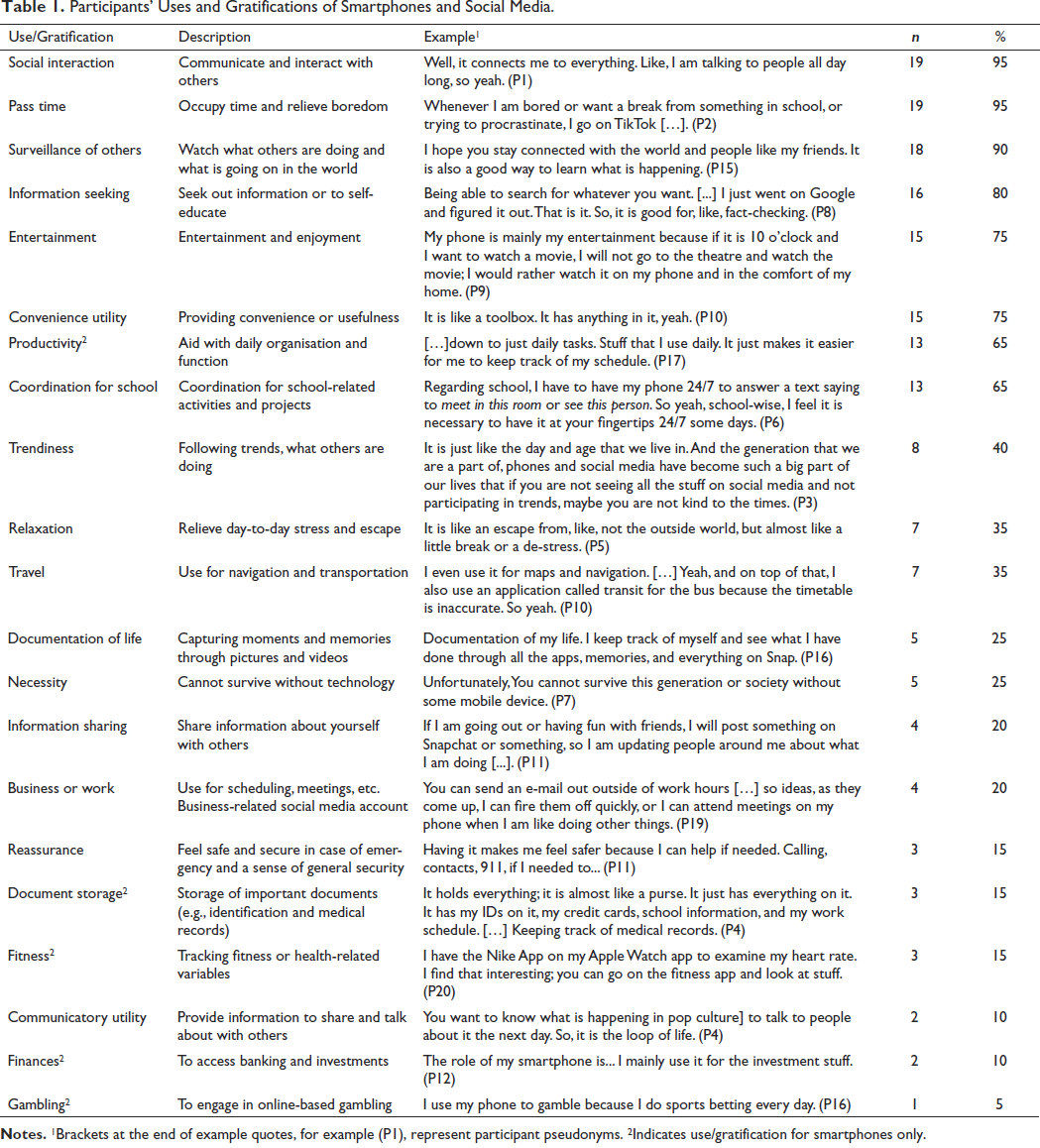
Participants identified 21 uses and gratifications for their smartphones and social media. A complete list of all services and gratifications specified is available in Table 1. Descriptions and examples for each use/gratification are also provided. Most commonly, participants used their smartphones and social media for social interaction (n = 19; 95%), to pass time (n = 19; 95%), and to conduct surveillance of others (n = 18; 90%). Notably, half (n = 10; 50%) of participants suggested that usage could have been more purposeful and that a particular gratification was not sought from engaging with either technology. Instead, as participant 18 indicated, ‘it has just become a habit’.
Participants’ Uses and Gratifications of Smartphones and Social Media.
Drawbacks
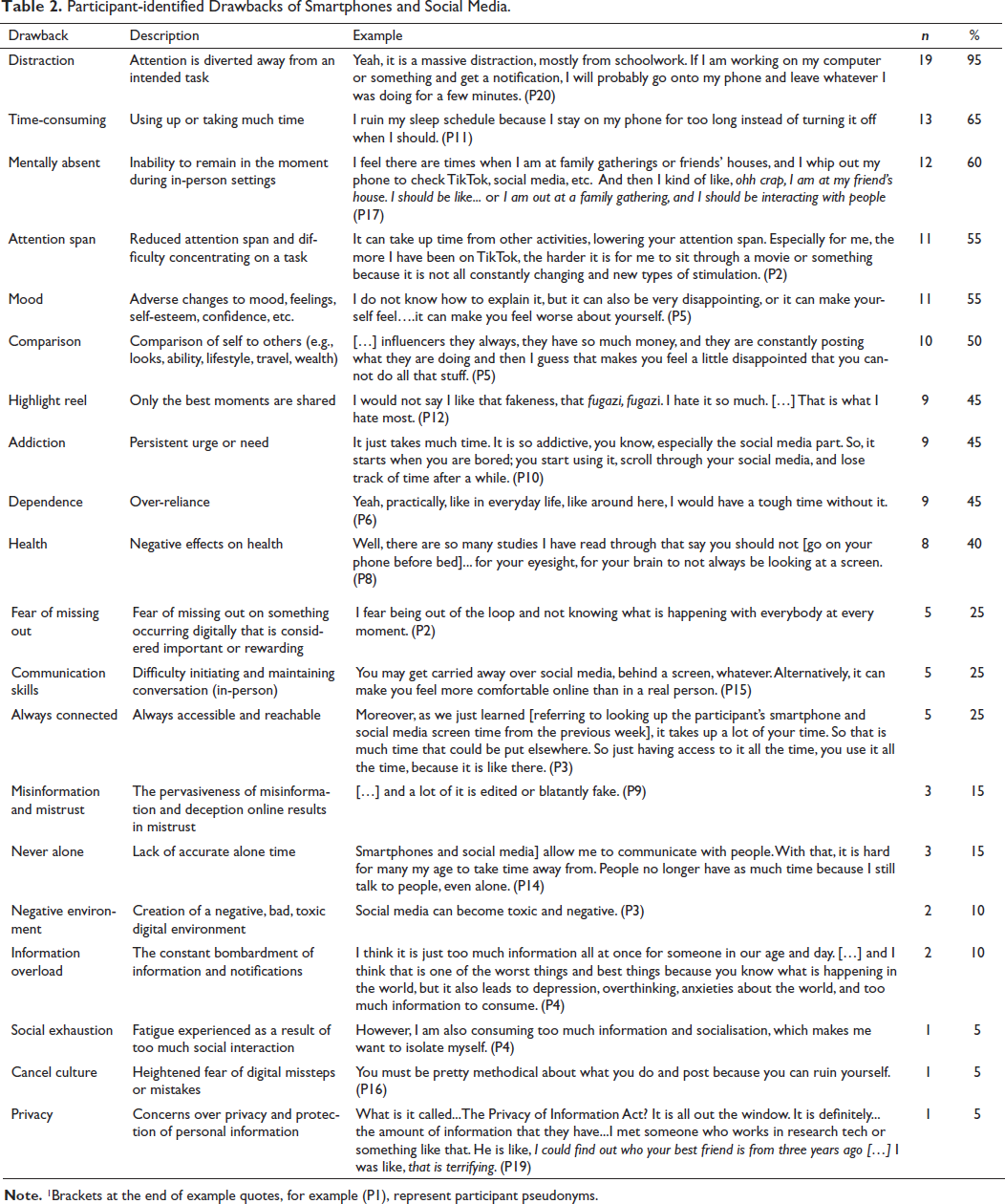
Twenty drawbacks of having a smartphone and social media were identified. A complete list of all identified disadvantages is available in Table 2. Descriptions and examples for each drawback are also provided. The most frequently cited drawback mentioned by participants was that their smartphones and social media caused substantial distraction (n = 19; 95%), diverting their attention from an intended task (e.g., schoolwork, class and conversation with a friend).
Participant-identified Drawbacks of Smartphones and Social Media.
Interferences
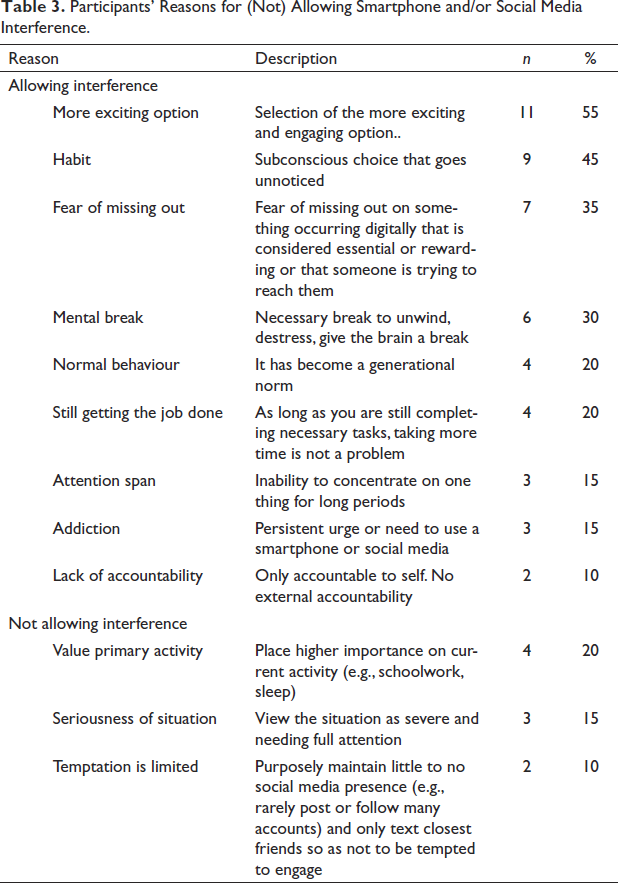
All but two participants (n = 17; 85%) admitted that their smartphone and/or social media use interfered with their daily life and well-being in some fashion. The areas in which interferences occurred were school (n = 16; 80%), sleep (n = 14; 70%), social life (in-person; n = 13; 65%) and work (n = 2; 10%). When prompted to elaborate, 12 reasons for allowing or not allowing interference were provided (Table 3). The most popular reason for allowing interference was the excitement (n = 11; 55%) that occurs when engaging with one’s smartphone and social media. For example, Participant 11 said, ‘I guess it is just the excitement of seeing… I am usually always on TikTok before going to sleep and just excitement of seeing new content […] if I get a little bit less sleep, it is not the end of the world.’ Conversely, the most popular reason for not allowing interference was that a high value was placed on the current activity (n = 4; 20%). For example, Participant 1 explained, ‘I value my sleep, and it is difficult for me to sleep to begin with, so having that extra addition [going on smartphone/social media] would just, you know, not be very smart for me.’
Participants’ Reasons for (Not) Allowing Smartphone and/or Social Media Interference.
Discussion
This study sought to procure a holistic yet nuanced understanding of current-day young adults’ smartphone and social media usage and the impacts that using these technologies has on users’ well-being. Namely, this study wanted to identify the benefits of smartphones and social media by enumerating their uses and gratifications. It also called attention to their drawbacks and how they can positively or negatively impact users’ well-being by enhancing or interfering with daily life.
Participants identified 21 uses and gratifications of wielding smartphones and social media, many of which (but not all) were positively contributing to participants’ well-being and benefitting their day-to-day lives. Among those identified, a considerable number of uses and gratifications were consistent with previous research by Agarwal and Lu (2021), Grellhesl and Prenyanun-Carter (2012), Joo and Sang (2013), Leung and Wei (2000), Menon (2022) and/or Whiting and Williams (2013), among others. For example, as Whiting and Williams (2013) and Joo and Sang (2013) reported, participants in the current study often sought to use their smartphones to engage in social interaction, seek information, pass time, be entertained and relax. However, changes over time have occurred. Namely, participants in the current study, compared to the past studies, appeared far more interested in surveying others (Whiting & Williams, 2013).
Moreover, the current study’s once-popular uses and gratifications of smartphones and social media (e.g., expressing opinion and status; Grellhesl & Prenyanun-Carter, 2012; Whiting & Williams, 2013) were non-existent. A small number of lesser-mentioned or novel uses and gratifications were also identified. For example, some participants leveraged their smartphones for financial purposes (i.e., regular banking transactions, investments, day trading) and gambling (e.g., sports gambling through mobile applications such as Bet365). In contrast, others conveyed the importance of social media for coordinating school-related activities and projects. Notably, many participants emphasised that they preferred to create Instagram or Snapchat groups for group-project-related communication instead of sharing their phone numbers and creating a group chat, saying that they only communicated via text messaging with close family (e.g., parents and siblings), partners, friends, if at all.
Conversations with participants suggest that not all smartphone and social media usage is intentional or attached to a particular gratification. Before discussing the benefits (i.e., uses and gratifications) and shortcomings (i.e., drawbacks and interferences with daily life) of smartphones and social media, participants engaged in an icebreaker activity where they estimated their smartphone and social media use and smartphone pickups. They compared these estimates with their actual usage figures. Participants needed help to assess their smartphone and social media usage accurately, supporting previous research (Andrews et al., 2015; Coyne et al., 2023; Oulasvirta et al., 2012; Parry et al., 2021). To better understand these discrepancies, participants were prompted to discuss their thoughts and reactions with the moderator, with many expressing shock and noting they were not aware that they used or checked their phones that often, confirming that, for many young adults, smartphones and social media checking has become largely habitual (Gardner, 2012). Interestingly, young adults from the current study had nearly double the number of pickups/checks compared to Andrews et al. (2015), suggesting that today’s young adults may be accessing their smartphones and social media more frequently than even 7 or 8 years ago and that constant interaction with smartphone and social media has likely become habitual and increasing subconscious, automatic and ritualised (Joo & Sang, 2013; Oulasvirta et al., 2012). Moreover, although participants enumerated various uses of and gratifications derived from their smartphones and social media, half also suggested that their usage was mediated by habit.
In addition to identifying the uses and gratifications of smartphones and social media, participants enumerated an almost equal number of drawbacks associated with their service. Most notably, participants identified distraction, consumption of time and the inability to remain present/in the moment as the most common drawbacks of smartphone and social media use. Although literature related to each of these drawbacks does exist (e.g., Chotpitayasunondh & Douglas, 2018; Wang et al., 2015), this study, to the authors’ knowledge, is one of the first to consolidate smartphone and/or social media use drawbacks into a single, comprehensive list. As such, this list may serve as a starting point to create a quantitative smartphone and/or social media use drawback measure or instrument and help identify which drawbacks could be of most concern immediately and warrant further investigation and intervention. Moreover, even though the majority of all but one participant’s screen time on their smartphone involved accessing social applications (i.e., social media) and participants often struggled to discuss their smartphone and social media usage as separate entities (Silver & Huang, 2019), they still spent a considerable amount of time engaging in other activities on their phone, suggesting that additional research examining different types of smartphones applications (e.g., games, fitness) is warranted.
The authors of this study would like to acknowledge that some uses and gratifications or drawbacks could have been collapsed into broader categories (e.g., surveillance of others could be seen as a form of information seeking). However, it is believed that one of this study’s strengths lies in its ability to showcase the nuances of participants’ experiences using their smartphones and social media and the subtle (but significant) differences in how people interact with these technologies. For example, although surveillance is technically a means of information gathering, participants spoke very differently about both uses/gratifications. Specifically, the information-gathering experience was typically associated with positive or neutral feelings (e.g., looking up the definition of a word on Google when they did not know what it meant). In contrast, a more excellent range of feelings and reasons were associated with engaging in the surveillance of others, often leaving participants feeling unwanted negative feelings because of what they saw while conducting surveillance.
Despite acknowledging that many uses and gratifications obtained from their smartphones and social media positively influenced their well-being, nearly all participants also believed that their smartphones and/or social media use interfered with their well-being and day-to-day life to varying degrees. Most notably, participants allowed their smartphones and social media to interfere with their well-being by interfering with school, sleep and social life, supporting previous research (e.g., Chotpitayasunondh & Douglas, 2016; Demirci et al., 2015; McCoy, 2016) in these areas. When prompted to explain why they did or did not allow their smartphones and social media to interfere with their daily life and overall well-being, 12 reasons were identified. For those that allowed interference to take place, causes were often associated with characteristics of problematic use (e.g., fear or missing out, addiction; Abel et al., 2016; Elhai et al., 2017) and an inability to self-regulate (Gökçearslan et al., 2016). For example, many participants noted that they struggled to stay off their smartphones or social media, even when engaging with these technologies negatively affected their well-being and they knew they should not be on them. For many, this was a result of pressure to abide by subjective norms (Ajzen, 1991), with suggestions that maintaining constant engagement with their smartphone and social media was a necessary proponent of everyday life and that they were willing to sacrifice various aspects of their well-being to avoid the social ramifications of being disengaged.
Participants often pointed out that their smartphone and social media behaviour was something they learned over time and was influenced by their social and physical environment (Bandura, 1977, 1989; Vygotsky, 1978). Specifically, most participants said they were far more likely to be on their smartphones and social media with their friends than with family. Similarly, participants were more likely to interact with their smartphone or social media in causal settings (e.g., on the couch watching television) compared to more formal settings (e.g., dinner table), regardless of who they were with.
Finally, as suggested by Lavoie and Zheng (2023) and Verduyn et al. (2017), this study provides evidence that time spent on smartphones or social media does not automatically result in positive or negative impacts on well-being. Instead, how these technologies are used has more significant implications for well-being. For example, when used to enhance daily life activities, participants noted that smartphones and social media provided opportunities to increase interaction, connection, communication and information access, increasing well-being. However, when interactions with smartphones and social media interfere with, hinder or take away from daily activities, consequences for participants’ well-being usually follow. Thus, it is vital to be attentive towards how and why smartphones or social media are being used rather than just the overall amount of time spent using such technologies.
Conclusion
This study provides a holistic and nuanced understanding of smartphone and social media usage among young adults and the impacts their usage can have on users’ well-being. Specifically, this study highlights how changes to smartphone and social media technologies have altered the uses and gratifications derived from the technologies while also identifying their shortcomings.
Limitations
The sample size for the current study was relatively small (N = 20). However, saturation was achieved, and maximum variation purposive sampling allowed the researchers to ascertain a sample with variability in age, gender, ethnicity and varied intensity of engagement with smartphones and social media. The research team also successfully sampled participants with various views, experiences and perceptions. Moreover, it is believed that the current investigation holds sufficient information power and provides new and vital insights into smartphone and social media use (Malterud et al., 2016).
Additionally, participation in this study was limited to iPhone users, disqualifying all non-iPhone users from involvement. These differences impacted sampling because there are noted social and economic differences between iPhone and Android users. Although it is acknowledged that selection from only iPhone users was restrictive, it was imposed to ensure data quality and enable valid comparisons for smartphone and social media use and pickups across participants.
Author Contributions
PC: Conceptualisation, data curation, formal analysis, funding acquisition, investigation, methodology, project administration, writing (original draft and review and editing); SJW: Conceptualisation, funding acquisition, methodology, project administration, resources, supervision, writing (review and editing).
Footnotes
Declaration of Conflicting Interests
The authors declared no potential conflicts of interest with respect to the research, authorship and/or publication of this article.
Funding
This manuscript draws on research supported by the Social Sciences and Humanities Research Council, 125 Zaida Eddy Private, 2nd Floor, Ottawa, Ontario, Canada, K1R 0E3.
