




Abstract
Smartphone use, e.g., on social network sites or instant messaging, can impair well-being and is related to clinical phenomena, like depression. Digital detox interventions have been suggested as a solution to reduce negative impacts from smartphone use on outcomes like well-being or social relationships. Digital detox is defined as timeouts from using electronic devices (e.g., smartphones), either completely or for specific subsets of smartphone use. However, until now, it has been unclear whether digital detox interventions are effective at promoting a healthy way of life in the digital era. This systematic literature review aimed to answer the question of whether digital detox interventions are effective at improving outcomes like health and well-being, social relationships, self-control or performance. Systematic searches of seven databases were carried out according to PRISMA guidelines, and intervention studies were extracted that examined timeouts from smartphone use and/or smartphone-related use of social network sites and instant messaging. The review yielded k = 21 extracted studies (total N = 3,625 participants). The studies included interventions in the field, from which 12 were identified as randomized controlled trials. The results showed that the effects from digital detox interventions varied across studies on health and well-being, social relationships, self-control, or performance. For example, some studies found positive intervention effects, whereas others found no effect or even negative consequences for well-being. Reasons for these mixed findings are discussed. Research is needed to examine mechanisms of change to derive implications for the development of successful digital detox interventions.
Introduction
Nowadays, smartphones are ubiquitous. On average, we spend nearly three hours per day on our smartphones (Markowetz, 2015). Unlike other electronic devices, smartphones enable the use of such functions almost anytime and anywhere, with numerous consequences for our daily lives.
Smartphones come with benefits, such as constant contact with friends, attractive leisure activities, Internet access to an endless supply of information, and positive consequences for knowledge sharing (Lepp et al., 2013; Omar et al., 2016). Conversely, smartphone use can impair well-being, a trend that has become an issue of great concern to both the public and researchers. For instance, research has shown that smartphone use affects health and well-being, performance, and social interactions. Regarding health-related problems, studies have found that smartphone use is related to higher depression rates and anxiety (Lepp et al., 2014), sleep difficulties (Thomée, 2018), and also musculoskeletal problems in case of smartphone overuse (İNal et al., 2015). Furthermore, a predominance of empirical results indicates a negative association between smartphone use and academic performance (Amez & Baert, 2020), which corresponds with results showing that smartphone overuse is related to lower work productivity and engagement (e.g., Duke & Montag, 2017). Moreover, smartphone use also increases negative affect or stress and reduces the quality of interactions when individuals focus on their own smartphones during social interactions (so-called phubbing; McDaniel & Radesky, 2018; Nuñez et al., 2020).
Even though some of the negative associations between digital technology use and health and well-being are small (Dienlin & Johannes, 2020; Orben & Przybylski, 2019a; Orben & Przybylski, 2019b), smartphone users are concerned about their own smartphone use. For example, research has demonstrated that smartphone users blog about the need to spend time away from their smartphones (Jorge, 2019; Kuntsman & Miyake, 2016), or even search for strategies to better manage their online time, e.g., with the help of applications such as iOS Screen Time, Android Digital Well-Being, Moment, Forest, Quality Time, Detox, Space, or OffTime. Furthermore, groups have organized an annual National (and Global) Day of Unplugging, which have been held for several years now with many followers (National Day of Unplugging, n.d.). Thus, it is not surprising that mass media present unplugging from smartphones as a trendy way to reduce the negative impact from smartphone use on health-related outcomes. Self-help tips are available on many platforms, such as social media, websites, and books with titles such as 24/6: The power of unplugging one day a week (Price, 2018; Shlain, 2019; Syvertsen, 2017). The concerns expressed in these texts reflect general concerns about smartphone use, and advice is given on how to rebalance one’s life by restricting smartphone use (Syvertsen, 2017). In a similar vein, holiday tour operators promote so-called digital detox camps or centers and “mobile free” holidays. All aim to help people escape from everyday digital connectivity. Particularly in Asia such holidays and events are booming (Collier, 2009; Dickinson et al., 2016; Syvertsen, 2017).
Digital detox definition
Both the public and scientific community use different terms when it comes to non-use of electronical devices. Usually, terms like abstinence, break, disconnection, detox, timeout, or unplugging are used (e.g., Brown & Kuss, 2020; Fioravanti et al., 2019). The important aspect that these terms have in common is they describe a period during which use of digital devices, e.g., tablets, is restricted. In our review, we used the umbrella term digital detox to encapsulate all these different terms. The term was introduced for the first time around 2012 (Felix & Dean, 2012). Digital detox is defined as a “period of time during which a person refrains from using their electronic devices, such as smartphones, regarded as an opportunity to reduce stress or focus on social interaction in the physical world” (Oxford Dictionaries, 2019). This definition conceives digital detox as temporary abstinence from electronical devices to cleanse oneself, similar to fasting. Thus, digital detox differs from detoxification therapies to abstain permanently from illicit drugs or alcohol (Syvertsen & Enli, 2019). Furthermore, this definition also highlights a difference when compared with abstinence from TV viewing, which was advertised in the 1990s and early 2000s. Digital detox emphasizes an effort to raise awareness of excessive use and boost self-optimization to reduce stress, whereas abandoning TV was promoted due to negative evaluations of the medium and its content (Syvertsen & Enli, 2019). However, the definition of digital detox (Oxford Dictionaries, 2019) remains unclear in relation to the following aspects. No conclusion can be drawn as to whether (a) a person can take a timeout from only one device (e.g., the smartphone) or whether, according to the definition, all devices may no longer be used, (b) it entails merely voluntarily or intentionally staying away from digital devices or includes involuntary, forced abstinence, (c) abstaining from any particular content is relevant or digital detox refers to a complete timeout from electronic devices only. Therefore, we suggest extending the definition.
In line with the hierarchical computer-mediated communication taxonomy (Meier & Reinecke, 2020), digital detox should not refer exclusively to a period of time during which a person refrains from using (a) electronic devices, but instead should be extended to a time period during which individuals do not engage in using (b) certain types of applications (e.g., social media), (c) branded media (e.g., unplugging from Facebook), (d) special features (e.g., disconnect from chats), (e) interactions (e.g., active usage of WhatsApp), and/or (f) messages (e.g., voice messages). As indicated by Meier and Reinecke (2020), the distinction between the six levels is more than relevant to capture all different aspects of electronic media use in a systematic approach. Based on this taxonomy, we secondly suggest that digital detox includes breaks from just one device as well as from all digital devices. In line with the taxonomy of behavior change techniques (BCTs; BCT 7.5) from Michie et al. (2013), we thirdly understand digital detox to be a voluntary and intentional limited removal of this aversive stimulus, namely digital devices and/or specific subsets of smartphone use, to promote health behavior change. We assume that it is important to add the terms voluntary and intentional, as research has shown that individuals’ intentions and motivations are important for successful health behavior change (e.g., Hardcastle et al., 2015; Miller & Rollnick, 2013; Vitinius et al., 2018).
The present systematic review’s context
Although digital detox is ubiquitous and, per its definition, an opportunity to reduce stress or focus on social interactions in the physical world, it remains unclear whether digital detox is an effective strategy to promote a healthy way of life in the digital era. Surprisingly, no systematic review has been published on the efficacy of digital detox, yielding a body of literature with isolated findings. However, digital detox interventions can only be used as a strategy to reduce the possible negative impact of digital technologies on health and well-being in case of a synthesized overview of existing empirical evidence. Furthermore, the identification of effective digital detox interventions might guide the development and dissemination of future digital detox interventions. Thus, the present systematic review aims to compare findings regarding digital detox interventions systematically. This paper will focus on studies that have investigated timeouts from the device of smartphones instead of timeouts from other devices, e.g., TVs, radios, or other portable devices, e.g., music players. This decision is based on the circumstance that unlike other electronic devices, the smartphone enables the use of several functions anytime and anywhere, leading to constant connections among individuals, each creating a greater source of distraction and stress (e.g., Demirci et al., 2015). Furthermore, as already discussed above, the history of the term digital detox is closely related to the proliferation of the smartphone and can be distinguished from abandoning TV (Syvertsen & Enli, 2019).
Use of social network sites (SNS) and instant messaging (IM) as part of smartphone use
Along with the focus on digital detox interventions regarding the smartphone as a device, we also want to draw attention to digital detox interventions regarding the use of certain types of applications as the use of SNS, e.g., Instagram, as well as IM like Threema, or texting. As is remarkably obvious, a significant amount of smartphone use worldwide entails the use of SNS/IM (Markowetz, 2015; Statista, 2020). Therefore, we focused on this specific subset of electronic media use. However, we decided to exclude other types of use, like shopping or gaming, as their usage frequency is lower in the population worldwide. In addition, reviews on hazardous gaming and prevention approaches already exist (Costa & Kuss, 2019; King et al., 2018). Furthermore, abstinence treatment programs that target excessive gaming usually combine their treatment with psychopharmacology or psychotherapy (Singh, 2019). In contrast, this review focuses on interventions that have studied digital detox as the main behavior change strategy among individuals without diagnosed Internet gaming disorders, according to the Diagnostic and Statistical Manual of Mental Disorders (DSM-5; American Psychiatric Association, 2013) and the International Classification of Diseases (ICD-11; WHO, 2018). This also corresponds with the definition of digital detox, which states that it entails creating well-being and opportunities to reduce technology-related stress (Oxford Dictionaries, 2019).
Voluntary and intentional abstinence from smartphones
As the use of digital devices is an integral part of life, making it unrealistic to live without them, we further aim to summarize studies of limited abstinence periods in contrast to complete abstinence approaches (e.g., giving up Facebook). This procedure takes into account the definition of digital detox and recommendations on behavioral addiction research that aim for controlled use, rather than complete abstinence (e.g., alcohol; Yau et al., 2014). As already indicated above, we clarified that digital detox also should be defined as voluntary abstinence from digital devices. Therefore, we will not include involuntary detox interventions or restrictions imposed by others, e.g., school restrictions, parental allocation of screen time to their children, or employer restrictions (Chun, 2018, for a conceptualization). Furthermore, we will not focus on laboratory studies that investigated involuntary separation from smartphones with the help of a cover story (e.g., Clayton et al., 2015; Schmidt et al., 2018).
The review’s aims
This review aims to compare studies systematically regarding digital detox interventions based on the conditions outlined above. Furthermore, an in-depth evaluation of digital detox interventions also should identify different digital detox components – e.g., content that individuals disconnect from, duration of timeouts, or studies’ quality – to provide a basis for further research on digital detox interventions. The Participants, Interventions, Comparisons, Outcomes and Study design (PICOS) approach (Miller, 2001) was used to develop research questions to guide the search strategies and data review (see Method section below). The first research question is: Do digital detox interventions differ in terms of (a) the content that individuals disconnect from, (b) the duration of the timeouts, and c) studies’ quality? In addition, the second and main research question asks about the effectiveness of digital detox interventions: Are digital detox interventions effective at improving outcomes such as duration of use, performance, self-control, health and well-being, and/or social relationships?
Method
This systematic review proceeded in accordance with Preferred Reporting Items for Systematic Review, and Meta-Analysis (PRISMA) guidelines (Moher et al., 2009; see also Supplemental 1).
Search strategy
Relevant studies published between January 2008 and September 2020 were searched. This time period was chosen to exclude studies published before 2008 because the smartphone gained importance with the introduction of the iPhone in 2007. From then on, the smartphone changed many people’s daily lives (Addo, 2013), and more attention was given to timeouts from new technologies like the smartphone.
The literature search was done in seven databases: PsycINFO, PBSC, PsycArticles, PubMed, Cochrane Library, Web of Science, and Google Scholar to identify additional articles. Search terms can be found in Supplemental 2 in addition to an example of the search strategy. The search strategy’s sensitivity was tested by checking whether it retrieved articles by Turel and Cavagnaro (2019) and Wilcockson et al. (2019), identified as key publications in preliminary searches. In addition, the reference lists of all included articles were screened to capture further relevant studies missed by the electronic searches. Finally, important journals in this research area were searched manually for recently added publications, particularly Computers in Human Behavior and Cyberpsychology, Behavior, and Social Networking. After identifying and deleting duplicates, citations and full texts were imported into a literature database.
Inclusion and exclusion criteria
Type of studies
The included studies in our review needed to fulfill the following criteria: (a) written in English; (b) investigated a digital detox intervention with a voluntary limited absence of use; (c) examined abstinence from digital devices, including the smartphone or a specific subset of digital device use, e.g., the use of SNS/IM; and (d) conducted inferential statistics that examined the intervention’s effect compared with a control group or baseline assessment.
Type of sample
This review will not be limited to a particular population, but studies must provide information about the sample type, allowing for classification of participants.
Type of outcome
No focus on specific outcomes was predefined to ensure a broad overview on the effects from digital detox interventions, including health-related outcomes, social relationships, cognitive performance, or other aspects.
Exclusion of studies
As a consequence of the inclusion criteria, we excluded studies that focused on external restrictions, e.g., school restrictions. Corresponding with this, we also excluded studies that masked the reason for the period of abstinence from the smartphone with a cover story, e.g., to not disturb others during the experiment. Furthermore, studies focusing on behavior change techniques other than BCT 7.5 or in combination with the BCT 7.5 – e.g., mindfulness, resilience, or self-control trainings – were excluded from further consideration. In addition, studies on Internet gaming disorders were excluded, as were studies that only examined Internet addiction, but not in the context of smartphone use. Finally, qualitative studies were excluded.
Study selection
Two reviewers independently screened titles, abstracts, and full-text articles to decide whether an article was relevant to the review based on the inclusion and exclusion criteria. Inter-rater reliability between the two reviewers was assessed using the Cohen’s kappa statistic (Cohen, 1960). In the event of a disagreement, a third person was consulted.
Data extraction
Data were extracted from the selected articles and entered into an electronic data sheet, which recorded year of publication, research question or purpose, study design, outcome and measurement types, and the main results (see Supplemental 3).
Studies’ quality
To evaluate the identified studies’ quality, a tool by Kmet et al. (2004) was applied to address the following criteria: clarity of research objectives; description of study design, participants, measures, randomizations, blinding, and selection of outcomes; rationale for the sample size and analytic method; estimates of variance reported for the main results/outcomes; a control of analyses for confounding effects; and the reporting of results in sufficient detail. Each component was rated using a three-point response scale (two points for “yes,” one point for “partial,” 0 points for “no”). If one criterion was not applicable for a study, its score was excluded from the computation of the overall score. The quality scores were used to determine the relative quality of the studies included in the review. According to Kmet et al. (2004), a value above 75% of the possible scores indicates high quality (conservative cut-off point), whereas a value below 55% indicates low quality. Two reviewers (TR and TA) assessed the studies independently. Subsequently, inter-rater agreement was computed. Disagreements were resolved via discussion and consultation with a third author. The level of agreement between the two reviewers was measured with the interclass correlation coefficient (ICC), which was .946 (95% CI [.868, .978]), indicating a very good level of agreement (Koo & Li, 2016).
Results
Overall search findings
Figure 1 shows the PRISMA flow diagram (Moher et al., 2009), indicating the search process to select the final studies that satisfied the inclusion criteria. Accordingly, the results from this systematic review are based on k = 21 studies from 20 published articles.
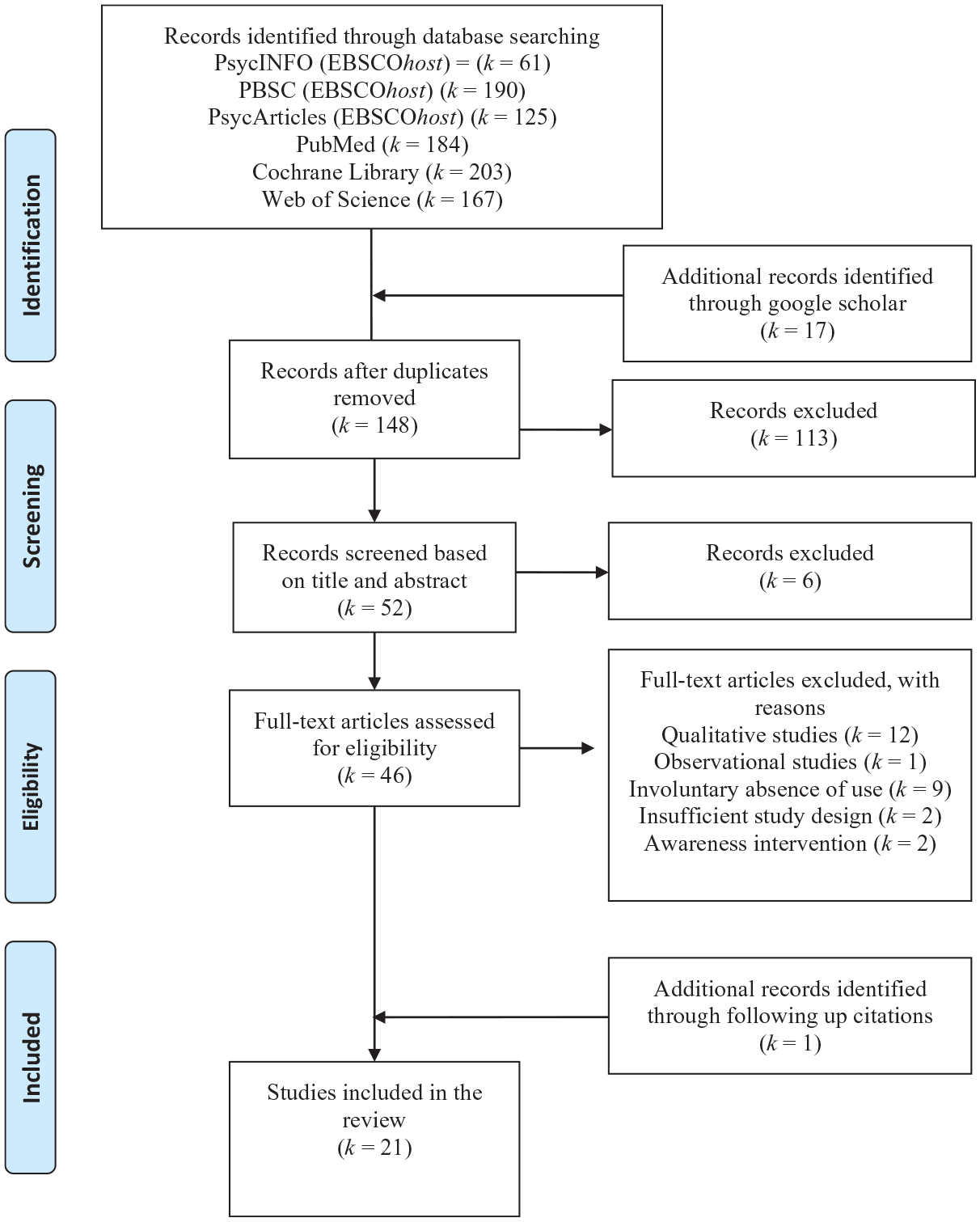
PRISMA flow diagram depicting the systematic search process.
Descriptive results
Table 1 provides an overview of the studies’ characteristics. The studies were conducted in 11 countries, mostly the United States (k = 7), followed by Australia (k = 3). The other studies originated from Belgium, Denmark, Germany, Italy, South Korea, New Zealand, Norway, United Arab Emirates, and the United Kingdom. A total of 3,625 participants were enrolled in all 21 studies, ranging from n = 15 to n = 1,095 participants per study. The average sample size was 173 participants with a Mdn = 98 (n = 104 [Mdn = 80] if excluding studies with more than 500 participants). The vast majority of the studies investigated students as the enrolled sample (k = 15). Other studies used non-student opportunity samples (k = 3), elite athletes (k = 1), or Instagram (k = 1) or Facebook users (k = 2).
Studies’ characteristics and results.
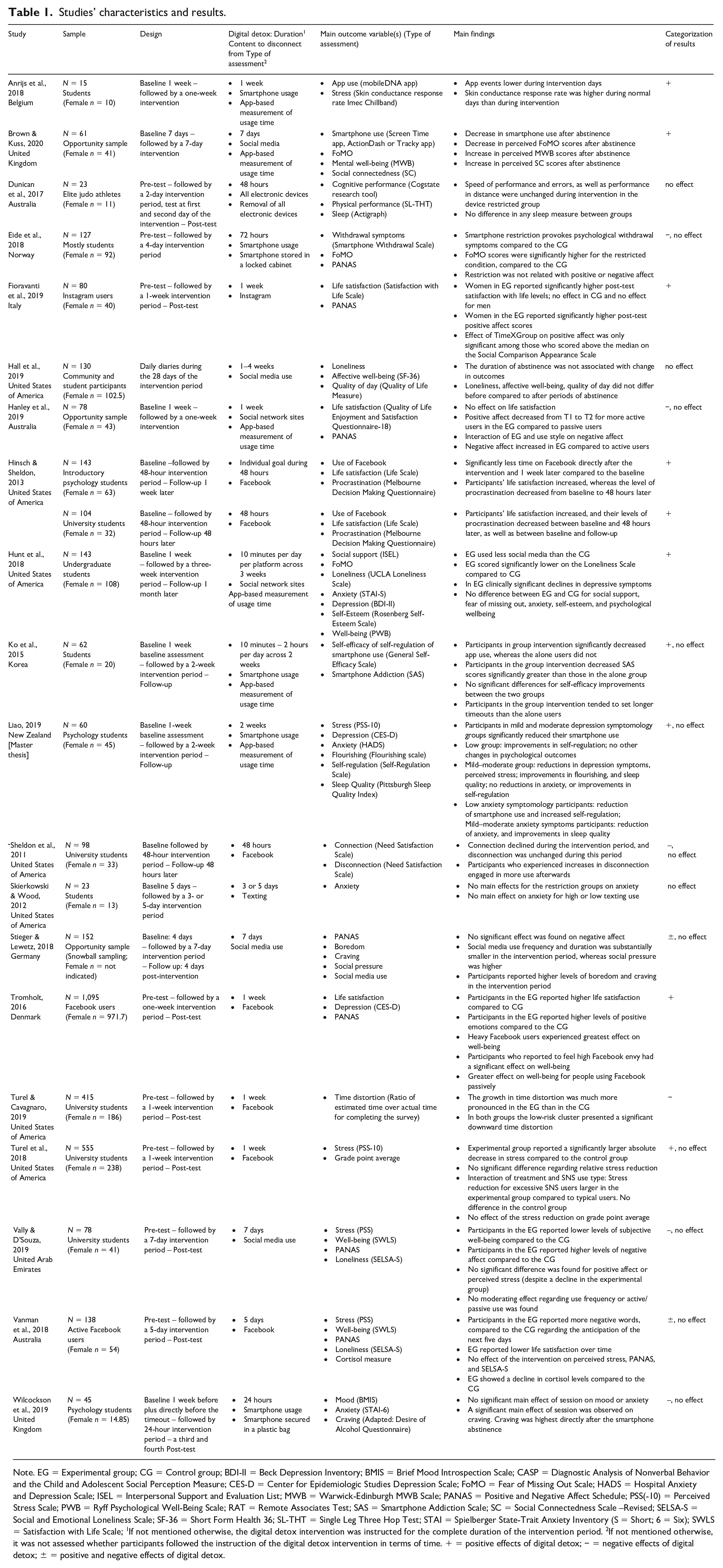
Note. EG = Experimental group; CG = Control group; BDI-II = Beck Depression Inventory; BMIS = Brief Mood Introspection Scale; CASP = Diagnostic Analysis of Nonverbal Behavior and the Child and Adolescent Social Perception Measure; CES-D = Center for Epidemiologic Studies Depression Scale; FoMO = Fear of Missing Out Scale; HADS = Hospital Anxiety and Depression Scale; ISEL = Interpersonal Support and Evaluation List; MWB = Warwick-Edinburgh MWB Scale; PANAS = Positive and Negative Affect Schedule; PSS(-10) = Perceived Stress Scale; PWB = Ryff Psychological Well-Being Scale; RAT = Remote Associates Test; SAS = Smartphone Addiction Scale; SC = Social Connectedness Scale –Revised; SELSA-S = Social and Emotional Loneliness Scale; SF-36 = Short Form Health 36; SL-THT = Single Leg Three Hop Test; STAI = Spielberger State-Trait Anxiety Inventory (S = Short; 6 = Six); SWLS = Satisfaction with Life Scale; 1If not mentioned otherwise, the digital detox intervention was instructed for the complete duration of the intervention period. 2If not mentioned otherwise, it was not assessed whether participants followed the instruction of the digital detox intervention in terms of time. + = positive effects of digital detox; − = negative effects of digital detox; ± = positive and negative effects of digital detox.
Descriptive results according to the first research question
Table 1 presents the summary of all studies reviewed in this paper (for a detailed overview of the findings, including effect sizes, please see Supplemental 3).
Content that individuals disconnect from
Most of the studies investigated digital detox interventions regarding SNS (k = 13), mainly Facebook (k = 6), Instagram (k = 1), social media use in general (k = 4), or the most prominent SNS (k = 2). Only one study examined texting. Furthermore, several studies examined timeouts from smartphones (k = 5) or from all electronic devices, including smartphones (k = 1).
Duration of the timeout
The range of the instructed detox duration was from 24 hours to four weeks. Most of the studies investigated a separation from digital devices or specific subsets of use one week long (k = 9). A total of k = 7 studies examined intervention periods that were shorter than one week, particularly 24 hours, 48 hours, or three to five days. In contrast, k = 4 studies examined longer breaks.
Studies’ quality
All selected studies included interventions conducted in the field. Of the 21 studies, 12 were randomized controlled trials (Eide et al., 2018; Fioravanti et al., 2019; Hall et al., 2019; Hanley et al., 2019; Hunt et al., 2018; Ko et al., 2015; Skierkowski & Wood, 2012; Tromholt, 2016; Turel & Cavagnaro, 2019; Turel et al., 2018; Vanman et al., 2018; Vally & D’Souza, 2019), from which 10 studies also reported a pre- and post-intervention measurement of the variables. The remaining eight non-randomized controlled trials all had pre- and post-intervention measurements.
Furthermore, studies’ quality was evaluated according to a tool by Kmet et al. (2004). Overall, none of the studies was below the cut-off point of 55% and k = 6 studies were above the 75% cut-off point.
Findings according to our main research questions
According to the main research question, the effectiveness of the digital detox interventions is presented in a structured overview according to the categories: duration of use, performance, self-control, health and well-being, and social relationships.
Duration of use
Six studies used a device-based measurement of the smartphone use (Anrijs et al., 2018; Ko et al., 2018; Liao, 2019) or SNS/IM use (Brown & Kuss, 2020; Hanley et al., 2019; Hunt et al., 2018). Applications such as ActionDash, Moment, Quality Time, Rescue Time, Screen Time, and Tracky were used. Three other studies used self-reports to measure changes in time spent on social media (Hinsch & Sheldon, 2013, study 1 and 2; Stieger & Lewetz, 2018). Overall, all studies reported a significant decrease in smartphone or app use with medium effect sizes during intervention days or after the intervention compared with pre-intervention days and/or a control group.
Performance
Cognitive and physical performance
Only three studies investigated performance outcomes. As shown by Dunican et al. (2017), no significant effect from a digital detox intervention was found on cognitive and physical performance among judo athletes compared with a control group. In the same vein, Turel et al. (2018) found no effect from abstinence from SNS on grade point averages, but Turel and Cavagnaro (2019) demonstrated that participants who abstained from using Facebook for over a week had higher time-distortion estimates compared with a control group when they had to estimate the time they needed to complete the survey. Participants with lower risk for social media addiction indicated a downward time distortion, whereas participants high at risk for social media addiction showed an upward distortion.
Self-control
Self-regulation
A study by Liao (2019) examined self-regulation in attention control after a two-week digital detox intervention period. Participants with low depression and anxiety symptoms showed an increase in their self-regulation skills, and the effect sizes were large. Another study (Ko et al., 2015) that investigated self-efficacy of self-regulation in smartphone use found no improvements compared with a control group.
Procrastination
Two studies from Hinsch and Sheldon (2013) showed that a reduction/cessation of Facebook use resulted in a decrease of procrastination directly after the intervention and at a 48-hour follow-up.
Health and well-being
Sleep
Sleep was assessed in two studies (Dunican et al., 2017; Liao, 2019). While Liao’s (2019) measured sleep quality using the Pittsburgh Sleep Quality Index (Buysse et al., 1989), Dunican et al.’s (2017) used a device-based measurement, the ActiGraph, to assess sleep quality. While Dunican et al. (2017) found no effects on sleep quality, Liao (2019) reported that people with mild-to-moderate anxiety and depression symptoms improved their sleep quality with medium to large effect sizes.
Life satisfaction
Eight studies examined the effect from digital detox interventions on life satisfaction (Hanley et al., 2019; Fioravanti et al., 2019; Hall et al., 2019; Hinsch & Sheldon, 2013, study 1 and 2; Tromholt, 2016; Vanman et al., 2018; Vally & D’Souza, 2019). Most of the studies used the Satisfaction With Life Scale (SWLS; Diener et al., 1985). Two of the studies found no effect from timeouts from SNS on life satisfaction (Hanley et al., 2019; Hall et al., 2019), whereas two studies observed a decrease in life satisfaction as a result of detox interventions (Vanman et al., 2018; Vally & D’Souza, 2019). In contrast, four studies found an increase in life satisfaction after taking a break from SNS use (Hinsch & Sheldon, 2013, study 1 and 2; Fioravanti et al., 2019; Tromholt, 2016), although one study could confirm this finding only for women. Effect sizes were small to moderate.
Subjective well-being
Affect
Seven studies assessed the effect from digital detox interventions on affect (Eide et al., 2018; Fioravanti et al., 2019; Hall et al., 2019; Hanley et al., 2019; Stieger & Lewetz, 2018; Tromholt, 2016; Vanman et al., 2018; Vally & D’Souza, 2019). All studies except those from Hall et al. (2019) used the Positive and Negative Affect Schedule (PANAS) (Watson et al., 1988). Most of the studies reported no effect on either positive or negative affect, but two studies (Hanley et al., 2019; Vally & D’Souza, 2019) found that participants after a digital detox intervention reported higher negative affect compared with a control group. Only two studies found beneficial effects from a break from Facebook (Tromholt, 2016) or Instagram (only valid for women) (Fioravanti et al., 2019) on affect.
Mood
One study (Wilcockson et al., 2019) focused on mood by utilizing the Brief Mood Introspection Scale (BMIS) (Mayer & Gaschke, 1988). No effect from the 24-hour digital detox intervention on mood was found.
Mental and psychological well-being
A study by Brown and Kuss (2020) investigated mental well-being using the Warwick-Edinburgh MWB Scale (WEMWBS; Tennant et al., 2007). A medium effect from the seven-day digital detox intervention through an increase in mental well-being was observed, corresponding with results by Liao (2019) showing that participants with mild–moderate depression symptoms reported improvements in flourishing after a smartphone-use reduction period. In contrast, a study by Hunt et al. (2018) found no effect from their digital detox intervention on psychological well-being.
Boredom
One study (Stieger & Lewetz, 2018) found that a social media abstinence period of seven days led to higher boredom levels.
Anxiety
Four studies (Hunt et al., 2018; Liao, 2019; Skierkowski & Wood, 2012; Wilcockson et al., 2019) examined anxiety using the State and Trait Anxiety Inventory (STAI) (Spielberger et al., 1970) or the Hospital Anxiety and Depression Scale (HADS) (Zigmond & Snaith, 1983). Only one study (Liao, 2019) found a decrease in anxiety for participants with mild–moderate anxiety symptoms after the intervention compared with the baseline assessment, whereas the other three studies found no effect.
Stress
Five studies investigated the effect from a detox intervention on stress (Anrijs et al., 2018; Liao, 2019; Turel et al., 2018; Vanman et al., 2018; Vally & D’Souza, 2019). Four of the studies used the Perceived Stress Scale (PSS) (Cohen et al., 1983), whereas one study also measured cortisol levels (Vanman et al., 2018). The study by Anrijs et al. (2018) measured skin-conductance response rate. Whereas two studies found no effect from a digital detox intervention on perceived stress (Vanman et al., 2018; Vally & D’Souza, 2019), the other three studies found a significant decrease in perceived stress (Liao, 2019; Turel et al., 2018), cortisol level (Vanman et al., 2018), and skin-conductance rate (Anrijs et al., 2018) with medium to large effect sizes. However, one study found a significant reduction in perceived stress only among participants with mild–moderate depression symptomology (Liao, 2019). Furthermore, it was found that excessive users of SNS benefited from abstinence to a larger degree compared with typical users of SNS (Turel et al., 2018).
Depression
Three studies (Hunt et al., 2018; Liao, 2019; Tromholt, 2016) measured the effect from a digital detox intervention on depression. All three studies found a significant decline in depression symptoms after a break from social media use or smartphone use in general.
Addiction
Only one study measured the effect from a timeout from smartphone use on smartphone addiction (Ko et al., 2015). It was shown that participants’ smartphone addiction scores decreased after a two-week-long group digital detox intervention compared with an individual digital detox intervention. Furthermore, three studies investigated withdrawal symptoms in relation to a digital detox intervention. As shown by all three studies, symptoms of craving and withdrawal significantly increased during and after abstinence from smartphone or SNS use (Eide et al., 2018; Stieger & Lewetz, 2018; Wilcockson et al., 2019).
Social relationship
Fear of missing out
Three studies (Brown & Kuss, 2020; Eide et al., 2018; Hunt et al., 2018) examined fear of missing out (FoMO) using the FoMO scale (Przybylski et al., 2013). While one study found no effect from a smartphone limitation on FoMo scores compared with a control group (Hunt et al., 2018), the two other studies revealed contrary findings. Eide et al. (2018) found an increase in FoMO scores, whereas Brown and Kuss (2020) reported a medium effect from the digital detox intervention on FoMO score reduction.
Social connectedness
Two studies focused on social connectedness (Brown & Kuss, 2020; Sheldon et al., 2011) while investigating the effect from digital detox. The intervention from Brown and Kuss (2020) that examined a one-week abstinence from social media use showed a small to medium effect on the increase in social connectedness. Conversely, Sheldon et al. (2011) noted a decrease in feelings of relatedness after a 48-hour abstinence from Facebook. Participants who experienced a larger increase in disconnection engaged in more Facebook use afterward.
Loneliness
Loneliness was captured in four studies (Hall et al., 2019; Hunt et al., 2018; Vanman et al., 2018; Vally & D’Souza, 2019) with mostly different scales. One study (Hunt et al., 2018) found a decrease in loneliness compared with a control group, whereas another study (Vally & D’Souza, 2019) found an increase in loneliness. The other two studies reported no effect from the digital detox intervention on loneliness.
Social support and social pressure
Two studies investigated social support (Hunt et al., 2018) and social pressure (Stieger & Lewetz, 2018) based on a timeout from social media use. While no effect from social media abstinence was found on social support (Hunt et al., 2018), Stieger and Lewetz (2018) showed that participants reported higher social pressure during social media abstinence compared with the pre-intervention measurement.
Discussion
This systematic review provides a synthesis of existing evidence of associations between digital detox and different outcomes, e.g., time of use, performance, self-control, health and well-being, and social relationships. Generally, our review shows that the results across the studies and the different outcomes are quite diverse. Even though a few more studies revealed positive, rather than negative, consequences from digital detox interventions, most of the studies showed either no effects or mixed findings regarding digital detox efficacy. These diverse and contradictory findings are equally evident across randomized controlled trials and non-randomized controlled trials, as well as across studies with different sample sizes. Furthermore, diverse findings are also observable across studies with similar digital detox intervention periods and subsets of smartphone use the individuals disconnected from. However, in reviewing the various outcomes, it becomes apparent that there are some outcomes for which there appear to be consistent findings. It was demonstrated that the duration of smartphone or SNS/IM use decreased during the intervention period. Furthermore, all three studies that investigated depression symptoms found a decline in such symptoms after a digital detox intervention. Nevertheless, no effect across studies was found consistently among cognitive and physical performance measures after a digital detox intervention. For all other presented outcomes in this review, the included studies revealed mixed and contradictory findings. Thus, the answer to our main research question of whether digital detox interventions are effective in improving outcomes such as duration of use, performance, self-control, health and well-being, or social relationships is that mixed findings exist, but no clear answer can be given yet.
Explanation of the findings
We identified several possible reasons for inconsistent findings. First, wide variety in the implementation of digital detox interventions was found. For example, some studies (e.g., Ko et al., 2015; Turel & Cavagnaro, 2019) allowed participants to define individual goals about the length of the timeout or to interrupt the timeout earlier than planned, whereas other studies (e.g., Eide et al., 2018; Sheldon et al., 2011) instructed a complete separation from the use of smartphones or certain apps. Although both approaches have their justifications, the different instructions for the digital timeouts can lead to different findings regarding outcomes. Second, not all studies used the same measurements to assess the same outcomes. For example, life satisfaction was measured using the Satisfaction With Life Scale (Diener et al., 1985), Quality of Life Enjoyment and Satisfaction Questionnaire (Endicott et al., 1993), or other unspecified scales. Thus, the findings might differ due to different assessments, but a large number of studies used the same scales to measure affect, depression, and anxiety. Third, the studies differed in terms of measurement time points. Some studies assessed the change in outcomes during the intervention, whereas others assessed change after the intervention with different time spans (e.g., directly after the intervention or one week later). Furthermore, only a few studies included follow-up measurements (e.g., Hunt et al., 2018). Thus, it remains unclear whether the effects are valid only during the digital detox intervention, immediately after the intervention, short term, or long term. A fourth reason that needs attention is the fact that the studies differed in terms of their samples. Next to a large deviation in sample sizes, the sample types were quite diverse across the studies, even though most of the studies used student samples. Future research should investigate digital detox interventions in large-scale studies with the general population (cf. Dienlin & Johannes, 2020). In addition, some studies distinguished between participants with higher and lower (smartphone/SNS/IM) addiction scores and higher and lower depression scores, whereas other studies did not. By doing so, the advantage is to identify for whom the intervention is effective. Thus, future research should focus on possible moderating variables – e.g., gender, or usage frequency – and triggers to use smartphones/SNS/IM to get more insight on which digital detox intervention might be beneficial or harmful for whom.
Limitations of the studies included in this review and recommendations for future research
Several limitations in the included studies in this review need to be mentioned that also might explain the findings, as only six of the 21 studies had a high quality according to criteria suggested by Kmel et al. (2004). One limitation in most of the studies is the lack of device-based measurements of smartphone and SNS/IM use that would allow for reliable assessments of the duration of usage (cf. Dienlin, & Johannes, 2020; Orben & Przybylski, 2019b). Furthermore, it would be helpful to measure physiological indicators of health-related outcomes, such as the skin-conductance response rate (cf. Anrijs et al., 2018), as a stress indicator. Thus, future research needs to incorporate device-based measurements. Another limitation belongs to the aspect of compensatory behaviors during the digital detox intervention. Most studies did not control whether participants used other electronic devices instead of their smartphones or switched to other SNS/IM use during the separation phase. However, this is of great importance to derive the right conclusions from the digital detox interventions. Most studies included in our review had rather small sample sizes with non-representative samples. Furthermore, not all studies were randomized controlled trials. As a consequence, the studies’ internal validity needs be considered with caution, as it is most likely that not all confounding variables have been controlled for. A possible solution would be to use laboratory studies (e.g., Clayton et al., 2015; Schmidt et al., 2018; Turgeman et al., 2020), though laboratory studies might confound ecological validity, especially when considering variety and diversity in everyday smartphone use. In addition, in all these laboratory experiments, the smartphone was taken away from the participants upon presentation of a cover story. Thus, apart from the lack of external validity, intention to take a smartphone break or reduce SNS/IM use is not considered. Therefore, it is highly recommended to investigate the effect from digital detox interventions with (a) large sample sizes, (b) randomized controlled field experiments, (c) valid measurements like device-based assessments, (d) long-term intervention periods, and (e) short- and long-term follow-ups. Overall, more high-quality research on the consequences of digital detox interventions is needed, as only a few studies per outcome exist, as can be seen in the results section. In addition, only three studies (Hinsch & Sheldon, 2013; Skierkowski & Wood, 2012; Turel et al., 2018) investigated possible mediators of the effect from digital detox intervention on examined outcomes. This is essential for deriving conclusions as to why digital detox interventions might be beneficial or harmful. Examples of possible mediators could be procrastination, withdrawal symptoms, or social support. Corresponding with this, the timeout duration should be investigated systematically, as this factor might allow for a distinction between beneficial and harmful digital detox interventions as well. In line with this, it is also needed to check whether participants implement digital detox interventions as instructed and how long each timeout is. In our review, only three studies (Dunican et al., 2017; Eide et al., 2018; Wilcockson et al., 2019) placed the electronic devices, e.g., in a locked cabinet to ensure full adherence to the digital detox intervention. The other studies did not measure the duration of the timeout even though six studies used a device-based measurement. However, these studies focused on the duration of the smartphone or SNS/IM usage which can be only regarded as a proxy of the timeout itself.
Next to the rather methodological aspects for future research, one important conceptual issue regarding the definition of digital detox should be taken into account. From our perspective, the current definition needs to be extended in terms of the hierarchical computer-mediated communication taxonomy (Meier & Reinecke, 2020). Digital detox should not only refer to a time period during which a person refrains from using electronic devices, but also to time periods during which a person does not engage in certain types of applications, branded media, special features, interactions, and/or messages. This is also in line with the definitions used in the studies included in this review. Across the 21 studies different terms are used like “removal of electronical devices” (Dunican et al., 2017), “smartphone/Facebook restrictions” (e.g., Eide et al., 2018), “vacation from Facebook” (Hanley et al, 2019), or “abstinence from Facebook/social media” (e.g., Hall et al., 2019). In line with the definition of Anrijs et al. (2018) we further recommend to add the terms “voluntary/intentional abstinence” to the definition of digital detox (see the introduction section for reasons). However, it needs to be mentioned that most of the studies included in this review did not present a definition of digital detox. Therefore, a stronger conceptual and theoretical embedding of digital detox (interventions) is necessary. Corresponding with this, another aspect of future research could be the focus on digital detox interventions that emphasize a healthy way of using the smartphone, instead of discouraging the use of smartphones (cf. Buctot et al., 2018; Keller et al., 2021), as this might be more realistic in everyday life, because the smartphone is and will remain people’s daily companion.
The systematic review’s strengths and limitations
This review provides information for research and practitioners about digital detox interventions’ efficacy. Furthermore, we discussed implications for the definition of digital detox and provided a conceptual framework for future research. Aside from these strengths, limitations in this review also need to be mentioned. The first is the wide variety of terms used in studies that investigate a timeout from smartphone/SNS/IM use. Studies used alternative terms, and it could be the case that some studies might have been missed because we have not included the term in our literature search. This might be the case for specific social media platforms (e.g., TikTok) or terms that describe a timeout from smartphone or social media use (e.g., a year without such media). However, it is not feasible to account for all possible synonymous terms in the literature search. Another limitation is the focus on smartphone use in general and SNS/IM use. As the smartphone could be used for other activities – e.g., gambling, or dating – our findings might result in an incomplete picture of digital detox interventions. However, considering that SNS/IM use is the most widespread use for the smartphone, our review covers a wide range of behavior. Furthermore, study selection may have been skewed, as only studies published in English were included. Therefore, the results can be transferred only to the Western world, with no more than two studies from other countries (South Korea and United Arab Emirates).
Conclusion
This review provides a novel insight into the associations between digital detox interventions and different outcomes. It can be concluded that across the included studies, digital detox interventions exert some promising effects on usage itself and on depression symptoms. However, the inconsistent findings regarding other outcomes across all presented studies prevent making a recommendation as to whether to promote or discard digital detox interventions, as positive and counterproductive consequences need to be examined more clearly. Thus, it is recommended that more investment in empirical high-quality research be implemented to understand under which circumstances digital detox is helpful and for whom. Thus, potential moderating and mediating variables need to be examined in the future – including for the duration of the digital detox period, the level of smartphone addiction, or the level of technology-related stress – before the utility of digital detox interventions can be determined adequately.
Supplemental Material
sj-doc-1-mmc-10.1177_20501579211028647 – Supplemental material for Digital detox: An effective solution in the smartphone era? A systematic literature review
Supplemental material, sj-doc-1-mmc-10.1177_20501579211028647 for Digital detox: An effective solution in the smartphone era? A systematic literature review by Theda Radtke, Theresa Apel, Konstantin Schenkel, Jan Keller and Eike von Lindern in Mobile Media & Communication
Supplemental Material
sj-docx-1-mmc-10.1177_20501579211028647 – Supplemental material for Digital detox: An effective solution in the smartphone era? A systematic literature review
Supplemental material, sj-docx-1-mmc-10.1177_20501579211028647 for Digital detox: An effective solution in the smartphone era? A systematic literature review by Theda Radtke, Theresa Apel, Konstantin Schenkel, Jan Keller and Eike von Lindern in Mobile Media & Communication
Supplemental Material
sj-docx-3-mmc-10.1177_20501579211028647 – Supplemental material for Digital detox: An effective solution in the smartphone era? A systematic literature review
Supplemental material, sj-docx-3-mmc-10.1177_20501579211028647 for Digital detox: An effective solution in the smartphone era? A systematic literature review by Theda Radtke, Theresa Apel, Konstantin Schenkel, Jan Keller and Eike von Lindern in Mobile Media & Communication
Footnotes
Acknowledgements
The authors would like to thank all student assistants for their assistance with the literature search for the manuscript.
Contribution
TR designed the study. All authors contributed to the systematic search and data extraction, as well as the interpretation of the data. Furthermore, all authors helped draft, write, and revise the paper, as well as approve the manuscript.
Funding
The author(s) disclosed receipt of the following financial support for the research, authorship, and/or publication of this article: this work was funded by the Swiss National Science Foundation (SNSF). Grant number: 100019_169781/1.

Supplemental material
Supplemental material for this article is available online.
Author biographies
Theda Radtke is professor of Health Psychology and Applied Diagnostics at the University of Wuppertal. Her expertise is in theory- and evidence-based health promotion using modern technologies. In her research, she focuses on a healthy approach to digital media use (e.g. digital detox) as well as increasing physical activity.
Theresa Apel is a research assistant and works as a course coordinator at the University of Witten/Herdecke. She also supports teaching in educational psychology.
Konstantin Schenkel is a Post-doc and docent at the University of Zurich. He teaches and conduct research on health behavior and health behavior changes. For the past few years, his research focus is on the impact of digital technology use and physical inactivity.
Jan Keller is a Post-doc and docent at the Freie Universität Berlin. He teaches and conduct research on health behavior and health behavior changes.
Eike von Lindern is co-founder of Dialog N – Research and Communication for People, Environment and Nature and holds a PhD in environmental psychology. His research focusses restorative environments research, health promotion, experience of protected areas, national parks and wilderness, analyzing geospatial data, as well as intervention and communication design aiming at promoting sustainable behavior.
References
Supplementary Material
Please find the following supplemental material available below.
For Open Access articles published under a Creative Commons License, all supplemental material carries the same license as the article it is associated with.
For non-Open Access articles published, all supplemental material carries a non-exclusive license, and permission requests for re-use of supplemental material or any part of supplemental material shall be sent directly to the copyright owner as specified in the copyright notice associated with the article.
