




Abstract
This article addresses the phenomenon of mobile bystanders who use their smartphones to film or take photographs at accident scenes, instead of offering their help to people in need or to assist medical units. This phenomenon has been extensively discussed in Swedish news media in recent years since it has been described as a growing problem for first responders, such as paramedics, police, and firefighters. This article aims to identify theoretical perspectives that are relevant for analyzing mobile media practices and discuss the ethical implications of these perspectives. Our purpose is twofold: we want to develop a theoretical framework for critically approaching mobile media practices, and we want to contribute to discussions concerning well-being in a time marked by mediatization and digitalization. In this pursuit, we combine theory from social psychology about how people behave at traumatic scenes with discussions about witnessing in and through media, as developed in media and communication studies. Both perspectives offer various implications for normative inquiry, and in our discussion, we argue that mobile bystanders must be considered simultaneously as transgressors of social norms and as emphatic witnesses behaving in accordance with the digital media age. The article ends with a discussion regarding the implications for further research.
Introduction
In the summer of 2015, Swedish news media reported how witnesses at accident sites used their smartphones to film the situation, instead of offering help. By late summer 2015, it had become a point of reference for public debates about media ethics, moral courage, as well as working conditions for first responders. The reports on these “mobile bystanders” were soon followed by a debate where different stakeholders (first responders, journalists, politicians, experts) gave their view on the phenomenon. While this debate included various positions and perspectives, there was one perspective shared by most commentators: that the behavior was morally deplorable. Those who addressed the issue in the public sphere appeared to agree that it was wrong to take photos of victims. Still, the extensive media reporting proved that it was a widespread phenomenon.
In the debates that followed, two demands for new jurisdiction were raised: on the one hand, liberal/conservative politicians used the phenomenon to argue for the need for a “moral courage act,” a law that obliges witnesses to intervene; on the other hand, the paramedics’ union asked for a law against “defamatory photography at accident sites.” There seemed to be a social consensus concerning the moral status of this kind of behavior; still, people all over the country resorted to it when faced with a dramatic or traumatic event such as an accident. This apparent gap between ethical consideration and actual behavior is a phenomenon that is well documented by the sociology of law, where social norms and legislation sometimes appear to be out of sync (Hydén & Svensson 2008). While commentary on mobile bystanding in social media and the news is quick to pass moral judgment on what is considered to be problematic behavior, the task for a critical scholarship needs to come to grips with the phenomenon beyond spontaneous denunciations and explanations: How can the phenomenon be approached from a critical theoretical framework in order to explain and understand the behaviors among witnesses to accident scenes? What can we learn from studying mobile media practices about the urge to document and share traumatic witnessing in a time when communication has become part of a mobile lifestyle?
Mobile bystanders activate inquiries into the social psychology of digital media, social control, and digital existence. Furthermore, it raises questions about how normative models of media theory can be updated to be relevant in the encounter with this type of phenomenon. The aim of this article is to identify theoretical perspectives that are relevant for analyzing mobile bystanders and discuss the ethical implications of these perspectives. Our purpose is to develop a theoretical framework for approaching mobile bystanders in a critical way, as well as contributing to discussions about well-being in a time marked by mediatization and digitalization (Lagerkvist, 2018; Rowland, 2019; Wang, 2014). In this pursuit, we combine theory from social psychology regarding how people behave at traumatic scenes, with discussions about witnessing in and through the media, as developed in media and communication studies. Both perspectives offer various implications for normative inquiry, and in our discussion, we argue that mobile bystanders must be considered simultaneously as transgressors of social norms and as emphatic witnesses who are behaving in accordance with the digital media age.
Ethical implications of mobile media practice
Central to our analysis of mobile bystanders is the notion of the human subject, the subject’s relation to the other, and the idea of a “failed subject.” The subject’s relation to the other is fundamentally an ethical problem: that is, recognizing the other is an act that comes with moral obligations. This relation finds its most urgent form when the subject is confronted with the pain of the other. Earlier this relation was defined by religion (e.g., the parable of the good Samaritan within Christianity), but what are the moral obligations to the other in a secular world? Early sociology took an interest in “failed subjects,” such as outsiders and deviants, and how modernity produced these failed subjects by analyzing how modern society established a moral differentiation of behavior. It is in this context that the bystander-effect described by Latané and Darley (1968) should be viewed. It is a theory that has an ambition to explain why people do not act according to shared ethical norms and instead become “failed subjects” who stand idly by while a neighbor is in distress. The popular, or spontaneous, understanding of bystander passivity included terms such as alienation, apathy, dehumanization, indifference, lack of empathy, as well as other terms connected to the idea that modernity led to weaker social ties and a lack of social integration that made people less altruistic. Darley and Latané found these nominations unscientific and too vague (Latané & Nida, 1981, p. 308). Instead, their initial attempt at an explanation of the bystander effect interpreted it as a phenomenon derived from rational choice: the cost of intervening is higher than the gain compared to non-intervention. This cost-benefit calculation was, in turn, described as three processes (Latané & Nida, 1981, p. 309):
Audience inhibition—the fear that behavior will be observed and valued by others inhibits individuals from intervening.
Social influence—seeing others’ passivity leads to the conclusion that inactivity is the expected reaction.
Diffusion of responsibility—the knowledge that others are present and available to act reduces the individual’s sense of responsibility.
The central point made by Latané and Darley (1968) is that the individual witness’ willingness to intervene to help a person in need depends upon the presence of other spectators. For the most part, the presence of others decreases the preparedness to act. Variables such as group size, group relations, and type of danger have all been identified as factors that influence individuals’ willingness to act.
The bystander effect is about passivity. Its core question is why people do not intervene. According to Arendt (2019, p. 176), it is through speech and action that the individual reveals her/himself. It is through speech and action that we enter the world together with others. Hence, to act is an existential event; it puts one’s self on the line. Following this, virtues recognizable in most human cultures, such as care and courage, are closely connected to action. To be active is virtuous, to be passive is not. From this perspective, it becomes clear that inhibition to act in the face of danger becomes a charged phenomenon of existential importance. Hence, the cultural interpretation of passivity is that it is far from virtuous. However, the ethical implications of the mobile bystander phenomenon cannot be understood merely as a traditional bystanding situation with the addition of a mobile camera, but a phenomenon that is defined by a certain media practice. Hence, we must pay equal attention to the act of photography as to the socio-psychological dynamics of bystanding. In this we rely on recent engagements with the role of the photograph in the era of social media, as well as with the media practice-approach. From this we draw that the act of taking a photograph might have different cultural meanings in the digital age than what have traditionally been ascribed to photography.
The media practice approach focusses on actions whose possibility are conditioned by the prior existence, presence or functioning of media (Couldry 2013, p. 35). Naturally, the bystander-effect existed before people had smartphones, but the ethical implications of mobile bystanding cannot be grasped by the bystander-effect alone. The meaning of the photographic act needs to be taken into account. As argued by Jurgenson (2019), mobile and social media have turned photography into a casual everyday habit, and hence, the significance of taking a photograph has changed. In this era of “social photography,” an image’s “existence as a stand-alone media object is subordinate to its existence as a unit of communication” (Jurgenson, 2019, p. 9). If we accept the assumption that smartphone photography is a habitual media practice, similar to a conditioned reaction, and that the cultural meaning of a photograph is to be found in this practice rather than in its archiving or documentation function, then we have to navigate in a social landscape that requires a fresh approach to the question of ethical implications.
According to some scholars, this social landscape brought about by digital, mobile, and social media, presents a new ontology (Deuze, 2012; Couldry & Hepp, 2018; Peters, 2015), that calls for a new understanding of media ethics (Couldry, 2012; Ess, 2009; Fourie, 2017). Couldry (2012, p. 181) uses the term “limit situation” for this mismatch between norms and behavior in these new social arenas. It is, writes Couldry, “out of such limit situations that new domains of ethical thinking are born.” Central to his discussion about new domains of ethical thinking are the virtues accuracy, sincerity, and care (Couldry 2012, p. 190). On a similar note, Fourie (2017) argues that digital media has introduced new forms and relations that make the question of how to use media in an ethical way more complex. He introduces the concept of “ethical communication,” a normative model that recognizes universal human virtue (e.g., care, empathy, courage, and respect for one’s neighbor) in and through mediated communication (Fourie, 2017, p. 113). Therefore, communication can be considered ethical if it does not cause damage to human dignity (Fourie, 2017, p. 122).
It could be argued that the act of photographing an accident fulfills the criteria of accuracy and sincerity as described by Couldry—bearing witness to what is happening, perhaps intending to share a traumatic event. However, the problem in this context is with care, since it might as well be a careless act to document the distress of the other and cause damage to human dignity. There are parallels here to traditional photojournalism, where care for personal integrity sometimes stands in contrast so (supposed) public interest, a conflict that has been described in numerous cases of ethical trespassing by journalists (e.g, Fishman, 2017; Zelizer, 2010; see also Allan, 2013b).
In what follows, the ethical implications of mobile bystanding as a media practice are discussed in relation to different conceptual accounts about how the subject acts upon a scene (passive/active), or how close the subject is to what is happening (proximate/distant).
Mobile bystanders, rubbernecks, and disaster tourists
Considering the three processes of bystanders outlined above, contemporary behavior at accident scenes fits the description of the traditional bystander, despite the fact that the mobile bystander is active and not a passive observer: firstly, everyone else is taking pictures, why interfere? A new factor to make the audience inhibition even stronger is the fact that if intervening, the risk of the bystander themself being caught on camera is obvious and perhaps not wished for; secondly, taking pictures is the expected reaction, meaning that the social influence is still valid as one way to explain the mobile bystander; and thirdly, other people are still present and available to act leading to the diffusion of responsibility among the mobile bystanders. The mobile bystander is still a passive bystander towards the accident scene, but takes a different kind of action towards himself/herself and the need to communicate to others of the firsthand experience. Towards first responders, the action could also be described as passive-aggressive, in terms of being passive in not helping out, and aggressive in being in the way and at certain events, even blocking the way for the rescue actions.
The exaggerated curiosity among passers-by at traffic accidents and other roadway events is the highest single category of external distraction among drivers (Colon et al. 2013, p. 1810). This well-documented behavior is commonly referred to as the “rubberneck effect.” According to Masinick et al. (2014, p. 117), rubbernecking “is a result of a human response to the surroundings, such as freeway signs, scenery, billboard ads, and many other visual ‘eye-candy.’” Rubbernecking is regarded as a safety issue, and in the studies of traffic safety, rubbernecking is usually referred to as the effect occurring in the opposite direction of where the accident or other roadway events have taken place. Rubbernecking has also been picked up by digital communication studies where it has been applied to analyses of the curiosity aroused by intimate and emotional content on social media (Baruh & Cemalcılar, 2015; DeGroot, 2014). In Coats and Ferguson’s (2013) article about dark tourism after the Christchurch earthquake in New Zealand, rubbernecking appears as an expression of gawking at someone else’s misfortune.
Mobile bystanders and rubbernecks are not necessarily disaster tourists. They may very well be eyewitnesses by accident as opposed to spectators who seek out the scene of a disaster. “Disaster tourist” is a popular term that refers to the irresponsible use of photography (Allan & Peters, 2015a). However, disaster tourism as a concept is more complex, and in order to understand both the positive and negative sides, it needs to be related to the concepts of dark tourism and thanatourism (Kelman & Dodd, 2009). According to Kelman and Dodd, disaster tourism has emerged from dark tourism (visits to death and disaster sites), but thanatourism (visits to fictional deaths) also assists in explaining the meaning of disaster tourism. Usually, disaster tourism refers to peoples’ visits to natural disaster scenes, either when they are still ongoing or directly afterwards. The academic interest of dark and disaster tourism has increased (Wright & Sharpley, 2016).
The phenomenon of disaster tourism, as well as disaster tourists, has been an object for study from various perspectives. In the quote below, from an article on disaster and prehospital medicine, the following definition is used:
. . . a disaster tourist may be defined as a person heading to the site of a disaster to see the destruction, take pictures, obtain bragging rights, and get the shoulder badge. Man has forever been a curious being, and with television desensitizing us to tragedy, people want a true taste of authenticity. Everyone wants to experience everything firsthand. (Van Hoving et al., 2010, p. 201)
The quotation mentions curiosity as a basic human disposition, and curiosity is an important aspect for understanding the normative implications of rubbernecking and disaster tourism. While curiosity might be an expression of care for one’s neighbor, it lacks the empathy and respect expected from ethical care. In existential philosophy, curiosity is understood as an inauthentic mode of being—curiosity is not about contemplation that seeks to understand, it “makes sure of knowing, but just in order to have known” (Heidegger, 2010, p. 166). Hence, curiosity betrays the observer and the observed alike: for the observer, curiosity is merely a distraction that closes the self from existence, and the observed is objectified (even dehumanized?) by a spectatorship that is not motivated by care, compassion, or respect.
Besides discussing the primary function of curiosity, the definition of disaster tourist above includes two references to media-related behavior: taking photographs and watching television; thus, mediation plays a part in the disaster and, somehow, the relation to media appears to add negative connotations to disaster tourism. It is assumed that television makes us less sensitive to other peoples’ suffering, and that taking pictures is one step further down the ethical slope than just observing the destruction with one’s own eyes. Even though these remarks are made in passing in the definition, they point to a long-standing scholarly debate concerning mediated suffering and media witnessing. While aspects of the bystander, rubberneck, and disaster tourist effects are all included in the concept of mobile bystanding, they are arguably not enough for understanding the phenomenon. Hence, we need to address the topic of witnessing to expand or theoretical inquiry.
From witnesses to citizen journalists
According to Peters (2001, p. 709), the divide between active and passive as discussed in the previous section can be observed about witnessing as well: witnessing has “two faces” that include “seeing,” which is a passive form of witnessing, and “saying,” an active form of witnessing. However, when we consider the possibility to witness in and through the media, another divide is introduced: proximity and distance. A central question related to media witnessing is what constitutes the difference between witnessing an event co-present as it takes place, and to take part in the mediation of the same event. It might seem commonsensical to make a clear distinction between direct experience and mediated experience, but the question has generated much discussion over the past decade (Frosh & Pinchevski, 2009). Among those who underline the difference between immediate witnessing and mediated witnessing is Peters (2001). To bear witness, says Peters, is “to put one’s body on the line” (Peters, 2001, p. 713), and thus to witness becomes equal to action as discussed by Arendt (2019) and outlined in the previous section. To witness is a particular type of perception that comes with obligations and a sense of responsibility. With mediation, these obligations become obscure because the witness is taking place from a safe distance, no one’s body is put on the line on behalf of the witness. This strict notion of witnessing has been problematized by Frosh (2009), who disputes the demand of “being there” as the sole criterion for witnessing, pointing to the media witnessing by audiences of media events as an example (Dayan & Katz, 1992).
Technological developments such as digitalization, ubiquitous internet access, and mobile devices produce new forms and possibilities for media witnessing. It is now possible to be a mediated witness and, at the same time, put one’s body on the line. This development has provoked new approaches (and a sprawling terminology) to the potentials of mediated witnessing. One example is the concept “citizen witness” (Allan, 2013a), based on the notion of the “eyewitness” and the significance it has had for a journalistic ideal of “being there” (Allan, 2013a; Allan & Peters, 2015a; Zelizer, 2007). This is a practical definition that does not carry the same burden of moral obligation and responsibility, as was the case with Peters’ (2001) definition of witnessing above. The citizen witness is a definition of witnessing that is more concerned with proximity and mediation. It is argued that citizen accounts and documentation of events are becoming increasingly more important in media reporting, especially in times of crisis. However, according to Allan and Peters (2015b), there are reasons to discuss this type of media witnessing in normative terms. For them, the main benefit of using the term citizen witnessing is that it calls for a return to a more fundamental definition of witnessing, one that stresses co-presence:
. . . citizen witnessing requires one’s physical, embodied presence to engage with the experiences of others. To bear witness is to do more than observe images of distant events on flickering screens, as important as that may be; rather, it is to affirm an ethical ethos on behalf of those encountered firsthand and, as such, brings to the fore the interpretive work of a testimonial act of representation in the service of epistemic truth-telling. (Allan & Peters, 2015b, p. 1351)
Witnessing, as defined by Allan and Peters (2015b), focuses on the material aspect of physically “being there,” whereas media witnessing in Frosh (2009) focuses on the existential aspect of witnessing that can also take place through mass media. For the former, witnessing is something that is limited to the person on the ground, while, for the latter, it is possible to include a shared experience. The ethical implications of this concept are that it allows for a way to show care, respect, and compassion by turning observation into an act. For the mobile bystander, this perspective on witnessing adds a possibility to act in an ethical way without physically intervening. Another aspect worth mentioning when it comes to citizen witnessing is that it is not media-specific: the written report holds the same status as the photography since the critical part is having “been there.” This indiscriminating attitude towards modalities could probably be explained by the fact that Allan’s point of departure is journalism—professional, and civic. With the words of Peters (2001), saying is more important than seeing.
A more media-specific approach can be found in Andén-Papadopolous’ (2013, 2014) concept “citizen camera-witnessing,” which refers to how the act of witnessing through media has come to include, not only the act of being a spectator of mediated events, but to be the one mediating events through the ever-present camera:
The term [citizen camera-witness] refers to camera-wielding political activists and dissidents who put their lives at risk to produce incontrovertible public testimony to unjust and disastrous developments around the world, in a critical bid to mobilize global solidarity through the affective power of the visual. (Andén-Papadopolous, 2014, p. 754)
Furthermore, she argues that not only have digital devices and mobile media become essential parts of instant documentation, but the act of photographing/filming events have become intimately entwined with the act of witnessing. However, she is careful to point out the distinction between mundane, ubiquitous photography, and what could count as witnessing in the Christian tradition that Peters (2001) refers to, where to bear witness is linked to pain and death. For Andén-Papadopolous, this risk-taking is taking place on behalf of the photographer—the case she is studying is opposition movements, protesting on the streets of Burma, Egypt, Tunisia, in other words, “citizens documenting their own repression” (Andén-Papadopolous, 2014, p. 757). Consequently, in the act of documenting one’s own repression, it is one’s own body that is exposed to suffering, and the moral obligation of the photographer differs from that of a spectator from a safe distance. Following Andén-Papadopolous, one could propose that it has become difficult to think of witnessing without technical documentation. The film and photography are not only items that accompany the eyewitness account; they constitute the witnessing. If we are to consider the implications of this perspective seriously, then it becomes more understandable how and why mobile cameras appear on all occasions, even those deemed inappropriate.
Reading (2009, p. 72) discusses “mobile witnessing” as a performative act that transgresses not only the binaries active–passive, and distance–proximity, but other binaries as well: “the self and the other, the individual and the group, the private and the public, the citizen and the professional journalist, the living body and the machine.” Furthermore, she argues that mobile witnessing “enables a sense of mutuality and engagement beyond spectatorship” (Reading, 2009, p. 72), and as such, has the potential to achieve an ethical witnessing. On a similar note, Chouliaraki (2015) discusses ordinary citizen’s documentation of conflict zones in terms of “digital witnessing.” The proliferation of mobile media has reached all parts of the world, including sites of violence and death. This, in turn, has meant that mainstream media news reporting nowadays is flooded with imagery that fulfills the journalistic ideal of an eyewitness “being there,” but is disturbing to the extent where it becomes a moral dilemma for publishers:
Whilst such testimonial acts were earlier the privilege of journalistic professionals, the rise of local actors has complicated the remediation of testimonies of death in Western news platforms. This is, at least partly, because digital witnessing is not simply about these actors’ use of cameras to record death, but, importantly, about their own active participation in the very death scenes they produce as potential victims, benefactors or perpetrators. (Chouliaraki, 2015, p. 1362)
Digital witnessing, in Chouliaraki’s definition, is closely associated with death, and she claims that this phenomenon offers a new type of spectacle for Western audiences: mediatized death (Chouliaraki, 2015, p. 1363). Interestingly enough, the immediacy of these eyewitness accounts, and in extension its truth claim, becomes subject to a new type of doubt/skepticism when remediated in Western news: “given the multiple actors filming in conflict zones, digital witnessing breaks with the professional monopoly of the journalist and becomes a complex site of struggle where competing spectacles of death, each with their own interest, vie for visibility” (Chouliaraki, 2015, p. 1372). A consequence of this democratization of representation is that professional journalism must re-establish its dominance over the meaning-making process. The ethical implications of citizen camera-witnessing, mobile- and digital witnessing are that they transgress boundaries: Not only do they turn the spectator into an active witness but also pass moral obligation on to the act of remediation (e.g., traditional media institutions) and mediated spectatorship (i.e., the audiences). For the mobile bystander, this implies diffusion of responsibility—the moral obligation is not only with the bystander but involves remediators and viewers.
A final perspective, introduced by Rentschler (2015), is “bystander video,” a term that problematizes notions of proximity–distance and active–passive in relation to the bystander phenomenon. According to her, video making “stages the problem of bystander non-intervention in ways that re-define it as a position from which one could bear witness.” (Rentschler, 2015, p. 18). This argument can be read as a rehabilitation of bystanding away from being a sign of inactivity, to the representation of a capacity for action. Instead of understanding bystanders as “failed subjects,” Rentschler (2015) points to several empirical examples that illustrate how social movements use bystander video to document violence. According to Rentschler, bystander intervention should not be approached as a moral concept; instead, the preparedness to act in favor of distressed others is a skill that requires training. She uses the term “practical knowledge” to speak of unreflective, habitual action. The ideal intervention should not come from a moral consideration of an event but as a result of continually training in preparedness to act. Here bystander video can be a useful tool. However, for the case of mobile bystanders, there are some limitations to this approach: Rentschler’s paradigm case is different forms of violent abuse, either sexual harassment or police violence. In both cases, it is easy to see how documentation could be understood as a form of intervention. It is more challenging to apply her line of argument on bystander video from accident sites, even though there is the possibility that they can provide helpful documentation that can assist formal investigations.
From active to passive, proximate to distant
Based on the theoretical accounts presented above, it is possible to sketch a grid that illustrates possible behavior among people at accident sites. The professional first responders are not accounted for; people in this sense are the laymen, passers-by, or the ones choosing to come near the site. The grid includes two dimensions: one distinguishes between proximity and distance—how close the spectator is to the event (and how exposed he/she may be to a danger)—and the other separates between active and passive behavior— to what extent the spectator takes an active part in the situation. Collectively, these form a quadruple of four possible categories of behavioral patterns at accident sites, as seen in Figure 1.
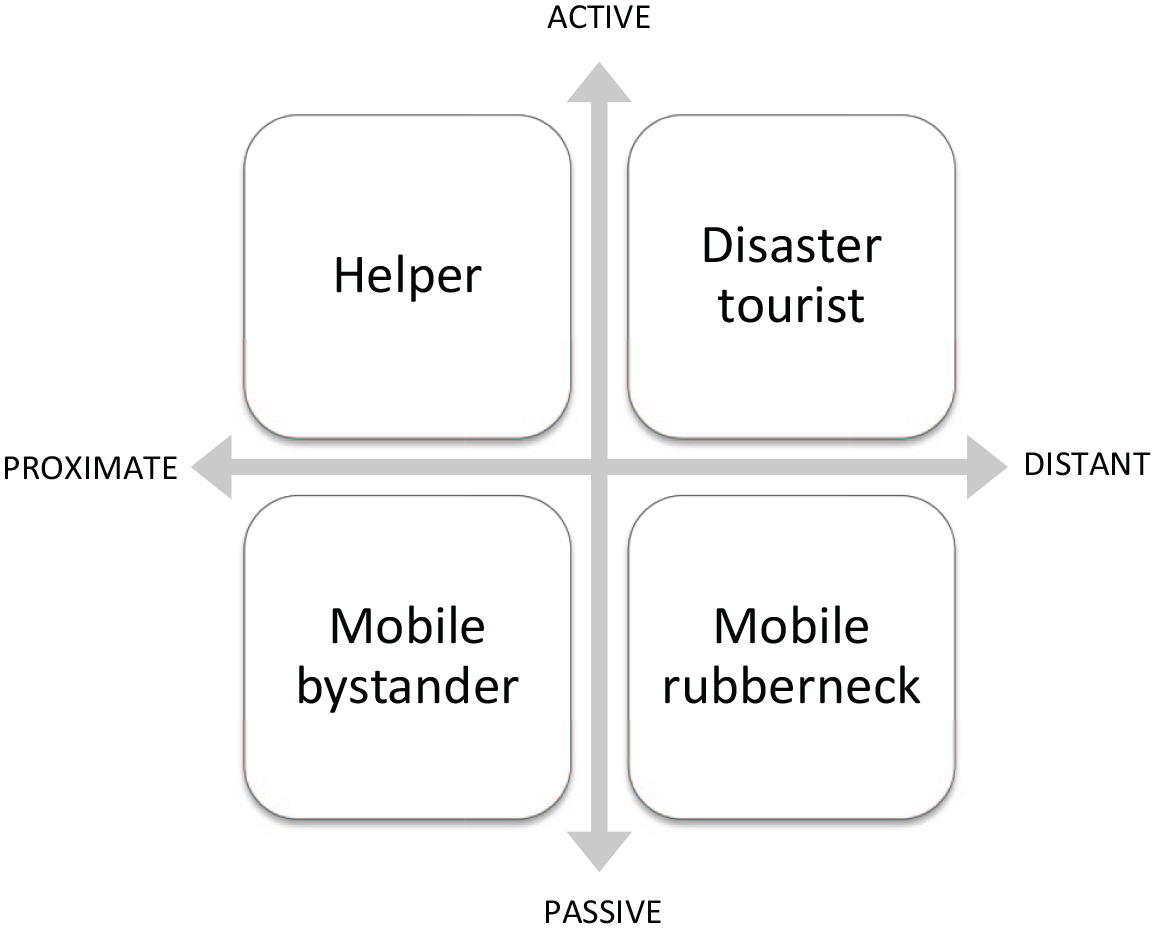
Action possibilities at accident sites among laypeople.
Based on the virtues of respect for human dignity, it is evident that active proximity is the most legitimate form of behavior: to give first aid, or to intervene for making it easier for rescue squads to do their jobs. From a legislative perspective in Sweden, people are not obliged to perform first aid, and many people would not know how to, but witnessing an accident obliges people to stop, call emergency services, and be prepared to make statements to the police. This behavior or action possibility does not include mobile media practices, and therefore, we will not further discuss this category since it does not raise issues of ethical considerations concerning communication practices.
Passive proximity tends to be more complex. Behind the patterns within this box of the quadruple, we find various reasons for being close to the accident scene. The mobile bystander, sometimes acting as a citizen witness or journalist, may collect invaluable evidence for later investigations, which gives moral credit to the behavior. On the other hand, the statements from first responders regarding aggressive crowds blocking the way are more difficult to justify morally. Another dimension of the passivity is the reason to be close to the accident scene. The assumption is that the person did not choose to become a first-row witness; it occurred solely by coincidence. This is the main difference between the category found in the upper right corner of Figure 1. Active distant involves the active choice of being near the accident scene, but not too close. When referring to disaster tourism, this has become associated with morally condemned behavior. The dimension of distance is complicated for the determination of the moral call of the action. Some disaster tourists fall under the category of “catastrophe seekers” and rush to scenes to put themselves into danger. This means that we also have a difference within the dimension of proximity–distance. Distance can also be interpreted in time. Mobile bystanders are found immediately at the scene, while disaster tourists usually arrive after some delay. Visiting historical sites of disasters does not necessarily connote with immoral behavior but is, on the contrary, an act of respect. Finally, the passive distant refers to spectators not choosing to be part of the accident scene, but by circumstances experiencing the event from a distance. Here, we easily recognize the traditional bystander and rubberneck. Both categories happen to pass by; the bystander stops due to curiosity or to gather information for a better understanding of the situation. The behavior can be described as passive and distant, but can also include the active choice to document the scenery for different reasons. The mobile rubbernecks are also passing by slowly, trying to grasp information by being attentive to a close-by situation. In the cases of mobile rubbernecks, moral judgment comes with their choice of picking up the phone for personal documentation. In the rubberneck case, it becomes even worse since the behavior may cause other traffic situations due to using the phone while driving.
Figure 1 is an attempt to categorize different types of behavior among people at accident scenes. However, it is apparent that it is difficult to distinguish between different types of behavior and to categorize them in one or the other boxes of the quadruple. Some behaviors are so complex that they may shift from one box to another. A person who, by coincidence, arrives at an accident may call for help but then make way for the rescue squad to do their job, and from a distance wait for the police to pick up witness information. Consequently, the ethical implications of mobile bystanding cannot be fixed but are contextual. Curiosity and care, courage, and cowardice can coexist in these mobile media practices. If we are to think of mobile bystanding as a “limit situation” in Couldry’s (2013) use of the term, meaning a domain where new ethical thinking emerges, then it is important to be attentive to the interactions between social virtues and vices associated with the behavior.
Using dimensions of proximity–distance and active–passive could be a help to understand these situations and carefully study what actually is going on along the dimensions for getting a broader understanding of the phenomenon of personal documentations that violate vulnerable victims’ integrity. Moreover, this approach allows for a deeper, critical understanding of the phenomenon. As stated initially, the task for a critical scholarship is to move beyond simplistic, spontaneous moral denunciations as can be found in public reactions and explore the ethical implications. It is also a possibility to add new perspectives to the phenomenon.
Furthermore, mobile media practices of bystanders, disaster tourists, and rubbernecks become a problem in the interference with the professional first responders at the scene. In those cases, both the active–passive and proximity–distance dimensions can cause danger and conflict as bystanders block the way of rescue (active/passive proximity), or that their filming adds stress and tension among professionals (active/passive distance). From such examples, it is clear that mobile media practices at accident scenes generate situations that are qualitatively different from traditional notions of bystanding and rubbernecking. Mobile bystanders constitute a new disposition that requires a theoretical approach that is able to encompass the complexity of the phenomena.
Discussion
The aim of this article has been to elaborate upon theoretical perspectives relevant for analyzing mobile media practices in extra-ordinary events, such as traffic accidents, in a time when communication has become part of a mobile lifestyle. A point of departure was the classic theory of bystanders, developed in the late 1960s by Latané and Darley, explaining why witnesses to accidents and crimes were passive due to certain processes. The term “mobile bystander” may be confusing since it is not obvious that people at accident scenes nowadays would be referred to as passive, especially not when the first-responders complain about witnesses blocking the way and playing out in an aggressive mode. In our elaboration with the model of laymen’s actions of possibilities at accident scenes we have come to the conclusions that the mobile bystander has replaced the bystander. In today’s digital everyday life, it is rare that anyone witnessing an accident would not document it with their mobile phone. Furthermore, it is unlikely anyone would witness an accident with an “ordinary” camera at hand. The main point is that the mobile bystander witnesses an accident by also communicating the experience momentarily. This is the new dimension in the bystander phenomenon that also brings out another process to be combined with the previous ones that explain the passivity, and where we can see a behavior that is not based on passivity, but where the activity has mainly taken place for their own fulfilment. Still, the mobile bystander is passive towards the victims. This is the crucial borderline, and why the term bystander is still valid, however elaborated to suit today’s ubiquitous everyday digital communication practices, as defined as the mobile lifestyle.
We did not invent the term mobile bystander. In 2012, the Washington Post published a column regarding the mobile bystander phenomenon, referring to an accident taking place in the NYC subway (Basulto, 2012). If the term bystander goes back 50 years, we need to more than double the years for the term rubbernecks. So far, we have described the modern rubbernecks to be passers-by in their cars, so they are mobile per se, but also in the behavior of picking up the phones for camera use.
In this article, we have also touched upon the phenomenon of disaster tourists as a possible laymen action at accident scenes. Disaster tourists are relevant in our attempt to sketch a grid of behaviors connected to proximity and distance. However, this category of behavior demands other conditions than what is normally seen in accident situations. The timeline must be extended since, as implicated in the term, tourists usually plan where to go, and do not become accidental ones. Therefore, we will not further explore this category, but return to the mobile bystanders and rubbernecks. There is no doubt that the behavior of these two categories have changed due to the digital communication becoming part of everyday life and a mobile lifestyle.
Furthermore, we have seen that the mobile lifestyle transgresses social norms and raises ethical and moral issues. There are, as we have already pointed out, numerous examples of how everyday media use in the digital era leads to unwanted social consequences.
The case of mobile witnessing illustrates how technological development provokes negotiations about social norms. While public opinions regarding this can become intense, and professional commentators are quick to condemn the phenomenon, we have shown how the ethical implications of mobile media practices cover social vices as well as virtues. We have also shown the difficulty of distinguishing different behaviors. People’s behaviors, especially in terms of extra-ordinary situations in everyday life, are complex and may follow different dimensions at the same time. It is clear that the phenomenon needs more attention within media and communication studies in order to understand the underlying processes of the behavior and to what extent ethical considerations need to be further addressed for the protection of an individual’s integrity as well as dignity.
Footnotes
Funding
The author(s) disclosed receipt of the following financial support for the research, authorship, and/or publication of this article: This work was supported by the Center of Research of Welfare, Health and Sport, School of Health and Welfare, Halmstad University.
