



Abstract
Globalized English offers interaction platforms, including cyber-based settings, for linguistically and culturally diverse speakers, particularly in the English as a second language/English as a foreign language context. Thus, it requires developing the intercultural competence of the parties involved. English users’ different perspectives may challenge effective communication and interaction. This paper results from a collaboration project between an Omani higher learning institution and an American higher learning institution and reports an exploratory study that examined the understanding and use of intercultural communicative competencies by 15 undergraduate users of English. Data was collected from the sample participants’ notes on material analysis, collaborative projects, test performances, and the instructors’ field observations. Data analysis examined the participants’ intercultural intelligence in various communicative settings in English. The findings showed the participants changed certain predetermined misconceptions about the “other culture” and developed positivity and acceptance of intercultural differences. Results also highlighted the significance of online academic internationalization and incorporating intercultural competence in the English as a second language/English as a foreign language curricula. The study further indicated the significance of the teacher’s role in nurturing learners’ intercultural competence and intercultural-awareness priorities for being the global citizens of today.
Keywords
Introduction
The history of the English language is a riveting journey of evolution, remarkable change, and growth. Exhibiting peculiarity for being adaptive to different circumstances and influences, English has developed and dominated the international linguistic arena in recent years. The triumph of English has gone in tandem with an increase in both the population of its speakers and the geographical areas where it is used. This situation has been described by Kachru’s (1990) concentric circles model for the global distribution of English: The inner circle in reference to the English-speaking countries; the outer circle which includes the former British colonies; and the expanding circle such as China where English plays a role in education. Jenkins (2002) observed that at the beginning of the 21st century, the majority of applied linguists realized that non-native speakers (NNSs) using English in international communication acts had outnumbered native speakers (NSs). According to Crystal (2002), “estimates tell us that mother-tongue speakers are now over 400 million.” However, “this total,” Crystal continued to remark, “is far exceeded by the numbers of people who use English as a second or foreign language-at least a further 500 million …, and over a billion, according to radical ones” (pp. 1–2).
This mounting significance of English among its users in outer and expanding circles (Salih, 2017, 2021) reveals a pertinent fact that “Whereas, in the past, English was but one international language among others, it is now increasingly in a category of its own” (Cook, 2003: 25). In their response to the rapid growth of English, researchers often refer to globalized English as “English as an international language (EIL)” (e.g. Alptekin, 2002; Jenkins, 2000; McKay, 2002), “English as a world language” (e.g.Mair, 2003; McCrum, 2010), “English as a medium of intercultural communication” (e.g. Holmes and Dervin, 2016; Meierkord, 1996), “English as a global language” (e.g. Crystal, 2003; Northrup, 2013), and “English as a lingua franca” (ELF) (e.g. Kecskes, 2019; Mackenzie, 2014; Seidlhofer, 2004).
Researchers observe that “changes in the distribution and balance of languages, and in particular the growth of ELF, have both reflected and influenced the populations and purposes of language learners” (Cook, 2003: 30). Moreover, the speedy growth of English with its profound implications for language pedagogy, particularly in English as a second language (ESL)/English as a foreign language (EFL) contexts, has gone in tandem with its triumph as an international lingua franca where hundreds of thousands of linguistically and culturally diversified people use it every day for varieties of reasons. A lingua franca is a language other than the native language used by NNSs (see Cook, 2003; Jenkins, 2006, 2014; Kecskes, 2019) “who do not share a standard code, and the English language today functions to serve such a goal at the global level” (Salih and Ali, 2018: 102).
The recent growth of EIL has gained significance among researchers. Jenkins (2014) reported that “during the decade from 2000, there was an explosion of ELF research … leading in turn to a proliferation of ELF corpora, published books and articles, special journal issues, and unpublished theses and dissertations on ELF” (p. 24). Crystal (2002) observed the “urgent need to communicate at world level, where everyone involved has a vested interest in keeping at least one channel open, in the form of standard written English” (p. 11). This new trend implies that “for a large proportion of the world’s population, the learning and use of English as an additional language is both a major language need—often one upon which their livelihood depends—and also one of the salient language experiences of their lives” (Cook, 2003: 26).
English as a lingua franca has been investigated first as an emerging means of communication among users who hold no cultural loyalty to the English-speaking community and do not have communicative engagement with NSs (see Crystal, 2003; Jenkins, 2002). Crystal (2002) remarks that the unparalleled ability to speak to each other over a long distance, in the form of radio and television program, telephone, news media, and the Internet, is likely to influence the speech habits of ELF users. These new frontiers of ELF mean expansion in use range by fast-growing populations of users.
An emerging research strand on ELF has started to focus on the involvement of NSs in communication activities within the context of ELF and the norms that emerge out of such encounters. In their study about the instances of spoken English patterns among international users where NSs took part, Roberts and Canagarajah (2009) report that ELF speakers can respond to communicative context requirements even when an NS is involved. Besides, the ELF speakers tend to bring diversified linguistic repertoires to the negotiation of English contexts. This study is significant as it extends the ELF’s perspective with the inclusion of NSs and the possible norms that might emerge out of such interaction. With the growing potential of NSs’ involvement, it is essential to focus on intercultural competence to shape ELF users’ capacity to negotiate cultural differences, develop effective communicative behaviors and minimize cross-cultural misunderstanding.
Intercultural competence and the EFL/ESL learner as a global citizen within the framework of internationalization
The accelerated pace of globalization has changed the scope and nature of our cross-cultural communication and contributed significantly “to a dramatic increase in intercultural interactions” (Kong et al., 2020: 169). This has called for promoting the intercultural competence of individuals and necessitated addressing English as an international lingua franca’s (EILF’s) role in higher education (Jenkins, 2014; Smit, 2010). Globalization is both an opportunity and a challenge for universities that have witnessed a rise in the number of incoming and outgoing students who need to develop an aptitude to deal with cultural diversity in academic settings and beyond and become “prepared for a multicultural society” (Brancu et al., 2016: 337). Graduating global citizens capable of living and working in a rich multicultural environment (Ribiero, 2016) is one of the significant challenges for higher education institutions. This competence is a fundamental adroitness that ESL/EFL learners need and aspire to acquire to respond to intercultural interaction requirements in the global age. An effective way to prepare higher education learners to become competent, interculturally oriented global citizens is the internationalization of education (Smith-Isabell and Rubaii, 2020: 3).
Bodis (2020) observed the integrated relationship between intercultural competence, English as a lingua franca, and academic internationalization. The researcher stated that “the internationalization of education has resulted in an increased focus on developing global citizenship. (…) One element of global citizenship is intercultural competence” (p. 26). Intercultural competence (Byram et al., 2001; Deardorff, 2009) is the ability of language users to communicate with others in an interculturally sensitive way. This skill has been referred to interchangeably as cultural intelligence (Brancu et al., 2016; Kong et al., 2020), intercultural intelligence (James and Shammas, 2013), or intercultural communicative competence (Lyddon, 2018). According to Piwko (2020), intercultural competence is indispensable for “communication between people or groups representing different cultures, in which different ways of establishing a mutual relationship are used” (p. 73).
Before the emergence of the notion of “intercultural competence,” there was an emphasis on communicative competence which comprises the skills of language users on the grammatical, sociolinguistic and discourse levels (Alptekin, 2002). A competent language user is required to develop “knowledge of not only if something is formally possible in a language, but also the knowledge of whether it is feasible, appropriate, or done in a particular speech community” (Richards and Schmidt, 2002: 90). However, Alptekin (2002) criticized the notion of communicative competence in EFL contexts because it expects learners and teachers “to use the language as it is used by its native speakers … so as not to offend the native speakers” (p. 58). Other researchers criticized the hegemony of linguicism (Khan, 2019; Macedo et al., 2016; Phillipson, 1992) which projects a stereotypical understanding of other cultures and idolizes the sociocultural, sociolinguistic patterns of the target culture at the expense of the source culture patterns.
In light of English's undeniable presence in the global arena, English language teaching (ELT) programs are supposed to distance themselves from the domineering, target-culture-oriented approach to teaching English and be cognizant of the multicultural, complex nature of the world language. Communicative competence was seen as falling short of reflecting the status of English as a lingua franca that involves NNSs in real interactive exchanges with NSs or other NNSs. In response to the new developments in the status of English as a global language, the term “intercultural communicative competence” (Secru, 2004: 76) emerged to view any act of communication as “essentially intercultural” (Lyddon, 2018: 174).
Intercultural communicative competence embraces a model of interaction in which English users negotiate between the source culture and the target culture. This model gave birth to varieties of English and the notion of the Englishes of the world (see Alptekin, 2002; Kachru, 1990; Salih and Ali, 2018) and embraced the notion of teaching/learning EIL in authentic interactive scenarios between native and non-native interlocutors, on the one hand, and non-native–non-native interlocutors, on the other hand. The new model does not view learners as representatives of a fixed cultural whole that is easy to contrast with a generalized category in the target culture. Instead, it embraces a diversified, gestalt understanding of learners as distinct individuals who are entitled to a more objective understanding of their cultural and individual identity away from any stereotypical categorization of their behavioral patterns and sets of beliefs.
Accordingly, intercultural competence comprises four domains: cognitive (knowledge based), metacognitive (the ability to acquire and process cultural content), motivational (to show interest in effective communication interculturally), and behavioral (the ability to behave in an interculturally sensitive way) (Ang et al., 2011; Brancu et al., 2016). Due to the interdisciplinarity of the notion, it shifted from a theoretical topic to a practical context for educational training and developmental activities (Ang et al., 2011). The cognitive component is the lynchpin of developing learners’ intercultural competence as it raises their awareness about “sociocultural and sociolinguistic differences” (Cakir, 2006: 160) between cultures. Thus, they can understand the reasons behind any relevant disruption in communication and find the appropriate solutions for miscommunication. As for the motivational, metacognitive, and behavioral components (Brancu et al., 2016; Kong et al., 2020), these are advanced skills that require a minimum level of cultural intelligence that motivates individuals to observe and analyze the similarities and variations in the cultural patterns of other cultures.
Developing cognitive awareness about the other culture is a journey that starts with a comparison between the source culture and the target culture. The point of departure for comparing between cultures is to examine aspects that outline our individuality. These include the notions of individualism/collectivism, uncertainty avoidance, femininity/masculinity, power distance, long-term/short-term orientation (Hofstede, 2001, 2011). Researchers use these notions to navigate cross-cultural similarities and differences as “relative features, not absolutes” (DeCapua and Wintergerst, 2016: 61). Relativity is indispensable for developing intercultural competence as it helps language learners avoid stereotyping others.
The intercultural approach to communication accentuates the need of learners to express their linguistic and cultural patterns visibly and be vocal about their cultural priorities without reservations or attributing others’ behavioral and linguistic patterns to their subjective experiences. Initially, nurturing intercultural intelligence among EFL learners involves “raising learners’ sociolinguistic and cultural self-awareness” (Lyddon, 2018: 174) which “begins with an open attitude, respect and curiosity … through skills of listening, observation and evaluation and analysis” (Deardorff, 2009 as cited in Bodis, 2020: 30). DeCapua and Wintergerst (2016) observed that successful communication mandates knowledge of each other's socio-cultural identities, and they introduced the intercultural communication framework as a mechanism to enhance cross-cultural communication in different contexts by “(1) establishing and maintaining a relationship, (2) identifying and accommodating priorities, (3) making associations between the familiar and the unfamiliar” (p. 32).
James and Shammas (2013) observed that what happens in the classroom is “essential for building trusting relationships of honesty and freedom, spaces of where diversity and plurality can be explored” (p. 153). Bodis (2020) highlighted the significance of scaffolding the learners while completing tasks that build their knowledge and improve their ability to communicate with others. This can be achieved by preparing an inventory of linguistic and extra-linquistic content that facilitates the scaffolding process and helps to “build bridges from one cognitive system to another” (Cakir, 2006: 156). However, it is essential to ensure that the instructors do not design and interpret such inventories based on their subjective experiences. Khan (2019) reported that intercultural competence requires involving ELT students in classroom activities that allow them to observe, interpret, form attitudes, and interact using critical analysis skills.
Accordingly, ELT educators need to nurture their students’ intercultural awareness by underscoring the plural nature of intercultural communication and encouraging them to reflect on this multiplicity in an analytical, comparative way. This view sees teachers as facilitators who mediate between the source culture and target culture of learners. To perform this role, teachers may employ in-class strategies that “help students to overcome cultural ‘fatigue’” (Cakir, 2006: 157). Such strategies include storytelling (Ribiero, 2016), “cultural minidramas, critical incidents, culture assimilators, simulation games and documents originating from a foreign culture can be used as input for teaching” (Secru, 2004: 74). While storytelling is a useful educational tool to understand oneself and the world around, critical incidents provide authentic examples of misconceptions or miscommunication due to the variation in cross-cultural behavior modes. Other strategies that prepare students to engage with the target culture comprise “introspective readings, roleplays, explorations of mass media, and the many resources available on the internet” (DeCapua and Wintergerst, 2016: 86).
Although the learners’ intercultural competence in academic contexts starts with a cognitive process (building knowledge), it can only be tested in real communicative exchanges beyond the classroom setting. Brancu et al. (2016) introduced a dual mechanism to develop the intercultural intelligence of learners, focusing on the curriculum and invigorating intercultural exchanges by introducing academic and professional internships abroad. Building the intercultural competence of learners can also occur at a broader level under the banner of international academic cooperation. Under the volatile conditions caused by the coronavirus disease 2019 (COVID-19) pandemic that disrupted the educational process worldwide (see Salih and Omar, 2021) and destabilized the potential of conducting such academic activities, the recent trend of online academic internationalization has re-emerged as a mechanism to prepare students for the globalized workplace/academic setting and enable them to build new culturally oriented learning experiences. Nothing compares to surpassing the traditional borders of the classroom and introducing a new learning model that is second best to traveling abroad as this can reduce any future impact of cultural shock (Fumham and Bochner, 1986; Hofstede, 2001; Oberg, 1960).
In attempting to be part of an effective intercultural communication process, language users face verbal and nonverbal communication challenges. The main barrier for successful communication is linguistic relating to language users’ verbal behavior. There are two types of linguistic barriers. The first is related to cultural concepts that reflect visible cultural constructs, with direct connotations, and invisible cultural constructs, with indirect pragmatic connotations including “cultural emphasis on directness or indirectness in the discourse, the weight attached to social status … the appropriateness of different discourse styles, in rules of speaking, and in the relative importance assigned to different context variables” (DeCapua and Wintergerst, 2016: 258). Language is a predictor of the learners’ level of intercultural competence, and this is expressed by the notion of linguistic relativity, introduced in the Sapir-Whorf hypothesis. According to this hypothesis, individuals can only observe the objects and concepts that they are familiar with and “that can be expressed in the language” (Krishnaswamy et al., 1992: 59). In other words, our cognition and interaction with the world around us are confined by our linguistic structures that may be subjective but still “feel natural to us” (Goddard and Mean, 2000: 2) as they are acquired subconsciously.
Impediments that learners face on the linguistic or extra-linguistic levels are the result of enculturation which makes the native language and culture of individuals influence their conceptualization of the other culture. Language learners project their linguistic patterns on their communication in the second/foreign language and reject or neutralize the target language linguistic patterns in an impulsive manner that leads to misconception and misunderstanding. Enculturation is a subconscious learning process that starts as early as the phase of childhood. Individuals can only learn to reverse or reconsider their subjective filtering of cultural constructs and behavioral patterns by having real interaction with the “other/s” (DeCapua and Wintergerst, 2016). The second impediment that obstructs intercultural intelligence development in the EFL classroom and beyond falls under non-verbal behavior comprising the use of vocal and visual signals (DeCapua and Wintergerst, 2016). Examples of visual, non-verbal communicative behavior comprise space relationships (proxemics), body language, and silence. Although these components share certain universal aspects, they continue to be at variance in many ways.
Building the cultural competence of learners is never a modest project with clearly delineated strategies and mechanisms. It is a life-long learning journey that requires remarkable efforts on the cognitive, metacognitive, motivational, and behavioral levels without sacrificing one's cultural priorities and identity. The present study is significant because of the topicality of intercultural competence vis-a-vis the current status of English as a lingua franca, particularly in light of the recent shift to online education and the blossoming interest in the internationalization of higher education (Proctor and Rumbley, 2018). The study is also timely and enriching, taking into consideration “the newness of the construct” (Brancu et al., 2016: 338) and the pressing need for empirical studies on integrating intercultural competence with EFL contexts. It is particularly significant in a Gulf country like Oman that comprises “national indigenous populations working alongside with expatriate populations that … constitute over 50% of the total population” (Al Barwani et al., 2010: 179). The study specifically attempted to address the following research questions:
How is intercultural communication challenging for EFL users where NSs are involved? How do users of English as a lingua franca manage communication within an intercultural academic context?
Methods
The study is exploratory in nature as it examines NNSs English language users’ intercultural communicative competencies in their interaction with native (NSs) speakers of English within ELF context. The study combines aspects of qualitative and descriptive approaches in exploring the participants’ intercultural competence by analyzing their reflections on different types of cultural materials. The study was implemented in three phases: First, the Omani students were exposed to cultural materials (texts on the American culture) and were asked to write their reflections on the similarities and differences between their culture and the other culture; second, the students from both universities worked on a joint collaborative academic project. Third, the Omani students were asked to write their reflections on the materials that were developed by their peers from the American university.
The reflections from Phases 1 and 2 were collected and analyzed to measure the progress in the intercultural competence of the Omani learners following the project implementation. Throughout the period of interaction with each other to complete the joint project, the students from both universities were scaffolded by their instructors in the classroom to help them avoid different challenges and deal with possible critical incidents. This happened in the form of classroom discussions following activities that comprised watching/reading cultural content and commenting on critical incidents that the students may have encountered during their interaction with each other.
Participants
The participants who acted as a source of data in this study comprised (N = 15 undergraduate students) from two higher learning institutions in the Sultanate of Oman and the United States of America. The Omani participants were NNSs majoring in English language and have learned English from the age of five. In terms of proficiency, they are able to provide an IELTS Band 7 or any other equivalent. The American participants were NSs of English. The participants in both institutions enrolled in a course on culture in the classroom for one semester.
The Omani higher learning institution (OHLI) participants were exposed to selected materials available on mass media and several Internet resources like YouTube and Ted Talks. The materials also comprised anecdotes and critical incidents from the textbook and the learners’ daily experiences. This exposed the students to different cultural constructs to prepare them for the project. To develop their cognitive and metacognitive competencies, the participants needed motivation in the form of exchanging good wishes on national and religious occasions (completion of the American 2020 elections, Oman’s National Day, Thanksgiving). This enabled the participants to build a relationship, which facilitated the process of intercultural communication.
Data collection Procedures
The data was collected in two phases. In Phase 1 the OHLI students completed an online test, and in Phase 2 the participants reflected on their completion of the project by responding to a second online test. The study specifically used the following tools for data collection.
Joint project
The study utilized the materials produced collaboratively in a joint project by the sample participants from both OHLI and American higher learning institution (AHLI). The project involved the students from both universities in jointly producing a bilingual children book with rich cultural content (examples include celebrating Eid al-Fitr, celebrating Easter Day, traditional food, etc.). The rationale behind the joint project was to offer a platform for the participants to have exposure to the other culture as they interact virtually with their counterparts. The participants used online media such as email correspondence, zoom meetings, and whatsapp chat.
Test performance
The participants also performed in online tests designed on the topics taught during the semester. The tests were designed to measure the Omani students’ level of intercultural competence before and after their interaction with their AHLI counterparts and to identify the types and nature of challenges they encountered along the process.
Instructor’s notes
The OHLI instructor’s notes collected during class sessions also represented a source of data. The observation focused on the participants’ attempts to handle both similarities and differences in intercultural communicative situations when interacting with other English users outside their culture and the sources of challenge the students met during their interaction with each other.
Data analysis
Initially, The OHLI participants completed an online test in which they were asked to read a text and write their reflections on the similarities and differences between their culture and the American culture, and their performances were collected and analyzed. The analyzed text addressed different aspects of the American culture including religion, food, social customs, and celebrations. Following the completion of the project, the students completed a second test in which they were asked again to report on the similarities and differences between the two cultures and their impressions on the implementation of the project and the content developed by their peers. The participants’ reflections took the form of formative assessment and summative assessment (the Omani participants peer-reviewed the materials produced jointly during their collaboration with their American counterparts).
The researchers analyzed the OHLI participants’ reflections to compare their intercultural competence before the project and their intercultural competence after the project implementation and, thus, evaluate the achieved progress. Also, the OHLI instructor’s class observations on the discussions conducted with the students were collected and analyzed for reflection on the challenges encountered by the participants during the project implementation.
Results and discussion
The analysis revealed that, throughout the project’s implementation, the OHLI participants nurtured their intercultural competence on the cognitive, metacognitive, and motivational levels, as shown in Tables 1 and 2 and Figures 1 and 2. The following Tables and Figures reveal how the intercultural competence of the participants developed across different cultural constructs. Table 1 shows the frequencies of similarities and differences by cultural constructs before the project, whereas Table 2 shows the frequencies of similarities and differences by cultural constructs after the project.
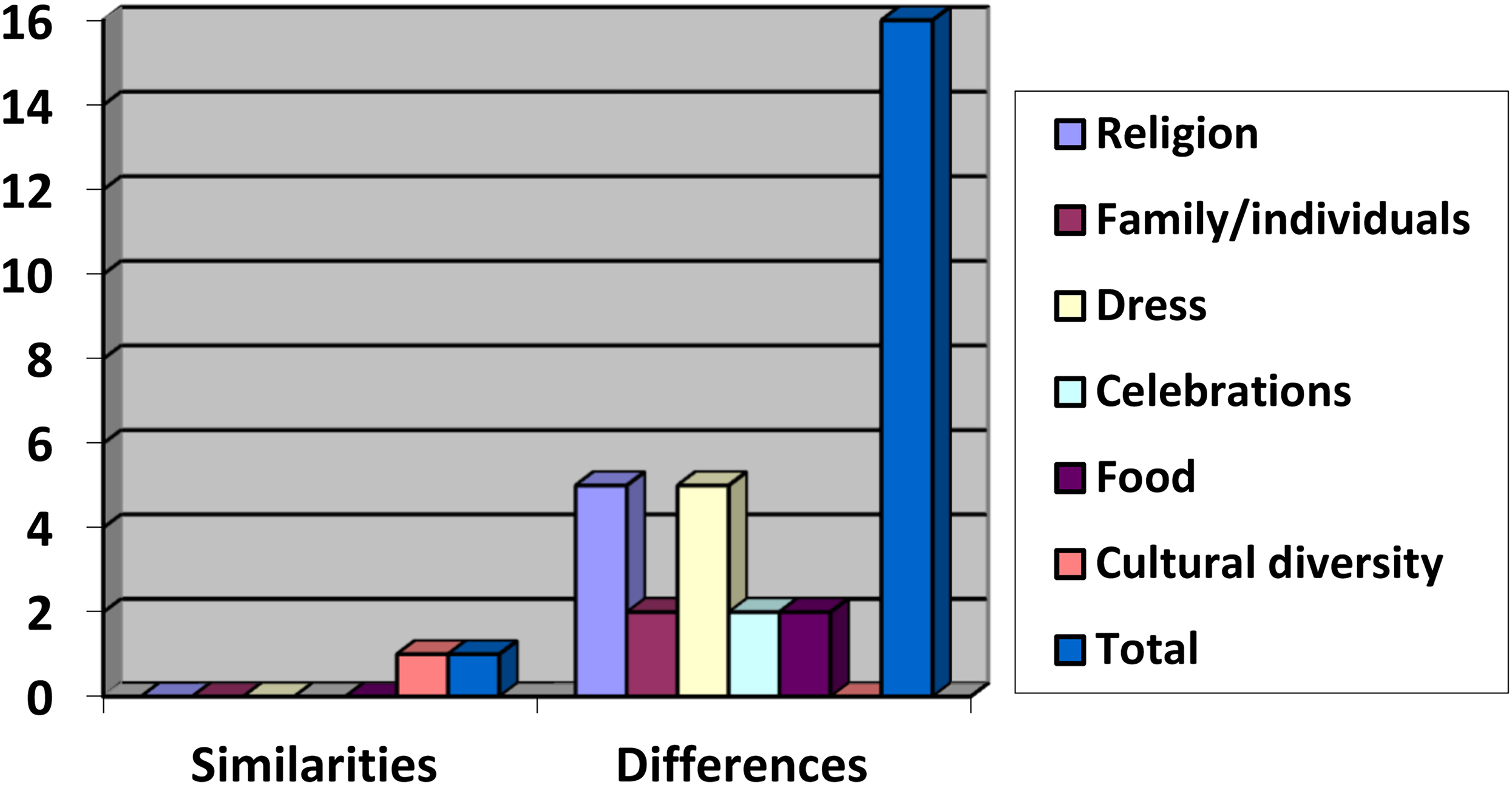
Distribution of similarities and differences by cultural constructs before the project.
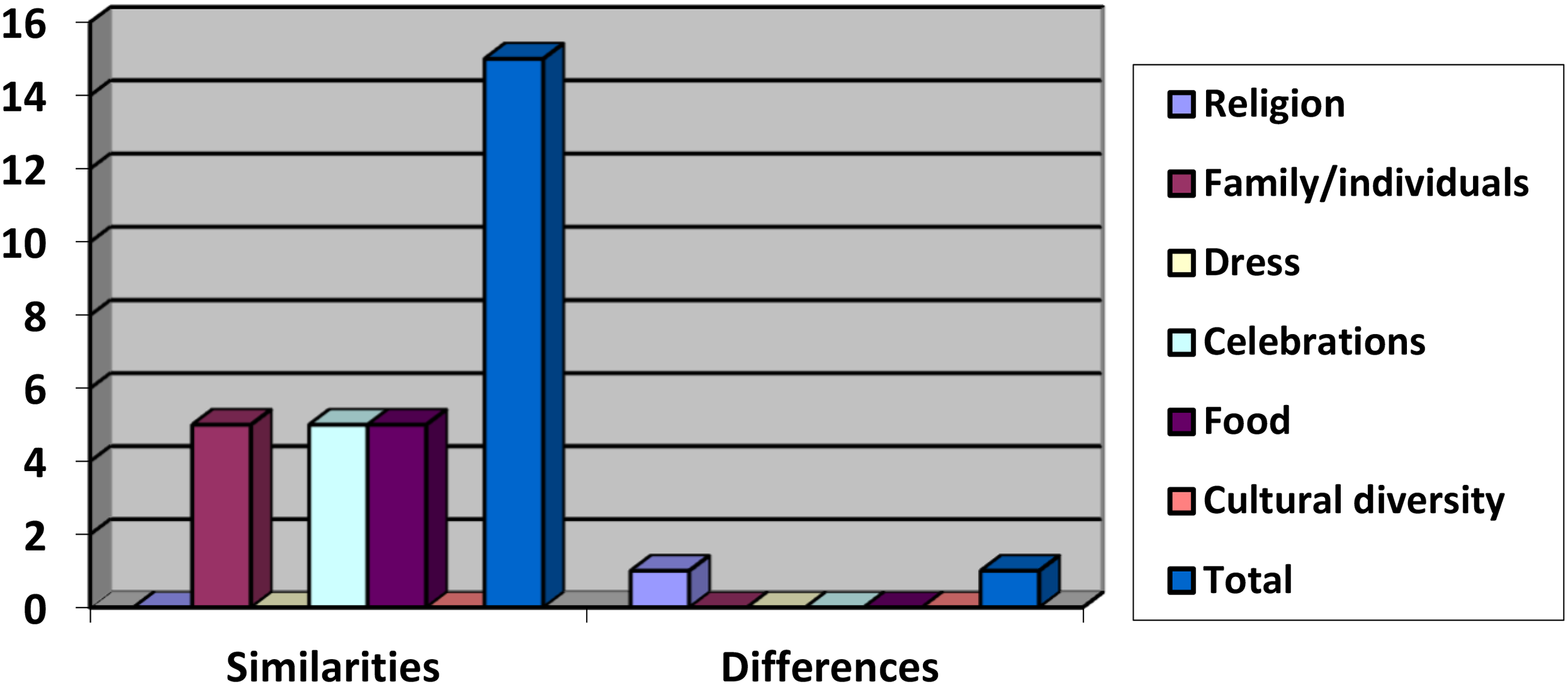
Distribution of similarities and differences by cultural constructs after the project.
Frequencies of similarities and differences by cultural constructs before the project.
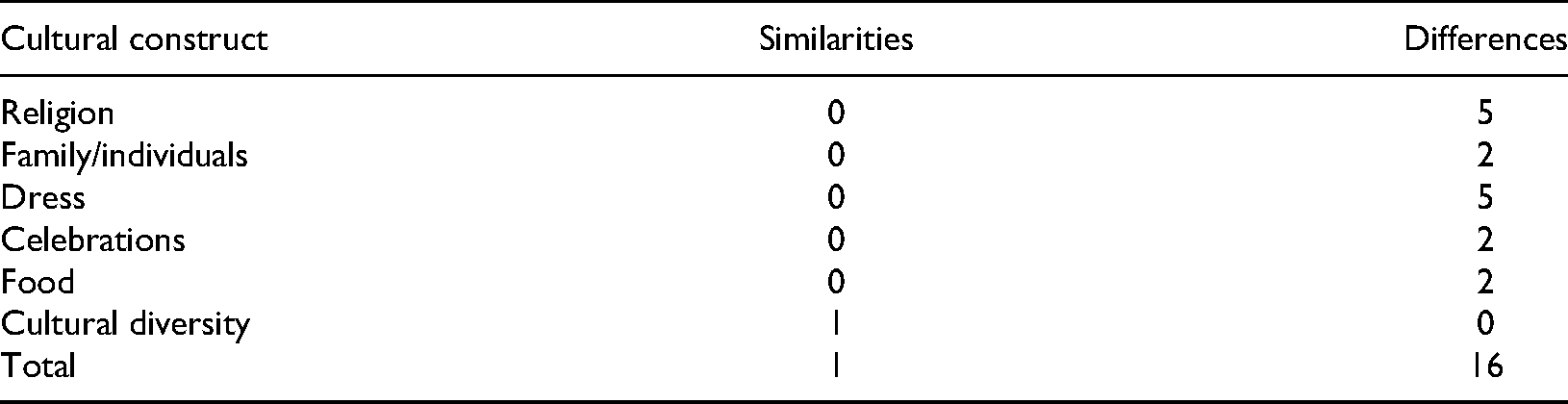
Frequencies of similarities and differences by cultural constructs after the project.
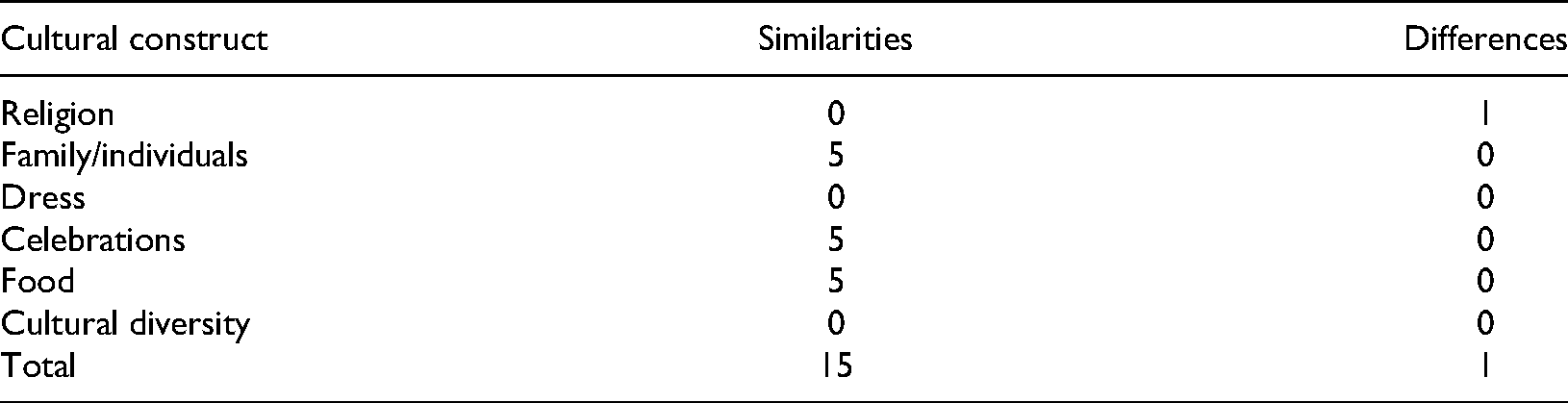
Table 1 shows that before the project the OHLI students’ level of intercultural competence was rather low as they could hardly observe any similarities between their culture and the other culture. The text that was analyzed by the students in Phase 1 contained content on American cultural constructs such as religion, family/individuals, dress, celebrations, food, cultural diversity, and others. The only point of similarity which the students spotted was cultural diversity, while they observed other cultural constructs as distinct and belonging to the other extreme on the intercultural diversity continuum.
Before the project, OHLI students were most concerned about the differences between the two cultures in terms of religion and dress. Being part of a collectivist culture, the OHLI students observed the two cultures as falling on the two extremes of religious differences. All five students highlighted the differences in dress between the two cultures and related their national dress to their religious and national identity. Only two out of five students commented on the differences relating to family relationships, food and celebrations. Interestingly, only one participant saw one general point of similarity between the two cultures relating to cultural diversity (see Table 1 and Figure 1).
The Omani students perceived the American culture as utterly individualistic with fragile relationships, as opposed to the Omani collectivistic culture. The individuals of the American culture were viewed by the Omani students as too liberal and divided by the exaggerated variation in their values and sets of beliefs. In their first formative assessment in Phase 1, the Omani students used expressions such as “I dislike …, crossing the limit of modesty by showing some skin …, I did not like the religious freedom …, I disliked how as a nation, they don’t share the same values, beliefs, and religion …, it seemed hard for a person of a different background to interact with another group of people …”.
Following the project completion in Phase 2, there was a paradigmatic shift in the intercultural competence of the Omani participants who highlighted the similarities between their culture and the American culture in most examined cultural constructs (see Figure 2). While at the beginning, the participants were under the influence of the cognitive dissonance triggered by the apparent conflict between the two cultures, the project implementation culminated with the realization of deep cross-cultural similarities.
The OHLI students perceived similarities between the two cultures in terms of family relationships, celebrations as well as practices related to cooking and sharing food. The participants appeared to be less interested in differences related to religious practices. Only one student reported a difference between the two cultures in terms of eating halal meat. The others seemed to be fascinated with the similarities in how cultural values are practiced during religious celebrations and family gatherings that reflect the intense bondage between family members. They described these similarities using expressions like “I can familiarize Thanksgiving with Eid …, most holidays are related to religion like us …, they also prioritize family values and come together to feast …, I liked American traditions in Thanksgiving plate because they care about family”.
Interestingly, Table 2 above shows consistency and consensus among students on the observed similarities, which means that the project implementation helped the participants achieve a similar level of progress in improving their intercultural competence. Although the analysis shows the strong tendency among students to attribute the experiences of others to their own culture, which is natural being part of the enculturation process, this realization has enabled the students to develop their intercultural competence on the motivational level, as proven by the comments they made in their summative assessments at the end of the course.
In their reflections on the project implementation and their collaboration with their American peers, OHLI students used expressions like “I respect …, my team …, my team and I were very kind when working together …, this helped me explore the American culture …, they were very respectful with me …, I respect their opinions, they respect my time, I liked the American tradition …, I hope to meet face to face …, it is interesting to interact with another culture and work together …, it is true that we may face challenges and difficulties when interacting with American culture, but it is very useful to learn about their culture …, it is a good experience of communication, to share their happy and bad times …, they are bound to their religious beliefs unlike what we assumed …, I think I had a misperception about them that they don’t take their religion seriously …, what fascinated me is that all members should prepare and make one dish and share it with their family members.” The transformation in OHLI participants’ perception of the other culture shows that the motivational level follows a successful intercultural interaction experience on the cognitive and metacognitive levels.
Not only have the OHLI students become capable of observing points of commonality between both cultures, but they have also started to appreciate and admire certain individualistic features of the American culture, such as the ability of individuals to use critical thinking and express their opinions openly. In their peer review of a report produced by an American student, the Omani students valued the student's ability to openly criticize one of her colleagues who fell short of making a valid contribution to their joint project. While the Omani students saw this as a clear departure from the collectivistic cultural values they embrace, they did not fail to appreciate this value as an indicator of the freedom of self-expression.
Throughout this journey, the students faced several challenges in different aspects of intercultural competence. The following account describes the impediments and challenges students from both universities faced during the implementation process and how they managed to surmount these difficulties.
Linguistic and extra-linguistic challenges
The primary source of confusion for students on the linguistic level was their focus on form rather than pragmatics and the situational context in processing both visible cultural constructs and invisible cultural constructs throughout their interaction with others or when exposed to cultural materials. For example, when the students encountered texts, images, or other materials with cultural content, they failed to identify the reference of culturally embedded concepts such as the Father (in Christianity), Christmas, jack-in-the-box, prayer mat (in Islam), and others.
Most students associated these concepts with their first-hand-experience denotative meanings. Accordingly, Omani students confused the concept of the “‘Father as Deity’ in Charles Dickens” “A Child's Dream of a Star” for the concept of “father as a parent.” They confused the concept of “Christmas” with that of the “New Year” failing to observe the root of the word, i.e. “Christ.” On the other hand, the American students identified a prayer mat that is used by Muslims to perform their prayers as a “piece of carpet” which can be used for insulating a person's feet or for decoration.
These linguistic and extra-linguistic barriers are related to the lack of cognitive awareness among both universities’ students, barriers that can gradually diminish throughout the interaction with and exposure to the other culture's cultural constructs and patterns. A more strenuous and deeply rooted source of the challenge lies in the students’ inability to unveil the pragmatic connotations beyond specific verbal patterns. In an in-class discussion that allowed OHLIs’ students to talk about some critical incidents in their academic life, one of the students asked, “teacher, why do our EFL teachers feel disappointed and express criticism when we use the expression, “‘Insha’ Allah’ (if God so wills)? Is it because we are Muslims?”
This question raised by one of the Omani students highlights the student's concern that her EFL teachers’ reaction may result from their lack of appreciation or understanding of their Islamic identity. It is worth noting that cultural constructs that are embedded in the faith of the Omani students are their priority during their interaction with their teachers and peers from the other culture. Clearly, throughout the process, the participants became competent in identifying and expressing their priorities, which is an essential component for smooth intercultural interaction. In many parts of the world and particularly in the Gulf region, EFL and ESL are rich teaching contexts that attract teachers from different linguistic and cultural backgrounds. Thus, exposing both students and instructors to intercultural differences and raising their awareness of the significance of understanding and sharing intercultural values may enrich both learning and teaching experiences and practices. Exploring and developing the EFL and ESL teachers’ intercultural competence is an area that awaits researchers’ attention.
Interestingly, after the students discussed with their instructor the constructs of polychronic/monochronic cultures, their intercultural competence started to take a new trajectory towards a more pragmatic understanding of the utterances used by their peers. In their reflections on a report written by one of their American peers as part of the peer-review process, the Omani students showed development in their metacognitive ability to analyze the American student's reservations on what she described as “the laidback Omani culture.” The students’ observations revealed their newly developed ability to analyze this comment about the newly acquired knowledge during the implementation. As a result, they observed that “the Americans care about time and getting things done sooner…, for them as Americans, time and schedules are sacred.” Exposing students to intercultural norms and patterns is expected to prepare students to develop an understanding of the significance of appreciating “the other culture” in international education settings and make exchange programs a successful project.
Stereotyping the other: pragmatic failure
Although OHLI's students realized the motive behind describing their culture as a “laidback culture,” they criticized this remark as an attempt by their American peers to overgeneralize and “stereotype” them. They attributed it to the American student's pragmatic failure to distinguish between different individuals on varied occasions and situations. In an in-class discussion of the content developed by the American participants, this remark was considered as over-deterministic and part of the preconceived ideas that individuals from other cultures might have about the Islamic culture. The OHLI's participants even observed how the American student attributed the delay in the email exchanges between herself and her team from (OHLI) to a stereotypical view of the “Omani polychronic culture” while referring to the lack of communication between herself and her AHLI's team player as a type of individual variation.
The critical incident relating to OHLI's students’ use of “Insha’ Allah” to talk about their future plans seems to have triggered an accumulation of critical incidents that these students had encountered throughout their academic life. For the Omani students, the pragmatic connotation of “Insha’ Allah” is not to express a relaxed view towards commitments. Instead, it gives strength to their commitments as it is derived from the “will of God” (faith is a powerful construct for the Omani people). According to the OHLI's students, it is our nonverbal behavior that determines the pragmatic connotation and force of a specific verbal message/utterance rather than our preconceived cultural background.
It appeared to be challenging to change or neutralize the students’ attitudes regarding certain cultural constructs. For this impact to be reversed or neutralized, students need more exposure to the other culture and more interaction with its individuals. It is pertinent that with the globalization of English and its emergence in international higher education practice, inculcating intercultural competence and values in university students has become imperative. Since EILF may offer communicational settings with minimized cultural gaps and prejudices, it is essential to build on it to help learners develop an understanding of their own culture and sensitivity and positivity towards other cultures. Material design and curriculum development activities need to give more attention and space to the intercultural awareness and competence of EILF users to help them become global citizens. Designing classroom materials based on the outcomes of action research on intercultural competence in the context of EILF will foster the bid for the internationalization of higher education, and building intercultural competence should be a fundamental pillar towards achieving such a noble goal.
In reference to the present study's questions, the results reconfirmed that despite the hurdles faced by users of ELF in their communication with NSs, their communication succeeds and becomes more effective when there is room for direct interaction in which the instructor plays the role of facilitator. The discussion reconfirmed the results of earlier research while highlighting the following observations:
At the beginning of an encounter between NNSs and NSs of English, differences between the two parties are amplified as the participants seem to worry about the minute details of variation between the source culture and the target culture and about their priorities while interacting with others. As the interaction intensifies, the participants’ obsession with details starts to diminish, giving room for seeing the points of similarity and commonality, as a whole. In nurturing the intercultural competence of L2 users, what happens in the classroom complements what happens outside the classroom provided it gives the students the opportunity to reflect on intercultural differences and similarities before, during, and after completing different tasks. The sources of challenge in intercultural communication are related to priorities that are cherished by each party of the communication process. For effective intercultural communication, each party needs to be vocal about their priorities while trying to understand the priorities of the other party.
Conclusion
This paper has reported a small-scale study that involved 15 undergraduate students in two higher learning institutions in Oman and the United States of America. The study aimed at examining the growth of intercultural competence of NNs of English when they communicate with NSs in an ELF context. The study's findings answered the questions raised by revealing that, despite the challenges met on intercultural differences and how to negotiate these differences, the participants have managed to develop their intercultural competence on the cognitive, metacognitive, and motivational levels as a result of the international cooperation project between OHLI and AHLI. It remains to be seen whether they have managed to achieve similar development on the behavioral level, which can only be tested in a real-life interaction experience that can be researched in a direct exchange program between the two universities. Nonetheless, this pilot experience has revealed the vital role of online academic internationalization and the validity of the used pedagogic materials in nurturing EFL students’ intercultural competence when they interact with NSs.
It is encouraging to notice that the participants were able to develop an informed ability to negotiate and appreciate cross-cultural differences and focus on similarities and points of commonalities with the “other culture.” This shift of intercultural competence from highlighting negatively perceived cultural differences to positively appreciated commonalities, particularly in the universal values, facilitates using EILF. EILF promotes itself as a global language that facilitates communication among speakers of different languages who share universal cultural values. Thus, further research that uncovers EILF universal cultural values is imperative.
In the current analysis, the participants developed an aptitude to communicate in a pragmatically effective manner. This finding indicates that intercultural communication and interaction among the users of EILF is possible because there is no fixed, permanent negative understanding of differences as long as there is a common understanding that results from exposure to the “other culture” and understanding the commonly shared universal values. Students should be encouraged to explore other cultures and identify common cultural values while interacting with speakers of different varieties of English and reflecting on different aspects of their interaction.
The findings also reveal the participants’ understanding of the significance of intercultural communication axioms in developing a global perspective of intercultural communication. The study also confirmed the ESL/EFL students’ needs for more direct and intensive exposure to intercultural norms in the language classrooms and beyond. The study also confirmed Dodd’s (1998) views that “it is the bridging of the intercultural gap that gives intercultural communication its fullest meaning” (p. 20). These findings have significant pedagogical implications for the EFL/ESL classrooms and they highlighted the value of action research and reflection by the instructors to improve the quality of their pedagogic interventions that aim at preparing the global citizens of the future. The study also underscored the importance of online academic internationalization as a step towards preparing students from the inner circle, outer circle, and expanding circle alike to become global citizens who can contribute to more effective cross-cultural exchanges within the context of EILF.
The encouraging results that emerged from this pilot research motivate widening the role of online academic internationalization as a potential for bringing together university students to embrace universal cultural values in an active EILF context. Students should be encouraged to use the cyber space to establish a global cultural identity that transcends the limitations of local cultural contexts. Future research is needed to examine the culturally based needs analysis that can inform designing a universal curriculum for preparing the global citizens of tomorrow and possibly developing an inventory that can help instructors understand cultural constructs of the EIFL. This study is limited to a small subject population; however, it remains significant for future studies in teaching contexts that aspire to explore similar projects. After all, building the learners’ intercultural competence is not the sole responsibility of teachers or incorporating some in-class pedagogical practices. Instead, it is the fruit of inclusive, collaborative endeavors that involve an indispensable role for the academic institution.
Footnotes
Declaration of conflicting interests
The authors declared no potential conflicts of interest with respect to the research, authorship, and/or publication of this article.
Funding
The authors received no financial support for the research, authorship and/or publication of this article.
