




Abstract
Across democracies, education predicts electoral participation and political interest. Here, German students on the pre-vocational and pre-academic educational tracks are compared to show how these differences emerge, and thus indicate how they can be addressed. In a Preliminary Study, a large dataset (3747 participants) revealed that there is a gap in political interest between the tracks, and that this predicts a gap in voting intentions. Study 1 (228 participants) tested three mediators of the relationship between educational tracks and voting intentions. Differences in civic understanding primarily explained the link between educational track and voting intentions. Lastly, in Study 2, 23 semi-structured interviews explored how limited civic understanding constrains political engagement among students on the pre-vocational track, indicating that a narrow understanding of power and a lack of sociological imagination are key. The finding that the gaps emerge due to differences in civic understanding, which is teachable, suggests that schools can play an effective role in addressing them. Limitations and implications are discussed.
Across democracies, participation is not equal. Those with more education, higher income and social status participate more in both expressive and electoral activities (Castillo et al., 2015), and thus their interests are more likely to be taken up by politicians (Hayes, 2013). Concurrently, young people express frustration with what is on offer in the political sphere (Cammaerts et al., 2014) and their participation in formal politics has declined in most Western countries (Inglehart and Norris, 2016). This is problematic, since broad public involvement has long been recognized as a prerequisite of a healthy and stable democracy (e.g. Almond and Verba, 1963) and since, on the individual level, being involved makes it more likely that one’s interests are served (Flanagan, 2009).
This paper explores the dynamics that connect educational differences to a civic engagement gap with regard to electoral participation and political interest in Germany. Three studies are presented. In order to understand the extent of the challenge, we conducted a Preliminary Study, in which we used a large-scale representative national survey to establish the size of the gap. In Study 1, we moved on to test possible mechanisms that explain the emergence of that gap. We considered three possible mediators of the impact of education on civic engagement, namely civic understanding, civic self-efficacy and political trust. Having established the importance of civic understanding, in particular, we used in-depth interviews in Study 2 to further understand how these mediators exert their influence. The results yield suggestions for how schools can address the engagement gap and thereby fulfil their role as the midwives who help ‘democracy to be born anew every generation’ (Dewey, 1980: 139).
Voting and inequality
Across most countries, electoral turn-out rates have declined in recent decades, largely because of higher abstention rates among younger generations (Blais and Rubenson, 2013). Within the younger generation, electoral participation closely tracks education; in the 2000 US presidential election, for instance, young college graduates were nearly four times as likely as high school drop-outs to vote (Galston, 2007). In line with this, adolescents have grown more cynical of electoral politics, especially when they have a low socio-economic or educational background (Henn and Foard, 2013; Hennessy, 2006).
The decline in electoral participation may have been accompanied by a shift towards other, mostly informal and expressive, forms of participation that have given young people a new voice in civic processes (Albert et al., 2015; Sloam, 2014). However, these forms of participation ‘are heavily structured in favour of highly educated and well-off citizens’ (Sloam, 2014: 663) as they depend more on skills, resources and self-efficacy. In any case, important decisions are still made at the ballot box and the notion of democratic elections is inevitably entangled with notions of equality (Jacob, 2015). Therefore, the focus of the studies presented here will be on electoral participation and on political interest as a general foundation.
The role of schools in increasing participation
In light of concerns about declining participation, citizenship education has garnered attention. Educators and policymakers across countries strive for schools to become venues where civic understanding is developed, participation is promoted and disparities are diminished, yet they pursue a wide variety of aims and approaches (Schulz et al., 2010). Overall, it has been shown that a lasting disposition towards participation is formed during early adolescence (Keating and Janmaat, 2016). Among the many political socialization agents, schools play a considerable role (Andolina et al., 2003; Quintelier, 2015; Torney-Purta, 2002). Civic knowledge, which can be taught in citizenship classes, has a lasting effect on electoral participation in early adulthood (Hart et al., 2007). Similarly, the development of civic self-efficacy appears to be furthered by such classes (Sohl and Arensmeier, 2014).
Schools can also contribute to civic equality by counteracting some of the contextual factors that contribute to unequal participation. A higher socioeconomic status (SES) is associated with greater political interest, political self-efficacy and political trust (Hooghe and Dassonneville, 2013). Additionally, interactions with parents are crucial so that political inequality is transmitted across generations (Schlozman et al., 2012; White and Mistry, 2015). If schools offer effective citizenship education, they can weaken the link between socioeconomic variables and participation intentions (Castillo et al., 2015), as there is a strong impact of education on participation independent of SES (Bovens and Wille, 2010). Conversely, here we are interested in testing whether schooling students in distinct tracks can exacerbate SES differences, in that schools that attract lower SES students incrementally contribute to their relative disengagement.
The present research and the German context
The present research assessed the civic engagement gap with regard to political interest and voting intentions between students at German Gymnasien (selective schools that lead towards university, referred to as the pre-academic track) and Sekundarschulen (comparatively disadvantaged schools that primarily lead into vocational training, referred to as the pre-vocational track). Students in Germany are separated into these tracks between the ages of 10 and 12, and approximately equal numbers pursue each track 1 ; this makes Germany particularly interesting for this research as it enables a comparison of students on different academic tracks, not retrospectively but in real time. Additionally, Germany is of interest as it is often seen as one of the success stories of civic education and high electoral participation of young adults (Alexander, 2016). Despite the rise of populism, young Germans’ trust in politics is far higher than the European average (Von Schwartz et al., 2017). Nevertheless, there is a strong link between civic engagement and adolescents’ socio-economic status (e.g. Albert et al., 2015); little is known about its emergence in relation to educational tracks. We conducted a Preliminary Study to gain initial insights regarding the gap between educational tracks, before exploring potential causal mechanisms in subsequent studies.
Preliminary study
Prior research has established that students in the pre-academic track have access to more scheduled citizenship education, as well as to a wider range of extra-curricular activities in that area (Achour and Wagner, 2020; Gökbudak and Hedtke, 2019). However, it is not yet clear to what extent this influences relevant outcomes. Additionally, to date little research has attempted to establish whether educational tracks still play a role when controlling for socioeconomic status, which is correlated with the allocation to the tracks (Baumert et al., 2010). Therefore, we began this research with a Preliminary Study to establish whether the differences between the educational tracks result in different civic outcomes and to quantify the size of that gap. Using independent samples from four waves of a large-scale representative German youth survey, the following hypotheses were tested:
H1: Students following the pre-academic track are more interested in politics than students following the pre-vocational track. This effect is maintained when controlling for students’ socioeconomic status.
H2: Students on the pre-academic track are more likely to report an intention to vote than students on the pre-vocational track. This effect is mediated by political interest.
As an exploratory analysis, the fact that the data covered a period of 13 years was used to test whether the gap in political interest remained stable over time.
Method
Data and sampling
The study used data from four waves of the Shell Youth Studies, collected in 2002, 2006, 2010 and 2015, which is publicly available (Albert et al., 2018). Each of the waves employed quota sampling to survey a representative sample of German youth in all federal states, stratified by age, gender, migration status, school type and the level of urbanization (Albert et al., 2015: 389–394). For these analyses, students attending schools that belong clearly to the pre-vocational track (i.e. Sekundarschulen and similar) or the pre-academic track (i.e. Gymnasien) were included, as well as students who had moved on from the pre-vocational track into school-based vocational training. This allowed us to compare the association of the tracks with civic outcomes over the entire period of compulsory education. This yielded a sample of 4575 students (49.6% female, mean age: 15.4, SD = 2.2). Responses were weighted in line with the variable report to ensure that the sample matched the defined strata as closely as possible, which resulted in an adjusted sample size of 4531.
Variables
The type of school attended was taken as the independent variable and dichotomized into the pre-vocational track (e.g. Sekundarschulen, Hauptschulen and Realschulen, as well as vocational training schools, 53.8% of the total sample) 2 and the pre-academic track (i.e. Gymnasien, 34.9% of the total sample). Some states also offer comprehensive schools that combine the tracks; those students were excluded from the analyses given that these schools often teach different curricula to different students. Students attending schools catering for special needs and those attending ‘other’ types of schools not further described were also excluded. In total, this affected 11.3% of the sample.
Political interest was taken as the dependent variable. It was measured with a single item: ‘Are you generally interested in politics?’ (1 = very interested to 4 = not at all interested). This was reversed for the analysis so that higher values express greater political interest. For the test of the second hypothesis, voting intentions were included, measured in 2002 only by asking ‘would you vote in the next federal elections?’ (1 = certainly to 4 = certainly not). Again, this was reversed so that higher values express a greater intention to vote.
Gender and age were included as covariates. To account for differences in socioeconomic status (SES), an SES index was included that comprised home ownership, financial stability, the parents’ education and the number of books in the household, ranging from 1 = low SES to 5 = high SES (for details on the calculation, see Albert et al., 2015). Additionally, migration experience was included in the way it has been measured in the Shell Youth Studies: as a binary indicator, combined with citizenship, coded as 1 = born in Germany; has German citizenship, 2 = not born in Germany and/or does not have German citizenship.
Results
An ANCOVA comparing students’ political interest on the different educational tracks across multiple years showed both main effects to be significant, educational track: F(1, 4558) = 207.3, p < 0.001, part. η² = 0.074, year: F(3, 4555) = 45.4, p < 0.001, part. η² = 0.017. Students on the pre-vocational track expressed less interest than those on the pre-academic track (see Table 1), while the overall level of interest increased over the years (2002: M = 1.85, SD = 0.79; 2015: M = 2.09, SD = 0.80). The interaction between school type and year was not significant, F(3, 4549) = 2.64, p = 0.35, part. η² = 0.001. Regarding the covariates, being older and being male was associated with higher levels of interest, age: F(1, 4554) = 181.6, p < 0.001, part. η² = 0.065, gender: F(1, 4553) = 36.1, p < 0.001, part. η² = 0.014. The effect of SES was also significant, with higher SES predicting greater interest, F(1, 4552) = 42.7, p < 0.001, part. η² = 0.016.
Descriptive statistics for variables in the Preliminary Study.
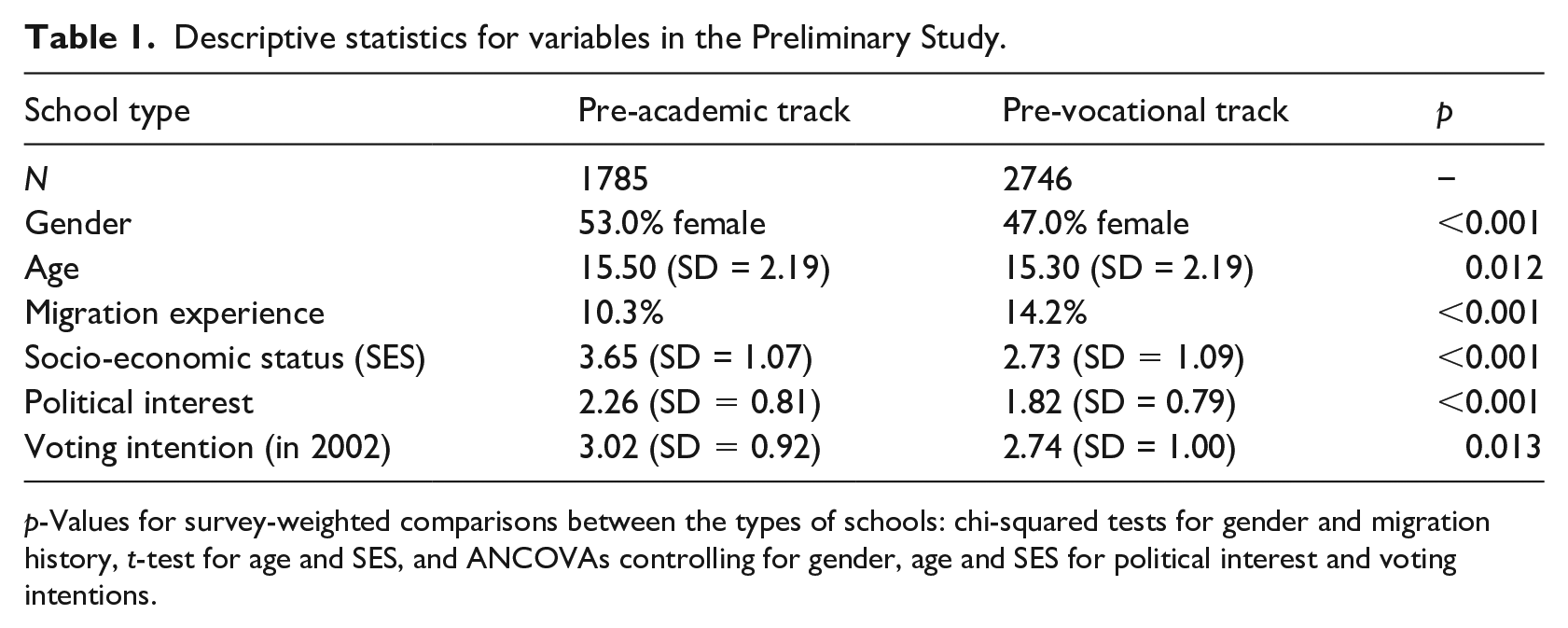
p-Values for survey-weighted comparisons between the types of schools: chi-squared tests for gender and migration history, t-test for age and SES, and ANCOVAs controlling for gender, age and SES for political interest and voting intentions.
Voting intentions in 2002, the only year in which they were measured, were also associated with education track when controlling for gender, age and SES, F(1, 1023) = 19.54, p < 0.001, part. η² = 0.020, with students on the pre-vocational track less likely to report an intention to vote (see Table 1). The effect of the covariates was comparable to the above. As hypothesized, the link between school type and voting intentions was fully mediated by interest, see Figure 1.
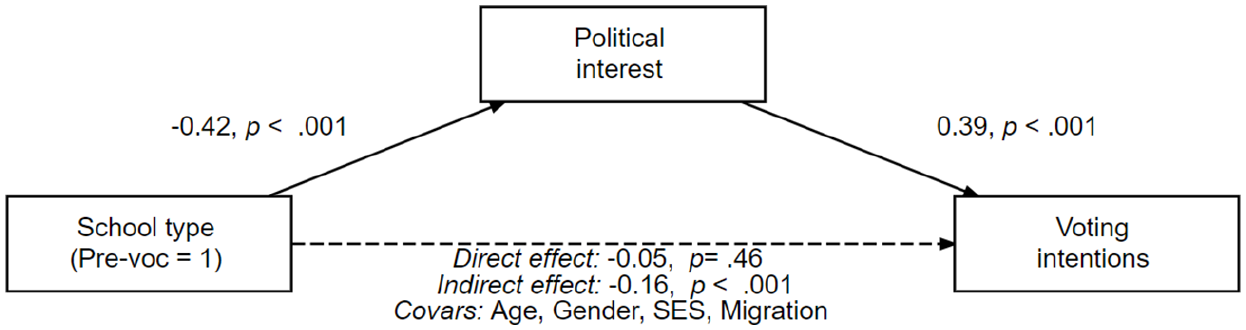
Mediation of the effect of school type by political interest (standardized coefficients).
Discussion
The result showed that students’ educational track predicted their political interest over a period of 13 years and provided support for the hypotheses that students on the pre-academic track have greater political interest and in turn greater voting intentions. These effects were maintained when controlling for socioeconomic status, which suggests that the educational experience has an independent influence. However, here it needs to be noted that the measure of migration status was very crude and conflated two distinct dimensions (citizenship and origin), so that this null effect should not be interpreted as more than a control variable. Overall, this study highlights that the civic engagement gap between educational tracks in Germany is relevant, and further research into the mechanisms that link educational tracks and civic engagement is needed.
Study 1
Given the gap between educational tracks, this study set out to test three possible mediators of the link between educational tracks and both political interest and voting intentions, namely civic understanding, civic self-efficacy and political trust. These are introduced in turn.
Civic understanding
Civic understanding has been widely associated with voting intentions (see Castillo et al., 2015, for a review). Relatedly, political awareness, defined as the perceived ability to make sense of political debates and issues, has been found to be one of the strongest predictors for voting in a large pan-European study (Hooghe and Marien, 2013). However, civic understanding has been measured in divergent ways; while some focus on the knowledge of procedural facts and current events (e.g. Cohen and Chaffee, 2013), others have a more functional definition that emphasizes the contextual knowledge and reasoning skills needed to make sense of political issues (Torney-Purta, 2002). This research is based on the premise that ‘knowledge should lead to both skills in interpreting political communication and to dispositions favouring actual involvement in conventional citizenship behaviour [i.e. voting]’ (Torney-Purta, 2002). Therefore, we speak of understanding rather than knowledge and focus on the ability to make sense of political situations, for example by identifying stakeholders, their likely interests and potential avenues for change. This was usually measured through vignettes as outlined below.
It appears likely that civic understanding differs between education tracks that are aimed at different levels of academic ability, and where students have recently been shown to differ in their ability to solve complex problems (Zehner et al., 2017). Therefore, we expected that:
H3: Civic understanding mediates the impact of the educational track on voting intentions and political interest, in that participation in the pre-academic track is associated with greater civic understanding, which in turn predicts greater interest and voting intentions.
Civic self-efficacy
Prospective participants need to believe that people like them can influence the political process, and that they personally have the ability to take action (Cohen and Chaffee, 2013; Westholm and Niemi, 1986). This is conceptually linked to an internal locus of control and to generalized self-efficacy, both of which have been shown to be lower for students who are not on the more selective and advanced pre-academic track (Balin and Hirschi, 2010). Also, given that more students and parents aspire to the pre-academic track than actually make it there, many students on the pre-vocational track will have experienced disappointment at what is seen as a major turning point of their early life (Büchner and Koch, 2001). This will likely shape general self-efficacy beliefs, as well as more specific beliefs about their ability to successfully engage with public institutions. Therefore, we expected that:
H4: Civic self-efficacy mediates the impact of the educational track on voting intentions and political interest, in that participation in the pre-academic track is associated with greater civic self-efficacy, which in turn predicts greater interest and voting intentions.
Political trust
Trust in political institutions has been widely found to predict electoral participation among all adults (Dalton, 2004; Hooghe and Marien, 2013) and among young adults (Fieldhouse et al., 2007) and also to predict voting intentions among adolescents (Hooghe and Dassonneville, 2013). Here again, it seems likely that students on the pre-vocational track who might feel let down by the state in their allocation to their school, or who recognize that their schools are disadvantaged, and described as such, will experience less trust towards state institutions. Therefore, we expected that:
H5: Political trust mediates the impact of the educational track on voting intentions and political interest, in that participation in the pre-academic track is associated with greater political trust, which in turn predicts greater interest and voting intentions.
In addition to the testing of the three mediators, this study aimed to replicate the measure of the engagement gap from Study 1, and the mediation of the impact of education track on voting intentions through political interest.
Method
For this study, a survey was administered to students at Gymnasien, again referred to as the pre-academic track, and Sekundarschulen, referred to as the pre-vocational track, which measured political interest, voting intentions, the hypothesized mediators and demographic covariates.
Sampling and participants
Under federalism, education in Germany is a matter largely reserved to the states. They differ widely in the extent to which citizenship education is provided, particularly in schools outside the pre-academic track, as indicated in a recent report that ranked the states (Gökbudak and Hedtke, 2019). To reduce the influence of local specificities, two locations near the extremes were included: Berlin as the German capital, which ranked last, and the Saarland in the West German periphery, which ranked third from the top. In each, two schools on the pre-vocational track and one school on the pre-academic track schools were recruited. Schools were approached through teachers known socially to reduce a bias from self-selection based on the research topic; six out of the eight schools we contacted agreed to participate.
Participants were recruited in Year 10 because this is the final year of academic education (including citizenship education) for all; afterwards, vocational trajectories diverge, where little citizenship education is offered to date, so that a crucial window of opportunity closes (Abs and Hahn-Laudenberg, 2017). The first two classes per school, based on their letter ‘name’, were asked to respond to the questionnaire. Eighty-five percent of students present during data collection volunteered to participate (98% in Berlin, 72% in the Saarland where prior parental consent was required). Overall, 228 students took part (48% female, mean age: 15.9 years, SD = 0.83, 30% with a migration history).
Questionnaire
The questionnaire included voting intentions and political interest as the dependent variables, as well as measures of the potential mediators and selected demographic items.
Voting intentions and political interest were measured using six-point Likert-scales (1 = fully disagree, 6 = fully agree.) Voting intentions were requested for four administrative levels (local, state, federal and European), primarily to suggest that a range of answers is acceptable and thereby reduce social desirability bias. The items read: ‘In the future, I will vote in [federal, state, local, European] elections.’ The mean was taken as the dependent variable, with α = 0.93. Political interest was measured as a single item: ‘I am interested in politics.’ This was preferred to a longer measure in order to retain a measure similar to Study 1, and in line with research that shows the validity of single-item measures for such concrete constructs (e.g. Bergkvist and Rossiter, 2009; Gogol et al., 2014; Wanous and Hudy, 2001).
Mediators
Mediation analysis was used to identify possible pathways by which students’ educational track influences their political interest and voting intentions. Three mediators were tested. Trust in political institutions was measured as the mean of three items from the Shell Youth Study (Albert et al., 2015). These asked for trust in political parties, the parliament and the government, 1 = very little trust, 7 = a lot of trust, α = 0.89. The measure for civic self-efficacy was derived from Cohen and Chaffee (2013). It was the mean of two items on a six-point Likert scale (1 = fully disagree, 6 = fully agree) that asked for the ability to make a difference individually or with others, α = 0.70. Finally, civic understanding was measured through eight multiple-choice questions that assessed knowledge needed to unravel political arguments rather than abstract procedural knowledge, all adapted from the ICCS, the largest international survey on citizenship education (Brese et al., 2011; Schulz et al., 2008). For instance, one item asked who would be likely to protest a law that decreases taxes on investment income and increases taxes on wages; another presented a fictional newspaper article outlining a conflict of interest in the award of a public contract and asked why members of parliament might ask for the removal of the minister in charge. Each question asked for the correct answer among four options, the count of correct answers was taken as the measure, with good reliability, KR-20 = 0.74.
Demographic data
In line with Study 1, participants’ gender, age and migration history were to be included as covariates. Migration history was coded as given for participants who had been born outside Germany or primarily spoke a language other than German outside their school. Due to revised data protection legislation, there could be no questions regarding the parents or the home environment, so that we could not control for SES beyond migration experience. (This did not apply to the dataset from the Preliminary Study because it was not collected in schools.) Descriptive statistics for all variables are shown in Table 2.
Descriptive statistics for variables in Study 1.
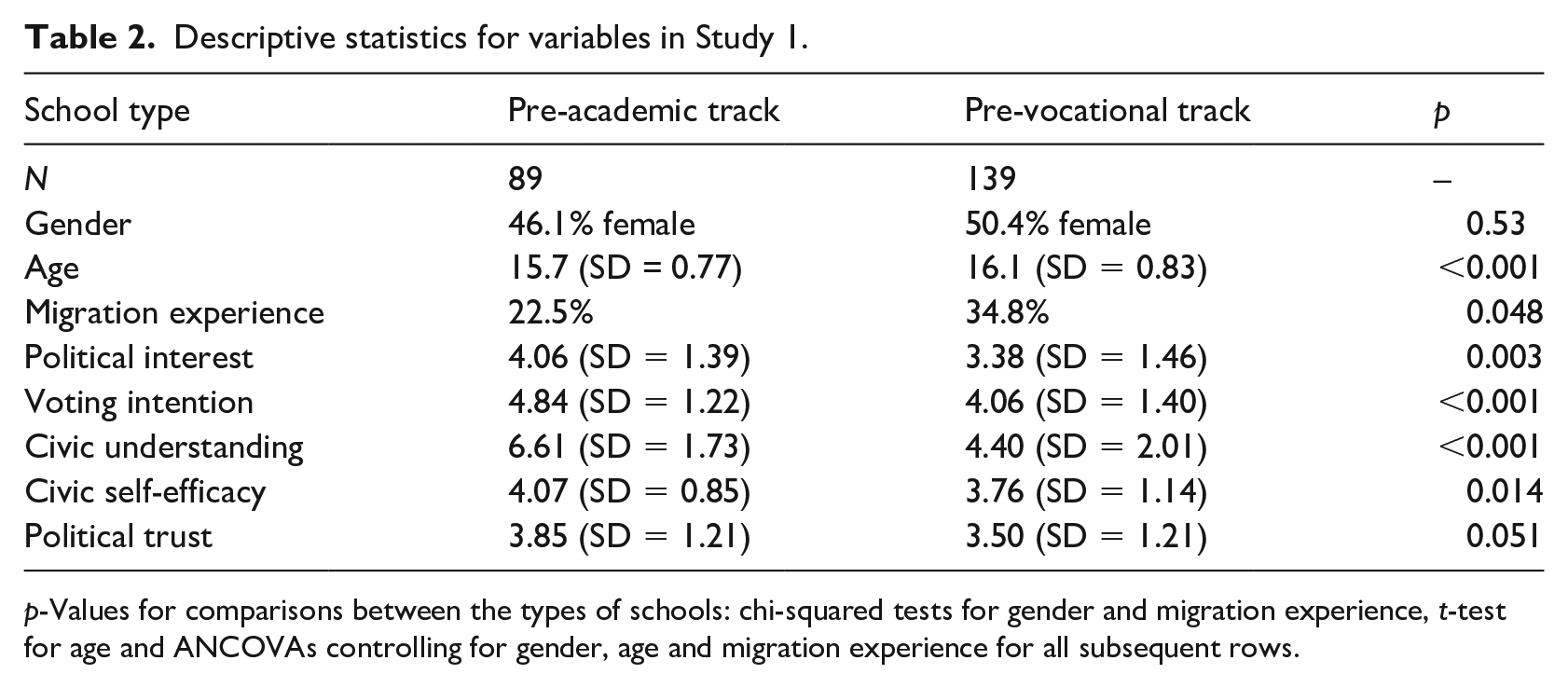
p-Values for comparisons between the types of schools: chi-squared tests for gender and migration experience, t-test for age and ANCOVAs controlling for gender, age and migration experience for all subsequent rows.
Results
The engagement gap
To replicate the findings of the Preliminary Study, one-way ANCOVAs were used to test for differences between the educational tracks while controlling for migration history, gender and age. This confirmed a gap between the pre-academic track and the pre-vocational track with regard to political interest, F(1, 216) = 9.00, p = 0.003, part. η² = 0.050 and to voting intentions, F(1, 192) = 12.5, p < 0.001, part. η² = 0.089 (see Table 2 for descriptive statistics).
To illustrate the gap, it is worth comparing the share of students who report political interest or an intention to vote. On the pre-vocational track, 54.3% reported that they will vote in federal elections (agree and strongly agree combined, excluding rather agree), while 23.7% expressed an interest in politics. This compares to 78.8% of students on the pre-academic track who reported an intent to vote, and 41.6% who expressed an interest in politics.
Test of mediators
Mediation of the effect of school type on voting intentions was tested in a path model, with civic understanding, political trust and civic self-efficacy as simultaneous first-stage mediators and political interest as a second-stage mediator. As Figure 2 shows, all indirect paths were significant, while the direct paths from school type to political interest and voting intentions were not significant (p > 0.21). Considering the indirect effects of school type on voting intentions through each first-stage mediator, the difference in civic understanding was associated with a 0.29 SD reduction in voting intentions, p < 0.001, while the difference in political trust was associated with a 0.08 SD reduction, p = 0.045. The indirect effect through civic self-efficacy, 0.06 SD, was only marginally significant, p = 0.069. Comparing the size of these effects, civic understanding made a greater contribution than civic self-efficacy, p = 0.01, and political trust, p = 0.02, while the size of the effects of political trust and civic self-efficacy was not distinguishable, p = 0.72.
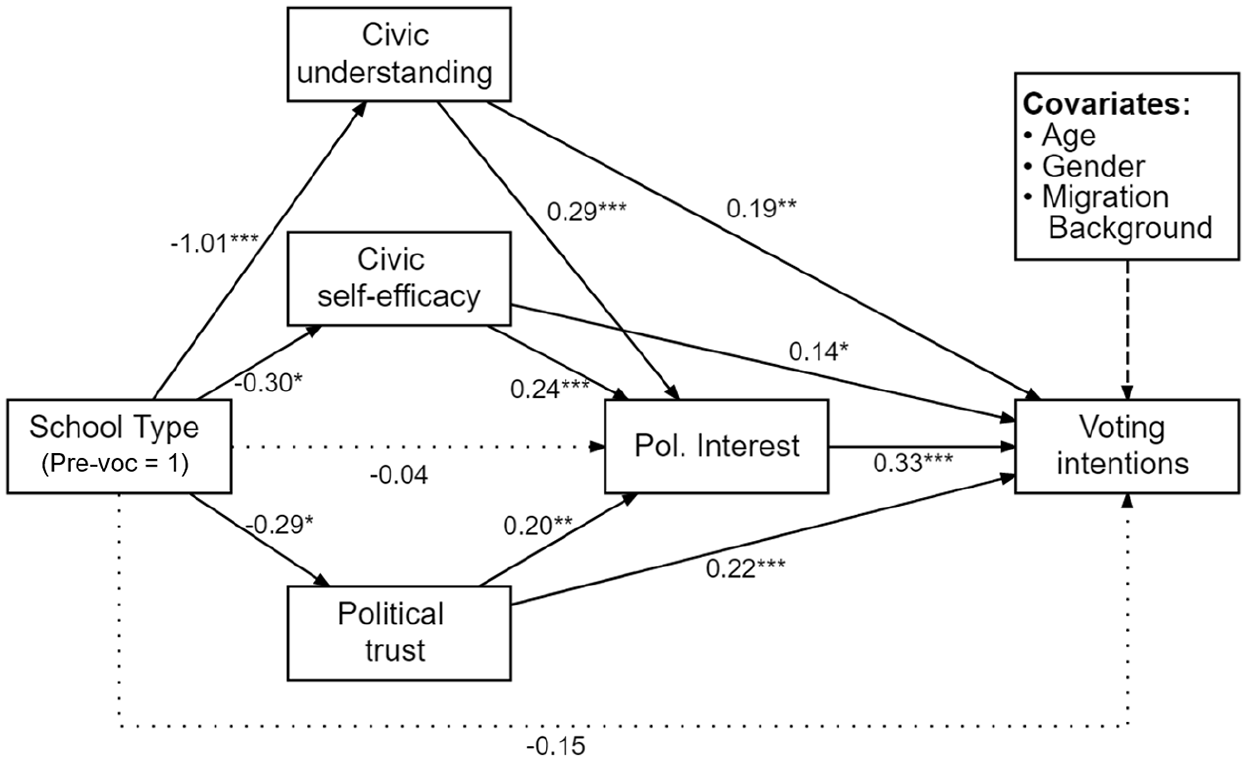
Two-stage mediation of the effect of school type (standardized coefficients).
Discussion
The results replicate the findings of Study 1, in that there is a gap in both political interest and voting intentions between students on the pre-vocational and the pre-academic track, and that the effect on voting intentions appears to be mediated by political interest. While we could not control for SES here, the existing gap still indicates that schools on the pre-vocational track are facing a particular need – even if only partly of their own making – to promote civic engagement among their students if civic equality is to be achieved.
Regarding the three proposed mediators, the results support the hypotheses and indicate that each has a role to play, even though the indirect effect through civic self-efficacy is only marginally significant. Strikingly, the indirect effect through civic understanding has roughly four times the size of the other effects, which suggests that the difference in civic understanding between the educational tracks explains most of the difference in outcomes.
Study 2
Having established that civic understanding primarily mediates the effect of the educational tracks on political interest and voting intentions, we conducted interviews with students on the pre-vocational track to explore this pathway further. This enabled us to better understand how this mediator works, and to thus support the development of ideas for possible interventions. Given the underlying interest in enabling schools on the pre-vocational track to close the gap, and the fact that much research exists with regard to advantaged students, be it in the form of university student samples or with a particular focus on such students in schools (e.g. Ballard et al., 2015), we decided to focus our efforts only on the comparatively disadvantaged students on the pre-vocational track.
Semi-structured interviews were used to explore how the students understand the political process and think about their political preferences and efficacy, and thus where they see reasons and opportunities for participation. In order to capture the students’ voices and to be open to the emergence of new ideas, we did not set out to test specific hypotheses but rather employed an inductive qualitative approach.
Method
Sampling and participants
The four pre-vocational-track schools involved in Study 1 were approached for the interviews; five to six students per school participated (n = 23, 43% female, mean age: 16.0 years, 38% with migration history). The sampling for interviewees was done by social studies or home room teachers in each school. They were asked to follow the exemplar approach (Ballard, 2014), specifically including students with different levels of interest and experience in participation. Nevertheless, some relied on self-selected volunteers. While the interviewees reported somewhat higher voting intentions and political interest than their peers, tests using data from Study 1 showed that the differences in voting intentions, political interest and civic understanding were not significant (t-tests, all p > 0.1).
Interview protocol
Interviews were semi-structured and covered various aspects of civic understanding and its links to participation intentions. In the first part, students were asked to identify and discuss changes they would like to see in society. Thereby, awareness and imagination were explored as foundations of civic understanding. Subsequently, the interviews focused on perceived avenues towards political change, including the students’ views of political power, of elections and of other ways of exerting influence.
Interview procedure
The interviews lasted 18–45 minutes, with most taking 25–30 minutes. With participants’ explicit consent, they were recorded for subsequent transcription. The sequence of questions was flexibly adjusted to maintain a conversation flow and enable participants to fully develop their thoughts (Rubin and Rubin, 2005).
Thematic analysis
The interviews were transcribed by the lead researcher; then patterns and themes were identified across the interviews through an iterative inductive coding process that followed the steps outlined by Braun and Clarke (2006). After reading all manuscripts, the researchers generated initial codes from the data, that were inputted into the QDA Miner Lite software. Then all transcripts were loaded, and any passage related to any of the codes tagged accordingly. In addition, codes were added to tag any other passage of relevance to the research questions so that responses were organized into meaningful groups. After this first round, the newly added codes were revised and restructured, and all transcripts reviewed and recoded with the expanded codebook. This process was repeated once more. Then the passages associated with each code were reviewed to assess internal homogeneity; where there was significant heterogeneity codes were split.
Subsequently, themes were developed from the codes at an interpretive level rather than just a semantic and explicit level (Boyatzis, 1998). Related codes were identified, then all associated interview passages were reread to arrive at a theme that captured the essence of the data. To ensure a clear separation of themes, both internal homogeneity and external heterogeneity were tested for each theme (Patton, 1990). A colleague reviewed all themes based on the codes and independently coded 30 interview passages to assess inter-rater reliability. Initially, there was divergence on 17% of the coded segments, then, five codes were merged as they were not sufficiently distinct, which resolved the discrepancies. Additionally, three candidate themes were merged at this stage.
Results
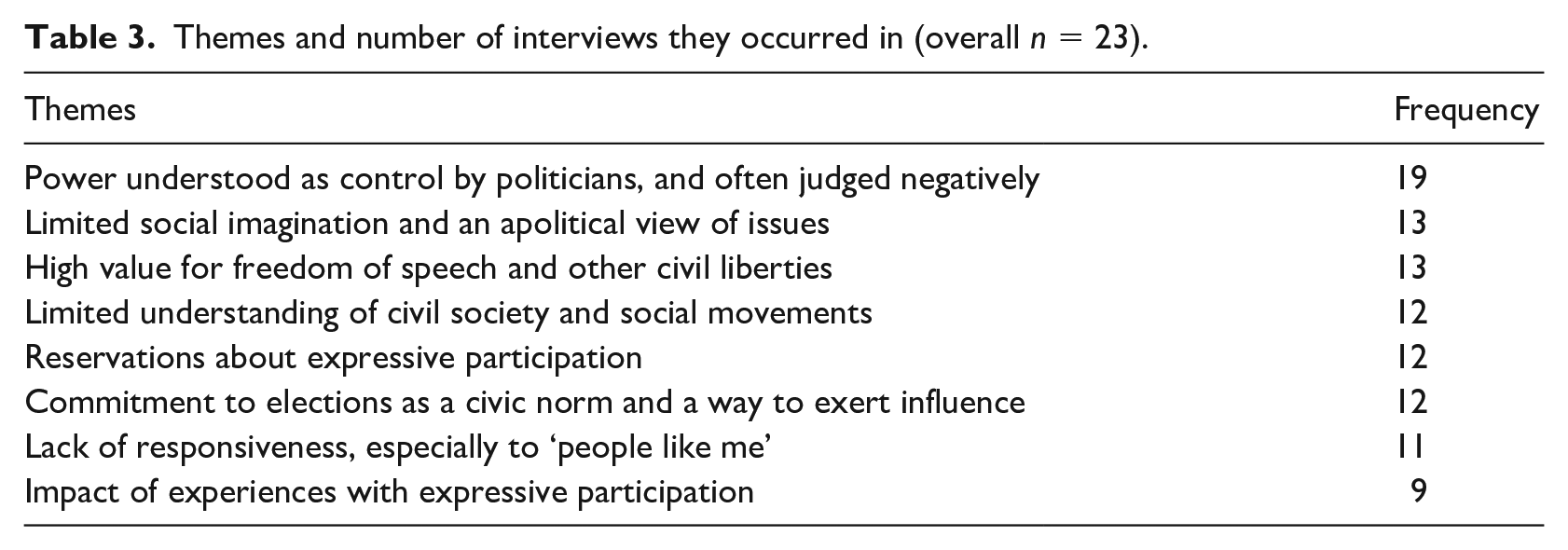
Table 3 lists the final eight themes, with the number of interviews that each theme occurred in. In the following, they are further illustrated, and their implications are discussed.
Themes and number of interviews they occurred in (overall n = 23).
Lack of social imagination constrains civic understanding
Civic understanding was initially explored by asking students to identify three things that should change and three things that should be preserved in German society, and then discussing some of the issues they raised. Even though most stayed on task for several minutes, less than one in four completed the list. In general, they particularly struggled to identify things that should be preserved; when prompted about welfare, education and liberties, it became clear that this was because many were unable to imagine changes to institutions and arrangements they hold dear. Similarly, when prompted about things they do not like in their life, participants would often express personal frustrations with their educational experience, racism, exclusion, and economic struggles, yet rarely view these aspects as amenable to change, or as affected by arrangements in society.
The related concepts of social imagination and sociological imagination can help to make sense of these conversations. Social imagination, the ability to imagine how ‘things could be otherwise’ in society (Ayers, 1995), is an obvious condition for belief in social change, and thus in the efficacy of civic action. Similarly, sociological imagination is needed to recognize the need for civic rather than mere individual action, as it is the ability to connect personal observations and grievances with broader social structures (Mills, 1959). Racism, for example, was generally seen as a personal choice that could only be addressed at the personal level: ‘Everyone needs to decide for themselves if they help when someone is assaulted or not.’ A lack of policing in their neighbourhood was attributed to challenging entry exams rather than to the underlying political priorities and choices: ‘There isn’t enough police to keep us safe. [Why?] Because the exams are hard, so many [. . .] are turned off.’ Such attributions made it harder to recognize different positions held by politicians up for elections; relatedly, the students were typically unable to articulate ideas for how politicians could act to address issues they identified.
Collective power is not understood
When political issues identified by the students were discussed in the interviews, they could rarely name relevant actors apart from politicians and individual citizens. This was related to their general understanding of power, which most students immediately equated with control exerted by politicians. ‘[Power is] that one takes the decision from others [. . .] for example like a dictator who rules the population so that they cannot take any decisions for themselves.’ This was linked to negative evaluations: ‘[Power is] something very negative. [. . .] No one needs power.’ It also led to an almost exclusive focus on high-level politicians when it came to the question of who holds power in Germany: ‘Merkel [the German Chancellor] has power. Of course, not only her, the population, and then some parties and the like, but on the whole Merkel.’
In what appeared to be an echo from their citizenship classes, about half of the participants also mentioned that the people hold power. When asked what this meant, almost all exclusively referred to the power to vote: ‘All of us [also hold power], we can vote, and if everyone votes he can participate in that way.’ Beyond this, the dominant mental representation of participation was that of individuals sharing their opinion all alone, together with the feeling that such individuals would not be heard: ‘I don’t think that when someone protests, something will change just because of him.’ Participants were also mostly unable to name examples where popular action led to changes; the exception were three participants who could draw on personal experience with community-based activism. The power of lobbyists and other influencers was typically overlooked; when the interviewer suggested that power might also rest with the media or with economic interest groups, most participants rejected these notions and emphasized that it is politicians who hold power and who set the agenda. This firmly suggests that the participants have not taken part in any shift from electoral towards expressive participation.
Limited self-efficacy is rationalized
More than half of the respondents explicitly suggested that politicians do not listen. Often that was based on the broader notion that no one would listen to them: ‘I don’t think that anyone would just listen to me and then say “okay, she is right.”’ A strong reason given for this lack of civic self-efficacy was their age because they are not yet voters: ‘Basically I can’t do anything yet. I can only vote in certain areas, but for larger things I can’t vote yet.’ Relatedly, they referred to a lack of qualifications and experience. The bar for this was frequently set rather high: ‘Until one can show a university diploma, that one has studied politics or so, no one is going to be interested in what one says.’ This led to a situation where the perceived lack of responsiveness to young people’s views was seen as legitimate by many, which again stands in the way of participation.
Participation experiences are powerful in enhancing efficacy and understanding
Most exceptions to typically low self-efficacy came from participation experiences. These were reported by four interviewees, ranging from local action for traffic calming to protests against racist politicians, and appeared to have had lasting empowering effects: ‘Once I signed a petition that there should be fewer trucks in my street but that they should be diverted. [Was that successful?] Now there are fewer trucks, not all of them are gone, but they listened. So now I sign more petitions.’
However, participation experiences can be problematic if a perceived lack of efficacy in one situation is generalized into broader disempowerment. This appears to have happened with the refugee crisis in Germany. Given that the arrival of approximately one million refugees in 2015 was still a dominant political topic by the time the interviews were conducted in 2017, most students brought this up during the conversation. While a majority supported the welcoming stance of the government, they believed that the large-scale protests to limit the inflow had received no hearing: ‘At the moment, those up there decide on their own. There were many protests, but they decided that way anyway.’ ‘Merkel decided, and the only change would come if someone else wins the elections.’ Several saw this as evidence for a general futility of protest and expressive participation.
Commitment to voting is still widespread
Despite the gap to students on the pre-academic track, a clear majority of students on the pre-vocational track are still committed to voting. Based on the data from Study 1, 54% agreed or strongly agreed that they would vote in the next federal election, while another 19% rather agreed. This was echoed in the interviews, where all but two participants expressed a desire to vote. During an election campaign dominated by a rising right-wing populist party, this was most frequently driven by a desire not to feel guilt over undesirable outcomes: ‘Politics isn’t very interesting to me [. . .] but I will follow the news and vote so that I can say if something bad happens, that I wasn’t in favour, that I at least tried to do something against it.’ ‘I think one should vote before parties get elected that ruin Germany.’ Additionally, and in contrast to an international literature that shows much cynicism about elections, they were generally seen as a real opportunity to influence politics: ‘The moment when citizens are asked are the elections [. . .] but at other times, citizens have little say and just have to accept that things are said in the parliament, and live with it, and then vote anew every four years.’
Impressions from informal interviews with social studies teachers
Brief informal interviews were conducted with social studies teachers in the four schools included in this study. When asked about how they address questions of citizenship and participation, they all emphasized the lack of time for these matters. According to the curricula in the two states under consideration, a mere 30–45 minutes per week are meant to be spent on social studies, yet often even that time was reduced due to more pressing requirements. The remaining time was seen as insufficient to go beyond teaching basic procedures. Additionally, most teachers perceived their students to lack any interest in politics, in contrast to the data in Study 1 and the student interviews here that showed limited but widespread interest. When asked about that contrast, students emphasized that they are interested in political action and news, but not in arcane procedures.
Discussion
Overall, the interviews confirmed that the civic understanding of students on the pre-vocational track is limited, as they were often unable to identify stakeholders and their interests in relation to issues they cared about, unable to connect personal experiences to social arrangements, and unable to conceive of influences on politics that transcend the ballot box and formal structures of power. This suggests some of the ways in which civic understanding works to limit participation intentions and political interest. With an unexpected directness, the participants linked this explicitly to civic self-efficacy, in that several reasoned that as they were unable to understand political issues, politicians were right not to listen to people like them. Relatedly, most participants were convinced that there is no way for citizens to exert power beyond the ballot box, yet still believed in the power of elections. The fact that a commitment to vote is still widely expressed (in line with Study 1) provides an opening for citizenship education, which will be discussed below.
An important additional finding from the interviews that can inform citizenship education was that individual events can be of fundamental importance to shaping the entire civic outlook of adolescents, which is in line with evidence that single experiences can be transformative during these ‘impressionable years’ (Dinas, 2013). For most students, the refugee crisis was such an experience that left them with the conviction that civic engagement is futile, regardless of their stance on the substantive issues. Citizenship teachers, on the other hand, tended to avoid the topic because they believed that students are ‘tired of it,’ rather than recognizing it as an inevitable anchor for the formation of attitudes that should be dealt with explicitly.
General discussion
As shown in a Preliminary Study, there is a wide civic engagement gap between students on different educational tracks in Germany, with students on lower academic trajectories significantly less likely to vote and take an interest in politics. This appears to be primarily mediated by an even larger gap in civic understanding, and to a lesser extent, in political trust and civic self-efficacy (Study 1). The interviews in Study 2 suggest that limited civic understanding expresses itself through a narrow understanding of power that leaves little space for civil society and through a lack of social imagination, which may prevent students on the pre-vocational track from following political debates and taking part in them.
These findings respond to a large literature that emphasizes the critical importance of differences in education for civic outcomes (Bovens and Wille, 2010), yet that has offered little guidance how these differences can be most effectively addressed. It concurs with Castillo et al. (2015) in suggesting a focus on civic understanding, yet for different and complementary reasons: Castillo and colleagues showed that differences in socio-economic status primarily create a civic engagement gap through differences in civic understanding, while the present research suggests that German schools, rather than mitigating this, actually exacerbate it. A focus on developing civic understanding can thus mitigate both the negative effects of educational and socio-economic inequality.
The findings to some extent lead one to question the common emphasis on citizenship education through citizenship practice (advocated by, e.g. Andolina et al., 2003; Keating and Janmaat, 2016). While Study 2, in particular, highlighted the positive impact of participation, the results, overall, emphasize the importance of focusing on civic understanding as a foundation for political interest and voting, particularly among students on lower educational tracks. In the following, the results are discussed and further related to the literature in response to two overarching questions: how does civic understanding constrain participation by disadvantaged youth, and what are emerging opportunities for educators to increase their engagement?
Civic understanding as a barrier to engagement
Study 1 showed that students on the pre-vocational track were unable to understand nearly half of the basic political situations presented to them, which limits their ability to follow political debates. It is important to be clear that this was not about knowing procedural matters; incidentally, in Study 2, two interviews in different schools suggested that the teaching of procedural matters might reduce interest: students who had mastered the arcane procedure used to elect the German president, a ceremonial office, appeared to have lost interest in substantive issues in the course of that lesson, which concurs with the recent finding by Stadelmann-Steffen and Sulzer (2018) that the teaching of political knowledge rather than thinking skills might reduce political interest.
The limiting role of civic understanding also became clear in Study 2. Firstly, an understanding of power is a key to civic understanding and a condition for taking effective action (Green, 2016). The finding that participants with their very narrow understanding of power were often unable to place civil society actors in their descriptions of political debates highlights the importance of this, in terms of effectively barring participants from participating in non-electoral civic activities but also from fully understanding election campaigns. Another facet of limited civic understanding was the lack of social imagination. As suggested by Albert et al. (2015) in reflecting on an interview study ‘the concept of society initially seems abstract and superficial to most young people’ (p. 27). This was part of what prevented respondents from turning localized grievances into political aspirations that might guide electoral choices or civic expression.
Opportunities to build engagement
Despite the signs of marginalization, the study also found positive indications and opportunities to build engagement among students on the pre-vocational track. Most importantly, the mere fact that civic understanding is the primary mediator is encouraging because civic understanding is more imminently teachable than trust or self-efficacy, so that schools are well placed to address the gap. However, for that they need to follow the established finding that deliberative classroom discussions are more effective than the rote learning of civic procedures (e.g. Feldman et al., 2007), which still appeared to be the approach to civic education taken by at least some schools in the sample.
Additionally, the positive attitude towards elections, indicated by the fact that nearly three quarters of secondary school participants in Study 1 rather intended to vote at federal elections in the future, provides an opportunity to build engagement. In the international context, the respondents’ attitude is surprising, given that Henn and Foard (2013) found that a majority of British youth believes that elections ‘don’t really change anything’ (p. 371), while Hennessy (2006) suggests that for most young Canadians ‘the ballot box is a piece of window dressing’ (p. 234). Thus, citizenship education should continue to support the commitment to vote, and where possible, accompany students through the process of casting their first vote, a critical step towards habit formation (Fujiwara et al., 2016).
Possible school-level factors limiting pre-vocational schools
The current research could not systematically explore school-level factors that contributed to the observed inequalities in mediators and outcomes. However, in light of the interviews with social studies teachers and the structure of the German educational system, three differences in the approach to citizenship education on different tracks can be identified that will have influenced the results and deserve further exploration in future research. Firstly, schools on different tracks have different amounts of time for civic education. In Year 10, this varies from 30 to 45 minutes per week on the pre-vocational track to 90 minutes on the pre-academic track; in addition, schools on the pre-academic track have more time for related subjects such as history and ethics. Secondly, as has recently been shown in Switzerland (Stadelmann-Steffen and Sulzer, 2018), it appears likely that schools on the pre-vocational track focus that little time on teaching procedural knowledge, while schools on the pre-academic track focus more broadly on understanding. Finally, citizenship education is often given by teachers who are not specifically qualified for this subject; for the states under consideration, this data is not available, yet for another German state, this was the case for around 70% of students on the pre-vocational track in 2017/18, compared to less than 27% on the pre-academic track (Frein, 2018), which likely also affects the quality of instruction.
Limitations and future research
While both our Preliminary Study and past research show that educational tracks are not only a proxy for socio-economic status but an influence in their own right, the inability to adequately consider school- and parent-level factors in our main studies significantly limits the current research. It would have been insightful to explore both school-level practices and the interaction between school and home further. This could not be addressed at present due to sampling and data protection constraints but appears to be a critical direction for future research based on larger samples and multi-level models.
A further important extension would be longitudinal qualitative research on electoral intentions, given that most participants reported that they intend to vote and several asserted an increasing interest in politics over their adolescence, both of which stands in marked contrast to the first-time voter turnout that stood at 69.9% in the last German federal elections, six points below the average (Thiel, 2018). Thus, it appears that these intentions either change or are not put into practice. A further understanding of these dynamics could reveal pathways for citizenship education to bolster the intentions and/or foster their realization.
Conclusion
The civic engagement gap between educational trajectories that was confirmed in our Preliminary Study presents a threat to democratic equity and, ultimately, stability. It appears to be primarily related to an even larger gap in civic understanding (Study 1), which prevents disadvantaged students from following political debates and taking part in them (Study 2). In that case, it is not surprising if they disengage. However, the dominant role of civic understanding is encouraging in that it indicates that schools can fulfil their role as ‘midwifes of democracy’ (Dewey, 1980: 139), if they create spaces for effective citizenship education and focus it on understanding rather than on procedural matters.
Footnotes
Declaration of conflicting interests
The author(s) declared no potential conflicts of interest with respect to the research, authorship, and/or publication of this article.
Funding
The author(s) received no financial support for the research, authorship, and/or publication of this article.
