




Abstract
This study explores social studies teachers’ self-reported instruction about teaching the 2020 election in U.S. secondary schools. We analyzed survey responses from 1,723 secondary social studies teachers from 12 states (3 left-leaning, 3 right-leaning, 6 battleground) collected in the weeks after the election, examining self-reported pedagogies, topics taught, and overall frequency of teaching about the election. Respondents reported teaching about the election more frequently if they taught courses in civics or government and/or if they had greater control over their curricula. Analyses indicated that teachers’ demographic characteristics, teaching contexts, and ideologies about civic education were related to the election-related topics they taught and the instructional practices they employed. Our findings have important implications for educators, administrators, policymakers, and others interested in strengthening civic learning.
This study explores secondary school teachers’ self-reported instruction about the 2020 presidential election, an unusually vitriolic contest that unfolded amidst one of the greatest public health crises in global history. Teaching about elections can substantially strengthen students’ engagement in public issues (Levy et al., 2016), but many educators have recently been hesitant to integrate current political issues into their course content (Costello, 2017). Whereas some teachers exclude such content to avoid accusations of political bias (Geller, 2020; McAvoy & Hess, 2013), others are concerned about maintaining a positive classroom environment (Levy et al., 2016). Further, teachers’ own ideological stances toward civic education can influence their instructional decision-making (Clark et al., 2020; Knowles, 2018).
The extreme political partisanship associated with the 2020 election coupled with the COVID pandemic created an unusually heated context for teaching about elections and related issues (Grossman et al., 2021). In our multistate study, we examine the intersections among teachers’ civic education ideologies, teaching contexts, and demographics on the frequency and ways the 2020 election was taught. Findings strengthen our understanding of the opportunities that students have (or do not have) to learn about vital political issues during highly contentious and politically charged election cycles.
Background
Central to this study is our belief that educators, as vital instructional and curriculum gatekeepers (Kaka & Hollstein, 2022; Thornton, 2005), should help students learn to engage thoughtfully and participate actively in the political world (Hinchliffe, 2010). This requires educators to support students’ understanding of civic life and public issues (Rebell, 2018); and over the past several decades, standards in many U.S. states have begun to reflect this notion (e.g., Michigan Department of Education, 2019; New York State Education Department & University of the State of New York, 2014).
There are numerous, valuable ways to engage in civic issues (Levine, 2007), but this study focuses on education for electoral participation because elections are a widely accessible method of choosing leaders and shaping policies that affect our everyday lives. Despite recent upticks in political participation, more than 3 in 10 eligible voters in the United States did not vote in the 2020 presidential election (Fabina & Scherer, 2022), and U.S. voter turnout rates have typically been lower than those of most other developed countries (Desilver, 2017). Furthermore, young Americans have participated at lower rates than their older counterparts (Center for Information and Research on Civic Learning and Engagement [CIRCLE], 2020), which allows political leaders to pay less attention to the needs of youth.
Civic leaders and educational scholars have consistently expressed concern over schools’ limited efforts to prepare youth for political participation, including educators’ avoidance of controversial political issues in classrooms (Hess & McAvoy, 2015). This study seeks to identify factors that affect these decisions during a moment of widespread political interest, a heated presidential election.
What Are the Benefits and Challenges of Studying Elections?
Studying public issues in school, including elections, can support various dimensions of students’ civic and political engagement (e.g., Hess, 2009). When students discuss and explore controversial public issues, they often develop a greater sense of political efficacy (Levy et al., 2016): the belief that citizens can influence political processes. This attitude is an especially strong predictor of political participation (Becker, 2004; Hahn, 1999; Kenski & Stroud, 2006; Morrell, 2005; Wells & Dudash, 2007). Exploring political issues also strengthens students’ political interest (Levy et al., 2016), another robust predictor of civic action, including their likelihood of voting (Prior, 2019). During election seasons, youth notice political ads, yard signs, and adult conversations about politics. Teachers can leverage students’ heightened interest and increase it further by highlighting ongoing debates among candidates and interest groups, encouraging students to explore issues in ways that foster procivic attitudes, and generating meaningful learning about controversial topics, such as race, gender, abortion, and gun ownership rights (Journell, 2012; Levy et al., 2016). Thus, election seasons offer unique opportunities to support civic and political learning.
Teaching about elections, however, can be challenging and has grown increasingly so. Whereas students draw on their background knowledge and experiences in all school subjects (Donovan & Bransford, 2005), political issues are entangled with values, morals, and emotions (Gutmann & Thompson, 1996), so disagreements about such issues can spark serious disagreements between and among students and teachers. Certain public issues generate responses from students that could be difficult for a teacher to navigate. For example, some first-generation students in the United States experienced the 2016 election as a deeply traumatic event, as they feared the deportation of their families (Sondel et al., 2017).
In addition, political differences among students have led to more contentious classroom environments and increased instances of bullying (Rogers et al., 2019). A nationally representative study of over 600 high school principals indicated that most schools have experienced partisan political tensions that have led to demeaning and hateful remarks among students with opposing views (Rogers & Kahne, 2022). Meanwhile, numerous states, such as Texas and Florida, have passed laws limiting instruction about certain important public issues, some of which are closely related to elections (Stout & Wilburn, 2022). These trends could discourage many teachers from teaching about important issues that could ignite passionate or emotional responses.
In this heated political climate, teachers may receive negative feedback from parents and community members about their efforts to teach controversial public issues, and many fear that they will be accused of bias or trying to indoctrinate students (Geller, 2020; Pollock et al., 2022; Stoddard et al., 2022). Amid such tensions, many teachers have maintained their commitment to teaching about controversial issues, but others have developed the practice of ending classroom exchanges that they perceive as highly emotional (DiGiacomo et al., 2021). Reflecting this trend of avoiding potentially contentious issues (Hess, 2009; Hess & McAvoy, 2015), one large survey found that many teachers were hesitant to teach about the 2016 election (Costello, 2017). Given this context, it is important to examine how and under what conditions teachers are most likely to guide instruction that helps students understand elections, the vital issues at stake, and ways to engage in the process.
Conceptual Framework
To frame our study, we consider various factors that shape teachers’ decision-making regarding the frequency, methods, and substance of teaching about elections, including teachers’ civic education ideologies as well as contextual and demographic variables that often shape instruction. Our overall conceptual framework is represented in Figure 1, and the research to support this framework is summarized just below and more extensively in the following sections.

Civic education ideologies and contextual and demographic factors that shape civic instruction and learning.
As indicated in Figure 1’s outer ring, broad contextual factors inevitably shape all our experiences. In civic and social studies education specifically, the political climate, including political polarization and highly contested election cycles, is related to instruction because students often bring ideas from the broader context into the classroom (Costello, 2017). In addition, educational standards and mandates shape the curriculum, and school administrators lend varying degrees of support to certain types of instruction and to teacher autonomy in general, which in turn affect teachers’ curricular choices (Journell, 2022: Stoddard et al., 2022). Acknowledging these broad contextual variables is vital for understanding how and why educators teach about elections. In addition, research has long found that teachers’ background characteristics can affect student outcomes (Darling-Aduana, 2021; Kini & Podolsky, 2016).
Furthermore, teachers’ civic education ideologies affect their instruction and students’ concrete civic outcomes (Westheimer & Kahne, 2004). For example, teachers with liberal civic education ideologies (defined below) are more likely to guide students in political discussions, and participating in discussions supports students’ development of political interest (Kahne et al., 2013; Knowles, 2018), a good predictor of political participation (Prior, 2019). On the other hand, teachers with conservative civic education ideologies, who use more direct instruction, are more likely to foster students’ understanding of traditional civic knowledge (Knowles, 2018). These civic education ideologies can exist to varying degrees within any individual, and Figure 1 illustrates these potential overlaps.
Whereas prior research has found that contextual factors and teachers’ civic education ideologies influence instructional decision-making, scholars have not yet examined how these factors affect teaching about elections or the employment of certain “best practices” in civic education (Gould et al., 2011). The present study begins to fill this research gap, adding nuance to our understanding of civic education. Building on decades of earlier scholarship, we examined how educators’ civic education ideologies and broader contextual factors affect their instruction about civic issues, including political topics and pedagogy.
Differing Ideologies in Civic Education
Research indicates that just as our ideas shape our actions (and vice versa), educators’ perspectives on civic education will shape their teaching and, consequently, student outcomes. Two decades ago, Westheimer and Kahne (2004) found that ideologies can affect student learning. After identifying three “types of citizens”—personally responsible, participatory, and justice-oriented—their study of several youth programs found that instruction embedded with the latter conception led to greater political interest and critical perspectives than the two former types of instruction. On the other hand, traditional instruction, which focuses on factual learning and neutrality, could foster antidemocratic orientations among some students (Ross, 2006).
In addition to the “three types of citizens” identified by Westheimer and Kahne (2004), political scientists have identified a variety of civic orientations for educators to consider. It is worth noting that across these studies, the spectrum of civic orientations moves from standard, performative (e.g., voting) to more deeply engaged civic action (e.g., active participation in political party or community service) (Ekman & Amnå, 2012; Nussbaum, 1996). Considering this spectrum amidst these varying frames can help educators reflect on their own orientations and how these might affect their instruction (Cohen, 2019).
For the present study, we draw on a well-established and theoretically robust framework of civic education ideologies. In a thorough review of numerous texts exploring “discourses of citizenship,” Abowitz and Harnish (2006) identified three broad themes in prior literature: civic republican, liberal, and critical. Whereas civic republican discourses emphasize core civic knowledge and service to one’s political community, liberal discourses prioritize individual liberty, equality, and the rights of individuals to pursue their own ideal of the good life. The third broad category includes critical perspectives on citizenship, which aims to expand conceptions of human freedom by focusing on discriminatory exclusions, such as those based on gender, ethnicity, and race.
Building on this scholarship, Knowles (2018) used similar categories to analyze survey responses from secondary social studies teachers. His factor analyses surfaced three categories of civic education ideology: liberal, conservative (similar to “civic republican” above), and critical. (These terms, especially liberal and conservative, should not be confounded with the political meanings of those terms.) Knowles found that teachers who held a more liberal civic education ideology were less likely to pursue traditional teacher-led instruction than those with more conservative perspectives on civic education. Teachers who self-identified with a critical perspective on civic education associated with collaborative research-based instruction.
Though not to be conflated with civic education ideology, political beliefs also influence how teachers teach and choose content for instruction about politics and elections. In research examining how teachers taught about presidential elections, Journell (2012) found partisanship openly influenced educators’ pedagogy—even as teachers professed to follow a policy of nondisclosure. Motivated reasoning, whereby personal, implicit biases influence (or motivate) actions, has been theorized to partially account for how individuals assess and make judgements on the veracity of political content (Kahne & Bowyer, 2017). Furthermore, Clark and colleagues (2020) found that teachers’ political leanings (politically liberal to conservative) affected how they viewed the credibility of news sources, suggesting that how content is presented to students is not agnostic in nature. Thus, prior research suggests that the content and form of civic education is shaped by teachers’ conceptions of civic education as well as by their personal and political convictions. The present study explores this phenomenon in the context of a presidential election.
Contextual and Demographic Factors That Shape Civic Education
Although teachers’ curricular decisions are shaped by their own perspectives (Kaka & Hollstein, 2018), their instruction is also influenced by a variety of contextual variables, including state curricula, graduation requirements, content standards, and other local factors. Forty-three states and Washington, D.C. now require civic education as part of a course curriculum or as a standalone class, but there is considerable variability in the type of civic instruction students experience (Hansen et al., 2018). Only about half of all states include language in their standards or curriculum frameworks related to democratic processes, but even fewer (11 states to date) make specific mention of more active pedagogies (e.g., service learning). In short, students’ access to civic education varies substantially by state, and within states, access to high quality civic education often varies by socioeconomic status (Fitzgerald et al., 2021; Kahne & Middaugh, 2008).
Nonetheless, recent research suggests that certain conditions can facilitate educators’ teaching about politics, even during politically heated times. In a nationwide survey examining how social studies teachers taught about the 2018 midterm elections, Stoddard et al. (2022) found that having curricular autonomy and shared goals with colleagues made social studies educators more likely to teach about the election, regardless of the political context in which the schools were situated. In addition, a substantial body of evidence indicates that school and classroom demographic variables are associated with how civics is taught in schools. For example, when students are in classrooms where a higher percentage of students are from high socioeconomic backgrounds, those students are more likely to have engaging social studies learning activities, such as debates and mock trials (Kahne & Middaugh, 2008). Yet students in classrooms with diverse demographic, less partisan profiles have been associated with high-quality instructional practices and a willingness to consider multiple perspectives (Clark, 2018; Jacobsen et al., 2012). Meanwhile, teachers with more classroom experience tend to be more effective at supporting students’ learning in general, in both academic and nonacademic domains (Kini & Podolsky, 2016). The present study builds on this earlier work, this time exploring the elements that facilitate educating youth about a heated presidential contest.
Research Questions
Previous studies have examined how teachers’ instructional decision-making in the civic domain is related to their civic education ideology (e.g., Knowles, 2018), broad contextual variables (Stoddard et al., 2022), and teacher characteristics (Clark et al., 2020). However, few studies have attempted to explore how these various factors coalesce and how they affect various aspects of teachers’ civically oriented pedagogy, including the topics taught and frequency of teaching about an election. This exploratory study, situated in a politically charged environment, addresses this gap by analyzing how teachers reported teaching about the 2020 election. The following research questions framed our study:
How often did a sample of secondary social studies educators report teaching about the 2020 election? To what extent were their civic education ideologies, teaching contexts, and demographics associated with the frequency of teaching about the election?
What 2020 election-related topics did a sample of secondary social studies educators report including in their instruction? To what extent were their civic education ideologies, teaching contexts, and demographics associated with teaching about these topics?
What pedagogies did a sample of secondary social studies educators report using to teach about the 2020 election? To what extent were teachers’ reported civic ideologies, teaching contexts, and demographics associated with their pedagogies?
Methods
Sample
To address our research questions, we analyzed quantitative survey data from a sample of 1,723 U.S. secondary (middle and high school) social studies teachers in 12 states—3 predominantly “blue” states (Colorado, New Mexico, New York), 3 predominantly “red” states (Indiana, Ohio, South Carolina), and 6 “battleground” states (Arizona, Michigan, Florida, North Carolina, Pennsylvania, and Wisconsin). The six battleground states were chosen based on data provided by Ballotpedia. 1 These battleground states were of particular interest because political advertisements and related messaging disproportionately bombard these areas (Ridout & Fowler, 2012), potentially shaping the frequency and direction of election coverage in classrooms as well. We selected the six nonbattleground states for comparison based on their geographical proximity and cultural similarity to each of the battleground states. The sampling frame for each of these states was provided by Marketing Data Retrieval, Incorporated (MDR), a national education marketing company.
To collect our data, we distributed a carefully developed online survey (described below) to approximately 37,000 potential participants on November 19, 2020, about 2 weeks after Election Day, sent three follow-up email reminders (once per week after Thanksgiving week), and closed the survey on December 20, 2020. Potential participants were screened for eligibility to establish that they were teaching two or more social studies classes where elections are typical topics of study, such as U.S. history or civics, in a U.S. secondary school during the fall of 2020. Of those who consented to participate, 1,723 completed the survey, which provided a 4.66% response rate. Prior research suggests low survey response rates during COVID was national trend (National Center for Education Statistics [NCES], 2022); various pressures on teachers during the prevaccine era likely impacted responses and response rates. Some school districts restricted access to teachers for research in 2020, and some teachers were required to teach out-of-field during the apex of the pandemic, potentially skewing who had access to the survey and who was eligible to participate. 2 We conducted additional bias estimate tests to examine the difference in distribution between the sample and the sampling frame (Table 1). Results indicated potential oversampling in Wisconsin and undersampling in Florida and New York. While we acknowledge the low response rate overall and the overrepresentation of participants in certain states, this is an unusually robust sample in the field of social studies education, and the field of social studies lacks large-scale research on teachers’ instructional decision-making appraisals (e.g., Clark et al., 2020; Fitchett & Heafner, 2017). The current study thus provides one of the largest cross-sectional analyses to date of social studies teachers’ perspectives on teaching about political issues.
Demographic Characteristics of the Sample (n = 1,578)
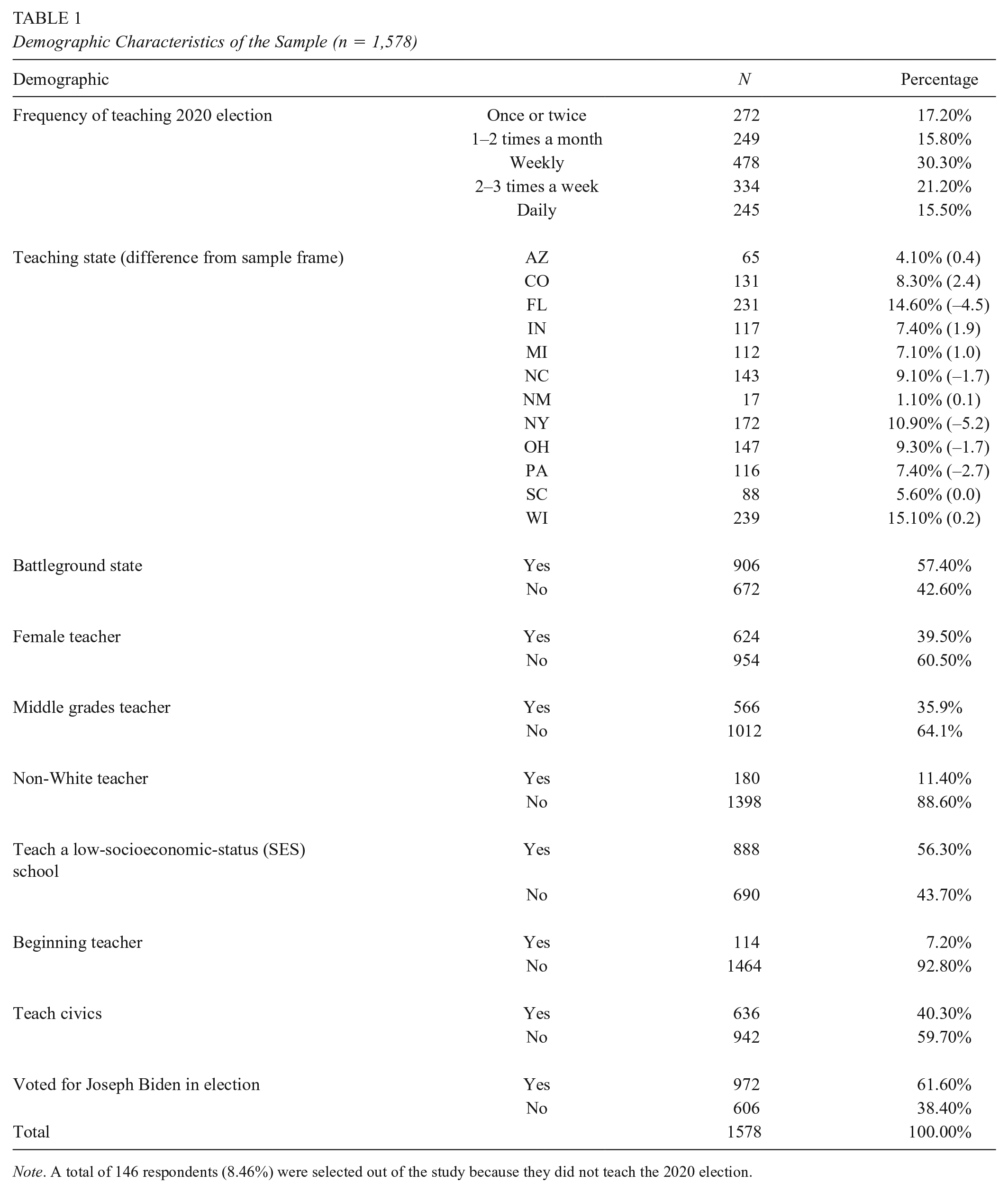
Note. A total of 146 respondents (8.46%) were selected out of the study because they did not teach the 2020 election.
For most of our analyses, we selected respondents who reported that they taught about the 2020 election at least once (n = 1,578). We made this decision because we were interested in analyzing the topics and the instructional strategies used during instruction about the 2020 election. Based on these criteria, we did not have any missing data to impute since questions about teaching the election required respondents to report having taught about the election at least once.
Survey Instrument
We developed the survey instrument by adopting and adapting scales validated in prior studies of civic education. Specifically, the survey included items and instruments tightly linked to our research questions, including the CivID scale by Knowles (2018), items developed by Stoddard et al. (2022) in a previous study on teachers’ reported instructional decision-making during the 2018 election, items from the NCES Schools and Staffing Survey (NCES, 2012), and previously validated scales focused on civic education teaching practices, engaging in controversial issues, and open classroom climate (Godsay & Sullivan, 2014; Rogers & Westheimer, 2015; Torney-Purta et al., 2001).
After establishing that participants were teaching at least two class periods of secondary social studies in the U.S. (letting those who did not do so exit the survey), we asked participants how frequently they taught about the election overall: “THIS FALL, how often did you teach about the 2020 election?” Participants had six response options ranging from never to daily. 3
To explore our second research question, we asked participants whether or not (yes/no) they had taught about key election issues (Godsay & Sullivan, 2014; Rogers & Westheimer, 2015) in their “focus class” (i.e., the class in which teachers spent the most time teaching about the election). These topics, compiled from polling data on key issues likely voters care about (Pew Research Center, 2020), were divided into two categories: perennial topics (e.g., the electoral college and the economy) and hot-button topics (e.g., protests for racial justice, COVID pandemic, and election interference). 4
To explore our third research question, the survey included several items about the use of election-related pedagogies in the focus class. One set of Likert-type items asked how often (never to daily) participants required students to engage in certain activities during the fall election season, such as conduct research on election-related issues, debate the election in class (i.e., election topics), or talk about the election with family members. In addition, we administered dichotomous (yes/no) items when asking if teachers required their students to engage in the following: participate in a mock election, watch a presidential debate, watch election night coverage, and (pre)register to vote.
Because prior research indicated that student demographics, contextual factors, and teachers’ civic education ideologies were related to certain kinds of instruction (as noted in the literature review above), we also examined these issues in the survey. To measure teachers’ civic education ideologies, we included a subset of the CivID inventory (Knowles, 2018). Next, to understand participants’ instructional contexts, the survey asked teachers about their workplace and community climates (e.g., autonomy, political ideology). To gauge teachers’ backgrounds and experiences, we asked if they taught civics or government, had voted for Biden, and viewed COVID as hindering their ability to teach content (see Table 1 for descriptive statistics). We also asked several questions to capture demographic information about our teacher participants, including their gender, race, teaching experience (in years), level of teaching (middle or high school), and whether they taught in a battleground state.
The full survey was reviewed by a group of five civic education experts to better ensure face validity. These civic education researchers had experience with quantitative methods, survey development, and the topics included in the instrument, including civic education ideological beliefs and the teaching of controversial issues. Experts received an early draft of the survey and were invited to comment on each item, especially questions aligned with their areas of expertise. For example, one researcher with expertise in teachers’ civic education identities was asked to review the overall survey but was also asked to give comments and suggestions on the battery of items directly related to civic education ideology. Based on the collective feedback, the survey was carefully revised before dissemination. Although we are interested in classroom practice, we acknowledge, as external reviewers pointed out, that this survey generated self-reports of such practices. Therefore, when describing our results below, we refer to teacher reported instructional decision-making and perceived alignment with community values.
Data Analysis
After collecting these quantitative data, we conducted descriptive and regression analyses to explore answers to our research questions. To answer our first research question, we chose as the dependent variable an item measuring the frequency with which teachers taught about the 2020 election. For the second research question, we derived dependent variables from items about the election topics that teachers addressed in their classrooms. To answer our third research question, we drew dependent variables from the two inventories in the survey related to pedagogy.
For our descriptive analyses, we examined the frequencies of certain responses, such as how many teachers reported teaching about the election daily or addressing certain election-related topics in their classrooms. Our regression models, however, were more complex, as they included numerous independent variables, fitting into three categories: civic education ideology, teaching context, and teacher characteristics (or demographics).
With the 14 civic education ideology items (from the CivID scale), we conducted a factors analysis using principal axis factoring with varimax rotation. Factor scores were generated from the analysis as independent variables. They aligned with the civic education ideologies identified by Knowles (2018): critical (belief that civic education should focus on issues related to social justice, systemic racism, and other critical forms of citizenship; α = .931), liberal (belief that civic education should focus on issues of individual rights, exploring multiple perspectives of an issue, and the like; α = .813), and conservative (belief that civic education should promote American exceptionalism, free market values, and the like; α = .836). See Table A1 in the online supplementary material for a comprehensive description of the items incorporated into these factors. As noted in prior studies, civic education ideologies should not be conflated with teachers’ political leanings. Rather, each ideological perspective represents a set of teachers’ beliefs about the topics and pedagogies that should be emphasized in civic education (Abowitz & Harnish 2006; Knowles, 2018), and each teacher may have multiple ideologies.
Using factor analysis, we also created scale scores as independent variables aimed at measuring aspects of the teaching context, including items related to classroom control (i.e., agency over content and curricular materials; α = .769) and community-teacher value alignment (i.e., items measuring the participant’s view that key community stakeholders share the same values as that teacher participant; α = .775). In addition, two single items were used: one measuring the teacher’s appraisal of conservatism in the community (very liberal = 1 to very conservative = 5) and a self-reported measure of about the predominant socioeconomic status (SES) of the school’s students (see Table 1). See Table A2 in the supplementary material for more information on how these variables were constructed.
Because we were initially interested in examining potential variance in teaching the election by state, including differences between battleground and non-battleground states, we used hierarchical linear modeling (HLM) software to examine the intraclass coefficient (ICC) of teachers nested among states. Results indicated that less than 10% of the variance of frequency in teaching the election could be attributed to state designation. This a priori analysis suggested that variance in teaching about the election was associated with more local factors (e.g., teacher characteristics and perceived community values) than by state context. Rather than excluding the battleground state designation altogether, we decided to model it as a contextual variable within single-level models rather than employing multilevel models (Hox, 2010).
Our final analytical models were constructed as follows, using the dependent and independent variables outlined above. To answer the first research question, we conducted an ordinal regression with SPSS’s PLUM command. To answer the second research question, we conducted logistic regressions across each of the hot-button and perennial topics. Finally, to answer our third research question, we conducted both logistic regressions and ordinal regressions, depending on whether the outcome variable was dichotomous or ordinal. Findings from these analyses are described below. For a full description of multinomial and binomial parameter estimates, refer to Table A3 and Table A4 in the supplementary materials in the online version of the journal.
Results
Frequency of Teaching About the 2020 Election
Most respondents in our sample reported teaching about the election (Figure 2), with 61% of the sampled teachers reporting teaching the election weekly or more often. As detailed below, a variety of variables made it more likely that they would teach it, including civic education ideologies, teaching contexts, and demographic variables.
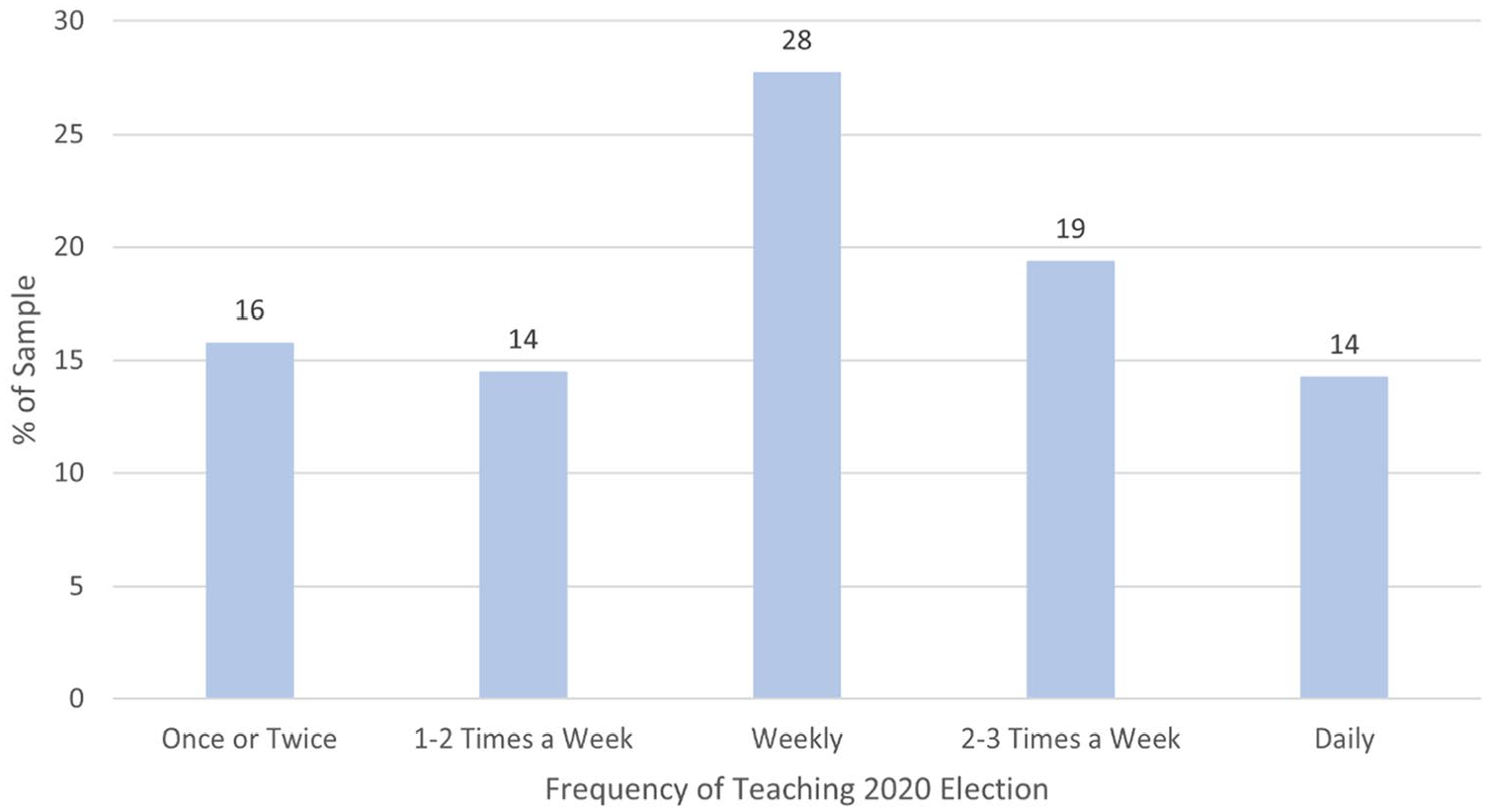
Teachers’ frequency of teaching about the 2020 election (N = 1,578).
Civic Education Ideologies and Election Teaching Frequency
Teachers’ beliefs about civic education were related to the frequency of election-related instruction in the classroom. Teachers who expressed views that might seem diametrically opposed yet operate within the bounds of traditional civic education ideologies—liberal and conservative orientations—were more likely to teach about the election, controlling for teaching experience, race, sex, and other background variables (see Table 2). The odds of teaching about the election increased 14.5% for each standard deviation increase in conservative civic education ideology, 5 and a more liberal view of civic education was associated with a 17% increase in the odds of teaching about the 2020 election. However, having a critical perspective on civic education, (i.e., questioning existing institutional structures) was not associated with more teaching about the election. This suggests that conservative and liberal civic education ideologies may be more supportive of our electoral system than critical civic education ideologies.
Factors Related to the Frequency of Teaching the 2020 Election (Results of Regression Analyses)

Note. Nagelkerke = .234.
p < .05. **p < .01. ***p < .001.
Teaching Context and Election Teaching Frequency
When teachers reported having greater curricular control, or believed their values were more closely aligned with those of their communities, they reported teaching about the election more often, controlling for various background characteristics (see Table 2). Neither teachers’ appraisal of conservatism in their communities nor being in a predominantly low-SES school was significantly associated with election teaching frequency. Reflecting on previous findings (Stoddard et al., 2022), these results suggest that teachers may be more likely to report teaching about potentially controversial topics, such as elections, when they believe they have curricular freedom and community support.
Demographics and Election Teaching Frequency
In contrast to prior findings (e.g., Pollock et al., 2022), neither demographic variables nor background variables were related to the reported frequency of teaching about the election, notwithstanding a few notable exceptions. In our analyses, race, sex, being a new teacher, being a Biden voter, and living in a battleground state were unrelated to election teaching frequency.
However, respondents who reported teaching civics or government were more likely to teach about the election (4.517 times more), and middle school teachers were less likely than high school teachers to report teaching about the election. As noted in research focusing on middle school social studies instruction (e.g., Conklin 2010), the quality and content of instruction is often affected by the structure of the middle school (e.g., teach only social studies or multiple subjects) and professional background of the teacher (e.g., their own content knowledge in the subject). This finding might also be related to the fact that high school students are closer to voting age, which may lead teachers to emphasize elections more. Additionally, not every state mandates civic instruction in the middle grades.
Which 2020 Election Topics Were Taught?
Our analyses indicated substantial variability in the election-related topics that participants reported addressing in their classrooms (see Figure 2). The most taught hot-button topics were the COVID pandemic (87%), protests for racial justice (69%) and the U.S. Supreme Court confirmation of Amy Coney Barrett (60%). Among perennial topics, the electoral college (88%), the economy (60%), and immigration (46%) were regularly addressed by teachers in the sample. Across all topics, teachers who reported teaching the election at least weekly were more likely to guide instruction about hot-button issues and perennial issues than were teachers who reported teaching about the election less frequently.
Civic Education Ideologies and Election Topics Taught
Res-ults of our regression analyses indicated certain civic education ideologies correlated with participants’ likelihood to report teaching certain hot-button issues (see Table 3). Teachers with more critical perspectives on civic education were more likely to report teaching about climate change/environmental issues, voter suppression, the peaceful transfer of power, and protests for racial justice, controlling for teachers’ sex, race, teaching experience, and other background variables. Teachers with more conservative civic education ideologies were less likely to report teaching about voter suppression, racial justice, and gerrymandering. Additionally, teachers with more liberal conceptions of civic education were more likely to report teaching about election interference. For perennial topics, having a more conservative orientation to civic education was associated with a lower likelihood of reported teaching about the electoral college, but with an increase in reported teaching about the economy and immigration. Teachers with liberal civic education ideologies were more likely to report teaching about the economy and healthcare policy. These findings suggest that teachers with critical and liberal civic education ideologies were more likely to raise challenging questions about our electoral system.
Topics Taught About the Election (Results of Regression Analyses, N = 1,578)

Note. Covariates also include battleground state, gender (female), middle/high school teacher (middle), beginning teacher (<3 years), race/ethnicity (non-white), Covid impact, and frequency of teaching the election. Dashes indicate that the independent variable in question did not have a statistically significant association with the outcome variable at the top of that row.
Results from ordinal regression analyses.
Results from logistic regression analyses.
p < .05. **p < .01. ***p < .001.
Teaching Context and Election Topics Taught
Furthermore, teachers reporting greater alignment between their own values and those of their local communities were more likely to indicate teaching about certain hot-button issues, including the Supreme Court nomination and the peaceful transfer of power, as well as certain perennial issues, such as the electoral college and the economy. Teachers appraising their local communities as more conservative were less likely to report addressing several hot-button election topics, including voter suppression. Meanwhile, teachers reporting curricular control (i.e., greater autonomy) were less likely to report teaching about immigration issues or healthcare. This suggests that autonomy can go both ways, that is, teachers with increased agency can choose to teach or to sidestep divisive election-related issues. Overall, this indicates that teachers’ perceptions of their teaching contexts can have a substantial impact on what they teach about elections.
Demographics and Election Topics Taught
As with the reported frequency of teaching about the election, being a teacher of a civics or government course was closely related to self-reported teaching about several hot-button and perennial issues, including redistricting, campaign finance, and voter suppression. In addition, self-reported Biden voters were associated with an increased likelihood of teaching about environmental issues, voter suppression, and the peaceful transfer of power.
How Was the 2020 Election Taught?
Overall, teachers reported a variety of active and passive pedagogies (see Figure 3). They most frequently reported asking students to read articles on the election (85%), conduct research on election issues (69%), talk about the election with family (58%) and debate the election in class (54%). They reported less frequently engaging students in mock elections (29%), encouraging voter registration (25%), and mandating election night television viewing (33%). In addition, our analyses found that various contextual factors and teachers’ civic education ideologies were associated with their reported pedagogical practices.

Teachers’ self-reported use of various election-related pedagogies.
Civic Education Ideologies and Civic Pedagogy
Mirroring prior studies (Knowles, 2018), we found teachers’ civic education ideologies were related to their instructional practices. An increase in conservative civic education ideology was associated with various active and passive pedagogies (see Table 4). Specifically, a one-unit increase in teachers’ conservative civic education ideology was associated with a 36% increase in the odds of the teacher asking students to debate the election in class and a 35% increase in the odds of a teacher requiring students to follow election news via social media. Meanwhile, having a more critical civic education ideology (e.g., believing that youth should understand the ramifications of systemic racism and class privilege) was associated with significant, albeit moderate, increases in the odds of requiring students to conduct research on election issues, talk about the election with family, and read news articles on the election, controlling for background variables. Having a liberal civic education ideology was not associated with increases or decreases in specific pedagogies. These findings indicate that teachers with both conservative and critical civic education ideologies reported engaging in active and passive pedagogies—but that a more critical perspective led educators to encourage deeper exploration of election-related issues.
Pedagogies Used to Teach about the Election (Results of Regression Analyses, N = 1,578)

Note. Covariates also include battleground state, gender (female), middle/high school teacher (middle), beginning teacher (<3 years), race/ethnicity (non-white), Covid impact, and frequency of teaching the election. Dashes indicate that the independent variable in question did not have a statistically significant association with the outcome variable on that row.
Results from ordinal regression analyses.
Results from logistic regression analyses.
p < .05. **p < .01. ***p < .001.
Teaching Context and Civic Pedagogy
Educators’ perceptions of their own teaching context also affected their reported instructional decision-making (see Table 4). Teachers were less likely to require students to watch 2020 election night coverage if they worked in communities that they perceived to be more conservative (10% decrease in the odds). On the contrary, teachers reporting a stronger alignment with their school communities’ values were more likely to require students to engage in certain election-related activities, such as conducting research, debating the election, and following the election on social media. Meanwhile, teachers’ perceptions of curricular control were associated with two closely related pedagogies: requiring students to conduct research on election issues and to read news articles about the election. Overall, this suggests that educators were more likely to structure engaging election-related learning opportunities if they perceived that their instructional decisions would not be challenged.
Demographics and Civic Pedagogy
Teachers of civics and government courses were more likely than other social studies teachers to report using most of the election-related pedagogies that we listed on the survey, including requiring students to conduct research, (pre)register to vote, and watch debates. This finding suggests that civics and government courses are more common curricular spaces for discussing, debating, researching, and otherwise learning about elections compared to other social studies courses. Other demographic variables, including teachers’ political affiliation, were not statistically significantly associated with instructional decision-making in our models. This is likely because a greater proportion of the variance in instructional decision-making was attributed to teachers’ civic educational ideological stance and the context in which they worked. In the section below, we discuss these findings and their implications for civic education and future research.
Discussion
In this exploration of how educators taught about the 2020 election, we provide valuable insights on how educators’ teaching contexts, civic education ideologies, and demographics are associated with their self-reported instruction about elections. Understanding how teachers reported engaging students in election-related content during this election is important not only because elections are a vital opportunity for civic learning (e.g., Journell, 2011; Levy et al., 2016), but also because this specific election involved two somewhat new but ongoing challenges: (a) highly vitriolic campaigns rife with disinformation, including during nationally televised presidential debates (Gill, 2022); and (b) hybrid or virtual models of instruction because of the COVID pandemic, which often meant limited time with students, restricted curricula, and the inability to develop classroom culture in the same ways as educators can do in person (Grossman et al., 2021). While COVID restrictions have diminished, school is by no means back to “normal,” and heightened partisanship and the impact of polarization in schools is likely to continue for the foreseeable future.
Additionally, while past studies have highlighted the partisan tension that has spilled into U.S. classrooms and contributed to a hesitancy toward discussing politics in school settings (Costello, 2017; DiGiacomo et al., 2021; Kiesa et al., 2022), the current study brings to light other variables associated with teaching the election. Results indicated that perceived community partisanship and value alignment correlated with the content selection and election pedagogies. However, our study also suggests that teacher instructional decision-making is not wholly shaped by these contexts. Other factors, particularly teachers’ beliefs on civic education and their perceived classroom control, were closely related to what and how they reported teaching about the 2020 election. Therefore, our findings are unique, given the timing of the survey, and useful for policymakers, teachers, teacher educators, and school administration. Below, we summarize this study’s contribution to the scholarship on civic learning as well as implications for educational practice and research.
Scholarly Contribution
One of our clearest, and perhaps most obvious, findings is that civics teachers were much more likely than teachers of other social studies subjects to teach about the 2020 election, to teach about various election-related topics, and to engage in “best practices” in civic education (see Tables 2, 3, and 4). Although many social studies teachers help their students explore current political issues (e.g., Swalwell & Schweber, 2016), this study details how teachers in different social studies courses varied widely in the amount and type of instruction on the 2020 election.
Research has pointed towards the contributions of partisanship and fear of community backlash in muting political discourse (Costello, 2017; Hess & McAvoy, 2015). Our study similarly highlights the importance of contextual factors in teachers’ instructional decision-making. Teachers reported teaching more about the election when they expressed having a greater degree of classroom control and alignment with the values in their school communities. Teachers were less likely to teach about a variety of hot-button or potentially controversial issues, including environmental issues and immigration, when they viewed their communities as politically conservative. These findings align with prior studies (e.g., Stoddard et al., 2022), which suggest teachers are more likely to teach about controversial political issues when they perceive fewer external constraints on their instruction. While this largely trends true in our study, we also found that teachers who reported increased agency were less likely to teach about healthcare reform. Therefore, we cautiously note that greater teacher autonomy might also contribute to teachers’ avoidance of certain controversial, partisan topics.
While contextual factors, professional autonomy, and curriculum are mostly external drivers of teacher decision-making (i.e., the outer ring of our conceptual framework). Our study also points to the importance of internal beliefs as substantial contributors to teachers’ reported election-related instruction. Teachers’ ideologies on civic education were significantly associated with their pedagogies, frequency of teaching about the election, and the election-related topics they chose to address in the classroom. Teachers with more liberal or conservative views on civic education were more likely to teach about the election, but having a more critical view of civic education did not affect teachers’ likelihood of teaching the election. On the other hand, such a critical view made teachers more likely to guide students to do research on election issues and read news articles, activities that were not related to having more conservative or liberal perspectives on civic education (see Table 4).
Teachers with critical and conservative civic education ideologies also differed substantially in the topics that they reported teaching. Teachers reporting more critical orientations were significantly more likely to teach about hot-button issues like racial (in)justice, and teachers with more conservative teaching ideologies were more likely to teach about perennial topics, such as the economy. These findings add nuance to results of previous studies that indicate that teachers’ perceptions of civic education affect their curriculum and pedagogy (Clark et al., 2020; Abowitz & Harnish, 2006; Knowles, 2018). Building on the concept of teachers as curricular gatekeepers (Thornton, 2005), our study further suggests that civic education ideology shapes what is taught about elections, leading to the inclusion or exclusion of various election-related topics, and how students are taught to explore election-related issues.
Our lone indicator of partisanship (voting for Biden) was not associated with any of the election pedagogies, but it was significantly associated with an increased likelihood of teaching the hot-button issues of climate change, voter suppression, and peaceful transition of power—talking points of the Biden campaign. This effect holds even when accounting for teachers’ reported civic education ideology. These findings build upon prior research on motivated reasoning’s association with teacher decision-making (Clark et al., 2020), as well as suggesting that political views, while potentially influential on teachers’ instruction, are distinct from ideologies about civic education.
Implications for Policy and Practice
Our findings on teachers’ instruction about the election have implications for educational practice and policy. First, given that instruction about the election and the use of engaging pedagogies was much more common in civics courses than in other social studies courses, districts and states that value civic learning should consider offering and even requiring more courses focusing explicitly on civic issues. Previous research has shown that such civic education opportunities, in terms of who has access to high-quality civic education or civic education at all, depend greatly on context, curriculum, and teachers being supported (DiGiacomo et al., 2021; Hess & McAvoy, 2015). Our findings suggest civics and government courses are the predominant place where students are engaged in learning about democratic processes, such as voting, elections, and key contemporary issues. During times of political polarization, learning about contemporary issues is vital for civic life, and these courses can play a key role in helping students understand them. However, schools and districts could expand their offerings, perhaps through courses on civics and government as well as social issues and public policy, to provide a broader array of opportunities for young people to learn about current civic issues.
Given that exploring public issues and participatory processes are viewed as best practices within civic education (e.g., Educating for American Democracy, 2021), steps to provide access to all students could include requiring more civics instruction, embedding these aspects of civics teaching in state standards, or providing professional learning opportunities and curriculum to engage students in these key civics content and processes. The traditional civics curriculum (embedded in many state standards) focuses on government structures and procedures, and this may allow teachers to avoid engaging students in contemporary issues. To strengthen the relevance and value of school coursework, state departments of education or local curriculum decision-makers should explicitly include in their standards instruction about contemporary civic issues and deliberative or inquiry-based engagement with these issues. Prior studies make clear that supporting students’ civic engagement emerges from not only having more civics instruction but certain kinds of civics-related content and pedagogy, and the present study suggests that the supports and policies noted above could encourage more of the latter.
Additionally, as research has found (e.g., Costello, 2017), teachers’ perceptions of their political contexts can have a substantial impact their instruction about elections, perhaps hindering their willingness to teach about them, so it is important for educators and districts to clarify the types of issues that can and should be examined in classrooms. This could involve, for example, open discussions among teachers, administrators, and community members about what should be taught, recognizing the role that community values play but not necessarily bowing to unreasonable external pressure, such as anti–critical race theory (CRT) campaigns (e.g., Hamilton, 2022). Together, adults and youth interested in civic education policy could consider what issues students can and should explore, implications for different levels of education, and the principles that should guide this type of instruction.
Finally, teacher educators and professional developers can help teachers conceptualize, reflect upon, and perhaps revise their ideologies about civic education. Like prior research, our study found that educators’ perceptions of the purposes of civic education, such as how much to prioritize teaching about American exceptionalism (conservative civic education ideology) or institutional racism (critical civic education ideology), correlated with instructional choices. Helping educators to metacognitively consider their ideologies may encourage them to be more flexible and self-reflective in ways that affect their teaching. Put differently, the framework for civic education ideologies (e.g., Figure 1) may be used as a reflective tool among social studies teachers to consider their goals for civic education and how this aligns with their instructional decision-making.
Research Implications
This study also raises important questions to explore in future research. First, because civics and government courses are a primary setting for students to learn about elections, it would be valuable to explore how we can ensure that more students have opportunities to take such courses, especially engaging ones. Whereas over 40 states require some coursework in civics or government, fewer than 10 require year-long courses, and 7 states require no civics course at all (CivXNow, 2021; Education Week, 2018). Identifying how to provide high-quality civic learning opportunities for all students is a vital topic for future exploration, and this should include exploring factors that contribute to high-quality civic learning opportunities across the social studies curriculum and beyond.
As noted above, our work and other recent studies have found that contextual factors, both within schools and the local community, can affect how and if social studies classrooms serve as sites for engaging in current issues through inquiry and deliberation. Here, our focus on the role of teacher civic education ideologies in relation to teaching contexts and conditions may be built upon to further understand the relationship between these two key factors in teacher decision-making. Our use of the teacher civic education ideologies framework (see Figure 1) to examine the relationships between teacher beliefs and other contextual factors in teacher decision-making may be a useful model on which to build future research.
It is also important to continue exploring simply how educators teach about elections and how students learn about them. Each election is different and offers unique instructional affordances and constraints. Whereas the present study and others (Journell, 2011; Levy et al., 2016) have provided useful insights, each study has limitations related to both contexts and samples, making ongoing research important in this domain. Also, several of our findings about the effects of civic education ideologies raise questions for further exploration. For example, why are teachers with more conservative civic education ideologies more likely to have their students (pre-)register to vote, watch debates, and follow news on social media (see Table 4)? Future research should more deeply examine the reasons behind the differences among teachers with different civic education ideologies. In addition, teaching about and for equitable voting is key to fostering a more equitable society (e.g., Kiesa et al., 2022), so exploring this question is vital for future research in this area, as well. Lastly, researchers should examine how teachers and administrators can conjointly craft approaches or strategies to strengthen civic education, including election-related learning. Understanding the processes and challenges involved in this important work could facilitate more efforts to broaden and deepen civic learning.
Limitations
We acknowledge that our sample was not representative of U.S. social studies teachers, but its diversity by race, gender, teaching experience, geography, and political orientation make it a valuable data set to examine. As noted above, the low response rate was likely due to COVID-related access to teachers, and virtual learning restrictions may have also limited the amount of time dedicated to teaching about the election. Additionally, our study relied on self-reported data, making it difficult to ascertain the nature of participants’ actual instruction. Also, lower sampling rates in and potential distribution imbalances between certain states might contribute to response bias. Lastly, we were unable to sufficiently model teachers within given schools in a multilevel analysis. It is quite possible that some of the various election-related dependent variables could be attributed to school-level fixed effects, but our data did not allow for the analyses needed to confirm this possibility. Our findings should be interpreted in light of these limitations, and additional research is needed to further our understanding of how and to what extent elections are taught in the United States.
Conclusion
This study explored how teachers’ demographics, teaching contexts, and civic education ideologies were related to their decision-making on how to teach about one of the most contentious and politically vitriolic elections of the last century. Our findings can be useful and informative for teachers, teacher educators, and other stakeholders who remain concerned about how elections are taught in U.S. classrooms.
As noted above, our findings have numerous implications for educators and researchers, and three of our findings stand out as especially consequential for today’s teachers and administrators, who will shape students’ learning in the upcoming election cycles. First, when teachers have greater control over the curriculum (i.e., are not required to meet certain deadlines or teach to a test), they are more likely to teach about the election and to employ information-rich pedagogies for teaching about it. This suggests that greater teacher autonomy could strengthen election education. Second, we found strong evidence that teachers of civics or government courses are much more likely than teachers of other social studies subjects to teach about the election and help their students explore numerous election-related issues. These findings highlight the vital role of such courses in preparing the future electorate. Finally, our most unique finding is that teachers’ conceptions of civic education can substantially shape their pedagogy, including the political topics they raise in class and the kinds of election-related activities that they enact in their courses.
Understanding teachers’ perspectives on teaching the 2020 election provides us a better understanding of what U.S. students learned (or did not learn) about this highly consequential, collective moment in history, and it also provides insights about what leverage points we have to strengthen the education of the electorate. As educators and scholars, we should consider how educational climate, context, and ideologies will shape how young people learn about upcoming elections. Practitioners, policymakers, and researchers seeking to enhance civic education should be mindful of these challenges and opportunities in their efforts to sustain the health of our democracy during these politically tumultuous times.
Supplemental Material
sj-docx-1-ero-10.1177_23328584241234884 – Supplemental material for How and Why Teachers Taught About the 2020 U.S. Election: An Analysis of Survey Responses From Twelve States
Supplemental material, sj-docx-1-ero-10.1177_23328584241234884 for How and Why Teachers Taught About the 2020 U.S. Election: An Analysis of Survey Responses From Twelve States by Paul G. Fitchett, Brett L. M. Levy and Jeremy D. Stoddard in AERA Open
Footnotes
Declaration of Conflicting Interests
The author(s) declared no potential conflicts of interest with respect to the research, authorship, and/or publication of this article.
Funding
The author(s) disclosed receipt of the following financial support for the research, authorship, and/or publication of this article: Data collection for this study was supported with funding from the University of Wisconsin-Madison and the University at Albany, State University of New York.
Open Practices Statement
Supplemental Material
Supplemental material for this article is available online.
1.
2.
We heard from some teachers that their schools and districts had put a moratorium on research requests during the school year due to COVID-related constraints on time. Additional teachers in the contact list were assigned to non-social-studies classes to cover shortages and virtual instruction priorities or had left the classroom.
3.
For most of our analyses, we included only those who reported teaching about the election “once or twice” or more often because these participants completed all questions on the survey.
4.
The Oxford English Dictionary defines a hot-button as “a subject or issue that people have strong feelings about and argue about a lot.”
5.
Parameter estimates are summarized in  . Note that exp(b) is the exponentiation of the coefficient, meaning that a value equal to one indicates the independent variable correlates with no change in the odds of an increase in the dependent variable. Meanwhile, a value greater than one indicates an increase of the odds of a one-unit change in the frequency of teaching the election, and a value less than one is associated with a decrease in the odds of a one-unit change in teaching the election.
Authors
PAUL G. FITCHETT is a professor and head of the Department of Curriculum and Teaching at Auburn University, 3084 Haley Center, Auburn, AL 36849; e-mail:
BRETT L. M. LEVY is an associate professor and director of the Master of Science in Secondary Education Program in the Department of Educational Theory and Practice at the University at Albany, State University of New York, 1400 Washington Ave., Albany, NY 12222; e-mail:
JEREMY D. STODDARD is a professor of curriculum and instr-uction at the University of Wisconsin–Madison, 225 N. Mills St., Madison, WI 53715; email:
References
Supplementary Material
Please find the following supplemental material available below.
For Open Access articles published under a Creative Commons License, all supplemental material carries the same license as the article it is associated with.
For non-Open Access articles published, all supplemental material carries a non-exclusive license, and permission requests for re-use of supplemental material or any part of supplemental material shall be sent directly to the copyright owner as specified in the copyright notice associated with the article.
