



Abstract
This study examines the impact of a university-high school debate mentoring program on educational outcomes of high school graduates attending a racially segregated school in New Jersey, USA. Evidence shows that from 2011 to 2018, participants had stronger grade point average growth, higher cumulative grade point averages, and higher SAT scores relative to non-debating graduates. The sample (N = 275) consists of 55 high school graduates who competed on the debate team and a control group of 220 non-debating graduates. Findings indicate debate graduates experienced a 0.81 GPA growth (2.5–3.31) from 9th grade to 12th grade while non-debate graduates exhibited a markedly lower 0.10 GPA growth (2.2–2.3). Debaters scored higher on particular sections of the SAT exam and overall SAT scores. The study provides evidence of the potential efficacy of debate team membership on student outcomes.
Introduction
While some of New Jersey’s suburban schools are among the highest performing in the United States, others in the state’s urban centers are among the lowest performing schools—a virtual tale of two cities. One explanation for this academic achievement gap is students in segregated urban schools are more likely to be populated by low-income children of color who struggle with a unique set of personal, social, and economic hardships. The Civil Rights Project at UCLA has labeled New Jersey’s educational system as hyper-segregated and lists it as one of the most segregated school systems in the nation, behind only New York, Illinois, and Maryland (Orfield et al., 2016). Similarly, the Institute on Education Law and Policy at Rutgers University labels these schools as apartheid schools, attaching the term to any school with a 99% non-white student population. One of its studies found that 49% of New Jersey’s African-American students and 43% of its Hispanic students are currently enrolled in intensely segregated schools, defined as those with a 90% or higher non-white student population (Tractenberg et al., 2013). Looking more closely, these schools are actually doubly segregated by race and income level, given that 79% of students attending segregated schools now live below the poverty line (Tractenberg et al., 2013). The school featured in this study fits this profile with a 98% non-white population and with 88% of its student body eligible for New Jersey’s free lunch program (Public School Review, 2020).
This study surveys whether a university-high school debate mentoring program aided in improving student outcomes of the high school students who competed on the debate team from 2011 to 2018. Debate has a rich tradition of promoting academic growth and personal and professional development in many urban students, none more inspiring than the case of U.S. Supreme Court Justice Sonia Sotomayor. When she was nominated to the nation’s highest bench, she credited her mother and her involvement with the debate team at Cardinal Spellman High School in the South Bronx as the two most important reasons for her success. It was in fact through the influence of her high school debate coach that she went on to attend and graduate from Princeton University in 1976 (Dooley and Patten, 2021).
This study loosely replicates Mezuk’s (2009) study that surveyed the impact of policy debate competition on graduation rates and test scores of African American male high school students who competed in the Chicago Urban Debate League (Mezuk, 2009). The study’s population consists of high school graduates (N = 275) from 2011 to 2018, including graduates (N = 55) who competed on the debate team and a random sample of non-debating graduates (N = 220). This four to one ratio of non-debaters to debaters replicates the four to one ratio of non-debaters to debaters used in Mezuk’s (2009) analysis. Prior to reviewing the literature on debate team participation and academic outcomes, a brief overview of the university-high school debate partnership will be provided.
The university-high school debate partnership
The university debate team first partnered with the high school debate team in the spring of 2009. Seeds for this program were spread after members of the university’s debate team were invited to make a presentation in front of a group of high school students visiting the campus as part of a Big Brothers/Big Sisters mentoring program. At the end of this hour-long session, one of the students asked the university debaters for help in creating a debate team at his high school. It was at this point that the debate mentoring partnership was formed. Selected members from the university’s debate team have since met once a week after school with the high school students for the purpose of coaching them through intra-squad debate scrimmages, and coaching the students through three to four weekend contests per year, including an annual debate tournament hosted by Harvard University. This ongoing program is funded in part through a TD Bank community grant and is jointly administered by the university’s debate team faculty advisor (and author) and the high school’s English teacher.
The National Association for Urban Debate Leagues
The high school competitions were sponsored by the National Association for Urban Debate Leagues (NAUDL), which was first formed in Atlanta, Georgia in 1985; and has now grown to include debate leagues in 22 cities across the United States. In 1997, George Soros’ Open Society Institute formed the Urban Debate Program and provided seed money for the purpose of replicating Atlanta’s debate league model into other urban high schools across the United States (Breger, 2000). Each Urban Debate League has a unique history and functions in a diverse context that includes a wide array of local partnerships and varying degrees of school district involvement. Students in this study participated in the Jersey Urban Debate League (JUDL) in Newark, New Jersey and the New York City Urban Debate League (NYCUDL), which were both originally created in partnership with the Soros Open Society Institute. However, the current NYCUDL was relaunched in 2011 by a group of New York City teachers in partnership with a New York City law firm. It is now the largest urban debate league in the nation with over 2000 middle school and high school debaters representing 140 participating schools (New York City Urban Debate League, 2020).
Approximately 84% of the nearly 11,000 high school and middle school students who competed in Urban Debate League tournaments across the United States in 2020 were students of color, and 72% of the league’s entrants were from low income families (NAUDL, 2020). Each year the NAUDL selects a topic that is debated at every tournament throughout the year. The purpose of having a fixed annual resolution is to limit the parameters of the debate and to encourage scalability of newly acquired knowledge from one debate tournament to the next. For instance, the Debate Resolution adopted in the 2020–2021 academic year was: Resolved: The United States federal government should enact substantial criminal justice reform in the United States in one or more of the following: forensic science, policing, sentencing. Debaters are grouped into teams of two and compete against teams from other schools in switch-side debate, which requires teams to alternate between affirming and negating the resolution. This study is significant because while there has long been anecdotal evidence pointing to a positive relationship between the debate activity and academic outcomes, we believe this is the first study to evaluate whether debate team participation contributes to grade point average growth from 9th grade to 12th grade in students attending racially segregated high schools.
Previous literature
Previous scholarly work focusing on debate as an academic intervention is somewhat sparse, especially so for those in at-risk environments. However, the existing literature is also relevant to other sub-literatures concerning the importance of building school-community social networking systems and the need to incorporate a holistic learning approach into schools serving impoverished urban communities. This review of the literature will assess the potential impact of the debate activity on promoting active citizenship, socio-emotional learning, and academic growth in the educational setting.
Debate and the promotion of active citizenship skills
One of the fundamental lessons of debate team membership is persevering through competitive debate tournaments. Students are rarely successful in their first debate tournament. Most are nervous before starting their first debate round, and sometimes come out of it embarrassed by their performance, vowing never to debate again. However, resiliency is fortified through the strong bonds that naturally form when individuals come together through a team effort to achieve a collective goal. Eskreis-Winkler et al. (2014) and Von Culin et al. (2014) discovered in separate non-debate related studies that traits associated with long term goal attainment are more effectively developed when people are enthusiastic about the engaged activity. Passion for debate competition can be bolstered through university-high school debate partnerships because of the social connections made between the college debaters and high school students. These social bonds are sometimes formed outside of the classroom context, whether through light-hearted exchanges on long bus rides to tournaments, or casual discussions about the college application process while sharing meals during weekend contests. It is through these informal interactions that college mentors are able to build the high levels of trust and social capital needed to help inspire high school students to continue on in the debate activity after experiencing common setbacks associated with first debate tournaments. Once trust is established and friendships formed, the college debaters are able to help the high school debaters persevere through the highs and lows of debate competition. Debate is an academic team sport that not only teaches vital critical thinking and public speaking skills, but also teaches important life lessons; such as how to comport oneself after winning or losing a round, and the importance of letting go of past mistakes and the value in simply moving on to the next round.
Another undervalued benefit of the debate activity is the extent to which it helps connect teenagers to their larger political community. Alexis de Tocqueville’s Democracy in America reminds us that our political system is only as strong as the community that undergirds it (De Tocqueville, 1835). And he argued one of the telltale indicators of a healthy community is the extent to which private citizens’ form and join groups (i.e. voluntary associations), rather than remain isolated and left to go “bowling alone” (Putnam, 2000). By becoming a member of a debate team and by debating public policy issues that involve criminal justice reform, climate change, U.S. foreign policy, and/or immigration policy, students are able to connect to issues larger than themselves and come to see how governmental decision making impacts every facet of their lives, while simultaneously learning the necessary debating skills to influence these public policies in their communities. A recent National Assessment of Education Progress report shows an “alarming and continuing trend that civics in America is in decline” as we continue to focus “more upon developing the worker at the expense of developing the citizen” (Dillon, 2011). The U.S. Department of Education has not authorized any funding for civics education since 2011 and civics education has been viewed as “add-ons” in many schools rather than as a core academic requirement. Levine and Kawashima-Ginsberg (2015) found civics education has also been weak in part because of the passive instructional model used in most public schools whereby more than half of the 4th graders, 8th graders, and 12th graders in the United States have never even participated in an assigned civics simulation, such as a class debate, mock trial, or model congress. Debate and other types of active simulations foster a deeper learning of civics while also teaching children how to work collaboratively and how to civilly navigate through disagreements with peers and teachers.
Formal and informal high school debate competitions have existed for approximately 125 years in the United States (Keith, 2007). Fine’s (2001) study found that most high school debaters come from upper middle-class families who tend to score well above average on SAT scores. In one of the few books published on high school debate, he surveyed 400 debaters, 83% of whom were Caucasian, with only 2% coming from the African American community (Fine, 2001). In addition to potentially enhancing grade point averages and SAT scores of at-risk students, the debate activity can potentially empower students more holistically, by creating new social networking systems that can help support impoverished urban communities (Warner and Bruschke, 2001). Malcolm X, for example, used the activity to first transform himself and then his larger community after competing on his Norfolk prison debate team in Massachusetts (Breitman, 1965). He described the power of his prison debating experience this way in his autobiography:
“But I will tell you that, right there, in the prison, debating, speaking to a crowd, was as exhilarating to me as the discovery of knowledge through reading had been. Standing up there, the faces looking at me, things in my head coming out of my mouth, while my brain searched for the next best thing to follow what I was saying, and if I could sway them to my side by handling it right, then I had won the debate– once my feet got wet, I was gone on debating” (X and Haley, 1965: 184).
Debate and the promotion of socio-emotional learning
While there is some evidence concerning debate as a positive educational intervention, it is important to highlight the causal mechanism behind this connection while also providing empirical evidence. We contend that the debate activity also helps to develop emotional and behavioral traits that serve as foundational building blocks to strong academic outcomes.
Duckworth et al. (2012) found that while IQ scores tend to correlate with standardized testing scores, they do not as accurately predict success in schools as measured through grade point averages. Likewise, other studies found that grade point averages link more closely with behavioral traits, such as submitting assignments on time and participating in class discussions, which might explain why female students tend to have higher grade point averages than males do, even when sharing similar IQ scores (Duckworth and Seligman, 2005, 2006). Green (2009) reminds us that behavioral issues cause many students to fall through the cracks of schools, given that 110,000 students are expelled and 3 million students are suspended nationally each year. IQ scores also offer no explanatory power as to why one recent study found that more than half of the 76,000 students surveyed struggled with anxiety and why almost half felt “hopeless and purposeless” (Nash and Jang, 2015).
Still others believe it is not productive to try to explain student success through the “nature versus nurture” lens, as the two are now so intertwined that it is difficult to know where one ends and the other begins. Tough (2012), for example, points out that stressful home environments can have a physiological effect on children. Students brought up in deprived environments produce higher levels of the hormone cortisol which weakens the immune system and makes “small setbacks feel like crushing defeats,” and turns “tiny slights into serious confrontations” (Tough, 2012). Accordingly, some children brought up in toxic environments might become hard-wired to “drop-out” when the academic going gets tough. Dysfunctional behavior in schools has long been linked to the lingering effects of early childhood trauma. It might be difficult for some students to concentrate on their studies when destabilizing conditions at home accompany them through the schoolhouse gates. Seligman et al. (2009), the founder of positive psychology, advocates for a more holistic approach of “positive education” whereby synergy is built “between learning and positive emotion” by teaching traits of hopefulness and perseverance alongside traditional subjects. He found students need to be optimistic and resilient in order to perceive personal setbacks as “temporary and changeable” (Seligman et al., 2009). His approach emphasizes the importance of building up the self-esteem of students while simultaneously enhancing their knowledge in vital academic areas. It is difficult for some at-risk students to be academically resilient if they lack confidence to succeed in a high school setting. Desteno (2018) similarly found that self-pride is an essential building block when attempting to infuse resiliency in children. In order to elevate the self-esteem of the high school debaters the university debate mentors are trained to be generous in offering positive feedback during debate scrimmages and tournaments. Just as athletic coaches blow the whistle on the practice field in order to reinforce proper technique, debate team members are given guidance in real time, as opposed to waiting several days to receive feedback on written assignments.
Dweck (2010) found that student success depends less on a student’s level of intelligence and more on attitudinal and behavioral factors. Her research and the research of others found that academically resilient students tend to have “growth mindsets” while students predisposed to dropping out of high school possess “fixed mindsets” (Dweck, 2006; Hochanadel and Finamore, 2015; Perkins-Gough, 2013; Yeager and Dweck, 2012). Students with growth mindsets believe intelligence is something you “cultivate through your efforts” whereas students with fixed mindsets are more likely to believe there is little they can do to change their perceived academic standing. Those with fixed mindsets are less likely to take academic risks or seek help, and they tend to shy away from challenges and expend little effort on self-improvement. Duckworth et al. (2007) found teachers can help students create growth mindsets by developing academic exercises that reward reaching long-term goals and by “internalizing the motivation to persist” (p. 1089). Growth mindsets are especially important since Eskreis-Winkler et al. (2014) found that students with academic resiliency, defined as those with passion and the ability to persevere through long-term goals, are more likely to graduate high school. Yoon et al. (2018) also found that teaching resiliency is most effective when students receive a high degree of individual attention from teachers, something that occurs in this program as college debate mentors are assigned to coach one particular high school team of two students. Research also shows teaching academic resiliency in school is important because our capacity for resiliency tends to increase as we age, which might also help some students maintain long term relationships in the next chapters of life (see also Duckworth and Eskreis-Winkler, 2013).
Of course, learning to be resilient outside of the school setting is a necessity for students battling against the structural inequities endemic to impoverished communities. Some children attending segregated schools are forced to contend with toxic stressors that are brought about by such factors as parental incarcerations, domestic violence, homelessness, and/or rampant drug and alcohol abuse (Shonkoff and Garner, 2011).
Debate and the promotion of academic growth in educational settings
Some studies have found that students who are more involved in school activities are less likely to drop out of high school. Crispin’s (2017) study, for example, found that while a very low percentage of at-risk 10th graders actually participate in extra-curricular activities, those who do, are much more likely to graduate from high school. Another study found that some extra-curricular activities might spur greater academic growth than others. Schwartz et al. (2015) learned that New York City middle school children who participated in clubs or teams that include the broader community were more likely to have higher grade point averages than students who engaged in more private activities. This suggests that in addition to increasing academic outcomes by honing reading, research, and debating skills at tournaments, academic outcomes might also be buoyed from the structured support debaters receive from the public-private partnerships embedded in many Urban Debate Leagues. Cridland-Hughes (2018) postulates that because public schools have historically propagated a systemically inferior educational system to many African American students, Urban Debate Leagues might be better positioned to promote critical literacy in urban student since the activity uses “access points rooted in both popular culture and Black culture to engage students” (see also Cridland-Hughes, 2011, 2012, 2017). Others also found that debate as a co-curricular activity can help students feel a sense of academic belonging (Breger, 2000; Gould et al., 2011; Mitchell, 1998) while promoting critical thinking (Elliott et al., 2016; Mirra and Pietrzak, 2017), and active civic engagement (Hlavacik et al., 2016). This literature is important as it highlights the idea that while debate can bring about positive effects in academic outcomes, it should not be seen as a singular way to cure the structural and individual-level inequities that can impact educational outcomes.
While the debate activity is now widely popular and supported in many school districts across the nation, there is scarce empirical quantitative data on the effect of debate team membership on test scores and graduation rates of at-risk students (Mezuk, 2009). One unpublished study found improved reading test scores and higher grade point averages of high school debaters relative to their non-debating peers (Collier, 2004). Another 2008 study from the National Association for Urban Debate Leagues found that debaters have higher graduation and college admission rates than non-debaters do (NAUDL, 2008). Zorwick and Wade (2016) surveyed 160 teachers of forensics who overwhelmingly saw strong growth in critical thinking, writing skills, and social interactions in students participating in the debate activity.
The best empirical study on the impact of debate participation on test scores and graduation rates of students in segregated schools is Mezuk’s (2009) 10 year study (1997–2007) of African American male high school students who participated in the Chicago Urban Debate League. Her analysis showed that students participating in the debate activity had a 70% greater chance of graduating high school than their non-debating counterparts did (Mezuk, 2009). This study also found that students participating in the Chicago Urban Debate League had higher cumulative grade point averages and reading comprehension scores than their non-debating equivalents did (see also Anderson and Mezuk, 2012; Mezuk et al., 2011). Shackelford et al. (2019) built on Mezuk’s (2009) study to show that students who competed in the Chicago Urban Debate League from 1997 to 2007 were also more likely to enroll in 4 year colleges than non-debaters.
Other studies have also found a positive correlation between the debate activity and academic outcomes since Mezek’s (2009) seminal study. For instance, one 2012 study of 621 students who competed in the Houston Urban Debate League found debaters had higher cumulative grade point averages, higher attendance rates, and were less likely to require disciplinary action than non-debating students were (Houston Independent School District, 2012). This study also found that schools that offered debate as both a class as well as an extra-curricular activity saw stronger correlations between the debate activity and positive educational and behavioral outcomes. Winkler (2011) conducted a 3 year study on students who competed in debate leagues in Milwaukee and Atlanta that revealed debaters were less likely to get suspended from school than non-debaters. Another study sponsored by the Minnesota Public Schools (2015) that included 316 students who competed in the Minneapolis Urban Debate League revealed a positive relationship between debate participation and higher reading and math test scores (see also Peters, 2009). The Minneapolis study also discovered that students who competed in a high number of debate tournaments experienced greater test score growth than students who competed in tournaments less frequently, or not at all. Another interesting study highlights the benefits of introducing students to the debate activity at a young age. Shackelford’s (2019) 10 year longitudinal study found that elementary school debaters who competed in the Baltimore Urban Debate League from 2005 to 2014 scored on average 14 points higher on their eighth grade math and reading test scores and had lower absenteeism than their non-debating peers.
Given the breadth of literature reviewed, it is helpful to conceptualize how the current study fits into the existing literature. First, we do not posit that debate team membership can outweigh the structural and personal factors that may impact underprivileged students. Our analysis attempts to isolate the impact of a singular educational intervention that has the potential to positively affect student educational outcomes. Furthermore, while the analysis is unable to account for direct measures of academic resiliency, our theoretical framework focuses on a specific intervention that has the potential to enhance “the motivation to persist” (Duckworth et al., 2007). However, any positive effect should not be seen as the only factor that impacts success; as highlighted previously, structural and personal factors undoubtedly play a role. Essentially, the current study attempts to capture the potential benefits of one type of intervention designed to increase a student’s willingness to persevere through challenging academic situations. This study loosely replicates the research design used in Mezuk’s (2009) seminal 10 year study on the positive effects of debate membership on African-American male students. Specifically, we seek to analyze the following research question:
Does participation in the debate activity correlate with higher grade point average growth from 9
th
grade to 12
th
grade, higher cumulative grade point averages, and higher SAT scores of high school graduates in this study from 2011-2018?
Methods
We include multiple tests in order to provide a comprehensive view of the impact of debate team participation on students who graduated from the high school under consideration from 2011 to 2018. This section offers an overview of the sample employed, the dependent and independent variables of interest, as well as the expectations for the analysis.
Sample
With the approval of the school board, data were collected directly from official student records. Student records of non-debater graduates were systematically chosen at random for inclusion into the sample. For every debate graduate chosen, four non-debate graduates were included into the sample, with an initial sample size of 275. However, after cleaning the dataset of missing or incomplete observations, the total sample size is 252, with 53 debate team graduates and 199 non-debate graduates. Within the full sample, there is a near even split in terms of gender, with 51.6% of the sample being male and 48.4% being female. For debaters, the split is relatively the same, with 50.9% being male and 49.1% being female. Summary statistics on race and ethnicity were not collected due to privacy concerns, although the high school under consideration has a 98% non-white enrollment. Summary statistics of all continuous variables included in the study are displayed in Table 1.
Summary of continuous variables.
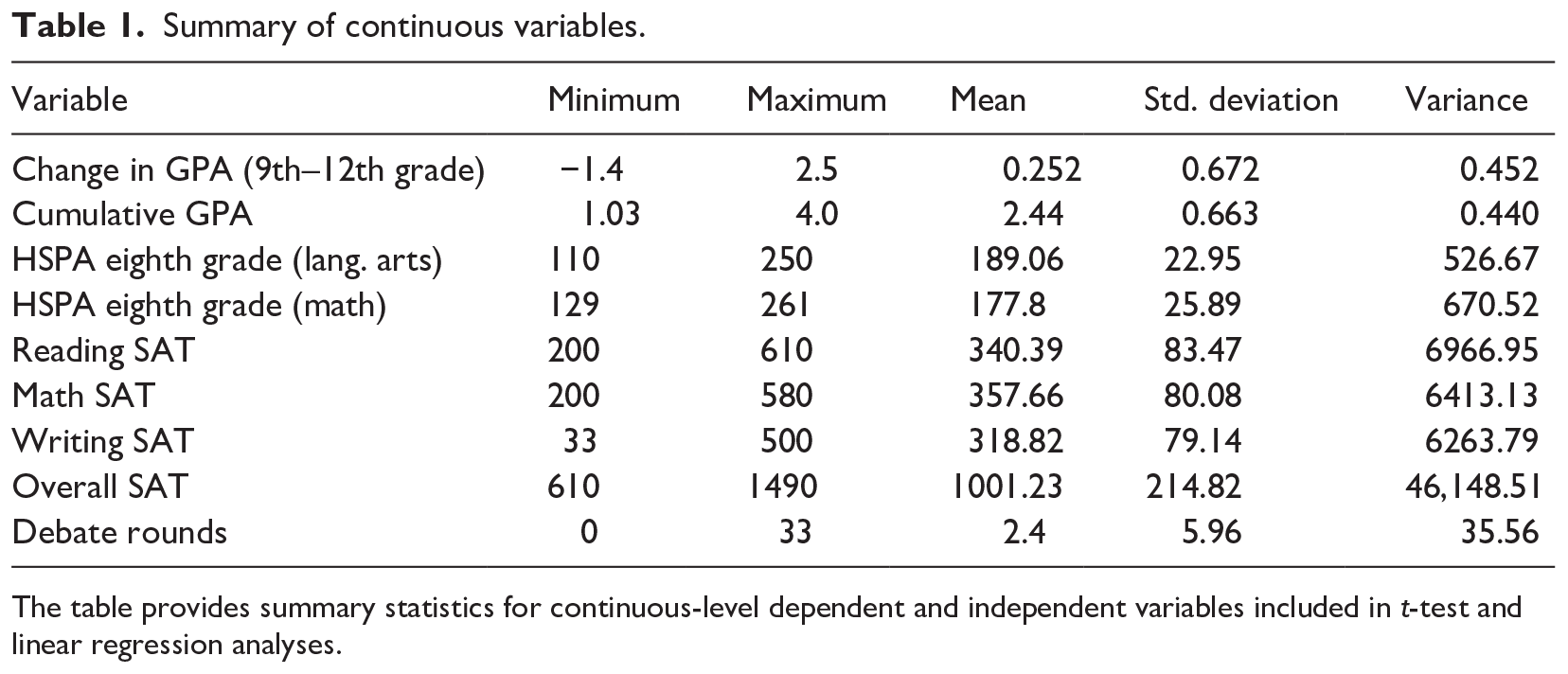
The table provides summary statistics for continuous-level dependent and independent variables included in t-test and linear regression analyses.
The sample includes only those who graduated from the high school between the years 2011 and 2018. We are unable to make any causal claims with respect to graduation rates because the study’s population only includes high school graduates. However, given the historical drop-out rates of the school under consideration, any significant effects of debate membership are minimized by only including graduating students. Furthermore, within the span of analysis, debate team members attained a 100% graduation rate. For the purposes of this analysis, we consider any student ever on the debate roster as a debate participant, meaning we cannot ascertain when the student began their debate team experience. However, we are able to glean the impact of level of participation in debate with an additional measure of rounds completed.
Dependent variables: Grade point averages and SAT scores
The main outcome variables of interest are grade point averages and SAT scores. Grade point averages are included for each year of high school, which allows for measuring and assessing the impact of debate team participation on grade point average growth over time. These variables include the cumulative average as well as the change in grade point average from 9th grade to 12th grade. We expect that students who are members of the debate team will see higher levels of cumulative grade point averages as well as stronger grade point average growth from 9th grade to 12th grade. In order to test whether debate team participation correlates with GPA growth from 9th grade to 12th grade, cumulative GPA, and SAT scores, we rely on a series of descriptive statistics, t-tests, as well as linear regression models.
With respect to SAT scores, we assess students’ scores for each section of the test (reading, writing/language, and mathematics) as well as overall scores. The State of New Jersey uses the College Board, a non-profit organization, to administer the SAT examination. Student scores are shared with schools according to guidelines set forth by the U.S. Department of Education (“SAT Suite of Assessments Annual Report,” 2018). We expect that debate team participants should see a significant increase in scores relative to their non-debating peers. Specifically, we expect to see the largest differences in the reading and writing/language sections, as these sections are most transferable to skills learned in the debate activity. Similar to the grade point average analysis, we employ both t-tests and linear regression models to ascertain the effect of debate team membership on SAT scores.
Independent variables: Debate participation
Our main independent variable of interest is debate team participation. We include two measures, one dichotomous and one continuous. The dichotomous variable simply measures whether the graduate was a debate participant at any point in their high school career. We also include a continuous variable that accounts for the specific number of debate rounds in which the student participated. This method allows us to analyze the degree of involvement from students on the debate team that could not be captured with the dichotomous variable. This measure was created based on the tournament registration records maintained by the English teacher at the high school. These two measures should allow us to offer a dynamic view of the effects of debate team participation on educational outcomes.
Control variables
We also include certain control variables. First, we include a control for gender, as previous research found that female students have higher grade point averages than males while possessing similar I.Q. scores (Duckworth and Seligman, 2005, 2006). In addition to gender, we include a baseline measure of the students’ eighth grade High School Proficiency Assessment (HSPA) score for mathematics and language arts. While this type of test could be used as an additional outcome variable, as of 2015, the state of New Jersey shifted from the HSPA test to the Partnership for Assessment of Readiness for College and Careers (PARCC) test. Furthermore, many students throughout the state of New Jersey opted out of taking the exam, making it difficult to make accurate comparisons across the two tests. However, the eighth grade HSPA scores serves as a control variable for a student’s preparation level. We expect both of the HSPA variables to exert a positive effect on student outcomes. Of course, other control variables would be beneficial, such as membership in other school programs or additional individual home-life traits. However, our data collection process was limited to only official school records, which makes additional controls impossible in the current analysis.
These variables should offer a somewhat comprehensive view of the impact of debate participation. Prior to discussing specific findings, we explore the possibility of selection effect from debate participants.
Findings
Potential selection effect
One potential objection to any significant effect of being a member of the debate team may stem from the type of student that chooses to become a member, that is, high performing students might be self-selecting into the activity. Most of the students were recruited by their English teacher in their 10th grade mainstream-track English course. The teacher offers no academic incentive for participation. While this characteristic may seem troubling given the lack of complete random assignment, we are able to test for selection bias by comparing eighth grade standardized testing scores and ninth grade GPA’s of debate graduates and non-debate graduates.
There are significant differences in the eighth grade HSPA scores as well as ninth grade GPAs between debaters and non-debaters, pointing to a potential selection bias. Eventual debate participants had a mean ninth grade GPA of 2.5, while non-debate students had a 2.2 GPA (t = 2.966, p = 0.003, d = 0.44). It is also important to note that the ninth grade average GPA for eventual debate participants (2.5) and non-debate participants (2.2) are both below the 3.38 national average high school GPA (Jaschik, 2017). Their math and language HSPA scores from eighth grade are also significantly different. Debate participants held a 200.43 mean score in language, while non-debate students held a 186.14 (t = 3.48, p = 0.001, d = 0.69) mean score. Similarly, eventual debate students held a 195.41 mean math score, while non-participants held a 173.4 (t = 4.8, p = 0.001, d = 0.85). These figures are summarized in Table 2.
Differences between debaters and non-debaters prior to team entry.
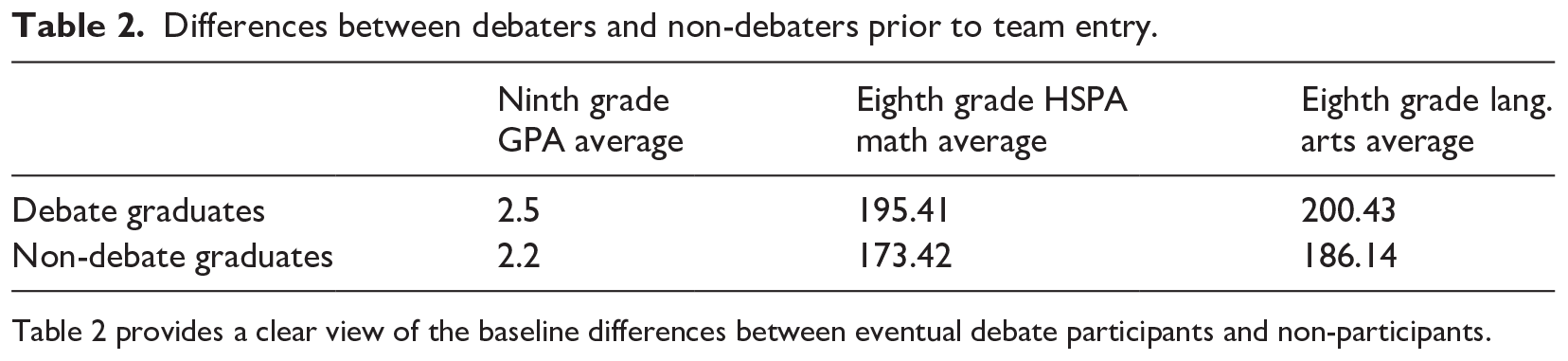
Table 2 provides a clear view of the baseline differences between eventual debate participants and non-participants.
While these differences range from small to medium in terms of effect size, disparities between average ninth grade GPAs (2.5 GPA for debate graduates vs 2.2 GPA for non-debate graduates) is concerning as it represents a three-tenths of a letter-grade difference between the two groups. This holds true for the HSPA scores as well, suggesting that a slight selection effect may be influencing the findings.
However, as can be seen in Table 3, when including the debate variable in a linear regression model with the ninth grade GPA as the dependent variable, while including eighth grade HSPA scores and gender, the debate variable falls out of significance in explaining the variation in ninth grade GPAs between eventual debate students and non-debate students. In fact, results of a linear regression model indicate that neither the baseline eighth grade HSPA scores, gender, nor eventual debate participation had a significant impact on GPAs for students in the ninth grade. We would expect that if there were significant differences in the types of students eventually entering into the debate activity, that is, more intelligent, motivated, etc., they would have higher GPAs in ninth grade. Of course, there are many variables that can capture initial performance in high school, although they are not within the scope of the dataset or the current analysis.
Analysis of potential selection bias.
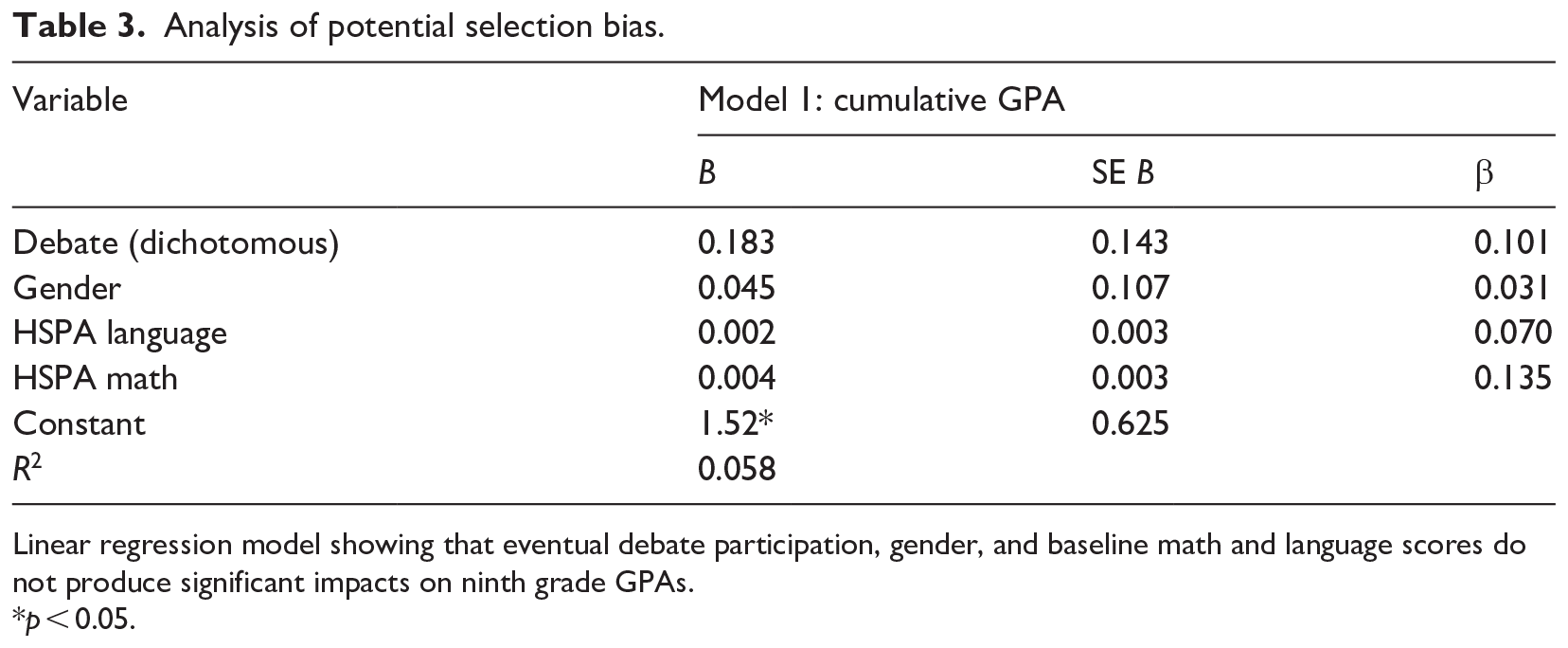
Linear regression model showing that eventual debate participation, gender, and baseline math and language scores do not produce significant impacts on ninth grade GPAs.
p < 0.05.
While there are significant differences between these two groupings, the findings of the regression analysis do not indicate a substantial selection-bias effect. Moreover, it is important to highlight that the study does not include the academic records of the significant number of students who either transferred or dropped out of high school from 2011 to 2018.
Grade point averages
In order to offer a first-cut view of testing the hypothesis of a positive relationship between debate participation and GPAs, we start with a t-test. Results of the initial independent sample t-test analysis for both outcome variables indicate a significant correlation between debate participation and both GPA growth and cumulative GPA measures. For the GPA growth variable, debate participation was associated with a 0.81 GPA average increase from 9th to 12th grade, while the average GPA growth for non-debaters was 0.10 (t = 7.94, p = 0.000). Taking the mean GPA scores, these numbers translate to an average increase from a 2.5 to 3.31 grade point average growth from 9th grade to 12th grade for debate graduates, and a much smaller 2.2–2.3 grade point average growth for non-debate graduates. Debate participation is also associated with a 20.25% increase in GPA over the course of the students’ high school education. These differences can be seen visually in Figure 1. It is also important to note that no debate participant within the sample saw a decrease in their GPA over the course of their high school education, while more than half of the non-debating graduates saw a decrease over that same period.
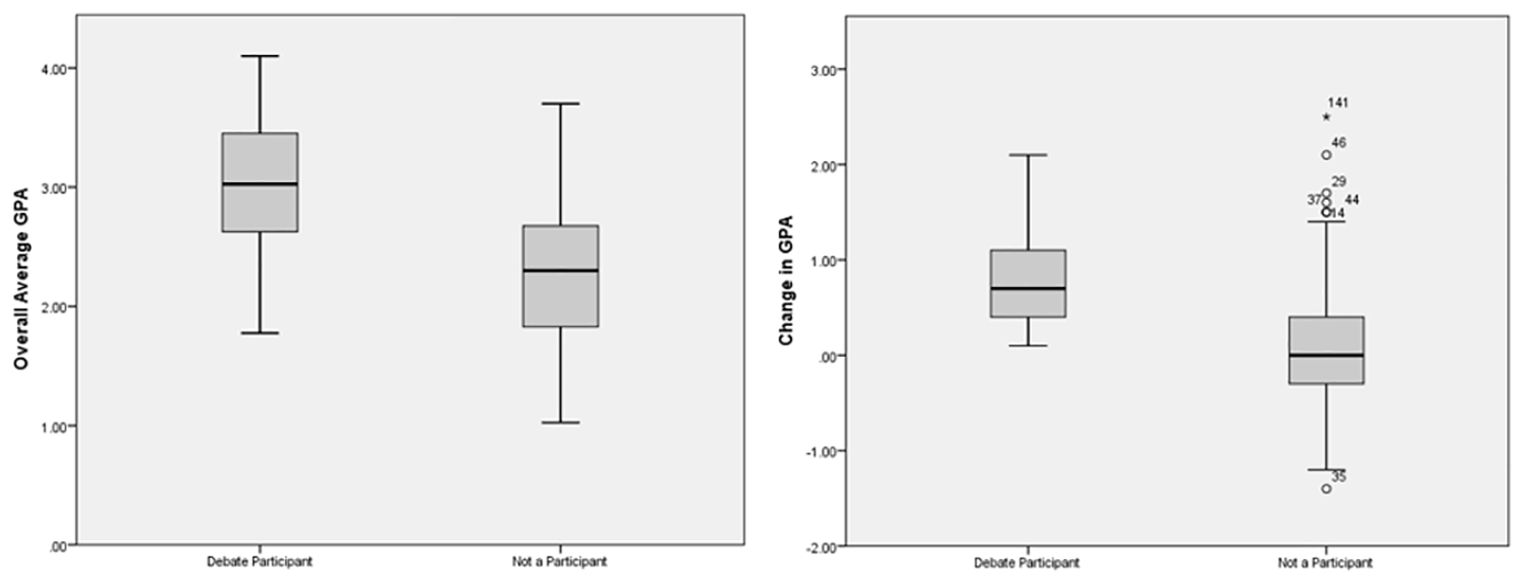
Cumulative GPA and change in GPA from 9th to 12th grade.
In order to reinforce these findings and to assure they are not being driven by outliers, Figures 2 and 3 compare the distribution of GPA indicators between debate participants and non-participants.
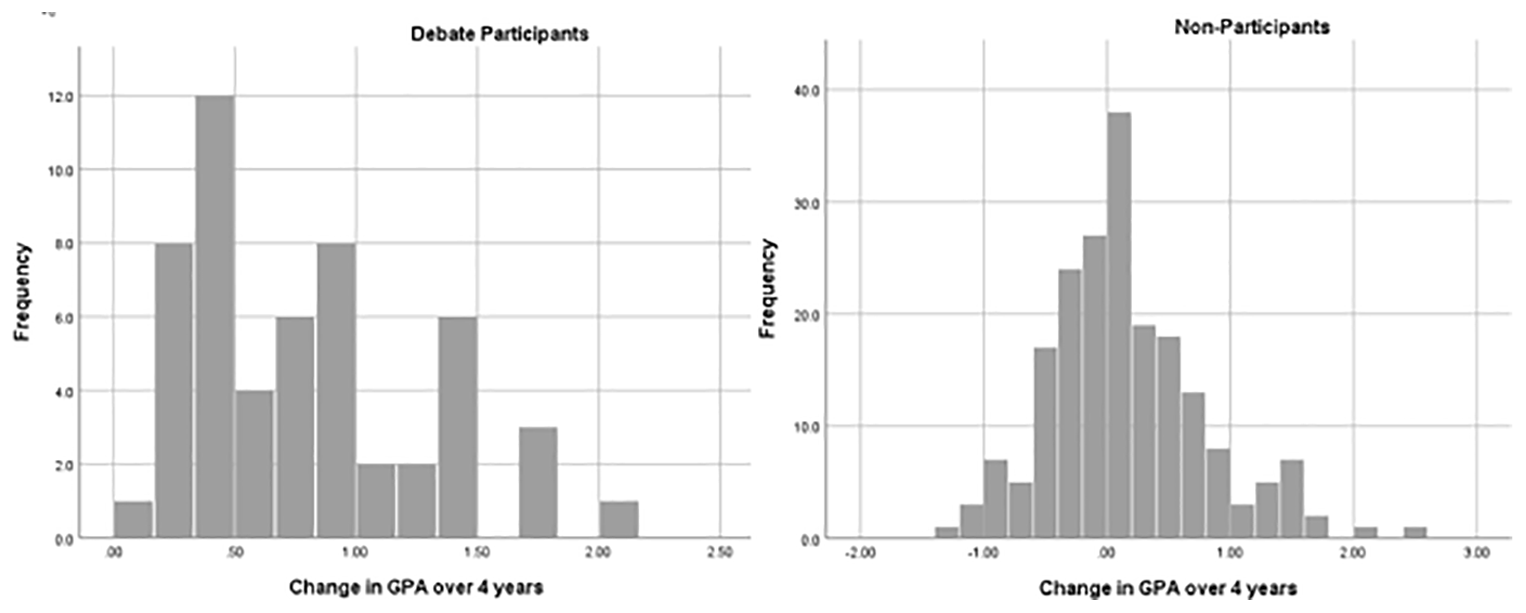
Change in GPA.
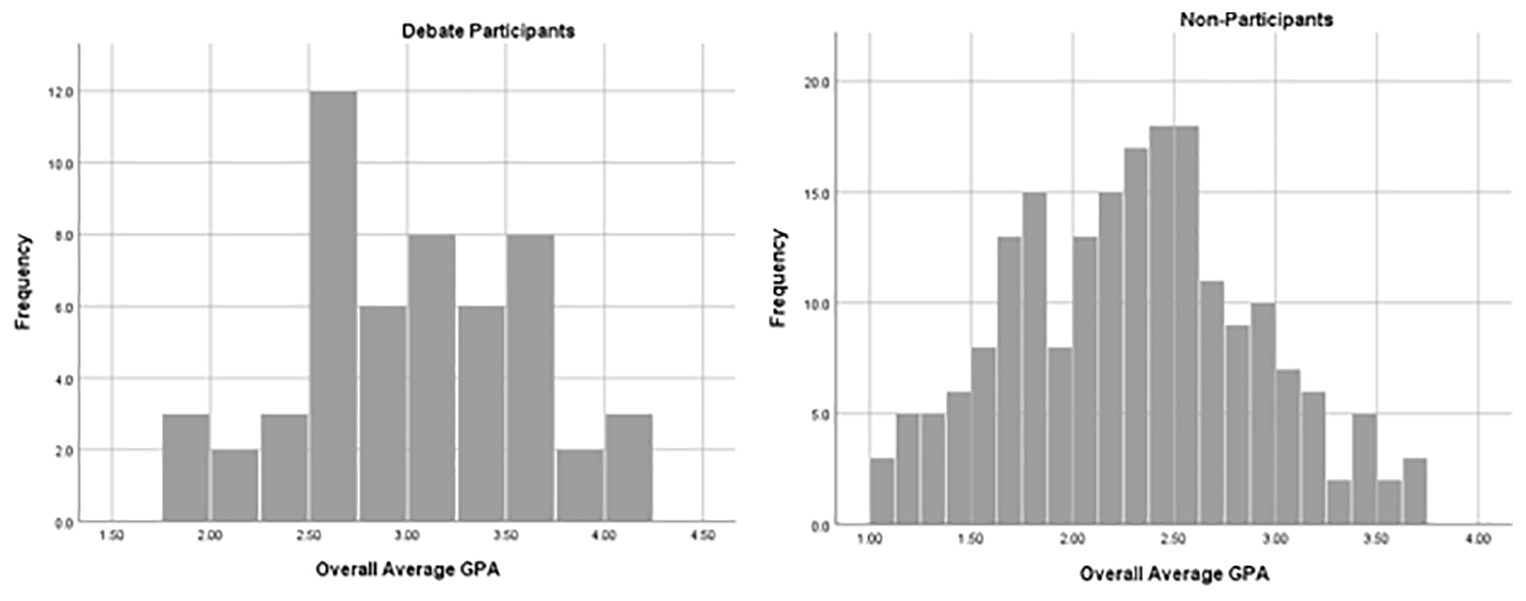
Overall average GPA.
Overall, the distributions do not appear to be significantly impacted by outliers. The change in GPA distribution for debate members does have one outlier, but the overall distribution is clearly skewed positive. Furthermore, it again shows that no debate participant had a negative value for the change in GPA variable. The cumulative GPA variable for both groupings follow a relatively normal distribution, further indicating the results are not being dragged by an outlier effect. One potential drawback of this is entry into Advanced Placement (AP) courses, which could skew the findings. While we were unable to ascertain the students who took part in such courses across both groupings, there is only one instance of a cumulative GPA above 4.0, indicating it does not significantly impact the distributions or subsequent results.
Moving to the specific cumulative GPA analysis, there is a significant difference in mean GPAs, with debate graduates holding an average 3.02 GPA and non-debating graduates averaging a 2.3 GPA by the end of their high school careers (t = 7.54, p = 0.000). This shows that debate participation correlates with an 18.5% increase in cumulative GPA relative to non-debating graduates (on a 4-point GPA scale). These findings are reinforced by calculating effect sizes for each dependent variable. Cohen’s d values for both equate to a strong relationship, with a 1.24 value for the cumulative GPA variable and a 1.23 for the GPA growth variable.
While the initial results are promising, it is important to include the same baseline and gender controls in order to gain a more complete picture of the influence of debate participation on outcomes. Table 4 reports the results for the dichotomous debate variable analysis. For both GPA outcome variables, there is a strong and significant association with debate participation. Utilizing the dichotomous debate variable, when including variables measuring students’ baseline preparation entering high school, as measured by both sections of the eighth grade HSPA exam as well as gender, debate participation correlates with a 0.550 increase in cumulative GPAs, meaning that debate team membership correlates with an increase of more than half of a grade point. Similarly, the GPA growth variable is even more dramatic, with debate graduates averaging a .653 GPA growth from 9th to 12th grade when accounting for other factors. The eighth grade language HSPA variable is the only control showing some significance in either model that includes the debate team membership variable. The HSPA language variable is significant at the 0.1 level and in the positive direction for the GPA growth model, with each additional increase in score bringing about a 0.004 increase in GPA from 9th grade to 12th grade, aligning with expectations. However, the standardized coefficients indicate the debate variable is a stronger predictor of outcomes relative to the language scores (0.401 and 0.116, respectively). This could point to a potential interaction effect from the HSPA language scores and debate participation. Another regression model was run with an interaction term included yet did not return significant results.
GPA analysis with dichotomous measure of debate team membership.
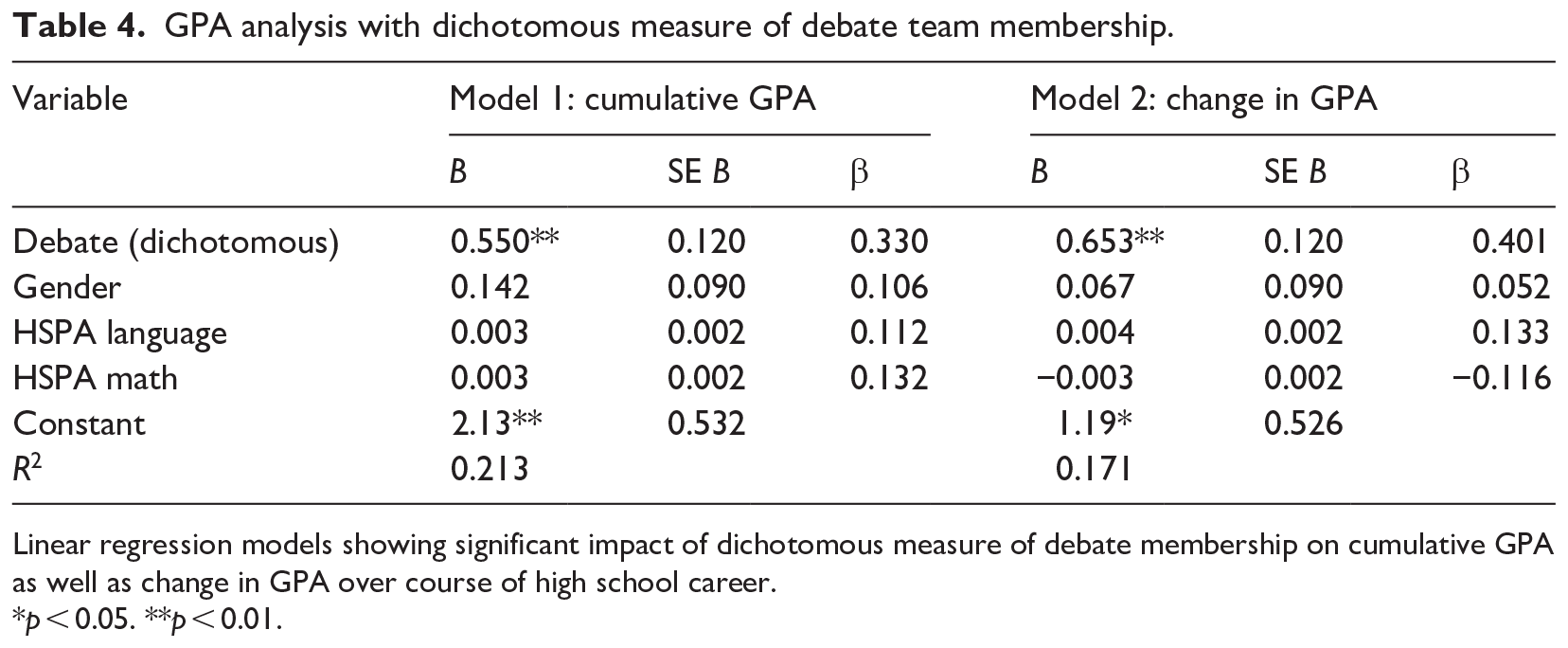
Linear regression models showing significant impact of dichotomous measure of debate membership on cumulative GPA as well as change in GPA over course of high school career.
p < 0.05. **p < 0.01.
While the explained variance in both models is on the low end, with the cumulative GPA model accounting for 21.5% of the variance and the GPA growth from 9th grade to 12th grade model accounting for 11.7% of the variance, there are multiple forces that can impact grade point average growth beyond debate participation that are not captured in this study. For instance, academic growth can also naturally be influenced by effective teaching, Advanced Placement courses, other extra-curricular activities, the positive influence of family and friends, as well as structural and personal barriers to success. To provide a deeper view of the relationship between debate team participation and grade point average growth, Table 5 examines whether grade point average growth is stronger in students who competed in a higher number of debate tournaments.
GPA analysis with continuous measure of debate team membership.
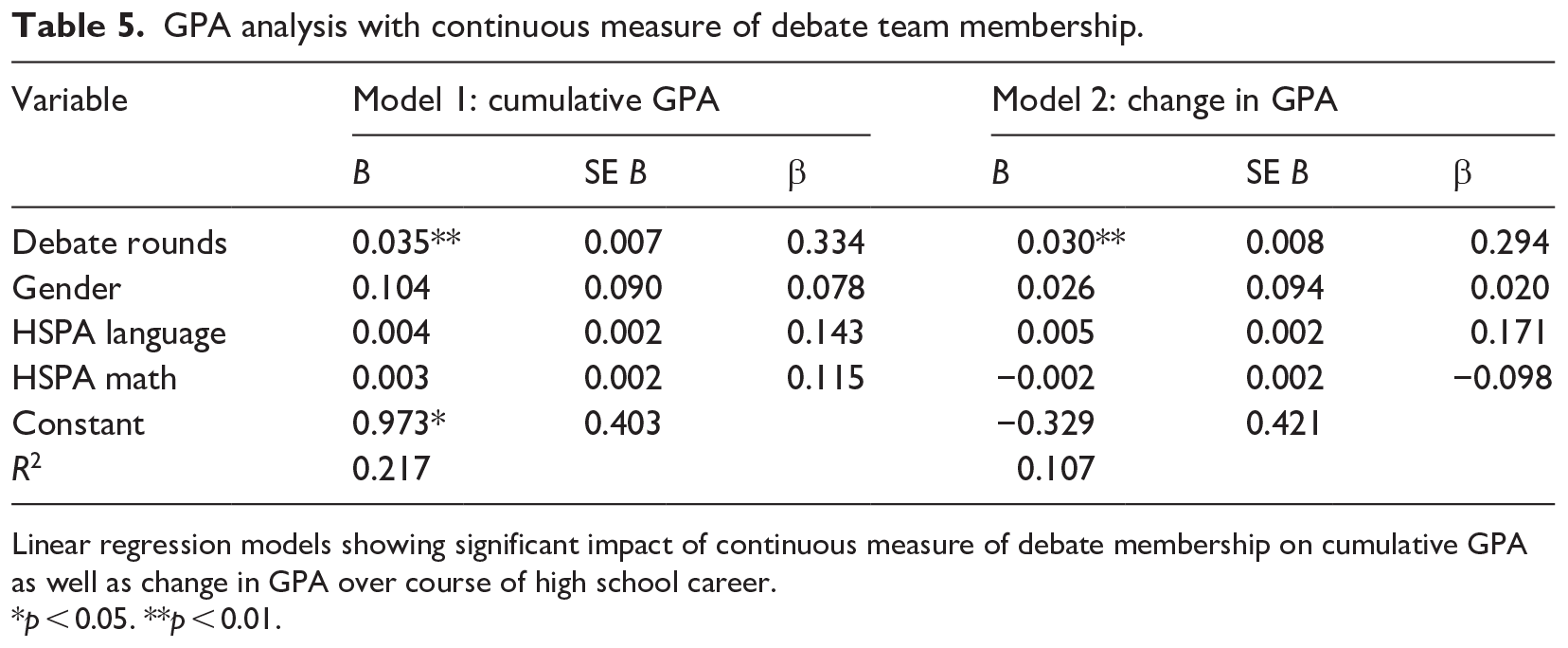
Linear regression models showing significant impact of continuous measure of debate membership on cumulative GPA as well as change in GPA over course of high school career.
p < 0.05. **p < 0.01.
The inclusion of the number of debate rounds variable returns similar results as the debate team membership models. For each additional debate round, findings show an increase of 0.035 in cumulative GPAs and a 0.030 increase in GPA growth from 9th grade to 12th grade. The number of completed rounds within the sample range from 3 to 33 (equating to completion of one-eleven full tournaments), meaning debate team membership correlates with a 0.175–1.155 increase in cumulative GPAs, and a 0.09–0.99 uptick in GPA growth over the 4 years of high school. Similar to the previous model, only the eighth grade HSPA language variable returns significant results in the GPA growth model, with a 0.005 increase for each additional point on the test. Again, standardized coefficients show that the debate variable is the strongest predictor of GPA growth from 9th grade to 12th grade (0.294 and 0.171, respectively). The explained variance in the models account for 21.7% and 10.7% of the variance in the dependent variables. We view these levels of explained variance as relatively promising given the multitude of personal and structural factors that can impact grade point averages.
The findings of the GPA analysis show promise for the potential effect of debate participation and we are able to reject the null hypothesis of there being no association between debate participation and GPAs. We now move to analyzing the potential effect of debate participation on SAT scores.
SAT scores
Similar to the GPA analysis, we begin with a series of t-tests to analyze each section of the SAT (reading, writing/language, and math) as well as cumulative SAT scores. The results of each t-test show a significant difference between debate graduates and non-debate graduates. For the reading section, debate participants received a mean score of 397.56 and non-debate graduates obtained a 322.15 average (t = 5.175, p = 0.000). For writing/language, debate graduates saw an average score of 377.43 relative to non-debaters with an average of 298.11 (t = 5.66, p = 0.000). For the mathematics section, debate team graduates returned a mean score of 394.05 and non-debate graduates had an average of 346.06 (t = 3.27, p = 0.001). For overall scores, the debate graduates had an average score of 1157.71, while non-debaters had a mean score of 945.91 (t = 5.55, p = 0.000). Debate graduates scored 75.41 points higher in reading, 79.32 points higher in writing/language, 47.99 points higher in mathematics, and 211.8 points higher in their overall scores than non-debate graduates. Effect sizes for each also align with expectations. Cohen’s d values for the reading, writing, and cumulative scores are all strong, with d-values of 0.958, 1.18, and 1.12, respectively. The only moderate relationship found was with the mathematics section (d = 0.64). However, this was expected given the type of skill-transfer associated with the debate activity. Our initial findings are reinforced by the results of the linear regression models found in Tables 6 and 7.
SAT analysis with dichotomous measure of debate participation.
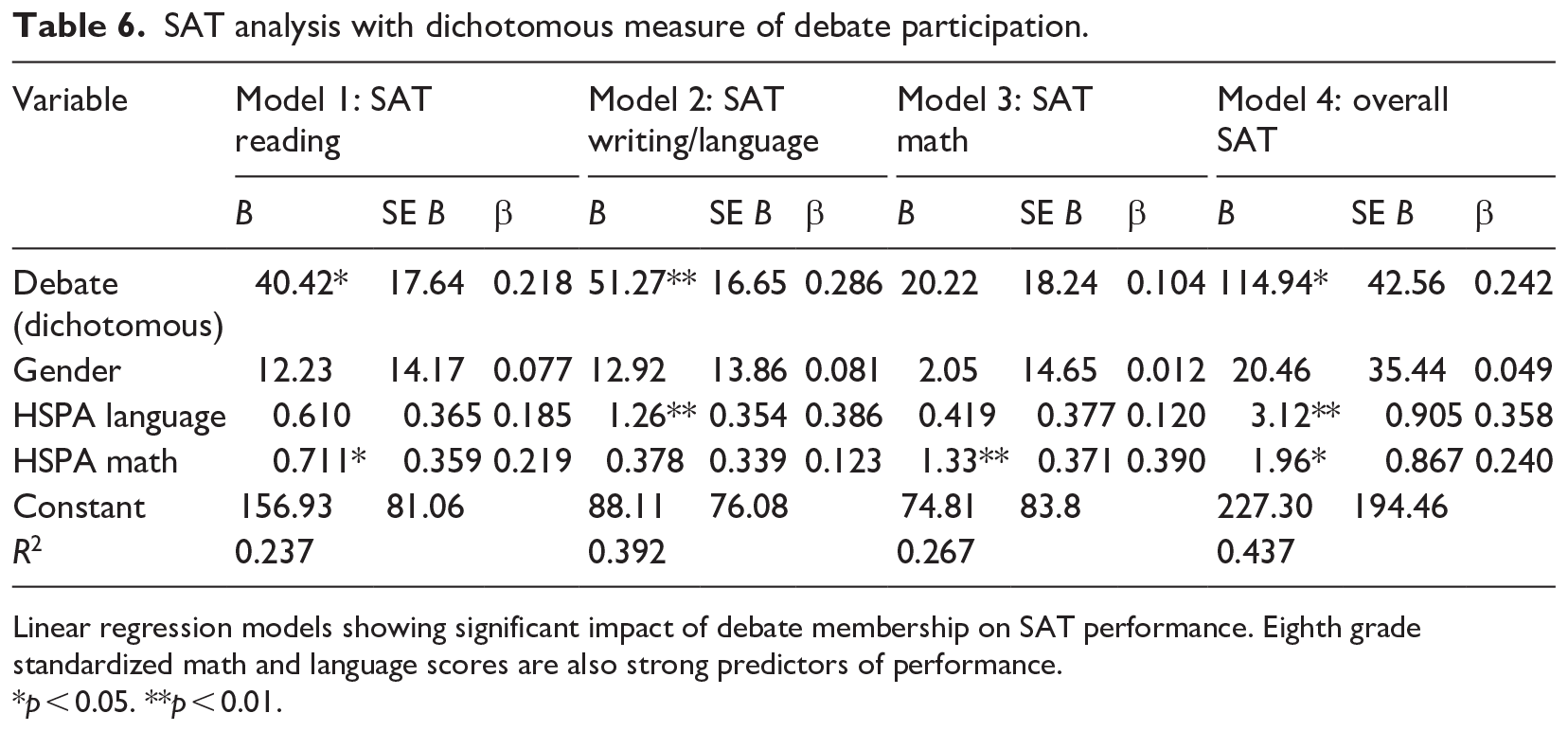
Linear regression models showing significant impact of debate membership on SAT performance. Eighth grade standardized math and language scores are also strong predictors of performance.
p < 0.05. **p < 0.01.
SAT analysis with continuous measure of debate participation.
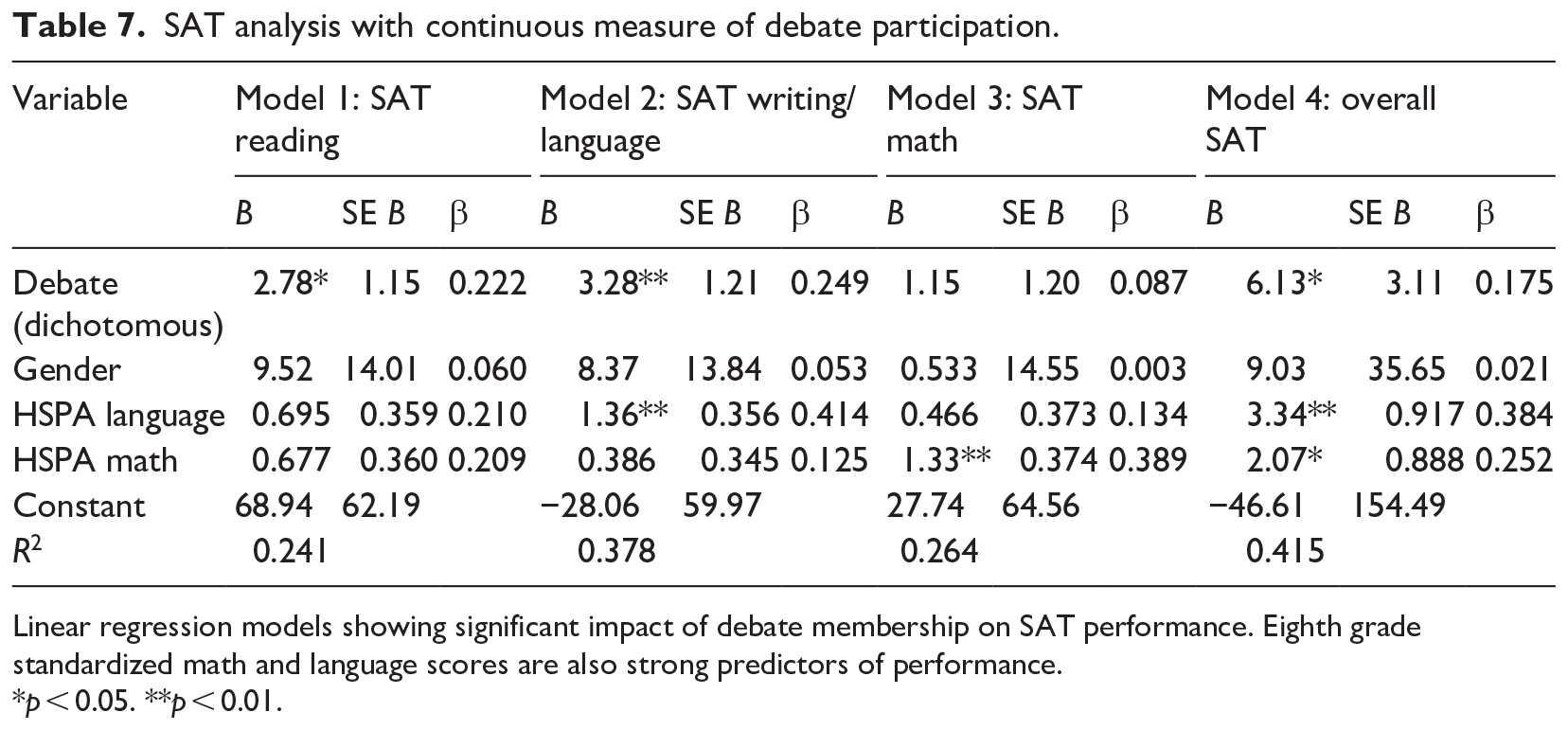
Linear regression models showing significant impact of debate membership on SAT performance. Eighth grade standardized math and language scores are also strong predictors of performance.
p < 0.05. **p < 0.01.
Results of the regression analyses show a strong relationship between debate team participation and SAT scores. Table 6 shows that, aside from the mathematics section of the SAT, debate membership played a significant and positive role in students’ scores. For reading, debate membership correlates with a roughly 40-point increase in student scores. Debate participation is also associated with a 51.29 increase in scores for writing and language and a 114.93 increase in overall SAT scores. For overall scores, this equated to roughly a 7.5% increase in SAT scores relative to non-debate graduates. The only model in which debate membership did not correlate in a statistically significant way was in the SAT math scores, which is consistent with our expectations and Mezuk’s (2009) findings. Gender does not have a significant impact for any section of the SAT; however, the eighth grade HSPA scores do in many of the models. For the eighth grade HSPA language test, there is a significant impact in the reading and writing/language sections as well as overall scores. Similarly, the eighth grade HSPA math scores are significant in all but the writing and language models. This finding indicates that eighth grade standardized test scores are a better predictor of how students will score in future standardized tests than they are in predicting grade point average growth, which is consistent with the findings from the Duckworth et al. (2012) study. Even when we controlled for the indicators of baseline high school preparation via the eighth grade HSPA scores, debate participation still exerted a significant effect. The explained variance in the models range from 23.7% to 43.7%, indicating that inclusion of the debate variable and eighth grade HSPA scores account for a good amount of variation in the dependent variables. Again, this finding suggests that there are other personal and institutional factors at play. To provide a more nuanced view of these relationships, we now move to the regression models that includes the continuous measure of debate participation.
Similar results were found when measuring a potential relationship between graduates who competed in a high number of debate rounds and SAT scores. Table 7 shows debate participation is associated with a significant and positive impact for overall, reading, and writing/language SAT scores. For each additional round completed, SAT reading scores increased by 2.78 points, writing/language scores increased by 3.29 points, and overall scores increased by 6.13 points. Given the range of completed rounds (3–33), debate participation correlates with a modest to strong increase in SAT scores. Again, as expected, no statistically significant correlation was found between math SAT scores and debate participation.
We observe no significant influence of gender in any of the models, consistent with other results. Not surprisingly, the baseline measures of eighth grade test scores significantly correlates with performance on SATs in a similar fashion to models with the dichotomous debate variable. Both eighth grade HSPA math and language scores are significant at the 0.1 level for reading SAT scores and are in the expected direction. For writing/language SAT scores, only the eighth grade HSPA language scores played a significant role in SAT performance while in the math SAT scores, only the eighth grade HSPA math scores showed a significant impact. Finally, both exerted a significant impact on overall SAT scores. Again, this finding is to be expected as a student’s baseline capacity prior to high school will surely impact their performance in subsequent standardized tests. However, what is important for the current analysis is when taking into account this baseline capacity, debate performance still correlates strongly with educational outcomes. The consistent findings allow us to reject the null hypothesis of there being no relationship between debate participation and SAT scores. The R2 values for the models account for 23.7%–43.7% of the explained variance, again indicating that while the current models perform well, other factors are also influencing academic growth.
These findings, as with others included in the analysis, should be taken with caution. Other factors that are not within the scope of this analysis, such as home-life situation, socioeconomic status, and participation in other school-led activities are clearly at work as well. Prior to concluding, we move to a discussion of the limitations of the current study.
Limitations
The most crucial limitation to the current analysis is the lack of an active control group. While we are able to make comparisons between debate graduates and non-debate graduates, this study does not independently assess the impact of debate team participation against the impact of other extra-curricular activities or educational interventions, such as athletic team membership, Advanced Placement courses, or other club activity that could also have a positive impact on educational outcomes. We are also unable to account for the multitude of inequities that could impact educational performance. Therefore, any positive effect of debate team participation should be taken with caution as further research would be necessary in order to create any causal linkage. However, it is our hope that future research may be able to capture the isolated effects of debate team membership when taking into account other group memberships and activities that occur at the individual level.
Furthermore, it would be useful to incorporate qualitative research as well by conducting interviews or focus groups of debate participants in order to extract common themes shared amongst team members. Such strategies would require additional time and resources to conduct over an extended period of time, but it has the potential to compliment the findings of the current study.
Another shortcoming of the current study is the lack of complete random assignment in that there was not a random selection of students chosen to compete on the debate team. While debate team members are generally self-selected into the activity via general announcements, one should interpret the results cautiously until research is conducted to assess whether debaters are fundamentally different from non-debating student populations.
Finally, the potential for selection bias serves as another limitation of the current study. While findings displayed in Table 3 highlight the lack of significance for all variables of interest included in the study, the baseline differences in ninth grade GPAs and eighth grade HSPA scores between eventual debate participants and non-participants are a concern and should be taken into account when interpreting the results of this study. Furthermore, the t-test analyses did show a significant difference between the two groups.
Having offered a thorough discussion of the design, findings, and limitations of the study, we now move to a conclusion section to offer a general overview of the theoretical perspective, evidence provided, and implications of the current analysis.
Discussion/conclusion
Overall, the goal of this analysis is to offer initial evidence that debate team membership can be an effective co-curricular activity that might help to facilitate higher grade point averages and SAT scores. Taking the results as a whole, we’ve provided a strong, yet cautious, narrative about debate participation and educational outcomes. After participating in the debate mentoring program, high school students learned literacy skills by competing in the academic sport of policy debate that is associated with a positive effect on grade point average growth and SAT test scores. Findings indicate there is potential for debate participation to compliment other education strategies.
With respect to the GPA analysis, findings align with our expectations as we anticipated debate team membership to have a positive relationship with GPA growth from 9th grade to 12th grade and cumulative GPA scores. However, with the absence of an active control group, these findings should be taken with caution. These initial results show potential for debate team membership to serve as a possible co-curricular activity that can facilitate academic growth.
For the SAT analyses, we also provided findings consistent with our expectations. Participation in the debate mentoring program correlated with higher SAT scores in the reading and writing/language sections of the examination. We did not observe a statistically significant relationship with debate participation and SAT math scores, which might suggest that math proficiency is not perceptibly enhanced by the debate activity.
Most importantly, our findings align with Mezuk’s (2009) research on debate participation and educational outcomes. Our goal was to build from this existing research to expand the scope and outcome variables of interest. We have provided evidence showing that, consistent with Mezuk’s work, debate participation can lead to increased educational outcomes.
What this research shows, at the macro level, is that a university mentoring program has the ability to provide resources to assist underprivileged students in reclaiming a history of debate participation in underserved educational settings. It offers these students a way to partially even the playing field by cultivating skills via an academic sport that places them at par with students that do not face a range of institutional barriers. Such an intervention is an important building block on the path towards educational equity.
Footnotes
Declaration of conflicting interests
The author(s) declared no potential conflicts of interest with respect to the research, authorship, and/or publication of this article.
Funding
The author(s) received no financial support for the research, authorship, and/or publication of this article.
