




Abstract
This article explores how young Europeans (12–19) describe how they discuss political issues with their friends, their parents, and teachers in their schools, and the ways in which these appears to impact on their political understanding and identities. Based on 324 group discussions with 2000 young people, in 104 locations in 29 different European states, the findings suggest that many young people see parents as the people with whom they most often talk about politics. They describe a range of situations – from intense discussion and support from parents to antagonistic arguments about their parents’ political views. Discussion with teachers was relatively less common, and more often dependant on individual personalities than as part of a pedagogic programme. Instances of citing citizenship education as locations for political discussions were rare. The article discusses the methodology that gathered this data, and suggests that this might contribute to an effective pedagogy to discuss political identities with young people.
I think my identity has been shaped a lot by the community, my family and high school, and I think the media and the internet – primarily the internet.
What resources do young Europeans draw on when they construct their multiple political identities around a country, a particular city, or Europe? What are the social sites in which they discuss this? This article seeks to address this through data gathered from deliberative discussions with small groups of young people in a range of continental European countries. Zorka, quoted above, was one such informant, and she made this comment in response to an opening invitation to describe herself and her personality. This paper will explore the extent to which young Europeans say that they discuss political and social issues with friends, family and teachers in constructing their political identities as members of their localities, their countries and of Europe.
Three sources of young peoples’ constructions of socio-political identities are commonly asserted: the school, the family and the media. Coles (1986) noted ‘a nation’s politics becomes a child’s everyday psychology’ (p. 31): his study of the political life of young people was based on his analysis of his earlier work as a somewhat unconventional child psychiatrist. He ‘conceptualize[d] the family as something of a miniature state, characterized by many of the same moral and political concerns as a nation at large. For many children, the family dynamic typifies the interpersonal relations and the continuous jockeying for power and influence that takes place in the political world.’ (London, n.d.). Coles describes politics as learned from the family, and describes how parents, siblings and the extended family can create an immersive political discourse of politics. Other studies suggest that if the home environment encourages discussion and independent thinking this enhances political socialisation (Chaffee et al., 1973), and such behaviour is more likely in middle-class families than working-class families (Dekker, 1996).
An extensive literature suggests schools have a particular significance and role in the development of social and political ideas. Hess and Torney (1967) argued that school is the prime agent of political socialisation, rather than the home. Palonsky (1987) noted that many studies in the 1970s identified schooling as a factor that affected the extent of young people’s political understanding. Other studies identify the curriculum (Keating et al., 2009), the ethos of the school (Hahn, 1998; Nowicka, 2004; Schiffauer et al., 2004) or the values and information in school text books (Crawford, 2000) as major determinants in young people’s political involvement and orientations. However, Greenstein et al. (1974) described young people’s political socialisation about power as being ‘not the result of deliberate inculcation by the schools . . . [but from] the absence of any explicit inculcation whatsoever . . . the vacuum is filled by casual absorption of impressions from family, peers and the mass media’ (pp. 271–272). Cullingford (2000) also cautions that ‘what teachers present and what children learn are fundamentally different’ (p. 49).
Jennings and Niemi (1968) have made a number of studies of the role of the family in what they term ‘the transmission of political values from parent to child’. This phraseology implies that a process is being carried out on young people, denying them agency: their study describes ‘the transmission of party preferences from one generation to the next’ as ‘being rather successful in the American context’ (Jennings and Niemi, 1968: 173). They examined four specific issues, where parental responses were compared to their son’/daughter’s responses, and found a 10% difference on issues such as racial segregation (young people being more in favour of steps to integrate). The data was collected in 1965, but there appeared to be no attempt to map such views on to contemporary incidents (e.g. the Civil Rights Act of 1964, or the Selma voting protests). Subsequent studies by Jennings and Niemi in 1973 and 1982 found that dissonance between the generations fell between 1965 and 1973, and remained low between 1973 and 1982 (Jennings and Markus, 1984). The overall conclusion was that while ‘partisanship . . . was not simply inherited, . . . parental party loyalties surely had much to do with the direction of their children’s initial loyalties’ (Jennings and Niemi, 1991: 86).
There is also a substantial literature that holds that young people are uninterested in politics, do not follow current affairs, and do not participate in political activity, and that such attitudes and behaviours are becoming increasingly prevalent. It is claimed that a young people’s ‘democratic deficit’ has developed (e.g. Frank et al., 2018; Putnam, 2000). Forbrig (2005) pointed to ‘a dramatic decline in the political involvement of younger generations, and decreasing levels of youth participation in elections, political parties and traditional social organisations’ (p. 7). Calenda and Meijer (2009) suggest that ‘older generations now were more active as youngsters than young people are today’, which they attribute ‘to a changing attitude towards politics . . . related to a more individualistic, and even hedonistic, attitude’ (p. 879).
Such claims largely relate to particular forms and patterns of political participation: such ‘traditional’ political activity as voting need not be the only form of involvement – and is rooted in an outdated conception of what constitutes a civic culture. Much of these comments on ‘the democratic deficit’ are rooted in a culture in which citizens were expected to quietly endorse the political system, occasional making selections between parties. The classic exposition of Almond and Verba (1965) was of a passive political culture, in which most citizens accepted existing systems and structures, and only a minority were more actively involved in political roles. Norris (2002) has argued that such forms of engagement are becoming redundant: ‘political participation is evolving in terms of the “who” (the agencies and the collective organisations), ‘what’ (the repertoires of actions commonly used for political expression) and ‘where’ (the targets that participants seek to influence)’ (Norris, 2002: 4). Traditional politics are being replaced with less formal political participation through demonstrations, single-issue activism, petitions, and micro-level participation, and young people in particular are involved in these (Bessant et al., 2015).
The narrative of young people’s apathy assumes that the narrow and regulatory model of political activity is politics, and that lack of participation in this indicates a lack of political knowledge and interest. Henn et al. (2002) call this ‘conventional political science’ (p. 170), and argue that including wider forms of political participation in studies of young people’s participation would show much greater evidence of activity among young people, and higher levels of youth political participation (Henn et al., 2003). Brooks (2009: 426) concluded that young people saw no meaningful channels to engage with politicians, who are seen by young people as failing to connect with them. But many young people are engaged in these kinds of ‘little politics’ movements and non-institutionalised participation (Sloam, 2016). We need more nuanced understandings of which young people are alienated, and from what aspects of politics: Rainsford’s (2017) study of UK young people suggests that some may be less alienated, and that others are alienated from political actors, rather than the political system.
The analysis that follows is based on a large number (324) of deliberative discussion groups, held with young people aged between 12 and 19, 1 across a range of European countries. It should be stressed that these were not ‘focus groups’, in the conventional sense. While discussions were unstructured, they centre on their sense of identity with their country (or with several countries), and with the concept of also being European. This, however, is not the main emphasis of this article, and is reported at length elsewhere (Ross, 2019). Here I report on and analyse the many references to having talked with political issues such as these with others – family members, friends and with teachers in school. Most groups were also specifically asked about this at the end of the discussion, after some 45 to 50 minutes. The analysis presented here seeks to see which categories of people were reported as most significant by these young people: was this the home, as Coles (1986) and Palonsky (1987) suggest? If it was parents, was this in some way a rejection or confrontation of their parents’ values (as Jennings and Niemi found with a minority of students in 1968); or was it to accept and support their parents’ views, as they found was the norm in 1991? Were middle-class young people more likely to engage in political discussion with their parents, and outside the home, than working class young people, as Chaffe et al. (1973) and Dekker (1996) suggest? Were there differences between countries, and if so what were they? Did they appear alienated from politics (Forbrig, 2005; Putnam, 2000) or were they discussing politics in less traditional political fora (Rainsford, 2017)?
Methodology
Constructing identities is a social activity: it takes place in social settings, and the process is contingent on the particular circumstances in which these identities are expressed. But young people of school age are a particularly difficult group to ask questions of, not least because they are used to much adult questioning being designed to test their knowledge. Most questions put to young people in schools are closed: the questioner knows the answer, and the task of the young person is (if they are compliant) to demonstrate that they can provide a correct response.
This study – part of a larger one-person investigation (Ross, 2015, 2019) – uses a qualitative methodology that attempts to use young people’s own naturalistic language and vocabulary to examine the ways in which young people in mainland Europe constructed identities for themselves that might include such entities as their country and Europe. I visited over 104 different villages, towns and cities (with populations varying from 500 to 13 million) in 29 European countries, and in each engaged in discussions with small groups of young people, talking with some two thousand of them in 324 conversations.
I was working with the understanding that most people will not necessarily have firm and fixed senses of identity: the ways in which a person chooses to describe their identities will depend on the context in which they are engaged (Anthias, 2012; Balescu, 2009; Bauman, 2000; Bruter, 2005). Deliberative discussions, with a very loose agenda, were designed to allow these small groups to feel that they largely determined the direction and content of their conversations, which ranged widely over social and political concerns about their countries and the range of views within them, and about any sense of being European. They talked, amongst much else, about the social locations and sites in which they discussed, deliberated and rehearsed their sense of political identities: Zorka’s comment that introduced this section neatly summarises these. This article examines their views of the relative importance and use of these sites, and how they were employed to construct these identities.
My approach was therefore to initiate small group deliberative discussions, where between five and eight young people would feel they controlled the subject, and could discuss issues with each other using their own vocabulary. Group members would manage pace and direction. Open-ended questions, often made in response to what had been said, elicited their sense of attachment to their locality, country and other locations that might represent political identities. An apparent lack of structure was designed to capture and use the narratives the young people themselves – for example, I would initial refer to ‘your country’, letting them (perhaps) introduce terms such as ‘state’ and ‘nation’, and only then inquiring what they meant by their terms, for examples and contexts.
Group conversations (gruppendiskussionsverfahren: group discussion method) have been developed in German social science research over the past 20 years (Loos and Von Schäffer, 2001; Gugglberger et al., 2015). Described as ‘an open interview, intended to let respondents develop a topic in their own language, in their symbolic system and their relevant framework’, the technique allows analysis that ‘avoid[s] projecting into single utterances meanings that are not appropriate’ (Bohnsack, 2000: 21). It is a process ‘in which respondents can set the structures and contents of the conversation by themselves’ (Scheunpflug et al., 2016: 10), producing ‘conjunctive knowledge . . . implicit, action-guiding knowledge . . . based and acquired in fundamental experiences . . . that groups of individuals share with each other’ (Wagener, 2018: 92).
Groups were assured that there were no ‘right’ answers, and they should say if they disagreed with each other. This was to establish an empowering rapport, in which discussion was substantially directed and paced by group members. My strategies to generate such a dialogue were: not to introduce leading terminology; to make questions transparently open (If they said they were French, I might respond ‘What makes you French?’); to accept all responses as valid; where possible, to construct questions that responded to what had been said; to ask as few questions as possible; not to expect everyone to respond (not a sequential interview); and to ask for examples.
Most of the young people (about 95%) made some significant contribution: at least two-thirds were fully participant for the whole session. Each conversation varied in focus and emphasis, because my questions changed in response to them, and used their vocabulary, in order to establish a conversational rather than an interrogatory mode. Although I had areas that I wanted to explore, the interactive nature of the discussion made responses difficult to quantify. The majority of discussions were in English, the others simultaneously translated by my local colleague.
I used my networks and contacts in some 100 European universities to assemble small groups of young people in 29 different states. Each was asked to identify two schools, one in a middle class area, one in a working class area, and to arrange for two groups of about six to be selected by the staff – of both sexes, of average ability, willing to discuss issues, and representative of significant minorities in the school. Consent was obtained from school principals, and written consent from the young people’s parents (all of those under 16, and older in some countries) and from the young people themselves. All names used here are pseudonyms. My first phase of fieldwork (2010–12) covered the countries that had joined the European Union after 2004: a second phase (2014–16) added many of the pre-2004 members. At least two places were visited in each country, and four or more in the larger countries (Greece, the Republic of Ireland and the United Kingdom were not included). 2 The young people participating were diverse. The total sample was of slightly more females than males (56:44). The groups were designed to be from schools that were situated in both middle-class and working-class areas: ‘class’ was not defined to my colleagues who made the selection, and is not consistently constructed across the countries involved: it was assumed that ‘upper class’ young people would be subsumed within the category ‘middle’ (and there were two children of members of parliament). But I did collect parental occupations for all participants, and made an analysis of these on a social class basis (as far as was possible, given the sometimes hazy descriptions offered). On an individual basis, 51.7% were thus middle class, and 48.3% working class (see Figure 1). There were minority-origin young people in many discussion groups, reflecting the distribution of minorities in each country and Europe as a whole: by country of origin, 77% had parents and grandparents from the country they were living in: of the remainder, 7.4% had at least one parent/grandparent from another EU country, 8.4% from a European country not in the EU, and 7.4% from outside Europe (figures based on what was volunteered in discussion). This was not intended to be a statistically representative sample, but a range of potential views across each country: from different regions, social backgrounds and cultural origins.
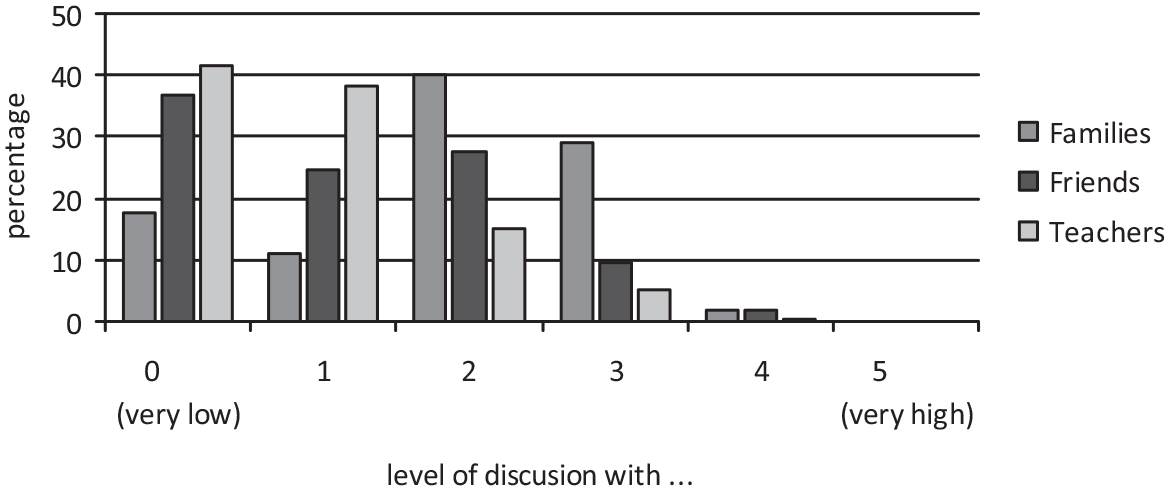
Levels of discussion reported by each group with families, friends and teachers.
Much empirical social science research draws subjects from a narrow base: Arnett (2008) estimates that 80% of non-USA studies are drawn from psychology undergraduates in the capital city of a country. Rochat points out that ‘in academia, a priori claims of universality sell better than diversity, which complicates rather than simplifies matters . . . This tends to relegate diversity to noise rather than as a primary object of study’ (Rochat, 2010: 107). This study was intentionally noisy, reflecting the diversity of the populations of these countries: hence the emphasis on different locations, and avoiding an over-emphasis on the capital city. The variety of locations and sizes of the settlements broadly reflected the population distribution in each country, and many of the regions. 3 Within the constraints that the population being sampled was of young residents of these European countries (largely industrialised, democratic and comparatively rich): the recruitment process was designed to avoid the problems analysed by Henrich et al. (2010).
As each discussion drew to an end, I would thank them for their very interesting contributions and ask if they talked about ‘things like this’ very much, with their family, friends or teachers in school. Although I continued to record the conversation, I no longer gathered the names of each contributor, unless it was volunteered. Not every group was asked, because of the exigencies of the situation – the room was needed for a class, for example – but in four-fifths of the cases, I was able to ask this. Nor was there time for each person to respond to all three sets of people, or to explore responses in depth. However, this closing stage was by no means the only source of information: much data was interlaced into other discussion, or even used to introduce themselves (as Zorka did, above).
Findings
Many groups referred during the discussions to discussions with others: family members, friends and sometimes to particular teachers. The responses to the closing questions were sometimes brief and uninformative: for example, in Turku (Finland) Karri (♂12) said ‘we don’t think much about these things’. But where the question was put, each groups’ strength of response to each of the three social sets (family, friends and teachers) was scored from 0 (no discussion with that group) to 5 (most group members said there was much discussion with that group). This evaluation also included the references that had been volunteered in the earlier part of the discussion about talking with others. The coding was conducted after all the data had been collected and transcribed, over a short period of time, so that there was consistency in evaluation.
Table 1 shows some examples of how various comments were coded.
The coding frame, and number of responses recorded.
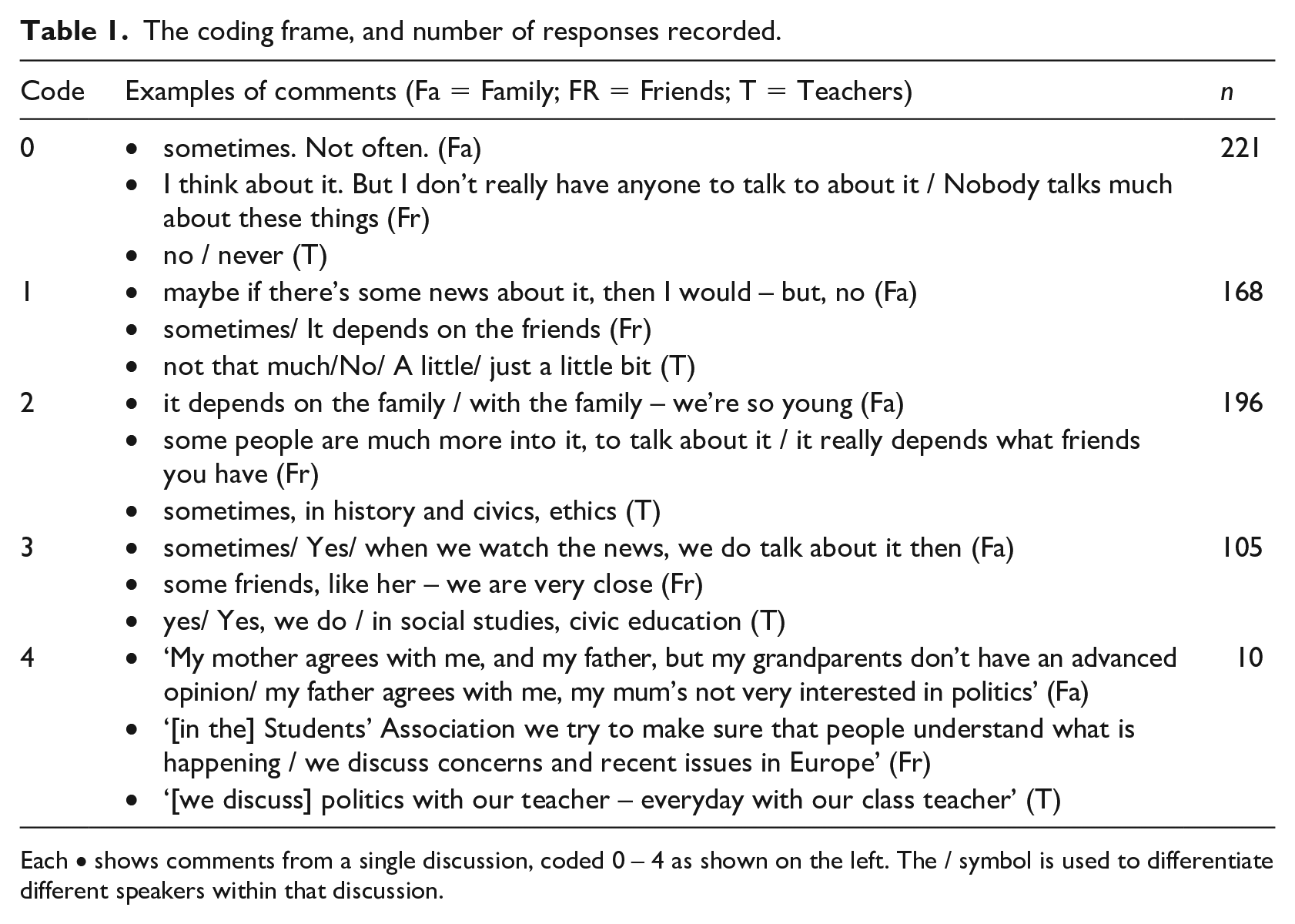
Each • shows comments from a single discussion, coded 0 – 4 as shown on the left. The / symbol is used to differentiate different speakers within that discussion.
The average scores for discussions were with families 1.9, with friends 1.1 and with teachers 0.8.
Families
Parents (and family members generally) were much more likely to be seen as those with whom they would discuss these matters than were teachers (71% of groups scoring 2 or more, Table 1). A few groups suggested that their opinions were naturally – and properly – the same as those of their parents. Thus in Olsztyn (Poland) Paweł (♂13) said ‘what we are like is what our parents have taught us . . . this is how our identity and our mentality is shaped’. In Pécs, Katarina (♀17) suggested her parents ‘taught me how to think about Hungary, and that’s how I feel like I’m Hungarian’. Such responses might in some way correspond with the patterns recorded in Jennings and Niemi’s 1991 study. But these examples were a small minority, and were made early in discussions. Later remarks suggested there was more debate with parents: with greater confidence in the nature of our discussions, family difference became articulated. Serafin (♂13) in Warszawa explained that though ‘we are similar to our parents, we are not the same . . . we don’t agree with our parents, and we would like to have our own views on certain matters’.
Another view that was held by a minority of young people was that their parents explicitly thought they were too young to discuss politics. For example, in Budapest, Erzsébet (♀13) said she had ‘asked my parents yesterday why can’t we talk about politics in school, and they said we are not old enough to have viewpoints about it, and what we say about things is not our viewpoints, it’s only other people’s. I often talk about politics’. In Tokat (Turkey) Naz (♀16) said ‘at home we are just little kids who don’t understand about these things!’. There appeared to be an assumption in these homes that young people’s political views were only repeated opinions (e.g. Lopes et al., 2015).
Much more common were accounts of engagement in political dialogue in the home. In the current study, there were many accounts of such family discussions, and how these were for many the preferred location for political talk. For example, in a small provincial town in central Turkey, the potential difficulties of political discussion were analysed by Dilây (♀12): she was ‘comfortable talking about these things in my family, but I don’t in school, it’s not suitable there – there can be conflicts with friends’, and Mazlum (♂15, in another school in the same town) said ‘in school, there may be fights – it’s not forbidden, but they prefer us not to speak of such things. At home, when we are watching TV news, then we share our opinions’. In Hannover (Germany) Jule (♀13) said ‘I talk more about that [political affairs] with my parents and my family, not so much with my friends’, and in Zagreb (Croatia) Dubravka (♀15) talked politics with her parents, but ‘I don’t want to talk about it with my friends’. In Madrid one young woman said she discussed politics ‘a lot with my father – in our house we are always debating politics’. But these family discussions were not always straightforward. In Pécs (Hungary) Luca (♀13) complained that when her grandmother ‘starts to talk about the war. I just sit there and listen – it’s like the thousandth time I’ve heard it’. And for a few there was sometimes too much: in Ljubljana (Slovenia), Dominik’s (♂17) mother ‘works in politics, and everyday when she comes home I have to listen about politics. . . politics every day at lunch – I have enough politics for my lifetime!’.
The subject of such discussions was reported as being either contingent on the issues of the day, or discussions were informed by the experiences of family members.
There were many instances of families where there was encouragement of discussion and independent thinking based on current political and social issues. Chaffee et al. (1973) suggest that if family discussions are orientated towards conceptual matters, rather than consensus and the acceptance of authority, young people tend to be both knowledgeable about politics and to demonstrate an interest in public policies. In Tokat, the Turkish central Anatolian town, young people from public service backgrounds described family conversations on current affairs. Cem (♂13) said ‘there are many topics . . . we talk about – but the European Union is . . . top of the list’, and Emir (♂13) said that such talk was ‘mostly after the newsman on the television – we discuss these topics at home, and comment on each other’s opinions’. Hasret (♀13) explained ‘when we see news on the TV it reminds the family about what’s going on, and we discuss it’. In Wien, Cordula (♀19) thought that ‘maybe because my parents are very political, and I’m also a part of a political party, I see myself as part of change. It’s all I talk about with my parents! Politics, it’s so interesting. I have always discussed it with them’. Also in Austria, Kulthoom (♀17, of part Taiwanese origin) said ‘I talk a lot with my parents about what’s going on – not just what’s going on in Europe, but wars and things all over the world’.
Family history also played a prominent role in some family discussions. Gerold (♂15), in Berlin, explained that his grandmother had fled from what had become Poland in 1945, and his father was a refugee from the former East Germany to West Germany. ‘One of my relatives relates to the AfD [Alternative für Deutschland], and we have a huge discussion at home that we think we should welcome all of them [refugees] – so my family is split . . . I think when we get refugees from Syria it’s OK, because they are running to save their lives – when you think sixty years back in Germany, I think two and a half million people were running’. In Hannover, Blerina (♀13) had discussed her Kosovan-born parents’ migration: ‘they had to come, and how hard it was to create a life here. Others should have a chance here, because they are fleeing, because there is a lot of war’. Similarly, In Białystok (Poland), Karolinas’ (♀18) grandfather had spoken of ‘how it was in communist times, because they were witnesses’. In Warsaw, Rostek (♂16) thought ‘older people remember more how it was ‘back in the [old] days’, they remember the troubles of everyday life’.
Some family discussions were disputatious. Family disagreements about politics arose with both parents and with grandparents. One group in Paris gave several examples that illustrate this. Aimée (♀16) started, saying ‘Usually people of our age think the same as their parents, but not always – sometimes we really think differently. My father is gauche [left wing], and my grandfather is rightwing, and my grandfather [and] father disagree’. Berthe (♀16) complained that her parents and grandparents were not really interested in politics: ‘they say that they’re left wing, but they never talk about political problems, about equality . . . with the “immigrant problem” . . . they say nothing’. Aimée (♀16) thought that because her mother worked with a medical relief NGO, ‘she agrees with me – everyday she sees immigrants who arrive with nothing, and babies who sleep in the streets – and my father agrees with us too. But my grandparents don’t have really advanced [progressive?] opinions’. Marinette (♀16) said her mother ‘agrees with me – but she’s not very interested in politics. If you talk about immigration, she’ll say “Oh yes, I agree with you” – but it’s just that’. Léone (♀16) clearly disagreed with her father: ‘I gave a euro to a man in the street and I told my father. He said that I can’t, because if I do it for one person, I should do it for all people. He says it’s not a place for immigrants, and I think he’s so closed. My mother, she’s like me, she works in healthcare, and she agrees with immigrants coming to France’.
Racism was an issue argued about in a number of families. In Wien, Waldtraut (♀10) felt that ‘in my family every one is racist, I’m the only one who says leave them alone. . . .I don’t really argue with my father about politics, because he has opinions that I can’t stand. He isn’t able to discuss – he doesn’t shift a centimetre’. In Bergen (Norway), Maybrit (♀18) spoke of family divisions on this issue: ‘my father kind of broke from my grandparents – they are racist, and he is not’. In Linz (Austria), Rosemarie (♀16) spoke of family disagreements. ‘My parents are really tolerant, my mother especially – but my grandpa is not. . . . He says he’s against the immigrants who come to Austria and don’t work’. A study by Hively and Eveland (2009) suggests that young people growing up in a family that encourages discussion, but does not particularly value reaching an agreement are more likely to take part in political discussion. Perloff (2014) also argued that ‘when parents encourage children to openly explore ideas and challenge others’ beliefs at home’, then young people are more likely to ‘explore issues in the media, discuss political topics with others, and become active in civic causes’ (p. 102).
There were instances where it was suggested that (other young peoples’) parents might instil their own political views in their children, and that this might be particularly true of racist views. In Montpellier (France), Zaif (♂13, French born of Moroccan origin) argued that ‘racism for many people comes from them agreeing with how their parents think: if the parents are racist, then the guy or the girl becomes educated as racist’. In Wien, Waltraut (♀13) spoke about some French young people with whom she corresponded on the internet were supporters of the Front Nationale because their parents were: ‘you should form your own opinion, and not copy your parents. And parents should support you to form your own opinion’. Jaime (♂11) in Madrid spoke about some young Spaniards whose parents are patriotic and have ‘convinced them to be patriotic, and not to change things. You hear what your parents say, and it influences you – so that’s what you end up thinking’.
There were sometimes more serious family difficulties. Particularly in Poland, grandparents were constructed as prejudiced against Germans. In Białystok (Poland) Ida (♀18) remarked ‘they don’t really like German people because of the wars . . . We are thinking in different ways. We are more open for different countries’. Patrycja (♀18) said her father wouldn’t talk with her about the past: ‘he doesn’t like to talk about times when he was young. He always says he was born at the age of 30, and he doesn’t want to tell me about it’. Jolanta (♀15) in Kraków found problems talking with her grandparents: ‘they have had traumatic experiences, and they don’t like to talk about Russia or Germany . . . they have a kind of trauma from the past – that suddenly Germans will come and will start killing . . . they are still afraid of the unknown’.
Thus in some cases when issues such as racism and nationalism were discussed with family members there was evidence of disagreement with parents and/or grandparents: such responses challenge the findings of Jennings and Niemi (1968, 1991). This suggests that what is happening is not simply a matter of rejection or acceptance of the parental politics, but a more independent judgement made on the particular context of different values.
The research process itself may have had an effect. At the end of one discussion in a Budapest school Kató (♀13) observed ‘maybe after this conversation we will go home and talk about this more! This discussion really drew my attention to the fact that I can’t form an opinion on these matters – I have to get more information’.
Friends
Friends were also significant for some young people (39% of groups recorded as 2 or more), but most said that they were less significant than parents. In Córdoba, one group reported that they talked about these things with their friends, but more with their parents. In Berlin, they ‘definitely’ talked with their parents, ‘more than with our friends’. Friends were sometimes described as a group with whom political affairs could be discussed, but a sizeable minority said that they would not discuss these with friends.
In Tokat, in central Turkey, Armagan (♂16) was aware that this might lead to arguments: ‘in the group I try to keep my feet in step with the others’. In Lisboa, Aleixo (♂18) said politics was not part of their daily talk: ‘I don’t think that we talk about that, we talk about things that are related to our routines’. Damiãno (♂17) agreed: ‘we comment about these things, but we don’t talk about it’. But towards the end of this particular discussion it emerged that the group members did regularly talk politics in the context of the Student Association. Gonçalo (♂17) said ‘I do – me and Damiãno are members of the Student Association . . . we try to make sure that the people we work with understand what is happening’. Rui (♂18) added ‘we discuss recent issues in Europe, in nearby countries – for example wars, we have discussed what happened in Syria, what would be the best’. This context-specific discussion of the political with friends was also seen in Malmö (Sweden): most said they did not talk with friends, but then Mattis (♂14) then said ‘Right now we talk about politics – sometimes. It’s just now, around the election, I think’. The Swedish general election of 2014 had been held 3 weeks earlier.
Occasionally friends were more important interlocutors than parents. In a Madrid group, Fabio (♂12) talked about a friend in his class: ‘I talk with [him] a lot about politics, and with my parents not that much, because I see him a lot here in school – I see him more than my parents’. In the same group, Triana (♀11) spoke of a friend – ‘he’s very intelligent and he knows a lot of things – I sometimes talk with him about these things’. In Hannover, Christiane (♂14) said ‘I speak a lot about it with my friends – also with my family, but not so often’. But for most, friends were only occasionally talked with about politics. It was, by some young people, seen as an area that might put strains on friendships. Lujza (♀15) in Szeged (Hungary) said ‘it’s a very hard subject, and I don’t talk about it often with my nearest friends, just occasionally’. Cvita (♀16) in Zagreb (Croatia) said: ‘we do sometimes talk among friends – for example, when somebody picks on a Bosnian, or somebody different, then we defend them, talk with the others’.
Schools
Conversations about political matters with teachers were less frequent (less than a fifth scored 2 or more in Table 1) and more erratic. Discussion appeared to be almost accidental, dependant on a particular teacher’s attitude or rapport with students. There were occasional examples of effective discussions as part of a regular teaching programme, but more often civics lessons were dismissed as uninteresting and boring, in which students were given a great deal of information and little opportunity to discuss issues that concerned them. Teachers were usually seen to be reluctant to discuss politics – or on two occasions too eager, when they appeared to the students to be attempting to indoctrinate them. Some young people believed that it was forbidden to discuss politics in school, and others wished that they could have much more talk and debate about political and social matters.
Some young people thought it was forbidden to talk about politics with teachers or in schools. In Bergen (Norway), one said ‘we’re not allowed to talk about politics, because that’s about political parties’. In Croatia, Danijela (♀15) explained ‘we don’t talk about that. . . it’s taboo. . . because – well some teachers have roots from other countries. And students, because of the war, they came from somewhere else in Yugoslavia, from Serbia to Croatia – so it can be a problem’.
A more frequent response was that it was impossible to talk about such issues with teachers: the question was sometime met with near-incredulous laughter. Sometimes a teacher was seen as too opinionated to discuss matters with: in a Bulgarian school Daniel (♂16) described his geography teacher’s anti-European Union views: ‘I cannot feel European when my teacher told me that! She was really convincing – I can believe her – she’s a geography teacher’. He was interrupted by Angel (♂15): ‘She’s weird – she’s crazy’ and Vladimära (♀16): ‘we are aware of her!’
Other discussions with teachers appear to have resisted, or only being reluctantly engaged in. For example, the 2014 New Year’s Eve assaults [allegedly of German women by migrants] in Köln were a moment when a Berlin group wanted to talk about this and the media response. Liselotte (♀15) said that there had been a discussion with a teacher, but Annegret (♀15) reminded her: ‘that was only because it was mentioned, and that’s what we are missing. If we want to talk about something, we really have to push the teacher – like Köln – we wouldn’t have talked about it if we hadn’t pushed. They have their school curriculum which they stick to, they don’t like going off track’.
What political talk there was with teachers often seemed to be very much on an ad hoc basis like this. It would happen around a particular political event, such as the Charlie Hebdo killings in Paris (January 2015), but was less often about everyday political news. Thus Cordula (♀17) in Wien (Austria, where the voting age is 16) said that they did talk ‘in school about voting . . . shortly before the vote, we talked a lot about it’. Where it happened, political discussion seemed to occur because an individual teacher was perceived as sympathetic or approachable. In Brussels, there were discerning comments on pedagogic approaches: Maartje (♀16) said ‘not every teacher is talkative – shall we say it like that – but there are some teachers – like our history teachers, one who’s very up-to-date on what’s happening, a great partner in conversation’. Loes (♀17) then added ‘but there are some teachers who – don’t allow arguments or opinions that aren’t usual’. In Hannover, Tarik (♂13) said particular teachers would talk about the refugee situation with them, and Jule (♀13) said ‘I don’t talk about refugees with my friends – but with our teacher we talk a lot’. When it happened, it was likely to be teachers of subject that might have some bearing on politics, like history; in Lisboa, Damiãno (♂17) said ‘in some subjects, like psychology or Portuguese, we talk about it’.
Rarely, it appeared to be a regular practice in schools. In Zagreb, two members of a group had been in the same elementary school the previous year ‘and there we had Citizenship classes every week, and we discussed the European Union, politics, philosophy’ (Morana ♀14). ‘Our Citizenship teacher really taught us to think about it’. This experimental curriculum was abandoned under political pressure in 2014, ‘for its liberal orientation, especially for the introduction of . . . notions of gender equality and . . . European and global citizenship. [It was] claimed that it violated the rights of parents to educate their children in accordance to their own values and worldviews’ (Spajic-Vrkas, 2016: 2). In the small Czech town of Hradec Kralóvé, Oldrich (♂12) spoke of his Civic Education classes with enthusiasm: ‘in future it will be the most important subject, because the whole world will develop, and if we do not know the relations of the countries in the world, then we will be lost. I think we should not learn about these issues, rather we should discuss these issues’.
Where schools did engage in real debate and discussion, there was a particular level of engagement and sophisticated observations were made. Sometimes extra-curricular political discussion activities appeared to have been encouraged by the school. The Lisboa example of the Student Association School was mentioned in the previous section. There was an active debating club in a Budapest school, in which three members of one group participated: Álmos (♂15) described this as leading to ‘quite interesting conflicts with each other – and that’s a good thing, because every time we discuss, it strengthens my view of the world’.
There were occasions where the teacher had evidently been partisan, as in the example of the geography teacher in Sofija, above. In Sabadell (Catalonia, Spain) a teacher had argued strongly for Catalan independence, and students and parents complained (the head ‘took him out of class and told him he should be ashamed of himself’). The group said they wanted a debate, but not ‘just one side’.
Some young people argued that for more political education in school. In Córdoba (Spain), Agustina (♀17) began by observing that: ‘they are not topics we talk about in the classroom. We talk when we have free time, to the professor [teacher], and tell him about the problems in the world – but it’s not something we talk about in the classroom’. Feliciana (♀17) then added ‘it’s very important to study these – but the government thinks that we have to study all the things that we don’t need for the future’. Agustina went on ‘talking about these things makes you have an opinion, develop yourself’. Nieves (♀18) was emphatic: ‘the government says study maths, languages – but for life? For values? – “don’t study these!”’ In Malmö (Sweden), Jens (♂14) said ‘I want to have more lessons where we talk about this kind of stuff, but – we read – we should take it in smaller groups’. And in Kraków (Poland), Kamilia (♀15) complained ‘But if we are to learn here in school, then we should talk about this! I miss it, I miss the opportunity’.
Conclusion
Because of the relatively unstructured nature of the discussions, this analysis has had to be largely qualitative in nature. This was anticipated from the outset: the advantages of empowering the young people in these conversations produced very rich data, that would not have been forthcoming had the discussions been more defined and ‘closed’. Nevertheless, the post-discussion attempt to quantify the young people’s reports of whom they talked to, described above, does lend itself to some tentative further analysis. The coding system could only be carried out at the group, not the individual level, which makes it difficult to carry out a gender analysis. The quotations in this article were selected simply on the basis that they seemed to best illustrate the various points of analysis being presented: examining them on completion of the article, some 41 were made by females (61%) and 26 by males (39%). It was noted earlier that, on an individual basis, 51.7% were thus middle class, and 48.3% working class. I then used these to categorise each group as either middle class (where over 70% of the group had fathers in middle class occupations), working class (a similar proportion), or mixed. This meant that in a typical group of six, five would have to be of the same class for the group to be categorised as ‘middle’ or ‘working’. This results in 24% of groups being considered predominantly middle class, and 20% predominantly working class. Table 2 shows the intensity of discussion with these groups, and Table 3 the levels of discussion by the predominant social class of each group.’ shows the levels of discussion reported by these three categories.
Percentages of groups who talked about politics with other people.
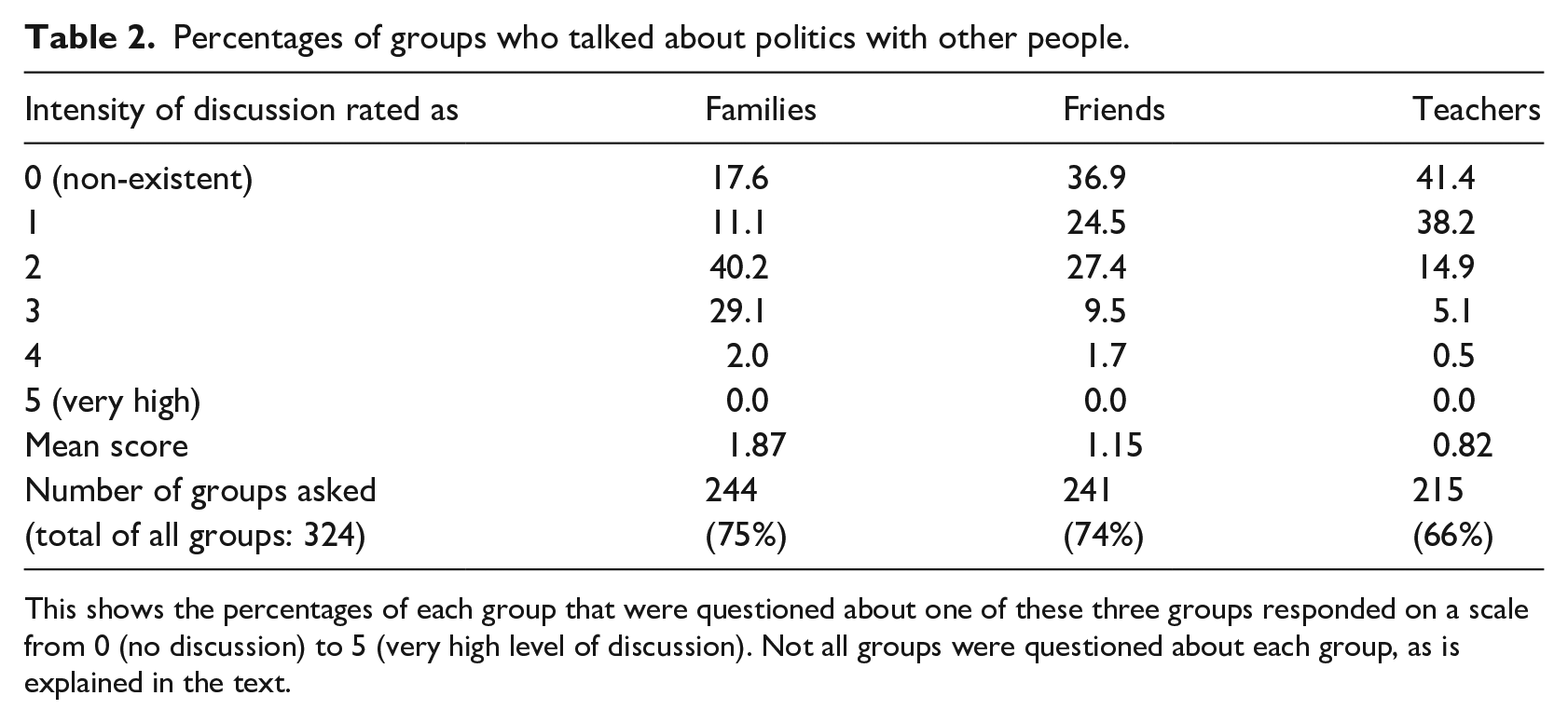
This shows the percentages of each group that were questioned about one of these three groups responded on a scale from 0 (no discussion) to 5 (very high level of discussion). Not all groups were questioned about each group, as is explained in the text.
Percentages of groups who talked about politics with other people.
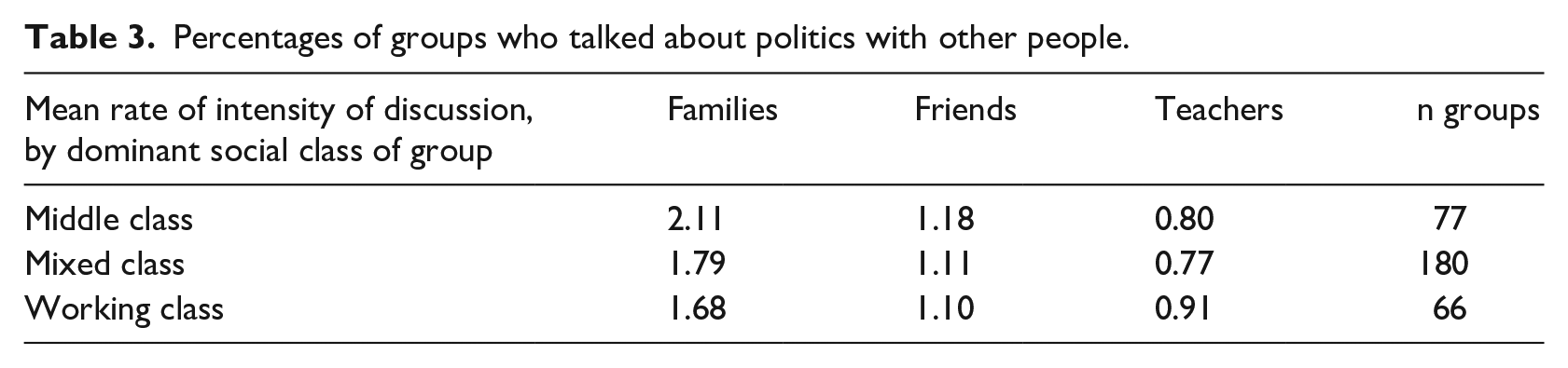
Three points might be made: the rank order (families more than friends, friends more than teachers) applies to all three categories; the middle class young people were more likely to talk with parents than were working class parents; and all three groups reported very similar levels of interaction with friends. It is also possible that the working class young people interacted slightly more with teachers than did middle class pupils. The different interaction levels with parents seems to support the findings of Hively and Eveland (2009) and Perloff (2014), cited earlier, if it is argued that it is middle class families that are more likely to ‘encourage children to openly explore ideas and challenge others’ beliefs’ (Hively and Eveland) or ‘to discuss political topics with others’ (Perloff, p. 102).
A similar exercise was conducted by examining the data by country. In 18 countries (of 28: Luxembourg had too few groups to be included in this particular analysis), the ranking was the same as before (families > friends > teachers). In only two countries were family members not the highest: Cyprus, and Finland (where all three were rated very similarly). Only eight countries did not put teachers the lowest (only two by a more than marginal amount, Poland and Cyprus). It would be hard to suggest that there was significant country variation.
These fragments from the discussions held in this study appear to suggest that little has changed since Greenstein et al.’s (1974) study 50 years ago, which concluded that young people’s political socialisation was not so much the result of activity by schools, but nor was it simply the ‘casual absorption of impressions from family, friends and the mass media’ (p. 369). Coles’ study, that suggested that children learn their politics from parents, school, and peers may also have overemphasised the significance of school. The importance of schools that many studies suggest is not generally supported by the empirical data in this study. Cullingford’s (2000) caution still holds: we cannot assume that what teachers present is the same as what children learn. With a few particular exceptions, most of the young people talked with in this study said that they did not – indeed, would not – discuss issues like these with teachers or in school. Parents may have been more significant discussants for most young people, but this was not a casual ‘inheritance’ or absorption of parental party loyalties. There was a much greater emphasis on contingent and contextual events that illuminated their engagements with issues (such as rights, racism and inequalities) and their discussions with all three categories examined here: it was the intensity of such discussions that varied between the three, not the subject matter.
These young peoples’ comments often seem perceptive. Although many were critical of the nature of their political education, and wanted more of it, they were in no sense uninterested or uninformed about contemporary political issues. The great majority were able to effectively marshal political arguments about issues that interested them. These concerns were often about values and human rights, such as racism, equalities, the status of refugees, women’s rights and LGGT rights. Their concern was often with the contemporary lack of specific rights, rather than rights that had already been well established. They were also about issues that were current, very often located around current state and international news items.
For most of them schools were not seen as a place where these matters could be easily discussed, but this does not seem to have inhibited their interest in political matters, nor to have hindered their ability to argue about them. But this does not mean that educational establishments could not have an important role to play in extending these skills and interests. Bennett et al. (2009), reviewing a wealth of studies, wrote that there were generally negative outcomes in classrooms that limited student input in discussion topics and processes. In such closed environments, some communication related classroom activities actually diminished students’ sense of political voice . . . an important correlate to a generally open classroom environment is the presence of classroom discussion, of current events or other issues . . . Discussing hotly contested topics may particularly increase student interest in politics. (Bennett et al., 2009: 109)
There is an emergent literature on deliberative discussion as a pedagogic practice. Jerome and Algarra (2005) have analysed the role of debate in secondary education to promote reflective analysis of social issues, and García-Albacete (2014) has conducted similar work in a wider European context. Mycock and Tonge (2012, 2014) discuss how young people may be politically engaged through such processes.
The methodology employed in this study was carefully constructed to be open and not to lead young people’s discussion to a particular topic agenda, and this might indicate a promising pedagogic approach. Initiating questions were open, and responses were accepted as valid and of interest: subsequent questions tended to be based on the nature of the response (and use the vocabulary and language of the response) to explore further and elucidate what had been said. Groups were sufficiently small to allow all to participate in genuine discussion and interplay. These are not necessarily easy conditions to replicate in class teaching, but with some ingenuity it might be possible for occasional small group activity, and at such length, to be included in a school programme. Perhaps more difficult will be for the teachers to transition to an overt ‘non-teacherly’ role, and for this to be accepted by the young people involved. Always asking open-ended questions, and always trying to act in a responsive way, is neither straightforward or easy, and – with the hindsight of over 300 discussions – takes time and practice to develop and improve.
Equally, the subject matter that the young people wanted to discuss was often controversial and sensitive: but it was striking that their discussions were sensitive, respectful of other participants (and generally of other groups and peoples not represented in the group). One strategy that might be a possible way of focussing discussion would be to pick up on immediate items on the current news agenda, and to encourage an open discussion on these. The examples of Liselotte and Annegret from Germany (quoted above), who wanted to discuss the New Year’s eve attacks in Köln were not an isolated example of young people being eager to discuss the news, and being frustrated at teacher reluctance to take this up. If classes had a weekly opportunity to discuss current news items, this could provide a basis for the exploration of many issues of values in political and social contexts that many young people would appear eager to discuss. If this suggestion were to be adopted, I would suggest it would be important to insist that a consensus was not sought, and it became a debate without a conclusion. This would, I suggest, allow discussions to be easily continued, and for the important learning point to be established that in many issues there are no conclusive or ‘right’ answers. Such a position would perhaps need to be reconciled with much of the rest of the curriculum, where assessment regimes allow no such latitude.
Introducing issues that may be seen by some parents, school and educational administrators and politicians as contentious is not always easy. But doing so may make young people better able to participate in their futures: and this is no more than their entitlement.
Footnotes
Data availability
All recordings of the discussions have been transcribed, and have not yet been archived because they are still being added to and further analysed by the writer. The original audio recordings have been deleted. Records and consent forms from parents and young people that contain material that would identify them are being securely held in the archives of London Metropolitan University until 2026, when they will be destroyed.
Declaration of conflicting interests
The author(s) declared no potential conflicts of interest with respect to the research, authorship and/or publication of this article.
Ethical approval
I received ethical approval for the research from London Metropolitan University in November 2009 and in June 2014.
Funding
The author(s) disclosed receipt of the following financial support for the research, authorship and/or publication of this article: This work was supported (travel and subsistence) during 2010–12 Jean Monnet chair grant from the European Commission, award 2009-3226/001-001. In 2014, I also received a small grant from London Metropolitan University to cover my fieldwork expenses for the autumn of 2013. All other expenses were met personally.
