




Abstract
Historical consciousness is regarded as an important means to stimulate moral citizens through history education. This article conceptually examines the moral dimension associated with historical consciousness by revisiting the paradigm wars between natural science based on positivism and human and social sciences during the 1960s–1990s as expressed through the voice of Gadamer. More specifically, the article explores: (1) the moral arguments that Gadamer put forward for introducing historical consciousness and (2) the epistemological and ontological building blocks for approaching morality in history education that his arguments brought to the fore. In general, moral consciousness in relation to historical consciousness draws attention to: (a) people’s life conditions, (b) that moral reasoning and practice are influenced by feelings and reason, (c) that reflections on past events can help to interpret our ways of being towards others in the present and future, (d) that a plurality of people, thoughts and history are important to acknowledge and (e) that every person is part of creating history and responsible for weaving the past/present/future web in ways that acknowledge others.
Keywords
Introduction
There is a general discussion that history education carries an important role to form good citizens who harbour not only desired knowledge but also cherished moral values (see for instance Davison, 2017; Vella, 2007; Jordan and Taylor, 2002; Jordan et al., 2012). Since the 1990s historical consciousness (HiCo) as a concept has played a vital role in school curricula, also in relation to citizenship formation in history education ranging from the first year of schooling to upper secondary school in northern Europe (e.g. Karlsson, 2009: 47), and has a key position in history didactics and history research (Ahonen, 2005: 697–699). HiCo is an open concept and has many similarities with another central concept in citizenship education, namely democracy. However, like democracy HiCo has limits (Dahl, 2002; Edling and Simmie, 2020; Mouffe, 2005) that are interesting to discuss from a moral point of view.
In general terms HiCo highlights how people orientate in and make meaning of the relationship between past, present and future (Jeismann, 1979: 40–42). It can be regarded as a fundamental human trait in that everyone has some kind of historical consciousness (Ammert, 2009) – as a collective and/or individual understanding (Seixas, 2012: 19) or an ability that can range from a simple and one-dimensional awareness of history to a more complex and multi-layered consciousness (Rüsen, 2012: 52–54). The concept of morality, which stems from the Latin word moralis (proper character, manner, behaviour), has focused on the practice of being, whereas the Greek term ethics (from ethos, meaning custom and/or habits) directs attention to different ways of thinking about and motivating moral choices. However, it is asserted here that no moral action is erased from certain modes of thinking, which implies that morality (acting in a way that is seen as moral) and ethics (reflecting on the moral action) can be regarded as co-dependent (see also Fox and DeMarco, 2001). Subsequently, in order to understand the moral dimension of HiCo we argue that ethical reflections are essential.
As a philosophical enterprise, the term HiCo emerged in the 1960s, 1970s and 1980s and was infused by a moral turn that took place in historical scholarship, which implied that questions about good and bad and right and wrong were recognised as important in history education (Cotkin, 2008). In relation to history education, several empirical studies show that questions related to morality or values tend to engage students and stimulate their interest in learning history. This is arguably due to the tendency of moral issues to stir up emotions of good and bad and right and wrong (see, for example, Berggren and Johansson, 2006: 37–38; Ammert, 2017: 23). Although many people at the time argued for the need to acknowledge HiCo, Hans-Georg Gadamer was one of the leading voices who provided a broad and deep argumentation for the importance of HiCo. Following Gadamer (1987), the introduction of HiCo was most ‘likely the most important revolution amongst those we have undergone since the beginning of the modern epoch’ (p. 89)
While the question of morality in relation to HiCo is commonly referred to in published research (see for instance Chinnery, 2014; Seixas, 2004; Simon, 2000; Straub, 2005), it has as yet only been broached in a general way (Rüsen, 2006, 2011). This makes the role of HiCo difficult to understand as a conceptual frame for stimulating moral consciousness in history education and also how morality in relation to HiCo can be understood more specifically in practical or concrete ways.
HiCo as a term has been criticised for being too complex and too vague, thereby making it difficult ‘to find a shared focus’ (Körber, 2015; Wertsch, 2012: 49; see also Thorp, 2013: 213–217). One reason for this is that HiCo is used by some researchers as an empirical and open concept (drawing on the research of Jeismann) through which a variety of moral values can be addressed. This overlooks the fact that HiCo was created from insights into how history had been used in relation to humans and how the world could continue without allowing the horrors of the Holocaust to emerge again (Körber, 2015: 3, 6). By maintaining that the concept is fuzzy or ambiguous due to its multifaceted nature, Thorp (2014) argues that the epistemological building blocks of HiCo need to be made clear in order to reduce its heterogeneity. He does this by interconnecting HiCo with the concept of historical thinking in order to make it a useful tool for history analysis and (moral) development (Thorp, 2014).
In partial agreement with Thorp, we maintain that there is a need to return to the epistemological building blocks of HiCo. However, rather than trying to find one comprehensive theory of HiCo, we strive to understand how morality was intimately connected with the concept during its establishment as a way of reminding us of the specific challenges that those who advocated HiCo aimed to address. Here, our understanding of epistemology means ways in which beliefs and knowledge are justified at a certain point in time and influence the direction for action (Peirce, 1878).
The fascination with questions concerning actions that are good and bad and right and wrong seems to be universal, although the meanings of these values are far from obvious and stand in relation to what is deemed as desirable by humans in society at any point in time (Dewey, 1959/1916, Chapter 18). From this way of arguing, the very origin of HiCo took shape in relation to something that was considered as bad for humans and was presented as a solution or suggestion for making things better. Indeed, nothing takes place in a vacuum and what particularly interests us are the moral arguments that paved the way for HiCo in the 1960s through to the 1990s. These arguments can be regarded as epistemological building blocks for how morality can be approached in relation to HiCo and extended to history education. Epistemological building blocks can provide teachers with conceptual tools to navigate with (Schön, 1983) when grappling with intersections of historical and moral consciousness.
With this as a background, the article aims to conceptually examine the moral dimension associated with historical consciousness by revisiting the paradigm war (Kuhn, 1974) of the 1960s–1990s between natural science based on positivism and human and social sciences. More specifically, the article addresses the moral arguments that Gadamer put forward for introducing historical consciousness and the epistemological building blocks for approaching morality in history education and teachers’ work that his arguments brought to the fore.
As it is well established that ideas for HiCo took shape in the paradigm war between traditional history science and human and social sciences we describe the notion of paradigm war and the rationale and positivistic ideas permeating traditional history research and history education.
In relation to the fundamental clash between two radically different worldviews, we explore Gadamer’s moral arguments for introducing HiCo as a better solution for approaching history (education) than that found intraditional approaches. As the process is complex, the aim is not to provide a fully-fledged historiography of how HiCo was introduced in different countries, but rather to capture some of the major philosophical strands that contributed to a shift in thinking about and dealing with history (education) and the resulting moral issues. Here we turn to hermeneutic phenomenologists who have contributed to anchoring HiCo in the German and Nordic countries, with a focus on Hans-Georg Gadamer’s writings.
The arguments are thereafter applied to describe the epistemological [and ontological] building blocks in history and social education in order to understand issues about morality within or in relation to the concept of HiCo. We maintain that the arguments are not just abstract statements, but set overall directions for action and have moral consequences. This section serves as both a summary and a brief discussion.
Historical consciousness and the paradigm war
In the 1980s a ‘moral’ turn took place in historical scholarship which implied that questions concerning good and bad and right and wrong were recognised as important in history education (Ammert, 2008; Löfström, 2014). The changes that took place then are linked to expressions like the cultural turn, the language turn and the moral turn that emerged in the 1980s (Ankersmit, 1983; Karlsson, 2017; Parkes, 2011; Wilschut, 2012). Thus, the changes that took place during the 1980s can be seen as a paradigm shift from traditional ways of approaching history education to approaching education through lenses of historical consciousness (Chinnery, 2014). During the 1990s and the publication of the book Testimony: Crises of Witnessing in Literature, Psychoanalysis, and History by Felman and Laub (1992) moral issues became more explicitly linked to memory in various fields of research, including but not limited to history, education, psychology and philosophy. Questions about moral responsibilities linked to history learning have now become important to highlight, such as the need for apology, reparation of past ill-deeds (Gibney, 2008; Thompson, 2002; Torpey, 2006) and dealing with trauma (Govier, 2006; Long and Brecke, 2003).
Intimately linked to history didactics (didaktik), HiCo arose as a concept in West Germany during the 1960s (Karlsson, 2009) Contrary to the Anglophone context’s emphasis on HiCo as a(n empirical) method, the concept in Germany began as an awareness that methods are interlinked with thinking (ideas) and that theory is important for critical reflection and action (Körber, 2015). The West German historian Karl-Ernst Jeismann’s definition of the term influenced German history education during the 1970s. Bernard Eric Jensen introduced the concept in Denmark in the 1980s and it then spread to Sweden through his work (Karlsson and Zander, 2009). In recent years, HiCo has become more popular in English speaking countries, such as the US, Canada, Australia and the UK, although unlike the tradition in West Germany and Scandinavia the ideas underpinning HiCo in English speaking countries are influenced by psychology (Wineburg, 2006). Even though there is a split in worldviews within the group of scholars using HiCo, it is the paradigm war in northern Europe that is of interest here.
Accordingly, tensions between contradictory worldviews are important to bear in mind in order to understand why historical consciousness was introduced as an analytical concept in the field of north European history education between the 1960s and 1980s. The American historian, physicist and philosopher Tomas Kuhn’s publication, The structure of scientific revolution (1974), led to an intense debate that impacted many scientific fields, including history science. According to Kuhn, science develops in a cumulative manner within a paradigm maintained by a significant number of people in a research society. Paradigm here broadly means a fundamental trust in the very foundation of the research carried out and a paradigm shift is created when the previous assumptions underlying research are unable to solve pressuring challenges in present society. According to Kuhn, the breaking of a previously dominating paradigm generally produces contradictions and tensions between different groups of researchers; a type of cognitive dissonance. However, it was not only historians who contributed to the paradigm shift, but various disciplines dealing with the human/social condition.
The paradigm war in relation to history research and education is often described in what can be regarded as dualistic terms. This includes ‘traditional contra reformist history’ (Herbst, 1977), ‘traditional history education and educating for historical consciousness’ (Chinnery, 2014: 254) and objective contra interpretative or natural science contra humane and social science (Cohen and Manion, 1994). The tension arose between two philosophies: the advocates of positivism who claimed that science and knowledge about history should be based on universalism and pure objectivism, and those who stressed the need for social/human sciences to enter the field of history and include interpretations of what it means to be human in the equation (Carr, 1965). This can subsequently be regarded as the first clue to understanding the notion of morality associated with HiCo.
Positivism was positioned as distant to the human and social realm. Henri de Saint-Simone introduced the term during the 18th century, but it is the definitions of August Compte and Emile Durkheim that are most frequently used. Although positivism contains a range of different perspectives, such as classical positivism, logical positivism and methodological positivism (e.g. Bredo, 2006; Riley, 2007), they share similar features. Regardless of perspective, there is a belief that real knowledge about the world can only be gained through systematic empirical experiments based on people’s senses and that these experiments need to be grounded in Descartes’ rationalism (Bredo, 2006; Cohen and Manion, 1994, see Chapter 1).
René Descartes (1596–1650) was a French philosopher who strove to find a foundation for science at a time when the church stood for most of the thinking and people were obliged to obey this authority. In order to find a firm platform for science he explicitly argued that science could not be based on humans and human plurality, since these aspects lacked stability (Descartes, 1998). Rather, he introduced four principles originating in his faith in God’s perfection: (1) the principle of dualism, (2) the principle of essentialism, (3) the principle of categorisation, measurability and visibility and (4) the principle stressing the need to eliminate doubt. Dualism stood for a clear and unbridgeable division between entities such as objectivity and subjectivity, good and evil and body and matter, which logically secured that two entities did not pollute each other. Dualism entailed a possibility to find the essence (core/truth) of things, including history and various categories of humans, through systematic categorisations and measures based on what can be seen. Since doubt is evil and linked to the devil, a supreme aim of research is to constantly try to eliminate doubt (e.g. Nordström, 2008; Edling, 2016). It is these principles that advocates of hermeneutics have proved to be insufficient for dealing with human challenges.
Following Nietzsche (1873/1998), the need for history and the ways that people approach it vary depending on a person’s particular life situation. Someone who is satisfied with how things are and were may want to preserve a particular image or images from the past, while a person who suffers or can see suffering is open to change. Drawing on the work of Hans-Georg Gadamer, this article highlights the overarching and interrelated ethical arguments as to why traditional approaches to history (education) were problematic.
Gadamer and the illusions and dangers of abstractions, ideals of perfections, and progress distant from the human condition
There are many traditions in hermeneutics, but the main problem is the struggle to understand how the presence of human experience and the conditions and circumstances pertaining to it affect science. This involves knowing how being is connected to understanding (Palmer, 2007). One central reason for turning to Gadamer is that he is especially interested in relating the use, meaning and effects of language to history and past traditions (Wright, 2000: 993). Moreover, his notion of the universality of human understanding and historical consciousness has had a major impact on the field of science (cf. Seixas, 2012).
Hans-George Gadamer (1900–2002) was a German philosopher who drew on continental philosophy and, more specifically, hermeneutics, that is, the theory of interpretation. Gadamer’s dissertation from 1922, The essence of pleasure in Plato’s dialogue [Das Wesen der Lust nach den Platonischen Dialogue], played a significant role in his way of understanding the relationship between art and science and the importance of dialogue. After completing his dissertation Gadamer continued his studies at Freiburg University together with Martin Heidegger, Karl Löwith, Hanna Arendt and Leo Strauss. Like several others in the group, Gadamer was, strongly influenced by Heidegger’s ideas and, in particular, the ontological question of ‘understanding of being’ that starts from Dasein, which means being involuntarily cast out into the world and thus rendering everyone both innocent and responsible at the same time. In short, people are innocent in the sense that no-one has chosen to be born, and responsible in that they nonetheless try to understand the world and make the best of the situation they are forced into (Di Cesare, 2007).
Like so many others at the time Gadamer was also influenced by Heidegger’s notions of being and time, which in turn drew on the legacy of Hegel and stressed the fact that our consciousness of both the world and ourselves was filtered through time and history. Gadamer developed Heidegger’s work in relation to the concept of historical consciousness and his thoughts are worth pursuing in order to understand in more depth how historical consciousness was created in relation to moral issues (ibid). Although the questions that Gadamer raised are ontological and knotted into the fibres of being human, the idea here is to establish a specific epistemological framework for the relationship between historical consciousness (HiCo) and moral consciousness (MoCo). The results below are based on a close reading and re-reading of a selection of Gadamer’s texts – not the least his famous Truth and Methods.
Morality (and science) as a human condition is positioned in a web of relations
Gadamer’s (1975/2006) notion of hermeneutics starts from the shortcomings that he identified as accompanying the rigid idealism of traditional history, earlier hermeneutics, Marxism and natural sciences’ abstract and dogmatic principles. What he particularly criticised was the tendency to separate various entities, such as objective methods versus human experience, art versus science, the past versus the present, the possibility of finding universal principles and repeating studies without taking human change, theory versus practice and so forth into account (p. 342). He was also highly critical of the seemingly solemn belief that the objective of science was to dominate men and the world itself. This stance was not only expressed in the natural sciences, but also in the arguments put forward by Marxism. Some hermeneutic branches argued that the knowledge that hermeneutics generated would automatically lead to the enlightenment and liberation of oppressed groups (354–355; Gadamer, 1975/2007: 8–9).
According to Gadamer, a major criticism of modern science was that it tended to be distanced from human life and the human condition, and in this sense was no longer in the service of humans and truth, but became a tool for domination due to its way of obstructing any kind of questioning (Gadamer, 1966/2007: 84; Gadamer, 1975/2006: 353–354). Against this background, he argued for the need to establish an approach to science that distanced itself from ‘the methodologism’ that drew on neo-Kantianism and instead turned to a philosophy that took human life based on the ideas of Fredrich Nietzsche and Martin Heidegger into account (Gadamer, 1975/2007: 7).
In contrast to modern science, Gadamer argued that the tendency to separate entities and the possibility of mastering people and the world with the argument that it was about locating truth was no more than an illusion if knowledge about humans was taken into account. The word illusion not only signalled a form of deceit that obstructed true knowledge about what it meant to be human and the challenges facing people, but also risked enslaving people’s minds (Gadamer, 1975/2006: 353). Central to his reasoning was that human understanding takes place in people’s life experiences and that these are always entangled with history, implying that there is no position outside human experience and that human experience is always historically tinted. For example: ‘/. . ./it seems to me there can be no doubt that the great horizon of the past, out of which our culture and our present live, influences us in everything we want, hope for, or fear in the future’ (Gadamer, 1966/2007: 82).
This also meant that the belief in progress, that is, human beings slowly progressing forward on a timeline, was not feasible, because time itself was filtered through a form of historical consciousness in which an understanding of facts was entangled with everyone’s life experiences. People were not ‘on a timeline’ but ‘in time and in creation of history’ (Gadamer, 1966/2007: 84; Gadamer, 1970/2007: 95–96; Gadamer, 1975/2007: 8–9, 24): ‘[o]ne has to ask whether progress, as it is at home in the special field of scientific research, is at all consonant with the conditions of human existence in general’ (Gadamer, 1972/2007: 240).
Gadamer maintained that he was not at war with the natural- and other sciences that placed their belief solely in methods and their desire for mastery, but simply pointed out that there was no objective grounds to being separated from people’s experiences and that every attempt to eliminate human experience was not just an illusion, but was also highly immoral. The hermeneutic problem was consequently universal and belonged to everyone (Gadamer, 1975/2006: 354; 1975/2007: 24).
Rather than grounding science in separate fragments, he argued that it should start from a holistic perspective where people’s life situations and possibilities for acquiring knowledge were dependent on the conditions and circumstances they found themselves in (see for instance Gadamer, 1975/2007: 24–25; Gadamer, 1966/2007: 83–84). Consequently, moral consciousness and moral judgement needed to take human conditions into account: ‘[a]t the very least, in judging others – and this too belongs to the moral sphere – one cannot ignore their being conditioned’ (Gadamer, 1961/2007: 284).
Gadamer did not see himself as a relativist, but simply claimed that although facts were important they could only be created and understood through people’s understanding and life experiences (Gadamer, 1989a/2007: 362–363). This also took the question about establishing meaningful relationships as something exterior to oneself into account:
To be sure, one has to master the grammatical rules, the stylistic devices, and the art of composition upon which the text is based, if one wishes to understand what the author wanted to say in the text; but the main issue in all understanding concerns the meaningful relationship that exists between the statements of the text and our understanding of the reality under discussion (Gadamer, 1972/2007: 235–236).
In Gadamer’s writings, condition can be understood as an environment in the sense that various factors are in a relationship with one another in ways that frame people’s lives. Humans are thus conditioned by the environment they live in yet are also able to form that environment through their engagement and meaning making (Gadamer, 1975/2006: 195; Walhof, 2016: 440–441).
This implies that knowledge is never just added to the brain in terms of appropriation and assimilation, but has to be filtered through the individual’s historical consciousness (Gadamer, 1972/2007: 235–236), thereby giving birth to a never-ending process of understanding and a fusion of horizons (Gadamer, 1992/2007: 62). Accordingly, aspects that were previously kept separate in modern sciences, such as art/science (Gadamer, 1975/2006: 62), conscious/unconscious (Gadamer, 1972/2007: 239–240), thinking/speaking/acting, answers/questions, concrete/abstract (Gadamer, 1995/2007: 385), moral practice/ethical ideas (Gadamer, 1961/2007: 276), past/present/future and so on are placed in relation to one another in Gadamer’s writings. In his view, it is not a question of ‘either-or’, but of keeping cognitive faculties, understanding and senses in harmony with one another (Gadamer, 1975/2006: 62).
Morality is dependent upon an awareness of consequences ideas/practice bring for human life and is characterised by constant change over time, otherness and uniqueness
As indicated above, the distancing and abstraction of human life by modern science gives the false impression that humans can be fixed and, hence, controlled. This overlooks the fact that human life is primarily about understanding, and that understanding as an ontological condition for human existence is in constant motion [alteration]. In other words: ‘“[u]nderstanding” is no longer meant as one process of human thinking amongst others, a behaviour that could be developed through discipline into a scientific procedure; rather/it means something that constitutes the basic being-in-motion [Bewegtheit, movedness] of the existing human being [Dasein]’ (Gadamer, 1992/2007: 56). This means that social life is a never-ending process of questioning that has previously been regarded as valid, and that its validity is not mainly in relation to abstract principles, but in relation to the human condition and the consequences that ideas bring for humans (Gadamer, 1961/2007: 263, Gadamer, 1966/2007: 83–84).
The notion of alteration can also be understood in relation to the presence of otherness. Whereas modern science argues that a human being can be fully known and controlled for various purposes, Gadamer maintained that this too was false: ‘[i]t is an illusion to see another person as a tool that can be absolutely known and used’ (Gadamer, 1975/2006: 353). Every attempt to try to abundantly know the other robs the person of legitimacy and keeps that individual’s understanding at a distance. Gadamer’s starting point thus makes moral bonds to other people impossible. It is only when we take a genuine interest in what other people (including texts) have to say that any kind of moral relation becomes thinkable (Gadamer, 1975/2006: 354). Thus, while understanding is the prime aim of hermeneutics, it is not an understanding that aims to overcome the other’s differences.
According to Gadamer, the unavoidable presence of otherness and being-in-motion were two central facts that conditioned human life and that otherness (differences between people) was intimately linked to time as a flowing entity [panta rei] (Gadamer, 1975/2006: 351), thereby rendering every exploration of history as unique, rather than (merely) being about finding general laws:
Historical consciousness knows about the otherness of the other, about the past in its otherness, just as the understanding of the Thou knows the Thou as a person. In the otherness of the past it seeks not the instantiation of a general law but something historically unique. (Gadamer, 1975/2006: 354)
Even though individuals return to the same historical facts, they also bring something new to the present and future due to a never-ending process of interpretation. This also suggests that the idea [illusion] of superiority that strongly governs Judeo-Christian traditions needs to be questioned, since superiority does not merely keep people’s differences at a distance, but also the genuine will to understand what others have to say (Gadamer, 1975/2007: 29).
Morality as interlaced with language use, which is the sole medium for human consciousness
In contrast with the illusion of self-consciousness as well as the naïveté of a positivist concept of facts, the between-world of language has proven itself to be the true dimension in which that which is given is given. (Gadamer, 1989b/2007: 167)
Gadamer was criticised for his use of the word consciousness, especially by Heidegger who found it too vast and difficult to grasp. In one of his texts, Gadamer stressed that it was the best he could find in order to capture the holism of the human condition, but that perhaps linguisticality – the experience of the world filtered through language – might be a better concept (Gadamer, 1995/2007: 385)
The use of language as the source of all communication and understanding is a crucial building block in Gadamer’s hermeneutical philosophy (Gadamer, 1995/2007: 385). This suggests that there is no point outside human language use that can constitute the foundation for objectively scrutinising the world (Gadamer, 1975/2007: 24–25).
It is a well-known fact that all people and all sciences use language to communicate and that the possibility for critical thinking (Gadamer, 1975/2007: 21) and morals lies in this awareness. Indeed, it is in the very act of communication involving speaking and listening that an openness to others’ understanding and life situations takes shape (Gadamer, 1975/2004: 354) and constantly brings something new to the world (Gadamer, 1975/2007: 27).
Existing through and working with language implies taking part in language games where the meanings of concepts, interrelations and consequences are illuminated and openly discussed (Gadamer, 1975/2007: 23, 25). Gadamer stressed that the process of understanding required intense listening and working with language: ‘I always stayed close to the text’ (ibid., p. 18 see also Gadamer, 1966/2007: 88) and also involved understanding the meaning of words in a process of reaching agreement (Gadamer, 1970/2007: 95–96). This brings us to the political/moral dimension of Gadamer’s philosophy.
Morality is dependent upon communication and is interlaced with commonality and politics
The commonality that we call human rests on the linguistic constitution of our life world /. . ./ For this reason, in every dialogue we have with the thinking of a thinker that we are seeking to understand, the dialogue remains an endless conversation. If it is a true conversation, a conversation in which we seek to find “our” language—to grasp what we have in common. (Gadamer, 1975/2007: 25, 33)
Although modern science stresses the importance of obeying and following rules and expertise (Gadamer, 1975/2004: 354, see also Gadamer, 2004/2007: 117), Gadamer maintained that this was not enough because it obstructed people’s ability to think and act in a community with others. As the very fibre of human life is a commonality based on language and communication, working actively with communication and people’s possibilities for critical thinking, both of which are necessary in order to acknowledge and contest wrongdoings in relation to human conditions, is important. ‘The commonality that we call human rests on the linguistic constitution of our life world. . .[and] every attempt by means of critical reflection and argumentation to contend against distortions in inter-human communication only confirms this commonality’ (Gadamer, 1975/2007: 25, 33).
The process of understanding is also a question of acquiring knowledge (widening one’s horizon in encounter with something new) and a precondition for learning. Drawing on Aristotle, Gadamer argues it is the combination of episteme (knowledge to understand), techne (knowledge to act), phronesis (knowledge to judge what is good in relation to practice and hence act as morally good citizens) that constitutes Gadamer’s understanding of energia as a central component for good citizenship (Gadamer, 1972/2007: 254).
In order to grapple with a science that took human condition as a life mode in constant change involving unique human beings forced to exist side by side into account, Gadamer turned to the knowledge produced by Aristotle. According to Aristotle, philosophy, knowledge and science were meaningless if they were not anchored in human practice. Everything including philosophy had to be in the service of humanity, rather than distanced from it. Here, practice implied the ‘status of a free citizen in the polis’ and the ability to make free decisions based on ideas about moral good (Gadamer, 1961/2007: 230). Commonality was consequently the glue that bonded everyone together, awakened the importance of reflexivity and communication (ibid., p. 263) and required modesty in contrast to believing that one was superior and the sole owner of true knowledge (Gadamer, 1975/2007: 33–34). The endeavour to reach an understanding together with others was central in this process: ‘[t]he basic model of reaching an understanding together is dialogue or conversation’ (Gadamer, 1992/2007: 70).
Drawing on Aristotle’s notion of phronesis, Gadamer argued that people’s visions and ways of thinking about ethics influenced their day-to-day practices and made it important to be aware of the consequences that ideas brought to practice. For this reason he preferred virtues over values, because virtues encompassed action/thinking, rather than merely thinking that was detached from practice (Palmer, 2007: 275–276). In other words, the outcomes of concrete situations needed to be taken account in ways that mediated between ‘logos and ethos, between reason and situation, between the subjectivity of knowing and the substance of being’ (Palmer, 2007: 276), since people’s actions tended to impact society, thus making ethics irreversibly linked to politics. Ethical reflections and a moral life of action thereby became interconnected as the ‘right management of actions’ and a political question (Palmer, 2007: 276). From this it followed that liberation that enabled reflection as a never-ending road of understanding was of key importance, in that it was essential for people’s ethical and political participation as citizens. Even though technical abilities, knowledge and skills were important and needed to be learned, they meant nothing without people’s deliberations and judgements of what was good/not good in relation to real life (Gadamer, 1972/2007: 232).
Commonality involves solidarity with others and for Gadamer was an important balance to power and domination. It is also a fundamental condition for human existence and depends on our desire to understand others and a hope that others want to understand us. However, understanding does not mean that we agree with others, but simply that the will, humility, and openness to understand is a prerequisite for communication and in the long run to stimulate peaceful relationships (Gadamer, 2004/2007: 118–120). Today the importance of open communication becomes clear in the light of hate speech, which rather than opening up, actually closes any possibilities for genuine encounters and instead stimulates violence and aggression. It also becomes clear that any communication, like racist hate speech for instance, is linked to a historical consciousness that incorporates ideas from the past (Wright, 2000: 1004). Gadamer stressed that human existence in a world with others brought the entire person into the conversation and not just the conscious brain, meaning that communication can awake feelings in people like joy, surprise, anger, disappointment and fear (cf. Gadamer, 1975/2007: 33). A conversation is as such always coloured by our imperfectness and prejudices.
Morality is dependent upon an awareness that human understanding is imperfect and always tinted by prejudices
I have given the following formulation to this insight: it is not so much our judgments as it is our prejudices that constitute our being. (Gadamer, 1966/2007: 82)
Gadamer’s philosophy did not aim to add anything new to science, but simply embraced the conditions under which science and humanity already operated, namely through the use of language and communication. Contrary to the modern scientific belief of finding a position of absolute objectivity, Gadamer stressed that as humans we were unable to liberate ourselves from our own beliefs and prejudices. The hermeneutic problem was thus everyone’s problem – including that of the natural sciences. He maintained that in order to achieve as objective a view as possible, people’s defectiveness and prejudices needed to be included in the process of understanding. This meant a constant movement between what was said/written and one’s own understanding and perceptions. ‘[o]ne can describe this as follows: the interpreter and the text each possess his or her and its own horizon, and each moment of understanding represents a fusion of these horizons’ (Gadamer, 1992/2007: 62).
It was not only a belief in the pure objectivity of natural sciences that Gadamer criticised for being false if reality (human condition) was taken into account, but also the dogmatic belief present in, for example, Marxism, that is, that knowledge about oppression would automatically lead to a better society. According to Gardamer, as knowledge was not free from our own prejudices, any hope of reaching enlightenment and a better society lay in the constant process of understanding and struggling with our own predispositions (Gadamer, 1975/2006: 354; Gadamer, 1975/2007: 20; Gadamer, 1966/2007: 82). Here, prejudice is given a positive connotation in that an awareness of our own prejudices is a prerequisite for moral relations and for understanding history – not in a quest for domination, but to see what new things it can bring to the present and future (Gadamer, 1975/2006: 354).
Accordingly, prejudice is not something that needs to be overcome – as this is impossible – but is a natural condition in human existence that influences judgement, including judgements in the natural sciences. For this reason, the process of interpretation needs to be brought into all science, as well as the claims that science can make for establishing control over human conditions: ‘[t]hese limits are truths that need to be defended against the modern concept of science, and defending these truths is one of the most important tasks of a philosophical hermeneutics’ (Gadamer, 1992/2007: 71).
Morality is dependent upon an awareness that all science (language) is value loaded and ideological
In this way it may become clear that in reality, the method fanatics and the ideology critics are the ones who are not doing enough reflection. For the method fanatics treat the rationality of trial and error—which is undisputed—as the ultimate measure of human reason; on the other hand, the ideology critics recognize the ideological prejudice that such rationality contains, but they do not sufficiently ponder the ideological implications of their own critique of ideology. (Gadamer, 1975/2007: 23)
Subsequently, as no position is free from human experience and prejudice it means that no science is free from values and ideology. The motto of modern science is to search for objective truth based on principles and, based on this, create a better world. It thus becomes value-blind due to a created gap between a seemingly abstract (de-humanised) history and the flow of present life (see Gadamer, 1966/2007: 80). However, there is no history outside human experience and all the conditions that accompany it. Also, every choice of research focus means that something is both included and omitted, and that every question that is posed in research or in written articles is based on language that requires interpretation. Without providing tools for the interpretation of language, presentations of ‘statistical facts’ risk becoming mere propaganda (Gadamer, 1966/2007: 83–84).
As previously indicated, Gadamer emphasises that taking the human condition seriously is not just an issue for hermeneutics, but for everyone. For him this is a highly moral issue, because neglecting the human condition, interpretation and consequences of action risks harming humanity: ‘[a]nd yet, over against the whole of our civilisation that is founded on modern science, we must ask repeatedly if something has not been omitted/. . ./ [i]f the presuppositions of these possibilities for knowing and making remain half in the dark, cannot the result be that the hand applying this knowledge will be destructive?’ (Gadamer, 1966/2007: 83)
If we become aware of the shortcomings (illusions) of modern science without being accountable for them, it is a question of deceit (Gadamer, 1966/2007: 83; Gadamer, 1975/2007: 24). Indeed ‘/. . ./practical philosophy [which includes the ideas embedded within natural sciences] has to be accountable with its knowledge for the viewpoint in terms of which one thing is to be preferred to another: the relationship to the good’ (Gadamer, 1972/2007: 231).
Morality involves an awareness that life always involves some amount of present and future risk
At the heart of Gadamer’s hermeneutics is the desire to understand humans and life based on facts that are only reachable through language [hermeneutics of facticity]. At the same time, the human condition involves plurality (the ever presence of otherness), being-in-motion (the constant flow and alteration of practice and being as subject) and the inevitable presence of human imperfectness (the presence of prejudice). Furthermore, it is vital to become aware of the fact that hermeneutics is not just a technique or an art to be taught, but also primarily includes situations in which our own opinions are challenged and opposed. These situations do not have ready-made solutions, but are natural in all kinds of conversations and therefore need to be addressed. Avoiding elements of risk makes genuine communication impossible and hence hinders the possibility for moral bonds to be forged in a society (commonality) with others (Gadamer, 1992/2007: 69–70).
This means that no matter how much we focus on understanding the facts, we need to be aware that we can never reach full understanding. Humans are thus unavoidably caught in the tension between wanting to understand and know what things are like, while at the same time having to face the fact that life in its entirety cannot be completely understood (the not understandable) and therefore plead for caution and humbleness (Gadamer, 1975/2007: 33–34; Gadamer, 1989a/2007: 361). In the hermeneutic process of presenting the facts of the human condition, the solid foundation of modern science, together with its promise of erasing anxiety through objective knowledge, is brutally shaken. Rather than erasing anxiety, Gadamer argues that we should learn to live with and intelligently deal with a certain amount of insecurity in life.
He also reminds his readers that after the war humankind was vulnerable in that we now had the capacity to destroy ourselves. Based on this vulnerability, he stressed the need for everyone to engage in thinking and reflecting together. Indeed, according to Gadamer, the survival of humankind rests on solidarity, that is, the will and openness to engage together to solve common problems: ‘I am of the opinion that with all our technical and scientific progress, we [Europeans] still have not learned well enough how to live with each other and with our own progress’ (Gadamer, 2004/2007: 119). This implies strenuously working to understand facts that are dressed in language and concepts while at the same time making these concepts understandable through communication.
A summary and discussion: Epistemological [and ontological] implications for approaching moral issues in history education
As HiCo is closely related to history didactics, history research (Ahonen, 2005: 697–699) and citizenship education (Jordan et al., 2012) and it plays a key role in the various curricula used in Western Europe (Karlsson, 2004: 44). There is a widespread acceptance that HiCo is accompanied by a moral dimension, which implies that students’ encounters with the past have the potential to illuminate and/or develop their moral consciousness and enable them to use the knowledge from the past to shape a better future. Just like democracy and democratic citizenship, historical consciousness is an open concept. But even an open concept needs limits if it is not to lose its meaning altogether (cf. Mouffe, 2005).
The moral dimension(s) of HiCo can be approached empirically by exploring people’s moral consciousness in relation to historical events, thereby making the concept totally open ended. In this way HiCo becomes a tool that can help us to make meaning of a sometimes contradictory set of values and perspectives (Körber, 2015: 3). Another way of approaching the moral dimension(s) of HiCo is to turn to the moral motivations for introducing the concept in the first place and try to understand the epistemological implications for history education and teachers’ work. This has been the purpose of this article by starting from the writings of Hans-Georg Gadamer. Gadamer was by far the only one discussing the notion of historical consciousness at this time, but seeing that his thoughts are both well-developed and still referred to in current research it is worth looking at more thoroughly.
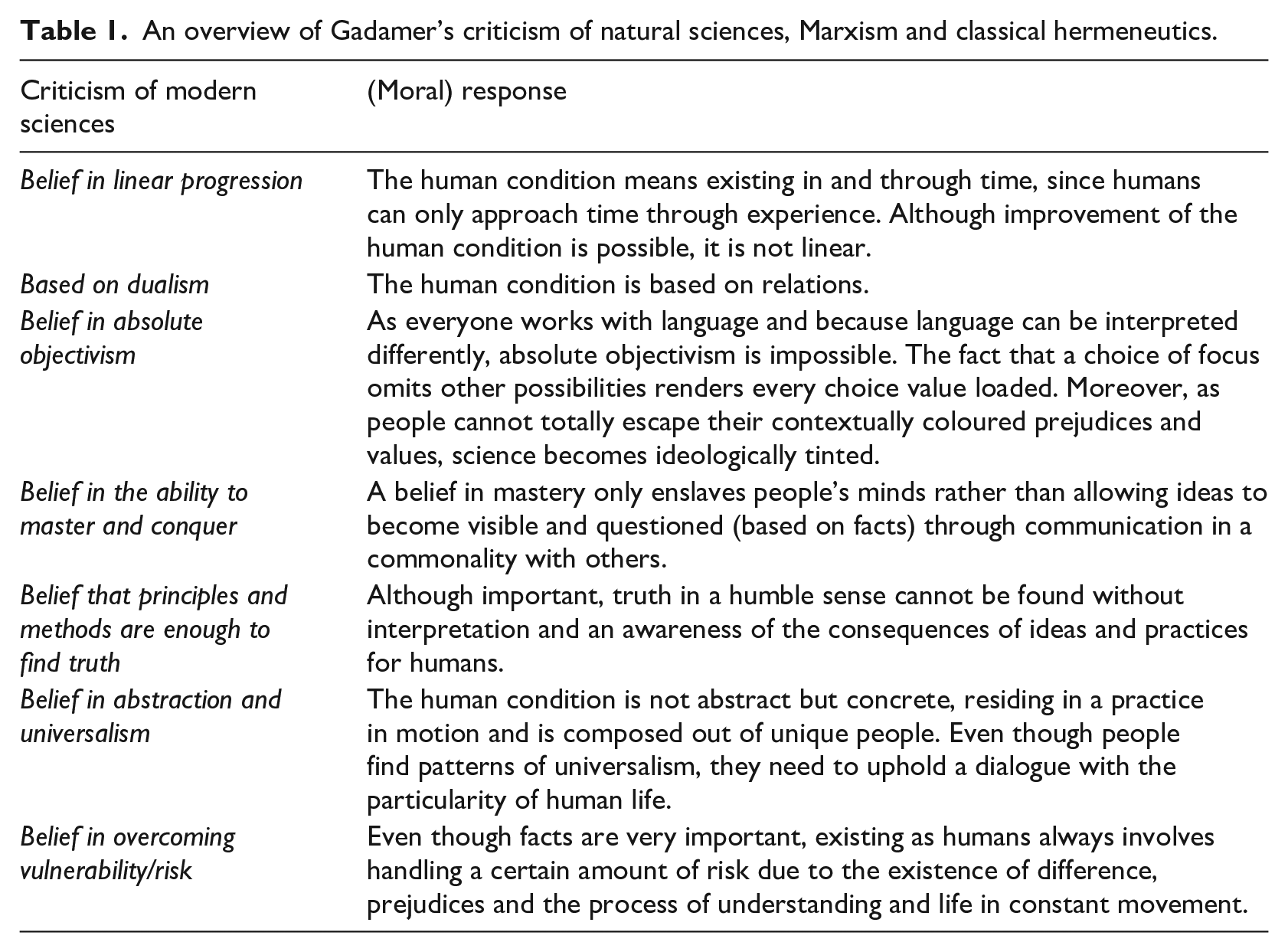
HiCo as a concept was established as a way of dealing with the inability of positivism to address human suffering, people’s interest in and responsibility for history and also to capture the complexity of human reality. From this way of reasoning, HiCo was introduced in relation to social phenomena that were regarded as ‘bad’ at the time. In this sense it not open ended, but charged with a specific way of grasping morality from the start (see Table 1). Motivations like these brought forth an epistemological paradigm shift from perceptions inspired by positivism/natural science to those guided by social and human sciences that were bound to influence the notion of moral consciousness (see Table 1). When describing the development of historical consciousness it is important to note the epistemological movement from a narrow to a broad (holistic) perception, a dualistic to a dialectic perception and an atomistic to a relational perception of history – all of which are bound to influence moral consciousness.
An overview of Gadamer’s criticism of natural sciences, Marxism and classical hermeneutics.
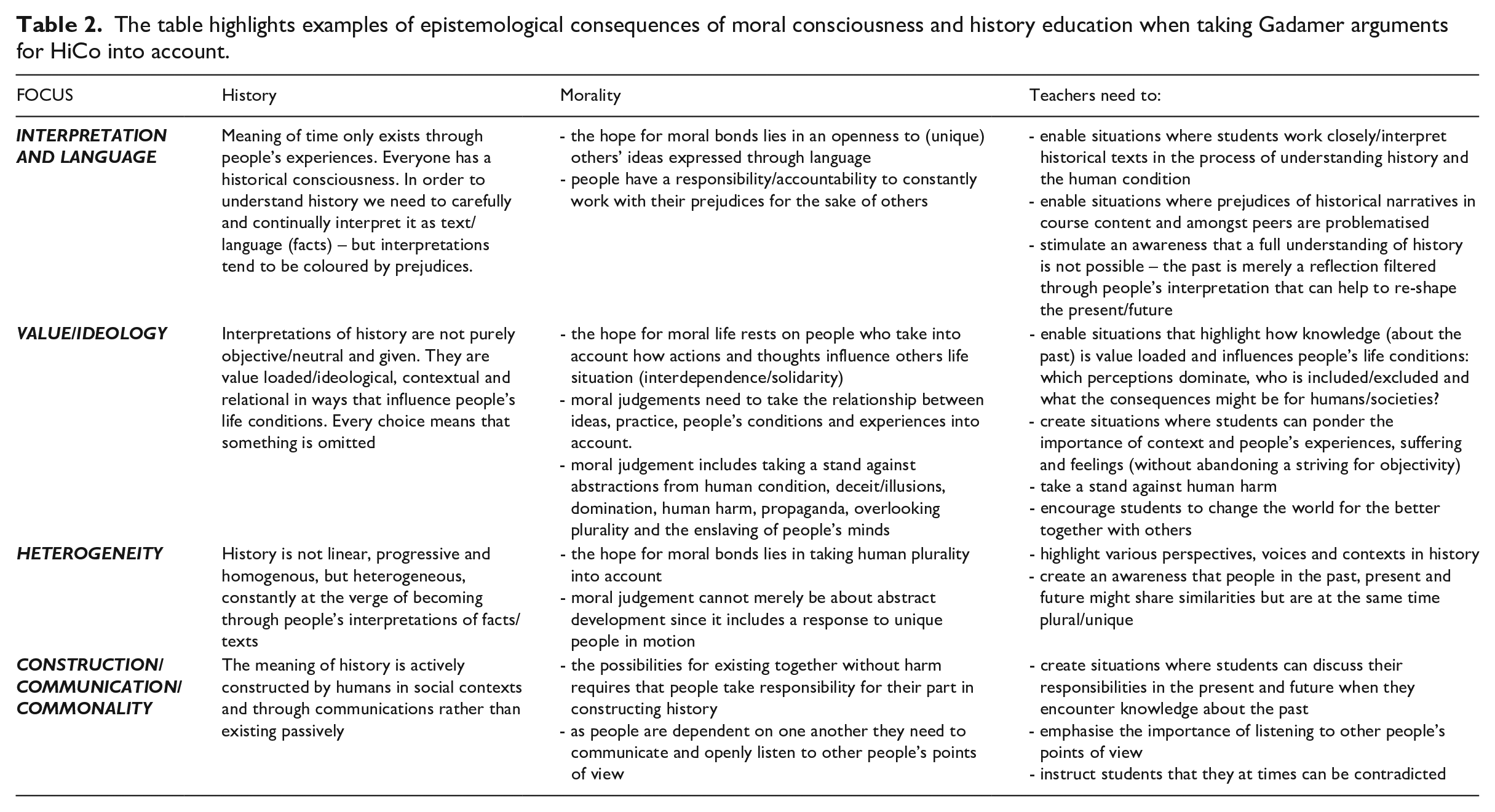
The moral motivations for introducing HiCo presented through the interpretations of Gadamer’s texts suggest something fundamental about how moral/ethics is to be understood and provides directions for teacher judgement and practice (see Table 2).
The table highlights examples of epistemological consequences of moral consciousness and history education when taking Gadamer arguments for HiCo into account.
In a sense, HiCo is an open concept in that it makes people’s meaning making visible in order to deal with human challenges that are considered harmful. This means that questions about morality in HiCo and history education are dilemmatic in that they are caught between the importance of acknowledging plural perspectives (including positivism) and taking a stand against perspectives that support narrow forms of science and dogmatism that overlook the human condition.
Footnotes
Acknowledgements
We would like to thank the Swedish Research Council for financing this paper as part of a larger research project.
Declaration of conflicting interests
The author(s) declared no potential conflicts of interest with respect to the research, authorship, and/or publication of this article.
Funding
The author(s) received no financial support for the research, authorship, and/or publication of this article.
