




Abstract
In a historical review of curriculum revisions carried out in British Columbia, Canada, the author argued that these revisions were undemocratic in the sense that the revisions were carried out by a small selection of individuals associated with the Ministry/Department of Education. This article begins with a brief review of previous findings along with a discussion of how democracy, and in particular, procedural democracy, are understood. Procedural democracy is argued to relate to the public’s knowledge about government-initiated changes, ability to provide feedback, and how this feedback is attended to by those in government. This article then discusses the research methods and findings of a study carried out with British Columbian teachers and curriculum developers at a time when a major curriculum revision is occurring. The survey was designed based on the theoretical model of procedural model of democracy described. The findings focus on looking at the perceptions of teachers and curriculum developers regarding the process of curriculum reform carried out in British Columbia.
Background
Since public schools were established during the latter part of the nineteenth century in British Columbia (BC), Canada, the provincial government’s Department of Education (now Ministry of Education) has managed key administrative features of public schools including teacher certification, curriculum development, and teacher and school supervision (Broom, 2015; Dunn, 1980). Curriculum revisions occurred regularly over the twentieth century and into the twenty-first century, as Ministry officials embraced the aim of keeping schools modern (Broom, 2015; McDonald, 2009).
In curriculum documents, particularly in the subject of Social Studies, a consistently stated objective has been to educate for and about democracy. For example, documents include content knowledge teachers are to teach about government structures and processes and the roles and responsibilities of “good citizens.” This connection between public schools and citizenship education goes to the founding mission of public schools (Broom, 2015; Cordasco, 1976; Evans, 2004; Osborne, 1996; Sears and Hughes, 1996; Sears, 2009). Public schools developed as nation states emerged. In early curriculum guides, “good citizenship” has been argued to have been “passive”: good citizens were to understand the political system, be informed, and vote (Sears and Hughes, 1996). In academia, over the twentieth century, debate has erupted over the meaning and processes of “good” citizenship (Crick, 2000; Evans, 2004; Levine and Higins-D’Alessandro, 2010; Lin, 2013; Sears, 2009; Sherrod et al., 2010; Zajda et al., 2009). However, curriculum documents in BC have consistently aimed to create “good” political citizens, in the sense of individuals who are knowledgeable of political structures and events, and who vote and actively work to improve their societies (Broom, 2019). Some features of more critical features of citizenship, linked to ideas of social justice, are included in more recent curriculum documents, layered onto older models of good citizenship (Broom, 2015). Considering the close connection between public schools, the rise of nation states, and education for citizenship, and that one of the major means for controlling what is taught in schools is the mandated curriculum, a question that needs to be considered is: how democratic has the process of curriculum development and implementation been in a province (and nation) that considers itself to be “democratic.” This article will discuss research into this question, while acknowledging the complexity of concepts related to government. After briefly reviewing the context of this study, through a discussion of concepts related to government and governance and a brief summary of a previous study on the history of curriculum reform in BC, this article will discuss the findings of a survey study conducted with BC teachers and curriculum developers regarding their perceptions of how “democratic” they feel the latest curriculum revision in the province has been. The survey questions that were asked to the research subjects were based on a theoretical model of the procedures of democratic processes which are discussed as follows.
Questions that arose from government control of curriculum development and implementation in previous work (Broom, 2015; Broom, 2019) included: Are there tensions between the government’s assertion of its democratic nature (and of the democratic nature of society that it aims to educate students about) and the form and nature of the curriculum revisions which it has implemented? Is it possible to argue that government officials may have a special interest in developing curricula which leads to its own continuity, that is, biased processes and products? In a province in which the government has played a strong, central, and controlling role in education (Fleming, 1989, 1996), what is the nature of curriculum reform related to democracy and governance?
Perspective
The author is influenced by ecological and pro-democratic perspectives. First, the author writes from a multi-dimensional and systems perspective: individuals are viewed to be connected to each other, and living and non-living factors and events affect each other and interact (Broom, 2016; Overton, 2010). The implications of considering curriculum reform from this perspective is the author’s interest in considering the diverse factors that influence how and why curriculum reform is implemented and how these interact with each other in particular contexts and conditions, as well as impact thinking about the nature of curriculum reform.
Second, research into the nature of curriculum reform in BC is conducted using a pro-democratic perspective. While democracy as a form of government and governance has its flaws, it is (as Churchill argued) the form of government that allows for the most public participation, from among the other options, such as that of dictatorship and oligarchy, and it is the one (in theory) in which people are valued for their ability to participate in governance. Acknowledging democracy as a valuable yet complex and contested concept, this article begins with a discussion of how democracy is understood in relation to concepts such as power, politics, governance, public voice, and the procedures and processes of democratic forms of governance. This discussion framed how the survey tool was designed.
Key concepts
Government is defined as the formal structures, policies, and processes of administering a nation’s affairs. This is contrasted to governance, which relates to the informal means through which decisions and policies are made (Broom, 2015). Government can be organized into a number of various forms, from Oligarchy, to Monarchy and Democracy. Democracy, in its broadest sense, is defined as rule “by, of and for” the people, to quote Lincoln. Today, many nations have representative democracies, a form of democracy in which the public elects representatives to govern on their behalf. These representatives work to fulfill their public mandates, based on the platforms on which they were elected by the majority of the public in their ridings. Elected individuals, in other words, run on a party ideological platform and they aim to implement this platform (the public’s mandate) when in government. The public then votes again in a few years to illustrate their satisfaction (or lack of satisfaction) with how affairs have been run by re-electing or electing new representatives. As democracies are based on public participation in some form, the argument could be made that these governments value people and believe in their abilities to participate in governing the state. Individuals have civic, political, and social rights (Marshall, 1950), associated with responsibilities to participate in these processes.
While BC today is a representative democracy, in which elected individuals are supposed to serve the public which elected them, we can consider democracy in its broader sense (as that of government of, by and for the public) by considering the manner in which those in power govern. That is, we can consider how the government functions. For example, when the government decides that it is time to change the province’s curriculum, we can explore how they go about the process of revising the curriculum, considering such questions as where does the desire to revise the curriculum come from, and how is the process undertaken. Drawing from the work of Hyland (1995), the researcher theorizes that we can consider how democratic a government is in practice by considering how it goes about undertaking such revisions (Broom, 2015).
Democracy, in other words, is a complex term, ranging from a concept of full public participation in government and governance processes to one that is representative. However, these two conceptions of democracy connect with regard to the manner in which those who are in positions of power (elected by the public) act while they are in power. The argument can be made that the more open and “democratic” the means and methods of elected representatives in government are, the more “democratic” (or people-based) the government can be considered to be. In other words, democracy is illustrated in how procedures and processes are undertaken by the government. These include providing citizens with the equal ability to participate in governance discussions and decisions (“equality of procedural power”; Hyland, 1995: 54, quoted in Broom, 2015). That is, all citizens should have access to relevant information on proposed changes and should be able to suggest ideas. Second, all options should be considered in decision-making. In addition, the option that is selected should be agreed upon by the majority (as government officials are representatives of the majority of voters that elected them). Finally, the chosen option should be implemented as agreed upon and not according to the interests of the implementer (Hyland, 1995). In summary, we can explore how democratic a nation’s government processes are in practice by considering the following: (1) who participates in decision-making; (2) how openly citizens can acquire information and participate; and (3) how decisions are discussed, made, and implemented (Hyland, 1995, quoted in Broom, 2015).
Democracy, in sum, involves procedures and processes related to government, processes of governance, and citizens’ rights and responsibilities. The more elected representatives provide the public with the ability to be informed of and participate in discussions on government policies and practices, the closer the concept of lived democracy is to government “of, by and for the public.” In the case of curriculum revisions, the author argues for the value of all members of the “public” having the opportunity to share their thoughts on changes to policies and documents that affect them, connecting into the conception of democracy as that “of, by and for the public.” This is because the sharing of ideas, particularly by those with different ideas, is enriching: discussion, debate, contestation, and justification of beliefs leads to improved understanding of ideas and changes. This conception connects to the National Council for the Social Studies’ (NCSS) emphasis on the key role Social Studies plays in developing well-informed citizens who discuss and participate in addressing issues in society (Levstik and Tyson, 2008; NCSS C3 Framework, n.d.). Similarly, this conception is illustrated in Hess’ (2009) work on the value of discussing controversial issues in classrooms to develop citizenship skills and Parkinson and Mansbridge’s (2013) conception of deliberative democracy: discussions arising between individuals and groups within society using a variety of mediums including social media and organizations are positive forces, as they can influence people’s beliefs and ideas and lead to social, cultural, political, and economic changes that have been better thought out, or negotiated, through these processes of contestation and deliberation. Similarly, the European Union’s civic competence objective aims to develop students’ political knowledge so that they can actively participate in democratic processes (Ross and Davies, 2018). Having students develop critical thinking and discussion skills in association with active citizenship leads to an enriched democratic society through their participation in decisions about social, cultural, political, economic, and other reforms and initiatives. By extension, providing opportunities for the public to comment on governmental changes, such as revisions to curriculum documents, provides enrichment opportunities for the final curriculum document, as a result of the processes of deliberation, contestation, and negotiation.
In this article, the “public” is focused on teachers, who form part of the public that holds special expertise on the field of education, as educators. Future studies can expand upon the research participants’ pool to include the views of the general public, that is, individuals who do not work in schools, including parents and general members of the public. In other studies conducted by the researcher, these groups were found to have different perspectives on a new school subject to that of teachers, thus illustrating tensions in views about the purpose and processes of education (Broom, 2012; Broom, 2013).
Previous research findings
In a previous historical study of curriculum revision processes in BC, the author concluded that the three major Social Studies curriculum revisions carried out over the twentieth century by the Department/Ministry of Education were done so in a nondemocratic manner by individuals closely connected to (or actually in) government, and that close ties existed between academia and government at the turn of the twentieth century and into the sixties and then declined in the latter part of the century (Broom, 2015). Participation in the process of decision-making related to curriculum revision was limited primarily to ministry/government staff and the people they invited to be part of the process. Citizens in general – including educational stakeholders such as parents, teachers, and students – were limited in their participation of curriculum revision processes. Reflecting a process of centralized provincial control of education, Ministry officials kept control of the process of curriculum reform (Fleming, 1989, 1996). This may help to explain why curriculum revisions were not always implemented in teachers’ classes. For example, Ministry officials edited the curriculum revision drafts of the 1997 revision (Ekdahl, 1996). During the 1960s major curriculum revision which implemented a “New Social Studies” curriculum in BC, teachers were invited to provide feedback through their journal, Exploration. However, after feedback was received, a journal article stated that “It is quite apparent, however, that no province-wide consensus exists which can be considered a directive and the committee must take responsibility for assessing the opinions expressed for any modifications which may result” (Exploration, vol. 6, no. 2: 26, quoted in Broom, 2015). Similarly, in the 1930s, Minister Weir stated that the new curriculum was being developed by experts, by committees with “carefully chosen” members who were trained in (the then contemporary) educational psychology and methods and in curriculum construction in postgraduate programs (Weir, 1937: 429, quoted in Broom, 2015). The findings of this historical study laid the foundation for this research study of teachers’ and curriculum developers’ perceptions of a new curriculum revision just being implemented in the province.
A new curriculum revision
BC’s Ministry of Education (2017) is currently implementing a curriculum revision across grades and subjects. The curriculum is arranged around “Big Ideas” which are three to four key themes that organize the content and competencies students are to learn in each grade. The content is the material that students are to study (knowledge) and the competencies are the skills or abilities that students are to acquire, which are grade-focused and also include developing students’ communication, creative thinking, critical thinking, positive personal and cultural identity, personal awareness and responsibility, and social responsibility competencies across grades. Teachers are encouraged to use personalized and active learning practices, such as inquiry. The curriculum states that “the primary goal of Social Studies education is to give students the knowledge, skills, and competencies to be active, informed citizens who are able to think critically” (Ministry of Education, British Columbia, 2017). Students study History and Geography to learn about people and the world, develop appreciation of diverse peoples and cultures, and understand the links between people, places, and economies. Seixas’ (2004) historical thinking concepts can be used in History education. As in previous citizenship education programs (Broom, 2015), citizenship education is embedded in Social Studies. Students are to learn about democracy and the “rights and responsibilities of Canadian citizens” (Ministry of Education, British Columbia, 2017). Students are to learn about democratic forms and processes, to develop their inquiry and critical thinking skills and to participate actively in supporting issues of personal interest. They are to learn to get along with individuals with diverse opinions in order to “create a healthy and vibrant democracy” (Ministry of Education, British Columbia, 2017). This conception is similar to that discussed in the previous section on democracy: students are to develop citizenship skills, that include active participation in social issues, through class activities. As democratic citizenship education focused on educating students for active participation is a stated aim of BC schooling, this study investigates whether government officials who reform educational policies or guidelines follow these same practices in their revision processes. An area for future investigation and research relates to the manner in which “active” is understood by different groups from scholars to government officials, curriculum developers, teachers, parents, and students. Conceptions can range from “active” in the sense of voting for political parties and reading the newspaper, what Sears and Hughes (1996) call traditionalist conceptions, to that of more “active” civic and social participation in the sense of participation in protests, organizations, or events that aim to transform society or that involve direct participation in government or governance processes and procedures. In this research, “active” is understood in the sense of participation in discussion, debate, knowledge dissemination, organizations, and other social institutions related to government and governance, such as policy and curriculum review, with the aim of improving government reform.
Methods and data sources
After ethics approval, the researcher invited Social Studies teachers in the province to comment on the latest curriculum revision process using an online survey tool (Qualtrics). Teachers were invited to participate through an invitation sent through the provincial Social Studies teachers’ association’s email list serve. Teachers who consented to the study went to the online survey to fill out the survey. The surveys were anonymous: no identifying data were collected on those who filled out the surveys. The survey began by asking individuals to identify some basic background variables (such as age bracket) and then asked teachers to share their perspectives on how democratic they felt the latest curriculum revision was. Questions were developed from the theoretical discussion of procedural democracy described above. Participants were asked if they heard about the revision before, during, and after the revision, if they received any information about their ability to comment or participate in the revision, and if they felt their feedback was attended to. Open-ended questions allowed participants to add any further comments they wanted to make.
Individuals who participated in the curriculum revision process were then invited to participate in the study through emails sent to teachers or others who were known to have participated in the process, or who might have known people who had participated in the process who they could forward the invitation on to. Similarly to the teachers’ data collection method, those who participated in the curriculum revision process consented to the study by going to the online survey and filling out the survey. The survey asked similar questions to that of the teachers, although it focused on the perspective of those who participated in the curriculum revision and asked the curriculum developers to consider whether a number of groups, including teachers, parents, students and general members of the public, were invited to participate in the curriculum revision process prior to, during, and as implementation occurred.
Data were analyzed using qualitative and quantitative methods (Glaser, 1992). Quantitative answers were analyzed using percentages on 5-point Likert-type scales. Qualitative answers were analyzed using a grounded theory approach: the researcher read through the answers identifying repeated comments and words from which key themes were identified. These themes were placed in a table for analysis, based on such factors as the frequency of key words found in answers (Glaser, 1992).
Findings
As mentioned previously, Social Studies teachers and individuals who participated in the curriculum revision process across BC were invited to fill out an anonymous online survey through an email invitation sent out to the provincial Social Studies teachers’ list serve, and emails were sent to individuals who participated in the curriculum revision process. Only a small number of participants filled out the surveys (N = 23), so the findings are not considered representative of all Social Studies teachers’ and curriculum developers’ views in the province. They represent a selection of voices from those who consented and took the time to fill out the surveys. They provide a glimpse into some of the views held by teachers and curriculum developers toward the new curriculum revision process in the province. Teachers’ answers to the survey are described first, followed by those who participated in the curriculum revision process.
Participants’ backgrounds
Of those who filled out the survey, 57% identified themselves as males, 38% as females, and 5% as other/undisclosed. 1 The majority of participants (81%) were high school teachers, followed by 14% who were middle school teachers, and 5% who were elementary teachers. Most of the teachers (38%) had been teaching for 10–20 years, followed by those (33%) who had taught 0–5 years, and then those (24%) who had taught 5–10 years. Those who had taught more than 20 years were the lowest number of participants at 5%. The majority (71%) of participants came from coastal BC, including the populous lower mainland (which includes the city of Vancouver), with 19% coming from the interior of the province and 10% from the North. Furthermore, the majority (86%) of participants studied Social Sciences in university, followed by the Language Arts (10%), and finally other (5%) subject areas. Thus, the majority of respondents were male, high school teachers from the larger metropolitan area around Vancouver who had been teaching for more than 10 years and studied the Social Sciences at university themselves. This was a different demographic to that of those who participated in the curriculum revision process.
Participants’ answers regarding their perceptions of democracy and democratic processes
The majority (95%) felt that it is important for people to participate in democratic processes such as voting, joining a political party, protesting, boycotting, writing government officials, following political news, joining civic groups, or volunteering. The largest number (47%) defined democracy as active rule by/of the people in which people have power to participate in decisions. About one quarter (21%) defined democracy as people having their voices heard by government. The rest of the participants defined democracy as the opportunity to elect the government. For example, participants stated, When the people have a say in how their government is run. (Teacher response #16, 2018) Free and fair elections to determine who will represent the wishes of the electorate. (Teacher response #17, 2018) Government of the people, for the people. (Teacher response #18, 2018)
Knowledge about an upcoming revision and perceived opportunities to participate
Regarding curriculum revision processes, the majority (63%) of participants felt that they received “some information” on the curriculum revision prior to the revision, that is, during the data-gathering, pre-curriculum reform state. A total of 25% stated that they received “no information” about a coming revision and a minority (13%) were unsure. The majority (75%), further, felt that they were given “some opportunities” to voice their thoughts on how the curriculum should be changed prior to the curriculum revision process, with a minority (25%) feeling they were given no opportunities to comment. Some participants commented that they did not recall being asked to participate or that they knew the revision was coming but did not feel teachers had a say. Others stated that they were aware of opportunities to participate but that teachers had to find these, or that they were unsure of the process for providing feedback. Others felt that there was no time provided to teachers to participate: This (new curriculum) was pushed through as a fait accompli. Teachers were not invested in being a part of changing curriculum, that arguably did not need changing. Frustrating period for many of us. (Teacher response #1, 2018) It has been difficult to find ways to provide feedback and is adding one more thing to do in a busy season and so often does not happen. The process itself for revision felt like it was a small team and there was little input from teachers until drafts were made and by then it has felt like it is too late. (Teacher response #7, 2018) There were some opportunities to give feedback if you went looking for it, and found it when the feedback window was open. (Teacher response #9, 2018)
Knowledge during the curriculum revision process and perceived opportunities to participate
During the curriculum revision process, the majority of participants (81%) also felt that they received “some information” on how the revision process occurred. None said they received “lots of information” on the revision, 6% stated they received “no information,” and 13% were “unsure.” Furthermore, the majority of participants (69%) felt that they were given “some opportunities” to comment or provide feedback to the Ministry of Education during the curriculum revision, with 25% feeling that there were given “no opportunities” and 6% feeling “unsure.” Some teachers stated that they were aware of opportunities to participate, but that the process was confusing or unclear. They were not sure what to do or for what purpose, or lacked knowledge or time: I recall only very few opportunities to provide feedback. I also think that we were left wondering what was happening and timelines kept changing. (Teacher response #4, 2018) It has been difficult to find where to write feedback and is often something that falls to the wayside as the main priority is figuring out how to adapt and change to what is already before us. (Teacher response #6, 2018)
Post curriculum revision information and perceived opportunities to participate
After the curriculum was revised, the majority of participants (75%) stated that they received “some information” about the revision, with 13% feeling they received “lots of information about the revision.” A total of 6% stated they received “no information” on the revision, and another 6% were “unsure.” Furthermore, half (50%) of respondents felt they received “some information” on teachers’ abilities to comment on the new curriculum as it is being completed or implemented, with 38% stating they were given “no information” on opportunities to comment. Six percent stated that they received “lots of information about commenting on the revision” and another six percent were “unsure.” The same number (50%) also stated that they were given “some opportunities” to comment on or provide feedback to the Ministry of Education on educational reform and policy (including the latest curriculum revision). Just under one third (31%) stated that they were given “no opportunities” to participate. A total of 6% stated they were given “lots of opportunities to share thoughts” and 13% were “unsure.” However, the majority of participants (56%) were “unsure” as to whether feedback which was provided to the Ministry was attended to. Almost one third of participants (31%) felt that “some feedback was attended to” and 13% of participants felt that “no feedback was attended to.” No participants (0%) stated that the “feedback was attended to.” Teachers commented that the Social Studies curriculum was changed as the revision occurred but some were not sure how much of this was the result of teacher feedback: In Socials the revised curriculum has been altered and amended several times as feedback was gathered. (Teacher response #1, 2018) I have never been shown proof that the Ministry actually modifies the curriculum based on teacher feedback? (Teacher response #5, 2018)
Regarding the general public’s abilities to comment on or provide feedback to the Ministry of Education on educational reform (including curriculum revision) prior to, during, and after the latest curriculum revision, the majority of participants (47%) were “unsure” if opportunities were provided, with similar numbers feeling that “some opportunities” (27%) or “no opportunities” (27%) were provided. No participants (0%) felt that lots of opportunities to share thoughts on the revision were provided to the general public. Half of the participants (50%) were unsure if the government attended to the feedback from the general public, 31% felt that feedback was “not attended to,” and 19% felt that “some feedback was attended to.” No participants felt that “feedback was attended to.”
Regarding who teachers felt should participate in curriculum revision processes teachers answered.
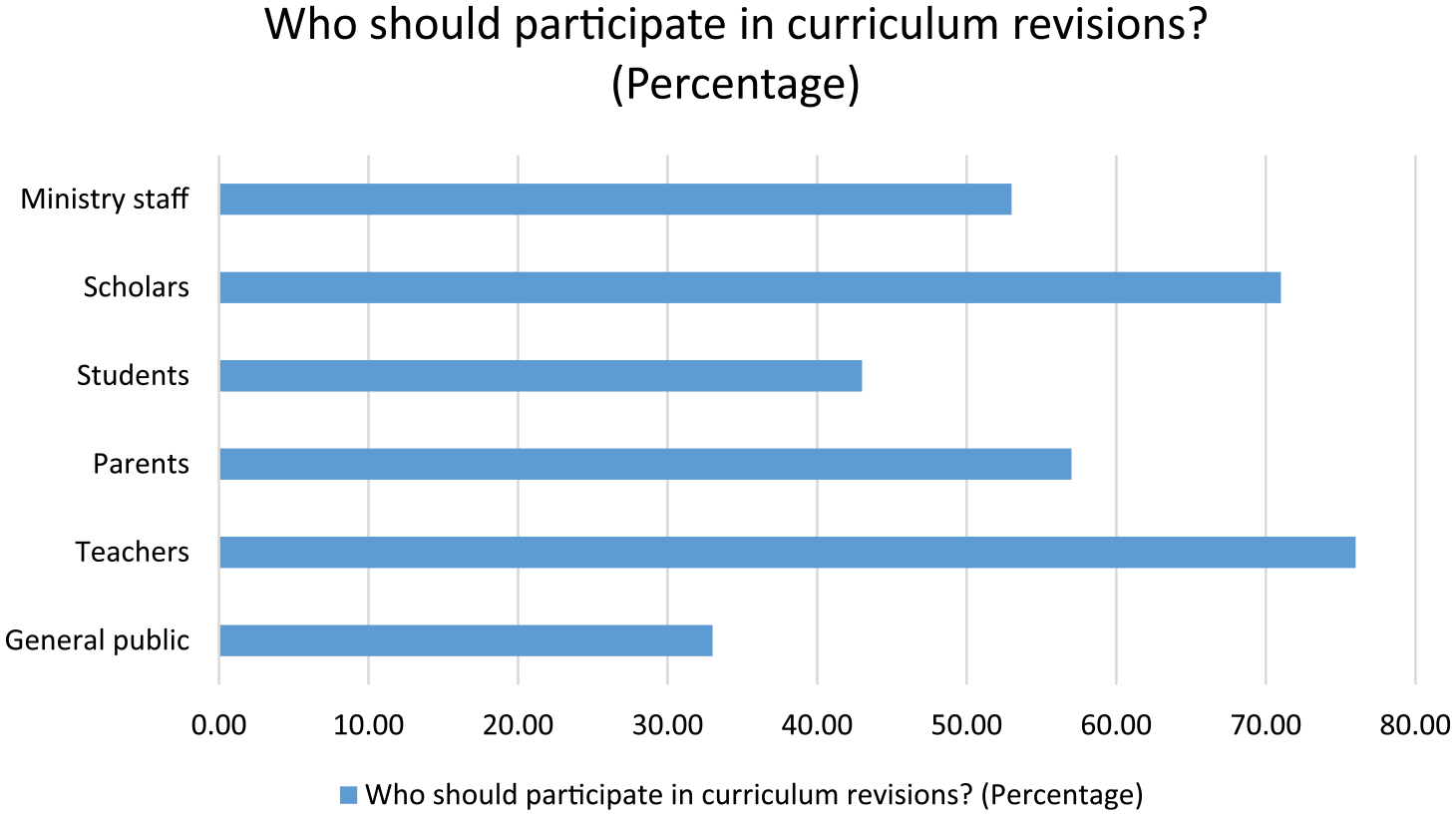
Thus, teachers and scholars were the most chosen categories for who should participate in curriculum revisions, with students and members of the general public coming last.
Knowledge of the process
The majority of teachers (69%) stated that they did not have knowledge about the process followed by the Ministry of Education before, during, and after the revision, with 25% stating they had “some knowledge” of the process and few (6%) stating they were “knowledgeable” of the process. No participant stated that they were “unsure.”
Implementing the new curriculum implementation
Close to half of the participants (44%) stated that the curriculum revision is being implemented in a “fair” manner, with 31% stating that it is being implemented “poorly,” and one quarter (25%) feeling unsure. No participants (0%) answered that the curriculum is being implemented “well.”
General comments teachers made about the curriculum implementation included concerns about the changing implementation process as the curriculum was implemented, the content of the new curriculum and uncertainty in the process, leading some to comment that teachers continued what they had done before: I do not agree with the killing of SS 11. Most grade 10 students lack the maturity to deal with our new SS 11 curriculum. Many good components of SS 9 can no longer be taught because of a lack of time to cover these topics. SS 9 is now too full of content because, the earlier or missing content is not being taught in the lower grades. Students need more time in the SS sciences to work with content and the discrimination of information sources. Critical thinking is essential- yet the new S. Science curriculum expose students to less not more of our S.S. curricular areas. Botched roll out. A problems was “fixed” that did not need fixing. (Teacher response #1, 2019) Delayed timelines, optional start dates, lack of assessment changes have all made the process more chaotic and frustrating, leading some to simply continue what they have been doing. (Teacher response #2, 2018) The multiple pushbacks of the grade 10-12 curriculum has caused chaos in schools as they have planned for changes coming down the pipeline only to have the timeline pushed back, leaving teachers scrambling to teach students who have received inconsistent Social Studies education. (Teacher response #7)
In summary, the majority of teachers valued public participation in democratic processes. They stated that they were given some information on the curriculum revision prior to, during, and after the revision, and that they were aware of some opportunities to provide feedback. However, the majority were not sure if feedback provided to the Ministry of Education was attended to. They were less sure about whether opportunities to participate were provided to the general public or whether the government attended to feedback provided by the general public, and were also unsure about the process followed by the Ministry of Education prior to, during, and after the revision. The majority felt the curriculum implementation was being implemented in a fair manner. Some voiced concerns about the uncertain or changing nature of the curriculum implementation process.
Curriculum developers’ perspectives
The responses of individuals who participated in the curriculum revision process are discussed next.
Participants’ backgrounds
The curriculum developers’ backgrounds differed somewhat to that of the teachers in relation to gender (more females), areas of study (more Language Arts areas), and locale in the province (more Northern and central locations).
Participants’ answers regarding their perceptions of democracy and democratic processes
All participants (100%) answered that it was “important” for people to participate in democratic processes. They defined “democracy” as citizens’ rights to participate in their nation’s government or decisions: Citizens having an equal voice in the leadership, directions, and decisions of the nation. (Curriculum developer response #1, 2018–2019)
Knowledge about an upcoming revision and perceived opportunities to participate
All of the curriculum developers (100%) felt that teachers had “lots of information” about the curriculum revision prior to the curriculum revision starting; half felt that parents also had “lots of information” on the revision. All felt that students and general members had “some information” on the revision, and half felt that parents had “some information.” No curriculum developers felt that teachers, parents, students, or general members of the public had “no information” and none were “unsure” whether these groups were informed about an upcoming curriculum revision prior to the process. Thus, curriculum developers felt that knowledge about an upcoming revision was disseminated to the community, particularly to teachers.
Their answers about how high they rated different groups’ abilities to comment on curriculum reform and policy prior to the revision were more mixed. Half felt that teachers, parents, and general members of the public had “lots of opportunities” to share thoughts, with students having “some opportunities” to share their thoughts. One participant stated that “there were forums, online response tools, professional development days, a website, videos, white papers, drafts of the curriculum made public” (Curriculum developer response #1, 2018–2019). Half felt that these groups had “no opportunities” to voice their thoughts on how the curriculum should be revised prior to the process.
Knowledge during the curriculum revision process and perceived opportunities to participate
All curriculum developers (100%) felt that teachers had access to “lots of information” about the revision during the curriculum revision process. Half (50%) felt that parents and general members also had access to lots of information, with the other half stating that parents and the public had “some information” on the revision. Curriculum developers agreed that students had “some information” on the process. Furthermore, all felt that teachers had “lots of opportunities” to share their thoughts during the curriculum revision process. Half also felt that parents and the public had “lots of opportunities” to share thoughts, with the other half stating that these groups had “some opportunities” to voice their thoughts. All developers felt that students had “some opportunities” voice their thoughts. Thus, curriculum developers agreed that various groups had access to information and opportunities to share their thoughts. None felt that these groups had “no opportunities” to participate. One curriculum developer stated that “during the process, it seemed that an effort was made through advertising, social media and word of mouth (meetings) to share what was being done and to invite educators and members of the public for their feedback and input” (Curriculum developer response #2, 2018–2019).
Post curriculum revision information and perceived opportunities to participate
After the curriculum revision, all the respondents (100%) stated that teachers received “lots of information” about the revision, with half of respondents also feeling that parents and the public received “lots of information.” In all, 50% of respondents felt that students received “lots of information” on the revision and half felt that students received “some information.” Half stated that parents and the public received “some information.” In addition, all the respondents (100%) also stated that teachers were given lots of information about commenting on the revision, with students receiving “some information” on commenting on the revision. Half also stated that parents and the general public were given “lots of information” on their abilities to comment on the new curriculum, with the other half of respondents stating that these groups were given “some information” on their abilities to comment. Thus, respondents responded positively that the Ministry provided information about the curriculum revision and about various groups’ abilities to comment on the revision.
Regarding groups’ abilities to comment or to provide feedback to the Ministry of Education on educational reform and policy (including curriculum reform) after the revision, half of the curriculum developers stated that teachers, parents, and the general public had “lots of opportunities” to share thoughts and students had “some opportunities.” The other half of the respondents stated that “no opportunities” were available for teachers, parents, students, and members of the general public.
All participants (100%) felt that the government attended to the feedback received. Participants stated, Several iterations of the curriculum documents were produced that incorporated feedback. I enjoyed seeing the changes in the revisions. (Curriculum developer response #1, 2018–2019). In the case of the Ministry of Education, as a member of the revision team, I know that all feedback was discussed and appropriate revisions were made accordingly. (Curriculum developer response #2, 2018–2019)
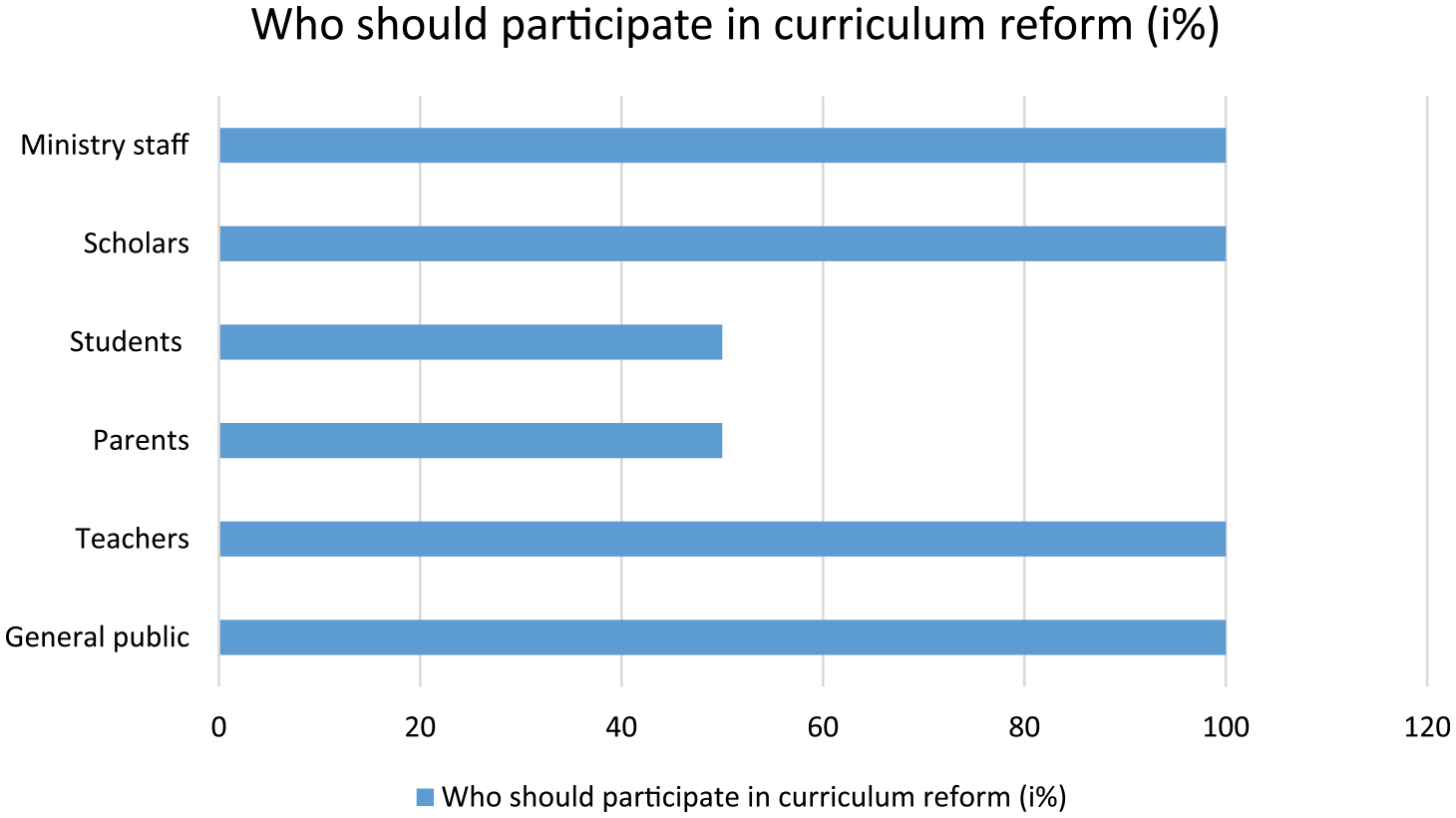
As illustrated in the figure below, all curriculum developers (100%) felt Ministry of Education staff, scholars, teachers and members of the general public should participate in curriculum revision processes. Half of respondents felt that students and parents should participate.
Knowledge of the process
Half of the curriculum developers (50%) felt that they were “knowledgeable” of the curriculum revision process followed by the Ministry of Education before, during, and after the revision. The rest felt that they had “some knowledge.”
Process of curriculum implementation
Half the curriculum developers (50%) feel that the curriculum is being implemented “well” and the rest feel it is being implemented “fairly.” Some of their comments included, K-9 I think that the implementation of the curriculum has been rich and really enabled teachers to be creative in the design of their teaching. Teachers feel a lot of ownership of the curriculum and its implementation. The new graduation program (grades 10-12) seems to be be a moving target. (Curriculum developer response #1, 2018–2019) I think that change is difficult, especially in large organizations, and it is also a challenge to control public perception. It will take time. (Curriculum developer response #2, 2018–2019)
In summary, the curriculum developers stated that teachers were given information on and opportunities to comment on the curriculum revision prior to, during, and after the revision. They also stated that feedback was attended to and that revisions were made based on feedback. They were generally positive about how the curriculum is being implemented. Their answers regarding who should participate in curriculum revisions and other group’s (parents, students, members of the public) access to information and abilities to comment were more mixed.
Discussion of findings
Democracy was explored in this article through the procedures used by those in power. Specifically, this article explored the following elements of procedural democracy: (1) who participates in decision-making, (2) how openly citizens can acquire information and participate throughout the process (before, during and after), and (3) how decisions are discussed, made, and implemented.
This research study found that teachers and curriculum developers generally agreed that information was provided on the curriculum revision before, during, and after the revision and that opportunities to participate were also provided to teachers. However, the two groups differ regarding their perspectives of how much information they had about the process with curriculum developers stating they had more knowledge of the process, and teachers being more unsure or confused of the process followed by the Ministry of Education.
Teachers and curriculum developers also disagreed regarding their perceptions of how feedback was attended to, with teachers voicing less knowledge about whether feedback was incorporated into the curriculum revision process and curriculum developers stating that feedback was attended to, as the curriculum was developed. Furthermore, teachers voiced some concerns about the changing deadlines and uncertainty of the curriculum rollout. Generally, curriculum developers were more positive about the democratic processes followed by the Ministry of Education than teachers, feeling that opportunities to participate were given to teachers and that this feedback was attended to, although they were more mixed in their answers about the opportunities to participate that were available to the general public and parents. A historical study conducted on past curriculum revision processes in BC argued that the Ministry of Education kept control of the process and invited people supportive of its views to the process (Broom, 2015). In this revision, there does seem to have been some effort on the part of the Ministry to invite feedback during the process from teachers. However, it remains unclear how much feedback was attended to and how feedback was attended to.
A few themes to emerge from this study are presented next, providing opportunities for further research and discussion.
Different perspectives regarding how feedback was attended to in the revision process
While both teachers and those who participated in the curriculum revision process were generally positive that teachers were provided with information about and opportunities to comment on the revision, the two groups disagreed about how feedback was attended to, with curriculum developers stating that feedback was considered and incorporated into the revision. Some teachers, further, did state that they did not hear about the revision or opportunities to comment on the revision. Some teachers stated that the process was confusing and were not sure how feedback that was received was attended to. Thus, different perspectives regarding participation and incorporation of feedback emerged in the research. Further research can explore why these different perspectives emerged, and consider factors such as how information about the revision and opportunities to participants was disseminated by the Ministry of Education, and received by teachers. Questions also remain about how feedback that was received was dealt with and incorporated into the revision. In the revision of the 1960s, opportunities to provide feedback were provided to teachers. However, a journal article, as mentioned above, stated that as diverse feedback was received, the committee decided which feedback was to be incorporated and how (Broom, 2015). This study did not provide data to analyze what process regarding attention to feedback was used in the latest curriculum revision. It does highlight different perspectives held by teachers and curriculum developers regarding attention to feedback.
Different ideas regarding who should participate in the process
Both teachers and curriculum developers tended to agree that less opportunities were provided to parents, students, and the general public to participate, although they valued democracy and many defined democracy as including public involvement in governance. Thus, questions remain regarding who should participate in curriculum revisions and how. In other research, the author has found that the public’s views of educational content, aims, and procedures span a vast continuum of ideological positions, some of which could be considered to be irreconcilable (Broom, 2013). Further discussion can explore who should participate in curriculum revisions in a nation that identifies itself as a democracy, and – if diverse and even incompatible perspectives emerge – how should or can these be managed. For example, how can those who support more traditional concepts of education as involving the learning of the three “Rs” which are tested, and those who view education as a process of cooperative inquiry and exploration be considered? What is the relation between the opinion of the majority (which is a principle of democracy) and varied perspectives in relation to curriculum reform? It is possible that the more open nature of the latest curriculum revision, which is framed around big ideas, aims to address diverse perspectives on educational aims and processes by providing teachers with more choice regarding what and how they teach.
Different perspectives on democracy and its current “representative” nature
While teachers and those who participated in the curriculum revision process generally shared the view of democracy as involving public participation in some manner, there were differences with regard to how democracy was understood. For some participants, democracy involved an active view of public participation in decision-making on state affairs. Others described a more “representative” form of democracy in which the public’s role was that of voting representatives into office who work in the public’s interest. These different perspectives open questions regarding the nature of democracy and governance at this time, as illustrated in processes such as curriculum revision processes. If democracy today is actually the election of individuals who act in the public’s best interest (representative democracy), questions to consider are the following: Is it feasible to call curriculum reform “representative curriculum reform”? Do elected individuals determine what is in the “public’s best interest” based on the public policy platforms which elect them? What is the “public’s best interest,” and who should determine this? Could “representative democracy” account for swings in curriculum revisions’ aims and methods in the past, as governments change (Broom, 2015)? Could research discussing increasing public apathy (such as Howe, 2010) be related to the public’s feeling that it lacks democratic power in government processes such as curriculum revisions, due to government’s representative nature, in which people’s role is largely that of voting in elected individuals, with individuals in power making the final decisions about what changes are made and how? Further, how is the concept of representative democracy reconciled to that of democracy as public participation in governance, which is closer to the one that curriculum documents seem to embrace? That is, curriculum documents aim to create knowledgeable and active citizens who work toward improving their societies.
Challenges of implementation and teachers’ practice
As mentioned above, some teachers stated that they were unclear about the curriculum implementation process. They found the changing deadlines confusing and were not sure how feedback was attended to. Some teachers stated that they would keep doing what they had done in the past. Final questions for further research and discussion relate to how the curriculum revision is being implemented in teachers’ classes over the province, for previous revisions were not always implemented in teachers’ classes (Broom, 2015).
