




Abstract
This evocative autoethnography is an exploration of learning and perseverance during a particularly dark time in my personal and professional life. In a period of just over 3 years, my spouse and I dealt with the need for several surgeries, the Covid-19-Delta pandemic and subsequent isolation, social unrest, an insurrection in the U.S., and the tragic death of our son. Then, the D.Ed. program in which I teach was closed. Through this writing, I attempt to make meaning from these events and to share what I have learned.
Keywords
“Coping with an onslaught of pain and loss sharpened and intensified my practice as a critical adult educator.”
For weeks, each time I began to work on this article, I experienced something akin to a panic attack. My heart raced, I started to perspire, and I felt slightly nauseated. I’d talk myself into postponing this task. Lapina (2018) points out, however, that coping by avoidance is the least effective way to deal with stress, so I began typing random thoughts, hoping to overcome my physical aversion. Ellis (1997) decries “the deficiencies of traditional social science research for dealing with day-to-day realities of chronic illness and relational processes” (p. 127). An evocative autoethnography, in contrast, requires writers to probe “the psychic defenses and emotional complexities” of personal experiences (p. 130). To do so could surely help me loosen my desperate clasp on avoidance behaviors. Ellis further notes that autoethnographers discover meaning through writing and should not pretend to “have it all worked out” (p. 130). My reactions to commencing this article made me realize I need to write with the apperception that “my attempts would be limited by what is possible to know and admit to oneself about oneself” (p. 130). Therefore, I committed to an honest acknowledgment to myself of whatever I might learn about myself. I weighed anchor and set sail upon this sea of self-discovery without map, without compass, and without the foggiest idea of my ultimate destination.
First, I want to make it clear that I recognize adversities could be much worse. We have all witnessed the agony of parents whose children were callously killed due to systemic racism or unprovoked war. In recent months, many have lost jobs, homes, and close friends and family members to the Covid-19 pandemic. Maddeningly, the politics around these events have torn many families irreparably apart. I acknowledge that, in many ways, I am fortunate. Sharing part of my story is not a plea for sympathy but, rather, one educator’s probing exploration into an exceptionally dark time. As Lapina (2018) found, “reflection in various forms was a substantial part” of coping effectively (p. 133). I hope first to discover, then to proffer, some lessons learned.
As for my personal struggles, between 2018 and 2021, I suffered the death of one of my children (by accidental overdose), endured five surgeries followed by months of physical therapy, nursed my husband through three spinal surgeries, agonized over a grandchild born too early, spent more than a year in pandemic isolation with my spouse (a trial in itself, right?) and, just as I began to fight my way back, I was informed that the D.Ed. program in which I teach was to be terminated. Ironic, as many in the field now agree that much of the program’s emphasis, critical media literacy and social justice, “must be a focus of adult education as we go forward” (Schmidt, 2021). Unsurprisingly, concurrent events, like the murder of George Floyd, the subsequent protests, the rise of White supremacist groups, the child abuse in US border facilities, the nerve-wracking US election, and the attempted insurrection on January 6, 2021 added immeasurable stress and despair. I felt saturated with pain, sorrow, empathy, yearning, anger, and loss. I was drowning in it—choking on it. Relationships became strained as friends and family members, deluded by disinformation spread by right-wing media, elevated superstition over science, and believed fiction instead of facts. Some died; others refuse vaccinations even now. My work never felt as prescient, yet never more undervalued by my institution.
During post-surgery confinements, I scribbled feelings on legal pads and recorded rantings to help loosen the chokehold of depression and heartbreak. I closed myself off from friends and colleagues because I felt incapable of being pleasant company. I was in physical, mental, and emotional pain. Loss and grief were compounded daily; finding focus was futile.
For this evocative autoethnography (Ellis, 1997), I will use my notes, recordings, and memories to help me recount and reflect on ways this 3-year period shaped my perspective on teaching, adult education, and personal survival. Kivinen (2020) argues that “we embody our experiences . . . and traumatic events make us vulnerable and push us on a lifelong journey to verbalize and visualize our experiences” (p. 503). I position this narrative within autoethnographic texts that are embodied, visceral, fleshed, and vulnerable (Mandalaki & Perézts, 2020; Pullen, 2018; Pullen & Rhodes, 2008). My purpose is to share what I learned, and to suggest implications for practice, in hopes that it may be of help to others who find themselves experiencing difficulties.
Background and Timeline
I begin with a narrative—a timeline of events—with minimal scholarly comment. Following that, I’ll grope with my story in a way that I hope proves valuable to educators who also confront a relentless storm of setbacks. I will share how teaching during a global pandemic not only compounded the strangeness of events, but simultaneously became my intellectual and spiritual lifeline. Finally, I will conclude with thoughts on how to move forward.
A Series of Unfortunate Events
In the summer of 2017, I earned promotion and tenure, whereupon I promptly applied for, and was granted, a year-long research sabbatical for the following academic year. I had a large project planned, several articles in various stages of completion, and joy at the thought of concentrating fully on my research for an entire year. A full-year sabbatical would drastically reduce my income, but I was exhausted and facing burnout. I planned some restorative activities along with a research project and book proposal. But by October 2017, intensifying pain in my right shoulder became so acute that I was forced to leave my own tenure celebration to go to the emergency room. Through repetitive use (including keyboarding), I had torn 3 of the 4 rotator cuff tendons. Surgery was scheduled for February 2018. Around this same time, my husband’s back pain became intolerable, so he had 3 discs fused in his lower spine in December 2017. While teaching courses and awaiting shoulder surgery, I cared for him and managed both of our usual chores. But it would soon be his turn. After February, my dominant arm would be in an immovable sling for 6 weeks, followed by months of physical therapy.
This meant that the spring before my sabbatical I had to avail myself of the Family and Medical Leave Act (FMLA). I finished the fall semester, nursed my spouse, and awaited surgery. Recovery was difficult (have you ever tried brushing and flossing your teeth using only your non-dominant hand?). Of course, I had no idea things would get so…much…worse.
In August 2018, I was still seeing a physical therapist to strengthen my recovering arm, but was happily preparing to plunge into my sabbatical research. My arm was weak, but my anticipation was strong. On the evening of August 28th our youngest son, Benny, called from his home in Texas. I answered eagerly. My daughter-in-law, Kerri, was pregnant with their first child and I was thrilled for them (and us). My smile fell at the sound of the pain in his voice, “Hey, Mom…are you and Pop sitting down?”
I turned to Gary, my husband, and said, “Ben says we should sit down.” With a look, he caught the serious tone and we later learned each of us had the same initial thought, “Is there something wrong with Kerri or with the baby?”
We sat down. I placed the phone on the table between us, tapped speaker, and turned up the volume: “We’re sitting; we’re listening.”
His voice was strong and steady, but the tone was strange. We braced for bad news about the baby but were completely blind-sided by what he said next: “Alex died last night.” Gary and I looked at one another in confusion. What was he saying?
“Alex who?” I managed. We knew Ben had a dear friend in Texas named Alex. But his response came quickly, “Our Alex”—Ben’s brother and our middle son.
Silence…Disbelief…Comprehension? (No, not quite, not yet). I looked across at Gary and saw him visibly whiten, age, and shrink. He glanced at the suitcase I’d just retrieved for his planned flight to spend Labor Day weekend with Alex. As he began to cry, I sat stunned. Tears struck my bare legs, indicating I was crying, too, but my brain couldn’t process what Benny was saying. Alex? Dead? Someone from his apartment building found him; the police in Tennessee, where Alex lived, found Benny.
“What happened?” I heard someone ask. I realized Gary was weeping silently. It must have been me.
By now, Ben was crying, too. Through his tears, he managed, “They don’t know yet, but it appears to be drug related. He was found in his recliner in front of his TV. There’ll be an autopsy.” But due to backlogs, we would not know the results of the autopsy for months.
I don’t remember the rest of the brief conversation. My mind was numb. I couldn’t think. One of us poured stiff whiskeys. We drank them in silence, held hands, and wept. Alex was 37 years old.
Over the next weeks, I made trips between Pennsylvania and Tennessee. We cleaned out his apartment, made burial arrangements. I was thankful to be on sabbatical and could take time to arrange a memorial gathering which we held near his birthday in October. A life celebration. I spent hours each day planning; it would be the last thing I could do for my blue-eyed boy. Our daughter, Aubrey, an artist, designed a “logo” for his memorial—a penciled likeness of his face. I spent my energy assembling remembrances for those who would come to the hotel ballroom to mourn with us and to celebrate Alex’s short life.
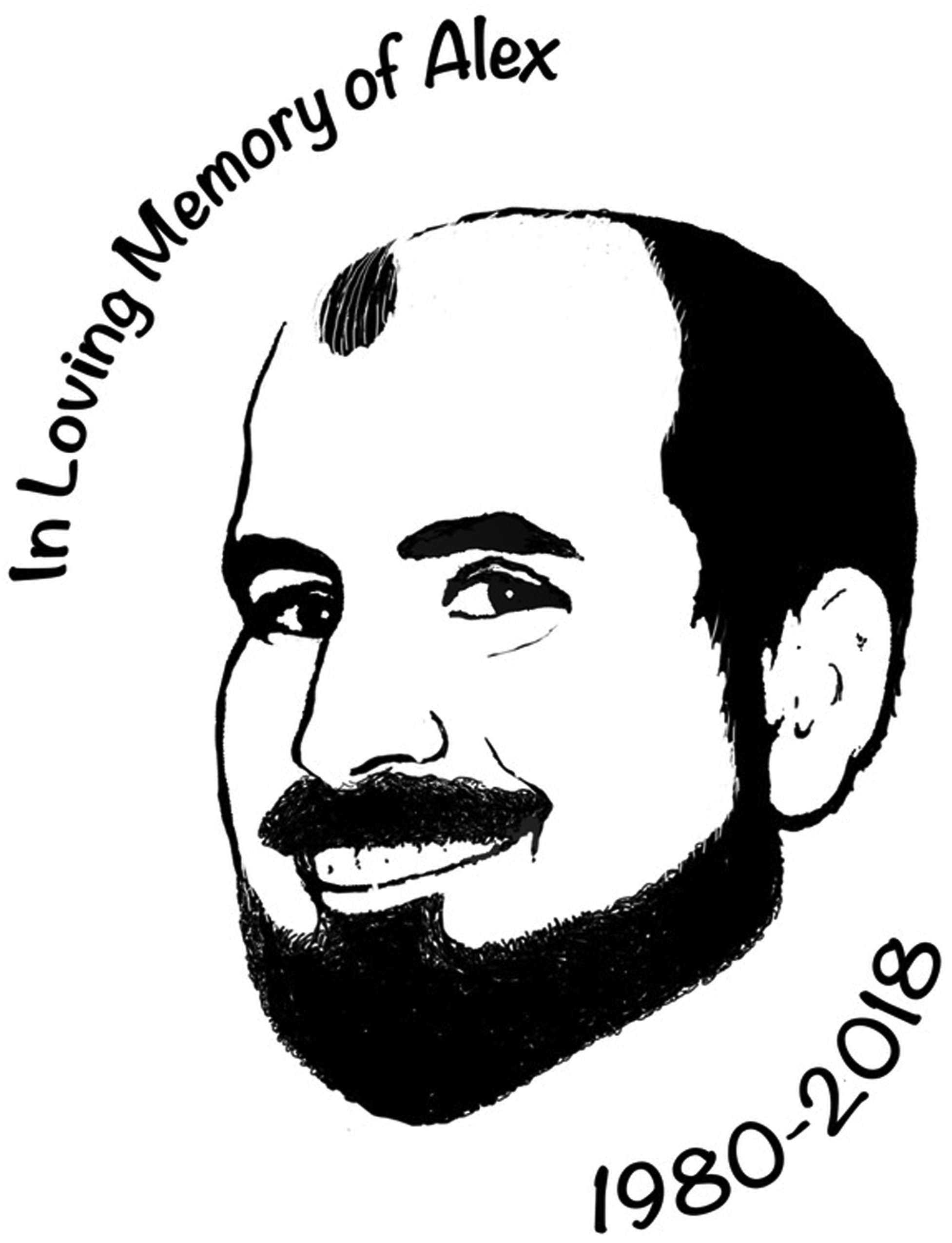
Soon after the memorial in Tennessee, we received another call from Benny telling us Kerri was on bedrest. Indeed, there were issues with the pregnancy. She was hospitalized. The baby was distressed. Ultimately, they had no choice but to deliver her on December 8, 2018, almost 2 months early. A tiny three-pound bundle of hope. Tears of elation—shaded by the knowledge that she would never know her Uncle Alex. He loved family and would surely have doted on Adeline. The flight to Texas was emotional—a mixture of anticipation, joy, anxiety, and grief. Holding her—so careful of the feeding tube and monitor wires. A tiny life to fill the hole left by loss? No. Too dark there. The heart is infinite, but that space will always belong to Alex—and the unspeakable agony of losing him.
When we returned from Texas, the spring 2019 semester was just starting. Gary would teach his mathematics courses; I would try to focus on research since only half my sabbatical remained. I’d managed to collect some data during the previous semester but, given the events of those months, I was far short of my initial timeline. Grief had a firm grasp on my heart; I struggled to focus.
Everything Breaks Down
On January 17th 2019, I experienced a sharp pain in my left hip and almost collapsed. I screamed. As Gary came running, burning pain seared my hip joint with every step I attempted. By the time I was able to get a referral to a specialist, undergo an MRI, and return for a diagnosis, a month had passed. Although I learned to use a cane, I walked as little as possible. Each limping step was nauseatingly painful.
The diagnosis was unexpected. The femoral head had died and, over time, had weakened and collapsed. Did you know your bones could die while you were…you know…still using them?
A hip replacement was my single option. Surgery was scheduled for August, though I wasn’t sanguine about lasting until then. Even with the aid of a walker or cane, sharp edges of bone stabbed with every step, sending jagged lightning flashes blazing down my leg and up my spine, causing muscle spasms and headaches. Sitting was painful; standing was worse. My research was curtailed. No more flights were possible. Nonetheless, I was determined to work, albeit slowly, and I grieved.
Soon, I began having severe headaches and neck pain. Then, peculiarly, I developed intense, constant, burning pain in the joint of one toe. A nerve was pinched in an arthritic joint. Injections didn’t help. Consequently, because I had to be able to walk to recover from a hip replacement, surgery was scheduled for June to remove the joint. I would be on crutches for 6 weeks during which I could put no weight on the foot with the affected toe. Fortunately, it was attached to the leg with the collapsed femur.
As I recovered, the headaches and neck pain worsened. A scan of my upper spine revealed the need to replace two discs in my neck. By this time, it was July. After months of painful hobbling, I yearned for the relief hip surgery should bring and pleaded to postpone spinal surgery till summer. Unfortunately, the surgeons felt there was a risk of paralysis during hip surgery unless the discs were replaced first. Hence, neck surgery was scheduled for September 2019, and hip surgery bumped to November. I became emotionally numb—and not just from pain killers—I missed students and I needed to be back in the classroom for another reason.
My university has no way for faculty to accrue additional paid sick leave. We receive one 12-week (total) allotment of paid FMLA leave per lifetime and I was forced to use all of it with shoulder surgery the year before. This meant I would be on unpaid FMLA leave for fall 2019. Having just managed the sabbatical year with approximately half my regular salary, the financial burden of having no salary increased our stress and anxiety.
For the entirety of 2019, I was unable to either sit or stand at my computer except for very short periods of time. My writing was limited to answering emails and editing dissertations. I hoped 2020 would be a more productive year—a year of healing, both emotionally and physically, and a year of churning out the articles I’d been engaging with throughout the previous 2 years. But as everyone on the planet knows, 2020 did not meet expectations.
Oblivious to the coming plague, I was back in the classroom in January 2020. I could walk without aids, though not without discomfort. I was continuing physical therapy for both spine and hip which was helpful, but emotionally I felt raw. Mercifully, my students were patient, encouraging, and supportive. During class, and beyond, the political nightmare of the Trump presidency and its draconian policies made for distracting discussions.
Plague, Police Brutality, and Political Cataclysm
By March, the Covid-19 virus had forced virtually all courses onto synchronous Zoom sessions. In a not-so-modern way, my twice weekly visits with a physical therapist were exchanged for a photocopied pamphlet with at-home exercises. Still, I limped along, focused on creating class activities to be done in “breakout rooms,” and occasionally volunteered for political candidates. By this time, it had been over a year since we lost Alex, but watching the murder of George Floyd, only a few years older and similar in size, ripped open our grief, exposing the unhealing wound and mingling our pain with the grief we felt for Mr. Floyd and his family. Each report on the wrongful death of a young person—especially a death at the hands of current or former police—was horrifying and overwhelmed us with empathy for the victims’ families. And, of course, the death toll from Covid-19 grew exponentially. Every morning started with death and hospitalization counts. Stories of pain, loss, and “lives-well-lived” filled screens and newspapers. Exhausted health care professionals went before cameras to plead for help—in obtaining equipment, in teaching the public, and by staying home. I started the “fully-synchronous online” fall 2020 semester with my heart heavy with apprehension, sadness, and pain.
Some of my pain was new. I started having trouble with my left shoulder. I’d been taken off immunosuppressant arthritis medication before the earlier surgeries. I did not think it wise to start it again during a pandemic, so my rheumatoid arthritis had worsened. Still, I was eager to interact with students again. I was feeling more confident technically with remote delivery, but larger class sizes were intimidating. It would be a trial-and-error semester, but I psyched myself up for the challenge.
Despite my determination to find equilibrium, halfway through the semester, I felt a sharp snap of pain in my left shoulder that shot to my elbow. The next day, my upper arm was bruised, painful, and oddly misshapen. A rotator cuff tendon had snapped away from the bone and two others were torn. It meant another surgery and 6 weeks with my arm in an immovable sling. At least, I thought at the time, Trump’s reign of cruelty and ignorance would soon be over and 2021 would be a time of rebuilding and healing. Despite another upcoming surgery, my students’ enthusiasm inspired me. Hope began to stir that our collective 4-year nightmare was ending, vaccines were coming, my personal wounds would heal, Gary and I could make time for grief counseling, and competency and reality would re-emerge in Washington DC. I focused on a course I was teaching on media messaging and Covid-19. I felt some relief at the growing public awareness of systemic, institutionalized, and engrained racism, sexism, and inequality in the US Figure 1. Timeline of personal events.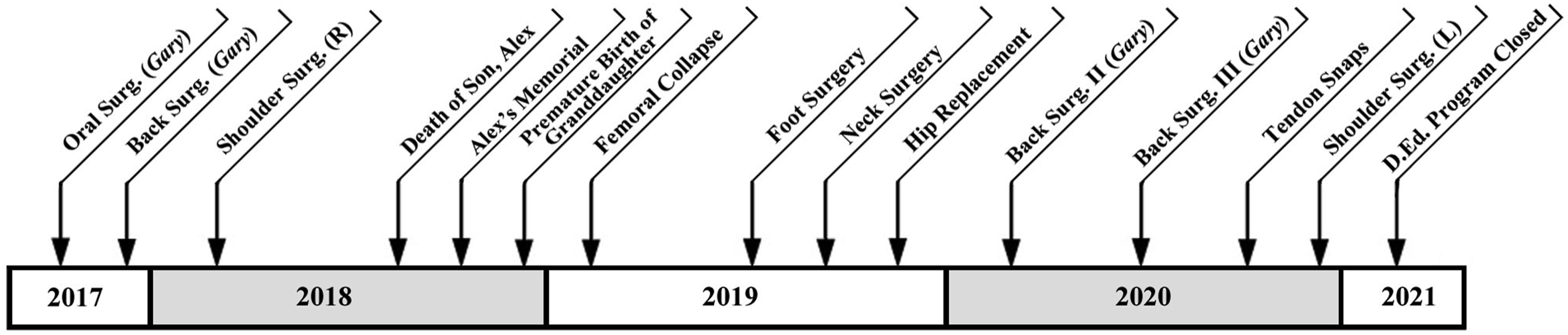
I scheduled surgery for just after the last day of classes, so I could be well enough, though still in a sling, to begin the spring semester. More months of physical therapy would follow. Teaching 3 graduate courses during rehab was a challenge, but I remained hopeful that 2021 would bring the country together.
Meanwhile, Gary needed two additional back surgeries during 2020, in February and then in June. He was in almost constant physical pain during all I’ve described above. His recovery has been slow, but mostly steady. Teaching via Zoom afforded him some much-welcomed time to heal.
January 6, 2021 smothered the fragile flicker of optimism I had scrupulously cultivated. The horror of that day haunts me still. I’ve seen it before—in dying democracies succumbing to authoritarianism. Legitimate elections overturned with force and an ousted fascist-leaning leader re-installed. The certification of the election late that night brought some relief, but was short-lived as Republicans began to dismiss, or even support, the domestic terrorist attack and the brutal beating of Capital Police.
My Zoomed courses became my lifeline. Many of the students were MDs or in medical school, others worked in myriad health, non-profit, or education fields. Discussions on the novel coronavirus were numerous, but so were discussions on social justice and politics. I taught my social issues course with renewed intensity. My personal experiences with ongoing health issues became an asset to teaching educators in the health professions. Work is what I clung to; it’s the expression of a desire to help the human species evolve—because life is short.
A few weeks into the semester, I was informed that the university was discontinuing our D.Ed., effective immediately, and the M.Ed. was given one more year. My shock and dismay were made worse by the certainty that the field of adult education has never been more essential. The civil rights and labor union work of adult education organizations like the Highlander Center in Tennessee are foundational to our profession. Change-making is what we do. With urgency, Schmidt (2021) exhorts, “Possibly more than any other time in history our time is now, and the field of adult education is necessary for the world to move forward” (p.1). I feel that in every fiber of my being.
Learning and Teaching during a Cascade of Crises
Cixous (1993) argued that the only writing worth doing is writing that “we don’t have the courage or strength to write” (p. 32). That is how this writing feels. When I forced myself, words failed at first, then gushed through my fingers and onto the screen like projectile vomit. I stared at the 15,000 + word document I had regurgitated. Editing was a messy cleanup operation. I could write autoethnographically about living and teaching with RA; about teaching and working through a series of painful surgical procedures; about teaching through crippling grief layered with the unspeakable regret of missed opportunities; about teaching and learning remotely during a deadly pandemic and political upheaval; or about coping with professional uncertainty and neoliberal university administrators. I may write all those eventually. After all, as Cunliffe and Coupland (2012) argue, “whether we are aware of it or not, we make our lives and ourselves ‘sensible’ through embodied (bodily) interpretations in our ongoing everyday interactions” (p. 64). As I tell my students, embodied sensemaking through writing can help both writer and reader learn from human experiences.
In this piece, however, I attempted to get my mind around the onslaught of difficulties that swept me far from a sense of stability or normalcy. I lost myself. My body was no longer recognizable. Family photos seem strange. When I’m asked how many children I have, I don’t know how to respond. Nothing fits. Real understanding requires self-reflection on many levels, but my emotions are pulped and raw. Cixous (1993) challenges us to write about that which “hurts us, that makes us tremble, redden and bleed” (p. 32). My journal entries go on for pages about pain. Physical. Emotional. Intellectual. On Sept 30, 2019, for example, while recovering from neck surgery and waiting for a hip replacement, I wrote, “I try to find a way to make meaning of all this constant pain. I can’t take my mind off pain. Why have I been left to suffer with this [hip] pain for so damn long?” followed by pages on our failed health care system. I found little meaning apart from the recognition that “with 2 PhDs, decent insurance, and students and graduates who work at the same medical facility we frequent, Gary and I still can’t seem to navigate the system well enough to get the help we need.” This was written before the pandemic in 2020 when it became crystal clear to anyone paying attention that our health care system is flawed.
According to Pullen (2018), “Writing exposes, and with this exposure, we get cast in a sea of risk, insecurity and vulnerability” (p. 123). That exposure increases exponentially the more personal the narrative. Editing this explosion of painful prose down to an academically acceptable form is an attempt to cauterize it for reader consumption. I continue to struggle, striving to cope with the cards I’ve been dealt. The world seems filled with pain and loss. Empathy mingles with personal grief at each report of another unnecessary death.
America has very “wicked problems" (Sork, 2019). In 2019, Sork exhorted us to “shift our perspective as adult educators…to a more assertive, insistent, globally oriented approach to our work” (p. 144). In the aftermath of George Floyd’s murder, Charlottesville, the insurrection, rampant voter suppression, QAnon, and catastrophic events caused by climate change, Sork’s call for us to more aggressively fight “wicked problems” that are “malignant, vicious, tricky or aggressive” takes on renewed urgency (p. 144). Coping with an onslaught of pain and loss sharpened and intensified my practice as a critical adult educator. Feeling my mortality while watching the radicalization of the Alt-right solidify through the Trump presidency culminating in a violent attack on the Capitol police has shifted my focus on critical, feminist, and antiracist pedagogy into high gear.
Our work is imperative, crucial, and pressing. It should involve critical analyses of structural inequality, media messaging, capitalism, politics, environmental justice, climate change, immigration, systemic discrimination, and bigotry. I’m still in the process of reflection and healing, but one thing is clear. Time is short for all of us. If we fail to intensify our efforts as critical and, yes, activist scholars and teachers, we may soon find we have run out of it. So many people have suffered the loss of loved ones through this pandemic—6,500,000 globally in just a couple of years, and over 1,050,000 in the U.S. alone. We are all living with collective grief. Even those who are personally unaffected have been forced to reconcile with the fragility of human life on some level. All the events of the last few years sometimes meld into a cacophonous barrage of intensely painful thoughts and emotions. I now suffer from panic attacks. When that happens, I must step out of myself and focus on the imperative to “teach and learn a combination of feistiness, character, courage, and perseverance” (Newman, 2006) to fight these wicked problems.
From a purely embodied, physical perspective, the effects of so many surgeries cannot be simply “put behind me.” Each operation adds scar tissue that aggravates arthritic pain and exacerbates stiffness. I will never get back all I have lost in muscle tone, flexibility, strength, and stamina. The Bible (I Cor. 11:15) says that a woman’s hair is her glory—my glory is clogging my drains and breaking my vacuum. Pandemic stress has caused brain fog, burnout, malaise, and depression in a significant percentage of working adults, according to studies cited in the New York Times (Lyall, 2021). Given the events I’ve laid out, it’s not surprising that I’m experiencing those things in cycles…and in spades. Writing this helped me understand I should be patient with myself, even as the demands on my time and work-life continue to increase. Self-care has never been a priority for me. Now, it is essential for survival.
Despite loss and grief, however, I’ve gained renewed purpose and learned to better appreciate the power of my profession. As I work with doctoral students still in the pipeline, I can’t help but feel growing resentment about the decision to close our doctoral program. Our graduates are difference-makers. The current roster is no different. I work with them on their dissertations with renewed commitment to push them toward critical theoretical frameworks when appropriate, because income and wealth inequality is growing exponentially, the U.S. democracy may be on the verge of failing, and women, people of color, immigrants, and the LGBTQIA community are facing increasing, rather than decreasing, discrimination. My work to mentor emerging scholars feels crucial. Yes, I feel my mortality more than I ever have, but it is more than that. Authoritarian uprisings, expanding inequality, climate change, loss of reproductive rights, and burgeoning White nationalism require bold, activist educators. I want to be part of finding solutions and stopping the horrific turn toward fascism. Adult education has an important role to play in the future (Schmidt, 2021).
The combination of trying to understand why our son died, dealing with the healthcare system repeatedly, and living through a deadly pandemic while teaching medical students and physicians in our MEd program feels surreal at times, but it as an opportunity. I am in a unique position to help health professionals learn to reach and teach patients, families, residents, and medical students. Moreover, the daily news reports of increasing displays of racism, antisemitism, radical authoritarianism, and anti-democratic insurgency have elevated my game. In the spring of 2021, my classes took on a clearer exhortation to challenge inequitable beliefs and practices wherever they find them. The final assignment in my course on social issues was to design and conduct a workshop on their choice of topics dealing with diversity, inclusion, or equity with their colleagues or a community group. I recently received a text from a former student, a physician and educator, telling me he has turned his final project, a workshop to teach faculty physicians to recognize—and to speak up—when they witness discriminatory acts among patients, colleagues, or leadership, into a reality at his new institution. Moreover, he and a colleague have presented the workshop at a physicians’ conference. While that is not something easily listed on an annual report, it is exactly the type of feedback that drives my practice.
Issues around climate change, too, are no longer optional content for courses. Whether I’m teaching courses for remaining doctoral students or M.Ed. students, the disparate effects of climate change on the poor and the concomitant increases in human migration away from its most devastating effects should be included in discussions on social issues, medical education, research, popular culture and media, and adult learning. Our planet is in trouble (https://www.ipcc.ch/report/ar6/wg2/).
I will be honest. There are days when my joints are hot and swollen, my back is spasming and, momentarily, I consider early retirement. But there is so much more each one of us needs to do. The one constant in my life has been my desire to work for progressive social change. Yet has never been clearer to me that I should channel my frustrations, fears, and even my physical and emotional pain, into meaningful actions. Recent events present an ominous picture of the future unless scholars and teachers manage to stem this neoliberal tide. While I have always considered myself a critical educator, I am changed. My priorities have changed. None of us are guaranteed tomorrow, nor are we guaranteed a democracy, and equality is still illusive. Just as getting healthy again takes daily commitment, so too does educating for democracy and equity—physical therapy for citizens with the goal of global conscientization (Freire, 1990). I now design each course with an outreach assignment, like the one mentioned above. Rather than papers for my eyes only, I challenge students to educate their colleagues and communities on topics ranging from critical information literacy to citizenship to racism to climate change. I offer options, depending on individual student needs, like creating a video presentation and putting it online, writing an Op-Ed for a local newspaper, or working to inform undergraduate student organizations on the importance of voting. I see my graduate courses as training grounds for activism. If a student mentions a desire to man a voter registration booth, for example, are you flexible enough to help her turn that desire into an assignment to encourage action?
Moreover, I am grateful to be able to point to some of our graduates as examples of possible careers dedicated to justice and equity work. Dr. Amber Sessoms developed, Natural Inclination, LLC, where she had found success helping businesses and school systems to “(1) understand the power of devaluation of minoritized groups; (2) develop the power to disrupt devaluing beliefs; and (3) translate these new understandings into a powerful stance of divestment from policies and practices that maintain inequity” (aninclination.com). Or Dr. Kathryn Sandoe, who coaches individuals and businesses to examine their leadership practices more critically with a focus on equity, purpose, and service (kathrynsandoe.com). Students in our courses should understand their potential to do more than just find personal success. In this unprecedented point in history, amidst a global struggle between democracy and authoritarianism, adult educators can have a significant positive impact on the future. I urge those reading this to consider how they can meet that challenge. How might you encourage civic action and activism with your assignments? What other ways can you promote critical civic engagement?
Finally, I now use current events to create discussion groups. Each semester, I practically redesign each course based on events: book-banning, authoritarian uprisings, capitalism’s abuses of the global south, voting rights, gun deaths, gender inequality, anti-immigrant groups, and myriad other issues headlining each day. Many students are busy and, unfortunately, too apathetic to notice. I no longer consider that acceptable if they are to graduate from our program. We need all of us in the fight, so I keep content, discussions, and assignments current with realities that face the marginalized.
This autoethnography explored some of the emotions and thought processes involved in my efforts to find purpose and to wear it like a life preserver through a sea of personal loss and compounded pain. Autoethnography requires that researchers “strip away the veneer of self-protection that comes with professional title and position…to make themselves accountable and vulnerable to the public” (Denzin, 2003, p.137). I have certainly done that here but, in the process, I found resolve to fight the rising tide of purposeful ignorance brought on by technological algorithms and greedy profiteers who create media echo chambers of prejudice, propaganda, and perfidia. Life is precious and too tenuous not to spend it in service to democracy, equity, reparation, radical love, and lifelong learning.
Footnotes
Declaration of Conflicting Interests
The author(s) declared no potential conflicts of interest with respect to the research, authorship, and/or publication of this article.
Funding
The author(s) received no financial support for the research, authorship, and/or publication of this article.
