



Abstract
In higher education, across countries, a large share of students choose to study economics. Although there is only a small difference in the share of female and male students in that field, there is robust empirical evidence of a gender gap in economic competencies, showing that male students in most cases outperform female students. There is a broad discussion about the differences in gender-specific socializations that cause this gender gap. However, no research exists on the long-term effects of this gender gap. This study uses longitudinal and representative data of N = 1397 Swiss students (824 female students) to analyse the gender-specific effects of economic competencies at the end of the upper secondary level on their aspiration and decision to study economics. The results show that economic knowledge and interest in economics have a substantially stronger effect on the choice of economics for female students. The aspiration to study strongly mediates these effects. We argue that these results can mainly be traced back to different interests and self-perceptions of skills and abilities in economics caused by gender-specific socialization. Possible implications of gender socialization and discrimination in economics for secondary and higher education and for the labour market are discussed.
Keywords
Introduction
Choosing a course of study in higher education can be described as one of the most important and complex decision-making processes for many young students (e.g. Eccles, 2009). A recurrent finding that researchers observe with regard to subject choices are different preferences between female and male students that do not lead back to typical explanatory factors, for example, (domain-specific) skills and abilities, interests or academic self-concepts (e.g. Eccles, 2009; Wang and Degol, 2017). For instance, other things being equal, female students are more likely to choose to study humanities or social science subjects, while male students are more likely to choose to study science, technology, engineering and mathematics (STEM; see Wang and Degol, 2013). Expectancy-value theory (EVT) describes these effects on subject choices based on gender-specific socialization. In this context, it is asserted that female and male students differ in their domain-specific expectancies and values, which can often lead back to different cultural socializations based on gender-specific and occupational stereotypes (e.g. Eccles, 2009). Consequently, students choose courses of study that do not necessarily fit their skills, abilities, and interests, which often leads to lower performance, dissatisfaction, and a higher dropout (e.g. Bohndick et al., 2018; Schmitt et al., 2008).
Looking at the landscape of the fields of study in higher education, economics 1 represents the most popular field worldwide (Organisation for Economic Cooperation and Development (OECD), 2017). Although approximately one out of four students is enrolled in an economics course of study, the majority of studies on the gender gap focus on STEM because researchers have identified this field as the only field that is clearly male-dominated in terms of gender distribution (Perez- Felkner et al., 2017). According to the share of male and female students in economics, most countries show a relatively small gender gap of approximately 45% female students to 55% male students (e.g. Germany: German Federal Statistical Office (German FSO), 2019; US: National Center for Education Statistics (NCES), 2018). However, many studies show a significant gender gap with regard to performance and in part with regard to interest in economics as well (e.g. Brückner et al., 2015b; Förster et al., 2018; Jensen and Owen, 2001). Over the past few decades, several reasons for this gender gap have been researched (for a literature review, see Asarta et al., 2014). In addition to methodological issues when assessing economic knowledge (e.g. Walstad et al., 2013) and differences in basic competencies (mathematics vs verbal skills, see, e.g. Anderson et al., 1994), the different socializations of female and male students is discussed as a crucial explanatory factor (e.g. Brückner et al., 2015b). In this regard, some studies mention ‘that economic topics and content play a greater role in male socialization than in female socialization’ (Brückner et al., 2015b: 506). For instance, there is robust empirical evidence of stronger parent-child financial discussions in early ages with sons than with daughters (especially father-son discussions; e.g. Shim et al., 2010). According to this, it must be assumed that female students are less likely to choose an economics course of study at university. Considering the share of female and male students in economics in higher education, this fact seems contradictory to the discussion on the gender gap in economics education. Thus far, it is not clear whether there actually is an effect of the gender gap in economic competencies on students’ subject choices in higher education at all. This is surprising, especially when considering (a) the gender pay gap in male-dominated occupations (e.g. managerial positions; see Schoon and Eccles, 2014) to which an economic course of study typically leads, (b) the great influence of gender-stereotyped self-perceptions and values on career aspirations and choices (e.g. Watt and Eccles, 2008), and (c) the continuing discrimination against women in the labour market (e.g. England, 2010).
Against this background, this study aims to answer the question of the effects of the gender gap in economics education by analysing the gender-specific effects of high school graduates’ economic competencies on their choice to study economics.
Theoretical background
The concept of economic competencies
There is a wide range of definitions of economic competencies. In our understanding, economic competencies comprise the ability to act as informed citizens within modern societies by being able to understand and assess economic issues (see also Walstad, 1994). 2 Therefore, we define economic competencies as
Economic knowledge and skills required to solve economic issues and to evaluate suggested solutions to economic problems.
Motivation to address and interest in economic issues.
Attitude towards economics and value-oriented dispositions to reflectively solve economic issues and to appropriately judge solutions.
This definition strongly relates to the general definition of competence by Weinert (2001) and considerations by Beck (1989). Economic knowledge and skills form the core dimension, which is consistent with many other definitions. A main difference can be seen in the consideration of further facets (interest, intrinsic motivation, attitude and value-oriented dispositions). Interest in economics represents students’ dispositional preferences in solving economic issues, which is consistent with the theoretical assumption that interest is described as a relationship between a person and an object of interest (for details, see person-object theory; e.g. Krapp, 1993; Renninger et al., 1992). In contrast, intrinsic motivation describes the extent to which students solve an economic issue for its own sake. Therefore, it is not just object—but also process-oriented, considering self-determination theory (e.g. Ryan and Deci, 2000), which defines motivation by how strong one’s basic needs (autonomy, social integration and competence) are fulfilled. The attitudes towards economics determine students’ willingness to take an economic perspective (see Beck, 1993; Walstad and Soper, 1983). Finally, value-oriented dispositions represent students’ ability to reflectively solve economic issues (e.g. by considering opinions of other stakeholders).
The ‘Gender Gap’ in economic competencies
There is strong empirical evidence of a gender performance gap in terms of economic knowledge (Asarta et al., 2014). A robust finding is that male students achieve higher scores on economic knowledge tests than female students (e.g. Brückner et al., 2015b). These differences in economic knowledge have been debated for more than 50 years (e.g. Siegfried, 1979). However, the causes of this gender gap still cannot be fully identified (Asarta et al., 2014). Less evident are gender differences regarding further dispositions, for example, interest in, intrinsic motivation for, and attitude towards economics. At the secondary level, studies show that male students have greater interest in, greater intrinsic motivation for and better attitudes towards economics than female students (e.g. Beck and Wuttke, 2004; Förster et al., 2018; Schumann and Eberle, 2014). In contrast, in higher education, Arnold and Rowaan (2014) found that female students are more intrinsically motivated, whereas male students are more extrinsically motivated.
Several reasons for this gender gap are discussed in the literature. From a social psychological perspective, researchers suggest that gender differences in economics originate from a different cultural socialization (e.g. Brückner et al., 2015b). It is assumed that male students are more interested in economic issues because they perceive these as more relevant to their lives than female students do (ibid.). In addition, researchers suggest that these differences are caused by teacher role-model effects in both secondary and higher education (see Arnold and Rowaan, 2014; Asarta et al., 2014). Others suggest that the reason for the lack of interest in economics on the part of female students originates from a (school) ‘curriculum that excludes topics and methods that appeal to women’ (Jensen and Owen, 2001: 323). There is empirical evidence that this higher interest on the part of male students strongly mediates the gender effect on economic knowledge (Förster et al., 2018). Finally, researchers suggest that basal competencies (numeracy vs literacy) play a crucial role in gender differences in economic knowledge (e.g. Schaeper, 2013) because solving economic issues requires both mathematic abilities (numeracy) and verbal abilities (literacy) (e.g. Brückner et al., 2015b). Separating these factors, the gender gap is significantly stronger with regard to economic numeracy than for economic literacy (Brückner et al., 2015b). Thus, there is also a broad discussion on the testing format of economic literacy/numeracy tests (ibid.).
In contrast to this discussion, meta-analytic findings show that the gender gap in economics is often overestimated and has annually decreased over the past few decades (e.g. Johnson et al., 2014). In addition, the fact that most of the research on this topic focuses on differences in economic knowledge must be criticized. There is little research on further sociological and psychological determinants, for example, cultural socialization, interest in economics and economic self-concept (e.g. Brückner et al., 2015a).
Gender effects on the choice to study economics
Considering subject choices, it is assumed that students strive to choose a course of study that best fits their skills, abilities, and (occupational) interests and preferences or, in other words, a course of study that is (a) valuable and (b) represents a manageable task (Schoon and Eccles, 2014). However, following theoretical considerations, for example, EVT (Eccles and Wigfield, 2002), this assumption is disrupted by different social psychological mechanisms leading to individual behaviour that cannot be entirely traced back to interests or skills. According to recent literature reviews on this topic, gender-related stereotypes and biases are one of the main factors explaining the gender gap in subject choices in higher education (Wang and Degol, 2017). Schoon and Eccles (2014) point to the crucial role of gender socialization, gender essentialism, gender discrimination and the cumulation of experiences over time. There is strong empirical evidence of the influence of these factors on students’ educational aspiration and attainment (Schoon and Eccles, 2014), where aspirations function as a mediator for choices (Eccles and Wigfield, 2002). 3 Consequently, male and female students are more or less likely to choose a course of study at the university level independent of their skills, abilities and interests.
Against this background and the explanation of the gender performance gap in economics, the broad discussion regarding the STEM field can be transferred to the field of economics. Therefore, it must be assumed that similar effects can be found for choosing economics as the course of study. However, to the best of our knowledge, there are no studies that have observed gender-specific effects of upper secondary school students’ economic competencies on their post-secondary subject choices. Although there is no clear gender gap in terms of the gender distribution in economics, the question of whether this share of students is the result of unadulterated self-selection processes must be raised. To answer this question, it is also crucial to consider the specific characteristics of the higher education system, which is examined as part of the explanation of the choice of the course of study (Brückner et al., 2015a). This consideration becomes important, especially against the background of transferability and the comparison of the empirical findings (ibid.).
Transition from school to university in Switzerland
To deliver a better understanding of the empirical part of the study, the Swiss transitional structure in education is briefly described. The traditional path from secondary school to university in Switzerland is represented by baccalaureate schools (BSs, academic track, attended by approximately 20% of a cohort). 4 Students who are following this track can gain a general qualification for university entrance. There are no entrance constraints regarding study choices (except for medicine) for BS students. 5 The rate of students transitioning from BSs to universities is relatively high. Approximately 90% of all BS students in a cohort move on to university within two years after graduation. At BSs, all students must choose ‘Economics and Law’ as a basic or advanced course. 6 In this regard, all BS students gain at least a basic education in economics. In Switzerland, the gender distribution gap regarding economics is relatively high, with approximately 65% of male and just 35% of female students (Swiss Federal Statistical Office (Swiss FSO), 2018b).
Research question and hypotheses
Based on the theoretical background, we address the following research question:
How do the effects of the economic competencies of upper secondary female and male students differ with regard to their choice to study economics?
Considering the arguments with regard to gender stereotypes in economics and results on gender socialization, which are related to EVT, we assume that female students only choose economics if they have higher economic knowledge and skills and a higher interest in economics compared to male students. Therefore, two hypotheses will be tested:
H1: The effect of economic knowledge and skills on the probability of the decision to study economics is higher for female than for male students.
H2: The effect of interest in economics on the probability of the decision to study economics is higher for female than for male students.
Due to the lack of research regarding the other facets of economic competencies that we modelled (intrinsic motivation, attitude towards economics, and value-oriented dispositions), no hypotheses are formulated for these.
Method
Study design
The study was based on longitudinal data with two measurement points (T1 and T2). T1 was in the spring/summer of 2011 in the last year of upper secondary education, while T2 was in the spring/summer of 2016. At T1, students’ economic knowledge/skills and academic abilities (cognitive ability, mathematics and verbal skills) were tested via achievement tests. In addition, further facets of economic competencies (interest, intrinsic motivation, attitude, and value-oriented disposition) as well as study aspirations, school grades and sociodemographic variables were examined via a questionnaire. At T2, educational choices (e.g. study choices) and variables pertaining to students’ academic success (not part of this paper) were examined.
Sample
The sample was drawn from the population of all BS students from the German-speaking part of Switzerland who graduated in the summer of 2011. This population comprised 584 classes (10,091 students) and was separated into the following explicit strata: (a) BS students with the advanced course ‘Economics and Law’ (BS Advanced) and (b) BS students with another advanced course (BS Basic). In addition, implicit stratification of the sample based on gender, canton (state) and age was used. Fifty BS classes were randomly selected from each of the two explicit strata with equal probability (altogether 1838 students). At T1, 79 classes participated (1277 students). There were no systematic differences between the classes that participated and the classes that did not (Schumann et al., 2013). However, the classes in the population were nested disproportionally regarding the two explicit strata. Therefore, the selection probabilities of the classes differed between the two explicit strata, which led to the necessity of stratum-specific weighting.
A total of 947 students agreed to participate in a follow-up study and provided e-mail and/or postal addresses, and 728 of these were still valid at T2. Finally, 367 BS students participated in T2. Altogether, 910 BS students dropped out (unit non-response). We compared the students who only participated at T1 and the students who participated at T1 and T2 and found moderate differences with regard to all facets of economic competencies, school grades, cognitive ability, and mathematics and verbal skills (0.17 < d < 0.47). Inverse-probability weighting is one way to address this issue (Brick and Montaquila, 2009). Therefore, we used the variables that caused unit non-response within a logistic regression model to predict the probability of remaining (coded as 1) or dropping out (coded as 0). The reciprocal value of the probability was used as the individual weight, and four weights had to be trimmed to prevent overweighting (Kish, 1992). After weighting, the only significant difference between the students who participated at T1 and T2 and the students who only participated at T1 was with regard to economic knowledge and skills, with a small effect size (d = 0.26). The weighted longitudinal sample is presented in Table 1.
Longitudinal sample (weighted).
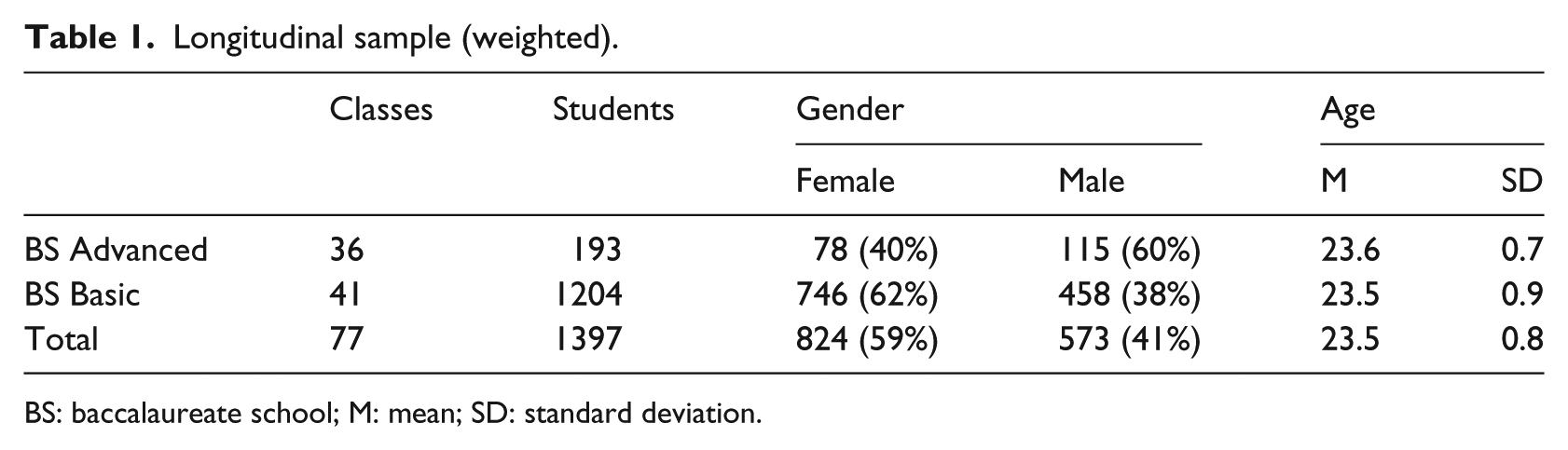
BS: baccalaureate school; M: mean; SD: standard deviation.
Instrument
At T1, achievement tests were used to measure economic knowledge and skills, cognitive ability, and mathematics and verbal skills. In addition, a paper-based questionnaire was used to ask about the further facets of economic competence as well as about study aspirations and sociodemographic variables. At T2, computer-assisted telephone interviewing (CATI) was used to ask about the students’ choice of course of study. The CATI was conducted by trained interviewers at the Survey Lab of the University of Konstanz. 7 Table 2 provides an overview of the instruments used to measure students’ competencies.
Overview of the instruments used to measure students’ competencies.
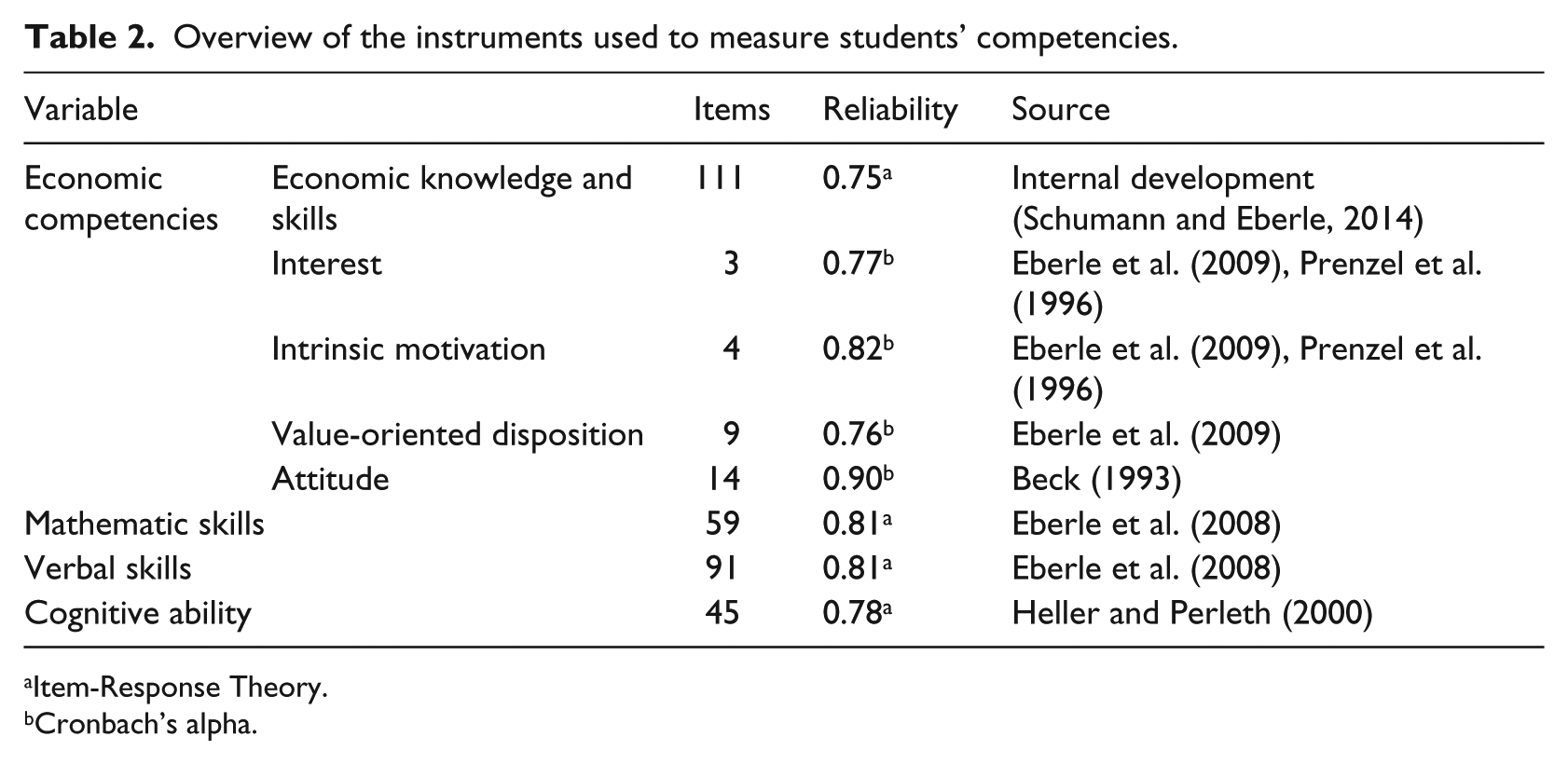
Item-Response Theory.
Cronbach’s alpha.
Economic knowledge and skills
To assess students’ knowledge and skills in economics, an internally developed test was used (for details, see Schumann and Eberle, 2014). The test comprised 111 items that were adopted in a multi-matrix booklet design (90 minutes testing time). The items were subdivided into three dimensions: (a) economics, (b) business and administration and (c) accounting. However, based on high latent correlations between these dimensions and the comparison of different model fit indices (deviance, AIC, BIC), the two- or three-dimensional model was not superior to the one-dimensional model (ibid.). Therefore, we refer to the less complex, one-dimensional model of economic knowledge and skills.
Further facets of economic competencies
For interest and intrinsic motivation in solving economic issues, items by Prenzel et al. (1996) were used on a four-point Likert-type scale (1 =‘does not apply’ to 4 =‘applies’). These items were adapted to the subject “Economics and Law” in secondary education (Eberle et al., 2008). 8 To measure students’ attitudes towards economics, a translated and validated version of the “Attitude Towards Economics Test” by Walstad and Soper (1983) was used (see Beck, 1993). 9 These items were measured on a five-point Likert-type scale (1 =“disagree” to 5 =“agree”). Finally, the items about value-oriented dispositions originated from Eberle et al. (2009) and were also measured on a four-point Likert-type scale. 10
Aspiration and decision to study economics
The aspiration to study was measured by three items. The first item asked about students’ general aspiration to study; the responses ranged from 1 to 4 (1 =“Yes,” 2 =“Probably yes,” 3 =“Probably not” and 4 =“No”). If students (probably) intended to study, the second and third items asked about their most and second most intended course of study. The categorization of the Swiss Higher Education Information System (SHIS, for the latest versions, see Swiss FSO, 2018a, 2019) was used to categorize the named courses of study. If a student (probably) intended to study and named a course of study from the field of economics as the first and/or second most intended course of study, the intention to study economics was recorded as “yes” (coded as 1). Other cases were recorded as “no” (coded as 0). The subject choice describes students’ first chosen field of study after graduating from school. The named course of study was again categorized by SHIS categorization. In the present study, the choice of economics as the major is the focus. If the named course of study came from the field of economics, the subject choice was recorded as “yes” (coded as 1). Otherwise, it was recorded as “no” (coded as 0).
Control variables
Based on the theoretical background, the following variables are considered control variables: First, to control for individual skills and abilities, basic academic abilities (cognitive ability, and mathematics and verbal skills) were tested using tests by Eberle et al. (2008) and the ‘KFT 4-12 + R’-Test (Heller and Perleth, 2000). These tests were also used in a multi-matrix booklet design (90 minutes testing time). Second, school grades in the subjects of Mathematics, First Language 11 and Economics and Law at the end of school and the economics advanced school course (0 = BS Basic, 1 = BS Advanced) were used to control for prior schooling and school characteristics. Finally, the Highest International Socio-Economic Index of Occupational Status (HISEI; see Ganzeboom et al., 1992) was used to control for family background.
Analyses
Missing values: Missing values (item non-response) were mainly found for all facets of economic competencies, cognitive ability, mathematics and verbal skills of approximately 24 to 29% of individuals. 12 Hence, a two-level multiple imputation model using chained equations with the function mice.2l.pan of the software package mice in R was used (van Buuren and Groothuis-Oudshoorn, 2011). At least, seven predictor variables were used to calculate twenty imputed datasets. School classes were considered the cluster variable. In addition, individual weights were included in the imputation model. Finally, fixed and random effects, as well as the fixed effects of class means for cognitive variables, were considered.
Nested data structure: The sample was nested in 77 school classes. Therefore, standard errors were adjusted by using classes as the cluster variable referring to the sandwich estimator in MPlus (Muthén and Muthén, 2017). In addition, school grades were standardized by school class mean.
Further analyses: To estimate individual abilities based on the achievement tests, mean-weighted likelihood estimators (WLE, Warm, 1989) were calculated on the basis of item response theory (IRT) with the software programme ‘ConQuest’ (Wu et al., 2007). The estimators showed good reliability (see Table 2). Estimators for the further facets of economic competencies followed classical test theory and showed good reliability as well (see Table 2). To answer the research question, two path models separated by female and male BS students were calculated. Economic competencies functioned as the independent variable. Basic academic abilities (cognitive ability, mathematics and verbal skills), school grades, and HISEI were modelled as control variables. The decision to study economics at university was modelled as the dependent variable, and the aspiration to study economics functioned as a mediator. Linear probability modelling (LPM) was used to formulate a linear regression model with binary dependent variables (see Mood, 2010). This approach allows the comparison of the coefficients of the two path models (Mood, 2010).
Results
Descriptives and intercorrelations
First, we analysed the share of students in the field of economics. In total, 246 students chose economics after graduation from school. Sixty-five percent of these students were male (n = 161). This result is consistent with federal statistical data (Swiss FSO, 2018b). Second, we analysed the differences in economic and further competencies between female and male students considering (a) all the students in the sample, (b) all the students who intended to study economics, and (c) all the students who chose economics (see Tables 6 to 8 in the Appendix 1). In general, male students scored higher in economic competencies, mathematic skills, and cognitive ability, whereas female students scored higher in verbal skills. These results are in line with those of previous studies (e.g. Brückner et al, 2015b; Wang and Degol, 2017).
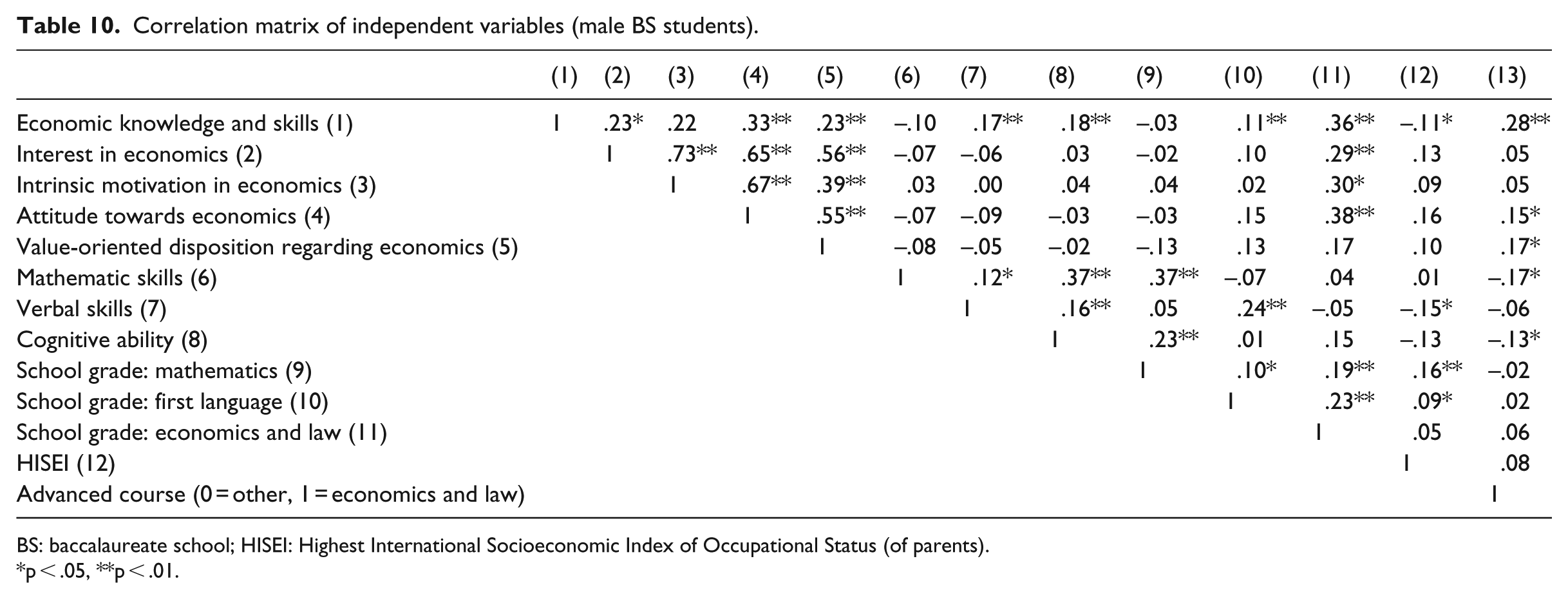
Tables 9 and 10 in Appendix 1 show the correlation matrices among all the independent variables that were considered in the empirical model separated by male and female BS students. With the exception of the further facets of economic competencies (interest, intrinsic motivation, attitude and value-oriented disposition), the correlations were moderate or small. In addition, there was a moderate correlation between gender and the intention (Cramer-V = .29, p < .01) as well as the decision (Cramer-V = .23, p < .01) to study economics, showing that male students were more likely to intend/decide to study economics. Table 3 presents the correlations between the endogenous and exogenous variables of the path model separated by gender. In general, there were moderate to strong correlations between all the facets of economic competencies and the intention and decision to study economics. Correlations regarding the intention to study economics were, in general, stronger than those regarding the decision to study economics. Finally, students with the advanced school course ‘Economics and Law’ had a higher intention to study economics and were more likely to decide to study economics. There were several differences between male and female students. First, for male students, there were stronger correlations between economic competencies and school grades in economics and the intention/decision to study economics. Furthermore, negative correlations between further competencies (mathematic and verbal skills) and the intention/decision to study economics could only be found for male students. Finally, the correlation between the intention and decision to study economics was stronger for female students than for male students.
Correlations between exogenous and endogenous variables.
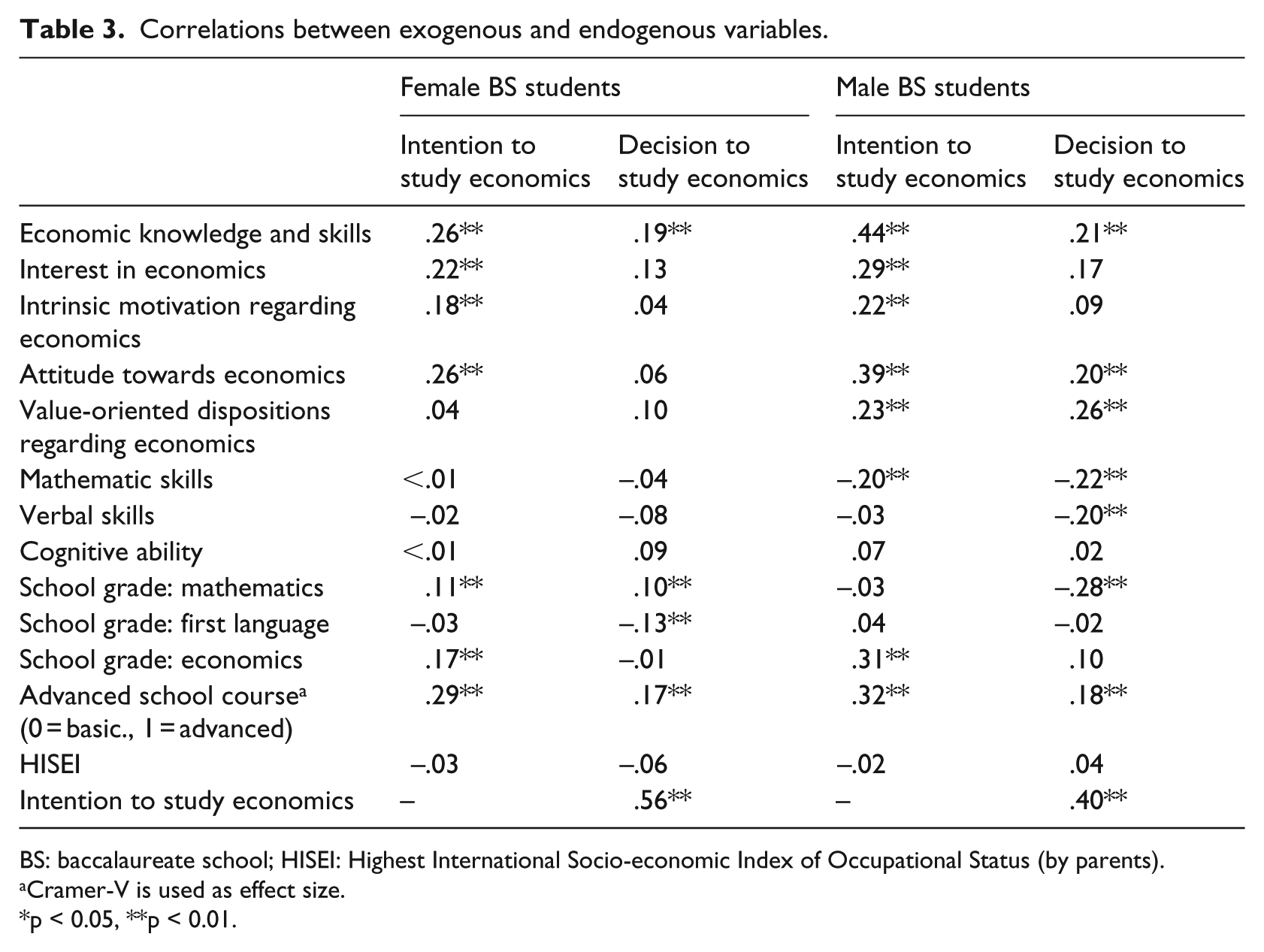
BS: baccalaureate school; HISEI: Highest International Socio-economic Index of Occupational Status (by parents).
Cramer-V is used as effect size.
p < 0.05, **p < 0.01.
Gender-specific effects regarding the prediction of the choice to study economics
Because of the large number of considered variables, the results of the path analyses are presented in tabular form (see Tables 4 and 5).
Gender-specific path coefficients of the path models (direct effects).
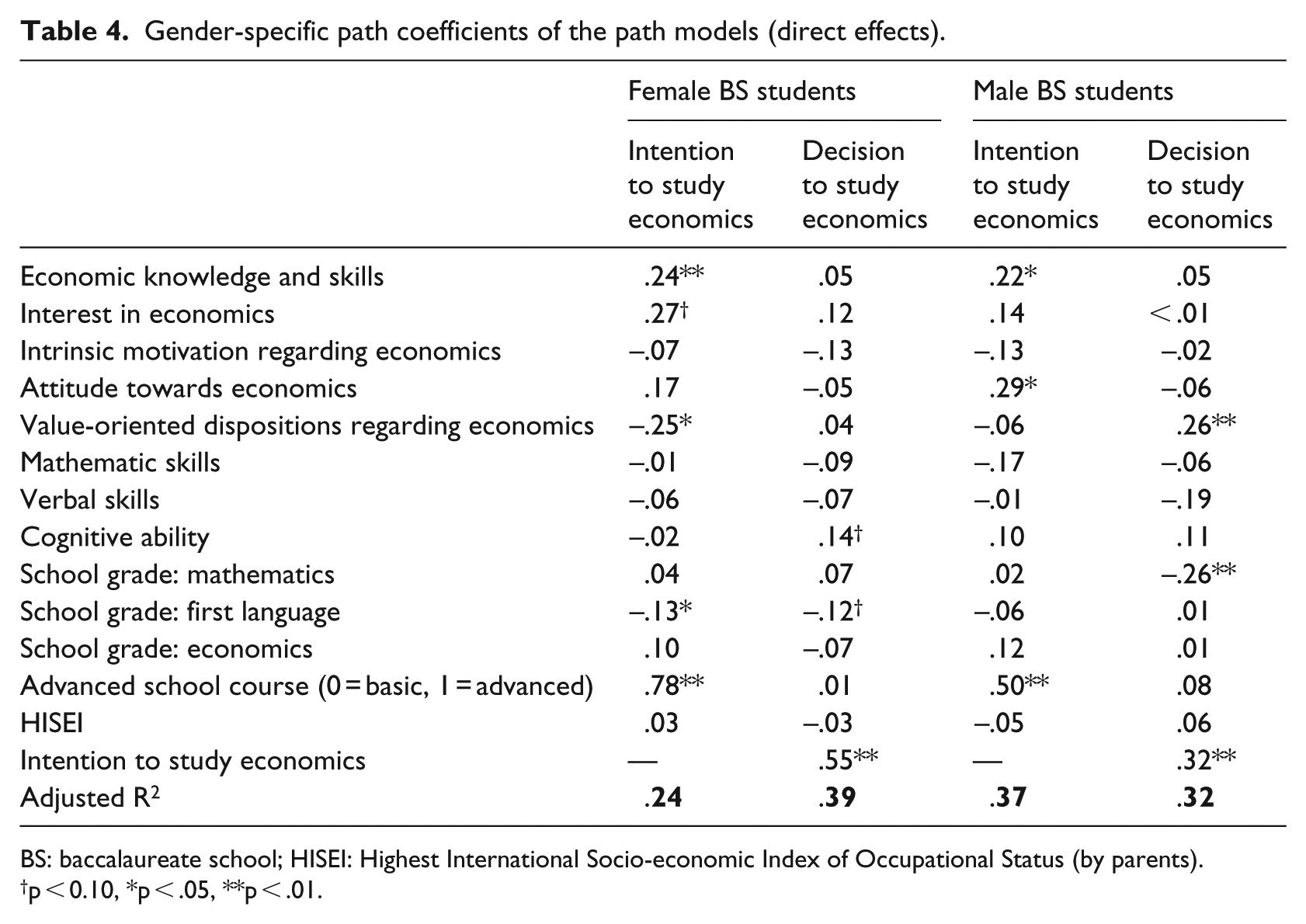
BS: baccalaureate school; HISEI: Highest International Socio-economic Index of Occupational Status (by parents).
p < 0.10, *p < .05, **p < .01.
Gender-specific indirect and total effects on the choice to study economics mediated by the intention to study economics.
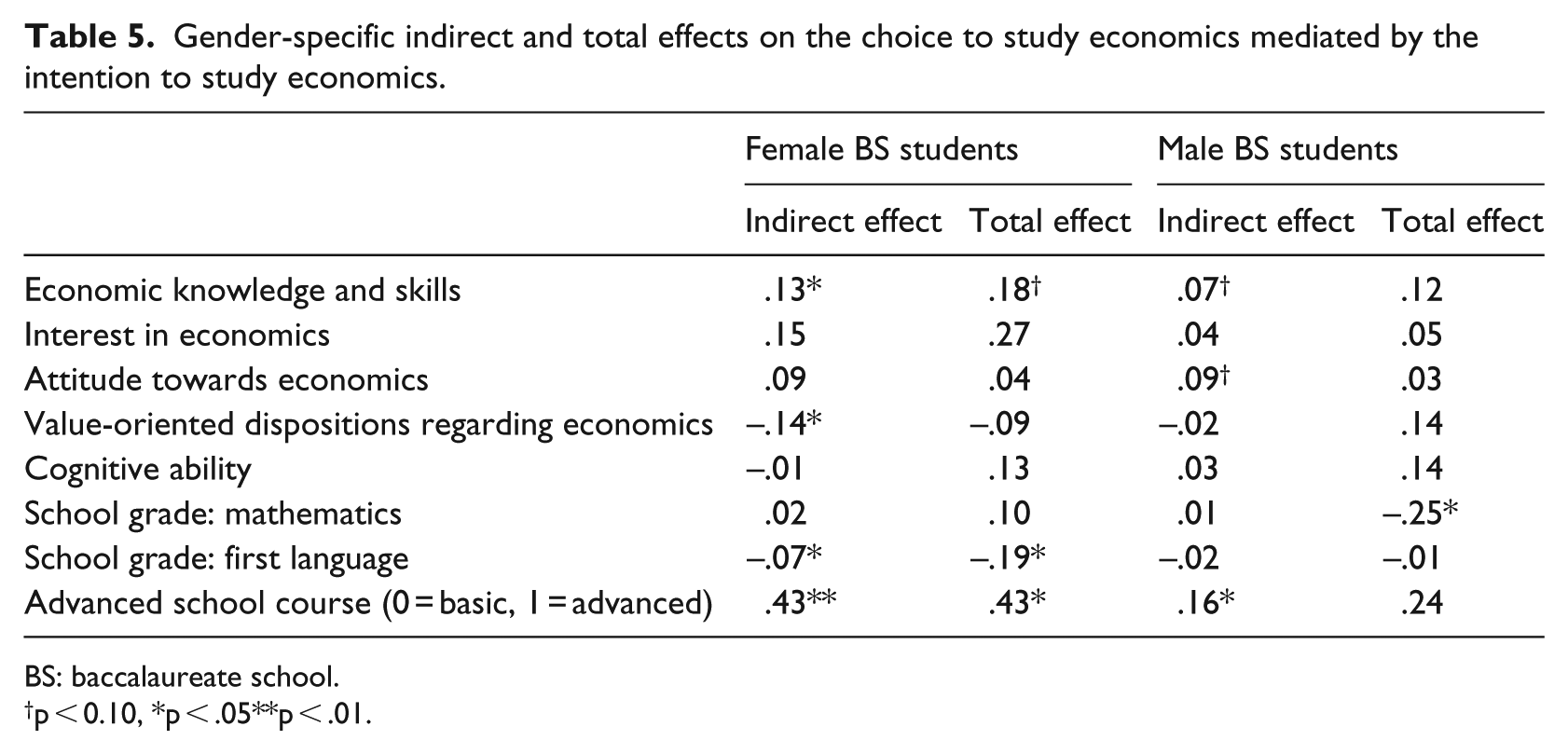
BS: baccalaureate school.
p < 0.10, *p < .05**p < .01.
Considering the direct effects of the two path models (see Table 4), most of the crucial differences regarding economic competencies could be found for attitude towards economics and interest in economics. While female students’ interest in economics was predictive of the intention to study economics, male students who reported higher attitudes towards economics were more likely to intend to study economics. In addition, school grade in mathematics was a negative predictor for male students. In contrast, school grade in first language was a negative predictor for female students. Therefore, female students who were better in first language were more likely to decide for a field of study other than economics. The same result is true for male students who were better in mathematics at school. Finally, the intention to study was more predictive for female students than for male students, that is, female students more likely chose the field of study they had intended to. By combining bivariate and multivariate analyses, it becomes obvious that the intention to study represents a strong mediator. To analyse these mediating effects, Table 5 shows the indirect and total effects of the variables that became predictive in the gender-specific path analyses represented by Table 4.
Because of the stronger effects of the intention to study economics for female students, the indirect effects of economic competencies became stronger for them, except for attitude towards economics and value-oriented dispositions. The total effect of female students’ interest in economics was moderate but did not become significant in this sample. The results indicate different self-selection processes between female and male students regarding the choice to study economics: Female students referred stronger to their knowledge, skills and interest in economics. Thus, both hypotheses (H1 and H2) can be confirmed. Furthermore, contrary effects could be found for school grades in mathematics and first language (see above). Finally, female students were more likely to decide to study economics when they attended an advanced course in Economics and Law in upper secondary school; this effect was less strong for male students.
Conclusion
In the present study, we investigated the gender-specific effects of economic competencies at the end of upper secondary school on the choice to study economics at university. Based on the importance of gender-specific stereotypes for educational aspiration and attainment (e.g. Eccles and Wigfield, 2002) and the significant gender gap in economic competencies (Asarta et al., 2014), we assumed that the effects of economic competencies on the probability of the intention and decision to study economics differ between male and female students. To analyse this question, we used longitudinal data from a representative sample of Swiss students. Despite the annual decline in gender differences in economic knowledge (Johnson et al., 2014), we could identify a strong gender gap in the economic competencies of students at the secondary level. Considering the choice to study economics, we found that economic knowledge and skills as well as interest in economics were more predictive for female students than for male students and were strongly mediated through their aspiration to study economics. Therefore, both hypotheses could be confirmed. According to this, female students were only more likely to decide to study economics if they had higher economic knowledge and skills and were more interested in economics, compared to male students. In addition, female students were more likely to decide to study economics if they had taken the advanced course ‘Economics and Law’. Finally, there was a negative effect of school grades in first language on the choice of economics for female students and of school grades in mathematics for male students.
Based on the theoretical considerations, we interpret these findings as follows: It is likely that these effects can be lead back to differences in gender-specific socialization regarding economics in modern societies. Since economics can be seen as a typical ‘male’ domain (Brückner et al., 2015b), female students choose this specific environment only if they have comparatively high economic knowledge and skills as well as interest in economics. Otherwise, female students might perceive this field of study not being valuable enough or being too difficult to manage. With this in mind, it can be assumed that female students have a lower economic self-concept than male students. Considering the negative effects of the school grades, the results are in line with those of previous studies (e.g. Wang and Degol, 2013): Female students who were better in first language were probably more likely to choose humanities or social sciences instead of economics. Similarly, male students were probably more likely to choose STEM instead of economics if they performed better in mathematics.
Some limitations and open questions must be mentioned. First and foremost, with our data, we are not able to empirically prove the causal mechanisms that lay behind the gender-specific effects of economic competencies in detail. Although it is very likely that the effects of gender stereotypes play a crucial role, we did not ask about factors that are important in this matter, for example, expectations of parents, peers, significant others, or teachers. Future research should address these aspects in more detail to explain the causal effects. Second, because of sample size, we did not differentiate between different courses in economics studies. Doing so would have led to the necessity for several multinomial logistic regressions, including a nominal mediator. Therefore, effect sizes might be biased because of the heterogeneity within the group ‘economics’. Future research should consider this issue by providing a larger sample and a more complex empirical model. In addition, it would also be necessary to include another point of measurement in order to collect data about economic competencies and the intention to study economics separately. Third, although there was a moderate effect of interest for female students, it did not become significant; this is probably also an issue of sample size. Therefore, this result must be interpreted carefully and require further investigation. Finally, we did not measure students’ domain-specific self-concept in economics. According to EVT, self-concept is the more proximal predictor explaining subject choices because it reflects students’ conviction in their abilities. Future studies should measure self-concept in addition to students’ skills and abilities at the end of upper secondary education. Against this background, we strongly recommend further investigations on this topic to replicate these findings, particularly due to system-related characteristics (e.g. the relatively high gender-gap in economics at higher education) of the Swiss education system regarding the transition from school to university.
Regardless of these limitations and open questions, this study provides the first longitudinal data on this matter. There are several implications that can be derived from our results. First and foremost, the study provides empirical evidence that the gender gap is not only visible in the field of STEM but also in the field of economics. Thus, (educational) measures applied in the field of STEM should also be transferred to the field of economics. Considering economic education at the upper secondary level, the importance of conveying a picture of economics that is not a typically ‘male’ domain and in which female students can be as successful as male students is crucial. In this context, interventions, such as campaigns that invite female role models from the academic field to come and visit high schools to encourage female students to consider pursuing economics at the A-level, are one possible way of dealing with this gender gap (for details on role-model effects in STEM, see, e.g. Solanki and Xu, 2018). Therefore, it is important to show female students that careers in economics match their skills and interests and to eradicate stereotypes about women and economics that would cultivate their interest in economics (Wang and Degol, 2017). However, so far, it is not clear which interventions at school show positive long-term effects on female students’ achievement, interest and behaviour (Wang and Degol, 2017). To effectively eradicate gender-specific stereotypes, it is suggested that educators must intervene earlier (e.g. in lower secondary education at least, Wang and Degol, 2017). It is remarkable that, although female students are more selective about their economic competencies when deciding to study economics, the gender performance gap in higher education still exists (Brückner et al., 2015b). In addition, although graduation rates in economics differ only slightly between male and female students, the greatest number of positions in middle and top management are still occupied by men (e.g. Einarsdottir et al., 2018), which can in part be traced back to gender discrimination (Schoon and Eccles, 2014). Therefore, the discussion of our results should be continued in higher education and the labour market as well. In summary, these results support meaningful empirical evidence of gender-specific effects on different levels of education as well as on transitions between those levels.
Footnotes
Appendix 1
Correlation matrix of independent variables (male BS students).
| (1) | (2) | (3) | (4) | (5) | (6) | (7) | (8) | (9) | (10) | (11) | (12) | (13) | |
|---|---|---|---|---|---|---|---|---|---|---|---|---|---|
| Economic knowledge and skills (1) | 1 | .23* | .22 | .33** | .23** | –.10 | .17** | .18** | –.03 | .11** | .36** | –.11* | .28** |
| Interest in economics (2) | 1 | .73** | .65** | .56** | –.07 | –.06 | .03 | –.02 | .10 | .29** | .13 | .05 | |
| Intrinsic motivation in economics (3) | 1 | .67** | .39** | .03 | .00 | .04 | .04 | .02 | .30* | .09 | .05 | ||
| Attitude towards economics (4) | 1 | .55** | –.07 | –.09 | –.03 | –.03 | .15 | .38** | .16 | .15* | |||
| Value-oriented disposition regarding economics (5) | 1 | –.08 | –.05 | –.02 | –.13 | .13 | .17 | .10 | .17* | ||||
| Mathematic skills (6) | 1 | .12* | .37** | .37** | –.07 | .04 | .01 | –.17* | |||||
| Verbal skills (7) | 1 | .16** | .05 | .24** | –.05 | –.15* | –.06 | ||||||
| Cognitive ability (8) | 1 | .23** | .01 | .15 | –.13 | –.13* | |||||||
| School grade: mathematics (9) | 1 | .10* | .19** | .16** | –.02 | ||||||||
| School grade: first language (10) | 1 | .23** | .09* | .02 | |||||||||
| School grade: economics and law (11) | 1 | .05 | .06 | ||||||||||
| HISEI (12) | 1 | .08 | |||||||||||
| Advanced course (0 = other, 1 = economics and law) | 1 |
BS: baccalaureate school; HISEI: Highest International Socioeconomic Index of Occupational Status (of parents).
p < .05, **p < .01.
Acknowledgements
The opinions, results, and conclusions in this paper are those of the author(s) and are independent from the funding sources. The reported findings serve purely scientific purposes.
Funding
The author(s) disclosed receipt of the following financial support for the research, authorship, and/or publication of this article: This work was supported by the Baden-Württemberg Stiftung (see  ) under Grant FP017/14 (Duration: 11/2015-10/2016) and the Swiss National Science Foundation (SNSF) under Grant 130301 (Duration: 05/2010-07/2012).
Data availability statement
Access to the data must be approved in advance by the Baden-Württemberg Foundation (www.bwstiftung.de). An enquiry can be made using the official application form (see ) stating the project number (FP017/14). If approval has been granted, the raw data can be transmitted in encrypted form in order to fulfil the data protection standards of the organization.