



Abstract
Since the first Confucius Institute was set up by the Chinese government for the promotion of Chinese language and culture overseas in 2004, the development of Confucius Institutes has become exponentially increasing. Currently, there are 29 Confucius Institutes in the United Kingdom among over 500 Confucius Institutes abroad; meanwhile, the activities of the British Council in China also became popular as one of the central paradigms for educational communication between China and the United Kingdom. Although there have been several studies on Confucius Institutes and British Council, respectively, little research exists about them from the international comparative perspective, with regard to both of them being cultural institutes abroad and the establishment of Confucius Institutes benefitting from the United Kingdom’s experience in promoting its national languages and culture. This article aims to discover the general similarities and differences between Confucius Institutes and the British Council in three aspects: the organisation structures and culture diffusion models, the language teaching and learning resources and activities, and the cooperation that the two institutes have with the other organisations.
Introduction
With globalisation and economic integration trends, China has enjoyed tremendous economic growth since the open-door policy was deployed in 1978, and it is becoming increasingly important on global affairs. As a result, the interaction between China and the United Kingdom is also exponentially increasing. During October 2015, the president of China Xi Jinpin visited Britain and formed the ‘UK-China Joint Statement on building a global comprehensive strategic partnership for the 21st Century’, which involves economic, educational, cultural and technological bilateral and multilateral cooperation (Gov.UK, 2015). Cultural institutes abroad play a vital role in this process since the close relationship between these two countries entails more cultural communication and mutual understanding. In particular, we are now living in a post-modern pluralistic world and now witness worldwide immigration, tourism, cultural exchange programmes, refugees, economic crises and a tenacity of nationalism that have encouraged us to create a friendly knowledge and understanding from one country to the other. Since the effectiveness and feasibility of those organisations in the context of cultural globalisation are still largely unknown, it is particularly vital to investigate cultural institutes abroad in the contemporary era.
There are a series of cultural institutes abroad due to the government realising the importance of cultural diplomacy, and promotion of national culture in the international arena has become extraordinarily popular. For example, Dante Alighieri (1889) in Italy and Alliance Françoise (1883) in France have been established to promote the study of those countries’ languages and culture throughout the world since the nineteenth century. After that, the British Council (1934), the Goethe Institute (1925), the Japan Foundation (1972) and the Confucius Institute (2004) have been founded in partnership with government as well. These cultural institutes have several similarities, for example, they have all built up branches worldwide in different countries, aiming to provide opportunities to people to study their language and culture (Starr, 2009). On the other hand, some of them have their own unique features, for instance, the British Council proposed to build mutually beneficial relationships between the people of the United Kingdom and the wider world (British Council, 2015), meanwhile the Confucius Institutes (CIs) aim to promote friendly relations with other countries (Hanban, 2015a). In this case, the study considers the influences of the CIs and the British Council within their relative countries.
Background of the CI and the British Council
The CI was established by the Chinese government in 2004 to promote global knowledge of Chinese language and culture, and it aims to ‘contribute to the development of multiculturalism and the building of a harmonious world’ (Hanban, 2015a)). The CI Headquarters, which is called Hanban, is affiliated with the Ministry of Education of China in Beijing. The headquarters is responsible for administration and rules stipulation, and each individual CI is responsible for its own activities. There are normally three forms of CIs: those which are entirely operated by the Headquarters of CIs, those which are entirely run by the host country organiser which are permitted and obtain a licence from Hanban and those which operate between the overseas university, the partner Chinese university and the CI Headquarters. The number of CIs has grown steadily since the first CI opened its door in Seoul in 2004. Until 2015, there were 500 CIs and 1000 Confucius Classrooms (CCs) established around 134 countries, and 29 CIs and 110 CCs among them were set up in the United Kingdom (Hanban, 2015b).
The British was founded in 1934, and the original aim of the British Council 1940-1941 was ‘to create in a country overseas a basis of friendly knowledge and understanding of the people of this country’ (Britishcouncil.org, 2016b). Nowadays, the aim is stated as ‘promoting a wider knowledge of the UK and the English language abroad and developing closer cultural relations between the UK and the wider world’ (Britishcouncil.org, 2016b), and it has become the United Kingdom’s largest international for educational opportunities and cultural relations. There are several programmes and services, including English language learning, the arts, education and society for promoting the United Kingdom’s vibrant culture and providing educational opportunities to others.In China, five cultural and education offices were located in Beijing, Shanghai, Guangzhou, Chongqing and Wuhan. In particular, the British Council has been to popularise the IELTS (International English Language Testing System) examination with UCLES (University of Cambridge Local Examinations Syndicate) and IDP Education all around the world, and Chinese candidates have become the largest part of this examination.
The purposes of the comparative study between these two institutes
There are many equivalences between CIs and the British Council with regard to education. First, both of them are cultural institutes for encouraging friendly understanding and supporting the sustainable international development of education. Specifically, the British Council provides some free language classes online and has a series of projects to give chances to people who want to study abroad; at the same time, CIs also offer a large number of Mandarin learning materials and book donations. Second, the structures of these two organisations are similar. Both of them were set up along with government support, and each is run as a charity. The British Council works closely with all UK governments to ensure strategic alignment to UK policy priorities as outlined by the Britishcouncil.org (2016a); meanwhile, CIs can increase China’s ‘soft power’ and help it project an image of itself as a benign country (Paradise, 2009: 647). Third, both of them have participated in the decision and organisation of language professional tests. The British Council provides the IELTS, and the Hanban established the HSK (HanyuShuipinKaoshi) international language examination which is now the new world standard examination of Chinese language proficiency (Starr, 2009). Whereas there are a large number of equivalences between these two institutes, there are many more different influences on education in both countries which also need to be studied.
Therefore, this article pursues three purposes:
It aims to investigate the diverse organisational structures and culture diffusion models between CIs and the British Council in general and in each country;
It aims to seek out the distinctive language teaching and learning resources and activities in both countries;
It will examine the cooperation that the two institutes have with the other organisations and consider how they can carry out further cooperation.
Literature about the CI and the British Council
This section begins with a brief review of the relevant literature of the CI and the British Council, respectively, in specific areas which are relevant to the three purposes above. First, although the CIs have only been in operation since 2004, they have already become one of the specific subjects of Chinese policy, foreign diplomacy, economy and culture and education research. Paradise (2009), Yang (2010) and Ren (2010) pointed out that there are relationships between CIs and Chinese ‘soft power’. They argued that the CIs’ blooming reflects the enhancement of Chinese ‘Soft power’, which is defined by Nye (2004) as ‘the ability to get what you want through attraction rather than coercion or payments, and it arises from the attractiveness of one country’s culture, political ideology etc’. Some academics and journalists have described CIs as being a propaganda tool of China’s international cultural diplomacy for creating an image of China’s peaceful emergence of economy (Brady, 2008; Hoare-Vance, 2009; Zhao and Tan, 2007). From another point of view, Kluver (2014) applied the Castells theory of cultural nodes, and examined the impact of the CI project that is not as a propaganda device, but is to develop a network of nodes of Confucianism, that is to say, the network of Chinese cultural capital. Jocelyn (2008) highlights concerns about the situation that the CIs might jeopardise the academic independence and integrity of higher education. Lien et al. (2012) employed gravity models which revealed that there are significant positive influences on outward trade and foreign direct investment (FDI) to developing countries through the operation of CIs. Meanwhile, the comparative study of CIs and multinational businesses reported that leadership and knowledge-sharing models are highly successful in CIs and that distributed leadership can be a suitable way for coping with variant cultural globally (Chang Li et al., 2009).
Apart from policy and economy studies about CIs, the language learning and teaching dimension has also attracted some discussions. Travis Selmier (2015) proposed that the English-speaking world needs CIs, due to the fact that native English speakers will face a disadvantage in the twenty-first century because of their English dependency. Zhang and Li (2010) studied contemporary Chinese language teaching in the United Kingdom and concluded that Mandarin learning in the United Kingdom has changed dramatically over the last 10 years, which is evidenced by the fact that more and more secondary schools run Chinese classes and more primary schools offered extra-curricular Chinese cultural and language activities. Starr (2009) investigated different CIs in France, Germany, Britain and Spain, and concluded that even though there have been ample activities and programmes established in CIs, they are still at an initial stage of development. As summarised by Zhao and Tan (2007), Hoare-Vance (2009), Paradise (2009) and Ren (2010), CIs are still facing a number of issues that hinder their development, such as shortage of qualified and professional teachers, deficient language teaching materials tailor-made to different culture contexts, the risk of financial instability for the long term, and the lack of innovation of the teaching methods.
With reference to distinctive language and culture activities, Paradise (2009) concluded three objectives of CIs: teaching Chinese, promoting cultural exchange and facilitating business activities. The CIs foster a train of activities, such as Chinese Language and Culture Initiative with the College Board programme in the United States, which comprises the Guest Teacher programmes, Chinese Bridge Delegation to China and so on, to enhance exchanges and communications between Chinese teachers and American schools. The more broad-based activities such as international teacher training courses, foreign students’ summer camp, and the provision of scholarships for students from overseas are also included in the schedule. With regard to cooperation, Ren (2010: 6) introduced three types of cooperation between CIs and other institutions: the first type is that the CI operated in conjunction with a foreign university, the second type is that the CI operated in conjunction with a public or social organisation overseas and the third type is that the CI cooperated with foreign corporations and targeted Chinese business language students. Fostering these cooperations, especially association with a foreign university, can bolster educational globalisation, as mentioned by Paradise (2009).
In reference to British Council, Xu (2009) conducted a comparative study on current UK policy concerning how the British Council is distributing English culture overseas. The Schiffman’s linguistic culture and language policy theory, the Marschak’s economic language theory and the cultural and ecologic theory were applied to this study. According to the study, the organisational structure of the British Council is divided into Board of Trustees, Executive Board, and Advisory Groups, which are cooperated with various internal and external organisations. The Board of Trustees is the guardian of the British Council’s purpose and ultimately responsible for the institution; the Executive Board takes account of the overall strategy, direction and management of the institution; the Advisory Groups are consultant organisations which provide professional suggestions in different areas. In addition, the funding is mainly generated from teaching English, administering a series of examinations overseas, and other collaboration with social, commercial and governmental partnerships, and the remainder comes from the UK government as grant-in-aid to the Council. With regard to the distinctive language learning and teaching activities of the Council, the author discussed various English promotion activities, including the activities of English teaching and training overseas, the examination standardisation process, the overseas teacher training and export, the publication and design of language teaching materials and the scholarship settings and international student aids. For the cooperation with other organisations, the British Council combined English language promotion with cultural diffusion, and pursued a series of cooperations in diverse aspects such as cooperating with the United States International Communication Agency (USICA) on English teaching programmes, working with Microsoft to improve access and quality in education, training and technology in Africa and carrying out a UK–China partnership with a series of institutes to strengthen and expand the cultural relationship between the United Kingdom and China. The study also pointed out the challenges posed for the British Council in the future, such as the strong English promotion’s effects in the protection of local language and cultural diversity; some countries resist cultural invasion because of political and economic matters; and meanwhile, the Council also faces fierce competition of English teaching globally.
After having looked into the literatures of CIs and British Council, the questions that the study wants to answer can be generalised into three aspects: what are the similarities and differences of the organisation structures and culture diffusion models between them, what are the similarities and differences of language teaching and learning sources and activities and what are the similarities and differences of cooperation with other organisations in both countries.
Comparison of the organisational structures of these two institutes
In 2004, NOCFL (National Office for Teaching Chinese as a Foreign Language) began establishing non-profit education organisations overseas. As outlined by Hanban.org (2016b), Since China’s economy and exchanges with the world have seen rapid growth; there has also been a sharp increase in the world’s demands for Chinese learning. Benefited from the UK, France, Germany and Spain’s success in promoting their national languages, China began its own exploration through establishing non-profit public institutions which aimed to promote Chinese language and culture in foreign countries in 2004, which were given the name as Confucius Institute.
According to Constitution and By-Laws of the Confucius Institutes (Hanban.org, 2016a) and the Department of Ministry of Education of China, the objectives of CIs are as follows:
Promoting and meeting the demand of Chinese language and culture studies;
Improving international relationships between China and the rest of the world;
Developing multiculturalism and fostering a harmonious world.
Beyond those purposes of CIs, the main functions of CIs are as follows:
Carrying out Chinese language teaching services throughout the world;
Selecting, training and dispatching Chinese language teachers and volunteers to countries abroad;
Developing and implementing Chinese Proficiency Tests and Chinese teacher certification or qualification;
Providing consultation of education, culture, economy and society information about China;
Deploying and supporting the research of contemporary China studies.
The CI Headquarters (Hanban) as a public institution is affiliated with the Chinese Ministry of Education, and the headquarters comprise the Council and Secretariat. The Council consists of one Chairman, Vice Chairs, the executive council members and the council members, who are committed to examining and approving the development strategies and planning the globalisation strategy of CIs, as well as discussing issues of working plans and significance concerning the development of CIs. The Secretariat includes Chief Manager and Vice Managers, who are responsible for the daily works of the headquarters. In addition, the headquarters also developed a series of Chinese language hubs with primary and secondary schools in different countries which are called Confucius Classrooms (CCs). The primary aims are to secondary education rather than tertiary education, and some CIs are responsible for operating the CCs in the United Kingdom. The standard CI cooperation agreement is a continued 5-year period between the foreign host organisation and Hanban, along with a Chinese partner institute. Hanban undertakes to provide start-up funding, teaching materials, dispatch teachers and volunteers. The foreign institution takes charge of other works such as accommodation, infrastructure and administrative support (Starr, 2009). As noted by the Annual Report of Hanban (2015a), funding for the CIs was contributed from both China and abroad, and the foreign part expenses US$ 476 million, while the expenditure from the Chinese government and cooperative institutes are US$ 319 million, which shows 1.4:1 ratios between foreign parts and China parts.
The predecessor of the British Council is called “British Committee for Relations with Other Coutries”, which was established in reaction to the growing threat to British interest in early 1930s (Britishcouncil.org, 2016b). The original mission of the Council in the Royal Charter in 1940 was stated as ‘promoting a wider knowledge of the United Kingdom and the English language abroad and developing closer cultural relations between the UK and other countries’ (Britishcouncil.org, 2016b). Although the work of the Council has been expanded and much changed and become more open-minded in order to embrace variety and differences, the main purpose still exists today. According to the Brtishcouncil.org (2019), the objectives of the British Council are as follows:
Promote cultural relationships and the understanding of different cultures between people and peoples of the United Kingdom and other countries;
Promote a wider knowledge of the United Kingdom;
Develop a wider knowledge of the English language;
Encourage cultural, scientific, technological and other educational cooperation between the United Kingdom and other countries; or
Otherwise promote the advancement of education.
The Council works through various programmes and services in the English language, the arts, education and society, and the works of the British Council are mainly present below:
Work in English: bringing high-quality language materials to learners and teachers, teaching English and training teachers, offering English examinations and qualifications;
Work in education and society: building more inclusive and open societies, encouraging international students to come and study in the United Kingdom, bringing schools around the world;
Work in the arts: increasing audiences for international work in the United Kingdom and for UK work globally, supporting the development of skills and policy in the arts and creative industries.
The Council built up a set of organisational structures and operating mechanisms throughout the long development process, and the Council is operationally independent and has its own operating model: the Executive Board is responsible for overall strategy, direction and management, the Board of Trustees are the guardians to make sure the purpose of the Council is accountable for the organisation and the Advisory Committees are in charge of providing professional suggestions. In addition, the Council also has a close relationship with the Foreign and Commonwealth Office (FCO), which is the sponsoring department of the British Council. Based on the Annual Report (British Council, 2015), 66% (637 million) fees and income came from services, 17% (164 million) came from contract activity and 16% (167 million) came from voluntary income, and only less than 20% of the operating funds are from FCO in 2015. In China, 7.8 million grant-in-aid and 98.5 million incomes were received in 2015, which became the largest amount of funds given to any country in the world. Currently, the British Council works with over 100 countries all around the world, and there are five offices located in Beijing, Shanghai, Guangzhou, Chongqing and Wuhan in China which conduct a series of examinations and activities.
As we can see from the history, organisational aims, functions, operating structures, funding sources and distribution of branches, there are several similarities and differences between these two organisations, which are briefly summarised in Table 1.
The comparison of organisation structures between the Confucius Institutes and the British Council (Compiled 2016).
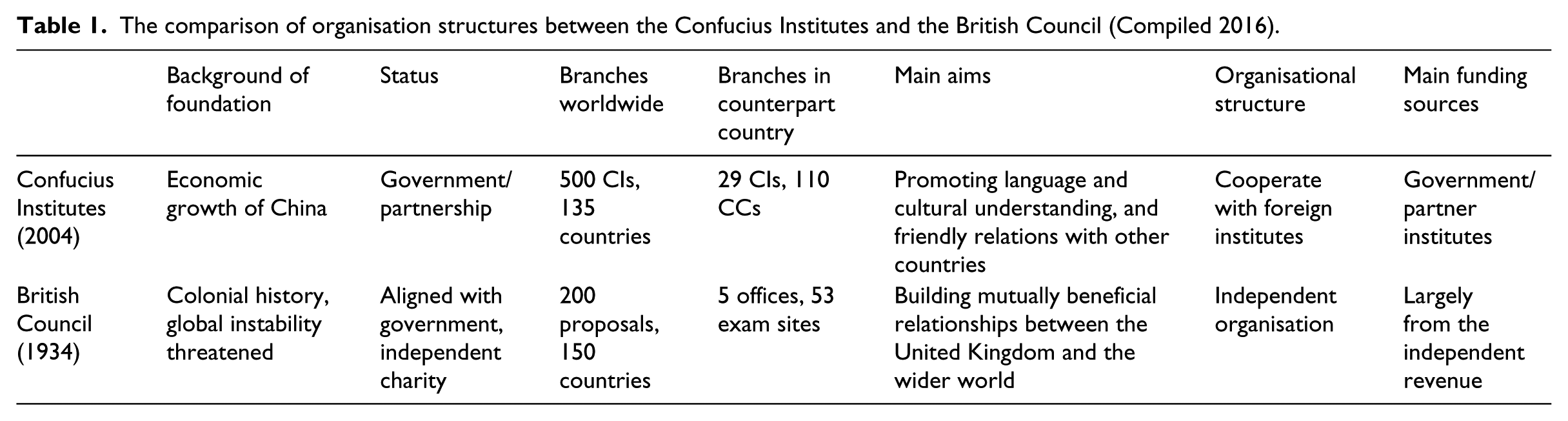
Although the two organisations were established in different times, the development of cultural organisations has always had a close relationship with the development and the strength of international influences of one country. To be specific, with respect to the Industrial Revolution in the eighteenth century ensured that Great Britain became the most powerful capitalist country, and the economic growth also called for the cultural communication and understanding. In the same way, due to China’s increasing economic and political influence in the twenty-first century, it became more imperative to process the dissemination of Chinese culture in a globalised world. However, the British Council was established for more than just economic reason, the growing instability of extremism, such as the Bolsheviks and Nazism were threats to British prosperity, security and influence, and the colonial history also asked for Great Britain to reinforce its presence in the region by cultural promotion abroad (Paschalidis, 2009). In contrast, because of the unique Communist Party System, as well as its relative political isolation, the Chinese government tried to create a benign image to avoid the threat of critical voices (Kluver, 2014); hence, the cultural institutes became the successful way to deliver the concept of ‘peaceful rise’ and ‘peaceful development’ of China.
With regard to the purposes and functions of the two organisations, both of them are responsible for promoting a friendly knowledge and understanding between their own countries and the wider world, both of them provide access to the people of language learning and teaching and both of them address the vibrant and diverse culture and contribute to the development of multiculturalism and cosmopolitanism. Regardless of those similarities, we can clearly find that the British Council has broader purposes and functions, and more collaboration not only between cultural and educational organisations but also involving environment, art, trade investment, tourism, poverty prevention and so on. For instance, the British Council which works in partnership with the Department for Culture Media and Sport launched a series of art programmes: East Africa Arts programmes, Connection through Culture programme with China. The programmes are in relation to cultural skills, film, literature, music, theatre, dance, visual arts, creative economy and architecture design fashion. With regard to the societal aspect, accessing justice programme, empowering women and girls programme and global social enterprise, particularly in the developing world, also helped both the third-world countries to achieve an effective participation in the global economy, and the women and girls of different cultural identities to achieve gender equality.
Apart from the advantage of English serving as a Lingua franca and the strength of profound education history of Britain, it is obvious that the promotion of domestic economic growth is one of the main reasons which encourage people to access UK education and qualifications, since the UK government and the UK higher education institutes nowadays face fierce competition in the world market of international education (Binsardi and Ekwulugo, 2003). Hence, there is a range of encouragement policies of the UK government and communication, such as the international education strategy that was published by the HM Government (2013) which identified eight priority countries (China was one of these countries) in terms of attracting international students and supporting transnational education.
The rapid increase in the number of Chinese students who came to the United Kingdom for further study also created numerous economic returns: the British Council received £490 million teaching and examinations income generated in 2014–2015, and among this, £98.5 million income was from the Chinese market (British Council, 2015). By 2020, China will have over half of the world’s population of 18- to 22-year-olds, and it is expected to send most students abroad (HM Government, 2013). Meanwhile, worldwide, various universities also view China as a major market for recruiting students to study in their countries (China Scholarship Council (CSC), 2014). Overall, the British Council has broader functions, rather than just being confined to the cultural exchange and language promotion fields, and it also involves the potential requirement of economic interests of the country and itself.
The structures of the British Council and CIs also have slight differences, though both of them set up Boards of Trustees/Headquarters and executive Board/Council. With regard to the scope of their global networks, seven regions over 150 countries were established by the British Council: Americas, European Union, South Asia, Wider Europe, East Asia, Middle East and North Africa and Sub-Saharan Africa; meanwhile, three regions over 135 countries were established CIs: Division of Asian and African Confucius, Division of American and Oceania Confucius and Division of European Confucius. Since the British Council directly supervises and manages offices around the world, there are only five offices located in China: one operates as the cultural and education section of the British Embassy and four operate as the cultural and education section of the British Consulates General (Britishcouncil.cn, 2016). On the contrary, there are 29 CIs in the United Kingdom and most of them are located in universities, and the number of CIs is still increasing. On account of the cooperation with foreign universities and domestic ones, it is much easier to open a new institute rather than wholly exploiting the existing ones. Furthermore, it is interesting to note that 90% of employees of the British Council are Chinese in China (Li, 2014), while most CIs employees are Chinese teachers and volunteers in the United Kingdom from Hanban, and only a small percentage of staff is provided by local universities. Speaking of the relationships with own government and financial sources, the British Council states that it is a public corporation and operationally independent from the UK government, but still receives a government grant-in-aid. It works closely with UK governments and devolved administrations to ensure strategic alignment to UK policy priorities and contribute to UK soft power (Britishcouncil.org, 2016a). However, the CIs are mainly run by the Chinese government, under the supervision of the Ministry of Education and the Hanban headquarters. According to statistical data from the Annual Reports from both institutes, the grant-in-aid in the British Council was reduced by £8 million to just 16% of total income in 2014, and more than two-thirds of income is generated from teaching English, administering examinations overseas and partnerships and contracts (British Council, 2015). On the contrary, £319 million was spent by the Chinese side of CIs in 2015 (Hanban, 2015a), and most CIs still need financial support from the Chinese government.
Literature reviews of the organisational structures of these two institutes
The most prevailing discussion on the cultural institutes abroad that can be found in the literature is the relationship between the institutes and their political impacts. Since the CIs project was only been launched for just over 10 years and was initiated by the Chinese government, there are many criticisms state that the programme of CI are ideological propaganda and are just for political purposes and preferences. Both Juneau-Katsuya (2010) and Starr (2009) mentioned that there is apprehension that the CIs conduct espionage and political surveillance on sensitive areas, such as Tibet, Taiwan and Falungong. Mosher (2012) even stated that the purpose of the CIs is to brainwash students into Chinese ideology. On the other hand, those who are actually involved with CIs in overseas institutes generally took a relaxed view on the debate, such as in the H-Asia meeting on June 2008, the teaching materials and books provided by Hanban were quiet transparent in the propaganda and there was no threat to change students’ minds, they argued. Some hosting universities, such as Stockholm University, also claimed that there was no sign to show that the CI had been used for political purposes of the Chinese government. Due to the rapid growth of CIs in such a short period, many views treated it as an increase in China’s ‘soft power’ and geopolitical influence. Meanwhile, cultural and educational exchange has become the important portion to enhance a country’s global impact and soft power nowadays, as discussed by Paradise (2009) that the role of CIs in bolstering Beijing’s soft power.
Albeit there are a certain number of critics of CIs, the Chinese side tried to clarify these arguments. Both director and chief executive, Xu Lin and the Chairman of the Council of Hanban, Liu Yandong stated that CIs are not a tool of soft power, but designed to promote understanding of each other. In contrast, the British Council seems to treat the link with soft power in a fairly straightforward way. The facts about the British Council website presented that the work of the Council can contribute to UK soft power through Britain’s most attractive assets, notably culture, education, language and values; meanwhile, it also noted that the United Kingdom has unrivalled international networks and influence which can help the United Kingdom meet the international challenges (Britishcouncil.org, 2016a. Dating back to the presence of the Council, it was widely believed that the foundation of the British Council lay in the mission of European colonialism, though this belief is rather inaccurate (Paschalidis, 2009). However, there are few critiques concerning the motivation and purposes of the British Council nowadays. Since CIs are affiliated with the Chinese government rather than being an independent organisation and received programme funding from Hanban at its infancy stage, it is not surprising that suspicions emerged in Western countries (Mcdowell, 2010). Overall, as Hartig (cited in Schmidt, 2013: 650) pointed out, ‘it would be unwise to lose a critical lens when regarding any state-initiated project, the literature on soft power and CIs is seldom based on any empirical evidence of what CIs actually do, nor what influence they actually garner’. Furthermore, the unfavourable attitude towards the soft power of CIs in Chinese top executives showed a lack of confidence in their political party system and the protective action of the new institute. Meanwhile, it also indicated that there are still some hostilities from Western countries.
Another doubt of cultural institutes concerns the academic integrity of education. Since most CIs operate with universities abroad, and their language and cultural courses are supported by the Chinese government, it might jeopardise the academic freedom of higher education (Yang, 2010). When we observed the partner universities, it seems the highest level universities overseas are reluctant to become involved, such as Harvard, Princeton, Columbia and Stanford in America. One reason for this perhaps is that the top foreign universities do not need to cooperate with CI and attract negative comment just for gaining official favours; they can ask for collaboration with China’s top universities by themselves (Starr, 2009). Meanwhile, since international students bring huge cultural and economic benefits to the United Kingdom, the critics argued that the British Council is not just a charity anymore, it is a quango that is sponsored by the Foreign Office, which is supposed to represent UK education interests abroad and compete with them at the same time (Montrose42 Blog, 2012). In conclusion, Criticisms of CIs are mainly from political and cultural perspectives, while criticisms of the British Council are generally from economic and business angles.
Comparison of language teaching and learning between the CIs and the these two institutes
According to the report of ‘Language for the future’ of the British Council (2013), Mandarin is the most widely spoken language by first language speakers, who number 848 million; meanwhile, English is the language of international communications all around the world. With education cooperation and frequent commercial intercourse between China and the United Kingdom, language learning and teaching is increasingly vital for both countries. It not only enriches cultural understanding but also provides the vehicle that can overcome intercultural barriers in an international context. As the main language promotion institutes, the CIs and the British Council play active roles in many aspects, such as providing the online and offline resources of language teaching and learning, organising a series of language proficiency examinations, carrying out all sorts of teacher training and exchange activities and conducting various language learning activities. This article will compare and analyse these four aspects mentioned above, and subsequently discover and conclude the similar and different characteristics of these two institutes in language teaching and learning.
Chinese learning and teaching has had a long history in the United Kingdom but it has experienced an unprecedented and rapid development in the recent decades (Zhang and Li, 2010). Nowadays, many UK universities offer different kinds of Mandarin courses and more primary and secondary schools have started to offer opportunities for their students to study Chinese language and culture. Particularly, the establishing of CIs in universities and CCs in local schools has led to an increase in the number of language learning and cultural activities. Almost all of the materials for teaching in CIs are donated by Hanban, who provided 3000 books and items of teaching material during the first 5-year period (Starr, 2009). In addition, the Hanban also encourages individual CIs to develop country language teaching (CLT) materials according to their regional curriculum and test criteria. According to the list of CLT materials from Hanban (2015b), there are several CIs who have become pioneers in locally produced Chinese teaching materials in recent years, such as Robert Burns Poetry by CI for Scotland in the University of Edinburgh, Business Chinese and Culture by CI for Business London and Traditional Chinese Medicine Basics by CI for TCM London. Apart from these sources, the CI Digital Library and the International Society for Chinese Language Teaching can also provide extra assistance.
The British Council in China uses online applications, English newspapers, books, videos and open courses, due to the high demand for English learning and the long history of English teaching in China. The resources for English teachers online can help teachers earn an internationally recognised teaching qualification, discover new teaching methods and techniques and improve teachers’ English proficiency (Britishcouncil.cn, 2019). The English teacher development, such as Teacher Trainer Development Project and Communicative Assessment Project, can offer support in curriculum design and delivery, assessment, teaching competence and methodology. The English language teaching policy studies that are used with Chinese English teaching institutions provide regular forums and symposia to share information about trends, developments and research in the English language teaching in the United Kingdom and China. Apart from these, there is also a series of programmes which can provide assistance to language teachers, such as the British Council libraries and information services and high-level China–UK training programme.
We can notice that the British Council is more fruitful and comprehensive in terms of language teaching resources than CIs, and the online resources are abundant and systematical, and involve almost every aspect of language teaching. With respect to CIs, CIs provide digital library services and book donations for teachers and schools, the specialised teaching materials that are designed with regard to the UK’s context are still less than adequate (Zhang and Li, 2010). This is partly due to the early stage of the development of CIs, and partly due to the fact that most people in the United Kingdom take Chinese as a subject simply for interest, rather than for examination purposes.
With regard to learning resources and language proficiency examinations, both of these organisations offer online self-learning resources, including language learning websites, learning applications on phone, open courses and radios, and both of them can hold the authoritative proficiency languages examinations, such as HSK and IELTS. The CI online learning resources (www.chinesecio.com) contain many sections: news, self-learning and live classes, self-assessment, culture discovery, culture courseware and learning community. It also broadcasts a series of activities of CIs, such as Chinese bridge language competition, online spring festival gala and individual CI video. The language learners can search the specific area to study online and they can select the difficulty level (beginners, intermediate, advanced), learner category (children, teenagers, adults), content category (culture, travel, business, entertainment, movies) and language to find out what is most suitable for them. The British Council learning resources (www.britishcouncil.cn/english) are broader than CI and collaborate with many different organisations. Learning English online provides a series of online learning websites for various types of learners, such as Learning English Kids, Learning English Teens and Premier Skills English. The Council designs some applications for English learning with phone, such as Learning English Grammar, IELTS Word Power and Learning English Kids collection. The English learning publications also comprise a series of tailor-made English content in partner publications in China, such as English Weekly Newspaper, 21st Century Newspaper and China Kids English. Furthermore, the learning English radio was launched in China in 2012, and millions of learners can listen to the programmes every weekend in China through radio. With regard to the language proficiency examinations, the HSK (Chinese Proficiency Test), YCT (Youth Chinese Test) and BCT (Business Chinese Test) of CIs have been around in the United Kingdom for several years, and the annual number of candidates is expected to rise dramatically in the next few years (Zhang and Li, 2010). At the same time, the IELTS has been approved by more than 9,000 organisations worldwide, including academic institutes, companies and governments. The Chinese candidates become the largest part to take the IELTS examination for study abroad purposes, and £98.5 million income was generated from China in 2014–2015, of which a large part came from IELTS earnings.
Both institutes have plentiful learning resources, and the ways of learning have also become much more convenient and personalised nowadays. However, the Chinese language resources are mainly from online and Hanban, and it is hard to find appropriate Chinese language materials that can satisfy the needs of the UK’s curriculum design and the requirements of the education system, while the English language learners in China can easily find many specialised English learning materials by themselves in China. The main reason might be that English is a compulsory course in China, and there are spin-over effects of English learning, such as the chances to study overseas and to become more competitive than others; however, Chinese is less important than English on the functional purposes. Moreover, the British Council is seeking out more cooperation with organisations, publications and media in China to distribute English learning, and even the IELTS have their own Chinese website to provide the official online services. In contrast, the CIs seem to be more reliant on the universities’ collaboration, and have not yet formed an effective and holistic system. It seems the main purpose of CIs at this stage is to promote access to understanding Chinese culture and then to study Chinese language while the British Council has no need to put effort into English culture promotion since the IELTS test is already very popular and with high demand in China. Compared with IELTS, the Chinese language tests seem to be more complicated and there is no unitised exam system and syllabus (Zhang and Li, 2010). For example, there are several tests for Chinese language in the United Kingdom, such as GCSE for Chinese, Asset Languages certification scheme for Chinese, Pre-university Diploma in Chinese and Chinese HSK and so on.
Apart from the teaching and learning resources, the institutes also engaged in both exchange activities and other language activities. Both of them offer scholarship opportunities to people who intend to study in their countries. The Confucius China study programme contains six projects (Ccsp.Chinese.cn, 2016), including the Joint Research Ph.D. Fellowship, which can support foreign university doctoral students to come to China for study and research; the Ph.D. in China Fellowship, which can help foreign students to pursue full-time PhD degrees in the humanities and social sciences at Chinese universities; the Understanding China Fellowship can provide short-term visiting scholars to China; the Young Leaders Fellowship can support outstanding youths in certain fields to come to visit China; the Publication Grant and the International Conference Grant also can support scholars to publish or hold international academic conferences related on Sinology and China studies. Compared to the support from CIs, the British Council also offers a number of scholarship schemes which are run by charities, organisations and government. International students can apply to Chevening UK Government Scholarships, Erasmus Scholarships and Royal Society grants for financial support. In addition, there is a project for UK-China HE Research Partnership for Ph.D. studies (Newton Fund) which was delivered by the British Council China and the CSC to provide opportunity for UK and Chinese PhD students to conduct research in some common interest areas for both countries.
Overall, it can be concluded that both institutes are positively organising educational and cultural exchanges and it can also be expected that there will be a continuous increase in these cooperation and exchange activities. The Chinese government and CIs seem to place more effort on encouraging foreigners to obtain a better understanding of contemporary China by providing chances for them to visit China. This may be attributed to the rapid development of the Chinese economy in recent years, CIs may want to present the new and modern China but not the undeveloped one thereby endeavouring to eliminate the stereotypical image of China (Table 2).
The comparison of language teaching and learning between CIs and the British Council.
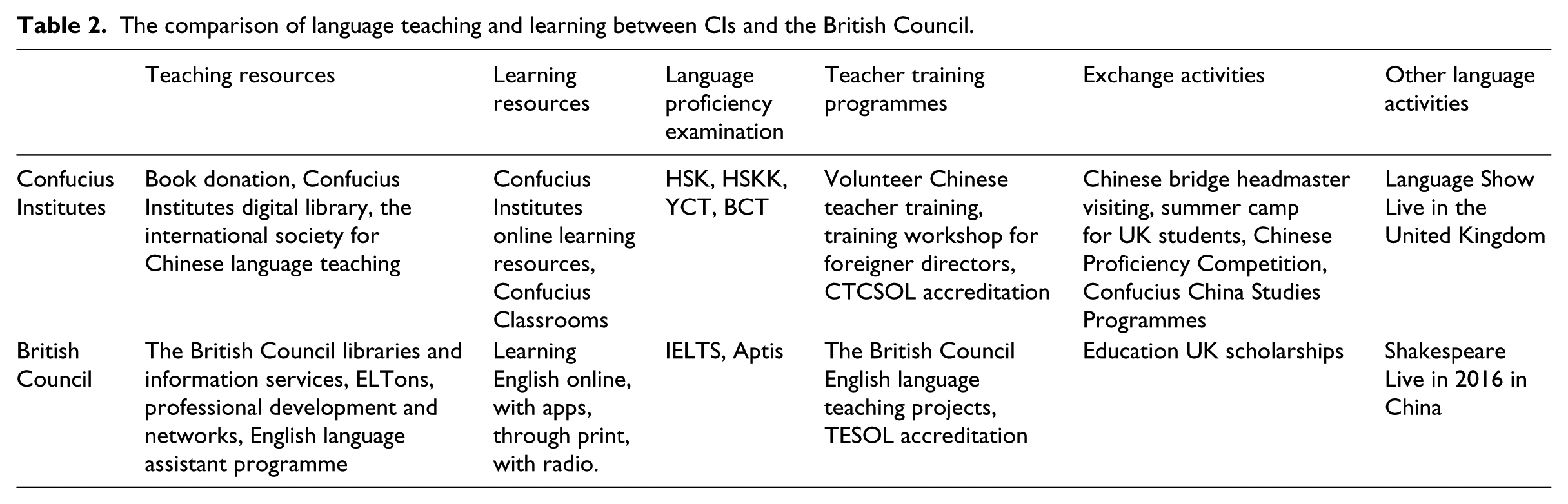
Both institutes experience culture shocks when they conduct language teaching and learning activities because of the cultural differences. Gu (2005) investigated the British Council English language teaching projects in China, and found that the fundamental method in the project is to use a culturally appropriate methodology. Zhang and Li (2010), Yang (2010) and Stambach (2015) pointed out that the problem of CIs is lack of experienced teachers who can understand Western culture and different places. In addition, CIs still face several problems as concluded by Zhang and Li (2010); for example, lack of adequate and unitised examination system for Chinese teaching, lack of quality tailored teaching materials, lack of relevant research concerning the language teaching and learning and so on.
Comparing the cooperation that the CIs and the British Council have with the other institutes
It is essential for cultural institutes abroad to seek out as much cooperation as possible in order to create friendly knowledge and understanding with others and promote their language and culture. It is worth noting that both institutes moved vigorously to search out collaborations not only with other cultural institutes but also with interdisciplinary partners in both countries. Hanban welcomes any approaches for innovative cultural and language collaborations, and most of the CIs were also established with higher educational organisations overseas. At the same time, partnership is at the heart of everything of the British Council have done since 1934, and they have ambitious goals which can only be implemented by working with others. Moreover, both institutes were set up by the local office to conduct management and provide service in their host country. The CIs established the Hanban UK office and Chinese Learning Resource Centre UK in 2009 in London, in order to meet the needs of Chinese learning and Sino–British cultural exchanges in the United Kingdom. The British Council also operated its first office in 1943 in China, and the Beijing office was set up as the Cultural and Education Section of the British Embassy for the purpose of providing language services, sharing arts and delivering education programmes in China. Hence, we now look at similarities and differences between CIs in the United Kingdom and the British Council in China in respect of cooperation with other organisations in three aspects: co-operating with governments and corporations, co-operating with academic organisations and media and co-operating with each other.
Cultural institutes abroad may not develop smoothly without governments’ political and financial support from their own country and the host countries. With regard to CIs, the nature of Hanban is the public institution affiliated with the Chinese Ministry of Education, and it receives a large amount of funding from the Chinese government each year. Hanban was given the right to distribute funding and teaching materials to each CI all around the world. The Hanban UK office also seeks cooperation with government agencies in the United Kingdom. In 2004, the office, in collaboration with the UK Home Office, the Foreign & Commonwealth Office and the Ministry of Education, established a bespoke scheme under the UK Tier 5 Point Based System–Hanban Mandarin Teachers Scheme (Hanban, 2015b). This scheme was officially incorporated into the UK’s immigration rules, which resolved UK visas difficulties for Chinese teachers for several years.
In addition, the CIs in the United Kingdom also conducted a series of commercial cooperations with diverse corporations. There are three business CIs in the United Kingdom now: the CI for Business London, which is established not only with a university (The London School of Economics and Political Science), but also with international enterprises (HSBC Bank, Standard Charted Bank, British Petroleum etc.); the business CI at the University of Leeds and the Scottish CI for Business and Communication at Heriot-Watt University. The main purposes of these CIs are to develop academic research and international businesses collaboration between China and the United Kingdom, and to engage in building close bonds with leading local businesses which deal with China (Hanban, 2015b). The British Council also has close links with the Chinese government. In 2004, the British Council represented the China IELTS Network (CIN) and made an agreement with Chinese National Education Examination Authority of Ministry of Education about the validity of holding the foreign-owned examinations in China (ChinaIELTS.org, 2016). Moreover, the Council conducted the education exchange project ‘The Outside World 2015’ in rural areas along with local education councils in Chongqing and Yunnan Provinces in China. The British Council is searching for more business partners in China than CIs in the United Kingdom. There are some successful cases which have achieved mutually beneficial results, such as the Council’s Education UK marketing programme, which is sponsored by China Union Pay; the Council’s Education UK programme, of which the China Everbright Bank has been a sponsor since 2005; and the UK Study Visit Programme, which is sponsored by HSBC China. All these cooperations can provide some funding to the Council to operate the programmes, as well as are being able to enhance the corporations’ reputations and extend their business outreaches (Britishcouncil.org, 2016c). In conclusion, both institutes are positively searching for cooperation with government in order to create a friendly environment to deliver the language and culture activities; meanwhile, both of them have also tried to make more business connections with international companies for funding and exchange purposes. However, the CIs are more concerned with building up official links rather than searching for business partners in the United Kingdom. On the contrary, the British Council seems to endeavour more to explore several kinds of cooperation that relate to business areas.
With regard to cooperation with academic organisations, the CIs created a new model to work with academic organisations to establish CIs with local universities and operated by three parts: the host university, the China cooperative university and Hanban. Many CIs were established with local universities which already have Chinese studies departments, such as the SOAS Language Centre at the University of London, and this would make it easier to find suitable cooperative Chinese university with which they already have connnection before. Some CIs were established with local universities which had no previous programmes or units for Chinese study, such as Newcastle University. In addition, some CIs were established with other academic organisations, such as the CIs for Scotland’s Schools, which cooperated with Scotland’s National Centre for Language (SCILT). With regard to the British Council, cooperation with academic organisations in China mainly concerns English language teaching and IELTS examinations. There are 71 IELTS examination centres that are located in 39 cities, and nearly all of them are held at reputable Chinese universities. With the increasingly booming number of IELTS candidates, the Council has started to seek more appropriate primary and high schools to become new examination centres in order to expand the scales of IELTS examination in China. Apart from this, the Council also engages in various cooperation projects, such as ‘the Fellowship of IELTS Project’ which works with education agencies and language training institutes in China. This cooperation can not only promote the popularity of IELTS but can also benefit the agencies and language schools in China. With regard to co-operation with media, both institutes conduct multiple propagandas through fashionable social media in both countries. The CI has its own official Facebook page and Twitter account; meanwhile, the British Council also created official accounts in active media in China: Sina, Douban, Youku and Wechat. Moreover, the Council has set up solid relationships with Chinese English publishers, such as ‘Chinese Kids English’, ‘Weekly English Newspaper’ and ‘21st English Newspaper’. The operation of CIs seems less independent than the British Council; at the same time, this new model of cooperation was pioneering and has inevitably raised several controversies, as was discussed in the previous section.
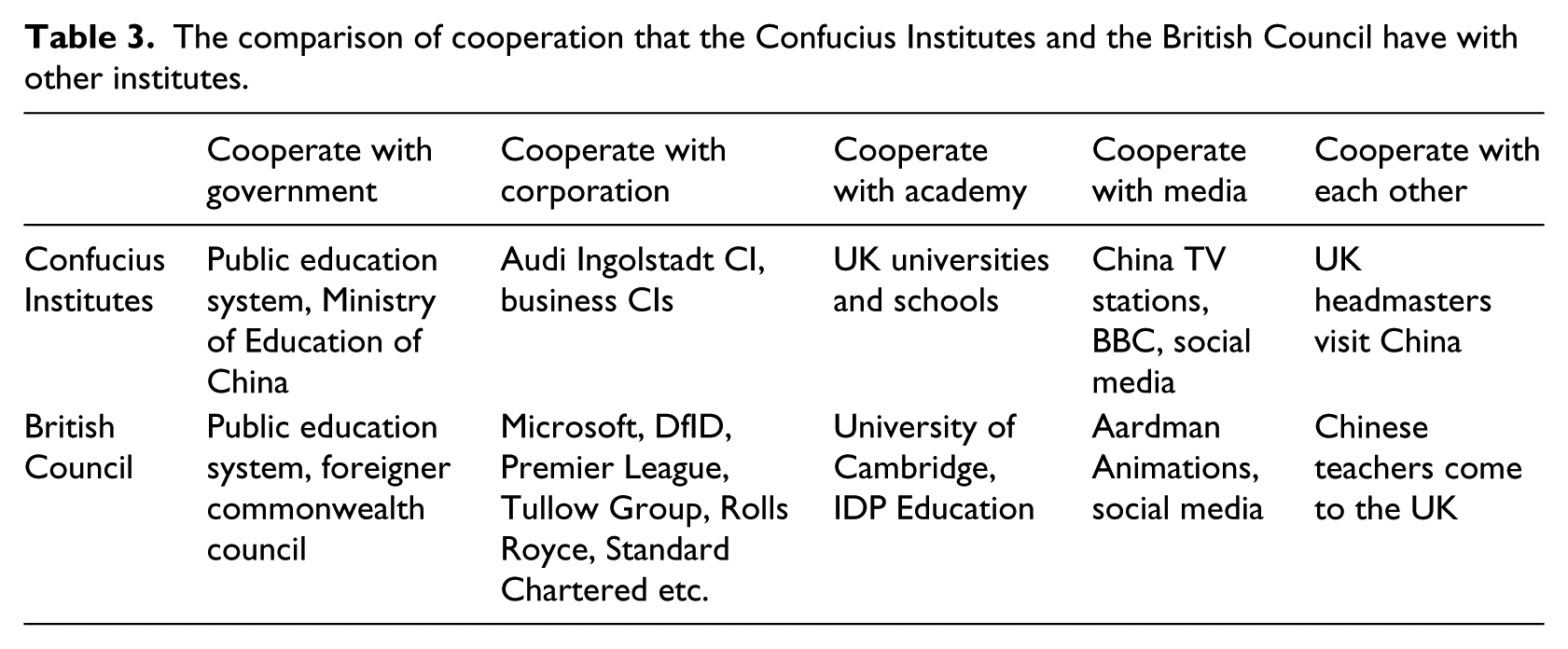
Since the UK’s former Prime Minister David Cameron visited China in 2013, and the Chinese president XinJinpin visited the United Kingdom in 2015, the cooperation between China and the United Kingdom became increasingly frequent in the educational, cultural and economic fields. According to the review and analysis from the Language for the Future Report (British Council, 2013), Mandarin Chinese has already become the fourth most important language which has the potential to add most value to the UK’s strategic interests. As a result, the UK government started to support more young people to study Mandarin Chinese, in order to help them become equipped with the skills required to compete in a globalised economy. On the one hand, the British Council works with Hanban to recruit and manage the Chinese language assistants in the United Kingdom. It takes charge in connecting with hosting primary and secondary schools, and taking part in the language teachers’ selection process. On the other hand, the CIs also work with the British Council to organise the schools’ delegations from the United Kingdom to visit China. The communications between the two institutes are still at their infant stage; it would be easy to conclude that there will be more cooperation in the future. Table 3 shows the differences of the cooperation with other institutes.
The comparison of cooperation that the Confucius Institutes and the British Council have with other institutes.
Conclusion
The CIs as a new cultural institute has been developing dramatically over the last decade, and has benefitted from the UK’s former experience in promoting their national language and culture. However, most studies from the literatures on CIs were conducted through political and soft power lenses, especially in the Western-dominant narratives, rather than the cultural and intercultural communication aspects and failed to consider the CIs as a global community in the context of cultural globalisation as it is now (Kluver, 2014). With respect to the British Council, many studies placed more emphasis on the practical issues like the English as a Second Language (ESL) teaching and learning techniques; one reason might be that it had already formulated rigorous internal mechanisms and a relatively stable operating model over 80 years. Moreover, there was considerable research on empirical studies of the reasons for the British Council’s success in China, rather than critical discussions. Although both institutes are language and cultural institutes for contributing positive images of their own countries around the world, the distinct political structures and models of the two countries and their different development stages result in completely different research approaches when it comes to these two institutes. Few studies compare and contrast the similarities and differences between them within different social contexts.
This article has looked into both institutes in the partner country with the aim to find out if there are any similarities and differences in organisational structure and culture diffusion, language teaching and learning, and forms of cooperation between them.
With regard to the organisation structures and culture diffusion models between CIs and the British Council, the CIs adopted a unique model, which aims to establish the CI at favourable foreign universities. On the one hand, this new model could accelerate culture understanding between China and other countries, as well as stimulate deep cooperation between universities in the United Kingdom and China. However, this new model also raises concerns about academic freedom in some Western universities, including the universities in the United Kingdom. Another benefit of this unique cooperative structure is that it also produces some outreach effectiveness, such as the promotion of higher education internationalisation, exchange programmes between universities and setting up Oriental or Chinese study centres in local universities. However, this outreach effectiveness slowly fades away since many universities already established a series of mature connections over the last decade, and this specific function of CIs become less effective nowadays. With respect to the British Council, the relatively independent enterprise structure ensures they have more autonomy on decision making and direction guidance and they can seek more direct and profitable cooperation for their own long-term development, both strategically and financially. In addition, the council more actively embraces the wider communities, such as in connection with the diverse charitable works for providing citizens and institutions with a more inclusive, open and prosperous world, which ranges from social action to diversity and youth issues (Britishcouncil.us, 2019). In comparison, the British Council also has similar historical moments of government initiative and funding in the early twentieth century, but thanks to the fact that English has become the Lingua franca; the British Council no longer now has to rely on financial support from government. It is more like an independent profitable company, particularly the British Council in China, which has the largest English learning and test market. On the contrary, the CI in the United Kingdom is still in its infancy and can barely make profits by language learning and tests.
In the comparison of language teaching and learning resources and activities, the UK government started to realise the importance of studying the emerging language of Mandarin for the benefit of employability, trade and economic purposes and then began to promote mandarin teaching and learning in the United Kingdom. Meanwhile, business Chinese learning became popular and the initiatives of studying Chinese also show a diverse trend. With regard to English learning in China, the abundant English learning and teaching materials, which are designed by the British Council, are always in great demand in China, not only because English is the compulsory course but also that there are increasing numbers of people choosing to study in the United Kingdom by taking IELTS. The British Council even planned to detach the examination business from its general works in China because of considerable expansion over the years. Overall, the British Council has more fruitful and comprehensive experiences in terms of language teaching and learning with more applicable and systemic materials for language learners. In this case, the different demand and status of the language attractions in both countries have resulted in different strategies of both institutes.
In comparing cooperation strategies, two types of organisations can be considered: the government and other organisation. In relation to government cooperation, both of them have strong links with their corresponding government to some extent, and their purposes and strategies are highly consistent with government requirements. In particular, although CIs stand for Chinese government’s interest which has received some criticism, the Britishcouncil.org (2016a) also stated that ‘the Council is firmly committed to strategically aligning its work to the long-term policy priorities of the UK Governments’ to ensure the greatest value for the United Kingdom. Apart from the similarities with governments, the emphasis of cooperation seem slightly different. With respect to cooperation with other organisations, the CIs tend towards long-term relationships and cross-cultural communication with academic and business organisations, while the British Council has already started to seek an economic win-win situation with more diverse partners. In conclusion, the cooperation of the British Council is more comprehensive and extensive, which needs to be gradually developed by CIs in the future.
Finally, this article only conducts the comparative analysis from three aspects between the two institutes. As cultural institutes abroad, both of them have already developed with their own features, as well as in sympathy with the partner countries’ characteristics. Although the development of CIs in the United Kingdom has already achieved a certain scale, only limited studies exist with respect to the effectiveness and efficiency of CIs. In addition, the information transparency of CIs is very limited to public audiences. Hence, more areas would be worth exploring on CIs in the future, such as from ethnographical and cultural studies perspectives, both in the United Kingdom and in other countries or regions.
Footnotes
Declaration of conflicting interests
The author(s) declared no potential conflicts of interest with respect to the research, authorship, and/or publication of this article.
Funding
The author(s) received no financial support for the research, authorship, and/or publication of this article.
