




Abstract
Ample research has noted a positive sense of political efficacy associated with increased civic engagement. In turn, the role of service-learning in boosting students’ civic engagement has been well documented. As civic engagement is a desirable goal for strengthening communities and empowering citizens, the role of service-learning in directly increasing political efficacy in students is worthy of observation. In the context of a student population that includes first-generation students at a Hispanic-serving Institution, where service is emphasized and institutionalized, this study examines preliminary data from student service-learning surveys. This study examines whether student participation in service-learning projects contributes to an increase in students’ sense of political efficacy and civic engagement. This first phase included service-learning projects on environmental justice and voting rights in three upper level political science courses. Preliminary findings indicate a modest increase in perceptions of political empowerment and civic engagement.
Keywords
Even before Putnam’s (2000) classic work showing a decline in civic engagement, the news media, academics, and the general public have bemoaned the loss of civic participation, involvement, and sense of community. Research has found Americans to be lacking in knowledge about ways to demonstrate their political demands, and without basic information about political institutions (Barber and Battistoni, 1993; Hunter and Brisbin, 2000). In 2015, Gallup reported that the most important area of concern among respondents was our dysfunctional political system, even more so than concerns about the economy (Riffkin, 2015). Between 1975 and 2005, the numbers of Americans who reported attending community meetings, working with neighbors to address problems, and belonging to organizations have all decreased (Levine and Liu, 2015). Other research has found instead that political participation has not declined, but changed its modality to new forms of civic engagement especially resonant with younger citizens; activities such as Internet activism, individualized responsibility taking, blogging, and other forms of “creative participation” have emerged as more meaningful (Bennett et al., 2009; Dalton, 2013; Micheletti and McFarland, 2010). Inglehart (2000) has noted an increase in the postmaterial values of freedom of speech and political expression among many economically advanced democracies. However, taking both of these views into account, the conclusion stands that civic participation, in whatever form it may take, remains an important part of a healthy functioning democracy and strong communities. If civic participation is so endemic to democracies around the world, the important question to ask is what factors could encourage its growth and flourishing?
For decades, social science research has examined the important connection between a sense of political efficacy and the likelihood one will participate in civic life (Almond and Verba, 1963; Kahne and Westheimer, 2006). Those who feel empowered and as though their contributions may have an effect on the political system are more likely to participate in politics and to vote, which in turn fuels advances in social justice. Likewise, previous studies have shown a positive relationship between students’ participation in service-learning and increased sense of civic responsibility and awareness (Eyler, 2010; Kuh, 2008; Prentice and Robinson, 2007). Based on these trends, this research will explore the relationship between service-learning and political efficacy and whether participation in service-learning projects boosts students’ feelings of political empowerment and connection to their community. This study will utilize data from undergraduate political science students’ experiences in various service-learning projects in three courses, to gauge the effectiveness of service-learning as a tool for increasing political efficacy. This endeavor is the first stage of a long-term effort to widen the scope to all undergraduate students taking service-learning courses at Our Lady of the Lake University (OLLU) and ultimately at other universities as well.
Ample research exists on the positive connection between student participation in service-learning projects and increases in civic engagement (Eyler, 2010; Felton and Clayton, 2011; Hunter and Brisbin, 2000; Kuh, 2008; Prentice and Robinson, 2007). Service-learning is a pedagogy whereby course learning outcomes are linked with community service in a way that enhances comprehension of course content while leading to a transformative change in student awareness, critical thinking, personal values, and civic responsibility, as well as empowerment of and reciprocity with community partners (Felton and Clayton, 2011; Freire, 1970; Kolb, 1984; Sigmon, 1979). This transformation is facilitated by student reflections on their ongoing service-learning experience, which are formally built into the course and guided by the course instructor. While numerous models exist for its implementation, the focus here is less on implementation and more on the transformative promise inherent in the pedagogy.
As Converse (1964) notably documented, the nature of belief systems in the mass public is lacking in sophistication and higher order cognition, as well as a lack of deeper understanding of the political world. Young people in particular may have “very poorly developed skills when it comes to higher level abstractions and systems of abstractions … [and] little skill in relating their observations in community settings to the abstract concepts they are encountering in their classrooms” (Cone and Harris, 1996: 52). Through the process of reflection on what they are experiencing with community problems, unequal power structures, and persistent marginalization, students usually “come to recognize the extent to which they are prisoners of stereotypes and preconceptions, and begin to develop new perspectives” (Cone and Harris, 1996: 52). This critical thinking awakening is exactly the solution needed to develop a sense of political efficacy. Indeed, it may be seen as the engine for increasing political efficacy and in turn political participation in its various forms.
Political efficacy can be defined as “the feeling that political and social change is possible, and that the individual citizen can play a part in bringing about this change” (Campbell et al., 1954: 187–189). And as Weissberg (1975) has clarified, “when we say that someone has a high sense of political efficacy, we mean that he [she] believes that political action is not only possible but of positive utility as well … the concept does not imply accuracy in these perceptions” (p. 470). Balch (1974) noted that a sense of political efficacy has the largest impact on political participation for “low status Individuals” (pp. 10–12) since higher socioeconomic individuals are already affected by other positive factors such as more resources and social standing. Furthermore, Balch distinguished between internal and external efficacy. The former is defined as an individual’s level of confidence in his or her political abilities, and external efficacy is the belief that one’s actions will have an influence on the authorities or that those in power are responsive. For example, internal efficacy can be measured by asking individuals whether they believe voting is the only way to have a say in government, as well as whether they believe politics is too complicated for them to understand. External efficacy, however, can be gauged by asking whether they trust the political system and believe their actions will have an impact on authorities and institutions.
Before the research design is explained, the context of the study must be addressed. OLLU is a private, Catholic University in San Antonio, Texas, in the United States, with an enrollment of about 3130. It is a Hispanic-serving institution (HSI) with approximately 59% of its student body identifying as Hispanic. The student population is 74.7% female and 25% male; 39% report being first-generation college students, and 26% are below the poverty threshold (poverty threshold calculated by applying the U.S. Department of Health and Human Services, Office of The Assistant Secretary for Planning and Evaluation, 2015 poverty guidelines). In Fall 2014, 44% of OLLU’s students were the first in their family to attend college, while in Fall 2015 the percentage rose to 47% (Office of Institutional Research and Effectiveness, 2015, 2017).
Data from the “NSSE 2015 Snapshot, Our Lady of the Lake University” included high-impact practices (HIPs), which are defined as learning strategies or activities that have “positive associations with student learning and retention” such as participation in a learning community, service-learning, or research with faculty (National Survey of Student Engagement (NSSE), 2015: 1). Collection of these data gauge students’ levels of engagement and can be used to substantiate the effects of such HIPs (Felton and Clayton, 2011). In particular, Kuh’s (2008) report employing NSSE’s data revealed that “historically underserved students tend to benefit more” (p. 17) from HIPs, like service-learning, than majority students do, although they are beneficial for all students.
OLLU’s robust levels of involvement in HIPs and modest student voter turnout in the various NSSE categories suggest a student body that is fairly engaged as part of the campus culture. As such, this study is a first step in making a general association between such HIPs and political efficacy. This is especially relevant given Kuh’s (2008) finding on the enhanced benefits of practices such as service-learning for minority students, given OLLU’s HSI status. More data collection over time will be needed to gauge how much, if any, above average levels of political empowerment and efficacy are the direct result of service-learning, or rather if they are a common feature of all students in this population, regardless of whether they have taken a service-learning course. This study is a preliminary study with small sample sizes and seeks to explore potential relationships to be analyzed more in depth as more service-learning surveys are collected. Use of primary data, although initially with small sample sizes, is one way to alleviate critiques of previous research on service-learning that have relied on secondary data (Burth, 2016).
NSSE data for 2015 indicate that OLLU outperforms its comparison cohort of other southwest private universities. For first-year students at OLLU, for example, 16% participated in two or more HIPs and 59% participated in one HIP, contrasted with 8% and 38%, respectively, at other southwest private universities. Rates for seniors show even more involvement in HIPs, with 67% participating in at least two HIPs and 31% participating in one HIP, whereas rates for other southwest private universities are 40% and 34%, respectively (NSSE, 2015).
In addition, the NSSE data indicate other areas where OLLU students may demonstrate a significant advantage in areas that foster political efficacy. The survey includes items measuring first-year students’ and seniors’ performance on Engagement Indicators as well as the HIP discussed above. NSSE then ranks the attributes where first-year and senior students score the highest and the lowest relative to other southwest private institutions. For first-year students, one of the Engagement Indicators of a Supportive Environment, where OLLU freshmen ranked highest, was “Institution emphasis on attending events that address important social/economic/political issues” where the score was +39 relative to students in the comparison group. The second highest ranking, also in the area of a Supportive Environment, was for “Institution emphasis on attending campus activities and events …” where OLLU’s score was +36 relative to students in the comparison group. The HIP indicator of “About how many courses have included a community-based project (service-learning)?” was OLLU’s third highest score, with +29 relative to students in the comparison group (NSSE, 2015).
The NSSE data for seniors in areas that potentially may foster political efficacy demonstrate a similar pattern. Like first-year students, the highest Engagement Indicator of a Supportive Environment was “Institution emphasis on attending events that address important social/economic/political issues” where the score was +39 relative to students in the comparison group and the second highest ranking was for the indicator of “Institution emphasis on attending campus activities and events …” where OLLU’s score was +37 relative to students in the comparison group. The same pattern was shown in the third highest ranking, where Seniors reported a similar score for “About how many courses have included a community-based project (service-learning)?” with +32 relative to students in the comparison group (NSSE, 2015).
Other data suggest a relatively modest, but higher level of OLLU student voting turnout. For example, in the 2012 presidential election, 48.3% of OLLU students voted, compared to 46.9% at all institutions. In the 2014 midterm elections, OLLU students had a 23.7% turnout rate, compared to 19.1% at all institutions. That same year, it was a record low of 13% for 18- to 24-year-olds (Institute for Democracy and Higher Education, 2015).
There are several limitations of the study that must be addressed. In addition to the preliminary small sample sizes, a deserved critique of much of the research on the results of service-learning has been its tendency to focus more on student impact than on community impact. The fact that we are aware of the positive results of students partnering with members in the community is a result of the centering of the “high-impact” effects of experiential learning. Areas of concentration have measured the degree to which students benefit, whether it be in terms of personal transformation, ability more deeply to absorb the course learning objectives, and the more permanent nature of “learning by doing.” This attention deserves merit, for guiding improved pedagogies and strengthening student learning outcomes, especially for minority-serving institutions. However, we should also consider the needs of the community. As service-learning should be a reciprocal relationship, much less attention has been given to the benefits, if any, experienced among the partnering communities. The danger is of the perception or effect of privileged students swooping down to “help” less fortunate communities, suggestive of a colonizing culture as originally explained by Paulo Freire (1970). In the course of the service-learning project, while there is likelihood of transformation, much less research is devoted to impacts on communities.
These critiques are well noted. At the same time, the preliminary nature of this research endeavor as well as the limitations of available data necessitates a focus on the potential change in political efficacy of students participating in these service-learning projects. A worthy future goal is to ask the same or similar questions of the community partners with whom the students are working, to gauge the degree to which student partnerships advance or inhibit the goals of the organization or lead to changes in attitudes among the staff working with the students.
Research design
In Spring 2015, four questions were added to the OLLU Center for Service-Learning and Volunteerism’s (CSLV) end-of-course survey administered to students completing the course POLS 4351 Environmental Policy and Law. The questions were adapted from Prentice and Robinson’s (2010) Faculty Survey of Course Outcomes, which included a section on Civic Responsibility. Although Prentice and Robinson did not address the validity of their survey instrument, they did note that the survey was developed by the American Association of Community Colleges (AACC) as a result of a Community Colleges Broadening Horizons through Service Learning grant project. In addition, as part of the study, AACC conducted a qualitative analysis, through eight focus groups, to measure the impact of service-learning and to compare the results from the survey. When they compared the survey results with the qualitative data from the focus groups, they found similar results of increases in civic engagement.
Answers to the four questions were arranged in a 5-point Likert-type-style scale where the number “5” indicated “Strongly Agree,” “3” indicated “Neutral,” and “1” indicated the lowest response with “Strongly Disagree.” One of the questions asked was “I believe I can have a positive impact on local social problems” which could be considered as an approximation of measurement for a sense of political efficacy. The question “I plan to improve my own neighborhood in the near future” is an effort to gauge students’ political efficacy from a different perspective, as well as the question “I am more concerned about local community issues.” The question “I think that people should find time to contribute to their community” attempts to approximate students’ commitment to the ideal of civic responsibility.
Students enrolled in the POLS 4351 Environmental Policy and Law course consisted of mostly junior and senior political science majors and minors. Enrollment in the course is required for all political science majors and minors. Student respondents were given informed consent forms, detailing that participation in this survey was voluntary, that all responses were anonymous, and that there were no risks or benefits from participating. The process was reviewed and approved by the university Institutional Review Board.
The students’ service-learning project involved working with community partner Southwest Workers’ Union (SWU) for a minimum of 20 hours. SWU unites workers, health communities, and youth in the struggle for dignity and justice. Based in San Antonio, Texas in the United States, SWU is a grassroots membership–based organization working for social change from the bottom up. SWU’s Environmental and Climate Justice Programs uses education and organizing methodology to address the issue of environmental racism in communities, which examines the accumulative effects due to multiple sources in contamination of an area and the health of the surrounding community (Center for Service-Learning and Volunteerism, 2015b).
Students contributed to SWU’s Calumet Refinery Project. Located on the East part of the Southside of San Antonio, the Calumet Refinery has been a primary destination for Eagle Ford processing shale with “fracking,” a technique in which rock is fractured by a hydraulically pressurized liquid made of water, sand, and chemicals, which leads to contamination of land, air, and water. As a result, chemicals have spilled into and near the San Antonio River. Fires and explosions are a recurring event and the permanent flare continues to contaminate the surrounding environment. OLLU students assisted SWU in their organizing of residents of this area and helped create a readable report for local residents that addresses transparency, environmental justice, and environmental racism. Throughout these initiatives, service-learning students obtained basic information on the diverse aspects of organizing community-based campaigns, including tactics, targets, and power mapping. Students went block walking to gather information from local residents, met with local community members, and worked with elected officials to implement different policies. Students learned how the current energy and fracking debate affects Environmental Justice Principles (Center for Service-Learning and Volunteerism, 2015b). During the midterm of the course, students were required as part of their overall course grade to submit a service-learning reflection, where course learning objectives, scholarly readings, and course themes and topics were linked to what the student had learned up to that point in their work with their community partner. At the conclusion of the course, students expanded and updated their service-learning reflection in a journal and presentation format, again applying critical reflection on their experience (see Appendix 1 for excerpts from student reflections).
In Fall 2015, the same four questions were administered to students enrolled in POLS 4360 Latino Politics and the Law, which also consisted of mostly junior and senior political science majors and minors; enrollment in the course is required for all political science majors and minors. This time, the questions were asked both the first week of class in September as well as part of the CSLV’s service-learning end-of-course survey in December.
The service-learning project in this course involved working with community partners The Willie C. Velasquez Institute (WCVI) and MOVESA; students were required to complete 20 hours with one of the organizations. The WCVI is a civil rights organization and US national nonpartisan policy research organization founded in 1985 with offices in San Antonio, Texas and Los Angeles, California. WCVI provides policy analysis and development activities to minority community leaders and elected officials, especially US Latinos. The primary focus of the service-learning project with WCVI on Latino Voter research aimed at providing data, trends, and estimates on Latino voter registration and turnout. Students gathered and analyzed data from the Census and prepared surveys to assist in gathering voter data (Center for Service-Learning and Volunteerism, 2015a).
The other group of students in the course worked with community partner MOVESA. MOVESA is a local nonprofit founded in May of 2013 to utilize grassroots tactics and mobilize the youth voice in politics. MOVESA values the connection of young people to democracy and the need for active and engaged communities. The organization is developing young leaders and engaging tens of thousands of young voters every election, while advancing progressive policy in San Antonio. This service-learning project involved students in this course collaborating with MOVESA’s “Feelin’ My Vote” campaign and working to register 2500 voters this year. The students and MOVESA volunteers visited local campuses and neighborhood events to engage San Antonio youth and community members in politics and to register new voters. Students became deputized as Bexar County Volunteer Voter Registrars and participated in dozens of voter registration events on campuses and at community events across San Antonio (Center for Service-Learning and Volunteerism, 2015a). As with the Environmental Policy and law course in spring 2015, students were required to submit a service-learning reflection in a journal and presentation format, thereby applying critical reflection on their experience.
In Spring 2017, the same four questions were again administered to students enrolled in the POLS 4351 Environmental Policy and Law course during the first and last weeks of class. Although the course learning outcomes were identical to the same course offered in Spring 2015, more community partners were added due to a higher student enrollment. In addition to working with Southwest Workers Union on their Environmental and Climate Justice Program to gather and report data on the current state of the environment in neighborhoods in San Antonio, as part of the City of San Antonio’s Climate Assessment, students partnered with the Greater Edwards Aquifer Alliance and Green Spaces Alliance. As explained in the MEA, The Greater Edwards Aquifer Alliance (GEAA) is a 501(c)(3) nonprofit organization that promotes effective broad-based advocacy for protection and preservation of the Edwards Aquifer, its springs, watersheds, and the Texas Hill Country that sustains it. The Edwards Aquifer is the source of the largest springs in Texas and the sole source of drinking water for more than 1.5 million Central Texas residents. (Center for Service-Learning and Volunteerism, 2017).
Students working on this project completed a White Paper on the impact of subsurface pollution on the Edwards Aquifer. According to their mission, “Green Spaces Alliance (GSA) is a 501(c)(3) organization, founded in 1998 and dedicated to sustaining the natural environment and enhancing urban spaces through land conservation, community engagement, and education” (Center for Service-Learning and Volunteerism, 2017). The service-learning work with this community partner included field work to explore local land use patterns and creation of schematics of the Revised Conversation Subdivision Ordinance and the New Low Impact Development & Natural Channel Design Protocol Ordinance in order to demonstrate their policy structure and their impact on local water resources management and land management practices. As with the previous courses, students were required to complete midterm and final critical reflections on their service-learning experience.
Results
The first group of students to take the survey was students enrolled in the spring, 2015 course POLS 4351 Environmental Policy and Law. Students were administered a survey by the CSLV including the four questions explained above. The survey was administered the last week of class by the CSLV as part of their end-of-course assessment. In all, 10 students completed the survey out of 12 students enrolled in the course. As can be viewed in Figure 1, for the question, “I believe I can have a positive impact on local social problems,” 9 students, or 90%, answered “Strongly Agree,” while 1 student, or 10%, answered “Neutral.” On the measure of “I plan to improve my own neighborhood in the near future,” 70% of the students answered “Strongly Agree,” while 2 answered “Agree” and 1 answered “Neutral.” When asked if they were “concerned about local community issues,” 70% answered “Strongly Agree,” while 1 answered “Agree” and 20% replied “Neutral.” Finally, when asked about level of involvement with the question “I think that people should find time to contribute to their community,” 90% strongly agreed with the statement and 10% agreed.
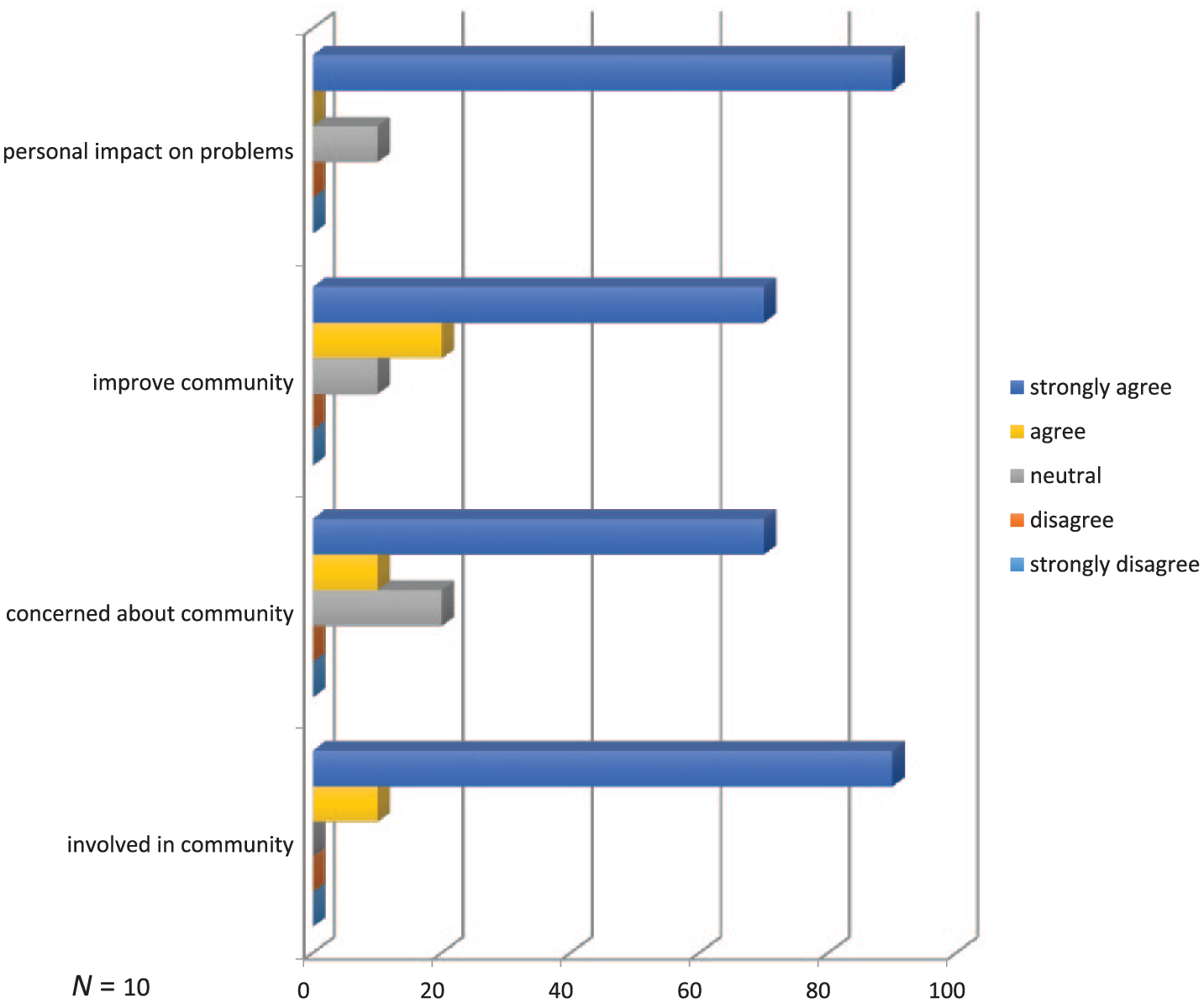
Student service-learning survey POLS 4351 May 2015 (N = 10).
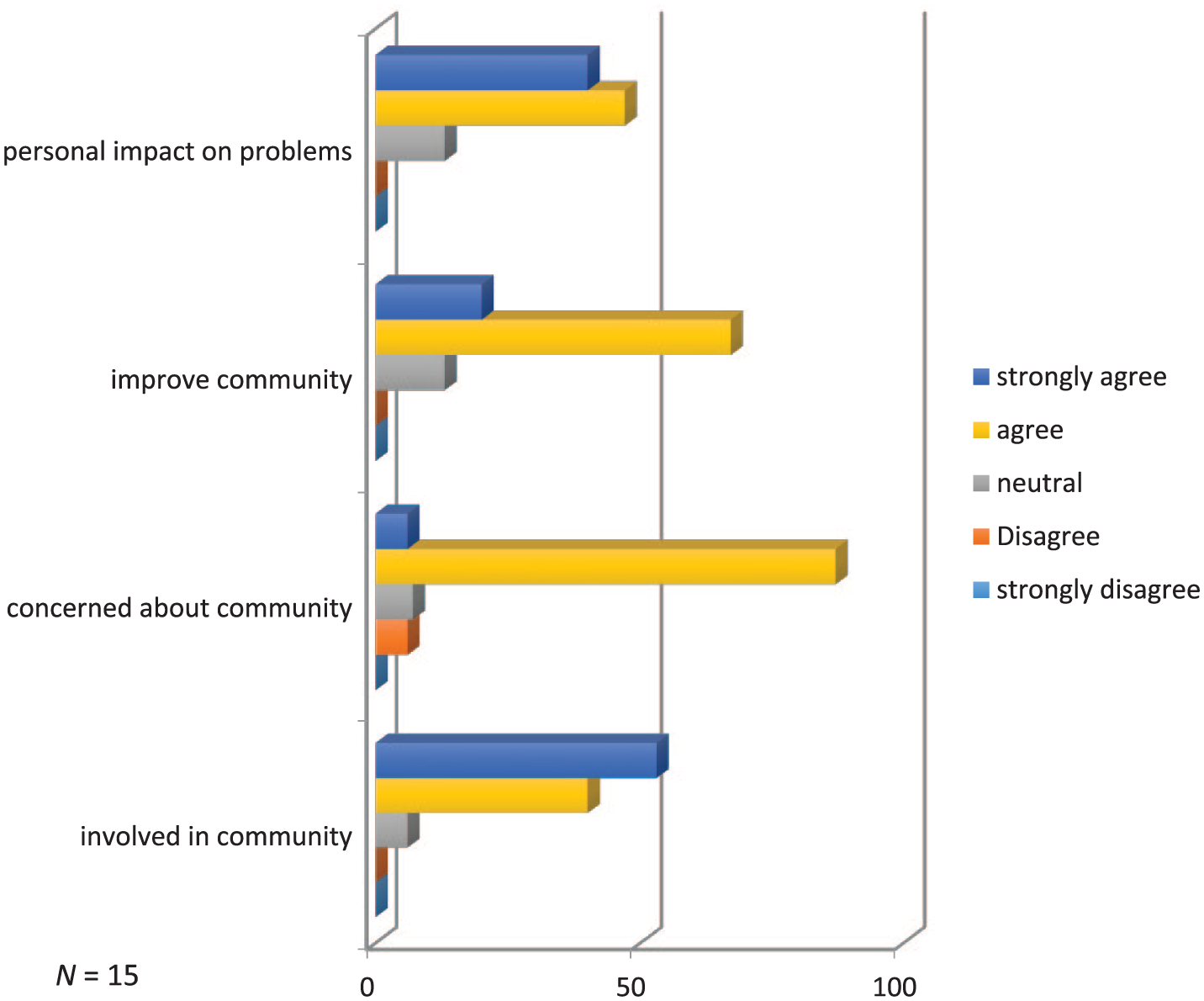
The second round of data began in the fall semester 2015 with students enrolled in the course POLS 4360 Latino Politics and the Law and administered by the CSLV. As shown in Figure 2, the first survey was administered in September, along with the service-learning orientation provided by the CSLV. Out of the 17 students, 15 students enrolled in the course completed the September survey. For the question, “I believe I can have a positive impact on local social problems,” 6 students, or 40%, answered “Strongly Agree,” while 8 students, or 53.3%, answered “Agree” and 1 replied “Neutral.” On the measure of “I plan to improve my own neighborhood in the near future,” 26.6% of the students answered “Strongly Agree,” while 2, or 13.3%, answered “Agree” and 60% or 9 students answered “Neutral.” When asked if they were “concerned about local community issues,” 20% answered “Strongly Agree,” 46.6% answered “Agree,” 26.6% replied “Neutral,” and 0.06% replied “Disagree.” Finally, when asked about level involvement with the question “I think that people should find time to contribute to their community,” 40% strongly agreed with the statement, while 6 students or 40% agreed and 20% were neutral.
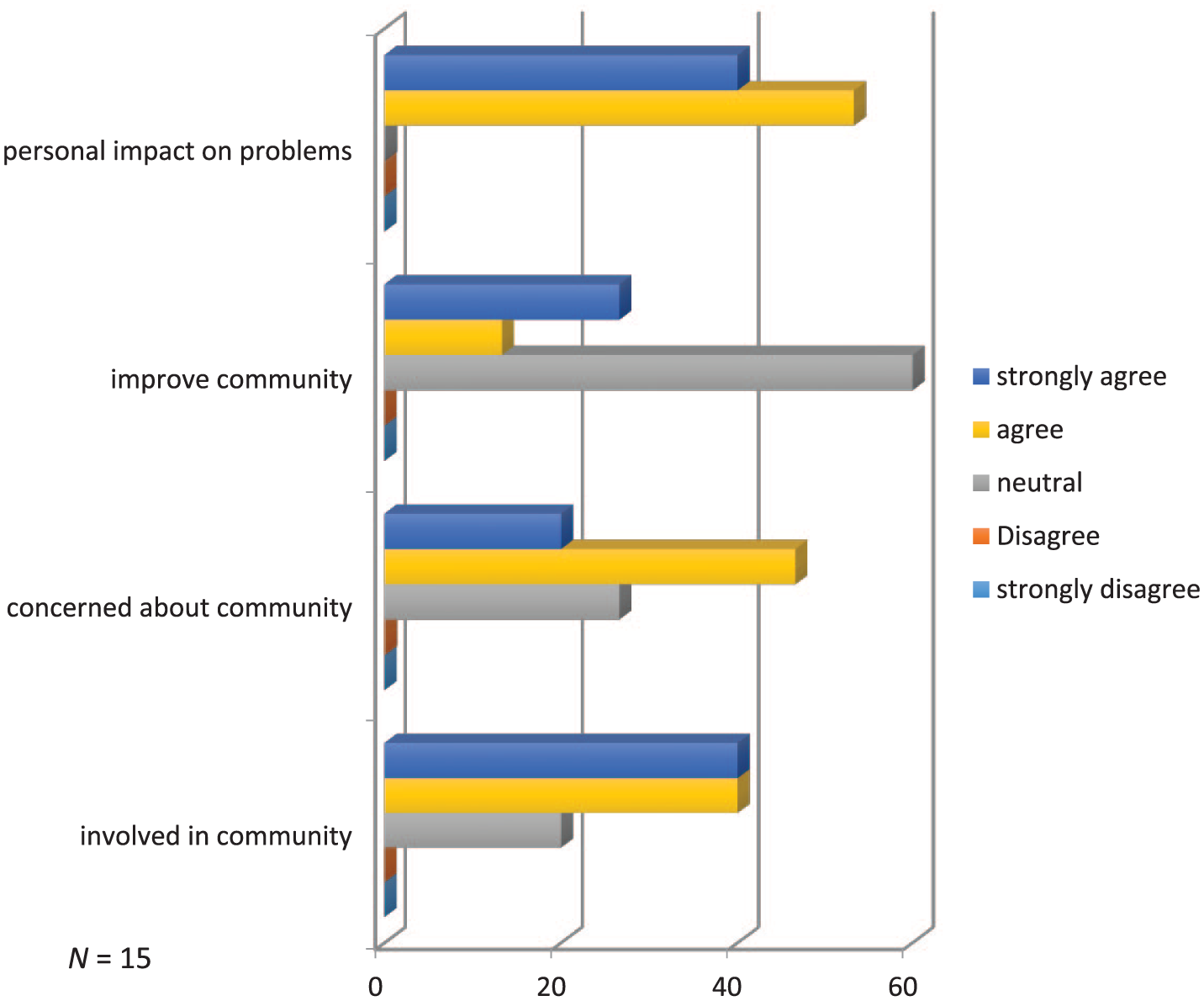
Student service-learning survey POLS 4360 September 2015 (N = 15).
The second survey administered to POLS 4360 students was given the final week of classes in December 2015, as part of the CSLV’s final assessment and debriefing session with students and community partners. This time, 16 out of 17 enrolled in the course completed the December survey. Figure 3 indicates that modest increases in student responses for all four questions were observed. For the first question, “I believe I can have a positive impact on local social problems,” the percentage answering “Strongly Agree” increased from 40% in September to 62.5% in December. Those answering “Agree” decreased from 53.3% to 37.5%, indicating more students had stronger opinions about their potential positive impact after participating in the service-learning experience.
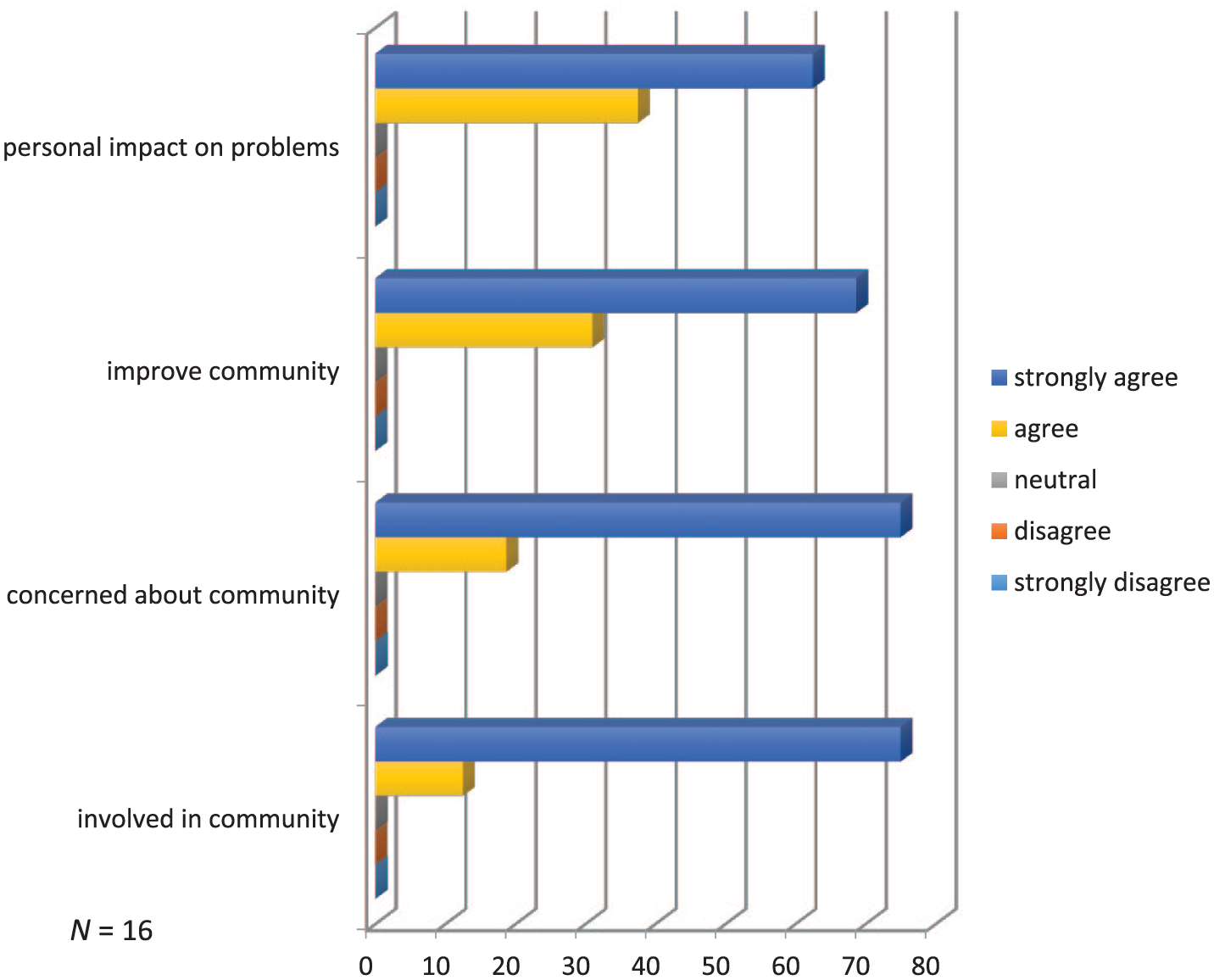
Student service-learning survey POLS 4360 December 2015 (N = 16).
The question “I plan to improve my own neighborhood in the near future” also saw a positive increase. In September, 26.6% of the students answered “Strongly Agree” and by December, 68.7% strongly agreed with the statement. There was also an increase in the “Agree” response, with 13.3% answering “Agree” in September and 31% with that response in December. No students answered “Neutral” in the December survey, as contrasted with 60% who answered neutral in September. This shift again implies a change toward much stronger positive attitudes toward students’ civic participation intentions.
When asked if they were “concerned about local community issues,” 20% answered “Strongly Agree” in September, but that number jumped to 12 students, or 75% by December after participating in their service-learning projects. Again, movement toward strongly agree can be observed with the shift away from “Agree” (46.6% in September down to 18.7% in December). In the first survey, four students or 26.6% replied “Neutral,” while zero students were neutral in December. However, in September, 1 student, 0.06%, replied “Disagree” and 1 student, 0.06%, replied “Strongly Disagree” in December.
For the final question addressing level of involvement, “I think that people should find time to contribute to their community,” 40% strongly agreed with the statement at the beginning of the course, while by the end of the course the number increased to 75%. There was a decrease in the number who agreed with the statement, with 6 students, or 40%, agreeing in September and 12.5% agreeing in December. In September, 20% were neutral to the statement, but in December only 0.06% were neutral and the same percentage answered “Strongly Disagree.” The movement in percentages to the “Strongly Agree” category suggests more students, after experiencing their work in the community with service-learning, ended up with stronger, more well-formed opinions on the positive aspects of civic engagement and political efficacy.
For student respondents in this course, a paired-samples one-tailed t-test was conducted to gauge whether there was an increase in level of agreement on the four civic engagement questions from before the service-learning project to after completion of the service-learning project. For the question, “I think that people should find time to contribute to their community” there was not a significant difference in the scores for before service-learning (M = 2.74, standard deviation (SD) = 2.134) and after service-learning (M = 3.13, SD = 2.30); t(22) = 0.581, p = 0.581. These results indicate that participation in the service-learning project did not significantly increase attitudes on the importance of contributing to the community. For the question, “I am concerned about local community issues,” there was a significant difference in the scores before and after the projects. Before the service-learning project, M = 3.5, SD = 1.366 and after M = 4.563, SD = 1.031; t(15) = 3.782, p = 0.001, showing that participating in the project increased concern about community issues. The third question, “I plan to improve my own neighborhood in the future,” indicated that service-learning again did have a positive impact on notions of community involvement, t(15) = 4.038, p = 0.001 with M = 3.437, SD = 1.263 for before service-learning and M = 4.688, SD = 0.479 after the project. Finally, on the question “I believe I can have a positive impact on local social problems,” scores before the service-learning had M = 4.063, SD = 1.237 and after M = 4.625, SD = 0.5; t(15) = 2.183, p = 0.023, indicating a modest increase in feelings of political efficacy in terms of local social problems.
The final group for this phase of the project included students in the POLS 4351 Environmental Policy and Law course in spring 2017. Out of 17 students enrolled in the course, 14 completed the pre-test and 15 completed the post-test. Figures 4 and 5 show that the two clearest areas of improvement in measurements of political efficacy were observed in the belief that people should contribute to their community and the belief that they can have a positive personal impact on local social problems. In the former, 50% agreed with the statement and 43% strongly agreed. After participating in the service-learning projects, answers shifted to 40% agree and 53% strongly agree. Regarding whether students believed they can have a positive personal impact on local social problems, the pre-test showed 14% neutral, 50% agree, and 36% strongly agree, while the post-test results were 13% neutral, 47% agree, and 40% strongly agree, a slight shift toward stronger self-efficacy. The other two questions showed modest to little change between the pre-test and post-test results.
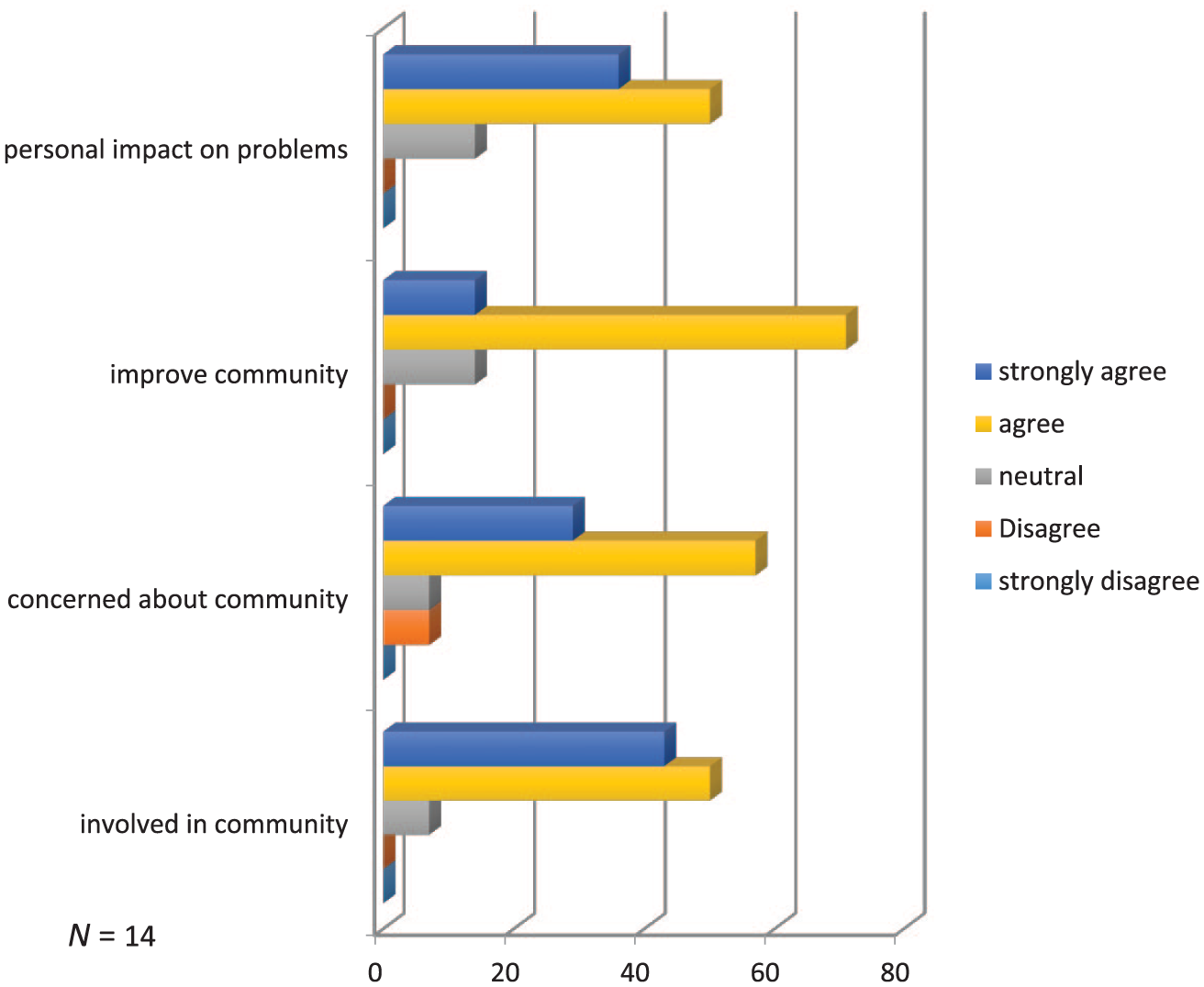
Student service-learning survey POLS 4351 January 2017 (N = 14).
Student service-learning survey POLS 4351 May 2017 (N = 15).
As with the 2015 group student responses in this course, a paired-samples t-test was conducted to compare level of agreement on the four civic engagement questions before the service-learning project and after completion of the service-learning project. For the question “I think that people should find time to contribute to their community,” there was not a significant difference in the scores for before service-learning (M = 4.067, SD = 1.279) and after service-learning (M = 4.467, SD = 0.639); t(15) = 1.192, p = 0.126. Similar results were found for the second question, “I am concerned about local community issues,” t(14) = 0.367, p = 0.359 with M = 3.8, SD = 1.320 before the project and M = 3.733, SD = 1.099 after the project. When asked level of agreement with “I plan to improve my own neighborhood in the future,” there was not a significant change from before the projects (M = 3.733, SD = 1.163) to after the projects (M = 4.067, SD = 0.593); t(14) = 1.581, p = 0.068. Finally, the question “I believe I can have a positive social impact on local problems” likewise did not yield significant results, with t(14) = 1.581, p = 0.068 and M = 3.933, SD = 1.279 before the project and M = 4.267, SD = 0.704 after the service-learning projects.
Discussion
This phase of this study represents a preliminary exploration of the associations between student participation in service-learning and increases in political efficacy and in turn civic engagement. The study notably is taking place in the context of an HSI with comparatively high levels of service and political participation. No causal relationships are attempted to be established, but rather a start to a longer inquiry is initiated. Given the backdrop and context in which these service-learning experiences were taking place, in an HSI where service is institutionalized, much more digging is needed to determine to what degree service-learning has a positive impact on the development of political efficacy. Preliminary results do indicate there is positive uptick in students’ sense of personal empowerment and impact on and concern for the community in some cases, but some paired t-tests indicate mixed results. Most of one class showed neutral attitudes toward measures of political efficacy and civic engagement decreasing and migrating toward more strongly held positive attitudes after participating in service-learning experiences with community partners, while the other group did not see a statistically different change. Sample sizes were small, so more data are needed to determine a trend.
Research on Latino youth political participation has found generally lower levels of civic engagement compared to non-Latino youth. On immigration issues, Latino youth demonstrate more positive associations and interest, but otherwise generally lower levels of civic engagement and civic knowledge (Torney-Purta et al., 2006, 2007). At the same time, this tendency is mediated when an environment is created that focuses on civic responsibility and political issues. When developmental assets focusing on outcomes such as connections to community and contribution to society are harnessed, a positive impact on Latino youth is observed. As noted by Torney-Purta et al. (2006): Students who form connections to their school and community (and to their ethnic group) are likely to care about issues pertaining to these institutions, and therefore to contribute to addressing these issues. Character is relevant because it relates to social responsibility and civic duty. (p. 112)
This positive development is buttressed by the availability of external assets, such as support systems and an environment that encourages youth empowerment. Regarding the findings in this study, it could be that even in instances where the uptick in indicators of political efficacy were noted, the presence of developmental and external assets in the university climate contributed to the observed increases in political efficacy and political participation and muted in the instances where statistically significant changes were not noted. If the ingredients for such outcomes are present in this campus environment as noted in the discussions above, it could dilute the definitive, known contribution of service-learning on increases in political efficacy and political participation. In the context of an HSI, where 59% of the student population identify as Hispanic (predominantly Mexican-American), there could be the ripe opportunity for connections to be made to ethnic ties and ethnic identity, in particular in the Latino Politics course, where the focus is on Latino voting rights, ethnic identity, and civil rights. Such conditions of developmental assets are supported in the research as being a factor in fostering civic engagement and may help explain the different results found for the two different classes.
Another possibility is that service-learning is an effective tool for increasing political engagement, alongside other equally worthy tools in the toolbox. For example, Martinez (2005), while focusing on nonconventional modes of participation such as protests, has noted that those who are a part of a strong social network with social ties within an organization are more likely to be pulled into political activism. Being a part of an organization serves as a facilitator of political participation by leading to the formation of social ties to others in the organization and community and that ultimately lead to a higher chance of civic engagement. This is consistent with earlier research by McAdam (1986, 1988), Fernandez and McAdam (1988), Snow et al. (1980), and Kitts (1999). Considering the environment created by a small class size, and a tight-knit student group within that classroom working together on a service-learning project, a parallel can be drawn to those found within an organization with strong social networks. Add to that the larger context of a small Catholic university where there is a strong sense of community, and conditions are created where civic involvement is fostered, even among a population where the literature has shown typically for there to be lower participation levels. In other words, service-learning may be a positive force, but the context of where it is taking place mimics the same context where civic engagement is fostered, whether in a university setting or elsewhere.
More data from more classes are needed. In particular, more data are needed from nonpolitical science service-learning courses, given the possibility that political science majors are more likely to begin with higher levels of political efficacy and civic engagement and/or that these service-learning projects were by nature designed to increase civic engagement, given they involved voting and community organizing and activism. Kahne and Westheimer (2006) have noted the importance of service and service-learning projects to be politically oriented in nature in order to have a maximum impact on political efficacy. Their warning that “youth seem to be ‘learning’ that citizenship does not require government, politics, or social action” (p. 294) is relevant to this research, as it may somewhat inflate the effects of political advocacy-type service-learning projects such as the ones examined in this research. In addition, as previously noted, the campus culture at OLLU has institutionalized and provided ample opportunities for service and service-learning, which may neutralize or reduce any observed effects if the student population is likely to begin with higher levels of political efficacy and civic engagement with or without having taken a service-learning course. Ideally, data should be collected from service-learning students at public institutions as well, especially in light of the observations by Torney-Purta et al. (2006, 2007) and Martinez (2005). One way to delve deeper into the impact of the service-learning experience may be to query a control group of students, who are enrolled in a political science course that does not require service-learning. Results could be compared to see if merely learning about political activism, civil rights, and so forth leads to increased political efficacy or if it is more attributable to the experience of service-learning.
Another area of improvement for future research will be to examine subtle differences between service-learners’ development of internal and external political efficacy. The questions administered in these surveys did not attempt to tease out those differences. Some research since Balch (1974) has found an important distinction in terms of impact on likelihood of political involvement. For example, minority populations have tended to have lower levels of external political efficacy, because their experiences with government responsiveness have tended not to be positive. The way a service-learning experience is structured may have consequences for the development – or suffering – of students’ internal or external political efficacy, as noted by Kahne and Westheimer (2006). This could partially explain the differences in the statistical significance of the service-learning in the two classes. Research by Bedolla (2000) delves more deeply into the dynamics of Latino youth’s sense of political efficacy and shows differences varying among gender, class, and generational groups. This may be a starting point to explore variations in internal and external efficacy in the context of Hispanic service-learners, as well as to explore gender differences, since OLLU’s student population is predominantly female. Bedolla (2000) and García (1997) show, for example, that value is placed on civic acts such as voting, regardless of differences in identification. However, respondents did not generally feel that their participation was effective or well informed. More research is needed to see to what degree service-learning may play a role in the bolstering of internal and/or external political efficacy.
Furthermore, regarding student outcomes, one limitation of these data is that the outcome to be measured focuses on a change in student attitudes rather than more revealing long-term student action. One may positively change attitude toward community involvement, but not take the step of doing so. Future research should attempt to conduct long-term follow-ups of these cohorts in order to determine whether the positive change in attitude led to political action.
Previous research has consistently shown a strong relationship between political participation and socioeconomic status (SES) or its variants such as resources (Brady et al., 1995; Verba and Nie, 1972; Wolfinger and Rosenstone, 1980). As noted above, 39% of the student population at OLLU report being first-generation college students, and 26% are below the poverty threshold (Office of Institutional Research and Effectiveness, 2015, 2017). This could provide a counterweight to factors outside of service-learning that would bolster civic engagement, such as strong organizational ties, social ties, and the presence of developmental and external assets in the university climate as discussed in the above literature.
The findings of these preliminary results present a modest but positive change in student attitudes regarding their political efficacy and potential for civic engagement after a semester of service-learning. Given the counter-forces of ethnic identity, university climate, political science majors, and the presence of developmental and external assets, the next step of this inquiry should be to include more service-learners from nonpolitical science courses, students enrolled in non-service-learning courses, from larger public universities, and from those with a more ethnically diverse student population. Introducing such factors would hopefully tell us more about the exact role of service-learning in bolstering political efficacy and political participation.
Footnotes
Appendix 1
Acknowledgements
This study was presented at the American Political Science Association Annual Conference held in August 2017. The author wishes to acknowledge the OLLU Center for Service-Learning and Volunteerism for its assistance in the service-learning projects and data gathering.
Declaration of conflicting interests
The author(s) declared no potential conflicts of interest with respect to the research, authorship, and/or publication of this article.
Funding
The author(s) received no financial support for the research, authorship, and/or publication of this article.