



Abstract
Amidst institutional reckonings with anti-blackness, minority-serving institutions (MSIs) are thought to be an intervention. But, how do Black students perceive being served at Hispanic-serving institutions (HSIs)? Analyzing focus groups (n= 33), we find Black students perceived anti-blackness at an HSI from: overrepresentation of white personnel in power; lack of culturally attuned and financial support; racially hostile climate; and little solidarity from non-Black Latinx and other peers. We show that HSIs contend with anti-Black institutional embeddedness, too, and argue that the goals of HSIs to serve racially minoritized students will not be achieved unless they address institutional, organizational, and interpersonal anti-Blackness.
Introduction
“I didn't know what anti-Blackness was until I got here” is a quote from one of our research participants, a Black woman student interviewed about her experiences at a Hispanic-serving institution (HSI). At the time, she was naming the specified racist practices she experienced as part of the 5% of Black students enrolled at that institution. Coincidently, the same institution that put out a solidarity statement for Black lives just weeks after she graduated, during the summer 2020 racial justice uprisings after a wave of publicized police murders, stating that “the university denounces anti-Blackness and anti-Black violence.” 1 According to kihana miraya ross (2020), writing in the New York Times about these same national uprisings, “Anti-blackness is one way some Black scholars have articulated what it means to be marked as Black in an anti-Black world. … It's a theoretical framework that illuminates society's inability to recognize our humanity.” Anti-Blackness represents a form of racism, informed by white supremacist ideologies, centered on the particular devaluation and exploitation of Black persons and is embedded in institutions, organizations, cultures, and so on. Dancy and colleagues describe these parallels between anti-Blackness in society and in higher educational systems, and that the protests of both, “reflect higher education's investment in maintaining an institutional and social relationship of ownership with people of color and Black people in particular” (p. 177). This paper extends this conversation about how anti-Black educational organizational cultures shape Black students’ experiences at institutions of higher education—even in institutions that are celebrated for their diversity and have denounced anti-Blackness.
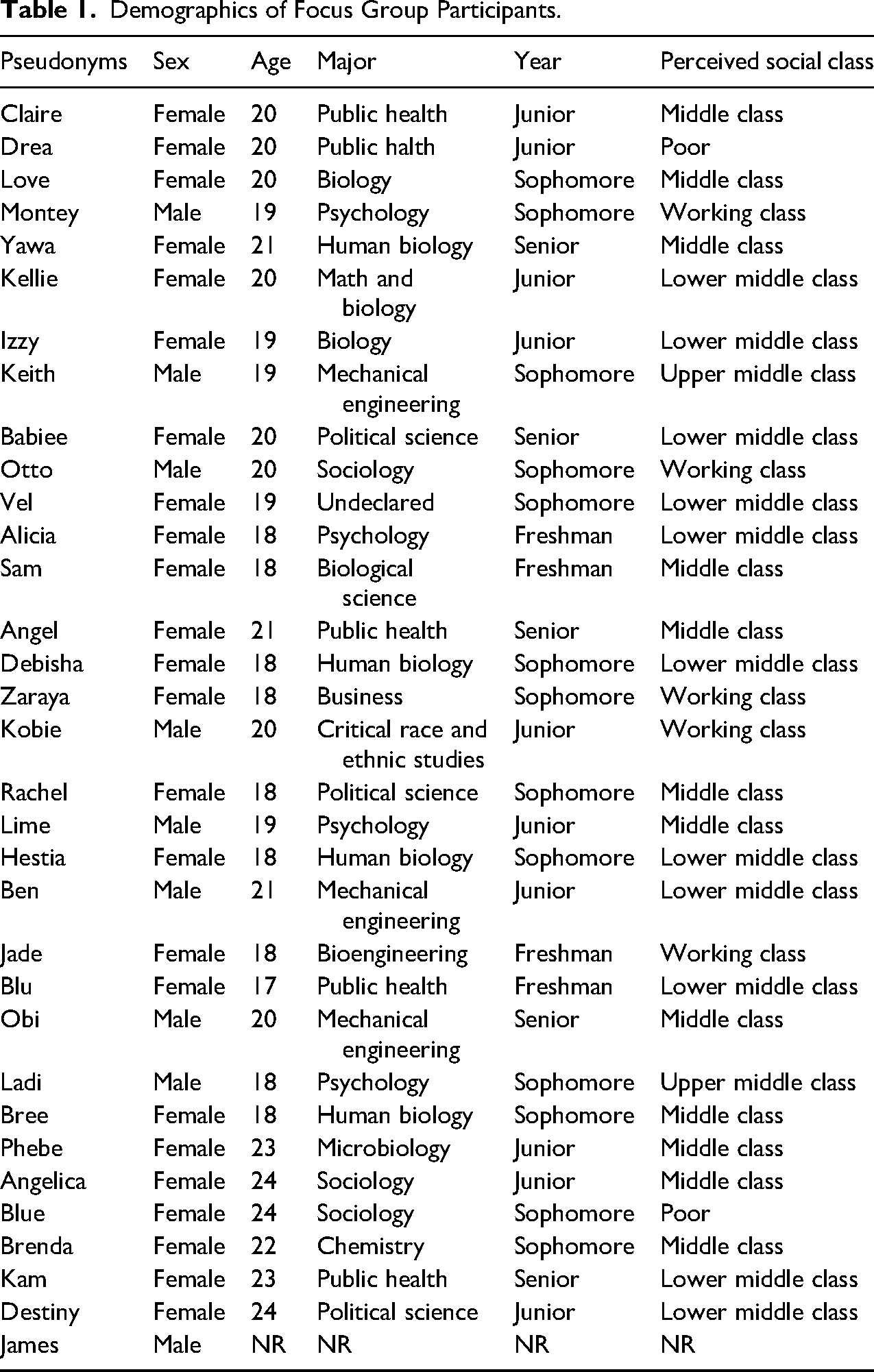
Demographics of Focus Group Participants.
Moreover, though the implications of this article extend to all institutions, we focus our attention to anti-Blackness in higher education on a specific type of minority-serving institution (MSI)—hispanic-serving institutions (HSIs). By 1992, a university could identify as an HSI if it enrolled at least 25% Latinx students, a designation that brings additional federal funding. They have grown consistently, and there are now nearly 600 HSIs in the United States (HACU, 2019). Advocates and researchers alike (i.e., Cortez, 2017; Mendez et al., 2015; Santiago et al., 2016) have contemplated the promise of HSIs, with the most optimistic visions of them as having the potential to challenge white hegemonic norms and organizational cultures of higher education. If achieved, HSIs would serve Latinx and other racially minoritized students by cultivating a radical affirming cultural and educational space, such as third space (Gutiérrez et al., 1999), which both enriches and produces successful students.
The trend of universities toward Becoming Hispanic Serving Institutions (2019) is what led Gina Garcia to ask in her book, “What does it mean, at an organizational level, to serve racially minoritized students?” (2019, p. 3). Within her analysis, Garcia introduces servingness as a model to capture equitable outcomes and an enhancing and affirming organizational culture for Latinx students at HSIs. Yet, despite the promise of HSI's, recent research suggests there are varying degrees of servingness for Latinx students at HSIs campuses (Cuellar & Johnson-Ahorlu, 2020; Garcia, 2019; Vargas & Villa-Palomino, 2019). We know even less about how other racially minoritized students are served within these institutions or how organizational structures might work to include or exclude their belonging within the HSI, though recent research suggests HSIs might not affirm Black students’ lives (Abrica et al., 2020). Thus, we heed the call for a greater “need for researchers to attend to institutionalized forms of anti-Blackness across structurally diverse institutional contexts” (Abrica et al., 2020, p. 55).
In this paper, we explore what it means, at an organizational level, for an HSI to serve Black students. We privilege student voices to address this question and specifically ask: how do Black students perceive servingness at an HSI? Do Black students experience anti-Blackness at an HSI? And, if under-served and mistreated, what services help support Black students? We analyze focus group data (n = 33) of Black identified students 2 at one particular HSI that enrolls over double the proportion of Latinx students needed to qualify as an HSI (62%) and also one that touts multicultural diversity discourses of positively serving under-served students of color (see Hundle & Vang, 2019) as part of the heart of its academic mission 3 . Our analysis found that the university's mission to serve a diverse group of students falls short when it comes to Black students’ perceptions; instead of feeling served, they report experiencing anti-Blackness at the institutional, organizational, and interpersonal levels. Overall, we show that HSIs may contend with what we frame as anti-Black institutional embeddedness, too.
Background
Racialized Organizational Cultures and Anti-Blackness in Higher Education
According to Victor Ray (2019), institutions of higher education are racialized organizations in the way they uphold racialized institutional cultures and racial structures, where “race connects cultural rules to social and material resources through organizational formation, hierarchy, and processes” (Ray, 2019, p. 27). Within the formation processes, racialization shapes the organizational identity of institutions. For instance, Garcia argues that institutions in the United States have undergone racialization processes where they are assigned the value “that have privileged institutions enrolling white students while subjugating those enrolling a large percentage of students of color (racially minoritized)” (Garcia, 2019, p. 9). Similar to conceptualizations of K12 schools as urban for having urban characteristics, that is, large populations of students of color and resource constraints (Milner, 2012), MSIs have been devalued by serving racially minoritized students, for example, through lack of material resources. Racialization processes also perpetuate a normalized model for educational success and evaluate institutions using white normative standards and metrics, such as national rankings or graduation and persistence rates, and often discount more holistic outcomes such as student belonging (Garcia, 2019; Keels, 2020).
More recently, work has identified how anti-Blackness operates as a specific organizational culture within institutions of higher education (Abrica et al., 2020; Dumas, 2016; Dumas & Ross, 2016; Harper et al., 2018). Warren and Coles (2020) explain that “Anti-blackness, or the socially constructed rendering of Black bodies as inhuman, disposable, and inherently problematic, endures in the organizational arrangement and cultural ethos of American social institutions, including her K-12 schools, colleges, and universities” (p. 2). Therefore, we can theorize that anti-Blackness is replicated through cultural rules that sustain the organization and its processes—processes that means Black students are relegated to the bottom of the educational totem pole (Harper et al., 2018). For example, Dancy et al. (2018) identified multiple dimensions of anti-Blackness within higher education, including Black subjugation and unequal labor practices that position white workers in authority figures and Black student and staff workers as lesser and disposable, as well as the institutionalization of Black suffering through defunding Black organizations and non-systemic responses to anti-Black violence. Dancy and colleagues’ work focuses on PWIs as one institutional context, but we know less about how this operates at MSIs that are already devalued for the students they are thought to serve.
Hispanic-Serving Institutions as a Third Space—for Who?
Pulling from formative work by Gutierrez and colleagues (1999), Garcia (2019) contends that HSIs have the potential to cultivate a third space, which “legitimizes and validates … the minoritized, racialized epistemologies of its students” (p. 92). In Gutierrez et al.'s study of K12 classrooms, the third space is a social space that offers counter-hegemonic discourses; a place where dominant cultural scripts make space for competing scripts to be upheld. These third, or similarly described by Micere Keels (2020) as counterspaces, are thought to correct the way institutions have “fail[ed] to connect these supposed non-racial, non-ethnic factors to the historical oppression and continued discrimination of historically subjugated racial–ethnic groups” (p. 5), which can negatively impact normative education outcomes for students of color at PWIs.
Garcia extends this idea of a counterspace to the prototypic organizational identity of HSIs, which have high potential to become a third space if they focus on serving. She explains that an HSI could be Latinx-enrolling (high enrollment of Latinx students), Latinx-producing (high degree outcomes for Latinx students), and/or Latinx-enhancing (high cultural awareness and support for Latinx students), but all of those independently are insufficient. Servingness at an HSI would include positive enrolling, producing, and enhancing together, with an emphasis on a strong Latinx organizational culture. The Latinx-enhancing organizational identity includes social justice curriculum, cultural programs, services, and resources, and faculty and administrators of color. Of her case studies, she found only one positive case, a private institution founded on the mission to serve Latinx students in a large urban Midwestern metro. Additional research has found that, similar to MSIs in general, HSIs do broaden enrollment and even producing to other racial groups (i.e., Black and Asian), low-income students, and immigrant students (Flores & Park, 2015; Garcia, 2019). Though HSIs are not exclusive to Latinx students, and their accompanying missions are also not exclusive, it is not clear how they have addressed serving (via enhancing) a cross-sector of racially minoritized students.
Problematizing the ideals of HSIs to be a different kind of space, Abrica and colleagues (2020) argue that “HSIs represent a colonial institution fundamentally shaped by white supremacy” (p. 57), just as PWIs do. Additional research has shown that the impetus to become an HSI often comes as a result of growing population changes and increased federal money to match the need, rather than a revisioning of the institution as serving particular needs of students of color (Garcia, 2019; Vargas & Villa-Palomino, 2019). For instance, Vargas and Villa-Palomino (2019) found that grant writers promote their HSI designation but devalue Hispanic students using deficit language and displace them in the award-funding programmatic efforts.
Who Serves Black Students?
We extend the examination of HSIs and servingness to ask what that racialized organization structure might mean for Black students—who do enroll at HSIs at a high rate (Flores & Park, 2015)—but often are not central to the conversation. The lack of specificity to Black students within institutional narratives is evidence of anti-Blackness in and of itself (Dumas & ross, 2016). Long-standing research on the Black student experience at PWIs typically suggests these places fail to support or fully serve these students (Keels, 2020). PWIs are found to be socially isolating places (Allen, 1992) and often have a harmful racial climate for Black students (Dancy et al., 2018), even when non-Black students report it more positively (Harper & Hurtado, 2007). The harm comes partially from the institution's white normative framing (Garcia, 2019; Keels, 2020), which relates to there being “a poor match between Black students’ academic needs and White campus academic expectations” (Allen, 1992, p. 29). In contrast, HBCUs are MSIs that research has found to support and serve Black students. Black students at HBCUs often experience strong educational outcomes, such as retention, which can be linked to positive interactions with faculty and staff (Fountaine, 2012). HBCUs also report many positive non-normative educational outcomes for its Black students, such as psychological well-being, cultural affinity, and even happiness (Fleming, 2001).
HSIs, as one type of MSIs, are also supposed to serve racially minoritized students in ways that enhance their student experience and outcomes. There is now a small but growing body of research related to HSIs serving Black students. Harper and colleagues (2018) apply a needed critical race analytic lens to their mixed-method study of Black student success at a racially diverse HSI in a large Northeastern metro and concluded that the university had “structural [racist] problems that undermine persistence and degree completion, sense of belonging, and academic achievement for [their] Black undergraduates” (p. 3), which included hiring “white overseers” (p. 18) and relying on federal grants of their low-income Black students to fill budget needs (see also Hypolite & Tichavakunda, 2019). Garcia and Dwyer (2018, p. 208) found that Black students (n = 5 out of a sample of 41) expressed “disdain for their institution being or becoming, an HSI, suggesting that the label is exclusionary or derogatory”, whereas non-Black Latinx and white students had more positive or indifferent identification and connections with the HSI. This tracks with Serrano's (2020) interview study with Black male students (n = 8) which found that they reported feeling isolated by the campus as a whole, whereas the Latino male students (n = 11) reported positive sense of belonging.
Abrica and colleagues’ (2020) study also focused on men, this time on Black male students at a Hispanic-serving community college (n = 15), who reported many anti-Black experiences, such as having their intellectual merits questioned, feeling either invisible or hypervisible, and lack of support for movements regarding their humanity. Lu and Newton's (2019) study had very consistent findings related to in- and hyper-visibility of Black students (n = 14) at an emerging HSI and Asian American Native American Pacific Islander Serving (AANAPI) Institution. They also suggested that the cultural mismatch thought to be addressed in third spaces does not exist for Black students at these institutions—arguing that Black students are a “minority within a minority-serving institution” (Lu & Newton, 2019, p. 67). Finally, Vega’s (2019) study with university personnel (n = 7) and students (n = 10) regarding a Black space at an HSI concluded that the space site, and its eventual closure, captured the race-based organizational conflict that diminishes the extent to which Black students feel served and supported at that institution.
The above studies point to the particular experience, one of nonservingness, of Black students in non-white and majority Latinx educational spaces related to organizational scripts and norms within the institution. These include the centering of whiteness, but may also include group tensions between non-Black Latinx and Black people. For example, despite Black and non-Black Latinx students facing similar socioeconomic educational barriers, Literte (2011) suggests the scarce resources on a college campus have caused both groups to apply common stereotypes to one another and carry over community Black–Brown issues to the campus environment. Shange (2019) found that tensions between Brown (non-Black Latinx) and dwindling Black communities in San Francisco seeped into interactions within the school site and influenced the way Black students were mistreated (via pushing out) in school. Anti-Afrolatinidad, or Black/Afro-Latinx rejection within the Latinx community, additionally shapes perceptions of anti-Blackness and is another theme that fuels the relationship between Black and Latinx students on a college campus (García-Louis & Cortes, 2020). As such, nonservingness and anti-Black exclusion is also shaped through group and interpersonal interactions by members within institutions.
Finally, in questioning who serves Black students, we additionally consider research on safe, affinity, racially cultivating spaces, and counterspaces to question whether these organizations within organizations might fulfill the need (e.g., Reyes, 2017). Serrano (2020) contends campus racial microclimates are distinct spaces where race and diversity operate to inform the perceptions and experiences of students of color in ways different than the larger campus racial climate. More specifically, Black spaces on college campuses have historically been used to mitigate anti-Black campus racial climate and provide a safe space for students to convene as their unapologetic selves (Brooms, 2018; Carter, 2007; Keels, 2020; Patton, 2006; Vega, 2019) as well as serving as a space to maintain cultural norms and help further develop racial identity formation (Tatum, 2017).
Furthermore, these Black spaces and organizations also set students up for educational success by exposing students to a diverse set of peers for support, increased contact to Black faculty and staff, and provide insider information about the hidden curriculum that students might have been excluded from otherwise, all of which can improve a students’ experience and outcomes (Brooms, 2018; Keels, 2020; Patton, 2006). Even more so, Black-centered counterspaces can become Black fugitive education spaces where Black humanity is actualized and determined on their own right (Warren & Coles, 2020).
There is limited research on Black counterspaces at HSIs. Brooms (2019) found that Black and Latino male students rely on a family-community nexus of social support to succeed at HSIs. Similarly, Serrano's (2020) examination of microclimates at an HSI, including academic homespaces (i.e., African American Studies Department) found that they can mitigate negative campus racial climates and become these Black students’ “lifeline” (p. 13) within the university. However, Vega’s (2019) postdiagnostic article about how the closure of a Black space reveals pitfalls in the level of serving an MSI provides. In particular, her study reveals that race-based organizational conflict leads to interpersonal conflict and feelings of dis-service of Black students. Thus, she contends that more analyses of Black counterspaces at MSIs/HSIs provide an opportunity for scholars to examine exactly how they provide support (or not) for students of color (Vega, 2019). We therefore additionally offer an exploratory look into how a Black student living and learning community (BLLC) space helps shape Black servingness amidst perceptions of anti-Blackness at one HSI.
Framing Anti-Blackness Institutional Embeddedness
Synthesizing theories of anti-Blackness (i.e., Dumas and ross, 2016) and racialized organizational cultures (i.e., Ray, 2019), along with models of MSI servingness (i.e., Garcia, 2018), and through our inductive/deductive data analyses, we put forth our conceptualization of anti-Blackness institutional embeddedness. For this project, we contend that anti-Black ideologies become embedded within educational systems through either implicit or explicit antagonistic relationships that shape disregard for Black students at the institutional, organizational, and interpersonal levels. In centering Black student perspectives at an HSI, we explore how anti-Blackness is both embedded and experienced through mismatched cultural scripts, uneven resource allocation, lack of representation, and group exclusion, even at institutions that claim to support racially minoritized students through centering diversity.
Data and Methods
Data come from an exploratory qualitative project on the Black student experience in the BLLC at an HSI: UC Central. UC Central, BLLC, and students’ names are pseudonyms per IRB recommendations (#2018-89). UC Central is located in a Latinx-majority, working-class community in California's central valley, and schools there can be characterized as urban emergent (Milner, 2012). UC Central (see Golash-Boza and Valdez, 2018) enrolls over double the proportion of Latinx students needed to qualify as an HSI, now over 62%, and is the newest and most racially diverse campus within a large university system. UC Central obtained an HSI status two years after opening its doors and quickly began obtaining HSI-designated grants. It is a part of HSI alliances and the HSI status is a key identity of the organization, as is diversity overall. The selection of this university is beneficial to the project because it shows how an institution with strong commitments to serving students of color in the books might not be felt by the students (Table 1).
Black student enrollment at UC Central hovered around 5–6% for the last 5 years, consistent with state population rates. For our methodology, we elected to do focus groups, a culturally attuned method of qualitative inquiry that allows students to hear others’ experiences and reflect on their own (Hughes & DuMont, 2002). From July to December of 2018, we conducted eight focus groups with Black identifying students (n = 33) who had varying degrees of affiliation with the BLLC. The focus groups were administered by the authors and research team, which consisted of one graduate student and four undergraduate students, three of whom were members of the BLLC. The lead author was an advisor and mentor. Student researchers used personal networks, organization listservs, and GroupMe messaging to recruit. Our questionnaire was informed by our literature review and sample questionnaire generously provided by researchers studying Black cultural centers and racialized equity labor (Lerma et al., 2020; Patton, 2006).
The BLLC was founded by three Black women students in 2014, another time in which the sociopolitical climate was ripe for Black activism because of the highly publicized police murders of unarmed Black men and women. UC Central was no different. At UC Central, there were protests about the lack of support of Black students, lack of Black faculty, administrators, psychologists, and the racial climate was one that reflected the larger society. The founders of BLLC said they needed to do something; one said, “We did not know what the term retention meant, but we heard from upperclassmen that half the Black students—and these weren’t the right statistics—but “about half of y’all won’t be back.” Hearing that was very scary, so what we did try to do was figure out what could we do that could make more of us stay here.” Thus, they created BLLC. Over the year of data collection, the BLLC housed 22 students and around 100 members in the organization.
Each focus group had between three and eight participants, with an average of four. The majority of the sample are women (70%), which means our data are skewed toward women but does reflect trends in intra-racial gender distributions. The GPA average was 3.03 (range 2.3–4.30); students’ age ranged between 18 and 24. All respondents are Black, some being multiracial, some Afro-Latinx, and some first and second immigrants (24% were foreign-born from the African continent). The focus groups lasted between 1 and 2 hours. Participants received a $15 Target gift card for their participation.
The focus groups were transcribed and then analyzed using a two-phase coding scheme developed by the team using Nvivo software. The project was initially driven by students’ request for more support for the BLLC. The research aim was to explore how the BLLC served students, and findings were to be used for advocacy by the students. The first coding phase included team discussions about potential coding categories that aligned with the project's research aim (i.e., academic/emotional benefits of BLLC, microaggressions on campus) and informed by relevant research (i.e., Brooms, 2018; Lu & Newton, 2019; Patton, 2006). Next, using those deductive codes, all members analyzed one focus group together and added inductive codes as they surfaced. The full transcripts were then coded by at least two undergraduate researchers, and new codes and discrepancies were discussed with the PI and team. It was during this collective process additional research ideas were created, including the project at hand. That is, our framework on anti-Black institutional embeddedness was derived organically from the focus group data. This was not the project we set out to do but was one we needed. 4
Findings and Discussion
Analysis revealed that Black students perceived high levels of exclusion and low levels of servingness at UC Central. Informed by our focus group data, we argue these experiences are the result of the university as an anti-Black educational space and contend that the anti-Blackness is maintained at the institutional, organizational, cultural, and interpersonal levels. At the same time, our focus groups revealed that the BLLC was a critically important space for identity-building, educational success, and a buffer to the racially hostile, anti-Black climate. We use quotes and interactions between students in our focus groups to highlight the themes below.
Institutional Anti-Blackness as Lack of Support and Perceptions as PWI
The majority of Black students interviewed at UC Central did not feel they were well incorporated into the student population or served by university staff. In fact, many students actually used PWI to describe UC Central, signaling they lacked identification with the status of an HSI (Garcia & Dwyer, 2018), and pointing out that the majority white faculty and administration replicated racial hostility found elsewhere. For Debisha and Angel they see, predominantly, white people in power:
I think I'm used to calling most of the UC's PWIs. So like it's just like, it's just a roll off the tongue even though, like I know it's not…. Even though, you know the student body is mostly [not], all the faculty is majority white, so they're like that's like the face of it. Sometimes it was like again, there you go, white people.
I say that because I feel like it's still like, once again even though Hispanics are like 62%, right after them is whites...and then the faculty majority are white. The staff here is majority white. Our chancellors are all white. Um, so it was predominantly white. There's some Hispanics here there's a lot—there's more than usual– but it's still majority white.
The comments by Debisha and Angel support Garcia's argument that “No longer matters whether postsecondary institutions enroll a majority white population, as whiteness is recreated by individual actors within the institution and reinforced within the culture” (2019, p. 11). In fact, the second largest racial/ethnic group at UC Central is Asian, but that was not perceived by these Black students.
An additional part of this rhetoric regarding PWI status also explicitly focused on the lack of institutional support of, and over-reliance on, Black student organizations to fulfill the student needs. In many ways, this finding supports Vega’s (2019) argument that the institution creates race-based organizational conflict through lack of support for Black organizations. In response to my question about the university's support of BLLC, this exchange happened between Izzy and Kelly:
the way I look at it is like we have all these clubs that are student-led. Yes. But we don’t have anyone above it to regulate all of them. And so I feel that because we’re missing that, the school doesn’t really care, and they kind of leave it to the hand of the student at that as a totally bad thing.
Like if you had… have a legit center that support or all our Black orgs on campus and I feel the school will care a lot more about the whole diversity thing—the so-called “diversity”—would matter. Yeah. Seriously.
like it may not seem like a PWI, but if you look around it really is a PWI. I don’t think they really care as much because if they did they would be a part of the activities that we would host. We have to make, we have to make the time, and we have to constantly email the chancellors and all that kind of stuff too, just to get a meeting with them to tell them to like force their hand and give us a Black resource center… How, how is it that the school is more okay with giving it to like, let's say, sorority names like Delta, Delta, Delta, Kappa, Gamma or whatever they’re called. Like how are they, like, how are they more inclined to give them more money than to us? We’ll try to put on like a culture shows to bring more culture to the school to show them… we’re open to everybody but because the school doesn’t open the support or doesn’t come to these things.
…they [student funding board] keep asking the same question. “Is this open to the public?” And “its like yes its open to the public!” But because we’re Black people, the public wouldn’t show up. So, what do you want us to do?
Izzy and Kelly perceived whiteness given that Black students and their culturally influenced needs and events were not supported at comparable levels to the standard, normalized organizations like sororities and fraternities. For that reason, diversity felt like a term thrown up by the white administration but not supported in tangible ways, especially when it came to Black students, as well as their organizations. Hundle and Vang (2019) name this institution's reliance on the student of color's labor as it being a DYI (do it yourself) university (see also Lerma et al., 2020). In terms of institutional resources, such as money, time, and support, Black students felt that their needs, in particular, went unmet, and eventually lead to a DYI approach.
Organizational Anti-Blackness as Lack of Inclusion and Mismatch of Cultural Scripts
Students who did talk about the uniqueness of being at an HSI still did not perceive it as a more inclusive space for Black students and felt under-served by the university. They pointed to situations where they perceived an understanding by university staff of Latinx issues, including solidarity on DACA-related concerns and speaking Spanish to one another, but did not perceive the same level of commitment for staff to understand their own set of issues. When Yawa shared as an aside, “I wish someone would speak Igbo to me,” it resonated with Shange’s (2019) chapter “Why Can’t we learn African?” which discussed how even progressive curriculum, such as Spanish-language/heritage requirements in K12 schools, often perpetuate anti-Black pedagogy in the ways it sets Blackness (and African languages like Igbo) outside of both normative and “heritage” learning. Keith answered the question about how the university cares about Black students firmly saying, “I don’t think they care. They don’t even want to hire Black people to begin with,” pointing again to lack of representation. He went on to emphasize other places the university was putting money into “more buildings and stuff like. That's important, yes, but there's also … the real issues with race and they really have to crack down on that type of stuff, and I feel like they should hire more Black people first before they do all that.”
A major event took place in which Black UC Central students hosted a party off-site and the police came in, unannounced, shot rubber bullets into the crowd, and arrested students, on the charge of searching for a Black man from the local community who they believed was attending (though never found). Black students started a campaign and protested on campus and at city hall. But the university's response was interpreted as them suggesting that since the event occurred off-campus, they had no obligation in working toward a solution. Students used this example in juxtaposition to anti-Hispanic/immigrant events on campus, led by the Republican club, to which they believe the university came down in more support of. To my question about support, Yawa explained: I don’t know if it's like a good topic that I should like compare both, but I’ll just compare cause they are both in my head. So like, when the republican club thing came up. Right? And then when the like police thing came up the school basically told us they couldn’t do anything about the students that were involved [with] the police, um. And the school basically laid it out that, “oh they can’t really support us because it happened out of campus.” Whereas with the republican club thing, It's like, “oh like, you can speak to somebody. You can do this and that.” … We were basically told that they can’t get involved because that's not like their thing, but to me at the end of the day. It's like we’re your students, like, we’re in [Central city] because of the institution. We’re not in [Central city] cause we want to be. And I think with the Latino community most of them are in [Central city] because of school too. So I look at both and when I look at those two I think the school chooses one side…
Above and beyond the more tangible supports that an institution might provide for its students, Black students at UC Central did not feel a sense of belonging that might be facilitated through racially and culturally attuned support and uplift. This reflects a mismatch in scripts between institutional cultures and Black student culture, as found by Keels (2020) of PWIs. Significantly, this translates to a lack of perceived servingness by the HSI, as similarly substantiated by Lu and Newton’s (2019) study at an emerging HIS and AANAPI.
Interpersonal Anti-Blackness as Lack of Solidarity
In addition to the lack of support and inclusion at the institutional and organizational level, students reported a lack of support and inclusion at an interpersonal level between students on campus. Although many students discussed friendly relationships with non-Black students at UC Central, at a group level the relationships were void of intimacy. In terms of positive relationships, some students, like Claire, shared that this comes from similar histories and linked fates, saying they were “similar especially like being family-oriented and like, you know, being like first-generation students. So they kinda like, you know, understand where I’m coming from”. Sara agreed that “the Hispanic and Black community together is all very welcoming of each other” but added important nuance. She said, “However, group-wise we are not—we are very separated. So, individually—yes, we all can mix, and go talk to them, and go hang out with them. But, if you are looking at campus or at an event, you’re not going to see an even mixture of Black and Hispanics.”
Some of this stems from societal level tensions between non-Black Latinx and Black communities (see Shange, 2019). The separation also echos segregation patterns in educational settings across the nation; explained by Beverly Tatum's (2017) Why do All the Black Kids Sit Together in the Cafeteria?, when Black students are in the numerical minority and have to be the “only” or “one of a few” in classrooms, labs, workspaces, the proverbial Black table in the cafeteria isn’t about self-segregation, but rather is an important coping tool for psychological survival. This is especially the case in spaces where Black students experience anti-Black microaggressions and racism. These group segregation patterns are understood at UC Central, as evidenced by the interaction between Bree and James:
Yes, it's diverse when you see, like, who's all here, but when you’re actually here? {shakes head} You see like everyone sectioned off to who like they’re relatable to, like the Blacks are mostly together, the Hispanics are mostly together, the Asians are together. I don’t really see too many people mixed.
Yeah, I agree one hundred percent. Like you see so many different faces, but do you see all those different faces colliding with each other? No, not really…. but um, yeah, I’ve personally only been hanging around with a lot of Black people. And then my roommates are both Hispanic and, uh, we don’t even hang out that much together. Cause they hang out with their own groups, which are all filled with Hispanics….There's a separation even inside our own dorms….
Bree then ties this back to the institutional level and connecting it acutely to servingness, adding that “it is like minority-based, but like you [James] said the Hispanics have more of an advantage because it's like not just for them, but most of the like staff people that help are Hispanic. They’re not Black. You don’t see too many Black people as staff members. … Cause like you already feel discouraged like you feel like they don’t want to help you as much.” What Bree is getting at is that the Latinx students on campus do not need as much cross-racial solidarity to feel supported or included, because they have representation among staff.
But above and beyond the racialized separation, Black students understand the lack of solidarity among students based on their Blackness. For instance, Ben retells the frustrating situation where students who belong in the BLLC would study together in a study room. They might not have a sign that says “BLLC ONLY,” but other non-Black students treated it as such. He says, “Like we’ve had trouble with like other floors like because they would see a study room full of Black people and they would just be like ‘oh they’re hogging the study room’ because they just see a bunch of Black people in a study room.” He says anytime someone would come in they would reassure that it was an inclusive space: “We all know if somebody comes into the study room, we’re going to be like ‘Oh, how is your day?.’ We’re going to like talk to them. We’re going to like be very welcoming like, like Jade was saying.” Ben is explaining the idea that they were not trying to segregate, but folks assumed that to be the case, to which he attributes to being Black.
I guess it's like some people look at it as, like you were saying, I think you said reverse segregation. Like looking at as in like “oh, they’re trying to exclude themselves from the rest of the I guess UC [Central] community.” And like we all know we’re not trying to do that… So it's like a lot of miscommunication, and then it's like, kind of like, being targeted like just as like a Black like group.
Kobie also called what he perceived to be a one-sided relationship saying, “so I feel like it's always Black people extending camaraderie versus other groups going out of their way to try to.” Importantly, Kobie and other students perceived that this non-allegiance among Latinx as people of color (POC) is steeped in differing racialization processes that place Latinx in closer proximity to whiteness (see, Bonilla-Silva, 2004). For instance,
So now that Latinx people are the majority, you would think it would be more of a comforting space for other people who [endure] marginalized oppression. But they’ve kind of co-opted the white identity and are kind of oppressive and try to like, identify as dom-like dominating figures within the community. So like instead of like being comrades, they pretty much going to be authoritarian figures.
Likewise, Ben shares “I definitely have seen how even though other minorities are targeted by white people … some of them still find it okay to single Black people out, even though it's like we all go through racism. We all suffer from it. But why are you going to entertain it further?” Not only did Black students report that they perceived the Latinx student majority to exclude them, but also to sometimes perpetuate anti-Blackness themselves. What the students discussed is reminiscent of the larger racial hierarchy in the United States, that places whites at the top and Blacks at the bottom, and how many non-Black racial/ethnic groups might fall into what Bonilla-Silva (2004) calls the honorary-white middling tier of the racial hierarchy. In this position, non-Black POC has attitudes that often reflect White Americans as a way to solidify separateness and superiority.
This was even the case with Afro-Latinx students whose Black features meant they were often excluded from Latinx students who racialized them as only Black. One student, Zaraya, discussed how she felt ignored in a classroom by her Latina peers until they heard her speak Spanish. “I go to class early and I’ll sit down and then everyone else will sit down around me but never next to me. … unless I say something [in Spanish] or like, um, like it’ll come up, they’re like, ‘oh, like I speak Spanish’.” After signaling her connection to Latinidad through language, she then felt more included. However, at the same time, it heightened feelings of exclusion because she felt as though they marked her Blackness as negative. This illustrates that anti-Afrolatinidad that García-Louis and Cortes write about: “The rejection of Afro-Latinidad is reflective of the historical rejection of blackness in society. While this rejection is experienced by individuals differently, it takes a common form in racial discrimination” (2020, p. 2). In their study, they found that students “rejected back” after being rejected for being Black, through experiences of racism and microaggressions, by affirming their Afro-Latinidad. They did so through amplifying racial cues, like big curly hair that is racialized as Black (see Sims et al., 2020), and also organizational campus spaces. Zaraya felt inclusion at BLLC even though her Latina identity might have made her feel more welcomed at UC Central.
Anti-Black Experiences as Psychological Torment On and Off-campus
Anti-Blackness operates throughout institutions of higher education in a myriad of ways. According to Dancy and colleagues, one way anti-Blackness is evidenced is through the institutionalization of Black suffering. They explain that racial microaggressions, or the continued onslaught of slights, or feeling like a token or impostor as one of few Black students can cumulates as “the psychological torment regularly visited upon Black humanity in higher ed” (2018, p. 188). As alluded to above, we found this to be the case among Black students at UC Central who experienced varying levels of racism at the HSI as well. This is troubling, but in many ways an unsurprising finding given what we know about racialized minoritized students in institutions of higher education and the growing work on HSIs of varying status, size, and location (i.e., Abrica et al., 2020; Brooms, 2019; Harper et al., 2018; Lu & Newton, 2019). What this project reiterates is anti-Black racism persists at diversity driven MSIs. Moreover, it is the fact that UC Central is a new HSI that the anti-Blackness was identified above and beyond racism; Black students recognize institutional, organizational, and interpersonal racism but in a different form, manner, and perpetrator than would impact all POC. They call it was it is: anti-Blackness.
Zaraya helped to make this point related to invisibility above, but many other students shared other stories of racial discrimination. For instance, Yawa told a story of where she had to quit an on-campus job because of racial hostility. She and another Filipina student were having difficulties with the lab manager. The Filipina student directly addressed the situation by “going on and off,” whereas Yawa was quiet: “And you know, me being as African as I am, I was very nice, and you know quiet.” But when the lab manager emailed about the situation to their boss, the boss, a White woman, “automatically thought it was me. So she called me in, and she's like, ‘You might lose your job’ … and she went like on a thirty-minute lecture” before Yawa even had the chance to interject. Yawa could not remain in a job where the angry Black woman racist trope shaped her boss's perceptions.
Students recalled many racist experiences off-campus as well. On multiple occasions in the focus groups Black students at UC Central shared stories of being called racial slurs at the local mall, feeling unsafe to jog in neighborhoods, and being told a store is closed when they allowed non-Black customers in, for example. They often shared that the perpetrators were not only white community members, but Asian and Latinx as well. They understood that the local community was different than the campus community, but still implicated the university in the lack of safety they felt, or the lack of concern when students reported issues reiterating what Yawa shared before: “it's like we’re your students, like, we’re in [Central city] because of the institution.” The outside community context is important; Cuellar and Johnson-Ahorlu (2020) found that the outside community impacted the extent to which even Latinx students felt served at an HSI. They argued that if not purposeful in countering external negative racialized experiences, the HSI might perpetuate them. Dancy et al. (2018) agree, saying the university's dismissiveness of these experiences as being “incidental or anomalous functionally erases the history of trauma experienced by Black bodies on White campuses” (p. 189). Here, we add that this anti-Blackness extends to dismissing racist experiences as being unattached to the university, and also that the trauma can occur at HSIs, too. For the students, these were not one-off events; they are patterns that shaped their daily experiences.
Countering Anti-Black Institutional Embeddedness
What became clear through our focus groups and the analysis is a systematic climate of anti-Blackness that perpetuated institutional, organizational, and interpersonal experiences. Students knew this to be true. Jade didn’t have the words to describe the anti-Blackness but talked about the uniqueness of being Black, even though admitting that racism is more specific: “I feel like all minorities are definitely, like, discriminated against. But like there's just, there's just something else about being Black that's just, I don't know, that's different. And so like I feel like other people can't really relate.” In one focus group, Babiee summed it explicitly, “I didn’t know what anti-Blackness was until I got here,” as others in the room snapped in solidarity.
In a telling moment, Kobie also put the anti-Blackness in plain language, but tied it to the Black counterspace they had created for themselves, the BLLC. He explains, “Yeah. So pretty much I feel like any negative stigma like for [BLLC] is rooted in anti-Blackness. So it's like, it's just a general perception of Black people. It doesn't really rely on facts from them. …. It's just what people seem to project onto Black people.” However, Jade goes on to explain how crucial the BLLC was to combat the anti-Blackness: So like going back to [BLLC] or like friends in [BLLC], they can like relate and that's just the feeling of like being validated. I feel like that that does a lot more than just being like, “Oh, I feel bad for you.” Or like, “Oh, I'm sorry that happened.” Which is I think one of the greatest things that [BLLC] kind of does to help us.
Jade's point is important because she points to how the BLLC offers a counterspace to the harsh anti-Black climate they feel.
In fact, whereas UC Central's organizational culture did not facilitate a sense of belonging for its Black students; the student-run BLLC organization was critical for facilitating a sense of belonging and servingness for Black students. One mechanism that created this space was employing culturally sensitive programming that increased feelings of belonging overall; a home base and safe space within UC Central. As a safe space, Black students felt empowered to be themselves, unapologetically. As Sarah offered “Like, when you see your skin color, you know when you see who resembles you and it kinda, like, builds a comfortable space or safe haven when you have those people around you.” The BLLC provided a sense of belonging and of inclusion as a counterspace or microclimate (e.g., Keels, 2020; Serrano, 2020).
We agree with Vega (2019) that undervaluing the need for counterspaces, even race-specific ones at an HSI, severely underestimated the challenges faced by Black students due to their identities. When institutional organizational cultures do not facilitate that belonging, students turn, or in this case create, sub-organizational micro-cultures that are racialized in a way that affirms, support, and serves, and especially sees them as Black and as mattering (see also Brooms, 2019; Serrano, 2020). Our future work will extend the theorizing of Warren and Cole's Black Education Spaces on (2020) the creation of Black counterspace as an intervention for anti-Blackness at MSIs/HSIs.
In sum, the findings of the qualitative data collected suggests that Black students’ experience the consequences of anti-Black institutional embeddedness at UC Central stemming significantly from greater representation of white personnel in positions of power, passive responses to culturally relevant events, minimal funding for Black-centered organizations, lack of perceived solidarity from Latinx and other peers, and anti-Black hostility on and off-campus. To combat these factors, Black students create their own organizational counterspaces. We argue that if the goal of HSIs is to better serve all racially minoritized students, the institution must find institutional ways to incorporate, support, and serve Black students.
Conclusion
Anti-Blackness describes “what it means to be marked as Black in an anti-Black world” (Ross, 2020). Institutions of higher education are micro-chasms of larger social worlds, but also have their own racialized organizational cultures (Ray, 2019). While many HBCUs seem to have a positive organizational culture that affirms Blackness, many other institutions, including some PWIs and as we are arguing here, some HSIs, operate as an anti-Black space through their organizational processes and hierarchies. That is, despite the promise and potential for HSIs to serve as a third space that serves racially minoritized students (Garcia, 2019), we contend HSIs fall short of this progressive promise for students marked as Black. Our research confirms recent, important work on the lack of inclusion, support, and servingness of Black students at MSIs (Abrica et al., 2020; Lu & Newton, 2019; Vega, 2019) and extends the finding that “anti-Blackness is at the heart of HSIs” (Abrica et al., 2020, p. 57).
Analyzing focus group data of 33 Black identifying students at UC Central, we find that students perceive anti-Blackness across organizational levels and interpersonal relationships through mismatched cultural scripts, uneven resource allocation, lack of representation, and group exclusion—which then mutually constitute anti-Blackness in the institution. First, students perceived the HSI as a PWI given the overrepresentation of white administrators, staff, and faculty. They felt the lack of representation meant the commitment to support students of color, and Black students especially, was minimal. In addition, they did not feel served at the institutional level in terms of material resources allocated to Black-specific events, groups, and spaces which would better support their academic success as students. They also perceived a lack of inclusion in terms of organizational culture, a culture that did not recognize or address specific social and emotional needs that would make them, as Black students, feel included and served. This was especially the case relative to experiences with police on campus and in the community, which is reflective of larger current societal issues related to anti-Blackness. Moreover, the students recognized that university policies that did not support their humanity or safety, above and beyond anti-Black interactions with personnel, shaped the anti-Blackness they experienced.
This is not to say interpersonal relations did not matter—they did. Students reported multiple racist encounters from staff, students, and community members that they accounted to their Blackness, and these major events and microaggressions were very harmful toward their personal and academic well-being. Many students specifically named non-Black Latinx and other POC as perpetrators of microaggressions, by mostly upholding a sense of superiority relative to Black students, which facilitated feelings of exclusion. As members of the BLLC, the main respite they had on campus was this BLLC. It became a counterspace where they could be their authentic selves, celebrate their Blackness, support each other and their academics, and confront anti-Blackness. This finding reiterates the need for counter-, third-, or micro-spaces (i.e., Garcia, 2019; Keels, 2020; Serrano, 2020). Without the BLLC, our analysis revealed that Black students perceived high levels of exclusion and low levels of servingness at UC Central.
The context of the HSI for this analysis is significant, given the rate at which this institutional identity is growing. Our analysis confirms that Black students do not have a strong institutional identity as being an HSI (i.e., Garcia & Dwyer, 2018), and extends that finding by arguing it is a result of the institutionalized anti-Blackness. Whereas research at PWIs might focus on students of color more broadly, or attribute Black students’ experiences to general racism, analyzing Black students at HSIs and multicultural spaces allows the specific form of anti-Blackness to be pinpointed (e.g., Shange, 2019; Vega, 2019). This is not to play into ideas of zero-sum gains between underrepresented groups, rather, it shows that even at a university that serves almost 90% students of color, Black students still come up against specific barriers, given their placement in the racial hierarchy (Harper et al., 2018).
We recognize some limitations with our study with regard to generalizability and selectivity. First, this is a study of one HSI, which is also a new university, and one that could be considered an urban emergent with urban characteristics. It could be the case that a longer-standing MSIs or HSIs have had the time and infrastructure to better support Black students, or that institutions in urban settings might operate differently given broader local context. More research is needed to tease out these nuances. Our study additionally focused on students affiliated with the BLLC. We do not have empirics to know if Black students unaffiliated with the counterspace perceive the same level of anti-Blackness on the campus, though the Black student writers on this piece attest to the broader validity. Future research should consider these limitations and expand on this work.
Addressing Anti-Black Institutional Embeddedness
In many ways, what we see at UC Central is reflective of the “progressive dystopia” Savannah Shange (2019) writes about in reference to a San Francisco, California progressive, multicultural high school. Her book critiques the progressive framings of “wins” especially as related to social justice issues within schools by showing how these supposed victories fail to meet the actual needs and freedoms of Black people in particular; at the multicultural school “blackness is eclipsed by the more equivocal ‘people of color'” (Shange, 2019, p. 2). As a new university set to serve many first-generation, racially minoritized students, the mission of UC Central is a victory in contrast to older, whiter universities. However, despite UC Central's public display of support for multicultural racial and ethnic diversity, our work supports Hundle and Vang’s (2019) account of the university as tokenizing the students of color through neoliberal practices as related specifically to Black students. Our research extends the concept of a progressive dystopia (Shange, 2019) in urban schools in large cities to higher education and even rural spaces, showing the UC Central serving of racially minoritized students falls short when it comes to its Black community because it does not confront its anti-Blackness.
The larger implications of our project extend to education inequalities more broadly as Dumas and Ross (2016, p. 432) make the explicit connection: “antiblackness serves to reinforce the ideological and material ‘infrastructure’ of educational inequity—the misrecognition of students and communities of color, and the (racialized) maldistribution of educational resources.” We contend that anti-Blackness must be recognized as a harmful yet systematic part of education and argue we must work collectively and swiftly towards its eradication.
In closing, we do recognize that MSIs represent a critical educational intervention and therefore offer a few implications. Perhaps one day MSIs might be what Garcia (2019, pp. 91–92) offers as a vision: an institutional third space that might “bridge cultural, social, and epistemological knowledges as a way to challenge dominant ways of knowing while enhancing learning”; one that decolonizes institutional scripts and includes student knowledge as integral. However, our project suggests this vision cannot become a reality for HSIs in particular, and institutions as a whole, unless they work to decolonize racialized institutional cultures in a way that supports and serves all Latinx students and non-Latinx Black students, while explicitly addressing anti-Black racism and violence. Researchers then need to remain vigilant in analyses of educational spaces that are commended for diversity or progressiveness; in doing so, the veil is often lifted regarding ways that students of color still are not being holistically served.
Likewise, education practitioners too should remain committed to serving all students, according to their particular needs rooted in their racialized experiences and histories, and can better learn what these needs are by really listening to all, and especially contextually marginalized, students. At an HSI, this means broadening servingness to Black students, as well as understanding that Latinx students include some Black (i.e., Afro-Latinx) students. This includes a freeing from white normative standards of educational success. Hiring more Black faculty and staff, and especially supporting those who work as institutional change-makers, can also help to empower students and to institute context-based policies to better support and serve students at MSIs (Garcia & Ramirez, 2018). Universities need to de-individualize solutions, and also consider community and familial relations as a place of intervention (i.e., Brooms, 2019; Cuellar & Johnson-Ahorlu, 2020). Finally, institutions should continue to support student-led services through increased funding and paths towards institutionalization, given the ways students step in to fill gaps. Institutional, sustainable support for Black radical, even fugitive spaces (Warren & Coles, 2020) should be increased as they often do the important work to serve Black students in the way the university simply cannot—yet.
Footnotes
Acknowledgments
We are thankful to our other team members, Rochelle Mulondo and Manuel Leon, who were integral to this project's formation. We are indebted to all of our participants for sharing their stories. We appreciate feedback from Dalia Magana and Antar Tichavakunda on early drafts of this work.
Declaration of Conflicting Interests
The authors declared no potential conflicts of interest with respect to the research, authorship, and/or publication of this article.
Funding
This work was supported by a UC Merced Faculty Senate Research Award and in part by a grant from the Andrew W. Mellon Foundation for UC Merced’s “Undergraduate Research Opportunities Center-Humanities (UROC-H): Research and Graduate Preparation in the Humanities.”
