




Abstract
Discourse on youth development has only begun to explore how Black youth experience courses intended to result in their sociopolitical development. The present study examined the link between pedagogical experience in a culturally relevant class and sociopolitical involvement and tested the mediating role of sociopolitical efficacy. Cross-sectional data were collected from 278 Black, former students of a mandatory high school course, called Social Justice. Pedagogical experience, sociopolitical efficacy and sociopolitical involvement were all measured as latent variables. As anticipated, structural equation modeling showed that pedagogical experience is associated with sociopolitical involvement, and that sociopolitical efficacy mediates this relationship. Ultimately, the current study shows the merit of giving Black youth the opportunity to learn how to respond to social and personal unjustness, and the paramountcy of improving youth’s perception of their ability to make a difference in their communities. Findings highlight the role of sociopolitical efficacy and support the idea that student experience has implications for whether culturally relevant teachers meet their intended goals. In the case of the present study, many years after the course, there is a relationship between their perceptions of their course experiences and their intention to engage productively in their communities.
Introduction
The pedagogy of culturally relevant teaching, defined as a method of teaching that empowers students by using cultural referents familiar to them, has been shown to predict positive developmental outcomes. Culturally relevant pedagogues engage in instructional practices that depart from the tried and true methods of more traditional-minded pedagogies (Gay, 2002; Howard, 2001; Irvine, 2003 and Ladson-Billings, 1995b), which includes an explicit focus on the sociopolitical development (SPD; a critical, reflective form of civic development) of students. The framework of SPD emerges from several psychological fields, most notably liberation and developmental psychology. SPD is the evolving understanding of social inequities as well as the political, economic, historical and cultural processes and outcomes of oppression; this includes developing an understanding of one’s status within these societal forces and becoming involved and engaged in civic life (Watts and Flanagan, 2007).
Studies have documented the positive relationship between service learning and forms of civic development (e.g. Flanagan et al, 2007a; Voight and Torney-Purta, 2013; for review, see Conway et al., 2009) and between civic education and forms of civic development (e.g. Godfrey and Grayman, 2014; Watts et al., 2003), illustrating how direct targeted efforts can influence the likelihood of high school students to be engaged civically and socially (Reinders and Youniss, 2006). Using the lens of culturally relevant pedagogy (CRP) grounded in a model of SPD, the present study explores whether participants’ experience of one such course, “Social Justice,” simultaneously predisposes Black youth to high levels of sociopolitical efficacy and engagement. That is, whether a culturally relevant “Social Justice” experience makes Black youth more likely to experience SPD.
Culturally relevant teachers of “Social Justice” intend to develop lasting SPD in youth by infusing service learning with civic content. The social justice subject matter is well-known in many Catholic and private schools (Dallavis, 2011), but bears important similarities with established social studies courses (and civics in particular) in many public secondary schools (e.g. civic competence and participation, political science). In theory, SPD is facilitated by such a course through several methods, including critical social analysis (i.e. deconstructing and studying social issues like racial profiling or police-community relations; Ginwright, 2015), which is often seen as a tool to help marginalized youth learn to redress systemic inequality (Freire, 2005; Watts et al., 2003; service learning, which can enhance a culturally relevant civic minded curriculum by connecting it to students’ lived experiences or home-community; efforts to relate course content to students’ cultural context; and several forms of engaging and charismatic instruction (Ladson-Billings, 2006; Lin, 2015).
Unfortunately, there may be a gap between CRP theory and practice as research on educators implementing CRP reveal that the methods and ideologies surrounding its use are dynamic, complex, and, at times, unsuccessful (Esposito and Swain, 2009; May, 2011; Rozansky, 2010). Differences in levels of success reflect differences in the praxis of CRP, culturally relevant teaching. Moreover, research focused on investigating programs intended to promote SPD have not addressed culturally relevant strategies that are of most benefit to traditionally marginalized groups (Fridkin et al., 2006). For instance, few quantitative studies to date have assessed the relationship between Black students’ perceptions of their learning experiences and intended outcomes like SPD. Thus, there is increased interest in understanding the delivery of culturally relevant courses focused on civic development (for an example, see Hope and Jagers, 2014), as well as whether there is a relationship between Black youths’ experience of these courses and sociopolitical behaviors (Dassonneville et al., 2012).
Although research to date suggests that culturally relevant content may elevate levels of sociopolitical participation, there are gaps in the literature. First, there is limited empirical evidence about the factors that support sociopolitical involvement and, in particular, unconventional political engagement (Stockemer, 2014); the quantitative research on sociopolitical involvement among Black citizens is particularly limited. Second, when investigating SPD among ethnic minorities, no previous study that the author is aware of has examined potential mediation of the association between the course experience and SPD.
Sociopolitical efficacy as a mediator
Sociopolitical efficacy refers to an individual’s belief in his or her capacity to impact the community in ways that are social and political (Godfrey and Grayman, 2014; Prilleltensky, 2003). Although consistent with some conceptualizations of political efficacy (e.g. Colby et al., 2010), sociopolitical efficacy diverges from most definitions of political efficacy because it looks beyond faith and trust in government and the belief that one can influence political affairs to include the belief in one’s capacity to bring about community change with knowledge and skills that are both social and political. Because SPD posits that efficacy is a prerequisite for action, sociopolitical efficacy is likely a precondition for sociopolitical involvement (Rubin, 2007). For instance, working with others in the community will likely only happen if youth first believe that working with others in the community can be effective. This sense of efficacy has both internal and external components because youth must believe that, one, they are capable and competent, and, two, that people in a position to make changes care about what they say and do (Diemer and Rapa, 2016).
The SPD model proposed by Watts and Guessous (2006) lays out several propositions related to the relationship between opportunity structures (e.g. components of CRP in the Social Justice class), feelings of agency and efficacy (e.g. sociopolitical efficacy) and societal involvement (e.g. sociopolitical involvement). The psychological model of civic engagement proposed by Watts and Guessous explains how institutional efforts can transact with contextual and individual factors to help mobilize youth capacities and stimulate political and civic involvement. Their model extends what is understood about how Black youth (and members of other marginalized groups) in a culturally relevant class may move from a positive class experience to sociopolitical involvement. Taken together, CRP and the SPD model illustrate how civic engagement is supported by adolescents’ perception of their learning experience (which includes teacher personality, teaching style and course content), a relationship that may be explained by sociopolitical efficacy (see Figure 1).
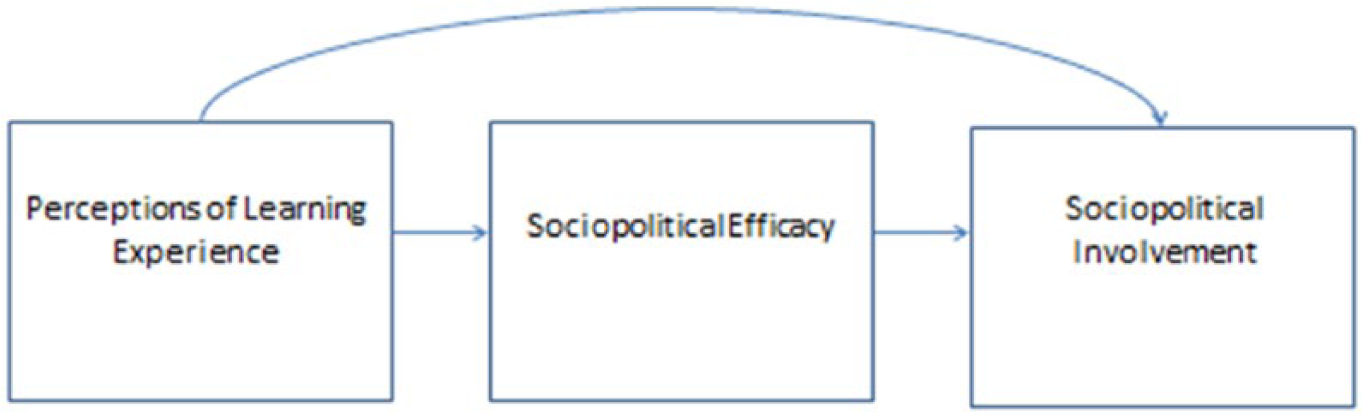
Conceptual model.
There has been extensive work on political efficacy, particularly among researchers who look at political efficacy as an indicator of greater civic development (e.g. Bandura, 1999; Charles, 2005; Hart and Atkins, 2002; Warren et al., 2008). There also is empirical work to support the relationship between class experiences, the development of sociopolitical efficacy, and ultimately civic behaviors, a trajectory supported by extant theory (Freire, 2005; Watts and Flanagan, 2007). For example, in a longitudinal study about cultivating democratic citizenship in a college classroom (Gurin et al., 2004), compared undergraduate students in a curricular diversity program with a matched control group and determined that experiences within the program affected students’ process of learning to become engaged, informed citizens. Similarly, Hope and Jagers (2014) found that political efficacy and civic education were associated with civic engagement.
Sociopolitical involvement is a behavioral construct that is often considered a subtype of civic engagement; it refers to the intention to participate in the community, both conventionally (e.g. volunteering) and unconventionally (e.g. participating in a boycott), but with intention to operate at a more political level than what may be stated in some conceptualizations of civic engagement (e.g. Putnam, 1995). A comprehensive assessment of sociopolitical involvement may include indicators for the likelihood of political engagement and the likelihood of engagement in community issues (which includes participation in social issues that are not necessarily related to politics). Although there are many distinct pathways to sociopolitical involvement, research suggests that sociopolitical efficacy is likely to mediate the relationship between institutional efforts and participatory action (see Diemer and Li, 2011).
Current research on Black youth engagement offers a mixed picture of the relationship between culturally relevant practices, efficacy and engagement. On one hand, scholars have identified a link between efficacy and civic behavior. For example, Diemer and Li (2011) studied Black school-age children and found a relationship between perceived ability to influence society and voting behavior, a finding that supports the expectation that efforts to bolster sociopolitical efficacy should lead to more sociopolitical involvement. On the other hand, in a study on political efficacy and action among marginalized adolescents, Diemer and Rapa (2016) found that political efficacy neither mediated nor moderated the relationship between critical analysis and political action. Moreover, despite research to suggest that Black youth are more likely to be sociopolitically engaged than other racial groups (Center for Information & Research on Civic Learning and Engagement (CIRCLE), 2007; Ginwright, 2015), other research reveals that groups that historically faced race and class based oppression and marginalization have a lower sense of politically efficacy (Van Stekelenburg and Klandermas, 2013). Growing scholarly literature on Black youth civic participation suggests that, when broadening the conceptualization of engagement to include involvement in community issues and more unconventional (and less often studied) forms of civic and political involvement, Black citizens are civically and politically engaged (Ginwright, 2015).
An approach that balances a CRP and SPD lens offers that Black youth trajectories toward sociopolitical efficacy are influenced less by civic education itself and more by participants’ personal experience of the context within a civic education experience. Although there have been studies in this area (e.g. Godfrey and Grayman, 2014), few studies examined whether political efficacy mediates the relationship between class factors and sociopolitical involvement. Studies addressing SPD among Black youth must consider whether classes like Social Justice can successfully influence political efficacy, as low efficacy is considered a major barrier to political participation among Black youth (Fridkin et al., 2006; Van Stekelenburg and Klandermans, 2013). One focus of the current study, therefore, is on the potential role of three important aspects of the culturally relevant course that may be implicated as proximal influences on sociopolitical efficacy.
Summary and study aims
Culturally relevant courses intended to foster civic development offer one viable pathway toward SPD. Understanding if, and how, SPD is fostered among Black youth who have benefited from a culturally relevant class will help improve the quality of civic education afforded to all Black youth. Therefore, the purposes of the present study were to (1) examine the association between pedagogical experience and SPD and (2) test whether the level of sociopolitical efficacy mediates the association between pedagogical experience and sociopolitical involvement.
Based on the SPD model (Watts et al., 2003; Watts and Guessous, 2006) and CRP theory (Ladson-Billings, 1995b, 2003, 2006, 2014), and building on previous research by Hope and Jagers (2014), it is hypothesized that former students of the culturally relevant course selected for this study will demonstrate higher levels of sociopolitical efficacy and sociopolitical involvement when they perceive that the course helped them critically analyze social and political situations relevant to their lives, they perceive that the teacher’s efforts and course content were imparted in ways that were culturally relevant to them, and when they perceive that they participated in a service experience that was culturally relevant and well-integrated into the class. It is also hypothesized that there will be a positive relationship between perceptions of the learning experience and sociopolitical involvement, and that this relationship will be partially explained by former students’ sociopolitical efficacy. This study contributes to current literature by utilizing a robust measure of the culturally relevant learning experience, considering the perceptions of former students, and drawing from a sample in which all study participants were required to take the same culturally relevant course with the same civic development goals. Importantly, the CRT course chosen for the present study allowed for variation in participants’ experience of the course, due to a flexible and organic curriculum and self-selected service experiences.
Method
Sample characteristics and procedures
Data for the present study came from 278 former students (48% males) of a mandatory junior year service learning course, called Social Justice. Alumni entered high school at different times. The majority graduated between 1993 and 2001 (52%) and the mean age was 29 years old. Thirty-three percent of participants reported being Catholic in high school, while 10% of the sample reported not belonging to any religion. Sixty-six percent of participants had received a college degree or higher at the time of the study. Less than half the sample had a mother who was college-educated; 40% of participants had a mother who graduated from college. While for the majority of the sample, tuition was mostly funded by a family member (82%), 14% of the sample funded their tuition through need-based scholarships and/or vouchers. The predominately Black, socioeconomically diverse catholic high school in this study was located in an urban area in Washington, DC. The participating school distributed the survey to their alumni directly (i.e. newsletter, alumni Facebook page, and emailing link to survey directly to alumni). In addition, participants were identified via Facebook, an online social networking site.
Course material varied by class and by academic term, as the CRT teachers were allowed to choose reading materials based on current events and interests they perceived as culturally relevant and timely. However, curricula for Social Justice were approved through the Archdiocese of Washington, DC, and aligned with Catholic Social Teaching. Examples of course content (e.g. lessons on criminal justice, poverty, and global stewardship) established in prior qualitative research (Harrell-Levy, Kerpelman, & Henry, 2016) were revealed through informal and formal interviews with staff and several SJ teachers at the study school, including past and present teachers of the Social Justice course. Because students could choose their own service projects or opt out of them all together, everyone in the sample participated in a variety of service projects (within academic years and even within course sections with the same teacher). Therefore, critical analysis assignments, which were often tied to students’ individual service experiences, also varied from student-to-student. Overall, the course changed from year to year in its implementation (e.g. curriculum and service component), there was variation from class section to class section within each academic year, and students within each section were likely to have different service experiences within each year.
Measures
Dependent measures
Engagement in community issues
One measure of sociopolitical involvement was a scale adapted from the California Civic Index (Kahne et al., 2005) that assessed the intention to participate in community issues. These three items were measured on a 5-point scale ranging from 1 (definitely no) to 5 (definitely yes). An example item is “do volunteer work to help needy people.” Internal reliabilities for the engagement in community issues items in Flanagan as well as the present study were good; α = .80 and α = .81, respectively.
Unconventional political engagement
Another measure of sociopolitical involvement assessed the likelihood of becoming engaged in unconventional ways. This was a scale adapted from the Civic Engagement Questionnaire (Keeter et al., 2002). These three items were measured on a 5-point likelihood scale ranging from 1 (definitely no) to 5 (definitely yes). The scale broadens the definition of civic engagement to include alternative community and political activities (e.g. participate in a boycott against a company, refuse to buy clothes made in sweat shops, and participate in political activities such as protests, marches, or demonstrations). Internal reliabilities for the unconventional political engagement items in Keeter et al., as well as the present study were good (α = .84; and α = .75 respectively).
Sociopolitical efficacy
Sociopolitical efficacy assessed participants’ perception that they can change social conditions as well as political ones. These two items were assessed on a 5-point scale ranging from 1 (strongly disagree) to 5 (strongly agree). Items were adapted from the California Civic Index Civic and Political Efficacy measure (Flanagan et al., 2007b). An example item is “By working with others in the community I can help make things better.” The two sociopolitical efficacy items were significantly correlated in Flanagan, Syvertsen and Stout, as well as the present study, r = .72, p < .001 and r = .82, p < .001, respectively.
Independent measures
Service learning
Service learning assessed whether participants perceived that the experience of service learning was thorough and well-integrated with the class. The scale was adapted from Flanagan et al. (2007b). This scale was comprised of 5-items on a 2-point scale (1 = No; 2 = Yes). One example item is as follows: “I learned about possible causes of and solutions to social problems I was addressing in a service project.” The “yes” responses were summed to create a composite variable. Higher scores on the ‘service learning’ scale indicate that the relationship between service and class was more integrated, which is in line with what would be expected in classes with culturally relevant goals. In the current study, the service learning items showed good internal reliability (α = .79).
Critical social analysis
Critical social analysis assessed the degree to which participants perceived the class caused them to systematically explore situations or social problems. Using a scale developed by Matlock et al. (1990) alumni were asked to indicate whether different types of critical analysis occurred during their course/program using a 6-point scale ranging from 1 (strongly disagree) to 5 (strongly agree); a sixth option for ‘do not recall’ is included. The original scale ranged from 1 (not at all) to 5 (very much like me), but was modified for the present study to maintain the consistency of scales and avoid confusion for respondents who, prior to that scale on the survey, had been using an agreement scale. A sample item is “Making mistakes and reconsidering my options.” Higher scores indicate more critical social analysis. Internal reliability for the critical social analysis items in Matlock, Gurin, and Wade-Golden, as well as the current sample were good; α = .84 and α = .89, respectively.
Pedagogical experience
Pedagogical experience measured the way pedagogical relations in the class were lived and experienced by participants. A latent construct with three observed indicators signified whether participants perceived that their experiences in class were consistent with a culturally relevant approach (Colby et al., 2010). The first subscale, Teacher Personality, was derived from the (Matlock et al., 1990) and assessed participants’ impressions of whether the teacher had character traits that were more or less transformative (e.g. passionate about social justice). This scale comprised 6 items on a 5-point agreement scale ranging from 1 (strongly disagree) to 5 (strongly agree). The items for this scale were averaged to create a single composite variable. Higher scores indicated that the student perceived their teacher had traits consistent with culturally relevant teachers (α = .93). The second subscale, Teaching Style, was also adapted from the study by Matlock et al. (1990) and assessed participants’ perceptions of the teaching style (e.g. validated my views and beliefs). To align with theory on CRP, two additional items were added to address the culturally relevant practice of encouraging students to share opinions and experiences (e.g. brought in a different perspective when everyone seemed to be agreeing). This scale was comprised of 11 items on a 5-point agreement scale ranging from 1 (strongly disagree) to 5 (strongly agree). The items were averaged to create a single composite variable. Higher scores indicated that the pedagogical approach had more transformative teaching elements (α = .91). The third scale, Culturally Relevant Content, assessed participants’ perception of the learning content of the course (e.g. the materials we read and discussed were about issues I could relate to). The scale was adapted from a prior study (Harrell-Levy and Kerpelman, 2015), and included three items on a 5-point scale ranging from 1 (strongly disagree) to 5 (strongly agree). These items were averaged to create a single composite variable. Higher scores indicated that participants perceived their learning experience contained more CRP elements (α = .85).
Demographic Variables
Demographic variables included sex, religious affiliation (Catholic or not), years since graduation, mother’s education (college degree vs none), funding of tuition (tuition funded through need-based aid vs other sources), grades in high school (ranging from mostly As to mostly Fs), religiosity, and teacher (students of seven teachers were included). Religiosity was included as a covariate because the course took place in a Catholic school and was assessed with one item that asked participants how often they attend religious services. Students responded on a 6-point scale ranging from 1 (more than once a week) to 6 (rarely to never).
Analytic plan
A measurement model was fit for the latent factor of class experience (measured with three observed indicators) and sociopolitical involvement (measured with two observed indicators). After fitting a measurement model, structural equation modeling (SEM) in Mplus (Muthén and Muthén, 2012) was employed to test the hypothesized models of the current study to avoid problems related to biased parameter estimates, full information maximum likelihood procedure (FIML) was used to manage missing data. The model controlled for sex, church attendance (religiosity), years since graduation, grades in high school, being Catholic, the teacher of the course, and mother’s educational attainment. Several goodness-of-fit indices were used to evaluate model fit, including chi-square, the root mean square error of approximation (root mean square error approximation (RMSEA); Browne and Cudeck, 1993), and the comparative fit index (CFI; Bentler, 1992).
The approach applied to assess mediation was the product of coefficients test (e.g. MacKinnon, 2008). This test estimates how much of the effect that an independent variable exerts on a dependent variable is exerted through one or more mediator variables. To account for the non-normality of the mediation effects and generate an accurate estimate of the standard error, 95% bias-corrected bootstrap confidence intervals (CI) were calculated (bootstrap = 5000 replications) (Hayes, 2013). To evaluate the size of indirect effects, the percentage mediated effect (PME) was used as an effect size to evaluate the size of the total mediation effect (see MacKinnon et al., 2002). Cohen’s (1988) r2 criteria (0.01 = small; 0.09 = medium; 0.25 = large) was used to evaluate the effect size. Computations were performed by Mplus 6.12 (Muthén & Muthén, USA).]
Results
Preliminary analyses
Means, standard deviations and Pearson correlations among study variables are presented in Table 1. All of the variables follow a relatively normal, symmetrical distribution with mean scores between 3.45 and 4.49. As expected, all the study predictors were positively correlated with the two indicators of sociopolitical involvement. In addition, unconventional political engagement and engagement in community issues were significantly correlated with each other, as we would expect given that they are both forms of sociopolitical participation.
Means, standard deviation, and correlations between predictors and outcomes.
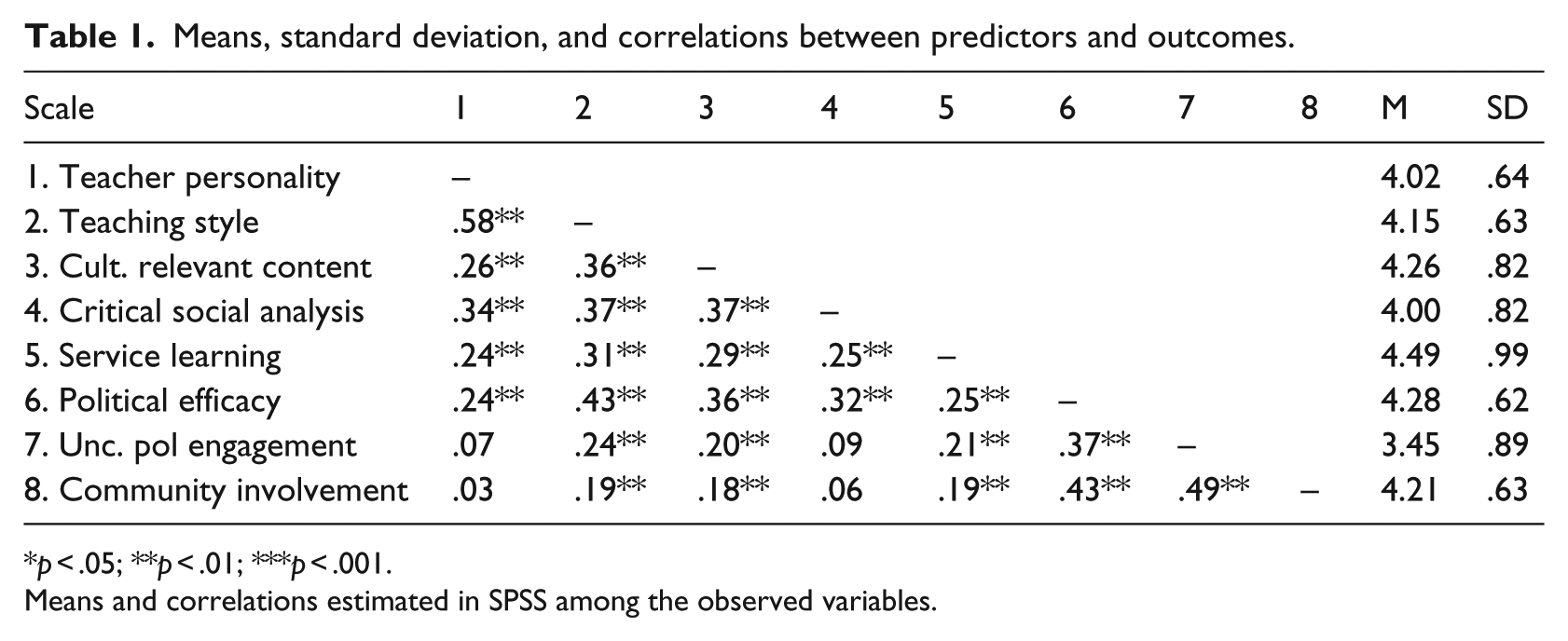
p < .05; **p < .01; ***p < .001.
Means and correlations estimated in SPSS among the observed variables.
The culturally relevant teaching experience, sociopolitical efficacy and sociopolitical involvement
Hypothesis 1: Sociopolitical involvement
The model for hypothesis 1 tested whether former students’ perceptions of their learning experience (critical social analysis, pedagogical experience and service learning) in a culturally relevant class were associated with sociopolitical involvement (latent construct comprised of engagement in community issues and unconventional civic engagement). In a first step, a measurement model was fit for the latent factor of class experience (measured with three observed indicators) and the latent factor of sociopolitical involvement (measured with two observed indicators, unconventional political engagement and community involvement). All the proposed factors loaded significantly (p < .001) on the latent constructs in the anticipated directions, ranging from .49 to .81. The structural model showed good fit to the data (see Figure 2). The chi-square was nonsignificant, and the CFI, RMSEA, and chi-square to df ratio indicated good fit. The following fit indices supported adequate model fit: comparative fit index (.95), root mean square error of approximation (RMSEA) = .067, and the chi-square was nonsignificant (see Kline, 2011). Consistent with the hypothesis, the path from pedagogical experience to sociopolitical involvement was significant (β = .32, p < .01) and the path from perception of service learning to sociopolitical involvement was significant (β = .32, p < .05). Contrary to expectations, the path from critical social analysis to sociopolitical involvement was not significant. Overall, as students perceived that their personal experience of the class was consistent with culturally relevant practices and that they had a well-integrated service learning experience, their sociopolitical involvement was higher. The results indicate also that in a model that includes teacher characteristics, teaching style, course content and service learning, critical social analysis is largely inconsequential. This model accounted for 22% of the variance in sociopolitical involvement.
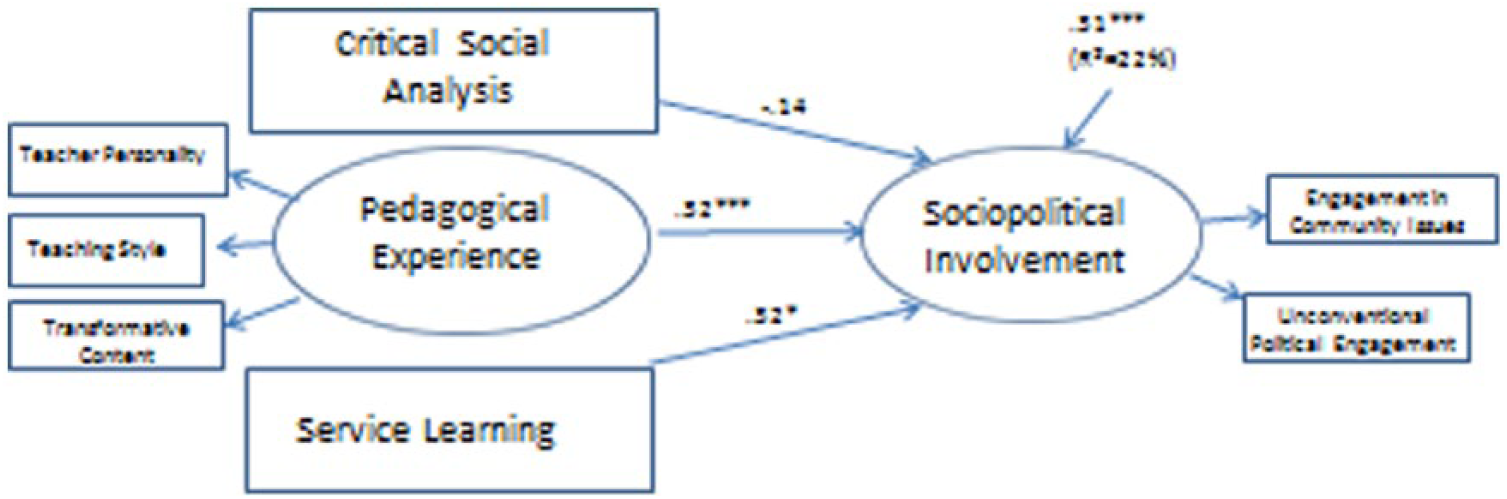
Hypothesis 1 structural model.
Hypothesis 2: Sociopolitical efficacy
The model for hypothesis 2 tested whether former students’ perceptions of their learning experience (critical social analysis, pedagogical experience and service learning) in a culturally relevant class predicted sociopolitical efficacy. The following fit indices for the measurement model supported adequate model fit: comparative fit index (.92), root mean square error of approximation (RMSEA) = .08, and the chi-square was nonsignificant (see Kline, 2011). Consistent with the hypothesis, the path from pedagogical experience to sociopolitical efficacy was significant (β = .63, p < .00); however, neither the path from service learning nor from critical social analysis to sociopolitical efficacy was significant. Overall, as students perceived that their personal experience of the class was consistent with culturally relevant practices, their sociopolitical efficacy was higher (see Figure 3). In addition, results indicate that service learning may be more consequential for involvement (seen in Hypothesis 1) than for efficacy. This model accounted for 31% of the variance in sociopolitical efficacy.
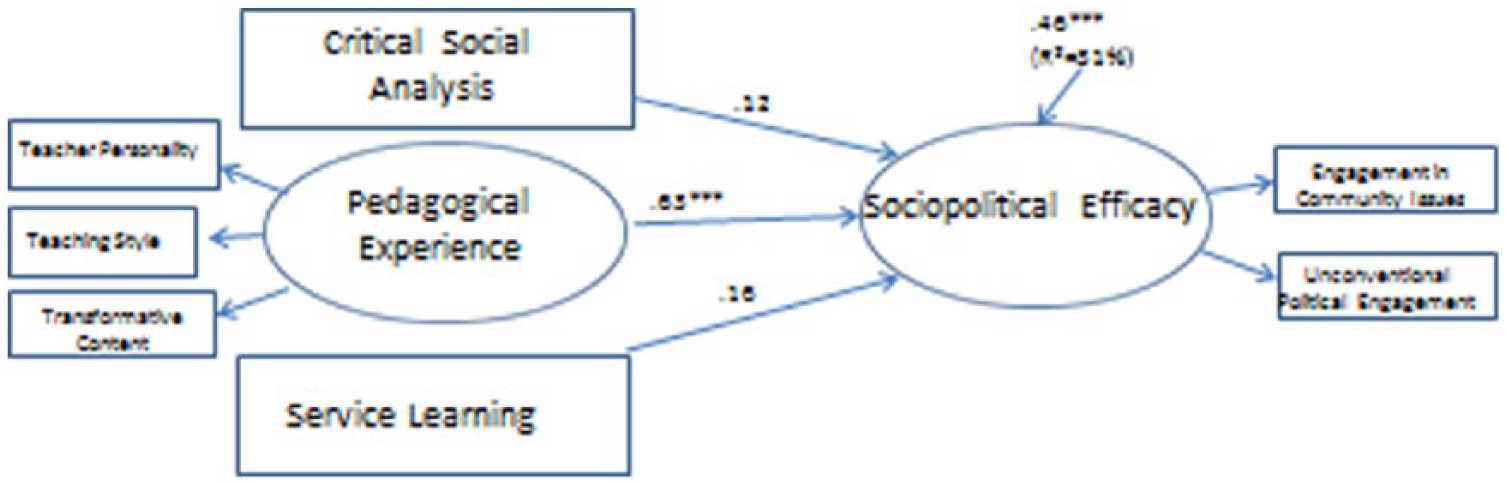
Hypothesis 2 structural model.
Sociopolitical efficacy as a mediator of class experiences and sociopolitical involvement
Hypothesis 3: Sociopolitical efficacy as a mediator
Hypothesis 3 addressed whether the addition of sociopolitical efficacy to the model in hypothesis 1 would result in the direct paths from the class experience factors to sociopolitical involvement becoming weaker or nonsignificant. To test this hypothesis (H1), we applied SEM in Mplus (Muthén and Muthén, 2012) with class experience as independent variable, sociopolitical involvement as dependent variable and sociopolitical efficacy as mediating. Because there was no direct effect of critical social analysis on sociopolitical involvement, and of service learning on sociopolitical efficacy, these paths were left in the structural model but excluded from mediation analysis. This model fitted the data well and explained 30% of the variance in sociopolitical efficacy and 39% of the variance in sociopolitical involvement (see Figure 4). As hypothesized, the indirect path from class experience to sociopolitical involvement runs via sociopolitical efficacy (β = .0.54, p < .001) to sociopolitical involvement (β = .0.55, p < .001, CI = (0.01; 0.08) = 0.09). The strength of the indirect path was computed as the product of the two direct effects (.54 x .55 = .30, p < .001). Overall, sociopolitical efficacy mediates the relationship between former students’ pedagogical experience and sociopolitical involvement but does not mediate the path between the other two class experience factors (service learning, critical social analysis) and sociopolitical involvement.
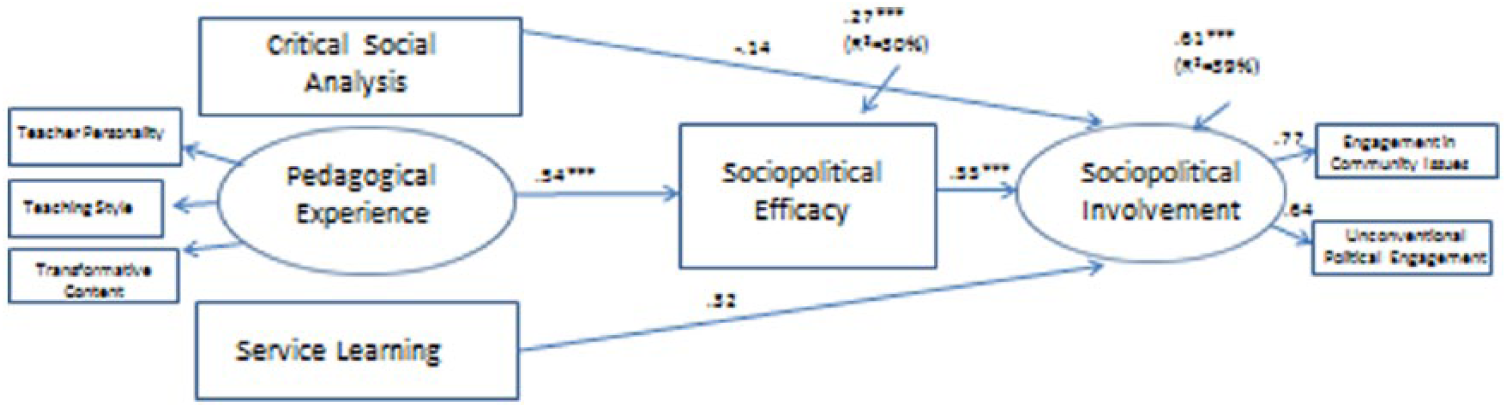
Structural equation modeling (SEM) mediation model.
Discussion
The current study addressed the intersection of research on CRP and SPD to investigate the associations between alumni’s perceptions of their experience in a culturally relevant service learning course, Social Justice, and two important factors linked to SPD, sociopolitical efficacy and sociopolitical involvement. In addition, the study explored whether sociopolitical efficacy mediated the relationship between perceptions and involvement.
In support of the first hypothesis, and consistent with extant research (Conway et al., 2009), it was found that pedagogical experience and service learning were associated with sociopolitical involvement. However, there was no evidence to support the assumption that critical social analysis is related to sociopolitical involvement. This result was surprising. Given the SPD model (Watts and Gusseous, 2006), and qualitative research on the relationship between critical analysis and psychosocial vitalities like resilience and sense of purpose among Black youth (AUTHOR CITATION), it was anticipated that critical social analysis of their sociopolitical environment would be a critical opportunity for Black adolescents to understand and confront racialized oppression, which would positively influence their intent to participate in civic and political life later (Stevenson et al., 2005). Nonetheless, these results point clearly to the important role of two aspects of the culturally relevant learning experience for sociopolitical involvement, pedagogical experience and service learning. Therefore, culturally relevant teachers need to be sensitive to the way their methods are experienced by students given that not all former students in this study received the culturally relevant social justice class in the same way. When CRP is charged with meanings that are not intended by the teachers, students who engage in social analysis may still not develop an interest in sociopolitical concerns.
Consistent with the second hypothesis, pedagogical experience was also associated with sociopolitical efficacy. Specifically, when participants reported a higher level of experience in the class with practices considered culturally relevant they also reported higher levels of sociopolitical involvement. However, neither critical social analysis nor service learning was associated with sociopolitical efficacy. Given that service learning, in a model with perceptions of the culturally relevant approach and critical social analysis, appeared to boost sociopolitical involvement, it was particularly surprising to find that there was no relationship between service learning and sociopolitical efficacy; a result that suggests that service learning bears a different relationship with efficacy than it does involvement. This result, while surprising, may be supported by theories and studies that have considered that the personal benefit of service learning may be different for youth more familiar with marginalized communities and for youth who have more experience with personal and social injustice (Schutz, 2006). Therefore, with regard to the pedagogical experience (teacher personality, teaching style, culturally relevant content), findings suggest that improving adolescents’ perception of their learning experience is key to the promotion of sociopolitical involvement, above and beyond both service learning and critical social-reflection. This appears to support research in the field of teacher education that suggests that CRP amounts to more than a set of habits in a class but instead is an extension of the teacher’s personal commitment to social justice, as made evident through his or her interface with the class Ladson-Billings, (1995b, 2009). Students who perceive that the teacher is invested both in the topics and in them individually (based on the content discussed, the enthusiasm the teacher brings to the content, and the way the teacher relates to the students, for example) may take away more from the experience than their peers, regardless of what other pedagogical measures are withheld or introduced.
Finally, as found in earlier studies (e.g. Zimmerman, 1995), and in support of the third hypothesis, sociopolitical efficacy was related to sociopolitical involvement. Results demonstrate that pedagogical experience and sociopolitical involvement are related and suggest that it is possible that pedagogical experience promotes efficacy. That is, the capacity of the pedagogical experience to influence unconventional political engagement and engagement in community issues may depend on whether class participants also developed sociopolitical efficacy. Therefore, the study sheds light on the path between a course intended to foster social justice and the likelihood of becoming engaged, illustrating that the influence of the culturally relevant course works through sociopolitical efficacy. Although this result is similar to Diemer and Li (2011), who found a relationship between efficacy and behavior among Back youth, this study further contributes to studies on sociopolitical and political efficacy by illustrating how sociopolitical efficacy possibly explains the relationship between pedagogical experience and sociopolitical involvement.
Overall, whether engaging in community issues, like volunteering to help needy people, or engaging politically, like participating in a political protest, the culturally relevant class contributed to the likelihood of former students’ sociopolitical involvement, a relationship that is explained by sociopolitical efficacy. Among the three factors that were hypothesized to stimulate the SPD variables, only pedagogical experience had significant direct effects on both sociopolitical efficacy and sociopolitical involvement, and when sociopolitical efficacy and sociopolitical involvement were entered into a model together, there were no longer direct effects between pedagogical experience and sociopolitical involvement. This examination confirms the contributions of culturally relevant classes in secondary schools and, in particular, students’ perceptions of those experiences.
Although all participants took the same course with the same stated goals at the same school, there was considerable variation in the time they took the course, the teacher with whom they took the course and, ultimately, their lived experience of the teachings and service opportunities in the course. The results of the present study thereby demonstrate that how students experience a course may have implications for whether culturally relevant teachers meet their intended goals. Further, the results of this article suggest that the deciding element in successful implementations of culturally relevant classes is neither critical social analysis nor service learning, but, rather, pedagogical experience. While service learning had a relationship with sociopolitical involvement, which is consistent with findings from similar studies (e.g. Diemer, & Rapa; Godfrey and Grayman, 2014; Watts et al., 2003), this relationship was nullified when pedagogical experience was added to the model. Therefore, one exciting takeaway for the present study is this insight on a pivotal and often overlooked aspect of a culturally relevant social justice education. The second, and perhaps more intriguing, result, however, is the role of sociopolitical efficacy in explaining the relationship between pedagogical experience and later sociopolitical involvement. Youth in the sample who did not leave the course with the perception that they could change social and political conditions were far less likely to indicate a willingness to involve themselves in community and political affairs. The implications for teachers and schools are numerous.
First, this study suggests that not all implementations of social justice education are equal, and, while this course appeared generally to benefit the Black participants in our sample, such classes may not always lead to favorable outcomes. We must consider the possibility, for instance, that some teachers use such courses as an opportunity for indoctrination – pushing slanted and/or factually unsupported views on intellectually vulnerable youth. Although this was not assessed directly in the present study, such a pedagogical experience would likely be perceived as negative by students and therefore fail to lead to positive outcomes. In the present study, a less positive course experience was correlated with less sociopolitical involvement. Second, this study reveals that institutional efforts at SPD could be ineffective if teachers fail to empower their students. It may not be enough to learn about social problems and social solutions; present findings emphasize the role of perceptions of culturally relevant course experiences in the development of civic mindsets in youth, as well as the importance of sociopolitical efficacy in explaining the relationship between perceptions of the course and later involvement. In other words, the black participants in our study need to perceive that if they take action in various ways, they have a reasonable chance at making meaningful change. Without this perception, the relationship between a good class experience and later SPD diminishes.
These results add significantly to extant scholarship on CRP and SPD in the following ways: first, they highlight the potential of culturally relevant courses focused on social justice for the SPD of Black youth. Given the current political landscape following a slew of videos capturing violence against Black Americans, and rising anxieties about matters such as race, social class, and police-community relations within the Black community (Love and Bradley, 2015), social justice education is emerging as a an important topic in national media (Anderson, 2016). Ideally, such education gives youth the opportunity to construct productive and responsible responses to injustice; responses that may not be readily available to those who have not been trained on these topics in a critically reflective way. The current study shows the potential such courses can have on Black youth, where many years after the course there is a relationship between their perceptions of their experiences and their intention to engage productively in their communities. Results further illustrate that taking the course is not enough; the vocational commitments of a culturally relevant teacher may only be as effective as the meanings the students charge to their efforts.
Second, the current study illustrates which aspects of the course were most influential for the SPD of Black youth. Prior research on the civic development of Black youth has uncovered a relationship between civic content, political efficacy and political involvement (see Hope and Jagers, 2014), but few quantitative studies focused on evaluating civic education programs have explored the culturally relevant strategies that are of most benefit to traditionally marginalized groups (Lin, 2015). Similar to Dassonneville et al. (2012), who examined the relation between formal civic education in schools and political attitudes and behaviors among a sample of Belgian adolescents, the present study examined aspects of the culturally relevant course that were theoretically related to the promotion of civic behaviors. The pedagogical experience (which included variables for former students’ perception of teacher characteristics, teaching style and course material) emerged as particularly important, but the other aspects observed, critical social analysis and service learning, had mixed results. Whereas critical social analysis was not significantly related to either sociopolitical efficacy or sociopolitical involvement, service learning was related only to sociopolitical involvement.
Regarding service learning, prior research (Atherton, 2000) is consistent with the current finding that youth who had a service learning experience that they perceived was thorough and well-integrated with the class expressed a stronger interest in sociopolitical involvement. Although not hypothesized, this result is not entirely unexpected. Extant theoretical and empirical research has established a relationship between service learning and civic participation in majority populations, but there has not been a similar agreement regarding the relationship between service learning and political efficacy. Moreover, these results are also supported by research that suggests that, while Black youth are more likely to be sociopolitically engaged in society than their peers (Ginwright, 2015), they are also more likely to express less political efficacy (van, Stekelenburg, and Klandermans, 2013). This may be a function of the type of unconventional engagement to which Black adolescents are predisposed. It is also plausible that students of CRP who benefit from thorough service learning experiences may be inclined to continue serving their community without necessarily feeling that they have the capacity to impact the community in ways that are social and political.
Overall, results provide support for the theoretical formulations presented by Hope and Jagers (2014) and Watts and Guessous (2006). Specific aspects of a culturally relevant course with civic development goals facilitated sociopolitical efficacy which, in turn, facilitated sociopolitical involvement. This contributes to understanding of the delivery of courses intended to promote positive development among Black youth.
Conclusion
Results from the present study offer fresh and useful considerations for teachers of adolescents, including adding emphasis to methods that touch on efficacy. While previous research has demonstrated that social justice education requires helping youth develop an understanding of social inequities (e.g. Esposito and Swain, 2009; Ginwright and Cammarota, 2015), this study points to the possibility that understanding alone may not suffice. Rather, successful teachers should direct their attention to improving youth’s perceptions of their capacity to impact their communities, and a variety of methods noted in this study may be helpful to this end. Example methods include efforts to align course content with charismatic instruction and to encourage students to experience courses in ways that are both personal and experiential (which, as noted by several scholars, requires culturally relevant teaching methods; e.g. Dallavis, 2011; Gay, 2002; Howard, 2001).
While quantitative studies on this topic are still rare, results also align well with extant quantitative studies that include variables like pedagogy, critical consciousness and SPD (e.g. Diemer and Li, 2011; Diemer and Rapa, 2016). These findings fit neatly with the growing body of research on SPD in adolescence and its relationship with social justice education (e.g. Ginwright & Cammarota). Our study echoes work that has revealed a positive connection between school-based programs and long term civic and personal development (Dassonneville et al., 2012; Flanagan et al., 2007; and Flanagan et al., 2007). Collectively, this work informs our understanding of the potential impact of courses on youth development, highlighting the possibilities apparent for programs intended to influence youth in lasting ways.
The black students in our sample appeared to benefit from the culturally relevant course chosen for the present study even after it had concluded. While longitudinal assessments of classroom experiences are few, and this study is no exception, these findings are supported theoretically and empirically by studies on youth development in various fields, including in the areas of racial and ethnic development (Adams and Bell, 2016; Irvine, 2003). Research across these fields suggests that black youth may benefit differently from courses that focus on marginalized groups of people, as social justice course often do (Prilleltensky, 2003). It appears in this study that students’ experience of the course made the biggest difference in expected outcomes (Gurin et al., 2004; Ladson-Billings, 2006; Love and Bradley, 2015). Therefore, it is reasonable to conclude that so long as youth are allowed and encouraged to have unique experiences, positive developmental may follow.
Limitations and future directions
The results of the current study suggest that student perceptions and sociopolitical efficacy matter when considering the impact of culturally relevant social justice courses on the SPD of adolescents. However, because this was a retrospective, cross-sectional study, cause-and-effect relationships are not addressed. On one hand, participant responses may have been influenced by recall, particularly for those who were far removed from the course experience. Thus, although the analyses controlled for the year of graduation, it is still to be determined whether these relationships operate differently for different cohorts of Social Justice students. On the other hand, because students were not followed longitudinally and levels of SPD prior to the class were not observed, other contextual factors and life experiences that may have contributed to the SPD of participants cannot be ruled out, nor can the theorized directionality of relationships be fully confirmed. Although there were several variables held constant (sex, religious affiliation, years since graduation, mother’s education, source of funding of school tuition, grades in high school, religiosity, social justice teacher, and religiosity), so as to test the relationship between the main study variables, it is impossible to fully dissociate from the encyclopedia of factors that could be at play in this study. Recall of the perceived class experience, for instance, may vary according to how sociopolitically engaged one is in the present; where those who have higher sociopolitical involvement recall the course differently because of that involvement. Relatedly, while many theories of behavior support the position that there is a relationship between actions and beliefs, the relationship between the two has not always been empirically supported. Even when supported, there remains the possibility that actions do not always align with what study participants say they will do. Therefore, reliance on participants’ intentions and beliefs is a limitation inherent to this study that provides direction for future work in this area.
To address the aforementioned limitations, future research on this or similar populations will benefit from prospective longitudinal studies (following youth before, during and after their experience in a social justice course) that examine intentions and actual behaviors. In addition to eliminating some of the aforementioned limitations and reducing the impact of others, such a study will allow for better consideration of a wider range of contextual factors. Moreover, a mixed method study that incorporates qualitative measures (e.g. focus groups, interviews and evaluations of assessments) could also contribute to this larger goal, and provide a sense of youth’s lived experiences. It is worthwhile also for future research on the relationship between school experiences and later development to consider the use of comparison groups. One additional limitation to the interpretation of results in the present study is that there was no comparison group. Not only was a comparison group not feasible because the course chosen for the present study was a mandatory, junior-level course that all students took during their junior year of high school, but, additionally, this study was not an intervention evaluation. Notably, the inclusion of a comparison group is not a straightforward proposition. A comparison group would strengthen the analysis, but, quite unfortunately, such a study would likely also require working with programs that are not mandatory, such that students could self-select into the class, which would also limit the interpretation of results.
Overall, building on prior theory, results demonstrated that certain aspects of a culturally relevant course are related to sociopolitical efficacy, which in turn are associated with sociopolitical involvement. Thus, this work contributes to an understanding of the processes linking civic education to SPD during adolescence. Because this study was quantitative, focused on adolescents as opposed to instructors or adult learners, and investigated a possible mediator of the relationship between educational experience and SPD, the results make a novel and important contribution to research on both adolescent sociopolitical development and teaching pedagogy. However, while the course chosen for the present study matches well with commonly described conceptions of social justice education, there are limitations to the generalizability of a study of one course at one school. Therefore, the scope of this study may be too narrow to extend research findings and conclusions to the population at large. Future work should apply the basic findings to other courses and schools.
Footnotes
Declaration of conflicting interests
The author(s) declared no potential conflicts of interest with respect to the research, authorship, and/or publication of this article.
Funding
The author(s) received no financial support for the research, authorship, and/or publication of this article.