




Abstract
This critical, integrative qualitative review explores how researchers approach, describe, and justify culturally relevant, culturally responsive, or culturally sustaining literacy instruction in prekindergarten through fifth-grade (P–5) classrooms. We reviewed 56 studies published between 1995 and 2018. We documented terms researchers use, theorists cited, methods, student outcomes, and student populations. We also analyzed how researchers talked about achievement gaps, addressed their own positionality, and determined that specific literacy instructional practices were culturally informed. We found that researchers most commonly claim to document culturally relevant or responsive instruction, in some cases conflating the terms and related theorists. Most studies were qualitative, occurred with traditionally marginalized students (usually Black or Latinx) in the United States, and involved students reading a text that researchers deem culturally informed. We make recommendations for teachers and researchers to move the field of culturally informed literacy forward.
Keywords
Calls for teaching that connects learning and cultures have increased in recent years. The International Literacy Association (2020) annually produces a “What’s Hot in Literacy” report, based on a large, international survey of literacy educators, to “note trends” (p. 3) in literacy education. In the 2020 report, nearly a quarter of the respondents ranked “emphasizing culturally responsive curriculum and instruction” (p. 10) as one of the top five issues in literacy education. However, the report does not contain the words “strengths,” “assets,” “multicultural,” or “funds of knowledge,” all related pedagogical approaches to cultural responsiveness. This report and our own observations as prekindergarten through fifth-grade (P–5) teachers and researchers led us to perceive that sometimes “culturally responsive” acts like a buzzword, standing in as a catchall for culturally based equity-oriented approaches.
Educators sometimes use several historically related terms for culturally informed approaches; we focused on these approaches, specifically in literacy education. Thus, we reviewed articles where researchers described literacy instruction as culturally relevant, responsive, or sustaining to understand how researchers conceptualize these approaches. For brevity, we adopt the umbrella term “culturally informed” to refer to all three approaches. We support these approaches and we wanted to understand how researchers conceptualize and operationalize them. Our research questions clustered into three categories:
We chose these questions because, in our experience producing and consuming research about culturally informed literacy instruction, we observed a lack of precision about what culturally informed literacy instruction means and looks like. We believed that a review that highlighted methodological approaches (Question 2) as well as researchers’ understandings (Question 1) and application (Question 3) of culturally informed approaches could support future research and theorizing in this tradition.
Background and Theoretical Framework for This Review
Theoretical Framework
We ground our work in social perspectives of literacy, holding that children cannot detach themselves from “immediate meanings and contexts” in learning (Street, 1997, p. 133). Street documented an important shift in the field of literacy studies. Historically, prevailing perspectives saw literacy as a neutral, technical, or autonomous skill where teaching was divorced from the larger sociopolitical context and learning was a cognitive task and product of individual efforts. Street (1995) proposed studying literacy as an “ideological practice, implicated in power relations and embedded in specific cultural meanings and practices” (p. 1). He continued, “The impact of the culture and of the politico-economic structures of those bringing it is likely to be more significant than the impact of the technical skills associated with reading and writing” (p. 15). This shift toward social literacy perspectives had implications for literacy education, including the integration of critical perspectives that looked broadly at types of literacies valued in the schooling of typically marginalized youth. This transition coincided with Ladson-Billings’s (1998) call for considerations of race in teaching and learning. Taking these calls into consideration, the present study shows how researchers have explored literacy instruction that centralizes culture.
Historical Emergence of Culturally Informed Approaches
Several authors (Aronson & Laughter, 2016; Banks, 2013; Bennett, 2001; López, 2016) trace how culturally informed approaches have roots in multicultural education. Multicultural education in the United States grew out of the civil rights movement (Gorski, 1999) and focused on bringing about “structural and systemic changes in the . . . school . . . to increase educational equality” (Banks, 1993, p. 20). Gay (2004) described multicultural education and culturally responsive approaches as sharing a common goal to teach contributions of culturally diverse groups and develop social consciousness, civic responsibility, and political activism to “reconstruct society for greater pluralistic equality, truth, inclusion, and justice” (p. 32). Banks (2013) explained that multicultural approaches that center equity represented an important break from classifying culturally diverse students as having a cultural deficit. He situated the work of Ladson-Billings (who theorized culturally relevant teaching) and Gay (who theorized culturally responsive teaching) and others who take assets-based approaches (such as funds of knowledge; Gonzalez et al., 2005) within this tradition.
Defining Culturally Informed Approaches
Ladson-Billings (1995b) explained that she theorized culturally relevant teaching after finding that earlier terms (like “culturally appropriate,” “congruent,” or “compatible”) “connote[d] the accommodation of student culture to mainstream culture” (p. 467). She considered culturally relevant teaching to “not only address student achievement but . . . help students . . . accept and affirm their cultural identity while developing critical approaches that challenge inequities” (p. 469). Culturally relevant teaching is a “pedagogy of opposition . . . committed to . . . empowerment” (Ladson-Billings, 1995a, p. 160), where students critically examine society to promote and enact social change.
Gay (2002) used the term “culturally responsive teaching” to emphasize curricular content. Her work focused on representation of students’ experiences and cultures in curriculum and using students’ cultural styles in instruction. She encouraged teachers to go beyond “mere inclusion of ethnic content into . . . curricula” and make “radical changes” in “instructional processes . . . [to promote] inquiry, critique, and analysis” (Gay, 2018, p. 35).
Building on this work, Paris (2012) questioned “whether the terms ‘relevant’ and ‘responsive’ are . . . descriptive of much of the teaching and research founded on them” (p. 93) and whether the terms go far enough. He encouraged educators to ask “if a critical stance toward and critical action against unequal power relations is resulting from such research and practice” (pp. 94–95). He urged educators to adopt culturally sustaining pedagogies to promote students’ cultures and a multicultural society.
We relied on the following definitions:
“Culturally relevant pedagogy rests on three criteria: (a) Students must experience academic success; (b) . . . develop and/or maintain cultural competence; and (c) . . . develop a critical consciousness through which they challenge the status quo of the current social order” (Ladson-Billings, 1995a, p. 160).
Being culturally responsive means “using cultural knowledge, prior experiences, frames of reference, and performance styles of ethnically diverse students to make learning encounters more relevant to and effective for [students]” (Gay, 2000, p. 29).
“Culturally sustaining pedagogy . . . has as its explicit goal supporting multilingualism and multiculturalism. . . . [C]ulturally sustaining pedagogy seeks to perpetuate and foster—to sustain—linguistic, literate, and cultural pluralism as part of the democratic project of schooling” (Paris, 2012, p. 95).
These approaches emphasize asset-based, culturally informed practices that foster critical consciousness and target social transformation through supporting students’ academic success and cultural competence (Ladson-Billings), integrating students’ ways of knowing and doing (Gay), and sustaining multiple languages and cultures (Paris).
Existing Reviews of Culturally Informed Approaches
Reviews of culturally informed literacy instruction shed light on how researchers conceptualize these approaches in classrooms. Fairbanks et al. (2009) described approaches that increased student talk as culturally informed because such approaches “make a space for students to bring their own language and cultural knowledge to the meaning-making process” (p. 595). They grouped culturally informed literacy instruction into three categories: (a) changing classroom participation structures, (b) cultural modeling, and (c) creating hybrid spaces. Another team also divided culturally informed literacy instruction into three components: curriculum (like texts), teaching (like grouping structures, feedback processes), and supports (Kourea et al., 2018).
Machado (2017) reviewed early childhood literacy instruction in three related areas (biliteracy, translanguaging, and culturally sustaining pedagogies). She found researchers described practices related to comparing language and literacy across languages, encouraging hybridization of language and literacy, and drawing on students’ cultural and linguistic repertoires. Another team reviewed classroom-based culturally relevant research (not specific to literacy) and grouped practices into categories of high expectations, cultural competence, and critical consciousness (Morrison et al., 2008). This team identified fewer instances of teaching for critical consciousness than the other categories.
In addition to categorizing culturally informed approaches, other reviews highlight methodological issues in this field, particularly related to outcomes. Aronson and Laughter (2016) surveyed culturally relevant content-area instruction linked to student results. They found that researchers claimed (but did not always measure) student outcomes related to motivation, interest, discourse, confidence, and self-perception. Bottiani et al. (2017) reviewed studies of professional development about culturally responsive instruction. They found that most studies did not document outcomes, and those that did reported behavior or social inclusion. They reviewed no studies (qualitative or quantitative) that met standards for claiming effectiveness, but they all claimed effectiveness anyway. When Fairbanks et al. (2009) attempted to describe the connection between culturally relevant literacy instruction and reading comprehension, they found few studies documenting this connection.
Why has the field seen so much focus on culturally informed literacy instruction with so little attention to outcomes? First, many researchers interested in culturally informed literacy instruction tend to “focus on processes rather than outcomes” (Fairbanks et al., 2009, p. 600). Often, these researchers find traditional quantitative measures to not provide a full picture of literacy learning (Kumashiro, 2012). Second, these researchers frequently understand literacy as cultural, which changes the outcomes of interest. They often “examine less the degree to which students understand a text and more the means by which they construct the meanings . . . and how these meanings are shaped by cultural, historical, and situational contexts” (Fairbanks et al., 2009, p. 600).
Fairbanks et al. (2009) argued for work that produces evidence relating culturally informed literacy instruction to reading comprehension. Bottiani et al. (2017) argued for defining and operationalizing the outcomes that should result from culturally informed teaching. In addition to student outcomes, they argued for considering equity as an outcome itself and theorizing how to define equity as an instructional outcome. This theorizing is foundational for moving the field forward.
Beyond outcomes, reviewers have raised other methodological concerns, such as the tendency for this work to focus on homogeneous groups of students in the United States (Morrison et al., 2008) and for researchers to neglect their own positionality (Bottiani et al., 2017). Fairbanks et al. (2009) also documented that when researchers situate the need for culturally informed approaches within an achievement gap, their work often focuses on assimilation, standardization, and school success rather than empowering students.
Summary
This review sheds light on the potential of culturally informed approaches in literacy instruction and highlights specific needs for research. We know of no studies that describe how researchers position, implement, and describe culturally informed literacy instruction in P–5 contexts. This study aims to fill that gap. We focused on P–5 literacy instruction to limit the scope of our review and align with our own experience and research interests, and because P–5 literacy instruction receives targeted focus in policy and teacher education in the United States.
Method
We conducted an integrative, critical review (Torraco, 2005) of peer-reviewed journal articles published between 1995 and 2018 to understand culturally informed literacy instruction in P–5 classrooms. Such reviews critique and synthesize representative literature to generate new frameworks and perspectives in areas of established research (Torraco, 2005). We began in 1995 because attention to culturally informed literacy instruction increased after Ladson-Billings’s (1995a) article calling for more culturally relevant teaching (Schmeichel, 2012).
Article Selection
We searched the PsycINFO and Education Resources Information Center (ERIC) databases in April 2018 for combinations of the terms, culturally relevant, culturally responsive, culturally sustaining, literacy, read*, and writ*. For article selection, we defined literacy instruction as instruction related to reading and/or writing. Researchers and educators take divergent approaches to literacy instruction and define literacy differently. This diversity makes for ideological tension in a review. While we describe our own positionality below, we did not expect to resolve these tensions for the field. Our goal was to survey the state of this literature—what researchers describe in their own words as culturally informed literacy instruction. Our final PsycINFO search returned 232 studies and ERIC returned 378 studies. Some studies appeared in both searches.
The lead author reviewed all results to determine which related to our research. We excluded studies that did not claim to study culturally informed literacy instructional practices with P–5 students (approximately ages 4–10 in the United States). We excluded review articles, articles with recommendations but no data, and articles about teacher beliefs, education, or professional development but not classroom practices. We included studies that described contexts beyond the school day if they addressed literacy instruction for P–5 students. We included studies from any location but most that met the inclusion criteria occurred in the United States. In short, we included a study if we could complete this sentence: “In this study, researchers collected data in [P–5 context] about [instructional practice(s)], which they described as culturally informed literacy instruction.” “Data” did not always mean student outcomes, but that authors provided a description of literacy instruction so that we could tell they had observed or implemented it. A review of abstracts showed 91 studies potentially met criteria, and 389 did not. At the request of a peer reviewer, we conducted hand searches of eight major literacy journals (Journal of Early Childhood Literacy, Journal of Literacy Research, Language Arts, Reading Research Quarterly, Research in the Teaching of English, Scientific Studies of Reading, The Reading Teacher, and Written Communication) and identified six additional articles. Upon reading the full articles, 56 studies described data about culturally informed literacy instruction in P–5 settings; others did not report data, include P–5 participants, or focus on literacy instruction.
Review Process
We reviewed each study with an analytic review template (Online Appendix A) that included citation; terms, definitions, and theorists; rhetorical role of the achievement gap; methods; student outcomes; student population; author positionality; practices described as culturally informed literacy instruction; and why authors described these practices as culturally informed. We arrived at some of these categories (Online Appendix B) because they seemed basic to understanding the state of methods and how researchers viewed culturally informed approaches. We developed some of the specific sub-questions (such as role of the achievement gap, researcher positionality, and how researchers determine when literacy instruction is culturally informed) when we started reviewing articles and noticed patterns in how researchers addressed (or did not address) these issues.
Initially, two researchers reviewed each study. After reviewing half the studies, we did not identify inconsistencies among our team’s use of the analytic review template, so we divided the remaining studies to be reviewed by one researcher.
Data Analysis
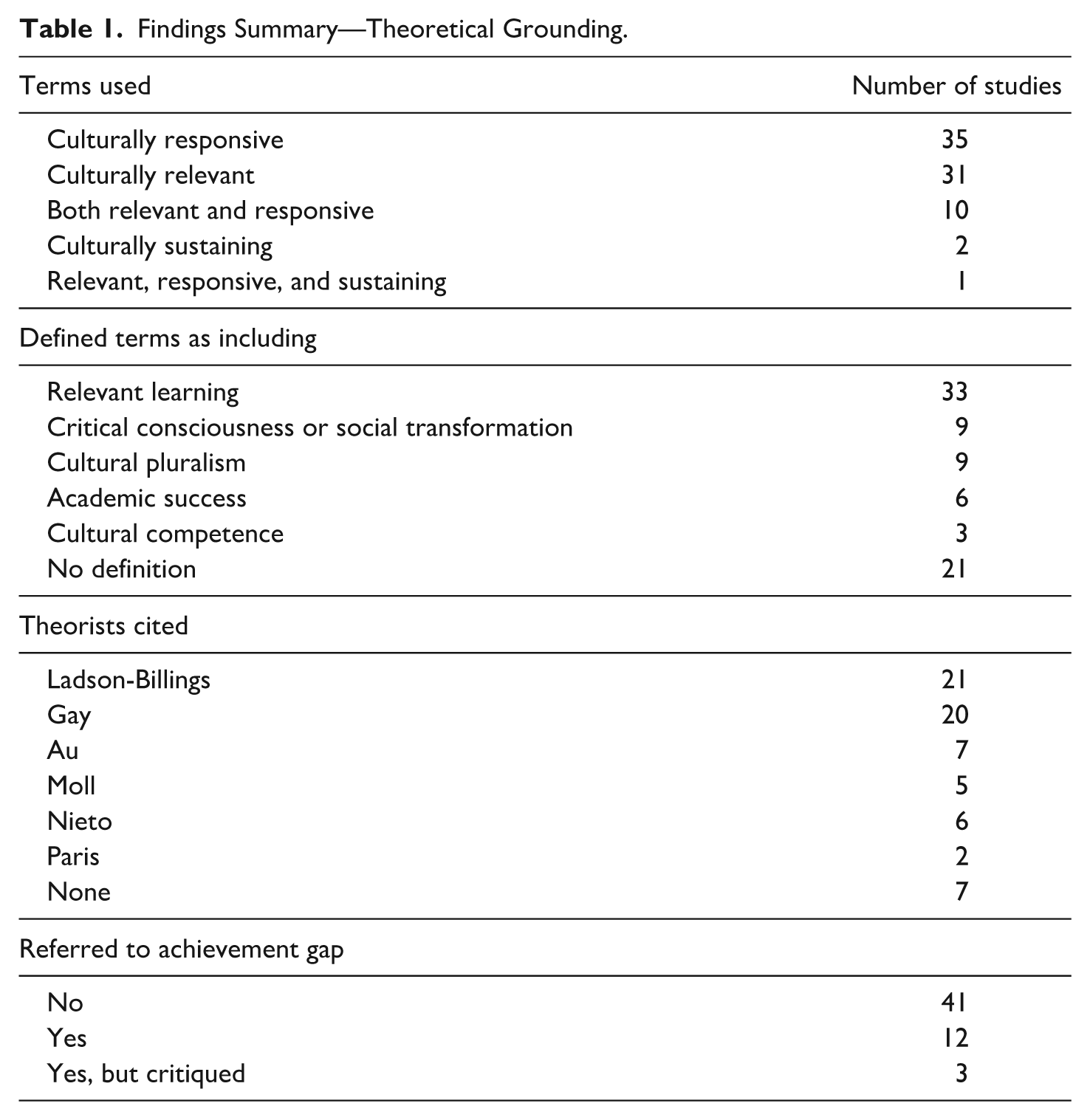
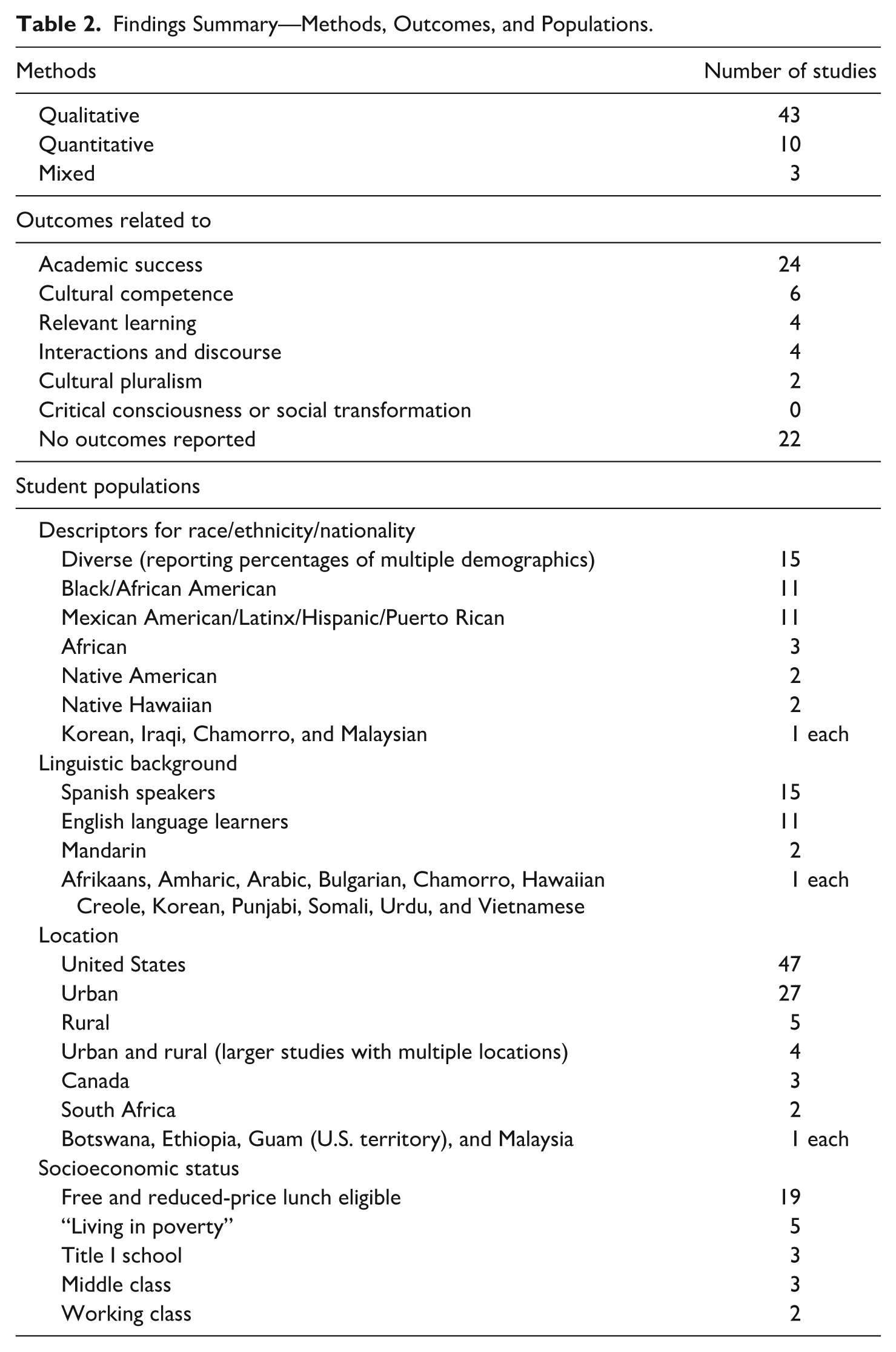
We counted instances across the data set (and recorded totals in Tables 1 and 2) to address questions about terms and theorists, achievement gap rhetoric, methods, student outcomes, and populations.
Findings Summary—Theoretical Grounding.
Findings Summary—Methods, Outcomes, and Populations.
To learn how researchers define culturally informed instruction, we reviewed the definitions (in our introduction) provided by Ladson-Billings of “culturally relevant,” Gay of “culturally responsive,” and Paris of “culturally sustaining.” We identified five elements across these definitions, and we evaluated the definitions that researchers gave in the reviewed articles against these five elements: critical consciousness and social transformation (Ladson-Billings, 1995a; Paris & Alim, 2014), cultural competence (Ladson-Billings, 1995a; Paris, 2012), academic success (Ladson-Billings, 1995a), making learning relevant by drawing on student knowledge and experiences (Gay, 2010b), and sustaining cultural pluralism (Paris, 2012).
We used these same five elements to classify student outcomes (listed in Table 2). We classified outcomes as related to academic success if researchers described them as such (standardized and researcher-created measures related to typical reading and writing outcomes, such as comprehension, fluency, word recognition, vocabulary, English language skills, overall reading level, or other measures researchers related to academic success such as motivation or literature responses). We classified students giving feedback on whether or not they found instruction relevant as relevant learning. We classified studies that measured students’ affiliation with, and understanding of, their cultures as cultural competence. We considered studies involving children discussing cross-cultural themes or working in multicultural groups as related to cultural pluralism. We developed another category, related to cultural pluralism, but not described as such in the reviewed studies. This category appears in Tables 1 and 2 as “interactions and discourse.” No studies documented outcomes related to critical consciousness or social transformation.
Collaboratively, we developed descriptive codes based on the data (Saldaña, 2013) to understand how researchers address positionality, what strategies they describe as culturally informed, and how they justified that these practices were culturally informed. At least two members of the research team participated in each coding or categorizing processes described here. Each researcher worked independently and then discussed with each other until they agreed on the codes or categories. Example data from each code or category appear in Online Appendix B; Tables 1, 2, and 3 report the totals for each code or category.
Researcher Positionality
Our diverse personal and educational backgrounds brought unique, varied perspectives to this research. We represent diversity in some areas but not in others. Collectively, we identify with the cisgender female majority of P–12 educators, and each of us received (or is pursuing) a doctoral degree in education. Our research team identifies variously as White, Chicana, and Japanese American. Our home language is English; several of us use Spanish in our communities, family, and research; and one of us uses Setswana in her work. We are united in our qualitative and sociocultural approaches to literacy, rooted in our commitment to affirming and expanding opportunities for youth to engage in multicultural, multilingual, and transformative pedagogical spaces. Further, we represent distinct family structures, religious affiliations, socioeconomic upbringings, and teaching experiences. These differences enriched our collaboration and analyses. We acknowledge that we are in many ways instruments of the research processes in which we have been trained (Maxwell, 2012). Our own epistemological subjectivities and shortcomings, which are at times beyond our own immediate view, undoubtedly influenced this research.
Findings
The 56 articles we reviewed (Online Appendix C) appeared across 43 different journals. We consolidated our findings into Tables 1, 2, and 3. Here, we document highlights not readily apparent from the tables. After we present the primary findings, we explore themes and tensions in the discussion.
How Do Researchers Conceptualize Culturally Informed Literacy Instruction?
Table 1 shows the frequency of terms, theorists, and achievement gap rhetoric. Researchers commonly claimed to implement culturally responsive (35 studies) or culturally relevant (31) literacy instruction. Researchers most commonly defined culturally informed approaches by drawing on Gay (2010a) to center students’ cultural knowledge in curriculum. Those who defined culturally informed literacy instruction in this way often quoted Gay or summarized similar ideas, such as helping students draw on “strategies they know well from their everyday experiences . . . to make sense of classroom instruction” (Pinkard, 2001, p. 18). We assumed that researchers might be more likely to cite Ladson-Billings when they described their work as culturally relevant and Gay when they described it as culturally responsive. However, authors cited Ladson-Billings almost equally to support both descriptions and they relied on Gay for both terms as well. The authors who did not define their terms also often did not cite theorists or relied on authors other than Ladson-Billings, Gay, and Paris.
We found that most studies made no reference to an achievement gap. Sometimes, these studies justified culturally responsive literacy instruction through asset-based explanations. Yet 12 studies argued for culturally responsive teaching by suggesting it “may help . . . reduce the achievement gap” (Bui & Fagan, 2013, p. 60). These studies described students in such terms as “disproportionately lag[ging] in reading achievement” (Cartledge et al., 2016, p. 399) or “behind their English monolingual peers in vocabulary and literacy” (Méndez et al., 2015).
How Is This Research Conducted?
What method is used?
(See Table 2 for totals.) Of the studies using qualitative approaches, researchers described using descriptive or observational methods, case study, the constant comparative method, action research, interaction or discourse analysis, ethnography, linguistic analysis, developmental research approach (Thanabalan et al., 2014), and the three cultures method (Wurdeman-Thurston & Kaomea, 2015). Data sources included interviews, focus groups, surveys, student work, and field notes. These methods and data sources may overlap and we relied on authors’ descriptions. Several authors described using a combination of methods or may have used methods without naming them. Some practitioner journals require less reporting related to methods, potentially leaving authors to provide less detail.
In quantitative studies, researchers adopted pre-/post-designs, group comparisons, single-case designs, and correlational statistics. Only three studies reported effect sizes or data from which effect sizes could be calculated (Bennett et al., 2017; Bui & Fagan, 2013; Méndez et al., 2015).
What outcomes are measured?
Twenty-two studies reported no specific student outcomes (Table 2). When studies did not report outcomes, they may have had other purposes, such as developing instructional practices for future use (Thanabalan et al., 2014) or describing practices for the benefit of practitioners (Singer & Singer, 2004). The most common results related to academic success as construed by the researchers. These results included scores on standardized and researcher-created measures related to typical reading outcomes, such as comprehension, fluency, word recognition, vocabulary, English language skills, and overall reading level; two studies reported academic success in relation to writing. The majority of studies included outcomes in English only. Only two measured home-language literacy (Alanis et al., 2003; Méndez et al., 2015).
Student populations and researcher positionality
Most work occurred with marginalized students in the United States (Table 2). However, most researchers gave negligible attention to their own positionality (Table 3) or simply reported racial and linguistic backgrounds for the teachers they worked with. Among researchers who addressed positionality more thoroughly, some addressed how their identities or efforts impacted their relationships with students or their familiarity with their cultures. For example, one researcher lived in the community for several months and interviewed parents and teachers before designing culturally informed literacy instruction (Watanabe Kganetso, 2017). Some researchers acknowledged that researcher identities influence research outcomes and interpretations. These acknowledgments included admitting that a research project may have failed because outsiders flown in briefly from another country facilitated it (Hunt, 2007). May (2011) described collaborating with a teacher who did home visits and attended children’s events to know families and their culture. May addressed her cultural outsider status as a weakness and noted, “Historically, considerable damage has been inflicted on cultural groups when European American researchers have made claims about what is best for groups of which they are not members” (p. 30).
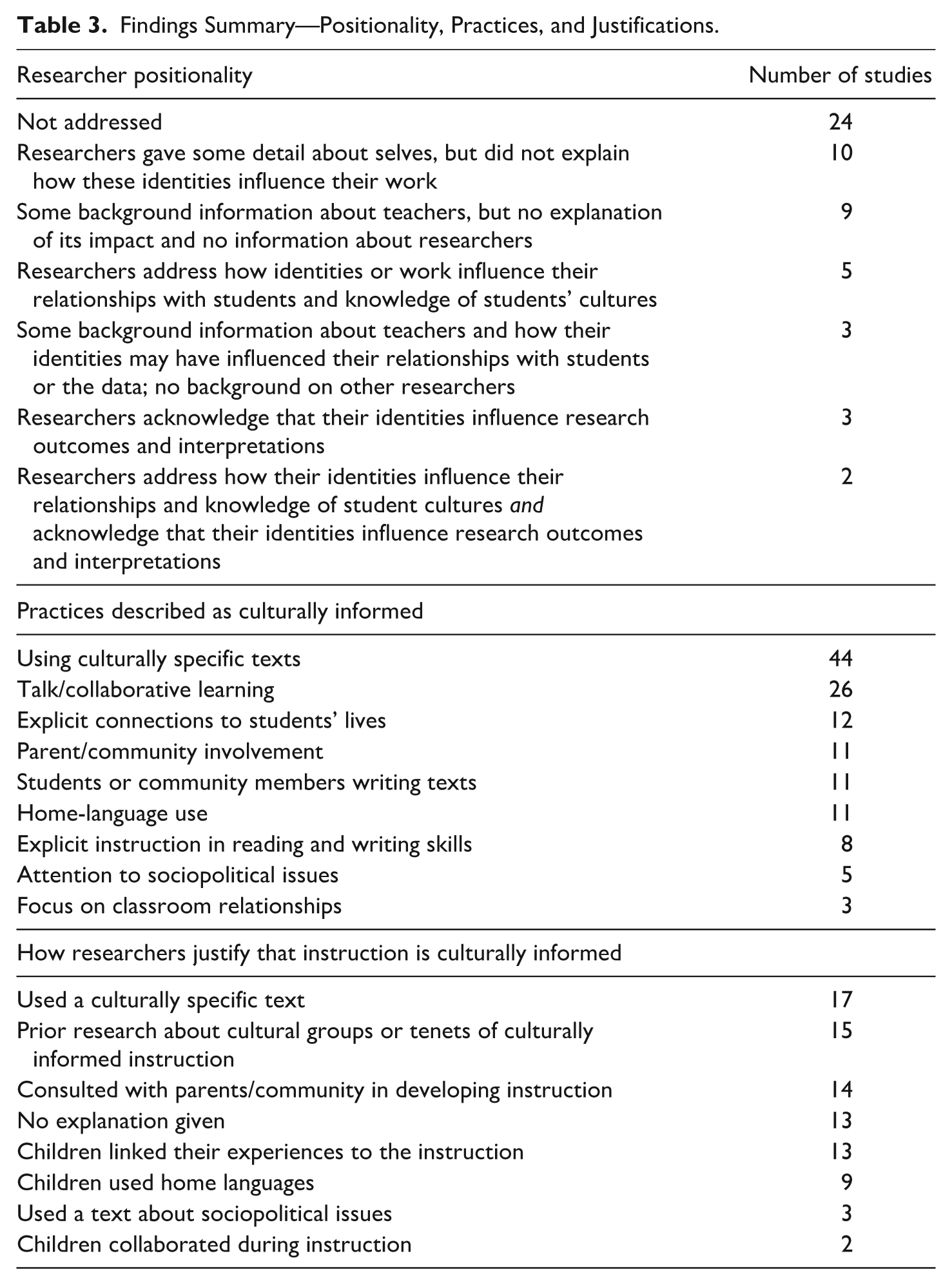
Findings Summary—Positionality, Practices, and Justifications.
What Do Authors Describe as Culturally Informed Literacy Instruction? And Why?
Most commonly, researchers described culturally informed literacy instruction as children reading a culturally specific text. These texts included those written by authors from a similar background to the children, texts that featured people from a similar background to the children, texts representative of children’s heritage cultures (like Indigenous folktales), and texts written specifically to reflect experiences of children in the study. Most researchers adopted several practices in Table 3, but 13 studies included only culturally specific texts and no other elements of culturally informed literacy instruction. Other practices that researchers described as culturally informed included talk or collaborative learning (26 studies), explicit connections to students’ lives (12), parent and community involvement (11), students or community members writing texts (11), home-language use (11), explicit instruction in reading or writing skills (eight), instruction that attended to sociopolitical issues (five), and focus on classroom relationships (three).
Notably, few studies included instruction related to critical consciousness or social transformation. Studies that did attend to these issues often did so through critical literacy, as in Souto-Manning's (2009) study where children read and discussed books about Martin Luther King Jr. and Rosa Parks. Overt conversations about current and personal equity issues, such as how Norton (2014) described them—“we discussed issues of oppression and inequality . . . referenced in hip-hop songs around issues of race, class, gender, and ethnicity” (p. 337)—appeared rarely.
Because many researchers had different cultural backgrounds than the children they worked with, we expected explanations of how they learned about children’s cultures to offer culturally informed literacy instruction. In some cases (see Table 3), researchers offered circular, limited, or no explanations. These justifications included references to major theorists in culturally informed traditions and claims that the work in the article aligned with those theorists or affirming that features of instruction (such as a culturally specific text or collaboration) made the literacy instruction automatically culturally informed. Happily, other researchers described in-depth collaboration with community members and children to understand cultural experiences. Examples included relying on teachers as cultural insiders to draft texts about children’s daily experiences (Lohfink & Loya, 2010; Mackay & Mcintosh, 2012; Sailors et al., 2010), surveying parents about the cultural relevance of an activity or topic (Cartledge et al., 2016; Nash et al., 2018), and inviting children to use their own experiences in writing (Bicais & Correia, 2008).
Discussion
This review highlighted several areas of interest for researchers working in the field of culturally informed literacy instruction.
Researchers Lack Clarity About These Terms
This review suggests that, for many researchers, “culturally relevant” and “culturally responsive” refer to the same concept: providing instruction relevant to the cultural experiences of students from minoritized groups. Such instruction plays a critical role in what Ladson-Billings described as culturally relevant and what Gay described as culturally responsive. However, many researchers defined their instruction in ways that did not align with the theorist they cited. López (2016) explained how foundational theorists in culturally informed teaching have taken great care to explain their terms and critique the terms used before them. We did not find that most researchers justified their terms for what they called culturally informed literacy instruction.
Many researchers did not include critical consciousness or social transformation in their definitions of culturally informed teaching or in their instruction. Other reviewers have identified the same tendency (Morrison et al., 2008), which may indicate that educators find this aspect of culturally informed literacy instruction challenging or that they experience contextual constraints such as school reform measures and a lack of time and resources (Esposito & Swain, 2009). Thus, educators may need additional support and access to examples of critical and transformative culturally informed literacy instruction for P–5 students (Doucet & Adair, 2013; Picower, 2012). Although the findings (Table 3) showed that few addressed critical issues, a number of the studies involved parents and community, encouraged students to author their own texts, and welcomed home-language use.
Whereas researchers cite Ladson-Billings and Gay widely, fewer relied on Paris’s idea of culturally sustaining pedagogies. Paris’s ideas were published more recently, and scholars may centralize culturally sustaining pedagogies with time. Possibly, fewer Paris citations relate to our finding that many researchers used the terms “culturally relevant” and “culturally responsive” with little to no attention to the equity issues that the terms were coined to address. Culturally sustaining pedagogy centralizes those ideas. Ladson-Billings (2014) encouraged those who found her theorizing of culturally relevant teaching to resonate to consider transitioning to the idea of culturally sustaining teaching.
Ideological Tensions Manifest in Framing, Outcomes, and Method
The field would benefit from tying culturally informed approaches to academic growth for students, while respecting multiple ways of defining academic growth, measuring other significant outcomes of culturally informed literacy instruction, and moving away from an achievement gap narrative.
A fifth of the studies we reviewed argued for the value of culturally informed literacy instruction based on an achievement gap. Gay (2018) described academic achievement as an outcome of culturally responsive teaching, and Ladson-Billings (1995b) positioned academic success as a goal in culturally relevant teaching. Multicultural education broadly has the goal of making education “more effective” for students from diverse groups (Gay, 2004, p. 30). Programs that align with these culturally based approaches often demonstrate strong academic outcomes for students (Gay, 2018).
However, when researchers uncritically accept an achievement gap narrative, they may cast blame on students for failing to achieve (or teachers for failing to be culturally informed) rather than acknowledging that educational institutions have consistently failed to invest in the education of all students (Carey, 2014; Ladson-Billings, 2006a, 2006b). Gay (2010a) explained, “Merely belaboring the disproportionately poor academic achievement of certain students of color, or blaming their families and social class backgrounds, is not . . . helpful,” particularly as “some . . . disparity is attributable to racism and cultural hegemony” (pp. xvii–xviii). Educational inequity exists because of structural racial and class-based inequalities (Anyon, 2014; Berliner, 2013); calls to remedy these problems with culturally informed teaching lessen the obligation for society to address inequalities and place that responsibility on individual teachers.
No author who referenced an achievement gap also included a critical component in their study: either by defining culturally informed literacy instruction as including raising students’ critical consciousness or doing something in the literacy instruction that engaged students with sociopolitical issues. Of the 12 studies that referred to an achievement gap, half of them did not define what they meant by culturally informed literacy instruction. While six studies represent a minority in our study, this vague use of “culturally informed” alongside an achievement gap narrative indicates that some researchers may employ culturally informed literacy instruction as a buzzword without deeply engaging with the theorizing behind it.
When researchers in this sample related student outcomes, they usually measured traditional academic outcomes. Ladson-Billings (2006b) wrote that she came to regret describing culturally relevant teaching as leading to “academic excellence” because that term has become associated with the test score frenzy (linked to the achievement gap) and less associated with authentic learning. Standardized measures have often further marginalized some children in school (Darby & Rury, 2018; Turkan & DaSilva Iddings, 2012) and upheld whiteness as an academic standard (Kirkland, 2010), so using such measures while purporting to conduct culturally informed literacy instruction represents a tension for researchers to navigate. Conversely, some have argued that reporting these measures is essential for identifying and consequently rectifying educational disparities; these thinkers position addressing the achievement gap as a civil rights issue (Paige & Witty, 2009). Addressing the oppressive experiences and substandard education that many children receive is a paramount civil rights issue (Love, 2019; The New Teacher Project, 2018), yet large-scale efforts to do so through focusing on traditional measures of achievement have resulted in punitive high-stakes testing and had deleterious side effects on the students they are intended to help (Carey, 2014; Zhao, 2018). Researchers must navigate how to conduct achievement research without centering whiteness and pushing for policies that have punitive effects on schools, teachers, and students.
Alongside academic outcomes, the field needs to document outcomes related to other aspects of culturally informed literacy instruction. To what extent can we document that social transformation and critical consciousness, cultural competence, and cultural pluralism occur or increase when teachers implement culturally informed teaching? Existing research in P–5 literacy classrooms does not address this question both because few researchers document these outcomes and because the field has yet to decide how to measure and document such outcomes (Bottiani et al., 2017). Yet documenting all the outcomes possible in culturally informed approaches is critical to realizing the promise of culturally informed approaches. We did not find studies that reported outcomes across all of these domains and doing so would be a significant undertaking, but perhaps a necessary one, to understand how these outcomes work together. Educators could collaborate with psychologists who have developed assessments of critical consciousness and cultural affiliation (Byrd & Hope, 2020; Diemer et al., 2017). New instruments may be needed for young children or school contexts.
We documented whether researchers reported individual student outcomes. However, children may experience the outcomes of culturally informed literacy instruction communally. For example, in Souto-Manning’s (2009) work, children collaborated to advocate changes in how their school implemented instructional support, so that racially identifiable groups were not pulled out for gifted or remedial services. That study did not measure individual student–level outcomes but it relayed a narrative of a community of first graders growing in critical consciousness and advocating for change. As educational researchers seek to document such outcomes, they may need to consider communal models as well as individual assessments.
In this review, when researchers reported academic results, they often used designs not associated with causal claims (e.g., collecting informal reading inventory scores during a case study), which limits usefulness for advocating curricular changes with policy makers. Some researchers have used designs that allow them to infer causation (Cabrera et al., 2014; Dee & Penner, 2016) but we found few examples at the P–5 level. Most studies took qualitative approaches. We expected as much because many researchers who value culturally informed literacy instruction work within paradigms that promote qualitative approaches. Like Bottiani et al. (2017), we found that many studies underreported their methods, which limited the extent to which their studies can drive the field forward. More work is necessary to expand claims about the value of culturally informed literacy instruction, examine it across contexts with more students, and communicate its worth to the general public.
Researchers Neglect Many Groups and Do Not Address Intersectionality
Culturally responsive literacy instruction “should be shaped by the sociocultural characteristics of the settings in which [it occurs], and the populations for whom [it is] designed” (Gay, 2013, p. 63). Thus, texts and instruction cannot be inherently culturally responsive. They can only be responsive to somebody. Researchers claiming to implement culturally responsive literacy instruction must provide ample descriptions of the students for whom the instruction is supposed to be responsive. Ladson-Billings (2006b) explained to future teachers that she did not want to tell them how to do culturally relevant teaching “because you would probably do exactly what I told you to do” (p. 39), which defies the spirit of responding to the needs of specific children.
In this review, most work occurred with Black or Latinx students in the United States. These two groups represent sizable populations that schools should serve better. However, researchers did not gather data on student demographics beyond broad racial categories and therefore the research findings tended to report these groups as monolithic groups, with little attention to within-group differences (Grant et al., 2004). Thus, the studies neither acknowledge intersecting identities (e.g., class, ethnicity, religion, citizenship status, language, and able-bodiedness) nor identify how these intersections may complicate what culturally informed literacy instruction looks like. Likewise, the studies indicate that less teaching and research has addressed culturally informed literacy instruction for other groups representing large numbers in U.S. schools: Asian Americans, African immigrants, people from the Middle East, refugees, Muslims, and students living in rural areas, for example (again, some of these identities may overlap).
Researchers Do Not Address Their Own Positionality
Researchers’ worldviews, personal experiences (and whether those experiences are like or different from those of the students they work with), biases, and beliefs affect the questions they ask, approaches to work with students, and how they “[filter] . . . information . . . from participants and [make] meaning of it, and . . . may shape the findings and conclusions” (Berger, 2015, p. 220). Although researchers sometimes disclosed aspects of their identity, they seldom analyzed what those identities meant for their research.
Like Bottiani et al. (2017), we judged that few authors addressed positionality well. Qualitative research reporting standards recommend that researchers include their “backgrounds in approaching the study,” including how “prior understandings . . . influenced the research” (Levitt et al., 2018, p. 35). Researchers who do not share a common background with the children in their studies must consider the role of their own background because historically and currently researchers have inflicted harm on communities they do not understand through their research and policy recommendations (Smith, 2012).
Many Researchers Should Do More Work to Know Students’ Cultures
We found the claims that culturally specific texts resonated with children to vary in plausibility. For example, Cartledge et al. (2015) wrote reading assessment passages that approximated the experiences of the mostly African American students in their study by conducting focus groups with, and observations of, children and surveying parents and teachers. Other authors described that they aimed to select texts that portrayed familiar experiences (such as making tamales or breaking a piñata) but without describing how they knew such experiences were familiar to participants (Méndez et al., 2015). The researchers may have known the community well enough to make this determination, but educators who replicate this project may stereotype students. In a few cases, researchers determined that Black children reading about Black people was automatically culturally informed (Conrad et al., 2004; Leonard & Hill, 2008). This approach means that educators do not have to know students and their cultures, and it overlooks dimensions beyond representation that make a text relevant or not (Ebe, 2010). Such an approach may not help educators analyze whether culturally specific texts include groups in accurate and affirming ways.
Some researchers conflated culture with racial, ethnic, or linguistic affiliation, and this focus led to emphasizing heritage culture exclusively or to reducing culture to mere representation in text. Paris and Alim (2014) cautioned against viewing students only in terms of their heritage or traditional cultures without acknowledging that cultures change over time and that youth adopt cultural practices to affiliate with groups they choose. Few researchers explored elements of youth or pop culture; the few who did include popular music such as rap and hip-hop in instruction (Christianakis, 2011).
What Does This Review Suggest About Culturally Informed Literacy Theories?
Our analysis suggests that culturally informed approaches are hard for educators to implement. They require effort to learn student culture and craft instruction responsive to local conditions. Furthermore, these theories are prone to being oversimplified, reduced to representation, and not focused on critical consciousness and social transformation. Finally, culturally informed approaches are local solutions. As Machado (2017) documented, most of these studies occurred in individual classrooms; we know less about fostering culturally informed learning environments across school systems. These theories are not easily translated to large-scale reform or prepackaged curriculum. However, districts can make broad commitments to this type of work by investing in teachers’ time and professional learning to understand communities and craft relevant curriculum (Gonzalez et al., 2005).
Limitations
Many limitations of this study result from the parameters of our search. We only reviewed studies in literacy, but educators implement culturally informed approaches in other school subjects. We reviewed studies of reading and writing, but few focused strongly on writing, digital literacies, or multiliteracies. We reviewed data-based studies, not recommendations, but the literature has strong recommendations. We did not include studies about teacher education or professional development, so we did not study how teacher education represents culturally informed literacy instruction to future and current teachers. Furthermore, teachers seldom read peer-reviewed articles. Thus, we did not review what most teachers understand or implement as culturally informed literacy instruction, but rather how a slice of the literature represents such instruction.
Like other reviewers (Khalifa et al., 2016), we observed that sometimes researchers document work that we would describe as culturally informed literacy instruction, but they do not use our search terms. Most of the studies we reviewed occurred in the United States; scholars working in international contexts may describe similar work with different terms or theoretical orientations. Thus, our review only reveals some work toward culturally informed literacy instruction.
Culturally informed literacy instruction is an orientation and not a set of activities. However, our search focused on how educators enact culturally informed literacy instruction, which led to studies focusing on specific activities (like using rap in writing workshop, for example) instead of studies that operationalized culturally informed literacy instruction across many dimensions. This choice, similar to that of other reviewers of culturally based education approaches (Khalifa et al., 2016; Morrison et al., 2008), skews our data toward studies that sometimes exemplified culturally informed literacy instruction in a limited way.
Implications
For researchers
We call for thoughtful selection of terms with supporting citations and descriptive documentation of what makes instruction culturally informed. Terms evolve over time, and researchers may have good reasons for only focusing on part of the descriptions laid out by theorists. However, when they operationalize terms differently from original authors, it would be helpful to understand why and how. Researchers should include a broader range of diversity beyond race, language, and representation in texts. This work may involve conducting literature reviews, ethnographic work, and relying on cultural informants to understand how to develop culturally informed instruction. In addition, for reasons described above, we urge an end to referencing a so-called achievement gap to justify this work. We also urge researchers reporting culturally informed literacy research to meet standards of methodological soundness, to consider documenting achievement-related outcomes in studies that resonate with policy makers, and to document equity-related outcomes that move beyond achievement. Finally, researchers should address their own positionality, detail its impact, and explain how they know instruction is culturally informed.
For teachers and teacher educators
Teachers must get to know their students before making judgments about what is responsive to them (Christ et al., 2018). Teachers should not merely select texts that feature people of the same racial or national background as their students and consider that choice as culturally informed. Yet, for many teachers, selecting culturally representative literature serves as an accessible entry point into culturally informed literacy instruction. These actions can move teachers toward more culturally informed literacy instruction (Botelho & Rudman, 2009; Sims Bishop, 1990), yet we encourage teachers and the teacher educators who support them to view literature as a starting place and not an end in itself. Second, teachers should look for ways to help students develop their critical consciousness and work toward social transformation. Young children can take part in this work (Cowhey, 2011; Vasquez, 2004), but we found few researchers who described it.
Conclusion
While we critiqued studies for not including all elements of culturally informed literacy instruction, culturally informed literacy instruction is an orientation and repertoire of approaches, rather than one tool easily contained in one lesson or research article. Several studies provided exemplars of individual elements. Cartledge et al. (2015) developed reading passages by listening to children describe their daily experiences. Bui and Fagan (2013) focused on supporting children to complete rigorous grade-level work. The Family and Child Program at Canoncito affirmed students’ Navajo cultural and linguistic identities (Field, 1996). Through analysis of rap lyrics and discussions of oppression, Christianakis (2011) developed students’ critical consciousness. By supporting children to interact in multicultural groups, Endo (2015) prepared children to live in a multilingual and multicultural society. Across a school year, combining such approaches contributes to children experiencing culturally informed literacy instruction.
This review fills a gap in the literature by documenting how P–5 literacy researchers approach and implement culturally informed approaches. We found this review heartening and instructive. The studies included here reported much good work. They highlighted the work of educators who care about equitable school experiences, who incorporated and celebrated students’ families and communities when these families have often experienced exclusion before, and who looked to centralize students’ languages and cultures in curriculum. However, the review also suggested ways in which this research base can improve in coming years, and we hope it will.
Supplemental Material
Appendices_A,_B,_and_C – Supplemental material for What Is Culturally Informed Literacy Instruction? A Review of Research in P–5 Contexts
Supplemental material, Appendices_A,_B,_and_C for What Is Culturally Informed Literacy Instruction? A Review of Research in P–5 Contexts by Laura Beth Kelly, Wendy Wakefield, Jaclyn Caires-Hurley, Lynne Watanabe Kganetso, Lindsey Moses and Evelyn Baca in Journal of Literacy Research
Footnotes
Declaration of Conflicting Interests
The author(s) declared no potential conflicts of interest with respect to the research, authorship, and/or publication of this article.
Funding
The author(s) received no financial support for the research, authorship, and/or publication of this article.

References
Supplementary Material
Please find the following supplemental material available below.
For Open Access articles published under a Creative Commons License, all supplemental material carries the same license as the article it is associated with.
For non-Open Access articles published, all supplemental material carries a non-exclusive license, and permission requests for re-use of supplemental material or any part of supplemental material shall be sent directly to the copyright owner as specified in the copyright notice associated with the article.
