




Abstract
How questions concerning democracy and emancipation thread through teacher education is currently under theorized and there is a paucity of cross-national studies examining the problem. In this study, we draw from a number of theoretical frameworks for their discursive positioning of democracy and emancipation in teacher education and what we are calling teacher educators’ democratic assignment. The framework allowed us to identify key words which we then used for a limited content analysis of policy documents in two European countries, Sweden and the Republic of Ireland, in two separate timelines 2000/2002 and 2010/2012. Our findings indicate that despite significant cultural and contextual differences between the two education systems, key words linked to democracy and emancipation have significantly decreased in policy documentation in both countries in this timeline. This prompts our hypothesis that a paradigm shift has occurred in the discursive positioning of teacher educators’ democratic assignment. The findings suggest the need for a deeper discourse analysis of the four documents as the next phase in the research design. The findings while tentative have implications, well beyond two nation states, for contemporary issues in teacher education and society that require collective consciousness and action.
Keywords
Introduction
Teacher education has become (re)framed within a market-led discourse, while policymakers and politicians have effectively shielded themselves from the public gaze through invocation of the expert language of positivistic research (Rönnberg, 2017; Sellar and Lingard, 2013). In this article, we are interested in interrogating how these market-led discourses have changed democracy and emancipation thread through teacher education, what Biesta (2011) broadly refers to as the democratic dimension in education contrary to ideas present in the lifelong learning project dominating in many societies today. Whereas the economic dimension in the lifelong learning discourse focuses on using education as a means to strengthen economic growth and the personal dimension in lifelong learning stress how education can stimulate the individuals’ own growth and happiness, the democratic (social) dimension highlights the role of education in striving for democracy, social justice, and emancipation. The democratic dimension, which we are calling teacher educators’ democratic assignment, can be grasped as a question of socialization, which implies a desire to foster people to become democratic citizens into an already existing social order (Biesta, 2011: 63). At the same time, it can be grasped as a question of subjectification, highlighting the subject’s possibilities of coming into being in the present. Hence, the notion of subjectification is about “an orientation towards the promotion of political agency and democratic subjectivity, highlighting that democratic citizenship is not simply an existing identity that individuals just need to adopt, but is an ongoing process that is fundamentally open to the future” (Biesta, 2011: 2).
It, therefore, becomes of interest to highlight how teacher educators’ democratic assignment is presented in policy documents for teacher education, an under-theorized field in the literature with a paucity of cross-national studies in this regard (Zeichner et al., 2015). We draw from a number of theoretical frameworks to illustrate this problem: earlier work by Dewey and contributions from critical theory and moral and political philosophy to position what we are calling teacher educators’ democratic assignment (Bingham et al., 2010, Dewey, 1959 [1916]; Freire, 1972).
The approach taken to emancipatory issues in teacher education is far from fixed seeing that education over the years, due to its political significance as a moral and social shaper of change, has been subjected to frequently recurring reforms (Cochran-Smith, 2005, 2009). Reforms define ideals in ways that include some options and more or less indirectly exclude other options. We argue that notions of power and symbolic control always accompany policy processes (Apple, 2012). Furthermore, we highlight the complexity of policy enactment processes and the criticality needed by teacher educators as they mediate policies through the lenses of research and theory with multiple communities of inquiry (e.g. Ball, 2003, 2012).
The conception of the teacher educator is deeply contested in contemporary literature (Beach, 2008; Cochran-Smith, 2005; Korthagen, 2004; Krantz, 2009; Murray, 2008) with reconceptualized roles, such as teacher, educator, researcher, academic, and partner in learner (Hallsén, 2013; Trent, 2014; Tryggvason, 2012). A market-led discourse of education threatens teacher educators’ academic freedom and reduces discursive space for intellectual autonomy creating instead compliance cultures, where impression management and fabrication become an inevitable part of professional strategy and self-survival (Ball, 2003; Fransson, 2012; Krantz, 2009; Skelton, 2012). This reductionism cherishes instrumentalism, a-history, public accountability, and evidence-based research stemming from positivism (e.g. Darling-Hammond, 2010; De Lissovoy, 2015; Sleeter, 2008). Positivism has been criticized for its incapability in handling important issues, such as differential power relations, context, affectivity, meaning-making, and plurality. (Edling and Frelin, 2014, Mooney Simmie, 2012).
Whereas studies show that emancipatory and democratic ideals in teacher education are pushed to the margins (e.g. Darling-Hammond, 2005; De Lissovoy, 2015; Rohstock and Tröhler, 2014; Wiggan et al., 2014), there is a paucity of cross-national studies, highlighting how national policies have approached these questions and how these questions might have changed since the start of this century. This is the rationale for our study of teacher education policy documents in Sweden and the Republic of Ireland (Ireland), two democratic states in Europe with very different education systems (Mooney Simmie and Edling, 2016). Such cross-national comparisons have the potential to yield a deeper and more nuanced theorization of the problem by illuminating particular ways in which emancipatory and democratic ideals are not expressed.
First, we begin with a background policy and context of education in Sweden and Ireland. Second, we draw from a number of theoretical frameworks for their discursive positioning of democracy and emancipation in teacher education and what we are calling teacher educators’ democratic assignment (Bingham et al., 2010, Dewey, 1959 [1916]). Third, we outline the research methodology, showing how our framework allowed us to arrive at an agreed word table which we then used for a limited content analysis of four teacher education policy documents in Sweden and Ireland. We tested our hypothesis that since the start of the century, key words linked to teachers’ democratic assignment have decreased. We asked,
what change of direction, if any, is found within policy documents for teacher education in Sweden and Ireland, between 2000/2002 and 2010/2011, in relation to a word count for centrally agreed concepts related to teacher educators’ democratic assignment?
Finally, we present the findings from this limited content analysis and discuss how the study contributes to a deeper theorization of democracy and emancipation in teacher education and offers a valuable overview of how centrally agreed words have been imprinted or not imprinted in national policies in each country. The findings while limited and tentative have profound implications beyond two nation states for contemporary issues that require collective consciousness and action (e.g. climate change and acts of terrorism).
Policy background and context
Sweden and Ireland are Western democratic states governed by the same European laws and follow a similar Eurocentric chain of logic in relation to teacher education. Sweden is a highly secular country with a long history of democracy, and Ireland is a highly non-secular country where the ethos of denominational schools in the free education system is legally protected. (Mooney Simmie and Edling, 2016). From relatively homogeneous populations in former times, both countries have recently experienced a growing multiculturalism which is challenging teacher education and calling for new strategies. Cross-national studies are well regarded in the literature as having the advantage that they can provide a deeper perspective and yield new findings that might not otherwise be possible (Crossley and Watson, 2003).
Sweden – Policy background and context
Sweden is a country with approximately 10 million people. There are currently twenty-eight teacher education institutions scattered from north to south 1 and governed centrally by the state (Hallsén, 2013). Although all teacher education institutions are under the control of the state, there have been differences in how strict this regulatory discourse varies over time. In recent times, state control has increased in response to growing complaints that teacher education is unscientific and therefore incapable of handling its assignment properly.
Ever since the end of World War II, Swedish education has been based on a democratic and political platform strictly separated from religion, although the understanding of how the teacher educator should comprehend this democratic assignment has varied over time. From 1962 to 1980, the focus of education was to foster a workforce based on empirical investigations infused by positivism in which questions concerning emancipation were placed in the background. After the 1980s, the strict focus on scientific rationalism softened and demands to foster democratic citizens were instead emphasized (Englund, 1986). This ran parallel with claims for increased teacher autonomy and professionalism (e.g. Carlgren, 1999). However, from 2000, the comparative positioning of Sweden in the OECD Programme for International Student Assessment (PISA) test scores of literacy and numeracy challenged progressive ideals with more essentialist approaches drawing on, for example, evidence-based research, new managerialism, and public accountability. Even if issues related to democracy and emancipation retained a core position since the post-war period Swedish society has been relatively homogeneous. It is only in recent years that Sweden experiences an upsurge of non-European immigrants, and this changing landscape pleads for new policy and strategies in teacher education (Gunlög, 2012).
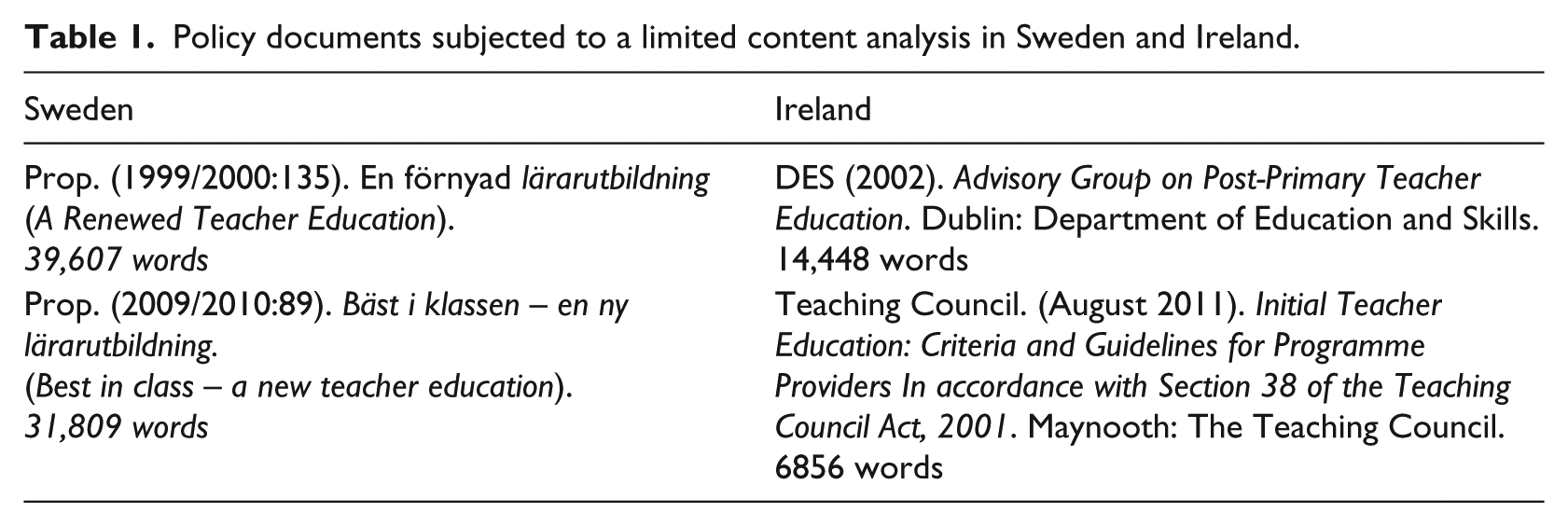
Swedish teacher education is governed by several documents that are hierarchically arranged in relation to each other: The Act for Higher Education (Högskolelagen) (1992:1434), The Regulation for Higher Education (Högskoleförordningen) (1993:100), Codes of Statutes for universities and university colleges (universitets- och högskolerådets författningssamlingar), Directions for Examination (Examensordning), Educational Plans (Utbildningsplaner), Cours plans (Kursplaner), Clinical training (Riktlinjer för verksamhetsförlagd utbildning, VFU), and local documents (lokala studiregler). 2 For this study, we selected two propositions presented as motives for new regulations aiming to guide teacher education. These documents were selected because they provide descriptions of the direction of teacher education and teacher educators’ expectations in the stated timelines (see Table 1).
Policy documents subjected to a limited content analysis in Sweden and Ireland.
Ireland: Policy background and context
Ireland is a country with close to 5 million people. There are currently 19 teacher education institutions scattered throughout the country with a plan to amalgamate these to six centers of excellence. While all higher education institutions are under the control of the state, the Catholic Church has retained a dominant influence in teacher education over a long historical timeline (Ó’Buachalla, 1988; O’Sullivan, 2005). In the last decade, regulation by the state has increased exponentially in response to an economic crisis, similar OECD PISA “shock” as reported in test scores in Sweden and a neoliberal turn to a market-led discourse of scientific planning, for example, new modes of accountability and fitness to practice (Lynch et al., 2012; Author, 2014).
After the end of World War II, where Ireland remained a neutral country and after the poverty of mass emigration in the 1950s, the education system opened outward toward free secondary education for all and a market-led discourse juxtaposed with a traditional Christian (predominantly Catholic) system of communitarianism (Ó’Buachalla, 1988). The special position of the Churches is found in the legal protection of the ethos of all denominational schools – approximately 90% of primary (national) schools and a high percentage of second-level schools in the free education system (Education Act, 1998).
Since the post-war period Irish society has been relatively homogeneous. However, similar to Sweden in recent years, Ireland has experienced an increase in immigration and growing secularization. Teacher education is governed by several policy documents that are arranged in relation to each other: Universities Act (1997) inclusive of academic freedom, the Education Act (1998) for regulation of primary and secondary education, Teaching Council Act (2001) for regulation of teachers and teacher education (Teaching Council, 2011), Codes of Conduct for teachers, new directions for Curriculum and Assessment (National Council for Curriculum and Assessment), and policy in relation to Inspection and new modes of Public Accountability (Department of Education and Skills (DES)). For this study, we selected two documents, DES (2002), a policy document expressing expectations for teacher education before the Teaching Council became a statutory body in 2007 and, Teaching Council (2011), a document expressing the criteria issued to higher education institutions in relation to teacher education after the Teaching Council became a statutory body (see Table 1).
Theoretical frameworks
In this section, we draw from a number of theoretical frameworks for their discursive positioning of democracy and emancipation and what we are calling teacher educators’ democratic assignment.
Lens of Dewey’s philosophical pragmatism
The struggle for emancipation is present in John Dewey’s (1959 [1916]) pragmatic philosophy where he argued that a vibrant and progressive society needs to be based on ideas of democracy since this allows people to contribute in the formation and shaping of that society. According to Dewey, education holds the key to the development of a democratic society, since it holds the possibility of discursive spaces where knowledge and practices can be combined in the development of the social good (Dewey, 1959 [1916]). Subsequently, his reasoning allowed a Copernican turn where the dualistic and atomistic platform for orienting in the world at the time was replaced by an environmental and holistic one, stressing the interdependent and dialectical relationship between purposes and practices for emancipation and democracy in education. Rather than seeing parts as separate entities ordered hierarchically, Dewey focused on the interactions taking place, whereby different parts exist in co-dependence rather than in an atomistic and hierarchical fashion to each other. Accordingly, Dewey recognized the political role of the educator as a moral agent, advocating for civic values and engaging young people in ethical discourses for the development of a just and democratic society (e.g. Biesta and Burbules, 2003; Hansen, 2002). His pragmatic reasoning had an impact on the way critical theory came to approach educational issues (Ali and Seyed, 2014), the need to pay due regard to the child’s experiences, and the importance of education as a social responsibility for public interest values and justice (Eisner, 1994).
Lens of critical theory
The Frankfurt School was formed by people who found that governing ideologies at the time, such as, fascism, capitalism, and communist regimes, were insufficient to handle risks and controversies in social life (Jay, 1996 [1973]). One contemporary thinker from the Frankfurt School is the philosopher and sociologist Jürgen Habermas who introduced a communicative platform referred to as deliberative democracy (Dryzek, 2000; Englund, 1986). Habermas (1972) maintains that open discursive spaces guided by rational deliberations between plural worldviews and discursive struggles is the best way to achieve the social good. Drawing on Dewey, Habermas maintains that rational communication is an important road to emancipation and lies in people’s active search for knowledge and interest in reason (Habermas, 1972: 197–198).
Although Dewey and the Frankfurt School influenced democracy and emancipation in education, it is nonetheless intimately associated with the Brazilian pedagogue and theorist Paulo Freire’s reasoning in The Pedagogy of the Oppressed where he highlighted the adult illiteracy problem in Brazil (Freire, 1972). Freire’s central argument is that education is not about molding character in a desired fashion by offering solutions and restrictions, but instead setting students’ thought processes in motion through critical questioning and problem posing (e.g. Breunig, 2010; Freire, 1972; Keesing-Styles, 2003; McLaren, 1998). Critical theory seeks to illuminate ways in which institutional and social practices express dominant norms and structures, as well as their consequences for human beings. Critical pedagogy directs attention to the social, moral, and political responsibilities of education to handle inequality and oppressive power relations at the borders between society and schooling. Central in critical pedagogy is the notion that education cannot be anything other than political that there is no neutral place where education can take form and where the teacher educator can stand (Youdell, 2011). Critical pedagogy stresses the importance for the teacher educator to create opportunities to think, negotiate, and transform unequal power relations; the content of knowledge; and institutional structures in education and society at large (Keesing-Styles, 2003).
Following from earlier work by Freire, Ira Shor’s (1987) emancipatory pedagogy was based on deep learning, capability to interrogate shallow meaning-making, “first-impressions,” dominant myths, “traditional clichés, received wisdom, and mere opinions” (Shor, 1987: 129) to explore reoccurring patterns of thought expressed in speech and writings found in literature, political texts, media, and interactions. Shor emphasized the importance not only to strive for deep understanding of social phenomena but also to reveal the consequences of (dominating) ideas for life conditions in various contexts.
Lens of moral and political philosophy
Ranciére’s reasoning shifted the premises of emancipation and its relation to education by placing equality as a central focal point, which he considered as interchangeable with democracy (Bingham et al., 2010). In this way, equality is understood as an assumption that can only be confirmed in practice when people’s engagement for equality is interlaced with the consequences of this engagement – that is to say the expressed experiences of those affected by the engagement (Säfström, 2011). Ranciére’s comprehension of emancipation differs from mainstream reasoning, in that people do not depend upon someone else to emancipate them, when a superior individual liberates a subordinate, since emancipation is possible if and only if both are regarded as co-equals, that is, there is a need for trusting the unique experience of those in need of emancipation (Biesta, 2010; Bingham et al., 2010).
In this way of reasoning, emancipation takes shape in discursive spaces between the existing social order and the possibility for interruption of that social order and involves a dynamic interplay, a dialectical and discursive struggle between order and interruption expressed “in a language in which it can be recognized as something valuable for society” and, at the same time is “seen as something that is simply destructive” (Säfström, 2010: 607). The notion of dilemma over the issue of inequality and discursive struggle in education is captured by Schnebel (2016). It allows not only teaching about democracy and emancipation where democracy is assumed (‘thin’ democracy) but also teaching for democracy and emancipation (Zyngier, 2016) within an expansive understanding of “thick” democracy (Biesta, 2010; Bingham et al., 2010; Dewey, 1959 [1916]; Freire, 1972).
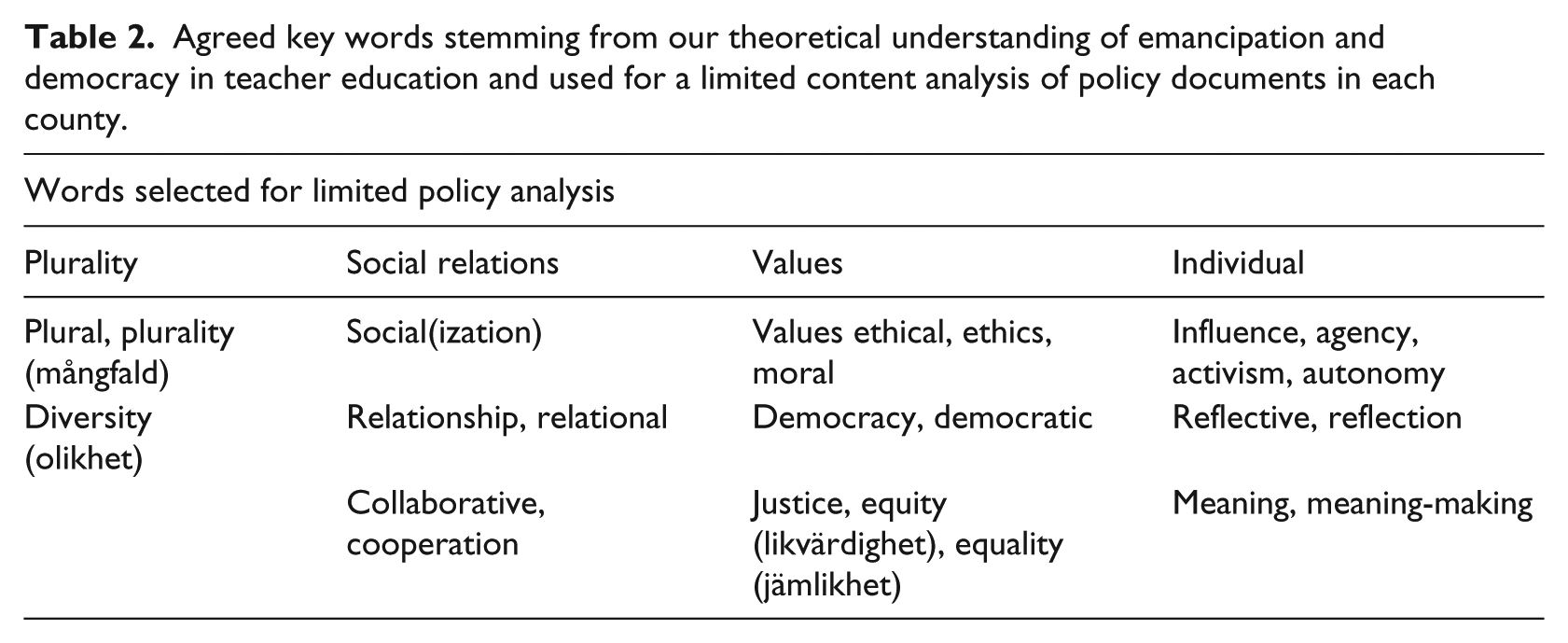
In summary, this expansive framing for democracy and emancipation in teacher education allowed us to select and highlight certain words and word groupings, such as democracy and justice, dialectical/relations, equality, equity, power, the need to incorporate plurality/difference, meaning-making, arguments for paying regard to context, social(ization), collaboration, and influence/agency/activism (see Table 2). We then used this word table for a limited content analysis of policy documents in Sweden and Ireland and to set the scene for a deeper policy analysis.
Agreed key words stemming from our theoretical understanding of emancipation and democracy in teacher education and used for a limited content analysis of policy documents in each county.
Methodology
Our research design used a theoretically informed quantitative study based on a limited content analysis, situated within a policy background and context, where we counted key words related to a specific and pre-defined (theoretical) way of grasping emancipation and democracy in teacher education as it occurred in four selected policy documents, two documents in each country (Hsieh and Shannon, 2005). We argue that the rationale for this research design is that a dialog between quantitative research, theoretical frameworks and policy contexts broadens the problem outward and opens the possibility of new insights to emerge that otherwise might be lost with a narrower single-country approach (Bryman, 2008: 163).
The quantitative inquiry concerns the number of times certain key words – stemming from a pragmatic, critical, and emancipatory understanding of thick democracy as an expansive dynamic ecosystem – occurred in four policy documents in teacher education for Sweden and Ireland. A content analysis can be both manifest, where the frequency of certain words are counted in order to study patterns and overall policy directions in a text and latent where the counted key words and their usage are analyzed (Hsieh and Shannon, 2005). This article focuses primarily on a manifest content analysis in order to gain some preliminary insights and to highlight potential policy trends in the changing position of teacher educators’ democratic assignment in different timelines.
The policy documents analyzed from the Swedish direction were government proposition (1999/2000:135) and government proposition (2009/10:89) that constitute the basis for teacher education reforms in 2001 and 2010 as concerns policy direction and expectations (see Table 2). The policy documents analyzed from the Irish direction were the report in relation to the policy direction proposed for teacher education at the turn of the century, a report for secondary education requested by the DES (2002) and the Teaching Council’s policy on the Criteria and Guidelines for Initial Teacher Education providers written in accordance with Section 38 of the Teaching Council Act (2011). A limitation of the study is that the selected documents in each country were not exact replicas of each other, and there are other similar documents that equally could have been selected and compared. Nonetheless we argue that the selected documents were sufficiently illustrative of the policy drivers for change in teacher education in relation to democracy and emancipation in each timeline and, as such, allowed interrogation of our research question.
A quantitative approach allows the researcher say something about what is happening (rather than why). Content analysis is based on an idea that verbal documents are expressions of communication that convey something valuable about what counts as meaningful and what does not count (Cohen and Manion, 1994: 55; Hemmings and Woodcock, 2011). The study was based on our hypothesis that key words positioned within a dialectical view of democracy and emancipation are rapidly diminishing in teacher education.
All selected words were counted independent of their context, which can be deemed as a limitation. Instead, we posit that the words counted while they inform us about their relative importance in the documents studied do not explicitly convey anything about how they are used in practice. Drawing on research grounded in content analysis (Bryman, 2008; Hemmings and Woodcock, 2011; Holsti, 1968; Travers, 1969), we maintain that the number of times words occur signal a policy imperative and direction which is important to acknowledge since it contributes in setting conditions for teacher educators’ responsibilities and practices. Therefore, our focus in the study was not on absolute values but was rather on identification of trends and patterns in the documents studied (Holsti, 1968).
We counted the number of times key words occurred (e.g. Bryman, 2002, 2008), their absolute and relative frequencies, as well as the percentage change in relative and absolute frequency. Absolute frequency is calculated as the number of occurrences of the word in the text. Relative frequency is calculated as the number of occurrences of the word divided by the total number of words in the text. The percentage change is calculated as: subtract second value with the first value and then divide with the first value, finally converting to a percentage. This was completed for both absolute and relative frequency. The percentage change in relative frequency takes into account the difference in the total number of words in each of the texts.
This limited content analysis was conducted in two steps: (a) an overall examination addressing whether our hypothesis was correct or not and (b) depicting words that have decreased most and words that have increased most in the two countries over a decade apart (e.g. Hsieh and Shannon, 2005). The limited content analysis stopped short of conducting a comparative analysis between the four documents. We were more interested in preliminary findings in relation to mapping change in policy direction rather than seeking to explain some grand narrative in relation to teacher education.
Findings from the limited content analysis
In this section, we present the findings of the limited content analysis in the Swedish and Irish policy documents (Tables 3 to 6). We were less interested in a direct comparative analysis of the word count as these documents did not have the exact same number of words to begin with and these initial findings while important were merely indicative, rather than conclusive, of the direction of policy change in each country, albeit change detected in two separate countries. Moreover, the findings pointed in the direction of the next phase of the research design and were important in shaping a new hypothesis.
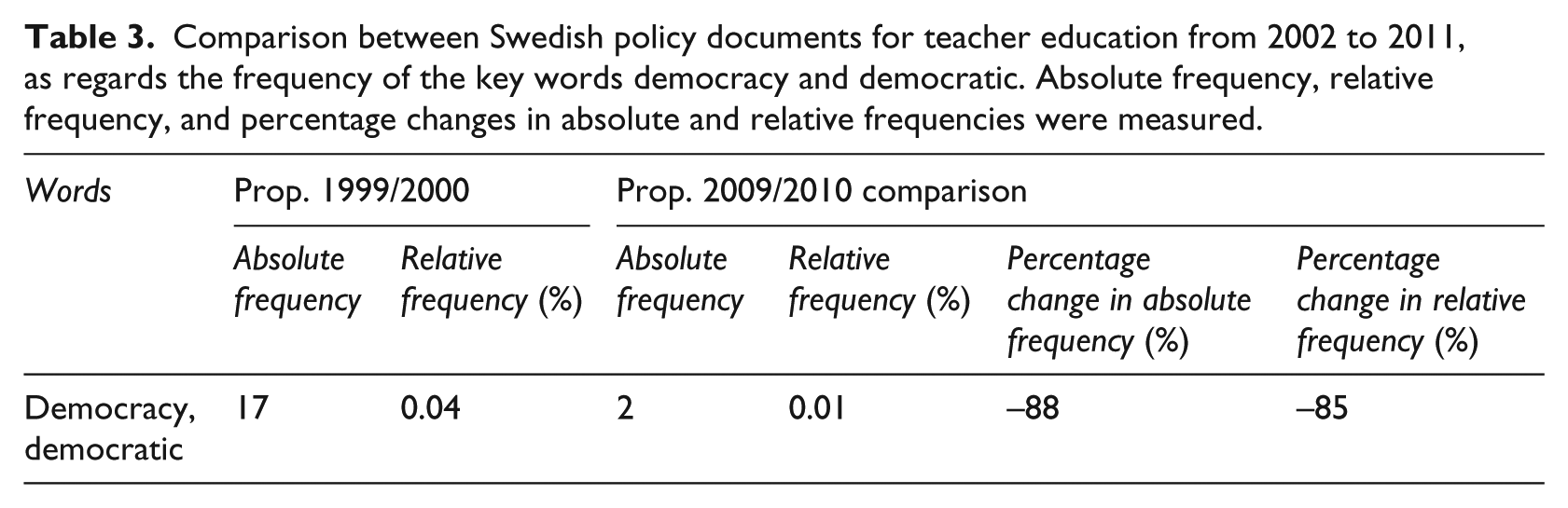
Comparison between Swedish policy documents for teacher education from 2002 to 2011, as regards the frequency of the key words democracy and democratic. Absolute frequency, relative frequency, and percentage changes in absolute and relative frequencies were measured.
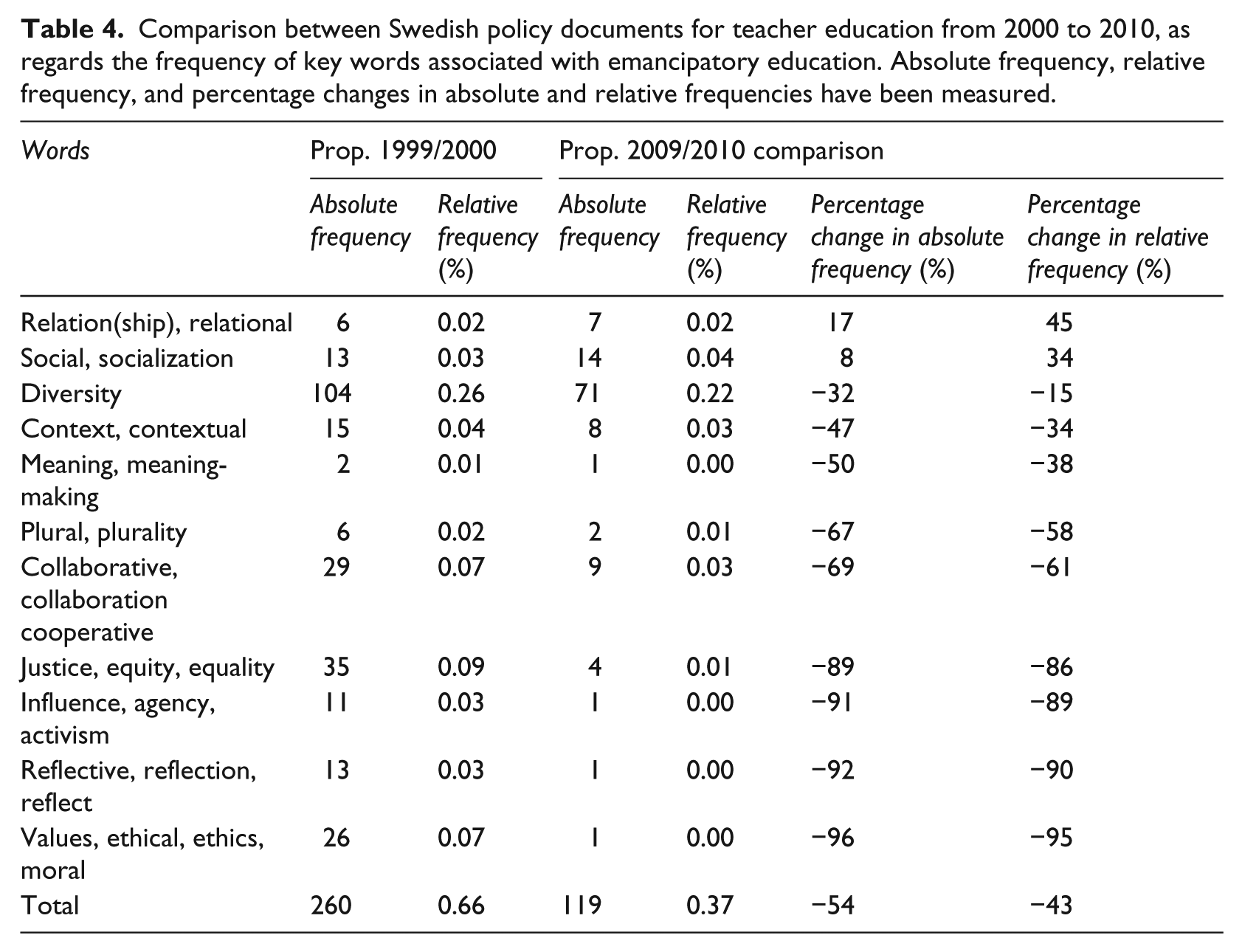
Comparison between Swedish policy documents for teacher education from 2000 to 2010, as regards the frequency of key words associated with emancipatory education. Absolute frequency, relative frequency, and percentage changes in absolute and relative frequencies have been measured.
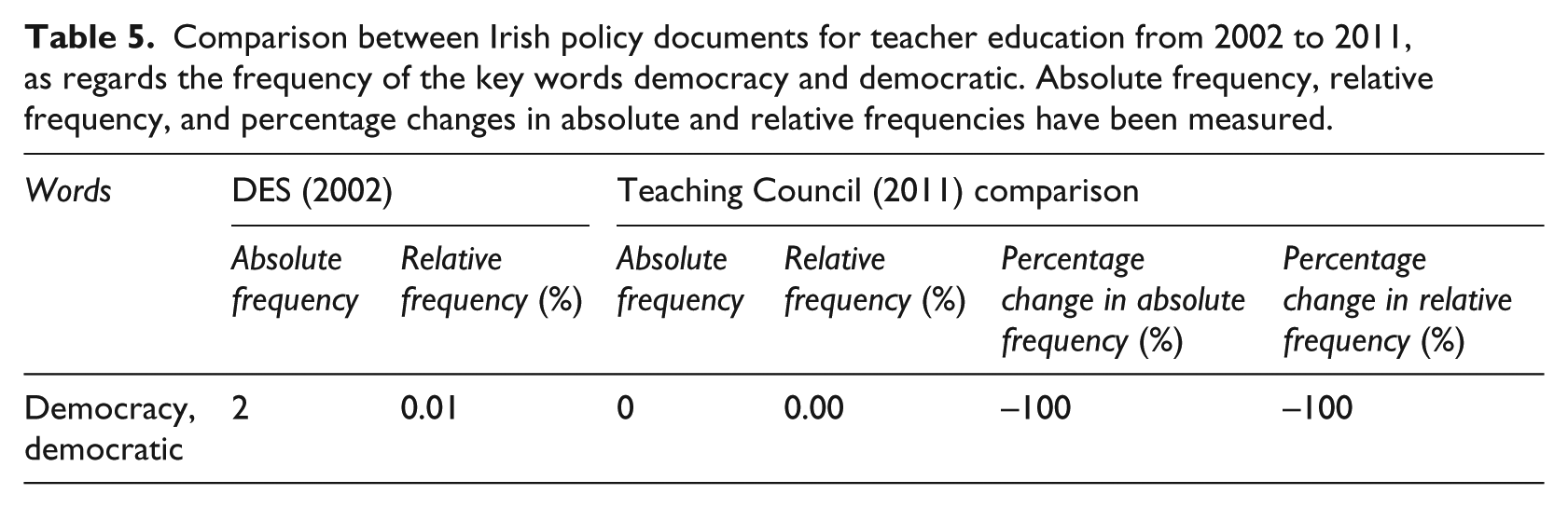
Comparison between Irish policy documents for teacher education from 2002 to 2011, as regards the frequency of the key words democracy and democratic. Absolute frequency, relative frequency, and percentage changes in absolute and relative frequencies have been measured.
Comparison between Irish policy documents for teacher education from 2002 to 2011, as regards key words associated with emancipatory education. Absolute frequency, relative frequency, and percentage changes in absolute and relative frequencies have been measured.
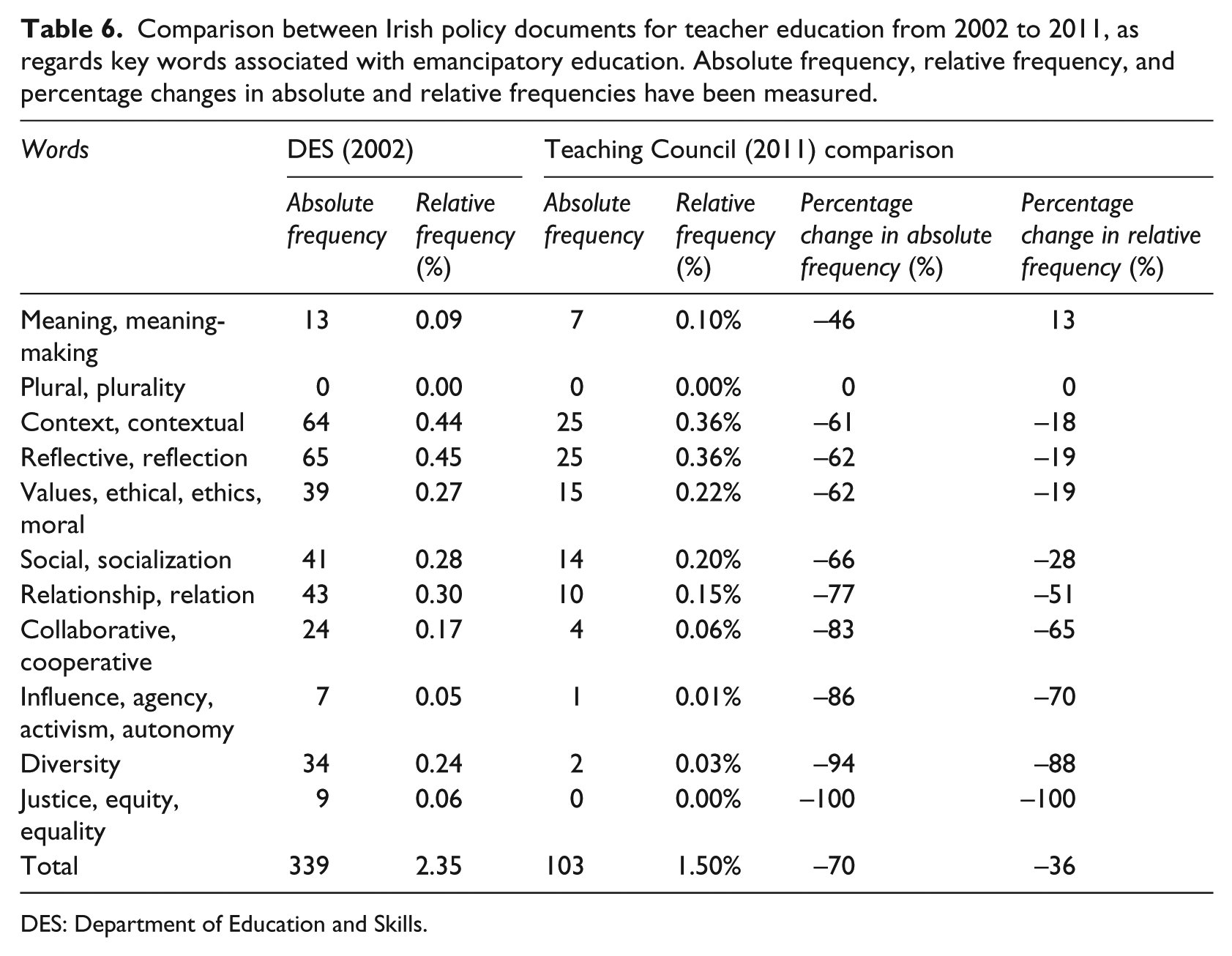
DES: Department of Education and Skills.
Content analysis of policy documents in Sweden
The analysis of two policy documents in Sweden were structured in relation to a hierarchical scale of what was reduced most and what was reduced less, as well as what was increased most and what was increased less. The results indicated substantial differences between the two government propositions as to how the expectations (directions) of teacher educators’ democratic assignment is expressed in number of words used. We used the terms Older Policy (OP) and Later Policy (LP) to distinguish the older policy documents from the later and more recent policy documents.
The first hypothesis of the article is that words such as democratic and democracy have decreased in frequency in teacher education in the last decade, thereby changing teacher educators’ responsibilities. The result of this limited content analysis confirms our hypothesis in the case of these two policy documents in Sweden. The percentage of the relative frequency decreased 85%, in relation to how often democracy and democratic are mentioned, between the OP document at the start of the century and the recent policy document.
The second hypothesis of the article is that certain words central to emancipatory understandings of democracy have also diminished. The results indicate that this hypothesis is also correct, seeing that the key words selected for comparison have decreased by 43% as regards percentage changes in relative frequency. The word groups that have decreased most are plural, plurality, collaborative, collaboration, and cooperative which have decreased between 50% and 60%, and justice, equity, equality, influence, agency, activism, reflective, reflection, reflect, and values, ethical, ethics, and moral, which have decreased between 80% and 95%. Word groups such as relationship and relational and social, and socialization have, however, increased between 30% and 45% in relative frequency, although in absolute frequency the change only implies a minor increase (+1).
Content analysis of policy documents in Ireland
The percentage change in policy documents in Ireland clearly showed a rather weak democratic project in teacher education in 2002, which appeared to have further diminished by 2011 in national importance.
Subsequently, the hypothesis that words such as democracy and democratic have decreased from the OP document to the LP document in Ireland is also correct, given that the words “democracy” and “democratic” went from being mentioned only twice in the OP to having no mention in the LP.
The second hypothesis claims that words important to emancipatory understandings of democracy have decreased. Following the results, it is possible to argue that this hypothesis is also valid, seeing that the key words chosen have decreased by 36% in the LP compared to the OP as regards relative frequency. Word groups related to meaning-making have increased in the Irish documents by 13%. Word groups that have decreased most are relationship, relation, collaborative, cooperative, influence, agency, activism, autonomy, diversity, and justice, equity, equality. Word groups related to relationships and collaboration have decreased between 50% and 65% in relative frequency, while influence, diversity, and justice have decreased between 70% and 100%. The word “plurality” is non-existent in both policy documents.
Discussion and conclusion
In this study, we theorized the discursive positioning of teacher educators’ democratic assignment, stressing the dialectical and interdependent relationship between democracy and emancipation in teacher education. We did this by drawing from pragmatic, emancipatory, and moral and political lenses (Bingham et al., 2010; Dewey, 1959 [1916]; Freire, 1972). This provided the study with a powerful explanatory framework and allowed a selection of agreed words to emerge which we then used to conduct a limited content analysis in four teacher education policy documents in two European countries, Sweden and Ireland. Whereas a summative content analysis does not convey anything about how certain concepts central to teacher educators’ democratic assignment are and should be interpreted, it can, nonetheless, say something substantial about what terms are included and excluded which, in turn, can signal how policy documents provide space for and value particular concepts and ideas through both the use and absence of terminology. There is a broad repertoire of research, indicating that the use and absence of words are not neutral but a carrier of both meaning and power. Seeing that the policy documents studied are political-steering instruments aiming to flesh out more in detail how teacher educators’ responsibilities should be grasped, the use and/or absence of concepts linked to a thick democracy provides a political direction for teacher educators’ practices.
The findings, while limited, expressed something significant about a new national policy direction in teacher education in Sweden and Ireland, that is, what it is that appears to be deemed meaningful or not. This study, while necessarily inconclusive and partial, indicates converging trends in each country in relation to emancipation and democracy in teacher education and what we are calling the discursive positioning of teacher educators’ democratic assignment. There was evidence of a rapid decrease in selected words associated with democracy and emancipation in this timeline in each country (e.g. Ball, 2012; Darling-Hammond, 2005).
The findings from this limited content analysis show that in both countries, the word count in relation to teacher educators’ democratic assignment using words, such as democracy, justice, and influence, has all significantly diminished in policy documents from the start of the century to more recent times. The focus in the policy documents in Sweden has been more on the uniqueness of the individual and their social (democratic) ties to an egalitarian society, whereas in Ireland, in keeping with a touchstone of Catholic social teaching, the emphasis has been predominantly on commonality and collective identity, such as reflective practices and the emancipatory generation of a just society for the common good.
In the policy documents in Sweden, it is possible to distinguish a changing trend where certain words stressing a (political) agency dimension such as plurality, values, democracy, and justice have been considerably reduced. This pattern is also found in the policy documents in Ireland, with the diminution of the role of the teacher/educator as a reflective practitioner for wider moral, social, and political purposes, and in some instances, the removal of words in relation to the emancipatory agency of the teacher/educator.
This changing conception of the democratic assignment in teacher education, presumably moving from a broader dialectic view of discursive struggle in a “thick democracy” toward a narrower reductionist view associated with “thin democracy,” has profound implications not only for (re)framing of roles, responsibilities, and regulation in teacher education but also for teacher education as a moral, social, and political shaper of change in relation to democratic societies. It is the difference between framing teacher education for a sanitized view of teaching about democracy and the ideal citizen or a dialectical view of teaching for democracy, a discursive interplay between social order and at the same time affordances for critique of the social order (Bingham et al., 2010; Zyngier, 2016). It is particularly pertinent to contemporary issues where collective consciousness and action is required (e.g. climate change, migration, and acts of terrorism) as a social responsibility for the public good.
The next phase of the research design points to the need for a deeper discourse analysis of the same policy documents to examine the extent of this paradigm shift. This is a hypothesis worthy of further consideration. Implications go well beyond two nation states and have potential to help others struggling with similar issues.
Footnotes
Acknowledgements
The authors wish to acknowledge constructive feedback for an earlier draft of this article by Dr. Manfred Lang, IPN Institute of Education, University of Kiel, Germany. Also, many thanks to the university of Gävle for all the financial support in writing this paper.
Declaration of conflicting interests
The author(s) declared no potential conflicts of interest with respect to the research, authorship, and/or publication of this article.
Funding
The author(s) received no financial support for the research, authorship, and/or publication of this article.