




Abstract
This qualitative research aims to describe the strategies applied by female parliamentary candidates to develop empathy values to gain constituent support in the legislative general election in 2014. Research subjects comprise 12 female members of parliament from seven regencies/cities in South Kalimantan who were chosen from different regencies/cities and different political parties. The research findings showed that in developing empathy values, female candidates were able to gain sufficient votes to be members of parliament. The strategies applied were as follows: first, the use of political marketing strategies that covered mapping or segmentation, positioning, and campaigns then monitoring and social capital strategies; second, socialization of empathy developing values conducted internally by meeting the constituents directly (door to door), whether individually or in groups; and third, utilizing their good social capital in relating to and working with other people. The social capital referred to covers: ability to build a network, build confidence, and attach themselves to Islamic values.
Introduction
Pancasila and the Constitution of 1945 explicitly states that Indonesian women, as citizens and human resources, have a similar status, rights, and obligations to men, to participate in all areas of life, including politics. Various regulations have been drafted and ratified to strengthen the participation of women in the state and political areas (DAW, 2005).
The rights of women in politics flows through Law No. 12/2003 on Political Parties, article 65 clause 1. This law requires political parties to nominate 30% female candidates in the general election. According to Purwanti (2015), the policy of affirmative action of 30% for women in politics has been applied in three general elections, in 2004, 2009, and 2014. However, representation of women in parliament still has not met the public expectations. Women participation remains low (Pande and Ford, 2011).
According to data from the Ministry of Women’s Empowerment and Child Protection, the number of women with seats in the House of Representatives is only 18%, whereas in the Executive (MPR) and the People’s Regional Assembly (DPD), women have 20% and 27% of seats, respectively (Soetjipto, 2014). In the provincial parliament, women have only 16% of the seats and hold a mere 12% in regency/city level government.
Many factors result in low women’s representation in political institutions, among which are cultural factors (Kartikasari, 2017). Culturally, women in patriarchal systems only play a role in the domestic sectors, while the public sectors, such as politics, are only the domain of men. This makes the chances and opportunities for women in politics difficult. Another obstacle is the issue of human resources that includes quality and quantity. Overall, these obstacles are the effect of a culture that has been very stereotyped and gender biased (Abdullah, 2006).
According to Afrido (2013) in the Online Sindo news reporting, he describes the condition of women participation in politics as follows: Referring to the Human Development Index (HDI) and Gender Empowerment Index (IDG), the role of Indonesian women in various ways, including in politics, is still relatively low, and can even be considered backward. According to data from the 2009-2014 election results, women representations nationally comprised only 101 members (18.3%) of the 560 members of the House. Regional parliament had only 27 percent female representatives, while governments in 33 provinces had only 16 percent female representatives, with a mere 12% at regency/city level government. 10% of the 497 districts/cities did not have a female representative in the legislative. Meanwhile, within the executive leadership, there was only one governor and one deputy governor from 33 governors/regional heads. 38 women became regent/mayor (7.6%) of 497 districts/cities. Only 11% of 56 ministers/deputy ministers were women. This data shows that the percentage of men is higher than women, therefore, a significant gender gap in decision-making is discovered. (Accessed on 9 June 2014)
Such was the case in South Kalimantan in the 2014 general election, where the number of women who won seats in the regency/city level government was still lower than expected (KKPU, 2014). Table 1 illustrates the Female Members of Parliament Elected in 2004, 2009, and 2014 in South Kalimantan (this information was obtained from KKPU (2014)).
An illustration of the number of female members of parliament in South Kalimantan in Indonesia.
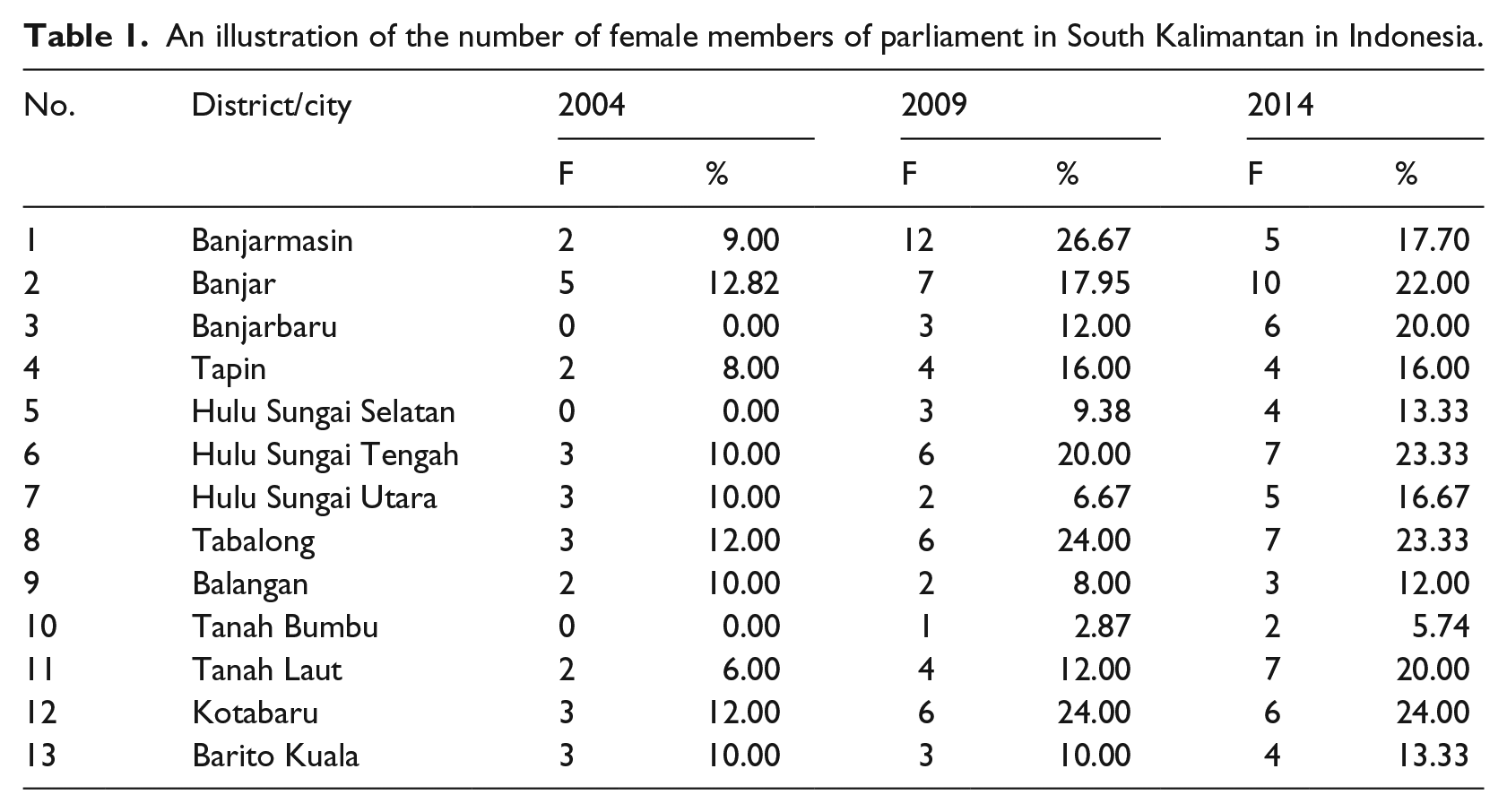
Table 1 shows an increase in the percentage of women elected from 2004 to the 2014 elections. The average increase in 2014 was 8.09%, rising 12.12% at the 2009 election and around 16.96% in the 2014 election, although the rate of this increase is not very significant when viewed from the votes women gained overall. The highest percentage of women MPs was obtained in Tabalong, while the area with the lowest female representation with women obtaining just 2 of the 35 seats, or 5.7%, was Tanah Bumbu regency. The figures were still far from the expected results. The 30% quota of female parliamentary candidates is merely a formality of election eligibility. It is in the women’s own hands after being nominated as parliamentary candidates, whether they are able to exist in the public eye and win the sympathy of the constituents to vote for a woman.
It remains an issue why the electability of women is still lower than men. Based on an analysis conducted by Puskapol Fisip UI (2014), the total average of votes given to female members of parliament was only 22.45% compared to men, who gained 77.54%. The percentage of female electability in the House of Representatives also dropped to only 97 women (17.3%) in 2014, compared to the 2009 election of 104 women (18.4%).
There are several factors which influence this situation, including social cultural factors and the budgetary constraint factor. This is in line with the findings of Elder (2008) who states that The primary reason for women’s under- representative is that women are significantly less likely to choose to run than men. A multiplicity of factors including political gender role socialization, lack of political confidence, family responsibility and relatively few numbers of visible women role models in politics.
Competition for women in parliament is very tight, not just between parties, but also within the same party. Female members of parliament are labeled from the beginning with a stereotype of not being suitable to act in the world of politics, which is identified as men’s territory. Regarding this, Rosaldo (1974) states that “both natives and ethnographies tend to view politics as male pastime … women are seldom as political actors but rather as pawn to use in the political maneuvers of men.” In general, politics is identified as a mean and brutal world where friendship means nothing.
Women’s journey in politics to date has seen multiple layers of competition faced. If a woman has just been nominated as a political candidate for the first time, the competition will be particularly felt. A female candidate, in addition to having to compete with other women who may be more senior (whether within the same party or from other parties), also has to compete with male candidates who are incumbent, renowned and already “established” in politics. The next tier of competition is money competition which has been closely linked to politics recently. The political climate in the last few periods has been susceptible to money politics. It is interesting to note that this practice is considered reasonable and usual because it is considered an important strategy in determining victory. A correct strategy, however, would include attempts to improve the quality of one’s self, intensive communication with constituents, effective management of a campaign team, rational funding, and so on.
Female members of parliament have proven that they have political ability, as do men (Yanti, 2000). Their success cannot be separated from the totality they show. One such totality is to realize compilation of a “strategy” which enables them to acquire seats in parliament. Strategies and development of empathy values are the decisive factors in the success of female legislators.
One of the efforts to get the support of the popular vote is for parliamentary candidates develop empathy of constituents in every meeting, to ensure they understand the conditions and thoughts of others. Batson and Coke (as cited by Brigham, 1991) suggested empathy as an emotional state of a person that is in accordance with what is perceived by others. Meanwhile, Hurlock (1999: 118) suggested empathy is the ability to understand other people’s feelings and emotions and the ability to imagine oneself in the place of others.
In developing constituents’ empathy, there are some aspects proposed by Batson, Darley and Coke (1978) which can be undertaken, namely (1) warmth, to generate a feeling of warmth toward others; (2) tenderness, to be well-spoken and gentle toward others; (3) concern, to pay attention to each other and the surrounding environment; and (4) mercy, to feel pity or be compassionate toward others.
Political strategy is also referred to as “political marketing.” The preparation of strategy requires steps that are related to one another. There are five important stages in the preparation of political marketing strategies, grouped into three major groups, including segmentation, strategy, and score card, explained as follows (Hadari, 2005).
First, mapping or segmentation includes (1) mapping social characteristics of the community, (2) mapping voting behavior of the community, (3) mapping groups of voters (targets), (4) mapping social networks that exist in the constituency, (5) mapping media, and (6) mapping female candidates in an electoral district of different grades/levels (national/regional/provincial and regency/city).
Second, preparation of the strategy includes three important stages. (1) Positioning of the candidate/party, brand and campaign, namely, how the candidates determine their image to the voters (Hadari, 2005). Image is important to make each candidate unique, differentiated from the competing candidates/parties, while branding is how the personification and the identity of the candidate/party are organized, including the slogans and symbols of the candidate/party. (2) Preparation of the campaign. Campaigns can be through print or electronic media, or attacks on the ground face to face with voters. In the current Internet era, a campaign model through Internet and social media is growing. (3) Scorecard for evaluation and monitoring. It is very important to monitor the performance of the political marketing strategy created. Thus, political marketing is a comprehensive activity framework to deliver and translate ideas and concepts appropriate to the target voters identified.
Campaigns are necessary in order to achieve political marketing objectives. Campaigns are one of the determining strategies to gain public sympathy. Crucial aspects in a campaign are authentic attitude, not overreacting (not being a “superman”), and ability to shape character and to position oneself well (Indriani, 2012).
Social capital was introduced by Piere Bourdie: “the aggregate of actual potential resources which are linked to possession of a durable network of institutionalized relationships of mutual acquaintance or recognition” (as cited in Alejandro, 1980). Social capital consists of cohesiveness, altruism, trust, social networking, and social collaboration. Many experts believe that social capital is the main basis for the creation of democracy within society. The major elements of social capital include norms, reciprocity, trust, and network. Social capital is created from hundreds to thousands of interactions between people every day. Social capital is a phenomenon that grows from the bottom, which is derived from people who form social connections and networks based on the principle of trust in a relationship of mutual reciprocity. It cannot be created by an individual, but is greatly dependent on societal capacity. This research aims to discover how female members of parliament developed empathy values, by applying various strategies to gain constituent support in the legislative general election of 2014.
Research method
This research used a qualitative-naturalistic approach by conducting intensive, in-depth, direct interaction with the sources of information and research subjects. This research was conducted in seven regencies/cities in South Kalimantan Province. Research subjects were chosen by using purposive and snowball sampling techniques. This research used two sampling groups: female members of parliament and constituents. A total of 12 female members of parliament were selected with one to three from each regency/city, from different political parties. Meanwhile, constituents selected were those who had voted for female parliamentary candidates, with selection through snowball sampling. Nine political parties accounted for 12 respondents. This number of parties exceeded 50% of the 12 2014 election contestant parties, achieving 75%.
Data were compiled through the technique of participant observation, in-depth interviews, hermeneutic inquiries, and relevant document analysis. Observation was used to discover social interaction patterns between female members of parliament and their constituents. In-depth interviews were conducted to obtain information from female members of parliament. Hermeneutic inquiries were used to gain data regarding empathy values and give meaning to them. Document analysis was undertaken to complete the information gained through interviews and observations, to ensure credibility. This was all conducted to reveal subjects’ orientation toward the meaning of the world of politics.
The development of theories referred to grounded discovery techniques combined with basic principles of multiple hermeneutics (Baharuddin, 2007). The process was conducted through identifying the role of female members of parliament and identifying the democracy process during the approach.
This study tends to use the definition of social capital given by Lawang (2004). According to Lawang (2004), he defines social capital as having the same substance as previous experts. Social capital is an institution in which there is social interaction and individual or group attitudes with three dominant elements: network, trust, and values (Lawang, 2004). Lawang (2004) further explains that trust is the result of action and social interaction where the social action refers to what is undertaken between two parties in creating a mutually beneficial relationship to achieve hope and trust. Meanwhile, social networks are the bond between individuals, groups, and institutions that are formed because there are social relations. Social networks have a wide variety of forms, known as paired networks, multiple networks, layered networks, and so on (Lawang, 2004: 45, 70).
Results
Respondent identification
Based on the education of the women members of the parliament, there are six members with a master degree (S-2), one member is still in the process of completing her master programs, four members are senior high school graduates, and one member with a bachelor degree (S-1). The ages are between 31 and 52 years. All of them have already got children aged between 1 and 4 years. Most female MPs have organizational experience before entering the world of politics. About 67% have gained organizational experience before entering the political world. They decided to go into politics after obtaining family consent. Families have a major role in shaping their political thoughts and attitudes. All respondents acknowledge the major influence of family. Family is a determining factor in their engagement in politics. Entering the world of politics is a major decision for them, so family considerations are given priority so consequences can be faced together. Moreover, they acknowledge that politics is a world full of interests and very difficult, so requires the support of their families. Political party involvement is only 10%.
Strategies in developing empathy values
Each female member of parliament has developed a strategy in accordance with their capacity, creativity, and innovation. Starting with introducing themselves, socialization, and offering programs during the campaign period, female MPs have always relied on persuasive approaches to develop values of empathy toward female constituents. They argue that this approach is necessary because the number of women entitled to vote is higher than the number of men.
In socializing themselves, they develop the values of empathy because they correspond to their values as women. The empathy values they develop include the aspects of relationship warmth, tenderness, care, and compassion. These values are put forward on every occasion of self-socialization, in order to build the empathy of the constituents toward female parliamentary candidates. The themes that are often brought up at the time of the campaign to grow constituents’ empathy are women’s rights and gender mainstreaming. The materials they convey in every socialization are aimed to encourage women to fight to sit as equals with men in parliament; fight to make sure that women have an equal opportunity to fill public positions in government; and fight to ensure that women have equal opportunities in the world of work/business. They convince constituents that only women are concerned with the rights of women. They ask the constituents to vote for female MPs in the upcoming election so that they can fight for the rights of women through parliament.
Self-socialization is conducted face-to-face individually or in groups. Individual socialization is often done by visiting the homes of women constituents packed with events in the forms of group activities. Socialization is done by visiting groups/associations such as study groups/taklim, Qur’an recital groups, salawatan groups, and social gathering/PKK groups. Campaign messages they convey are persuasive and use very polite language to develop a sense of empathy and sympathy of the constituents to understand feelings and emotions, to cause a sense of pity. Facilities and media are used to express the hope for many female members of parliament, by voting for women MPs
Political marketing strategy and social capital
In developing the values of empathy, they use political marketing strategies and social capital. Political marketing strategies include constituent regional mapping, campaigns, and evaluation. The mapping activity includes the social characteristics of the voting population, voter group behavior, and forms of social networks in the election areas. All MPs use their social capital by developing networking abilities, the ability to build trust, and the ability to develop the values of religion (Islam).
Most constituents expressed that the values of empathy provided by MPs during the self-introduction, socialization, and campaign period were very emotional, but over time the feeling of empathy decreased, especially when the campaign continues with intervention by competitors from the other legislative candidates. All women MPs feel that the black campaign and money politics are two factors that have a great influence in diluting the effect of empathy embedded in the hearts of the constituents.
Barriers they experience during the self-socialization period until the campaign period are the big influence of money politics, ignorance toward violation by the organizers of the election, and persistent discriminatory attitudes toward women. Most of the respondents considered money politics the biggest obstacle which most disturbs their political journey. For them, money politics is a stumbling block to their istiqomah (constant) intentions in politics. The second obstacle is related to the first hurdle, namely, the continuation, in the absence of decisive action from the parties involved, despite the existence of binding rules. The third barrier is the discriminatory attitudes toward women who enter the world of politics. Although history has proven the existence of women in the political world, but a less sympathetic attitude still exists, both when they are candidates and even after occupying seats in parliament.
Discussion
Strategies for developing empathy values
In line with the above findings, Baron and Byrne (2005: 111) state that empathy is the ability to sense the emotional state of others, feeling sympathetic and trying to solve problems, and taking the perspective of others. In this regard, the substance of empathy values can use the power of the “persuader” to gain constituent support expressed at the time of introduction, socialization, and the campaign. An empathetical person is willing to share and understand the problems faced by others. In an emotional state like this, the values of empathy can be developed so that there is a sense of pity and compassion from the constituent to support and chose female parliamentary candidates.
But in a relatively long time before the legislative elections, the influence of the values of empathy can fade and decrease along with the emergence of new influences from other parliament member mainly through political intervention of money politics and black campaign. The values of empathy that is embedded in the hearts of the constituent cannot survive long after receiving the influence of other candidates who are men and have a larger number.
Political marketing strategies
In self-introduction, socialization, and campaigns, women MPs use political marketing strategies and social capital strategies. Political marketing strategies they carry out include mapping or segmentation, positioning, campaigns, and then monitoring and evaluation. The mapping conducted includes the social characteristics of the community, voter group behavior (target), social networks that exist in the constituency, the media, as well as mapping of other female candidates in the same election area. Ideally, mapping is conducted through a survey or at least a little research, but because most of the candidates are citizens of their own election area, then information about societal characteristics is usually known based on information from the party, their networking, or teamwork. All candidates have conducted mapping or segmentation of the social characteristics of the community, mapping the behavior of voters, mapping groups of voters (the target), mapping social networks that exist in the constituency, mapping the media, as well as mapping other women candidates in the same election area, but at a different level/grade (House of Representatives/Regional Assembly) Province, Regency/City. Mapping of the last two is not conducted optimally by all candidates.
The ability of the candidates in positioning is very good because it is supported by good personal qualities. Their ability is obtained from their organizational experience, level of education, and families. All candidates value the importance of education. This can be seen from their educational level, which is high. Positioning capabilities are supported by appropriate mapping and the capacity of self-efficacy by the parliamentary candidates. Personal qualities or what is termed personal capital of a female politician can be gained from work and organizational experience, education, profession, and in the local context, their position within the community.
They also have good communication skills. Their choice of words and sentences, their voices, and the way they speak are full of confidence. Their organizational experience in general is mature, and some have been actively involved in organizations since junior high school. The candidates portray themselves in a manner or with characteristics desired by the community and society in their electoral district. Simple appearance is one way to bring the candidates closer to the voters. As for the campaign, in general they aim to show themselves as someone authentic and open. Campaign messages are short, concise, and have the interests the constituents at heart.
Although generally party vote acquisition targets have not been met, the strategies formulated and implemented by the candidates have successfully delivered them to parliamentary seats. Socialization is done much more subtly by meeting the public directly (door to door). They exploit their feminine side, such as tenderness, honesty, care, anti-violence, and anti-money politics against women. They undertake evaluation and monitoring systematically and regularly with the involvement of their respective success teams.
Some of the constraints experienced by female candidates are the lack of political party role in helping female candidates, the substantial costs required for nomination as legislative candidate, discrimination against female candidates and money politics, but their spirit to win legislative elections is very large, so all candidates consistently build and maintain close relationships with their constituents.
Social capital strategies
All female parliamentary candidates have solid social capital, which is related to their ability to relate and work together with other people. Lawang (2004) states three main characteristics of social capital: network, trust, and values.
Networking abilities are demonstrated through their solid relationships with success teams, political parties, and formal/non-formal organizations in the community. Network between individuals, groups, and institutions are formed because there are social relations. Since networks link individuals with individuals or groups, these networks are known as social networks. Social networks have a variety of forms. Networks can be paired, multiple, layered, and so forth according to the complexity of the network (Lawang, 2004).
Networks are needed to facilitate the realization of their plans and targets, given the limitations of individual candidates. Many things in politics cannot be undertaken alone, although there are some things that must be done that way. Networks built by legislative candidates themselves include formation of a success team, consolidation with political parties, and partnerships with the community.
The composition of success teams formed differ from one another. Some are composed of only family, some are combinations of family and others, and some contain only public figures. Tala2, Tala3, PL2, and HSS1 candidates agreed to use their families as success teams. The other candidates (eight candidates) used a mixture of other people and family as their success team, because according to them, whoever the person is, the most important thing is reliability. Given the difficulty of getting reliable people, anyone can be recruited as long as they are reliable. Moreover, not all families are trustworthy and able to work professionally as a success team, so being a member of family is not the only criteria.
There are also candidates who always give a “token” at every opportunity, such as food, clothing, and watches. These candidates’ transparency is not only linked to technical issues and election winning strategies but also to the financial/budget transparency toward the success team.
A party with its hierarchical organizational structure from the center to the branches forms a network that governs those within it to work in accordance with the existing structure. All candidates follow the pattern of their respective party networks in order to adapt and form new networks. Candidates use the party as part of a large network that they establish. The role of parties is acknowledged explicitly by all candidates, especially those in Banjar2 and HSS1 (see the “Results” section). The role of the party in this case is closely related to the technical–operational role of the organization run by all members of the party, not to mention the female candidates.
In general, the candidates take advantage of existing organizations in the community; nevertheless, these organizations are rather informal. Some female candidates are supported by a network of formal organizations, such as the PKK and KNPI. In general, they use a network of family/kinship organizations, such as family gatherings, taklim, prayer groups, Islamic arts groups, and non-governmental organizations (NGOs), which are considered to help their socialization programs.
The next important element of social capital is trust. Based on Lawang’s view, the three main elements/characteristics of social capital are networks, trust, and values (Lawang, 2004) which are equally important in preparing the candidates to face competition in the election. Social capital grows from below, derived from the individuals who make up social connections or networks. A network that has been established should be maintained through the principle of trust (John, 2003). The network will be even stronger if it is based on the principle of trust in a mutually beneficial relationship (mutual reciprocity). Trust is the result of actions and social interactions in which there is an interaction between two or more parties to achieve certain goals.
In building the trust of their constituents, female legislative candidates use a variety of means. First, communication is made with the success team in the electoral area. Second, face-to-face meetings are conducted with the public. Third, a simple attitude and appearance should be shown, especially when dealing with the public. Fourth, commit totally to handling community issues and carrying out tasks, before and after sitting in parliament. This was stated by the candidates, particularly the Bjm candidate (see the “Results” section). For BJBR candidates, totality is the readiness to face the worst things, starting from the nomination process through to serving in parliament (see the “Results” section).
As for HSS2, being honest, natural, sincere, independent, and not dependent on any other person or party (especially financially) is a total attitude. She demonstrated her independence by saving her salary for the last 5 years in preparation for the second period elections. Totality for HSS2 is also a full effort in politics, that is, no empty space, total, not wishy-washy, not half-hearted, brave and courageous to fight, which means arguing and being strong minded to defend the aspirations of the people. Fifth, being open means being willing to listen to the aspirations of the people and receive feedback from the success team.
The value element is no different to the previous two elements (networks and trust) in that it has an important position for the success of the candidates. Value, termed “norms” by Lawang, is the unwritten rules considered valid and adhered to by the community (Lawang, 2004: 45, 70). All female candidates elected used as samples in this research are Muslim, just like the communities in their constituencies, so the values they profess are also based on Islam. Islamic values have become an integral part of public (constituents’) lives in South Kalimantan (Alfani, 1997).
Islamic values include the following activities carried out by parliamentary candidates. First, prior to their decision to be involved in politics, they request their family’s permission (husband and parents). Second, all candidates have the ability to use the language and symbols of religion (Islam) well. During socializations and campaigns, the gifts given are also related to religious values, such as sacrificial animals, items related to religious worship, such as praying kits, Moslem shirts/koko, gloves/tapih, beads, and veils or head scarves/jilbab. Third, all candidates approach non-formal Islamic institutions/organizations, such as prayer groups, Qur’an recital groups, and taklim. All candidates make sure they never miss these organizations in their political activities. Fourth, all candidates care about community members who are weak (Dhu’afa) which includes the poor, the elderly, and children. Most subjects explicitly mention their concerns for women, and one candidate has a special program related to mothers, children, and the elderly (by establishing posyandu mother and child health clinics and posyanda health clinics for seniors). Fifth, they use a feminine style when socializing with people. Sixth, they use their conscience in accordance with Islamic guidance that has ordered people to act conspicuously because the heart will direct them to behave sincerely and honestly (without benefitting oneself or sheer ego). They acknowledge that many parliamentary activities conflict with their conscience, but they are powerless to do anything about this. Seventh, they reject money politics. In general, the candidates do not agree with the practice of money politics in the election process because it can damage the public mentality and destroy Indonesia’s political system. Only one candidate admitted to being forced to “go with the flow” in order not to fail to become a legislative candidate.
Conclusion
Empathy values including warmth, tenderness, care, and compassion in relationships can be developed to persuade constituents how to vote if female members of parliament are able to internalize those values through their self-introduction, program socialization, and campaigns, by utilizing themes related to women empowerment and gender equality persuasively. The development of empathy values, and the use of political marketing strategies and social capital strategies, can increase the number of votes in legislative elections, although the increase was not very significant in the 2014 election.
Electability of female parliamentary candidates as legislative members is closely linked to the political marketing strategies and social capital strategies they applied to get votes in the 2014 election, by carrying out a series of mapping strategies, positioning, and campaigns. Social capital strategies they carried out included the ability to build networks, the ability to build trust, and the ability to relate themselves to (Islamic) religious values. Obstacles faced by candidates were the absence of major funding as political capital, discriminatory attitudes toward female candidates, and the flourishing practice of money politics. These can be overcome as the candidates have good social capital to form relations and work together, to build trust, and to build networks.
Footnotes
Declaration of Conflicting Interests
The author(s) declared no potential conflicts of interest with respect to the research, authorship, and/or publication of this article.
Funding
The author(s) disclosed receipt of the following financial support for the research, authorship, and/or publication of this article: The present research was soley funded by the author and there is no institutional facilitation or funding offered.