




Abstract
Issues related to financial matters are an integral component of the curricula in vocational education and training in Switzerland. However, the differences between students’ competences are caused not only by the curricula but by multiple factors. One key factor is teachers’ characteristics that support successful learning processes. Teachers’ conceptions with respect to general or domain-specific aspects of teaching-related phenomena and processes play a particularly important role. In contrast to subjects such as mathematics, little is known about teachers’ conceptions in the domain of economics and financial literacy. This applies in particular to the investigation of the deep structure of teachers’ conceptions, which goes beyond the designation of contents. A structural representation in the form of concept maps is a possible instrument for the collection and analysis of data to that end. Consequently, it is the aim of this study to demonstrate, how concept maps can be used as a methodological instrument in order to gain information about the domain-specific conceptions of vocational education and training teachers regarding the subject matter of financial literacy. Results show that concept maps are a targeted instrument for the exploration of the deep structure of conceptions and have therefore a great potential for research and teacher education.
Keywords
Introduction
In modern economies, finance-related tasks and challenges are increasingly essential for individuals responsible for managing their financial affairs in everyday life. This increasing importance of financial matters is attributable to several societal developments, such as the growing demand for personal responsibility in insuring personal life risks and securing retirement provisions or changing consumption and debt habits (e.g. Aprea et al., 2016; Aprea et al., 2015). Assuming that these challenges cannot be adequately addressed by everyday experiences alone, the promotion of financial literacy should be a core concern for every education system (Aprea, 2012; Leumann and Aprea, 2016). Whereas financial and/or economic education is not a mandatory subject in the general education tracks of upper secondary education in Switzerland, it is an integral component of the curricula in vocational education and training (VET). More specifically, issues related to money and financial matters are integrated into the subject of language, communication and society (LCS), which is taught with similar content in all dual apprenticeship programmes in Switzerland. According to the national framework curriculum, the main aim of LCS education is for individuals to find their way independently and responsibly in their personal life and in society (Bundesamt für Berufsbildung und Technologie (BBT), 2006). With regard to financial education, institutionalised learning processes are required to prepare individuals for money- and finance-related tasks and challenges in the realms of their private life and in democratic society. However, learning and instruction processes and therefore VET students’ learning affordances are determined not only by curricula but by multiple, complex and interrelated factors. Empirical findings show that teachers’ cognitive, motivational and volitional characteristics are among the key factors (e.g. Köller et al., 2013; Lipowsky, 2006). As Lucey (2016) states, it is particularly teachers’ content understanding as well as their instructional strategies which affect heavily how they construct learning arrangements. This statement underlines the important role of teachers’ conceptions. Teachers’ conceptions reflect their mental representations with respect to general or domain-specific aspects of teaching-related phenomena and processes (Kunter and Pohlmann, 2015). In contrast to knowledge, conceptions entail both cognitive and non-cognitive components and are often implicit, including not only (empirical) facts but also ideologies and experiences (Kagan, 1992). Pratt (1992) interprets conceptions as lenses through which teachers see the world: ‘In effect, we view the world through the lenses of our conceptions, interpreting and acting in accordance with our understanding of the world’ (p. 204). Teachers’ conceptions can thus be understood as their mental representations of personal knowledge or their subjective views of the phenomena and processes of learning and instruction and the associated interdisciplinary or domain-specific content.
Whereas interdisciplinary teachers’ conceptions refer to general teaching-related conceptions such as classroom management or instructional strategies, domain-specific conceptions refer to ‘the teacher’s overarching conception of the purposes for teaching a subject matter’ (Borko and Putnam, 1996: 676). This involves what teachers know about a subject matter, what they believe is important for students to learn, what they view to be appropriate instructional strategies and how they expect students to learn in a particular content domain (Borko and Putnam, 1996). Currently, processes of learning and instruction are widely considered to be domain specific (Baumert et al., 2013), which increases the importance of the domain specificity of teachers’ conceptions. Nevertheless, empirical evidence of the domain-specific conceptions of teachers varies greatly. Teachers’ conceptions in mathematics and natural sciences (e.g. Forgasz and Leder, 2008; Huibregtse et al., 1994) are relatively well explored, but little is known about teachers’ domain-specific conceptions in the domain of economics in general and in the subdomain of financial literacy in particular. This applies in particular to the investigation of the deep structure of teachers’ conceptions, which goes beyond the designation of contents and considers aspects of structural organisation as well. Therefore, teachers’ conceptions and the relationships among these conceptions have to be made visible and arguable by applying an instrument that assesses the mental representation of their conceptions. A structural representation in the form of concept maps is a possible instrument for the collection and analysis of data to that end. Consequently, it is the aim of the current study to demonstrate, how concept maps can be used as a methodological instrument in order to gain information about the domain-specific conceptions of LCS teachers in VET schools regarding the subject matter of financial literacy. Based on the findings, and considering the important role of teachers’ conceptions in supporting targeted learning and instruction processes, the study also intends to provide a basis for the development of approaches to (LCS) teacher education regarding how conceptions can be reflected and modified towards pedagogically and didactically viable mental representations through concept maps.
Theoretical background
Approaches to financial literacy
A wide range of approaches to financial literacy can be identified both in the German-speaking and international research literature (e.g. Atkinson et al., 2007; Davies, 2015; Kaminski and Friebel, 2012; Organisation for Economic Co-operation and Development (OECD), 2012). These approaches differ largely in their definition of financial literacy, and they can be classified along two relevant dimensions: ‘content’ and ‘psychological dispositions’ (Aprea et al., 2015; Leumann et al., 2016).
Within the ‘content’ dimension, two main perspectives are identified. On one hand, financial literacy is understood as personal finance management. This position is currently the most widely used approach to financial literacy. It is mainly oriented towards financial decisions made in personal life, including budgeting, everyday payments, the use of credit, insurance for life risks, wealth building and retirement provision (Huston, 2010). Approaches that are subsumed under this point of view can be referred to as ‘individual perspectives’ of financial literacy. The Pisa 2012 Financial Literacy Framework launched by the OECD provides an example of the approach to financial literacy as personal finance management. Financial literacy is defined as the
knowledge and understanding of financial concepts and risks, and the skills, motivation and confidence to apply such knowledge and understanding in order to make effective decisions across a range of financial contexts, to improve the financial well-being of individuals and society, and to enable participation in economic life. (OECD, 2012: 13)
On the other hand, a group of approaches defines financial literacy in a wider economic and political context and emphasises the ability to understand and participate actively in a democratic economic and financial system. Thereby, individuals are viewed not only as addressees but also as co-creators of the larger economic and political conditions; this role requires an understanding of economic and financial concepts and processes. This group of approaches can be subsumed under a ‘systemic perspective’ of financial literacy. Davies (2015) presents an example from the Anglo-Saxon world. According to the author, a central task of financial literacy is to enable individuals in the role of voters to ‘have sufficient understanding of financial processes and incentives to create a climate of pressure for politicians which makes it more likely that [they] govern in the public interest’ (p. 312).
The second dimension, ‘psychological dispositions’, contains the characteristics ‘cognitive’ and ‘non-cognitive’. ‘Cognitive’ refers mainly to knowledge, skills and abilities; consequently, the specific content of the concerned approaches to financial literacy is informed exclusively by cognition. In contrast, non-cognitive dispositions imply emotional, motivational and volitional aspects as well as social values and norms. The few existing approaches to financial literacy that take these aspects into account integrate, for example, volitional strategies (e.g. the ability to delay gratification) and emotional and motivational aspects, such as attitudes (e.g. towards money), in their definition of financial literacy.
Based on these two dimensions, four facets of financial literacy emerge (see Table 1): individual cognitive, individual non-cognitive, systemic cognitive, and systemic non-cognitive (Aprea et al., 2015; Leumann et al., 2016).
Four facets of financial literacy.
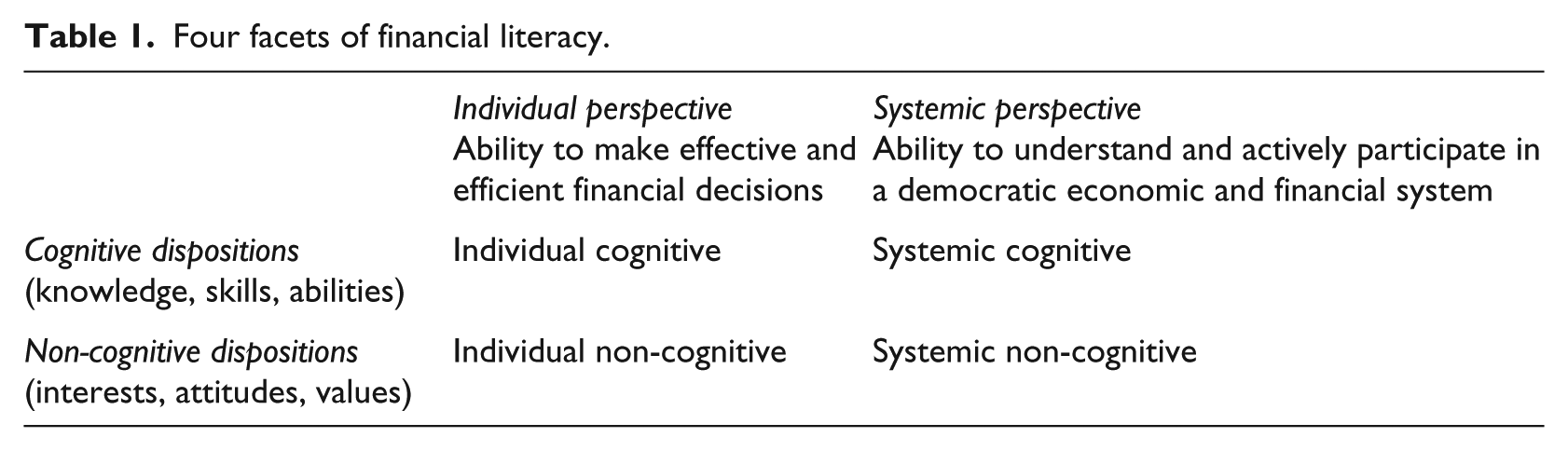
In a previous interview study (Leumann et al., 2016) conducted to further specify the concept of financial literacy in the VET context, 40 stakeholders from the financial vocational education context from six European countries were asked to attribute relevant topics to the four facets of financial literacy. One result was the substantive elaboration of the individual cognitive facet and the systemic cognitive facet into four and five main content categories, respectively. For the individual cognitive facet, these categories were ‘daily financial tasks’, ‘borrowing’, ‘saving’ and ‘informing’. The systemic cognitive facet was differentiated on the basis of the categories ‘issues of monetary and financial policy’, ‘issues of real economy’, ‘other economic issues’, ‘social security system’ and ‘tax system’ (Leumann et al., 2016).
Cognitive psychology approach to teachers’ conceptions
Cognitive psychology has addressed the question of how information is represented, interpreted and stored in long-term memory. Information contains any content that is mentally represented in any way and thus also includes conceptions, which describe personal knowledge or subjective views (see section ‘Introduction’). Information in long-term memory is considered organised, and it is assumed that the nature of its mental representation is a central prerequisite of cognitive information processing (Tergan, 1993). There are different models of how information is represented in long-term memory. If semantic information about facts, terms or circumstances is depicted, semantic network approaches are used (Gluck et al., 2010). Such approaches are widely recognised and describe a linguistically abstract way of storing memory contents. Semantic networks consist of nodes and labelled lines that connect the nodes together. The nodes correspond to concepts that are represented in memory, such as objects, people or events. The basic unit of meaning is expressed by a proposition that consists of two concepts and a connection between them. In the logic of semantic network theory, an individual learns by associating new concepts to existing ones, thereby building new propositions. Therefore, the existing information structure is constantly reorganised and becomes increasingly interconnected and more precisely structured (Novak and Gowin, 1984; Ruiz-Primo and Shavelson, 1996; Wender, 1988). The structure of represented information in a specific domain can be gathered with structural representations (Ruiz-Primo and Shavelson, 1996). Concept maps – consisting of concepts and labelled relations – constitute such a structural representation (Stracke, 2004). The method of concept mapping has been established as a reliable tool for collecting, documenting and investigating the cognitive structures of students and teachers in didactic and psychological research (e.g. Ruiz-Primo and Shavelson, 1996). Cognitive psychologists argue that the value of concept maps lies in their format, which corresponds to the mental representation of knowledge in the form of semantic networks (Collins and Quillian, 1969). As a consequence, a teacher’s concept map can be interpreted as representing important structural aspects of concepts and the range of relationships in his or her memory (Ruiz-Primo and Shavelson, 1996). 1
There are different criteria by which to characterise cognitive structures and thus to analyse concept maps (e.g. Ebner and Aprea, 2002; Hoz et al., 1990; Novak and Gowin, 1984; Ruiz-Primo and Shavelson, 1996; Weber, 1994). Distinctions can first be made among the criteria related to (1) the extent, (2) the elaboration, (3) the organisation and (4) the content of the mental representations. Whereas (1) ‘extent’ is captured by the number of propositions or the degree of coverage of certain content, (2) ‘elaboration’ describes the sophistication of the depicted propositions. From the perspective of cognitive psychology, this is essential for the context of teaching because the more sophisticated the concepts are, the more knowledgeable a teacher is in a certain domain (Ruiz-Primo and Shavelson, 1996). (3) ‘Organisation’ is captured by diverse criteria in the research literature, such as the level of integration, the number and labelling of relations, the number of hierarchy levels and the variance of symbols. In cognitive psychology argumentation, as the level of integration becomes higher, the number of relations and hierarchy levels increases; moreover, as the labelling of relations and the variance of symbols improve, information is structured in memory more precisely, stably and coherently (Ruiz-Primo and Shavelson, 1996). Finally, (4) ‘content’ is captured by the accuracy of the concepts or the consideration of central concepts in a specific domain.
Teachers’ conceptions in the domain of economics and financial literacy
In the domain of economics, there are only a few – predominantly explorative – studies on the domain-specific conceptions of teachers at all levels of education. These studies apply different methods of data collection and focus on diverse facets of teachers’ domain-specific conceptions. Four facets can be distinguished: domain-specific conceptions of goals, content, teaching methods and learners (for detailed documentation, see Leumann and Aprea, 2016). As content-related conceptions of financial literacy are the focus of interest in this study, the findings of three studies on content-related teachers’ conceptions in the domain of economics and the specific context of financial literacy are presented and discussed in the following.
Kirchner (2016) investigated the domain-specific conceptions of 15 economics teachers in different school tracks at the secondary level in Lower Saxony (Germany) applying problem-centred interviews. The content discussed by the teachers was differentiated into the following eight categories: (1) state: economic systems and policy, (2) companies, (3) households: consumer education and financial literacy, (4) economic principles, theories and models, (5) vocational orientation and (6) international economic relations. Of subordinate significance were the topics (7) economy and ecology and (8) regional economy. Additionally, Kirchner noted that these teachers mainly followed curricular requirements and daily news from the media to justify the importance of teaching certain content. Teachers’ individual preferences were strongly linked to their own field of study and work experience outside of school.
With regard to the specific context of financial literacy, Leumann and Aprea, 2016) studied the content-related domain-specific conceptions of financial literacy among 172 LCS teachers in Swiss VET schools through a written questionnaire. The teachers were asked to record the five teaching contents they perceived to be the most significant ones. The results showed that the topic of daily financial tasks was considered especially relevant for financial education classes in VET schools. Almost half of the topics rated as most important were related to the budget, and approximately 10% each were related to ‘income and salary’, ‘consumer behaviour’ and ‘debts’. Approximately two-thirds of the topics rated second and third in importance were related to daily financial tasks. Central topics were ‘debts’, ‘budgeting for individuals or households’, ‘different financing methods/credits/leasing’ and ‘mid- or long-term financial planning/asset building’, in equal proportions. Regarding the topics ranked fourth and fifth in importance, those gained in importance, which can be subsumed under educational preparatory skills for the engagement in financial and money issues (e.g. calculation of interest and percentages) or discussions on values (e.g. in the context of sustainable consumption or the socio-economic development gap between developed and developing countries) with one-fifth of the indications. Topics related to the financial market, the role of the state in the economy or basic economic or fiscal terms and concepts were considered to be of minor importance, with less than 10%.
On the basis of interviews and questionnaires, data-specific features of the investigated content-related conceptions were understood, but no conclusions concerning the deep structure in terms of the structural interconnectedness and organisation of these conceptions could be drawn. This restriction was considered to a certain extent by Bender (2011). In her study of the conceptions of 48 bachelor’s students in business education at the University of Mainz (Germany), she was interested in the content-related domain-specific conceptions of private economic activities focusing on the dimensions ‘assets building’ and ‘indebtedness’. These conceptions were visualised and analysed by means of concept maps. The basic objective was to develop a reference structure that could be used in follow-up studies as a comparative measure. For this purpose, a modal network and a prototypical network were calculated, but no specific structural categories of analysis were applied. The analysis showed that the majority of the respondents assigned a bipolar structure to the process of private economic activities, with debt generation, on one hand, and asset accumulation, on the other hand. The respondents recognised multifaceted reasons for private indebtedness. Factors such as unemployment, deficits in economic activity or excessive spending were consistently mentioned. With regard to asset building, the importance of saving measures or financial investment was recognised. A further outcome was that both the modal and the prototypical network had only marginal similarities with the individual concept maps of the respondents, and therefore, the establishment of a referential structure of the available data did not seem appropriate.
The state of the research discussed above reveals that there is some empirical evidence of teachers’ content-related domain-specific conceptions of financial literacy. Nevertheless, the study in question focuses only on the content of the conceptions and not on the structure of these conceptions. To be able to draw early conclusions about the mental representation of teachers’ conceptions, it has been illustrated that it is indispensable also to consider structural features. Concept maps have been established as a possible tool for investigating cognitive structures. In the context of teachers’ content-related domain-specific conceptions, Bender (2011) used concept maps but had the objective to develop a reference structure and not to structurally analyse the respective conceptions.
Method
Questions
Based on the theoretical background outlined above, the aim of this study is to demonstrate how concept maps can be used as a methodological instrument in order to gain information about the mental representation of the content-related domain-specific financial literacy conceptions. Concept maps can be considered as a valuable and targeted instrument for the collection and analysis of data if they provide substantial information on the following questions:
What are the content-related domain-specific conceptions of financial literacy?
Which of these content-related domain-specific conceptions are the most significant?
How are these content-related domain-specific conceptions structurally represented?
Participants
The sample of the study comprised the complete cohort of 16 LCS teachers who started their 2-year in-service training at the Swiss Federal Institute of Vocational Education and Training (SFIVET) in September 2014. All 16 teachers were teaching LCS at a VET school at the time of data collection and had different academic and professional careers until that moment. 2 Seven of the 16 teachers had a teaching diploma for primary education, 4 for lower secondary education and 1 for baccalaureate schools. Two other teachers had a university degree in economics and one each in politics and journalism and communication. At the beginning of the training at SFIVET in September 2014, the participating teachers had been teaching LCS at a VET school for 1.5–8 years (M = 2.9 years). The teachers were aged between 26 and 51 years (M = 36 years), and 56% of them were women. Within LCS, all 16 were teaching finance and economics, among other subjects.
Data collection
Data were collected by means of concept maps, and the collection took place within the last course unit of the module ‘domain-specific competencies in economics and politics’ at SFIVET in autumn 2014. 3 After an introduction concerning the characteristics of concept maps and a short concept-mapping training, the participating teachers were asked to create a concept map representing their personal conceptions of financial literacy. In particular, they were asked to generate a concept map that answered the following guiding question: ‘What should a VET student know and be able to do in order to be considered literate in financial issues?’ In the first step, teachers were asked to write down all terms and concepts that came to mind with regard to the subject matter. In the second step, they were invited to depict these concepts in a multi-relational network, whereby new terms or concepts could be included during the processing period. The teachers were given 1 hour and a half and could not use any means other than paper and a pencil.
Data analysis
For the analysis of the 16 individual concept maps, three preparatory activities are necessary. With the (1) categorical content analysis of the concept maps, individually used concepts and relations are aggregated according to their semantic similarity (e.g. concepts in singular and plural or synonymous terms). The outcome is a list of expressions commonly used by the 16 teachers in the form of a basic lexicon consisting of 200 concepts and 31 relations. In the subsequent (2) structural content analysis, individual concept maps are reconstructed propositionally in their structure using the expressions of the basic lexicon, and they are then (3) transferred to the free software CmapTools. This procedure is based mainly on an approach proposed by Fürstenau and Trojahner (2005), which was developed to enable a comparison of concept maps.
To answer the first question (content-related domain-specific conceptions), the 16 reconstructed concept maps are analysed on the basis of the financial literacy category scheme introduced in the ‘Approaches to Financial Literacy’ section to describe the range of content-related domain-specific conceptions. Thereby, conventional content-analytical approaches are applied (e.g. Krippendorff, 2012).
To answer the second question (most significant content-related domain-specific conceptions), a reference structure in the form of a modal network is created. The modal network contains the propositions and concepts named consistently and most frequently by the subjects in their individual concept maps. Thus, it serves as a synthesis of the predominantly depicted content-related conceptions. The number of propositions to be included in the modal network corresponds to the average number of propositions used in the individual concept maps (Fürstenau and Trojahner, 2005; Fürstenau et al., 2014). Finally, the representational strength of the modal network is assessed to draw conclusions concerning the homogeneity or heterogeneity of the content-related domain-specific conceptions of the participating teachers. The average representational strength describes the degree of correspondence of the individual concept maps with the modal network and is calculated by means of the software CmapTools, which enables a pairwise comparison of concept maps and thereby determines a value for the average compliance of all maps (Fürstenau and Trojahner, 2005). It might be noted that the modal network allows making statements about the entire group of teachers and thus goes beyond the analysis of individual mental representations. However, according to Fürstenau and Trojahner (2005), it cannot be assumed without any constraints that the modal network represents the referential structure of the participants because it is an artificially created construct that has been developed by each of the 16 teachers.
To answer the third question (structural representation of content-related domain-specific conceptions), five criteria have been developed based on existing criteria for the structural analysis of concept maps (see the ‘Cognitive Psychology Approach to Teachers’ Conceptions’ section). For each criterion, a four-level scoring rubric with values from 0 to 3 is established (see Table 2).
Criteria for analysing the structure of teachers’ conceptions.
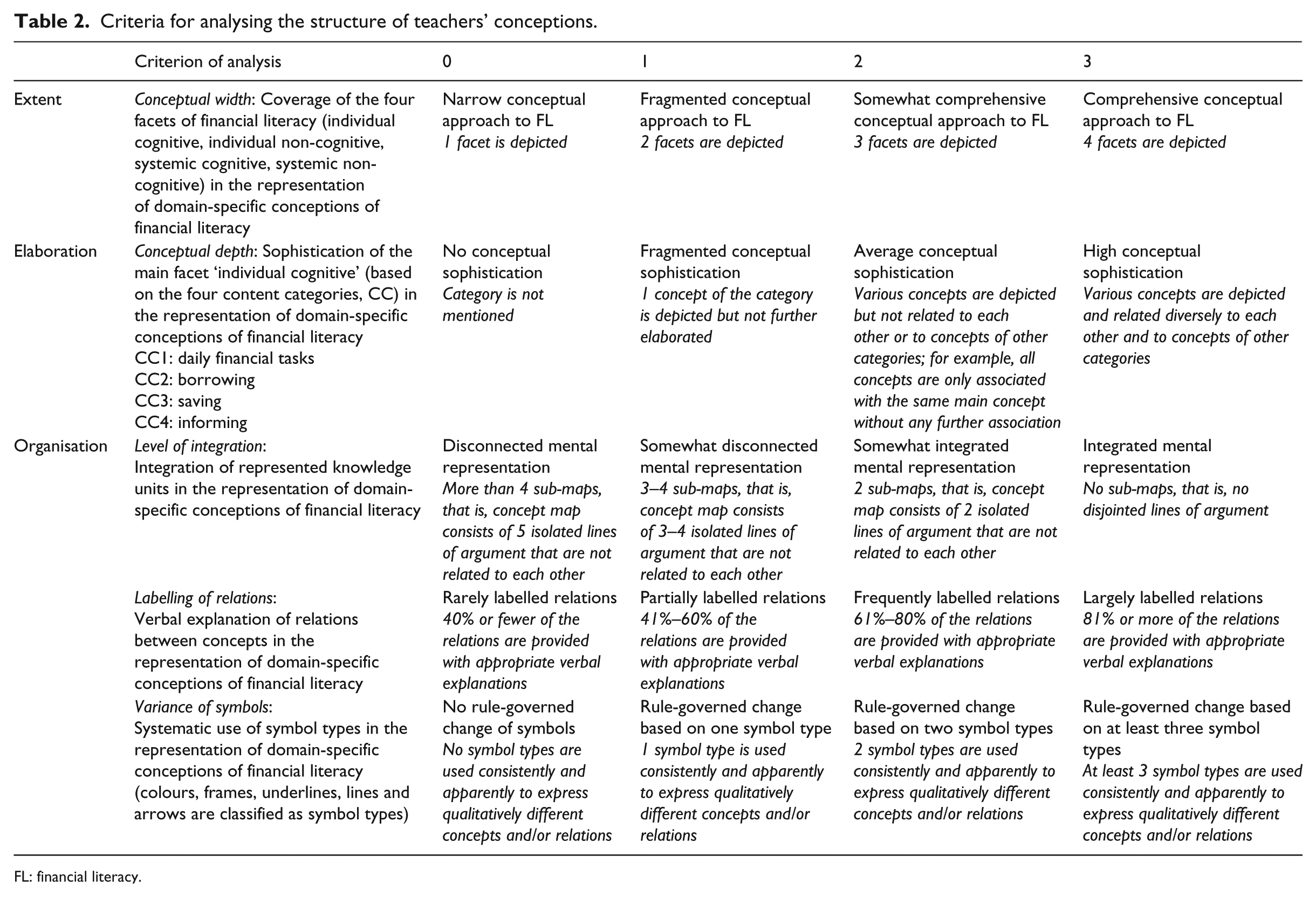
FL: financial literacy.
The first criterion, ‘extent’, describes the coverage of the four facets of financial literacy in the represented content-related conceptions; the conceptual approach to financial literacy is described as narrow (one depicted facet), somewhat narrow (two depicted facets), somewhat comprehensive (three depicted facets) or comprehensive (four depicted facets). The second criterion, ‘elaboration’, refers to the conceptual depth of the represented content-related conceptions of financial literacy, ranging from no to high conceptual sophistication. The criterion considers whether the respective content is represented diversely (various concepts and relations) or not at all (no concept). The individual cognitive facet is taken into account since it represents the most common facet of financial literacy and thus constitutes the core of the concept. The third criterion, ‘level of integration’, provides evidence of the degree of integration of the represented content-related conceptions. It ranges from disconnected (with more than four isolated sub-maps) to integrated (with no isolated sub-maps) content-related conceptions. The fourth criterion, ‘labelling of relations’, describes the appropriate domain-specific verbal explanation of the relations between the concepts in the representation of the conceptions of financial literacy and ranges from rarely labelled relations (40% or fewer relations with appropriate verbal explanations) to largely labelled relations (81% or more of relations with appropriate verbal explanations). The fifth criterion, ‘variance of symbols’, is an indicator of the systematic use of symbol types in the represented conceptions to express qualitatively different concepts and/or relations. It is distinguished by no rule-governed change of symbols or rule-governed change based on one, two or three or more symbol types.
Results
Content-related conceptions of financial literacy
The following shows the content-related domain-specific conceptions of financial literacy generated by the 16 teachers in their individual concept maps (for a detailed overview with examples amounts and shares, see Table 3).
Content-related conceptions of financial literacy (FL) based on concept maps.
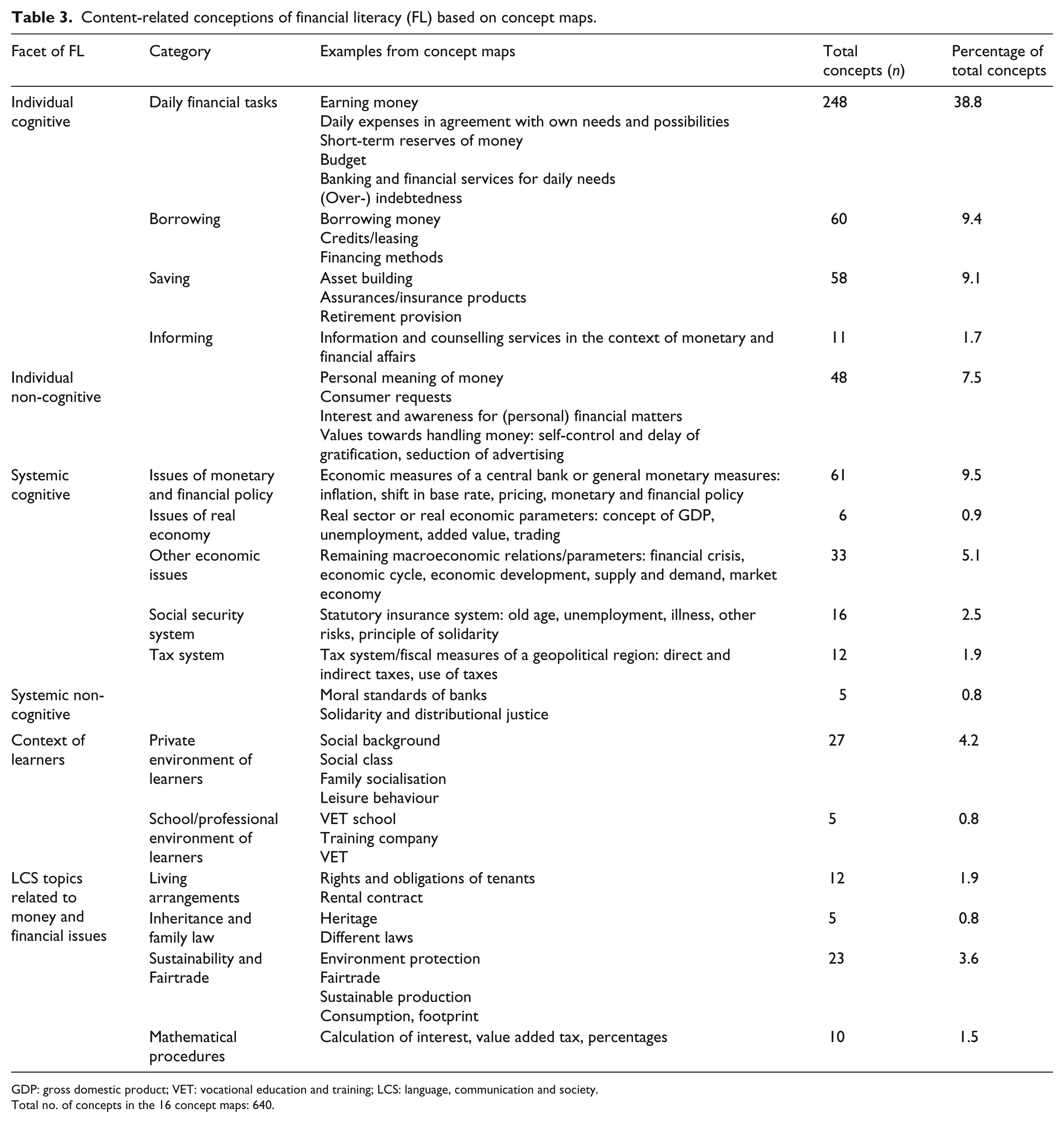
GDP: gross domestic product; VET: vocational education and training; LCS: language, communication and society.
Total no. of concepts in the 16 concept maps: 640.
The content analysis shows that more than half of all the 640 concepts teachers integrated into their maps can be assigned to the individual cognitive facet of financial literacy. Specifically, concepts concerning budgeting, daily consumption decisions, consumption behaviour, daily payments with cards or cash and the related risks of indebtedness are of central importance in their content-related conceptions of financial literacy. These concepts constitute more than one-third of all concepts included in the concept maps and can be summarised under the category ‘daily financial tasks’. Furthermore, teachers’ conceptions of financial literacy include concepts about borrowing money, weighting up the advantages and disadvantages of different financing methods and the changing interests involved. Nearly one-tenth of the reported concepts are subsumed under the respective category ‘borrowing’. Another tenth of the concepts are categorised as ‘saving’. This concerns those content-related conceptions that refer to medium-term financial reserves and the related choice of an appropriate form of capital investment. A small proportion of teachers’ conceptions concern concepts related to requesting information, advice or assistance about financial issues.
Of the total of 640 included concepts, 7.5% are associated with the individual non-cognitive facet of financial literacy. Herein, mainly content-related conceptions are identified, which concern the personal meaning of money, norms and values towards handling money and the effects of advertising on individual consumption behaviour.
Another 19.9% of the concepts refer to the systemic cognitive facet of financial literacy. The conceptions mentioned herein are grouped into the categories ‘issues of monetary and financial policy’, ‘issues of real economy’, ‘other economic issues’, ‘social security system’ and ‘tax system’. Thereby, nearly half of the respective concepts can be assigned to first category, including issues related to money policy, pricing and differences between the tasks of commercial and national banks.
With the allocation of 0.8% of the concepts, the systemic non-cognitive facet plays a marginal role with issues related to the moral standards of banks, the code of conduct of banks and companies and distributional justice in modern economies.
The teachers’ content-related conceptions of financial literacy go beyond the narrow focus on the concept of financial literacy and additionally take into account the context of the learners and the thematic context of LCS in VET schools. Both contexts are directly related to financial literacy and together comprise 12.8% of the concepts integrated in the 16 individual concept maps. The context of the learners can be further differentiated into ‘private environment of the learners’, consisting of concepts such as social background, family socialisation and leisure behaviour as well as ‘school and professional environment of the learners’. Regarding LCS topics related to money and financial issues, concepts referring to ‘Sustainability and Fairtrade’ (e.g. sustainable production and consumption, environment protection), ‘living arrangements’ (e.g. rights and obligations of tenants), ‘mathematical procedures’ (e.g. calculation of interest, value added tax, percentages) and ‘inheritance and family law’ were integrated by the participating teachers in the concept maps.
Most significant content-related conceptions of financial literacy
Based on the construction of a reference structure in the form of a modal network, the following illustrates the most significant propositions and concepts of the 16 teachers.
The modal network consists of 36 propositions with 32 concepts (see Figure 1). Each of these propositions is mentioned by at least 4 and at most 9 of the 16 teachers.
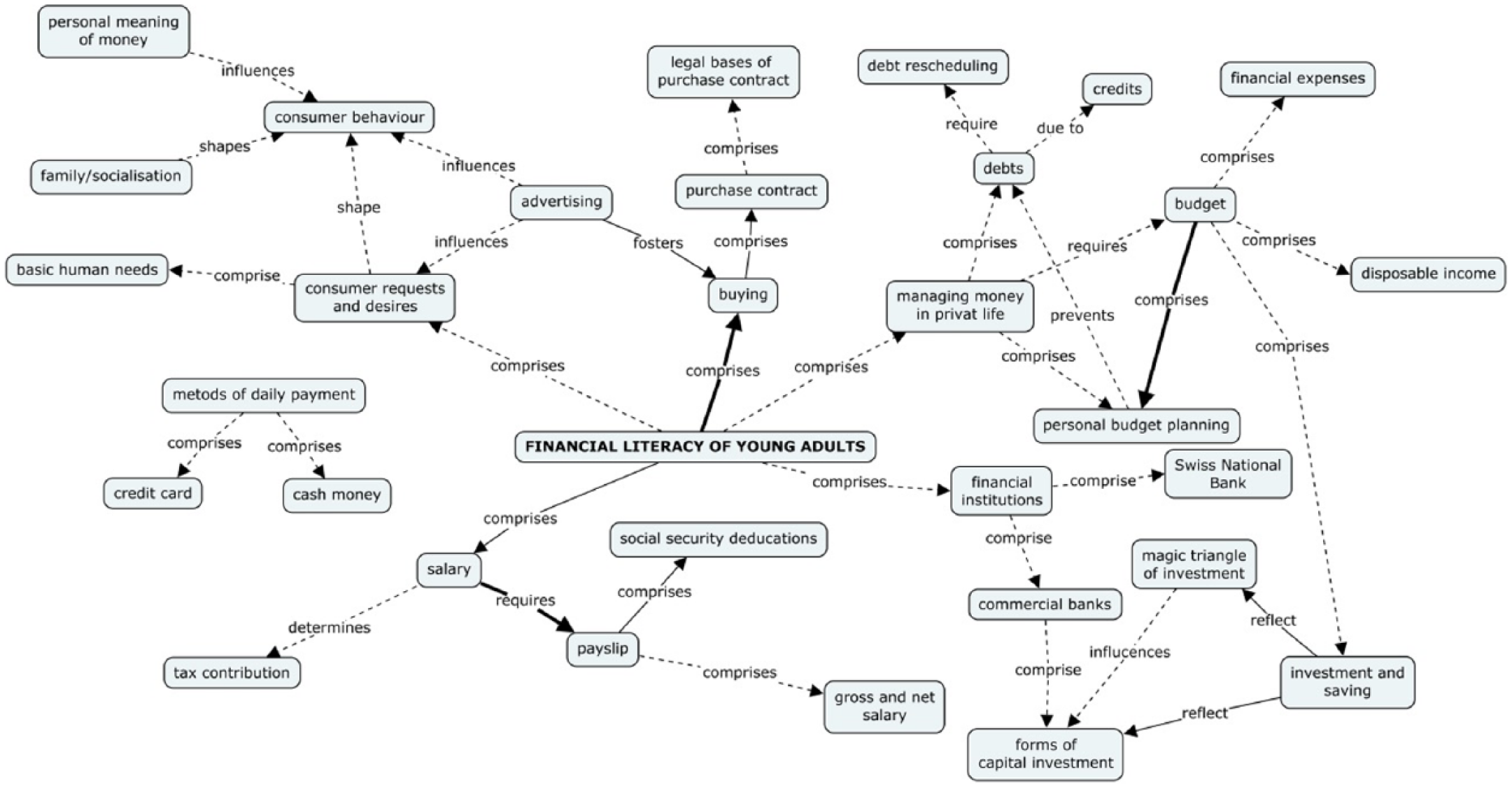
Modal network of content-related conceptions of financial literacy.
Regarding the content of the modal network, the majority of the teachers have integrated diverse components of financial literacy into their content-related conceptions. Four main strands can be identified in the modal network, which are mainly related to aspects of personal finance management: (1) managing money in private life and related aspects of budgeting and indebtedness; (2) buying and consuming behaviour and influences thereon of family, advertising and consumer requests and desires; (3) aspects concerning salary and the link with statutory taxes; and (4) financial institutions and, on that basis, questions about investing and saving money. However, looking at the constructed modal network, a methodological problem becomes apparent. Since the modal network is mathematically generated and constructed in this specific way by each of the 16 teachers, two propositions that are related but otherwise disconnected with the rest of the network emerge (methods of daily payment comprise credit card; methods of daily payment comprise cash money). These propositions can be found in this form in any of the 16 individual concept maps.
The average representational strength is 21.5% at the proposition level. This means that the modal network covers slightly more than one-fifth of the total number of propositions listed by the teachers and indicates that the individual concept maps are heterogeneous. However, the representational strength varies to a relatively large degree depending on the individual concept map, with values between 2% (one corresponding proposition) and 36% (13 identical propositions). In contrast, regarding the level of concepts, the average representational strength is considerably higher (61.3%). The same applies to the respective representational strength with regard to the individual concept maps, ranging from 40% to 81%. This leads to the conclusion that the primarily mentioned content-related conceptions of the financial literacy of the investigated teachers are based on similar concepts, but these concepts are interconnected differently. Therefore, the shared content-related conceptions of financial literacy are limited.
Structural representation of content-related conceptions of financial literacy
The following describes how the content-related domain-specific conceptions of financial literacy are structurally represented in the concept maps generated by the teachers.
Table 4 illustrates that the distribution of the 16 concept maps in the range of 0–3 points differs depending on the criterion of analysis.
Structure of content-related conceptions of financial literacy based on the concept maps.
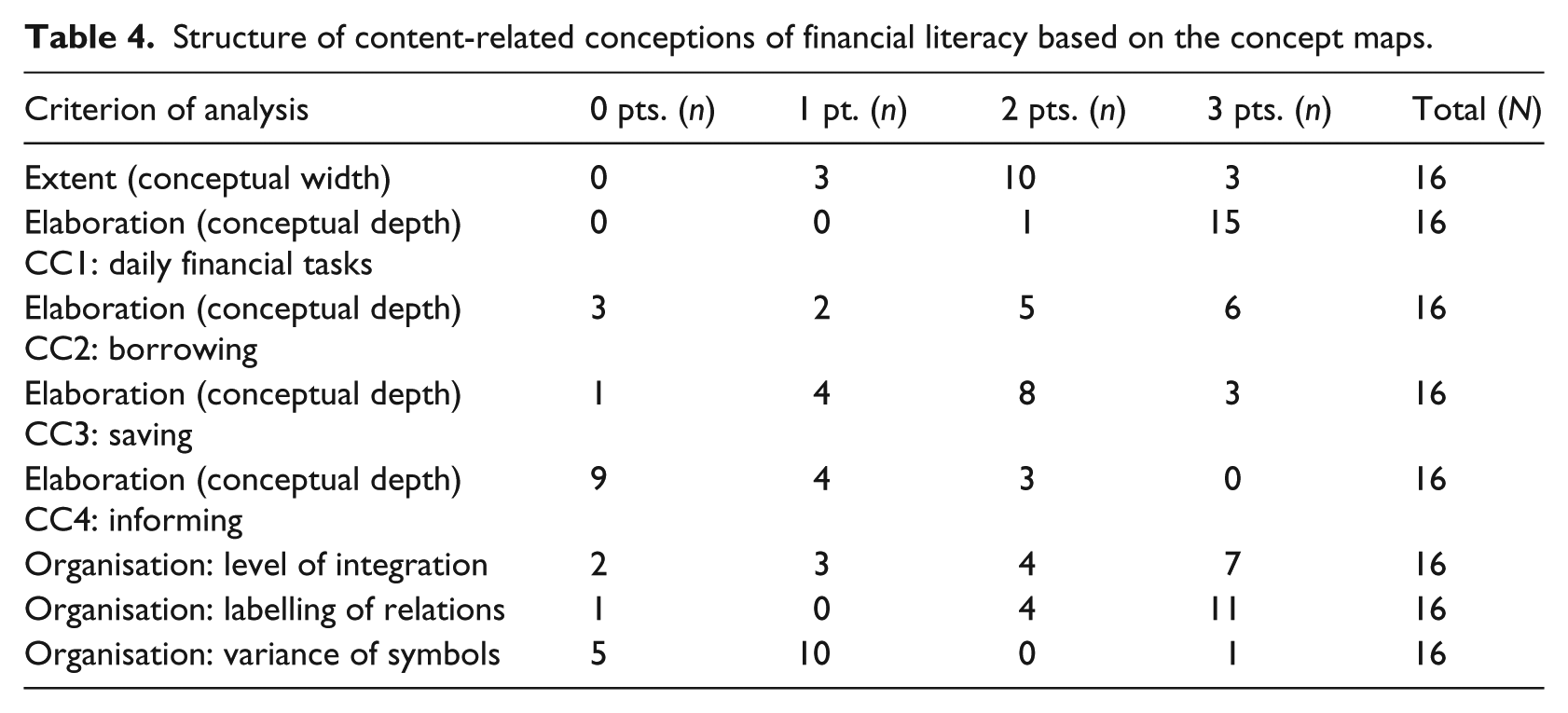
Concerning the criterion ‘extent’ of the mapped conceptions, it is shown that more than half of the teachers (10 out of 16) represent three of the four facets in their individual concept map. They therefore adopt a somewhat comprehensive conceptual approach to financial literacy. It is significant that without exception, those teachers ignore the systemic non-cognitive facet. Three out of 16 teachers possess a comprehensive conceptual approach to financial literacy since they depict concepts of all four facets in their graphical representation. Three other teachers invariably show cognitive concepts in their concept map and have a fragmented conceptual approach to financial literacy because they do not take into account the two non-cognitive facets. None of the 16 teachers confines himself or herself to only one facet of financial literacy.
The criterion ‘elaboration’ is determined for the four content categories of the main facet ‘individual cognitive’. The content category ‘daily financial tasks’ is displayed by all teachers except one with high conceptual sophistication. In the individual concept maps, diverse concepts of this category are not only mentioned but also related versatilely with each other and with concepts of other content categories. Although 1 teacher mentions different concepts in the category, he does not put them in a broader context. Specifically, in concept map 9, the concept ‘money’ is connected with ‘salary’, ‘filling in tax return’, ‘budget’ and ‘debt trap’ via the verbal label ‘contains’. However, these concepts are not further related. The second content category, ‘borrowing’, is represented by 6 out of 16 teachers with high conceptual sophistication, reflected by diverse concepts and numerous relations. In concept map 7, for example, different financing methods, the judging of advances and disadvantages of the various methods and legal bases are depicted and associated with the seduction of advertising, consumer requests and concepts related to debt. Another 5 teachers map the category with an average conceptual sophistication by reproducing various concepts but not relating them versatilely with each other or with concepts of other content categories. Two teachers mention just one concept of the category ‘borrowing’ that is not further elaborated. For example, in the case of concept map 5, the concept ‘leasing’ is cited in connection with car purchases. Consequently, the 2 teachers display a fragmented conceptual sophistication with respect to the category ‘borrowing’. Finally, 3 teachers do not integrate any ‘borrowing’-concept in their concept map. The third content category, ‘saving’, is represented by 8 out of 16 teachers with an average and by 3 teachers with a high conceptual sophistication. An example of high conceptual sophistication is provided by concept map 1. Concepts in the context of saving are depicted at two different places on the map. First, connected to budget, it shows that the constitution of financial reserves and, consequently, investment and saving should be a part of personal budgeting. Second, different forms of capital investment and the magic triangle of investment, consisting of ‘profitability’, ‘security’ and ‘liquidity’, are mapped, associated with commercial banks. Four out of 16 teachers represent the content category ‘saving’ in a fragmented way, each mentioning only one isolated concept that is not further elaborated. One teacher mentions no concept of this content category. Regarding the fourth content category, 9 out of 16 teachers do not integrate any ‘informing’-concept in their concept map. Four teachers each depict one concept of the category, representing a fragmented conceptual sophistication, and 3 other teachers mention various concepts but do not relate them with each other or with other concepts. The latter manifests, for example, in concept map 3: debt and budget counselling services as sources of information and the educational programmes provided by the Swiss National Bank to explain the societal role of money are mentioned, but these notions are not further differentiated or connected. Consequently, these teachers display an average conceptual sophistication. Finally, none of the 16 teachers display the category ‘informing’ with a high conceptual depth. In summary, all 16 teachers represent the content category ‘daily financial tasks’ with an average or high conceptual depth in their concept map. In the categories ‘borrowing’ and ‘saving’, this is the case for approximately two-thirds of the teachers; in the category ‘informing’, for one-fifth.
The analysis of the criterion ‘level of integration’ shows that 7 out of 16 teachers have a structurally integrated concept map. This implies that the depicted conceptions are represented cohesively without exception and that there are no sub-maps with at least one relation. The structure of the concept map of 4 teachers can be described as somewhat integrated. This means that the concept maps of these teachers consist of two isolated lines of arguments that are not related to each other. An example of this is concept map 4. This teacher distinguishes, in the first step, between ‘managing money in personal life’ and ‘managing money in professional life’ and constructs a diverse network of propositions for each. Despite thematic and content-related similarities, these two sub-maps are not related with each other. Three out of 16 teachers represent in their concept maps a somewhat incoherent activated mental knowledge structure, with three or four isolated lines of argument that are not related to each other. In the case of concept map 2, this implies that around the concepts ‘salary’ and ‘budget’, two isolated lines of argument are constructed that are not associated with the rest of the very comprehensive and diversely related map. In the case of 2 teachers, the activated mental knowledge structure is incoherently represented and therefore jagged. Their concept maps consist of at least five isolated lines of argument. Concept map 9 serves as an example. The teacher starts her concept map with concepts of financial literacy that she considers key components. Based on the concepts ‘money’, ‘flow of cash and goods’, ‘insurance products’, ‘buying’ and ‘financial institutions’, she then develops five independent sub-maps.
Regarding the criterion ‘labelling of relations’, 11 out of 16 teachers provide 81% or more of the relations with accurate verbal explanations. Another four teachers label 61%–80% of the relations accurately, and one teacher inscribes the relations between the concepts rarely (fewer than 40%). Generally, it is striking that for most of the cases assessed as ‘wrong’, the reason is not an inappropriate label but a missing verbal explanation of the relation.
The analysis of the ‘variance of symbols’ criterion shows that in the concept maps of 10 teachers, a rule-governed change to express qualitatively different concepts and relations is consistently and apparently visible by means of one symbol type. This is a thick frame of the central concepts (e.g. concept maps 3 and 6), the colour coding of the key relations (e.g. concept map 7) or dashed arrows expressing indirect correlations (e.g. concept map 12). Five teachers use no symbol type to express qualitative differences in their concept maps. In contrast, 1 teacher uses three different symbol types. Thus, in concept map 1, the central concepts (coloured frame) and relations (coloured relation) and additional LCS topics related to financial literacy (dashed frame) are highlighted consistently and apparently.
Discussion
The aim of this study was to demonstrate how concept maps can be used as a methodological instrument of the collection and analysis of data in order to gain information about the content-related domain-specific conceptions among teachers, including also structural aspects. Therefore, three leading questions were raised for the analysis of the concept maps.
The results presented on content-related domain-specific conceptions of financial literacy (question 1) indicated that the 16 teachers depicted contents of all four facets of financial literacy in their individual concept maps. However, topics related to daily financial tasks were obviously the focus and could therefore be referred to as key components of financial literacy for the investigated group. On one hand, this result is consistent with the findings of the reported quantitative questionnaire study among 172 LCS teachers in Switzerland (Leumann and Aprea, 2016): daily financial tasks were considered as especially relevant for financial education classes in VET schools by the teachers. Whereas ‘budgeting’, ‘income and salary’, ‘consumer behaviour’ and ‘debts’ were the topics rated as most important, topics related to the financial market, the role of the state in the economy or basic economic or fiscal terms and concepts were considered to be of minor importance. On the other hand, this result corresponds to the fact that the individual perspective of personal finance management is the most widespread in existing approaches of financial literacy. However, in consideration of the main aim of LCS education (see the ‘Introduction’ section), it is important also to take into account topics of the systemic financial context to prepare VET students for their life in society. The comparison of the individual concept maps with the reference structure in the form of the modal network illustrated that even though teachers’ content-related domain-specific conceptions of financial literacy were based on similar concepts, these concepts were differently linked to various propositions. Consequently, the individual concept maps were relatively heterogeneous, which was expressed in the average representational strength of 21.5%. This may reflect the fact that the teachers have different academic and professional backgrounds and therefore show different affinities with respect to financial and economic issues despite having the same actual training and work settings. Moreover, Kirchner (2016) noted in her study that the different educational background and extracurricular working experiences of the teachers investigated had an influence on the assessment of the relevance and the choice of topics for economic classes at school. Nevertheless, on the basis of the modal network, the following four main strands could be indicated as fundamental for the teachers investigated (question 2): (1) budgeting and indebtedness, (2) consumer behaviour and the influence of family, advertising and consumer requests, (3) salary and taxes and (4) financial institutions with the focus on asset building.
The presented argumentation of cognitive psychology in the ‘Cognitive Psychology Approach to Teachers’ Conceptions’ section referred to the fact that being knowledgeable in a specific domain implies having a highly integrative structure of knowledge. The structural analysis of the concept maps (question 3) presented mixed results concerning the structure of the teachers’ content-related conceptions. With regard to the extent and thus the coverage of the four facets of financial literacy, the systemic non-cognitive facet was mostly missing. The elaboration of the maps was assessed differently depending on the four main categories of the individual cognitive facet. Whereas the category ‘daily financial tasks’ was conceptually depicted as highly differentiated, ‘borrowing’ and ‘saving’ were mainly represented with an average conceptual sophistication and ‘informing’ in an undifferentiated way. With regard to organisation, the findings illustrated that the majority of the maps were portrayed as somewhat integrated, the relations between the concepts were mainly labelled with accurate verbal explanations, and few to no symbol types were used to express qualitatively different concepts and/or relations.
However, the results about the structural features have to be interpreted carefully in at least two respects. Although a theoretical introduction of the characteristics of concept maps and a short training were carried out before the individual concept maps on financial literacy were designed, the method of concept mapping was new for some of the teachers. This could be a reason why some criteria – such as the variance of symbols – were not a primary focus of the teachers when designing their maps. They might have needed further training and experiences related to concept maps in order to take all criteria into account in the same way. Additionally, the data collection has to be considered a snapshot at the beginning of their in-service training. It would be interesting to present the teachers with the same task in regular time intervals and to investigate (individual) development. Besides the analysis of the development it would also be worthwhile to investigate where these conceptions come from.
Despite these limitations, it can be summarised that concept maps seem to be a valuable and targeted instrument in order to analyse the deep structure of the mental representation of teachers’ conceptions and have therefore a great potential as research method. In this study, it is shown that concept maps provide substantial information not only about the content (questions 1 and 2) but also about structural aspects of conceptions (question 3). Unlike interviews or written questionnaires, which are commonly used for the investigation of conceptions, concept maps allow analysing the deep structure of conceptions. Thus, they offer a unique approach to the mental representation of conceptions by providing additional information about the extent, the elaboration, the interconnectedness or the organisation of these conceptions. This underpins statements of cognitive psychologists, according to which concept maps are a reliable tool for investigating conceptions because their format corresponds to the mental representation of knowledge in the form of semantic networks (Collins and Quillian, 1969; Ruiz-Primo and Shavelson, 1996).
Conclusion
On one hand, the developed and approved instruments for the analysis of the content (adapted financial literacy category scheme and creation of modal network) and the structure (set of structural criteria) of teachers’ content-related domain-specific conceptions of financial literacy can be used for further research on (LCS) teachers’ conceptions of financial literacy. It may be interesting to extend the same study to a larger, representative sample of LCS teachers in Switzerland in order to be able to draw generalisable conclusions on the population of LCS teachers. Nevertheless, some aspects should be considered: first, it must be ensured that the teachers are familiar with the method of concept maps. Second, data collection should be carried out computer-based (e.g. with the free and easily manageable software CMapTools) in order to facilitate further analysis. Third, the use of additional, more normative structural criteria such as the accuracy of the concepts or the consideration of pre-defined key concepts has to be examined.
On the other hand, concept maps provide a wide range of applications for the assessment of mental representations in teacher education – in this specific case, in LCS teacher education. First, concept maps are an advantageous tool for the diagnosis of structured individual prior knowledge. Because of the definition of main concepts and the integration of these concepts in a structured overall picture, differentiated cognitive requirements are involved. The concept maps illustrate, which subject content and relations are already present and where, for example, technical terms and connections are still lacking. Constructing a concept map requires active and creative work in a specific subject area. Second, concept maps can be applied in creative learning arrangements to promote cross-linked and well-structured knowledge among student teachers. In the specific case of LCS teacher education, it would be interesting, for example, if the different educational and professional backgrounds of student teachers were used to create heterogeneous working groups, where they discuss on a topic such as financial literacy and create a joint concept map as the main outcome. In the current study, the correspondence between the individual concept maps and the modal network was low at the level of propositions; this represents great potential. Through this interpretation, concept mapping serves as an instrument for the creation of learning effects. Additionally, such cooperative approaches promote communication skills. Finally, concept maps offer an individual working tool for student teachers to elaborate a specific topic throughout teacher education and to supplement their map repeatedly with new facets and perspectives according to a spiral curriculum. Used in this way, concept maps inspire reflection on their own knowledge and conceptions and thus allow them to control their own learning progress. For the present case, this could mean, for example, that student teachers rethink their current concept maps after further training modules on financial and economic issues and try to integrate the new aspects in the existing structure.
Footnotes
Acknowledgements
The author wishes to warmly thank to her PhD supervisor Prof. Dr. Carmela Aprea for her support and helpful comments.
Declaration of Conflicting Interests
The author(s) declared no potential conflicts of interest with respect to the research, authorship, and/or publication of this article.
Funding
The author(s) received no financial support for the research, authorship and/or publication of this article.