




Abstract
The goal of this article is to examine the way character education and multicultural values’ education can contribute to a perfect and transformed Indonesia by 2045. At this time (i.e. 2045), the Republic of Indonesia will be 100 years old. The presence of an ideal Indonesian will contribute to high national growth and development. This will depend on the understanding of multiculturalism and cooperative attitudes of the future Indonesian citizens. In such a situation, a variety of methods, media and instruments need to be prepared in order to achieve the country’s 2045 dream, among the various aspects which must be considered is character and multicultural values’ education. Both forms of education should not be limited to mere conceptualisation, but should lead to an understanding of personality traits in an Indonesian context and of course taking in consideration the globalisation aspect. Early research on contemporary and future Indonesia generates a clear overview of the Indonesian traits. Based on this, the present study investigates two groups comprising 100 respondents, divided into pessimistic and optimistic respondents. The pessimistic respondents are of the view that a competitive Indonesia will depend on today’s generation and their character. While, on the contrary, the optimistic respondents indicate that a competitive Indonesia is that which will be able to compete with other nations in this rapidly changing world. However, it is concluded that both groups are optimistic to the new birth of a great Indonesia, if good character and well-planned multicultural education is in place and of course well taught to students.
Introduction
Various events occurring in Indonesia recently have raised concerns of disintegration among Indonesians. These events are street brawls, interreligious fights, interethnic fights and actions of terror, drug abuses, killings, robberies, corruption and other perturbing cases. Obviously, this range of events should not be ignored because they might have a bad impact on the nation. They might result in a crisis of trust in the social system and distrust in the government.
It is widely acknowledged that Indonesians have a multiplicity of different backgrounds. Indonesia is a country with many social differences because in this country, there is a multiplicity of different ethnic groups, languages, traditions, religions and faiths, in addition to sharply different socio-economic backgrounds.
Sharp background differences have the potential to spark both social and interpersonal conflicts that will further develop into more latent and overt complicated conflicts. These complications might lead to what is termed ‘social entropy’. Social and cultural divergences have the potential to generate conflicts which might lead to separatist movements. Consequently, the national integration is at stake. Other countries will have distrust in Indonesia.
Some scholars view that conflicts have negative, positive and neutral senses. In this study, however, conflicts are considered to be negative because they are related to violence and destruction. The traditionalists view ‘conflict’ as negative, counterproductive and destructive so that their appearances are to be repressed, but the behaviourists view conflicts as essentially the nature of man living in a social world. Their definition limits the concept of conflict to the extent that it is only something neutral and not harmful. The interactionists, however, view that conflicts are useful for bringing about important changes in life. Conflicts are essential for human beings (Malihah, 2011, Opini Pikiran Rakyat).
The emergence of a range of violent actions in Indonesia constitutes the basis of my discussion about the meaning of conflict that applies in this country, particularly when we refer to various violent actions as reported in the media ranging from separatists, communal violence and religious conflicts. However, such conflicts have continued to drop in count; for instance, according to Geneva Academy of International Humanitarian Law and Human Rights (ADH) (2015), there were no conflicts in 2007, even though religious and rebel movements continued to exist in some areas of Indonesia. In Aceh, for example, there has been an implementation of the 2005 Memorandum of Understanding, while in Papua region, the separatist movement has reduced number of attacks, and in Maluku Islands, there were no reports of conflict-related casualties during 2006 (Geneva Academy of International Humanitarian Law and Human Rights ‘ADH’, 2015). With the current democratic process, violence and conflicts are expected to diminish from the archipelago. Marshall and Cole (2014) categorise conflicts in types as either episodes of international, civil, ethnic, communal and genocidal violence and warfare. To understand the situation, this study involved 100 students as subjects who facilitate the identification of the characteristics of an ideal Indonesian for the Golden period of 2045.
Research method
This study uses a qualitative method, namely, phenomenology, a research method which aims to describe situations. In this regard, this study attempts to describe the characteristics of the ideal Indonesian man as expected by Indonesian people. Nonetheless, for the sake of convenient data presentations, the distribution of the respondents’ answers was quantified in terms of percentages, and these trends were discussed in more details qualitatively. As for the data collection method, this study uses open-ended questionnaires for 100 students at Universitas Pendidikan Indonesia.
Findings and discussion
This study attempts to answer three questions about (1) a description of a contemporary Indonesian, (2) a description of an ideal Indonesian for the projected golden period of 2045 and (3) steps required to materialise the creation of an ideal Indonesian by those optimistic of positive change.
A description of contemporary Indonesians
This study reveals that most students depict current Indonesian people negatively as indicated in Table 1.
Students’ perception of a contemporary Indonesians.
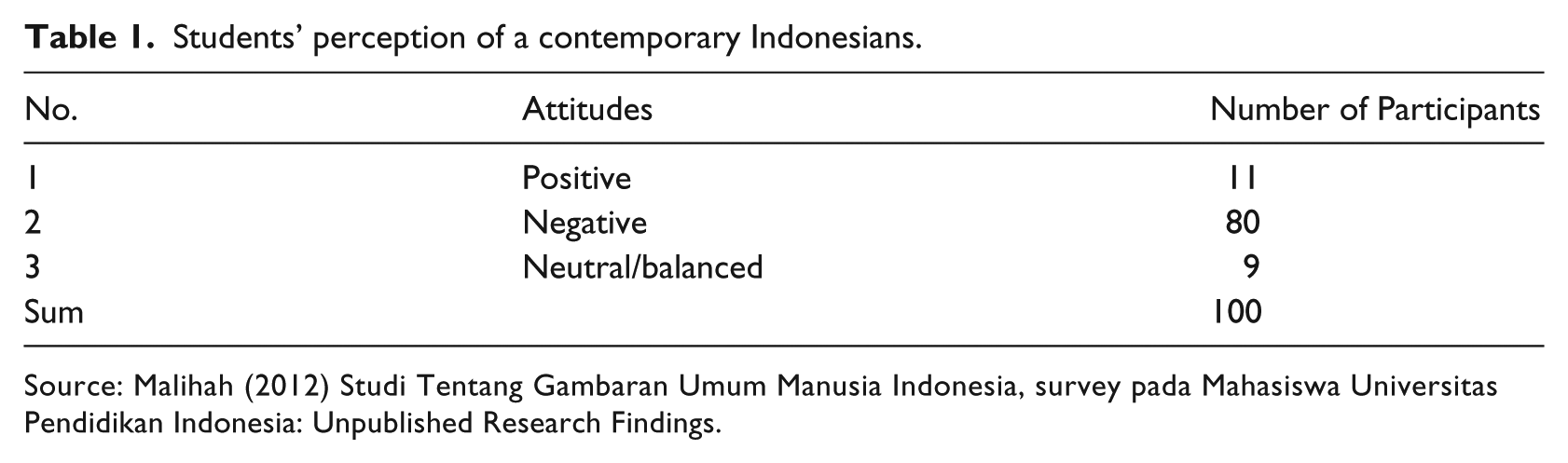
Source: Malihah (2012) Studi Tentang Gambaran Umum Manusia Indonesia, survey pada Mahasiswa Universitas Pendidikan Indonesia: Unpublished Research Findings.
Indonesia just like other Asian countries has continuously blamed history, for instance, when Japan and Netherlands are compared, it is concluded that Japanese are more of brothers than the Netherlands which occupied Indonesia for a period of over 300 years plus. Indonesia is faced with several challenges ranging from the negative perceptions of the citizens to poverty and other development challenges. Among the negative things Indonesia faces today are corruption, consumerism behaviour, widespread Westernisation of the people’s life style, abandoning own culture, poor time managers, poorly developed human resources and over dependence on other countries, easily influenced behaviour and moral crisis, eroded self-identity and lack of nationalism among others. The following is a piece of information from the respondent as a sample of the responses reflecting the people’s negative and positive views and or perceptions.
One of the respondents appears negative in the description of today’s Indonesia. She says, Today’s Indonesian tends to be egoist or individualistic. Most of us, Indonesians today, seek for personal satisfaction and seem not to care about others. This has led to widespread crime, corruption, poverty, and unemployment which have become the government’s unsolved challenges we face today. The present Indonesian is also too consumptive, making the country highly dependent on other countries. Hedonistic behaviors have also become one of the cultural elements among most of us. If this goes unchecked, Indonesia will find it hard to be a developed country; because, no matter how many development projects are implemented, it will be a waste of time due to the people’s degraded morals.
In contrast, some respondents had positive views about Indonesians, describing them as technologically literate, open-minded, willing to change, self-acceptance, highly literate, independent, able to adapt too and ready to face the challenges of globalisation, have the freedom expression, are of good quality, are optimistic, are self-confident and they love domestic products (in other words, they support national growth and development). In specific, the following response shows a positive description of an ideal Indonesian: At present, a perfect Indonesian does wish for a better change. Is not confused of what can be better change. Thus, they ask right questions on ‘how to bring about such change?’ This means there is chance for potential Indonesians to lead a better change or bring about positive development to country. This is evident in various new inventions made by Indonesian people or people of Indonesian origin. Such inventions are a proof that there intelligent Indonesians. The strength of Indonesia today, is its population which, if well nurtured and properly managed, can lead to national growth and development.
This implies that not all Indonesians are individualistic and that not all seek for personal satisfaction but there are those concerned of other people’s condition. Some of the respondents neither responded negatively nor positively, but they decided to take a neutral stand, and among the responses depicting neutral views about an ideal Indonesian is the following: Nowadays, globalization affects the whole world; including Indonesia. Great revolutions are happening in all aspects of life; telecommunication, technology, transportation, economy, etcetera. These revolutions result in the cultural changes people face today. People who used to work conventionally in every field now use modern and sophisticated tools and equipments. Each of us today than before is required to be a cosmopolitan (a person who is a citizen of the world). There are many positive and negative effects of such revolutions; ranging from conflicts to consumptive behaviors (spending money unwisely).
Depending on the above descriptions of an ideal Indonesian, I classify their characteristics into several traits which include the following:
Self-centred, lacking collectiveness (egotistical and indifferent);
Lacking patience and trust in god;
Lacking social and religious values (justifying all means);
Lacking nationalism;
Lacking self-appreciation (tending to love foreign products);
Lacking tenacity in pursuing self-development;
Lacking self-confidence (easily provoked);
Inconsistent (tending to be hypocritical).
A description of negative Indonesian characteristics has, in fact, been stated by Mochtar Lubis (1978), namely, hypocritical, unwilling to assume responsibility, feudalistic, superstitious, artistic, meek, wasteful, not hardworking, impatient, envious and full of hatred, imitator, cruel, impulsive, tending to run amuck, tending to kill, burn, betray, oppress, blackmail, deceive, steal, corrupt and be insensible.
It appears that the negative traits of Indonesian people put forward by Mochtar Lubis (1978) were also found in the respondents’ answers (2012). The existence of these common traits implies that Lubis’ opinion is still relevant today in the sense that it is still useful to describe the negative traits of current Indonesian people. Lubis’ (1978) opinion raised many questions and even criticisms. However, if people had not debated the negative traits and if they had attempted to discover the solutions of how to reduce the negative traits, today we would have got the solutions and we would have been able to overcome current social problems involving people who tend to be anarchistic.
A description of expectations for the ideal traits of gold Indonesian people (2045)
This study shows the traits of gold Indonesian people of 2045 as follows: Table 2 indicates that 76% of the respondents expressed optimistic traits about Indonesian people for 2045, although they observe that current Indonesians tend to exhibit negative traits. However, the respondents predicted that Indonesian babies born in 2045 will have positive traits. This prediction suggests that it is important for Indonesians to keep positive traits; at least people should be willing to change starting with themselves. If this is the case, the respondents whose ages currently range from 17 to 19 years will turn to be 50–52 years old in 2045; in other words, they will be at productive ages. Thus, at this time, they are expected to be able to respond to challenges and to prove that the Indonesian people being described will not be valid once they are in 2045 when they probably hold important positions in the government or companies. Meanwhile, along the way, they will be parents who have to guide their children.
A description of gold Indonesia people (2045).
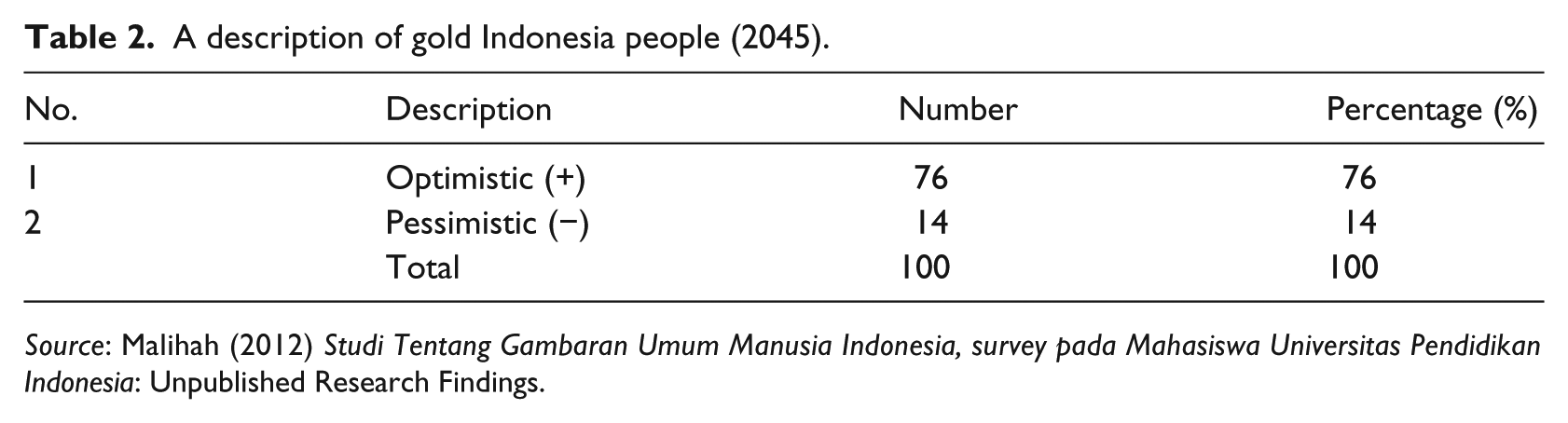
Source: Malihah (2012) Studi Tentang Gambaran Umum Manusia Indonesia, survey pada Mahasiswa Universitas Pendidikan Indonesia: Unpublished Research Findings.
The following notes present a sample response about optimistic characteristics of Indonesian people in the future: Higher level of nationalism, higher technology literacy; not merely using technology but also changing technology, Social relationship and interaction become an important and primary thing, People change into environment-loving and environment-caring individuals, and Corruption-free society, moral degradation of young generations has diminished.
Meanwhile, the following response indicates apparently negative characteristics of Indonesian people as follows: Considering the characters of people nowadays, the situation is unlikely to change. Indonesian will still be individualists who do not care about environment, do not care about national intelligence, and even more dependent on technology. It is even said that in 2045, technological advancement will far surpass human intelligence. Many people predict that human will be superior being in 2045. In actuality, Indonesian has a wish or expectation to be a developed country (a prominent nation) in 2045. This was stated by Susilo Bambang Yudhoyono, the President of Indonesia. This is a step towards hopes for the future Indonesian people.
This study indicates that on the one hand there have appeared perceptions of negative traits about current Indonesian people, but on the other hand, there have also appeared hopes for positive traits of future Indonesian people, namely, dignity, excellence, morality, faith, intelligence, nationalism, patriotism and global competence. In order to materialise those traits in Indonesian people, efforts need to be made, namely, Indonesian people have to take measures towards the expected character of Indonesian people. Thus, the expected Indonesian people are formulated as people with an Indonesian identity who possess excellent manners, intelligence, nationalism and are able to compete globally.
Such a view is in accordance with Emile Durkheim’s (1961) insight as quoted by Ratna Megawangi (2004: 15) from Friedman Thomas (1999) as follows: Society must have before it an ideal toward which it reaches. It must have some good to achieve, an original contribution to bring to … mankind. When individual activity does not know where take hold, it turns against itself. When the moral forces of society remain unemployed, when they are not engaged in some work accomplish, when deviate from their moral sense and are used up in a morbid and harmful manner. (pp. 12–14)
The following response reveals a respondent’s answer on the measures that should be taken to materialise the expected traits of Indonesian people: It requires a leader that can truly be an example for the people, who is always optimistic in everything; no matter how hard they process may be, such a lead should be optimistic that can lead change. There should be value of the local efforts, not merely counting on the help other countries. Reshaping of the people’s moral is one way to prevent national disintegration.
In the process of realising such values, education should be considered a right channel that can nurture and instil religious values, moral values, nationalism and Indonesian cultural values transmitting the positive values of a multicultural society.
Education to overcome the crisis of morality
There are a number of educational fields that aim to nurture morality and personality. Among these fields that aim to develop personality in the core curricula in universities are Religious Education, Civics, Pancasila Education, Basic Social and Cultural Education, Science Education, Physical Education, Multicultural Education and Conflict Resolution Education. In addition to those courses, curriculum developers have designed what is called ‘character education’ which is integrated into all courses and all aspects of life.
It has been widely acknowledged that such courses as Personality Development and Living in the Social World along with Multicultural Education and Character Education constitute strategic steps into the formation of the gold generation. Nevertheless, what is more important is that those courses should not merely address the courses’ objectives in superficial ways. That is, the students are expected to be able to help themselves to become people with excellent characters, instead of only understanding definitions and concepts. The Ministry of Education has attempted to implement its character building strategies through socialisation, education, empowerment, familiarisation and cooperation.
The Ministry’s decision to adopt a far-reaching course of action that aims to prepare the Indonesian gold generation for 2045 is a significant step for accelerating the nation’s human resources development.
In fact, the theme proposed by the Ministry to commemorate the Education National Day is ‘The Awakening of the Indonesian Gold Generation’. This theme is actually in accordance with the Ministry’s plans to prepare for the Indonesian 100th Anniversary. This year, therefore, marks as a starting jump for the Gold Generation Period. There is a strong possibility for the jump to occur because within the period of 2010 and 2035, Indonesia has a demographic bonus where the number of its productive population is at the peak compared to that of children and old people (Muhammad Nuh, the Ministry of Education Bulletin, 2012: 3rd edition, III, July: 4).
Furthermore, the bulletin explains that the Government has prepared a grand design to make the most of the demographic bonus. The Government is nurturing children under 6 through the Early Age Education Program. Meanwhile, children who are between 6 and 15 years of age are provided with quality education. Finally, the Universal Middle Education has also been administered since 2013 so that children who are between 15 and 18 years of age attend the programme. After these students graduate from the programme, they can go to universities when they are 16–22 years old.
This demographic bonus will be a significant contributing factor for the national development if it is properly managed. However, if it is inappropriately managed, it will bring an adverse effect on the Government. In other words, it can lead to a huge burden on the economy. That is why, concerned ministries including that of education, health, and the bureau of statistics have worked hand in hand to manage population explosion. The government has designed measures to shape the young generation ‘youths in specific’ into future responsible citizens. According to Wirjawan (2009) the first phase of 20-years, Indonesia must ensure that one to two percent of the population gets the best tertiary education both locally and abroad so that they will become locomotives of the change. This should taking in consideration the demographic bonus as indicated below:
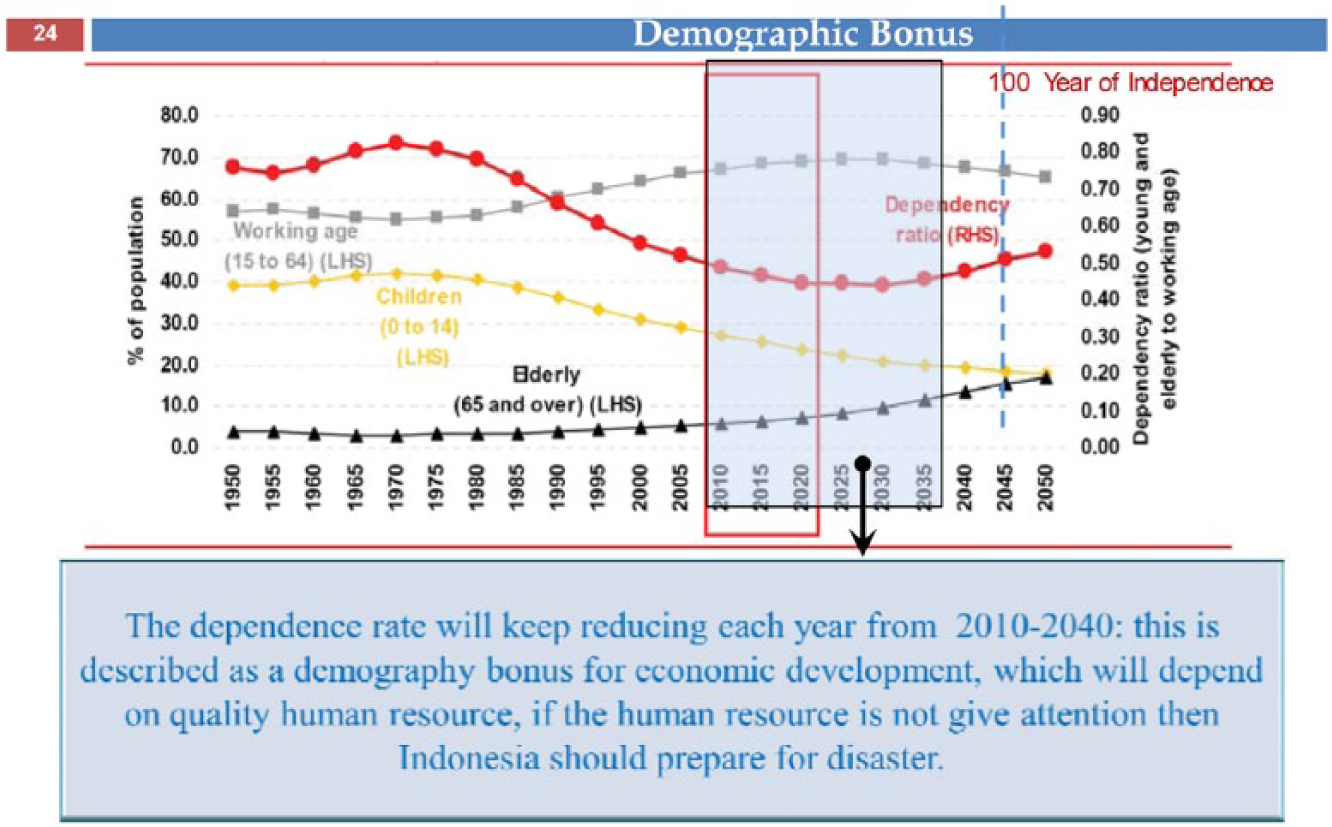
Human Resources.
Establishing a synergy of the multicultural society
In terms of the existing variety within the society, it is acknowledged that the local cultural values need to be nurtured along with the national and global cultures. This nurturing is intended to make people adopt a global perspective without abandoning their own ethnic and national identities. Multicultural education as course in university is expected to be able to respond to the challenges of a multicultural society and to encourage the students to be culturally aware individuals.
There are a number of ways to establish a positive synergy in a multicultural society in order to strengthen people’s national identity in facing global challenges as follows.
Diversity is the nature of a society; people have to be aware that there is no society without differences.
People need to be aware of sociability which refers to the capability of every individual in a society to keep balance between social rights and obligations in every action, so that they come up with activities for their common good. Their ability to work in such organisations embodies their collective intelligence that needs to be developed. The success or failure of economic and political development is determined by the people’s sociability (Wirutomo, 2001: 22).
Establish cross-cultural understanding and communication with an open dialogue: mutual understanding and communication is expected to reduce racial prejudices which often lead to culture shock and conflicts. Suradinata (2008: 27) mentions the urgent need for people to establish openness to develop people’s potential and strength. Openness is increasingly significant for pluralistic society, particularly to promote mutual understanding, respect and cooperation among different cultures.
Developing Positive Minds in a pluralistic society: In a pluralistic community, it is important to develop positive minds because with positive minds, people are able to reduce prejudices towards people from different cultures. In addition, by thinking positively, they are in a position to radiate positive energy that will motivate them to produce positive results. This is supported by Shepherd (2009) who says, ‘I choose to use a positive approach in doing things. I’d never think of myself as a protester, but rather as an eye witness for a harmonious life’ (p. 168). Those who make themselves eye witnesses will find a solution to every problem they face. On the other hand, those who will not will usually find it difficult to solve their problems, and such people will not get out of confusion and will keep blaming and condemning others. Naturally, a negative approach generates a destructive effect, whereas a positive approach yields good results. Thus, developing a golden generation of 2045 may be achieved by thinking optimistically and by avoiding negative thoughts.
Building Networks: Establishing relations and expanding networks among different cultures with the principle of mutual benefits and respects will reduce the negative impact of pluralism. This principle needs to be developed: ‘one million friends and zero enemy’.
Conclusion
On the one hand, this study has shown the traits of current Indonesians which tend to be negative; on the other hand, this study has also revealed the expected traits of Indonesians for the future which tend to be more optimistic that hopefully will enable Indonesians to fix the negative traits in the 100th Indonesian golden anniversary in 2045.
Education is believed to be the best solution to reduce negative traits and to overcome moral crises. In addition, through education, intellectual, emotional, spatial, kinetic and spiritual intelligence may be enhanced to develop human capabilities.
The implementation of character education should be our common responsibility. It is all the national elements that are obliged to assume the responsibility to create a society with good manners and attitudes. Thus, character education and multicultural education should be viewed as a process rather than an event. The two kinds of education should be correctly implemented, not just a lip service.
In addition, synergy is needed to develop a multicultural society because our society consists of various cultural backgrounds. By establishing synergy among cultures, we are in a position to develop cross-cultural understanding among local, national and global cultures. Through cross-cultural understanding, Indonesians will be prepared to face globalisation.
The most important issue in moulding the golden generation of Indonesians for 2045 is how to develop a leadership model. That is, government officials and local leaders should be able to show good examples of leadership in all walks of life.
Footnotes
Funding
This research received no specific grant from any funding agency in the public, commercial or not-for-profit sectors.