




Abstract
Public relations, both as a profession and as an academic field, has increasingly sought to make its activities more culturally sensitive. Although significant advancements have been made, public relations theory and practice lack a focus on cultural safety: an approach to interacting with individuals of different cultural backgrounds that starts with the individuals and their cultures, and results in a feeling of safety for those individuals, as defined by those individuals, throughout each interaction. This paper argues that the successful integration of cultural safety into public relations involves a focus on listening, by practitioners to individuals and groups, as it is the crucial ingredient in understanding the perceptions of safety of diverse publics. Prioritising cultural safety necessitates a significant shift in culturally oriented public relations practice and theory, as it involves placing diverse individuals and listening at the heart of public relations efforts, especially ones that involve interpersonal interactions. Integrating cultural safety into public relations thus involves a shift in power dynamics within public relations activities and, specifically, a shift into culturally safe power-with relations. Drawing on interdisciplinary cultural safety theories, this paper presents a novel framework for developing culturally safe public relations.
Introduction
As societies worldwide become increasingly diverse, public relations theory and practice continue to evolve in respecting the unique characteristics of culturally varied publics. As Joseph (2023) notes, cultural sensitivity is particularly playing a vital role in shaping global public relations campaigns; from the UK to Sub-Saharan Africa, culturally relevant campaigns are steadily growing. Beyond campaigns, all sorts of public relations activities – from community relations in multicultural countries to government communication efforts targeting immigrants – are steadily becoming more culturally sensitive. In an age of ‘hyperdiversity’, featuring “different orders of difference and degrees of complexity” (Noble, 2011: 830) in many societies, the need for public relations to prioritise publics of different backgrounds has never been greater. This need builds on longstanding calls, by such scholars as Sriramesh (2008), for public relations to keep advancing from the ethnocentricity that previously long defined it.
Yet, it is now insufficient for public relations theory and practice simply to encourage the use of components from different cultures in public relations activities, as international good practice is increasingly focusing on ensuring that individuals from diverse cultural backgrounds feel safe in interactions. In many countries, as Thompson and Taylor (2021) note, interaction-based practices have moved beyond the encouragement of cultural awareness (in recognising cultural differences) and cultural sensitivity (accepting individuals’ right to be culturally different) to cultural safety. Although definitions of cultural safety vary (as this paper discusses), it can be understood, drawing on Cox and Best’s (2022) wide-ranging review, as an approach to interacting with culturally diverse individuals that involves the starting point being the individuals and their cultures, and the end-result being a feeling of safety for those individuals, as defined by those individuals, throughout each interaction; this approach is “vastly different” (Cox and Best, 2022: 71) to cultural awareness. Even in culturally homogenous countries, cultural safety should be defined by the (culturally diverse) individuals with whom public relations practitioners engage. While all public relations areas can and should strive to ensure cultural safety for publics, some areas – including community relations, community engagement, employee engagement, internal leadership, and health communication – might naturally be best placed to integrate cultural safety into their activities. Similarly, the cultural safety of minority and marginalised publics can and should be particularly ensured given the lack of safety that these publics have traditionally experienced (and often continue to experience).
It is vital for public relations to strengthen its culturally oriented practice and theory through cultural safety. This type of safety makes culture – “a foundational element that determines how public relations is practiced” (Sriramesh and Vercic 2003:11) – a central element of communication activities, not a background variable. Public relations professionals need to avoid undertaking practice using outmoded cultural approaches. Cultural safety’s implementation can not only help prevent reputational damage, but also enhance front- and back-stage practice (Goffman, 1956). That is, it can help practitioners engage more successfully with diverse publics (especially key stakeholders), clients, other colleagues and (for in-house practitioners) organisational superiors. Additionally, embracing cultural safety could help practitioners engage more effectively with individuals who do not necessarily always actively identify with their cultural heritage (including members of third, and later, generations). As Charles (2023) has reported, a lack of cultural safety can profoundly negatively affect individuals’ sense of belonging, harm identity, impair mental health and strain relationships. Other risks include alienating publics, contributing to conflicts and thwarting communication efforts’ successful implementation.
This paper argues that the successful integration of cultural safety into public relations involves a focus on listening, by practitioners to individuals and groups, as it is the crucial ingredient in understanding diverse publics’ perceptions of safety. As such, the integration involves a significant shift in power dynamics within public relations activities: specifically, a shift into culturally safe power-with relations. Power-with, arising from Follett’s (1940) analysis of organisational power processes, is now a prominent freestanding concept in power-related scholarship (Pansardi and Bindi, 2021). In the public relations literature, power-with relations comprise “dialogue, inclusion, negotiation, and shared power guid[ing] decision making” (Berger, 2005: 6). By contrast, power-over relations involve dominance and centralised control (Berger, 2005). Prioritising listening to diverse individuals within culturally safe public relations shifts power from organisations or clients to diverse publics; it enables publics to help shape culturally safe communication activities.
The paper’s scholarly contribution centres on its integration of cultural safety into public relations. This novel integration enhances theory by enriching public relations conceptually and advances practice by improving communication activities for culturally diverse individuals. Additionally, the paper contributes to theories of power in public relations. Although many scholars (see, for example, L’Etang et al., 2015) have examined problematic power dynamics in public relations, culturally safe power-with has not yet been posited in the scholarship. In integrating cultural safety into public relations, the paper deliberately takes a broad approach to cultural safety, given the importance of bringing this type of safety into the field and profession. As such, in the paper, cultural safety applies to all members of diverse publics with whom public relations practitioners engage; furthermore, cultural safety is determined or defined by these diverse members and implemented through practitioners’ activities involving these publics. At the same time, as cultural safety emerged primarily from First Nations communities, and particularly because of power imbalances in the health sector, it is important to continue to recognise the need to prioritise First Nations cultural safety (Heckenberg, 2020): a prioritisation that practitioners can implement in communication activities.
The paper adopts the conceptual research ‘theory adaptation’ approach outlined in Jaakkola’s (2020) widely cited overview of the key approaches to undertaking conceptual studies. That is, in the paper, existing public relations culture-oriented theory is expanded using cultural safety theory. The paper’s proposed culturally safe public relations in no way invalidates existing culture-oriented public relations theories; it adds to them. Interdisciplinary cultural safety theories, along with other related theories, have been used to construct the paper’s vision of culturally safe public relations. As such, the paper follows leading practice in the development of conceptual studies in public relations (as embodied, for example, in Hurst et al., 2023; Morehouse, 2024).
The paper is divided into five sections. First, a literature review canvasses the existing culture-oriented public relations scholarship. Second, cultural safety is outlined in greater depth. Third, the paper’s approach to implementing cultural safety in public relations is presented. Fourth, a discussion section considers the challenges involved in the implementation. Fifth, a conclusion offers final thoughts and outlines future research directions.
Literature review: Culture in the existing public relations scholarship
Over the past few decades, the culture-oriented public relations scholarship has steadily grown – and continues to expand – as cultures’ impacts on theory and practice have increasingly been noted and studied. The scholarship has particularly focused (in addition to the areas mentioned in the introduction) on effective diversity promotion, integration and management (see, for example, Hon and Brunner, 2000; Pompper, 2021), more recently taking into account such growing priorities as intersectionality (Vardeman-Winter and Place, 2017). As such, the field’s research is reflecting Bardhan and Weaver’s (2011) call for culture to be theorised in much more complex terms. The research also responds to the profession, in some countries (including the U.S.), still “lag[ging] concerningly behind” growing societal diversity (Bardhan and Gower, 2020: 102).
Given the rising diversification of populations worldwide, and flourishing interactions between cultures, the scholarship has increasingly attended to interculturality. Within the domain of intercultural public relations – involving communication between organisations and culturally diverse publics, requiring practitioners to recognise and respect cultural differences in values, beliefs and communication norms (Sriramesh and Vercic, 2003) – an ever-evolving cluster of theory has emphasised the integration of cultural identity into communication processes (Sha, 2006). In this respect, researchers have grappled not only with the various aspects (verbal, non-verbal, and perceptual) of culture’s influence on communication (Zaharna, 2000), but also with cultures’ impacts on each other and the field (Zaharna, 2001), highlighting the need for cultural awareness, context specificity and cultural sensitivity in public relations. Theoretical frameworks in intercultural public relations also encompass relationship management, conflict-resolution, intercultural competency training and the empowerment of marginalised groups (Ni, 2022b). Additionally, a range of scholars (see, for example, Ni 2022a, 2022b; Ni et al., 2015; Sha 2006) has explored the differences between global, international and intercultural public relations. Previous studies, though, have made no mention of cultural safety.
Culture-focused skills-cultivation has also emerged as a significant area within the scholarship. For instance, Fitch and Desai’s (2012) distinctive study, focused on cultivating global practitioners, has advocated for the integration of intercultural competence from academia to professional practice; by contrast, Jandt (2010) has highlighted barriers to intercultural communication, including ethnocentrism, stereotyping, prejudice and misinterpretations. However, such studies (like most research outputs in this area), do not consider the cultural safety of interactants. While efforts have been made to explore relevant challenges – for example, elucidating the inclusion/exclusion dynamics related to communities, identities, groups and backgrounds (Alexander et al., 2014) – substantial evidence has accumulated (Azmi et al., 2023; Jonasson and Lauring, 2012) to suggest that individuals from diverse cultural backgrounds employ distinct communication styles and linguistic practices, thus emphasising the need for more in-depth considerations of cultural safety to ensure these individuals’ comfort in communication activities.
Cultural safety: Its nature and development over time
While cultural safety has spread rapidly across multiple fields, its origins lie in nursing. The idea was first proposed by the Nursing Council of Aotearoa New Zealand (NCANZ), which described this form of safety as “a focus for the delivery of quality care through changes in thinking about power relationships and patients’ rights” (Papps and Ramsden, 1996: 493). It arose from Māori nurses’ frustration over Māori populations’ poor health, with the nurses looking to make culturally sensitive changes in nursing education for Māori and other indigenous peoples. As such, the earliest definition of the idea drew on self-reflection and the self-examination of personal cultural identity (Papps and Ramsden, 1996). Cultural safety’s addition to the nursing curriculum attracted critiques revolving around the belief that it would detract from other important aspects of nursing education. Opponents also initially argued that cultural safety was not really relevant to cultural groups besides Māori (Papps and Ramsden, 1996: 494), hindering its wider adoption (at that time).
Since the NCANZ proposed its initial definition, understandings of cultural safety have grown and studies about it have become more extensive. In particular, it has enabled a shift, from focusing solely on providing all individuals with benchmark-care, to acknowledging the unique identities that all individuals carry with them through all aspects of their lives, in turn affecting other aspects of their wellbeing (DeSouza, 2008; Dune et al., 2022; Ramsden, 2002). It has also provided a tool for acknowledging and addressing the impacts of structural problems in societies (Dune et al., 2022; Taylor and Guerin, 2019). Research has been undertaken in areas ranging from indigenous higher education (Bin-Sallik, 2003) to public health policymaking (Tremblay et al., 2023). Studies have also increasingly focused on minority and ethnic populations (Lokugamage et al., 2023). Importantly, though, cultural safety-oriented research has mostly focused on health communication and, specifically, health communication for Indigenous populations (understood, here, as the original inhabitants of a region or territory who have distinct cultural, historical, social and political characteristics): a focus that has deepened understandings of its relationship to other ideas, such as intersectionality (Dune et al., 2022). The broader use of cultural safety in diverse areas does not detract from – and should not come at the cost of – the need (as the paper has already indicated) to continue to prioritise the cultural safety of First Nations publics. That is, diverse publics’ cultural safety can be ensured while giving precedence to First Nations cultural safety. After all, Heckenberg (2020: 48) highlights, drawing on Eckermann et al. (2006: 215), cultural safety responds to “the ‘need for the system to reflect something of’ us, as self-determining Indigenous people”.
Cultural safety’s many benefits continue to drive its uptake around the world. As Bin-Sallik (2003) notes, its implementation across diverse fields has the potential to help enhance equal opportunity, diversity recognition, inclusion, positive discrimination and anti-racism in innovative ways. As cultural safety is not monoculturally oriented, it can help in tackling power, inequality and other discrimination-related issues holistically across multiple cultures (Dune et al., 2022). Lokugamage et al. (2023) have highlighted that it can usefully be employed in listening to diverse minority group voices and enhancing day-to-day practices (especially in addressing health injustice). As such, it helps facilitate social inclusion, which, in turn, can improve general wellbeing (Dune et al., 2022).
Although cultural safety is increasingly acknowledged internationally as a fundamental right for Indigenous populations, it still garners insufficient attention in professional contexts. Organisations and practitioners, though, have significant roles to play in driving positive social change. To foster culturally safe environments, it is imperative for practitioners to engage actively with this type of safety in their professional capacities (Williams, 1999). Practitioners especially need to help tackle unsafe cultural practices: that is, actions or behaviours that diminish, belittle or undermine the cultural identity or well-being of individuals (Dune et al., 2022). Without practitioner action, programs and practices risk perpetuating longstanding problems. Publics, too, need to be prepared to engage in more sustainable and culturally sensitive interactions (Williams, 1999). In terms of public relations, as noted earlier in the paper, a dearth of literature about cultural safety is currently apparent: a dearth that obliges scholars, practitioners, clients and organisational superiors (among others) to participate actively in discussions about this topic. The valuable initial efforts within the nursing profession to develop and implement cultural safety need to be extended to address broader structural and systemic challenges (Williams, 1999).
This paper’s understanding of cultural safety takes into consideration the five principles outlined by Ramsden (2002) in reflecting on power and privilege: enabling the wider examination of power imbalances (in interactions and relationships), recognising and addressing inequalities, engaging in self-reflection, ensuring that safety is defined by the party involved, and committing to ongoing education and dialogue as it supports research, practice and solutions-development. This understanding also aligns with Dune et al.’s (2022) view, which tackles power-, inequality- and racism-related issues. It also harmonises with Lokugamage et al.’s (2023) understanding, which assists publics in learning from individuals who have historically been seen to be minor or inferior. These understandings from diverse areas highlight the need for public relations not to be left behind in this important evolution in culture-related theory and practice.
Undertaking the integration of cultural safety into public relations
To enable the successful implementation of cultural safety into public relations, enhancements to theory and practice are required. Both scholars and professionals need to think closely about cultural safety, while practitioners also need to modify the enactment of their communication activities. Specifically, professionals need to focus on the manner in which they undertake their actions with a view to promoting cultural safety (Dune et al., 2022). As this type of safety is still inadequately understood and implemented within public relations, the model presented in this section should aid practitioners and scholars. The model, which uses listening as a driver, goes beyond skill acquisition to incorporate broader considerations of power dynamics. An emphasis on active listening (by practitioners to individuals and groups) is a key element in comprehending, and then responding to, the safety perceptions of diverse publics. Active listening is highly attentive; it requires significant cognitive focus and engagement (Place and Flamme, 2024). It also helps practitioners grasp the necessary intercultural communication skills, especially understanding the perspectives and requirements of diverse stakeholders (Ni et al., 2015).
The processes required to integrate cultural safety into public relations are illustrated in Figure 1. This diagram has been separated into different levels – specifically, levels 1 to 4 – to convey the processes more effectively. Level 1 captures several basic concepts and skills that practitioners need to grasp in order to attain competency in intercultural communication at level 2. The diagram further showcases a flow of activities that need to be in place when striving to listen to stakeholders at level 3. Lastly, level 4 is the point of contact between practitioners and stakeholders that features the most direct, often interpersonal, cultural safety in action. At this final level, the active implementation of participant or stakeholder voices, along with the enactment of culturally safe practices, take place. Framework for integrating cultural safety into public relations (diagram showing the pivot from the focus on the practitioner to the participant’s perspective of cultural safety).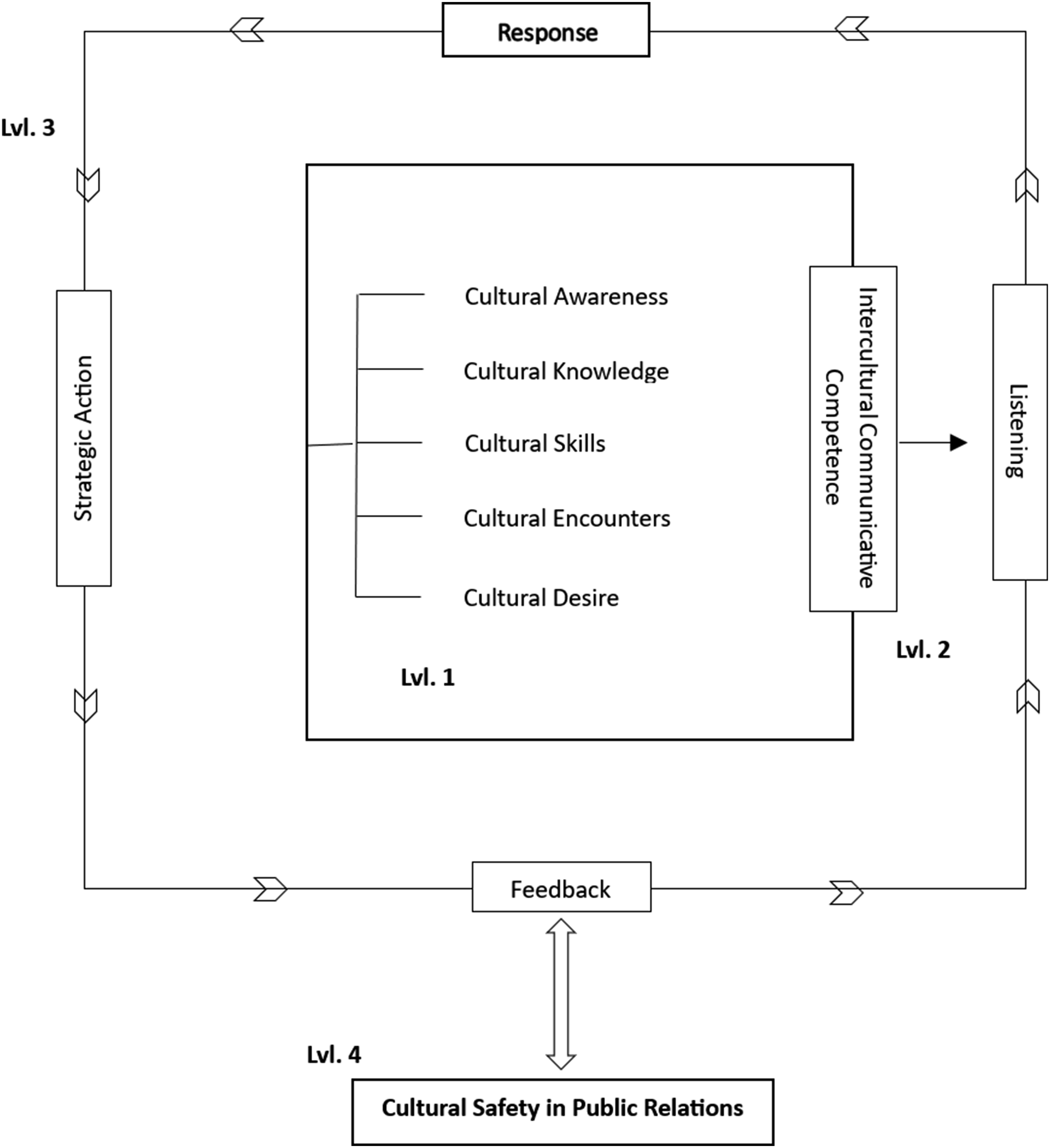
The diagram originates at level 1, which is a base level for any practitioner who wishes to participate in communication with any individual from a different background. This level, which is adopted from Campinha-Bacote’s (1999) widely recognised model for building cultural competence in health care services, requires an understanding of the key cultural elements – namely, awareness, knowledge, skills, encounters and desire – that foster sensitivity to other cultures. Attaining this understanding (at level 1) brings a practitioner to the point of cultural competence (level 2). This level is informed by, and was adapted from, Campinha-Bacote’s (1999) model of cultural competence. The process necessitates that practitioners view themselves as continually developing cultural competence rather than having already achieved or attained it (Campinha-Bacote, 1999).
Level 1 carries five distinct aspects of intercultural competence, the first of which is cultural awareness. This type of awareness forms the basis of intercultural communication, which involves recognising, and reflecting on, one’s own cultural values, beliefs and perceptions (Kaihlanen et al., 2019). It is the intentional, thoughtful process by which practitioners develop an appreciation for, and sensitivity towards, different aspects of publics’ cultures, and includes way of life, beliefs and values (Campinha-Bacote, 1999). It also involves understanding and recognising that, depending on the culture, the meanings that people assign to certain activities may differ from one’s own (Constantin et al., 2015). During this process of gaining awareness, one must also be conscious of any personal biases and stereotypes that colour judgements of other cultures; however, understanding these stereotypes and biases alone does not guarantee the creation of interventions that are sensitive to cultural differences (Campinha-Bacote, 1999).
The second aspect of intercultural competence is cultural knowledge, which involves acquiring a solid educational grounding in the diverse worldviews of various cultures. The objective of this second aspect is to comprehend the perspectives of publics or individual participants (Campinha-Bacote, 1999). This process includes understanding the ways in which institutions operate and highlighting the significant impact of social class backgrounds on life events (Lareau, 2015). Additionally, it entails gaining knowledge about specific physical, biological, and physiological differences among ethnic groups (Campinha-Bacote, 1999).
The third aspect is cultural skill, which refers to the ability to gather pertinent cultural information about participants’ backgrounds and current issues, as well as to carry out tasks specific to participants’ cultures competently (Campinha-Bacote, 1999). The effective fostering of cultural skills goes beyond equipping practitioners with culture-specific knowledge and facts, such as language, rules and customs; rather, it involves developing strategies that build cognitive resources allowing practitioners to become accustomed to unique situations that might arise based on the various cultural situations that they might face (Dollwet and Reichard, 2014).
The last two aspects are cultural encounters and cultural desire. Cultural encounters involve practitioners actively engaging in direct interactions with individuals from diverse cultural backgrounds (Campinha-Bacote, 1999). The aims of these encounters include eliciting diverse verbal responses, and accurately interpreting and responding to both verbal and nonverbal cues in culturally diverse contexts. Cultural desire refers to the genuine and authentic motivation of practitioners to participate willingly in the journey of becoming culturally competent, without any hidden plans, in order to work effectively with clients from diverse cultures (Campinha-Bacote, 1999, 2014). While all of the constructs outlined in this model (cultural awareness, knowledge, skills, encounters, and desire) are important in their own right, it is the aspiration to practice with cultural competence that drives professionals to pursue the necessary knowledge, skills and experiences that they need (Isaacs et al., 2016); thus, cultural desire serves as the foundation for the entire process of achieving cultural competence (Isaacs et al., 2016).
Level 2 is where competence is tested and brought into action. Professionals can embark on their journey into this level by acquiring knowledge about common cultural challenges associated with managing stakeholders. Addressing these hurdles underscores the significance of reflective intercultural competence for public relations practitioners. This acquisition of knowledge requires cultivating cognitive flexibility and reevaluating interpretations of messages from various cultures: a set of skills that is applicable across all communication channels (Husband, 2009). Achieving this transformation demands a shift in communication techniques and practitioner approaches that support this evolution. Competent communicators should possess the capacity to acknowledge and respect cultural differences, abstain from making presumptions, and employ suitable language and nonverbal cues to convey messages effectively (Sha, 2006). Given today’s hyperdiversity across cultures, practitioners ought to recognise the potential divergences in the relevant cultural identities of the individuals and groups with which they engage, highlighting the necessity of communicating adeptly with both internal and external stakeholders of differing cultural affiliations: a necessity that is an essential aspect of the field (Sha, 2006). Skilfully navigating intercultural communication plays a pivotal role in building trust, fostering stronger relationships, and enhancing organisational reputation within varied cultural landscapes. Effective strategies in intercultural communication within public relations encompass adapting communication approaches to suit diverse cultural milieus, and fostering cultural awareness and sensitivity (Zaharna, 2001).
Moving from level 2 to level 3 crucially requires a strong focus on listening. In this context, listening involves giving people a chance to express themselves and be involved in the communicative process, understood using Macnamara’s (2016a: 5) widely cited definition of “the process of actively receiving, constructing meaning from, and responding to spoken and/or nonverbal messages”. As cultural safety goes beyond cultural competence – given the fact that it encompasses a broader assessment of power imbalances in practice, research, and initiatives aimed at addressing social issues (Dune et al., 2022) – practitioners must listen, respond, and take strategic action to implement what they hear, in order to reach level 3. These processes work together to constitute active listening; as Bodie and Jones (2012) have highlighted, this type of listening is a key component of supportive communication (even though active listening can be operationalised in different ways). The point at which listening is actioned by the practitioner, through the implementation of feedback from an individual or public, is the point at which cultural safety begins, as it requires the active adoption of the individual’s or public’s perspectives. A key element, at this point, is the recognition that the recipients of services have the authority to determine whether the care/feedback that they have received meets the standards of cultural safety as defined by them (Dune et al., 2022). When engaging with the model, practitioners and theorists ought to remember that cultural safety does not centre on any particular culture; instead, it addresses power dynamics, inequality and racism comprehensively (Dune et al., 2022) to tackle discrimination-related issues across cultures.
Level 4 is the point at which cultural safety is successfully integrated into public relations. At this level, in terms of practice, the public relations professional successfully listens, and responds to, the voices of the members of the culturally diverse public(s) engaging in public relations activities, ensuring that the members of those publics feel culturally safe (in terms of their perception of cultural safety). In terms of theory, scholars and practitioners successfully integrate cultural safety into their thinking and praxis, prioritising listening and foregrounding diverse publics’ views of cultural safety (rather than client or organisational public relations goals). In terms of both practice and theory, all social actors – and especially public relations professionals – think and act in ways that actively try to minimise (or even, if possible, eliminate) problematic power imbalances, by recognising those imbalances and seeking culturally safe power-with relations across all interactions with culturally diverse publics.
This model for integrating cultural safety into public relations illuminates the potential for cultural safety to strengthen the profession and field. When carried out strategically, culturally safe practices can enhance practice in both the front and back stages (Goffman, 1956) by providing a way for public relations professionals to make their activities more effective whenever engaging with individuals and groups from different cultural backgrounds. Culturally safe public relations takes into consideration the unique and broad specifics of the field and industry. The model consolidates different elements of practice and theory (ranging from cultural awareness to listening), highlights the importance of those elements, and showcases the roles that they play together. It suggests that a path for facilitating culturally safe public relations is achievable for public relations scholars and, in particular, practitioners.
To implement the model and its components successfully, a much stronger understanding of problematic power tensions in communicative interactions with culturally diverse publics is required. Racial power imbalances, and the use of cultural safety to address those imbalances (Lokugamage et al., 2023), especially need to be apprehended. For this reason, cultural safety extends beyond the acquisition of knowledge and skills to the broader examination of power imbalances in practice, research and interventions aimed at addressing social issues (Dune et al., 2022). The core elements proposed by the model in this paper are most vital particularly when seeking to gain insights from individuals who have historically been marginalised or seen to have been less-than-significant (Lokugamage et al., 2023). As such, the implementation of cultural safety does not focus narrowly on the attainment of specific benchmarks; rather, it involves a broader, ongoing journey that requires continuous self-reflection on the part of individuals about their own, as well as others’, culture and identity (Dune et al., 2022).
In this respect, incorporating cultural safety into public relations also requires a shift in power dynamics. As noted earlier in the paper, this shift involves moving away from the dominant organisation- or client-based wielding of power to the shared, negotiated and inclusive exercise of power with culturally diverse publics (Berger, 2005). Taking this power-with approach can enable public relations activities, especially ones involving interpersonal interactions, to be made culturally safe for individuals from diverse cultural backgrounds. Culturally safe power-with relations thus prioritise the needs of diverse individuals, focusing on the use of listening to ensure that power is exercised in culturally safe ways. This approach to power can be seen to undergird the pivot and practices captured in Figure 1. In other words, public relations scholars and, in particular, practitioners can approach public relations activities with the understanding that power can be inclusive, negotiated and shared, in a way that maximises cultural safety for diverse individuals.
Discussion
Integrating cultural safety into public relations theory and practice enhances the existing approaches to respecting cultural diversity in many valuable ways. Above all, it adds a new dimension to the existing approaches that focus on acknowledging and representing diverse social groups, particularly in such key activities as public relations campaigns (Joseph, 2023; Vardeman-Winter, 2011), by focusing on the experiences of the individuals taking part in varied, especially interpersonal, public relations activities. In this respect, the integration of cultural safety helps public relations engage in international leading practice that prioritises the safety of culturally diverse individuals and recognises the insufficiency of focusing on, for example, the cultural competence of practitioners and simply promoting cultural awareness or sensitivity (Thompson and Taylor, 2021).
The necessary focus on listening also responds to longstanding calls for the profession and field to pay more attention to listening (see, for example, Macnamara, 2016a). By embracing cultural safety, scholars and practitioners can embrace reciprocity and empathy – two key components in the cognitive, behavioural and affective dimensions of listening (Lipetz et al., 2020) – more effectively in theory and practice. They can also embrace understanding, consideration and response: the “important characteristics of listening” (Macnamara, 2019: 5190) that build on Macnamara’s (2016b) ‘seven canons of listening’. In this respect, to listen in ways that facilitate cultural safety, many practitioners will need to learn new ways of listening that go beyond simply reacting to the things that they hear (Dreher, 2010: 99), especially in the case of communication that “occurs [when] a person from one culture receives and actually processes a message from a person from a different culture” (Fretheim, 2016: 2). For this type of communication, listening “cannot be considered successful if [the] message is not welcomed, acknowledged and processed by the receiver” (Fretheim, 2016: 7).
Building cultural safety into public relations, especially into practice, entails various challenges that extend beyond the need to shift approaches to listening. Above all, implementing cultural safety requires practitioners to incorporate a focus on individuals’ cultural safety into their practice, alongside the existing focus on the achievement of clients’ or (in the case of in-house practitioners) organisations’ goals. To achieve this incorporation, especially for interpersonal public relations activities, many practitioners will need to re-develop existing approaches to diverse activities, especially in terms of the planning and running of face-to-face communication activities. This re-development, in turn, will require practitioners to devote time to developing the new approaches, as well as learning about cultural safety. For some practitioners already familiar with culture-related developments, little time for training will likely be needed; other practitioners are likely to need more time, taking those individuals away from their existing work. Hence, the leaders of agencies and in-house teams (as well as organisational superiors, such as CEOs and CFOs) will need to feel comfortable with releasing more time for the professional development of their team members. Independent practitioners will also need to take time out of their schedules and, in an additional challenge, find suitable training events and resources themselves.
A further challenge lies in the process of successfully undertaking the implementation of cultural safety itself given the diverse constraints that confront many organisations. These constraints range from budgetary limitations to policy boundaries. As such, it is feasible to ask whether, realistically, many organisations would be in a position to enable public relations practitioners to help lead the implementation of cultural safety successfully in ways that create environments that empower individuals of diverse cultural backgrounds while ensuring that cultural knowledge, practices and artefacts, among other elements, are protected for the individuals and communities themselves (Heckenberg, 2020). Additionally, it is possible to ask whether it is realistic for many organisations to ensure their organisations fully represent the culturally diverse communities in which they operate. Responses to these sorts of questions, as well as the broader issue of organisations’ ability to help implement cultural safety, might note that, while not all organisations would be able to implement cultural safety immediately, the gradual undertaking of cultural safety efforts could begin with large, well-resourced and -financed organisations, and spread to other organisations. It might also be noted that, as communities around the world become increasingly culturally diverse, the staff members who fill those organisations will also become steadily more and more diverse, thus helping organisations reflect the communities that they serve ever more effectively.
Adopting culturally safe power-with relations is also not without its own challenges. Power dynamics are always fraught with diverse, context-specific problems that leave some social actors better off than others and, in terms of public relations, some voices mattering more than others (Edwards, 2014). Communication practitioners seeking not only to be mindful of, but also genuinely implement, power-with relations need to be wary of the ways in which influence and control operate in the public relations activities in which they are involved. They need to ensure that cultural safety is not instrumentalised to achieve organisational objectives. They also need to be mindful of the pre-existing power imbalances already operating between culturally diverse publics, on the one hand, and well-resourced organisations or clients, on the other hand. Fully culturally safe power-relations might also be more challenging to achieve in some situations than in others. A prominent example is Bell Pottinger’s deliberate stirring of racial tensions in South Africa in 2016 and 2017; the public relations firm deliberately chose to engage in racist communication activities, designed to divert attention from corruption allegations against President Jacob Zuma, given fees of £100,000 a month from its billionaire clients (Cave 2017). This type of case illustrates the way in which concern for culture can be overridden by the prospect of lucrative financial gain (among other temptations that public relations professionals can encounter), especially in contexts that already feature structural racism and widespread power imbalances. Nevertheless, all parties in public relations activities, especially practitioners, need to appreciate the power dynamics operating in, and around, those activities and aim to reduce (or even, if possible, eliminate) those imbalances.
Scholars and professional associations will have key roles to play in enabling these challenges to be overcome. Thanks to their expertise in undertaking research and crafting theory to enhance practice, scholars – in all kinds of institutions (ranging from colleges of advanced education to universities) around the world – will be able to develop additional theory-driven approaches to integrating cultural safety into public relations. Indeed, this paper has offered only an initial way of helping the field and profession understand this important area of safety for diverse publics and build it into theory and practice; the paper does not claim to have provided an approach that covers all contexts. Also, more importantly, as the paper has focused on the practitioner perspective, in terms of integrating cultural safety into the work undertaken in the profession, it will be important for scholars to develop theory-driven approaches that focus on members of publics or the participants of public relations activities, giving more attention to those individuals’ experiences. In this way, scholars will be able to respond to calls (see, for example, Vardeman-Winter and Place, 2017) for intersectional research that considers diverse participants’ lived experiences. Professional associations around the world – ranging, for instance, from the Public Relations Institute of New Zealand to the Canadian Public Relations Society – will also have an important role to play in facilitating access to resources that help practitioners and organisations integrate cultural safety into public relations. These resources can range from events (whose recordings are available for later, on-demand viewing) to published, freely available guides. In so doing, professional associations and scholars will be able to support each other in aiding the profession and practitioners, especially in a time of rapidly shifting professional landscapes that necessitate the active involvement of professional associations, in particular, in ensuring that public relations activities help to care for diverse community members more effectively.
Conclusion
As the world’s populations increasingly change, as societies become more and more sensitive to cultural differences, and as public relations practice embraces new forms (both digital and non-digital) involving innovative interactions with individuals and groups from different cultural backgrounds, it will be increasingly important for public relations, as a profession and academic field, to ensure that its activities are undertaken in culturally safe ways. This paper has highlighted the need for public relations to embrace cultural safety. It has argued that the successful integration of cultural safety into public relations involves a focus on listening, which is the crucial ingredient in understanding the perceptions of the safety of publics from different backgrounds. Consequently, drawing on both interdisciplinary and public relations theories, it has presented an approach precisely for implementing culturally safe public relations. It has also noted the need for a shift in power dynamics to integrate cultural safety into public relations: a shift requiring culturally safe power-with relations that give diverse publics the chance to share and negotiate in more inclusive power relations that enable them to be culturally safe.
The paper opens a number of avenues for further research, some of which arise from its limitations. As the paper offered a conceptual approach for integrating cultural safety into public relations, it will be important for future research to understand (empirically) the best ways to implement cultural safety in public relations activities successfully. To that end, research methods including action research or design-based research will be helpful in applying the approach by training practitioners and measuring the outcomes, as well as impacts, of its implementation in diverse public relations settings and activities (from boardroom discussions in urban environments to community relations events in rural or regional areas). Future research could also explore the role of cultural curiosity, as well as observation, in the model presented in the paper. While listening is crucial, cultural curiosity could help practitioners engage more effectively with diverse publics and undertake learning about different cultures; the building of observational skills would also assist practitioners in growing in sensitivity and awareness.
In that respect, the paper adopted an overarching organisational lens that needs to be borne in mind; future research should engage with the critical societal, political and ethical implications of applying cultural safety to public relations. As the paper has noted, the integration of cultural safety into public relations involves a significant shift in theory and, in particular, practice that will likely be challenging for many public relations professionals. As such, interviews or focus groups will be helpful in understanding practitioners’ perspectives about their experiences, especially the challenges that they encounter and the professional development needs that they find they require. Meeting these fresh challenges may not necessarily prove to be straightforward, but they will be beneficial for practitioners, the diverse groups and individuals with whom they interact, as well as the public relations profession and field.
Footnotes
Acknowledgements
We sincerely thank the reviewers for their time and valuable feedback, which helped to enrich the paper on multiple levels.
Funding
The authors received no financial support for the research, authorship, and/or publication of this article.
Declaration of conflicting interests
The authors declared no potential conflicts of interest with respect to the research, authorship, and/or publication of this article.
