



Abstract
Public relations roles have been the subject of considerable scholarly investigation. However, conceptual and empirical work in this area has focused predominantly on the relationship between public relations and journalism and debates around ethics and professionalization; the link between role perceptions and actual role performance in practice remains opaque. In the current context of a permacrisis, environmental catastrophes, and political disruptions and demarcations on a global, national and local level, there is an urgent need for socio-ecological transformation and authentic sustainable development. This research asks what are the roles and perceived responsibilities of public relations professionals in this change process and how (much) perceived agency for change tests traditional boundaries between the professional and personal role? Through in depth, reflexive narrative interviews (n = 16), anchoring professional roles in their actual performance, we compare public relations practitioners’ ideals and practices in a traditionally green environment, in this case Austria, and the US, where sustainability communication is less regulated with less binding legal requirements – even before the most recent policy shifts. The findings show that professional communicators are claiming what we conceptualize as narrative agency in change contexts, focusing on ethics in the act of storytelling and dialogicality. This research expands the scope of public relations scholarship and particularly previous work on agency in a world in transition.
Keywords
Introduction
The role and relevance of professional communicators in shaping the world views of stakeholders and audiences has been a matter of ongoing investigation (see, e.g., Dozier, 1992; Kim and Reber, 2008; Smudde, 2021). However, to date, little attention has focused on the agency and, thus, advocacy, activism and self-efficacy that public relations practitioners might themselves hold and play in shaping social cultural understandings and narratives about issues of major social, cultural, political, and environmental concern.
Only recently have scholars focused on the potential of public relations practitioners (as opposed to the organizations or individuals they represent) to promote transformational social change and public awareness of such change within and beyond institutional structures. This increased scholarly interest in the transformative role of professional communication has been stimulated from within media and communication studies and has produced conceptual work on the transformative role of journalists (Brüggemann et al., 2022), as well as discussion about the place of communication scholars themselves and communication studies in a changing society (Waisbord, 2020). In turn, this has unsettled some strategic communication and public relations researchers and motivated them to rethink the ideals and actual practices of public relations professionals in a world in crisis (Hou and Johnston, 2024) and to explore how personal agency intersects in professional settings (Ciszek et al., 2025).
This paper explores how public relations professionals understand their own role and agency in relation to sustainability as a metadiscourse and master frame of the future (Weder, 2021). Agency from a communication perspective refers to the capacity and capability of an individual to effect change through communication by shaping interactions and navigating constraints (i.e. the organizational context) and, thus, to enact norms. Hou claimed in her conceptual paper on agency in Public Relations Inquiry to inspire PR scholarship through institutional theory and in particular she criticized that the linear, instrumental and thus managerial understanding of communication has overlooked the agency of PR in shaping organizational structures and institutional processes (2020). We go one step further and elaborate on how the aspect of agency manifests itself in communication as social practice to initiate changes. Thus, we build on Hou’s work (2020) on agency as embedded and interactive agency and explore how PR practitioners balance the complexities of enacting norms in their personal and professional roles and perceived responsibilities in a socio-ecological transformation.
The aim of the conceptual and empirical work presented here is therefore to further investigate the evolution of the ‘curator of change’ role ascribed to public relations practitioners in the works of Weder et al. (2023) and Weder and Weaver (2023). Previous research has identified how professional communicator roles are evolving due to new technologies and changes to the media and communication industries and their business models (Brockhaus et al., 2023). Furthermore, new boundary spanning roles like that of influencers are emerging at the outer edges of the public relations profession with communication practices that have been identified as converging around storytelling (Enke and Borchers, 2021; Weder and Weaver, 2023). In parallel, inside organizational and particularly corporate structures, new positions have emerged such as the ‘Sustainability Manager’ and ‘Chief Sustainability Officer’; roles which are responsible for managing, reporting and communicating corporate sustainability (Schaltegger et al., 2024). These developments led the authors of this paper to pose the questions of how much agency do professional communicators feel in a world where new roles are emerging – especially around sustainability discourses? How much agency do they feel they have in terms of initiating, and promoting organizational change and concrete socio-ecological organizational transformation? Consequently, we ask: how do public relations professionals define their roles and what are they actually ‘doing’ in the context of supporting sustainable transformational change?; what competencies are needed to do this work; and how much does it require high morality, passion and activism?
To shed light on what remains an opaque relationship between role perceptions and performance, between ideals and actual practices, this study offers a new concept of narrative agency supported by empirical interviews (n = 16), asking how public relations professionals understand their transformative impact and, thus, their role in initiating and promoting sustainable transformational change. The research was conducted in a traditionally ‘green’ country, Austria, and the US, where corporate social responsibility and sustainability and their communication are less regulated compared to the EU. The comparison between these two countries has high research value based on two significant factors. Firstly, while the US relies heavily on fossil fuels and has a market-driven approach to sustainability, policies vary significantly between state and federal levels. Austria, in contrast, has a strong focus on circular economy and renewable energy and has strong government-led sustainability policies aligned with the EU Green Deal regulations (most recently, the Omnibus regulation 1 ) with binding legal requirements for non-compliance 2 . Secondly, in terms of cultural attitudes towards sustainability, polarized views on the climate crisis and sustainability in the United States contrast with a strong eco-conscious culture in Austria. 3
In the next section we provide the background to understanding public relations in the context of sustainable development. Following that, we conceptualize narrative agency as key to public relations practice, not only, but primarily in situations of crisis and change. We then outline our research method, present the research findings and finally offer a robust conceptualization of what we call the narrative agency of public relations professionals.
Conceptual background
In a world where change and transformation must occur at a planetary level if the human species and, indeed, many life forms are to survive, it is a necessity that we identify how public relations professionals understand their role in communicating, supporting, achieving, and authoring such transformational change, and what are the skills required for “doing” this work. While roles and self-concepts of journalists have been extensively examined by communication and media scholars (see, e.g., Hanusch and Tandoc, 2019), academic research on public relations professionals, role concepts, competences and skills is more limited. Mostly following a functionalist, managerial approach, scholars have identified archetypes of the professional public relations role, such as the dissemination of organization-related information or navigating stakeholder interest (Neijens and Smit, 2006). Other scholars have focused more specifically on the relationship between and role differences of public relations professionals and journalists (Kent et al., 2016; Macnamara, 2014). This line of inquiry was then developed in research about curator roles and the convergence of the professions (Weder et al., 2023; Weder and Weaver, 2023).
The role of a PR professional has been described as one of constructing social reality through methods of signification, utilizing storytelling (Kent, 2015), and, increasingly, the production of narratives has been considered as intrinsic to this process (Heath and Waymer, 2019). In other words, PR professionals work to frame and co-construct the public agenda and associated issues and discourses (Sallot and Johnson, 2006), initiate public conversations and negotiate narratives (Weder and Weaver, 2023). What hasn’t been explored to date is how much the role of a professional communicator can be actually defined as a (co)production of narrative discourses, and, vice versa, how much role-holders’ perceive themselves to have the agency to build and frame these discourses, to create new narratives in relation to societal metadiscourses like climate change, sustainable development, or social transformation, and thus, how they negotiate their own role between ideals and actual practice.
Advocacy, activism or authorship? Professional communicators and their responsibility
Today’s permacrisis (Mishra and Sen, 2024), and associated ecological challenges create pressure to act for collectives and individuals. In this context, sustainable development has been introduced as a normative social framework to manage resources in ways that do not threaten future generations, and which consider planetary boundaries in economic and social terms. Sustainability is the ethical principle that guides related processes and behavior, with the potential to be cultivated as a universal value (Weder, 2023). However, sustainable development and related (corporate) activities are still framed through narratives of economic success, profit and progress (Wright and Nyberg, 2017). Consequently, sustainability has been criticized as ultimately underpinning an incremental and growth-friendly capitalist discourse, and as having failed to produce a much-touted transformation narrative and actual societal and environmental change (Pyla, 2012). Therefore, we are provoked to re-think the performative role of communication professionals, their ideals and practices related to transformation, and the potential resonance and impact public relations can have at a societal level.
Theoretical and empirical scholarship which examines the potential and transformative role of professional communicators in society has dealt with crisis scenarios and developed concepts like advocacy journalism (Waisbord, 2009) and activist public relations (Adi, 2019). Considering increased climate change related reporting in the media (Schäfer and Painter, 2021), and the growing number of voices driving public discourses about socio-ecological transformation and sustainable development (Fischer et al., 2022), it is not surprising that journalism was the first media and communication discipline to assess the potential change agency of a specific professional communicator role. Advocacy journalism was one of the first conceptual terms to describe this role in relation to the public and articulated support for a specific plan, idea, an argument or narrative, as well as related behavior (Thomas, 2018; Waisbord, 2009). The approach involves journalists giving up neutrality to become an advocate or ‘discourse attorney’ for a particular issue or topic (Thomas, 2018). Other related terms are solution journalism or constructive journalism (Mast et al., 2019; McIntyre, 2019), which describe the selection of good news, future and solution focused approaches in reporting over negative ‘bad news’ stories. While there are a few studies of activist journalists (e.g., Ginosar and Reich, 2022), there is a more established focus on activism in the public relations literature which explores communication activities by politicized third sector groups, social movements and activists (Adi, 2019). Thus, on the one hand, in public relations research, PR’s role is studied in terms of reacting to, strategically dealing with (Sommerfeldt and Yang, 2017) or even countering social and environmental activism with issue management tactics (Aronczyk, 2018). In these terms PR promotes public discourses about socio-ecological transformation and sustainable development which protect conservative corporatism against radical societal critiques (L’Etang, 2016). On the other hand, critical perspectives have reflected on the obligation of public relations to work for the public good (Brunner and Smallwood, 2019) or public interest (Johnston, 2017), recognizing that it plays a significant role in influencing how socio-ecological challenges p(l)ay out (McKie and Munshi, 2007; Valentini and Edwards, 2019). Part of thinking about public relations’ transformational potential is to focus on PR professionals and how activists use strategic communication in particular (Adi, 2019; Weaver, 2014), have attempted to encourage understandings of social issues in order to influence, for example, consumer spending, public policy, and public and private behaviors. At its core, research into what has been variously termed activist PR and protest PR (Adi, 2019), identifies the goal of this public communication as aiming to foster public legitimacy and position groups and individuals as ‘voices for social change’ (e.g., Demetrious, 2013). This is very similar to the recent journalism research, mentioned above, which points to the ‘agency’ journalists need to take in a global ecological crisis (Brüggemann et al., 2022). Complementary, the emerging field of sustainability communication differentiates communication of sustainability (reporting, transmission of information), from communication about and for sustainability. In this third dimension, the field describes advocacy for nature and focuses on communication that is dialogical, participatory, and includes all forms of sense and meaning making (Weder, 2023), which aligns with the concept of authorship, which has been theorized as crucial to empowerment of communicators more broadly in the face of crises (Hendersson and Wamsler, 2020).
Core to the conceptual basis of this research is, firstly, the notion that responsibility plays a key role in initiating, managing and promoting socio-ecological transformational change. Here, responsibility is framed not so much in terms of individuals or organizations, but rather in terms of what is said and, thus, the narratives of change that are created. Secondly, the notion of agency is core to all the concepts that inform this research, from advocacy, to activism, and authorship. Agency, which we consider as communicative, or more precisely, related to societal narratives, is conceptualized in the next section.
Narrative agency – developing a new perspective on public relations
Agency is a sociological term which positions every person as an agent; as someone who acts, and who is responsible for their activities (Emirbayer and Mische, 1998). Agency is discussed as characteristic of transformative actors, or those who have the moral and ethical duty, especially in a crisis, to act responsibly and sustainably; it means the ability to act as such and the consciousness about and care for the individual actions (Ling and Dale, 2014). Thus, agency emerges as a crucial element in transformation processes, enabling individuals to adapt to change and navigate crises; to acquire resources, rights, and normative frameworks (Horvath, 1998). It is theorized as the driving force behind social action, underlining an individual’s awareness of their ability to exert influence.
With Goodin (1986) it can be assumed that with all forms of responsibility comes the expectation of results which create resonance and impact for others. Thus, with responsibility exists moral agency (Ewald and Wallace, 1994). Moral agency is realized in different roles or within interactions between complementary roles. Going back to agency as the capacity of human actors to act independently and reflectively while interacting with contexts, the role of moral agent – or ethics guardians (Pompper, 2021) – goes further and can be described as comprising normative competence, which involves the ability to grasp and apply moral reasoning, and to govern one’s behavior through such reason. Therefore, we conceptualize moral agency as communicatively constructed and realized in communicative interactions.
The concepts of agency and moral agency have been productively employed in communication fields ranging from rhetoric (Hoff-Clausen, 2019), to media reception theory (Ytre-Arne and Das, 2021). Some such work draws on Bourdieu’s theorizing of communicative agency as a distinctive human capacity to create meaning (Catt, 2006). In these terms, agency is further theorized as a creative capacity and “obtained in relations” (Catt, 2006, p. 41) which includes not only awareness of agency but also consciousness of context. An inspiration for re-thinking agency from a communication and in particular narrative perspective was Hou’s work on agency, where she elaborates on the concept of ‘embedded agency’ (Clegg, 2010) and refers to structuration theory by claiming that agency is both shaped by and reshapes the context (Hou 2020; see also Hou and Johnston 2024). For the paper at hand, the most important aspect is that agency is not static but subject to and based on human subjectivity which involves personal values, professional experience, and emotions (Waldorff, 2013), which then influences and shapes the enactment of norms and production of incremental changes (Battilana and D’aunno, 2009) through, or as, communication.
To create a link to the agency to build and frame public discourses, to create new, alternative narratives in relation to societal metadiscourses like sustainable development or social transformation, we thus need to clearly differentiate agency from advocacy. While agency is apparently a ‘power’ aligned to the individual or collective to construct meaningful narratives, advocacy is what assumes a relational power and responsibility to act. From a PR perspective it is therefore narrative agency that includes the establishment of specific or new narratives in favor of dominant interests (Hou, 2020). Furthermore, we need to differentiate agency from activism. Agency is not externalized but rather incorporated in a specific role or in the negotiations of the own role between ideals and actual practice. Activism instead is a form of ‘social agency’, going beyond individual abilities into an organized form of taking agency – and thus an extended form of agency (Demetrious, 2008, 2013).
Therefore, we offer a new concept of narrative agency. From our perspective, narrative agency means the capability to understand the complexity of issues of concern (so called narrative environments), and the willingness to enact norms by participating in a co-creation (“co-authorship”) of related stories and (potentially new) frames. Therefore, narrative agency goes beyond subjective perspectives on an issue or individual value frameworks. Informed by literary studies and philosophical conceptualizations of the relationship between intersubjective narratives and role consciousness (Atkins and Mackenzie, 2013; Meretoja, 2016), and first applications of the concept of ‘narrative agency’ in consumer research (Van Laer and Orazi, 2024), agency has three components: 1. Narrative awareness: capability to enact norms (skills, competences) 2. Narrative imagination: (co)authorship (storytelling, framing) 3. Narrative dialogicality: creating links to narrative environments (networking, relationships)
Through a series of narrative interviews, we sought to further explore these dimensions and learn from public relations professionals about their transformative potential in the form of the ability to navigate different narrative environments. Our investigation was guided by the three research questions:
In the next section we outline the methods used to conduct this research investigation.
Method
A qualitative method was used to investigate the research questions given that the study of change, transformation processes, human social behavior and roles is best investigated through exploratory approaches. As Bryman (2016) explains, qualitative research seeks to understand social and individual practices and behavior, dissect complex processes, and provide in-depth, human-centered insights. Specifically, we used semi-structured, narrative interviews. Narrative interviews include a variety of methodological strategies to explore an individual’s experiences in an open format, more precisely through storytelling (Moenandar et al., 2024). Deeply rooted in constructivist paradigms, the main idea of a narrative interview is to open a conversational space to capture themes, patterns as well as contextual influences and – which is particularly of interest – actions and ‘ways of doing’. Recently, the narrative approach has been adapted in journalism research to capture specific ways of ‘doing communication’ in form of so-called “reconstruction interviews” (Ryfe, 2023; Schwinges, 2024), which seems to be well suited to examine role ideals and practices at an individual, organizational and/or societal level, and serve as an “access point” to understand a professionals’ identity and social position (Schwinges, 2024, p. 3).
The goal of this study was to explore public relations practitioners’ role perceptions and performances, and especially their ability to navigate different narrative environments. We wanted to know how they “interpret and understand their societal roles, ethical duties, and professional responsibilities” (Schwinges, 2024, p. 3) in the realm of strategic communication. This ‘realm’ – the social context in which public relations is practiced – is often disregarded (Ryfe, 2023), and yet, it is the external political, economic, ideological, etc., influences that shape the (self)negotiation of roles. The reconstruction interview allowed us to study the negotiation of ideals and practice in such contexts (Schwinges, 2024, p. 4). The aim in reconstruction interviews is to avoid idealization of best practices, and how participants think they work, and to focus on reconstructing how, in the specific case of this research, public relations professionals did communicate, promote, and otherwise experience change initiatives.
However, we must acknowledge certain limitations and questions that arise from bringing a methodology from journalism research to an exploration of public relations roles. In public relations there is no specific ‘news piece’, or single communication product in the doing of communication to serve as a point of discussion about the processes involved in crafting and producing this piece. Therefore, inspired by Schwinges paper (2024, p. 4) and her methodological recommendations, in our interviews we asked participants to talk about specific examples of change communication and ways they dealt with social and environmental issues. The main focus of the question-led ‘semi-structured’ interviews (Belina, 2023) was to have our research participants explicitly describe the role they played in that initiative, the skills that they drew on, and the outcomes of the work.
Following ethics approval 4 , we began recruitment using a convenience snowballing process (Noy, 2008). Individuals were recruited through our professional communicator industry networks; those individuals were then asked to refer us to other professional communicators. Snowball sampling can produce sample bias because researchers might only be able to reach out to a specific and small group of people (Noy, 2008). However, it is valuable when exploring relationships between groups (in this case professional communicators) and social systems, because it relies on and partakes in the “dynamics of natural and organic social networks” (Noy, 2008, p. 329). Exploratory in nature, this research was not concerned with recruiting and a representative sample of all public relations and professional communicators as our aim is not for generalizability of findings.
Sample.
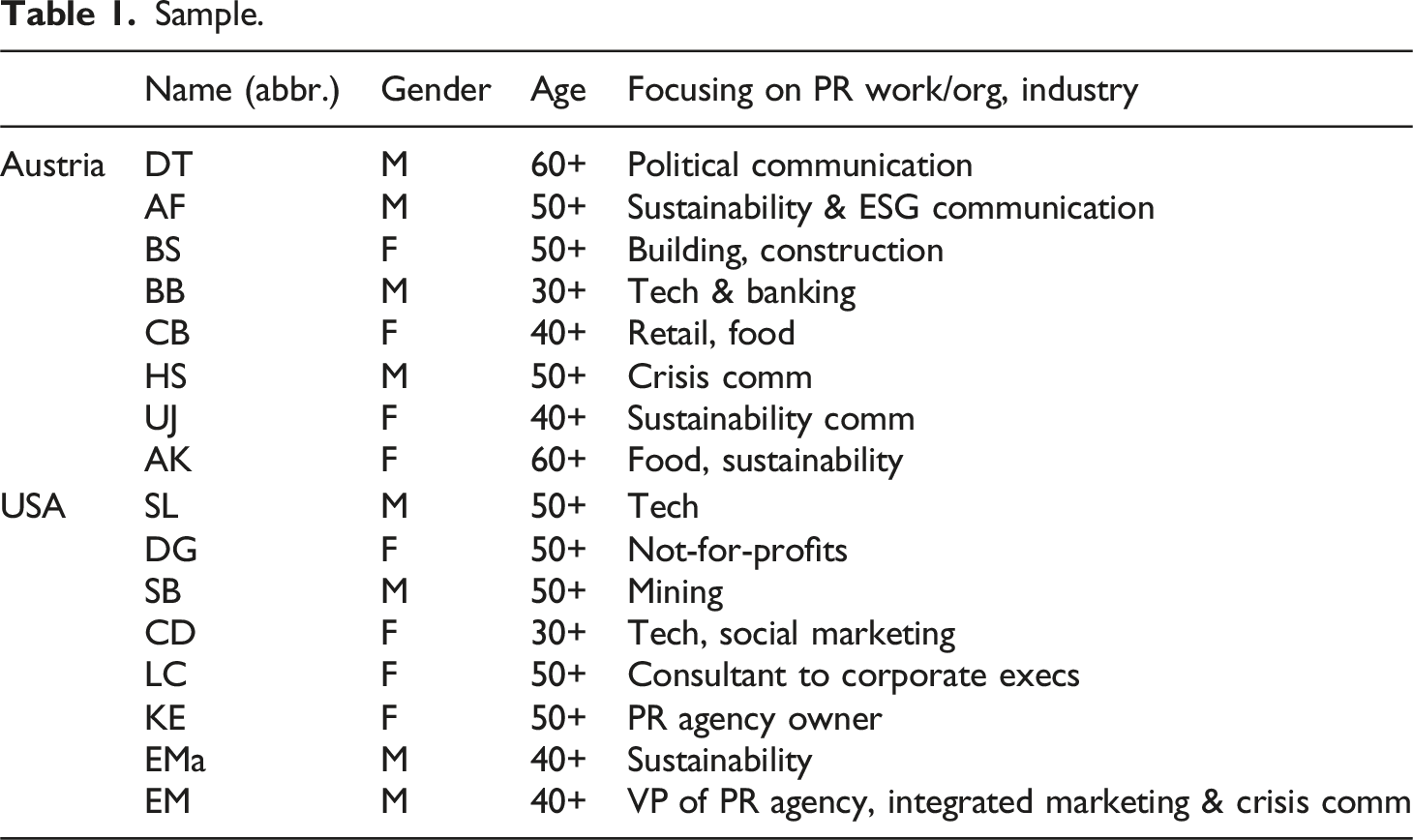
We recruited a range of in-house practitioners representing global and local for-profit corporate organizations with a focus on corporate sustainability and ESG, to NGOs, environmental and social justice groups, and those working for agencies. A total of 16 interviews were completed (eight in the US, and eight in Austria). All participants occupy public relations roles working with internal and/or external stakeholders, though their professional titles vary, from communication manager, chief communication officer, public relations advisor, agency owner, to executive officer. 5
The data was analyzed through an interpretive thematic analysis using coding processes related to the research objectives. A content analytical technique of inductive category building (multiple coding of categories counted) was applied (Mayring, 2014). The result of the analysis is a category system with the inductively developed categories and the corresponding frequencies. In the next section, we present our findings from this data analysis.
Findings and learnings - narrative agency
Through the interviews, we were able to elicit reflective reasoning behind the role performances of public relations professionals. Furthermore, in the context of sustainability, ‘invisible’ perceptions, norms, values and influencing factors for the doing of public relations materialized. We present our findings following the three guiding research questions detailed above.
Narrative awareness: enacting norms
Based on the conceptualization of agency provided in the first part of this paper, we consider awareness of culturally available narratives to be a core competency in professional communication. Awareness includes an idea of transformation as an available master narrative that shapes people’s lives by functioning as a model or reference point of sense-making (Meretoja, 2023). Bringing the transformation narrative to the level of ‘conscious reflection’ allows public relations professionals to evaluate those narratives critically, and to make sense of the individual doing and general meaning-creating process. Narrative agency includes awareness of how the sustainability story can be told and interpreted differently – from someone else’s perspective (Meretoja, 2023, pp. 125–132). This is particularly important in a situation where the sustainability story is told within the hegemonic frames of growth ideology (Banerjee et al., 2021), and defined by business interests (Banerjee, 2008; Weder, 2021).
The first – biographical narrative – section of the interviews led the participants to retrospectively narrate their doing. Here, they talked about the context of a crisis and sustainability as a master narrative. For example: Sustainability is a big issue, but in media work, you don’t get much out of it anymore. You’re not going to get into the media just because you’re talking about sustainability… Sustainability has been oversold as this massive topic that will automatically get attention. That’s not the case anymore. (AF, Austria)
Sustainability is perceived as an overarching narrative, increasingly institutionalized in regulatory frameworks, and, as such, “it plays a crucial role in strategic considerations” (DT, Austria). Interviewees from Europe, in particular, were aware of the potential to claim agency and authorship of the narrative: … sustainability is, by nature, a form of crisis communication, but with a positive spin. The word ‘crisis’ also contains the opportunity for change, which is the point where you can pivot. So, if we see crisis communication as an opportunity to highlight where things can improve and develop, then yes, sustainability communication is a new form of crisis communication. We need to transform the whole discussion around it. (HS, Austria)
Narrative awareness goes hand in hand with feelings of responsibility and care. Thus, awareness leads to a necessary willingness to explore the limitations of the sustainability story and how it is told. For several US based interviewees, this meant appreciating that their narrative agency was constrained by the financial business contexts in which they work: I might care deeply, like [about] climate change... But I have to be able to prove that there's a reason we should do it this way, and this is actually gonna save us money and make us look good for them to sign off on it. Especially, when … people are just kind of operating [on] bare bones - do more with less kind of vibe. (CE, USA)
Change and transformation are complex and operating in such an environment means that context, rather than content, was seen to be king. In our interviews we found that the relationship between business and society was seen, not uncritically, primarily through an economic lens, where corporate business interests come before social interests. A US based interviewee explained that to achieve change, he needed to be perceived by others as putting the interests of the business first: The way I look at my job is - I'm a businessperson. … I want people to think of it that way, because then they connect lines in the business and say ... I'm creating a line of sight to what the organization’s trying to do in the broader world (Sl, USA)
However, public relations work, the actual doing, includes awareness of the multiplicity of discourses on sustainable development and that these should not be reduced to a narrative of sustainable growth: In the future, people will need to understand complexity - how everything is interconnected and how to comprehend the consequences of that complexity. We’ve always said, “Content is king”, but I think we should revise that to, “Context is king”. The contextualization … is something younger colleagues need to grasp. (DT, Austria)
While in Europe legal regulations are part of the context (and constraints for the communication of sustainability, like reporting guidelines, mentioned in the introduction), there are different dynamics through which public relations professionals claim narrative agency. For example, a US practitioner talked about using his narrative agency from both top-down and bottom-up directions: There are stakeholders at [every] level … you have boards of directors, … investment managers and … customers. You have NGOs. And so … at that high level, you need to be able to align interests across multiple stakeholders to push something from the bottom-up. It’s movements, it's creating, it’s inspiring certain demographics to go out and make change. … You can then put pressure on all of those bigger stakeholders to get stuff done. And so sometimes we'll work up top and we'll work on the bottom. We'll do the push. (EN, USA)
This leads us to the second part of the interviews, where the doing is discussed including the perceived relationship between the doing and the professional role.
Narrative imagination: storytelling and advocating for change
As conceptualized above, interviewees spoke of narrative agency in terms of their creative and critical engagement with the master narrative of sustainability and change and related discourses. It has been previously argued that storytelling is the doing that sits at the core of strategic communication (Fischer et al., 2022; Weder and Weaver, 2023); it encompasses the imagination of different narrative trajectories for an organization, a community, and as well for humankind and the planet (Meretoja, 2023). Here, context takes primacy over a specific issue, event or fact, because narrative agency requires developing a sense of how different worlds function as spaces of possibility (Meretoja, 2023). In these terms, interviewees almost without exception described their doing as storytelling, more precisely as a technique for change and getting people to act … I call myself a storyteller, because I think that's one of the most pivotal toolsets you can have when it comes to creating change. The only reason anyone ever acts … is because they were moved by a story. (CE, USA)
Another said, “All change is about storytelling” (SL, USA), and others described storytelling as a “way to talk about the impacts of change” (SB, USA). Thus, storytelling is not seen simply as a tool but specifically related to the creation and further development of a narrative. In these terms the doing of public relations is intrinsically related to having narrative agency and narrative awareness, as this interviewee from Austria explained: You need to figure out what to do to bring out a narrative. What does the narrative look like, and how can I refine it so it stands out among all the other players and contributes something important to society? (BB, Austria)
In the second part of the interviews, participants were asked to talk about their individual motivations, activist potential, and passion that they may have felt in their professional careers. Here, several interviewees mentioned the imaginative and creative potential of a narrative storytelling approach and their motivation to bring about change: So I really have to figure out, hey, what’s gonna resonate with them? What's gonna make them trust me, what's gonna make them feel something? And what's gonna make them convert to action. I like to use storytelling as a way create that kind of trusted empathy (CE, USA)
Another interviewee was driven by a duty of care and responsibility: I want to make sure I can do things from a sort of an advocacy perspective. Both for humans and … environmental sustainability, and so forth, without it ringing hollow. I think it's a - obligation is not the right word. It's a thing we need to do because it's right. (SL, USA)
Agency in these terms is not to be confused with activism, but rather “advocating for change” (SB, USA). One interviewee explained this stating: “PR typically operates in the second row. We advise others, even internally, though press officers are an exception. Usually, we’re not on the front lines. An activist stands in the first row.” (AF, Austria).
While none of the interviewees described themselves as activists, they did describe themselves as passionate. For example, an Austrian participant stated: … a good communicator must be passionate about their work and the stories they tell. That passion still drives me today…. passion is key. Without it, you can’t succeed in this field. Whether it’s energy, sustainability, or crisis communication, you must be fully engaged. (HS, Austria)
Passionate engagement also translated into being the driver and author of the change narrative, as the following statement from a US interviewee demonstrates: 60% of the time I am the driver, and 40% of the time I'm the author, … like, okay, here’s … the change that we want to see. … A lot of communication and storytelling professionals are the driver. We're kind of that projector, that magnifying force, that when something that needs to change like we want to get it out to the public, get the masses on board, and really kind of ignite the spark. (CE, USA)
Sparking conversations is not the job of a single professional communicator, however. As we discuss in the next section, the relationship to various sources of information, network partners, and interactions with other communicators is vital.
Narrative dialogicality: relations, connectivity, co-creation
Narrative dialogicality points to an important dimension of agency, its relationality. As Catt (2006) argues, agency is neither subjective nor intersubjective nor objective; agency is obtained in relations. Our interviewees were very aware of this relation to other agents in the world and their stories, in a fundamentally dialogical way. Narrative dialogicality involves creating conversational spaces that make it possible for others to imagine new relationships and narratives of social and ecological change. Most of the interviewees framed this relationality in their self-definitions as strategists and consultants: I’m heavily involved in strategic consulting. That’s a key term for me. Strategic consulting has become extremely important in PR, in terms of its weighting. All-encompassing strategic consulting…we almost feel like business consultants (CB, Austria)
One interviewee explained that doing this work involved dialoguing and negotiating with the sustainability metadiscourse to create human change: “transformation in communication. It’s about much more than just technology .... It’s a human-centered transformation. … The core is the human element.” (HS, Austria). Another explained her role explicitly in terms of her agency to connect with others: So I'm like, here's all the nonprofits that we could align with, and why it matters for what we're doing. … How do we get people into action? ... And that starts with just everyday interactions that you're having with people.” (CE, USA)
Secondly, interviewees identified old school attitudes as restraining their agency. One said: “My biggest challenge was educating the people internally first … They have no idea about reputation management, except the fundamentals of, perhaps crisis” (SB, USA). Another said: “So the barriers would be … the way we've always done things.” (LC, USA)
A third set of challenges related to media business models, which one US interviewee saw as severely restricting his own agency. He explained this thus: Editors more and more are being pressured by their publishers to drive coverage and stories that advance clicks, shares and likes and subscriptions. … To be successful, you have to think of it within those practical guard rails of business. … Even the most progressive publications like NPR, Huffington Post. … They all have to drive revenue. (EN, USA)
For some interviewees, striving to maintain their narrative agency in doing their work and narrating change came with personal costs. A young US interviewee explained that “I quickly learned that my ideal of wanting that direct impact came [with] a lot more stress. … and a lot less room for growth. And then, obviously on the shallow side, less room for money and flexibility”. (EC, USA). This quote also demonstrates how reconstruction interviews helped to explore ideal and actual practices and identify agency as a driver of public relations practice.
Concluding remarks: claiming narrative agency for public relations
This exploratory inquiry based on a conceptualization of narrative agency has identified an inescapable connection between public relations work and socio-ecological transformation as a narrative. The research found that communication professionals feel responsible for co-creating this narrative and feel, at least partly, guided by sustainability as normative principle in a world in crisis. They stress that narrative agency does not necessarily mean that they have an agenda, or that public relations is politicized when it’s about sustainability or sustainable development, transformation and related change issues. Instead, public relations professionals are aware that they are social actors, embedded in very specific contexts: their communities, organizational structures, experiences, values, histories, and guided by their training and education. Narrative agency is expressed through their reflections on their skills and competences (narrative awareness), their doing, and here, above all, storytelling (narrative imagination), and their interactions with other communicators, clients and stakeholders, their networking and structural embeddedness (narrative dialogicality).
Conceptualized as reconstruction interviews, the conversations with the public relations professionals in the US and in Austria enabled more general reflections on roles and role performances as well as specific perceptions, norms and the influential factors behind professional practice. The iterative relationship between practices, the actual everyday ‘doing’ on the one hand, and the role ideals on the other, shows the dynamic of professional communicator roles - especially in the repeatedly emphasized socio-ecological crisis and a communicatively constructed narrative of transformation across various public discourses.
Acknowledging the limitations of qualitative approaches in general and narrative interviews in particular, and considering the small sample of interviews, the findings point to hidden aspects of ‘doing PR’ in times of a crisis, and challenges to take agency in and through PR. With interviewees explaining their ‘biography of doing PR’ and referencing examples of their work (a campaign, change communication situation, engagement with stakeholders, etc.), the doing was captured in the interviews. We do, however, recommend further application of the reconstruction interview in public relations research to assess the opportunities and learnings it might offer our scholarly field
This is one but certainly not the only starting point for more research. Based on the insights we gained in this study, we recommend further examination of the differences between public relations professionals in different cultural contexts and, most importantly, those communicators working in big agencies or corporates, and those engaged in local projects or organizations and agencies on a small scale. Finally, comparing public relations professionals in the US with communicators in Europe suggests that there is considerable research potential for looking more deeply at higher and lower regulated contexts, mainly in terms of CSR, ESG and sustainability related law, frameworks and general normativity.
Footnotes
Declaration of conflicting interests
The author(s) declared no potential conflicts of interest with respect to the research, authorship, and/or publication of this article.
Funding
The author(s) received no financial support for the research, authorship, and/or publication of this article.
