




Abstract
This study examines how ‘Data Boys’ covertly used social media platforms to promote, rehabilitate and sustain the image of political leaders in Nigeria. Data for this study are from an online qualitative survey of 25 social media influencers in Nigeria. Three broad themes (hyping a politician, remuneration and results) emerged from the data. Results reveal that Data Boys promote their political leaders by equivocation of identities, exaggerating the performance of their principals, falsifying corruption allegations against their principals’ competitor and concealing the transgressions of their principals. The paper conceptualises the rise of Data Boys in Nigeria’s political sphere and highlights ways through which they execute their online operations. The study argues that instead of using their networked communicative power for factual debate and respectful dialogues, that the Data Boys have been used as vehicles for covert message dissemination and other sponsored contents which could potentially go against public interest. The study concludes that the posture of Data Boys is inimical to public relations practice as their overtly negative and monolithic view of online influence cheapens the significance of social media influencer praxis and electioneering campaigns in Nigeria.
Introduction
As social media platforms become ubiquitous, its salience for political public relations is increasingly evident. The ubiquity of these social media platforms takes a different meaning when considered from the point of political influencing. Researchers outside public relations believe that the way a politician is perceived in the political environment depends on the position that those behind the online political influencing want the politician to occupy in the mind of their publics (Verma, 2015). Petrone (2012: 24) acknowledges the role that framing and the media play in positioning a politician in the mind of the public when he wrote that ‘an accumulation of frames repeated across multiple media, combined with powerful imageries, coalesces into branding.’ Framing and metaphor form a connotative confluence in the concept of political influencing. The connotative confluence is woven together in such a way that the definition of either metaphor, frame or a politician resonates with the meaning of the other.
Regardless of the semiotic fibre used to construct a politician and irrespective of the meaning that the politician promotes, the role of the media in political influencing is pivotal. The multiplicity and ubiquity of new media technologies in the world today have expanded what is known as the mass media. Even as our focus here is on social media, the reliance of the legacy media on social media as a locale of scavenging for news has heightened social media’s relevance in both political public relations and allied disciplines such as political marketing, and political communication. Insights from contemporary mediascape analysis yield concerns that enrich reviews on the role of social media in propping up political leaders (Petrone, 2012).
The ubiquity of social media platforms has made it easier for young people to build a robust network of fans and followers. The followers that these young people amass have given young people a voice and is increasingly turning young people outside of the political establishment into political opinion leaders as well as political influencers (Dekoninck and Schmuck, 2022; Schmuck et al., 2022). These social media influencers or ‘digital opinion leaders’ (De Veirman et al., 2017) build a close relationship with their followers via social media platforms such as Instagram (Jin, 2018). Online political influencers are not only promoting political parties and their ideological leanings but also championing causes and topics relating to climate change, racism and migration (Allgaier, 2020; Dekoninck and Schmuck, 2022; Riedl et al., 2021; Thomas and Fowler, 2023).
Social media influencers have an economic utility to brands and organisational partners. The insistence on the business and conversion of influence to monetary benefit interestingly, is a departure for political public relations research. This departure becomes clearer when social media influencers are differentiated from online opinion leaders. The dominant focus on social media influencers or what some has labelled ‘commodity paradigm’ (Boatwright, 2022: 1; Smith et al., 2021) constitutes a monolithic view of online influence. This materialistic posture waters down the salience of social media influencers to political public relations praxis. Social media influencers have been defined as ‘digital opinion leaders who have built a sizable social network of people following them’ (De Veirman et al., 2017: 801; Schmuck et al., 2022: 739).
The prevalence of diverse mediascape and how such diversity eliminates how to map what most people believe constitute an existential challenge to political influencing. Sunstein (2006) provides disturbing insight on how excess information results from multiplicity and ubiquity of information technology. The availability of excess information allegedly triggers ‘information chaos’. When this is triggered, the audience is allegedly forced into information-filtering process that compels the audience to insulate (Sunstein, 2007: 63). Information filtering arguably forces audiences to gravitate only to sites with contents that concur with their point of view (Sunstein, 2009). Such filtering behaviour sequesters the audience from nuanced positions and insights that are available in other sites (Sunstein, 2009; Webster, 2011). This underscores why it is important to study and understand the nature of social media influencers in Nigeria. The success of social media influencers in Nigeria lies in their ability to cut through the media clutter and build trust with their followers. This intimate relationship is useful when the social media influencer disseminates sponsored content.
Many studies have explored the emerging impact of social media influencers on both political marketing and political public relations (Gomez et al., 2018; Li and Feng, 2022; Nwala and Uwalaka, 2022; Ohme, 2019; Uwalaka, 2023a, 2023b). A few others have however examined the use of influencers to endorse dictators or for malign information influence (Arnesson, 2022a; Wagnsson, 2022). However, there are only a handful of studies that have evaluated the use of social media influencers to rehabilitate the image of political leaders or government departments (Uwalaka, 2023b). Crucially, there are fewer studies that have investigated the use of social media influencers to rehabilitate the image of political leaders in Nigeria.
To expand social media influencer area of research and establish its importance to political public relations, we conceptualise Data Boys as social media influencers in Nigeria. These Data Boys are influential users in a digital environment whose focus is both commercial and ideological. This conceptualisation aligns with the ideas espoused by other public relations scholars (Boatwright, 2022; Borchers, 2019; Enke and Borchers, 2021) on online opinion leaders due to their ability to influence attitudes, knowledge and behaviours. This study contributes to political communication and political public relations literature by answering the research question: how do social media influencers use online platforms to influence and sustain the support of some political leaders in Nigeria?
Social media influencer and political promotion
An influencer is someone who attracts the gaze of others and through that builds a personality that interests others. An influencer attracts many followers on social media and becomes a source of advice for them (Pradhan et al., 2023). Recently, influencers have started endorsing political parties and their candidates. Extant social media influencer literature in political public relations has shown mixed findings on the impact of social media in impacting how the public perceive politicians or organisations (Davies and Hobbs, 2020; Johansson and Bengtsson, 2016; Stoldt et al., 2019). Digital technologies illustrate the opportunities for public relations practitioners to use and for social media influencers to leverage networks of parasocial relationships to raise awareness, motivations, and influence worldviews (Smith et al., 2021; Yang and Taylor, 2015). Politicians, government departments, NGOs and interest groups know the role of influencing when setting their political goals (Hendriks and Lees-Marshment, 2019; Lees-Marshment, 2003, 2014; Nwala and Uwalaka, 2022). Lees-Marshment (2014) noted that a market and sales orientation strategy guides the creation of the political party to develop an attractive vision or candidate.
Scholarly inquiries into social media influencers in political marketing focus on how the social media influencer could leverage the influence in economic sense. This is why many studies in this area evaluate how a candidate’s personalised campaigns impact political outcomes (Enly and Skogerbø, 2013; Wells et al., 2022). For example, in a study that interrogated personalised campaigns in party-centred politics, Enly and Skogerbø (2013) found that politicians use social media as a tool for political communication. Their study demonstrates that politicians reported both marketing and dialogue with voters as motives for social media use. The politicians’ motives to use social media for branding purposes were reflected in their actual use (Enly and Skogerbø, 2013).
Contemporary mediascape analysis illuminates the deepening role of social media in influencer promotions. Jenkins (2006) is of the view that cherry-picking of media contents is boosted by the emergence of convergence theory. Convergence theory designates a ‘situation where multiple systems coexist with contents fluidly flowing across them’ (Jenkins, 2006: 282). Petrone (2012) has drawn on convergence theory to highlight how the emergence of diverse media landscape has supplanted the primacy of the orthodox print and television media. The elimination of this primacy has been linked to the elimination of the ‘consensus culture’ which Jenkins (2006) credits with ‘helping to map what most people believe and how people create a space for dialogue’ (Jenkins, 2006: 236). Pérez-Curiel and Limón-Naharro (2019) confirmed Trump’s empowerment online is a source of influence.
Some studies (Arnesson, 2022a; Wagnsson, 2022) have interrogated the use of social media for malign influence and branding in autocratic countries. Arnesson (2022a) offers a qualitative understanding of audience perceptions of influencers’ political power and responsibilities. She argues that this is connected to how the role of influencers is constructed. She further looked at influencers as ‘ideological intermediaries’ (Arnesson, 2022b: 1). Her study argues that the political potential of influencers might not always be as spokespersons for a cause or party, but rather ideological intermediaries who promote a lifestyle to be inspire by and aspire to (Arnesson, 2022b). One critical contribution of Arnesson (2022b) is that it analysed how the notion of authenticity impacts audiences’ interpretation, and politicisation of collaborations. Wagnsson (2022) labels RT/Sputnik’s audiences as ‘paperboys of Russia.’ She uncovers that Swedish RT/Sputnik consumers are somewhat more willing than non-consumers to disseminate news on social media and in real life despite being distrustful of the sources.
Unlike in allied disciplines, political public relations do not hold a monolithic, ‘commodity paradigm’ view of social media influencers or any form of online influencing. This is because the affordances provided by the emergence of social media influencers are predisposing practitioners to persuasive strategies and covert activities that lack transparency and are inconsistent with ethical ideals of best practices for organisational public relations (Davies and Hobbs, 2020). According to Yang and Taylor (2021) social media influencers’ networked structure, influence and discourse are co-created by the organisations and the communities that they engage. Social networking sites are propelling the emergence and sustained importance of social media influencers.
Some criticisms have been levelled against social media influencers. They have been accused of lacking in ethics (Sommerfeldt et al., 2019; Strömbäck and Kiousis, 2019; Taylor and Kent, 2014) and responsible advocacy (Heath, 2006a; 2006b) due to the nature of their promotional tactics. This criticism has forced studies to begin to move away from looking at public relations online influencers from social media influencers to online opinion leaders (Boatwright, 2022; Dekoninck and Schmuck, 2022; Li and Feng, 2022; Riedl et al., 2021; Schmuck et al., 2022). Riedl et al. (2021) illustrate how influencers make political communication look easy by seamlessly integrating product or candidate promotions in their social media posts. The researchers highlight how influencers use their social media pages to promote their endorsed products and political candidates. This point relates to findings from other influencer branding studies. For example, it has been noted that frequent posts from social media influencers increase perceived simplification of politics (Schmuck et al., 2022). They conclude that while perceived simplification of politics may fuel political cynicism, that it also stimulates youths’ interest in politics. Consequently, social media platforms have been observed to play superior role in the media diet of digital native voters (Ohme, 2019). Social media platforms also help online opinion leaders or influencers to stir the zeal of digital native voters and help foster their campaign participation. Ohme (2019) contends that digital media environment potentially socialises young voters into polarised information that, nonetheless, increases their involvement in an election. Young voters accuse mainstream political brands of not using social media platforms and influencers to build online relationships. Thus, smaller political brands enjoy the support of young voters due to their excellence in online branding, trust, and shared values (Abid et al., 2021).
Davies and Hobbs (2020) argue that social media influencers offer ‘irresistible possibilities’ for political public relations. Questions have been raised about the use of social media influencers by public relations professionals and their fit with the discipline’s basic frameworks that champion ethical dialogue and responsible advocacy (Heath, 2006a, 2006b; Taylor and Kent, 2014). The personal relationships created by social media influencers with their publics have made them significant cultural intermediaries and message endorsers for political public relations practitioners (Abidin and Thompson, 2012; Bourdieu, 1984; Hutchinson, 2017; Johansson and Bengtsson, 2016). Tellingly though, the styles and means with which social media influencers curate, record, and share their experiences and living style raise concerns about the reproduction of social structures for the benefit of organisations (Abidin, 2014; Conrad and Cheney, 2018; Edwards, 2018; Stoldt et al., 2019). Davies and Hobbs (2020) argue that the use of social media influencers as a paid model of message distribution is blurring the line between public relations practice and below-the-line marketing. This is important as any paid model of message delivery aligns with product placements covertly or overtly as well as the subliminal messaging strategies inherent in marketing.
Embodying their role as cultural intermediaries and message endorsers in the networked public sphere, social media influencers can utilise their networked power to influence the actions and sentiments of their followers. Dean (2005) labels this type of cultural intermediaries as communicative capitalism. She argues that networked communications technologies are resulting in a communicative capitalism. ‘Communicative capitalism refers to the form of late capitalism in which values heralded as central to democracy materialise in networked communications technologies’ (Dean, 2014: 4). Ideals of access, inclusion, discussion and participation are realised through expansions, intensifications and interconnections of global telecommunications (Dean, 2019). Although social media influencers have been accused of being the transmutation of celebrity culture or acts of conspicuous consumption (Abidin, 2018; Veblen, 1899), they are celebrities in a micro sense. They share some parts of their living styles for commercial gain or sometimes, just for their ego. The disclosures of their living experiences create an asymmetrical parasocial relationship with their followers (Davies and Hobbs, 2020). This is due to the fact their posts bring about intimacy with their followers which in turn ensures that their opinions are valued (Abidin, 2018).
This ability which connects with their followers on an intimate level not only breeds trust but also is the reason social media influencers are coveted and valued in the marketing and public relations professions. This trust that they develop with their followers give them the ability to package sponsored messages within contents that resonate with an active public. The relatability of social media influencers has given them the edge as their influence is a form of social proof from a cultural intermediary (Cialdini and Cialdini, 1984; De Vries et al., 2012).
Conceptual framework: the rise of Data Boys in Nigeria
There is unease in political public relations studies (Davies and Hobbs, 2020) around the concept of social media influencers and their activities. These concerns relate to the monetisation of their activities and the potential for unethical behaviour due to the nature of their activities. Davies and Hobbs (2020) spoke to this concern when they argue that affordance provided by the emergence of social media influencers are predisposing practitioners to persuasive strategies and covert activities which lack transparency and are inconsistent with ethical ideals for organisational public relations. There has also been concerns around social media influencers devolving into a commodity paradigm, that is too money conscious (Boatwright, 2022). There is also the criticism on how social media influencers depart from ethical dialogue and responsible advocacy (Heath, 2006a, 2006b; Taylor and Kent, 2014). There are fears that social media influencers may use their platforms for ill other than leveraging their networks of parasocial relationships in raising awareness and influencing worldviews (Yang and Saffer, 2019; Yang and Taylor, 2015). To understand these concerns and to understand a form of covert online influence operations in the political landscape in Nigeria, we decided to closely ascertain the modus operandi of these groups of social media influencers or Data Boys as we have labelled them here. We want to check their similarity with other social media influencers and their points of difference.
Data Boys are group of youths on politicians’ payrolls who help to promote these politicians online and do their bidding whether good or bad (Royal Times, 2022). The label comes directly from the type of stipend given to them. The politicians either on a fixed period or intermittently send stipends these ‘boys’ use to purchase Internet data that guarantee them Internet access to post promotional ‘news’ or ‘updates’ about their principal. The term, “principal” refers to the political leader that Data Boys serve. It is a term used to describe the employer in a more respectful and reverent way in Nigeria in general and by Data Boys in particular.
Data Boys’ collaboration with politicians and political parties are usually concealed from their followers. The reason for this concealment is to appear neutral. Thereby giving their promotional posts and influence operations an organic tilt. Perceived neutrality and organic posts help Data Boys to build trust with their followers and online community. This trust increases engagement and improves the effectiveness of their posts and influence operations. In this situation, publicly highlighting their role and collaborations with politicians will draw scrutiny from their followers. The combination of promotion, profit and politics is the reason they masquerade as being neutral in highly political posts and comments. Data Boys fear that if the true purpose of their operations were uncovered, that such revelation may delegitimise them in the eyes of their followers and could lead to them losing their online celebrity status.
Arnesson (2022b) revealed that commenters on sponsored posts on Instagram and blogs did not mind that those posts were fruits from a commercial collaboration between Swedish influencers and Visit Dubai – the government tourism agency of UAE. Unlike the above finding, Data Boys fear that their online followers will care about the commodification of their persona and social media pages. Thus, they adopt the covert influence operations and promotional style.
While the media in anti-colonialist movement and repressive military era became known for critical, sometimes adversarial reporting following independence in 1960, the ownership and control of major media organisations by prominent politicians appear to dilute the overall influence and significance of the media (Dare, 2011; Kperogi, 2022). Nigerians relied on media reports to make political decisions. This began to wane during military dictatorships. Trust in media practitioners faded even more when politicians began to own media organisations. Nigerians became disillusioned and started to seek information from media intermediaries such as online influencers. Now, the political class has started to pay online opinion leaders in Nigeria (Nwonwu et al., 2023). The idea of paying media intermediaries is a novel concept in Nigeria. However, it is increasingly becoming popular (Nwonwu et al., 2023). This trend is disconcerting in that when exposed, this may lead to distrust to the alternative political information source in Nigeria. The actions of Data Boys are not only unethical but also have consequences that transcend any given election. The suspicion that online influencers are engaging in unethical and inappropriate behaviour has forced some to demand government approval for social media influencers’ contents (Olaigbe, 2022; Riedl et al., 2023). This development if not well managed could lead to those in power dictating what online influencers posts and debates.
To expand our knowledge around the effects of social media influencers, this study evaluates the impact of social media influencers in political public relations and image rehabilitation among politicians in Nigeria. This study extends our understanding of social media influencers and their danger to public relations and political communication. The study examines how Data Boys use social media platforms to promote, rehabilitate and sustain the image of political leaders in Nigeria. It will attempt to answer the question: how do social media influencers use online platforms to influence and sustain the support of some political leaders in Nigeria?
Methods
This study is set in Nigeria. The country is both an economic powerhouse and the most popular democracy in Africa. One in every two West Africans, one out of every four Africans, and one out of every five persons of African origin is a Nigerian (Kayode and Alex-Ojei, 2024). Nigeria represents about 10% of the whole black population in the world (The Conversation, 2022).
Prior to the deregulation of the Nigerian telecommunications industry in 2000, Nigeria had about 400,000 phone lines (Kayode and Alex-Ojei, 2024). However, that has now increased to over 226 million phone lines (NCC, 2023). The rapid growth and evolution in the telecommunications industry have been a major driver of other critical sectors of Nigeria over the last two decades. This growth includes online influencers.
In Nigeria, opinion leadership in online community has been able to penetrate areas such as politics, advocacy, and voting. Online influencers in Nigeria emerged from innovation in digital technologies and the popularisation of digital activism. Online activist leaders such as ‘Techno-Enthusiasts’ use technologically mediated charismatic brilliance to attain online opinion leadership (Uwalaka, 2020). This move coincided with the rise of digital comic skits in Nigeria. What is known today as the Nigerian digital comic videos evolved from the Nigerian standup comedy creative industry (Idowu and Ogunnubi, 2023). Like their predecessors, the digital comic skit makers began to amass followership online and gained prominence. This brought about the process of online opinion leadership that led to the commercialisation of the online influencer industry. Thus, online influencers and influencing in Nigeria emerged from both a socio-political protest and digital therapeutic comedic skits culture.
Data collection
The study adopted a qualitative method for data collection. It used a written online qualitative survey of social media influencers in Nigeria. The link to the study was sent to the selected WhatsApp and Facebook groups of online political influencers in Nigeria. The participants were given the chance to consent or not to consent to the study. The survey was conducted in English. Group members of five online political influencers’ group were invited to participate in the online qualitative survey. See Appendix below for participant characteristics.
This research was conceived serendipitously. During an interview with a Nigerian Senator as part of a study around social media use during campaigns, the politician mentioned covert activities of some of their boys online during the election. This information was what helped us to launch this study. Due to the secrecy of these groups of online influencers, we adopted a snowball sampling approach in which some social media influencers from the said politician’s team introduced us to their group members and encouraged them to participate in our study (Bryman, 2016). In this study, social media influencers were encouraged to recruit their colleagues for the study. Utilising snowball sampling was important in this study as many social media influencers in Nigeria, particularly those who engage in the craft covertly did not want to talk about their covert influence operation. This method allowed for their friends, that is, those that they trust and work with to pitch the research to them having themselves participated in the survey. These referrals helped the researchers to have increased participants.
Although Johnson et al. (2021) highlighted that in-person interview have clear advantages when it comes to producing conversation turns and word-densed transcripts, however, it has been noted that the ordinariness and informality of mediated-communication help counter the ‘pressure of presence’ with remoteness and physical separation fostering a greater sense of ease (Weller, 2017). All participants were asked demographic questions such as age, identifying gender, and social media use frequency. Participants were asked to describe methods that they adopted to promote the image of political candidates, how they were remunerated, and results of their social media promotion and influence operations effort.
Data analysis
To make explicit the ‘how’ of analysis, we applied Braun and Clarke (2006) 6-step thematic analysis framework to data drawn from an online written interview. Data collection was through an online qualitative survey targeting five online political influencer groups in Nigeria from January 10th to May 29th, 2023. While 28 participants attempted the online qualitative survey, a total number of 25 online social media influencers completed the survey. The responses of these 25 participants formed the basis for this study.
Transcripts were coded, with the coding process guided by the framework of the study. The codes were then aligned with the research question, (how do social media influencers use online platforms to influence and sustain the support of some political leaders in Nigeria?) with a focus on identifying contextual factors or patterns of meaning. Data were coded by classifying elements of the data into patterns between the factors that were formed. These factors were then identified through an inductive ‘bottom-up’ approach and extrapolated from data excerpts (direct quotes from respondents) representing key phrases. Data from field notes were carefully considered in terms of the extent to which they were articulated or abstracted. The decision rules stated that an idea was included if it was given by one respondent, confirmed by another, and disconfirmed nowhere in the data. The aim was to capture the idiosyncratic meanings of respondents’ comments, which were then further interpreted and explained. Anticipatory data reduction was then conducted through summary or paraphrasing techniques. Lastly an organised assembly of information was applied, drawing meaning from displayed data, noting regularities, patterns, and explanations.
The extracts for this study are taken from online qualitative survey as part of a study that explored how Data Boys used social media platforms to promote, rehabilitate and sustain the image of political leaders in Nigeria. For this, specific themes and patterns were identified to address the research question: how do social media influencers use online platforms to influence and sustain the support of some political leaders in Nigeria? Questions focussed on what participants thought about strategies that they adopt in promoting their candidates and their online political influence operations. Braun and Clarke (2006) distinguish between a top-down or theoretical thematic analysis, that is driven by the specific research question(s) and/or the analyst’s focus, and a bottom-up or inductive one that is more driven by the data itself. Our analysis was driven by the nature of the phenomena in a bottom-up approach than a top-down approach. The worked example given is based on an extract from an online qualitative survey, with the aim of creating a clear and straightforward example that can be used as an accessible guide to analysing the data.
Results and discussions
Participants for this study comprised of one (1) female and 24 males. This ratio is closer to the ratio of females and males in these political online influencer groups. Based on our experience and engagement with these groups, they are male dominated and had extremely low numbers of female members. Many of the participants are between the ages of 25 to 34. Figure 1 below shows that most of our participants reported to use social media for a minimum of 8 h a day while six reported to use social media between 6 to 8 h in a day. About three noted that they use social media less than 4 hours in a day and two participants reported that they use social media between 4–6 h in a day. Furthermore, when participants were asked to rank the social media platform through which they post or conduct their promotional efforts and influence operations, 24 ranked Facebook as the foremost media platform in which they conduct their influence operations. Only one respondent ranked Twitter ahead of Facebook. (Figure 1). Number of hours Participant use social media per day.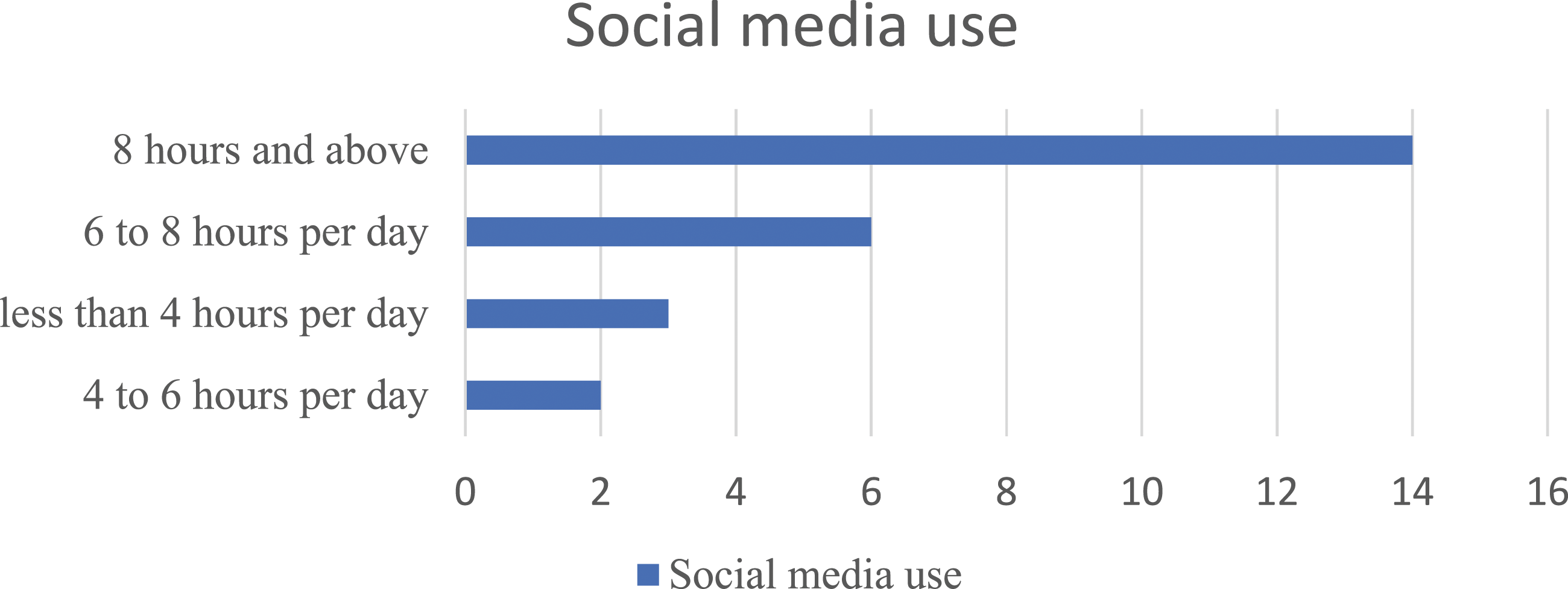
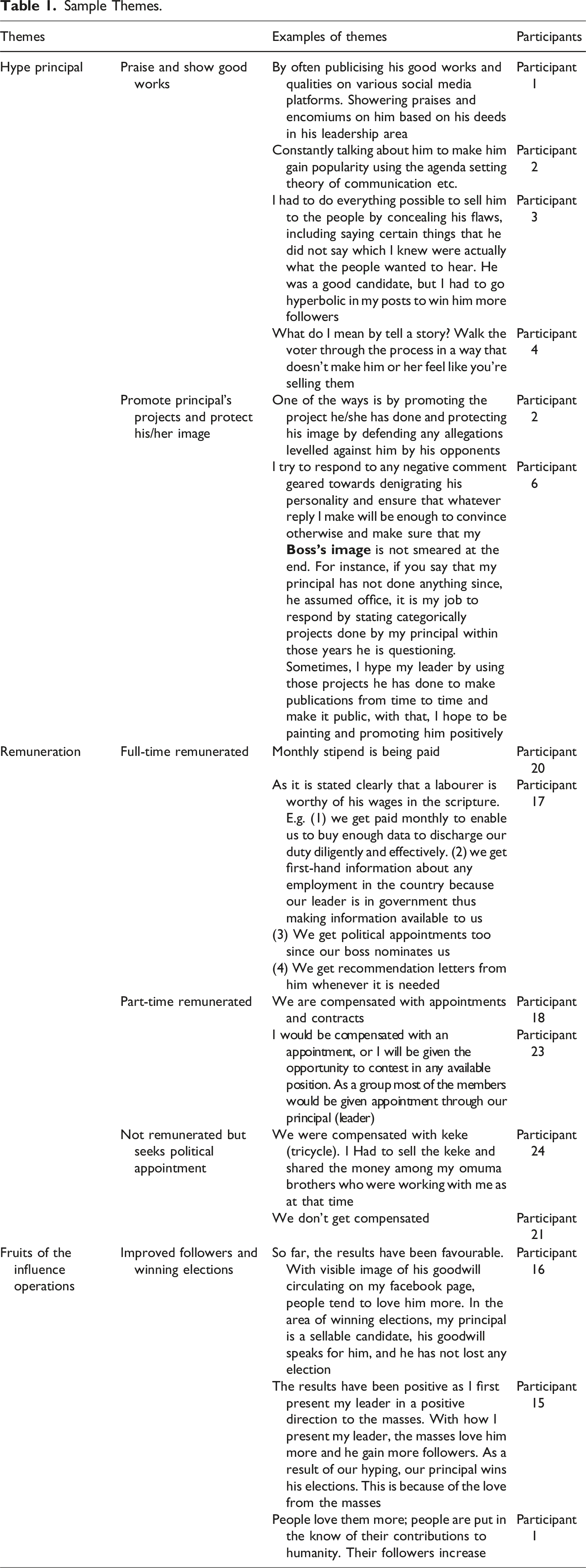
The data-driven findings revealed that participants in this study have well aligned objectives for their political promotional efforts and influence operation. Participants had a clear and consistent idea of what the goals were and the processes that lead to the success. The majority of these Data Boys had concrete ideas and purpose for which they are engaging in the influence operations. Beside the clarity of their goals and well-articulated process, concrete suggestions were also made about how current practices could be improved. For this, following the semi-structured nature of the questions, respondents highlighted their purpose, payment pattern (remuneration) and fruits of their promotional efforts. These were also conceptualised as inextricably linked due to their positive impact (for the politicians) in the art of online political influencing in Nigeria. Participants highlighted how their major goal is to hype their principals. They do this either by praising and showing the good works of their principal or promote their principal’s projects to protect the image of their principal online.
Sample Themes.
The hype-people: promoting and protecting the principal’s projects and image
The first category or theme is hyping the principal. This theme reveals that Data Boys acted as hype men and women of their principal. This category reveals that these online influencers consciously praised their principal and as well as promoted any effort that their principal made in attracting a project or completing humanitarian acts. This theme is divided into two sub-categories: praising and showing the good works of their principal, promoting, the projects and protecting the image of their principal. Participants who reported to praise and publicise the good works of their principal were clear and consistent about what constitutes praising and publicising the good works of a politician. Responses from our participants show that our respondents adopted the outward praise and positive narratives around good gestures and positive news coverage of their principal. Participant 20 noted, ‘most of the leaders are hyped through social media platforms, posts about their achievements are made and the public gets to be informed.’ The comment above shows that online political influencers adopted positive presentation of their political leader (their principal) and sensitising netizens and voters of their principals’ good nature, philanthropy, and ability to lead the people in his/her direct constituency in Nigeria. All their overtures were aimed at increasing the followership of the politician and goodwill to enable such political leaders to not only be popular but also be able to win their elections.
Like Participant 20, Participant nine also uses his posts and comments online to create awareness and to publicise his principal. He said, ‘I have helped my principal through my social media posts. I use my social media postings on Facebook to hype my boss and to showcase his stewardship and to promote his political relevance’ (Participant 9). Furthermore, Participant 24 stated how he has helped two politicians from Rivers State by sensitising their constituents in ‘tertiary institutions on the need for them to support them in their Houses of Representative and Assembly elections in 2019 and 2023’. He further noted, ‘in hyping them, I sold them to the voters. We were successful in 2019 and God willing we will prevail in 2023. My job is to publicise and promote them and that I am doing with my full chest.’ These highlighted comments show some of the strategies that the participants adopted to ‘sell’ their principals or benefactors. The participants noted that they helped their principals by creating positive narratives about their skills, personality and skill set. Participant 10 succinctly outline how they persuade voters. He said, ‘I help sell my candidate by simply posting positive things about them and their work on social media pages.’ These postings are ways that these influencers get to the mind of the voters.
The second part of the first theme is to promote their principal’s project and protect his or her image against political attacks and ‘witch-hunting’. From the comments of the participants, they are usually more forceful here. In fact, they engage in reputational attacks of their own as a deterrence from the ‘Media Boys’ of the opposing politicians. Participant 17 was referring to this sub-theme when he explained that ‘with pictures of his projects done within his/her time in office, I make a public post on all social media handles highlighting his achievements to the targeted audience with pictorial evidence.’ Similarly, Participant 16 explained how he helps rehabilitate the image of his principal. He noted, ‘the availability of modern technology has made it easy for people like me to air our views. This has proved to be advantageous move for some of us as we use the platforms to speak good of our preferred political candidate’.
The comments from these two participants show how they promote their principals’ projects and present them in good light to curry voters into their team with the purpose of swelling their ranks and to win elections. In a similar vein, in responding to how he helped his principal, Participant 13 noted, ‘one way in which I have helped improve the image of my political candidate is by publicising the constituency projects he has carried out in the past or still doing.’ Also, Participant 12 has ‘helped improve my boss’ image on social media and I also pointed out his projects as examples of his good manner nature and leadership skills’.
These comments show that participants understand their role and are delivering in their roles. They narrated how they use their social media pages such as Facebook, Instagram, and Twitter to publicise and promote their candidates by showcasing their good works and projects. The appearance of competence from the posts of the participants, improves the image of their principals in their respective constituencies. This potentially leads to increased followers and voters. It could be the difference between winning elections or not winning elections in many competitive constituencies. In describing this, Participant 22 said that she engages in ‘public publicity via my social media handle for my political leader’.
This study examines the use of social media platforms to influence and sustain the image of political leaders in Nigeria. We attempt to answer the research question: how do social media influencers use online platforms to influence and sustain the support of political leaders in Nigeria? We found already that online political influencers in Nigeria are avid social media users who are knowledgeable in covert political public relations. The participants and their craft are referred to as Data Boys in this study. This is because of the nature of their skills and what their modus operandi are, and how they go about achieving their objectives. Our data show that Data Boys would sing praises (sycophancy) as well as show-off the ‘good works’ of the principals.
Our results show that Data Boys consistently post ’news’ items online about the ‘good works’ of their political benefactor and do promote and protect their image. They do this by adopting the equivocation of identity technique, exaggerate the performance of their principal, falsify corruption cases or allegations of their principals’ opponents, and conceal the transgressions of their principals (Igwebuike and Chimuanya, 2021; Olajimbiti, 2023). Our participants stated that they conceal the flaws of their principal to enhance his chance of winning the election. Participants 3 said that much when he noted: I had to do everything possible to sell him to the people by concealing his flaws, including saying certain things that he did not say, which I knew were actually what people wanted to hear.
This finding resonates with that of other studies. For example, this study confirms that political influencing is derived from ‘image management’ (Surya and Jha, 2021). The study also illustrates that unlike the case of RT/Sputnik Swedish consumers acting as the ‘Paperboys of Russia’ (Wagnsson, 2022), Data Boys and not their followers engaged in this somewhat covert influence peddling efforts.
Results from this study also show that improved social media technologies and diffusion have increased online political influencer operations as it gives influencers access to platforms. This opinion leadership combines self-branding with a prescriber role, including messages with political content (Gomez et al., 2018). Data Boys use current mediatised communicative ecosystem to present themselves as ordinary and objective social media influencers or ‘Techno-Enthusiasts’ as a way to be trusted and to gain legitimacy (Kissas, 2022; Uwalaka, 2020). The performative logic that this ecosystem forces into platforms are emotional claims to ordinariness and sometimes, normative-moral claim to advocacy (Kissas, 2022). This ordinariness in the posts of Data Boys simplifies politics and stimulates political interests of their followers. It has been noted that frequent exposure to social media influencer contents increases perceived simplification of politics (Schmuck et al., 2022). This study indicates that social media platforms are being used for political influence operations in a way that is inconsistent with ethical public relations practices. This inconsistency with ethical public relations practice stems from the lack of transparency and honesty in their approach of online political influencing.
Remuneration: how Data Boys are paid
The second theme relates to how they are remunerated. This theme discusses how Data Boys are paid or appreciated for their influence operations. Based on our interview data, this broad theme was divided into sub-themes: remunerated on a full-time basis, remunerated on a part-time basis, and not remunerated but seek other favours such as political appointments or reference letters. Some of our participants noted that their online political influencing, which many of our participants, labelled as a ‘Media Boy’ role, is a full-time endeavour for them. These participants post, repost, and follow their principal to all the places that he or she visited; all the events that the politician attends as well as kind gestures that politician indulges. These participants then write about these events like a news story or updates without disclosing their relationship with the said political leader. Among those who are full-time remunerated are Participants 1, 4, 5, 6, 11, 13, 14, and 15. For example, Participant 14 described how they are remunerated thus, ‘my members and I are compensated well, we are more like salary earners because we receive our wages or salary after every month end. We are paid because of the services we render to our political leader’.
Others also explained how they are placed on a monthly salary and engage in online political influencer operation on a full-time basis. In responding to the question around their remuneration and benefit of their craft, Participant 1 simply said, ‘empowerment, human capacity building, monthly payment of stipends’. Like Participant 14, Participant 1 enjoys empowerment and other human capacity development that accrues to them beside their normal monthly salary or stipend. Participant 4 also highlighted that their group is paid monthly. This was like Participant 5, who in describing how he is renumerated noted, ‘me and members of my group are always compensated on monthly basis. We are more or less, salary earners because we are paid after every month, other benefits are gotten too, like jobs, gifts, being enrolled into some skill acquisition, etc’. Many of the Participants who are placed on a monthly salary also have access to other benefits such as fast-paced recommendation letter, access to information around government loan programs and the chance to be among successful applicants.
The part-time remunerated participants have similar packages to those that are in the full-time package. However, the part-timer’s stipends are paid in an inconsistent manner. They are not salaried but often given money intermittently. Participants 2, 3 and 8 are in this package. These participants, like the non-remunerated, are not too bothered by the salary. In fact, these are usually those with an ongoing job but use online political influencing as a side work to make additional money. Thus, they are not usually in need of salaries. They are more interested in other short-term programs where they can earn some money to support their salaries. This is why Participant 2 did not care much about money. He said, ‘when supporting a political leader, you don’t look at what you must gain but the potential in him. That is what drives me. Talking of compensation, we enjoy what every other citizen whom our leader is governing or representing enjoy. E.g., empowerment programs, scholarship etc’. In contrast, Participant 3 protested their lack of salary. To him, they should be placed on a salary and not paid intermittently. He noted, ‘no reasonable compensation, though we received paltry sums to subscribe for data. We were focused on what will come after our candidate wins and not what we were given at that point in time’. Although, Participant unlike Participant 2 appeared to complain about the lack of consistency in their pay, he also hinged his hope like Participant 2 on ‘what will come’ after the elections. Participant 8 also had similar sentiments. Participant 8 explained that they were fine regarding their compensation. He said, ‘we are compensated because we are here promoting the ideas of our political leader, we as a group are doing marvellously well’. Whilst not consistent, participants who are remunerated on a part-time basis still get paid but not in a full-time manner.
The last sub-theme is about participants who were not remunerated but who are given other benefits in an intermittent manner. These participants are not paid an agreed amount for their online political influencer operation. Like the part-time remunerated participants, these participants are usually full-time workers who seek other types of remuneration such as political appointment and promotion in their place of work. Having posited the above, Participant 7 is different. He wanted to be remunerated but was treated badly. He complained thus, ‘I am okay but the last group I worked with is nothing to write home about, I wasn’t compensated for the services that I provided’. Participant 7 appears to be unhappy with how he was treated in his earlier online political influencer group. His comments show that he moved from the group that did not treat him well to another group. Although he did not mention how he is faring in his current group, his ‘I am okay’ points to a better remuneration. Participant 9’s comments align with the description given above for this sub-theme. In replying to a question about remuneration, Participant 9 wrote, ‘not really but the truth is that after marketing them on social media there are other ways we are rewarded not directly compensated’. Participant 9 allude to other means of remuneration such as political appointments and reference letters. Participant 12 appeared to be angry with his principal. He noted that his principal made a lot of unfulfilled promises to the group and that due to the unfulfilled promises, he now distrusts politicians.
Fruits of online influence operations: the art of vote canvassing
The third theme relates to the results from the online political influence operations. In this theme, participants were asked of the fruits of their influence operations. The respondents unanimously narrated their success stories with the operation. From the comments of the participants, it is evident that their perceived online political influencer operations bore fruits for their principal. The Participants narrated how their postings and consistent push of positive narratives increase the following of their political leaders. Many of the respondents believe that the operations help their principals at the polls. For example, Participant 18 believes that ‘people love the leader more because of our postings’. According to Participant 18, their principals know the importance of the work that they are doing for them, hence, the compensation. He narrated how they (social media influencers) are ‘hot-cakes’ in the area of covert online political influence operations. He commented how it is usually easy for the people not to know that they are paid ‘hype men’ who are in the payroll of the politician. He noted that their writing style, such as the ‘use of third person point of view in a reportorial manner’ give their hype some legitimacy among the people. This ascribed legitimacy is the reason people believe them, hence, the increased followership.
Similarly, Participant 2 observed that people tend to pick more interest in their principals during their influence operations and that such interests help the political leaders to be competitive politically and even in their private businesses. Participant 3 concurred to Participant 2’s observation. Participant 3 noted, ‘yes, the people loved him more, though he didn’t win election, but that wasn’t his fault as his party chose a candidate by consensus’. Here, Participant 3 is of the view that his principal has become famous and accepted by the people. Although his political party chose another person as a consensus candidate, his fame still helped him in both his political life as he was appointed into a political position after the 2019 election and his personal business witnessed a boom after the election. Participant five noted that the results are positive as the voters love their political leader more. He further remarked that his principal was so popular that ‘even his opponent defected and worked with him’. He concluded by stating that his principal won his elections due to their operation.
Comments from our participants show that they observed how their postings and online influence operations helped publicise their candidates and improved the image of their candidates. According to the participants, their clients or principals had increased engagement during their influence operations. These engagements led to increase followership which increasingly helped them to perform well at the polls. This confirms why all the participants reported that their influence operations bore fruit. Even though that their success was variegated, the participants nonetheless demonstrated that their operations did not only increase the followers of their respective principals but also put them in positive light; thereby helping them to win their elections or improve their private businesses.
This finding confirms that politicians use social media platforms for public relations purposes and that influencers have seamlessly integrated brand promotions into their social media feeds (Enly and Skogerbø, 2013; Riedl et al., 2021). Data Boys’ fear of openly promoting politicians show the tension and problematic ironies of social media influence operations; and support the assertion that young people have control over influencers (Khamis et al., 2017; Pradhan et al., 2023). Abid et al. (2021) suggest that young voters perceive that mainstream political brand are not using social media to build online relationships, while this might be true, this study illuminates what might be going on. Since Data Boys work in the shadows and are in most cases paid on a full-time basis, it could be that young voters, such as those in Abid et al. (2021) may have relationships with mainstream political parties without even knowing. This is because influencers such as Data Boys in Nigeria pose as activists and ordinary popular social media users when they update their social media pages. ‘Data Boys’ pattern of payment or remuneration make it more difficult to track a covert online political influencer from an ordinary social media user.
Our findings have some implications both in political public relations praxis and practice. The covertness of the influence operations and promotional efforts of Data Boys and the politicians that they serve is anathema to the ethics and dictates of public relations practice. This study empirically confirms the fears raised by some scholars around the potential lack of transparency of social media influencers and how their covert influence operations are inconsistent with ethical ideals of public relations professionals (Davies and Hobbs, 2020). This study also shows how these covert influence operations negatively impact political public relations’ concepts of ethical dialogue and responsible advocacy (Heath, 2006a; Taylor and Kent, 2014).
This study extends understandings of the behind-the-scenes work of Data Boys. This knowledge extends the political public relations literature and provides evidence to this type of political promotions. Crucially, this study points out ethical issues that emerge when communicative capitalism (Dean, 2014) or poorly paid, gig economy workers such as Data Boys are corralled into promotional political work. This often crosses the ethical lines as these roles are performed by Data Boys without any form of reflection or sense of the consequences. But there are consequences. With the political leaders overrunning the mainstream media, and distrust of political and media institutions in Nigeria increasing, the covert influence operation will be devastating for the Nigerian flailing democracy if the people suspect that online political contents are paid for and controlled by the politicians.
In terms of practice, the study is significant as it raises ethical concerns around the activities of Data Boys. Crucially, these types of covert influence operations could backfire once the public understand the tactics, breeding cynicism and making it difficult for public relations professionals to engage with the public, particularly in political public relations. Influencers are not a professionalised field. Nevertheless, their actions could be damaging to the field of public relations as such actions could appear to be ‘public relations’. This is where the actions of Data Boys could by inimical to public relations practice, as their commodity paradigm (Boatwright, 2022) degrades the significance of online influencer praxis.
The above discussion needs to be understood in the broader conversation of politics in Nigeria, which initially was not social media-oriented but grassroot-based. At the time, social media was argued to be elite based. This initial apathy to social media pushed a narrative that is increasingly outdated as this study suggests within the broader context of elections in Nigeria. There is an assertion that elections are not won on social media but by the grassroots or what some labelled, ‘grassroots democracy’ (Serra and Pierce, 2021). Even with these scepticisms, social media platforms are applied to influence the thoughts of many young people, increasing their political awareness and cognizance, which in turn results in electoral success (Apuke and Tunca, 2018). Like this study, social media is used as a weapon to undermine and even destroy the image of political parties and their candidates, assassinate the character, and used to engage in abusive speeches against their competitors. Recently though, due to the dangers of electoral corruption, and godfatherism, social media platforms have been used to reach the middle class and the poor in Nigeria (Olarinmoye, 2008; Turnbull, 2020). This buttresses the significance of the Data Boys and their services to their principals.
Conclusion
The study examined the use of social media to brand, rehabilitate and sustain the image of political leaders in Nigeria. The study utilised online qualitative survey from 25 social media influencers in Nigeria. The study answers the research question: how do social media influencers use online platforms to influence and sustain the support of political leaders in Nigeria? Our findings were unanimous in many respects. Our data showed that online political influencers in Nigeria are avid social media users who are knowledgeable in traditional branding, marketing communication and crisis communication principles.
Comments from our participants showed that they are very skilled in the art of online influence operations and generic public relations practices. The participants reported to be online more than 8 hours a day. While this social media use may appear excessive, it however is logical. This is because their business is online, and they need to be online to draw the type of engagement that they need to ‘sell’ their political leaders or principals. Also, the majority of the participants are between the ages of 25 to 34. This age cohort is the most politically active in Nigeria. They are digital natives who recently started voting (Ohme, 2019). Voters of this age cohort are also the likeliest to be online. They are usually activists in nature and yearn for competent leadership.
Facebook was ranked as the social media platform of choice for these online political influencers. Only one participant ranked Twitter ahead of Facebook for the purpose of influence operation. The respondents mentioned that they also use other social media platforms such as Instagram, Twitter, WhatsApp and Nairaland (an online forum for Nigerians). They did use Facebook more and designed their branding efforts and influence operation with Facebook in mind. This finding is significant in that many scholars (Allen et al., 2024; Müller & Schulz, 2019) have accused Facebook of lack of control over mis/disinformation and fake news. Although online political influencers are not generally seen as fake news producers – since they declare their commercial ties to the brand that they are endorsing. Data Boys in Nigeria are slightly different. Findings of this study showed Facebook was the platform of choice and this is not surprising particularly in Nigeria where Facebook is used for digital activism, commerce, and even for news access (Alraja et al., 2020; Mutsvairo, 2016; Uwalaka and Nwala, 2022). Findings from this study further demonstrated that the participants were not ordinary social media influencers.
This study proposes a novel direction to understand covert influencer operations in Nigeria. Drawing from political public relations literature, we conceptualise the rise of Data Boys and uncover ways through which they execute their influence operations. We found that Data Boys hype their principals by equivocating of identity, exaggerating their performance, falsifying corruption allegations against their principals’ competitor while concealing cases against their principals. The study also uncovered that the remuneration of Data Boys is slightly different from those of other online influencers. This study revealed that Data Boys were paid in most cases, monthly stipends, others were paid on a part-time basis while few others were either paid intermittently or were unpaid beside political appointments and insider information. The idea of paying intermediaries is novel in Nigeria and is concerning. This study shows that this behaviour is disturbing in that when it is exposed, that it might lead to distrust to intermediaries. Historical and contextual issues illustrate that such exposition will be consequential not only to specific elections but also to the Nigerian democracy. The suspicion that online influencers are engaging in unethical and improper behaviour has led to demand of government approval for social media influencers’ contents (Riedl et al., 2023; Olaigbe, 2022; Vanguard, 2022). This development if not well managed could lead to politicians imposing what should be debated or posted online by influencers.
Our study showed that by employing social media influencers as a communicative tool, politicians and public relations practitioners can influence social networks to target publics who may not normally interact with their client or the politician. Indeed, it is increasingly apparent that the networked public sphere and its emergent issue arenas, is the ideal terrain of the social media influencer, who can openly use their networked communications power (Davies and Hobbs, 2020; Hobbs et al., 2020; Sommerfeldt et al., 2019) to act as vehicles for factual debate and respectful dialogue. However, our result shows that Data Boys are used as vehicles for covert message dissemination and other sponsored content, including some contents which could potentially go against public interest (Heath, 2006a; 2006b). We argue that instead of using their networked communicative power for factual debate and respectful dialogues, that Data Boys have been used to muddle the communication space. The study concludes that the posture of Data Boys is inimical to public relations practice as their overtly negative and monolithic view of online influence cheapens the significance of social media influencer theorisation in public relations.
Limitations of the study
This study has some limitations. Although the data for this study was from a written online qualitative survey with 25 social media influencers in Nigeria who engage in online political influencing, the findings reported in this study reflect mainly the views of these participants. A bigger qualitative sample or members of certain online political influencer groups may be different or might view themselves in as different light. Also, the fact that only one participant identified as female could be seen as a limitation to this study. As we stated earlier, these groups and their membership are male dominated than the traditional influencer profession. In this study, we did not delve too much into the ethical issues that Data Boys operations could raise in public relations. Further studies could be conducted to flesh out the ethical concerns that their operations raise. Also, the issue of the Data Boys groups could be studied in comparison to other social media influencer organisations.
Footnotes
Acknowledgements
We would like to appreciate the peer-reviewers of this manuscript for their constructive and comprehensive feedback. Their constructive comments and brilliant suggestions improved our manuscript immensely. We would also like to thank the editors for their unalloyed support, comments, suggestions, and professionalism throughout this process.
Declaration of conflicting interests
The author(s) declared no potential conflicts of interest with respect to the research, authorship, and/or publication of this article.
Funding
The author(s) received no financial support for the research, authorship, and/or publication of this article.
Ethical statement

Appendix
Participants Characteristics.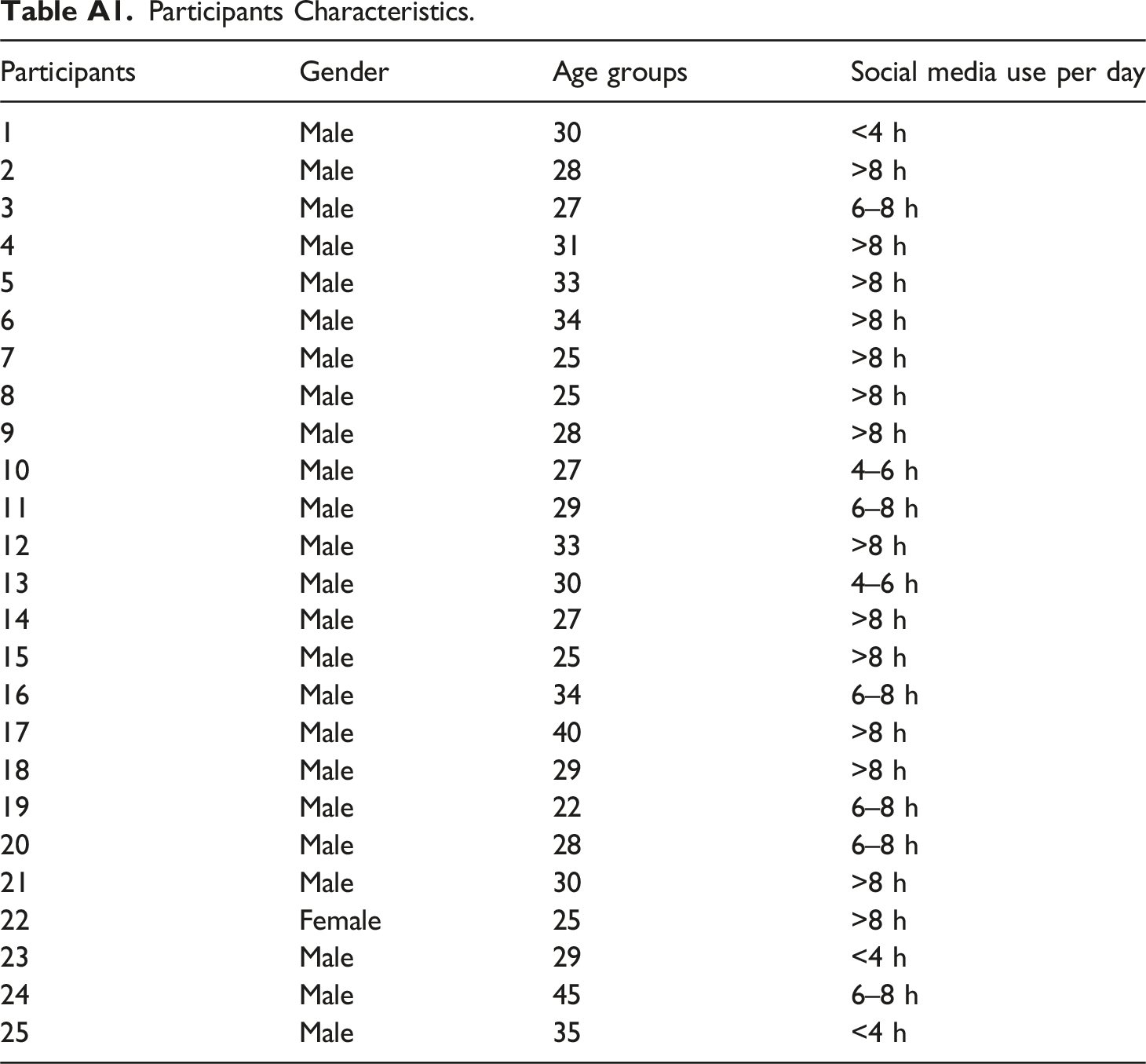
Participants
Gender
Age groups
Social media use per day
1
Male
30
<4 h
2
Male
28
>8 h
3
Male
27
6–8 h
4
Male
31
>8 h
5
Male
33
>8 h
6
Male
34
>8 h
7
Male
25
>8 h
8
Male
25
>8 h
9
Male
28
>8 h
10
Male
27
4–6 h
11
Male
29
6–8 h
12
Male
33
>8 h
13
Male
30
4–6 h
14
Male
27
>8 h
15
Male
25
>8 h
16
Male
34
6–8 h
17
Male
40
>8 h
18
Male
29
>8 h
19
Male
22
6–8 h
20
Male
28
6–8 h
21
Male
30
>8 h
22
Female
25
>8 h
23
Male
29
<4 h
24
Male
45
6–8 h
25
Male
35
<4 h