



Abstract
Although there is evidence that perceived authenticity has a positive impact on corporate reputation, the implications of authenticity in activist communication for social change have not been addressed. Within a sociocultural theoretical approach this paper provides an ethnographic account of how and why human rights activists enact authenticity and aims to better understand the implications of authenticity in activist communication oriented towards social change. An ethnographic study was carried out during 6 months, with two human rights activist organizations. In addition to participant observation, documents produced by the organizations were also analyzed and twenty-five semi-structured interviews were carried out. The role of authenticity in the public relations activities of this organizations was observed at two main levels: (a) as an intentional strategic choice and, (b) as a challenge or resistance to dominant discourses. Findings place authenticity as a strategic component of activist public relations illustrating the contributions of the field for civic participation dynamics.
Introduction
The relevance of what contributes to generating perceptions about authenticity in the study and practice of strategic communication 1 is recognized (Molleda, 2010). However, although the concept of authenticity has been researched within the scope of corporate strategic communication oriented to the market, brands, and consumption dynamics (Beverland et al., 2008; Gilmore and Pine, 2007; Leigh et al., 2006) studies on authenticity related to strategic communication for social change are not easily detectable.
French philosopher Gilles Lipovetsky claims that the “authenticity fever” has gripped our age (Lipovetsky, 2022: 9). In today’s promotional culture, audiences themselves use promotional techniques to intentionally manage their identity and image. Current organizations relate to ‘knowing’ audiences, “which demands authentic rather than instrumental communication” (Aronczyk et al., 2017: 5). According to the 2022 Global Communication Report, “The Future of Corporate Activism, (p. 25) 1 ” the most important component of an effective purpose driven campaign is “authentic messaging”.
This paper conceptualizes activist public relations (Demetrious, 2011) within the theoretical framework of symbolic interactionism (Blumer, 1971). An ethnographic study was carried out between January and June 2021, with two Portuguese organizations that defend human rights. In addition to participant observation, documents produced by the organizations were also analyzed and twenty-five semi-structured interviews with human rights activists were carried out. The data were analyzed with the aim of answering the following research question: What is the role of authenticity in the public relations (PR) activities of human rights activist organizations?
Findings suggest that the role of authenticity in the PR activities of human rights activist organizations was observed at two main levels: (a) as an intentional strategic choice and, (b) as a challenge or resistance to dominant discourses.
The article’s conclusions place authenticity as a strategic component of activist public relations associated with an ontological dimension that justifies the very existence of these human rights activist groups. The paper provides ideas to better understand PR activities in their subjective dimension of managing perceptions and to problematize the issues of power in communicative processes.
Activist public relations and the dimensions of authenticity
Daymon and Demetrious (2014: 15) defined public relations as “a communicative activity used by organizations to socially intervene in and between competing discourses in order to facilitate a favorable position within a globalized context”. This definition emphasizes the political dimension of the activity in its attempt to intentionally influence the meaning making process and symbolic interpretations. Theoretically, this position is anchored in the ideas of the symbolic interactionism school of sociology (Blumer, 1971). In symbolic interactionism human behavior is believed to result from the interactions between people and their use of symbols to co create meaning and this is at the center of the theoretical origins of public relations (Braun, 2015; Gordon, 1997; Hallahan, 1999).
Activist public relations are defined as (Demetrious, 2011: 1): “a focused view of communication activity by politicized third sector groups such as social collectives, community action groups, and nongovernmental organizations (NGOs) to foster their public legitimacy as voices for social change. (…) This voice consists of activists employing strategies, tactics, and especially worldviews to challenge dominant positions”.
In the last decade, activism has received more attention in public relations research within critical and sociocultural theoretical traditions (Adi, 2019; Ciszek, 2017; Coombs and Holladay, 2012a, 2012b; Demetrious, 2011; Holtzhausen, 2012; L’Etang, 2016). The sociocultural perspective claims that public relations are not simply an organizational instrument, but a meaningful way of examining the expanding uses and influence of public relations in its social, cultural, and political dimensions (Edwards, 2018).
A central and consensual element of public relations is that they serve to generate trust and engagement between an organization or individual and its publics. Developing trust is a crucial component in authenticity, and also involves the “perception of open and verifiable communication, or transparency” (Gilpin et al., 2010: 261). However, “one cannot become trusted by asking for trust” because trust is at the base of interpersonal relationships but has to be verified by experience (Dimitrov, 2020: 13).
When we talk about communication for social change that deals with complex social issues of public interest, like activist communication, conflict and tension are present and serve to build “contestation and dialogue” (Ganesh and Zoller’s, 2012: 85). In this context, the perceived authenticity of the social actors involved - which is fundamental to the trust needed to generate public engagement - becomes fundamental (Furco, 2010). But the concept of authenticity is slippery for its diverse philosophical and ethical approaches. This article concentrates on the analysis of authenticity from two lenses: identity and relational. The identity approach “refers to the construction of the self - be it personal, celebrity, fictional or organizational” - and leads to self-reflection and questioning about ‘who am I honestly at my core?’ (Motion et al., 2016: 57). However, identity and the self are not static notions (our 20-year-old self will certainly be different from the 50-year-old). The ‘true self’ is a fluid process affected by several contextual variables, and the notion of authenticity is also a social construction – even necessary in some situations and professions - hence it is so easily distorted or misunderstood (Motion et al., 2016).
The relational perspective focuses on interpersonal relationships and between various social actors. It has a strong subjective and perception management component because it asks what it is like to be in the world if we are being authentic and what consequences can come from this. Existentialist philosophers argued that authentic relational behavior implies “rejecting peer pressure to conform, which may take the form of active resistance to authority” (Motion et al., 2016: 58). That is, inauthentic behavior will be compliance with certain social rules for fear of being rejected. The second approach to authentic relational behavior involves a conscious and moral commitment to being true to oneself and others. Inauthenticity in this case involves a deliberate intention to deceive and manipulate others appearing to be or offering something that is false (Motion et al., 2016). The authentic relational approach in organizations is also associated to the process of acknowledging the organization’s own identity that is created and maintained through symbolic interactions (Shen and Kim, 2012). In this sense, authenticity is perceived as a continuous “multidimensional construct” (Shen and Kim, 2012: 373).
This is both a challenge and an opportunity for public relations because in the realm of socially mediated authenticity the notion of purpose, deliberate and/or strategic intention will be at the base of what is communicated (content and form) and perceived as authentic. Gilpin et al. (2010) suggested a preliminary model of authenticity in the public sphere discourse as conducted via social media that includes four dimensions: authority, identity, transparency, and engagement. Authority is based on perceived legitimacy and refers to the recognition of a social actor as a specialist, an expert to speak or write about a certain topic. To this extent, sources of information will be more authentic if they are recognized as authoritative. Identity is extremely contextual and need to be analyzed through specific interactions and temporalities. Identity considerations are closely linked to the perception of transparency. But even fluid identities are assessed as authentic if they maintain narrative coherence over time (Ricoeur, 1985; Somers, 1994). Transparency refers to the openness of communication. It is observed, on the one hand, in the sharing of information to provide adequate knowledge allowing publics to make free and informed choices. And on the other hand, when the communication is open to public scrutiny and verification by independent institutions. Engagement in public relations has been associated with the concept of community, in the perspective of belonging to a collective. Communication in this sense is a shared group activity and not just information sharing. Authenticity in this dimension implies a participatory interaction based on reciprocity as a way of “engaging and nurturing stakeholder communities” (Gilpin et al. 2010: 266).
Johnston and Lane (2019: 45) also studied the concept of community engagement (CE) in public relations activities by addressing the under-considered yet central role of authenticity in CE. The authors identified three fundamental dimensions for community engagement activities to be considered authentic. The first has to do with the content of the messages, which must reflect the following attributes: factual (true); consistent; social significance; genuine (in the sense that it is what it says it is); orientation toward other (good will) and moral character, integrity. The second dimension is related to the source (person) and includes elements such as: expectations (they act in accordance with community expectations), honesty and, representation (are they who they say they are).
The third dimension of authenticity in community engagement concerns processes and includes the following attributes: transparent and open, follow through (two-way communication flow), trust, legitimacy and, adequate channels.
Although there is evidence that perceived authenticity has a positive impact on corporate reputation (Lim and Young, 2021), the implications of authenticity in activist communication oriented towards social change have not been addressed.
The role of authenticity in human rights activist communication
The Universal Declaration of Human Rights implies a wide variety of very divisive and controversial other rights that have brought together diverse communities of social and political activists with their own agendas in the field of human rights (Clapham, 2015; Moyn, 2010). Activists are the main actors in social movements, developing a type of collective action that implies a collective identity 2 and engagement in cultural and/or political conflicts (Della Porta and Diani, 2015; Millward and Takhar, 2019). Activism and social movements can be considered as a form of public relations work concerned with advocacy, promotion, events, lobbying and public affairs, engaging with a diverse range of audiences, clearly oriented towards social change and for the achievement of idealized goals. Public relations can, therefore, be understood as an intervention aimed at collective action (L’Etang, 2016).
Alain Touraine (2009) argues that a new social thought is needed that considers people’s self-awareness in their desire to free themselves from deterministic notions of good and evil defined by institutions in the past. In his critique of what he calls the “Dominant Interpretive Discourse”, the author argues that the principle that allows the evaluation of the behavior of individuals and groups is the recognition of the rights (political, social, and cultural) of all human beings, considered as free and equals. Activists in the field of human rights seek to destabilize dominant discourses and provoke disruption in social structures that generate inequalities and injustice.
When activists position themselves as “feminists, pacificists, anti-racists, environmentalists, animalists and so on” the notion of authenticity is implicit (Motion et al., 2016: 60). Not only are they coming out from an identity point of view, but they are also sending a message about their beliefs that will impact and shape their personal and organizational relationships and this can represent a high risk of marginalization or social stigma.
Activists resort to interest alignment to create bridges and generate identification with different publics. Activist groups identification strategies include sympathy (when a person or organization presents itself as sharing values, concerns, and interests with its audiences), antithesis (a call to unite with audiences to fight a common adversary), and unawareness (“where dissimilar people with disparate interests are brought together under an assumed or transcendent ‘we’”) (Sommerfeldt, 2011: 88). Sommerfeldt (2011) discovered that the strategy most used by activist groups to create identification with their audiences is antithesis, that is, they often adopt a reactionary and confrontational stance against what they consider needs to change.
In modern societies trapped in the conformity of an excessive positivity in which authenticity has become “a selling argument” (Han, 2018: 29), the implied authenticity of activist groups communication is related to the risks they run and the indignation and hope they share (Castells, 2012).
Methodological design
Following an “epistemology of subjectivity”, an interpretive approach is the one that best fits the presuppositions of this investigation (Burrell and Morgan, 1979: 3). This approach is based on the need for a deeper understanding of the essence of the world as it is, not excluding the nature of subjective experience inherent to individuals and the relational dynamics that are established between them (Burrell and Morgan, 1979).
Investigations oriented towards critical and sociocultural approaches to public relations tend to favor the co-creative approaches to communication, using ethnographic methodological frameworks (Everett and Johnston, 2012; L’Etang et al., 2012). In public relations research, ethnography will examine how a group understands and experiences its environment and how it seeks to adapt to that environment (Sutton and Anderson, 2004). Ethnography involves the cultural process. It is a qualitative method for data collection based on “participant observation (experiencing), interviewing (enquiring) and studying materials prepared by others (examining)” (Wolcott, 2008: 48–49). The data obtained through ethnographic work and interviews were analyzed through an inductive lens based on a thematic categorical analysis, this is, the categories and indicators were drawn from existing literature and previous research (Neuendorf, 2016).
Data collection for this study took place between January and June 2021, for 6 months, with two Portuguese organizations that publicly assume themselves as activists working within the global scope of human rights and the United Nations 2030 agenda – União de Mulheres Alternativa e Resposta (UMAR) 3 - Alternative and Answer Women’s Union and Grupo de Ativistas em Tratamentos (GAT) 4 - Portuguese Activist Group for HIV/AIDS.
União de Mulheres Alternativa e Resposta is a Non-Governmental Organization (NGO) founded in 1976. It is an association dedicated to awakening feminist consciousness in society. União de Mulheres Alternativa e Resposta works within the scope of universal human rights and the UN 2030 Agenda, namely on the fifth objective: achieve gender equality and empower all women and girls. Grupo de Ativistas em Tratamentos is also a nonprofit NGO founded in 2001. Works with groups of people infected by HIV or at risk (migrants, prisoners, sex workers, drug users, gay men, and others). Grupo de Ativistas em Tratamentos advocates for legal and political changes within the scope of human rights and the 2030 Agenda, namely the third objective of the United Nations Sustainable Development Goals: ensure healthy lives and promote well-being for all at all ages.
During all stages of ethnographic research ethical concerns associated with the relationship observer–participant need to be addressed (Fetterman, 1998). In this regard, an informed consent form to participate in the research was signed by the directors of the two organizations, with the presentation of the objectives and associated protocols. The interviews were recorded with the permission of the interviewees. All virtual and face-to-face interactions were documented in each organization’s field diary, and all the recorded interviews were transcribed by the researcher as they were undertaken (Baszanger and Dodier, 2004).
Data related to participant observation - União de Mulheres Alternativa e Resposta
In addition to participant observation (January-June 2021), documents produced by UMAR 5 were also analyzed and nine semi-structured interviews with activists were carried out (online and offline). In total about 848 h were spent with participant observation at this organization (average of 4 h per day), during which 30 events and visits (virtual and face-to-face) were monitored. The organization’s activity on social media was also examined, in a total of 62 posts on Facebook and 13 on Instagram (online social networks where the organization is present). União de Mulheres Alternativa e Resposta field diary resulted in a document with 196 pages.
Data related to participant observation – Grupo de Ativistas em Tratamentos
In addition to observation (January-June 2021), documents produced by GAT 6 were also analyzed and 16 semi-structured interviews were carried out (online and offline). In total about 848 h were spent with participant observation (average of 4 h per day), during which 12 events and visits (virtual and face-to-face) were monitored. The organization’s activity on Facebook (social media where it was most active) was also examined, in a total of 30 posts. GAT field diary resulted in a document with 140 pages.
Through ethnographic immersion, a very high volume of data was obtained, which required a careful selection process for meaning units. For this article, the ethnographic analysis and the interviews made it possible to identify, at first, the public relations activities that each activist organization practice associated with certain issues/topics. In a second moment, it was examined whether these activities focus more on approaching authenticity through the lens of identity or through the relational lens. That is, if the activists’ PR actions indicate a framing of the issues more oriented towards reflections on the construction of the self, or if these actions mainly focus on interpersonal relationships between various social actors. In a third moment, discourses and actions were analyzed to detect the dimensions and attributes of authenticity identified by Gilpin et al. (2010) and Johnston and Lane (2019) and to understand whether new dimensions or attributes become visible in the communication dynamics of these activist organizations.
The data were analyzed with the aim of answering the following research question:
How and why do human rights activists promote authenticity in their communication culture and PR activities?
Findings
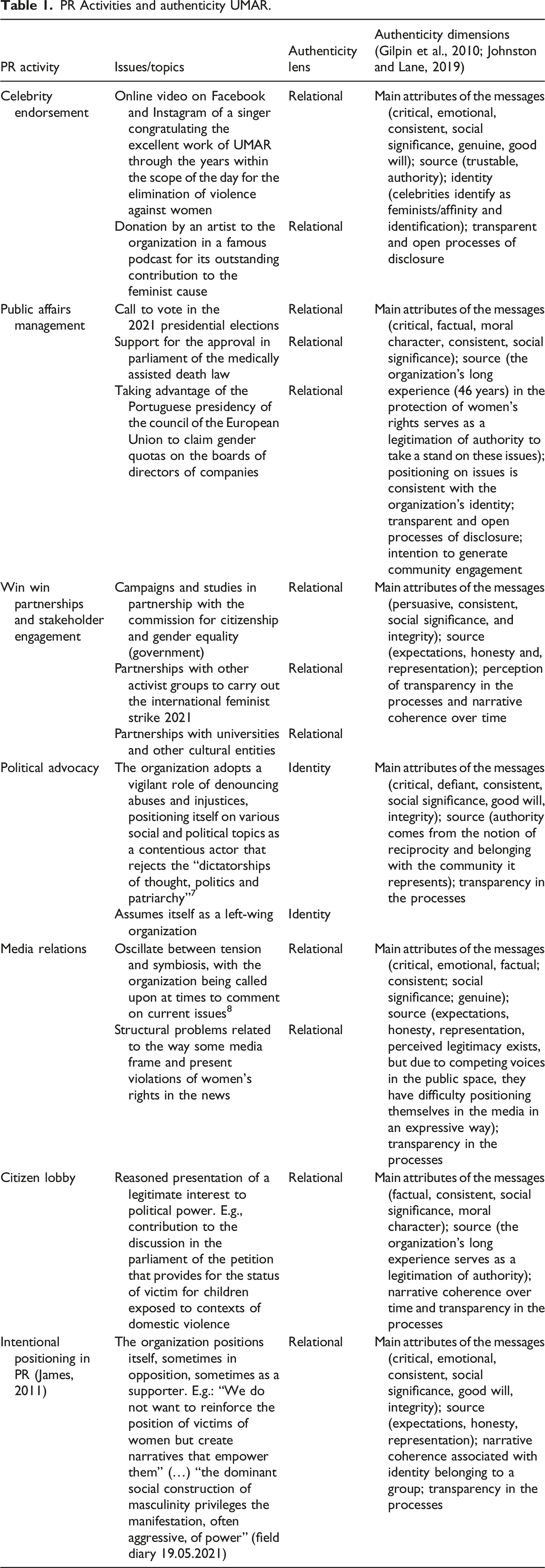
PR Activities and authenticity UMAR.
PR Activities and authenticity GAT.
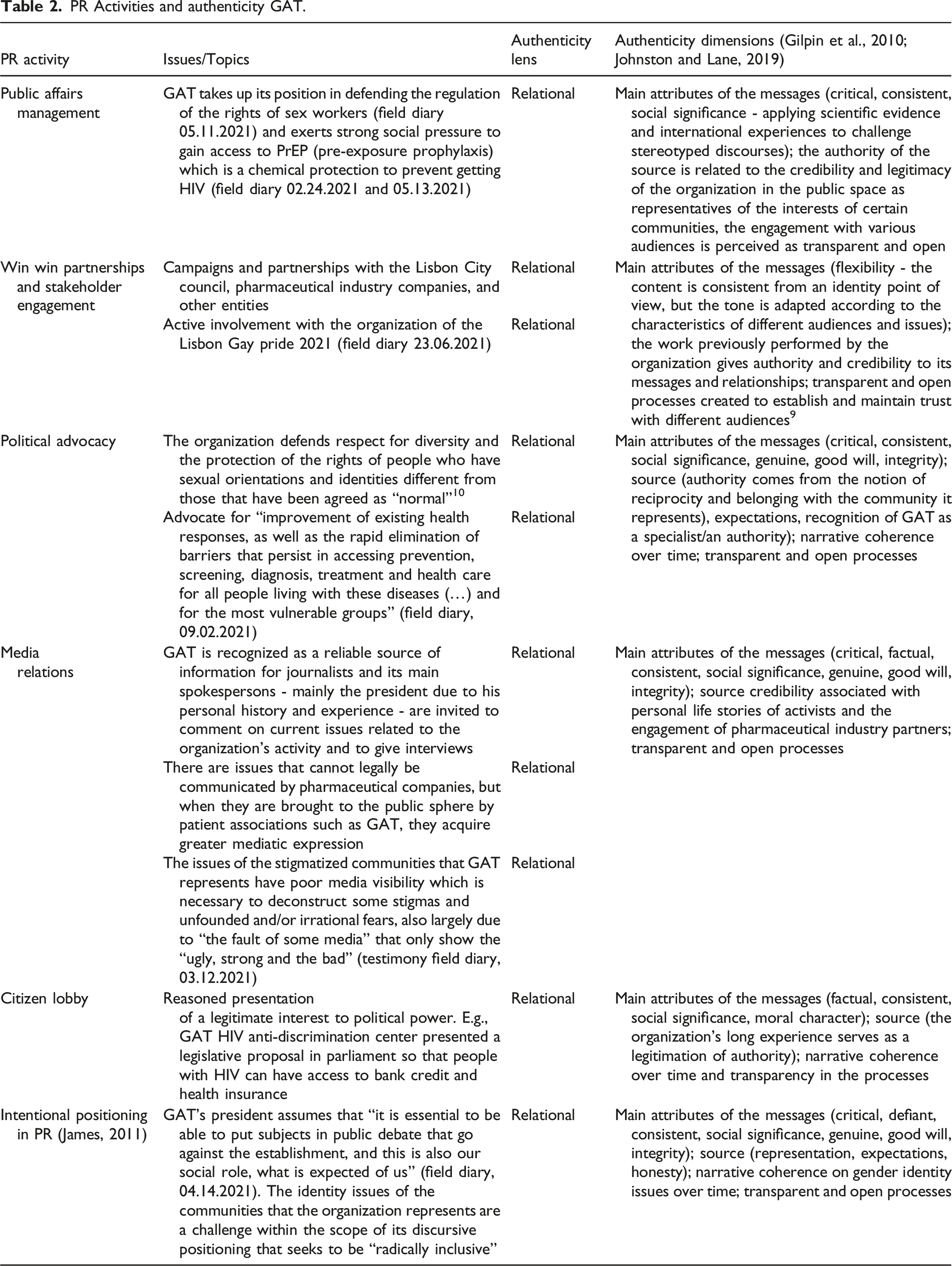
From the point of view of organizational identity and culture, the results indicate significant differences and similarities between the two organizations, related to their specific social missions, their origins, and their time of existence. With regard to the “target” of activism, both organizations highlight the complexity of trying to establish rigid boundaries between social and political activism. That is, they predominantly practice cultural and social activism, not aligned with specific political parties (despite UMAR assuming itself as a left-wing organization), which seeks to transform society through proximity to communities. However, their activities are also oriented towards the government and political reforms. The two organizations position themselves as defenders of democracy: “I don’t believe in reforming mentalities, I believe in reforming the system within democracy and the rule of law” (Interview with Luís Mendão, President of GAT, 14.04.2021). “Without memory there is no future. As feminists, we must fight until the end for freedom, social equality in diversity and democracy” (Testimony of UMAR activists within the scope of the International Holocaust Remembrance Day, 27.01.2021).
The two associations recognize the importance of communication and assume their weaknesses in this area, which they relate to the lack of human and financial resources. When talking about strategic communication, the first spontaneous discursive associations go to areas with more visible and relational results such as media relations, social media management and celebrity endorsement (field diary notes GAT, 12.01.2021; UMAR, 15.01.2021, 11.03.2021).
Though, during the observation period, different activists from these organizations recognized other areas in which they could benefit from a strategic approach to communication and relationships with different stakeholders. This is the case of the preparation of arguments and dossiers for presentation to policy makers (Umar field diary, 07.05.2021), planning and execution of authentic advocacy campaigns (GAT field diary, 12.01.2021), fundraising (UMAR field diary, 11.03.2021), public affairs management (GAT field diary, 23.02.2021), attracting talent: “We need people who authentically identify with our causes” (GAT field diary, 12.01.2021), and strategic use of democratic tools of participation (GAT field diary, 03.03.2021). It is from this perspective that celebrity endorsement supports authentic communication. While in commercial contexts it is necessary to pay or entice celebrities and influencers to publicly support the product, service, or idea, in the case of activist organizations this endorsement arose through a spontaneous (unsolicited) identification with the organization’s activities and messages.
With regard to media coverage processes, both organizations reveal concerns about adapting to the media logic (Altheide, 2004), and are also influenced by this logic. In the context of each organization, there is competitiveness to capture media attention. Considering that the current media ecosystem works based on the “attention economy”, this represents an opportunity and an added challenge for activism (Stoeckle, 2019: 279). Because it is easier to trigger a momentum of focus on a given topic, but it is more difficult to sustain this momentum over time, and this can jeopardize the perceived authenticity of communication (Stoeckle, 2019).
On the one hand, there is an intricate news production culture with a closed network of influences that does not encourage activists to approach traditional media, discouraging innovation and creativity in collective action narratives and repertoires. This journalistic culture tends not to generate news whose voices are outside the predictable institutional elites. Furthermore, there is a perception among the activists who participated in this investigation that the media tend to represent them as “radicals” or “crazy”. “I could consider myself a radical person, because I try to go to the root of issues that I consider to be wrong in society and that I try to subvert through my discourses, my work, etc. And, in the media, this is all put in the same bag” (Field interview UMAR, 01.04.2021). “It is essential that issues are put up for public debate that may go against the establishment, with elevation, and that the groups that bring them up are not immediately labeled crazy” (Field interview GAT, 14.04.2021).
Discussion
Authenticity as an intentional strategic choice
This article relates the dimensions of authenticity identified in previous research with the different public relations activities practiced by activist organizations that advocate for human rights. Authenticity appears in this context as a construction of cultural identity based on the relational experiences between various social actors. The experience and intention factors are what distinguishes an artificial social construction from an authentic communication based on “trustworthiness, originality and spontaneity” (Enli, 2015: 1). The communication initiatives of the activist organizations studied mix different dimensions of authenticity identified by Gilpin et al., (2010) and Johnston and Lane (2019), but the highlighted attributes change according to the PR activities, the type of publics and the issues being addressed.
This suggests an emergent communication strategy that focuses on flexible strategic learning, considering complex interactions and uncertainties. Strategic planning is not always about projecting the future, but also maintaining a strategic presence in everyday choices (Heath et al., 2018). In this sense, “all public relations activity is strategic” (James, 2009: 111).
In strategic communication and public relations, the objective is “positioning an idea, a persona, a political ideal, an ideology” in the minds of audiences (James, 2014). Public relations are comprehended as “purposive, persuasive strategic organizational communication” (Stoeckle, 2019: 279). Habermas’s (1984) concept of ‘communicative action’ - that involves two-way dialogical communication oriented towards consensus - was theorized as legitimate, this is, an authentic approach to negotiation in the wider public interest in opposition to strategical approaches. But this ideal discourse conditions were considered problematic to achieve in the context of critical public relations theory (Ciszek and Logan, 2018; Davidson, 2016; Ganesh and Zoller, 2012) since strategic attempts to persuade are apparently unavoidable in contemporary mass promotional cultures (Bakir et al., 2019; Fawkes, 2007; Müller, 2023).
The authenticity attributes present in the PR activities of the activist organizations examined are an intentional strategic choice that allows them to maintain trustful relationships with different stakeholders on different issues over time. The fact that authenticity is a strategic choice does not mean that it is not genuine and honest, on the contrary, it means that these organizations realize that authenticity is an intangible strategic asset based on essential identity values.
This approach to authenticity also impacts their reputation since both organizations are respected and recognized (publicly in mainstream media and social media) by government entities and other stakeholders as an example of good civic collaboration and social service. Even if these entities do not entirely agree with the ideological alignments of the organizations, they recognize the social impact of their actions, and this gives them legitimacy to operate. This illustrates Molleda’s (2010) statement that “authenticity claims of media products does not only reside in encoders or creators, but also in decoders or interpreters” (p. 228). To this extent, there is an understanding of their publics and stakeholders as critical individuals and entities that perceive and evaluate their authentic relational behavior involving a conscious and moral commitment to being true to their selves and others.
For example, when UMAR assumes itself as a left-wing feminist organization, it is making a strategic decision in line with its ideological convictions, knowing that it will attract certain publics and alienate others. This type of positioning, that does not intend to please all publics is recognized as consistent and authentic. In this case their political advocacy initiatives are more related to the identity lens of authenticity that leads to self-reflection and questioning about ‘who am I honestly at my core?’.
The management of the collective identities of activist groups needs to articulate the framework of social injustices and action structures, in order to clearly distinguish “us” from opponents, using various strategic and tactical decisions (Horowitz, 2017; Polletta and James, 2001). The identity of the individuals and organizations analyzed – and their perception of the power they have to change reality – is constructed in opposition to what they consider to be social injustices, being the main reason for the solidarity at the origin of their collective action. Identification and affinity with causes and issues appears therefore as a communication strategy that allows this activist organizations an “indirect targeting of publics through the mediation of influencers” (Dimitrov, 2020: 14).
Authenticity as a challenge or resistance to dominant discourses
On the other hand, the analysis of the links between the PR activities of the organizations and the dimensions of authenticity, place perception management at the center of activist communication strategies. Robert Leaf (2014) who has been at the forefront of the PR industry for almost 50 years, states that perception management is the main differentiating aspect of PR in the current context of the 24-h news cycle, and constant information flows on online social networks. This approach has a strong subjective component because it asks what it is like to be in the world if we are being authentic and what consequences can come from this.
In the case of the communication of these activist organizations, new attributes of the dimensions of authenticity emerged. In addition to the attributes identified by Johnston and Lane (2019) that were more salient in certain issues and activities, 11 the content of the messages, reveals new attributes such as: critical, emotional, persuasive, and defiant.
Activist organizations operate in the context of a communication that is essentially critical – oscillating between indignation, astonishment, and hope. Emotions are among the structuring elements of the discourse of these activist organizations, present as mobilizing factors of the broader social movements that they integrate, of their media coverage and of the public policies they seek to impact. The contents of the organizations’ messages indicate that they can operate within the realm of strategic consensual persuasion (Bakir, et al., 2019). The defiant attributes of some messages place these activists in the role of “communicative rebels” (Weder, 2021: 191). The flexibility attribute appears in the contents of GAT messages mainly with regard to activities related to the establishment of strategic partnerships showing a concern in adapting the different contents to the type of activity, publics, and issues. This adaptation does not mean conformity, it suggests a strategic concern with how each audience will be able to engage with the messages.
The source (Johnston and Lane, 2019) and identity (Gilpin et al., 2010) dimensions appear very close in terms of meaning in the analysis performed. The representation of the source as belonging to a certain community makes it a legitimate advocate of its interests and is recognized as authentic. Collective identity is fluid and relational, emerging from different kinds of interactions. It directs words and actions, allowing some claims and initiatives, but delegitimizing others and providing categories by which individuals divide and understand the social world (Polletta and Jasper, 2001).
Authenticity in these organizations is closely related to their social role and collective identity, that is, to improve systems and institutions and to challenge or resist dominant interpretive discourses. This kind of discourses describe a set of representations that “sometimes even succeed in making us accept as natural and objective what is no more than a product of some free-floating construct of social reality” (Touraine, 2009: 17).
Authenticity is implicit in these groups’ quest to shape and disseminate representations of social life. Considering that the representations of social life have been created to legitimize the discourses of those who already hold power as they “create the explanatory language that best suits their purposes” (Touraine, 2009: 3). Since there is evidence of the links between perceived authenticity and reputation (Lim and Young, 2021), the need to manage perceptions is thus also at the heart of the communication activities of activist groups. The balance of influence inherent to public relations practices can be seen as games of strategy influenced by the perceptions that the different players involved in the interactions have of each other (Murphy, 1991; Harrebye, 2016; Hasenfeld and Gidron, 2005; Lichterman, 1996; Taylor, 1989).
Authenticity appears in this research associated with the notion of purpose, deliberate and/or strategic intention to communicate something that actually exists without having to ‘speak’ directly about it. There is no appropriation of the language of authenticity by these organizations. That is, there were no discourses that claim that “we are authentic” as opposed to others that are “false”, in line with Gilmore and Pine observations (2007: 90) that: “If you are authentic, then you don’t have to say you’re authentic”.
Instead, these organizations implicit authenticity is associated with the risks and sacrifices inherent to their social functions so that human rights continue to be a “counter domination discourse” (…) “redefined in a way that mobilizes people to struggle for emancipatory rather than oppressive projects” (Perugini and Gordon, 2015: 1).
Implications section
Current research findings are significant for PR practice in the nonprofit context by helping human rights activists better understand and implement a strategic approach to their communication dynamics. Better understanding authenticity for activists can also contribute to establish bridges between the corporate world and social movements, since communication for social change is transversal and requires the contribution of various collective intelligences. Companies and brands are also being challenged by new activist audiences and they need to understand them better.
It extends PR theory demonstrating the valuable qualitative insights, that ethnography – a research approach underused in the public relations field – can bring to understand a context (activism), a situation (promoting social change), and the role of communication (authenticity purpose of message). The findings have demonstrated how authenticity is deliberated in these activist organizations’ strategic choices for actions and communications and how these change across situations. This allows an expansion of the notions of strategy, different from those provided by other functionalist approaches fostering a deeper and more critical understanding of PR uses and influence on society.
Conclusion
At a time of growing inequalities observing the relevant contributions of PR to social change represents a challenge and an opportunity in listening and responding to what values and emotions inspire and motivate people to relate to each other. Current research results reinforce Dimitrov’s (2020) observation that “there is a growing number of stakeholders who need the help of PR with such invisible – and invincible – strategies of resistance, survival, meditation, affirmation and rebound” (p. 18).
It was possible to obtain an ethnographic account of how and why human rights activists enact authenticity. Their communication culture and PR activities promote authenticity at two main levels: (a) as an intentional strategic choice and, (b) as a challenge or resistance to dominant discourses.
Authenticity as an intentional strategic choice is associated with an ontological dimension that justifies the very existence of these activist groups. That is, authenticity is implicit in everyday strategic choices of these organizations because of their social function, allowing them to maintain trustful relationships with different stakeholders on different issues over time. Authenticity as a challenge or resistance to dominant discourses implies considering emotions as driving forces of strategic thinking, traditionally more associated with rationality. This can be a strength in the PR activities of human rights activist organizations if they manage to structure their initiatives in a broader reflexive and self-reflexive framework.
This investigation shares the limitations of qualitative research, particularly ethnography. The methodological choices are not intended to be representative of the great diversity that exists within human rights activist organizations. Furthermore, ethnographic studies are limited in time and space. These limitations also open up a wide range of possibilities for future studies that intend to interpret intersubjective meanings about the communicative process. More research is necessary on the specificities of activist public relations in different contexts, particularly on the effectiveness of their strategies, that is, assessing whether activist PR has impacts (and which ones) on power dynamics and whether they manage to achieve the social changes they propose.
Limitations and future research
Despite the limitations inherent to the analytical application of such a subjective concept as “authenticity”, situating it as a strategic component of activist public relations - based on an inductive analysis of empirical data - illustrates the contributions of the field for civic participation dynamics that is fundamental to strengthen democracies.
Without a study of the audiences or stakeholders of these organizations, it is difficult to objectively know that the strategic communication work undertaken by the two human rights organizations is in fact perceived as authentic. Therefore, in future research it would be interesting to verify both assessment of the organizational crafting of the message and its audience/consumer/stakeholder reception. Even so, the data obtained disclosed that the consistency between discursive choices and the actions of organizations over time tends to generate relationships of trust and public recognition of the authentic value of the social impact of the work of these activists. It is as if we could say that the public demonstrations of appreciation for the work of the organizations over time is worth a thousand words in terms of “decoders” perceptions (Molleda, 2010: 228). And the work of public relations in this context is to communicate concrete actions framed on resistance and alternative visions of social reality.
Footnotes
Declaration of conflicting interests
The author(s) declared no potential conflicts of interest with respect to the research, authorship, and/or publication of this article.
Funding

Notes
Author biography