




Abstract
This article analyzes communication practitioners’ accounts to interpret what power effects the strategy discourse has on their ‘way of seeing’ themselves and their work. Through an analysis of 26 interviews with communication practitioners, the findings show that strategy, understood as a discursive body of knowledge, has empowered practitioners by enabling them to produce an understanding of themselves as worthy ‘strategists’ possessing unique expertise and competencies essential to their organization, and empowered them to claim intra-organizational power and power over others. The article empirically shows how practitioners engage with the strategy discourse to construct accounts of themselves and their work, and makes a theoretical contribution by exemplifying the problematizing potential of the strategy as discourse perspective by discussing the power effects strategy has on the profession and practice. Thus, the article complements classical and emergent perspectives on strategy in public relations and strategic communication by offering an approach more attentive toward the constitutive effects of strategy on the practice of public relations and strategic communication.
Introduction
Within public relations and strategic communication research, working strategically is generally promoted as the desirable way of working. Already 30 years ago, influential research outputs such as Grunig and Hunt (1984) and the seminal Excellence project (Dozier et al., 1995; Grunig, 1992) paved the way by promoting a strategic approach toward public relations and communication management. In the late 1990s and early 2000s, several research articles began addressing the importance of coming to grips with the concept of strategy in relation to communication management, emphasizing the importance of thinking and working strategically to gain access to the dominant coalition (e.g. Bütschi and Steyn, 2006; Simcic Brønn, 2001; Steyn, 2002, 2004, 2009; Tibbie, 1997). Then in 2007, strategy was thrusted to the forefront as the influential text Defining strategic communication (Hallahan et al., 2007) stated that the concept strategy is pivotal to the field and must be studied broadly.
However, while strategy and strategic work has been in the limelight for almost four decades, and the interest continues to grow, Frandsen and Johansen (2015) have noticed that it is still considered somewhat of an unknown terrain – a ‘black box’ researchers know little about. In recent years, public relations and strategic communication researchers have been influenced by contemporary strategy perspectives, such as the strategy-as-practice perspective, and suggested them as fruitful avenues for gaining a more complete understanding of strategy (Aggerholm and Asmuß, 2016; Frandsen and Johansen, 2015). While the ambition to reach a complete understanding of strategy and strategic work is admirable, it overlooks one fundamental question relevant when studying strategy – namely if it is possible to gain ‘true’ knowledge of strategic work, performed by certain strategists? In addition, while contemporary perspectives on strategy, such as the strategy-as-practice perspective, have been suggested as promising avenues for gaining a more complete understanding of strategy within public relations and strategic communication, especially the strategy-as-practice perspective has been criticized for reproducing and confirming the colonization of strategic management in organizations as it takes strategists and strategizing for granted instead of demystifying the concept (Blom and Alvesson, 2015).
By approaching strategy as an unquestionable real and relevant object of study (Pieczka, 2018), researchers in public relations and strategic communication tend to approach strategy in a manner that upholds and reproduces the assumption of it as a neutral concept and practice. While studies departing from this understanding of strategy have made useful contributions to knowledge, a promising alternative approach that so far has gained little attention in public relations and strategic communication is to approach strategy as a discourse (e.g. Knights and Morgan, 1991; Pieczka, 2018). This perspective is useful as it focuses on the conditioning effects of language and provides an analytical lens attentive to ‘what strategy does’ rather than ‘how practitioners do strategy’. Thus, it can contribute to generate a greater understanding of how the strategy discourse enables and constrains the way of thinking and doing that is labeled and studied as strategic work.
The aim of the study is therefore to deepen our understanding of strategy as a discourse in public relations and strategic communication by analyzing communication practitioners’ understanding of themselves and their work and interpret what power effects the strategy discourse has on practitioners’ ‘way of seeing’ (Ezzamel and Willmott, 2004). By doing so, the study makes two main contributions. First, it makes an empirical contribution by providing an account of how practitioners engage with the meta-level strategy discourse to construct an understanding of themselves and their work, thereby contributing to our understanding of how strategy, as a body of knowledge, enables and constrains practitioners understanding of their practice at the meso- and micro-level. Second, it makes a theoretical contribution by highlighting the potential of the strategy as discourse perspective for problematizing the understanding of strategy in public relations and strategic communication.
Strategy as discourse
The study draws inspiration from the work of poststructuralist-influenced strategy researchers and conceptualizes strategy as a specific body of knowledge and institutional field of practice that simultaneously enable and constrain talk and action (Balogun et al., 2014). This strand of researchers in turn draw inspiration from Foucault and his understanding of discourses as ‘truth regimes’ which produce effects of power that in themselves are neither true nor false (Foucault, 1980). These truth regimes, or discourses, ‘identify and order objects in particular ways’ (Ezzamel and Willmott, 2004: 45), and generate a number of ‘truth effects’, such as subject positions and practices, that are produced and reproduced by the agents accepting the logic of the discourse (Knights and Morgan, 1991). As discourses become embedded in ways of doing things, they should not be understood merely as a set of linguistic components existing solely in language (Hardy and Thomas, 2014). Instead, discourses have the potential to produce ‘real’ economic and political effects and advantages in organizations (Hardy et al., 2000; Levy et al., 2003).
While there has been considerable debate and critique against the tendency of Foucauldian-inspired researchers to overemphasize how agency is constrained by discourses (Motion and Leitch, 2018), I depart from an understanding of agency in which actors are considered capable of engaging with discourses strategically to take advantage of them, as well as engaging in resistance. However, as pointed out by Hardy et al. (2000), discourses are not infinitely pliable, and cannot be produced to suit every need of an actor. Discursive activities must be located in meaningful context where a ‘complex relationship emerges as the activities of actors shape discourses, while those discourses also shape the actions of those actors’ (p. 1228). While people can use discourses to further their own intentions (Vaara, 2010), the discourses that people engage with simultaneously shape their way of thinking and acting (Hardy et al., 2000).
To specify how the strategy discourse is approached within the context of this study, I draw on Vaara’s (2010) analytical distinction between the meta-level, meso-level, and micro-level of the strategy discourse as a heuristic framework for clarifying my approach. However, while Vaara follows a critical discourse analytical (CDA) perspective, I do not intend to adopt the full methodological approach of CDA in this article as the understanding of strategy in this article is more influenced by the post-structuralist strand in strategy research.
In Vaara’s (2010) suggested framework, the meta-level of the strategy discourse implies an analytical focus on the body of knowledge (i.e. key ideas, concepts, practices, methods) to identify and investigate different theoretical understandings, or sub-discourses, of strategy existing within the body of knowledge. When studying the meso-level, or organizational-level, the analytical focus is instead placed on the strategy discourses local to the organization and which, although they are enabled and constrained by the macro-level body of knowledge, also are influenced by the socio-cultural and organizational context in which they occur. Finally, when studying the micro-level, the analytical focus is instead placed on everyday social interactions in organizations in which the meso-level strategy discourses, shaped by the socio-cultural and organizational context, are talked into being in meetings, mail conversations, and other formal and informal communication. While the analytical levels in practice are intertwined, they are useful for clarifying how the strategy discourse is approached in the different phases of the study.
This study mainly addresses the meta-level and the meso-level. In the following literature review, I analyze the macro-level body of knowledge in public relations and strategic communication to identify how strategy and strategic work is conceptualized. Then, in the analysis, I instead shift the analytical focus to the meso-level of the strategy discourse as I analyze practitioners own socio-cultural and contextually influenced accounts of their work selves and their work to interpret the effects of the strategy discourse on their understanding. The micro-level of the strategy discourse is inevitably present as the practitioners in their accounts provide examples of everyday conversations. However, as I do not participate in and study these conversations per se, they only act as illustrative examples hinting at how the strategy discourse is enabling and constraining their relationships with other organizational members and professions.
Strategy, strategic work, and communication practitioners as strategists
This section presents the literature review conducted with the aim to identify how strategy and strategic work predominantly is conceptualized in public relations and strategic communication (see also Frandsen and Johansen, 2010, 2015). The review begins with a brief summary of the predominant perspectives in strategic management, given the influence of strategic management on conceptualizations of strategy and strategic work in public relations and strategic communication. Thereafter, the two predominant ways of conceptualizing strategy and strategic work in public relations and strategic communication, labeled the classical and emergent perspectives, are presented. In the classical perspective, strategy and strategic work is often conceptualized as an activity of planning, implementation, and analysis, and locates strategy and strategic work as taking place at the top management level. In the emergent perspective, strategy and strategic work is instead often conceptualized as a process or practice performed by all organizational members – thereby understood more as an emergent and ongoing activity. In the final section of the review, some rare critical and discursive approaches to strategy are addressed.
The classical and emergent perspectives in strategic management
Already in the late 1990s, Barry and Elmes (1997) pointed out that the understanding of strategy within the field of strategic management had evolved from the belief that strategic planning was the solution to all management problems, to strategy theory as a ‘highly contested and questioned site [. . .] riddled with competing models’ (p. 429). Although increasingly contested, the concept of strategy still remains foundational in management research, education, and practice. While the popularity of the phenomenon of strategy has generated an extensive and nuanced body of knowledge whose full complexity is near impossible to oversee, two main perspectives are frequently portrayed in the various attempts to accomplish this task. The first – often labeled a classical, linear, or traditional perspective – tends to emphasize the design and planning dimensions of strategic work (Chaffee, 1985; Mintzberg et al., 2009; Whittington, 2001), while the second – often labeled an emergent or process perspective – instead tends to emphasize the emergent, evolutionistic, process, and adaptive dimensions. Among the foundational texts belonging to the former perspective are Chandler (1990 [1962]), Drucker (1955), Ansoff (1987 [1965]), and Porter (1980, 1985), while foundational contributions within the latter are Mintzberg (1973, 1978), Hannan and Freeman (1977), March and Simon (1958), and March and Cyert (1963), among others. Recently, the process perspective’s idea of strategy as an ongoing accomplishment has mainly been promoted within the strategic management strand of strategy-as-practice (e.g. Golsorkhi et al., 2015), which has gained an increasingly central position within strategic management during the 21st century.
The classical perspective on strategy in public relations and strategic communication
Traditionally, conceptualizations of strategy and strategic work in public relations and strategic communication have tended to draw heavily from the classical perspective on strategy. The preference is not unexpected, given that the most influential study to date, the Excellence project, suggested that ‘the strategic management of organizations is inseparable from the strategic management of publics’ (Dozier et al., 1995). Grunig (1992) argued that communication practitioners can provide knowledge about their organization’s publics, thus improving the strategic decision-making of organizations. Gaining membership to the dominant coalition was therefore perceived as vital as it benefited the organization if communication practitioners were enabled to influence strategic decisions where strategy ‘happens’. Second, Grunig and his colleagues emphasized the importance of a strategic management approach to communication management. The study contributed to contest the, at the time, dominant view that communication management predominantly was a tactical function (Moss and Warnaby, 1998).
Due to the influence of the Excellence project, strategic work has frequently been conceptualized and studied as access to and influence in the dominant coalition (e.g. Berger, 2005; Bowen, 2009; Bütschi and Steyn, 2006; Kanihan et al., 2013; Reber and Berger, 2006; Zerfass et al., 2014), as a particular way of thinking (e.g. Simcic Brønn, 2001; Steyn, 2009; Steyn and Niemann, 2010), or as a particular way of working (e.g. Moreno et al., 2010; Steyn, 2002; Tench et al., 2009; Tindall and Holtzhausen, 2011; Werder and Holtzhausen, 2011). Even critics toward more prescriptive approaches tend to reproduce the assumption that working strategically entails influencing the strategic decision-making taking place within a selected group of strategists at a specific level (e.g. Desanto et al., 2007; DeSanto and Moss, 2005; Moss et al., 2005; Moss and Green, 2002).
Another influential conceptualization of strategy in public relations is Botan’s (2006) differentiation between grand strategy and strategy, where he argues that grand strategy are decisions at the policy level regarding goals, alignments, ethics, and relationship with publics and other forces, while strategy entails campaign-level decision-making to carry out grand strategies. While Botan’s conceptualization of strategy introduces a useful analytical distinction between different levels of strategic work, it still, similarly to other conceptualizations within the classical approach, conceptualizes strategy as an unquestionably real planning activity performed by certain strategists.
The emergent perspective on strategy in public relations and strategic communication
Inspired by contemporary perspectives such as the strategy-as-practice turn in strategic management (Golsorkhi et al., 2015), and the communication-as-constitutive (CCO) perspective in organization studies (Cooren et al., 2011), new ways of conceptualizing strategic work have in recent years emerged in public relations and strategic communication. These emergent approaches tend to focus less on producing normative prescriptions of strategic thinking and planning activities intended for communication practitioners, and instead study and conceptualize strategy as a social activity, often labeled strategizing, performed by a broader category of organizational members. Within public relations and strategic communication, these perspectives have inspired conceptualizations of strategy as a communication activity (Marchiori and Bulgacov, 2012, 2015), practice (Aggerholm and Asmuß, 2016; Aggerholm and Thomsen, 2012), and ‘collaborative and networked flows of shared decision making’ (Gulbrandsen and Just, 2016: 229). Besides the CCO and strategy-as-practice perspective, sensemaking theory has inspired conceptualizations of strategy and strategic work as deliberately created decision-making situations during sensemaking processes (Raupp and Hoffjann, 2012).
Critical and discursive perspectives on strategy in public relations and strategic communication
Although critical approaches toward strategic work and communication practitioners as strategists are scarce (Frandsen and Johansen, 2015), some have commented on the influence of strategy theory on the profession of public relations and strategic communication. For example, L’Etang (2008) describes strategy as a ‘holy grail’ for many practitioners and researchers since working strategically is understood as the desirable way of working. Moreover, Nothhaft and Schölzel (2015) focus on the very concept of strategy, and its roots in military writings, rather than the traditional focus on how practitioners do strategy, and suggest that communication practitioners, similarly to other professions, ‘use’ strategy to protect their position as experts. This reasoning thereby relates the concept of strategy to the ‘professional project’ of communication practitioners (Edwards, 2018), as the body of knowledge in this line of thinking is conceptualized as a resource with which practitioners can increase their status and influence.
By approaching strategy as a discourse, this study aims to follow these approaches and develop our understanding of the influence strategy as a body of knowledge has on the profession of public relations and strategic communication. The discursive approach to strategy has been acknowledged as useful for studying the constitutive dimension of strategy on the language-based practice of public relations and strategic communication (Pieczka, 2018), and the perspective has been utilized in previous studies (e.g. Aggerholm and Asmuß, 2016; Aggerholm and Thomsen, 2016; Grandien and Johansson, 2016). However, few public relations and strategic communication researchers have made use of the perspective’s potential to study and problematize the constitutive effects the strategy discourse has on practitioners and the profession.
Method
To achieve the aim of the study, a qualitative approach was considered suitable as it enables an in-depth analysis of how practitioners make sense of themselves and their work. Interviews are generally considered a good way to study the circulation of discourses (Alvesson and Kärreman, 2007), and among the strand of researchers studying the discourse of strategy, interviews is a commonly deployed technique for collecting material as practitioners’ way of talking about themselves and their work is assumed to have an influence on the subject positions, power positions, and legitimacy produced by the strategy discourse (Dameron and Torset, 2014).
To collect material, 26 semi-structured interviews were conducted with communication practitioners from 10 public and private organizations in Sweden. Twelve interviews were conducted by the author, and 14 by researchers working in the same research group. Of the 26 interviewees, 19 worked in the public sector, and 7 in the private. While, all interviewees had communication as their main area of responsibility, the ambition was to collect accounts from practitioners with different areas of responsibility, experience and position, to ensure that different experiences and ways of viewing strategic work were represented. Initially, a number of heads of communication were, therefore, selected strategically (Patton, 2015) – partly as they could provide a top-level perspective, and partly as they were potential gatekeepers and could assist with identifying suitable interviewees within their organization. These initial interviewees were then asked to suggest other practitioners. From these suggestions, I selected those practitioners who I considered ensured a sample where different experiences and perspectives on the practice were represented. The formal roles of the interviewees are summarized in Table 1 below:
Job titles of the interviewees.
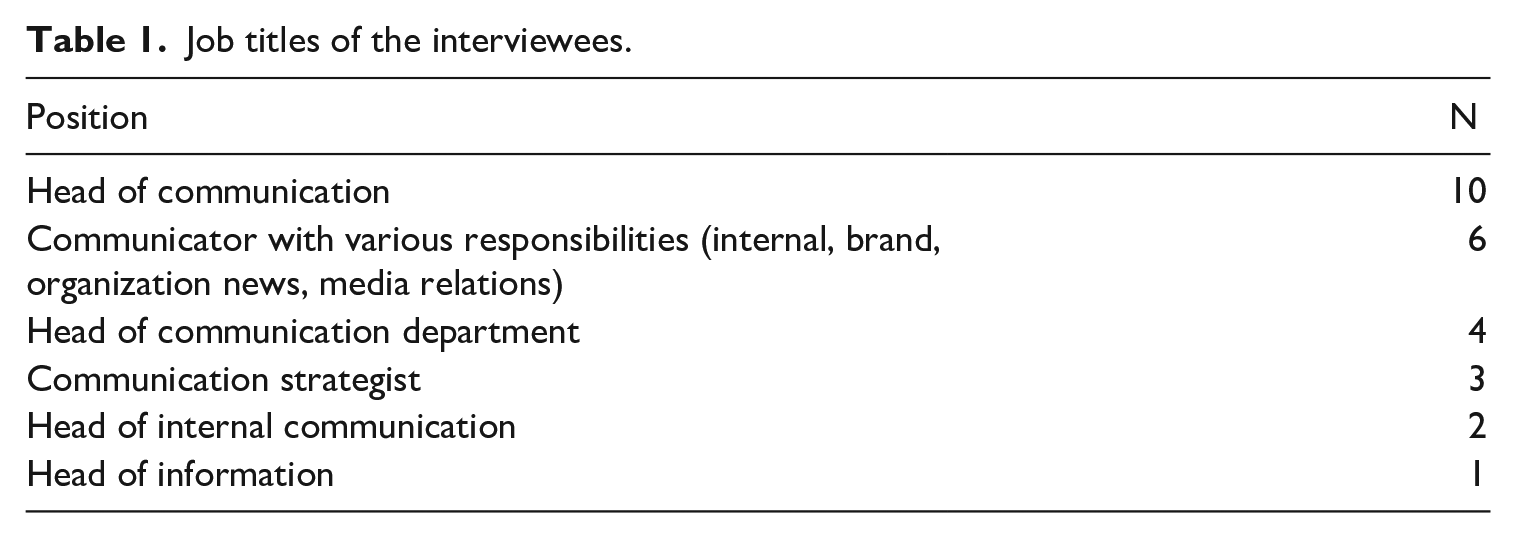
The interviews revolved around how the practitioners understand strategy in relation to their specific work. To reach beyond abstract answers of what communication professionals do and of what it means to work strategically, and to ensure that the interviewees based their accounts on experiences they themselves had encountered in their work, the interviewees were frequently asked to elaborate and concretize their accounts by giving examples of situations they have encountered. The average interview lasted for approximately 45 minutes (20–60 minutes).
The analysis followed an iterative approach (Tracy, 2013). The focus during the analysis was to better understand how the interviewees in their accounts engaged with the strategy discourse to interpret what power effects this engagement had on their understanding of themselves and their work. In the initial data immersion phase, the empirical material was read several times and coded into different in vivo codes based on the language of the interviewees (Strauss, 1987). Using in vivo coding initially was deemed important as the aim of the study was to analyze how communication practitioners engage with the strategy discourse in their accounts of their work as such an approach ensures attentiveness to the local vocabulary of a certain community (Tracy, 2013). This ensured that the early stages of the analysis were situated closer to the meso- and micro-level of the strategy discourse and provided an understanding of how the more abstract body of knowledge enables and constrains the practitioners’ accounts of themselves and their work. These initial analysis generated codes such as ‘strategist’, ‘non-strategist’, ‘communication essential to organization’, ‘strategic thinking’, ‘managers communicators’, and ‘employees ambassadors’.
During the secondary cycle coding (Tracy, 2013), the initial codes were re-read and interpreted. During this stage of the analysis, inspiration for ways of interpreting the material was especially drawn from previous theories and frameworks from the post-structuralist strand on strategy as discourse. This secondary stage of the analysis then resulted in three analytical coding themes (see Tab. 2): The worthy practitioner, Resistance, and Claiming intra-organizational power and power over others. As most of the resistance encountered during the study were interpreted as a resistance toward the ‘strategist’ self and what this ‘strategist’ considers ‘worthy’ work, the analytic codes The worthy practitioner and Resistance shown in Table 2 are collapsed into one in the presentation of the findings.
Power effects of the strategy discourse.
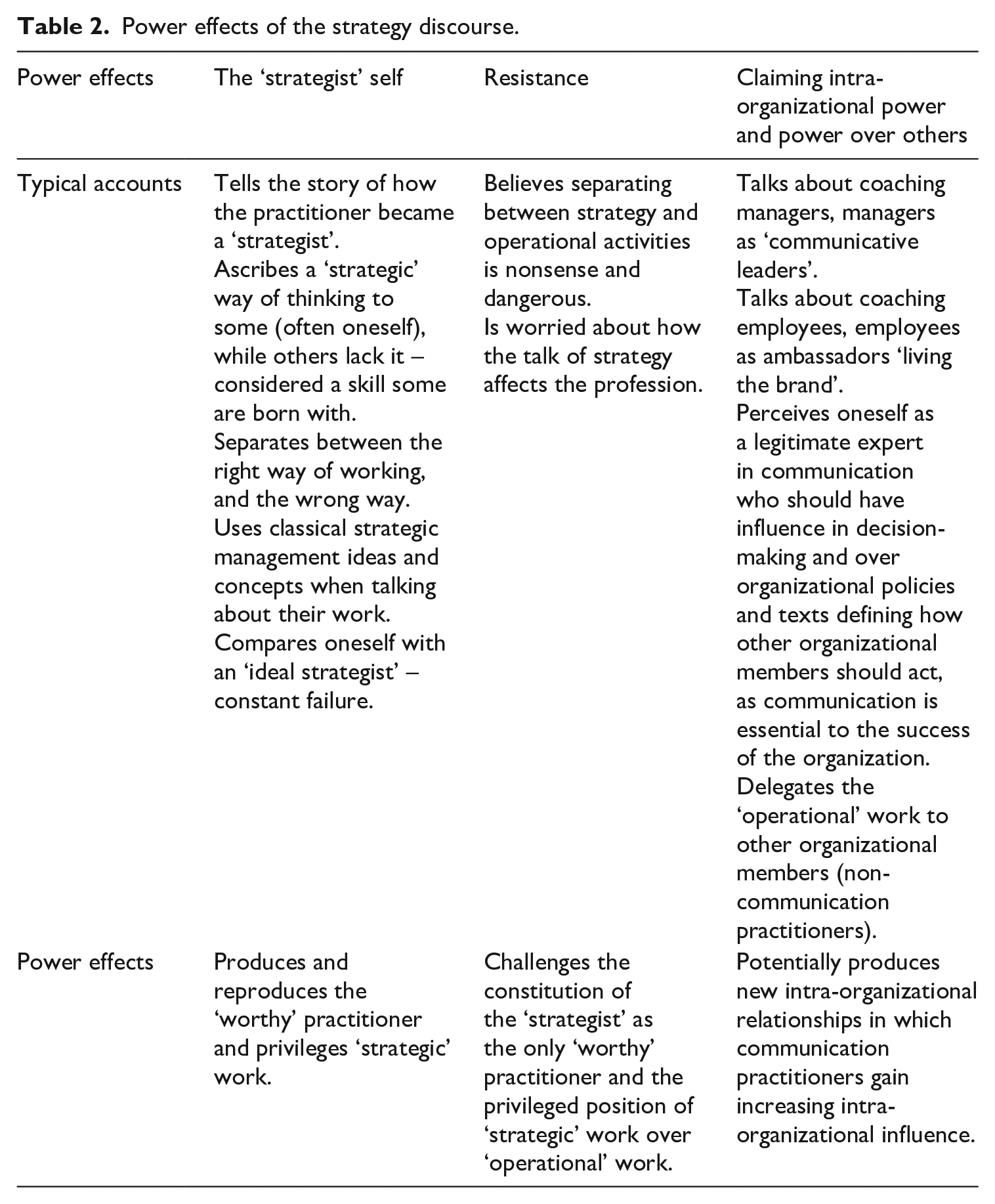
Analysis
The following sections present the findings from the analysis. The first section, The ‘strategist’ self, zooms-in on how the interviewees, through engaging with the strategy discourse, produce a desirable and ‘worthy’ ‘strategist’ self, as well as the encountered resistance toward the strategy discourse and its effects on the profession. The second section, The ‘strategist’ claiming intra-organizational power and power over others, instead zooms-in on how the practitioners, by engaging with key ideas and concepts of the strategy discourse, are enabled to produce accounts in which they as ‘strategic’ communication experts have a legitimate claim to greater intra-organizational influence as they, through producing accounts in which the solving of communicative problems is understood as essential to organizational success, see themselves as authorized to define communication practices and rules for other organizational members to follow.
The ‘strategist’ self
When asked to elaborate upon how they understand strategic work, several of the practitioners referred to it as the ‘right’ way of working. For example, one interviewee explained that ‘The communication manager participates in the strategic decision-making if one works in the right way. Then there are those that do not work in the right way’, adding that ‘you participate in the strategic decision making if you work in the right way, take up space and responsibility for driving questions of strategic nature. Then you are in’. Similarly, another interviewee emphasized that In my world there are two directions to walk. One direction is that there is an operationalist, then someone else owns communication and the decisions what to communicate. Sometimes they can decide what you communicate. [. . .] I don’t like that direction at all. [. . .] You come in early in the process. For me, that is foundational for working strategically with communication. If you are nothing but an operationalist, everything collapses. (Head of communication department)
The importance the interviewees ascribe ‘participation’ in strategic decision-making, ‘Owning the decisions’ regarding what to communicate, and being involved ‘early in the [planning] process’ shows how the interviewees in their accounts engage with some of the key ideas within the classical strategy perspective to elaborate upon how one works in the ‘right’, ‘strategic’ way. Present in these accounts is also the non-strategic ‘operationalist’ subject who works in the ‘wrong’ way. This ‘operationalist’ does what others tell him or her to do and is used by several of the interviewees to contrast the ‘strategist’. However, as illustrated in the example above, several of the interviewees stressed that this way of understanding oneself is ‘wrong’, as you are not in a position that enables you to produce value to the organization. This way of elevating the ‘strategist’ over other accounts of the self were common during the interviews. Other interviewees referred to other subject positions similar to the ‘operationalist’, such as ‘journalist’ or ‘producer’, to refer to those communication practitioners who work in the ‘wrong’ way in the sense that they, through their way of thinking and working, in contrast to the ‘strategist’ fail to contribute enough value to their organization. Knights and Morgan (1991) argue that one of the productive power effects of the strategy discourse is that it provides those who adopt it with a vocabulary of rationalization. By engaging with key ideas and concepts of the classical perspectives body of knowledge, the strategy discourse seem to have such an effect on the practitioners as they, by drawing upon especially key ideas and concepts from the classical perspective in particular, are enabled to produce accounts of their work in which working ‘strategically’ is rationalized as the ‘right’ way of working.
Furthermore, several of the interviewees seemed to understand themselves as possessing certain ‘strategic’ traits that explained why they are important to their organization. One interviewee explained that ‘To be a good strategist you must have foresight and know a little about what’s behind the corner’. Another emphasized that ‘You need a certain trait. You cannot just read yourself into becoming strategic, there is a certain trait that enables you to see trends and tendencies or the big context or where a piece of the puzzle is missing’. Similarly, a third interviewee explained that I think it is about me as a person. I had the ability to see different perspectives already from the start. I am even raised that way, my parents have always twisted and turned on different perspectives. [. . .] Not all managers or strategists are really strategic. It revolves a lot around how you are as a person. (Head of communication)
These interviewees all claim that having ‘foresight’, being able to ‘spot trends and tendencies’ and to see ‘different perspectives’ are ‘strategic’ traits they have that others lack. The idea of top managers possessing nearly superhuman powers enabling them to identify opportunities and secure strategic objectives is a central assumption in conceptualizations of strategy emanating from the classical approach (Alvesson and Willmott, 1995). Knights and Morgan (1991) argue that claiming strategic expertise provides a form of ‘existential comfort’ as managers can ‘see’ how they act on behalf of their organization, and how they as individuals are important for the long-term success of the organization. From how the several of the interviewees talk about themselves as possessing unique ‘strategic’ traits, it thus seems as if engaging with the strategy discourse in their accounts enables them to legitimize their role and frame their contribution as a ‘strategic’ contribution important to the organization.
However, while several of interviewees described themselves as ‘strategists’, there were also those that seemingly struggled with their self-understanding as they judged themselves and their work in relation to this ideal. For example, one interviewee bemoaned that she continuously fails to implement strategies into the everyday even though she sees it as ‘the greatest challenge’ and what she should ‘spend energy on’. Similarly, another interviewee complained that she is stuck being an ‘operationalist’ as that is how she is defined by others: I’m too operative [. . .] and . . . it sounds banal . . . but in every group I am involved in, if there is a PowerPoint to create, people look at me and say ‘You do that, right?’ Then I try to say that creating a PowerPoint is the responsibility of every employee. You do not need a communication practitioner for that, and especially not the head of communication. [. . .] I often get these roles. So, I must remind myself that an administrative officer probably can do that so I can consider more important things, and not get stuck in the operative work. It is a constant struggle. That there are other expectations on me than what I want to deliver. (Head of communication)
Through engaging with the discourse, The practitioners are enabled to ‘see’ that they fail to work ‘strategically’, either as they themselves fail to work in the ‘right’ way, or that the way others define them hinders them from doing more ‘important’, ‘strategic’, things. While creating Power Points, as in the example above, might not be the job of a head of communication, the point is that it is the engagement with key ideas and concepts within the classical perspective that enables the practitioner to rationalize herself as an ‘operationalist’ that often get those roles and therefore cannot do more ‘important’ things. Thus, these examples further highlight the productive ‘truth effects’ that enables practitioners to make understandable what they should do, and what not, as they engage with the discourse (Knights and Morgan, 1991).
The analysis also revealed acts of resistance toward the strategy discourse. Especially some of the more senior interviewees, who have witnessed how more and more colleagues define themselves as ‘strategists’ and talk about the importance of ‘strategic’ work, argue that it is not only for the better. The following examples illustrate the skeptic voices wary of the effects the strategy discourse has had on the profession: I have never thought that ‘now I am going to work strategically, and now I am going to work operationally’. [. . .] But I think that it unfortunately has become a development. It happened somewhere in the beginning of the 2000s where people started to talk about strategists and producers within our profession. (Head of communication) I think it is disheartening when we get newly graduated from the Universities saying that they do not do any Power Points because ‘I am a communication strategist’. There are no other disciplines where a newly graduated economist says ‘I do not work in Excel or make spreadsheets, I only do final accounts’. (Head of communication)
Although both of these interviewees have or have had senior positions at the ‘strategic’ level, and considers themselves to work ‘strategically’, they are both worried that all talk about strategy has resulted in that practitioners nowadays have started to diminish the more daily ‘operational’ side of their work. While the engagement with the strategy discourse has produced new ‘ways of seeing’ the profession and has complemented the traditional ‘operational’ hands on work, the resistance encountered in the interviews indicate that the increasing ‘hybridization’ (Noordegraaf, 2007, 2015) of the profession give rise to new intra-professional tensions regarding what should be considered ‘worthy’ work. As key ideas, concepts and practices of the strategy discourse is adopted and becomes embedded into in the practitioners daily work, the engagement with the strategy discourse thus seem to make the practitioners question the established ways of working which traditionally, to a greater extent, have been defined by the local need of the organizations which serves as the practitioners site of work. The resistance toward the strategy discourse encountered in the interviews thus suggest that the strategy discourse, rather than intertwining smoothly with existing ‘ways of seeing’ the work, due to its appeal and promises of empowerment, seemingly negates, devalues and even disables alternative understandings of who a communication practitioner should be and what she or he should do. Thus, while contributing to ‘hybridizing’ the profession, the strategy discourse simultaneously produces intra-professional tension regarding what should be regarded as ‘worthy’ work.
The ‘strategist’ claiming intra-organizational power and power over others
The way the interviewees talked about their practice in relation to their organization and other organizational members also highlights how engaging with the discourse empowers the interviewees to legitimize their claim to greater intra-organizational power and power over others. Most of the interviewees explained that communication is a central and integrated management function, but while some explained that top management values communication highly, others explained that getting other managers to understand the importance of communication is a work in progress. For example, one interviewee explained that she believes that it is one of her main tasks to get other managers to ‘see’ communication in the same way she does: . . . it is a part in the work with increasing the knowledge and understanding among managers why communication is useful for them. What is it? [. . .] And somewhere along the line they understand that communication can be so much more. They understand that communication is not what I do, that here comes someone and add a bit of communication. That is not how we see communication. Rather, it is an integrated part in managing the organization. (Head of communication department)
This quote illustrates the importance several of the interviewees ascribed the ability to convince others, and to claim that communication is a strategic management tool that is essential for the success of the organization. Another interviewee explains that while she has managed to prove her ‘strategic’ expertise to other senior managers, she is usually met with great suspicion regarding her ‘strategic’ competence when entering new management groups: As a head of communication, I would say that it is important to get access to different meetings. To have access to different management groups and contexts. And that is far from obvious. [. . .] it is a dilemma when you want to work strategically that you do not get access and that managers are afraid of your intentions. Perhaps they think that you listen to a meeting and then sends out a press release directly after. [. . .] and they think ‘Will someone listen to us? Then we won’t be able to talk freely. (Head of communication)
This struggle to convince other managers and employees about the importance of communication is a recurrent theme in the interviews. Some interviewees argue that they have been successful in convincing others, while others still struggle with convincing others that communication is a strategic management tool. One interviewee explained that Then it is about convincing the organization. That is not easy. I have been questioned. My colleagues have been questioned. [. . .] So, the readiness varies in different parts of the organization in my opinion. The readiness and mentality to accept another kind of communication practitioner, or a modern practitioner. (Head of communication department)
There are, however, some interviewees who claim that they have managed to gain a more central role within their organization. These interviewees talk about ‘delegating’ the communication responsibility to managers and employees, so they instead can act as ‘coaches’ and ‘facilitators’. One interviewee explains how she is responsible for introducing new managers every year, and how she during those introductions stresses that it is the managers’ responsibility to ensure that the internal communication in their department is of high quality, not the responsibility of the communication department. Another interviewee similarly explains, Yes, non-communicators are generally much better at it, so our profession has changed enormously from us sitting on the communication solutions, to us being the coaches that facilitate it. [. . .] They [employees] are fully capable of creating their own communication plans. You just have to ask a couple of questions, and when you have done it you give them the answers and say ‘Look, you have just created a communication plan!’ [. . .] And at the communication department we have pushed it. We believe in decentralization. (Head of communication department)
These accounts suggests that some practitioners engage more with what can be understood as the emergent strategy discourse, in which strategy instead is understood as a collective effort involving a broader category of organizational members, rather than involving top-down decision by certain ‘strategists’. However, while this alternative discourse seemingly enables practitioners to understand other organizational members as active communicators who should take an active role in the communication management, it still enables practitioners to break free from the understanding of themselves as ‘producers’ whose work is partly defined by others in favor of an understanding of themselves as subjects who make a difference through defining rules and practices which enable other organizational members to actively take responsibility for the organization’s communication. Thus, while some of the interviewees emphasize that all members share responsibility for communication, their subject position within the strategy discourse, through which they have constructed an account of communication as both the problem and solution to organizational success, is that they are the legitimate experts able to identify the solutions for others to follow. As the adoption of the strategy discourse produces new understandings of the ‘strategist’ as a ‘coach’ and ‘facilitator’ which complements existing understandings such as ‘operationalist’ and thus furthers the ‘hybridization’ of the profession, the discourse simultaneously produces ‘truth effects’ where practitioners ‘see’ their task as defining communication rules and practices for other organizational members to adhere to as this is the ‘right’, ‘strategic’ way of working creating value to the organization. This interpretation further highlights that the strategy discourse, rather than a neutral discourse, must be understood as a way for the profession to increase its status and influence on organizational practices, given that claiming a central role within the strategy discourse is closely related to increased intra-organizational power and status (Knights and Morgan, 1990, 1991).
Discussion and conclusion
This article has analyzed communication practitioners’ understanding of themselves and their work and interpreted what power effects the practitioners’ engagement with the discourse have on their ‘way of seeing’. The study has thereby made an empirical contribution by showing how practitioners engage with the meta-level discourse. First, the study shows that the strategy discourse empowers communication practitioners to produce accounts of themselves as ‘strategists’ whose ‘strategic’ work and expertise in the strategic management of communication is essential to their organization. The discourse enables practitioners to rationalize their self and their work and to distinguish between ‘worthy’ subjectivities and subject positions (i.e. ‘strategist’) and ‘unworthy’ (i.e. ‘producer’, ‘operationalist’) used to describe less successful colleagues and ‘ways of working’. Second, the study also shows that the strategy discourse empowers practitioners to claim greater intra-organizational power and power over others. In the analysis, this is exemplified by how practitioners seemingly produce accounts of themselves as ‘strategic’ experts whose role is to ‘coach’ and ‘facilitate’ other organizational members into becoming skilled ‘operationalists’, as this is essential to organizational success. Thus, the engagement with key ideas and concepts of the strategy discourse seemingly provide practitioners with a vocabulary and confidence to claim and justify a more central intra-organizational role through which they exert greater influence over the everyday practices of other organizational members.
The study has also made a theoretical contribution by showing the potential of the strategy as discourse perspective to public relations and strategic communication. Within the broader field of strategic management, the discursive approach to strategy has contributed to increase our knowledge of the constitutive effects of the strategy discourse on individuals and their work (e.g. Balogun et al., 2014; Grandy and Mills, 2004; Hardy et al., 2000; Levy and Egan, 2003; Mantere and Vaara, 2008; Seidl, 2007; Vaara, 2010). Thereby, it has contributed to complement and problematize both classical and emergent perspectives which, although conceptualizing strategy in different ways, tend to uphold the privileged position of the concept instead of attempting to demystify it (Blom and Alvesson, 2015). Public relations and strategic communication researchers, on the other hand, while drawing heavily from the classical and emergent strands in strategic management, have so far made little use of the strategy as discourse perspective. This means that assumptions of strategy and strategic work in public relations and strategic communication are left unchallenged and that their constitutive effects on practitioner subjectivities and practice are left unproblematized. While there are previous studies that have shown the potential of conceptualizing strategy as a discourse (e.g. Aggerholm and Asmuß, 2016; Nothhaft and Schölzel, 2015; Pieczka, 2018), the perspective’s problematizing potential has not been utilized. By approaching strategy as a discursive body of knowledge, and empirically demonstrating the constitutive dimension and power effects of strategy on practitioners understanding of themselves and their work, this study contributes to problematize the realist idea of strategy predominant in classical and emerging perspectives in public relations and strategic communication which tend to perceive strategy as an unquestionably real and relevant object or practice to study (Pieczka, 2018).
The findings from the study additionally contributes to previous research on the profession of public relations and strategic communication (e.g. Edwards, 2018; Edwards and Pieczka, 2013; Pieczka and L’Etang, 2006). The findings suggest, in line with previous research (Nothhaft and Schölzel, 2015), that practitioners’ engagement with the strategy discourse enables them to claim the status as experts whose expertise is essential to their organization. Thus, the strategy discourse can be understood as an important power tool useful for practitioners’ ‘professional project’ as it provides them with a vocabulary with which they can claim their jurisdiction and legitimacy in relation to other professions (Edwards, 2018). The findings highlight the increasing ‘hybridization’ (Noordegraaf, 2007, 2015) of the profession as practitioners engagement with the strategy discourse produces an understanding of the self as a ‘strategic’ expert which competes, and often negates, traditional understandings of the self which the interviewees labels in ways such as ‘operationalist’, ‘producer’, and ‘journalist’. Following the intricate relationship between the strategy discourse and power, where those who adopt it are provided an expanded subjective identity (Knights and Morgan, 1991), the conscious adoption of the discourse seemingly has such a strong appeal that it simultaneously has a strong disciplining effect on practitioners, demonstrated in how the interviewees understand the ‘strategist’ as the ‘worthy’ practitioner working in the ‘right’ way and judge themselves toward that ideal.
In relation to the ‘professional project’ of communication practitioners, the resistance encountered raises an interesting question regarding the effects of the strategy discourse on practitioners’ subjective understanding of themselves and their work. While most practitioners seemingly experience the empowering effects of the discourse, its devaluing and negating effects on the more ‘operational’ hands-on-work which some interviewees experience hint at a problematic tension worthy of further consideration. Some interviewees experience that the strategy discourse promote what researchers such as Weick et al. (2005) and Mintzberg et al. (2009) previously have criticized as a problematic separation between thinking and doing, where ‘strategic’ aspects are promoted, while ‘operational’ hands-on-work is devalued. While, for example, Gregory (2008) have shown that CEOs call for communication practitioners to acquire a better ‘strategic’ competence, the way some of the interviewees seemingly struggle to live up to their ideal of the ‘worthy’, ‘strategic’ practitioner, and other interviewees’ concern that ‘operational’ tasks are increasingly devalued by a growing number of practitioners, raises the question regarding how the contemporary practitioner and practice is portrayed in textbooks, articles, and University education. This study encourages researchers not only to pay more attention to the influence the concept of strategy has on our understanding of the practice of public relations and strategic communication, but also to how it shapes researchers’ and practitioners’ understanding of the role of communication in contemporary organizations and society.
As other organizational members increasingly perceive communication as important for both individual and organizational success (Falkheimer et al., 2017), future studies on the profession could investigate the changing relationships as communication practitioners claim ‘strategic’ expertise and identify other organizational members as ‘producers’. Studies have shown that concepts such as ‘communicative leadership’ (Hamrin et al., 2016; Johansson et al., 2014) and the ‘communication responsibility’ (Andersson, 2019) of all organizational members are becoming increasingly common in organizations. However, the profession has simultaneously been labeled a ‘bullshit’ job contributing little to no value in society (Graeber, 2018), and has been the subject of intense public debate in several countries, such as Denmark and Sweden, where its legitimacy, especially within the public sector, has been questioned. Thus, while the profession seemingly has been somewhat successful in claiming a more central role, changing social norms and concerns regarding what is considered inappropriate practice in different contexts, for example, the ongoing public discussion in Sweden regarding the appropriateness of public sector organizations work with branding, can result in that gained jurisdictional control is lost (Edwards, 2018). These parallel developments call for more studies on the public image of the profession as its growing influence in contemporary organizations and society gets increasingly noticed and scrutinized by others.
Footnotes
Funding
The authors disclosed receipt of the following financial support for the research, authorship, and/or publication of this article: The research project in which the empirical data were collected was co-funded by eleven Swedish public and private organizations and The Swedish Association of Communication Professionals.
