




Abstract
Priapism is a urological emergency defined as persistent penile erection that is unrelated to sexual stimulation and typically involving only the corporal cavernosa. It can occur as a rare side effect of antipsychotic medications and is mediated via their α-adrenergic antagonist effect. In this paper we describe a case of priapism in a patient started on risperidone and sodium valproate. We also review the South London and Maudsley Case Register Interactive Search database to assess how many other cases of priapism were reported in patients taking risperidone. We add this information to a literature review of cases of priapism associated with risperidone.
Introduction
Priapism is a urological emergency defined as persistent penile erection that is unrelated to sexual stimulation [Huang et al. 2009]. It typically involves the corporal cavernosa [Keoghane et al. 2002]. It can occur as a rare side effect of antipsychotic medications and is thought to be mediated via their α-adrenergic antagonist effect [Spagnul et al. 2011; Andersohn et al. 2010].
In this paper we describe a case of priapism in a patient recently started on risperidone and sodium valproate. We also review the South London and Maudsley (SLAM) Case Register Interactive Search (CRIS) database to assess how many other cases of priapism were reported in patients taking risperidone. We add this information to a literature review of cases of priapism associated with risperidone, building on the work of Choua and colleagues and Sood and colleagues [Choua et al. 2007; Sood et al. 2008].
Delayed recognition of priapism can have irreversible consequences with up to 50% of affected patients becoming impotent [Choua et al. 2007; Sood et al. 2008] or in some cases needing penile amputation [Hoffman et al. 2010] often because they present late. We believe that clinicians reviewing patients for sexual side effects, recognizing priapism and educating patients on how to distinguish priapism from a normal erection can minimize poor outcomes.
Case report
Y is a 45-year-old African with a 7-year history of schizoaffective disorder. Since his initial diagnosis, he had never been completely symptom free and poor compliance with medication had led to several relapses, hospital admissions and medication changes. He had previously been on various antipsychotics, including olanzapine, haloperidol, flupenthixol depot and trifluoperazine in combination with sodium valproate.
His last admission took place at the end of 2010 following concerns that he had stopped his medication (trifluoperazine and sodium valproate) and that his mental state was deteriorating. He was showing signs of self-neglect, fluctuating mood, agitation and irritability. He expressed grandiose delusions, paranoid ideations and had limited insight into his condition. He was started on risperidone 2 mg at night and sodium valproate 750 mg twice daily. One week later, risperidone was increased to 4 mg at night and sodium valproate to 1000 mg twice daily.
Y reported a 48 h history of persistent and painful erection 3 days later. He was immediately sent to the emergency department where a diagnosis of low flow priapism was made. He was treated with ice, pain relief and aspiration of 220 ml of blood from the corpora cavernosa and intracorporal injection of adrenaline. Risperidone was stopped immediately. He improved only slightly on this treatment, and was referred to the andrology department for shunting, which was performed the next day. A subsequent magnetic resonance imaging scan showed significant penile ischaemia, which required surgery and the insertion of a penile implant 7 days later. After a medication-free period, risperidone was replaced with aripiprazole. He tolerated this well and was discharged from hospital. He reported no further episodes of priapism after discharge.
On further questioning, Y admitted to one previous episode of priapism, which had occurred 3 days earlier and resolved spontaneously after 2 h. He denied any prior experience of priapism or any other erectile dysfunction. Apart from taking antipsychotic medication, he had no risk factors for priapism. He tested negative for sickle cell disease or trait and did not have any haematological disorder. He had never taken drugs for erectile dysfunction and had no history of illegal substance use such as cocaine or cannabis. He had no past or current medical history of note and was not on any medication with the exception of sodium valproate and risperidone. At home, he drank alcohol most days (beer) but rarely exceeded 2 units a day. He was a nonsmoker and had never had pelvic or genital trauma. Family history was unremarkable and he denied any drug allergy. Written informed consent was obtained from Y for this publication.
Pathology
In physiological erection, relaxation of the two corpora cavernosa allows increased arterial blood flow into the penis. This causes pressure on the veins that normally drain the penis, reducing venous outflow. The two mechanisms combine to cause a temporary engorgement of blood in the penis and erection. Reversal of this process causes detumescence. Several neurotransmitters have been implicated in the regulation of this complex process both centrally and peripherally. At the level of the peripheral nervous system, relaxation of the penile muscles is mediated mostly by the parasympathetic system (via acetylcholine muscarinic receptors) and the release of nitric oxide from the endothelium of the bloods vessels that line the corpora cavernosa. Detumescence and flaccidity are mediated by the sympathetic system, which releases noradrenaline acting on α-adrenergic receptors to cause contraction of the penile vessels and smooth muscles, which in turn reduces blood flow into the penis [Andersohn et al. 2010; Andersson, 2001]. Two types of priapism have been identified: low flow (ischaemic) and high flow (nonischaemic). In low-flow priapism, there is prolonged failure of venous outflow, typically either because the draining veins become obstructed (for instance in sickle cell or other haematological disorders) or because the sympathetic system fails to initiate detumescence. Blood stasis leads to ischaemia and fibrosis if left untreated. High-flow priapism results from excessive unregulated flow of arterial blood into the penis without outflow obstruction. The corpora cavernosa remain well supplied with oxygenated blood and penile tissues remain undamaged.
Low-flow priapism is a urological emergency. In adults it occurs most frequently in men in their third and fourth decade. The most common risk factors are pharmacological in adults and haematological disorders in children (although in 40–50% of all cases no cause is found) [Oweis, 2001; Sharma and Fleisher, 2009; Sood et al. 2008]. Several drugs have been associated with priapism. Some drugs commonly used in the management of cardiovascular and urological symptoms like prazosin, tamsulosin and doxazosin are α-adrenergic receptor antagonists [Spagnul et al. 2011]. Priapism is also a documented side effect of trazadone, an antidepressant with α-adrenergic antagonist properties [Abber et al. 1987]. Anticoagulant medication, including warfarin and intravenous heparin, some antihypertensives such as nifedipine, β blockers such as labetalol, corticosteroids, oral hypoglycaemic agents (tolbutamide) and other conditions such as pelvic trauma and pelvic tumours which may be associated with hyperviscosity states such as various haematological disorders and metabolic disorders (e.g. amyloidosis) can increase the risk of priapism [Brichart et al. 2008; Lapan et al. 1980].
Literature review
It is estimated that between 15% and 26% of priapism cases are linked to the use of antipsychotic medication [Sharma and Fleisher, 2009], via α1- and α2-antagonist activity, which inhibits sympathetic activity [Andersohn et al. 2010; Sood et al. 2008]. It has also recently been proposed that the corpora cavernosa of some men may be more sensitive to the α-blocking effect of antipsychotic medication [Sharma and Fleisher, 2009].
Although, atypical antipsychotics were initially thought to be less likely to cause priapism than their typical counterparts, all have now been associated with this side effect, including risperidone, olanzapine, aripiprazole, clozapine and quetiapine. Choua and colleagues did a literature search on PubMed/Medline (from 1994 to the third week of February 2007) and found 17 reported cases of priapism associated with risperidone, 11 with olanzapine (penile priapism only), 5 associated with quetiapine, 3 with ziprasidone and 2 with aripiprazole (both in monotherapy and in combination with other medications) [Choua et al. 2007].
In 2008 Sood and colleagues found 50 reports of priapism associated with atypical antipsychotics up to 2007, out of which 16 were associated with risperidone [Sood et al. 2008]. Building on this work, we searched PubMed and Ovid until 2011 with no time or language restrictions and found an additional 16 case reports of priapism involving risperidone (Table 1).
Literature review.

Table initially developed by Sood et al. [2008] (the first 16 cases listed above are those originally described by Sood et al. [2008]).
ED, emergency department. 2/7, 2 days.
We also reviewed the data of 180,000 patients treated at SLAM using the CRIS database, which was developed by the Biomedical Research Council (BRC) for use by researchers allowing anonymised access to information from SLAM’s electronic patient records. BRC monitors the use of the CRIS database and patients are able to opt out of the CRIS database if they choose.
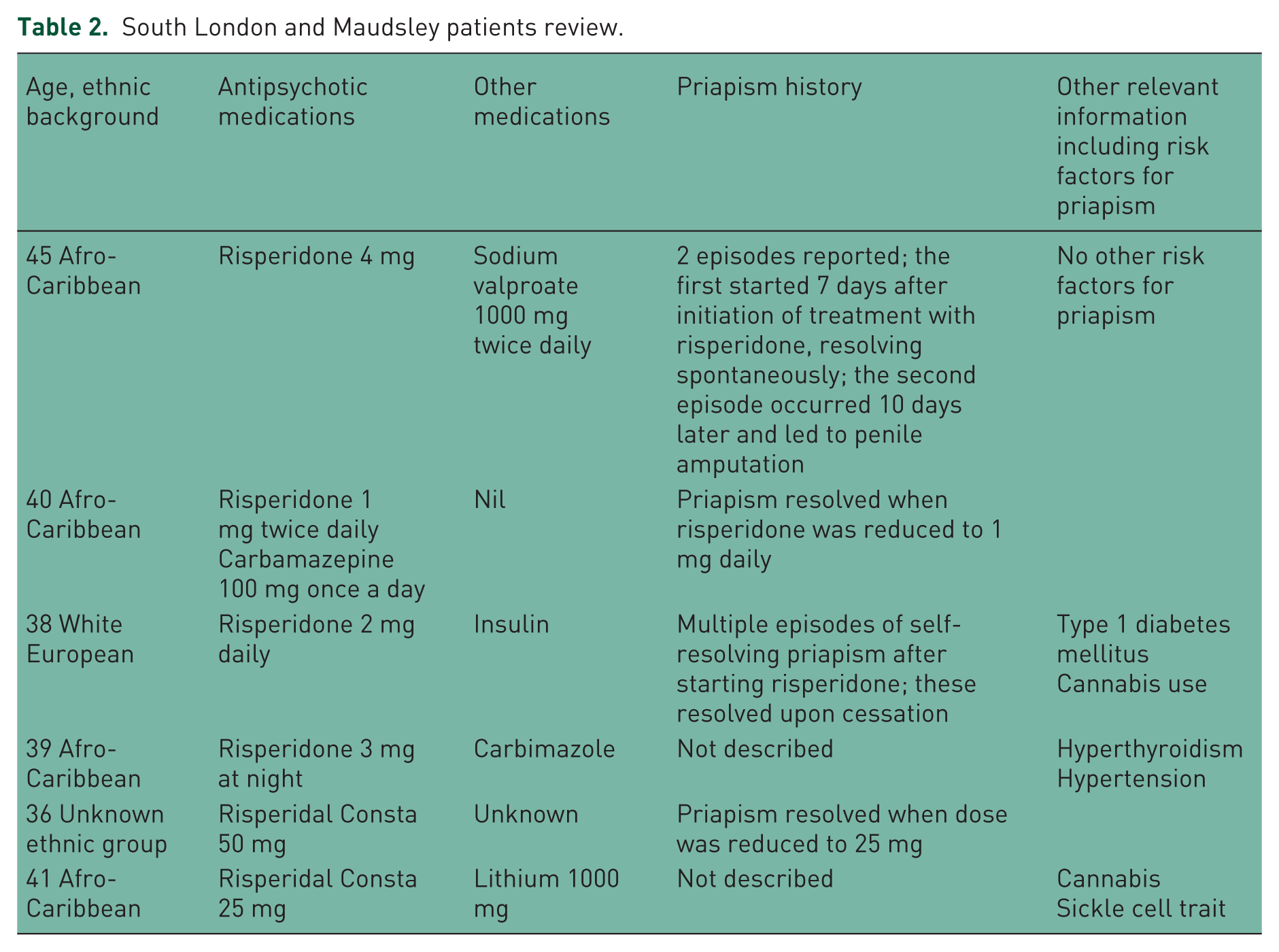
We found 13 cases of reported priapism between 2000 and 2010, 6 in patients taking risperidone (3 as monotherapy and 3 in combination with other drugs). Five cases were associated with trazodone, 1 with paroxetine, 1 with clozapine and citalopram (Table 2).
South London and Maudsley patients review.
In the UK, 37 cases of priapism in patients taking risperidone have been reported so far to the Medicines and Healthcare Products Regulatory Agency since the drug was licensed in 1992 (including the case described in this paper), with a total number of 7961 reactions reported in patients on risperidone.
It is difficult to draw a typical risk profile from these findings. However, it seems priapism can occur at any time from a few days following initiation of treatment up to 2 years. The age of those affected ranged from 13 to 65, although in a majority of cases, patients were in their 30s, 40s and 50s. The most striking feature of this review is the ethnic background of the patients. Out of 32 cases described in the literature, the ethnic group was known for 14 patients, 8 of which were of African-Caribbean origin, 4 were Hispanic. Out of the six cases identified at SLAM, four were of African-Caribbean origin, a population group more likely to be on antipsychotic medication [Bresnahan et al. 2007; Fearon et al. 2006; Kirkbride et al. 2006; Xanthos, 2008]. It is also worth noting that SLAM serves a migrant multiethnic catchment area, with a significant black African–Caribbean population, which undoubtedly contributes to this community being over represented in our small sample. We are not aware from our literature review of any described genetic predisposition in the black population with the exception of sickle cell disease, which is the most common cause in children [Adeyoju et al. 2002] and to a lesser extent sickle cell trait [Adeyoju et al. 2002; Birnbaum and Pinzone, 2008; Larocque and Cosgrove, 1974]. Unfortunately not all published case reports report whether sickle cell disease or trait was present.
Among atypical antipsychotics, risperidone and ziprasidone have the highest affinity for α-adrenergic receptors [Andersohn et al. 2010] and have been associated with several cases of priapism, both when administered as a monotherapy or in combination with other drugs [Brichart et al. 2008; Sood et al. 2008]. α-Adrenergic receptors have a significant role in physiologic erectile function and classes of drugs with α-adrenergic antagonistic properties can cause priapism [Horowitz and Goble, 1979; Traish et al. 2000] by inhibiting the process that causes penile detumescence [Spagnul et al. 2011]. It is unclear from the research published so far whether and to what extent the combination of different risk factors or polypharmacy increases the risk of priapism [Birnbaum and Pinzone, 2008].
In theory, polypharmacy may increase the risk of priapism either through the synergy achieved by combining drugs that independently can cause priapism or by combining drugs like risperidone with another drug that affects its metabolism. The effect of sodium valproate on liver enzymes is complex and not yet fully understood. According to the Clinical Manual of Drug Interaction Principles for Medical Practice [Wynn et al. 2009], sodium valproate inhibits 2D6, 2C9, 1A4, 1A9, 2B7, 2B15, UGT and epoxide hydrolase. There is no known and proven enzyme induction, although some evidence suggests that sodium valproate may induce 3A4 and ABCB1. Risperidone is metabolized by the cytochrome P450 2D6 enzymatic system and to a lesser extent 3A4 [Prior and Baker, 2003], so there is a possibility that enzyme inducers or inhibitors could have an impact on risperidone plasma levels [Bork et al. 1999; Odou et al. 2000; Yen-Yue et al. 2007], suggesting an increased risk of adverse side effects with coadministration of such drugs with risperidone. However, other studies suggest that valproate does not affect risperidone levels. A study by Spina and colleagues compared 10 patients taking sodium valproate and risperidone with 23 patients taking risperidone alone and found no significant difference in the levels of risperidone and its metabolite, 9-hydroxyrisperidone [Baxter, 2012; Spina et al. 2000]. Yoshimura and colleagues looked at 12 patients with schizophrenia given valproic acid 400–800 mg daily and risperidone 2–6 mg daily and came to the same conclusion [Baxter, 2012; Yoshimura et al. 2007]. It is currently accepted that no special precautions should be taken when prescribing risperidone and sodium valproate together [Baxter, 2012]. We have found no cases reporting priapism associated with sodium valproate.
There may be other types of drug interactions that can increase the risk of priapism. Lithium is not directly associated with priapism, however a number of cases have occurred in patients taking lithium and risperidone concurrently. A suggested mechanism of action is that lithium potentiates the α-adrenergic blocking activity of risperidone [Jagadheesan et al. 2004; Owley et al. 2001]. A review of published case reports shows that despite being extremely painful and worrying for patients; priapism is often reported late, possibly because the patient is embarrassed and hoping that the erection will settle spontaneously. However, the longer the duration of priapism, the higher the risk of ischaemia, anaerobic metabolism, acidosis and long-term penile tissue injury and fibrosis [Lapan et al. 1980]. Penile ischaemia following priapism could eventually result in penile amputation [Hoffman et al. 2010]. Early presentation therefore gives the best chance to improve outcome.
Priapism should be treated as an emergency. The American Urological Association recommends the following treatment guidelines [Erectile Dysfunction Guideline Update Panel, 2003]
Therapeutic aspiration (with or without irrigation).
Intracavernous injection of sympathomimetics (e.g. phenylephrine, epinephrine, norepinephrine, metaraminol).
Systemic treatment of underlying disease (e.g. sickle cell disease) plus intracavernous treatment for patients with underlying disorders or haematologic pathology.
Surgical shunts, including distal shunts (e.g. Winter, Ebbehoj and Al-Ghorab procedures); the cavernospongious shunt (i.e. Quackels procedure); and cavernosaphenous shunt (i.e. Grayhack procedure).
Conclusion
Antipsychotics, in particular α-adrenergic receptor antagonists like risperidone, may cause priapism. Although a rare side effect, it may have devastating consequences if not treated promptly. This highlights the need for increased awareness to facilitate early recognition and treatment. Special care must be taken when prescribing risperidone in patients potentially more susceptible to this side effect, such as those with comorbid pathology (i.e. sickle cell disease) or when treatment might also increase their risk [Brichart et al. 2008; Lapan et al. 1980]. Patients should be educated on distinguishing priapism from a normal erection and the need to report priapism promptly if it occurs should be emphasized, especially in at-risk patients. We could not find any studies that looked at alternative antipsychotic prescribing for patients who are at high risk of priapism, however given that drugs with high α-adrenergic antagonistic properties seem to increase the risk, antipsychotics with lower α-adrenergic affinity would be the preferred choice of treatment. It is unclear from the evidence whether priapism is idiosyncratic or a dose-related event. The literature review does suggest that some patients seemed to develop priapism only after an increase in medication dose (Table 1).
Overall our review shows that the aetiopathogenesis is far from being fully understood. We anticipate, with future advances in research, that physicians will be better able to identify patients who are at higher risk.
Footnotes
Acknowledgements
We would like to thank Olubanke Olofinjana, our team pharmacist at the South London and Maudsley NHS Foundation trust for her invaluable guidance and advice.
Funding
This research received no specific grant from any funding agency in the public, commercial, or not-for-profit sectors.
Conflict of interest statement
The authors declare no conflicts of interest in preparing this article.