



Abstract
This case explores the strategic, organisational, and technological challenges faced by a rapidly growing Nigerian SME – Kora Foods – as it confronts the limitations of its informal digital infrastructure. Founded during the COVID-19 pandemic, Kora has scaled swiftly by supplying frozen, ready-to-eat meals to supermarkets and schools across southwest Nigeria. However, as order volumes increase, the company’s reliance on manual processes, fragmented tools, and centralised decision-making by the CEO, Temi Adebayo, begins to undermine efficiency and reliability. The case introduces an operations manager, Musa Ibrahim, who advocates for formalising Kora’s IT function and implementing an integrated digital system. This proposal sparks a strategic dilemma as to whether the organisation should invest in structured technology now or continue relying on lean, people-driven processes. The narrative unfolds against the backdrop of infrastructure limitations, cultural resistance, and a founder’s instinct to retain control. Set in a dynamic emerging-market context, the case challenges students to examine how IT strategy can be aligned with business growth, how change should be managed in resource-constrained environments, and how SMEs can design technology systems that are fit for context. Through Musa and Temi’s conflicting perspectives, students are invited to engage with complex questions of governance, organisational readiness, leadership, and sustainable innovation.
Keywords
Learning outcomes
By the end of the case discussion, students will be able to. 1. Analyse the strategic role of information technology in SMEs, particularly in emerging-market contexts, using frameworks such as the Strategic Alignment Model and the Technology-Organisation-Environment (TOE) framework. 2. Evaluate technology investment options using structured decision-making tools (e.g. cost-benefit analysis and McFarlan’s Strategic Grid), considering trade-offs between cost, scalability, control, and risk. 3. Assess organisational readiness for digital transformation, including infrastructure, digital literacy, leadership alignment, and cultural acceptance of change. 4. Apply change management theories (e.g. Lewin’s Model, Kotter’s 8 Steps, and ADKAR) to propose context-sensitive strategies for introducing new systems in resource-constrained environments. 5. Critically reflect on IT governance and ownership models in growing enterprises, weighing centralised control against participatory and cross-functional approaches to system implementation. 6. Formulate practical implementation strategies for technology adoption that balance innovation with continuity, and that respond to the infrastructural and cultural realities of a developing economy. 7. Demonstrate awareness of the ethical, social, and human resource implications of digital change, including staff displacement fears, system usability, and trust in automation.
Introduction: Growth
The morning traffic in Lagos was as chaotic as ever, buses heaving with bodies, tricycle riders zigzagging through gaps that barely existed, and hawkers weaving between cars, selling everything from gala sausage rolls to SIM cards. Inside her modest but air-conditioned office in Ogudu, Temi Adebayo stared at a spreadsheet. It was the fourth version she had received that week, and each one showed a different stock level for the same batch of jollof rice packs. The sales figures looked promising, but the inconsistencies gnawed at her. ‘We can’t even agree on how many cartons we have in storage?’ she muttered, rubbing her temples.
Kora Foods, the company she founded during the pandemic lockdowns in 2021, had grown from a small kitchen operation to a supplier of frozen, pre-cooked meals to over 60 supermarkets and 40 school canteens across southwest Nigeria. Its recipes were packaged in vacuum-sealed portions and stored in cold rooms leased in multiple cities. In two short years, what had started as a survival venture had become a profitable business. Yet the company’s internal systems had not kept pace with its scale. Orders were tracked on WhatsApp, inventory reconciliations required daily phone calls, and each department had its own way of keeping records, often in conflicting Excel formats.
Temi had resisted formalising too much, priding herself on the company’s ability to move fast, cut costs, and adapt. Every major decision – including IT purchases – still passed through her. She saw this as a way of maintaining control and avoiding waste. But some staff saw it differently. Musa Ibrahim, the newly hired operations manager with prior experience at a mid-sized FMCG firm, was increasingly vocal about the inefficiencies he observed. ‘We can’t run a national supply chain on vibes’, he said in a staff meeting, half-joking, half-exasperated. He proposed hiring a dedicated IT lead and investing in an integrated system for inventory, finance, and procurement. Temi was unsure. Would such a move bring structure or would it bring rigidity, cost overruns, and unnecessary complexity?
This case explores the organisational, technological, and strategic challenges faced by growing firms like Kora Foods in the Nigerian context. It situates the decision to invest in digital infrastructure as a reflection of broader questions: How does a company balance flexibility and control? When should it formalise systems and at what cost? And how can IT be positioned not merely as a support function, but as a driver of strategic alignment and innovation?
Founder’s vision, Founder’s control
Temi Adebayo did not come from a tech background. Her training was in nutrition and dietetics, and her first job had been at a private secondary school where she ran meal planning for the boarding house. When the COVID-19 lockdown disrupted her income, she began cooking in bulk and offering delivery meals to neighbours through Instagram. Her jollof rice gained a small cult following, and with one freezer, two assistants, and her father’s loan of ₦500,000, she officially registered Kora Foods in 2021.
Her philosophy was simple: ‘Feed people well, and don’t spend more than you need to’. From the beginning, she had been careful with money, avoiding high rent locations and preferring to grow through reinvested profits rather than loans. When tech vendors came knocking with promises of cloud solutions and enterprise tools, she turned them away. ‘We’re not Dangote’, she would say. ‘We use what we have’. The company’s early success – built on local knowledge, market responsiveness, and word-of-mouth marketing – seemed to validate her approach. Orders were managed through WhatsApp groups, monthly expenses tracked in Google Sheets, and inventory was manually reconciled at the end of each week by supervisors’ texting numbers from four different cities. It was not efficient, but it worked.
Temi’s reluctance to relinquish control over IT decisions was because of an experience. In Kora’s second year, a freelance developer had sold the team a stock management app that crashed repeatedly and lost half the data. It had taken 2 weeks and three part-time staff to recover manually. Since then, Temi insisted on reviewing every tech expense herself – no matter how small. Her logic was clear: systems can fail, but cashflow must not. ‘We can fix problems’, she told her accountant once, ‘but we can’t recover from unnecessary debt’.
As the business grew, however, this centralisation began to create friction. Line managers complained that approvals were delayed. The sales team could not access real-time stock data before making supermarket deliveries. Finance struggled to reconcile daily sales because there was no automated linkage between dispatch and payment confirmation. Yet Temi remained cautious. She had seen peers drown their small businesses in technology they barely understood – ERPs bought before product-market fit, apps that nobody used, and consultants who spoke only in acronyms.
Musa’s arrival had challenged that caution. Unlike many others in the firm, he was not sentimental about the ‘start-up hustle’ phase. He spoke the language of systems, platforms, and integration. He acknowledged Temi’s achievements but insisted that ‘what got us here won’t take us there’. To him, IT wasn’t just about software – it was about enabling scale. Temi was unconvinced. ‘I built this place with common sense and grit’, she said. ‘You’re asking me to hand over the steering wheel to a dashboard I don’t fully understand’.
This friction between founder control and organisational complexity now sat at the centre of Kora’s future. The systems that once gave the company its nimbleness were now causing delays. Yet the alternatives promised structure at the cost of agility.
Musa’s diagnosis: A house built on Excel
Musa Ibrahim had been at Kora Foods for just 3 months when he prepared his first internal report. It was a simple document – eight pages, no graphs – titled Operational Risks and System Recommendations. But its content was anything but modest. The report detailed stock discrepancies in the Ilorin depot, delays in reconciling supplier invoices, duplicate orders placed due to miscommunication, and rising labour costs linked to manual reporting. ‘We’re paying people to chase numbers that systems could generate in seconds’, he wrote.
Before joining Kora, Musa had worked as a logistics coordinator at a Lagos-based food distribution company that had scaled its operations using a cloud-based ERP system. He had seen first-hand how data visibility improved forecasting, and how automation reduced human error. At Kora, what struck him most was not just the lack of formal systems – it was the reliance on informal workarounds. Admin staff stayed late to manually count deliveries. Depot supervisors shared stock levels via voice notes. The finance team juggled four different spreadsheets, each with its own formatting style. ‘There’s no single source of truth’, Musa said during a weekly management meeting. ‘Everyone is guessing differently’.
He found that much of the problem stemmed from Kora’s siloed operations. Procurement used one pricing sheet, sales another. The inventory log was updated in batches, often after stock had already moved. Data entry errors were common. On one occasion, a ₦3.5 million delivery to a secondary school chain was invoiced twice due to miscommunication between dispatch and accounts. The error was caught, but only after the client called to complain.
Musa did not blame the staff. ‘They’re doing their best’, he told Temi. ‘But we’re setting them up to fail’. In his view, the company needed three things: (1) a full-time IT lead or systems manager to design and manage digital tools; (2) an integrated platform to handle inventory, sales, and finance in one system; and (3) a phased implementation strategy, starting with two high-volume locations before scaling company-wide. He even mapped out a potential timeline, suggested software providers, and estimated a budget.
But his proposals met quiet resistance. Department heads were nervous. Some feared the changes would expose their mistakes. Others worried they would be replaced by ‘the system’. One supervisor privately told him, ‘We’ve seen these things before. They bring outsiders to show PowerPoint, and then we’re the ones blamed when it fails’. Temi listened carefully but remained cautious. She respected Musa’s expertise, but she also knew her team. ‘We’re not GSTBank’, she said wryly. ‘We don’t have IT departments and change management budgets’.
Still, she could not ignore the facts. Orders were growing. Mistakes were increasing. And every week brought more complexity. A missed delivery. A supplier dispute. A delayed payment. Musa was right about one thing: they could not keep patching holes with overtime and goodwill.
The case for change
By the end of Q1, Musa’s quiet diagnosis had become a loud undercurrent. Sales were up but so were returns. A school in Abeokuta had received 30 cartons of fried rice instead of the agreed 15. A supermarket chain in Akure complained that product expiry dates were inconsistent across batches. Meanwhile, the accounts team was struggling to close the monthly books because of manual reconciliations and late submissions from depot staff. Each issue was individually manageable. But together, they pointed to the same root cause: a lack of system visibility and process alignment.
Musa began to push harder. He framed his argument not just as a matter of operational efficiency but as a strategic necessity. ‘Right now, our success depends on individual effort and workaround culture’, he said at a leadership offsite. ‘But what happens when we double again in size? The cracks will widen. Then it won’t just be errors – it’ll be reputational damage’. His presentation included case examples from Nigerian SMEs in similar sectors. One, a mid-sized bakery chain, had reduced product returns by 40% after adopting a lightweight ERP system. Another had integrated procurement and accounting, cutting lead times for raw materials in half.
Still, Temi was hesitant. Her instincts told her that systems came with bureaucracy and bureaucracy killed speed. She had built Kora by saying yes quickly, solving problems in the moment, and moving on. The idea of implementation plans, systems training, and a ‘technology roadmap’ made her uneasy. ‘We don’t want to become slow just because we became structured’, she said.
Musa understood this tension. So, he changed his approach. Instead of pitching IT as a big transformation, he reframed it as an enabler of the company’s existing strengths. ‘What if we don’t lose our flexibility?’ he asked. ‘What if the system just frees us to be even more responsive, because we’re not guessing anymore?’ He suggested a lean model – start small, test in one depot, and iterate before scaling. ‘We’re not talking SAP’, he joked. ‘We’re talking something we can manage. Cloud-based, local support, mobile access for depot staff’.
To bridge the trust gap, Musa also proposed hiring a full-time systems manager – someone technical, but who would report directly to Temi. That way, control would not be lost; it would be better informed. He also offered to coordinate the implementation himself, drawing on his past experience, to reduce reliance on external consultants.
It was a persuasive pitch, but not an easy sell. Other executives were divided. The head of sales supported the idea – she was tired of apologising to clients for late deliveries. But the finance lead worried about cost. The HR officer flagged capacity: who would train the depot staff? Temi listened. She agreed that something needed to change. But was it the right time to invest? Or could they get by for one more year with better supervision and process tweaks?
Strategic questions and constraints
Temi stood by the office window, watching as a dispatch truck reversed awkwardly into the loading bay. The driver had called three times that morning for directions. The floor manager said the address had changed but had not updated the shared tracker. That was the third such incident this week. Her mind was full – not just of numbers, but of trade-offs.
Musa’s proposal made sense on paper. But on the ground, things were never that straightforward. Kora was an SME, not a multinational. Every naira spent had to earn its place. Every change brought risk, not just in cost, but in disruption. And yet, the status quo was becoming unsustainable. Her dilemma now hinged on three overlapping constraints: timing, capacity, and culture.
Timing
Kora was entering its busiest season. Government contracts for school feeding were ramping up, and supermarkets were increasing orders ahead of the long holidays. Temi worried that starting a major system overhaul now would introduce more problems than it solved. But delaying might mean missing the opportunity to fix longstanding inefficiencies before they scaled.
Capacity
The company had no formal IT department, no internal data analyst, and no systems specialist. Implementing any significant change would require either external vendors or upskilling existing staff-neither of which could happen overnight. Musa’s offer to lead the process helped, but he couldn’t do it alone. And even if they hired an IT lead, would that person understand the operational realities of a fast-paced Nigerian food business?
Culture
Temi knew her team. Many of them had grown with the company from its scrappy early days. Their loyalty was rooted in trust, not job descriptions. A few were already anxious that ‘the system’ might mean surveillance. Others feared automation would make them redundant. Training programmes could help, but trust-building would be just as critical. Change could not be imposed – it had to be absorbed.
On top of this, there were broader structural questions. • Should Kora outsource the IT function, or build capacity in-house? • Could they afford to implement an integrated system in phases, or was a complete transition more cost-effective in the long run? • How would they evaluate success – through savings, speed, or error reduction? • What compromises would Temi have to make on her hands-on management style?
There was also the invisible cost of delay. Each error, each miscommunication, and each missed opportunity added up slowly draining staff energy, customer goodwill, and operational resilience.
Kora’s situation was not unique. Across Nigeria, small- and medium-sized enterprises were facing similar crossroads. The shift from informal coordination to structured systems was not just a technical matter; it was a strategic one. The decision Temi now faced was not simply about software – it was about control, trust, timing, and the kind of organisation Kora wanted to become.
Technology options on the table
Musa arrived at the next leadership meeting with a single slide. There were no charts nor jargon. Just three options, listed side-by-side. ‘We don’t have to overcomplicate this’, he said. ‘But we do have to choose a direction’.
Temi nodded slowly, grateful for the clarity. The options Musa laid out were not perfect but they reflected a careful balancing of cost, risk, speed, and scalability. They offered different pathways for Kora to transition from improvisation to infrastructure.
Option 1: Tactical upgrade (the minimalist route)
This option involved improving existing tools without a full overhaul. The idea was to identify critical pain points and plug them using lightweight, low-cost software, for example, moving from Excel to Google Sheets with access controls, digitising order forms with Google Forms, and introducing a shared drive for key documents. The warehouse team could trial a simple inventory tracking app like Sortly or Stock and Inventory Simple. No ERP, no cloud migration – just incremental fixes. • Pros: Fast, low-cost, minimal disruption, and minimal training. • Cons: No integration across departments, continued manual processes, and short-term fix. • Risks: Dependence on individual discipline and continued spreadsheet logic.
Option 2: Off-the-shelf integration (the balanced path)
This option proposed implementing a commercially available inventory and finance solution targeted at SMEs. Platforms like Zoho Inventory, QuickBooks Online, or even local providers like SabiPro or TradeDepot Enterprise Suite could be used to manage procurement, invoicing, and stock levels in an integrated way. It would require onboarding and staff training, but could be rolled out in phases, starting with two high-volume depots. • Pros: Moderate cost, tailored for SMEs, modular implementation, and mobile-friendly. • Cons: Requires time for configuration, staff training, and change management. • Risks: Staff resistance, hidden costs (subscriptions and support), and reliance on vendor support.
Option 3: Cloud-based ERP and customer portal (the ambitious leap)
The third and most ambitious option was to implement a full ERP with cloud capabilities, enabling real-time data access, interdepartmental coordination, and automated workflows. Musa suggested SAP Business One (Starter Package) or Odoo, coupled with a customer ordering portal that supermarkets and schools could use directly. This would position Kora as a digital-first food supplier – a bold move for an SME in Nigeria. • Pros: High integration, future-ready, enables growth, strong data visibility, and improves decision-making. • Cons: High upfront cost, long implementation timeline, and need for skilled IT staff. • Risks: Over-engineering, implementation failure, culture misfit, and technical debt if underutilised.
Musa stressed that the decision was not just about software – it was about systems thinking. ‘What’s the trade-off between spending ₦5 million today and losing ₦10 million in errors and inefficiencies over the next year?’ he asked. ‘And how do we measure what we’re not tracking?’
Temi was quiet. She appreciated the breakdown. But her mind returned to a depot manager in Ibadan who did not know how to use Gmail, to the time the internet cut out during a payment confirmation, to the quiet confidence of her team members who made things work despite the chaos. Choosing an option was not about logic and trust – in people, in systems, and in the future.
Aligning IT with organisational goals
The challenge Temi now faced was not merely selecting a platform – it was ensuring that whatever direction Kora Foods took aligned with its identity, purpose, and long-term strategy. Technology, Musa had argued, was not an add-on. It was part of how the business thought, acted, and evolved. But how far could digital systems go without distorting the human-centred model that had made Kora what it was?
From day one, Kora’s value proposition was clear: quality, culturally resonant meals delivered reliably to institutional customers across Nigeria. What set the company apart wasn’t price or technology, but trust – relationships with school administrators, familiarity with supermarket procurement officers, and a responsiveness that made clients feel heard. Temi worried that introducing layers of systemisation might erode this sense of connection. Would a sales rep still call a client the night before delivery, or would they simply rely on a status update from a dashboard?
Yet the counterargument was also compelling: as Kora scaled, informal methods were becoming unsustainable. Without shared visibility, even well-intentioned staff were making decisions in isolation. Growth without systems meant that mistakes were not just likely – they were inevitable. Aligning IT with Kora’s goals, then, meant designing a system that preserved the company’s relational ethos while enabling smarter, faster decisions.
Musa’s vision was to embed IT in ways that made Kora’s values more actionable. • Responsiveness could be improved with live dashboards showing real-time order status. • Accountability could be strengthened through audit trails and automated checks. • Customer intimacy could be enhanced through CRM features that tracked client preferences and history.
Rather than replacing human judgement, the system could support it.
Strategically, Temi had to decide how IT would serve the business model. • Would it be a backbone – a hidden structure that supports operations? • Or a driver – an active force shaping how the company positioned itself in the market? • Or merely a tool – used selectively, only when needed?
These were not just technical decisions; they were about how Kora saw itself in 5 years. Would it remain a mid-sized supplier known for its personal touch? Or would it expand into regional markets, requiring automation, data intelligence, and platform-based customer engagement?
The wrong technology – or the wrong implementation – could create alienation, inefficiency, or sunk costs. But the right strategy could create alignment between people, processes, and growth.
Infrastructure and Implementation realities
On paper, the right IT solution could transform Kora Foods into a more responsive, data-informed, and scalable organisation. But in practice, digital transformation required more than vision. It demanded infrastructure, training, vendor reliability, and above all, context sensitivity. The Nigerian business environment, with its unpredictable power supply, inconsistent internet coverage, and price volatility, posed risks that standard implementation plans often failed to capture.
Power and connectivity constraints
In Lagos, the head office had a solar inverter and a backup generator. But in Ilorin and Akure, depot staff frequently reported power cuts and network downtime. One depot manager still printed invoices and manually updated sales ledgers when the internet failed. Cloud-based platforms sounded attractive – until a local mast went down or data bundles ran out. Any implementation strategy would need to factor in offline access, local backups, and redundant systems for continuity.
Digital literacy and training gaps
Temi also recognised that adoption would not be automatic. Some of Kora’s most reliable depot staff had little experience with digital tools beyond WhatsApp and USSD banking. Asking them to input stock levels into a web-based inventory platform – or interpret a dashboard – would require time, patience, and tailored training. ‘It’s not just the system that has to work’, Musa reminded her. ‘People have to feel like it was built with them in mind’.
Musa proposed designing a staggered rollout plan, starting with two depots that already had relatively tech-savvy staff and stable infrastructure. A small pilot team would test the system, identify challenges, and adapt workflows before wider adoption. This would reduce the risk of business disruption while building internal credibility.
Vendor support and local fit
One of the critical choices would be vendor selection. Foreign solutions often had sleek interfaces and broader capabilities, but they lacked local customer service and were priced in dollars – making them vulnerable to currency fluctuations. Nigerian providers were more affordable and offered local onboarding but often had limited functionality or depended on a single developer team.
Kora had already been burned once by a poorly supported custom app. Temi was wary of repeating that mistake. Musa suggested evaluating vendors on more than just functionality – criteria such as long-term support, user community, offline capability, and adaptability to the Nigerian market should take priority.
Security, compliance, and data risks
As Kora digitised, it would also inherit new risks: data breaches, access control failures, and the threat of cyberattacks. Although the business was not in a highly regulated sector, client information, supplier accounts, and transaction data needed to be protected. Temi asked whether implementing these systems might open the door to new liabilities. Who would manage passwords? What happened if the system crashed mid-dispatch? Could competitors exploit a data leak?
Musa acknowledged these concerns but argued that the risk of remaining offline – of errors going untracked, orders going unfulfilled, and decisions being made blindly – was ultimately higher.
Human resources, sourcing, and ownership
As the conversation shifted from whether to implement technology to how, Temi found herself asking a more foundational question: Who would own this transformation? The systems themselves could be bought or built. But unless the right people were responsible – and empowered – to implement, adapt, and sustain them, the entire effort could collapse under its own ambition.
Internal capacity versus external expertise
Kora’s current staff had grit, loyalty, and deep operational knowledge – but none had formal IT training. Musa had enough experience to lead the planning process, but even he acknowledged that implementation required more technical depth than he alone could offer. Temi considered hiring a full-time systems manager or IT lead, but such talent came at a premium and often lacked familiarity with the pace and constraints of small Nigerian businesses.
Alternatively, they could bring in a technology consultant or outsource to a vendor who would set up the systems and provide support. But this came with its own risks: dependence, cost inflation, and a lack of contextual grounding. Temi had seen businesses contract out their tech only to become hostage to unavailable developers and confusing jargon.
Hybrid approaches and local talent
One possibility was a hybrid model: recruit a tech-savvy project officer internally – perhaps a young graduate with digital experience and local language skills – who could work alongside an external vendor during setup and stay on afterwards to manage the systems. This ‘internal bridge’ could help translate between the needs of depot staff and the logic of the platform, ensuring better adoption.
Musa supported this idea, noting that growing internal capability was more sustainable in the long term. ‘The platform may change’, he said, ‘but if we build people who can think in systems, we’ll always have options’.
Ownership and accountability
Temi was also grappling with how to structure responsibility. Should IT sit under operations, finance, or report directly to her? Centralising ownership could ensure strategic alignment, but it might also create bottlenecks. On the other hand, decentralised ownership risked fragmentation – the very problem they were trying to solve.
She leaned towards a model where each department had a designated ‘system champion’ responsible for maintaining their part of the platform, feeding into a small cross-functional IT working group. This would not only promote accountability but also involve staff early, making them co-owners of the process rather than passive recipients of change.
Incentives and cultural buy-in
Even with the right team in place, successful implementation would hinge on motivation. Temi understood her staff well enough to know that new systems would be seen as extra work – unless the benefits were made personal. Musa suggested that each team should be shown how the system would make their own jobs easier: fewer calls, faster reports, and less manual correction.
Temi agreed but also wanted to avoid a top-down rollout that made people feel imposed upon. She proposed a 2-week feedback sprint after the pilot phase, where staff could share frustrations, suggest improvements, and even vote on system tweaks. It was a small gesture, but in an organisation where hierarchy was informal and voices mattered, it could make the difference between quiet compliance and active support.
The decision Temi must make
It was late evening when Temi finally turned off her screen. The office was quiet. The sales team had gone home. Musa was at the Ilorin depot, overseeing a test inventory count. The generator hummed in the background, and the air was thick with that peculiar kind of Lagos fatigue – mental, physical, and emotional.
On her desk were three printouts: Musa’s proposed implementation roadmap, a quotation from a local systems vendor, and her handwritten notes from a conversation with a supermarket buyer who had called earlier to complain about a late delivery. ‘It’s becoming a pattern’, the buyer had said. ‘If you don’t fix it, we’ll shift the shelf space’.
Temi knew the facts. Errors were rising. Manual processes were breaking down. Staff were overworked. Customers were noticing. But she also knew what was not in the documents – the spirit that had built Kora, the trust of her team, and the fear that digital transformation could change the company’s soul, not just its systems.
She considered her options. • Approve the full proposal and begin with a phased rollout – starting with depot-level inventory automation, supported by external vendors and internal champions. • Take a middle path-implement lightweight tools for the time being, while building internal capacity for a more ambitious shift in 6–12 months. • Delay the decision – wait until the end of the busy season and reassess after a formal audit.
Each path carried risks. Moving too fast could alienate staff and create chaos. Moving too slowly could compound existing inefficiencies and cost Kora its hard-won reliability. Doing nothing – holding on to control while hoping for fewer errors – might preserve short-term familiarity, but at what long-term cost?
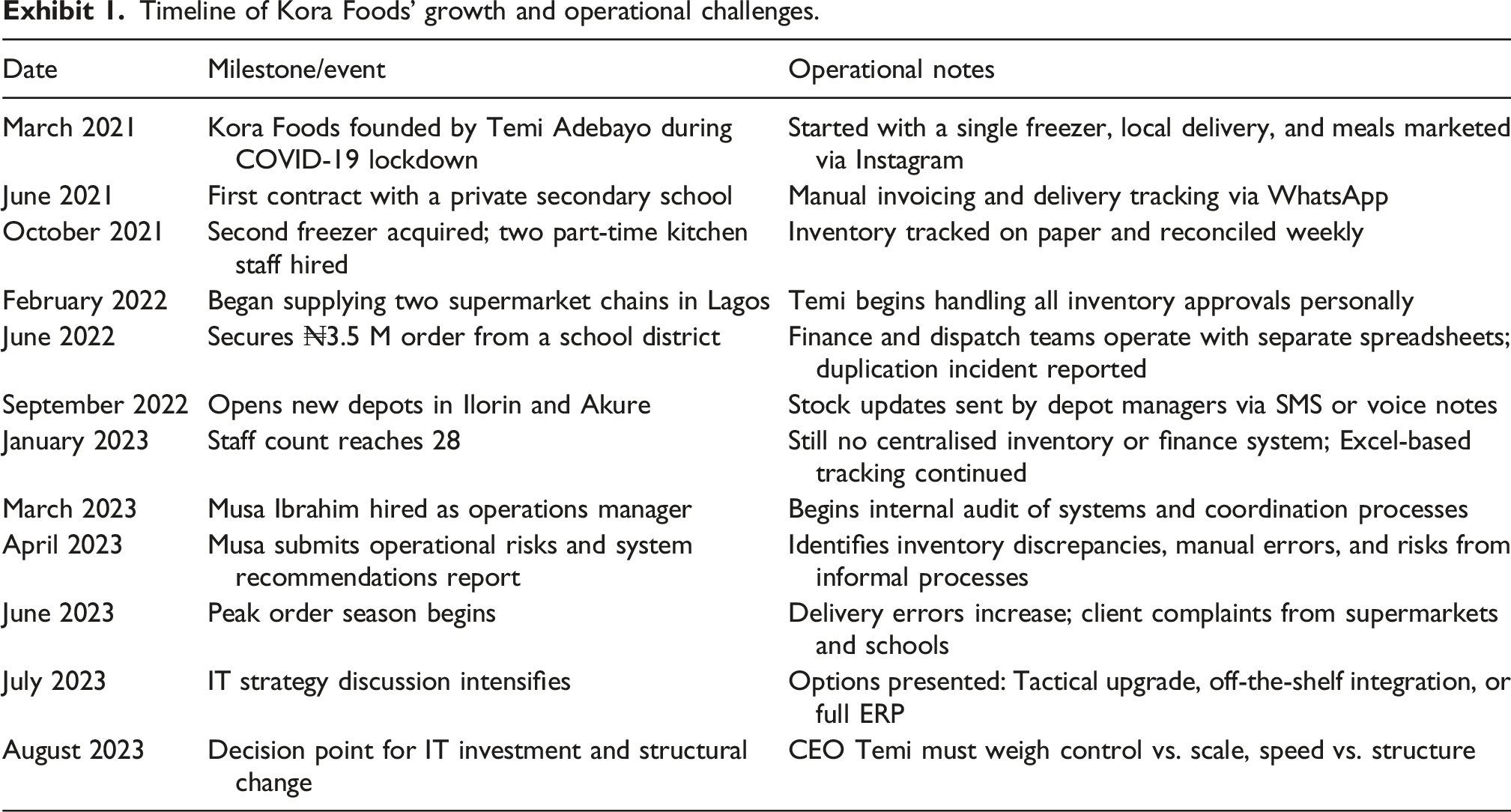
Timeline of Kora Foods’ growth and operational challenges.
Summary of proposed IT options at Kora Foods.
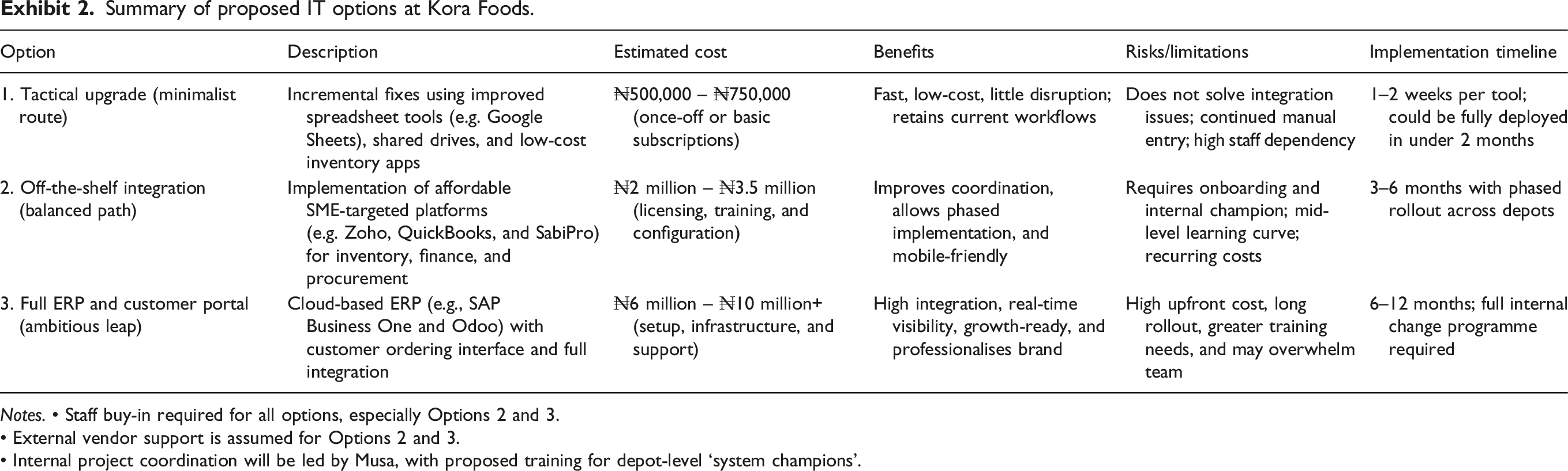
Notes. • Staff buy-in required for all options, especially Options 2 and 3.
• External vendor support is assumed for Options 2 and 3.
• Internal project coordination will be led by Musa, with proposed training for depot-level ‘system champions’.
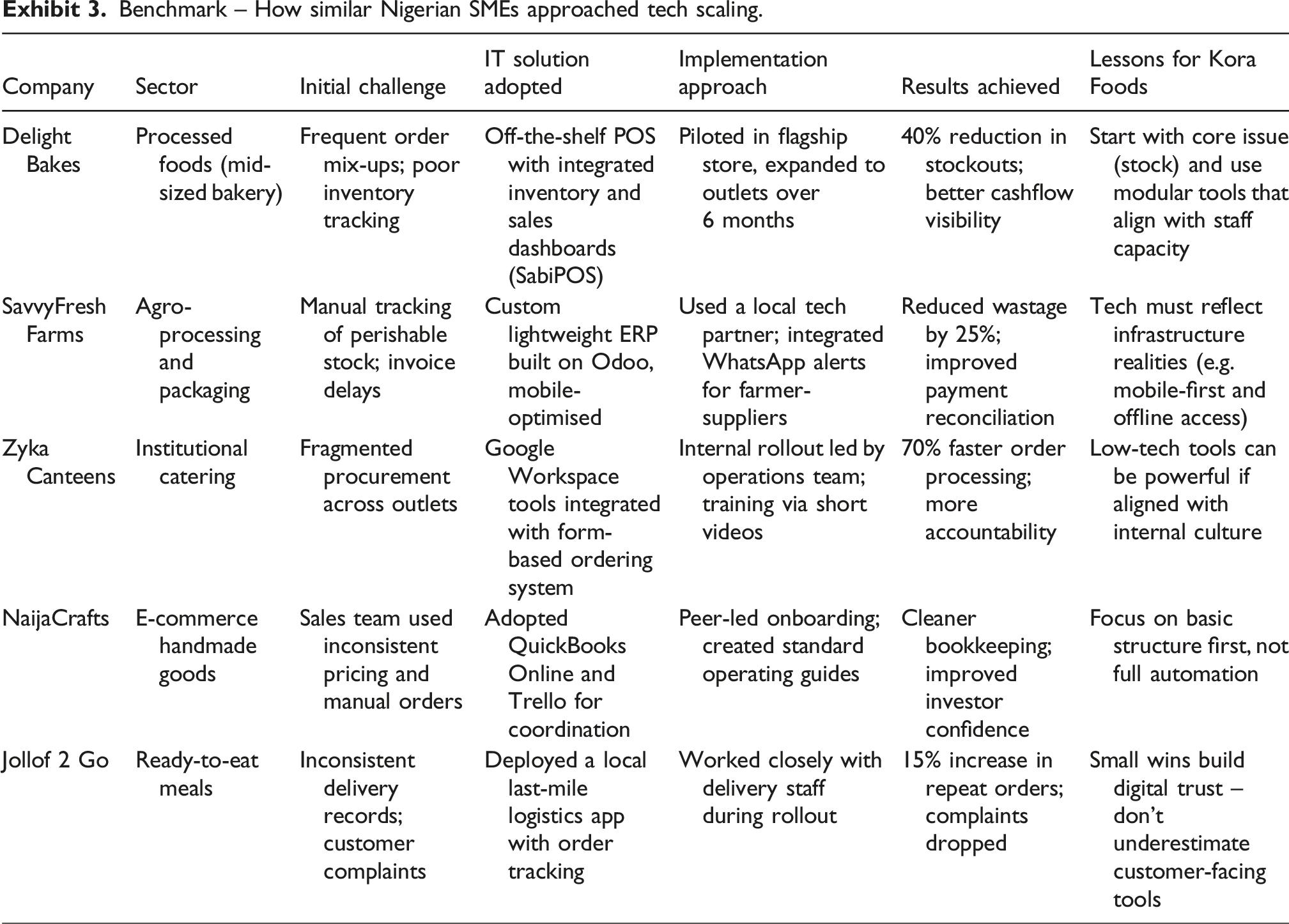
Benchmark – How similar Nigerian SMEs approached tech scaling.
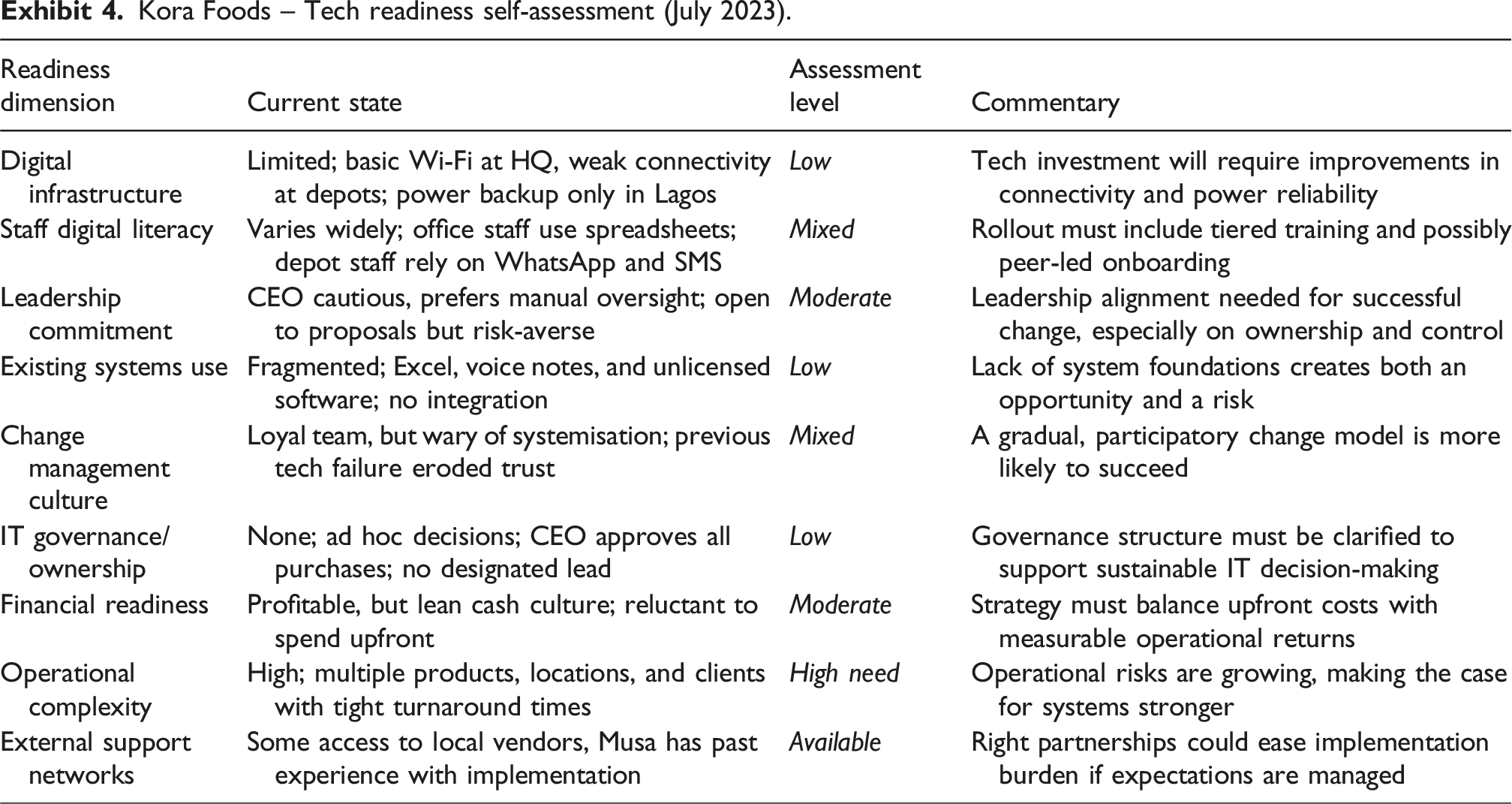
Kora Foods – Tech readiness self-assessment (July 2023).
What kind of organisation was Kora becoming? And what kind of leader did that future require her to be?
Discussion questions
1. To what extent should Kora Foods treat IT as a strategic driver rather than a support function? How can Temi align technology investment with Kora’s core business model and long-term goals? Consider models such as the Strategic Alignment Model (Henderson and Venkatraman, 1993) and IT-business alignment frameworks in SME contexts. 2. Evaluate the three proposed technology options using appropriate decision frameworks. Which option best fits Kora’s operational context, and how should the company sequence implementation? Students may apply cost-benefit analysis, McFarlan’s Strategic Grid, or the Technology-Organisation-Environment (TOE) framework. 3. What change management strategies should Temi and Musa adopt to ensure successful technology adoption at Kora? What risks must be mitigated across cultural, human resource, and operational dimensions? Explore Lewin’s Change Model, Kotter’s 8 Steps, or ADKAR; draw comparisons with SME digitalisation studies. 4. How should IT ownership and governance be structured within a growing SME like Kora Foods? What are the trade-offs between centralised and distributed ownership of IT functions? Discuss using principles from IT Governance frameworks (e.g. COBIT and Weill and Ross governance archetypes) adapted for SMEs. 5. Given the infrastructural and digital literacy challenges in Kora’s operating regions, how can the company ensure resilience and usability in its chosen system? Draw on socio-technical systems theory, digital inclusion literature, or examples of digital localisation in emerging markets. 6. What kind of leadership posture should Temi adopt in this moment of organisational transition? How should she weigh flexibility, control, and growth in making her final decision? Engage with theories of entrepreneurial leadership, bounded rationality, and decision-making under uncertainty.
Footnotes

Ethical consideration
Ethical approval was not required for this study, in accordance with Nottingham Trent University’s policy on the use of existing organisational data and anonymised field material. No human participants or personal data were collected through interviews, surveys, or direct observation requiring institutional review.
Funding
The authors received no financial support for the research, authorship, and/or publication of this article.
Declaration of conflicting interests
The authors declared no potential conflicts of interest with respect to the research, authorship, and/or publication of this article.
Data Availability Statement
Data has been included in the study in form of exhibits. Further data are not publicly available due to confidentiality agreements and anonymisation protocols.