



Abstract
As digital transformation accelerates, the global economy presents new opportunities for industries to transform their business models, and fashion is no exception. Virtual fashion—digital garments designed for use in virtual environments—is emerging as a disruptive innovation with the potential to reshape traditional consumption patterns. This case study explores the potential role of virtual fashion to drive sustainability by minimizing material waste and enabling more sustainable, digital business models. Using frameworks such as Innovation Diffusion Theory and the Triple Bottom Line, this study categorizes various types of virtual fashion and evaluates their capacity to deliver environmental, social, and economic benefits. Despite its promise, digital fashion is not without challenges, including risks of overconsumption. Therefore, this case study aims to offer actionable insights on how to leverage virtual fashion as a strategic opportunity while ensuring it complements broader sustainability goals rather than distracts from them.
Keywords
Introduction
Have you ever found yourself scrolling through endless online shops, seeking the perfect outfit to showcase on your social media feed? Now imagine if those outfits existing solely in the digital realm, while retaining their ability to impress. In 2009, the first-ever digital couture dress, “Iridescence”, sold for 54 ETH (approximately $9500) at the Ethereal Summit in New York (Renwick, 2019) (Figure 1). “Iridescence”, a collaboration between Dutch digital fashion house The Fabricant, designer Amber Jae Slooten and Dapper Labs (Roberts-Islam, 2019), marked the emergence of virtual fashion as a new frontier in the digital economy. While “Iridescence” was the first, Dolce & Gabbana set a $5.6 million record in 2021 by selling its nine-piece digital virtual clothing collection, “Collezione Genesi” on UNXD, a digital luxury and culture marketplace (Thomas, 2021). This sale is emblematic of a broader transformation taking place in the fashion industry. The world’s first-ever digital-only dress is sold for $9500 USD, Credits: Model: Johanna Jaskowska, Photographer: Julien Boudet, Digital Fashion Design: Amber Jae Slooten, Production: The FabricantxDapperLabs, The Fabricant: https://www.youtube.com/watch?v=6vNZ-LAZAvE&ab_channel=TheFabricant
Virtual clothes, also known as “digital fashion”, “virtual fashion”, “digital garments”, “cyber garments” or “3D fashion” were initially defined as “wearable computers” (Park and Lee, 2001). This early definition stemmed from virtual clothing’s origins in the online gaming world, where in-game-purchases of character garments, or costumes gained popularity (Makryniotis, 2018). These digital outfits allowed players to customize their avatars, which became central to identity formation within virtual gaming environments (Peachey and Childs, 2011). The desire to purchase virtual items was not purely functional but often driven by hedonic and social motivations (Marder et al., 2019). Avatars serve as tools for self-expression and identity creation, acting as “access points” to digital social life (Taylor, 2002). For example, players in free-to-play games, such as League of Legends, are motivated to buy virtual clothing to enhance their avatars, reflecting their personal or aspirational selves, demonstrating the importance of virtual representation in gaming and social interactions (Marder et al., 2019).
With the growing digital transformation of the fashion industry, virtual fashion is no longer confined to online gaming environments. The rise of 3D virtual modeling, NFTs (non-fungible tokens), and blockchain technologies has expanded the digital rendering of garments or accessories (Särmäkari, 2023). These advancements, coupled with the adoption of virtual reality, graphics design, and simulation technologies, have enabled virtual fashion to commercialize further. Its definition now includes digital assets that can be worn across various virtual environments such as social media, the metaverse, gaming platforms, and online meetings (Khelladi et al., 2023; Samuel et al., 2017; Sheng, 2023).
Contrary to traditional perceptions, virtual fashion also offers a wide range of products, from casual items such as t-shirts and jeans to “ethereal” designs, such as a “cloud cape”. As digital fashion entrepreneur Karinna Grant highlighted in her TED Talk “What’s the Point of Digital Fashion?” (Grant, 2024), these garments may be made of pixels rather than threads, but their potential for self-expression and consumer engagement is undeniable. In this case study, the terms “virtual clothes,” “digital fashion,” and “virtual fashion” will be used interchangeably.
The global fashion industry produces over 90 million tons of textile waste annually and contributes 10% to global carbon emissions and 20% of global wastewater (Waste Managed, 2024). These environmental challenges indicate the industry is moving away from achieving its net-zero target by 2050 (United Nations Climate Change, 2023). As sustainability and sufficiency become increasing priorities for consumers (Jungell-Michelsson and Heikkurinen, 2022; Schauman et al., 2023), virtual fashion presents a way to decouple the fashion industry from its material constraints. By reducing the environmental burden of traditional production, it also provides economic opportunities for fashion brands and opens the door to a circular economy, where virtual products can be reused indefinitely, reducing the need for raw materials and waste production.
Recognizing the platform power, decentralization and openness enabled by technological transformation, this case study explores three key areas: (1) how virtual fashion operates within digital marketplaces, (2) how its offerings can be classified, and (3) how virtual fashion has the potential to transform the fashion industry by driving sustainability. By answering these questions, this case study maps the ecosystem of virtual fashion, its brands (also known as Web3-native brands) and classifies the diverse digital product offerings available in the marketplace. The analysis also explores the dematerialization of fashion industry, viewed through the Triple Bottom Line framework, which considers how shifting consumer expectations and behaviors may influence the future of consumption. This case contributes to the broader discourse on sustainability, digital innovation, and the changing dynamics between consumers and the fashion industry.
How virtual fashion operates: Its classification though Web3 commerce
The service design for purchasing virtual clothes in Web3 commerce typically follows a straightforward pattern. After selecting a digital garment from a virtual fashion marketplace, users upload a full-body photo based on platform’s guidelines. This allows them to customize various aspects of the garment, such as color, pattern, and details like sleeve, neckline- tailoring it to their preferences, trying it on and experiencing the digital feeling. After this stage, a 3D fashion designer digitally tailors the item based on the photo, adjusting size to fit either a virtual avatar or the user’s desired proportions. Once finalized, users receive the digital item in their account, which they can then download and use across virtual environments, social media platforms, or for creating digital content (Särmäkari, 2023).
As the Internet evolves from being a simple information-sharing platform (Web 1.0) to a decentralized architecture leveraging blockchain technology to offer enhanced security, privacy, and autonomy to its users (Web3) (Gala, 2024), so too does the operational and commercial landscape for digital creative industries (Park et al., 2023; Potts and Rennie, 2019). From 2021 to 2022, Web3 fashion witnessed significant growth, largely coinciding with the bull market, allowing the Web3 fashion ecosystem to expand and consolidate.
Notably, the first digital fashion house, The Fabricant, founded in 2018, paved the way for virtual Web3-native fashion brands, such as RTFKT (later acquired by Nike), STEKKEL, and 9dcc. This led to a surge in Web3 fashion-tech start-ups and marketplaces such as Space Runners (https://spacerunners.com), Futures Factory (https://www.futures-factory.com/), and DressX (https://dressx.com/), which developed demand-driven distribution models focused on cross-chain fashion items for integration into Web3 metaverses and games. These platforms also reinvented visual discovery journeys to deliver extended reality (XR) and augmented reality (AR) consumer touchpoints and optimize the supply chains. Virtual marketplaces developed various ways to acquire fashion online, ranging from buying daily wearables to collectors’ items. Not only do Web3-native brand provide clothes, but many Web2 brands have also entered the market, offering daily wearables as well as collectibles.
Web3 has introduced new methods of commercialization, particularly in payments and asset transfers. These transactions are categorized as on-chain and off-chain, or real word assets (RWA). Off-chain payments refer to transactions between two parties outside the blockchain network: payments off-chain through other payment channels, such through traditional banking systems (e.g., credit card) (Hu et al., 2019). On-chain payments, however, occur on the blockchain network and require a cryptocurrency wallet, a digital wallet capable of holding specific currencies to complete the transaction (Bellagarda, 2019). On-chain transactions offer several benefits, including verifiable authenticity of digital items and a decentralized structure that makes counterfeiting difficult (Joy et al., 2022). Through on-chain payments, digital items—often in the form of non-fungible tokens (NFTs)—become authenticated digital assets. Blockchain’s transparency ensures any transaction to be visible, allowing the ownership rights are “transparent, immutable, and traceable” (Murray et al., 2023: 193).
Some leading digital fashion marketplaces, such as DressX and The Fabricant, offer users the option to purchase virtual clothes through both on- and off-chain payments. When users choose on-chain payments, the digital item-such as virtual clothing in this case-becomes a digitally authenticated item known as a non-fungible token (NFT), which is secured on the blockchain. This process ensures that ownership of the item is verifiable and cannot be replicated. However, on-chain payments come with certain trade-offs. The transparency and immutability inherent to blockchain technology mean that the transaction histories are publicly accessible (Wang and Liu, 2023). While this guarantees that the data cannot be altered or compromised, it also means privacy is not guaranteed, as anyone with Internet access can view the transaction history (Azgad-Tromer et al., 2023; Miyachi and Mackey, 2021). Despite this, on-chain transactions grant the buyer full ownership rights.
One of the major promises of Web3 is the creation of a decentralized Internet, often described as “a renaissance of peer-to-peer interactions” (Murray et al., 2023: 9). This framework enables users to transact directly without relying on trusted intermediaries, such as financial institutions (Ray, 2023). The shift towards decentralization allows individuals to gain control over their digital assets and personal data, paving the way for new forms of user-developed content, applications, and services powered by existing Internet infrastructure.
How do Web 2.0 brands operate in Web3? Exploring virtual fashion and product categories
The virtual fashion ecosystem operates at the intersection of Web3 technology and growing consumer demand for sustainable, digital alternatives to physical goods. Leveraging Innovation Diffusion Theory, this case study classifies virtual fashion adopters as innovators and early adopters who are driving changes in consumer behavior and fashion management practices. From a Resource-Based View, virtual clothes are new forms of intangible assets—digitally authenticated fashion items (NFTs)—that provide a competitive advantage for brands seeking to capitalize on digital and decentralized marketplaces.
This surge in Web3 adoption has compelled numerous high-profile fashion brands, referred to as Web 2.0 brands (Fournier and Avery, 2011), to integrate into the Web3 ecosystem. For example, in early 2021, Nike acquired Web3 native fashion brand RTFKT, launching unique virtual wearables and metaverse-ready avatars. Similarly, in August 2021, Burberry introduced its first non-fungible tokens (NFTs) in the blockchain-based game Blankos Block Party, which sold out within minutes (Melo, 2023). In 2022, Gucci unveiled its SuperGucci NFT collection in collaboration with toy giant Superplastic. Web 2.0 brands have entered the Web3 space by offering virtual fashion products in five distinct product categories, each tailored to meet the needs of digital-first consumers:
Phygital NFTs (physical + digital NFTs)
Phygital non-fungible tokens (NFTs) combine physical and digital experiences by linking real-world products to their virtual counterparts (Mele and Russo-Spena, 2024). These NFTs foster community engagement and continuous interaction between physical and digital realms (Floridi, 2015). A prominent example is the Bstroy x Givenchy phygital NFT launched in 2022, where buyers of the physical items in the U.S and Europe received an NFT as a digital twin (sometimes referred to as a virtual twin) of their purchase. This integration of physical products and digital assets underscores a dominant approach for Web2 fashion brands to engage native Web3 communities while also attracting the attention of Web3 collectors.
Phygital NFTs are often showcased in immersive environments such as social media platforms, virtual showrooms, or metaverse spaces. Gaming platforms like Roblox and Fortnite have become major destinations for virtual wearables, creating a bridge between the gaming world and fashion brands. These environments allow users to display their virtual fashion items in interactive spaces, enhancing the physical and virtual aspects of their purchases (Idrees et al., 2023).
For example, e.l.f. Beauty has adopted phygital commerce through its virtual kiosk within Roblox, where users can purchase exclusive physical skincare products alongside their digital versions to wear in the virtual world (Hirschmiller, 2023a). Roblox, which boasts over 79 million daily active users as of 2024, has seen remarkable growth in recent years, adding over 180 million users in the past 3 years alone (Statista, 2024). This rapidly expanding user base makes platforms like Roblox an ideal space for brands to experiment with phygital commerce, providing access to a vast audience for digital products and immersive experiences.
Membership NFTs
Membership NFTs serve as digital collectibles that grant holders access to exclusive benefits (Levi, 2021). These NFTs provide brands a way to create deeper connections with their most loyal customers by offering access to unique experiences. For example, the Dolce & Gabbana: DG Family collection (see: https://opensea.io/collection/dolce-gabbana-dgfamily), grants members to access to virtual events, exclusive content, and offsite meetings with Dolce & Gabbana team.
Similarly, in 2021, Adidas launched its “Into the Metaverse” NFT, which provided buyers with exclusive access to both virtual and physical products, as well as special events in immersive digital spaces (Adidas, nd). Holders of the NFT could participate in a range of virtual experiences, including a virtual runway in Decentraland (De Silva, 2023).
Collectible NFTs
Collectible NFTs are unique digital assets that represent ownership of a one-of-a-kind items or limited-edition collections (Valeonti et al., 2021). An example is Gucci’s Aria short film NFT launched in May 2021. This NFT, a four-minute digital artwork, was later auctioned and sold for $25,000 in June 2021 (McDowell and Schulz, 2024). These digital collectibles allow fashion brands to leverage their heritage and creativity, appealing to both traditional art collectors and digital-first audiences (Sung et al., 2023).
PFP NFTs (profile picture NFTs)
PFP NFTS, short for “profile picture” or “picture for profile” non-fungible tokens allow users to customize their avatars with branded fashion items and accessories, enhancing their digital presence on platforms such as Twitter, Telegram, Discord, and Github. According to Casale-Brunet et al. (2022), this type of the NFT contributed to the popularity of NFT technology. Both Web3-native and Web2 brands are investing in PFP NFTs to scale their reach, enabling loyal customers to transform their avatars from simple images created by an issuing party into valuable and customizable assets.
Champion Athleticwear has embraced this trend by introducing digital apparel where users can utilize to upgrade their avatars, enhancing deeper brand engagement in the digital realm. PFP NFTs are widely used in immersive environments, where users integrate their customized avatars into their social media or gaming identities. Platforms like Decentraland and The Sandbox allow users to wear and display PFP NFTs, making them integral to virtual identities.
Loyalty NFTs
Loyalty NFTs function as tokenized rewards, offering brands a unique way to connect with consumers through loyalty programs. For example, Lacoste introduced its UNDW3 card as a part of the brand’s Web3 loyalty program, designed to co-create the brand’s future with its Web3 community. Holders of these NFTs can participate in exclusive NFT raffles, receive digital twins, and unlock other rewards, creating an ongoing relationship between brands and their consumers (Hirschmiller, 2023b). Loyalty NFTs are often deployed in immersive digital spaces, offering users exclusive access to events or merchandise that fosters long-term engagement with the brand (Hosseinalibeiki and Zaree, 2023; Yilmaz et al., 2023).
The rapid adoption of Web3 technologies has significantly transformed how Web 2.0 brands operate in the digital fashion space, pushing them to explore new product categories and virtual marketplaces. The integration of NFTs—whether phygital, membership, collectible or PFP—has allowed brands to connect and engage with consumers in innovative ways, blurring the boundaries between digital and physical commerce (Schauman et al., 2023).
These virtual fashion products have created news ecosystems, as illustrated in Figure 2, consisting of foundational stakeholders (Web 2.0 and Web3 brands), digital marketplaces, and diverse product categories that enable brands to connect with consumers across traditional and metaverse environments. This model highlights the interconnectedness of the Web3 ecosystem, where brands, marketplaces, and consumers continually engage through NFT-based offerings, driving the future of fashion toward a more decentralized and community-oriented approach (WEF, 2023). Web3 fashion ecosystem and ecosystem relationships, author’s creation.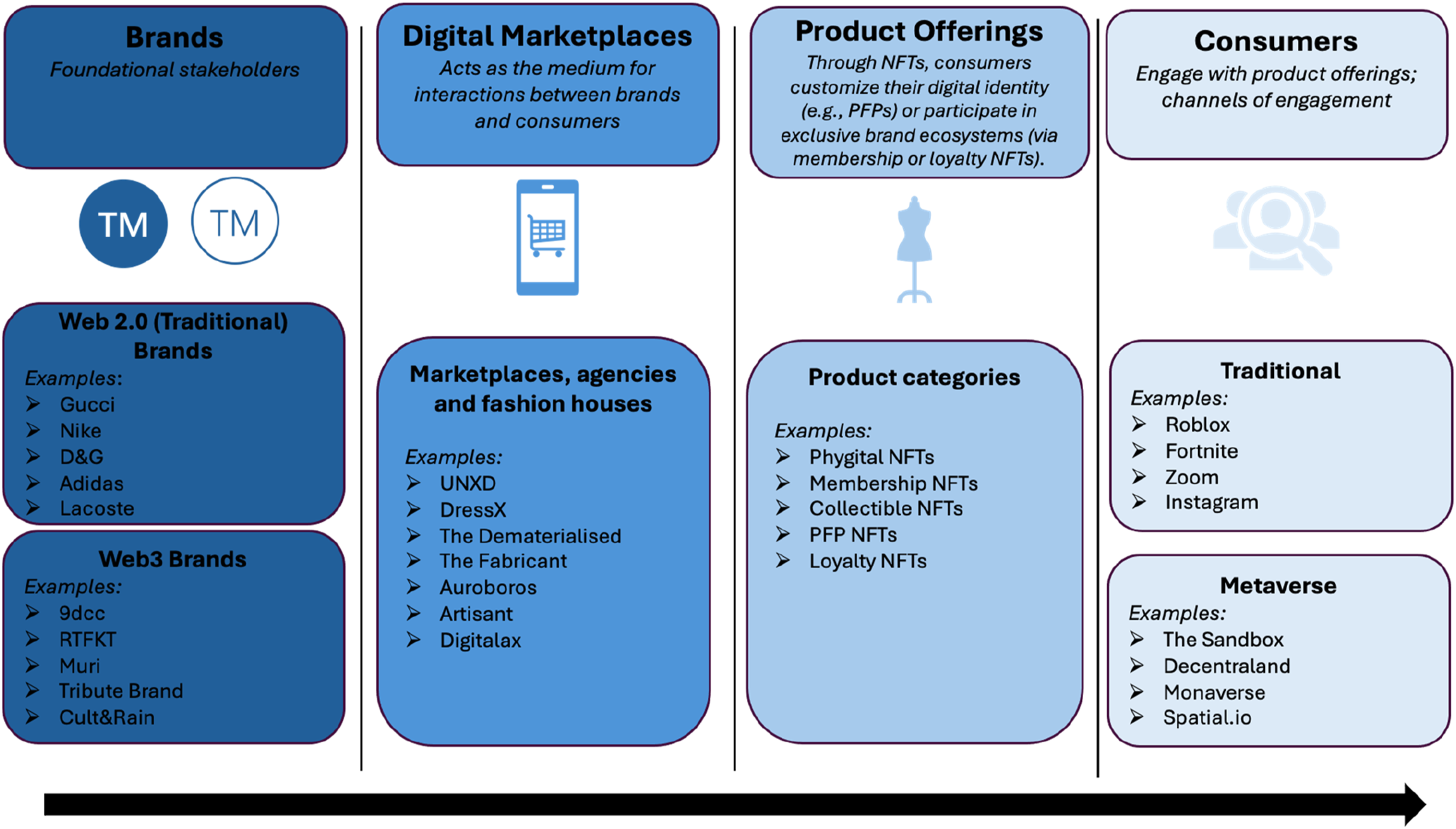
Dematerialization and the Triple Bottom Line: People, planet, and profit
The fashion industry accounts for more than 20% global clean water pollution annually (European Parliament, 2024). Its energy-intensive, fossil fuel-based production processes contribute significantly to resource depletion (Igini, 2023). The fast-fashion model, rooted in ever-growing consumption, promotes mass production and a use-and-discard culture (Bertola and Teunissen, 2018; Garcia-Ortega et al., 2023). In Europe, this model generates 391 kg of raw materials and uses 400 square meters of land per person, resulting in a carbon footprint of approximately 270 kg per capita (European Parliament, 2023). In 2015, this equated to emissions of 1.7 billion tons of carbon dioxide, exceeding the combined emissions of all international flights and maritime shipping (Sumner, 2019). As Devine (2015: 367) points out, “modern development, consumption and waste have strained the environment to the point of crisis”, placing fashion industry at the center of this global challenge.
Dematerialization refers to the process of reducing physical resource consumption while maintaining or even enhancing value creation (Casciani et al., 2022; Wernick et al., 1996). Just as the digitization of books, music, and videos shifted these industries from physical objects toward digital substitutes (Devine, 2015), the fashion industry is undergoing a similar transformation through virtual fashion. This shift holds significant potential for addressing the Triple Bottom Line.
The Triple Bottom Line is a sustainability framework that extends beyond financial results (also known as the financial bottom line) to include the social and environmental impacts of business operations (Miller, 2020). Rather than emphasizing profit alone, this framework encourages businesses to evaluate their performance across three interconnected areas: People, Planet, and Profit.
People
The social dimension of Triple Bottom Line, People, presents both opportunities and challenges for digital fashion. On the one hand, digital fashion reduces the need for labor-intensive production, an industry often characterizes by low wages. By lowering labor costs, it may negatively impact developing countries whose economies depend on textile manufacturing (Williams, 2022). On the other hand, the democratization of digital fashion can empower small designers and creatives by removing traditional barriers to entry. Emerging designers can leverage digital platforms to create and sell virtual clothes globally, fostering innovation and inclusivity.
Planet
The production of virtual clothes has a significantly lower environmental impact. Digital fashion requires no chemicals or water, resulting in a 97% smaller carbon footprint compared to physical clothes production (Digital Product Creation Report, 2022). Without physical production, it also eliminates microplastic shedding and soil degradation—key contributors to plastic pollution, with a considerable proportion of microplastics originating from textiles (Henry et al., 2019). According to DressX, replacing just 1% of physical clothing with virtual alternatives could help the fashion industry save 5 trillion liters of water and reduce its annual carbon footprint by 35 million tons—the equivalent of Denmark’s total carbon emission in 2017 (DressX, 2023).
Profit
The shift to digital fashion provides brands with not only environmental benefits but also economic solutions. It reduces production costs, increases profit margins, and taps into emerging digital-first consumer markets. This shift is particularly relevant given the recent challenges facing the fashion industry. As inflation continues to rise and high interest rates are expected to persist higher for longer (John, 2023), the fashion is grappling with an uncertain economic landscape. The post-pandemic fashion consumption boom has slowed, leaving many brands with unsold industry as products manufactured and ordered in advance sit in warehouses, often sold at steep discounts (McKinsey & Company, 2024).
Additionally, the fashion industry faces further challenges from fluctuating demand, worsened by the bullwhip effect—where small shifts in consumer demand cause significant supply chain disruptions. These disruptions result in factory inefficiencies, layoffs, and delayed infrastructure investments (Lee et al., 1997; McKinsey & Company, 2024). In such volatile times, the cost efficiencies and flexibility offered by virtual fashion can act as a buffer.
Unlike traditional fashion, virtual fashion is not constrained to physical production timelines or inventory risks. This flexibility allows brands to manage short-term economic pressures while positioning themselves to navigate future supply chain uncertainties with greater resilience. For example, FINESSE, a ready-to-wear brand in the U.S, uses artificial intelligence (AI) to design trends and showcase digital products, producing only what consumers approve. This approach minimizes overproduction and waste, creating a leaner, more cost-effective model (Fashion Network, 2022). Similarly, a fashion brand Hanifa hosted a virtual fashion show where all garments were displayed in 3D, appearing as if worn by invisible models (Segran, 2020). Such innovative uses of digital fashion reduce operational bottlenecks, lowering costs, lead time, and time-to-market (Alam et al., 2023; Jin and Shin, 2021). These examples further showcasing the economic advantages of digital fashion in a dematerialized world.
Digital fashion: Not a complete solution
While the shift to digital fashion promise in reducing resource consumption, it is not a panacea. Digital products remain a niche market, with only about 10% of consumers having engaged with digital currencies or purchased a virtual item (EY, 2022). Although adoption rates are expected to grow, digital fashion is unlikely to completely replace physical demand in the near future.
Moreover, there is a risk that digital fashion could divert the attention from the urgent need to reform physical production models and infrastructures (Williams, 2022). While investments in digital fashion are beneficial, they cannot fully compensate the ongoing environmental impact of physical manufacturing. Brands must be cautious not to use digital ventures as a distraction from implementing essential changes to their conventional supply chains (Jin and Shin, 2021).
However, as digital fashion continues to evolve, it has the potential to cater consumer desires for unique experiences and status, creating a new market for luxury digital items. This aligns with the theory of consumption values (Sheth et al., 1991), which suggests that consumers seek products that fulfill their need for self-expression and personalization. Virtual clothing allows consumers to curate their digital identities beyond the constraints of traditional fashion, offering new avenues for creativity.
At the same time, overconsumption in the digital realm could normalize unsustainable behaviors, ultimately hindering progress toward a more sustainable approach to physical fashion. Brands must balance the opportunities offered by digital fashion with the need to address the underlying environmental issues in their traditional operations.
Discussion questions
1. How can virtual fashion contribute to reducing environmental impacts in the fashion industry, and what limitations might prevent it from fully addressing sustainability challenges? Use Triple Bottom Line framework to evaluate the environmental benefits, social implications, and potential economic trade-offs. 2. What are the potential implications of adopting virtual fashion for traditional fashion brands in terms of business models and consumer engagement? Use Porter’s Five Forces to examine how virtual fashion affects competition, consumer bargaining power, and the threat of substitutes in the market. 3. In what ways might the adoption of Web3 and blockchain technologies affect consumer perceptions of virtual fashion, particularly regarding authenticity and ownership? Conduct PESTLE analysis to explore how technological advancements and legal considerations may shape consumer perceptions.
Footnotes
Declaration of conflicting interests
The author(s) declared no potential conflicts of interest with respect to the research, authorship, and/or publication of this article.
Funding
The author(s) received no financial support for the research, authorship, and/or publication of this article.
