




Abstract
This teaching case examines how engineering consultants Helbling Technik AG overcame challenges in implementing a digital twin approach to mechatronics product development, saving costs, and reducing time to market. It challenges students to understand digital twins in mechatronic system development and their implications for processes, use cases, and service models. This real-world example is relevant for students and educators interested in the challenges and opportunities of digital twin implementation.
A client visit that brings back memories
One morning in early 2020, during a business trip to the USA, Ueli Schläpfer, partner and team leader at Helbling Technik AG in Zurich, Switzerland, a provider of innovation and engineering services, received an invitation from the Chief Technology Officer (CTO) of a large textile manufacturing company. The invitation was for a professional exchange of technological development. For Ueli, informal exchanges are a common part of his work. Staying in close contact with clients and discussing views on new technologies, especially when they become market-ready, are key to the success of Helbling Technik AG.
As Ueli arrived at the large compound of the textile company, he couldn’t help but feel a sense of eagerness. Even after years of experience, he relished the opportunity to exchange ideas with other professionals in his field. As he entered the lobby of the company premises, the CTO, Maria, greeted him warmly and began to discuss the latest technological developments over a cup of coffee. Ueli was always interested in learning about the latest advancements made by his clients, and Maria had plenty to share.
Abruptly, Maria, a glint in her eye, stood up and said, “We have been working on something for the past two years that I think you will find interesting. Follow me.” Ueli’s interest was sparked, and his anticipation grew as Maria led him through the hallways, chatting about the textile company’s latest developments.
The two went up the stairs to the Research and Development Center. The large room, which covered almost one-third of the entire area of the production floor below, was occupied by only a handful of workers in white coats. A vast range of textile samples were laid out on clean white desks, and a futuristic textile machine was placed in the center of the room. Ueli immediately recognized the machine; after all, his company had a hand in developing it.
As they approached the machine, Ms. Miller pointed to a nearby PC monitor. “This is it,” she said. The monitor displayed a digital model of the machine core, showing an advanced simulation of textile production. “We intend to use this for future machines,” Maria explained. “We simulate different production activities and reproduce the most successful ones in any future machines.” Ueli was thrilled to witness such advanced digital twin technology. Following a productive discussion over lunch about the current project with Maria, he headed back to his hotel to pack for his flight to Zurich.
As Ueli settled into his seat on the aircraft, his mind began to wander. He could not help but think back about a project that had been put on hold over a decade ago. It was one of the first experiments Helbling Technik AG had conducted with digital twins, but the technology at the time was still in its infancy. Now, with more advanced digital twin technology available and inspired by what Maria had just shown him, Ueli saw the opportunity to revive and finish that project. He could not wait to start.
Getting organized back home in Zurich
Upon returning to Zurich, Ueli resumed his role as a partner and team leader at Helbling Technik AG. The company is the engineering consulting business of the Helbling Group, a holding company that offers technological innovation and business consulting services across various industries. Helbling Technik AG provides a wide range of services, including engineering, design, innovation, and product lifecycle management, with more than 500 employees and offices in Switzerland (see Figure 1), Germany, the United States, and China. Their interdisciplinary teams collaborate with clients to develop practical solutions and ensure their successful implementation. A view of Helbling’s headquarters in Zurich, Switzerland.
Ueli’s business unit at Helbling Technik AG specializes in serving clients who have specific ideas for mechatronic systems or devices but lack the necessary capabilities or resources to engineer them. This can include household appliances, medical devices, and industrial machinery. Within his team, Ueli works with mechatronics, mechanical, and robotics engineers. When necessary, they can also draw on specialists from other teams such as industrial designers, user interface designers, user experience designers, business engineers, simulation specialists, and physicists to form interdisciplinary project teams. This organizational structure allows Helbling Technik AG to lead the development of novel technologies in each domain while maintaining the flexibility needed to succeed in client projects. The company’s clientele ranges from start-ups to some of the largest corporations in the world.
It is critical for clients of Helbling Technik AG to launch new innovations quickly to capture first-mover advantages and reduce the time to market to the absolute minimum. This is often key to the success of a new product. However, such business objectives often conflict with the current development of technical innovations within the industry.
A common challenge in the development of innovative products is that the cost of change increases rapidly with advancement in development. Helbling Technik AG’s development process supports the translation of user requirements into technical requirements, ensures the coverage of a wide range of alternative solutions, and asks for reviews at various stages to obliviate the need for late changes. A digital twin is a valuable addition to this toolbox, as it allows for early virtual testing of concepts and greatly enhances the quality of evaluating competing solutions.
During the development of a prototype, there is usually a phase where the client is waiting while the development team assembles the prototype, tests, and powers the sensors and motors, and eventually implements the software designed for the prototype. Only when the prototype is fully assembled and wired can its operation be tested for the first time, and engineers can start thinking about improvements to the prototype and the processes it is designed for.
When utilizing the current standard development processes, that is, when no digital twin is used, testing and optimizing a device’s operation and process follow the electrical testing as well as the testing of the prototype’s control logic. The following diagram (Figure 2) shows an example process at Helbling Technik AG from kick-off to Factory Acceptance Testing (FAT) and Site Acceptance Testing (SAT). Typical mechatronic systems development process at Helbling Technik AG.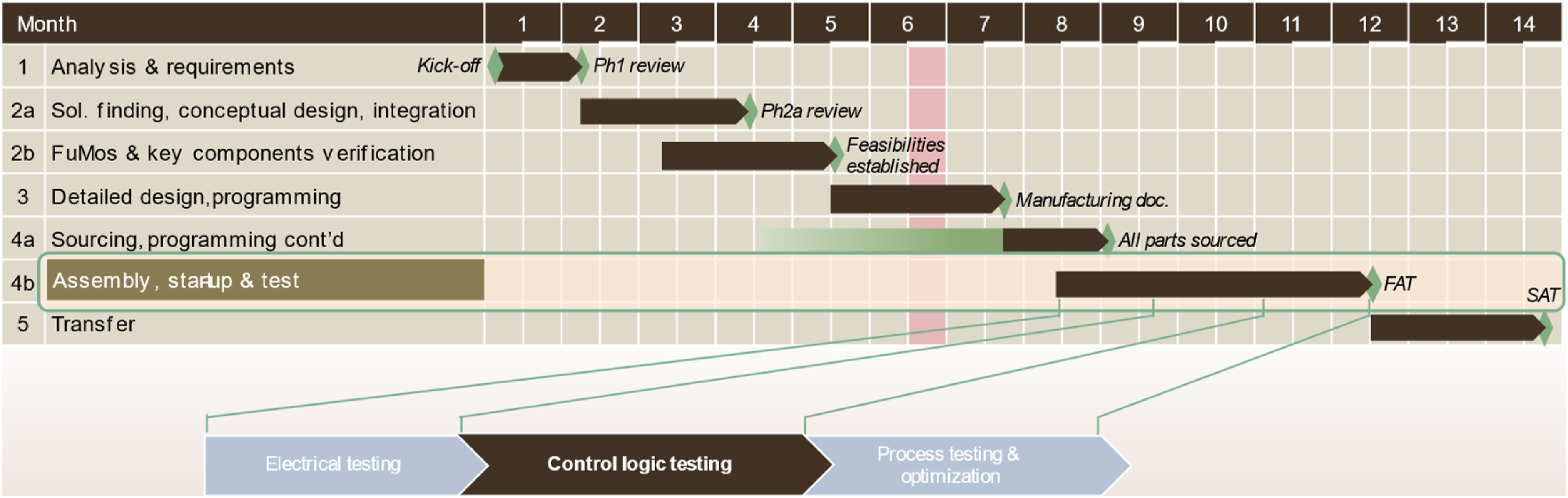
To discuss his digital twin project, Ueli called upon his colleague Fabian Schneider, who heads the mechatronic development team. Both possess extensive experience and postgraduate engineering degrees from the Swiss Federal Institute of Technology. As experts in their field, they are well versed in the latest technological concepts that can support and enhance the development of mechatronic systems. Among the various technological advancements, both have been particularly interested in digital twins, which are digital replicas of a physical instance, such as a machine or a prototype. Unlike simple Computer-Aided Design (CAD) Models, digital twins offer a more comprehensive and advanced representation of the physical devices in question.
A digital twin includes data about the exact physical, digital, and sometimes even chemical properties of the underlying devices as well as the sequence flows of processes so that experiments can be performed with it. Additionally, it shows exactly how a real device would respond to changes in its environment or how the device would perform during operations. Taking another look at their current mechatronic system development process, Ueli and Fabian discussed how the process could be changed when digital twins are used during the development of a prototype.
Launching the internal digital twin project
For Ueli, it was clear that the technology supporting digital twins had reached a maturity level that would allow for its application in regular projects. Compared to earlier attempts at working with digital twins, it was now possible to model various processes, such as that shown to him by Maria. Certainly, clients of Helbling Technik AG would welcome and support the idea of working with digital twins to improve both quality and efficiency in technology development. If he moved quickly enough, Helbling Technik AG could establish itself as an early adopter in the use of digital twins as part of the prototype development toolchain.
Ueli exchanged his thoughts with Fabian, who immediately expressed interest in the project if it was approved. The two evaluated the potential benefits of using digital twins in future development projects. How can Helbling Technik AG and its clients benefit from this new technology? To convince his management peers, Ueli drafted a proposal that explained how digital twins, as part of Helbling Technik AG’s development tool chain, can reduce project risks, costs of changes, and ultimately time to market. During a management meeting at Helbling Technik AG, Ueli presented his project proposal and emphasized the potential gains it could bring to the company. Many of his colleagues showed an interest in the idea and expressed their approval. It was clear that the project had the potential to deliver significant competitive advantages for Helbling Technik AG. Consequently, convincing management to green-light the project was not a difficult task.
Ueli was then faced with a typical challenge that consulting and engineering companies face when it comes to internal projects. How can an internal project be set up with a minimum of non-billable hours and not interfere with ongoing client projects? Ueli, as the newly instated project sponsor, decided to assign the project to Fabian, who had already expressed his interest. He would take the technical lead in the project during non-billable hours, whenever capacity was available. This implies that there was no hard deadline for the project. There was only slight pressure to present status updates and, at a later stage, the results at the annual management meeting. Fabian, now in charge of the project, arranged for some support from interns. Helbling Technik AG’s interns could make good contributors to this project, as they are recent university graduates and are thus familiar with the latest technology. Also, interns are frequently unable to assume significant roles in client projects because clients often require more experienced team members. In addition to the assigned project manager Fabian, other experienced engineers would be tasked with guiding the interns and ensuring that the newly generated knowledge would remain with Helbling Technik AG, irrespective of whether interns were hired later or not.
Exploring digital twin technology
The development of a digital twin, Ueli knows, includes the following major steps. • Develop a CAD Model that includes information on how all moving parts interact with each other. • Augmentation of the CAD Model with mechatronic information, for example, locations of sensors, actuators, and motors built in. • Digitally connecting the model with control systems on another computer. • Virtual commissioning, where the program code is entered into the control system.
In the virtual commissioning step, the digital twin is a digital representation of a real (existing or envisioned) device that can not only interact with itself but also with its environment and the materials and/or products that it processes. Having a digital twin allows the resolution of design flaws or inefficiencies iteratively, without having to change or even re-engineer a physical prototype. For example, the digital twin will alert when minor design flaws lead to collisions of components within the device.
To develop a digital twin in line with the steps outlined above, Ueli had to find a digital twin application or platform that would meet the requirements of Helbling Technik AG. A discussion between an intern, Fabian, and Ueli yielded the following major requirements for a digital twin application or platform: • Compatibility with the CAD system as well as the control software platforms used at Helbling Technik AG. • Easy integration of the platform within the existing workflows. • Synchronization of changes made to the CAD Model with the digital twin.
With these requirements in mind, Helbling Technik AG finally selected a digital twin platform provided by Siemens, namely, Siemens Mechatronic Concept Designer (MCD). Figure 3 shows an example of a CAD Model augmented with a Physics Engine that models movements. Example of a digital twin in mechatronics device development at Helbling Technik AG using Siemens mechatronic concept designer (image by Siemens digital industries software/Helbling).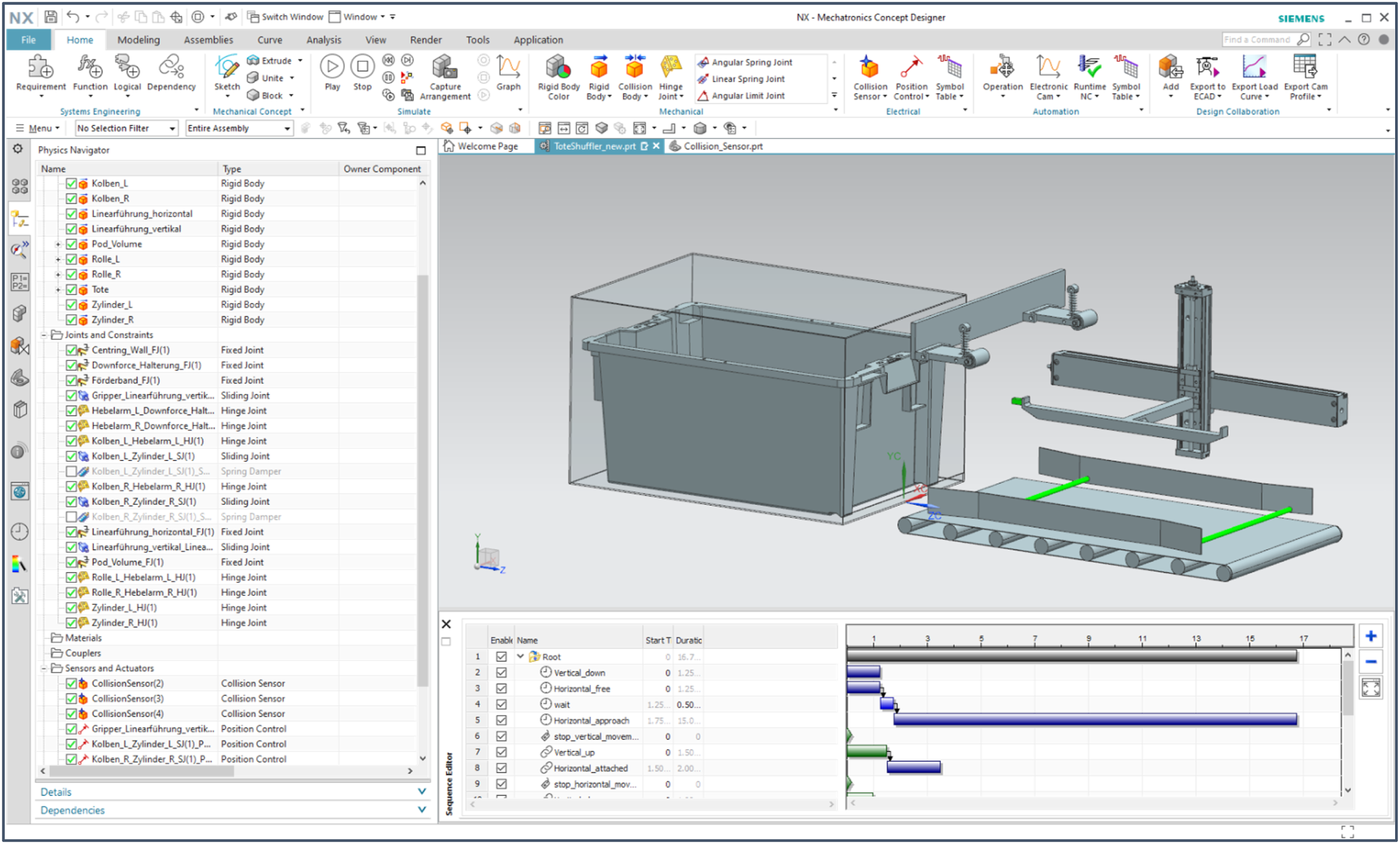
Siemens MCD is a software with modeling and simulation capabilities that allow its users to create and validate different design concepts early in the product development cycle. Siemens MCD allows users to add data about joints, motion, sensors, actuators, and collision behavior as well as kinematic and dynamic data for each component to feed the functional 3D model. This was important for Ueli and his colleagues since it would allow them to test the operation of their digital prototypes.
Eventually, the team at Helbling Technik AG selected two different types of machines for a Proof of Concept (PoC): one was a packaging machine for small flat items and the other was a component of a storage robot (see Figure 2). In addition to the selection of the ideal digital twin software, the major challenges were retaining the knowledge acquired by interns (who often stay at the company only for a limited period), as well as the problem of proprietary embedded software in components of the prototype that cannot simply be added to the digital twin. Digital twins of sensors, actuators, and other components are not routinely offered by manufacturers at present. The team often had to decide whether to try to mimic such information by writing their own code was worth it or whether skipping it was the better option.
Using the digital twin in development and beyond
Ueli beamed delight upon seeing the results of the project. “Excellent job, team, excellent job, Fabian!”, he praises his colleagues. Both Ueli and Fabian were excited to showcase the digital twin prototype to the rest of the management team. As they contemplated the future, they considered how the digital twin could change their client projects. They agreed that what will not change with or without a digital twin is that projects are deemed complete, and successful, once the client accepts the commissioned prototype (or machine), that is, when it works as specified. Yet getting there may be different in future projects. Specifically, they debated to what degree virtual commissioning with a digital twin should become a standard approach to speed up projects (mostly through parallelization). While the digital twin seems a valuable addition to the development toolchain at Helbling Technik AG, it may not be the silver bullet for every project. Model-based design is standard practice in certain areas (e.g., software and electronics development), where realistic simulations are often less complex—and newer tools extend the approach to domains such as mechatronics systems. They agreed that for Helbling Technik AG should continue to apply the digital twin concept in a pragmatic and focused way, considering the specific needs and characteristics of each project. In some cases, virtual commissioning with a digital twin may provide significant benefits in terms of reducing project lead times, quality, and optimizing system performance. However, in other cases, traditional approaches may still be more appropriate. The key, they concluded, is to maintain a flexible approach and to leverage the most appropriate tools and methods for each project, with the typical Helbling Technik AG goal of delivering high-quality, reliable systems that meet the client’s requirements.
After the success of the digital twin prototype, Helbling Technik AG decided to use a digital prototype in a live development project for the first time in collaboration with a long-time client. While that project was ongoing, Ueli and Fabian considered in more detail how the digital twin would transform the way Helbling Technik AG worked if digital twins should be used in all client projects. What would the future development process look like? How would it differ from the current process? (see Figure 2).
In the sky lounge of Helbling’s headquarters, overlooking a spectacular winter sunrise over the Swiss alps, Ueli and Fabian brainstormed potential applications of digital twin technology in their Product Lifecycle Management process (see Figure 4). Helbing’s Technik AG product lifecycle management process.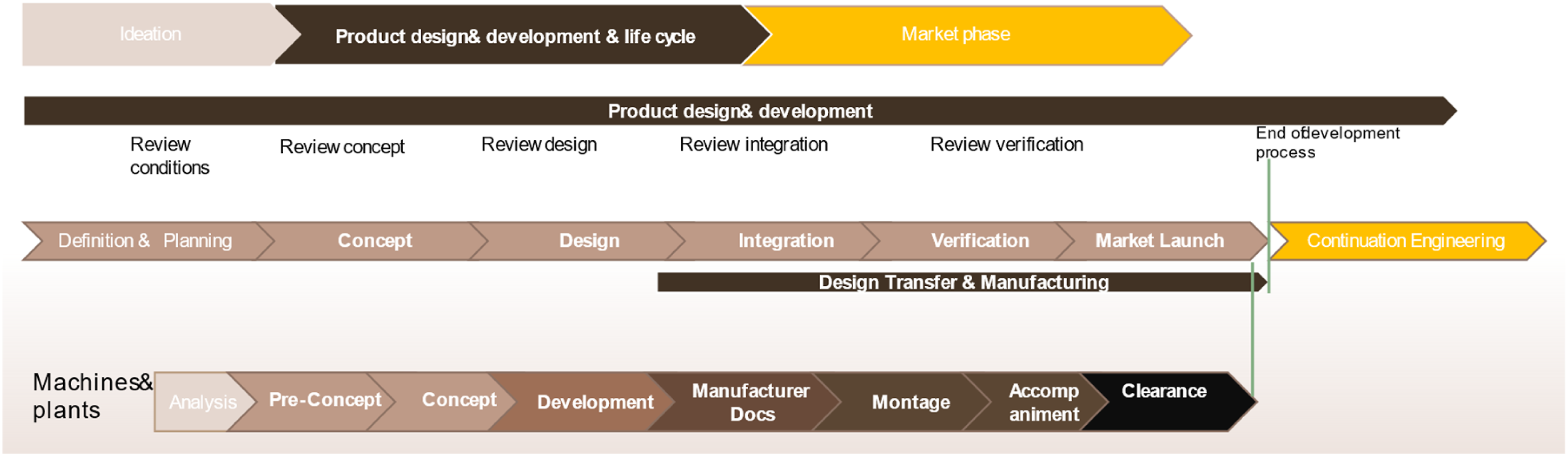
Ueli suggested that in the future, digital twins could be included as deliverables alongside physical prototypes, documentation, manuals, and other data. Customers could use the digital twin for virtual testing of both physical and programmatic machine modifications. Fabian added use digital twins in training, marketing, and sales. The two engineers were with full of ideas, and they believed that combining digital twins with other emerging technologies, such as virtual and augmented reality, could open exciting new possibilities for Helbling Technik AG and its clients.
Questions
1) Compared to the traditional development process, what core advantages do using digital twins offer for Helbling Technik AG and its clients? What would a future development project blueprint look like? 2) What are future business opportunities with digital twins for Helbling Technik AG beyond mechatronic system development? What would the new Product Lifecycle Management process look like? 3) Despite the success of Helbling Technik AG, why is the use of digital twins for mechatronic system development not more widely adopted? Which barriers did Helbling Technik AG manage to overcome, and would you have done it the same way?
Footnotes
Declaration of conflicting interests
The author(s) declared no potential conflicts of interest with respect to the research, authorship, and/or publication of this article.
Funding
The author(s) received no financial support for the research, authorship, and/or publication of this article.
