




Abstract
This case study examines digital health service provider Doctorola’s business strategy, competitive advantage, and challenges. The case is developed primarily on secondary sources, e.g., journal articles, newspapers, and authentic websites. The case presents the journey of the first online-based doctor appointment business - Doctorola, and its subsequent development as a full-fledged e-health service delivery provider. The case finds that Doctorola has designed effective service system to deliver patient centric services and captures a significant market share. This case shows its’ service evolution and illustrates the challenges it would face in the market to sustain in digital health market.
Introduction
The late James Grant, who was once the Executive director of UNICEF, regretted how their lack of proper knowledge and information during his administration resulted in sorrowful deaths of African children; when the lives of 80 % of them might have been saved if only they had the aid of an E-health system back then.
E-health can be the key for developing countries to ensure effective and accessible healthcare at a minimum cost. A study showed that back in 2001, almost 86% of people consulted the internet for healthcare-related guidance, and about 90% of physicians used it for primary healthcare (Harrison and Lee, 2006). Their study also mentioned that about 37% of internet searches are health-related (Harrison and Lee, 2006). Bangladesh has also stepped into this promising E-health frenzy of applying information and technology to healthcare, and it has been rapidly rising to fame. This development of the eHealth infrastructure has been made possible by the contribution of the public and private sectors.
E-Health services in Bangladesh
Doctorola and DoctorVhai are leading the e-health industry in the country among the multiple apps available in the market. Aponjon, a well-known mHealth brand among expectant mothers in Bangladesh, began its journey with 1500 pilot subscribers in September 2011. It is under the Mobile Alliance for Maternal Action; a company committed to delivering health care services through mobile telephones (MAMA). Aponjon Service, launched in September 2011 with about 1500 pilot subscribers, began its service in Bangladesh nationally in December 2012, allowing women to register from across the country. GrameenPhone, Bangladesh’s biggest mobile operator, has won the GSM Global Mobile Award 2007 for its famous people-centered “HealthLine” project in the “Best Use of Mobile for Social and Economic Development” category. HealthLine is a health contact center where citizens can access a physician 24/7 by calling a mobile hotline on Grameen’s mobile telephone.
Challenges of E-health service
Although this has a bright future, the industry faces numerous obstacles in Bangladesh.
ICT infrastructure assistance, such as computers, the internet network, print companies, and e-health energy, is inadequate in Bangladesh. Furthermore, computers are only available to a limited proportion of the total population. According to the Bangladesh Telecom Regulatory Commission, only 4.5 % of the population has access to the internet. Per the World Health Organization (WHO), lack of resources is one of the main barriers to developing e-health in developing countries, and Bangladesh is facing this problem. The creation, deployment, and use of e-health services are costly. Funding is a significant hurdle in eHealth program implementation in low-income countries such as Bangladesh. Some researchers suggest that e-healthcare services can enhance service quality and reduce operating costs (Davidson and Heslinga, 2006; Goldschmidt, 2005; Klein, 2007). However, other researchers also mentioned that implementing an e-health cloud system may require new software, hardware, infrastructure, and the training of healthcare professionals since they are yet to be used to the system (AbuKhousa et al., 2012). Older and more experienced administrative staff need to be more receptive to change.
Moreover, they have experience in the manual system of working. Changing this attitude is also a big problem in this industry. Some primary reasons are (1) they fear that computerization of different healthcare activities may become redundant for some people; (2) they are resistant to any change in their familiar working environment.
Another benefit of the e-healthcare system is that it provides healthcare more interactive and proactive (Saranummi, 2008; Vasilakos and Lisetti, 2010). It offers the opportunity to share data with relevant stakeholders and compile all previous medical records of every patient (AbuKhousa et al., 2012). However, some experts find this sort of record-keeping and sharing threatening and a breach of privacy (Kaletsch and Sunyaev, n.d.), but it can be viewed positively. If crucial medical data is shared with relevant authorities while keeping the patients private data anonymous, it can help us improve the quality of the healthcare system. When entities like the Ministry of Health or the World Health Organization have access to patient data, hospitals and staff will be extra careful in providing safe and sound quality medical treatment to all patients (AbuKhousa et al., 2012). It will aid in future research on such diseases too.
Doctorola - pioneer in E-health service in Bangladesh
In 2013, four friends, while in the middle of a chat, got the thought-provoking idea to start an organization that would be commercial and benefits the people. They initiated to turn the concept into reality. They assembled an organization named ‘Doctorola’ that would make it effortless for people to make appointments and find the right doctor.
The founder thought that by using this platform, consumers might easily find their doctor, gain general health education, and receive proper medical advice (Ruhul, 2016). In addition, the organization wants to continue to deliver exceptional service. Additionally, the stakeholders in the business are a top priority for them. Managing stakeholders is one of the company’s significant challenges as a provider of health-related services. Doctorola has significant strategic advantages due to being a forerunner, but they also face numerous challenges in establishing its operations across the nation. Doctorola has already established operations in 64 major cities in Bangladesh with the aid of technology, the government, and assisting organizations. The company’s PR manager comments that Doctorola’s main difficulty is attracting people’s attention and creating a dependable support network across the nation to help people find the right doctors, medications, health advice, and treatments. According to the CEO, the company is currently emphasizing developing a comprehensive marketing strategy to appeal to a larger public. The business is actively creating a logistics system to deliver required medications to the customer’s door and developing an online-based medical appointment service. Moreover, the company is training its staff to provide services more efficiently. Doctorola offers online consultations during this COVID-19 pandemic so patients can talk to physicians about their health concerns. Plus, the business delivers medication right to the patient’s door. The CEO is confident that the company is well-equipped to effectively handle potential challenges for its growth and sustainability. In addition, the business is now primarily focused on developing a top-notch e-health platform to provide better and more affordable health care. In fact, Doctorola was founded to give consumers access to a reliable e-health platform.
Inception of doctorola
This initiative of Doctorola began on the first of December 2014, and in 2015, it commenced in full swing. Doctorola staff is working tirelessly to improve the organization’s credibility, the far-reaching work, and the real benefit to the people. The company works on three prime issues: finding the right doctor for people across the country, making appointments, and helping with follow-up.
Abdul Matin Emon, managing director of the company, said, “People in our country do not usually go to the doctor until the disease is complicated. Their awareness is urgent. In addition to giving appointments, we are working in various ways to increase health awareness. For this, we work to make people aware through multiple posts on Facebook and quizzes. About 42 to 45 thousand people visit our Facebook page. People have already started responding, said managing director Abdul Matin Emon. “We get 150 to 200 phone calls every day. About 15 % of the patients contacted the matter again.”
Just like in other firms, Doctorola’s top management does all the decision-making. The team leaders direct the subordinates while complying with the upper management’s directives. The Board of Directors, as the highest level of the hierarchy, assumes a crucial role in the approach’s development. The Board of chiefs needs to be more specific about the everyday activity of the organization. An essential part of this organization is the manager; they ensure tasks are going in the right direction to achieve the organizational goals.
Operational process
Doctorola is a technology-enabled service driven by a group of integrated processes and organizations (see Figure 1 for details) to keep up with doctors' supply by booking appointments, receiving feedback from patients, and reminding them of follow-up procedures and other related activities (Matin, 2016). Doctorola is a platform that operates a user-friendly Web site (www.doctorola.com), a mobile app, and a call center number (16,484). On any of these sites, patients can choose a qualified physician and submit a request for an appointment. Operational process of doctorola (Compiled by authors).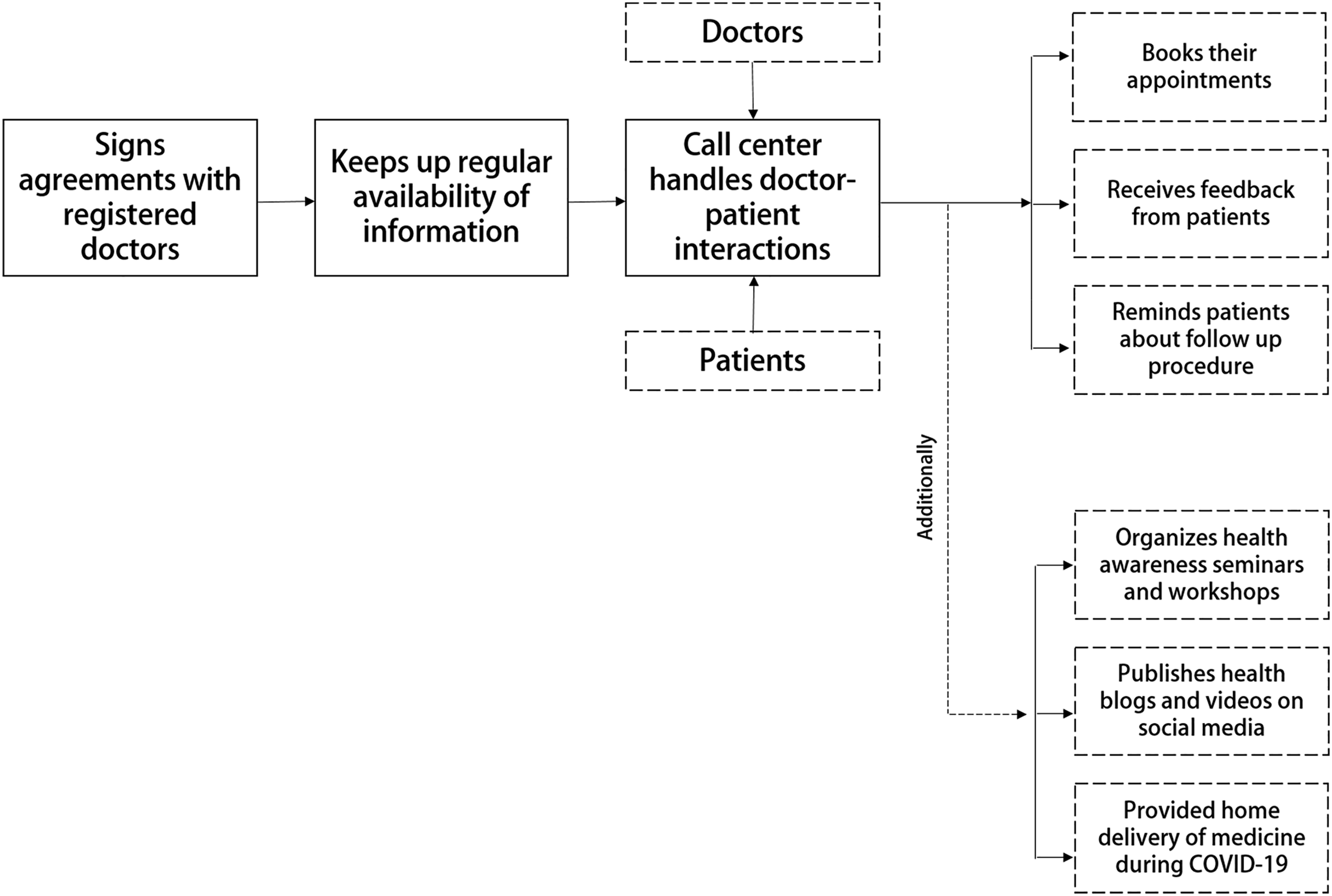
Director Operations Sanjidul Bari said about the institute’s staffing, ‘We have about 400 professors in various subjects. Besides, there are over six thousand doctors. About three hundred are associated with hospitals and diagnostic centers. We help patients book appointments in these places (Matin, 2016).
A powerful back-office application and databases support these gateways (see Figure 1). Maintaining this real-time availability of knowledge from thousands of doctors to hundreds of hospitals and locations takes work. Doctorola works with registered physicians who are self-employed, employed by clinics or hospitals, or both, to bring all of their physicians to the forum to feature a physician on the platform. The subsequent step is to keep up the regular availability of information or data, each of which involves a dedicated relationship team of more than one doctor. The call center works hand in hand to handle all service requests and patient interactions. Doctorola even prioritizes producing health awareness content and planning public engagement activities like seminars and workshops. One of its most significant aspects is its social media presence; since its inception, Doctorola has constantly released high-quality health blogs and videos, garnering a following of 1.25 M subscribers on YouTube (Sadia, 2017). Doctorola initially introduced the pivotal online-based doctor appointment service as a response to the COVID-19 outbreak. Patients can choose appropriate doctors from various hospitals and consult with them from the comfort of their homes regarding their health concerns. Doctorola has also introduced a new program called “Home service” in an effort to provide customers with improved services through which customers can obtain prescription drugs from the company and have them delivered right to their door (Mahmud, 2018).
Abdul Matin Emon said, “Apart from this, a program called ‘BG Life Health Connect’ is being organized to raise the awareness of corporate people. Medical camps are conducted here in various commercial establishments. Work to increase their health awareness. Also, Facebook Base Medical Camp was held. Here, people are asked to know their problems through Facebook, and simple answers are given to solve them” (Matin, 2016).
First mover advantage
Doctorola is the first mover in the online-based doctor appointment and health-related service business. This company has already grabbed lots of attention from the consumer segment and gained a competitive advantage for providing unique services in the industry. The marketing strategy of Doctorola makes them an esteemed company in the health sector of Bangladesh. They have an extensive function management structure, helping them operate the business fully functionally. From top to bottom, the management structure is indeed very active. The rival companies to Doctorola are very new to the market and lack the same management sophistication level.
On the other hand, the service product is quite diverse. Doctorola offers more services than just an online doctor appointment system. They heavily focus on providing health-related primary education to general people. This educational program was first released by the Doctorola in this service sector than their competitors. Apart from that, Doctorola developed a customer care helpline system; Doctorrola TV is the first hotline for appointments and an ambulance service. Customers can make appointments with doctors at various hospitals through this hotline, which also assists them in scheduling emergency ambulance assistance. This is another segment that the competitors lack.
Lastly, the apps-based services that Doctorola provides are highly user-friendly and effortless for anyone to use. The apps offer some other services such as the apps, including blood bank facilities, general people, and customers, to monitor their routine calorie consumption. The patient can track their medical reports and medicine schedules. All these features give Doctorola a competitive edge over their rival. Management is currently developing efficient and effective outlines to maintain this competitive advantage. This company intends to provide services to every single individual in Bangladesh. Thus, Doctorola is now expanding its operation at every district level to get good medical services and find excellent registered doctors in every area.
Limitations and future prospects
Doctorola took the first attempt at treading the path of becoming a trustworthy healthcare platform. Undoubtedly the stake is pretty high, albeit Doctorola launched the product to relatively low Fanfare. We suspect that Doctorola is well aware of the challenges “e−sashto” would present and is eager to see the response. Doctorola, as a company, has excellent brand recognition in the market and equally great reach across the country. Thanks to its regular healthcare-related programs and contents, it has a considerable following, and its doctors' appointment service continues to grow, although revenue from that business remains meager. However, this brand recognition can prove a real advantage for the company in doing e-shasto work. This is why this move to the consumer market is so essential for Doctorola.
We suspect the company will launch a few more products in the coming days to prove that it has built the foundation over the years to turn itself into a platform. We think that Doctorola has leverage in automating doctors' appointment systems; this is a b2b product and will require convincing hospitals to buy it and enabling, to some extent, maintenance of healthcare records in some form. Doctorola has a real upside there for several reasons. Most importantly, it has access to offer more sophisticated services, which it has not yet done. Let’s get back to e-shasto. We believe Doctorola will encounter considerable difficulties in making its e-shasto product function as intended. Our interpretation is that Doctorola targets mid and low-end customers with its existing e-shasto product who do not have access to quality healthcare. This is apparent from offering a 200-taka health card, ten over-the-phone consultations for 6 months, and SMS-based health tips. Whether the upper-middle-class and affluent markets will purchase these goods is still debatable. The disadvantage with the low-end market is that you will require a lot of persuasion and sales effort to make it work, which will likely influence your product’s overall cost. Presumably Doctorola will incur expenses regarding marketing and adaptation. Anyone can undoubtedly claim that after consumers adopt the product, the marketing costs will drop dramatically, and the product’s overall cost structure will improve. The question remains of how long it will take to make people adopt the product at scale. We believe that Doctorola has figured out a distribution strategy for e-shasto, mainly through collaborations with healthcare-related organizations.
However, to have a meaningful, lasting purchase, we believe the product has to be much better than it is now. Simultaneously, it is ambiguous how this offering differs from Telenor Health’s Tonic, which offers a similar bundle to Doctorola’s e-shasto, where Doctorola is a partner. And Tonic has the leverage of Grameenphone. Every business has its challenges, and the whole point of running a business is overcoming them. The upside for Doctorola in e-sastho is vast. If Doctorola successfully makes e-health work, it will be a natural entry point for the company to sell more services to the same customers, meaning the consumer market. At the same time, it will serve as a long-term moat for the company.
The competition in healthcare is just commencing in Bangladesh (Huda and Noushin, 2021). So, we can expect the company to work hard on it. Doctorola will likely introduce more services to enhance its bundle, such as telemedicine, and make it more lucrative to multiple users. At the same, like Tonic, it will also explore corporate packages in the future. Our interpretation, though, is that this will be yet another protracted game for Doctorola, much like appointment booking. That is the harsh reality of healthcare, a difficult market to crack. Another major challenge is the communication challenge with a large number of people. According to the CEO, “the-line communication is highly dominated by the telecom sector and FMCG ads, so the positioning of our services through that medium is tremendously challenging and costly for us.” Hence, we need to adopt engagement-based communication techniques in specific segments; around 250 promoters are physically running nationwide campaigns. We are primarily self-funded and only have a small corporate investment for marketing, besides being the first Bangladeshi startup to raise venture capital. But our investment from BD Venture has indeed given our initiative some speed. However, all of it together is still not enough to communicate on an impactful scale."
Conclusions
Doctorola has glorious service record since its inception in 2015. It has served thousands of people and solved their medical problems. Its’ service coverage stretches over 63 districts in the forms of hosts information and appointment canters involving around 9662 doctors and 556 consultation canters available on Doctorola.com or at hotline number 16,484 every day between 8a.m. to 11p.m. (Retrieved from https://doctorola.com/about on November 28th at 10.19 p.m.).
Bangladesh is not a highly technologically developed nation. Digital culture is relatively new to us. The majority of us do not care to visit a doctor when we are unwell; we usually rely on home remedies. However, most of us rely on foreign countries regarding severe diseases and treatment. Doctorola, despite all the challenges, is endeavoring to get our culture used to online medical services. It strives to provide an easily accessible medical facility for everyone, which has been the main focus of this case. Throughout the case, different aspects of this e-healthcare service have been discussed from its beginning of the journey, current state, opportunities, challenges, and so on to give the readers a fully-fledged idea about this ingenious service company. In short, Doctorola means health Service - a click away.
Discussion questions
1. Identify the competitive advantage Doctorola has and how the company effectively uses these competitive advantages to grab the market share from its rivals. 2. Identify the challenges that Doctorola currently facing and find some probable challenges Doctorola might face in the future. 3. Identify and discuss the ways Doctorola communicates with their target audience.
Footnotes
Declaration of conflicting interests
The author(s) declared no potential conflicts of interest with respect to the research, authorship, and/or publication of this article.
Funding
The author(s) received no financial support for the research, authorship, and/or publication of this article.
