




Abstract
The foundation of our educational system today is technology-based. Over time, technology has transformed how students learn and how teachers impart knowledge. Further, technology provides a platform for everyone to study and learn throughout their lives. Many platforms and options are available to expand one’s knowledge in a particular area of interest. National Technology Programme for Enhanced Learning (NPTEL) is one such venture. This teaching case will give detailed information about NTPEL, its initiatives and its progress. The case study also elucidates the challenges that are deterrents to the usage of NPTEL.
Background of E-learning
There has been a recent surge in the enrolment for Massive Open Online Courses (MOOC) worldwide. India ranks second in the world after the USA in MOOC enrolment growth. As an alternative to physical classes, MOOCs enable remote learning with technology. For a country like India, it serves to be a boon since it facilitates affordable professional learning for all classes of people. In India, several platforms are developed for e-learning purposes, such as NPTEL, SWAYAM, mooKIT, and IITBX. Realising the need to enrich the intellectual capital, the Indian Government has invested 6% of GDP toward establishing such platforms (Arun C Mehta, 2022).
There have been several stages of education transformation in India. The foundation of the Indian Institutes of Technology (IIT), Indian Institute of Science (IISc) (which was codified under the Indian Institutes of Technology Act of 1961), National Council of Educational Research and Training (NCERT) curriculum’s introduction in 1961 and, more recently, the creation of open educational institutions are some milestones in India’s educational history. In recent years, however, online education forums have helped bring about significant changes in the education field.
In India, the government has promoted online education in a variety of ways, which has helped many people finish their education and increased the nation’s enrolment rate (Rahman and Ahmad Dar, 2022). The popular online resources in India are NPTEL, edX, Coursera, SWAYAM, and mooKIT. The platforms described above are not the only ones that provide online education; other, less well-known platforms also do so. The following are some of the leading providers of online education in India: Shikshit India, U18 eVoulte, Million Lights, Apna Course, UpGrad, EduKart Open, LearnVern, and Digital Vidya.
In 2016, India introduced its own public MOOC, offering 2000 courses and paying teachers more than USD 30 million. As of 2020, there are 50,000 subscribers. After the United States, the nation has the second-highest membership rate to Coursera. SWAYAM (Study Webs of Active-Learning for Young Aspiring Minds), a project of the Indian Ministry of Education, may be a very recent addition to India’s MOOC systems. In 2003, NPTEL launched the first MOOC in India. Early in the decade of 2010, MookIT and IITBX entered the scene. According to each MOOC site, such as NPTEL (1.5 million), mooKIT (0.1 million), IITBX (1.25 million), Swayam (10 million), and Coursera (4.8 million), there are millions of Indian participants.
Introduction to NPTEL
NPTEL was started in 2003 by seven IITs (Bombay, Delhi, Kanpur, Kharagpur, Madras, Guwahati, and Roorkee) and the IISc, Bangalore, and has been a big part of the revolution in Indian education (Nitonde, 2018). In March 2014, NPTEL started offering open online certification courses, letting anyone inside or outside of IITs get a good education from the comfort of their own homes.
NPTEL provides a wide range of opportunities. Indian students have greatly increased in number in recent years. Several well-known MOOC providers, including edX, Coursera, and Udacity, include India as one of their top student-enrolling countries. Many people in India now take advantage of MOOCs to meet their higher education needs. The best and the most complete education accessible in India is provided by this internet-based instruction. The deliverables are available in a range of regional languages.
NPTEL started with 53,807 students in 2014 and is now used by more than 18 lakh students in India and around the world. The Ministry of Human Resource Development (MHRD), part of the Indian government, provides funds to NPTEL through the Swayam project. NPTEL is the National MOOCs Coordinator for the Swayam for engineering program (UG and PG). All of NPTEL’s online courses are available on swayam.gov.in. There are fundamental problems with higher education in India, such as graduates’ poor employability, particularly for positions connected to computer technology, and the quality and accessibility of postgraduate instructors and material. An effective way to deal with these problems is via online education. We highlight important efforts in this approach that have shown beneficial results, such as the NPTEL provided by the Indian Institute of Technology (IIT) Madras.
NPTEL was reorganised in 2014 to provide individualised massive open online courses (MOOCs) with certification through proctored tests at designated places around the nation. Over 3500 courses in science, technology, engineering, liberal arts, and management were available via NPTEL from 2014 to 2021. Nearly 16 million students have registered for these courses, and 900,000 of them have received certifications upto 2021 (Jayakrishnan et al., 2022). Approximately 240 courses in six fundamental engineering and scientific disciplines – civil engineering, computer science and engineering, electrical engineering, electronics and communication engineering, mechanical engineering, and basic sciences and humanities that are shared by all engineering were covered under the program’s first phase, which ran from 2003 to 2007. These subjects were split from 2003 to 2007 and covered roughly 240 subjects. In addition to core courses and a few shared electives, the courses have been designed such that the whole undergraduate programme (B.Tech. or B.E.) is covered in all five of the aforementioned engineering fields.
The course materials are thorough and adequate for a semester’s worth of study (41 hours of lectures), and teachers may utilise them to augment their instruction study independently by professionals and students who want to refresh their knowledge in the relevant subjects (Krishnan, 2009). Access to the course materials is free and there is just a small certification fee to cover the costs associated with holding tests. Because of this, NPTEL is able to intensify its efforts to solve the issue of giving students throughout India access to high-quality education. On the other hand, commercial MOOC platforms have become service providers for master’s degrees and professional education that are outsourced by the Big Five Universities and have paywalls on their material. NPTEL has over 1.4 billion views, over four million YouTube subscribers, over 2500 self-paced courses, over 2.7 million students, over 24,000 test takers, over 5200 learning centres, over 47,700 massive open online courses (MOOCs), and over 80 business partners.
NPTEL ecosystem
Here are some important characteristics that set NPTEL apart from other MOOC sites (Figures 1).
Local chapters
Because of their background gaps and lack of exposure to various teaching styles, many students need assistance in order to participate in NPTEL courses. Without this assistance, dropout rates are quite high. Local chapters on campus at educational institutions have been created by NPTEL as a solution to this problem. Each local chapter includes faculty mentors who serve as local specialists and promote student learning via initiatives including in-person meetings, keeping track of assignment submissions, and developing learning communities inside the school. The NPTEL portal includes tools to help mentors and give them access to their students’ progress reports. A specialised staff works for NPTEL to interact with regional chapters. More than 4100 local chapters are now supported nationwide by NPTEL. Local chapters are the primary source of more than 75% of NPTEL’s course and test registrations.
Translations of course lectures
There are 22 official languages in India. Though technical education is generally taught in English, English is not the predominant language of communication in the majority of the nation. While many students can understand content written in English in textbooks, many fail to understand spoken English. As a result, dialect variety is a significant problem for online education. All NPTEL courses include written transcripts that have been approved by the professors and are available as subtitles to accompany the video lectures. NPTEL has begun a mission to convert these scripts into eight commonly known Indian languages. NPTEL’s local chapters assist in identifying subject matter experts who are fluent in many languages and may contribute to this initiative as translators or reviewers.
Industry involvement
The NPTEL Industry Associate programme provides opportunities for the industry and NPTEL to work together for the benefit of both parties. These options include joint course offerings, special lectures, recruitment chances from the NPTEL learner population, opportunities for current workforce members to acquire new skills via NPTEL courses, and numerous efforts falling under the umbrella of corporate social responsibility. Through this initiative, 48 businesses were working with NPTEL as of January 2022. NPTEL certification increases credibility among businesses and immediately tackles the current complaint with Indian higher education – that graduates lack applicable skills. This is a side effect of more industries enrolling in NPTEL courses for upskilling.
Features of NPTEL
We attentively examined the platforms throughout our investigation to get acquainted with their characteristics. We have identified certain elements of the NPTEL platform based on our comprehension of the investigated platform.
Asynchronous teaching-learning environments
NPTEL allows students to learn at their own schedule within a certain timespan. Information is provided through pre-recorded lectures, resource videos, lecture notes, assignments, quizzes, along with periodic self-evaluation. When made available with regard for students in non-urban and rural locations via supplemental DVDs and mobile provided material, they enable excellent and equitable access to a much broader population of students and working professionals and can cause a considerable increase in the gross enrolment ratio. Anyone can access these classes for free.
Cost structure and online certification
Making students employable in the industry or able to continue a relevant higher education program is the goal of allowing them to receive certificates for courses. 4, 8, or 12-weeks online courses, often on subjects pertinent to students in all years of higher education, are delivered via an online portal. These courses also include foundational core courses in the sciences and humanities that expose students to relevant tools and technology. These courses provide free enrolment and educational content. After completing these online lessons, students take a proctored certification exam in person, where they are awarded a certificate from the participating organisations and/or industry (original research paper massive open online courses (MOOCs) (Ipsita Das and Vindeshwari Pawar, 2016). During the period March 2014 to December 2021, total enrolments across all courses: 1.58 crore; total exam registrations: 15.1 lakh and total courses completed was 3496. The certification test costs Rs. 1000 per course exam and is optional. When a student applies for employment, the certifications they get are important additions since they have the Continuous and Comprehensive Evaluation (CCE), IIT seal. AICTE authorises as an FDP when the faculties successfully complete an advanced NPTEL course so they may get credit for it.
Eminent instructors
The instructors are from the IITs, IISc or other top institutions like Computer-Managed Instruction (CMI), Institute of Mathematical Sciences (IMSc), etc. Everyone who is interested in learning has access to high-quality material, which also includes participation in class discussions and access to homework assignments for self-assessment.
Flexible approach
The timetable for NPTEL courses includes a start and finish date. Some self-paced courses allow enrolment at any time and have no enrolment deadline. Only 6% of NPTEL’s courses are self-paced. Every course, whether it is delivered in person or online, supports a learning model. For instance, a conventional course enables face-to-face education, but online instruction, such as that offered by NPTEL, delivers information via multimedia material. Sometimes, a mixed-mode approach – also known as blended learning – is used to give teaching used rather than just one model. It combines elements of the internet and traditional classroom instruction. Sometimes the platform used to deliver the course is openly accessible with its source code so that anybody may use it or modify it to provide their own NPTEL.
Easy access
The Indian government has a policy to encourage the adoption of open technology. More consumers than ever before are now logging into courses using mobile devices, such as tablets and smartphones. Providers are providing mobile apps for their NPTEL while taking into account the user’s convenience. Furthermore, since these programmes may run on many operating systems, including iOS and Android, students can enrol, access course materials, and engage in all course activities using their mobile devices.
NPTEL background technology
CourseBuilder, an open-source platform developed by Google in 2012, is used to conduct NPTEL courses. It connects the software and hardware that Google utilised to create their online Power Searching with Google course. Anyone utilising a course building platform may provide their own courses. The platform offers the very minimum capabilities for delivering course content, including instructions for leveraging other Google products to build a course community, learner activities, and evaluations. It offers fundamental features like Google Accounts, Hangouts, and friend circles, which, if correctly integrated, might be utilised as the social networking function. But the platform does not include social networking in the traditional sense. Google App Engine is the foundation for Course Builder. Python is used to write it. The web application is hosted via the Google App Engine, and server side programming is done in Python. Google stated in 2013 that it will collaborate with edX as an Open edX contributor. Since then, they have merely maintained their old platform; no further improvements have been made.
NPTEL for underprivileged
NPTEL-IIT Madras and Madras Dyslexia Association offer free online programmes to help kids studying in Tamil. Children with dyslexia studying in Tamil medium may access a remediation programme thanks to a partnership between the Madras Dyslexia Association (MDA) and the National Programme on Technology Enhanced Learning (NPTEL), IIT Madras. The MDA created ‘Tamil Vazhi Payirchi’ to help students studying in primary schools teach Tamil as a second language since dyslexia, a language-based processing impairment, reveals itself as a difficulty understanding not just English but also other languages. D Chandrasekhar, President of the Madras Dyslexia Association (MDA) said, ‘Statistically, 10–15% of youngsters have dyslexia’. This suggests that a substantial percentage of students in Tamil-medium schools may need screening, evaluation, and remedial intervention. This approach would pave the path for early detection and intervention in such schools across the state of Tamil Nadu, he noted. Through NPTEL, this curriculum is available in an online format at no cost
Awards and recognition
NPTEL recognises and motivates enthusiastic learners with various award categories. Learners who appeared in 4-6 exams and topper in atleast three exams are NPTEL Superstars. NPTEL Believers should have appeared in 4 to 6 exams with a pass in atleast 4 exams appeared. Learners who have continuity and appeared in atleast 8 exams in 4 semesters with a pass in atleast 75% of the courses appeared, i.e., one in each of the four semesters become NPTEL Motivated Learners. NPTEL Enthusiasts are those who have secured a pass in 75% of the 8 courses appeared in 4 semesters. Learners who have completed more than 50 weeks of learning in the same domain with a final score >=55.
Current status of NPTEL Course registration and certification
The present status of NPTEL course registration and certification is presented in Figure 2. There are 25 partnering institutes that are a part of NPTEL. These institutes are responsible for providing course content, staff, and material, and they have assisted in the completion of 5433 courses. There are more than 20 lakh students enrolled in NPTEL, but only 10 lakh students receive certificates. Current status of NPTEL Course Registration and Certification. Source: NPTEL website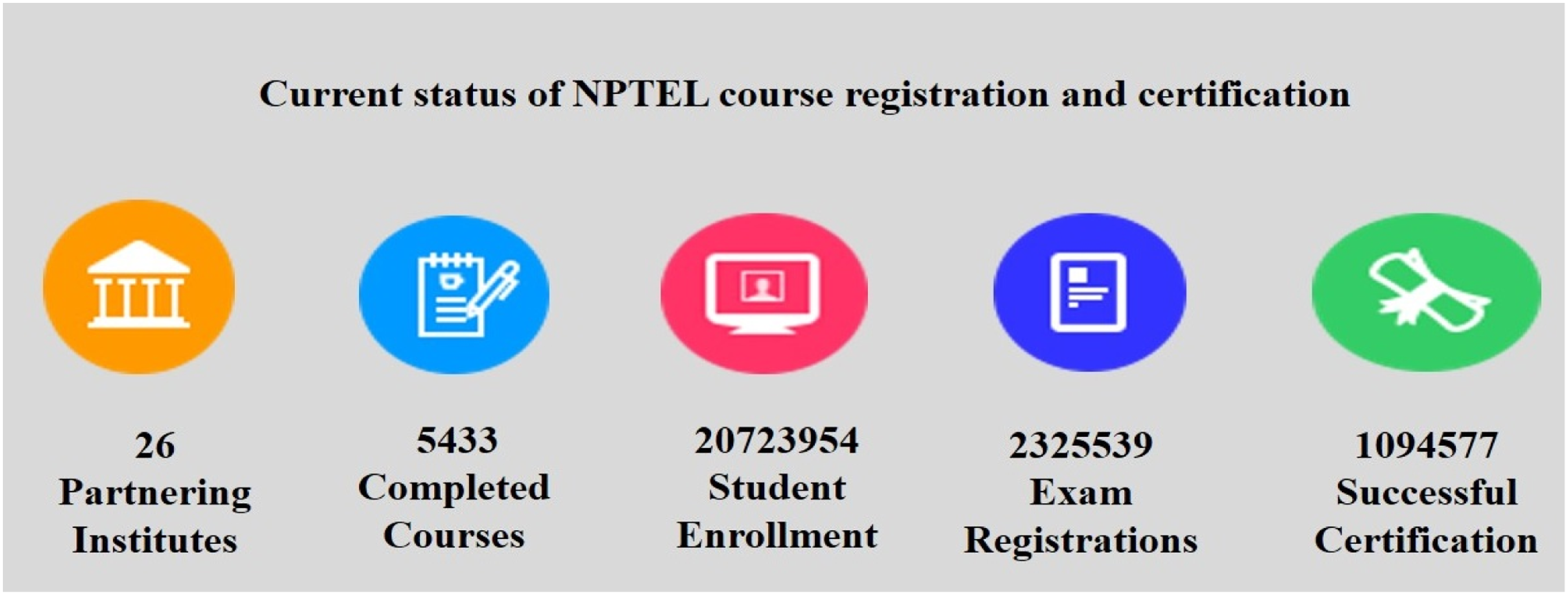
Usage of NPTEL
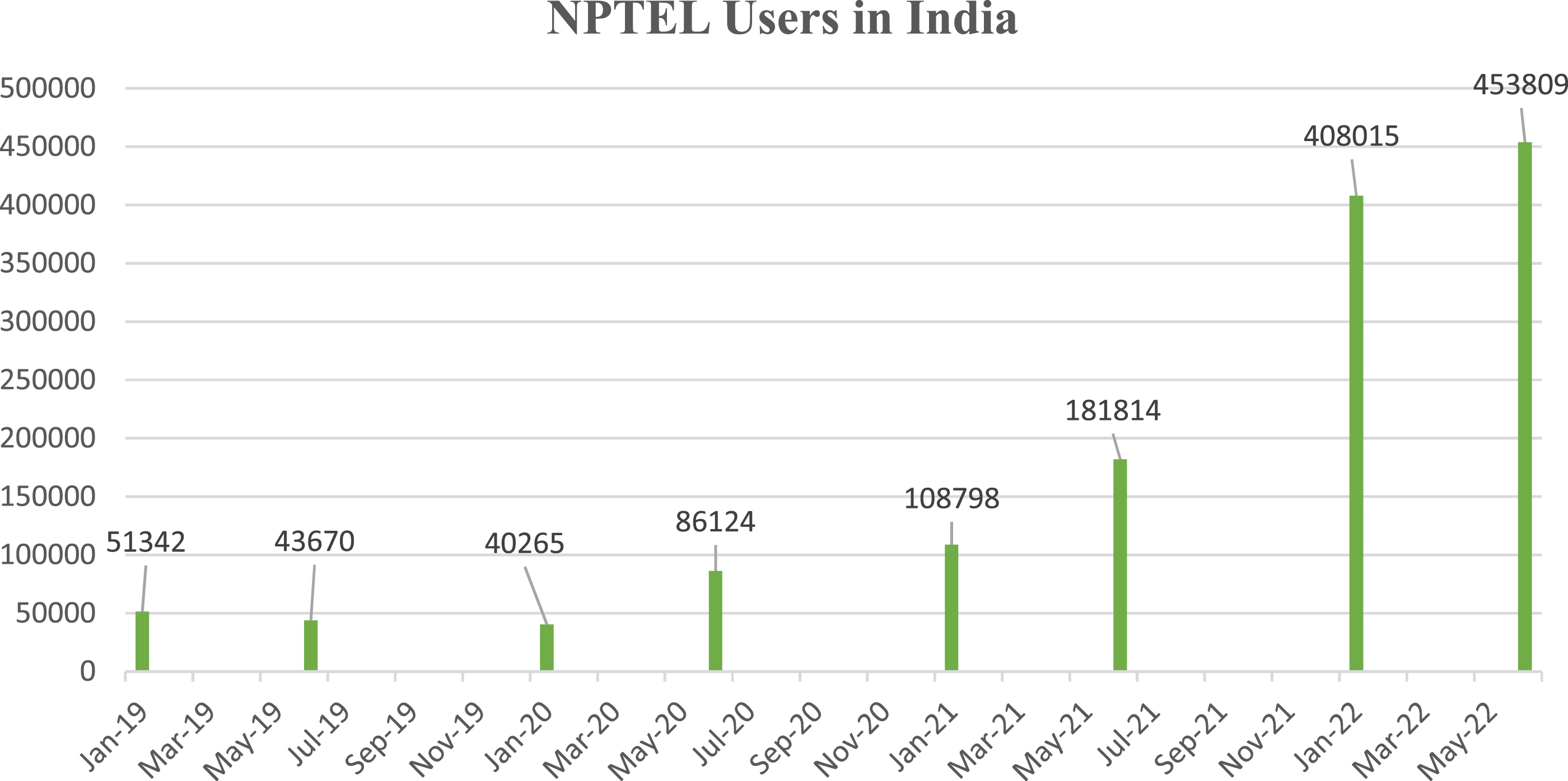
The number of users of NPTEL in India climbed steadily from 51,342 users in 2019 to 453,809 users in 2022, following a steady growth over the past 3 years (Figures 3).
NPTEL usage by student
Students made up a significant portion of the NPTEL course participants, and they were likely there for various reasons that made the online learning opportunities important to them. So, they decide to join in an NPTEL course in order to prepare for competitive tests like GATE.
As can be seen in Figure 4, students used NPTEL in a variety of contexts connected to job searching (25%), and internships (12%). Others include preparing for the Gate test (31%), which involves both firm personnel and professors for Learning and development (32%). NPTEL usage by student.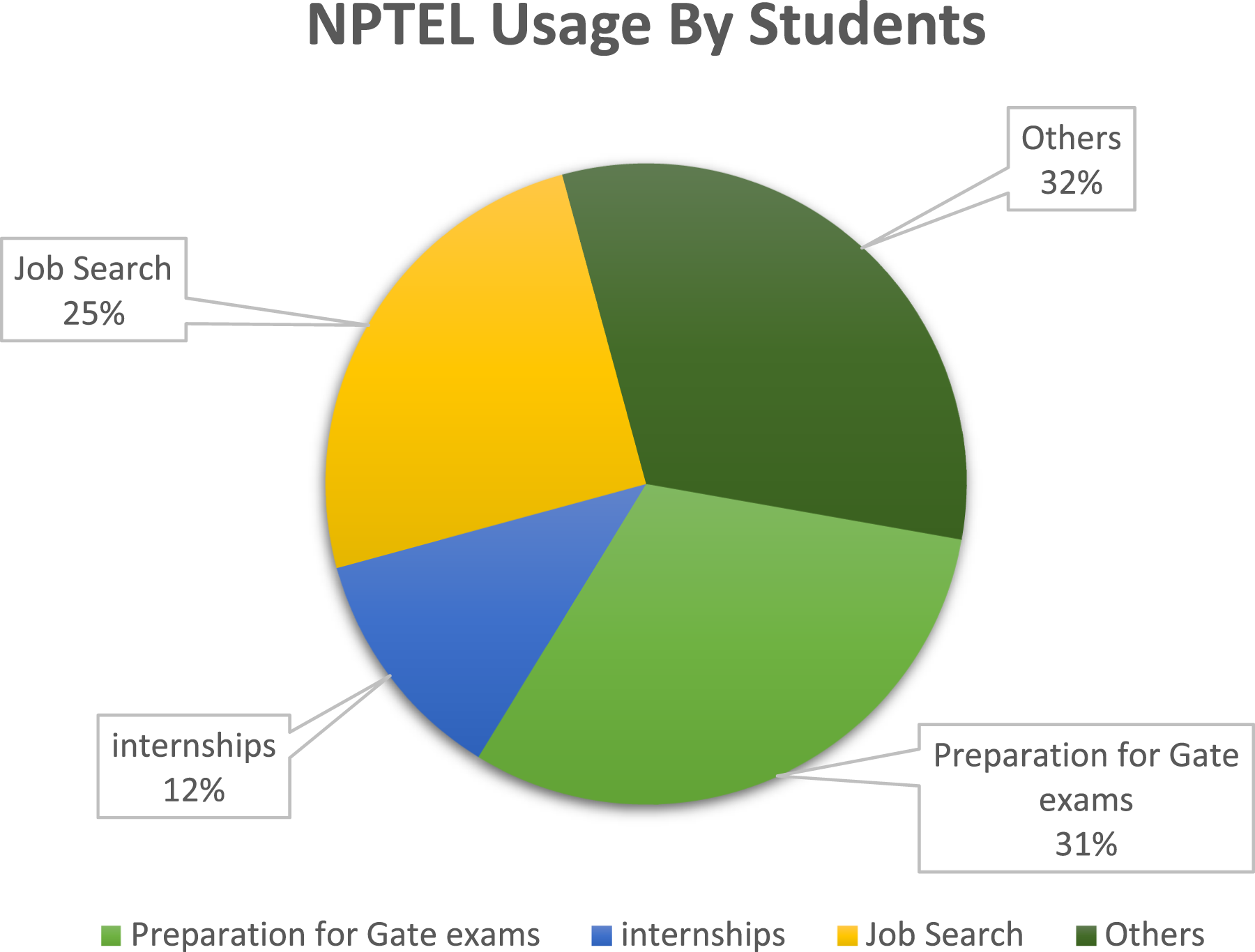
Benefits to students
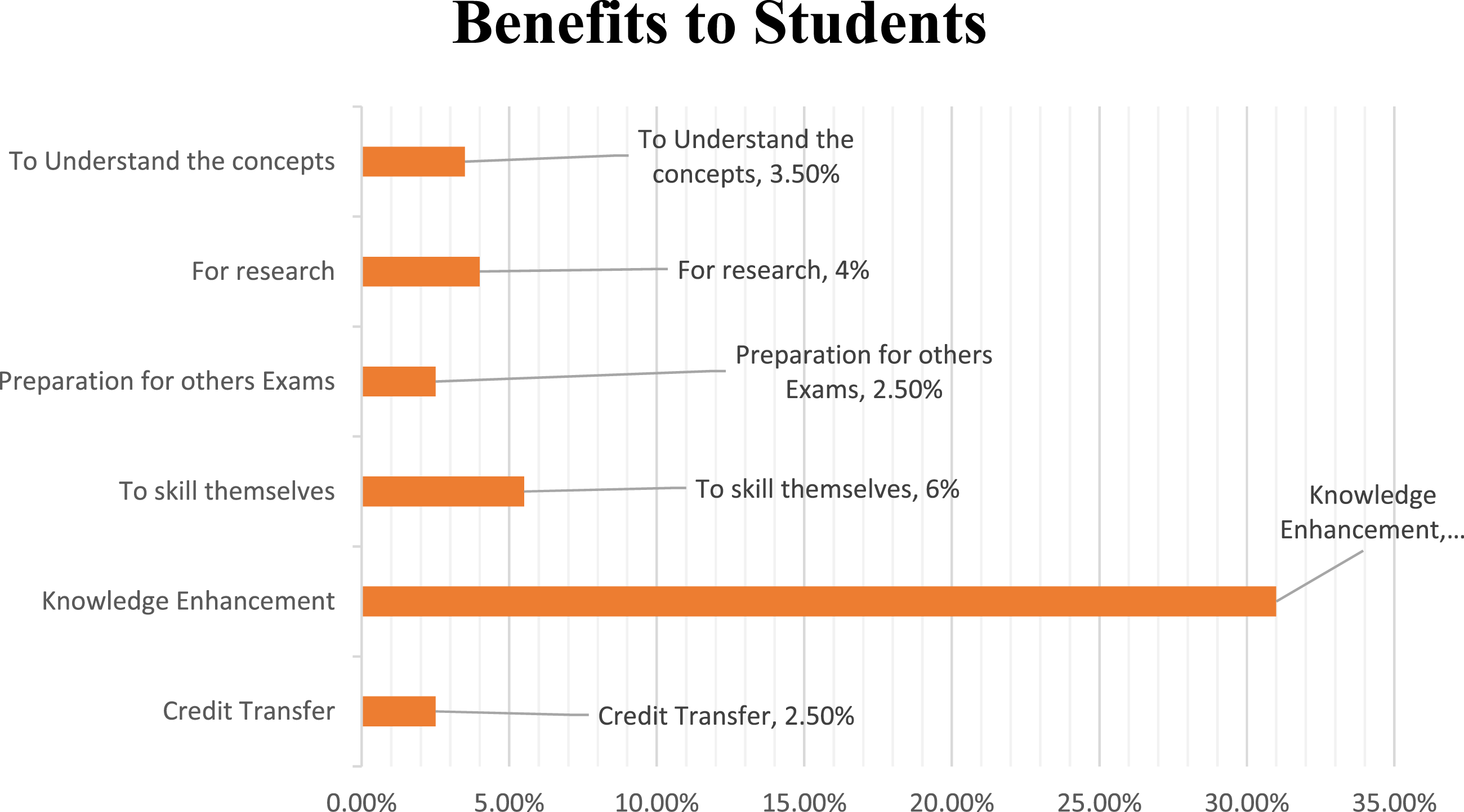
Approximately 31% of students are able to profit from knowledge improvement, and 6% of students are able to use the opportunity to upskill themselves. In the same way, 4% of students benefit from using NPTEL for research, 2.5% benefit from using it to prepare for exams, and 3.5% gain from using it to better their conceptual clarity (Figures 5).
NPTEL usage by working professionals
Employees and working individuals have also proven online education’s professional benefits. 19% of the thousands of workers who had completed courses on NPTEL acknowledged NPTEL with providing them the opportunity to earn a greater salary at work. According to another 14% of respondents who participated in the courses on NPTEL, employees felt the courses beneficial for enhancing their knowledge of a certain topic. In addition, many workers who answered the poll expressed a desire to give back to NPTEL and participate in their capacity to the online learning process. Therefore, the influence of NPTEL on the professional life of workers is evident from the Figure 6. NPTEL usage by working professionals.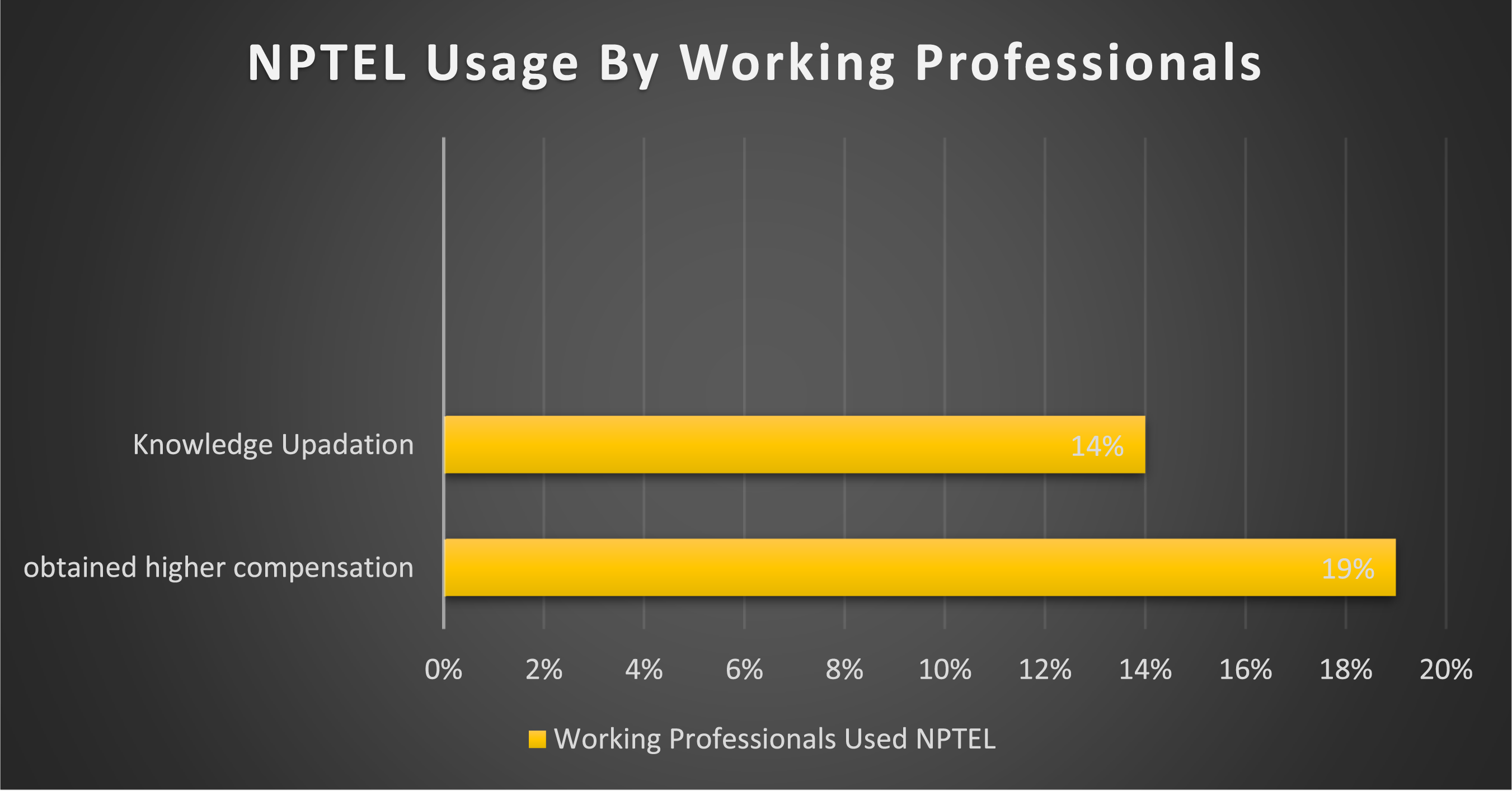
Country wise enrolment In NPTEL
Students from all around the world are welcome to enrol in NPTEL’s programmes, and the organisation is putting up systems to hold in-person tests in as many nations as it can. Now, in-person examinations are conducted outside India in the cities such as Dubai, Sharjah, and Abu Dhabi which are the nations that make up the UAE; Colombo and Jaffna in Sri Lanka; Muscat in Oman Bahrain, Kuwait, and Salmiya. Students will be writing their exam at the testing location if they currently reside in one of the above nations. To take the exam, they must bring their laptop to the testing location. No matter whether they are taking centre-based tests in places outside of India or exams that are remotely proctored, all students who live outside of India must take a System Compatibility Test prior to the exam date to make sure the test launcher functions properly on their laptop or computer. Exam costs are 3000 INR per course for countries other than Bahrain and Kuwait and 4000 INR per course for those two countries on the registration form. Total enrolment outside India is more than 20,000. NPTEL ECO system. Source: NPTEL Website NPTEL users in India. Source: NPTEL website Benefits to students.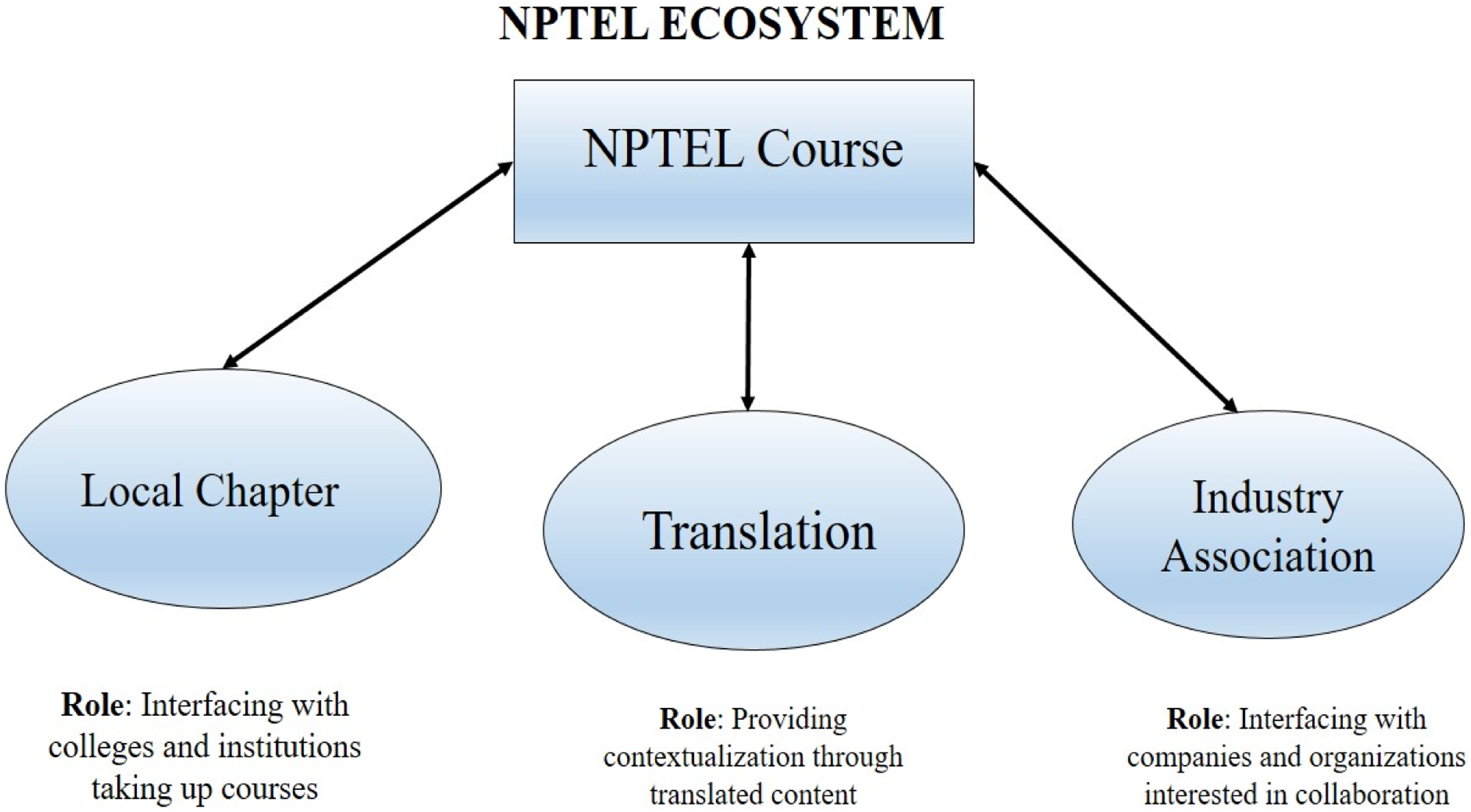
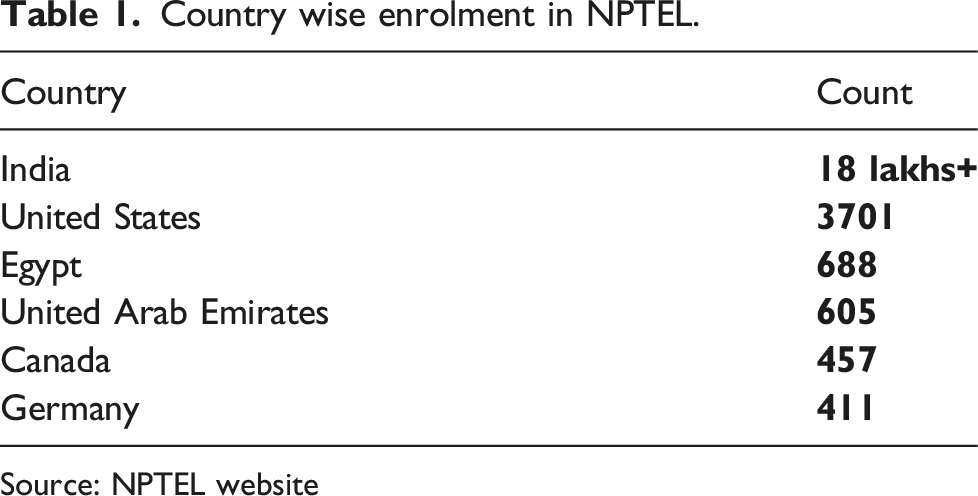
From the table in India, over 18 lakh learners use NPTEL and other countries are also part of NPTEL learners there.
Opportunities for growth in NPTEL
According to a projection published by India’s Central Statistics Office in 2017, 34% of the population will be between the ages of 15 and 24 by the year 2020. Additionally, this age group consumes the most digital content on mobile devices. According to predictions, 760 million smartphones would be in use in India by 2023. Currently, it has 560 million internet users. (Kaka et al.). In India, there are no higher education institutions in 75% of the districts since most of the universities are either in or close to metropolitan regions. Therefore, it is difficult for students from rural regions to obtain higher education. In this case, MOOCs could be able to provide a less expensive solution to this issue. It is fair to assume that India has a reasonable chance of growing its Edtech industry, with the number of Coursera users there exhibiting a 505% yearly increase rate (Miglani and Burch, 2019; Wang et al., 2022).
Barriers of NPTEL in India
India’s digital literacy level and internet connectivity are the two biggest barriers to the country’s projected MOOC market development. Although there are more internet users in India than in the US, just 29% of Indian women use the internet, and two-thirds of the population in India does not have access to it (Khokhar, 2016). It would be challenging for many users to cover the secondary charges for access (cost of a smartphone, internet charges) since 60% of Indians live below the poverty line (CPRHE, 2021).
Country wise enrolment in NPTEL.
Source: NPTEL website
Challenges faced by NPTEL learners
It is challenging for professionals to understand learners’ prior knowledge and degree of study on the subjects since they are unable to interact with them. It is advised that the lectures should be structured so that everyone can get a broad conceptual comprehension of the given course content. Sometimes additional visual aids are required in these classes to keep students’ interest. This platform’s online functionality eliminates the interactive component of such courses. On the website, a portal might be created to encourage frank discussions and respectful contact with the professors.
NPTEL cannot offer individualised course materials or the one-on-one attention from a teacher or other instructor because keeping track of students’ assignments and participation is challenging. NPTEL courses are inaccessible to students with impairments and low internet connections. While providing NPTELs, language barriers might be an issue. In a few universities/colleges, students cannot get credits by taking NPTEL.
Every day, more people are using NPTEL’s online learning. But these users also experience certain difficulties that prevent them from fully utilising the advantages of online learning and thereby some of them stop using it. Credibility, technical challenges, computer literacy, time management, and self-motivation are some of the drawbacks to NPTEL online learning. NPTEL offers a lot of promise for transforming the way we learn, despite certain limitations. It will be interesting to see how they develop and expand over time!
Questions
1. Explain the enrolment process, certification, and benefits related to the organisation and students’ value in NPTEL course. 2. Depending on your assessment, provide a recommendation to the NPTEL team on how to proceed with rural students to get benefit from online learning. 3. How should the NPTEL course proceed from here? Consider the chances and risks and internal and external factors influencing your decision. 4. Elucidate on the model of the NPTEL course. 5. Describe the Online Learning popularity in India.
Footnotes
Declaration of conflicting interests
The author(s) declared no potential conflicts of interest with respect to the research, authorship, and/or publication of this article.
Funding
The author(s) received no financial support for the research, authorship, and/or publication of this article.
