




Abstract
Our teaching case introduces the story of how the Italian Five Star Movement used digital technologies in the growth from a personal blog discussing politics back in 2005 to the most voted party in the Italian election in 2018, becoming part of the government. The Italian Five Star Movement is among the largest eParticipation initiatives globally. It is (almost) totally organized through the use of digital platforms. Members form online communities and are continuously invited to discuss and make decisions that end up into Italian politics. Adopting a chronological perspective, we describe the development of the Italian Five Star Movement, focusing on their use of digital technologies at various stages and for various purposes. The case illustrates the growth of online communities and the advent of a social movement organization within the political sphere, and how to organize for members to discuss and make political decisions online. Furthermore, it demonstrates the growth of online communities and opportunities and challenges faced with such a quick progress.
Keywords
Introduction
On 8 September 2007, in the Italian city of Bologna, the event called the V-day takes place for the first time. The ‘V’ (check the banners in Figure 1) refers both to the Italian words ‘vaffanculo’ (‘fuck-you’) and ‘vendetta’ (revenge). For more than 2 h, the charismatic front figure, Beppe Grillo, shouts to an excited crowd everything that is wrong with national and international politics (Figure 2). He stresses how no politician is to be trusted, and how the whole political system is corrupted and made only for pleasuring the politicians, no longer for serving citizens (you will find the whole event recorded on YouTube). About 35,000 people cheer and applaud the speaker on the stage. This event will be later recognized as a major breakthrough along the journey that in 2009 will lead to the foundation of the Five Star Movement (M5S): a new political entity into the Italian landscape.
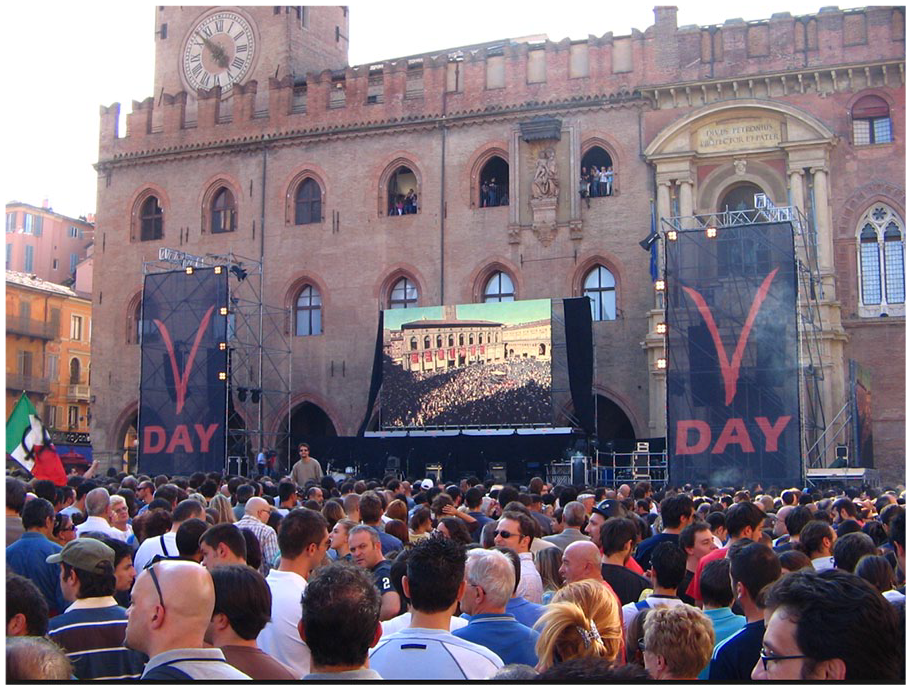
The V-day square.
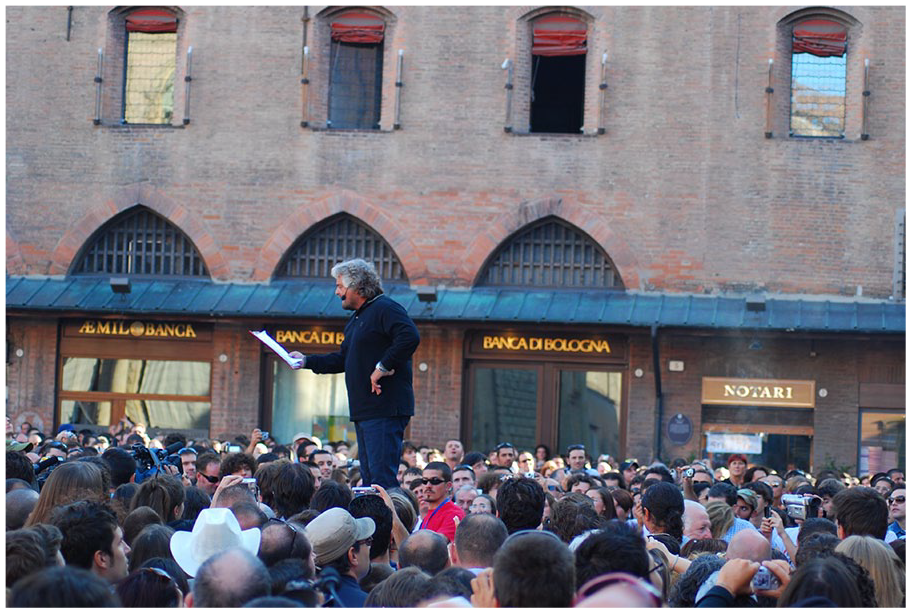
Grillo at the V-day.
In March 2018, about 10 years later, the M5S is the most voted party in the Italian national election (with around 32% of the votes), and eventually sits in the government forming a coalition with another party in June the same year. In this teaching case, we narrate the story of how it happened that a voluntary aggregation of people became an influential political party in charge of governing the eighth largest economy in the world, in less than 10 years. While so doing, we also illustrate how a mixture of emergent and purposeful use of digital technologies (both custom developed and general-purpose social media platforms including Facebook, Twitter, and YouTube) with organizational structures played a crucial role in the history and successes of the mobilization of the M5S.
There are several reasons why we find the M5S interesting. First, the M5S organizes almost all its activities online. While traditional parties are mostly concerned with how online activities may add value to their traditional way of conducting politics, the M5S is born online, altering and challenging the traditional way politics takes place. For its size and relevance in the political system, the M5S represents an important eParticipation initiative at the global scale. Hence, the exploration of the M5S case makes it possible to reflect on processes and structures through which digital technologies support the relationships among citizens, governments, and public organizations.
Second, the M5S represent a large online community (OC) introducing and designing different digital technologies needed to fulfil their needs. In OC, people sharing similar objectives use digital technologies to coordinate and cooperate, bypassing distance and time constraints. Throughout the case, we will focus on how the M5S organizes and uses digital technologies to help understanding opportunities and challenges digital technologies offer to OCs for information dissemination, people mobilization, and collective decision-making.
Third, the M5S represents a social movement that mobilizes people for changing the society they live in, offering a virtual space for subscribers and followers to share views and exchange knowledge to achieve common goods. We tell the story of the various steps the movement has gone through to demonstrate how social movement may come into existence through online activities for you to reflect on potential challenges and drawbacks the movement may face in the future.
In the chronological journey of the M5S, and of its use of digital technologies, described in this article, we encourage readers to stop and reflect on the consequences of the decisions being made, and speculate on what could eventually happen if the M5S would choose a different road ahead. We suggest a set of questions to keep in mind during the reading of the case:
What is the role of digital technologies throughout the various stages described?
How is the organizational structure and the use of digital technology intertwined?
What role exists in the various stages, and how does these roles develop from one stage to the next?
The M5S is a political party organization that is organizing (almost) all their activities online, what are the benefits and challenges of so doing?
How does the M5S represent a disruptive way of organizing a political party?
How do you think the experiences introduced here represent elements to be seen also by other political parties in the future?
What do you think are the key benefits and challenges of using digital technologies for the purpose of the M5S?
The goals and the background for the M5S
Before describing the experiences of how M5S developed, we would like to briefly introduce the motivation, goals, and the context. The main goal of the M5S was (and is) to strengthen the involvement of ordinary citizens in political decision-making processes. When initiated, the key argument was that the main establishment in Italy – including banks, newspapers, TVs, radio channels, and of course politicians –failed to care about ordinary citizens’ problems, whose stances were cut out from the political debate. Instead, they cared only about the élite (according to Grillo and his followers). Therefore, there was a need for a new political movement representing an alternative to what was already there. This represented the core motivation for initiating the M5S: directly include citizens into the political processes by the use of digital technologies, to allow everyone to participate in discussion, debate, and decision-making processes.
A core motivation was to reduce the influence of traditional mass media – which the M5S believes to be under the total control of the establishment – to inform the public political debate. The M5S resorts on social media and digital platforms to bypass traditional, supposedly biased and non-free, media by sharing information online. The sharing of freely accessible information online is linked with the idea of the M5S of acting transparently towards citizens. This is a cornerstone of the philosophy of the M5S and is still seen as one of the most significant differences compared to traditional parties. For instance, the M5S website allows visitors to view all the pay slips and expenses receipts of M5S parliamentarians, allowing citizens to see how their taxes are used.
From shouting into being: initiating the M5S
The birth of the M5S is the story of the efforts made by a charismatic and well-known front figure (Beppe Grillo) sided by a competent and visionary digital entrepreneur (Gianroberto Casaleggio). Grillo, a comedian who already reached the top of his popularity in the 80s, was banned from the public TV in 1986 due to political incorrectness. He continued his comedian activity outside TV channels and became a well-known voice criticizing the financial and political establishment. In 2005, he partnered with Gianroberto Casaleggio, who had the knowledge and the visions for how to exploit the opportunities of digital platforms to influence the public. As a result, Grillo launched a private blog in 2005, as a virtual forum to both disseminate his comedian activity and attract followers. Now, 4 years prior to the initiation of the M5S, the predecessor of the M5S OC was born.
At this stage, back in 2005, two important roles were present. The first one is represented by Beppe Grillo himself, representing the charismatic frontrunner, who in his posts and shows in theatres and squares mixed entertainment with harsh critiques on behaviours of politicians, banks, and large companies. The second key role involved was the followers, who listened, attended, read, commented, and disseminated posts through their personal online networks, feeding the online debates. Grillo’s blog was soon trusted by the followers as a source of information alternative to traditional media. Unlike everywhere else, according to these followers, economic and political topics were here debated from the perspectives of citizens. The blog was open for everyone and the political propositions were considered attractive, with the result that many citizens quickly joined the discussions. Rather quickly Grillo’s blog formed a large OC that continuously applauded and shared Grillo’s sharp, rude, and often witty comments, hammering the establishment to be corrupted, incompetent, greedy, selfish, and distant from real people problems. From the very beginning Grillo’s argument was clear: they (the élite) do not care about us (ordinary Italian citizens).
Grillo’s blog quickly became immensely popular. In 2009, the Forbes Magazine’s ranked him the seventh most influential web personality worldwide. But Grillo’s blog gained popularity not only due to his own posts, but more so for the fact that he allowed his followers to comment and to take active part in the online discourse.
Soon, a noticeable part of the followers turned into activists, organizing activities and local groups. To coordinate their actions and keep track of the groups being part of the OC, Grillo suggested everyone to use Meetup (www.meetup.com) as a supporting digital platform. Soon, ‘meetup’ became a synonym for local groups promoting local activism. Everybody being interested could now form a new group or join an existing one. While these groups formed the basis for the rise of the large OC, the coordination among them were only superficial at this stage, merely consisting of the official list of meetups groups hosted on Grillo’s blog.
Then, in September 2007, the ‘V-day’ gathered an unexpected large crowd, representing a historically important event and a milestone for what should later become the more formal political movement, the M5S. From this moment on, Grillo and his followers could no longer be ignored by existing political parties, the mass media, and other representatives for what is seen as the established elite. Fuelled by the success and the increased amount of meetup groups being established, a formal association named ‘Amici di Beppe Grillo’ (Friends of Beppe Grillo) was set up in 2008, initially coordinating the network of meetup groups across Italy. In the same year, the first groups decided to run for local elections, hence formally entering the Italian political landscape. While these initial attempts achieved only limited success, with only few seats gained in few local councils, the idea of entering the existing political institutions was born.
In search for a political influence for the movement and the followers, Grillo tried to join the Democratic Party (one of the major political parties at the time) in 2009. His objective was to run for the primary elections in which the party selected the leader to guide its action in the national parliament and other Italian and European institutions. The political agenda proposed by Grillo was the result of the discussions in the OC. What happened? The Democratic Party resisted and decided to block Grillo’s candidacy. Maybe the secretary of the Democratic Party at that time later on regretted the advice he gave to Grillo when his candidacy was rejected: ‘if you would like to do politics, go ahead and form your own political party, run for the elections, and let us see how many seats you will gain!’
In this first stage, the use of digital technologies consisted mainly on Grillo’s blog and the meetup groups officially mentioned in his blog. Most online activities were initiated by Grillo disseminating his posts at the blog, allowing the followers to comment and share the posts also through other social media channels. Local activities were organized by the meetup groups, to promote online discussions of matters of local interest.
The association ‘Amici di Beppe Grillo’ successfully gained attention in this first phase with a steady growth of followers and online activities. However, this success challenged the way activities were organized. The flat and predominately informal organizational structure, with only limited use of loosely connected digital technologies, provided very limited coordination opportunities among the groups. While some of the groups were quite successful within their local territories, the coordination mechanisms at the national level were quite ineffective, with redundant communication flows. Moreover, due to the success of the movement, the ambition changed. From aiming at being an open platform for open discussion and debate, Grillo’s followers now started to seek influence in the existing political systems and to run for elections. The ‘Amici di Beppe Grillo’ association found themselves in a need for a more formal structure, one that does not disperse the individual efforts and could more successfully capitalize at the national level the effort occurring in the local groups. The birth of the M5S was near.
Growing up: consolidating the M5S
In late 2009, ‘Amici di Beppe Grillo’ was replaced by the association named ‘Movimento 5 Stelle’ (Five Star Movement). This event marks the birth shift from an opinion movement orbiting around Grillo to a self-standing political movement that recognizes in Grillo his charismatic leader.
The movement was established by Grillo and Casaleggio as a legal entity with an official logo as a registered trademark, and with the motto ‘one is worth one’. The message was clear: every voice matters equally within the movement. The move from ‘Amici di Beppe Grillo’ to the M5S included the adoption of a formal regulation, encompassing few (only seven) short articles covering the following aspects:
The M5S is ‘not a party, but a platform for consultation and collaboration’.
The M5S is ‘a non-association’, regulated by a ‘non-statute’.
The movement has no physical infrastructure, since ‘the headquarter is the website of the movement’.
Internet should be used for consultation, deliberation, and election.
Behind these rules, there was an intent of offering egalitarian access to political debate to citizens, but also the idea to sharply distinguish from other political parties. M5S supporters and representatives will not describe the movement as a Party, and explicitly stated they will do never form coalitions with other parties.
At this stage, the movement launches an official online portal called movimento5stelle.it. The platform – managed by the technology provider company Casaleggio Associati – initially hosted the official regulation, the M5S political agenda, the official list of local meetup groups, and official open forums for discussion and debates. The local groups were invited to organize their local web presence as a subsection of the movimento5stelle.it portal and freely manage other digital technologies (as well as offline activities) at their own preferences, including online forums, and social media channels as Twitter and Facebook. Each local group was provided the freedom to set their own regulation for managing local activities and decision-making processes, and to define and manage roles within their groups. The digital channels were in general open for everybody to read and comment, not only for subscribers, but some subsections were restricted only to subscribers, or if addressed to a specific topic accessible only to those declaring their interest in the being discussed.
A set of new roles came in play at this stage. Grillo remains the owner of the M5S trademark while the Casaleggio Associati company runs the M5S’ portal and the related digital infrastructure. Subscription was now open to everybody: any Italian citizen older than 18, not member of other parties, and with a clean criminal record, may apply online to become a subscriber of the movement. The process is cost free and requires wannabe applicants to provide their personal details and ID card. Each application is verified by a staff through a lengthy process, at the end of which the applicant becomes a certified subscriber, being allowed to access also portal’s restricted areas, apply for becoming a candidate at elections, and vote during decision-making processes, such as for approving law proposals, internal rules, choosing candidates for elections, banishing members. The application process introduces a distinction among followers; certified subscribers, subscribers that applied online but are not yet certified by the staff (who do not have access to the restricted sections and cannot participate to the decision-making processes), and non-subscribers (everyone being interested) that have only access to information shared on the portal and the blog, or through the social media channels.
Few local groups participated in the local elections in 2010 and 2012, gaining some seats in local councils, and mayoral positions in a couple of medium-sized towns. In 2013, the M5S participated to the general election for the national parliament for its first time. The result was unexpectedly positive: the M5S became the second most voted party (very close to the first one) gaining about 25% of the votes. At this stage, the M5S had about 100,000 certified subscribers, with 700,000 more subscribers waiting for their application to be approved.
Despite not being part of the government, the M5S was now in the position to play an important role in national politics, which raised the immediate need for new rules and digital tools to cope with the new situation. The movement now issued a code of conduct that representatives elected using the M5S trademark must respect. The role of the M5S representatives in political institutions is different compared to traditional political parties. M5S representatives are intended as spokespersons, committed to report and vote in the councils, the statements and decision formed by the M5S OC through the official channels. Representatives shall always be able to reply to information requests coming from followers and have special access to the M5S online platforms. Before each election, every subscriber can run for being candidate as representative in a local or national council. The candidates are eventually decided internally by all M5S subscribers with online voting.
In the second half of 2013, the M5S released a custom-designed platform named the M5S Operating System, introducing two main features:
A voting tool for collective decision-making.
A tool (named Lex) for obtaining citizens feedback on parliamentarians’ law proposals.
The latter, Lex, supports a process that starts with a first draft of a law uploaded by a representative, who then solicits certified subscribers through other channels (like Facebook) to comment the proposal online. Certified subscribers can post comments for the representatives to read, comment on, respond to, and/or amend the original proposal. Subscribers are then called to approve the proposal through online voting, before the resulting proposal is submitted to the M5S representatives in the parliament.
The rapid development within very few years was seen as a success for an OC seeking political influence, but the success came with controversies. Already in 2012, some local representatives were banned from the movement, blamed not to be in line with the positions of the movement, and being more interested in their personal careers. By the end of 2013, Grillo announces through his blog that several representatives at the local and the national levels should be banned and no longer welcome to use the M5S trademark. They were expelled from the M5S Operating System and their user accounts were cancelled. This way of acting of Grillo and the movement was subject to a lot of criticism, both inside and outside the movement, and this asks for some revision of the internal rules. The M5S was now entering a turbulent face of internal re-organization, resulting in continuous calls for new rules and procedures.
From outsiders to decision-makers: stabilizing and controlling the M5S
By the end of 2014, the internal organization of the movement was a subject of discussion. While some subscribers publicly expressed their concerns about how the movement is organized and managed, several representatives voiced the need for a more structured organization as they struggle to face the more organized rival political parties.
As a response to an increasing number of disputes among representatives, Grillo and Casaleggio in 2015 created a Directorate formed by five prominent representatives to act as coordinators of the M5S. While this action was intended to improve the management of the M5S, it was not voted by supporters. As a result, several subscribers found this to be a violation of the foundational principle of equality among all members. Therefore, quite a large amount of the subscribers decided not to recognize and follow the decisions of the newly appointed members of this Directorate. In 2016 – almost a year after the Directorate was established – Grillo removed it due to its ineffectiveness. In the same year, the M5S was asked to change the statute of the association to comply with Italian laws that regulate political parties represented in the parliament. As an attempt to reply to this request, Grillo, Casaleggio, and two other persons set up a new association registered as a legal entity. The name of the association is similar to the name of the movement, but now the association brings a new and more detailed regulation, encompassing several aspects not present in the former Non-Statute. However, the new regulation was not approved through an online voting procedure, which again became a source for internal critique and debate.
The M5S now faced several judicial concerns. Representatives recently banished took the M5S and Grillo in person on trial. They claimed to have been excluded by an association they were not members of, on the basis of rules autonomously decided by Grillo and few others, not approved by the subscribers of the M5S. The judges often agreed with the claimants, with decisions made against the M5S. Once again the movement was forced to issue a new regulation, this time approved by votes among all certified subscribers. The new regulation is written to comply with Italian laws for political parties, including the rule that every subscriber has the opportunity to propose modifications of the regulation (if supported by 20% of subscribers), and a more structured procedure for the banishments of representatives, which now needs to be decided by a three-level process of appeal with specific commissions. The M5S trademark still remains a property of Grillo’s family. The online voting campaign for the new regulation stayed open for a month, with 87,000 votes casted (out of 135,000 certified subscribers), whereof 90% approved the new regulation. A new article (8) was then added to the Non-Statute to integrate the new regulation.
In April 2016, Casaleggio suddenly passed away and his son, Davide, took over his role in the Casaleggio Associati Ltd company. Few weeks later, the M5S released a new direct democracy platform named Rousseau, officially replacing the former Operating System, still in use nowadays. Rousseau has a more fashionable layout and new features, but still retains the Lex platform feature and voting systems as well as the same criterion for accessing the restricted area. At the time of this writing, the features within Rousseau include the following:
Three versions of Lex, for elaborating law proposals, respectively, for the local, national, and European levels;
Lex Iscritti, to allow subscribers to submit a law proposal to representatives (a feature long requested by subscribers);
E-learning, to support representatives, candidates and subscribers, providing some basic knowledge on how institutions work and how to behave when sitting in a council;
Scudo della Rete, a space to host requests and support for members sued for their activities in the movement;
Fundraising, a feature to collect contributions.
Two other features provided by Rousseau are specifically targeted to support activities within the local groups:
Call to action, intended to facilitate discussion and the organization of activities within each group;
Sharing, for national and local representatives to share any kind of documents within a space accessible only by subscribers.
With the next national election approaching in 2017, the M5S launched a campaign to select their candidate to run for the presidency of the ministry’s council if the movement wins the election. However, certified subscribers can only choose among a few candidates with only one of them being a well-known prominent representative and hence seen as a true candidate: Luigi Di Maio. The fact that a movement oriented towards direct democracy presents only one candidate was again a subject of criticism, both from inside and outside the movement. Another issue of debate concerned the fact that the elected candidate would also eventually be appointed as the formal political movement’s leader for next 5 years, which is a role not earlier being recognized (while somehow fulfilled by Grillo due to his charismatic leadership). This was seen by many as another violation of the basic principle of full equality among all members. In the online voting for deciding whom to become the new leader, only 35,700 subscribers cast their votes: a much lower participation-rate than during the vote for the new regulation some months back. Di Maio was appointed as the candidate and political leader of the movement, even though this role is not clearly defined.
The use of digital technologies within the M5S
In the presentation of the various phases above, we focused on the rapid development from the blog (in 2005), through the engagement of the crowd during the V-day (in 2007), and the advent of the Friends of Beppe Grillo (in 2008), prefiguring the launch of the M5S in 2009. From there, the movement quickly gained momentum by experiencing huge success within local and national elections. The joys of success came with the struggle of the managerial and organizational challenges, and the sorrows of the consequent tensions developing in the community.
Next to evolution of the movement, it is interesting to reflect on the use of digital technologies within the different phases, and how the use of such technologies is shaped and shapes the activities within the M5S. The M5S incorporates different technologies, including tools like blogs, discussion boards, video streaming, and online polling. Especially in the early phases, popular social-networking platforms like Facebook, YouTube, and Twitter are of critical importance. Later on, participation platforms, such as the ‘M5S Operating System’ and Rousseau, are developed internally to include features that support interaction among citizens and the organization’s subscribers. Some M5S tools are for specialized uses: that is, the official movimento5stelle.it website. Others have instead partially overlapping purposes: that is, the local sections of the official website and the corresponding regional websites host similar content. As a result, the M5 provides multiple access points for some services and single access point for others. Layouts and graphics vary, and similarities among different platforms can be limited to the M5S logo and a few other links.
Tools related to the national level, including the websites beppegrillo.it and movimento5stelle.it, the official M5S streaming channel, LaCosa, and the M5S operating system are all run by a single company: the Casaleggio Associati Ltd. These are the official platforms for political statements, and they host decision-making processes at the national level. They are managed by M5S staff members and are designed to support extensive deliberation, including polls for voting on decisions and for choosing candidates for elections, as well as an interface for creating and proposing laws in cooperation with other citizens that uses a structured, step-by-step process. At the local level, groups and representatives freely adopt tools without any clear guidance from the M5S. Every group may choose and change its online services dynamically and make its own rules on these tools’ use. Table 1 provides an overview of the digital technologies being used by the M5S along years.
Digital technologies used by M5S along years.
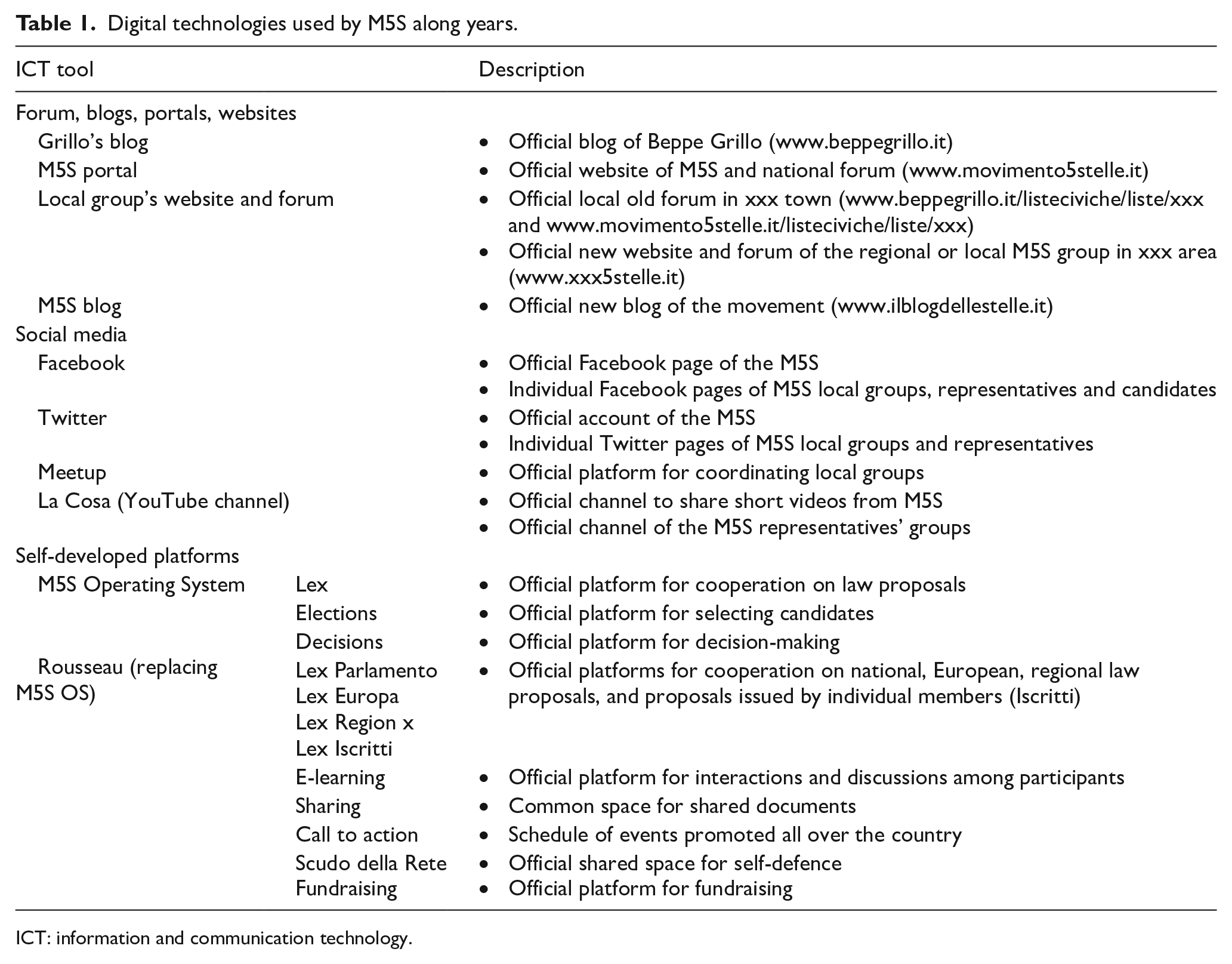
ICT: information and communication technology.
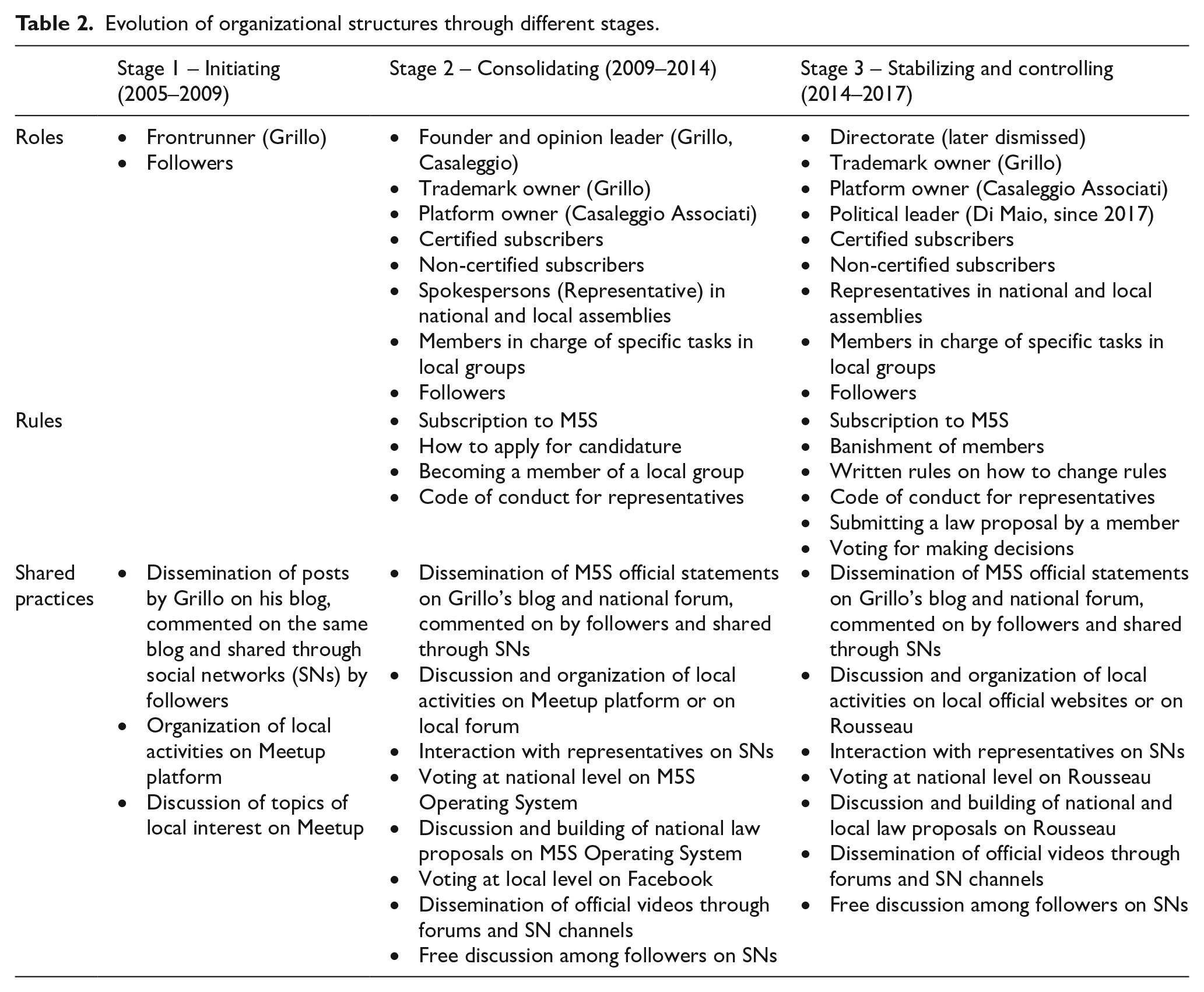
Not only the use of digital technologies, but also the organizational structures changes from one phase to the next. While the community grows, several new roles enter the scene, moving from a situation dominated by Grillo himself and his supporters in the first phase, to include formalized roles such as platform owners, subscribers, representatives, and members with specific responsibilities in the latter phases. At the early phases with only limited technologies and roles being present, the regulations were less important. Rules appeared alongside the more formal organizing adopted later on, first in the consolidating phase and even more in the stabilizing phase.
The growing complexity requires the MS5 to come up with rules on how to admit new members (how to subscribe), how to apply to become a representative for the movement, and procedures for developing new proposals and voting mechanisms for decisions to be made within the movement. Finally, the practices and activities within the movement become more complex from one phase to the next, when the movement transforms from a protest organization outside the traditional political systems to a de facto political party represented in the Italian parliament. What starts up with the dissemination of Grillo’s ideas on his blog for followers to comment on, moves towards a system of shared practices needed within a major political party. Table 2 summarizes the roles, rules, and shared practices related to the three stages discussed above.
Evolution of organizational structures through different stages.
What has been achieved by the M5S?
The M5S’ main objective is to offer citizens direct involvement in politics, through online, the decision-making process, from agenda setting to policy evaluation. The M5S demonstrates that numerous people are willing to play an active role in politics if they are allowed to do so through purposefully designed services, as long as their ideas are carefully considered by their representatives. Not only is the number of M5S subscribers rather substantial, but these subscribers also actively participate, with an average of 30,000–40,000 subscribers participating in important online discussions. Participation takes place both online and offline, and follows different steps at the national and local levels.
A main challenge the M5S has faced throughout their various phases is the problem of organizing, resulting from the movement’s fast growth in terms of subscribers, local groups, and online activities. Combined with the limited amount of administrative support available (due to the organization’s small staff), this makes representatives’ work difficult, slowing them down and diminishing what they can accomplish, with the result of them becoming less effective than expected. Representatives face another challenge deriving from the differences between processes and ways of operating within the OC of M5S and the external environment in which they operate. Originally, they have to ask the community to make all decisions through the platform, but it is rather evident that the timing for discussing and voting laws in the Parliament (from minutes to some hour) is incompatible with that for organizing an online voting, alerting subscribers and providing decent time for them to cast their votes (at least a couple of days).
The M5S continuously strive to find the right balance between the benefits of an open contribution, inviting everyone into the political process, and the risk of involving malicious users who are there to interfere or jeopardize the discussion along the collective decision-making process. Therefore, there is a need to find ways to prevent trolling and poor-quality contributions from dominating the online discourse. Another issue is the possible content overload: the huge volume of online postings on forums and blogs. These are open to everybody and organized only through a simple hierarchical structure with few, wide categories – making it difficult for participants to follow discussions, and to identify the more valuable contributions. Subscribers and followers face difficulties in reviewing discussions on the M5S blog, where a single page holds thousands of posts. Actually, a huge number of contents posted stay unexploited, since their amount and their variety of contents mixed together make them difficult to find and manage.
The Lex system is a tool that harnesses citizens’ active roles in the co-production of contents, such that M5S-certified subscribers can propose the texts for new laws following a specifically designed process. The Lex system exemplifies how difficult it is to incorporate direct citizen input into political processes, as average citizens often lack contextual and procedural knowledge. The issues deriving from a high level of participation are challenging for representatives managing law proposals’ process on the platforms. Representatives have to make sense of a large number of comments and suggestions collected through the online process within a very limited amount of time, with many posts being composed only of messages of appreciation or protest. Therefore, the M5S wishes to provide digital tools capable of meaningfully aggregating messages from large volumes of online contents, in order to profit from the collective intelligence of the masses of participants. The endemic problem of designing platforms that prevent information overload and differentiate meaningful content from unhelpful posts are issues that remain unsolved.
M5S subscribers do report difficulties in actually participating because of their lack of technical, legal, and political expertise in the issues being discussed, which indicates the need for technical and organizational solutions that empower citizens with regard to these aspects. The M5S provides information directly through the organization’s blog, to avoid mediated sources of mainstream publication. The lack of trust in the political and mass media is an important motivation for people to support M5S, arguing for the need for more directly engaging citizens in political processes.
The role of the representatives changes. First and foremost, such representatives are spokespersons on behalf of equally important participants. Second, the representatives are seen as ombudsmen, responsible for representing a transparent, unmediated flow of information between political movements and the followers. Indeed, the exploitation of Internet technologies, as undertaken by the M5S to avoid traditional intermediaries, offers political parties and movements the ability to communicate more directly with citizens.
The M5S explicitly states its desire to influence other political parties and movements as well. Through its use of participants’ needs and for raising concerns that reflect everyone’s needs. Finally, the influence of each representative may be reduced, due to the fact that they are committed to vote in accordance with the opinion of the majority of subscribers. The M5S’ new definition of roles resonates with the ideals of direct democracy and focuses on transferring power from traditional institutions to network-based groups of individuals. There is a strong belief among M5S followers that the organization is not only transferring power within the M5S, but may also influence political parties in general. One of the organization’s primary objectives is therefore to develop eParticipation tools for direct democracy to be offered to other parties.
A final aspect worth mentioning concerns the increasing complexity of the participation activities practised within the M5S. The number of members and contributions continues to grow, and online activities are consequently becoming more complex. After some followers demanded improved transparency concerning internal rules and roles in the M5S (including Grillo’s and Casaleggio’s roles), the movement responded with the appointment of a board of five representatives with the power to make decisions for the whole movement. Such aspects are currently being discussed; whereas some find it necessary to constantly improve organizational structures, others think doing so is a potential violation of the organization’s core philosophy that all M5S subscribers are peers and representatives should only deliver the decisions of citizens directly to the institutions to which they are elected.
The current challenges faced by the M5S
At the time of writing, August 2019, M5S representatives have been part of the government for some more than a year, in a coalition with the Lega party (who participated to elections within another coalition). The two parties have different opinions on several issues, and signed a deal involving an agenda of points promoted by one side and admitted by the allied. Di Maio – as political leader of the M5S – was the Deputy Prime Minister of the government and Ministry of Economic development, Labour, and Social Policies. After a year with conflict between the two allied parties, the government has recently resigned. M5S now seems to form an alliance with the Democratic Party to form a new government. The situation changes from one day to the next, so there is only one advice for knowing what will happen; stay tuned!
According to the latest M5S regulation, parliamentarians elected in 2018 not only abide by the code of conduct but sign a contract in which they formally agree to respect the direction set by the political leader in their political activity, and financially support the Rousseau platform donating a small amount of money from their parliamentarian income. This is a matter of internal tension as many parliamentarians feel they are locked into the line of actions dictated from the top and cannot act for the stances of the local territories. The prospected fear is to become again distant from the people, even if they are directly involved through digital technologies.
Another challenge is the decline of participants in online voting on the Rousseau platform concerning political issues and the selection of candidates. Several possible explanations are discussed, including the presence of a leader making most decisions on his own, decreasing the subscribers’ feeling of being influential, the lack of novelty (the M5S is becoming more similar to other parties), and difficulties in following themes complex in terms of specific or procedural technicalities.
The Rousseau platform has its troubles too. The main eParticipation platform of the movement was the target of a set of cyber attacks in the summer of 2017. Attackers publicly affirmed to be able to manipulate contents in the digital platform and allege manipulation of votes. To publicly prove the platform was vulnerable, an attacker releases fragments of personal data – including the mobile phone number of Di Maio and other key members and the password of some users – and advertised the sales of the result of a large data breach on the dark web. The data breach was investigated by the Italian independent privacy authority which, in April 2019, sued the Rousseau Association for €50,000 for the violation of GDPR (General Data Protection Regulation) regulations.
The representativeness of the M5S is continuously questioned by comparing the participants at each online voting to electors at national elections. Although the movement showed to be able to mobilize up to 80,000 active citizens online, critics will argue that these numbers are rather small in a country with 60 million inhabitants and 50 million voters.
Representatives of other parties frequently criticize the behaviours and practices within the movement for not being consistent. For instance, the M5S adopted and eventually abandoned the streaming of internal meetings, arguing that this practice may be misused by opponents who get to know their strategies. Hence, their claim for a full transparency is questioned. The practice of transparently declaring how they spend money for reimbursement also turns into a double-edged sword. First, they are blamed for how they are using the money. Second, not all parliamentarians promptly disclose their expenses data, arguing that the process is too complex and time-consuming, reducing their time for more important political activities.
Being part of the government, the M5S representatives are forced to take part in the discussion on newspapers and on TV, despite the fact that criticizing traditional media channels has always been a core issue within the movement. Grillo moves a step aside and he is no longer as influential as he used to be in the past. The front runner role is played by Di Maio. People still continue to attend social media and produce contents. While on the official platforms, the activities involve the usual number of people, social media channels are fervent. Other people, followers of rival parties, are also active on social media, and contrast the framing of the M5S stances, debunk, run hashtag wars, or mobilize other people to answer to polls opened by M5S representatives. The results are sometimes unexpected, with highly attended votes on social media polls on M5S representatives’ profiles where the result is totally opposite to the representative and M5S political opinion. On these open channels, it is now very difficult to distinguish friends from enemies.
What was intended to be a trustable and impartial source of information – the official M5S blog and its social media channels – is now presented to the public opinion as a fake news factory. An experiment of direct democracy is presented as just a networking mobilization strategy that pushed unexperienced representatives in relevant positions in the institutions of one of the G8 countries. Indeed, in the past, M5S social media channels, freely open to everybody, became also an arena for debates over disputable topics from the conspiracy theories, and anti-scientific opinion movements, such as No Vax and Free Vax. Under another perspective, the M5S channels gather large opinion movements against controversial public infrastructures projects, such as the No TAV (against the high-speed train connection in construction between the cities of Torino and Lyon), or No TAP (against the gas pipe infrastructure in construction in the Puglia region). Now, being part of the government, the movement struggles to respect these promises, since the other party in the coalition does not share the same view. As a result, some of the political battles that brought them power during the electoral campaign of 2017, proves to be difficult since they are not able to follow up as members of the government in the years after. For instance, they promise to promote a final solution to the case of a highly polluting steel manufacturing plant in Taranto (Puglia region) but so far, they did not succeed, and pollution continues. Actually, they eventually agree to the construction of the gas pipeline (in Puglia), an investigation that they strongly argued against during the electoral campaign. Therefore, resentments and frustration of followers circulate on M5S digital channels. For the first time, words such as ‘traitors’ and ‘betrayal’ are used in the OC by those who appear to be disappointed M5S supporters against the movement and its representatives.
What can be learned from the project, and how can similar projects proceed in the future?
We have here told the story of the birth and growth of the M5S. We have followed the movement through three main phases, focusing on digital technologies and how they organize their actions. As a movement being born online, this story relates to the research strand of eParticipation, exemplifying the processes and structures through which digital technologies support the relationships among citizens, governments, and public organizations. Furthermore, it tells the story of how an OC introduces digital technology to be able to conduct its activities, and finally how digital technologies are used by a social movement, Third, the M5S represents a social movement, demonstrating how digital technologies may offers virtual spaces for members of such movement on where to share views and exchange knowledge to achieve common goods. Now, after reading the story, we suggest to reflect on issues such as the following:
How can digital technologies foster development within social movement and online communities?
How did the organizational structure and the use of digital technologies change to address the challenges in the three phases introduced?
How to describe the rise of the social movement by the story told here, and what were the consequences of the decisions made?
What are the main differences between the ways of operating, the behaviours, the rules adopted within an OC and those of the external institutional environment?
What are the consequences of changes related to the external context on how the movement was organized and in their use of digital technologies?
What is the role of Beppe Grillo, and what are the pros and cons by his presence within the movement?
How would you describe the complexity of the movement, concerning the number of stakeholders, use of digital technologies, and the organizational structure?
What are the consequences of the social movement being born online, with only a very limited physical organization structure? What are the benefits and challenges for such a social movement, compared to more traditional social movements?
How digital technologies may represent a disruptive element within an organizational structure? How the M5S challenges the traditional way of organizing and forming political parties and political discussions?
What are the expected and unexpected results of the use of digital technologies to involve citizens in political decision-making processes?
What are the key challenges by introducing digital technologies the way it is done here?
Explore how the movement’s use of common, largely adopted technologies (such as blogs, forums, Meetup, Facebook, and Twitter) in the initiation of the M5S, later on are supplemented by custom-designed digital technologies (like the M5S OS) to be able to support the needs and the purposes.
Footnotes
Declaration of conflicting interests
The author(s) declared no potential conflicts of interest with respect to the research, authorship, and/or publication of this article.
Funding
The author(s) received no financial support for the research, authorship, and/or publication of this article.
