



Abstract
In this article, I begin with a conception of the urban as co-constituted and relational. However, I argue that relations are not intrinsically positive, and it is vital to name the centrality of relational harm in conceiving of crisis urbanism. Through this naming, it becomes possible to advance a clearer conception of reparative urbanism as a project laboring towards relational repair as life-affirming. In searching for openings for reparative circuits, I argue that sites of violence are equally sites of liberation. Ultimately, it is vital to attend to grounded enduring practices that work to seed and reconfigure new subjectivities and institutions over time. As scholars, we should pay attention to and support these labors, understanding them as uncertain, emergent, patchy, vital, and experimental.
Introduction: Locating crisis within relational harm
In a recent paper published in this journal, Beveridge et al. (2025) argue that the current advance of global crises necessitates new thinking on how the urban intersects with intertwined poly and permacrises. They develop four overlapping modalities for theorizing these intersections – naming them chrono-politics, spatial-politics, statal-politics, and epistemological-politics – and argue that the current moment is best understood as a crisis urbanism conjuncture. Finally, they proceed to mobilize crisis urbanism as object and method to support a reflection on the prospects of a transformative reparative politics. In this commentary, I understand their relational lens as a significant ontological and political move in keeping the future open. However, I argue for the necessity of locating readings of crisis urbanism within a system of relational harm. It is only through this naming that it becomes possible to advance a notion of reparative urbanism as a project laboring towards relational repair as life-affirming. I am guided by the visual below throughout (Figure 1).
The significance of a relational ontology is that it places an emphasis on becoming, thereby centering the recognition that world-making can move in any direction, towards a multitude of differing modalities of both crisis and repair. Pointing to the radical interdependence of all things and conceiving of the future as open, rather than foreclosed. However, it is vital to avoid an easy slippage into thinking of relations as necessarily positive forms of kinship and connection. In the current conjuncture, relations are experienced as structurally violent and divisive, carving up human and more than human life, and advancing an accumulation of difference, hierarchies, and divisions. As a relation that is anti-relational (Escobar et al., 2024: 4). Hence, whilst the four crisis modalities offered by Beveridge et al. (2025) are useful in emphasizing the enduring character of an urban crisis conjuncture (11), it remains vital to locate this condition within a system that has been built on structural logics of relational harm.
This work of naming and locating opens our ability to recognize the centrality of injury (Lewis, 2024: 3) in conceiving of crisis. For their part, LaDuke and Cowen (2020) name this logic the Wiindigo economy, invoking the cannibal monster of Anishinaabe legend. Similarly, Fraser (2023) conceives of the contemporary order of racial capitalism and settler coloniality 1 as a cannibalistic project of violence on relations, where life and ecology are treated as both disposable and indispensable. Thereby resulting in the erosion of its own conditions of possibility, related crises, and boundary struggles to remake relations otherwise.
The significance of locating crisis modalities within logics of relational harm is to bring into view the multi-scalar violence of a project that works to reorganize human and more-than-human relations towards extraction, enclosure, and differentiated hierarchies of disposability (e.g. Eidelman and Safransky, 2021; Federici, 2004). This argument aligns with Fanon (1952) notion of “zone of nonbeing,” best understood as a dialectic between being and nonbeing of the Black subject. As well as Sylvia Wynter's (1995) argument that humans are hybrid beings, composed of biology and narrative. In the current conjuncture, the very conception of what it means to be human is at stake, countering the dominant idea of man as homo economicus. At the same time, this reading suggests the potentiality to craft other relations of being and becoming human in common, where ‘despite the severity of the situation, the future is not foreclosed. We have agency, and life is magical … The question is how to move off the scorched path’ (LaDuke and Cowen, 2020: 44).
Towards an ecology of relational repair
In reflecting on an ethos needed to move off this scorched path, Beveridge et al. (2025) point to a growing concern for repair and reparative practice, as a political and socio-material disposition foregrounding healing and care to repair the fabric of urban life (11). This is a rapidly expanding scholarly field (e.g., Boudreau, 2022; Carr, 2022; Corwin and Gidwani, 2025; García-Lamarca, 2025; McElvain and de Coss-Corzo, 2025), making a comprehensive review impossible. Rather, I focus more narrowly here on scholars who seek to bridge socio-material repair, care, and reparations, in advancing a reparative framework, including the work of Lewis (2024), Safransky (2021), and related efforts I have contributed to with collaborators (Blatman et al., 2025; Cirolia et al., 2021; Millington et al., 2026; Nkula-Wenz & Scheba, 2025; Scheba & Millington, 2023; Scheba et al., 2024).
Lewis (2024) situates the growing call for reparations within a reparative conjunctural frame, where the current conjuncture is read as a moment of reckoning with the foundational features of racial capitalism and settler colonialism. In response, he argues that ‘the injuries that result from these processes must be responded to through a project of relational repair’ (ibid. 4). This is an argument for a far more expansive conception of reparations as more than a calculated transaction, towards an ecology of relational repair that is life-affirming.
Similarly, informed by abolition geography, Safransky (2021) offers a rethinking of reparations as the reconstruction of society, concerned to unsettle coloniality and advance liberatory futures (292). Finally, in collaborative work, I have contributed to efforts to conceive of reparative urbanism by bridging reparations 2 , material and affective repair, and collective care. This is an argument for future-making interventions that simultaneously labor against infrastructural disrepair and the disposability of racialized lives.
By situating repair at the level of relations, the significance and common thread across these projects is in advancing a framework of reparative urbanism that works to unsettle coloniality, is life-affirming, and takes form through the grounded labor of remaking infrastructural and socio-ecological relations. In other words, as an ecology of relational repair (Lewis, 2024), this references a reconstitution of human(ity) and more-than-human relations towards life-affirming and liberatory futures, through the reconfiguration of structures, infrastructures and social relations.
But how and where can reparative urbanism take place?
Conclusion: Reconfiguring relations for liberation
To begin with, moments of rupture may be significant in revealing all social orders as contingent, with no essential ground upon which they rest, suggesting the possibility of radical change (Swyngedouw, 2014). However, what happens after these spectacular moments? Breakdowns in the system create openings for differing modalities of repair practices to emerge. However, these may be regressive or transformative, either intervening to maintain the status quo or to reimagine and remake broken worlds. It is the latter which opens towards new reparative circuits that are ameliorative of harm and potentially enable new materialities, socio-political practices, and careful relations of being in common to take root and grow. They may be fleeting, partial, patchy, or precarious, yet they enable life within death-dealing systems and seed alternative relational logics.
In reflecting on the question of how and where reparative urbanism can take place, my contention is that sites of violence are equally sites of liberation, including the body, land, infrastructure, the relational state, and care relations. Returning to the work of LaDuke and Cowen (2020), infrastructure as a site and social relation is powerfully illustrative of this argument. They note, ‘infrastructure is how sociality extends itself; it is how life is provisioned or curtailed’ (264). Under racial capitalism and settler coloniality, infrastructure has been a central tool in the advancement of ecologies of harm. Yet physical and affective infrastructures are not inherently violent but equally essential for transformation through the appropriation and remaking of infrastructure in support of planetary survival.
This argument is echoed by scholars working across other key sites of relational struggle, concerned with the dialectic between violence and repair, including those focused on fugitive bodies (e.g., Lesutis and Kaika, 2024; Stokes and De Coss-Corzo, 2023), the abolition of private property & land dispossession (Bhandar, 2018; Bledsoe and Wright, 2019; Blomley, 2016; Safransky, 2022), and the state as a terrain of struggle (e.g., Angel and Loftus, 2019; Gilmore, 2022; Hamlin, 2023). Ultimately, crisis urbanism is not a closed loop, and infrastructures, institutions, and relations can be made otherwise. As scholars, we should gather, name, and support labors of enduring and making new subjectivities and institutions over time. These practices may only be fragments and glimmers of life repaired, but are vital sites where communities practice joy, rest, love, design, planning, imagination and creating (Lewis, 2024), advancing a myriad of situated experiments to bring a different world into being.
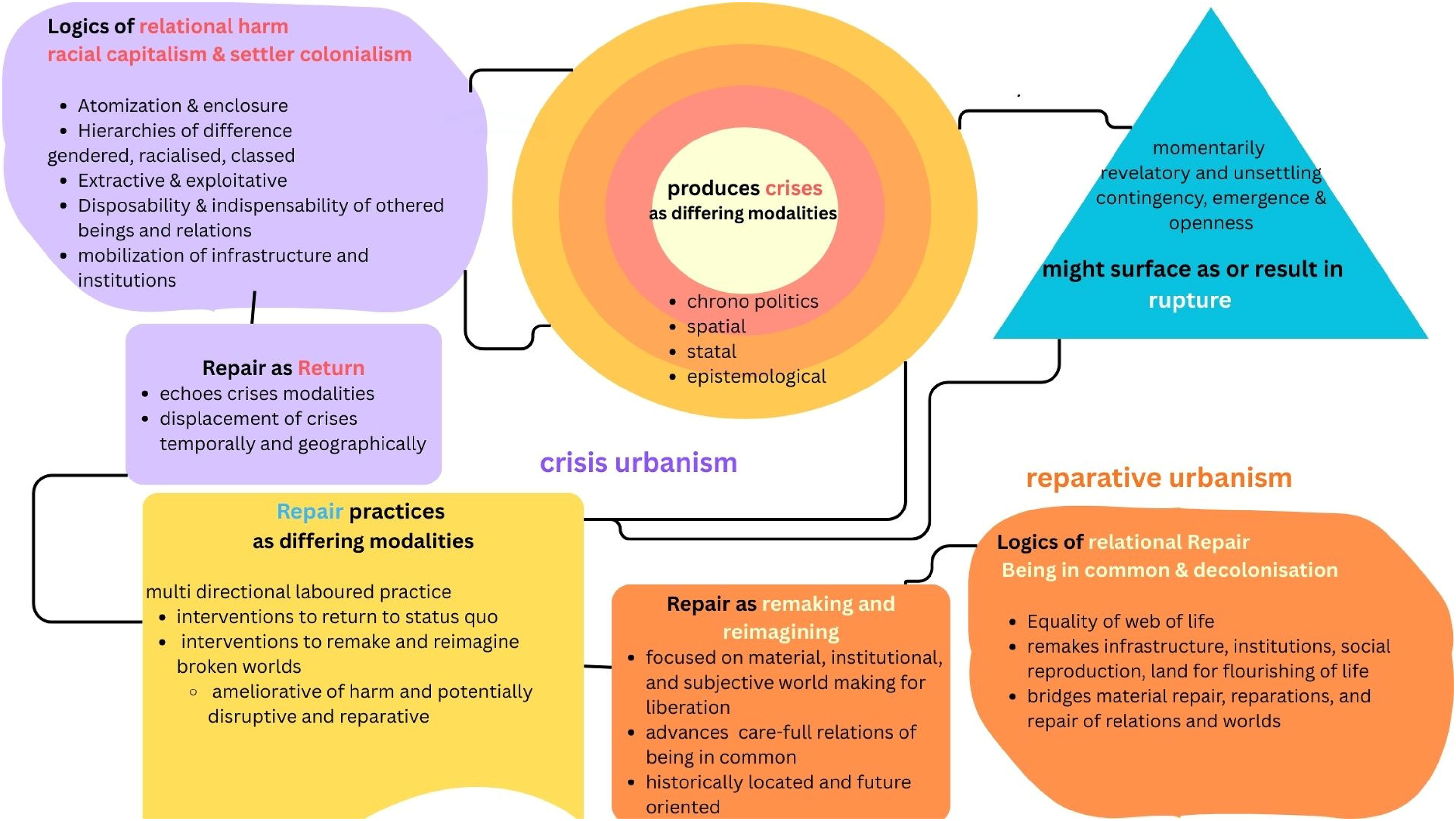
Rewiring the circuits of relational harm towards relational repair.
Footnotes
Acknowledgements
The author would like to thank my academic collaborators who have contributed to my thinking in this commentary. This includes colleagues mentioned in the citations and others from the African Centre for Cities, Human Sciences Research Council, and Indian Institute for Human Settlements. Finally, the author is especially grateful to my comrades and collaborators and the Cissie Gool House building occupation, who have greatly influenced my thinking, as they do the daily work of reconfiguring the circuits of relational harm towards relational repair.

Funding
The author received no financial support for the research, authorship, and/or publication of this article.
Declaration of conflicting interests
The author declared no potential conflicts of interest with respect to the research, authorship, and/or publication of this article.